EP3578451A2 - Dispositif de réglage pour une bicyclette et procédé de commande ou de réglage d'un tel dispositif de réglage - Google Patents
Dispositif de réglage pour une bicyclette et procédé de commande ou de réglage d'un tel dispositif de réglage Download PDFInfo
- Publication number
- EP3578451A2 EP3578451A2 EP19000233.7A EP19000233A EP3578451A2 EP 3578451 A2 EP3578451 A2 EP 3578451A2 EP 19000233 A EP19000233 A EP 19000233A EP 3578451 A2 EP3578451 A2 EP 3578451A2
- Authority
- EP
- European Patent Office
- Prior art keywords
- shift
- gear
- switching
- drive
- adjusting device
- Prior art date
- Legal status (The legal status is an assumption and is not a legal conclusion. Google has not performed a legal analysis and makes no representation as to the accuracy of the status listed.)
- Granted
Links
Images








Classifications
-
- B—PERFORMING OPERATIONS; TRANSPORTING
- B62—LAND VEHICLES FOR TRAVELLING OTHERWISE THAN ON RAILS
- B62M—RIDER PROPULSION OF WHEELED VEHICLES OR SLEDGES; POWERED PROPULSION OF SLEDGES OR SINGLE-TRACK CYCLES; TRANSMISSIONS SPECIALLY ADAPTED FOR SUCH VEHICLES
- B62M9/00—Transmissions characterised by use of an endless chain, belt, or the like
- B62M9/04—Transmissions characterised by use of an endless chain, belt, or the like of changeable ratio
- B62M9/06—Transmissions characterised by use of an endless chain, belt, or the like of changeable ratio using a single chain, belt, or the like
- B62M9/10—Transmissions characterised by use of an endless chain, belt, or the like of changeable ratio using a single chain, belt, or the like involving different-sized wheels, e.g. rear sprocket chain wheels selectively engaged by the chain, belt, or the like
- B62M9/12—Transmissions characterised by use of an endless chain, belt, or the like of changeable ratio using a single chain, belt, or the like involving different-sized wheels, e.g. rear sprocket chain wheels selectively engaged by the chain, belt, or the like the chain, belt, or the like being laterally shiftable, e.g. using a rear derailleur
- B62M9/121—Rear derailleurs
- B62M9/122—Rear derailleurs electrically or fluid actuated; Controls thereof
-
- B—PERFORMING OPERATIONS; TRANSPORTING
- B62—LAND VEHICLES FOR TRAVELLING OTHERWISE THAN ON RAILS
- B62M—RIDER PROPULSION OF WHEELED VEHICLES OR SLEDGES; POWERED PROPULSION OF SLEDGES OR SINGLE-TRACK CYCLES; TRANSMISSIONS SPECIALLY ADAPTED FOR SUCH VEHICLES
- B62M25/00—Actuators for gearing speed-change mechanisms specially adapted for cycles
- B62M25/08—Actuators for gearing speed-change mechanisms specially adapted for cycles with electrical or fluid transmitting systems
-
- B—PERFORMING OPERATIONS; TRANSPORTING
- B62—LAND VEHICLES FOR TRAVELLING OTHERWISE THAN ON RAILS
- B62M—RIDER PROPULSION OF WHEELED VEHICLES OR SLEDGES; POWERED PROPULSION OF SLEDGES OR SINGLE-TRACK CYCLES; TRANSMISSIONS SPECIALLY ADAPTED FOR SUCH VEHICLES
- B62M9/00—Transmissions characterised by use of an endless chain, belt, or the like
- B62M9/04—Transmissions characterised by use of an endless chain, belt, or the like of changeable ratio
- B62M9/06—Transmissions characterised by use of an endless chain, belt, or the like of changeable ratio using a single chain, belt, or the like
- B62M9/10—Transmissions characterised by use of an endless chain, belt, or the like of changeable ratio using a single chain, belt, or the like involving different-sized wheels, e.g. rear sprocket chain wheels selectively engaged by the chain, belt, or the like
- B62M9/12—Transmissions characterised by use of an endless chain, belt, or the like of changeable ratio using a single chain, belt, or the like involving different-sized wheels, e.g. rear sprocket chain wheels selectively engaged by the chain, belt, or the like the chain, belt, or the like being laterally shiftable, e.g. using a rear derailleur
- B62M9/121—Rear derailleurs
- B62M9/123—Rear derailleurs changing gears automatically
Definitions
- the present invention relates to adjusting devices for bicycles, methods for controlling adjusting devices for bicycles and methods for adjusting such adjusting devices.
- An electromechanical adjusting device for a bicycle in the form of an electric derailleur is for example from the US 2015/0111675 A1 and comprises an element to be fastened to the bicycle frame, a movable element for this purpose and an electromechanical drive which moves the movable element with respect to the stationary element in order to set a desired switching step.
- the electromechanical drive is operated by a motor gear arrangement which reduces the rotation of an electric motor and provides on a transmission output shaft for moving the movable element.
- a position detection device is provided which determines the rotational position of a position sensing wheel meshing with the transmission output shaft in the form of an electromagnetic rotation sensor.
- the position sensing wheel is additionally engaged with a tensioning wheel which is continuously biased in a rotational direction by a torsion spring. Regardless of a direction of rotation of the transmission output shaft thus the position sensing wheel is always in abutting contact with the same tooth flanks.
- a disadvantage of this construction is that the force of the torsion spring depends on the rotational position of the tensioning wheel and the clamping force designed for optimum operation acts only at a specific angle of rotation or over a small rotational angle range. At the beginning and at the end of the rotation angle range, on the other hand, the tension force of the torsion spring is either too low, so that the clearance reduction is no longer reliably ensured, or is too high, so that the torsion spring influences the output torque of the transmission too much.
- Another electromechanical actuator is from the DE 42 12 320 A1 known.
- This adjusting device also comprises a fixed element to be fastened to the bicycle frame, a movable element with respect to the stationary element and an electromechanical drive which provides driving force for a movement of the movable element.
- the adjusting device is part of an electromechanical derailleur for setting different switching stages of a derailleur.
- the known actuating device is adapted to detect such a blockage and to interrupt the motor current.
- an overload clutch can also be used, which interrupts the power flow from the motor to the movable element when a predetermined overload torque is exceeded at the overload clutch.
- the from the DE 42 12 320 A1 known electromechanical adjusting device also has a trim function for setting and readjusting the alignment between the rear derailleur and sprocket set.
- a trim function for setting and readjusting the alignment between the rear derailleur and sprocket set.
- the trimming function of the known control device allows the shifting of the shift positions by a certain amount of trim to compensate for manufacturing tolerances of the derailleur or deviations between different frame models and different sprocket sets.
- the known setting device thus realizes the same trim function, as it is already known from purely mechanical switching gears by adjusting a length of the switching cable.
- Another difficulty in setting the shift positions by the conventional trim function arises with an increase in the number of shift stages corresponding to an increase in the number of pinions in the sprocket set, for example, an increase in the number of sprockets of conventionally about five to seven to ten or more, for example twelve Pinion.
- a corresponding axial enlargement of the sprocket set and thus the distance between the lowest shift position and the highest shift position leads in the lowest or highest shift positions to a particularly strong skew of the chain between the front sprocket and sprocket set.
- the skewing of the chain exerts a force in the axial direction on the chain guide wheels of the derailleur and thus claims the rear derailleur in a direction which counteracts a precise adjustment of the shift positions. Due to these forces, the rear derailleur thus does not reach the desired setpoint positions in the highest or lowest shift stages, and as a consequence, an unclean chain run, unclean shifting, running noise in these shift stages and possibly even unintentional shifting occur.
- a first object of the invention is to provide an adjusting device for a bicycle, which comprises an electromechanical drive with a motor and a transmission, whereby a particularly precise and reliable operation is made possible by an increased positional accuracy between the elements of the drive.
- an adjusting device for a bicycle comprising a fixed element which is stationary with respect to a bicycle frame, a movable element which is movable with respect to the stationary element electromechanical drive providing driving force for movement of the movable member, the electromechanical drive comprising a motor and a transmission driven by the engine, the transmission comprising a first gear and a second gear meshing with the first gear.
- Gear, wherein the second gear comprises two part gears each having the same number of teeth, which are both simultaneously engaged with the first gear, said part wheels are rotatable about the same axis of rotation and are biased by a force in the rotational direction about the axis of rotation relative to each other.
- gear wheels are preferably gear wheels. However, individual gear wheels could also perform without meshing, for example by frictional engagement, the functions described herein, so that even such untoothed wheels are considered as gears.
- the second gear thus has two sub-wheels of the same number of teeth, which are biased to each other and at the same time are in engagement with the first gear.
- the teeth of the two partial gears which are currently in engagement with the first gear wheel are pressed by the force in the direction of opposite tooth flanks of the first gear wheel and rest there without play. Regardless of the direction of rotation of the first gear, therefore, the teeth of the two sub-wheels are always biased without play into engagement with the respective tooth flanks of the first gear.
- an accuracy of the rotational position of the second gear can be increased independently of the rotational position of the first gear.
- the force between the two partial wheels can be generated by a force generating device, which is functionally arranged between the two partial wheels, so that it is supported on the one hand on a first part of the two partial wheels and on the other hand supported on a second part of the two partial wheels.
- the force-generating device may in particular be an elastic device, for example a torsion spring.
- such elastic device is then not supported on a solid component, but generates a relative force between the two partial gears for biasing the partial wheels in opposite directions of rotation.
- the force biasing the sub-gears against each other is independent of a rotational position of the second gear.
- a reliable clearance reduction can be achieved in each rotational position of the second gear and the force can be such that it does not significantly affect the torque on the first gear.
- a first part of the two partial wheels may be mounted relative to the axis of rotation with a predetermined first radial clearance and a second part of the two partial wheels may relative to the axis of rotation with a predetermined second radial clearance which is smaller than the first radial clearance, or be stored without radial play.
- the first, with (larger) game mounted partial wheel is then able to position itself slightly eccentric to the axis of rotation to bring relative to the second part not only in the direction of rotation but also in the radial direction in a different position and a backlash against the first gear to further eliminate.
- This is especially thought that also the radial (larger) game of the first part of the wheel is controlled by a force, for example by a force of the same force generating device, which also biases the relative rotation of the two sub-wheels to each other.
- the (larger) radial clearance of the first partial gear can be realized in particular by supporting both partial gears on a common transmission shaft, wherein a diameter of an axial section of the transmission shaft supporting the first partial gear is smaller than a diameter of an axial section of the second partial gear transmission shaft.
- both partial wheels can be identical, so that cost and installation costs are reduced.
- a diameter of a gear shaft receiving the central opening of the first part of the wheel could be larger than a diameter of the transmission shaft receiving the central opening of the second part of the wheel.
- the adjusting device comprises a position detecting device for detecting a current rotational position of the first gear of the transmission, wherein the second gear is part of this position detecting device.
- the second gear may carry a sensor element of a rotational position sensor or the position detection device may comprise a third gear, which is in engagement with the second gear, in particular with both partial gears of the second gear and which carries a sensor element of a rotational position sensor.
- the above-mentioned first object is achieved by an electromechanical adjusting device for a
- a bicycle comprising a fixed member which is stationary with respect to a bicycle frame, a movable member which is movable with respect to the fixed member, an electromechanical driver which provides driving force for movement of the movable member, the electromechanical drive means Motor and a driven by the motor gear and wherein the transmission has at least one step gear with at least two coaxial gears of different numbers, wherein the two gears of the step gear each having a central opening into which a gear shaft is inserted.
- both gears of the step gear are formed separately from the gear shaft.
- the two gears may in turn also be designed as separate, in particular fastened components or integrally with each other.
- the separate training of the gears and the gear shaft allows for the respective elements of the step gear each adapted to their purpose construction and nature.
- the material of the gear shaft having a lower hardness, to prevent a hardening distortion, especially with longer gear shafts, while the material of the gears may have a greater hardness in order to transmit larger torques reliably and with less wear.
- at least one of the two gears is rotatably supported on the transmission shaft, preferably both gears are rotatable. The rotational forces of the transmission are thus not introduced into the transmission shaft, so that a cost-effective rotationally fixed mounting of the transmission shaft can be done.
- an adjusting device for a bicycle comprising a fixed element, which is fixedly arranged with respect to a bicycle frame, a movable element, which in relation to the a fixed electromechanical drive, which provides driving force for a movement of the movable member, wherein the electromechanical drive comprises a housing and an engine mounted in the housing, wherein the adjusting device further comprises a motor support, which first fixing means for fixing the motor mount on Housing and separate from the first fastening means second fastening means for fixing the motor to the motor carrier.
- the first attachment means may be specially adapted to the material of the housing, for example, to ensure a more precise and stable positioning in a housing formed of softer material, while the second attachment means may be adapted for easy and safe installation of the engine.
- the first fastening means can be realized in that the motor carrier is at least partially embedded in the material of the housing, in particular molded.
- the motor mount can have, for example, special projections and / or recesses which ensure a particularly secure positive fit in the material of the housing.
- a screw connection or an adhesive connection can be used as the first fastening means.
- the housing is formed to reduce weight of a plastic material.
- the engine mount can then, for example, off Metal be formed to allow a simple and accurate installation of the motor on the engine mount, for example by a screw connection.
- a second object of the present invention is to provide an adjusting device for a bicycle and a method for controlling or adjusting a setting device for a bicycle, which ensure an adequate reaction of the actuating device in case of malfunction, in particular by external mechanical influences and damage or avoid excessive stress on the actuator.
- the above-mentioned second object is achieved by a method of controlling a setting device for a bicycle, wherein the adjusting device comprises: a fixed element, which is fixedly arranged with respect to a bicycle frame, a movable element, which in relation is movable on the fixed member, an electromechanical drive which provides driving force for movement of the movable member based on a drive control signal, and a disturbance detecting means detecting a disturbance regarding the movement of the movable member, the method comprising the steps of: generating a first drive control signal to drive the electromechanical drive with a first drive power when the fault detection means detects no fault, and generating a second drive control signal to the electromechanical drive with a second n Drive power to drive when the fault detection device detects a fault, the second drive power is smaller than the first drive power, but greater than zero.
- the motor in the case of detecting a disturbance, the motor thus continues to operate at a reduced drive power operated.
- the second drive power is greater than zero, so that the adjusting device continues to attempt to carry out the desired setting process.
- adjusting devices are generally designed such that the drive power applied to the electromechanical drive is significantly greater than the power currently required for a movement of the movable element. In this way it is ensured that a faster and more reliable positioning process is ensured even if the friction forces within the adjusting device are increased by wear or contamination.
- the invention of the fourth aspect makes use of this latitude in order to maintain a reduced second drive power for a while even after detection of a disturbance, and furthermore to attempt to still carry out the desired adjusting movement. During this time, however, the actuator is not over-stressed. Only when the fault persists for a longer period of time, a complete shutdown of the drive power and an error message can be made.
- the detection of a disturbance can be made on the basis of a signal of a position detection device.
- a transmission of the electromechanical drive may have a rotational position sensor which detects a rotational position of one of the gear wheels of the transmission.
- a fault can then be detected if the position detection device determines that despite the application of a drive power, no movement of the electromagnetic drive or of the movable element takes place.
- the second drive control signal is then generated after a first period of time has elapsed after the fault has been detected in order to reduce the drive power to the second drive power.
- the electromechanical drive is stopped when the disturbance lasts for a predetermined second time after the second drive signal has been generated.
- the actuator may further comprise an overload clutch operatively interposed between a drive source of the electromechanical drive and an output member of the electromechanical drive and interrupting transmission of motive power from the drive source to the output member, if any the overload clutch force exceeds a predetermined overload threshold.
- an overload clutch may interrupt the force path between the movable member and the drive source in the event of an extraordinary load, for example, a shock or jamming of the actuator, to avoid damaging the drive source or other elements of the electromechanical drive.
- a slip clutch with a defined and possibly adjustable overload threshold can be used.
- the first drive power is dimensioned such that in the event of blocking the movement of the output member, the force acting on the overload clutch is greater than the overload threshold, so that the drive with the first drive power would trigger the overload clutch
- the second drive power is dimensioned such that in case of blocking the movement of the output member, the force acting on the overload clutch is smaller than the overload threshold, so that the second drive power is insufficient to trigger the overload clutch.
- an adjusting device for a bicycle comprising a fixed element, which is fixed relative to a bicycle frame, a movable element, which is movable with respect to the stationary element, an actuating device, which permits the selection of a desired shift stage from a plurality of available shift stages and which is adapted to move the movable member to a shift position corresponding to the selected shift stage and a trim means which permits adjustment of the shift positions associated with the shift stages, the trim means therefor is set up for at least two switching stages, the assigned switching positions to adjust different trim amounts.
- the trimmer is capable of adjusting (trimming) different shift positions with different trim amounts, thereby duplicating the possibilities of adjustment and readjustment of the actuator.
- a positioning of the adjusting device with respect to the sprocket package can be done in total, but also the relative positions the individual switching positions are changed to each other to respond to manufacturing tolerances or wear.
- circuit inaccuracies in extreme switching stages due to a strong skew of the chain and associated axial forces can be compensated for the rear derailleur.
- the trimming device may have an adjusting means for adjusting the trim amounts relative to one another for at least two switching stages, preferably for all the switching stages.
- the trim amounts of a plurality of shift stages, preferably all shift stages can be simultaneously adjusted relative to one another by a single adjustment operation.
- the trimming device may be configured to adjust the respective shift positions with respectively increasing trim amounts for all shift stages of a series of successive shift stages or to adjust the respective shift positions with decreasing trim amounts for all shift stages for a series of consecutive shift stages. In this way, in particular frequent misalignments between the switching positions and the respective pinions can be corrected, which occur to a greater extent in the extreme switching stages (lowest or highest switching stages).
- a neutral (eg middle) shift stage corresponding to a neutral (eg middle) shift position in which no or only a slight chain skew occurs is assigned to a predetermined first trim amount and if shift stages, whose shift positions have gradually greater distance from the shift position of the neutral shift stage, gradually larger trim amounts are assigned.
- the trim amounts of Switching stages towards the edges, ie to large switching positions and to small switching positions out, respectively Preferably, it can also be set for such a configuration how large this increase is in each case.
- trim amounts for the individual shift stages can each be stored in a memory, in particular in the form of different trim programs as respective data records with trim values for each shift stage, or can be input as input values from a user or from another device into the actuator become.
- mechanical adjusting means such as adjusting screws, may be used to effect the desired adjustment of the switching positions.
- the actuator may include a shift control cable and a take-up body for selectively winding or releasing the shift control cable, the take-up body then having a trim element by which a take-up contour of the take-up body is adjustable.
- an adjusting device for a bicycle comprising: a fixed member fixedly arranged with respect to a bicycle frame, a movable member which is movable with respect to the fixed member an electromechanical drive, which provides driving force for a movement of the movable element, an electronic control device, in which for A plurality of shift stages are stored for each shift stage at least one shift position parameter corresponding to a shift position of the movable member in the respective shift stage, wherein the control means is adapted to the electromechanical drive in response to a shift stage selection signal representing a shift stage to be set To control switching position parameters of the switching stage to be set such that the movable element reaches the switching position, wherein the adjusting device further comprises a trimming device, which is adapted to change at least one of the shift position parameters independently of all other of the shift position parameters at the behest of a user.
- This adjusting device also allows a more accurate trimming or adjustment of the adjusting device in order to be able to react to a concrete installation situation on the bicycle or to signs of wear, so that a precise shifting can be ensured.
- shift position parameters are stored for each switching stage, which respectively represent switching positions of the movable element in the respective switching stage.
- the shift position parameters can be set independently of each other, so that maximum freedom is created for the adaptation or the trimming of the adjusting device.
- a standard position parameter is stored in the adjusting device for each switching stage of the plurality of switching stages, which corresponds to a predetermined standard switching position of the movable element.
- the actuator can be quickly reset to a default state.
- the shift position parameter may, for example, be a deviation from the standard position parameter and then also called trimming parameters, allowing intuitive operation.
- the adjusting device comprises an acceleration sensor, which provides information about a vibration of the adjusting device.
- a vibration of the adjusting device may include a statement as to whether the movable element is in an optimal switching position for the respective shift position or how large the distance of the current shift position is from an optimal shift position.
- a misalignment between the movable element and the pinion i. a deviation of the shift position from an optimum shift position, by an increased vibration or noise of the actuator noticeable, resulting from vibrations of the chain, the actuator and the sprocket set.
- the setting device may further comprise a program code executable on a portable device, the program code being adapted to control the portable device to perform the following steps: a) receiving a user input for selection a switching stage of the plurality of switching stages, and b) receiving a user input for setting and / or changing the switching position parameter.
- the trimming process can be carried out using a portable device, in particular a smartphone with a corresponding smartphone app.
- the user can set a valid shift stage and subsequently change the shift position parameter for this shift stage individually (change the trim amount of the shift stage) until an optimal shift position is reached.
- the above third object of the invention is achieved by a method of adjusting an actuator according to any preceding aspect, the method comprising the steps of: selecting a shift stage, retrieving a stored shift position parameter corresponding to a shift position of a movable member Assigned adjusting device in the respective switching stage, from a memory, changing the shift position parameter, storing the changed shift position parameter in the memory.
- the adjusting device can be individually adjusted or trimmed for each switching stage.
- the method can be carried out in particular using a portable device, in particular a smartphone with a corresponding app.
- the functional parameter of the adjusting device which represents an accuracy of the switching stage setting, can represent, for example, a vibration or vibration of the adjusting device, so that the switching position parameter is adjusted in the sense of reducing the vibration.
- the adjusting operation or the trimming of the adjusting device can be carried out essentially automatically, for example while driving, in order to offer conditions that are as realistic as possible for the setting process.
- FIG. 1 An in FIG. 1 Generally designated 10 bicycle has in a conventional manner, a front wheel 12, a rear wheel 14 and a frame 16.
- the front wheel 12 is rotatably supported at lower ends of a front fork 18, which is rotatably supported at its upper end on the frame 16 and carries a handlebar 20 for controlling the bicycle 10.
- the rear wheel 14 is rotatably supported about a rotation axis A at a rear end of the frame 16.
- the frame 16 also carries a saddle 22 and a crank assembly with cranks 24 and a front chainwheel attached thereto 26.
- the crank assembly is rotatably mounted about a bottom bracket 28 on the frame.
- a sprocket set with a total of eleven pinions is provided and the front sprocket 26 is provided as a single wheel, so that a total of eleven switching stages are adjustable.
- other circuit designs can be used, in particular multiple chainrings, between which can be switched by means of a front derailleur.
- a rear derailleur with a rear derailleur 32 is used, which is also attached to a rear end of the frame 16 and forms part of the adjusting device of the embodiment of the invention.
- a chain 34 rotates the sprocket set 30 and the front sprocket 26 and passes through the derailleur 32 to transmit driving force from the front sprocket 26 to the sprocket set 30 and thus to the rear wheel 14.
- the Rear derailleur 32 is able to adjust the chain 34 in the axial direction with respect to the axis of rotation A of the rear wheel 14 to selectively align the chain 34 with one of the pinion of the sprocket set 30 and accordingly to guide the selected pinion.
- a control element 36 transmits operating commands for controlling the rear derailleur 32 wirelessly by a radio link between a radio transmitter integrated in the control element 36 and a radio receiver integrated in the rear derailleur 32.
- the control element 36 transmits operating commands of the driver from an operating element to the switching mechanism 32, for example a wired transmission by means of an electrical signal line or a mechanical connection by means of a switching cable.
- the bicycle preferably comprises a brake system, for example in the form of a front disc brake 38 and / or a rear disc brake 40.
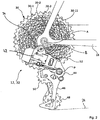
- FIG. 2 shows an enlarged view of a rear portion of the bicycle 10 in the region of the sprocket set 30 and the derailleur 32.
- the sprocket set 30 a plurality of pinions, in the embodiment eleven pinion 30-1 ... 30-11, which The size ordered coaxially stacked on the rear wheel axle A and are rotatably connected to each other.
- the largest pinion 30-1 may have, for example, 50 teeth, while the smallest pinion 30-11 may have, for example, nine to eleven teeth.
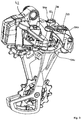
- the derailleur 32 includes a fixed member 42, which is also referred to as a "B-Knuckle” and which has a mounting portion 43 for attachment to the frame 16, preferably using a Heidelbergauges. Furthermore, the derailleur 32 comprises a movable element 44, which is also referred to as "P-Knuckle” and in a conventional manner carries a chain guide assembly 46 with a lower Ketten Entrysrad 48 and an upper Ketten Entrysrad 50.
- the chain guide assembly 46 is rotatably supported about an axis A parallel to the axis A to the movable member 44 and by a spring, not shown, in the reverse direction, ie in FIG. 2 clockwise, biased to keep the chain 34 stretched and in particular to balance the different chain travel paths around the different sized pinions 30-1 ... 30-11.
- the movable member 44 is movably coupled to the fixed member 42 by a hinge assembly 52.
- the hinge assembly 52 is particularly in the FIGS. 3 to 5 good to recognize and may be formed as in the embodiment of the parallelogram type.
- Such a hinge assembly 52 includes at least one outer pivot member, here upper outer pivot 54o and lower outer pivot 54u, and at least one inner pivot, here upper inner pivot 56o and lower inner pivot 56u.
- First ends of the upper and lower outer pivot members 54o, 54u are pivotally supported on a stationary member 42 on a first pivot axis S1.
- First ends of the top and lower inner pivot members 56o, 56u are pivotally supported on the fixed member 42 at a second pivot axis S2 spaced from the first pivot axis.
- the first ends opposite second ends of the upper and lower outer pivot members 54o, 54u are pivotally mounted on a third pivot axis S3 on the movable member 44.
- the first ends opposite second ends of the upper and lower inner pivot elements 56o, 56u are pivotally mounted on a movable member 44 at a fourth pivot axis S4 spaced from the third pivot axis S3.
- the pivot axes S1, S2, S3 and S4 essentially form the vertices of an articulated parallelogram and thus allow movement of the movable element 44 and thus the chain guide assembly 46 in the axial direction (parallel to the main axis A) outwards or inwards to guide the chain 34 of one of the pinions 30-1 ... 30-11 to another pinion.
- the movable element 44 is moved by an electromechanical drive 58 (see also FIG. 6 ) having a motor-gear assembly housed in a housing 60 and providing force for moving the movable member on an output member which is coupled for movement with the hinge assembly 52 or the movable member 44.
- the output member is formed by a drive arm 62 which has a stop 64 which on a counter-stop 66 (see FIG. 5 Drive arm 62 (hereby hidden)) of the lower inner pivot member 56u is in abutting contact so as to be capable of pivoting the lower inner pivot member 56u outwardly in an outward direction to cause the movable member 44 to move outwardly.
- the drive arm 62 is held under the tension of a spring 68 in abutting contact with the lower inner pivot member 56u, the spring 68 being supported on the one hand in a receptacle 70 on the drive arm 62 and on the other hand on the movable member 44.
- spring 68 may be held on the fourth pivot axis S4 and configured to bias the movable member 44 inward in a direction.
- the electromechanical drive 58 is operated such that the drive arm 62 moves in the outward direction and thereby directly on the stop 64 and the counter-stop 66, the lower inner pivot member 56u directly entrains.
- the electromechanical drive 58 is operated such that the drive arm 62 moves in an inward direction.
- the hinge assembly 52 tracks this movement of the drive arm 62, i.
- the spring 68 holds the counter-stop 66 of the lower inner pivot member 56u in abutting contact with the stop 64 of the drive arm 62.
- About the rotation of the output member of the electromechanical drive 58 and thus the pivotal movement of the drive arm 62 can thus be acted directly on the position of the chain guide assembly 46 and a desired shift position can be approached in accordance with a desired shift stage.
- FIG. 7 shows that the transmission housing 60 of the electromechanical drive 58 is formed in the illustrated embodiment of an upper gear housing part 60o and a lower gear housing part 60u, which by suitable connection means, here screw 63, are fastened together and in their interior a cavity for receiving the later zu define descriptive engine-gearbox arrangement.
- the gear housing 60 may in turn be accommodated between two housing parts of the stationary element, for example between an upper housing part 42o, on which Also, the attachment portion 43 is arranged for attachment to the frame 16, and a lower housing part 42u.
- the upper housing part 42o and the lower housing part 42u can be screwed together to secure the gear housing 60 in a precisely predetermined position safely and backlash.
- Power to power the electromechanical drive 58 is provided by a removable battery 64 in the illustrated embodiment.
- Battery 64 and gear housing 60 are both mechanically and electrically coupled to each other or separable from each other.
- Mechanical connection means may for example be formed by a hook 66 which engages in a mating recess 68 of the battery or vice versa.
- Electrical connection means may be realized by suitable pins 70 and mating recesses 72.
- the electromechanical actuator 58 may be powered by a remotely located power source which is connected to the drive 58 by an electrical cable.
- FIG. 13 shows an internal structure of the electromechanical drive 58, in particular a motor-gear assembly, wherein in FIG. 13 For better illustration some parts are hidden.
- the engine / transmission assembly includes a motor 74 having electrical terminals 76 for applying a motor voltage and an engine output shaft 78.
- the rapid rotation of the electric motor 74 is translated by a transmission 80 into a slow rotation of a transmission output shaft 82 which drives and drives the drive arm 62 especially rotatably held with the drive arm can be.
- a motor support in the form of a support plate 84 is provided, which is to be fastened in a first step on the lower gear housing part 60u.
- the carrier plate 84 is preferably formed from a metal and therefore has high mechanical strength.
- the transmission housing 60 is formed of a lighter weight material, particularly plastic.
- the support plate 84 is at least partially embedded in the plastic material of the lower gear housing part 60u for secure mounting to the lower gear housing part 60u.
- the embedding of the carrier plate 84 may take place during the production of the lower gear housing part 60u, for example during an injection molding process, or subsequently after the hardening of the lower gear housing part 60u.
- the support plate 84 has at least one projection 86 which is embedded in the plastic material of the lower gear housing part 60u.
- At least one passage opening or recess 88 can be provided in the at least one projection 86, into which plastic material can at least partially penetrate.
- adhesives may be used and the support plate 84 may be glued with its at least one projection 86 in a corresponding recess of the lower gear housing part 60u.
- the mounting portion 90 has second attachment means 92 for mounting the motor 74 to the support plate 84.
- the second fastening means 92 are realized by holes, to which the motor 74 by screws 94 can be screwed.
- the mounting portion 90 is preferably plate-shaped and lies in the assembled state flat against a plate-shaped portion of the motor 74, for example, an end face of the motor 74, on which also the motor output shaft 78 exits. In this way, a reliable, stable and very precise positioning of the engine and in particular the engine output shaft 78 is achieved.
- the assembly of the motor 74 by the second attachment means 92 can be done in a relatively simple assembly process.
- first gear 96 Fixedly connected to the transmission output shaft 78 is a first gear 96, which is designed for reasons of space as a segment, so that it is toothed only over its operating angle and is recessed in other peripheral portions.
- the first gear 96 is engaged with a small gear 98 of a first stage gear 100.
- Rotationally connected to the small gear 98 of the first stage gear 100 is a large gear 102 of the first stage gear 100, which in turn engages a small gear 104 of a second gear Stepwheel 106.
- a large gear 108 of the second stage gear 106 is formed as a worm wheel and is engaged with a worm 110 which is rotatably mounted on a worm shaft 112.
- the axes of rotation of the first gear wheel 96, the first stage gear 100 and the second stage gear 106 are preferably aligned parallel to each other, while the worm shaft 112 is preferably at an angle of 90 ° to the axis of rotation of the second stage gear 106.
- the worm shaft 112 also carries a third gear 114, which in turn is engaged with a fourth gear 116 which is rotatably mounted on the motor output shaft 78.
- the third gear 114 is preferably larger than the fourth gear 116.
- the rapid rotation of the transmission output shaft 78 via the fourth gear 116, the third gear 114, the worm shaft 112, the worm 110, the large gear 108 of the second stage gear 106, the small gear 104 of the second stage gear 106 , the large gear 102 of the first stage gear 100, the small gear 98 of the first stage gear 100, and the gear 96 are converted into a slower rotation of the transmission output shaft 82.
- the design of the gear 80 is to be understood as an example, alternatively, transmissions with more or fewer gear stages or with other reduction mechanisms can be used, provided that they are adapted to sufficiently adapt the speed of the motor 74 to the desired speed of the transmission output shaft 82.
- the transmission 80 may further include an overload clutch 118 which may be located at a suitable position in the above-described force path from the engine output shaft 78 to the transmission output shaft 82.
- an overload clutch 118 which may be located at a suitable position in the above-described force path from the engine output shaft 78 to the transmission output shaft 82.
- the small and large wheels of the step wheels which are rotatably connected to each other for torque transmission in the normal case, be rotatably mounted to one another in one of the step wheels. In the present embodiment, this is realized in the second stage gear 106 and the overload clutch 118 is disposed between the small wheel 104 and the large gear 108 of the second stage gear 106.
- the overload clutch 118 may be formed, for example, as a slip clutch and having a first clutch plate 120 which is fixedly connected to the small wheel 104 of the second stage gear 106, and a second clutch plate 122, which is fixedly connected to the large wheel 108 of the second stage gear 106 is.
- the first clutch actuator and the second clutch actuator are frictionally engaged with each other so as to transmit rotational force when a differential torque acting between the first clutch actuator 120 and the second clutch actuator 122 is smaller than a predetermined overload torque, and rotate relative to each other when the differential torque is greater than the predetermined one
- the overload torque is adjustable.
- the overload clutch 118 may be provided alternatively or additionally on the first step wheel 100.
- the transmission 80 may further include a position sensing mechanism 124 that summarizes a current position or rotational position of the transmission 80.
- the position detecting mechanism 124 detects a rotational position of the first gear 96.
- the position detecting mechanism 124 may include a second gear 126 which is also engaged with the first gear 96 and, on the other hand, is engaged with a fifth gear 128 which is a position sensor 130 carries.
- the axes of rotation of the second gear 126 and the fifth gear 128 are again parallel to the axis of rotation of the transmission output shaft 82.
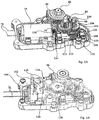
- the position sensor 130 may be a per se known encoder, which (not shown) in magnetic or optical interaction with a housing fixed held read head to, in particular contactless, to detect the rotational position of the fifth gear 128. Accordingly, it is important that the rotational position of the fifth gear 128 can be assigned as accurately as possible to a specific rotational position of the first gear 96. This results in the requirement to reduce any play in the transmission path from the fifth gear 128 to the first gear 96. According to one aspect of the invention, an anti-backlash mechanism is used for this purpose, which is described below with reference to FIG FIGS. 15 and 16 is explained in more detail.
- the anti-backlash mechanism is realized in the embodiment by the second gear 126, which includes two co-axially held partial gears 132, 134.
- the two sub-wheels, an upper Operarad 132 and a lower Operarad 134, have the same number of teeth and are both simultaneously engaged with both the first gear 96 and the fifth gear 128.
- the sub-wheels 132, 134 are rotatable relative to each other about the axis of rotation of the second gear 126.
- the relative rotation of the partial gears 132, 134 is biased by a force which is generated in the present embodiment by an anti-backlash spring 136.
- the anti-backlash spring 136 is preferably formed as a torsion spring and engages with one end 138 on the upper Generalrad 132, while their opposite end (not shown) engages the lower Generalrad 134.
- the largest part of the anti-backlash spring 136 is space-saving housed in a cavity 140 which is formed between the upper Ambirad 132 and the lower Generalrad 134.
- the upper part wheel 132 may have a first recess 142 facing the lower part wheel 134, which may be designed as a circular or annular recess.
- the lower sectionrad 134 may have a second recess 144 which faces the upper Operarad 132 and which may be configured as a circular and annular recess.
- the engagement of the end 138 of the spring 136 with the upper Generalrad 132 may be realized by inserting the end 138 in an opening 146 of the upper Generalrads 132.
- the other end (not shown) of the anti-backlash spring 136 may be held in engagement with the lower gear 134.
- the anti-backlash mechanism of this embodiment can further reduce the clearance between the first gear 96 and the fifth gear 128.
- the lower Operarad 134 is held on a gear shaft 146 of the second gear 126 with less clearance than the upper Generalrad 132.
- the lower Operarad 134 rotatably or substantially without play rotatably supported on the gear shaft 146, while the upper Generalrad 132 is mounted with a predetermined game d to the transmission shaft 146.
- a diameter of an upper central receiving opening 148 of the upper Generalrads 132, in which the transmission shaft 146 is received could be greater than a diameter of a lower central receiving opening 150 of the lower Generalrads 134, at which the lower Operarad 134 on the transmission shaft 146 is stored.
- the diameter ratios of the central openings 148, 150 may be reversed, so that instead of the upper Generalrads 132 then the lower Generalrad 134 receives a radial clearance on the transmission shaft 146.
- the result of a game d of the type described above is a predetermined radial play of the upper Operarads 132 against the transmission shaft 146 and thus also with respect to the lower Operarad 134th
- the radial movement may also be biased by the force of the anti-backlash spring 136, so that the anti-backlash spring 136 has a double function. Due to the additional radial clearance d, an even better fit between the upper part of the wheel 132 and the first gear 96 and the fifth gear 128 can be achieved, so that an additional game reduction takes place.
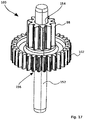
- FIG. 17 shows the structure of the first stage gear 100.
- the small wheel 98 and the large wheel 102 may each be formed separately from a transmission shaft 152 which forms the rotation axis of the first stage gear 100. That is, the small wheel 98 has a through hole 154 through which the transmission shaft 152 passes, and the large wheel 102 has a through hole 156 through which the transmission shaft 152 is also passed.
- the small wheel 98 and the large wheel 102 are held against rotation relative to each other and can be manufactured as separate components and fastened to each other or integrally formed as an integral structure.
- Small wheel 98 and large wheel 102 are preferably rotatably supported on the transmission shaft 152 so that the transmission shaft 152 can be mounted in the housing.
- the described construction allows the production of the small gear 98 and the large gear 102 from a material different from the material of the gear shaft 152.
- the small gear 98 and the large gear 102 may be made of hardened steel to transmit large torques and to reduce the wear of the teeth of the wheels, while the transmission shaft 152 may be formed of an uncured steel to prevent distortion of the transmission shaft 152 counteract.
- the transmission shaft 152 may be formed of an uncured steel to prevent distortion of the transmission shaft 152 counteract.
- the above-described features may alternatively or additionally be implemented on the second stage gear 106 or on another stage gear of the transmission 80.
- rotational force of the motor 74 is converted by means of the gear 80 and the joint assembly 52 in a movement of the movable member 44 to adjust the derailleur 32 for setting the desired switching stage.
- the control of the motor 74 is effected by an electronic control device 160, which schematically in FIG. 14 can be seen.
- the electronic controller 160 is in communication with the electrical terminals 76 (although in FIG FIG. 14 For reasons of illustration, the electrical connections 76 are shown in the separate state leading away from the electronic control device 160) in order to apply a motor voltage U to the motor 74.
- the operation of the electric motor 74 can be done in a conventional manner, for example via a PWM control (pulse width modulation control).
- the electronic control device 160 is further supplied via the contacts 70, 72 from the battery 64 with electrical energy. Furthermore, the electronic control device 160 has receiving means 162 for receiving control commands from the operating element 36 or from another device.
- signal transmission means known per se can be used here, for example a connection using an electric cable or, preferably, a wireless data transmission.
- the receiving means 162 may comprise a radio receiver, which is adapted to receive radio signals from a radio transmitter of the control element 36.
- one of the US 2014/0102237 A1 known wireless control are used.
- FIG. 18 shows, as a schematic block diagram, an example of an electronic control device 160 of the type described above, which is implemented on a circuit board 164 and is electrically connected to the circuit board 164 Motor 74, the battery 64 and the position sensor 130 is connected.
- the circuit board 164 is preferably also housed in the transmission housing 60.
- a CPU 166 and a memory 168 connected to the CPU 166 are preferably installed.
- the circuit board 164 may further carry a radio module 170, which forms receiving means 162 of the type described above.
- the circuit board 164 may carry an acceleration sensor 172 which can detect a vibration or movement of the derailleur 32 and pass a corresponding signal to the CPU 166.
- a function switch 174 may be attached to the circuit board 164 for switching the electronic controller 160 between various modes of operation, reset, turn on or off, or the like.
- a display element for example in the form of an LED 176, may be installed on the circuit board 164 and connected to the CPU 166 to optically signal operating states of the electronic control device 160.
- the method can be implemented in particular by a program running in the CPU 166.
- the radio module 170 receives a shift stage selection signal, for example the shift signal of a driver for setting the derailleur to a specific shift stage Sn, selected from the number of available shift stages (eleven shift stages in the exemplary embodiment).
- the electronic control device 160 determines a switching position sn associated with the switching stage Sn.
- the CPU 166 can read out a switching table stored in the memory 168, which contains an assigned switching position for each available switching stage.
- step S3 the motor 74 is operated with a motor voltage U1 and then detects the actuator 10 in step S4, the position s of the movable member 44.
- the position s from an output of the position sensor 130 can be determined, which determines the rotational angular position of the first Gear wheel 96 represents. If it is determined in step S5 that the position s of the movable element has reached the shift position sn of the desired shift speed Sn, the shift is completed in step S21. This corresponds to the case that the switching operation could be carried out successfully.
- step S6 If it is determined in step S5 that the position s of the movable element has not yet reached the switching position sn, it is checked in step S6 if the transmission rotates, preferably also by interrogating the position sensor 130, e.g. by polling a temporal change of the output of the position sensor 130, can take place. If the transmission does not rotate (although the shift position sn has not yet been reached), then the method includes a fault (step S7) caused, for example, by locking of the movable element 44, excessive wear or the like. On the other hand, if the transmission is still rotating (S6 YES), the process returns to step S4. The steps S4 to S6 thus form a waiting loop for fault detection in which the position s of the movable element is repeatedly interrogated and it is determined whether the movable element at some point reaches the desired switching position or whether there is a fault.
- step S9 the process again detects the position s of the movable element 44 and subsequently checks in step S10 whether the switching position sn has been reached in the meantime or not. If the shift position sn has been reached, the method ends in step S21. Has the switch position not yet been reached, it is checked again in step S11, whether the gear meanwhile rotates. If the transmission still stands still (S11 NO), it is checked in step S13 whether the time tz1 measured by the first timer has already exceeded a predetermined first time period ⁇ T1 or not.
- step S9 If the first time period ⁇ T1 has not yet been exceeded, the method returns to step S9, thus again detecting the position s of the movable element 44 and querying a rotation of the transmission, wherein the motor continues to be operated with the motor voltage U1. If the transmission is moving again in the meantime (S11 YES), the timer tz1 is reset to zero in step S12, since the method now assumes that the fault has been rectified and after some time the switching position sn is reached (S10 YES).
- step S13 if it is determined in step S13 that the first time period ⁇ T1 has been exceeded, the shift operation could not be successfully completed even after a time ⁇ T1 has elapsed after detection of the fault (S13 YES), then in a following step S14 the engine is provided with a second one Motor voltage U2 operated, which is smaller than the first motor voltage U1.
- the motor voltages U1 and U2 are adapted to a limit voltage Uc of the overload clutch 118.
- the overload clutch limit voltage Uc is the voltage at which the electric motor 74 is to operate, in a case that the transmission output shaft 82 is locked, the overload clutch 118 is straight trigger.
- step S15 proceeds to step S15 and starts a second timer tz2, ie, sets it to 0.
- first and second timers may represent only arithmetic variables and may be controlled by a common timer can only result from differences of a continuous clock.
- step S16 the position s of the movable element 44 is detected, whereupon it is checked in step S17 whether the position s of the movable element 44 has reached the switching position sn or not.
- step S17 the shift is successfully completed (S21). If the desired shift position sn has not been reached, the method again in step S18 requests a rotation of the transmission. If the transmission is at standstill (S18 NO), the process checks in step S20 whether the second timer tz2 indicates exceeding of a second time period ⁇ T2 or not.
- step S16 the process returns to step S16 so that the motor continues to be operated with the motor voltage U2 and the position detection and the transmission rotation retrieval are repeated. If it is found in the meantime that the transmission rotates again (S18 YES), then in a step S19, the second timer is reset to zero, since it is assumed that the fault is corrected and the movable element continues to move in the direction of switching position.
- the method determines that the shift has failed and carries out an error treatment in step S22.
- the error handling may include issuing an error message in the form of an optical or acoustic signal, sending an error message through the radio module 170, or the like.
- the method can also after waiting for a further third period of time .DELTA.T3 undertake a new shift attempt, ie return to step S3. Alternatively, the process may wait until a new switching signal is sent by the user.
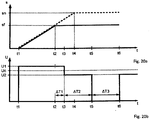
- FIGS. 20a and 20b show the effect of the switching method described above with reference to two timing diagrams, the two time axes t of FIGS. 20a and 20b have the same standards, so that FIGS. 20a and 20b in relation to the time axis t can be compared with each other.
- FIG. 20a is represented by a dashed line a normal, trouble-free switching process.
- the movable element 44 moves to the switching position sn corresponding to the desired switching stage and reaches it at a time t4.
- a solid line is the other hand in FIG. 20a illustrates the case of a disturbance in which the movement of the movable member 44 is hindered by, for example, external mechanical influences, wear or contamination.
- the movable element then does not reach the desired switching position sn, but remains at a time t2 at a switching position sf which is different from sn.
- This disturbance at time t2 can be detected, for example, by the output of the position detection element 130, which indicates that the position of the movable element 44 no longer changes or no longer changes in the expected manner.
- the motor voltage U1 on the motor 74 is still maintained for a period of time .DELTA.T1.
- the motor 74 is thus still supplied with full power, which may also cause the overload clutch 118 triggers, if the fault stops.
- the motor voltage is reduced to the reduced motor voltage U2 at time t3, so that the overload clutch 118 always remains coupled in or is coupled in again.
- the motor 74 is then operated at the reduced motor voltage U2 to continue to attempt to reach the desired shift position sn, but then avoid triggering the overload clutch 118.
- the motor voltage is preferably reset to 0 at a time t5, so that the motor 74 is preferably switched off.
- a renewed shift attempt may then be made, for example, at a time t6 when the operator gives a new shift command or a predetermined period of time ⁇ T3 has elapsed.
- the first time duration ⁇ T1 may be between 5 ms and 80 ms, preferably between 10 ms and 40 ms, in order to reduce repeated triggering of the overload clutch.
- the second time duration ⁇ T2 is preferably greater than the first time duration ⁇ T1 and may be between 40 ms and 500 ms, preferably between 60 ms and 200 ms, in order to wait a long time for the fault to be rectified, but at the same time to minimize a load on the circuit ,
- FIGS. 21 to 23 a trim device and a trim operation according to a further aspect of the invention explained in more detail.
- FIG. 21 schematically shows the running of the chain 34 between the front chainwheel 26, the rear derailleur 32 and the rear sprocket package 30.
- the movable member 44 of the derailleur 32 in particular the Ketten Installationszier 50, move the chain in a position s, so that the chain is ideally aligned with a predetermined pinion of the sprocket set or at least in an ideal for a uniform chain running position with respect to the Pinion is located.
- the derailleur 32 moves the chain 34 via respective pinions 30-1, 30-2,..., And for this purpose moves the movable element 44 into respective shift positions s1, s2,...
- Each shift stage is thus a shift position s1. s2, ... assigned.
- This assignment can take the form of shift position parameters in a shift table ( FIG. 22 ), wherein the shift position parameters may be the shift positions themselves or the shift positions may be indicative parameters.
- the switching table may be stored in the memory 168 of the electronic control device 160.
- the electronic control device 160 determines an appropriate value sn for setting a desired shift speed Sn from the shift table and controls the motor 74 such that the movable element 44 reaches the shift position sn.
- the switching position sn is not immediately stored in the switching table of the present embodiment. Instead, a standard position (standard position parameter) s0_1, s0_2, ... as well as a trim amount (trim parameter) x1, x2, ... are stored in the switching table for each switching stage.
- the switching position sn then results from the sum of standard position s0 and trim amount x.
- the switching position s1 of the switching stage 1 results from the sum s0_1 + x1, etc. This allows a simple resetting of the switching position to a basic setting or factory setting.
- the entries of the shift table can be changed such that two shift position parameters of different shift stages are changed by different amounts.
- the trim amounts x1, x2, ... could each be overridden by new values, so that at least two, preferably all trim amounts, can be changed independently of one another.
- the changes in the entries of the switching table can be carried out preferably by wirelessly received control commands, in particular by control commands that are received by the radio module 170 and forwarded to the CPU 166 and the memory 168.
- a wireless input device in particular a mobile terminal can be used.
- a smartphone, tablet or similar mobile terminal on which a predetermined program code (App) is installed, which gives the user the opportunity to directly influence the switching table to take.
- a program code may prompt the user to enter a desired shift stage and to input a trim amount for that shift stage.
- the program code may be further configured to provide an instruction to the electronic controller 160 to set a particular shift level.
- the radio module 170 may be configured to transmit data via stored entries of the switch table to the mobile terminal.
- the program code may allow a user to incrementally increase or decrease the trim amount x for a selected shift speed, with the program code sending an instruction to the electronic controller 160 for each trim amount set, moving the movable element to the appropriate shift position to adjust, which results from the standard position and the trim amount.
- This allows the user to trim the shift position of a particular shift stage during operation, that is, to simultaneously check the smooth running of the chain and the exact alignment between chain guide wheel 50 and pinion 30-n.
- the user can then set each of the switching stages, the switching process or the chain run and the alignment between the chain guide wheel 50 and pinion 30-n check and possibly make an individual adjustment for each shift stage exact adjustment of the shift position.
- the check of the chain run and the optimal shift position can be supported according to a further advantageous feature of the invention by evaluating the output of the acceleration sensor 172.
- the acceleration sensor 172 can detect a vibration and a value representing the magnitude or amplitude of the vibration to the CPU 166 to transfer.
- the CPU 166 can display the value representing the vibration in a suitable form to the user, for example by transmitting the value via the radio module 170 to a receiving unit, in particular a mobile terminal, to which the the vibration-representing value is displayed, or by appropriate control of the LED 176, which could output a statement about the strength or amplitude of the vibration in a simple variant by a specific flash code or the like.
- the user can then use a method for trimming the adjusting device, in which he sets a certain switching stage S1 and then sets different trim amounts x, so that the movable member 44 is moved to switching positions, in the vicinity of the previously entered switching position, in particular the standard switch position S0.
- the user can detect the magnitude of the vibration, whereupon he can finally select that trim amount or shift position at which the vibrations were the lowest.
- Such a setting then corresponds with a good approximation of an optimal switching position.
- the user can repeat the process for each shift stage for which he wishes to adjust the shift position.
- a trimming operation for one or more switching stages may be semi-automatic or fully automatic using an in FIG. 23 illustrated trim program are executed.
- the trim program can either run directly on the CPU 166 or alternatively on a control device connected to the electronic control device 160.
- the trim program may be installed on a mobile terminal, such as a smartphone, and may wirelessly transmit the individual control instructions via the radio module 170 to the CPU 166.
- a shift stage Sn is selected or an already set shift stage is changed.
- the subsequent step S2 based on the switching table ( FIG. 22 ) determines the shift position Sn associated with the shift stage Sn (for example, by adding the standard shift position s0_n with the trim amount xn).
- a value si is selected from an interval ⁇ s which encloses the switching position sn (sn lies in the interval ⁇ s).
- the interval ⁇ s is preferably less than or equal to a mean distance between the switching position of two adjacent switching stages.
- the steps S3 to S5 are preferably repeated until a predetermined exit determination 1 is fulfilled.
- another value si is selected from the interval ⁇ s, the movable element is moved to the new position si and the vibration vi is measured.
- This cycle is repeated until the exit condition 1 is fulfilled.
- exit condition 1 it can be provided that a predetermined number of different positions si have been approached and tested.
- the positions si at even intervals may be selected from a smallest value of the interval ⁇ s to a largest value of the interval ⁇ s, and the exit condition 1 is satisfied when all positions si have been approached.
- the exceeding of a predetermined period of time or a user input may be selected as the exit condition 1.
- step S7 when the exit condition 1 is satisfied, the vibrations vi measured for the respective position si are compared with each other and a minimum value v_min is determined.
- the position si at which the minimum value v_min is assumed is determined in step S8 as the position with the lowest vibration s_min.
- step S9 then updated the corresponding shift position parameter in the shift table, so that the value x_min now results as the new shift position sn from the shift table for this shift stage Sn (for example, the trim amount xn is set to x_min-s0_n).
- the switching table is thus updated and rewritten for this switching stage Sn.
- the steps S1 to S9 may be repeatedly executed for a plurality of shift stages Sn until an exit condition 2 is satisfied.
- exit condition 2 may require that all shift stages of the derailleur 32 have been selected at least once (step S1) and thus an optimal shift position parameter has been determined for all shift stages by steps S2 to S9.
- the exit condition 2 may poll the lapse of a predetermined period of time or interrogate a user input. If the exit condition 2 is met, the trim program ends (step S11).
- FIG. 24 shows a variant of the trim program described above according to the invention.
- the trim program is started, for example by user input via the function switch 174 or by a start command, which was input at the mobile terminal and received by the radio module 170 of the electronic control device 160.
- a position si within the maximum range of movement of the movable element 44 is then selected from s_min to s_max in step S'2.
- the electromechanical drive 58 then moves the movable element 44 to the position si in step S'3, whereupon in step S'4 a vibration vi is detected at this position si.
- the steps S'2 to S'4 are executed in the cycle until an exit condition of the step S'5 is satisfied.
- the movable element passes completely through the entire movement range from s_min to s_max and preferably also traverses the movement region again in the opposite direction, possibly even more than twice the movement region passes completely, ie all possible positions s of the movable element sets at least once. Accordingly, the exit condition of step S'5 asks whether the entire range of movement of the movable member in the desired number has been completed.
- the vibrations vi measured at this position si can advantageously be averaged to determine a mean vibration vim for each position si, so that the accuracy of the vibration measurement is improved.
- step S'6 the program searches in step S'6 in the data series of the measured values of the vibration vi or vim for minimum values v_min1, v_min2,... And determines the latter in step S'7 Positions assigned to minimum values s_min1, s_min2, ... In this way, exactly one position s_min should be found for each shift stage, for which the vibration assumes a minimum and thus represents the best possible shift position. Accordingly, in step S'8, a shift table is updated so that the stored shift positions s1, s2, ... are replaced by the newly found best shift positions s_min1, s_min2, ....
- step S'9 the trim program finally ends.
- variants of the trimming device or the trim method and the trim program allow individual adjustment of individual trim amounts or individual shift positions of the respective shift stages.
- variants of the invention are also considered to be advantageous in which a single trim operation simultaneously affects the trim amounts of all the shift stages or substantially all shift stages, albeit to varying degrees.
- a particularly simple trim function is achieved to compensate for misalignments between the rear derailleur 32 and pinion package 30, which increase or decrease steadily from pinion to pinion.
- An example of this is an adjustment of the position of the movable element 44 due to an axial force through the chain 34.
- the electronic controller 160 may then be configured to simultaneously vary the trim amounts x1, x2, ... in a predetermined manner to compensate for the effects of chain skew described above.
- the adjusting device can advantageously be adapted to increase the trim amounts with increasing distance of the switching positions of the switching position sn respectively.
- predetermined sets of trim amounts x1, x2, ... may be stored in the memory 168 or loaded from a mobile terminal to the electronic controller 160.
- FIG. 24 proceeded illustrated step sequence.
- This in FIG. 25 illustrated trim method can be made for example after the first installation of a rear derailleur on a bicycle, during maintenance or after replacement of components of the bicycle.
- a neutral shift stage SN is a certain shift stage, usually a middle shift stage, in which substantially no chain skew occurs, i. a pinion, which is arranged approximately at the same axial height as the chainring.
- step S101 it is checked in step S101 whether the shift position set by the derailleur is correct, i. whether the Ketten Equipmentsrad is set relative to the corresponding pinion at the correct axial height.
- the synchronization of the chain can be checked or a vibration of the derailleur can be detected, as described above.
- step S102 a trim procedure 1 which essentially corresponds to a trimming procedure known per se, for example a trim procedure in which all the switch positions are changed by substantially the same amount.
- the trim procedure 1 is completed when the correct shift position for the neutral shift stage SN is reached.
- step S103 the derailleur is set to an extreme shift stage, for example, the highest shift stage or the lowest shift stage (step S103).
- step S104 it is checked again in step S104 whether the switching position of the movable member is correct, that is, whether the Ketten Adjustsrad is in the correct position relative to the pinion. If this is not the case (step S104 NO), a trim procedure 2 is started which operates with different trim amounts for the different switch positions.
- a set of trim amounts may be selected in which the trim amounts are adjusted simultaneously, but by different amounts.
- a number of predefined sets of trim amounts are available, which can be optionally set.
- the adjustment process can be carried out by a user manually or by an electronic command to change the switching table. Finally, if a suitable trim amount has been found which ensures correct positioning in the selected gear stage, the trimming process finally ends in step S106. If desired, the method S100 to S106 may be repeated for different shift stages, in particular various extreme shift stages, to find the appropriate trim amounts.
Landscapes
- Engineering & Computer Science (AREA)
- Chemical & Material Sciences (AREA)
- Combustion & Propulsion (AREA)
- Transportation (AREA)
- Mechanical Engineering (AREA)
- Transmission Devices (AREA)
- Gear Transmission (AREA)
- Gear-Shifting Mechanisms (AREA)
- Connection Of Motors, Electrical Generators, Mechanical Devices, And The Like (AREA)
- Automatic Cycles, And Cycles In General (AREA)
- Steering Devices For Bicycles And Motorcycles (AREA)
Priority Applications (1)
| Application Number | Priority Date | Filing Date | Title |
|---|---|---|---|
| EP23020013.1A EP4186779A3 (fr) | 2018-05-15 | 2019-05-06 | Dispositif de réglage pour une bicyclette et procédé de commande ou de réglage de tels dispositifs de réglage |
Applications Claiming Priority (1)
| Application Number | Priority Date | Filing Date | Title |
|---|---|---|---|
| DE102018207493.3A DE102018207493A1 (de) | 2018-05-15 | 2018-05-15 | Stelleinrichtung für ein Fahrrad und Verfahren zur Steuerung oder Einstellung solcher Stelleinrichtungen |
Related Child Applications (1)
| Application Number | Title | Priority Date | Filing Date |
|---|---|---|---|
| EP23020013.1A Division EP4186779A3 (fr) | 2018-05-15 | 2019-05-06 | Dispositif de réglage pour une bicyclette et procédé de commande ou de réglage de tels dispositifs de réglage |
Publications (3)
| Publication Number | Publication Date |
|---|---|
| EP3578451A2 true EP3578451A2 (fr) | 2019-12-11 |
| EP3578451A3 EP3578451A3 (fr) | 2020-03-04 |
| EP3578451B1 EP3578451B1 (fr) | 2023-01-18 |
Family
ID=66554099
Family Applications (2)
| Application Number | Title | Priority Date | Filing Date |
|---|---|---|---|
| EP19000233.7A Active EP3578451B1 (fr) | 2018-05-15 | 2019-05-06 | Dispositif de réglage pour une bicyclette et procédé de commande ou de réglage d'un tel dispositif de réglage |
| EP23020013.1A Pending EP4186779A3 (fr) | 2018-05-15 | 2019-05-06 | Dispositif de réglage pour une bicyclette et procédé de commande ou de réglage de tels dispositifs de réglage |
Family Applications After (1)
| Application Number | Title | Priority Date | Filing Date |
|---|---|---|---|
| EP23020013.1A Pending EP4186779A3 (fr) | 2018-05-15 | 2019-05-06 | Dispositif de réglage pour une bicyclette et procédé de commande ou de réglage de tels dispositifs de réglage |
Country Status (5)
| Country | Link |
|---|---|
| US (3) | US11312449B2 (fr) |
| EP (2) | EP3578451B1 (fr) |
| CN (1) | CN110481699B (fr) |
| DE (1) | DE102018207493A1 (fr) |
| TW (1) | TWI808152B (fr) |
Cited By (1)
| Publication number | Priority date | Publication date | Assignee | Title |
|---|---|---|---|---|
| EP3733497A1 (fr) * | 2019-05-02 | 2020-11-04 | Sram, Llc | Réglage de changement de vitesses et dispositif |
Families Citing this family (26)
| Publication number | Priority date | Publication date | Assignee | Title |
|---|---|---|---|---|
| US9394030B2 (en) * | 2012-09-27 | 2016-07-19 | Sram, Llc | Rear derailleur |
| DE102018001253A1 (de) * | 2017-03-20 | 2018-09-20 | Sram Deutschland Gmbh | Hinteres Schaltwerk zur koaxialen Montage |
| US11498643B2 (en) * | 2019-02-26 | 2022-11-15 | Shimano Inc. | Bicycle electric derailleur |
| EP4253217A3 (fr) * | 2019-04-25 | 2024-03-20 | SRAM Deutschland GmbH | Derailleur électromécanique destiné au montage coaxial |
| DE102020000827A1 (de) * | 2019-04-25 | 2020-10-29 | Sram Deutschland Gmbh | Elektromechanisches Schaltwerk zur koaxialen Montage |
| TWI729557B (zh) * | 2019-11-06 | 2021-06-01 | 天心工業股份有限公司 | 自行車之後變速器 |
| TWI729556B (zh) * | 2019-11-06 | 2021-06-01 | 天心工業股份有限公司 | 自行車之後變速器 |
| TWI712547B (zh) * | 2019-11-06 | 2020-12-11 | 天心工業股份有限公司 | 自行車之後變速器 |
| TWI712540B (zh) * | 2019-12-02 | 2020-12-11 | 彥豪金屬工業股份有限公司 | 撥鏈位置設定系統及其方法 |
| TWI716290B (zh) * | 2020-03-04 | 2021-01-11 | 彥豪金屬工業股份有限公司 | 自行車組件及其配對方法 |
| US11554832B2 (en) * | 2020-09-11 | 2023-01-17 | Shimano Inc. | Bicycle derailleur and method of controlling bicycle derailleur |
| US11926394B2 (en) * | 2020-09-11 | 2024-03-12 | Shimano Inc. | Bicycle derailleur |
| US20220297798A1 (en) * | 2021-03-16 | 2022-09-22 | Tien Hsin Industries Co., Ltd. | Electronic derailleur |
| US12384491B2 (en) * | 2021-05-07 | 2025-08-12 | Sram, Llc | Bicycle derailleur |
| US11479323B2 (en) * | 2021-07-06 | 2022-10-25 | Hazem Nihad Hamed | Automatic bicycle shifter and shifting cable actuator |
| IT202100024800A1 (it) | 2021-09-28 | 2023-03-28 | Campagnolo Srl | Equipaggiamento di bicicletta elettronico |
| IT202100024725A1 (it) * | 2021-09-28 | 2023-03-28 | Campagnolo Srl | Equipaggiamento di bicicletta dotato di unita’ di alimentazione elettrica |
| JP2023051371A (ja) * | 2021-09-30 | 2023-04-11 | 株式会社シマノ | 人力駆動車用のコンポーネント |
| TWI786971B (zh) * | 2021-12-01 | 2022-12-11 | 彥豪金屬工業股份有限公司 | 變速器的控制方法及變速控制系統 |
| US12358592B2 (en) | 2021-12-09 | 2025-07-15 | Sram, Llc | Bicycle derailleur |
| US11787505B1 (en) | 2022-04-12 | 2023-10-17 | Shimano Inc. | Linkage and derailleur for human-powered vehicle |
| TWI839826B (zh) * | 2022-08-31 | 2024-04-21 | 凱納股份有限公司 | 電動輔助自行車之管理系統及其管理方法 |
| CN117719623A (zh) * | 2022-09-16 | 2024-03-19 | 株式会社岛野 | 用于自行车部件的马达单元和拨链器 |
| TWI848488B (zh) * | 2022-12-28 | 2024-07-11 | 彥豪金屬工業股份有限公司 | 自行車後變速器 |
| US12275491B2 (en) * | 2023-08-28 | 2025-04-15 | Shimano Inc. | Bicycle motor unit and bicycle derailleur |
| US12214845B1 (en) * | 2023-10-18 | 2025-02-04 | Shimano Inc. | Electric device and control system of human-powered vehicle and non-transitory computer-readable storage medium |
Citations (3)
| Publication number | Priority date | Publication date | Assignee | Title |
|---|---|---|---|---|
| DE4212320A1 (de) | 1992-04-13 | 1993-10-14 | Fichtel & Sachs Ag | Elektrische Stellvorrichtung |
| US20140102237A1 (en) | 2012-10-11 | 2014-04-17 | Sram, Llc | Electronic shifting systems and methods |
| US20150111675A1 (en) | 2013-10-23 | 2015-04-23 | Sram, Llc | Electromechanical rear derailleur |
Family Cites Families (68)
| Publication number | Priority date | Publication date | Assignee | Title |
|---|---|---|---|---|
| US2607238A (en) * | 1951-04-28 | 1952-08-19 | Oak Mfg Co | Gear drive |
| US3359819A (en) * | 1966-04-25 | 1967-12-26 | Leo J Veillette | Bidirectional step torque filter with zero backlash characteristic |
| US3809486A (en) * | 1971-04-06 | 1974-05-07 | Amana Refrigeration Inc | Mechanical coupling arrangement |
| US5059158A (en) * | 1990-05-08 | 1991-10-22 | E.B.T., Inc. | Electronic transmission control system for a bicycle |
| US5213548A (en) * | 1992-03-02 | 1993-05-25 | Colbert Ralph G | Gear shifting system for derailleur equipped bicycle |
| DE4212319A1 (de) * | 1992-04-13 | 1993-10-14 | Fichtel & Sachs Ag | Steuervorrichtung |
| IT1276417B1 (it) * | 1995-06-07 | 1997-10-31 | Campagnolo Srl | "dispositivo di cambio di velocita' per biciclette a controllo elettro nico" |
| US5599244A (en) * | 1995-08-14 | 1997-02-04 | Ethington; Russell A. | Automatic transmission shifter for velocipedes |
| US6109129A (en) * | 1997-05-08 | 2000-08-29 | Cummins Engine Company, Inc. | Apparatus and method for adjusting a gear |
| US5870928A (en) * | 1997-05-08 | 1999-02-16 | Cummins Engine Company, Inc. | Anti-lash gear with alignment device |
| US6162140A (en) * | 1998-12-18 | 2000-12-19 | Shimano, Inc. | Motor driven derailleur |
| US6148684A (en) * | 1999-03-10 | 2000-11-21 | Heidelberger Druckmaschinen Aktiengesellschaft | Anti-backlash gear |
| US6726586B2 (en) * | 2001-11-09 | 2004-04-27 | Shimano Inc. | Motorized bicycle actuator assembly |
| JP3654868B2 (ja) * | 2002-02-21 | 2005-06-02 | 株式会社シマノ | 自転車用変速制御装置及び自転車用変速制御方法 |
| US6781510B2 (en) * | 2002-07-24 | 2004-08-24 | Shimano, Inc. | Bicycle computer control arrangement and method |
| US6931958B2 (en) * | 2002-08-23 | 2005-08-23 | Shimaro, Inc. | Apparatus for controlling first and second bicycle transmissions |
| US20040089089A1 (en) * | 2002-11-08 | 2004-05-13 | Stevens Carlos J. | Anti-backlash method and system for multiple mesh gear train |
| US6945888B2 (en) * | 2002-11-21 | 2005-09-20 | Shimano, Inc. | Combined analog and digital derailleur position processing apparatus |
| EP1426284B1 (fr) * | 2002-12-06 | 2007-02-14 | Campagnolo Srl | Dispositif électronique servocommande de changement de vitesse pour bicyclette et procédé associé |
| ATE521530T1 (de) * | 2002-12-06 | 2011-09-15 | Campagnolo Srl | Elektronisch, servobetätigte fahrradgangschaltung und zugehöriges verfahren |
| JP3703810B2 (ja) * | 2003-02-25 | 2005-10-05 | 株式会社シマノ | 自転車用自動変速制御装置 |
| ATE312750T1 (de) * | 2003-07-24 | 2005-12-15 | Campagnolo Srl | Verfahren zum schalten eines fahrradgetriebes mit elektrischem hilfsantrieb und schaltvorrichtung |
| US7467567B2 (en) * | 2004-02-24 | 2008-12-23 | Shimano, Inc. | Gear reduction apparatus for a bicycle component |
| US7290458B2 (en) * | 2004-02-24 | 2007-11-06 | Shimano, Inc. | Bicycle derailleur with a motor disposed within a linkage mechanism |
| JP2005280408A (ja) * | 2004-03-29 | 2005-10-13 | Shimano Inc | 自転車用ディレーラ制御装置及び制御方法 |
| JP2005297655A (ja) * | 2004-04-08 | 2005-10-27 | Shimano Inc | 自転車用変速制御装置及びフロントディレーラの制御方法 |
| US7306531B2 (en) * | 2004-04-23 | 2007-12-11 | Shimano Inc. | Electric bicycle derailleur |
| JP2005313748A (ja) * | 2004-04-28 | 2005-11-10 | Shimano Inc | 自転車用変速制御装置 |
| ITMI20061295A1 (it) * | 2006-07-04 | 2008-01-05 | Campagnolo Srl | Medoto e sistema di erogazione di energia elettrica da una unita' di alimentazione a batteria |
| US7942768B2 (en) * | 2008-01-28 | 2011-05-17 | Shimano, Inc. | Electrically operated derailleur that re-engages a disengaged derailleur force overload clutch |
| EP2088071B1 (fr) * | 2008-02-06 | 2013-12-11 | Campagnolo S.r.l. | Procédé pour contrôler électroniquement un changement de vitesses de bicyclette et système électronique de bicyclette |
| US7805268B2 (en) * | 2008-02-20 | 2010-09-28 | Shimano Inc. | Bicycle component calibration device |
| AT508701B1 (de) * | 2010-06-23 | 2011-05-15 | Miba Sinter Austria Gmbh | Zahnradanordnung |
| AT510283B1 (de) * | 2010-09-29 | 2012-03-15 | Miba Sinter Austria Gmbh | Zahnradanordnung |
| US8979683B2 (en) * | 2012-01-31 | 2015-03-17 | Shimano Inc. | Bicycle electric actuator unit |
| US8955395B2 (en) * | 2012-05-24 | 2015-02-17 | Ronald Greggory Bjork | Magneto cyclist power sensor |
| ITMI20121279A1 (it) * | 2012-07-23 | 2014-01-24 | Campagnolo Srl | Metodo per controllare elettronicamente un cambio di bicicletta e cambio di bicicletta servoassistito elettronicamente |
| US9394030B2 (en) * | 2012-09-27 | 2016-07-19 | Sram, Llc | Rear derailleur |
| US9802669B2 (en) * | 2012-10-11 | 2017-10-31 | Sram, Llc | Electronic shifting systems and methods |
| AT513246B1 (de) * | 2012-10-25 | 2014-03-15 | Miba Sinter Austria Gmbh | Zahnradanordnung |
| US9726216B2 (en) * | 2013-02-04 | 2017-08-08 | Shimano Inc. | Cable adjusting unit |
| AT513613B1 (de) * | 2013-02-08 | 2014-06-15 | Miba Sinter Austria Gmbh | Zahnradanordnung |
| US9555856B2 (en) * | 2013-03-25 | 2017-01-31 | Shimano Inc. | Electric front derailleur |
| US9008923B2 (en) * | 2013-04-05 | 2015-04-14 | Shimano Inc. | Bicycle derailleur adjusting apparatus |
| ITMI20130895A1 (it) * | 2013-05-31 | 2014-12-01 | Campagnolo Srl | Sistema elettronico di bicicletta |
| ITMI20131064A1 (it) * | 2013-06-26 | 2014-12-27 | Campagnolo Srl | Sistema elettronico di bicicletta |
| JP2015027861A (ja) * | 2013-07-05 | 2015-02-12 | 株式会社シマノ | 自転車制御システム |
| US20150020629A1 (en) * | 2013-07-17 | 2015-01-22 | Achates Power, Inc. | Gear Noise Reduction in Opposed-Piston Engines |
| ITMI20131825A1 (it) * | 2013-11-04 | 2015-05-05 | Campagnolo Srl | Deragliatore ad azionamento motorizzato per un cambio di bicicletta |
| ITMI20131902A1 (it) * | 2013-11-15 | 2015-05-16 | Campagnolo Srl | Sistema elettronico di bicicletta |
| US20150284049A1 (en) * | 2014-04-04 | 2015-10-08 | Sram, Llc | Control assembly for a wireless electromechanical bicycle shifting system |
| EP2979970B1 (fr) * | 2014-08-01 | 2017-09-13 | Campagnolo S.R.L. | Système électronique de bicyclette et procédé associé |
| US9772030B2 (en) * | 2014-08-04 | 2017-09-26 | Achates Power, Inc. | Split gear assembly with one-way roller clutch for controlling backlash in opposed-piston engines |
| US20160039497A1 (en) * | 2014-08-08 | 2016-02-11 | Armando Mastracci | Gear Selection for Multi-Geared, Pedal-Operated Vehicles |
| US9751590B2 (en) * | 2014-08-15 | 2017-09-05 | Sram, Llc | Bicycle rear derailleur with a damper assembly |
| US9278728B1 (en) * | 2014-10-29 | 2016-03-08 | Shimano Inc. | Bicycle shifting control apparatus and method of controlling derailleur |
| CN107428393B (zh) * | 2015-02-13 | 2020-05-15 | 斯沃莱茨德塞格尔公司 | 电动自行车传动系统、方法和设备 |
| US10029754B2 (en) * | 2015-03-06 | 2018-07-24 | Shimano Inc. | Bicycle electrical system |
| US20160288877A1 (en) * | 2015-04-01 | 2016-10-06 | Wick Werks, LLC | Bicycle derailleur with automatic alignment, and methods for automatic derailleur alignment |
| ITUB20152302A1 (it) * | 2015-07-20 | 2017-01-20 | Campagnolo Srl | Sistema elettronico di bicicletta |
| US9944350B2 (en) * | 2016-01-11 | 2018-04-17 | Sram, Llc | Chain guide sensor and methods of controling a bicycle |
| US9714067B1 (en) * | 2016-02-29 | 2017-07-25 | Shimano Inc. | Bicycle chain device |
| US9809276B2 (en) * | 2016-02-29 | 2017-11-07 | Shimano Inc. | Electric bicycle derailleur control system |
| TWI648198B (zh) * | 2016-08-10 | 2019-01-21 | 天心工業股份有限公司 | 自行車及其變速裝置 |
| JP2018114959A (ja) * | 2017-01-20 | 2018-07-26 | 株式会社シマノ | 自転車用変速機キャリブレーションシステム、自転車用シートポストキャリブレーションシステム、および、自転車用サスペンションキャリブレーションシステム |
| US10577053B2 (en) * | 2017-06-06 | 2020-03-03 | Sram, Llc | Damper for a bicycle component |
| US10882587B2 (en) * | 2017-06-26 | 2021-01-05 | Sram, Llc | Damper for a bicycle component |
| CA3042547A1 (fr) * | 2018-05-11 | 2019-11-11 | Campagnolo S.R.L. | Manivelle de bicyclette comportant un systeme electrique/electronique |
-
2018
- 2018-05-15 DE DE102018207493.3A patent/DE102018207493A1/de active Pending
-
2019
- 2019-04-09 TW TW108112366A patent/TWI808152B/zh active
- 2019-05-06 EP EP19000233.7A patent/EP3578451B1/fr active Active
- 2019-05-06 EP EP23020013.1A patent/EP4186779A3/fr active Pending
- 2019-05-15 CN CN201910404205.9A patent/CN110481699B/zh active Active
- 2019-05-15 US US16/412,667 patent/US11312449B2/en active Active
-
2022
- 2022-03-22 US US17/700,914 patent/US11731733B2/en active Active
-
2023
- 2023-06-30 US US18/345,024 patent/US12485995B2/en active Active
Patent Citations (3)
| Publication number | Priority date | Publication date | Assignee | Title |
|---|---|---|---|---|
| DE4212320A1 (de) | 1992-04-13 | 1993-10-14 | Fichtel & Sachs Ag | Elektrische Stellvorrichtung |
| US20140102237A1 (en) | 2012-10-11 | 2014-04-17 | Sram, Llc | Electronic shifting systems and methods |
| US20150111675A1 (en) | 2013-10-23 | 2015-04-23 | Sram, Llc | Electromechanical rear derailleur |
Cited By (2)
| Publication number | Priority date | Publication date | Assignee | Title |
|---|---|---|---|---|
| EP3733497A1 (fr) * | 2019-05-02 | 2020-11-04 | Sram, Llc | Réglage de changement de vitesses et dispositif |
| US11840315B2 (en) | 2019-05-02 | 2023-12-12 | Sram, Llc | Gear changer adjustment and device |
Also Published As
| Publication number | Publication date |
|---|---|
| EP4186779A3 (fr) | 2023-08-02 |
| EP3578451A3 (fr) | 2020-03-04 |
| US11731733B2 (en) | 2023-08-22 |
| TWI808152B (zh) | 2023-07-11 |
| DE102018207493A1 (de) | 2019-11-21 |
| CN110481699B (zh) | 2023-05-05 |
| CN110481699A (zh) | 2019-11-22 |
| EP4186779A2 (fr) | 2023-05-31 |
| US12485995B2 (en) | 2025-12-02 |
| US20190351971A1 (en) | 2019-11-21 |
| TW201946834A (zh) | 2019-12-16 |
| EP3578451B1 (fr) | 2023-01-18 |
| US20220212753A1 (en) | 2022-07-07 |
| US11312449B2 (en) | 2022-04-26 |
| US20230348019A1 (en) | 2023-11-02 |
Similar Documents
| Publication | Publication Date | Title |
|---|---|---|
| EP3578451B1 (fr) | Dispositif de réglage pour une bicyclette et procédé de commande ou de réglage d'un tel dispositif de réglage | |
| DE4212320A1 (de) | Elektrische Stellvorrichtung | |
| EP1319997B1 (fr) | Dispositif à force constante | |
| DE10114937A1 (de) | Verfahren zum Steuern der Gangschaltung an einem Zweirad und entsprechendes System und entsprechende Komponenten | |
| DE102013021183B4 (de) | Fahrradheckumwerfer | |
| DE69129656T2 (de) | Elektronisches steuersystem für das getriebe eines fahrrads | |
| DE60220233T2 (de) | Motorisiertes Verstellungssystem für Fahrrad | |
| DE102012016312B4 (de) | Elektrische Servolenkungsvorrichtung | |
| DE102013017194A1 (de) | Vorderes Schaltwerk | |
| DE102018100918A1 (de) | Fahrradsteuervorrichtung und Verfahren zum Steuern eines Fahrrads | |
| DE102007037119A1 (de) | Schaltpositionswechselvorrichtung und Verfahren für ein Automatikgetriebe | |
| DE4134794A1 (de) | Weggeber fuer einen stellantrieb, insbesondere in einem fahrzeug | |
| DE3631481A1 (de) | Elektromechanische fahrrad-gangschaltung | |
| DE102017103733A1 (de) | Elektrisches Fahrradumwerfersteuerungssystem | |
| DE19514812A1 (de) | Industrieroboter | |
| DE102007009226A1 (de) | Schaltungssteuereinrichtung für ein Fahrrad | |
| DE102017003163A1 (de) | Fahrradschaltwerkapparat und fahrradantriebseinheit | |
| DE102020212445A1 (de) | Schaltwerk eines von Menschen angetriebenen Gefährts | |
| WO2022175100A1 (fr) | Boîte de vitesses à vitesse variable équipée d'un tambour de changement de vitesse entraîné par moteur électrique et procédé de commande d'une telle boîte de vitesses à vitesse variable | |
| WO2014198265A1 (fr) | Système de propulsion de bicyclette | |
| WO2023180538A1 (fr) | Processeur et procédé, en particulier procédé mis en œuvre par ordinateur, pour commander une boîte de vitesses de moyeu d'une bicyclette avec un moteur auxiliaire et système de changement de vitesses avec un processeur de ce type | |
| DE102013220541B4 (de) | Verfahren zur Erfassung eines Schaltvorgangs eines Schaltgetriebes eines Fahrrads und Verfahren zur Leistungssteuerung eines Hilfsantriebs eines Fahrrads | |
| DE102020212362A1 (de) | Schaltwerk eines von menschen angetriebenen gefährts | |
| DE102020212363A1 (de) | Schaltwerk eines von menschen angetriebenen gefährts | |
| DE4241273A1 (de) | Antriebsvorrichtung für die Umwandlung drehender Bewegungen in lineare Bewegungen und umgekehrt |
Legal Events
| Date | Code | Title | Description |
|---|---|---|---|
| PUAI | Public reference made under article 153(3) epc to a published international application that has entered the european phase |
Free format text: ORIGINAL CODE: 0009012 |
|
| STAA | Information on the status of an ep patent application or granted ep patent |
Free format text: STATUS: THE APPLICATION HAS BEEN PUBLISHED |
|
| AK | Designated contracting states |
Kind code of ref document: A2 Designated state(s): AL AT BE BG CH CY CZ DE DK EE ES FI FR GB GR HR HU IE IS IT LI LT LU LV MC MK MT NL NO PL PT RO RS SE SI SK SM TR |
|
| AX | Request for extension of the european patent |
Extension state: BA ME |
|
| PUAL | Search report despatched |
Free format text: ORIGINAL CODE: 0009013 |
|
| AK | Designated contracting states |
Kind code of ref document: A3 Designated state(s): AL AT BE BG CH CY CZ DE DK EE ES FI FR GB GR HR HU IE IS IT LI LT LU LV MC MK MT NL NO PL PT RO RS SE SI SK SM TR |
|
| AX | Request for extension of the european patent |
Extension state: BA ME |
|
| RIC1 | Information provided on ipc code assigned before grant |
Ipc: B62M 9/122 20100101AFI20200130BHEP |
|
| STAA | Information on the status of an ep patent application or granted ep patent |
Free format text: STATUS: REQUEST FOR EXAMINATION WAS MADE |
|
| 17P | Request for examination filed |
Effective date: 20200901 |
|
| STAA | Information on the status of an ep patent application or granted ep patent |
Free format text: STATUS: EXAMINATION IS IN PROGRESS |
|
| 17Q | First examination report despatched |
Effective date: 20210824 |
|
| GRAP | Despatch of communication of intention to grant a patent |
Free format text: ORIGINAL CODE: EPIDOSNIGR1 |
|
| STAA | Information on the status of an ep patent application or granted ep patent |
Free format text: STATUS: GRANT OF PATENT IS INTENDED |
|
| INTG | Intention to grant announced |
Effective date: 20220810 |
|
| GRAS | Grant fee paid |
Free format text: ORIGINAL CODE: EPIDOSNIGR3 |
|
| GRAA | (expected) grant |
Free format text: ORIGINAL CODE: 0009210 |
|
| STAA | Information on the status of an ep patent application or granted ep patent |
Free format text: STATUS: THE PATENT HAS BEEN GRANTED |
|
| AK | Designated contracting states |
Kind code of ref document: B1 Designated state(s): AL AT BE BG CH CY CZ DE DK EE ES FI FR GB GR HR HU IE IS IT LI LT LU LV MC MK MT NL NO PL PT RO RS SE SI SK SM TR |
|
| REG | Reference to a national code |
Ref country code: GB Ref legal event code: FG4D Free format text: NOT ENGLISH |
|
| REG | Reference to a national code |
Ref country code: CH Ref legal event code: EP |
|
| REG | Reference to a national code |
Ref country code: DE Ref legal event code: R096 Ref document number: 502019006798 Country of ref document: DE |
|
| REG | Reference to a national code |
Ref country code: AT Ref legal event code: REF Ref document number: 1544548 Country of ref document: AT Kind code of ref document: T Effective date: 20230215 Ref country code: IE Ref legal event code: FG4D Free format text: LANGUAGE OF EP DOCUMENT: GERMAN |
|
| REG | Reference to a national code |
Ref country code: NL Ref legal event code: FP |
|
| REG | Reference to a national code |
Ref country code: LT Ref legal event code: MG9D |
|
| P01 | Opt-out of the competence of the unified patent court (upc) registered |
Effective date: 20230523 |
|
| PG25 | Lapsed in a contracting state [announced via postgrant information from national office to epo] |
Ref country code: RS Free format text: LAPSE BECAUSE OF FAILURE TO SUBMIT A TRANSLATION OF THE DESCRIPTION OR TO PAY THE FEE WITHIN THE PRESCRIBED TIME-LIMIT Effective date: 20230118 Ref country code: PT Free format text: LAPSE BECAUSE OF FAILURE TO SUBMIT A TRANSLATION OF THE DESCRIPTION OR TO PAY THE FEE WITHIN THE PRESCRIBED TIME-LIMIT Effective date: 20230518 Ref country code: NO Free format text: LAPSE BECAUSE OF FAILURE TO SUBMIT A TRANSLATION OF THE DESCRIPTION OR TO PAY THE FEE WITHIN THE PRESCRIBED TIME-LIMIT Effective date: 20230418 Ref country code: LV Free format text: LAPSE BECAUSE OF FAILURE TO SUBMIT A TRANSLATION OF THE DESCRIPTION OR TO PAY THE FEE WITHIN THE PRESCRIBED TIME-LIMIT Effective date: 20230118 Ref country code: LT Free format text: LAPSE BECAUSE OF FAILURE TO SUBMIT A TRANSLATION OF THE DESCRIPTION OR TO PAY THE FEE WITHIN THE PRESCRIBED TIME-LIMIT Effective date: 20230118 Ref country code: HR Free format text: LAPSE BECAUSE OF FAILURE TO SUBMIT A TRANSLATION OF THE DESCRIPTION OR TO PAY THE FEE WITHIN THE PRESCRIBED TIME-LIMIT Effective date: 20230118 Ref country code: ES Free format text: LAPSE BECAUSE OF FAILURE TO SUBMIT A TRANSLATION OF THE DESCRIPTION OR TO PAY THE FEE WITHIN THE PRESCRIBED TIME-LIMIT Effective date: 20230118 |
|
| PG25 | Lapsed in a contracting state [announced via postgrant information from national office to epo] |
Ref country code: SE Free format text: LAPSE BECAUSE OF FAILURE TO SUBMIT A TRANSLATION OF THE DESCRIPTION OR TO PAY THE FEE WITHIN THE PRESCRIBED TIME-LIMIT Effective date: 20230118 Ref country code: PL Free format text: LAPSE BECAUSE OF FAILURE TO SUBMIT A TRANSLATION OF THE DESCRIPTION OR TO PAY THE FEE WITHIN THE PRESCRIBED TIME-LIMIT Effective date: 20230118 Ref country code: IS Free format text: LAPSE BECAUSE OF FAILURE TO SUBMIT A TRANSLATION OF THE DESCRIPTION OR TO PAY THE FEE WITHIN THE PRESCRIBED TIME-LIMIT Effective date: 20230518 Ref country code: GR Free format text: LAPSE BECAUSE OF FAILURE TO SUBMIT A TRANSLATION OF THE DESCRIPTION OR TO PAY THE FEE WITHIN THE PRESCRIBED TIME-LIMIT Effective date: 20230419 Ref country code: FI Free format text: LAPSE BECAUSE OF FAILURE TO SUBMIT A TRANSLATION OF THE DESCRIPTION OR TO PAY THE FEE WITHIN THE PRESCRIBED TIME-LIMIT Effective date: 20230118 |
|
| REG | Reference to a national code |
Ref country code: DE Ref legal event code: R097 Ref document number: 502019006798 Country of ref document: DE |
|
| PG25 | Lapsed in a contracting state [announced via postgrant information from national office to epo] |
Ref country code: SM Free format text: LAPSE BECAUSE OF FAILURE TO SUBMIT A TRANSLATION OF THE DESCRIPTION OR TO PAY THE FEE WITHIN THE PRESCRIBED TIME-LIMIT Effective date: 20230118 Ref country code: RO Free format text: LAPSE BECAUSE OF FAILURE TO SUBMIT A TRANSLATION OF THE DESCRIPTION OR TO PAY THE FEE WITHIN THE PRESCRIBED TIME-LIMIT Effective date: 20230118 Ref country code: EE Free format text: LAPSE BECAUSE OF FAILURE TO SUBMIT A TRANSLATION OF THE DESCRIPTION OR TO PAY THE FEE WITHIN THE PRESCRIBED TIME-LIMIT Effective date: 20230118 Ref country code: DK Free format text: LAPSE BECAUSE OF FAILURE TO SUBMIT A TRANSLATION OF THE DESCRIPTION OR TO PAY THE FEE WITHIN THE PRESCRIBED TIME-LIMIT Effective date: 20230118 Ref country code: CZ Free format text: LAPSE BECAUSE OF FAILURE TO SUBMIT A TRANSLATION OF THE DESCRIPTION OR TO PAY THE FEE WITHIN THE PRESCRIBED TIME-LIMIT Effective date: 20230118 |
|
| PLBE | No opposition filed within time limit |
Free format text: ORIGINAL CODE: 0009261 |
|
| STAA | Information on the status of an ep patent application or granted ep patent |
Free format text: STATUS: NO OPPOSITION FILED WITHIN TIME LIMIT |
|
| PG25 | Lapsed in a contracting state [announced via postgrant information from national office to epo] |
Ref country code: SK Free format text: LAPSE BECAUSE OF FAILURE TO SUBMIT A TRANSLATION OF THE DESCRIPTION OR TO PAY THE FEE WITHIN THE PRESCRIBED TIME-LIMIT Effective date: 20230118 |
|
| 26N | No opposition filed |
Effective date: 20231019 |
|
| REG | Reference to a national code |
Ref country code: CH Ref legal event code: PL |
|
| PG25 | Lapsed in a contracting state [announced via postgrant information from national office to epo] |
Ref country code: MC Free format text: LAPSE BECAUSE OF FAILURE TO SUBMIT A TRANSLATION OF THE DESCRIPTION OR TO PAY THE FEE WITHIN THE PRESCRIBED TIME-LIMIT Effective date: 20230118 |
|
| GBPC | Gb: european patent ceased through non-payment of renewal fee |
Effective date: 20230506 |
|
| REG | Reference to a national code |
Ref country code: BE Ref legal event code: MM Effective date: 20230531 |
|
| PG25 | Lapsed in a contracting state [announced via postgrant information from national office to epo] |
Ref country code: SI Free format text: LAPSE BECAUSE OF FAILURE TO SUBMIT A TRANSLATION OF THE DESCRIPTION OR TO PAY THE FEE WITHIN THE PRESCRIBED TIME-LIMIT Effective date: 20230118 Ref country code: MC Free format text: LAPSE BECAUSE OF FAILURE TO SUBMIT A TRANSLATION OF THE DESCRIPTION OR TO PAY THE FEE WITHIN THE PRESCRIBED TIME-LIMIT Effective date: 20230118 Ref country code: LU Free format text: LAPSE BECAUSE OF NON-PAYMENT OF DUE FEES Effective date: 20230506 Ref country code: LI Free format text: LAPSE BECAUSE OF NON-PAYMENT OF DUE FEES Effective date: 20230531 Ref country code: CH Free format text: LAPSE BECAUSE OF NON-PAYMENT OF DUE FEES Effective date: 20230531 |
|
| REG | Reference to a national code |
Ref country code: IE Ref legal event code: MM4A |
|
| PG25 | Lapsed in a contracting state [announced via postgrant information from national office to epo] |
Ref country code: IE Free format text: LAPSE BECAUSE OF NON-PAYMENT OF DUE FEES Effective date: 20230506 |
|
| PG25 | Lapsed in a contracting state [announced via postgrant information from national office to epo] |
Ref country code: IE Free format text: LAPSE BECAUSE OF NON-PAYMENT OF DUE FEES Effective date: 20230506 Ref country code: GB Free format text: LAPSE BECAUSE OF NON-PAYMENT OF DUE FEES Effective date: 20230506 |
|
| PG25 | Lapsed in a contracting state [announced via postgrant information from national office to epo] |
Ref country code: IT Free format text: LAPSE BECAUSE OF FAILURE TO SUBMIT A TRANSLATION OF THE DESCRIPTION OR TO PAY THE FEE WITHIN THE PRESCRIBED TIME-LIMIT Effective date: 20230118 Ref country code: BE Free format text: LAPSE BECAUSE OF NON-PAYMENT OF DUE FEES Effective date: 20230531 |
|
| PG25 | Lapsed in a contracting state [announced via postgrant information from national office to epo] |
Ref country code: BG Free format text: LAPSE BECAUSE OF FAILURE TO SUBMIT A TRANSLATION OF THE DESCRIPTION OR TO PAY THE FEE WITHIN THE PRESCRIBED TIME-LIMIT Effective date: 20230118 |
|
| PG25 | Lapsed in a contracting state [announced via postgrant information from national office to epo] |
Ref country code: BG Free format text: LAPSE BECAUSE OF FAILURE TO SUBMIT A TRANSLATION OF THE DESCRIPTION OR TO PAY THE FEE WITHIN THE PRESCRIBED TIME-LIMIT Effective date: 20230118 |
|
| PGFP | Annual fee paid to national office [announced via postgrant information from national office to epo] |
Ref country code: NL Payment date: 20250521 Year of fee payment: 7 |
|
| PGFP | Annual fee paid to national office [announced via postgrant information from national office to epo] |
Ref country code: DE Payment date: 20250526 Year of fee payment: 7 |
|
| REG | Reference to a national code |
Ref country code: AT Ref legal event code: MM01 Ref document number: 1544548 Country of ref document: AT Kind code of ref document: T Effective date: 20240506 |
|
| PGFP | Annual fee paid to national office [announced via postgrant information from national office to epo] |
Ref country code: FR Payment date: 20250528 Year of fee payment: 7 |
|
| PG25 | Lapsed in a contracting state [announced via postgrant information from national office to epo] |
Ref country code: AT Free format text: LAPSE BECAUSE OF NON-PAYMENT OF DUE FEES Effective date: 20240506 |
|
| PG25 | Lapsed in a contracting state [announced via postgrant information from national office to epo] |
Ref country code: CY Free format text: LAPSE BECAUSE OF FAILURE TO SUBMIT A TRANSLATION OF THE DESCRIPTION OR TO PAY THE FEE WITHIN THE PRESCRIBED TIME-LIMIT; INVALID AB INITIO Effective date: 20190506 |
|
| PG25 | Lapsed in a contracting state [announced via postgrant information from national office to epo] |
Ref country code: HU Free format text: LAPSE BECAUSE OF FAILURE TO SUBMIT A TRANSLATION OF THE DESCRIPTION OR TO PAY THE FEE WITHIN THE PRESCRIBED TIME-LIMIT; INVALID AB INITIO Effective date: 20190506 |
|
| PG25 | Lapsed in a contracting state [announced via postgrant information from national office to epo] |
Ref country code: TR Free format text: LAPSE BECAUSE OF FAILURE TO SUBMIT A TRANSLATION OF THE DESCRIPTION OR TO PAY THE FEE WITHIN THE PRESCRIBED TIME-LIMIT Effective date: 20230118 |
|
| PGFP | Annual fee paid to national office [announced via postgrant information from national office to epo] |
Ref country code: AT Payment date: 20260410 Year of fee payment: 5 |