EP3579257A1 - Verfahren zur herstellung eines gesinterten r-t-b-magnets - Google Patents
Verfahren zur herstellung eines gesinterten r-t-b-magnets Download PDFInfo
- Publication number
- EP3579257A1 EP3579257A1 EP18747505.8A EP18747505A EP3579257A1 EP 3579257 A1 EP3579257 A1 EP 3579257A1 EP 18747505 A EP18747505 A EP 18747505A EP 3579257 A1 EP3579257 A1 EP 3579257A1
- Authority
- EP
- European Patent Office
- Prior art keywords
- mass
- sintered
- based magnet
- alloy
- compound
- Prior art date
- Legal status (The legal status is an assumption and is not a legal conclusion. Google has not performed a legal analysis and makes no representation as to the accuracy of the status listed.)
- Withdrawn
Links
Images
Classifications
-
- B—PERFORMING OPERATIONS; TRANSPORTING
- B22—CASTING; POWDER METALLURGY
- B22F—WORKING METALLIC POWDER; MANUFACTURE OF ARTICLES FROM METALLIC POWDER; MAKING METALLIC POWDER; APPARATUS OR DEVICES SPECIALLY ADAPTED FOR METALLIC POWDER
- B22F3/00—Manufacture of workpieces or articles from metallic powder characterised by the manner of compacting or sintering; Apparatus specially adapted therefor ; Presses and furnaces
-
- B—PERFORMING OPERATIONS; TRANSPORTING
- B22—CASTING; POWDER METALLURGY
- B22F—WORKING METALLIC POWDER; MANUFACTURE OF ARTICLES FROM METALLIC POWDER; MAKING METALLIC POWDER; APPARATUS OR DEVICES SPECIALLY ADAPTED FOR METALLIC POWDER
- B22F1/00—Metallic powder; Treatment of metallic powder, e.g. to facilitate working or to improve properties
-
- B—PERFORMING OPERATIONS; TRANSPORTING
- B22—CASTING; POWDER METALLURGY
- B22F—WORKING METALLIC POWDER; MANUFACTURE OF ARTICLES FROM METALLIC POWDER; MAKING METALLIC POWDER; APPARATUS OR DEVICES SPECIALLY ADAPTED FOR METALLIC POWDER
- B22F3/00—Manufacture of workpieces or articles from metallic powder characterised by the manner of compacting or sintering; Apparatus specially adapted therefor ; Presses and furnaces
- B22F3/24—After-treatment of workpieces or articles
-
- C—CHEMISTRY; METALLURGY
- C22—METALLURGY; FERROUS OR NON-FERROUS ALLOYS; TREATMENT OF ALLOYS OR NON-FERROUS METALS
- C22C—ALLOYS
- C22C38/00—Ferrous alloys, e.g. steel alloys
- C22C38/002—Ferrous alloys, e.g. steel alloys containing In, Mg, or other elements not provided for in one single group C22C38/001 - C22C38/60
-
- C—CHEMISTRY; METALLURGY
- C22—METALLURGY; FERROUS OR NON-FERROUS ALLOYS; TREATMENT OF ALLOYS OR NON-FERROUS METALS
- C22C—ALLOYS
- C22C38/00—Ferrous alloys, e.g. steel alloys
- C22C38/005—Ferrous alloys, e.g. steel alloys containing rare earths, i.e. Sc, Y, Lanthanides
-
- C—CHEMISTRY; METALLURGY
- C22—METALLURGY; FERROUS OR NON-FERROUS ALLOYS; TREATMENT OF ALLOYS OR NON-FERROUS METALS
- C22C—ALLOYS
- C22C38/00—Ferrous alloys, e.g. steel alloys
- C22C38/10—Ferrous alloys, e.g. steel alloys containing cobalt
-
- H—ELECTRICITY
- H01—ELECTRIC ELEMENTS
- H01F—MAGNETS; INDUCTANCES; TRANSFORMERS; SELECTION OF MATERIALS FOR THEIR MAGNETIC PROPERTIES
- H01F1/00—Magnets or magnetic bodies characterised by the magnetic materials therefor; Selection of materials for their magnetic properties
- H01F1/01—Magnets or magnetic bodies characterised by the magnetic materials therefor; Selection of materials for their magnetic properties of inorganic materials
- H01F1/03—Magnets or magnetic bodies characterised by the magnetic materials therefor; Selection of materials for their magnetic properties of inorganic materials characterised by their coercivity
- H01F1/032—Magnets or magnetic bodies characterised by the magnetic materials therefor; Selection of materials for their magnetic properties of inorganic materials characterised by their coercivity of hard-magnetic materials
- H01F1/04—Magnets or magnetic bodies characterised by the magnetic materials therefor; Selection of materials for their magnetic properties of inorganic materials characterised by their coercivity of hard-magnetic materials metals or alloys
- H01F1/047—Alloys characterised by their composition
- H01F1/053—Alloys characterised by their composition containing rare earth metals
- H01F1/055—Alloys characterised by their composition containing rare earth metals and magnetic transition metals, e.g. SmCo5
- H01F1/057—Alloys characterised by their composition containing rare earth metals and magnetic transition metals, e.g. SmCo5 and IIIa elements, e.g. Nd2Fe14B
- H01F1/0571—Alloys characterised by their composition containing rare earth metals and magnetic transition metals, e.g. SmCo5 and IIIa elements, e.g. Nd2Fe14B in the form of particles, e.g. rapid quenched powders or ribbon flakes
- H01F1/0575—Alloys characterised by their composition containing rare earth metals and magnetic transition metals, e.g. SmCo5 and IIIa elements, e.g. Nd2Fe14B in the form of particles, e.g. rapid quenched powders or ribbon flakes pressed, sintered or bonded together
- H01F1/0577—Alloys characterised by their composition containing rare earth metals and magnetic transition metals, e.g. SmCo5 and IIIa elements, e.g. Nd2Fe14B in the form of particles, e.g. rapid quenched powders or ribbon flakes pressed, sintered or bonded together sintered
-
- H—ELECTRICITY
- H01—ELECTRIC ELEMENTS
- H01F—MAGNETS; INDUCTANCES; TRANSFORMERS; SELECTION OF MATERIALS FOR THEIR MAGNETIC PROPERTIES
- H01F41/00—Apparatus or processes specially adapted for manufacturing or assembling magnets, inductances or transformers; Apparatus or processes specially adapted for manufacturing materials characterised by their magnetic properties
- H01F41/02—Apparatus or processes specially adapted for manufacturing or assembling magnets, inductances or transformers; Apparatus or processes specially adapted for manufacturing materials characterised by their magnetic properties for manufacturing cores, coils, or magnets
- H01F41/0253—Apparatus or processes specially adapted for manufacturing or assembling magnets, inductances or transformers; Apparatus or processes specially adapted for manufacturing materials characterised by their magnetic properties for manufacturing cores, coils, or magnets for manufacturing permanent magnets
- H01F41/0293—Apparatus or processes specially adapted for manufacturing or assembling magnets, inductances or transformers; Apparatus or processes specially adapted for manufacturing materials characterised by their magnetic properties for manufacturing cores, coils, or magnets for manufacturing permanent magnets diffusion of rare earth elements, e.g. Tb, Dy or Ho, into permanent magnets
Definitions
- the present invention relates to a method for producing a sintered R-T-B based magnet.
- Sintered R-T-B based magnets (where R is at least one rare-earth element which always includes at least one of Nd and Pr; T is Fe, or Fe and Co; and B is boron) are known as permanent magnets with the highest performance, and are used in voice coil motors (VCM) of hard disk drives, various types of motors such as motors for electric vehicles (EV, HV, PHV, etc.) and motors for industrial equipment, home appliance products, and the like.
- VCM voice coil motors
- a sintered R-T-B based magnet is composed of a main phase which mainly consists of an R 2 T 14 B compound and a grain boundary phase that is at the grain boundaries of the main phase.
- the R 2 T 14 B compound, which is the main phase is a ferromagnetic material having a high saturation magnetization and anisotropy field, and provides a basis for the properties of a sintered R-T-B based magnet.
- H cJ coercivity
- H cJ coercivity
- sintered R-T-B based magnets for use in motors for electric vehicles are required to have high H cJ at high temperatures, i.e., to have higher H cJ at room temperature.
- H cJ is improved if Nd, as a light rare-earth element RL in an R 2 T 14 B-based compound phase, is replaced with a heavy rare-earth element RH (mainly Dy, Tb).
- RH mainly Dy, Tb
- replacing the light rare-earth element RL (Nd, Pr) with a heavy rare-earth element RH may improve H cJ , but decrease its remanence B r (which hereinafter may be simply referred to as "remanence" or "B r ") because of decreasing the saturation magnetization of the R 2 T 14 B-based compound phase.
- Patent Document 1 describes, while supplying a heavy rare-earth element RH such as Dy onto the surface of a sintered magnet of an R-T-B based alloy, allowing the heavy rare-earth element RH to diffuse into the interior of the sintered magnet.
- Dy is diffused from the surface of the sintered R-T-B based magnet into the interior, thus allowing Dy to thicken only in the outer crust of a main phase crystal grain that is effective for H cJ improvement, whereby high H cJ can be obtained with a suppressed decrease in B r .
- Patent Document 2 describes allowing an R-Ga-Cu alloy of a specific composition to be in contact with the surface of an R-T-B based sintered compact whose B amount is lower than usual (i.e., lower than is defined by the stoichiometric ratio of the R 2 T 14 B compound) and performing a heat treatment at a temperature which is not lower than 450°C and not higher than 600°C, thus to control the composition and thickness of a grain boundary phase in the sintered R-T-B based magnet and improve H cJ .
- H cJ can be improved without using a heavy rare-earth element RH such as Dy.
- Various embodiments of the present disclosure provide sintered R-T-B based magnets which have high B r and high H cJ while reducing the amount of any heavy rare-earth element RH used.
- a method for producing a sintered R-T-B based magnet comprises: a step of providing a sintered R-T-B based magnet work that contains R: not less than 27.5 mass% and not more than 35.0 mass% (where R is at least one rare-earth element which always includes at least one of Nd and Pr), B: not less than 0.80 mass% and not more than 0.99 mass%, Ga: not less than 0 mass% and not more than 0.8 mass%, M: not less than 0 mass% and not more than 2.0 mass% (where M is at least one of Cu, Al, Nb and Zr), and T: 60 mass% or more (where T is Fe, or Fe and Co, the Fe content accounting for 85 mass% or more in the entire T); a step of providing an RH compound (where RH is at least one heavy rare-earth element which always includes at least one of Tb and Dy; and the RH compound is at least one selected from RH fluorides, RH oxides,
- the sintered R-T-B based magnet work satisfies eq. (1) below: T / 55.85 > 14 ⁇ B / 10.8 (where [T] is the T content by mass%; and [B] is the B content by mass%).
- the RL-Ga alloy always contains Pr, and the Pr content accounts for 50 mass% or more of the entire RL.
- the RL in the RL-Ga alloy is Pr.
- RL accounts for not less than 65 mass% and not more than 97 mass% of the entire RL-Ga alloy, and Ga accounts for not less than 3 mass% and not more than 35 mass% of the entire RL-Ga alloy.
- a heat treatment is performed at a specific temperature (not lower than 700°C and not higher than 950°C) while a sintered R-T-B based magnet work is in contact with both an RH compound and an RL-Ga alloy, thus allowing RH, RL and Ga to be diffused into the magnet work interior via grain boundaries.
- an RH amount in a very minute range (not less than 0.05 mass% and not more than 0.40 mass%) is diffused together with an RL-Ga alloy into the magnet work interior, whereby a very high effect of H cJ improvement can be obtained.
- This provides a sintered R-T-B based magnet having high B r and high H cJ , while reducing the amount of RH used.
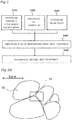
- a method for producing a sintered R-T-B based magnet includes step S10 of providing a sintered R-T-B based magnet work, step S20 of providing an RH compound, and step S30 of providing an RL-Ga alloy.
- the order of step S10 of providing a sintered R-T-B based magnet work, step S20 of providing an RH compound, and step S30 of providing an RL-Ga alloy may be arbitrary; and a sintered R-T-B based magnet work, an RH compound, and an RL-Ga alloy which have been produced in different places may be used.
- the sintered R-T-B based magnet work contains:
- this sintered R-T-B based magnet work satisfies eq. (1) below, where the T content (mass%) is denoted as [T] and the B content (mass%) is denoted as [B].
- This eq. (1) being satisfied means that the B content is smaller than is defined by the stoichiometric ratio of the R 2 T 14 B compound, i.e., there is a relatively small B amount for the T amount that is consumed in the main phase (R 2 T 14 B compound) formation.
- RH is at least one heavy rare-earth element which always includes at least one of Tb and Dy.
- the RH compound is at least one selected from RH fluorides, RH oxides, and RH oxyfluorides.
- RL is at least one rare-earth element which always includes at least one of Pr and Nd.
- the RL-Ga alloy may be an alloy of 65 to 97 mass% RL and 3 mass% to 35 mass% Ga. However, 50 mass% or less of Ga may be replaced by at least one of Cu and Sn.
- the RL-Ga alloy may contain inevitable impurities.
- the method for producing a sintered R-T-B based magnet further includes: a diffusion step S40 of, while keeping at least a portion of the RH compound and at least a portion of the RL-Ga alloy in contact with at least a portion of the surface of the sintered R-T-B based magnet work, performing a first heat treatment at a temperature which is not lower than 700°C and not higher than 950°C in a vacuum or an inert gas ambient, to increase the content of at least one of Tb and Dy in the sintered R-T-B based magnet work by not less than 0.05 mass% and not more than 0.40 mass%; and step S50 of subjecting the sintered R-T-B based magnet work having undergone this first heat treatment to a second heat treatment at a temperature which is not lower than 450°C and not higher than 750°C but which is lower than the temperature of the first heat treatment, in a vacuum or an inert gas ambient.
- the diffusion step S40 of performing the first heat treatment is performed before the step S50 of performing the second heat treatment.
- any other step may be performed, e.g., a cooling step; a step of retrieving the sintered R-T-B based magnet work out of a mixture of the RH compound, the RL-Ga alloy, and the sintered R-T-B based magnet work; or the like.
- the sintered R-T-B based magnet has a structure such that powder particles of a raw material alloy have bound together through sintering, and is composed of a main phase which mainly consists of an R 2 T 14 B compound and a grain boundary phase which is at the grain boundaries of the main phase.
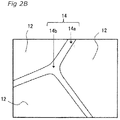
- FIG. 2A is a partially enlarged cross-sectional view schematically showing a sintered R-T-B based magnet.
- FIG. 2B is a further enlarged cross-sectional view schematically showing the interior of a broken-lined rectangular region in FIG. 2A .
- arrowheads indicating a length of 5 ⁇ m are shown as an example of reference length to represent size.
- the sintered R-T-B based magnet is composed of a main phase which mainly consists of an R 2 T 14 B compound 12 and a grain boundary phase 14 which is at the grain boundaries of the main phase 12.
- FIG. 2A is a partially enlarged cross-sectional view schematically showing a sintered R-T-B based magnet.
- FIG. 2B is a further enlarged cross-sectional view schematically showing the interior of a broken-lined rectangular region in FIG. 2A .
- arrowheads indicating a length of 5 ⁇ m are shown as an example of reference length to represent size.
- the grain boundary phase 14 includes an intergranular grain boundary phase 14a in which two R 2 T 14 B compound grains adjoin each other, and grain boundary triple junctions 14b at which three R 2 T 14 B compound grains adjoin one another.
- a typical main phase crystal grain size is not less than 3 ⁇ m and not more than 10 ⁇ m, this being an average value of the diameter of an approximating circle in the magnet cross section.
- the main phase 12, i.e., the R 2 T 14 B compound is a ferromagnetic material having high saturation magnetization and an anisotropy field. Therefore, in a sintered R-T-B based magnet, it is possible to improve B r by increasing the abundance ratio of the R 2 T 14 B compound which is the main phase 12.
- RL and Ga are diffused, together with an infinitesimal amount of RH, from the surface of the sintered R-T-B based magnet work into the magnet work interior, via grain boundaries. It has been found through a study by the inventors that, when an RH compound is allowed to diffuse together with an RL-Ga alloy at a specific temperature, owing to the action of a liquid phase containing RL and Ga, diffusion of RH into the magnet interior can be greatly promoted. As a result of this, RH can be introduced into the magnet work interior with a small RH amount, while also attaining a high effect of H cJ improvement. It has further been found through studies that this high effect of H cJ improvement is obtained when RH is introduced in a very minute range.
- the present disclosure comprises a finding that, when an RH amount in a very minute range (not less than 0.05 mass% and not more than 0.40 mass%) is diffused together with an RL-Ga alloy into the magnet work interior, a very high effect of H cJ improvement is obtained, while reducing the amount of RH used.
- any sintered R-T-B based magnet prior to a first heat treatment or during a first heat treatment will be referred to as a "sintered R-T-B based magnet work"; any sintered R-T-B based magnet after a first heat treatment but prior to or during a second heat treatment will be referred to as a "sintered R-T-B based magnet work having undergone the first heat treatment"; and any sintered R-T-B based magnet after the second heat treatment will be simply referred to as a "sintered R-T-B based magnet".
- An R-T-Ga phase is a compound containing R, T and Ga, a typical example thereof being an R 6 T 13 Ga compound.
- An R 6 T 13 Ga compound has a La 6 Co 11 Ga 3 type crystal structure.
- An R 6 T 13 Ga compound may take the form of an R 6 T 13 - ⁇ Ga 1+ ⁇ compound.
- the R-T-Ga phase may be R 6 T 13 - ⁇ (Ga 1-x-y-z Cu x Al y Si z ) 1+ ⁇ .
- the R content is not less than 27.5 mass% and not more than 35.0 mass%.
- R is at least one rare-earth element which always includes at least one of Nd and Pr. If R accounts for less than 27.5 mass%, a liquid phase will not sufficiently occur in the sintering process, and it will be difficult for the sintered compact to become adequately dense in texture. On the other hand, if R exceeds 35.0 mass%, grain growth will occur during sintering, thus lowering H cJ .
- R preferably accounts for not less than 28 mass% and not more than 33 mass%, and more preferably not less than 29 mass% and not more than 33 mass%.
- the B content is not less than 0.80 mass% and not more than 0.99 mass%. If the B content is less than 0.80 mass%, B r may lower; if it exceeds 0.99 mass%, H cJ may lower. B may be partially replaced with C.
- the Ga content in the sintered R-T-B based magnet work before Ga is diffused from the RL-Ga alloy is not less than 0 mass% and not more than 0.8 mass%.
- Ga is introduced by allowing an RL-Ga alloy to diffuse into the sintered R-T-B based magnet work; therefore, the sintered R-T-B based magnet work may not contain any Ga (i.e., 0 mass%). If the Ga content exceeds 0.8 mass%, magnetization of the main phase may become lowered due to Ga being contained in the main phase as described above, so that high B r may not be obtained.
- the Ga content is 0.5 mass% or less, as this will provide higher B r .
- the M content is not less than 0 mass% and not more than 2.0 mass%.
- M is at least one of Cu, Al, Nb and Zr; although it may be 0 mass% and still the effects of the present disclosure will be obtained, a total of 2.0 mass% or less of Cu, Al, Nb and Zr may be contained.
- Cu and/or Al being contained can improve H cJ .
- Cu and/or Al may be purposely added, or those which will be inevitably introduced during the production process of the raw material or alloy powder used may be utilized (a raw material containing Cu and/or Al as impurities may be used).
- Nb and/or Zr being contained will suppress abnormal grain growth of crystal grains during sintering.
- M always contains Cu, such that Cu is contained in an amount of not less than 0.05 mass% and not more than 0.30 mass%.
- Cu being contained in an amount of not less than 0.05 mass% and not more than 0.30 mass% will allow H cJ to be further improved.
- the T content is 60 mass% or more. If the T content is less than 60 mass%, B r and H cJ may greatly lower.
- T is Fe, or Fe and Co, the Fe content accounting for 85 mass% or more in the entire T. If the Fe content is less than 85 mass%, B r and H cJ may lower.
- the Fe content accounting for 85 mass% or more in the entire T means that, in the case where e.g. the T content accounts for 75 mass% in the sintered R-T-B based magnet work, 63.7 mass% or more of the sintered R-T-B based magnet work is Fe.
- the Fe content accounts for 90 mass% or more in the entire T, as this will provide higher B r and higher H cJ .
- a sintered R-T-B based magnet work according to the present disclosure may contain Ag, Zn, In, Sn, Ti, Ni, Hf, Ta, W, Ge, Mo, V, Y, La, Ce, Sm, Ca, Mg, Cr, H, F, P, S, Cl, O, N, C, and the like.
- the preferable contents are: Ni, Ag, Zn, In, Sn and Ti each account for 0.5 mass% or less; Hf, Ta, W, Ge, Mo, V, Y, La, Ce, Sm, Ca, Mg and Cr each account for 0.2 mass% or less; H, F, P, S and Cl account for 500 ppm or less; O accounts for 6000ppm or less; N accounts for 1000ppm or less; and C accounts for 1500ppm or less.
- a total content of these elements preferably accounts for 5 mass% or less of the entire sintered R-T-B based magnet work. If a total content of these elements exceeds 5 mass% of the entire R-T-B based sintered work, high B r and high H cJ may not be obtained. T / 55.85 > 14 ⁇ B / 10.8
- [T] denotes the T content (mass%)
- [B] denotes the B content (mass%)
- the composition of the sintered R-T-B based magnet work satisfies eq. (1) and further contains Ga, an R-T-Ga phase will be generated at the grain boundaries of the sintered R-T-B based magnet as finally obtained, whereby high H cJ can be obtained.
- the B content is smaller than in commonly-available sintered R-T-B based magnets.
- Commonly-available sintered R-T-B based magnets have compositions in which [T]/55.85 (i.e., the atomic weight of Fe) is smaller than 14 ⁇ [B]/10.8 (i.e., the atomic weight of B), in order to ensure that an Fe phase or an R 2 T 17 phase will not occur in addition to the main phase, i.e., an R 2 T 14 B phase (where [T] is the T content by mass%; and [B] is the B content by mass%).
- the sintered R-T-B based magnet work according to a preferred embodiment of the present disclosure is defined by Inequality (1) so that [T]/55.85 (i.e., the atomic weight of Fe) is greater than 14 ⁇ [B]/10.8 (i.e., the atomic weight of B).
- the reason for reciting the atomic weight of Fe is that the main component of T in the sintered R-T-B based magnet work according to the present disclosure is Fe.
- RH is at least one heavy rare-earth element which always includes at least one of Tb and Dy.
- the RH compound is at least one selected from RH fluorides, RH oxides, and RH oxyfluorides, e.g., TbF 3 , DyF 3 , Tb 2 O 3 , Dy 2 O 3 , Tb 4 OF, or Dy 4 OF.
- the shape and size of the RH compound are not particularly limited, and may be arbitrary.
- the RH compound may take the shape of a film, a foil, powder, a block, particles, or the like.
- RL is at least one rare-earth element which always includes at least one of Pr and Nd.
- RL accounts for 65 to 97 mass% of the entire RL-Ga alloy
- Ga accounts for 3 mass% to 35 mass% of the entire RL-Ga alloy.
- 50 mass% or less of Ga may be replaced by at least one of Cu and Sn. Inevitable impurities may be contained.
- that "50 mass% or less of Ga may be replaced by Cu” means that, given a Ga content (mass%) in the RL-Ga alloy being defined as 100%, 50% thereof may be replaced by Cu.
- the RL-Ga alloy always contains Pr, and the Pr content accounts for 50 mass% or more of the entire RL; more preferably, 80% or more of the entire RL is Pr; most preferably, RL is Pr.
- Pr is more ready to diffuse into the grain boundary phase, thus allowing RH to be more efficiently diffused and making it possible to obtain higher H cJ .
- the shape and size of the RL-Ga alloy are not particularly limited, and may be arbitrary.
- the RL-Ga alloy may take the shape of a film, a foil, powder, a block, particles, or the like.
- a sintered R-T-B based magnet work can be provided by using a generic method for producing a sintered R-T-B based magnet, e.g., an Nd-Fe-B based sintered magnet.
- a raw material alloy which is produced by a strip casting method or the like may be pulverized to not less than 3 ⁇ m and not more than 10 ⁇ m by using a jet mill or the like, thereafter pressed in a magnetic field, and then sintered at a temperature of not lower than 900°C and not higher than 1100°C.
- the pulverized particle size exceeds 10 ⁇ m, the sintered R-T-B based magnet as finally obtained will have too large a crystal grain size to achieve high H cJ , which is not preferable.
- the sintered R-T-B based magnet work may be produced from one kind of raw material alloy (a single raw-material alloy), or through a method of using two or more kinds of raw material alloys and mixing them (blend method).
- the RH compound an RH fluoride, an RH oxide, or an RH oxyfluoride that is commonly used may be provided.
- the RH compound may be what is obtained by pulverizing an alloy obtained as above with a known pulverization means such as a pin mill.
- the RL-Ga alloy can be provided by a method of producing a raw material alloy that is adopted in generic methods for producing a sintered R-T-B based magnet, e.g., a mold casting method, a strip casting method, a single roll rapid quenching method (a melt spinning method), an atomizing method, or the like.
- the RL-Ga alloy may be what is obtained by pulverizing an alloy obtained as above with a known pulverization means such as a pin mill.
- a diffusion step is performed which involves, while keeping at least a portion of the RH compound and at least a portion of the RL-Ga alloy in contact with at least a portion of the surface of the sintered R-T-B based magnet work that has been provided as above, performing a first heat treatment at a temperature which is not lower than 700°C and not higher than 950°C in a vacuum or an inert gas ambient, in order to increase the content of at least one of Tb and Dy in the sintered R-T-B based magnet work by not less than 0.05 mass% and not more than 0.40 mass%.
- the introduced amount of RH (amount of increase) can be relatively easily controlled by adjusting the amount of RH compound and the heating temperature during the process. It must be noted for clarity's sake that, in the present specification, to "increase the content of at least one of Tb and Dy by not less than 0.05 mass% and not more than 0.40 mass%" means that, regarding the content as expressed in mass%, its value is increased by not less than 0.05 and not more than 0.40.
- the diffusion step has increased the Tb content by 0.10 mass%.
- the determination as to whether the content of at least one of Tb and Dy (RH amount) has increased by not less than 0.05 mass% and not more than 0.40 mass% is made by measuring the Tb and Dy contents in the entirety of the sintered R-T-B based magnet work before the diffusion step and the sintered R-T-B based magnet work after the diffusion step (or the sintered R-T-B based magnet after the second heat treatment), and seeing how much the Tb and Dy contents (a total content of Tb and Dy) have increased through the diffusion.
- the first heat treatment temperature is lower than 700°C, the amount of liquid phase containing RH, RL and Ga will be too little to obtain high H cJ .
- H cJ may lower.
- it is not lower than 900°C and not higher than 950°C, as this will provide higher H cJ .
- the sintered R-T-B based magnet work having undergone the first heat treatment (not lower than 700°C and not higher than 950°C) is cooled to 300°C at a cooling rate of 5°C/minute or more, from the temperature at which the first heat treatment was performed, as this will provide higher H cJ . Even more preferably, the cooling rate down to 300°C is 15°C/minute or more.
- the first heat treatment can be performed by placing an RH compound and an RL-Ga alloy in any arbitrary shape on the surface of the sintered R-T-B based magnet work, and using a known heat treatment apparatus.
- the surface of the sintered R-T-B based magnet work may be covered by a powder layer of the RH compound and RL-Ga alloy, and the first heat treatment may be performed.
- the dispersion medium may be evaporated, thus allowing the RH compound and RL-Ga alloy to come in contact with the sintered R-T-B based magnet work.
- the dispersion medium may be alcohols (ethanol, etc.), NMP (N-methylpyrrolidone), aldehydes, and ketones.
- the RH compound and the RL-Ga alloy may be separately placed on the surface of the sintered R-T-B based magnet, or a mixture obtained by mixing the RH compound and the RL-Ga alloy may be placed on the surface of the sintered R-T-B based magnet work.
- the RH compound and the RL-Ga alloy may be placed at any arbitrary position so long as at least a portion of the RH compound and at least a portion of the RL-Ga alloy are in contact with at least a portion of the sintered R-T-B based magnet work; however, as will be indicated by Experimental Examples below, it is preferable that the RH compound and the RL-Ga alloy are placed so as to be in contact with at least a surface that is perpendicular to the alignment direction of the sintered R-T-B based magnet work. This will allow a liquid phase containing RH, RL and Ga to be introduced from the magnet surface into the interior more efficiently through diffusion.
- the RH compound and the RL-Ga alloy may be in contact in the alignment direction of the sintered R-T-B based magnet work alone, or the RH compound and the RL-Ga alloy may be in contact with the entire surface of the sintered R-T-B based magnet work.
- the sintered R-T-B based magnet work having undergone the first heat treatment is subjected to a heat treatment at a temperature which is not lower than 450°C and not higher than 750°C but which is lower than the temperature effected in the step of performing the first heat treatment, in a vacuum or an inert gas ambient.
- this heat treatment is referred to as the second heat treatment.
- the second heat treatment is at a higher temperature than is the first heat treatment, or if the temperature of the second heat treatment is below 450°C or above 750°C, the generated amount of R-T-Ga phase will be too little to obtain high H cJ .
- Raw materials of respective elements were weighed so that the alloy composition would approximately result in the composition shown indicated as No. A-1 in Table 1, and an alloy was produced by a strip casting technique.
- the resultant alloy was coarse-pulverized by a hydrogen pulverizing method, thus obtaining a coarse-pulverized powder.
- the fine-pulverized powder zinc stearate was added as a lubricant in an amount of 0.05 mass% relative to 100 mass% of fine-pulverized powder; after mixing, the fine-pulverized powder was pressed in a magnetic field, whereby a compact was obtained.
- a so-called orthogonal magnetic field pressing apparatus transverse magnetic field pressing apparatus
- the resultant compact was sintered for 4 hours at 1080°C (i.e., a temperature was selected at which a sufficiently dense texture would result through sintering), whereby a plurality of sintered R-T-B based magnet works were obtained.
- Each resultant sintered R-T-B based magnet work had a density of 7.5 Mg/m 3 or more.
- a component analysis of the resultant sintered R-T-B based magnet works is shown in Table 1. The respective components in Table 1 were measured by using Inductively Coupled Plasma Optical Emission Spectroscopy (ICP-OES). Any instance of eq. (1) according to the present disclosure being satisfied is indicated as " ⁇ "; any instance of failing to satisfy it is indicated as " ⁇ ".
- TbF 3 having a particle size D 50 of 100 ⁇ m or less was provided.
- the sintered R-T-B based magnet work of No. A-1 in Table 1 was cut and ground into a 7.4 mm ⁇ 7.4 mm ⁇ 7.4 mm cube.
- the RH compound (TbF 3 ) was spread on a surface of the sintered R-T-B based magnet work defining a face (single face) that was perpendicular to the alignment direction, such that RH would be spread by values indicated as "RH spread amount (mass%)" in Table 3.
- RL-Ga alloy No.
- the aforementioned cooling i.e., cooling down to room temperature after performing the first heat treatment
- an average cooling rate 25°C/minute
- variation in the cooling rate i.e., a difference between the highest value and the lowest value of the cooling rate
- the amount of RH increase was 0.10 mass% in No. 1-2, which is an example of the present invention where an RH compound was allowed to diffuse together with an RL-Ga alloy, whereas the amount of RH increase was 0.02 mass% in No. 1-7, which is a comparative example where only the RH compound was allowed to diffuse by the same RH spread amount (0.20 mass%) as in No. 1-2.
- No. 1-7 which is a comparative example where only the RH compound was allowed to diffuse by the same RH spread amount (0.20 mass%) as in No. 1-2.
- the present disclosure makes it possible to greatly reduce the amount of RH used, and attain high ⁇ H cJ with a small amount of RH used.
- a high ⁇ H cJ will not be obtained if the amount of increase due to RH diffusion exceeds 0.40 mass%.
- the amount of improvement ⁇ H cJ gradually lowers. Specifically, ⁇ H cJ is improved by 15 kA/m when the introduced amount of RH increases by 0.05 mass% from No. 1-1 (0.05 mass%) to No. 1-2 (0.10 mass%); however, from No. 1-2 (0.10 mass%) to No.
- ⁇ H cJ is improved by 10 kA/m for a 0.10 mass% increase in the introduced amount of RH; and from No. 1-3 (0.20 mass%) to No. 1-4 (0.40 mass%), ⁇ H cJ is improved by 5 kA/m for a 0.20 mass% increase in the introduced amount of RH.
- the amount of improvement ⁇ H cJ becomes gradually small. Therefore, above 0.40 mass%, it is impossible to obtain high B r and high H cJ while reducing the amount of RH used, because the effect of H cJ improvement is low.
- the present disclosure makes it possible to obtain high ⁇ H cJ even as compared to a value obtained by totaling the respective ⁇ H cJ values when separately conducting a diffusion from an RL-Ga alloy and a diffusion from an RH compound.
- the example of the present invention No. 1-2 had a ⁇ H cJ of 415 kA/m, a total ⁇ H cJ between the ⁇ H cJ (200 kA/m) when only an RL-Ga alloy (sample No. 1-6) was allowed to diffuse and the ⁇ H cJ (120 kA/m) of sample No. 1-7, in which the same amount of RH compound as in No. 1-2 (0.20 mass%) was spread, was 320 kA/m.
- ⁇ H cJ is being greatly improved (320 kA/m ⁇ 415 kA/m).
- Example 5 By a similar method to that of Example 1, TbF 3 was provided as an RH compound, and No. B-1 was provided as an RL-Ga alloy. Then, except for performing the heat treatments at the first heat treatment temperatures and second heat treatment temperatures shown in Table 5, sintered R-T-B based magnets were produced by a similar method to that of Example 1. With respect to each resultant sample, an amount of RH increase, B r , H cJ , and ⁇ H cJ were determined by similar methods to those of Example 1. The results are shown in Table 5. [Table 4] No.
- ⁇ H cJ was so high as 400 kA/m or more, and high B r and high H cJ were obtained.
- ⁇ H cJ was half or less of those of the examples of the present invention, such that high B r and high H cJ were not obtained, in all of: Nos. 2-4 and 2-5, in which the first heat treatment was outside the range according to the present disclosure; and No. 2-6, in which the second heat treatment temperature was outside the range according to the present disclosure.
- TbF 3 , Tb 2 O 3 and Dy 1 F 3 having a particle size D 50 of 100 ⁇ m or less were each provided.
- Example 7 By a similar method to that of Example 1, No. B-1 was provided as an RL-Ga alloy. Then, except for performing the heat treatments at the first heat treatment temperatures and second heat treatment temperature shown in Table 7, sintered R-T-B based magnets were produced by a similar method to that of Example 1. With respect to each resultant sample, an amount of RH increase, B r , and H cJ were determined by similar methods to those of Example 1. The results are shown in Table 7. [Table 7] No.
- TbF 3 B-1 900°C 500°C 0.30 0.15 1.34 1700 Inv. 3-13 A-15 TbF 3 B-1 900°C 500°C 0.30 0.15 1.32 1880 Inv. 3-14 A-16 TbF 3 B-1 900°C 500°C 0.30 0.15 1.31 1800 Inv. 3-15 A-17 TbF 3 B-1 900°C 500°C 0.30 0.15 1.28 1580 Comp. 3-16 A-18 Tb 2 O 3 B-1 900°C 500°C 0.40 0.20 1.38 1730 Inv. 3-17 A-18 DyF 3 B-1 900°C 500°C 0.40 0.20 1.38 1680 Inv.
- examples of the present invention (Nos. 3-2 to 3-5, No. 3-8, Nos. 3-10 to 3-14, Nos. 3-16 and 3-17), which were within the composition range for a sintered R-T-B based magnet work according to the present disclosure, all had an H cJ of 1600 kA/m or more, and all of these examples of the present invention attained high B r and high H cJ .
- H cJ was less than 1600 kA/m, such that high B r and high H cJ were not obtained, in all of: Nos. 3-1 and No. 3-6, in which the B content in the sintered R-T-B based magnet work was outside the range according to the present disclosure; Nos.
- examples of the present invention (Nos. 4-1 to 4-15), which were within the ranges according to the present disclosure, all had an H cJ of 1600 kA/m or more, and all of these examples of the present invention attained high B r and high H cJ .
- the RL-Ga alloy composition fell outside preferred embodiments according to the present disclosure (i.e., the RL accounted for less than 65 mass% in the entire RL alloy; and Ga accounted for more than 35 mass%) and No. 4-11 (in which the RL in the RL-Ga alloy was Nd (that is, not Pr)), the other examples of the present invention (Nos.
- RL accounts for not less than 65 mass% and not more than 97 mass% of the entire RL-Ga alloy; Ga accounts for not less than 3 mass% and not more than 35 mass% of the entire RL-Ga alloy; and RL always contains Pr.
- a sintered R-T-B based magnet with high remanence and high coercivity can be produced.
- a sintered magnet according to the present disclosure is suitable for various motors such as motors to be mounted in hybrid vehicles, home appliance products, etc., that are exposed to high temperatures.
Landscapes
- Engineering & Computer Science (AREA)
- Chemical & Material Sciences (AREA)
- Power Engineering (AREA)
- Mechanical Engineering (AREA)
- Manufacturing & Machinery (AREA)
- Materials Engineering (AREA)
- Metallurgy (AREA)
- Organic Chemistry (AREA)
- Inorganic Chemistry (AREA)
- Crystallography & Structural Chemistry (AREA)
- Hard Magnetic Materials (AREA)
- Manufacturing Cores, Coils, And Magnets (AREA)
- Powder Metallurgy (AREA)
Applications Claiming Priority (2)
| Application Number | Priority Date | Filing Date | Title |
|---|---|---|---|
| JP2017015394 | 2017-01-31 | ||
| PCT/JP2018/003088 WO2018143229A1 (ja) | 2017-01-31 | 2018-01-31 | R-t-b系焼結磁石の製造方法 |
Publications (2)
| Publication Number | Publication Date |
|---|---|
| EP3579257A1 true EP3579257A1 (de) | 2019-12-11 |
| EP3579257A4 EP3579257A4 (de) | 2020-02-19 |
Family
ID=63039758
Family Applications (1)
| Application Number | Title | Priority Date | Filing Date |
|---|---|---|---|
| EP18747505.8A Withdrawn EP3579257A4 (de) | 2017-01-31 | 2018-01-31 | Verfahren zur herstellung eines gesinterten r-t-b-magnets |
Country Status (5)
| Country | Link |
|---|---|
| US (1) | US11037724B2 (de) |
| EP (1) | EP3579257A4 (de) |
| JP (1) | JP6414653B1 (de) |
| CN (1) | CN109964290B (de) |
| WO (1) | WO2018143229A1 (de) |
Cited By (2)
| Publication number | Priority date | Publication date | Assignee | Title |
|---|---|---|---|---|
| CN111261355A (zh) * | 2020-02-26 | 2020-06-09 | 厦门钨业股份有限公司 | 钕铁硼磁体材料、原料组合物、制备方法、应用 |
| US11424056B2 (en) | 2019-01-28 | 2022-08-23 | Hitachi Metals, Ltd. | Method for producing sintered R-T-B based magnet |
Families Citing this family (14)
| Publication number | Priority date | Publication date | Assignee | Title |
|---|---|---|---|---|
| KR102561239B1 (ko) * | 2018-11-27 | 2023-07-31 | 엘지이노텍 주식회사 | 희토류 자석 제조방법 |
| CN109585113A (zh) * | 2018-11-30 | 2019-04-05 | 宁波韵升股份有限公司 | 一种烧结钕铁硼磁体的制备方法 |
| JP7139920B2 (ja) | 2018-12-03 | 2022-09-21 | Tdk株式会社 | R‐t‐b系永久磁石 |
| CN111223627B (zh) * | 2020-02-26 | 2021-12-17 | 厦门钨业股份有限公司 | 钕铁硼磁体材料、原料组合物、制备方法、应用 |
| CN111243807B (zh) * | 2020-02-26 | 2021-08-27 | 厦门钨业股份有限公司 | 一种钕铁硼磁体材料、原料组合物及制备方法和应用 |
| CN111312461B (zh) * | 2020-02-26 | 2021-10-01 | 厦门钨业股份有限公司 | 一种钕铁硼磁体材料、原料组合物及制备方法和应用 |
| CN111223626B (zh) * | 2020-02-26 | 2021-07-30 | 厦门钨业股份有限公司 | 钕铁硼磁体材料、原料组合物、制备方法、应用 |
| CN111524675B (zh) * | 2020-04-30 | 2022-02-08 | 福建省长汀金龙稀土有限公司 | 一种r-t-b系永磁材料及其制备方法和应用 |
| CN113936877A (zh) * | 2020-06-29 | 2022-01-14 | 有研稀土新材料股份有限公司 | 一种改性烧结钕铁硼磁体及其制备方法与应用 |
| WO2022181808A1 (ja) * | 2021-02-26 | 2022-09-01 | 日本電産株式会社 | モータ、駆動システム、掃除機、無人飛行体、電動航空機 |
| JP2022132032A (ja) * | 2021-02-26 | 2022-09-07 | 日本電産株式会社 | ネオジム磁石、ネオジム磁石の製造方法 |
| JP2022132088A (ja) * | 2021-02-26 | 2022-09-07 | 日本電産株式会社 | モータ、駆動システム、掃除機、無人飛行体、電動航空機 |
| CN115482982A (zh) * | 2022-08-30 | 2022-12-16 | 京磁材料科技股份有限公司 | 永磁体及其制备方法 |
| CN115240944B (zh) * | 2022-09-19 | 2022-12-30 | 南通正海磁材有限公司 | 一种烧结钕铁硼永磁体及其制备方法和应用 |
Family Cites Families (9)
| Publication number | Priority date | Publication date | Assignee | Title |
|---|---|---|---|---|
| EP2899726B1 (de) | 2006-03-03 | 2018-02-21 | Hitachi Metals, Ltd. | R-fe-b-seltenerd-sintermagnet |
| US8317937B2 (en) * | 2009-03-31 | 2012-11-27 | Hitachi Metals, Ltd. | Alloy for sintered R-T-B-M magnet and method for producing same |
| JP5572673B2 (ja) * | 2011-07-08 | 2014-08-13 | 昭和電工株式会社 | R−t−b系希土類焼結磁石用合金、r−t−b系希土類焼結磁石用合金の製造方法、r−t−b系希土類焼結磁石用合金材料、r−t−b系希土類焼結磁石、r−t−b系希土類焼結磁石の製造方法およびモーター |
| JP5884957B1 (ja) * | 2014-04-25 | 2016-03-15 | 日立金属株式会社 | R−t−b系焼結磁石の製造方法 |
| JP6503960B2 (ja) | 2014-07-29 | 2019-04-24 | 日立金属株式会社 | R−t−b系焼結磁石の製造方法 |
| US10510483B2 (en) | 2014-09-11 | 2019-12-17 | Hitachi Metals, Ltd. | Production method for R-T-B sintered magnet |
| DE112016000798B4 (de) | 2015-02-18 | 2025-07-17 | Proterial, Ltd. | Verfahren zum Herstellen eines R-T-B-basierten gesinterten Magneten |
| US10529473B2 (en) * | 2016-03-28 | 2020-01-07 | Tdk Corporation | R-T-B based permanent magnet |
| US11174537B2 (en) | 2016-08-17 | 2021-11-16 | Hitachi Metals, Ltd. | R-T-B sintered magnet |
-
2018
- 2018-01-31 WO PCT/JP2018/003088 patent/WO2018143229A1/ja not_active Ceased
- 2018-01-31 US US16/481,084 patent/US11037724B2/en active Active
- 2018-01-31 JP JP2018540885A patent/JP6414653B1/ja active Active
- 2018-01-31 CN CN201880004483.9A patent/CN109964290B/zh active Active
- 2018-01-31 EP EP18747505.8A patent/EP3579257A4/de not_active Withdrawn
Cited By (2)
| Publication number | Priority date | Publication date | Assignee | Title |
|---|---|---|---|---|
| US11424056B2 (en) | 2019-01-28 | 2022-08-23 | Hitachi Metals, Ltd. | Method for producing sintered R-T-B based magnet |
| CN111261355A (zh) * | 2020-02-26 | 2020-06-09 | 厦门钨业股份有限公司 | 钕铁硼磁体材料、原料组合物、制备方法、应用 |
Also Published As
| Publication number | Publication date |
|---|---|
| JP6414653B1 (ja) | 2018-10-31 |
| CN109964290B (zh) | 2020-05-01 |
| JPWO2018143229A1 (ja) | 2019-02-07 |
| EP3579257A4 (de) | 2020-02-19 |
| US20200411236A1 (en) | 2020-12-31 |
| US11037724B2 (en) | 2021-06-15 |
| CN109964290A (zh) | 2019-07-02 |
| WO2018143229A1 (ja) | 2018-08-09 |
Similar Documents
| Publication | Publication Date | Title |
|---|---|---|
| EP3579256B1 (de) | Verfahren zur herstellung eines gesinterten r-t-b-magneten | |
| EP3579257A1 (de) | Verfahren zur herstellung eines gesinterten r-t-b-magnets | |
| EP3330984B1 (de) | Verfahren zur herstellung eines gesinterten r-t-b-magneten | |
| EP3503130B1 (de) | R-t-b-sintermagnet | |
| US10672545B2 (en) | R-T-B based permanent magnet | |
| EP3128521B1 (de) | W-haltiger r-fe-b-cu-sintermagnet und abschrecklegierung | |
| US11232889B2 (en) | R-T-B based permanent magnet | |
| US10672544B2 (en) | R-T-B based permanent magnet | |
| US11823824B2 (en) | R-T-B sintered magnet | |
| US10916373B2 (en) | R-T-B sintered magnet and production method therefor | |
| US10242781B2 (en) | Method for manufacturing R-T-B based sintered magnet | |
| EP3716297B1 (de) | Gesinterter magnet auf r-t-b-basis | |
| US11424056B2 (en) | Method for producing sintered R-T-B based magnet | |
| JP7059995B2 (ja) | R-t-b系焼結磁石 | |
| US10614938B2 (en) | W-containing R—Fe—B—Cu sintered magnet and quenching alloy | |
| EP4498392A1 (de) | R-t-b-sintermagnet |
Legal Events
| Date | Code | Title | Description |
|---|---|---|---|
| STAA | Information on the status of an ep patent application or granted ep patent |
Free format text: STATUS: THE INTERNATIONAL PUBLICATION HAS BEEN MADE |
|
| PUAI | Public reference made under article 153(3) epc to a published international application that has entered the european phase |
Free format text: ORIGINAL CODE: 0009012 |
|
| STAA | Information on the status of an ep patent application or granted ep patent |
Free format text: STATUS: REQUEST FOR EXAMINATION WAS MADE |
|
| 17P | Request for examination filed |
Effective date: 20190723 |
|
| AK | Designated contracting states |
Kind code of ref document: A1 Designated state(s): AL AT BE BG CH CY CZ DE DK EE ES FI FR GB GR HR HU IE IS IT LI LT LU LV MC MK MT NL NO PL PT RO RS SE SI SK SM TR |
|
| AX | Request for extension of the european patent |
Extension state: BA ME |
|
| A4 | Supplementary search report drawn up and despatched |
Effective date: 20200117 |
|
| RIC1 | Information provided on ipc code assigned before grant |
Ipc: H01F 41/02 20060101AFI20200113BHEP Ipc: H01F 1/057 20060101ALI20200113BHEP Ipc: C22C 38/00 20060101ALI20200113BHEP Ipc: C22C 38/10 20060101ALI20200113BHEP |
|
| DAV | Request for validation of the european patent (deleted) | ||
| DAX | Request for extension of the european patent (deleted) | ||
| STAA | Information on the status of an ep patent application or granted ep patent |
Free format text: STATUS: EXAMINATION IS IN PROGRESS |
|
| 17Q | First examination report despatched |
Effective date: 20201207 |
|
| STAA | Information on the status of an ep patent application or granted ep patent |
Free format text: STATUS: THE APPLICATION HAS BEEN WITHDRAWN |
|
| 18W | Application withdrawn |
Effective date: 20210914 |