EP3581141A1 - Perle pour maintinir un appareil orthodontique - Google Patents
Perle pour maintinir un appareil orthodontique Download PDFInfo
- Publication number
- EP3581141A1 EP3581141A1 EP18305717.3A EP18305717A EP3581141A1 EP 3581141 A1 EP3581141 A1 EP 3581141A1 EP 18305717 A EP18305717 A EP 18305717A EP 3581141 A1 EP3581141 A1 EP 3581141A1
- Authority
- EP
- European Patent Office
- Prior art keywords
- pearl
- splint
- tooth
- archwire
- teeth
- Prior art date
- Legal status (The legal status is an assumption and is not a legal conclusion. Google has not performed a legal analysis and makes no representation as to the accuracy of the status listed.)
- Withdrawn
Links
Images



Classifications
-
- A—HUMAN NECESSITIES
- A61—MEDICAL OR VETERINARY SCIENCE; HYGIENE
- A61C—DENTISTRY; APPARATUS OR METHODS FOR ORAL OR DENTAL HYGIENE
- A61C7/00—Orthodontics, i.e. obtaining or maintaining the desired position of teeth, e.g. by straightening, evening, regulating, separating, or by correcting malocclusions
- A61C7/12—Brackets; Arch wires; Combinations thereof; Accessories therefor
- A61C7/14—Brackets; Fixing brackets to teeth
- A61C7/146—Positioning or placement of brackets; Tools therefor
-
- A—HUMAN NECESSITIES
- A61—MEDICAL OR VETERINARY SCIENCE; HYGIENE
- A61C—DENTISTRY; APPARATUS OR METHODS FOR ORAL OR DENTAL HYGIENE
- A61C5/00—Filling or capping teeth
- A61C5/007—Dental splints; teeth or jaw immobilisation devices; stabilizing retainers bonded to teeth after orthodontic treatments
-
- A—HUMAN NECESSITIES
- A61—MEDICAL OR VETERINARY SCIENCE; HYGIENE
- A61C—DENTISTRY; APPARATUS OR METHODS FOR ORAL OR DENTAL HYGIENE
- A61C7/00—Orthodontics, i.e. obtaining or maintaining the desired position of teeth, e.g. by straightening, evening, regulating, separating, or by correcting malocclusions
- A61C7/002—Orthodontic computer assisted systems
-
- A—HUMAN NECESSITIES
- A61—MEDICAL OR VETERINARY SCIENCE; HYGIENE
- A61C—DENTISTRY; APPARATUS OR METHODS FOR ORAL OR DENTAL HYGIENE
- A61C7/00—Orthodontics, i.e. obtaining or maintaining the desired position of teeth, e.g. by straightening, evening, regulating, separating, or by correcting malocclusions
- A61C7/08—Mouthpiece-type retainers or positioners, e.g. for both the lower and upper arch
-
- A—HUMAN NECESSITIES
- A61—MEDICAL OR VETERINARY SCIENCE; HYGIENE
- A61C—DENTISTRY; APPARATUS OR METHODS FOR ORAL OR DENTAL HYGIENE
- A61C7/00—Orthodontics, i.e. obtaining or maintaining the desired position of teeth, e.g. by straightening, evening, regulating, separating, or by correcting malocclusions
- A61C7/12—Brackets; Arch wires; Combinations thereof; Accessories therefor
- A61C7/14—Brackets; Fixing brackets to teeth
-
- A—HUMAN NECESSITIES
- A61—MEDICAL OR VETERINARY SCIENCE; HYGIENE
- A61C—DENTISTRY; APPARATUS OR METHODS FOR ORAL OR DENTAL HYGIENE
- A61C7/00—Orthodontics, i.e. obtaining or maintaining the desired position of teeth, e.g. by straightening, evening, regulating, separating, or by correcting malocclusions
- A61C7/12—Brackets; Arch wires; Combinations thereof; Accessories therefor
- A61C7/14—Brackets; Fixing brackets to teeth
- A61C7/143—Brackets with two or more recesses for arch wires
-
- A—HUMAN NECESSITIES
- A61—MEDICAL OR VETERINARY SCIENCE; HYGIENE
- A61C—DENTISTRY; APPARATUS OR METHODS FOR ORAL OR DENTAL HYGIENE
- A61C7/00—Orthodontics, i.e. obtaining or maintaining the desired position of teeth, e.g. by straightening, evening, regulating, separating, or by correcting malocclusions
- A61C7/12—Brackets; Arch wires; Combinations thereof; Accessories therefor
- A61C7/14—Brackets; Fixing brackets to teeth
- A61C7/145—Lingual brackets
-
- A—HUMAN NECESSITIES
- A61—MEDICAL OR VETERINARY SCIENCE; HYGIENE
- A61C—DENTISTRY; APPARATUS OR METHODS FOR ORAL OR DENTAL HYGIENE
- A61C7/00—Orthodontics, i.e. obtaining or maintaining the desired position of teeth, e.g. by straightening, evening, regulating, separating, or by correcting malocclusions
- A61C7/12—Brackets; Arch wires; Combinations thereof; Accessories therefor
- A61C7/20—Arch wires
-
- B—PERFORMING OPERATIONS; TRANSPORTING
- B33—ADDITIVE MANUFACTURING TECHNOLOGY
- B33Y—ADDITIVE MANUFACTURING, i.e. MANUFACTURING OF THREE-DIMENSIONAL [3D] OBJECTS BY ADDITIVE DEPOSITION, ADDITIVE AGGLOMERATION OR ADDITIVE LAYERING, e.g. BY 3D PRINTING, STEREOLITHOGRAPHY OR SELECTIVE LASER SINTERING
- B33Y80/00—Products made by additive manufacturing
-
- A—HUMAN NECESSITIES
- A61—MEDICAL OR VETERINARY SCIENCE; HYGIENE
- A61C—DENTISTRY; APPARATUS OR METHODS FOR ORAL OR DENTAL HYGIENE
- A61C13/00—Dental prostheses; Making same
- A61C13/0003—Making bridge-work, inlays, implants or the like
- A61C13/0006—Production methods
- A61C13/0013—Production methods using stereolithographic techniques
-
- A—HUMAN NECESSITIES
- A61—MEDICAL OR VETERINARY SCIENCE; HYGIENE
- A61C—DENTISTRY; APPARATUS OR METHODS FOR ORAL OR DENTAL HYGIENE
- A61C2201/00—Material properties
Definitions
- the disclosure relates to a method of an orthodontic treatment, a use of a pearl as a holding element for an orthodontic appliance and a pearl for an orthodontic treatment.
- the disclosure relates to a method of an orthodontic treatment.
- the disclosure also relates to a use of a pearl as a holding element for a splint, the pearl being placed on a tooth for an orthodontic treatment, the pearl having a surface, the surface consisting of a first surface and a second surface, the first surface being destined to be in contact with a tooth and the second surface being opposite to the first surface.
- orthodontic appliances comprising one or a plurality of orthodontic wires, a plurality of brackets which are each provided with one or a plurality of slots wherein the orthodontic wire may be inserted, or attachment means whereby the wire may be held.
- These appliances are offered in two versions.
- the brackets are arranged on the outer (labial) surface of the teeth.
- the orthodontic archwire is then inserted into the slots of the brackets so as to align the teeth.
- the brackets are visible when the subject wearing them smiles.
- the brackets are arranged on the inner (lingual) surface of the teeth. The brackets are then externally invisible.
- a bracket includes a mounting base for attachment to a tooth surface and an archwire slot formed upon the base and sized for receiving an orthodontic archwire.
- the bracket is provided with tie wings that hold the archwire by means of a wire ligature or elastic ligature.
- brackets are also used for the same purpose but with no ligature tie. These brackets are qualified of self-ligating braces.
- bracket is easily visible, making the bracket unaesthetic. Furthermore, and especially when the pearl is placed on the lingual surface of a tooth, the bracket as already known could cause a discomfort, when, for example, the tongue touches the bracket.
- occlusal appliance consisting on a removable device, usually made of hard acrylic that fits over the occlusal and incisal surfaces of the teeth in one arch.
- occlusal appliance is generally called a splint.
- a splint can be used individually when the patient suffers from a slight malocclusion of the jaws and/or dental misalignment.
- Another configuration is to use a splint further to a treatment with an orthodontic appliance comprising one or a plurality of orthodontic wires and a plurality of brackets, the use of such a splint complementing the orthodontic treatment.
- a splint is designed according to the future intended arrangement of the teeth. Therefore, when a person wears the splint over the teeth, the splint does not exactly fit with the teeth. Where the splint does not fit with the teeth, the splint applies a pressure to the teeth. This pressure guides the teeth into the desired alignment. So, gradually, the splint fits more and more with the teeth. But, regarding a particular tooth, it appears that, because of its intrinsic characteristics (such as size or shape for example), or because the splint fits well with this tooth, or again because the splint itself cannot apply the correcting movement desired, the splint does not apply a pressure on this tooth. In this situation, it is necessary to place an attachment on the tooth.
- Such an attachment is like a bump or dot.
- the attachment provides an anchor point.
- the attachment helps to apply the pressure on the tooth.
- an attachment is unaesthetic.
- the attachment must be bonded on the tooth, which requires time in order to be placed on teeth, especially when several teeth must be provided with an attachment.
- the disclosure relates to a method of an orthodontic treatment, the method comprising the steps of:
- the method comprises the steps of ;
- the disclosure also relates to a use of a pearl as a holding element for an orthodontic appliance, the pearl being placed on a tooth for an orthodontic treatment, the pearl having a surface, the surface consisting of a first surface and a second surface, the first surface being in contact with a tooth and the second surface being opposite to the first surface (18), wherein the second surface does not comprise any sharp corner.
- Such a pearl allows, in addition to its usefulness for an orthodontic treatment with one or more archwire, applying a pressure on the tooth.
- one and/or the other of the following features may be incorporated in the pearl of the disclosure, alone or in mutual combination:
- Another object of the disclosure is a method of manufacturing a pearl used as a holding element for an orthodontic appliance, the pearl being placed on a tooth for an orthodontic treatment, the pearl comprising a surface, the surface consisting of a first surface and a second surface, the first surface being destined to be in contact with a tooth and the second surface being opposite to the first surface, the second surface not comprising any sharp corner, wherein the pearl is obtained by additive manufacturing.
- the additive manufacturing is made with a ceramic material.
- the additive material is made with a biocompatible material.
- the figures illustrate different examples of a pearl 10 according to the disclosure.
- the pearl 10 is used for an orthodontic treatment.
- the pearl 10 is affixed on a tooth 14.
- the pearl 10 is affixed on the lingual surface 11 of the tooth 14.
- the pearl 10 may be affixed on the labial 13 surface of the tooth 14.
- the pearl 10 is a holding element for an archwire 12. More precisely, the pearl 10 has the function of a bracket for the archwire 12. The pearl 10 holds the archwire 12 within it, this avoids the archwire 12 to release from the pearl 10.
- an orthodontic arch is formed when an archwire 12 is inserted in a series of pearls 10 mounted on several teeth of the same jaw. When the pearls 10 are affixed on the lingual surface 11 of the teeth, the orthodontic arch is a lingual orthodontic arch. When the pearls 10 are affixed on the labial surface 13 of the teeth, the orthodontic arch is a labial orthodontic arch.
- the pearl 10 has a surface 16.
- the surface 16 consists of a first surface 18 and a second surface 22.
- the first surface 18 and the second surface 22 delimit the volume of the pearl 10.
- the volume of the pearl is comprised between 2 mm 3 (cubic millimetre) and 25 mm 3 .
- the volume is comprised between 3 mm 3 and 11 mm 3 .
- the pearl 10 has thus a particular compact size relative to a tooth.
- the pearl 10 occupies between 20% and 99% of the lingual surface of the tooth.
- the pearl 10 may have a shape that is anatomic and/or isomorphic with the teeth. In other words, for a tooth 14 that is wider on its top free end than on its base, the shape of the pearl 10 can also be wider toward the top free end of the tooth 14 than toward the base of the tooth.
- the pearl weights preferably between 1g (gram) and 10 g.
- the pearl 10 is for example made of ceramic material. Ceramic has a similar colour to the one of a tooth, which improves the aesthetic property of the pearl 10. In addition, ceramic is biocompatible, which means that it is compatible with an utilization for a human body. Ceramic is also a material resistant to load, which provide a good bearing of the pearl 10 regarding the load applied by the archwire 12 on the pearl 10. However, the pearl 10 may be made of other materials such as biocompatible resins.
- Such pearl 10 is especially manufactured in one piece when it is made of plastic material, for instance biocompatible resins.
- the manufacture in at least two parts may be manufactured in at least two parts assembled together by attaching means, like snap-fitting for instance.
- Such a manufacture in two parts allows an optimization of the quantity of material used and allows thus a reduction of the costs.
- the manufacture in at least two parts may be particularly applied when the pearl 10 comprises other material such as ceramic.
- the ceramic materials are generally more expensive than the plastic ones.
- the materials used in orthodontic treatment (plastic and ceramic) need to be biocompatible.
- the manufacture in at least two parts may be applied for technical / economic reasons.
- the pearl can be coated. More precisely, the external surface of the pearl 10 can be coated. In fact, the pearl 10 could be manufactured in metal for technical or economic reasons and coated with a smooth material at its surface to increase the patient's comfort. Likewise, the pearl 10 can be made of a smooth material.
- a smooth material is for instance a ceramic material or a plastic material.
- the first surface 18 is destined to be in contact with the tooth 14.
- the first surface 18 has a pearl area 20.
- the pearl area 20 is the area which is destined to be in contact with the tooth 14, on a tooth area 15.
- the pearl area 20 and the tooth area 15 are complementary.
- the shape of the pearl area 20 and the shape of the tooth area 15 are in a complementary form. In that way, the entirety of the pearl area 20 is in contact with the entirety of the tooth area 15..
- the pearl it means that at least the external surface of the second surface 22 is coated.
- the external surface of the first surface 18 may additionally be coated.
- the second surface 22 is opposite to the first surface 18.
- the second surface 22 is destined to be in contact with the surrounding environment of the inside of a mouth. A tongue can therefore touch the second surface 22.
- the second surface 22 is destined to be crossed by the archwire 12.
- the second surface 22 does not comprise any sharp corner. In other words, there is no surface irregularity or roughness on the second surface 22.
- the second surface 22 is therefore smooth.
- the second surface 22 is thus shaped in such a way that it completes the external aspect of a tooth 14.
- the second surface 22 has a domed shape.
- the angles between the tangents of the second surface 22 are comprised between and 120° and 180°.
- the second surface 22 is convex.
- the convexity of the second surface 22 may be more or less pronounced.
- the convexity of the second surface 22 is low (i.e. the second surface 22 is only few curved). In this case, the pearl 10 closes the hole.
- the shape of the first surface 18 is more convex than the shape of the second surface 22.
- the second surface 22 is in continuity with the surface of the tooth 14.
- the second surface 22 can be represented as a smooth function.
- the smooth function has its curves and at least its first derivate continuous.
- the function which represents the second surface 22 may be of class C 1 if only first derivates are continuous.
- the function may be of class C 2 , and its first and second derivates are continuous.
- the function may be of class C 3 , and its first, second and third derivates are continuous.
- the function may be of class C n , and its n derivates are continuous, n being a positive integer.
- This particular shape of the second surface 22 provides an aesthetic result of the pearl 10.
- a person runs his/her tongue over his/her tooth he/she does not have the feeling the tooth comprises a foreign element on its surface. Due to the shape of the second surface 22, the tongue does not hook on the pearl 10, or is not skinned when running over the pearl 10.
- the second surface 22 can comprise an apex 24.
- the apex 24 is not sharp. In fact, the apex 24 is convex.
- the radius of curvature of the apex 24 is chosen in order to give as much as possible the feeling of touching the tooth 14 (and therefore the feeling of absence of the pearl 10). For example, when the pearl 10 is placed on a tooth where the tooth or the pearl 10 is capable of being in contact with a tooth of the opposite jaw, the radius of curvature of the apex 24 should be selected in order to avoid a contact between the pearl 10 and the tooth of the opposite jaw.
- apex 24 can be located relative to a passage 30 that will be discussed below.
- the second surface 22 comprises a first opening 26 and a second opening 27.
- the first opening 26 and the second opening 27 delimit a passage 30.
- the first opening 26 and the second opening 27 are arranged approximately on both sides of the apex 24.
- the passage 30 defines a hollow channel for the archwire 12.
- the passage 30 extends longitudinally along a longitudinal direction D through the first opening 26 and the second opening 27, within the pearl 10.
- the first and second openings 26, 27 are located along the longitudinal direction D, opposite with regard to the apex 24.
- the shape of the passage 30 is provided so as to receive the archwire 12. More precisely, according to the disclosure, the passage 30 is dedicated to the archwire 12.
- the cross-section shape of the passage 30 corresponds to the cross-section shape of the archwire 12.
- the cross-section size of the passage 30 is taller than or equal to the cross-section size of the archwire 12.
- the play, and therefore the cross-section size of the passage 30 and/or the cross-section size of the archwire 12 is chosen in order to allow more or less the archwire 12 to move transversely within the passage 30.
- the best fit between the passage 30 and the archwire 12 is thus chosen for this purpose.
- the cross-section size of the passage 30 almost corresponds to the cross-section size of the archwire 12, the archwire 12 can barely move transversely within the passage 30.
- the more the friction between the passage 30 and the archwire 12, and the more the movements of the tooth 14 are controlled (such as for example the torque movement).
- the cross-section size of the passage 30 is higher than the cross-section size of the archwire 12, the archwire 12 can move transversely within the passage 30.
- the passage 30 can be in metal in order to facilitate the insertion of the archwire 12 and to reduce the friction between the archwire 12 and the passage 30.
- the cross-section of the passage 30 can be square.
- the cross-section of the passage 30 may be rectangular.
- the cross-section of the passage 30 may be circular.
- the cross-section of the passage 30 may also be triangular.
- the cross-section of the passage 30 may be a mix of the shapes presented here above.
- the passage 30 can have a cross-section with a square angle and the remainder rounded.
- the passage can have a cross-section with two square angles and the remainder rounded.
- a square section of the passage 30 is particularly adapted to a square archwire.
- a rectangular section of the passage 30 is particularly adapted to rectangular archwire, and a circular section of the passage 30 is particularly adapted to circular archwire.
- the second surface 22 comprises, in addition to the first and second openings 26 and 27, a third and fourth openings 28 and 29.
- the third opening 28 and the fourth opening 29 defines a supplementary passage 31.
- This supplementary passage 31 may be similar to the passage 30.
- This supplementary passage 31 may also be different to the passage 30.
- the supplementary passage 31 may have a circular cross-section shape while the passage 30 has a square cross-section shape;
- the supplementary passage 31 defines a supplementary hollow channel for a supplementary archwire 12'.
- the supplementary archwire 12' may be identical to the archwire 12. But, the supplementary archwire 12' may also be different to the archwire 12.
- the archwire 12 is circular in its cross-section whereas the supplementary archwire 12' has a circular cross-section.
- the supplementary passage 31 may improve the efficiency of the orthodontic treatment. Indeed, during an orthodontic treatment, teeth are intended to move, from a malocclusion position to an aligned position. Such movement is due to the force exerted by the archwire 12 on each tooth, via the pearl 10. The position of the archwire 12 within the pearl 10 determines the movement of the tooth 14.
- the pearl 10 comprises a supplementary passage 31 and when the supplementary archwire 12' is inserted into the supplementary passage 31, the archwire 12 may for example control the alignment of the tooth 14, and the supplementary archwire 12' may control the orientation of the tooth 14 and therefore the torque movement of the tooth 14.
- the supplementary archwire 12' completes the orthodontic treatment.
- the supplementary archwire 12' improve the effectiveness of the orthodontic treatment.
- the presence of a supplementary archwire 12' allows more force to be applied against the tooth 14 and thus allows reducing the duration of the orthodontic treatment.
- the passage 30 and the supplementary passage 31 may receive simultaneously the archwire 12.
- the pearl 10 is entirely filled with its material between the surface 16 and the passage 30.
- the pearl 10 is therefore a solid body which comprises the passage 30.
- the pearl 10 may comprise matter only at its surface 16 and at around of the passage 30, the material surrounding the passage 30.
- the pearl 10 is hollow, but the passage 30 is delimited by the material.
- the pearl 10 may comprise material and gaps between the surface 16 and the passage 30 in such a way that the arrangement of matter improves the rigidity of the pearl 10 (for example, we could imagine a honeycomb structure).
- the pearl 10 may comprise matter only at its surface 16. In this case, the pearl 10 is hollow.
- the second surface 22 comprises a housing opening 32.
- the housing opening 32 is provided for receiving a free end of the archwire 12.
- the housing opening 32 can be provided on the pearl 10 placed on the last or first tooth of the orthodontic arch.
- the housing opening 32 allows to stow the free end of the archwire 12, and not to leave free the end of the archwire 12 within the mouth of the person who is subject to this orthodontic treatment.
- the material delimits a housing 34 which extends from the housing opening 32 within the pearl. More precisely, along a longitudinal direction H, the housing 34 extends from the housing opening 32 to a bottom 33.
- the housing 34 has therefore a depth delimited by the bottom 33.
- the housing 34 has a shape which is complementary to the shape of the archwire 12 received within the housing 34.
- the housing 34 is provided so that the archwire 12 can move along the longitudinal direction H during the orthodontic treatment.
- the movement of the archwire 12 within the housing 34 is, for example, due to the movement of the teeth from the malocclusion position to the aligned position: the more the teeth tend towards the aligned position, the more the archwire 12 approaches the bottom 33.
- the depth of the housing 34 is chosen so that the archwire 12 does not abut against the bottom 33 of the housing 34. The bottom 33 of the housing 34 thus does not interfere with the orthodontic treatment.
- the dimensions of the pearl 10 depend on several factors.
- the factors can be one or a combination of the following:
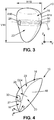
- Figures 4 and 5 illustrate an example of the dimensions that can have a pearl 10.
- the pearl 10 extends along a first direction Y, a second direction X and a third direction Z.
- the first direction Y, the second direction X and the third direction Z are perpendicular to each other.
- the first direction Y represents the horizontal direction.
- the second direction X represents the transversal direction.
- the third direction Z represents the vertical direction.
- the first surface 18 has a horizontal dimension H18, taken between its two most distant points A18 and B18, which is inferior to 5 mm (milimeter).
- the horizontal dimension is 2,5 mm.
- the horizontal dimension H18 can be chosen in order to comprise the largest possible length of archwire 12. The contact of the tongue with the archwire 12 is reduced. In other words, the pearl 10 protects the tongue of any discomfort when touching the archwire 12.
- the first surface 18 has a vertical dimension V18, taken between its two most distant points C18 and D18, which is inferior to 5 mm.
- the vertical dimension is 4 mm.
- the apex 24 is a distance D24, taken between the peak P24 of the apex 24 the first surface 18 which is comprised between 1 mm and 4 mm.
- the distance D24 is comprised between 2 mm and 3 mm.
- the pearl 10 can also be used as a holding element for an orthodontic appliance. More precisely, the orthodontic treatment may be a splint 40 (illustrated in figure 9, 10 and 11 ).
- removing the archwire 12 from the pearl means the end of the orthodontic treatment with an orthodontic appliance comprising an archwire.
- the splint 40 is destined to be placed on teeth.
- the splint 40 has a shape which is complementary to the one of the teeth. More precisely, the splint 40 is designed according to the future intended arrangement of the teeth.
- the future intended arrangement is not necessarily the aligned position of the teeth. Indeed, the future intended arrangement may be an intermediate arrangement of the teeth.
- the splint 40 is designed according to whether the aligned position desired or an intermediate position.
- the splint 40 may be a first splint 40, an intermediate splint 52 or a final splint 54.
- Each first splint 40, intermediate splint 52 and final splint 54 are different to each other.
- the splint 40 As the splint 40 is designed according to the future intended arrangement of the teeth, the splint 40 does not exactly fit with the teeth. The splint 40 thus applies a pressure to the teeth. This pressure guides the teeth into the desired alignment.
- the splint 40 comprises an internal surface 42 and an external surface 44.
- the external surface 44 is destined to be in contact with the surrounding environment of the inside of a mouth.
- the internal surface 42 is destined to be in contact with at least a tooth 14.
- the internal surface 42 corresponds to the external shape of the teeth that the splint 40 covers, in the intended arrangement of the teeth.
- the internal surface 42 has also a lingual surface 46 and labial surface 48.
- the lingual surface 46 is destined to be in contact with the lingual surface of at least a tooth 14.
- the labial surface 48 is destined to be in contact with the labial surface of at least a tooth 14.
- the internal surface 42 comprises impressions 50.
- the impressions 50 are able to receive the pearl 10 placed on the teeth.
- each impression 50 is placed on the internal surface 42 of the splint 40 so as to receive a pearl 10.
- the pearl 10 contributes to apply a pressure on the tooth 14.
- the impression 50 fits more or less well with the pearl 10.
- the pearl 10 applies few or no pressure on the tooth 14.
- the pearl 10 transfers the pressure applied on it by the splint 40 to the tooth 14.
- the impression 50 When the pearl 10 is placed on the lingual surface of the tooth 14, the impression 50 is thus placed on the lingual surface 46 of the internal surface 42 of the splint 40. Likewise, when the pearl 10 is placed on the labial surface of the tooth 14, the impression 50 is thus placed on the labial surface 48 of the internal surface 42 of the splint 40.
- the impression 50 has a general concave shape, which is complementary to the convex shape of the second surface 22 of a pearl 10. In other words, the impression 50 is like a notch which receives the pearl 10.
- each pearl 10 acts as a retainer of the splint against the teeth.
- the splint 40 does not fall out of teeth.
- Another object of the disclosure is a method of manufacturing the pearl 10.
- the pearl 10 is manufactured by additive manufacturing.
- the additive manufacturing is three-dimensional printing. Three-dimensional printing reduces costs and increases productive capacity.
- the pearl 10 can be made of ceramic materials or biocompatible resin.
- the pearl 10 Prior to printing, the pearl 10 is designed by computer-aided design (CAD).
- CAD computer-aided design
- the computer aided-design takes into account the malocclusion position and an aligned position of the tooth or teeth.
- the pearl 10 is manufactured by subtractive manufacturing.
- the subtractive manufacturing is done by cutting materials with a CNC (computer numerical control) milling machine or with a laser cutting machine.
- the pearl 10 is made by casting metal or ceramic or PEEK from a mould.
- Another object of the disclosure is a method of an orthodontic treatment.
- the method involves an orthodontic appliance comprising an archwire 12 and at least a splint 40.
- a pearl 10 is placed on a tooth 14.
- the pearl 10 is fixedly placed on the tooth 14.
- several teeth may be provided with a pearl.
- the pearl 10 is provided with an archwire 12.
- the archwire 12 is placed within the pearl 10 after step a).
- the pearl 10 can be provided with both the archwire 12 and the supplementary archwire 12'.
- the archwire 12 may be removed.
- a first splint 40 is placed over the teeth of a jaw.
- the first splint 40 is replaced with a second splint 52.
- a step c) the second splint is placed over the teeth that previously received the first splint 40, the first splint 40 being beforehand removed.
- the second splint is therefore the final splint 54.
- the orthodontic treatment stops at this step c).
- the second splint corresponds to an intermediate splint 52.
- the intermediate splint 52 is replaced with either another intermediate splint 52 or a final splint 54, depending on the obtained position of the teeth.
- the intermediate splint 52 may be replaced with another intermediate splint 52, as many times as necessary. In that case, each intermediate splint 52 is different than the other intermediate splint 52. More precisely, dimensions of each intermediate splint 52 correspond to a specific position of the teeth.
- step c) is repeated until the obtained position corresponds to the position of the teeth on which the final splint 54 may be then placed.
- a step d) when the intermediate splint 52 is replaced with a final splint 54, the final splint 54 is placed over the teeth that previously received the intermediate splint 52, the intermediate splint 52 being beforehand removed.
Landscapes
- Health & Medical Sciences (AREA)
- General Health & Medical Sciences (AREA)
- Veterinary Medicine (AREA)
- Epidemiology (AREA)
- Life Sciences & Earth Sciences (AREA)
- Animal Behavior & Ethology (AREA)
- Oral & Maxillofacial Surgery (AREA)
- Public Health (AREA)
- Dentistry (AREA)
- Engineering & Computer Science (AREA)
- Chemical & Material Sciences (AREA)
- Manufacturing & Machinery (AREA)
- Materials Engineering (AREA)
- General Engineering & Computer Science (AREA)
- Dental Tools And Instruments Or Auxiliary Dental Instruments (AREA)
Priority Applications (5)
| Application Number | Priority Date | Filing Date | Title |
|---|---|---|---|
| EP18305717.3A EP3581141A1 (fr) | 2018-06-12 | 2018-06-12 | Perle pour maintinir un appareil orthodontique |
| JP2020569955A JP2021527493A (ja) | 2018-06-12 | 2019-06-12 | 歯科矯正治療の方法、歯科矯正器具用の保持要素としてのパールの使用法、および歯科矯正治療用のパール |
| US16/973,909 US20210244508A1 (en) | 2018-06-12 | 2019-06-12 | Method of an orthodontic treatment, use of a pearl as a holding element for an orthodontic appliance and a pearl for an orthodontic treatment |
| CN201980039401.9A CN112261916A (zh) | 2018-06-12 | 2019-06-12 | 正畸治疗方法、珠粒作为正畸矫治器的固持元件的用途以及用于正畸治疗的珠粒 |
| PCT/EP2019/065360 WO2019238762A1 (fr) | 2018-06-12 | 2019-06-12 | Procédé de traitement orthodontique, utilisation d'une perle comme élément de maintien pour un appareil orthodontique et perle pour un traitement orthodontique |
Applications Claiming Priority (1)
| Application Number | Priority Date | Filing Date | Title |
|---|---|---|---|
| EP18305717.3A EP3581141A1 (fr) | 2018-06-12 | 2018-06-12 | Perle pour maintinir un appareil orthodontique |
Publications (1)
| Publication Number | Publication Date |
|---|---|
| EP3581141A1 true EP3581141A1 (fr) | 2019-12-18 |
Family
ID=62715997
Family Applications (1)
| Application Number | Title | Priority Date | Filing Date |
|---|---|---|---|
| EP18305717.3A Withdrawn EP3581141A1 (fr) | 2018-06-12 | 2018-06-12 | Perle pour maintinir un appareil orthodontique |
Country Status (5)
| Country | Link |
|---|---|
| US (1) | US20210244508A1 (fr) |
| EP (1) | EP3581141A1 (fr) |
| JP (1) | JP2021527493A (fr) |
| CN (1) | CN112261916A (fr) |
| WO (1) | WO2019238762A1 (fr) |
Families Citing this family (2)
| Publication number | Priority date | Publication date | Assignee | Title |
|---|---|---|---|---|
| WO2021067142A1 (fr) * | 2019-09-30 | 2021-04-08 | President And Fellows Of Harvard College | Attaches à tunnel fabriquées en cabinet dentaire conçues sur mesure permettant de déplacer des dents |
| WO2022081464A1 (fr) * | 2020-10-14 | 2022-04-21 | Braces On Demand Inc. | Dispositifs orthodontiques et procédés d'utilisation |
Citations (10)
| Publication number | Priority date | Publication date | Assignee | Title |
|---|---|---|---|---|
| US5964587A (en) * | 1998-09-16 | 1999-10-12 | Sato; Mikio | Bite control point and a method to form a projection on tooth surface |
| US20080057460A1 (en) * | 2006-08-30 | 2008-03-06 | Hicks Craig S | Anchor-based fixed retainers |
| US20100239992A1 (en) * | 2009-03-19 | 2010-09-23 | Align Technology, Inc. | Dental wire attachment |
| US8678817B2 (en) | 2011-09-16 | 2014-03-25 | Clarke John Stevens | Orthodontic bracket with slot base |
| EP2745798A1 (fr) * | 2012-12-21 | 2014-06-25 | Friedrich Widu | Élément de guidage d'une dent |
| FR3005405A1 (fr) * | 2013-05-13 | 2014-11-14 | Louis-Charles Roisin | Dispositif de contention orthodontique fixe |
| US20160256240A1 (en) * | 2015-03-04 | 2016-09-08 | Real 3D Polymers, LLC | Direct 3d-printed orthodontic aligners with torque, rotation, and full control anchors |
| US20170319296A1 (en) * | 2015-12-09 | 2017-11-09 | Align Technology, Inc. | Dental attachment placement structure |
| US20180014916A1 (en) * | 2015-03-13 | 2018-01-18 | 3M Innovative Properties Company | Orthodontic appliance including arch member |
| EP3308737A1 (fr) * | 2013-02-23 | 2018-04-18 | Amar Benaddi | Appareil d'orthodontie vestibulaire |
Family Cites Families (6)
| Publication number | Priority date | Publication date | Assignee | Title |
|---|---|---|---|---|
| CN102113917A (zh) * | 2010-03-10 | 2011-07-06 | 千吉文 | 活动牙齿矫治器及制作方法 |
| US9022781B2 (en) * | 2012-02-15 | 2015-05-05 | Align Technology, Inc. | Orthodontic appliances that accommodate incremental and continuous tooth movement, systems and methods |
| KR101461317B1 (ko) * | 2013-05-21 | 2014-11-12 | 공주대학교 산학협력단 | 치아교정장치 |
| CN105596098B (zh) * | 2016-02-19 | 2020-10-27 | 广州瑞通生物科技有限公司 | 一种组合式牙齿矫治器 |
| CN107260336A (zh) * | 2016-04-07 | 2017-10-20 | 无锡时代天使医疗器械科技有限公司 | 牙科矫治器械 |
| CN106963503B (zh) * | 2017-05-23 | 2018-10-02 | 南京医科大学附属口腔医院 | 压低前牙的矫治器 |
-
2018
- 2018-06-12 EP EP18305717.3A patent/EP3581141A1/fr not_active Withdrawn
-
2019
- 2019-06-12 US US16/973,909 patent/US20210244508A1/en not_active Abandoned
- 2019-06-12 JP JP2020569955A patent/JP2021527493A/ja active Pending
- 2019-06-12 CN CN201980039401.9A patent/CN112261916A/zh active Pending
- 2019-06-12 WO PCT/EP2019/065360 patent/WO2019238762A1/fr not_active Ceased
Patent Citations (10)
| Publication number | Priority date | Publication date | Assignee | Title |
|---|---|---|---|---|
| US5964587A (en) * | 1998-09-16 | 1999-10-12 | Sato; Mikio | Bite control point and a method to form a projection on tooth surface |
| US20080057460A1 (en) * | 2006-08-30 | 2008-03-06 | Hicks Craig S | Anchor-based fixed retainers |
| US20100239992A1 (en) * | 2009-03-19 | 2010-09-23 | Align Technology, Inc. | Dental wire attachment |
| US8678817B2 (en) | 2011-09-16 | 2014-03-25 | Clarke John Stevens | Orthodontic bracket with slot base |
| EP2745798A1 (fr) * | 2012-12-21 | 2014-06-25 | Friedrich Widu | Élément de guidage d'une dent |
| EP3308737A1 (fr) * | 2013-02-23 | 2018-04-18 | Amar Benaddi | Appareil d'orthodontie vestibulaire |
| FR3005405A1 (fr) * | 2013-05-13 | 2014-11-14 | Louis-Charles Roisin | Dispositif de contention orthodontique fixe |
| US20160256240A1 (en) * | 2015-03-04 | 2016-09-08 | Real 3D Polymers, LLC | Direct 3d-printed orthodontic aligners with torque, rotation, and full control anchors |
| US20180014916A1 (en) * | 2015-03-13 | 2018-01-18 | 3M Innovative Properties Company | Orthodontic appliance including arch member |
| US20170319296A1 (en) * | 2015-12-09 | 2017-11-09 | Align Technology, Inc. | Dental attachment placement structure |
Non-Patent Citations (1)
| Title |
|---|
| ARLEN J. HURT: "Post-Treatment Fixed Lingual Retainers", THE AMERICAN ACADEMY FOR CLEAR ALIGNER THERAPY JOURNAL, vol. 1, no. 1, 30 November 2012 (2012-11-30), pages 22 - 26, XP055394047 * |
Also Published As
| Publication number | Publication date |
|---|---|
| CN112261916A (zh) | 2021-01-22 |
| WO2019238762A1 (fr) | 2019-12-19 |
| US20210244508A1 (en) | 2021-08-12 |
| JP2021527493A (ja) | 2021-10-14 |
Similar Documents
| Publication | Publication Date | Title |
|---|---|---|
| US8517726B2 (en) | Dental appliance with resilient portion | |
| EP2868290B1 (fr) | Dispositif orthodontique | |
| EP3581143A1 (fr) | Système orthodontique pour le traitement orthodontique des dents d'un patient, procédé de placement d'un appareil pour le traitement orthodontique des dents d'un patient et utilisation de l'appareil d'un tel système orthodontique | |
| US20170007364A1 (en) | Dual aligner assembly | |
| US8038438B2 (en) | Totally adjustable bracket system | |
| JP7382312B2 (ja) | 歯科矯正ブラケット及び歯科矯正装置 | |
| WO2011156207A2 (fr) | Systèmes orthodontiques | |
| US9289274B2 (en) | Self-ligating orthodontic appliance | |
| CN211460606U (zh) | 调整上下颌位关系的牙科器械和牙齿矫治系统 | |
| CN108601633B (zh) | 舌面正畸器具 | |
| US20150173859A1 (en) | Orthodontic appliance with ligating feature | |
| EP3581145B1 (fr) | Ensemble de placement d'une attache orthodontique et procédé de fabrication d'un tel ensemble | |
| US20240033044A1 (en) | Orthodontic treatment including wire-driven and aligner phases | |
| CN108697488B (zh) | 正畸托槽和制造正畸托槽的方法 | |
| US20210244508A1 (en) | Method of an orthodontic treatment, use of a pearl as a holding element for an orthodontic appliance and a pearl for an orthodontic treatment | |
| EP3581140B1 (fr) | Perle comme élément de maintien pour une attelle orthodontique | |
| EP3581146B1 (fr) | Perle pour traitement orthodontique | |
| CN116473699A (zh) | 一种可精细控制牙齿移动的双弓丝矫治器 | |
| CN119587187A (zh) | 带有多曲结构的无托槽隐形矫治器 |
Legal Events
| Date | Code | Title | Description |
|---|---|---|---|
| PUAI | Public reference made under article 153(3) epc to a published international application that has entered the european phase |
Free format text: ORIGINAL CODE: 0009012 |
|
| STAA | Information on the status of an ep patent application or granted ep patent |
Free format text: STATUS: THE APPLICATION HAS BEEN PUBLISHED |
|
| AK | Designated contracting states |
Kind code of ref document: A1 Designated state(s): AL AT BE BG CH CY CZ DE DK EE ES FI FR GB GR HR HU IE IS IT LI LT LU LV MC MK MT NL NO PL PT RO RS SE SI SK SM TR |
|
| AX | Request for extension of the european patent |
Extension state: BA ME |
|
| STAA | Information on the status of an ep patent application or granted ep patent |
Free format text: STATUS: REQUEST FOR EXAMINATION WAS MADE |
|
| 17P | Request for examination filed |
Effective date: 20200618 |
|
| RBV | Designated contracting states (corrected) |
Designated state(s): AL AT BE BG CH CY CZ DE DK EE ES FI FR GB GR HR HU IE IS IT LI LT LU LV MC MK MT NL NO PL PT RO RS SE SI SK SM TR |
|
| STAA | Information on the status of an ep patent application or granted ep patent |
Free format text: STATUS: EXAMINATION IS IN PROGRESS |
|
| 17Q | First examination report despatched |
Effective date: 20201008 |
|
| RIN1 | Information on inventor provided before grant (corrected) |
Inventor name: HARVENT, JACQUES Inventor name: ERNENWEIN, DIDIER Inventor name: CURIEL, BRUNO Inventor name: COUDRIN, BENJAMIN |
|
| RAP1 | Party data changed (applicant data changed or rights of an application transferred) |
Owner name: 3C |
|
| GRAP | Despatch of communication of intention to grant a patent |
Free format text: ORIGINAL CODE: EPIDOSNIGR1 |
|
| STAA | Information on the status of an ep patent application or granted ep patent |
Free format text: STATUS: GRANT OF PATENT IS INTENDED |
|
| INTG | Intention to grant announced |
Effective date: 20220516 |
|
| STAA | Information on the status of an ep patent application or granted ep patent |
Free format text: STATUS: THE APPLICATION IS DEEMED TO BE WITHDRAWN |
|
| 18D | Application deemed to be withdrawn |
Effective date: 20220927 |