EP3582252B1 - Procédé de polissage - Google Patents
Procédé de polissage Download PDFInfo
- Publication number
- EP3582252B1 EP3582252B1 EP18751140.7A EP18751140A EP3582252B1 EP 3582252 B1 EP3582252 B1 EP 3582252B1 EP 18751140 A EP18751140 A EP 18751140A EP 3582252 B1 EP3582252 B1 EP 3582252B1
- Authority
- EP
- European Patent Office
- Prior art keywords
- polishing
- acid
- mass
- polishing liquid
- tungsten
- Prior art date
- Legal status (The legal status is an assumption and is not a legal conclusion. Google has not performed a legal analysis and makes no representation as to the accuracy of the status listed.)
- Active
Links
Images
Classifications
-
- B—PERFORMING OPERATIONS; TRANSPORTING
- B24—GRINDING; POLISHING
- B24B—MACHINES, DEVICES, OR PROCESSES FOR GRINDING OR POLISHING; DRESSING OR CONDITIONING OF ABRADING SURFACES; FEEDING OF GRINDING, POLISHING, OR LAPPING AGENTS
- B24B37/00—Lapping machines or devices; Accessories
- B24B37/005—Control means for lapping machines or devices
- B24B37/0053—Control means for lapping machines or devices detecting loss or breakage of a workpiece during lapping
-
- B—PERFORMING OPERATIONS; TRANSPORTING
- B24—GRINDING; POLISHING
- B24B—MACHINES, DEVICES, OR PROCESSES FOR GRINDING OR POLISHING; DRESSING OR CONDITIONING OF ABRADING SURFACES; FEEDING OF GRINDING, POLISHING, OR LAPPING AGENTS
- B24B37/00—Lapping machines or devices; Accessories
- B24B37/04—Lapping machines or devices; Accessories designed for working plane surfaces
- B24B37/042—Lapping machines or devices; Accessories designed for working plane surfaces operating processes therefor
- B24B37/044—Lapping machines or devices; Accessories designed for working plane surfaces operating processes therefor characterised by the composition of the lapping agent
-
- C—CHEMISTRY; METALLURGY
- C09—DYES; PAINTS; POLISHES; NATURAL RESINS; ADHESIVES; COMPOSITIONS NOT OTHERWISE PROVIDED FOR; APPLICATIONS OF MATERIALS NOT OTHERWISE PROVIDED FOR
- C09G—POLISHING COMPOSITIONS; SKI WAXES
- C09G1/00—Polishing compositions
-
- C—CHEMISTRY; METALLURGY
- C09—DYES; PAINTS; POLISHES; NATURAL RESINS; ADHESIVES; COMPOSITIONS NOT OTHERWISE PROVIDED FOR; APPLICATIONS OF MATERIALS NOT OTHERWISE PROVIDED FOR
- C09G—POLISHING COMPOSITIONS; SKI WAXES
- C09G1/00—Polishing compositions
- C09G1/02—Polishing compositions containing abrasives or grinding agents
-
- C—CHEMISTRY; METALLURGY
- C09—DYES; PAINTS; POLISHES; NATURAL RESINS; ADHESIVES; COMPOSITIONS NOT OTHERWISE PROVIDED FOR; APPLICATIONS OF MATERIALS NOT OTHERWISE PROVIDED FOR
- C09G—POLISHING COMPOSITIONS; SKI WAXES
- C09G1/00—Polishing compositions
- C09G1/04—Aqueous dispersions
-
- C—CHEMISTRY; METALLURGY
- C09—DYES; PAINTS; POLISHES; NATURAL RESINS; ADHESIVES; COMPOSITIONS NOT OTHERWISE PROVIDED FOR; APPLICATIONS OF MATERIALS NOT OTHERWISE PROVIDED FOR
- C09G—POLISHING COMPOSITIONS; SKI WAXES
- C09G1/00—Polishing compositions
- C09G1/06—Other polishing compositions
-
- C—CHEMISTRY; METALLURGY
- C09—DYES; PAINTS; POLISHES; NATURAL RESINS; ADHESIVES; COMPOSITIONS NOT OTHERWISE PROVIDED FOR; APPLICATIONS OF MATERIALS NOT OTHERWISE PROVIDED FOR
- C09K—MATERIALS FOR MISCELLANEOUS APPLICATIONS, NOT PROVIDED FOR ELSEWHERE
- C09K13/00—Etching, surface-brightening or pickling compositions
- C09K13/04—Etching, surface-brightening or pickling compositions containing an inorganic acid
- C09K13/06—Etching, surface-brightening or pickling compositions containing an inorganic acid with organic material
-
- C—CHEMISTRY; METALLURGY
- C09—DYES; PAINTS; POLISHES; NATURAL RESINS; ADHESIVES; COMPOSITIONS NOT OTHERWISE PROVIDED FOR; APPLICATIONS OF MATERIALS NOT OTHERWISE PROVIDED FOR
- C09K—MATERIALS FOR MISCELLANEOUS APPLICATIONS, NOT PROVIDED FOR ELSEWHERE
- C09K3/00—Materials not provided for elsewhere
- C09K3/14—Anti-slip materials; Abrasives
-
- C—CHEMISTRY; METALLURGY
- C09—DYES; PAINTS; POLISHES; NATURAL RESINS; ADHESIVES; COMPOSITIONS NOT OTHERWISE PROVIDED FOR; APPLICATIONS OF MATERIALS NOT OTHERWISE PROVIDED FOR
- C09K—MATERIALS FOR MISCELLANEOUS APPLICATIONS, NOT PROVIDED FOR ELSEWHERE
- C09K3/00—Materials not provided for elsewhere
- C09K3/14—Anti-slip materials; Abrasives
- C09K3/1454—Abrasive powders, suspensions and pastes for polishing
-
- C—CHEMISTRY; METALLURGY
- C09—DYES; PAINTS; POLISHES; NATURAL RESINS; ADHESIVES; COMPOSITIONS NOT OTHERWISE PROVIDED FOR; APPLICATIONS OF MATERIALS NOT OTHERWISE PROVIDED FOR
- C09K—MATERIALS FOR MISCELLANEOUS APPLICATIONS, NOT PROVIDED FOR ELSEWHERE
- C09K3/00—Materials not provided for elsewhere
- C09K3/14—Anti-slip materials; Abrasives
- C09K3/1454—Abrasive powders, suspensions and pastes for polishing
- C09K3/1463—Aqueous liquid suspensions
-
- H—ELECTRICITY
- H10—SEMICONDUCTOR DEVICES; ELECTRIC SOLID-STATE DEVICES NOT OTHERWISE PROVIDED FOR
- H10P—GENERIC PROCESSES OR APPARATUS FOR THE MANUFACTURE OR TREATMENT OF DEVICES COVERED BY CLASS H10
- H10P52/00—Grinding, lapping or polishing of wafers, substrates or parts of devices
-
- H—ELECTRICITY
- H10—SEMICONDUCTOR DEVICES; ELECTRIC SOLID-STATE DEVICES NOT OTHERWISE PROVIDED FOR
- H10P—GENERIC PROCESSES OR APPARATUS FOR THE MANUFACTURE OR TREATMENT OF DEVICES COVERED BY CLASS H10
- H10P52/00—Grinding, lapping or polishing of wafers, substrates or parts of devices
- H10P52/40—Chemomechanical polishing [CMP]
- H10P52/402—Chemomechanical polishing [CMP] of semiconductor materials
-
- H—ELECTRICITY
- H10—SEMICONDUCTOR DEVICES; ELECTRIC SOLID-STATE DEVICES NOT OTHERWISE PROVIDED FOR
- H10P—GENERIC PROCESSES OR APPARATUS FOR THE MANUFACTURE OR TREATMENT OF DEVICES COVERED BY CLASS H10
- H10P52/00—Grinding, lapping or polishing of wafers, substrates or parts of devices
- H10P52/40—Chemomechanical polishing [CMP]
- H10P52/403—Chemomechanical polishing [CMP] of conductive or resistive materials
-
- H—ELECTRICITY
- H10—SEMICONDUCTOR DEVICES; ELECTRIC SOLID-STATE DEVICES NOT OTHERWISE PROVIDED FOR
- H10W—GENERIC PACKAGES, INTERCONNECTIONS, CONNECTORS OR OTHER CONSTRUCTIONAL DETAILS OF DEVICES COVERED BY CLASS H10
- H10W20/00—Interconnections in chips, wafers or substrates
- H10W20/01—Manufacture or treatment
- H10W20/031—Manufacture or treatment of conductive parts of the interconnections
- H10W20/062—Manufacture or treatment of conductive parts of the interconnections by smoothing of conductive parts, e.g. by planarisation
Definitions
- the present invention relates to a polishing method.
- the present invention relates to a polishing method which is used, for example, in polishing in a wiring-forming step of a semiconductor device, and the like.
- CMP chemical mechanical polishing
- a damascene method As formation of embedded wiring using CMP, a damascene method is known.
- the damascene method for example, first, grooves are formed in advance on a surface of an insulating material such as silicon oxide, a barrier material (for example, a barrier film) having a shape following the surface of the insulating material is formed, and further, a wiring metal is deposited on the entire barrier material to embed the grooves. Then, the unnecessary wiring metal other than the wiring metal embedded in the grooves is removed, and then a part of the barrier material on the lower layer of the wiring metal is removed by CMP to form embedded wiring.
- a barrier material for example, a barrier film having a shape following the surface of the insulating material
- Patent Literature 2 described below discloses a technique of polishing a tungsten material using a polishing liquid containing abrasive grains, hydrogen peroxide, an iron compound, and the like.
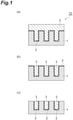
- FIG. 1 illustrates an example of a method of forming wiring of a tungsten material by polishing (damascene process).
- An object to be polished (substrate) 10 includes, as illustrated in FIG. 1(a) , an insulating material (such as silicon oxide) 1 having grooves on a surface thereof, a barrier material (such as titanium nitride) 2 having a shape following the surface of the insulating material, and a tungsten material (wiring metal) 3 covering the entire barrier material 2 to embed the grooves.
- a polishing method of the object to be polished 10 includes a rough polishing step of polishing the tungsten material 3 at a high polishing rate until the barrier material 2 is exposed ( FIGS.
- Patent Literature 3 described below discloses that a cationic water-soluble polymer such as polyethylenimine is used as a protection film-forming agent for a tungsten material and adsorbs to a surface of the tungsten material to form a protection film.
- a cationic water-soluble polymer such as polyethylenimine
- JP 2000 315667 A , JP 2010 518601 A , WO 2015/108113 A1 , and US 2015/031205 A1 relate to methods of polishing a surface to be polished containing a metal material and an insulating layer.
- An object of the present invention is to provide a polishing method capable of suppressing the etching of a tungsten material while maintaining a sufficient polishing rate of the tungsten material.
- the present inventors have conceived that a protection film-forming agent having an adsorption capacity suitable for a tungsten material is used for suppressing the etching of the tungsten material while maintaining a sufficient polishing rate of the tungsten material, and have found that the above object can be achieved in the case of using a specific polymer.
- the polishing method of the present invention it is possible to suppress the etching of the tungsten material while maintaining a sufficient polishing rate of the tungsten material.
- the polishing liquid can be suitably used in an intermediate polishing step, a final polishing step, and the like in polishing of the tungsten material.
- the polymer in the present invention acts as a protection film-forming agent having an adsorption capacity suitable for the insulating material in addition to the tungsten material so that the tungsten material and the insulating material can be polished at a sufficient polishing rate while decreasing the etching rate of the tungsten material.
- the polishing method of the present invention it is possible to suppress the etching of the tungsten material while maintaining sufficient polishing rates of the tungsten material and the insulating material.
- the present invention it is possible to provide a polishing method capable of suppressing the etching of the tungsten material while maintaining a sufficient polishing rate of the tungsten material. According to the present invention, it is possible to provide use of the polishing liquid to polishing of a surface to be polished containing a tungsten material. According to the present invention, it is possible to provide use of the polishing liquid to polishing of a surface to be polished containing a tungsten material and at least one selected from the group consisting of a barrier material and an insulating material.
- FIG. 1 is a schematic cross-sectional view for describing a method of forming wiring of a tungsten material by polishing.
- a numerical range that has been indicated with the use of "to” indicates the range that includes the numerical values which are described before and after "to", as the minimum value and the maximum value, respectively.
- the upper limit value or the lower limit value of the numerical range of a certain stage can be arbitrarily combined with the upper limit value or the lower limit value of the numerical range of another stage.
- the upper limit value or the lower limit value of the numerical value range may be replaced with the value shown in the examples.
- a or B may contain any one of A and B, and may contain both A and B.
- Materials listed as examples in the present specification can be used singly or in combinations of two or more, unless otherwise specifically indicated.
- the content of each component in the composition means the total amount of the plurality of substances that exist in the composition, unless otherwise specified.
- the term “layer” includes a structure having a shape which is formed on a part, in addition to a structure having a shape which is formed on the whole surface, when the layer has been observed as a plan view.
- the term “step” includes not only an independent step but also a step by which an intended action of the step is achieved, though the step cannot be clearly distinguished from other steps.
- a polishing liquid is a polishing liquid for polishing a surface to be polished containing a tungsten material
- the polishing liquid is characterized in that it contains abrasive grains, a polymer (polycarboxylic acid-based polymer) having a cationic group at the terminal (cationic terminal group), an oxidizing agent, a metal oxide-dissolving agent, and water, the polymer has a structural unit derived from an unsaturated carboxylic acid, a weight average molecular weight of the polymer is 20000 or less, and a pH is less than 5.0.
- the polishing liquid is, for example, a polishing liquid for a metal film containing a tungsten material.
- the components contained in the polishing liquid, liquid properties, and the like will be described in detail.
- the polishing liquid contains abrasive grains from the viewpoint of obtaining sufficient polishing rate of a tungsten material and an insulating material.
- the abrasive grains contain at least one selected from the group consisting of colloidal silica and colloidal alumina.
- the average particle diameter of the abrasive grains is preferably 10 nm or more, more preferably 20 nm or more, and further preferably 50 nm or more.
- the average particle diameter of the abrasive grains is preferably 200 nm or less, more preferably 100 nm or less, and further preferably 80 nm or less. From these viewpoints, the average particle diameter of the abrasive grains is preferably 10 to 200 nm, more preferably 20 to 100 nm, and further preferably 50 to 80 nm.
- the "average particle diameter" means a secondary particle diameter of the abrasive grains.
- the particle diameter (secondary particle diameter) can be measured, for example, by a light-diffraction-scattering particle size distribution analyzer.
- measurement can be performed using COULTER N4SD (trade name) manufactured by COULTER Electronics, Inc. with measurement temperature: 20°C, solvent refractive index: 1.333 (water), particle refractive index: Unknown (setting), solvent viscosity: 1.005 cp (water), Run Time: 200 sec, laser incident angle: 90°, and Intensity (corresponding to scattering intensity and turbidity): range of 5E+04 to 4E+05, and in a case where Intensity is higher than 4E+05, the measurement can be performed after dilution with water.
- abrasive grains from the viewpoint that dispersion stability in the polishing liquid is favorable and the number of scratches generated by CMP (polishing scratch) is small, at least one selected from the group consisting of colloidal silica having an average particle diameter of 200 nm or less and colloidal alumina having an average particle diameter of 200 nm or less is preferable, and at least one selected from the group consisting of colloidal silica having an average particle diameter of 100 nm or less and colloidal alumina having an average particle diameter of 100 nm or less is more preferable.
- the content of the abrasive grain is preferably 0.01 mass% or more, more preferably 0.02 mass% or more, further preferably 0.05 mass% or more, particularly preferably 0.1 mass% or more, extremely preferably 0.5 mass% or more, and very preferably 1 mass% or more, based on the total mass of the polishing liquid, from the viewpoint of easily obtaining sufficient polishing rates of the tungsten material and the insulating material.
- the content of the abrasive grain is preferably 50 mass% or less, more preferably 30 mass% or less, further preferably 20 mass% or less, particularly preferably 10 mass% or less, and extremely preferably 5 mass% or less, based on the total mass of the polishing liquid, from the viewpoint of easily suppressing generation of scratches.
- the content of the abrasive grain is preferably 0.01 to 50 mass%, more preferably 0.02 to 30 mass%, further preferably 0.05 to 20 mass%, particularly preferably 0.1 to 20 mass%, extremely preferably 0.5 to 10 mass%, and very preferably 1 to 5 mass%, based on the total mass of the polishing liquid.
- the polycarboxylic acid-based polymer is a polymer having a structural unit derived from an unsaturated carboxylic acid, having a weight average molecular weight of 20000 or less, and having a cationic group at the terminal, and is, for example, water-soluble.
- the polymer contains at least one selected from the group consisting of polyacrylic acid, polymethacrylic acid, and a copolymer of acrylic acid and methacrylic acid.
- the polycarboxylic acid-based polymer suppresses the etching of the tungsten material.
- the cationic group at the terminal is a cationic group positioned at the terminal of the main chain. Examples of the cationic group include an amino group and a quaternary ammonium group (quaternary ammonium base group).
- the polycarboxylic acid-based polymer suppresses the etching of the tungsten material is not clear, but is considered that a cationic terminal group having a positive charge adsorbs to a tungsten material showing a negative zeta potential in a wide pH range to form a protection film. That is, the polycarboxylic acid-based polymer exhibits favorable properties as a protection film-forming agent of the tungsten material.
- the terminal is not a cationic group but is a non-ionic group, or an amphoteric group, such a sufficient effect of suppressing the etching is not obtainable.
- the polycarboxylic acid-based polymer is an anionic polymer having a structural unit derived from an unsaturated carboxylic acid.
- a cationic polymer not having a structural unit derived from an unsaturated carboxylic acid such as polyallylamine
- the anionic polymer may exhibit the effect of suppressing the etching with respect to the tungsten material, but very strongly adsorbs to the tungsten material and the insulating material (such as silicon oxide), so that the polishing rates of the tungsten material and the insulating material are excessively decreased. Such an excess decrease in the polishing rates of the tungsten material and the insulating material is not observed in the polycarboxylic acid-based polymer.
- the effect of suppressing the etching of the tungsten material may be exhibited if the terminal of the polymer is a cationic group, but similarly to the cationic polymer, a decrease in the polishing rate of the insulating material tends to be large, and aggregation and sedimentation of abrasive grains such as colloidal silica tend to be easily caused.
- the polycarboxylic acid-based polymer contains at least one selected from the group consisting of polyacrylic acid, polymethacrylic acid, and a copolymer of acrylic acid and methacrylic acid.
- the terminal group of the polycarboxylic acid-based polymer is adjustable depending on the type of polymerization initiator, and selection of a suitable polymerization initiator can make the terminal to be a cationic group.
- the polymerization initiator in polymer synthesis used for forming the terminal group of the polycarboxylic acid-based polymer from the viewpoint of easily suppressing the etching of the tungsten material while maintaining a sufficient polishing rate of the tungsten material, at least one selected from the group consisting of 2,2'-azobis[2-(2-imidazolin-2-yl)propane]dihydrochloride, 2,2'-azobis[2-(2-imidazolin-2-yl)propane]disulfate dihydrate, 2,2'-azobis(2-methylpropionamidine)dihydrochloride, and 2,2'-azobis[2-(5-methyl-2-imidazolin-2-yl)propane]dihydrochloride is preferable.
- the upper limit of the weight average molecular weight of the polycarboxylic acid-based polymer is 20000 or less.
- the phenomenon that the ability to suppress the etching of the tungsten material decreases in the case of an excessively large molecular weight can be described as follows. It is considered that, since the polycarboxylic acid-based polymer adsorbs to a surface of the tungsten material by the cationic terminal group to protect the surface, when the molecular weight is large, the mass supporting an adsorption state by one terminal group is excessively large, so that the adsorption state is not held.
- the molecular weight when the molecular weight is large, the number of terminals is smaller than that in a case where the same mass as a polymer having a small molecular weight is added, so that an area to be protected may be small even when a polymer having a large molecular weight adsorbs.
- the upper limit of the weight average molecular weight of the polycarboxylic acid-based polymer is preferably 15000 or less from the viewpoint of ease of suppressing the etching of the tungsten material, ease of synthesis, ease of controlling a molecular weight, and the like, and is more preferably 15000 or less, further preferably 10000 or less, particularly preferably 9000 or less, extremely preferably 8000 or less, very preferably 7500 or less, and even more preferably 7000 or less, from the viewpoint of further shortening the synthesis time.
- the lower limit of the weight average molecular weight of the polycarboxylic acid-based polymer is preferably 500 or more, more preferably 1000 or more, further preferably 2000 or more, and particularly preferably 3000 or more.
- the weight average molecular weight of the polycarboxylic acid-based polymer is 500 or more, the molecular weight control at the time of synthesis becomes easy. From these viewpoints, the weight average molecular weight of the polycarboxylic acid-based polymer is preferably 500 to 20000.
- the weight average molecular weight of the polycarboxylic acid-based polymer is measured by gel permeation chromatography using a calibration curve of standard polystyrene. As the measurement conditions, the following conditions are mentioned.
- the content of the polycarboxylic acid-based polymer is preferably 0.001 mass% or more, more preferably 0.01 mass% or more, farther preferably 0.03 mass% or more, particularly preferably 0.05 mass% or more, and extremely preferably 0.1 mass% or more, based on the total mass of the polishing liquid, from the viewpoint of easily and effectively suppressing the etching of the tungsten material and the viewpoint of easily controlling the content.
- the content of the polycarboxylic acid-based polymer is preferably 20 mass% or less, more preferably 15 mass% or less, further preferably 10 mass% or less, particularly preferably 5 mass% or less, extremely preferably 1 mass% or less, and very preferably 0.5 mass% or less, based on the total mass of the polishing liquid, from the viewpoint of easily suppressing occurrence of aggregation of the abrasive grains in the polishing liquid.
- the content of the polycarboxylic acid-based polymer is preferably 0.001 to 20 mass%, more preferably 0.001 to 15 mass%, further preferably 0.001 to 10 mass%, particularly preferably 0.01 to 10 mass%, extremely preferably 0.01 to 5 mass%, very preferably 0.03 to 5 mass%, even more preferably 0.05 to 1 mass%, and still more preferably 0.1 to 0.5 mass%, based on the total mass of the polishing liquid.
- the polishing liquid contains an oxidizing agent containing hydrogen peroxide. (metal oxidizing agent).
- the content of the oxidizing agent is preferably 0.01 mass% or more, more preferably 0.02 mass% or more, and further preferably 0.05 mass% or more, based on the total mass of the polishing liquid, from the viewpoint of easily obtaining a favorable polishing rate of the tungsten material.
- the content of the oxidizing agent is preferably 50 mass% or less, more preferably 30 mass% or less, and further preferably 15 mass% or less, based on the total mass of the polishing liquid, from the viewpoint of easily decreasing the roughening of the polished surface. From these viewpoints, the content of the oxidizing agent is preferably 0.01 to 50 mass%, more preferably 0.02 to 30 mass%, and further preferably 0.05 to 15 mass%, based on the total mass of the polishing liquid.
- the polishing liquid contains a metal oxide-dissolving agent from the viewpoint of promoting the dissolving of the tungsten material oxidized by the oxidizing agent and improving the polishing rate of the tungsten material.
- the metal oxide-dissolving agent dissolve the oxidized tungsten material in water.
- the metal oxide-dissolving agent contains an organic acid. including at least one selected from the group consisting of formic acid, malonic acid, malic acid, tartaric acid, citric acid, salicylic acid, and adipic acid. pitfuablu
- the metal oxide-dissolving agent may be used singly or in combination of two or more kinds thereof.
- the content of the metal oxide-dissolving agent is preferably 0.001 mass% or more, more preferably 0.002 mass% or more, further preferably 0.005 mass% or more, particularly preferably 0.01 mass% or more, extremely preferably 0.05 mass% or more, very preferably 0.1 mass% or more, and even more preferably 0.2 mass% or more, based on the total mass of the polishing liquid, from the viewpoint of easily obtaining a favorable polishing rate of the tungsten material.
- the content of the metal oxide-dissolving agent is preferably 20 mass% or less, more preferably 10 mass% or less, further preferably 5 mass% or less, particularly preferably 3 mass% or less, and extremely preferably 1 mass% or less, based on the total mass of the polishing liquid, from the viewpoint of easily decreasing the roughening of the polished surface by suppressing the etching of the tungsten material.
- the content of the metal oxide-dissolving agent is preferably 0.001 to 20 mass%, more preferably 0.002 to 10 mass%, further preferably 0.005 to 5 mass%, particularly preferably 0.01 to 5 mass%, extremely preferably 0.05 to 3 mass%, very preferably 0.1 to 1 mass%, and even more preferably 0.2 to 1 mass%, based on the total mass of the polishing liquid.
- the polishing liquid can contain, as necessary, a metal corrosion preventive agent (a corrosion preventive agent for a metal).
- a metal corrosion preventive agent for a metal
- the metal corrosion preventive agent can be used for preventing a surface of a metal (for example, copper) other than the tungsten material when the tungsten material and this metal were polished at the same time.
- metal corrosion preventive agent examples include 2-mercaptobenzothiazole; triazole-based corrosion preventive agents (compounds having a triazole skeleton) such as 1,2,3-triazole, 1,2,4-triazole, 3-amino-1H-1,2,4-triazole, benzotriazole, 1-hydroxybenzotriazole, 1-hydroxypropylbenzotriazole, 2,3-dicarboxypropylbenzotriazole, 4-hydroxybenzotriazole, 4-carboxyl(-1H-)benzotriazole, 4-carboxyl(-1H-)benzotriazole methyl ester, 4-carboxyl(-1H-)benzotriazole butyl ester, 4-carboxyl(-1H-)benzotriazole octyl ester, 5-hexylbenzotriazole, [1,2,3-benzotriazolyl-1-methyl][1,2,4-triazolyl-1-methyl][2-ethylhexyl]
- the content of the metal corrosion preventive agent is preferably 0.001 to 10 mass%, more preferably 0.005 to 5 mass%, and further preferably 0.01 to 2 mass%, based on the total mass of the polishing liquid.
- the content of the metal corrosion preventive agent is 0.001 mass% or more, the etching of the wiring metal is suppressed and the roughening of the polished surface is easily decreased.
- the content of the metal corrosion preventive agent is 10 mass% or less, the polishing rates of the wiring metal and the barrier material (for example, a barrier metal) tend to become favorable.
- the polishing liquid can contain, as necessary, an organic solvent from the viewpoint of easily obtaining a favorable polishing rate of the insulating material even in the case of using an organic material as the insulating material.
- the organic solvent is not particularly limited, but a solvent which can be arbitrarily mixed with water is preferable.
- organic solvent examples include carbonate esters such as ethylene carbonate, propylene carbonate, dimethyl carbonate, diethyl carbonate, and methylethyl carbonate; lactones such as butyrolactone and propiolactone; glycols such as ethylene glycol, propylene glycol, diethylene glycol, dipropylene glycol, triethylene glycol, and tripropylene glycol; as derivatives of glycols, glycol monoethers such as ethylene glycol monomethyl ether, propylene glycol monomethyl ether, diethylene glycol monomethyl ether, dipropylene glycol monomethyl ether, triethylene glycol monomethyl ether, tripropylene glycol monomethyl ether, ethylene glycol monoethyl ether, propylene glycol monoethyl ether, diethylene glycol monoethyl ether, dipropylene glycol monoethyl ether, triethylene glycol monoethyl ether, tripropylene glycol monoethyl ether, ethylene glyco
- the content of the organic solvent is preferably 0.1 to 95 mass%, more preferably 0.2 to 50 mass%, and further preferably 0.5 to 10 mass%, based on the total mass of the polishing liquid.
- the content of the organic solvent is 0.1 mass% or more, the wettability of the polishing liquid to the substrate becomes favorable.
- the content of the organic solvent is 95 mass% or less, volatilization of the solvent is decreased and safety of production processes are easily secured.
- the polishing liquid contains water.
- the content of water in the polishing liquid may be the remainder of the polishing liquid excluding the contents of other contained components.
- the pH of the polishing liquid is less than 5.0. There is a close relation between the pH of the polishing liquid and the etching rate of the tungsten material, and when the pH is 5.0 or more, the etching rate of the tungsten material tends to increase.
- the pH of the polishing liquid is preferably 4.5 or less, more preferably 4.0 or less, further preferably 3.5 or less, and particularly preferably 3.0 or less from the viewpoint that the etching of the tungsten material can be further suppressed.
- the pH of the polishing liquid is preferably 1.0 or more, more preferably 1.5 or more, further preferably 2.0 or more, and particularly preferably 2.5 or more from the viewpoint of easily suppressing corrosion of the polishing device.
- the pH of the polishing liquid is preferably 1.0 or more and less than 5.0.
- the pH of the polishing liquid is defined as pH in a liquid temperature of 25°C.
- an acid component such as organic acid and inorganic acid
- ammonia or the like can be used.
- the pH of the polishing liquid can be measured by a pH meter (for example, trade name: Model (F-51) manufactured by HORIBA, Ltd.).
- the pH meter is calibrated by three points using a pH standard solution (pH: 4.01) of phthalate, a pH standard solution (pH: 6.86) of a neutral phosphate, and a pH standard solution (pH: 9.18) of a borate as a calibration solution, an electrode of the pH meter is put in the polishing liquid, and a stable value is measured after 2 min or longer has elapsed.
- the liquid temperatures of the calibration solution and the polishing liquid are set to 25°C.
- the polishing liquid may be stored as a one-pack type polishing liquid containing at least abrasive grains, a polycarboxylic acid-based polymer, an oxidizing agent, and a metal oxide-dissolving agent, and may be stored as a stock solution for the polishing liquid having a decreased content of water and used after dilution with water at the time of polishing.
- the polishing liquid may be stored as a multi-pack (for example, two-pack) polishing liquid set in which constituents of the polishing liquid are divided into a slurry (first liquid) and an additive liquid (second liquid) such that the slurry and the additive liquid are mixed to form the polishing liquid.
- the polishing liquid can also be divided into two liquids of a slurry containing at least abrasive grains and an additive liquid containing at least a polycarboxylic acid-based polymer. According to this, it is easy to avoid a problem of stability of the abrasive grains occurring at the time of adding a large amount of the polycarboxylic acid-based polymer.
- the slurry contains, for example, at least the abrasive grains and water.
- the additive liquid contains, for example, at least of the polycarboxylic acid-based polymer, the oxidizing agent, the metal oxide-dissolving agent, and water.
- the polycarboxylic acid-based polymer may be contained in the slurry.
- the content of the polycarboxylic acid-based polymer in the slurry can be set to a range that does not impair the dispersibility of the abrasive grains.
- the slurry and the additive liquid are mixed right before or at the time of polishing to prepare the polishing liquid.
- the multi-pack polishing liquid set may be stored as a stock solution for the slurry and a stock solution for the additive liquid which have a decreased content of water and used after dilution with water at the time of polishing.
- the polishing method according to the invention is as defined in claim 1 and includes a polishing step of polishing a surface to be polished containing a tungsten material using the polishing liquid.
- the polishing liquid may be a polishing liquid obtained by diluting the stock solution for the polishing liquid with water or a polishing liquid obtained by mixing the slurry and the additive liquid in the polishing liquid set.
- the surface to be polished may have a layer containing at least a tungsten material. Examples of the tungsten material include tungsten and a tungsten compound. Examples of the tungsten compound include tungsten alloys.
- the surface to be polished can be polished by supplying the polishing liquid between the surface to be polished of the substrate and the polishing cloth and relatively moving the substrate with respect to the polishing platen in such a state that the surface to be polished of the substrate is pressed against a polishing cloth of the polishing platen and a predetermined pressure is applied to the substrate from a surface, which is opposite to the surface to be polished, of the substrate (the rear face of the substrate).
- a material to be polished containing a tungsten material is polished.
- the material to be polished may be a film shape (film to be polished) and may be a film containing a tungsten material. Examples of the film formation method include known sputtering method and plating method.
- the polishing step may be a step of polishing a surface to be polished containing a tungsten material and at least one selected from the group consisting of a barrier material (for example, a barrier metal) and an insulating material using the polishing liquid.
- the polishing step may be a step of polishing a substrate having, for example, at least a layer containing a tungsten material and at least one selected from the group consisting of a barrier layer and an insulating layer.
- barrier material examples include tantalum, tantalum alloys, tantalum compounds (such as tantalum oxide and tantalum nitride), titanium, titanium alloys, and titanium compounds (such as titanium oxide and titanium nitride).
- the tungsten material may be used as the barrier material.
- the insulating material examples include silicon oxide and silicon nitride.
- the polishing step may include a first polishing step (rough polishing step) of polishing a tungsten material 3 until a barrier material 2 is exposed, a second polishing step (intermediate polishing step) of polishing the barrier material 2 and the tungsten material 3 until the insulating material 1 is exposed, and a third polishing step (final polishing step) of polishing the insulating material 1, the barrier material 2, and the tungsten material 3, in this order.
- a first polishing step (rough polishing step) of polishing a tungsten material 3 until a barrier material 2 is exposed
- second polishing step intermediate polishing step
- final polishing step final polishing step
- the etching rate of the tungsten material is preferably 5.0 nm/min or less, more preferably 4.0 nm/min or less, and further preferably 3.5 nm/min or less from the viewpoint of easily suppressing occurrence of a problem such as an increase in wiring resistance.
- the polishing rate of the tungsten material is preferably 10 nm/min or more, more preferably 12 nm/min or more, and further preferably 15 nm/min or more from the viewpoint that the polishing time can be shortened.
- the polishing rate of the tungsten material is preferably 40 nm/min or less from the viewpoint of easily obtaining more favorable flatness. From these viewpoints, the polishing rate of the tungsten material is preferably 10 to 40 nm/min, more preferably 12 to 40 nm/min, and further preferably 15 to 40 nm/min.
- the polishing rate of the insulating material is preferably 20 nm/min or more, more preferably 25 nm/min or more, and further preferably 30 nm/min or more from the viewpoint that the polishing time can be shortened and viewpoint of improving flatness.
- the polishing rate of the insulating material is preferably 100 nm/min or less from the viewpoint of easily obtaining more favorable smoothness and flatness. From these viewpoints, the polishing rate of the insulating material is preferably 20 to 100 nm/min, more preferably 25 to 100 nm/min, and further preferably 30 to 100 nm/min.
- the ratio of the polishing rate of the tungsten material to the polishing rate of the insulating material (for example, silicon oxide) (the polishing rate of the tungsten material/the polishing rate of the insulating material; hereinafter, also referred to as "polishing rate ratio") is preferably such a polishing rate ratio that can decrease unevenness such as "protrusion” in which the wiring portion protrudes more than the insulating material portion in the outer edge of the wiring portion, and conversely, "dishing" in which the wiring portion is recessed.
- the polishing rate ratio of the tungsten material to the insulating material is preferably less than 1.5, more preferably 1.2 or less, and further preferably 1.0 or less from the viewpoint of having favorable flatness after final polishing.
- the polishing rate ratio of the tungsten material to the insulating material is preferably 0.2 or more and more preferably 0.25 or more from the viewpoint of easily decreasing the protrusion.
- the polishing rate ratio is, for example, a polishing rate ratio when a blanket wafer (blanket substrate) having a tungsten material film formed on the substrate and a blanket wafer having an insulating material film formed on the substrate are polished.
- the polishing rate ratio can be evaluated, for example, by polishing each of the blanket wafer having a tungsten material film smoothly formed on the substrate and the blanket wafer having an insulating material film smoothly formed on the substrate with the same polishing cloth at the same number of revolutions and the same load.
- a polishing device for example, in the case of polishing with a polishing cloth, a general polishing device, which includes a holder capable of holding a substrate to be polished, and a polishing platen to which a motor that can change the number of revolutions or the like is connected and to which the polishing cloth can be attached, can be used.
- the polishing cloth is not particularly limited, and general nonwoven cloth, foamed polyurethane, porous fluororesin, or the like can be used.
- the polishing condition is not limited, but the rotational speed of the platen is preferably a low rotation of 200 rpm or less from the viewpoint of suppressing flying-off of the substrate.
- the pressure at which a substrate (such as a semiconductor substrate) having a surface to be polished against the polishing cloth is preferably 1 to 300 kPa, and in order to satisfy uniformity of the polishing rate in the surface to be polished and flatness of patterns, the pressure is more preferably 5 to 300 kPa.
- the polishing liquid can be continuously supplied to the polishing cloth with a pump or the like. The supplied amount thereof is not limited, but it is preferable that the surface of the polishing cloth is always covered with the polishing liquid.
- polishing CMP
- the conditioning of the polishing cloth is performed with a liquid containing at least water while using a dresser to which diamond particles attach.
- drying after performing a known cleaning method (for example, a method of removing the deposits on the substrate by pressing a brush made from polyurethane against the substrate with a constant pressure while letting a commercially available cleaning liquid flow on the surface of the substrate and rotating the brush).
- a known cleaning method for example, a method of removing the deposits on the substrate by pressing a brush made from polyurethane against the substrate with a constant pressure while letting a commercially available cleaning liquid flow on the surface of the substrate and rotating the brush.
- polymethacrylic acid 1 having a cationic group at the terminal of the main chain polymethacrylic acid synthesized by using 2,2'-azobis[2-(5-methyl-2-imidazolin-2-yl)propane]dihydrochloride as a polymerization initiator and methacrylic acid as a monomer and having a weight average molecular weight of 7000
- polymethacrylic acid synthesized by using 2,2'-azobis[2-(5-methyl-2-imidazolin-2-yl)propane]dihydrochloride as a polymerization initiator and methacrylic acid as a monomer and having a weight average molecular weight of 7000
- colloidal silica water dispersion having a silicon dioxide content of 20 mass%, pH: 8.1, specific gravity: 1.1, viscosity: 3.5 mPa ⁇ s, secondary particle diameter at the time of mixing: 60 nm
- 100 g of colloidal silica water dispersion having a silicon dioxide content of 20 mass%, pH: 8.1, specific gravity: 1.1, viscosity: 3.5 mPa ⁇ s, secondary particle diameter at the time of mixing: 60 nm
- 25 mass% of ammonia water pH adjuster
- the content of the abrasive grains was 2 mass%
- the content of the polymethacrylic acid 1 was 0.1 mass%
- the content of the hydrogen peroxide was 3 mass%
- the content of the malic acid was 0.4 mass%.
- a polishing liquid 2 was produced in the same manner as in Example 1, except that polymethacrylic acid 2 having a cationic group at the terminal of the main chain and a weight average molecular weight of 3200 was used.
- a polishing liquid 3 was produced in the same manner as in Example 1, except that polymethacrylic acid 3 having a cationic group at the terminal of the main chain and a weight average molecular weight of 4300 was used.
- a polishing liquid 4 was produced in the same manner as in Example 1, except that polymethacrylic acid 4 having a cationic group at the terminal of the main chain and a weight average molecular weight of 9100 was used.
- a polishing liquid 5 was produced in the same manner as in Example 1, except that polymethacrylic acid 5 having a cationic group at the terminal of the main chain and a weight average molecular weight of 18500 was used.
- a polishing liquid 6 was produced in the same manner as in Example 1, except that 10 mass% of sulfuric acid aqueous solution was used as a pH adjuster instead of 25 mass% of ammonia water to adjust the pH to 2.0.
- a polishing liquid 7 was produced in the same manner as in Example 1, except that 25 mass% of ammonia water was used as a pH adjuster to adjust the pH to 3.0.
- a polishing liquid 8 was produced in the same manner as in Example 1, except that 25 mass% of ammonia water was used as a pH adjuster to adjust the pH to 4.0.
- a polishing liquid 9 was produced in the same manner as in Example 1, except that 25 mass% of ammonia water was used as a pH adjuster to adjust the pH to 4.5.
- a polishing liquid 10 was produced in the same manner as in Example 1, except that 1 g of polyacrylic acid 1 having a cationic group at the terminal of the main chain (polyacrylic acid synthesized by using 2,2'-azobis[2-(5-methyl-2-imidazolin-2-yl)propane]dihydrochloride as a polymerization initiator and acrylic acid as a monomer and having a weight average molecular weight of 8500) was used instead of the polymethacrylic acid 1.
- polyacrylic acid 1 having a cationic group at the terminal of the main chain polyacrylic acid synthesized by using 2,2'-azobis[2-(5-methyl-2-imidazolin-2-yl)propane]dihydrochloride as a polymerization initiator and acrylic acid as a monomer and having a weight average molecular weight of 8500
- a polishing liquid 11 was produced in the same manner as in Example 1, except that 1 g of polyacrylic acid 2 having a cationic group at the terminal of the main chain (polyacrylic acid synthesized by using 2,2'-azobis[2-methylpropionamidine]dihydrochloride , as a polymerization initiator and acrylic acid as a monomer and having a weight average molecular weight of 5200) was used instead of the polymethacrylic acid 1.
- a polishing liquid X1 was produced in the same manner as in Example 1, except that the polymethacrylic acid 1 was not used.
- a polishing liquid X2 was produced in the same manner as in Example 1, except that polyacrylic acid 3 having a weight average molecular weight of 25000 was used.
- a polishing liquid X3 was produced in the same manner as in Example 1, except that polyacrylic acid 4 having a weight average molecular weight of 48500 was used.
- a polishing liquid X4 was produced in the same manner as in Example 1, except that polyacrylic acid 5 having a weight average molecular weight of 101000 was used.
- a polishing liquid X5 was produced in the same manner as in Example 1, except that 25 mass% of ammonia water was used as a pH adjuster to adjust the pH to 5.0.
- a polishing liquid X6 was produced in the same manner as in Example 1, except that 25 mass% of ammonia water was used as a pH adjuster to adjust the pH to 6.0.
- a polishing liquid X7 was produced in the same manner as in Example 1, except that 1 g of polysulfonic acid 1 (polysulfonic acid synthesized by using 2,2'-azobis[2-(5-methyl-2-imidazolin-2-yl)propane]dihydrochloride as a polymerization initiator and 2-acrylamide-2-methylpropanesulfonic acid as a monomer and having a weight average molecular weight of 8400) was used instead of the polymethacrylic acid 1.
- polysulfonic acid 1 polysulfonic acid synthesized by using 2,2'-azobis[2-(5-methyl-2-imidazolin-2-yl)propane]dihydrochloride as a polymerization initiator and 2-acrylamide-2-methylpropanesulfonic acid as a monomer and having a weight average molecular weight of 8400
- a polishing liquid X8 was produced in the same manner as in Example 1, except that 1 g of polyallylamine 1 (polyallylamine synthesized by using 2,2'-azobis[2-(5-methyl-2-imidazolin-2-yl)propane]dihydrochloride as a polymerization initiator and allylamine as a monomer and having a weight average molecular weight of 25000) was used instead of the polymethacrylic acid 1.
- polyallylamine 1 polyallylamine synthesized by using 2,2'-azobis[2-(5-methyl-2-imidazolin-2-yl)propane]dihydrochloride as a polymerization initiator and allylamine as a monomer and having a weight average molecular weight of 25000
- a polishing liquid X9 was produced in the same manner as in Example 1, except that 1 g of polyacrylic acid 6 (polyacrylic acid synthesized by using azobisisobutyronitrile as a polymerization initiator and acrylic acid as a monomer and having a weight average molecular weight of 4300) was used instead of the polymethacrylic acid 1.
- polyacrylic acid 6 polyacrylic acid synthesized by using azobisisobutyronitrile as a polymerization initiator and acrylic acid as a monomer and having a weight average molecular weight of 4300
- a polishing liquid X10 was produced in the same manner as in Example 1, except that 1 g of polyacrylic acid 7 (polyacrylic acid synthesized by using 4,4'-azobis(4-cyanovaleric acid) as a polymerization initiator and acrylic acid as a monomer and having a weight average molecular weight of 16000) was used instead of the polymethacrylic acid 1.
- polyacrylic acid 7 polyacrylic acid synthesized by using 4,4'-azobis(4-cyanovaleric acid) as a polymerization initiator and acrylic acid as a monomer and having a weight average molecular weight of 16000
- the pH of the polishing liquid was measured under the following conditions.
- the average particle diameter (secondary particle diameter) of the abrasive grains in the polishing liquid was measured using COULTER N4SD (trade name) manufactured by COULTER Electronics, Inc. The results are presented in Table 1.
- polishing liquid 100 g was maintained at 60°C. Then, the tungsten test piece was mounted on a stirring blade. The test piece was immersed in the polishing liquid for 5 min while stirring with the number of revolutions of a stirrer being set to 100 min -1 .
- a difference between film thicknesses of the tungsten films before and after immersing was obtained by conversion of electric resistance values thereof.
- the etching rate was calculated from the film thickness difference and the immersing time.
- the results are presented in Table 2. A value equal to or less than 5.0 nm/min was regarded as a favorable value.
- the test piece was fixed to a holder attached with a substrate-holding adsorption pad of a polishing device (manufactured by Nano Factor Co., LTD, FACT-200). Further, the holder with a film to be polished disposed downward was placed on a platen attached with a foamed polyurethane polishing cloth, and then a weight was placed thereon such that a working load would be 300 g/cm 2 (290 kPa). The film to be polished was polished for 60 sec while adding the polishing liquid dropwise onto the platen at 10 mL/min and setting the number of revolutions of the platen to 80 min -1 (rpm).
- a polishing device manufactured by Nano Factor Co., LTD, FACT-200
- the film thicknesses of the tungsten films before and after polishing were measured using a sheet resistance meter (manufactured by NAPSON CORPORATION, RT-80/RG-80), and the polishing rate was calculated from the film thickness difference.
- the results are presented in Table 2. A value equal to or more than 10 nm/min was regarded as a favorable value.
- Example 1 In Comparative Example 1 not using the polycarboxylic acid-based polymer, the polishing rates of tungsten and silicon oxide were favorable but the tungsten etching rate was 7.2 nm/min, which was not favorable. On the other hand, it is found that in Example 1 using the polymethacrylic acid 1, the tungsten etching rate is decreased and a favorable etching rate of 1.9 nm/min is obtainable. Further, there was not a large decrease in polishing rates of tungsten and silicon oxide in Example 1, which was favorable.
- Example 10 in which the monomer at the time of polymer synthesis is changed from methacrylic acid to acrylic acid that is an unsaturated carboxylic acid similarly to methacrylic acid, the tungsten etching rate, the tungsten polishing rate, and the silicon oxide polishing rate were favorable.
- Comparative Example 7 using polysulfonic acid obtained by using, as a monomer, 2-acrylamide-2-methylpropanesulfonic acid that is a sulfonic acid compound, the sufficient suppressing effect of the etching of the tungsten material was not obtainable.
- Example 11 using a cationic initiator different from that in Example 1 at the time of polymer synthesis, the tungsten etching rate, the tungsten polishing rate, and the silicon oxide polishing rate were favorable.
- Comparative Example 9 using a non-ionic initiator and Comparative Example 10 using an anionic initiator the tungsten etching rates were 8.9 nm/min and 6.8 nm/min, respectively, and the sufficient suppressing effect of etching was not obtainable. The reason for this is considered that the adsorption capacity with respect to the tungsten material having a negative charge decreases more than that of the polymer using a cationic initiator.
- 1 insulating material
- 2 barrier material
- 3 tungsten material
- 10 object to be polished.
Landscapes
- Chemical & Material Sciences (AREA)
- Organic Chemistry (AREA)
- Engineering & Computer Science (AREA)
- Materials Engineering (AREA)
- Mechanical Engineering (AREA)
- Inorganic Chemistry (AREA)
- Dispersion Chemistry (AREA)
- Mechanical Treatment Of Semiconductor (AREA)
- Finish Polishing, Edge Sharpening, And Grinding By Specific Grinding Devices (AREA)
Claims (5)
- Procédé de polissage destiné à polir une surface à polir contenant un matériau tungstène à l'aide d'un liquide de polissage comprenant :des grains abrasifs contenant au moins un sélectionné dans le groupe consistant en silice colloïdale et alumine colloïdale ; un polymère présentant un groupe cationique au niveau d'une terminaison ; un agent oxydant contenant du peroxyde d'hydrogène ; un agent de dissolution d'oxydes métalliques contenant un acide organique incluant au moins un sélectionné dans le groupe consistant en acide formique, acide malonique, acide malique, acide tartrique, acide citrique, acide salicylique et acide adipique ; et de l'eau, dans lequelle polymère présente un motif structural dérivé d'un acide carboxylique insaturé et contient au moins un sélectionné dans le groupe consistant en acide polyacrylique, acide polyméthacrylique et un copolymère d'acide acrylique et d'acide méthacrylique,le poids moléculaire moyen en poids du polymère est de 20 000 ou moins, déterminé comme décrit dans la description, etle pH est inférieur à 5,0.
- Procédé de polissage selon la revendication 1, dans lequel le poids moléculaire moyen en poids du polymère est de 10 000 ou moins.
- Procédé de polissage selon la revendication 1, dans lequel le poids moléculaire moyen en poids du polymère est de 7 500 ou moins.
- Procédé de polissage selon la revendication 1, dans lequel le pH est de 4,0 ou moins.
- Procédé de polissage selon la revendication 1, dans lequel le pH est de 3,0 ou moins.
Applications Claiming Priority (2)
| Application Number | Priority Date | Filing Date | Title |
|---|---|---|---|
| JP2017021359 | 2017-02-08 | ||
| PCT/JP2018/001981 WO2018147074A1 (fr) | 2017-02-08 | 2018-01-23 | Liquide de polissage et procédé de polissage |
Publications (3)
| Publication Number | Publication Date |
|---|---|
| EP3582252A1 EP3582252A1 (fr) | 2019-12-18 |
| EP3582252A4 EP3582252A4 (fr) | 2020-12-16 |
| EP3582252B1 true EP3582252B1 (fr) | 2022-02-23 |
Family
ID=63108051
Family Applications (1)
| Application Number | Title | Priority Date | Filing Date |
|---|---|---|---|
| EP18751140.7A Active EP3582252B1 (fr) | 2017-02-08 | 2018-01-23 | Procédé de polissage |
Country Status (7)
| Country | Link |
|---|---|
| US (1) | US11136474B2 (fr) |
| EP (1) | EP3582252B1 (fr) |
| JP (1) | JP7028193B2 (fr) |
| KR (1) | KR102532672B1 (fr) |
| CN (1) | CN110291619A (fr) |
| TW (1) | TWI756356B (fr) |
| WO (1) | WO2018147074A1 (fr) |
Families Citing this family (11)
| Publication number | Priority date | Publication date | Assignee | Title |
|---|---|---|---|---|
| JP7167557B2 (ja) * | 2018-08-30 | 2022-11-09 | Jsr株式会社 | 化学機械研磨用アルミナ砥粒及びその製造方法 |
| JP7167558B2 (ja) * | 2018-08-30 | 2022-11-09 | Jsr株式会社 | 化学機械研磨用水系分散体 |
| US10847410B2 (en) * | 2018-09-13 | 2020-11-24 | Taiwan Semiconductor Manufacturing Co., Ltd. | Ruthenium-containing semiconductor structure and method of manufacturing the same |
| US11037792B2 (en) * | 2018-10-25 | 2021-06-15 | Taiwan Semiconductor Manufacturing Company Ltd. | Semiconductor structure etching solution and method for fabricating a semiconductor structure using the same etching solution |
| WO2020231723A1 (fr) * | 2019-05-13 | 2020-11-19 | Ecolab Usa Inc. | 1,2,4-triazolo[1,5-a] dérivé de la pyrimidine comme inhibiteur de corrosion du cuivre |
| CN113004796A (zh) * | 2019-12-19 | 2021-06-22 | 安集微电子科技(上海)股份有限公司 | 一种化学机械抛光液 |
| US11658065B2 (en) * | 2020-06-15 | 2023-05-23 | Taiwan Semiconductor Manufacturing Company Ltd. | Chemical mechanical polishing slurry composition, method for chemical mechanical polishing and method for forming connecting structure |
| EP4339254A4 (fr) * | 2021-08-31 | 2024-11-20 | Resonac Corporation | Liquide de polissage, procédé de polissage, procédé de fabrication de composant, et procédé de fabrication de composant semi-conducteur |
| CN114958302B (zh) * | 2022-05-26 | 2024-06-18 | 珠海戴蒙斯科技有限公司 | 一种高效的研磨液及其制备方法和应用 |
| JP2023179924A (ja) * | 2022-06-08 | 2023-12-20 | 株式会社レゾナック | 研磨液及び研磨方法 |
| CN116200129A (zh) * | 2022-12-30 | 2023-06-02 | 宁波平恒电子材料有限公司 | 一种钨抛光液及其制备方法 |
Family Cites Families (14)
| Publication number | Priority date | Publication date | Assignee | Title |
|---|---|---|---|---|
| US3626665A (en) | 1969-08-29 | 1971-12-14 | Mobil Oil Corp | Process for separating uranium isotopes |
| US4944836A (en) | 1985-10-28 | 1990-07-31 | International Business Machines Corporation | Chem-mech polishing method for producing coplanar metal/insulator films on a substrate |
| US6068787A (en) | 1996-11-26 | 2000-05-30 | Cabot Corporation | Composition and slurry useful for metal CMP |
| JP4406111B2 (ja) * | 1999-04-28 | 2010-01-27 | 花王株式会社 | 研磨液組成物 |
| US7582127B2 (en) | 2004-06-16 | 2009-09-01 | Cabot Microelectronics Corporation | Polishing composition for a tungsten-containing substrate |
| JP4292117B2 (ja) * | 2004-07-15 | 2009-07-08 | Jsr株式会社 | 化学機械研磨用水系分散体及び化学機械研磨方法 |
| US20070218811A1 (en) * | 2004-09-27 | 2007-09-20 | Hitachi Chemical Co., Ltd. | Cmp polishing slurry and method of polishing substrate |
| US20070298336A1 (en) * | 2006-06-23 | 2007-12-27 | Xerox Corporation | Carrier coating |
| JP5381701B2 (ja) * | 2007-02-27 | 2014-01-08 | 日立化成株式会社 | 金属用研磨液及び研磨方法 |
| MY154861A (en) | 2008-12-22 | 2015-08-14 | Kao Corp | Polishing liquid composition for magnetic-disk substrate |
| JP5813921B2 (ja) | 2009-04-02 | 2015-11-17 | Jsr株式会社 | 化学機械研磨用水系分散体および化学機械研磨方法 |
| JPWO2013137220A1 (ja) * | 2012-03-14 | 2015-08-03 | 日立化成株式会社 | 研磨方法 |
| JP2017048256A (ja) * | 2014-01-16 | 2017-03-09 | 日立化成株式会社 | 研磨液の製造方法及び研磨方法 |
| WO2016140246A1 (fr) * | 2015-03-04 | 2016-09-09 | 日立化成株式会社 | Liquide de polissage cmp et procédé de polissage l'utilisant |
-
2018
- 2018-01-23 EP EP18751140.7A patent/EP3582252B1/fr active Active
- 2018-01-23 JP JP2018567352A patent/JP7028193B2/ja active Active
- 2018-01-23 CN CN201880010057.6A patent/CN110291619A/zh active Pending
- 2018-01-23 WO PCT/JP2018/001981 patent/WO2018147074A1/fr not_active Ceased
- 2018-01-23 US US16/484,157 patent/US11136474B2/en active Active
- 2018-01-23 KR KR1020197022133A patent/KR102532672B1/ko active Active
- 2018-02-05 TW TW107103958A patent/TWI756356B/zh active
Also Published As
| Publication number | Publication date |
|---|---|
| JP7028193B2 (ja) | 2022-03-02 |
| JPWO2018147074A1 (ja) | 2019-11-21 |
| KR20190116284A (ko) | 2019-10-14 |
| CN110291619A (zh) | 2019-09-27 |
| TWI756356B (zh) | 2022-03-01 |
| EP3582252A4 (fr) | 2020-12-16 |
| TW201840802A (zh) | 2018-11-16 |
| EP3582252A1 (fr) | 2019-12-18 |
| KR102532672B1 (ko) | 2023-05-12 |
| US11136474B2 (en) | 2021-10-05 |
| US20190352537A1 (en) | 2019-11-21 |
| WO2018147074A1 (fr) | 2018-08-16 |
Similar Documents
| Publication | Publication Date | Title |
|---|---|---|
| EP3582252B1 (fr) | Procédé de polissage | |
| US9299573B2 (en) | Polishing method | |
| US8821750B2 (en) | Metal polishing slurry and polishing method | |
| KR101263626B1 (ko) | Cmp용 연마액 및 연마방법 | |
| JP2020096190A (ja) | Cmp用研磨液、及び、これを用いた研磨方法 | |
| WO2014175397A1 (fr) | Solution de polissage cmp et procédé de polissage utilisant la composition de polissage | |
| WO2014175393A1 (fr) | Solution de polissage cmp et procédé de polissage utilisant la solution de polissage | |
| US11034860B2 (en) | Polishing agent, stock solution for polishing agent, and polishing method | |
| EP2684213A1 (fr) | Procédé pour la formation de trous d'interconnexion à travers la tranche de base | |
| JP2016030778A (ja) | Cmp用研磨液及びこれを用いた研磨方法 | |
| JP2017122134A (ja) | 金属膜用研磨液及びそれを用いた研磨方法 | |
| JP6638208B2 (ja) | 研磨剤、研磨剤用貯蔵液及び研磨方法 | |
| TW200937513A (en) | Method for polishing substrate | |
| JP2021145090A (ja) | 研磨液及び研磨方法 |
Legal Events
| Date | Code | Title | Description |
|---|---|---|---|
| STAA | Information on the status of an ep patent application or granted ep patent |
Free format text: STATUS: THE INTERNATIONAL PUBLICATION HAS BEEN MADE |
|
| PUAI | Public reference made under article 153(3) epc to a published international application that has entered the european phase |
Free format text: ORIGINAL CODE: 0009012 |
|
| STAA | Information on the status of an ep patent application or granted ep patent |
Free format text: STATUS: REQUEST FOR EXAMINATION WAS MADE |
|
| 17P | Request for examination filed |
Effective date: 20190827 |
|
| AK | Designated contracting states |
Kind code of ref document: A1 Designated state(s): AL AT BE BG CH CY CZ DE DK EE ES FI FR GB GR HR HU IE IS IT LI LT LU LV MC MK MT NL NO PL PT RO RS SE SI SK SM TR |
|
| AX | Request for extension of the european patent |
Extension state: BA ME |
|
| DAV | Request for validation of the european patent (deleted) | ||
| DAX | Request for extension of the european patent (deleted) | ||
| REG | Reference to a national code |
Ref country code: DE Ref legal event code: R079 Ref document number: 602018031270 Country of ref document: DE Free format text: PREVIOUS MAIN CLASS: H01L0021304000 Ipc: H01L0021321000 |
|
| STAA | Information on the status of an ep patent application or granted ep patent |
Free format text: STATUS: EXAMINATION IS IN PROGRESS |
|
| A4 | Supplementary search report drawn up and despatched |
Effective date: 20201117 |
|
| RIC1 | Information provided on ipc code assigned before grant |
Ipc: H01L 21/321 20060101AFI20201111BHEP Ipc: C09G 1/02 20060101ALI20201111BHEP |
|
| 17Q | First examination report despatched |
Effective date: 20201127 |
|
| GRAP | Despatch of communication of intention to grant a patent |
Free format text: ORIGINAL CODE: EPIDOSNIGR1 |
|
| STAA | Information on the status of an ep patent application or granted ep patent |
Free format text: STATUS: GRANT OF PATENT IS INTENDED |
|
| INTG | Intention to grant announced |
Effective date: 20211015 |
|
| GRAS | Grant fee paid |
Free format text: ORIGINAL CODE: EPIDOSNIGR3 |
|
| RAP3 | Party data changed (applicant data changed or rights of an application transferred) |
Owner name: SHOWA DENKO MATERIALS CO., LTD. |
|
| GRAA | (expected) grant |
Free format text: ORIGINAL CODE: 0009210 |
|
| STAA | Information on the status of an ep patent application or granted ep patent |
Free format text: STATUS: THE PATENT HAS BEEN GRANTED |
|
| AK | Designated contracting states |
Kind code of ref document: B1 Designated state(s): AL AT BE BG CH CY CZ DE DK EE ES FI FR GB GR HR HU IE IS IT LI LT LU LV MC MK MT NL NO PL PT RO RS SE SI SK SM TR |
|
| REG | Reference to a national code |
Ref country code: GB Ref legal event code: FG4D |
|
| REG | Reference to a national code |
Ref country code: CH Ref legal event code: EP |
|
| REG | Reference to a national code |
Ref country code: DE Ref legal event code: R096 Ref document number: 602018031270 Country of ref document: DE |
|
| REG | Reference to a national code |
Ref country code: AT Ref legal event code: REF Ref document number: 1471097 Country of ref document: AT Kind code of ref document: T Effective date: 20220315 |
|
| REG | Reference to a national code |
Ref country code: IE Ref legal event code: FG4D |
|
| REG | Reference to a national code |
Ref country code: LT Ref legal event code: MG9D |
|
| REG | Reference to a national code |
Ref country code: NL Ref legal event code: MP Effective date: 20220223 |
|
| REG | Reference to a national code |
Ref country code: AT Ref legal event code: MK05 Ref document number: 1471097 Country of ref document: AT Kind code of ref document: T Effective date: 20220223 |
|
| PG25 | Lapsed in a contracting state [announced via postgrant information from national office to epo] |
Ref country code: SE Free format text: LAPSE BECAUSE OF FAILURE TO SUBMIT A TRANSLATION OF THE DESCRIPTION OR TO PAY THE FEE WITHIN THE PRESCRIBED TIME-LIMIT Effective date: 20220223 Ref country code: RS Free format text: LAPSE BECAUSE OF FAILURE TO SUBMIT A TRANSLATION OF THE DESCRIPTION OR TO PAY THE FEE WITHIN THE PRESCRIBED TIME-LIMIT Effective date: 20220223 Ref country code: PT Free format text: LAPSE BECAUSE OF FAILURE TO SUBMIT A TRANSLATION OF THE DESCRIPTION OR TO PAY THE FEE WITHIN THE PRESCRIBED TIME-LIMIT Effective date: 20220623 Ref country code: NO Free format text: LAPSE BECAUSE OF FAILURE TO SUBMIT A TRANSLATION OF THE DESCRIPTION OR TO PAY THE FEE WITHIN THE PRESCRIBED TIME-LIMIT Effective date: 20220523 Ref country code: NL Free format text: LAPSE BECAUSE OF FAILURE TO SUBMIT A TRANSLATION OF THE DESCRIPTION OR TO PAY THE FEE WITHIN THE PRESCRIBED TIME-LIMIT Effective date: 20220223 Ref country code: LT Free format text: LAPSE BECAUSE OF FAILURE TO SUBMIT A TRANSLATION OF THE DESCRIPTION OR TO PAY THE FEE WITHIN THE PRESCRIBED TIME-LIMIT Effective date: 20220223 Ref country code: HR Free format text: LAPSE BECAUSE OF FAILURE TO SUBMIT A TRANSLATION OF THE DESCRIPTION OR TO PAY THE FEE WITHIN THE PRESCRIBED TIME-LIMIT Effective date: 20220223 Ref country code: ES Free format text: LAPSE BECAUSE OF FAILURE TO SUBMIT A TRANSLATION OF THE DESCRIPTION OR TO PAY THE FEE WITHIN THE PRESCRIBED TIME-LIMIT Effective date: 20220223 Ref country code: BG Free format text: LAPSE BECAUSE OF FAILURE TO SUBMIT A TRANSLATION OF THE DESCRIPTION OR TO PAY THE FEE WITHIN THE PRESCRIBED TIME-LIMIT Effective date: 20220523 |
|
| PG25 | Lapsed in a contracting state [announced via postgrant information from national office to epo] |
Ref country code: PL Free format text: LAPSE BECAUSE OF FAILURE TO SUBMIT A TRANSLATION OF THE DESCRIPTION OR TO PAY THE FEE WITHIN THE PRESCRIBED TIME-LIMIT Effective date: 20220223 Ref country code: LV Free format text: LAPSE BECAUSE OF FAILURE TO SUBMIT A TRANSLATION OF THE DESCRIPTION OR TO PAY THE FEE WITHIN THE PRESCRIBED TIME-LIMIT Effective date: 20220223 Ref country code: GR Free format text: LAPSE BECAUSE OF FAILURE TO SUBMIT A TRANSLATION OF THE DESCRIPTION OR TO PAY THE FEE WITHIN THE PRESCRIBED TIME-LIMIT Effective date: 20220524 Ref country code: FI Free format text: LAPSE BECAUSE OF FAILURE TO SUBMIT A TRANSLATION OF THE DESCRIPTION OR TO PAY THE FEE WITHIN THE PRESCRIBED TIME-LIMIT Effective date: 20220223 Ref country code: AT Free format text: LAPSE BECAUSE OF FAILURE TO SUBMIT A TRANSLATION OF THE DESCRIPTION OR TO PAY THE FEE WITHIN THE PRESCRIBED TIME-LIMIT Effective date: 20220223 |
|
| PG25 | Lapsed in a contracting state [announced via postgrant information from national office to epo] |
Ref country code: IS Free format text: LAPSE BECAUSE OF FAILURE TO SUBMIT A TRANSLATION OF THE DESCRIPTION OR TO PAY THE FEE WITHIN THE PRESCRIBED TIME-LIMIT Effective date: 20220623 |
|
| PG25 | Lapsed in a contracting state [announced via postgrant information from national office to epo] |
Ref country code: SM Free format text: LAPSE BECAUSE OF FAILURE TO SUBMIT A TRANSLATION OF THE DESCRIPTION OR TO PAY THE FEE WITHIN THE PRESCRIBED TIME-LIMIT Effective date: 20220223 Ref country code: SK Free format text: LAPSE BECAUSE OF FAILURE TO SUBMIT A TRANSLATION OF THE DESCRIPTION OR TO PAY THE FEE WITHIN THE PRESCRIBED TIME-LIMIT Effective date: 20220223 Ref country code: RO Free format text: LAPSE BECAUSE OF FAILURE TO SUBMIT A TRANSLATION OF THE DESCRIPTION OR TO PAY THE FEE WITHIN THE PRESCRIBED TIME-LIMIT Effective date: 20220223 Ref country code: EE Free format text: LAPSE BECAUSE OF FAILURE TO SUBMIT A TRANSLATION OF THE DESCRIPTION OR TO PAY THE FEE WITHIN THE PRESCRIBED TIME-LIMIT Effective date: 20220223 Ref country code: DK Free format text: LAPSE BECAUSE OF FAILURE TO SUBMIT A TRANSLATION OF THE DESCRIPTION OR TO PAY THE FEE WITHIN THE PRESCRIBED TIME-LIMIT Effective date: 20220223 Ref country code: CZ Free format text: LAPSE BECAUSE OF FAILURE TO SUBMIT A TRANSLATION OF THE DESCRIPTION OR TO PAY THE FEE WITHIN THE PRESCRIBED TIME-LIMIT Effective date: 20220223 |
|
| REG | Reference to a national code |
Ref country code: DE Ref legal event code: R097 Ref document number: 602018031270 Country of ref document: DE |
|
| PG25 | Lapsed in a contracting state [announced via postgrant information from national office to epo] |
Ref country code: AL Free format text: LAPSE BECAUSE OF FAILURE TO SUBMIT A TRANSLATION OF THE DESCRIPTION OR TO PAY THE FEE WITHIN THE PRESCRIBED TIME-LIMIT Effective date: 20220223 |
|
| PLBE | No opposition filed within time limit |
Free format text: ORIGINAL CODE: 0009261 |
|
| STAA | Information on the status of an ep patent application or granted ep patent |
Free format text: STATUS: NO OPPOSITION FILED WITHIN TIME LIMIT |
|
| 26N | No opposition filed |
Effective date: 20221124 |
|
| PG25 | Lapsed in a contracting state [announced via postgrant information from national office to epo] |
Ref country code: SI Free format text: LAPSE BECAUSE OF FAILURE TO SUBMIT A TRANSLATION OF THE DESCRIPTION OR TO PAY THE FEE WITHIN THE PRESCRIBED TIME-LIMIT Effective date: 20220223 |
|
| REG | Reference to a national code |
Ref country code: DE Ref legal event code: R081 Ref document number: 602018031270 Country of ref document: DE Owner name: RESONAC CORPORATION, JP Free format text: FORMER OWNER: SHOWA DENKO MATERIALS CO., LTD., TOKYO, JP |
|
| PG25 | Lapsed in a contracting state [announced via postgrant information from national office to epo] |
Ref country code: IT Free format text: LAPSE BECAUSE OF FAILURE TO SUBMIT A TRANSLATION OF THE DESCRIPTION OR TO PAY THE FEE WITHIN THE PRESCRIBED TIME-LIMIT Effective date: 20220223 |
|
| REG | Reference to a national code |
Ref country code: CH Ref legal event code: PL |
|
| PG25 | Lapsed in a contracting state [announced via postgrant information from national office to epo] |
Ref country code: LU Free format text: LAPSE BECAUSE OF NON-PAYMENT OF DUE FEES Effective date: 20230123 |
|
| REG | Reference to a national code |
Ref country code: BE Ref legal event code: MM Effective date: 20230131 |
|
| PG25 | Lapsed in a contracting state [announced via postgrant information from national office to epo] |
Ref country code: LI Free format text: LAPSE BECAUSE OF NON-PAYMENT OF DUE FEES Effective date: 20230131 Ref country code: CH Free format text: LAPSE BECAUSE OF NON-PAYMENT OF DUE FEES Effective date: 20230131 |
|
| PG25 | Lapsed in a contracting state [announced via postgrant information from national office to epo] |
Ref country code: BE Free format text: LAPSE BECAUSE OF NON-PAYMENT OF DUE FEES Effective date: 20230131 |
|
| PG25 | Lapsed in a contracting state [announced via postgrant information from national office to epo] |
Ref country code: IE Free format text: LAPSE BECAUSE OF NON-PAYMENT OF DUE FEES Effective date: 20230123 |
|
| PG25 | Lapsed in a contracting state [announced via postgrant information from national office to epo] |
Ref country code: MC Free format text: LAPSE BECAUSE OF FAILURE TO SUBMIT A TRANSLATION OF THE DESCRIPTION OR TO PAY THE FEE WITHIN THE PRESCRIBED TIME-LIMIT Effective date: 20220223 |
|
| PG25 | Lapsed in a contracting state [announced via postgrant information from national office to epo] |
Ref country code: MC Free format text: LAPSE BECAUSE OF FAILURE TO SUBMIT A TRANSLATION OF THE DESCRIPTION OR TO PAY THE FEE WITHIN THE PRESCRIBED TIME-LIMIT Effective date: 20220223 |
|
| PG25 | Lapsed in a contracting state [announced via postgrant information from national office to epo] |
Ref country code: CY Free format text: LAPSE BECAUSE OF FAILURE TO SUBMIT A TRANSLATION OF THE DESCRIPTION OR TO PAY THE FEE WITHIN THE PRESCRIBED TIME-LIMIT; INVALID AB INITIO Effective date: 20180123 |
|
| PG25 | Lapsed in a contracting state [announced via postgrant information from national office to epo] |
Ref country code: HU Free format text: LAPSE BECAUSE OF FAILURE TO SUBMIT A TRANSLATION OF THE DESCRIPTION OR TO PAY THE FEE WITHIN THE PRESCRIBED TIME-LIMIT; INVALID AB INITIO Effective date: 20180123 |
|
| REG | Reference to a national code |
Ref country code: DE Ref legal event code: R079 Ref document number: 602018031270 Country of ref document: DE Free format text: PREVIOUS MAIN CLASS: H01L0021321000 Ipc: H10P0014400000 |
|
| PG25 | Lapsed in a contracting state [announced via postgrant information from national office to epo] |
Ref country code: TR Free format text: LAPSE BECAUSE OF FAILURE TO SUBMIT A TRANSLATION OF THE DESCRIPTION OR TO PAY THE FEE WITHIN THE PRESCRIBED TIME-LIMIT Effective date: 20220223 |
|
| PGFP | Annual fee paid to national office [announced via postgrant information from national office to epo] |
Ref country code: GB Payment date: 20251204 Year of fee payment: 9 |
|
| PGFP | Annual fee paid to national office [announced via postgrant information from national office to epo] |
Ref country code: FR Payment date: 20251128 Year of fee payment: 9 |
|
| PGFP | Annual fee paid to national office [announced via postgrant information from national office to epo] |
Ref country code: DE Payment date: 20251203 Year of fee payment: 9 |