EP3582932B1 - Particules abrasives d'alumine utilisées pour des compositions de finition automobile - Google Patents
Particules abrasives d'alumine utilisées pour des compositions de finition automobile Download PDFInfo
- Publication number
- EP3582932B1 EP3582932B1 EP18754768.2A EP18754768A EP3582932B1 EP 3582932 B1 EP3582932 B1 EP 3582932B1 EP 18754768 A EP18754768 A EP 18754768A EP 3582932 B1 EP3582932 B1 EP 3582932B1
- Authority
- EP
- European Patent Office
- Prior art keywords
- microns
- alumina powder
- powder
- alumina
- particle size
- Prior art date
- Legal status (The legal status is an assumption and is not a legal conclusion. Google has not performed a legal analysis and makes no representation as to the accuracy of the status listed.)
- Revoked
Links
Images
Classifications
-
- C—CHEMISTRY; METALLURGY
- C01—INORGANIC CHEMISTRY
- C01F—COMPOUNDS OF THE METALS BERYLLIUM, MAGNESIUM, ALUMINIUM, CALCIUM, STRONTIUM, BARIUM, RADIUM, THORIUM, OR OF THE RARE-EARTH METALS
- C01F7/00—Compounds of aluminium
- C01F7/02—Aluminium oxide; Aluminium hydroxide; Aluminates
- C01F7/021—After-treatment of oxides or hydroxides
- C01F7/023—Grinding, deagglomeration or disintegration
-
- B—PERFORMING OPERATIONS; TRANSPORTING
- B01—PHYSICAL OR CHEMICAL PROCESSES OR APPARATUS IN GENERAL
- B01J—CHEMICAL OR PHYSICAL PROCESSES, e.g. CATALYSIS OR COLLOID CHEMISTRY; THEIR RELEVANT APPARATUS
- B01J6/00—Heat treatments such as Calcining; Fusing ; Pyrolysis
- B01J6/001—Calcining
-
- C—CHEMISTRY; METALLURGY
- C01—INORGANIC CHEMISTRY
- C01F—COMPOUNDS OF THE METALS BERYLLIUM, MAGNESIUM, ALUMINIUM, CALCIUM, STRONTIUM, BARIUM, RADIUM, THORIUM, OR OF THE RARE-EARTH METALS
- C01F7/00—Compounds of aluminium
- C01F7/02—Aluminium oxide; Aluminium hydroxide; Aluminates
- C01F7/44—Dehydration of aluminium oxide or hydroxide, i.e. all conversions of one form into another involving a loss of water
- C01F7/441—Dehydration of aluminium oxide or hydroxide, i.e. all conversions of one form into another involving a loss of water by calcination
-
- C—CHEMISTRY; METALLURGY
- C09—DYES; PAINTS; POLISHES; NATURAL RESINS; ADHESIVES; COMPOSITIONS NOT OTHERWISE PROVIDED FOR; APPLICATIONS OF MATERIALS NOT OTHERWISE PROVIDED FOR
- C09G—POLISHING COMPOSITIONS; SKI WAXES
- C09G1/00—Polishing compositions
- C09G1/02—Polishing compositions containing abrasives or grinding agents
-
- C—CHEMISTRY; METALLURGY
- C01—INORGANIC CHEMISTRY
- C01P—INDEXING SCHEME RELATING TO STRUCTURAL AND PHYSICAL ASPECTS OF SOLID INORGANIC COMPOUNDS
- C01P2002/00—Crystal-structural characteristics
- C01P2002/60—Compounds characterised by their crystallite size
-
- C—CHEMISTRY; METALLURGY
- C01—INORGANIC CHEMISTRY
- C01P—INDEXING SCHEME RELATING TO STRUCTURAL AND PHYSICAL ASPECTS OF SOLID INORGANIC COMPOUNDS
- C01P2004/00—Particle morphology
- C01P2004/51—Particles with a specific particle size distribution
-
- C—CHEMISTRY; METALLURGY
- C01—INORGANIC CHEMISTRY
- C01P—INDEXING SCHEME RELATING TO STRUCTURAL AND PHYSICAL ASPECTS OF SOLID INORGANIC COMPOUNDS
- C01P2004/00—Particle morphology
- C01P2004/60—Particles characterised by their size
- C01P2004/61—Micrometer sized, i.e. from 1-100 micrometer
-
- C—CHEMISTRY; METALLURGY
- C01—INORGANIC CHEMISTRY
- C01P—INDEXING SCHEME RELATING TO STRUCTURAL AND PHYSICAL ASPECTS OF SOLID INORGANIC COMPOUNDS
- C01P2004/00—Particle morphology
- C01P2004/60—Particles characterised by their size
- C01P2004/62—Submicrometer sized, i.e. from 0.1-1 micrometer
-
- C—CHEMISTRY; METALLURGY
- C01—INORGANIC CHEMISTRY
- C01P—INDEXING SCHEME RELATING TO STRUCTURAL AND PHYSICAL ASPECTS OF SOLID INORGANIC COMPOUNDS
- C01P2006/00—Physical properties of inorganic compounds
- C01P2006/10—Solid density
-
- C—CHEMISTRY; METALLURGY
- C01—INORGANIC CHEMISTRY
- C01P—INDEXING SCHEME RELATING TO STRUCTURAL AND PHYSICAL ASPECTS OF SOLID INORGANIC COMPOUNDS
- C01P2006/00—Physical properties of inorganic compounds
- C01P2006/12—Surface area
-
- C—CHEMISTRY; METALLURGY
- C01—INORGANIC CHEMISTRY
- C01P—INDEXING SCHEME RELATING TO STRUCTURAL AND PHYSICAL ASPECTS OF SOLID INORGANIC COMPOUNDS
- C01P2006/00—Physical properties of inorganic compounds
- C01P2006/14—Pore volume
-
- C—CHEMISTRY; METALLURGY
- C01—INORGANIC CHEMISTRY
- C01P—INDEXING SCHEME RELATING TO STRUCTURAL AND PHYSICAL ASPECTS OF SOLID INORGANIC COMPOUNDS
- C01P2006/00—Physical properties of inorganic compounds
- C01P2006/16—Pore diameter
Definitions
- This disclosure relates to alumina powder and applications using said powder. More particularly, this disclosure relates to alpha alumina powder having a specific surface area, a specific primary crystallite size, a specific porosity, and a specific particle size distribution for use in abrasive polishes.
- a clear coat is a glossy and transparent coating usually sprayed on top of a colored paint coat of an automotive (e.g., cars, boats, airplanes, etc.).
- the clear coat can form the final interface with the environment. Accordingly, besides providing a desired gloss to the automobile, the clear coat can also provide protection from UV rays that cause the paint on the car to fade and provide protection to the color coat from various forms of harmful chemicals, bird droppings, acid rain, minor scratches, etc.
- the clear coat can have some imperfections or be uneven, thereby affecting the gloss of the automotive. As such, the clear coat can be buffed with an abrasive polish, also known as a compound, to level out the clear coat.
- This abrasive polish can include coarse abrasive particles. These coarse abrasive particles can remove very fine layers of the clear coat, thereby leveling the clear coat. Besides leveling the clear coat, the abrasive polish can be used to remove scratches in the clear coat. This process of removing a scratch can be a multi-step process. For example, larger coarse abrasive particles can be used to first level the clear coat and then small fine abrasive particles can be used to obtain a high finish. Accordingly, the process of polishing the clear coat can be very time consuming.
- US5302368 provides a process for preparing alumina.
- the process comprises dispersing in an aqueous medium aluminum hydroxide and/or transition alumina to form a slurry, adjusting the resulting slurry to a viscosity of about 10 to about 1000 centipoises, spray drying the slurry, and calcining the resulting dry powders in the presence of a chlorine-containing substance at a temperature of about 1100°C to t 1500 °C to produce an alpha-alumina having a particle size distribution index, (D95 -D5)/D50, of not more than 1.5.
- the crystallite average particle size is 1 ⁇ m and BET is between 2-3 m2/g.
- D5 ranges between 0.2-0.4 ⁇ m
- D50 ranges between 0.6-1.4 ⁇ m
- D95 ranges between 1.1-3.8 ⁇ m.
- the alumina is applied in abrasive polish
- Applicants have discovered a powder that can be used in an abrasive polish to obtain a high removal rate with improved gloss and haze in a short amount of time. Specifically, Applicants have discovered an alpha alumina powder having a specific surface area, a specific primary crystallite size, a specific porosity, and a specific particle size distribution which can quickly enable high removal rate with undiminished aesthetic quality when used in abrasive polishes.
- a “particle” and an “aggregate” can be interchangeably used throughout.
- An aggregate/particle can comprise a plurality of crystallites that can be sintered together. These crystallites can be sintered weakly or strongly.
- references to "about” a value or parameter herein includes (and describes) variations that are directed to that value or parameter per se.
- description referring to "about X” includes description of "X”.
- reference to phrases “less than”, “greater than”, “at most”, “at least”, “less than or equal to”, “greater than or equal to”, or other similar phrases followed by a string of values or parameters is meant to apply the phrase to each value or parameter in the string of values or parameters.
- weight percent of alpha alumina can be at least about 75 wt%, about 80 wt%, or about 85 wt% is meant to mean that the weight percent of alpha alumina can be at least about 75 wt%, at least about 80 wt%, or at least about 85 wt%.
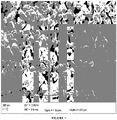
- Figure 1 illustrates a high resolution SEM micrograph showing the microstructure of an alumina powder described herein.
- Applicants have discovered a powder that can be used in an abrasive polish to obtain a high removal rate in a short amount of time. Specifically, Applicants discovered that the combination of an alpha alumina powder having a specific surface area, a specific primary crystallite size, a specific porosity, and a specific particle size distribution can quickly enable high removal rate with undiminished aesthetic quality when used in abrasive polishes.
- the starting material to form the alumina powder can be an aluminum oxide precursor powder.
- the aluminum oxide precursor powder can be an aluminum hydroxide powder.
- the aluminum hydroxide powder can include gibbsite, boehmite, diaspore, or a combination thereof.
- the aluminum oxide precursor powder can be an aluminum oxide powder containing a transitional aluminum oxide phase.
- the aluminum oxide precursor powder can include ⁇ , ⁇ , ⁇ , ⁇ , ⁇ , and/or ⁇ phase aluminum oxide.
- the particles of the aluminum oxide precursor powder can comprise a plurality of crystallites having an average primary crystallite size of less than about 5 microns, about 2 microns, about 1 micron, or about 0.5 microns. In some embodiments, the particles of the aluminum oxide precursor powder can comprise a plurality of crystallites having an average primary crystallite size of about 0.01-5 microns, about 0.05-2 microns, about 0.075-1 microns, or about 0.1-0.5 microns. In some embodiments, each of the crystallites have a primary crystallite size of less than about 5 microns, about 2 microns, about 1 micron, or about 0.5 microns. In some embodiments, each of the crystallites have a primary crystallite size of about 0.01-5 microns, about 0.05-2 microns, about 0.075-1 microns, or about 0.1-0.5 microns.
- the aluminum oxide precursor powder can also have a specific surface area of at least about 100 m 2 /g, about 200 m 2 /g, about 250 m 2 /g, about 275 m 2 /g, or about 300 m 2 /g. In some embodiments, the aluminum oxide precursor powder can have a specific surface area of about 10-400 m 2 /g, about 30-350 m 2 /g, or about 50-320 m 2 /g.
- the aluminum oxide precursor powder can have a density of at least about 2 g/cm 3 , about 2.2 g/cm 3 , about 2.5 g/cm 3 , about 3 g/cm 3 , about 3.25 g/cm 3 , about 3.5 g/cm 3 , about 3.75 g/cm 3 , or about 4 g/cm 3 .
- the aluminum oxide precursor powder described above can be calcined.
- aluminum oxide can be formed.
- aluminum oxide can be in a variety of phases including ⁇ , ⁇ , ⁇ , ⁇ , ⁇ , ⁇ , and/or ⁇ phase. Each phase of aluminum oxide can have a unique crystal structure and properties.
- the production of aluminum oxide tends to produce a multi-phase aluminum oxide (i.e., consisting of several phases of aluminum oxide rather than one individually).
- Applicants heat treatment process of the aluminum oxide precursor powder can produce a powder that has a majority alpha aluminum oxide (i.e., alpha alumina).
- Alpha aluminum oxide is the most chemically stable phase of aluminum oxide and also has the highest hardness, therefore making the alpha phase suitable for use in an abrasive compound.
- Various devices can be used in the calcination of the aluminum oxide precursor powder including a rotary kiln, a static kiln, a muffle furnace, an elevator kiln, or a pusher kiln, among others.
- various devices can be used to calcine the aluminum oxide precursor powder, there are main components of the calcination. These main components can include, for example, the calcination temperature and the calcination time. Due to the various phases of aluminum oxide that can occur, the main components of the calcination can allow the calcined powder to mostly be in the alpha alumina phase.
- the calcined alumina powder can be at least about 50 wt%, about 60 wt%, about 70 wt%, about 75 wt%, about 80 wt%, about 85 wt%, about 90 wt%, about 95 wt%, about 96 wt%, about 97 wt%, about 98 wt%, about 99 wt%, about 99.5 wt%, about 99.9 wt%, or 100 wt% alpha alumina.
- the remaining weight percent of the calcined alumina powder can be aluminum oxide in phases other than alpha.
- the temperature of the calcination process can be about 700-1600°C, about 800-1500°C, about 900-1400°C, about 1000-1300°C, or about 1100-1300°C. Outside of these temperature ranges, the alpha alumina content of the calcined powder might be outside of the alpha alumina weight percentages disclosed above.
- the calcination time can be about 1-48 hours, about 12-48 hours, about 24-48, or about 24 hours. A longer calcination time can elicit more crystallite grain necking or abnormal growth.
- the calcination can take place in an atmosphere of air, vacuum, or an inert gas.
- the particles of the calcined alumina powder can comprise a plurality of crystallites having an average primary crystallite size of less than about 5 microns, about 2 microns, about 1 micron, or about 0.5 microns. In some embodiments, the particles of the calcined alumina powder can comprise a plurality of crystallites having an average primary crystallite size of less than about 0.01-5 microns, about 0.05-2 microns, about 0.075-1 microns, or about 0.1-0.5 microns. In some embodiments, each of the crystallites have a primary crystallite size of less than about 5 microns, about 2 microns, about 1 micron, or about 0.5 microns.
- each of the crystallites have a primary crystallite size of less than about 0.01-5 microns, about 0.05-2 microns, about 0.075-1 microns, or about 0.1-0.5 microns.
- the structure of the powder can ultimately be altered and impact the millability and ultimately the size distribution achieved.
- the hardness and breakdown behavior of the aggregated crystallites can also be altered and change performance during use.
- maintaining a small primary crystallite size can provide greater flexability in achieving the final desired particle size distribution.
- the calcined alumina powder can also have a specific surface area (SSA) of about 1-20 m 2 /g, about 5-15 m 2 /g, about 5-12 m 2 /g, about 6-11 m 2 /g, about 7-10 m 2 /g, or about 8-9 m 2 /g.
- the SSA can be a good singular metric which combines alumina phase, structure, and size. If the SSA is much higher than these disclosed ranges, the alumina phase is likely to be lower than alpha and the removal rate of such powder in an abrasive polish would be decreased. If the SSA is much lower than these disclosed ranges, the alumina powder can have very coarse alpha particles which can cause significant scratching and therefore remove the clear coat in its entirety.
- the calcined alumina powder can have a density of greater than or equal to about 1 g/cm 3 , about 2 g/cm 3 , about 3 g/cm 3 , about 3.8 g/cm 3 , about 3.9 g/cm 3 , about 3.97 g/cm 3 , about 3.98 g/cm 3 , or about 4 g/cm 3 . If the density is much lower than these disclosed ranges, the alumina phase is likely to be lower than alpha and the removal rate of such powder in an abrasive polish would be decreased.
- the calcined alumina powder can also be porous.
- the calcined alumina powder can be mesoporous and macroporous.
- the mesoporosity and the macroporosity can be quantified by the pore volume and the pore size.
- the calcined alumina powder can be mesoporous with a pore volume of about 0.001-0.5 cm 3 /g, about 0.001-0.3 cm 3 /g, 0.005-0.25 cm 3 /g, about 0.01-0.2 cm 3 /g, or about 0.05-0.15 cm 3 /g and a pore size of about 2-50 nm, about 2-20 nm, about 3-15 nm, or about 5-10 nm.
- the calcined alumina powder can be macroporous with a pore volume of about 0.01-0.2 cm 3 /g, about 0.03-0.15 cm 3 /g, or about 0.05-0.1 cm 3 /g and a pore size of about 50-500 nm, about 50-200 nm, or about 50-100 nm.
- This porosity can allow the powder aggregates/particles to breakdown during use.
- these porosities (and densities) can allow the calcined powder to later be milled into the specific particle size distributions described below.
- the material characteristics described above can allow the creation of the particle size distribution described below.
- Applicants have discovered a specific particle size distribution of the alumina powder that can be used in abrasive polishes.
- the specific particle size distribution Applicants discovered can provide the performance benefits to abrasive polishes due to having particles/aggregates of particles on a large scale.
- the coarser particulate aggregates can provide high removal while the smaller particles and aggregates (and eventually individual crystallites) can provide the in-situ coarse scratch removal such that the finish can be maintained.
- the large particle aggregates can provide high removal first and then the smaller particles (or broken down aggregates) can provide the desired finish.
- the particles in the milled alumina powder can include particles with a size of about 0.1 microns to about 200 microns.
- the particle size distribution of the milled alumina powder can have a D5 of about 0.01-5 microns, about 0.05-3 microns, about 0.75-2 microns, or about 0.1-1 microns.
- the particle size distribution of the milled alumina powder can have a D50 of about 5-50 microns, about 10-45 microns, about 5-20 microns, about 7.5-17.5 microns, or about 10-15 microns.
- the particle size distribution of the milled alumina powder can have a D50 of less than about 50 microns, about 40 microns, about 30 microns, or about 20 microns.
- the particle size distribution of the milled alumina powder can have a D95 of about 30-120 microns, about 60-150 microns, about 65-110 microns, about 70-105 microns, or about 75-100 microns.
- the particle size distribution of the milled alumina powder can have a D95 of less than about 150 microns, about 100 microns, or about 75 microns.
- the particle size distribution of the milled alumina powder can have a D0 of about 0.1-1 micron, about 0.001-0.5 microns, about 0.005-0.3 microns, or about 0.01-0.2 microns and/or a D100 of about 65-200 microns, about 75-225 microns, about 90-210 microns, or about 100-200 microns.
- the particle size distribution of the milled alumina powder can have a D100 of less than about 200 microns, about 150 microns, or about 100 microns. This wide distribution can provide a rapid cut rate as abrasive particles in an abrasive polish while maintaining the ability to remove coarse scratches due to the powder having a wide size range.
- the smaller particles in the powder can provide a better finish that can transition a user more easily into the next step of the polishing process.
- the particle size distributions described above can be obtained by milling the calcined alumina powder.
- Various devices can be used in the milling of the calcined alumina powder including a vertical agitator, a horizontal agitator, a roll mill, a jet mill, or a planetary mill, , among others.
- the milling can take place in a wet or dry process.
- a wet process can include using a vertical agitator that employs a spindle and fine media.
- the ratio of media:powder in the vertical agitator can be about 2:1, 3:1, 5:1, or 10:1.
- the controlled rpm of the vertical agitator can be about 100-1500 rpm, about 150-1250 rpm, or about 200-1000 rpm.
- surfactants can be used in the vertical agitator to potentially control zetapotential and dispersion.
- the controlled rpm can be about 100-1500 rpm, about 150-1250 rpm, or about 200-1000 rpm and surfactants can be used to potentially control zetapotential and dispersion.
- Examples of a dry milling process include a roll mill and a jet mill.
- a roll mill can include media and powder of different loadings.
- the RPM of rolling can alter.
- a jet mill can mill particles using air-impingement impact of particles.
- an air-classifier can be employed with the jet mill to control the distribution size of the particles carefully.
- a planetary mill can be used which relies on rotational impact milling of powders in ceramic containers containing media.
- the milled alumina powder can be placed in a slurry.
- the slurry can include the milled powder and a fluid.
- the fluid can be water or other fluid the milled powder can be suspended within.
- the milled alumina powders described herein can be used as an abrasive polish.
- An abrasive polish can include the milled alumina powder, rheological modifiers, lubricants, suspension aids, stabilizers, dispersants, and/or surfactants.
- the rheological modifiers, the surfactants, the dispersants, the stabilizers, the suspension aids, and the lubricants can be abrasive particle rheological modifiers, abrasive particle surfactants, abrasive particle, dispersants, abrasive particle, stabilizers, abrasive particle suspension aids, and abrasive particle lubricants.
- the abrasive polish can include the milled alumina powder and at least one of a dispersant, a surfactant, a stabilizer, a rheology modifier, and a suspension aid.
- an abrasive polish can be made by adding the milled alumina powder and at least one of a rheological modifier, a lubricant, a suspension aid, a stabilizer, a dispersant, and a surfactant to a container; then mixing the components together.
- These abrasive polishes can be used on clear coats and/or hardcoats for various automotives (e.g., cars, boats, airplanes, etc.). More specifically, these abrasive polishes can be used in a coarse removal step to level the clear coat or hardcoat of the automotive. In some embodiments, the abrasive polishes can be used in a first coarse removal step to level the clear coat or hardcoat of the automotive and in a second finishing step to obtain a high finish.
- the performance of an abrasive polish can be measured as a removal rate and time to reach appropriate aesthetic appeal as measured by gloss and haze.
- Particle size distribution can be measured by a Laser Scattering method using a Horiba LA950.
- the powder samples can be analyzed for particle size using a Horiba LA-950 laser scattering particle size analyzer.
- Deionized (DI) water was used as the circulation bath medium and a refractive index of 1.66 with an imaginary value of O.Oi was used.
- the refractive index for water used was 1.333.
- the sample was pre-dispersed prior to analysis by introducing 0.5 g of sample into 30 mL of DI water in a glass beaker.
- the pH of the DI water was set to 6.4.
- the beaker was kept stationary and the material was sonicated for 2 minutes using a Sonics and Materials Inc. Vibracel brand processer with a model CV334 0.5 inch diameter horn and a model VC750 power source (750W). The power source was used at 50% amplitude.
- the Horiba LA950 analyzer was prepared for analysis with DI water of a pH 6.4 and by rinsing twice with additional DI water of a pH of 6.4 and then backfilling. The analyzer was aligned and blanked, after which the circulation and agitation were started. The circulation and agitation were kept at 15 and 5, respectively.
- the pre-dispersed sample was slowly introduced into the analyzer via transfer pipet until a transmittance level between 85 and 90% was achieved. The sample was allowed to circulate for 15 seconds prior to acquisition of the measurement.
- Specific surface area can be measured by the BET method.
- Density can be measured by helium pycnometry.
- the weight percent of the phase of the aluminum oxide can be measured by XRD Reitveld Refinement Method.
- Figure 1 illustrates a high resolution SEM micrograph showing the microstructure of an alumina powder described herein.
- Pore volume and pore size can be measured by nitrogen adsorption isotherm method.
Landscapes
- Chemical & Material Sciences (AREA)
- Organic Chemistry (AREA)
- Life Sciences & Earth Sciences (AREA)
- Geology (AREA)
- Inorganic Chemistry (AREA)
- Physics & Mathematics (AREA)
- Thermal Sciences (AREA)
- Chemical Kinetics & Catalysis (AREA)
- Compounds Of Alkaline-Earth Elements, Aluminum Or Rare-Earth Metals (AREA)
- Finish Polishing, Edge Sharpening, And Grinding By Specific Grinding Devices (AREA)
Claims (15)
- Poudre d'alumine comprenant au moins 75 % en poids d'alumine alpha, dans laquelle la poudre d'alumine a :une surface spécifique de 5 à 12 m2/g ; etune répartition de taille de particule avec un D5 de 0,01 à 5 microns, un D50 de 5 à 50 microns et un D95 de 30 à 120 microns,dans laquelle la poudre d'alumine comprend une pluralité de cristallites ayant une taille moyenne de cristallite primaire inférieure à 2 microns.
- Poudre d'alumine selon la revendication 1, dans laquelle la poudre d'alumine comprend au moins 85 % en poids d'alumine alpha ; ou dans laquelle la répartition de taille de particule de la poudre d'alumine a un D5 de 0,1 à 1 micron, un D50 de 10 à 45 microns et un D95 de 60 à 150 microns.
- Poudre d'alumine selon la revendication 1, dans laquelle la répartition de taille de particule a un D0 de 0,1 à 1 micron ; ou dans laquelle la répartition de taille de particule a un D100 de 65 à 200 microns ; ou dans laquelle la répartition de taille de particule a un D100 inférieur à 200 microns.
- Poudre d'alumine selon la revendication 1, dans laquelle la surface spécifique de la poudre d'alumine est de 7 à 10 m2/g.
- Poudre d'alumine selon la revendication 1, dans laquelle la poudre d'alumine a une densité d'au moins 3 g/cm3, de préférence dans laquelle la densité est d'au moins 3,8 g/cm3.
- Poudre d'alumine selon la revendication 1, dans laquelle la taille moyenne de cristallite primaire est de 0,1 à 0,5 micron ; ou dans laquelle chacun des cristallites a une taille de cristallite primaire inférieure à 2 microns, de préférence dans laquelle chacun des cristallites a une taille de cristallite primaire inférieure à 1 micron.
- Poudre d'alumine selon la revendication 1, dans laquelle au moins une partie de la poudre d'alumine calcinée a un volume de pores de 0,001 à 0,5 cm3/g et une taille de pores d'environ 2 à 50 nm ; ou dans laquelle au moins une partie de la poudre d'alumine calcinée a un volume de pores de 0,01 à 0,2 cm3/g et une taille de pores de 50 à 500 nm.
- Procédé de formation d'une poudre d'alumine broyée, le procédé comprenant :la calcination d'une poudre comprenant de l'hydroxyde d'aluminium à une température de 800 à 1500°C pour former une poudre d'alumine comprenant au moins 75 % en poids d'alumine alpha ; etle broyage de la poudre d'alumine pour avoir une répartition de taille de particule avec un D5 de 0,01 à 5 microns, un D50 de 5 à 20 microns et un D95 de 65 à 110 microns pour former la poudre d'alumine broyée.
- Procédé selon la revendication 8, dans lequel la température est de 900-1400°C, de préférence dans lequel la température est de 1100-1300°C.
- Procédé selon la revendication 8, dans lequel la poudre comprenant de l'hydroxyde d'aluminium est calcinée pendant 1 à 48 heures ; ou dans lequel la poudre comprenant de l'hydroxyde d'aluminium est calcinée dans un four rotatif, un four statique ou un four à poussoir ; ou dans lequel la poudre d'alumine comprend au moins 85 % en poids d'alumine alpha.
- Procédé selon la revendication 8, dans lequel la poudre d'alumine est broyée pour avoir une répartition de taille de particule avec un D5 de 0,1 à 1 micron, un D50 de 10 à 15 microns et un D95 de 75 à 100 microns ; ou dans lequel la poudre d'alumine est broyée pour avoir une répartition de taille de particule avec un D0 de 0,01 à 0,2 micron ; ou dans lequel la poudre d'alumine est broyée pour avoir une répartition de taille de particule avec un D100 de 100 à 200 microns.
- Procédé selon la revendication 8, dans lequel la poudre d'alumine est broyée en utilisant un agitateur vertical, un agitateur horizontal, un broyeur à cylindres, un broyeur à jet ou un broyeur planétaire ; ou dans lequel la répartition de taille de particule a un D100 inférieur à 200 microns.
- Suspension comprenant la poudre d'alumine selon l'une quelconque des revendications 1 à 7 et au moins un fluide pour suspendre la poudre d'alumine.
- Vernis abrasif comprenant la poudre d'alumine selon l'une quelconque des revendications 1 à 7 et au moins l'un parmi un dispersant, un tensioactif, un stabilisant et un modificateur de rhéologie.
- Procédé de fabrication d'un vernis abrasif, comprenant :l'ajout de la poudre d'alumine selon l'une quelconque des revendications 1 à 7 à un récipient ;l'ajout d'au moins l'un d'un dispersant, d'un tensioactif, d'un stabilisant et d'un modificateur de rhéologie au récipient ; etle mélange de la poudre d'alumine et du au moins un parmi le dispersant, le tensioactif, le stabilisant et le modificateur de rhéologie.
Applications Claiming Priority (2)
| Application Number | Priority Date | Filing Date | Title |
|---|---|---|---|
| US201762459400P | 2017-02-15 | 2017-02-15 | |
| PCT/US2018/018225 WO2018152236A1 (fr) | 2017-02-15 | 2018-02-14 | Particules abrasives d'alumine utilisées pour des compositions de finition automobile |
Publications (3)
| Publication Number | Publication Date |
|---|---|
| EP3582932A1 EP3582932A1 (fr) | 2019-12-25 |
| EP3582932A4 EP3582932A4 (fr) | 2020-12-23 |
| EP3582932B1 true EP3582932B1 (fr) | 2022-03-30 |
Family
ID=63105842
Family Applications (1)
| Application Number | Title | Priority Date | Filing Date |
|---|---|---|---|
| EP18754768.2A Revoked EP3582932B1 (fr) | 2017-02-15 | 2018-02-14 | Particules abrasives d'alumine utilisées pour des compositions de finition automobile |
Country Status (7)
| Country | Link |
|---|---|
| US (1) | US11130682B2 (fr) |
| EP (1) | EP3582932B1 (fr) |
| JP (1) | JP6876152B2 (fr) |
| CN (1) | CN110461545B (fr) |
| ES (1) | ES2921133T3 (fr) |
| PL (1) | PL3582932T3 (fr) |
| WO (1) | WO2018152236A1 (fr) |
Families Citing this family (2)
| Publication number | Priority date | Publication date | Assignee | Title |
|---|---|---|---|---|
| CN109439283A (zh) * | 2018-11-02 | 2019-03-08 | 长沙县新光特种陶瓷有限公司 | 一种抛光用氧化铝粉的制备方法 |
| CN114751438B (zh) * | 2022-04-28 | 2023-09-08 | 浙江奥首材料科技有限公司 | 一种氧化铝磨料、制备方法、用途及包含其的硅片研磨液和研磨方法 |
Citations (17)
| Publication number | Priority date | Publication date | Assignee | Title |
|---|---|---|---|---|
| US4301037A (en) | 1980-04-01 | 1981-11-17 | W. R. Grace & Co. | Extruded alumina catalyst support having controlled distribution of pore sizes |
| US4761394A (en) | 1986-10-31 | 1988-08-02 | Shell Oil Company | Ethylene oxide catalyst and process for preparing the catalyst |
| WO1992016595A1 (fr) | 1991-03-21 | 1992-10-01 | Mineralien-Werke Kuppenheim Gmbh | Procede de preparation d'alumine a partir d'hydroxyde d'aluminium a des fins de meulage et/ou de polissage |
| US5284809A (en) | 1991-11-22 | 1994-02-08 | Lonza Ltd. | Method for the preparation of α-aluminum oxide powder |
| US5302368A (en) | 1987-01-29 | 1994-04-12 | Sumitomo Chemical Company, Limited | Process for preparation of alumina |
| WO1995017957A1 (fr) | 1993-12-30 | 1995-07-06 | Shell Internationale Research Maatschappij B.V. | Catalyseur d'epoxydation et son procede de preparation |
| WO1998019967A1 (fr) | 1996-11-04 | 1998-05-14 | Aluminium Pechiney | Fabrication d'alumine calcinee a taille de cristallite reglee a la demande avec une faible dispersion |
| US6403526B1 (en) | 1999-12-21 | 2002-06-11 | W. R. Grace & Co.-Conn. | Alumina trihydrate derived high pore volume, high surface area aluminum oxide composites and methods of their preparation and use |
| US20030185746A1 (en) | 2002-01-16 | 2003-10-02 | Sumitomo Chemical Company, Limited | Calcined alumina, its production method and fine alpha-alumina powder obtained by using the calcined alumina |
| US20040197263A1 (en) | 2003-04-02 | 2004-10-07 | Saint-Gobain Ceramics & Plastics, Inc. | Nanoporous ultrafine alpha-alumina powders and sol-gel process of preparing same |
| US20050135995A1 (en) | 2003-04-02 | 2005-06-23 | Yuhu Wang | Nanoporous ultrafine alpha-alumina powders and freeze drying process of preparing same |
| JP2006124622A (ja) | 2004-11-01 | 2006-05-18 | Ishihara Chem Co Ltd | 研磨用α−アルミナ組成物、及びその製造方法 |
| US20110256051A1 (en) | 2010-04-15 | 2011-10-20 | Sumitomo Chemical Company, Limited | Method for producing spherical alumina powder |
| US20120034851A1 (en) | 2010-08-09 | 2012-02-09 | Ferro Corporation | Easy Rinsing Polishing Composition For Polymer-Based Surfaces |
| US20140158613A1 (en) | 2011-04-04 | 2014-06-12 | The Regents Of The University Of Colorado | Highly porous ceramic material and method of using and forming same |
| WO2014102249A1 (fr) | 2012-12-28 | 2014-07-03 | Albemarle Europe Sprl | Procédé de production d'une nouvelle alumine de polissage |
| EP2852564B1 (fr) | 2012-05-21 | 2019-05-15 | Alteo Gardanne | Utilisation d'alumine en tant qu'agent opacifiant dans la fabrication de produits ceramiques, et en particulier de carrelages |
Family Cites Families (3)
| Publication number | Priority date | Publication date | Assignee | Title |
|---|---|---|---|---|
| US20090120012A1 (en) * | 2004-06-18 | 2009-05-14 | Dongjin Semichem Co., Ltd. | Method for preparing additive for chemical mechanical polishing slurry composition |
| CN103332718B (zh) * | 2013-07-10 | 2015-09-30 | 晋城市富基新材料股份有限公司 | 一种超细、低钠α-氧化铝微粉的制备方法 |
| CN106044809B (zh) | 2016-05-27 | 2018-10-26 | 兰州大学 | 一种完全分散α氧化铝纳米颗粒的制备方法 |
-
2018
- 2018-02-14 ES ES18754768T patent/ES2921133T3/es active Active
- 2018-02-14 CN CN201880012148.3A patent/CN110461545B/zh active Active
- 2018-02-14 PL PL18754768.2T patent/PL3582932T3/pl unknown
- 2018-02-14 WO PCT/US2018/018225 patent/WO2018152236A1/fr not_active Ceased
- 2018-02-14 EP EP18754768.2A patent/EP3582932B1/fr not_active Revoked
- 2018-02-14 JP JP2019564388A patent/JP6876152B2/ja active Active
- 2018-02-14 US US15/897,117 patent/US11130682B2/en active Active
Patent Citations (17)
| Publication number | Priority date | Publication date | Assignee | Title |
|---|---|---|---|---|
| US4301037A (en) | 1980-04-01 | 1981-11-17 | W. R. Grace & Co. | Extruded alumina catalyst support having controlled distribution of pore sizes |
| US4761394A (en) | 1986-10-31 | 1988-08-02 | Shell Oil Company | Ethylene oxide catalyst and process for preparing the catalyst |
| US5302368A (en) | 1987-01-29 | 1994-04-12 | Sumitomo Chemical Company, Limited | Process for preparation of alumina |
| WO1992016595A1 (fr) | 1991-03-21 | 1992-10-01 | Mineralien-Werke Kuppenheim Gmbh | Procede de preparation d'alumine a partir d'hydroxyde d'aluminium a des fins de meulage et/ou de polissage |
| US5284809A (en) | 1991-11-22 | 1994-02-08 | Lonza Ltd. | Method for the preparation of α-aluminum oxide powder |
| WO1995017957A1 (fr) | 1993-12-30 | 1995-07-06 | Shell Internationale Research Maatschappij B.V. | Catalyseur d'epoxydation et son procede de preparation |
| WO1998019967A1 (fr) | 1996-11-04 | 1998-05-14 | Aluminium Pechiney | Fabrication d'alumine calcinee a taille de cristallite reglee a la demande avec une faible dispersion |
| US6403526B1 (en) | 1999-12-21 | 2002-06-11 | W. R. Grace & Co.-Conn. | Alumina trihydrate derived high pore volume, high surface area aluminum oxide composites and methods of their preparation and use |
| US20030185746A1 (en) | 2002-01-16 | 2003-10-02 | Sumitomo Chemical Company, Limited | Calcined alumina, its production method and fine alpha-alumina powder obtained by using the calcined alumina |
| US20040197263A1 (en) | 2003-04-02 | 2004-10-07 | Saint-Gobain Ceramics & Plastics, Inc. | Nanoporous ultrafine alpha-alumina powders and sol-gel process of preparing same |
| US20050135995A1 (en) | 2003-04-02 | 2005-06-23 | Yuhu Wang | Nanoporous ultrafine alpha-alumina powders and freeze drying process of preparing same |
| JP2006124622A (ja) | 2004-11-01 | 2006-05-18 | Ishihara Chem Co Ltd | 研磨用α−アルミナ組成物、及びその製造方法 |
| US20110256051A1 (en) | 2010-04-15 | 2011-10-20 | Sumitomo Chemical Company, Limited | Method for producing spherical alumina powder |
| US20120034851A1 (en) | 2010-08-09 | 2012-02-09 | Ferro Corporation | Easy Rinsing Polishing Composition For Polymer-Based Surfaces |
| US20140158613A1 (en) | 2011-04-04 | 2014-06-12 | The Regents Of The University Of Colorado | Highly porous ceramic material and method of using and forming same |
| EP2852564B1 (fr) | 2012-05-21 | 2019-05-15 | Alteo Gardanne | Utilisation d'alumine en tant qu'agent opacifiant dans la fabrication de produits ceramiques, et en particulier de carrelages |
| WO2014102249A1 (fr) | 2012-12-28 | 2014-07-03 | Albemarle Europe Sprl | Procédé de production d'une nouvelle alumine de polissage |
Non-Patent Citations (19)
| Title |
|---|
| "Alumina Chemicals: Science & Technology Handbook", 1990, ISBN: 0-916094-33-2, article CARBONE T. J.: "Production processes, properties, and applications for calcined and high-aluminas", pages: 99 - 105, XP093014681 |
| 1 January 1992, article BORKOWSKI J A, ET AL.: "Uses of Abrasives and Abrasive Tools", XP093017992 |
| ANONYMOUS: "3M™ Scratch Remover Safety Data Sheet", 3M SAFETY DATA SHEET, 13 April 2020 (2020-04-13), pages 1 - 12, XP093015251 |
| ANONYMOUS: "Aluminium oxide - Wikipedia", WIKIPEDIA, 1 January 2020 (2020-01-01), pages 1 - 10, XP055703993, Retrieved from the Internet <URL:https://en.wikipedia.org/wiki/Aluminium_oxide> [retrieved on 20200611] |
| ANONYMOUS: "Aluminiumoxid fur die Polier- und Schleifmittelindustrie", MARTOXID, 1 January 2003 (2003-01-01), XP093017952, [retrieved on 20230126] |
| ANONYMOUS: "B&B micro abrasives Polishing Alumina Meeting", PRESENTATION - BB MEETING 10.21.15, 2015, pages 1 - 46, XP093014936 |
| ANONYMOUS: "Ball mill", WIKIPEDIA, 16 December 2022 (2022-12-16), pages 1 - 4, XP093014933 |
| ANONYMOUS: "Calcined Aluminas for Polishing", ALMATIS INFO 2, 1982, pages 1 - 20, XP093014938 |
| ANONYMOUS: "Calcined Aluminas for polishing", ALMATIS PREMIUM ALUMINA, 2014, pages 1 - 8, XP093014670 |
| ANONYMOUS: "Korngrößenmessung CILAS 1064 NAB", KORNGRÖSSENMESSUNG, 29 December 2022 (2022-12-29), pages 1 - 2, XP093014675 |
| ANONYMOUS: "LA-950 Laser Particle Size Analyzer", HORIBA SEMICONDUCTOR, 1 June 2000 (2000-06-01), XP093017973, Retrieved from the Internet <URL:https://www.horiba.com/details/la-950- laser -particle-size-analyzer-108> [retrieved on 20230126] |
| ANONYMOUS: "Micromeritics Instrument Corp", MICROMERITICS, 29 December 2022 (2022-12-29), pages 1 - 6, XP093014694 |
| ANONYMOUS: "Particle Size Distribution of powders", POWDER PROCESS, 30 December 2022 (2022-12-30), pages 1 - 4, XP093015387 |
| ANONYMOUS: "Polieren", WIKIPEDIA, 1 January 2022 (2022-01-01), XP093017982, [retrieved on 20230126] |
| ANONYMOUS: "Polishing Aluminas from micro abrasives", MICROCLEAR DS, 2014, pages 1 - 28, XP093014924 |
| ANONYMOUS: "Rotary kiln", WIKIPEDIA, 16 October 2022 (2022-10-16), pages 1 - 5, XP093014931 |
| AUERKARI: "Mechanical and physical properties of engineering alumina ceramics", VTT MANUFACTURING TECHNOLOGY, 1996, pages 1 - 26, XP055532274 |
| CROQUESEL JEREMY; BOUVARD DIDIER; CHAIX JEAN-MARC; CARRY CLAUDE P; SAUNIER SÉBASTIEN; MARINEL SYLVAIN: "Direct microwave sintering of pure alumina in a single mode cavity: Grain size and phase transformation effects", ACTA MATERIALIA, vol. 116, pages 53 - 62, XP029673847 |
| KIYOHARA P K, ET AL.: "Structure, Surface Area an Morphology of Aluminas from ther- mal decomposition of Al(OH)( CH 3COO)2 Crystals", AN. ACAD. BRAS. CI., vol. 72, no. 4, 1 January 2000 (2000-01-01), XP093017958 |
Also Published As
| Publication number | Publication date |
|---|---|
| EP3582932A4 (fr) | 2020-12-23 |
| US20180230021A1 (en) | 2018-08-16 |
| CN110461545B (zh) | 2022-01-28 |
| US11130682B2 (en) | 2021-09-28 |
| WO2018152236A1 (fr) | 2018-08-23 |
| EP3582932A1 (fr) | 2019-12-25 |
| ES2921133T3 (es) | 2022-08-18 |
| PL3582932T3 (pl) | 2022-09-05 |
| JP6876152B2 (ja) | 2021-05-26 |
| CN110461545A (zh) | 2019-11-15 |
| JP2020510605A (ja) | 2020-04-09 |
Similar Documents
| Publication | Publication Date | Title |
|---|---|---|
| EP2157052B1 (fr) | Procédé de production de particules de boehmite et procédé de production de particules d'alumine | |
| EP2260013B1 (fr) | Matériau oxyde de cérium et son procédé de formation | |
| US6841497B1 (en) | Method of producing aluminum oxides and products obtained on the basis thereof | |
| EP2438133B1 (fr) | Composition de polissage contenant des nanostructures d'oxyde de métal de type framboise enrobées avec des nanoparticules de ceo2 | |
| RU2462416C2 (ru) | Керамический порошковый материал (варианты) и способ его изготовления | |
| JP5802336B2 (ja) | 研磨粒子材料を含む研磨製品、研磨粒子材料を使用する研磨布紙および形成方法 | |
| RU2302374C2 (ru) | Нанопористые сверхмелкие порошки из альфа оксида алюминия и золь-гель, способ их приготовления | |
| RU2401856C2 (ru) | Абразивный порошковый материал и абразивная суспензия для избирательного полирования полупроводниковой подложки и способ полирования | |
| US11130682B2 (en) | Alumina abrasive particles used for automotive finishing compositions | |
| Chen et al. | Nanocasting synthesis of mesoporous CeO2 particle abrasives from mesoporous SiO2 hard templates for enhanced chemical mechanical polishing performance | |
| JP6371193B2 (ja) | シリカ系複合粒子分散液の製造方法 | |
| KR102652102B1 (ko) | 복수의 연마 입자를 포함하는 조성물 및 이의 사용 방법 | |
| JP2001062705A (ja) | 金属研磨用αアルミナ研磨材およびその製法 | |
| CN114599607A (zh) | 埃洛石粉末 | |
| JP5259933B2 (ja) | セリウム系研摩材用原料およびセリウム系研摩材の製造方法並びにセリウム系研摩材 | |
| US20250179332A1 (en) | High removal rate chemical mechanical polish for ophthalmic polishing | |
| JP2018168063A (ja) | シリカ系複合粒子分散液の製造方法 | |
| JPH07256555A (ja) | 軟質材料用研磨材 |
Legal Events
| Date | Code | Title | Description |
|---|---|---|---|
| STAA | Information on the status of an ep patent application or granted ep patent |
Free format text: STATUS: THE INTERNATIONAL PUBLICATION HAS BEEN MADE |
|
| PUAI | Public reference made under article 153(3) epc to a published international application that has entered the european phase |
Free format text: ORIGINAL CODE: 0009012 |
|
| STAA | Information on the status of an ep patent application or granted ep patent |
Free format text: STATUS: REQUEST FOR EXAMINATION WAS MADE |
|
| 17P | Request for examination filed |
Effective date: 20190912 |
|
| AK | Designated contracting states |
Kind code of ref document: A1 Designated state(s): AL AT BE BG CH CY CZ DE DK EE ES FI FR GB GR HR HU IE IS IT LI LT LU LV MC MK MT NL NO PL PT RO RS SE SI SK SM TR |
|
| AX | Request for extension of the european patent |
Extension state: BA ME |
|
| DAV | Request for validation of the european patent (deleted) | ||
| DAX | Request for extension of the european patent (deleted) | ||
| REG | Reference to a national code |
Ref country code: DE Ref legal event code: R079 Ref document number: 602018033027 Country of ref document: DE Free format text: PREVIOUS MAIN CLASS: B24D0011000000 Ipc: C01F0007000000 |
|
| A4 | Supplementary search report drawn up and despatched |
Effective date: 20201125 |
|
| RIC1 | Information provided on ipc code assigned before grant |
Ipc: B24D 11/02 20060101ALI20201119BHEP Ipc: C01F 7/00 20060101AFI20201119BHEP Ipc: B24D 11/00 20060101ALI20201119BHEP |
|
| GRAP | Despatch of communication of intention to grant a patent |
Free format text: ORIGINAL CODE: EPIDOSNIGR1 |
|
| STAA | Information on the status of an ep patent application or granted ep patent |
Free format text: STATUS: GRANT OF PATENT IS INTENDED |
|
| INTG | Intention to grant announced |
Effective date: 20210909 |
|
| GRAS | Grant fee paid |
Free format text: ORIGINAL CODE: EPIDOSNIGR3 |
|
| GRAA | (expected) grant |
Free format text: ORIGINAL CODE: 0009210 |
|
| STAA | Information on the status of an ep patent application or granted ep patent |
Free format text: STATUS: THE PATENT HAS BEEN GRANTED |
|
| AK | Designated contracting states |
Kind code of ref document: B1 Designated state(s): AL AT BE BG CH CY CZ DE DK EE ES FI FR GB GR HR HU IE IS IT LI LT LU LV MC MK MT NL NO PL PT RO RS SE SI SK SM TR |
|
| REG | Reference to a national code |
Ref country code: GB Ref legal event code: FG4D |
|
| REG | Reference to a national code |
Ref country code: CH Ref legal event code: EP |
|
| REG | Reference to a national code |
Ref country code: AT Ref legal event code: REF Ref document number: 1479053 Country of ref document: AT Kind code of ref document: T Effective date: 20220415 |
|
| REG | Reference to a national code |
Ref country code: DE Ref legal event code: R096 Ref document number: 602018033027 Country of ref document: DE |
|
| REG | Reference to a national code |
Ref country code: IE Ref legal event code: FG4D |
|
| REG | Reference to a national code |
Ref country code: FI Ref legal event code: FGE |
|
| REG | Reference to a national code |
Ref country code: LT Ref legal event code: MG9D |
|
| REG | Reference to a national code |
Ref country code: NL Ref legal event code: FP |
|
| PG25 | Lapsed in a contracting state [announced via postgrant information from national office to epo] |
Ref country code: SE Free format text: LAPSE BECAUSE OF FAILURE TO SUBMIT A TRANSLATION OF THE DESCRIPTION OR TO PAY THE FEE WITHIN THE PRESCRIBED TIME-LIMIT Effective date: 20220330 Ref country code: RS Free format text: LAPSE BECAUSE OF FAILURE TO SUBMIT A TRANSLATION OF THE DESCRIPTION OR TO PAY THE FEE WITHIN THE PRESCRIBED TIME-LIMIT Effective date: 20220330 Ref country code: NO Free format text: LAPSE BECAUSE OF FAILURE TO SUBMIT A TRANSLATION OF THE DESCRIPTION OR TO PAY THE FEE WITHIN THE PRESCRIBED TIME-LIMIT Effective date: 20220630 Ref country code: LT Free format text: LAPSE BECAUSE OF FAILURE TO SUBMIT A TRANSLATION OF THE DESCRIPTION OR TO PAY THE FEE WITHIN THE PRESCRIBED TIME-LIMIT Effective date: 20220330 Ref country code: HR Free format text: LAPSE BECAUSE OF FAILURE TO SUBMIT A TRANSLATION OF THE DESCRIPTION OR TO PAY THE FEE WITHIN THE PRESCRIBED TIME-LIMIT Effective date: 20220330 Ref country code: BG Free format text: LAPSE BECAUSE OF FAILURE TO SUBMIT A TRANSLATION OF THE DESCRIPTION OR TO PAY THE FEE WITHIN THE PRESCRIBED TIME-LIMIT Effective date: 20220630 |
|
| REG | Reference to a national code |
Ref country code: AT Ref legal event code: MK05 Ref document number: 1479053 Country of ref document: AT Kind code of ref document: T Effective date: 20220330 |
|
| REG | Reference to a national code |
Ref country code: ES Ref legal event code: FG2A Ref document number: 2921133 Country of ref document: ES Kind code of ref document: T3 Effective date: 20220818 |
|
| PG25 | Lapsed in a contracting state [announced via postgrant information from national office to epo] |
Ref country code: LV Free format text: LAPSE BECAUSE OF FAILURE TO SUBMIT A TRANSLATION OF THE DESCRIPTION OR TO PAY THE FEE WITHIN THE PRESCRIBED TIME-LIMIT Effective date: 20220330 Ref country code: GR Free format text: LAPSE BECAUSE OF FAILURE TO SUBMIT A TRANSLATION OF THE DESCRIPTION OR TO PAY THE FEE WITHIN THE PRESCRIBED TIME-LIMIT Effective date: 20220701 |
|
| PG25 | Lapsed in a contracting state [announced via postgrant information from national office to epo] |
Ref country code: SM Free format text: LAPSE BECAUSE OF FAILURE TO SUBMIT A TRANSLATION OF THE DESCRIPTION OR TO PAY THE FEE WITHIN THE PRESCRIBED TIME-LIMIT Effective date: 20220330 Ref country code: SK Free format text: LAPSE BECAUSE OF FAILURE TO SUBMIT A TRANSLATION OF THE DESCRIPTION OR TO PAY THE FEE WITHIN THE PRESCRIBED TIME-LIMIT Effective date: 20220330 Ref country code: RO Free format text: LAPSE BECAUSE OF FAILURE TO SUBMIT A TRANSLATION OF THE DESCRIPTION OR TO PAY THE FEE WITHIN THE PRESCRIBED TIME-LIMIT Effective date: 20220330 Ref country code: PT Free format text: LAPSE BECAUSE OF FAILURE TO SUBMIT A TRANSLATION OF THE DESCRIPTION OR TO PAY THE FEE WITHIN THE PRESCRIBED TIME-LIMIT Effective date: 20220801 Ref country code: EE Free format text: LAPSE BECAUSE OF FAILURE TO SUBMIT A TRANSLATION OF THE DESCRIPTION OR TO PAY THE FEE WITHIN THE PRESCRIBED TIME-LIMIT Effective date: 20220330 Ref country code: CZ Free format text: LAPSE BECAUSE OF FAILURE TO SUBMIT A TRANSLATION OF THE DESCRIPTION OR TO PAY THE FEE WITHIN THE PRESCRIBED TIME-LIMIT Effective date: 20220330 Ref country code: AT Free format text: LAPSE BECAUSE OF FAILURE TO SUBMIT A TRANSLATION OF THE DESCRIPTION OR TO PAY THE FEE WITHIN THE PRESCRIBED TIME-LIMIT Effective date: 20220330 |
|
| PG25 | Lapsed in a contracting state [announced via postgrant information from national office to epo] |
Ref country code: IS Free format text: LAPSE BECAUSE OF FAILURE TO SUBMIT A TRANSLATION OF THE DESCRIPTION OR TO PAY THE FEE WITHIN THE PRESCRIBED TIME-LIMIT Effective date: 20220730 Ref country code: AL Free format text: LAPSE BECAUSE OF FAILURE TO SUBMIT A TRANSLATION OF THE DESCRIPTION OR TO PAY THE FEE WITHIN THE PRESCRIBED TIME-LIMIT Effective date: 20220330 |
|
| REG | Reference to a national code |
Ref country code: DE Ref legal event code: R026 Ref document number: 602018033027 Country of ref document: DE |
|
| PLBI | Opposition filed |
Free format text: ORIGINAL CODE: 0009260 |
|
| PLAX | Notice of opposition and request to file observation + time limit sent |
Free format text: ORIGINAL CODE: EPIDOSNOBS2 |
|
| PLAB | Opposition data, opponent's data or that of the opponent's representative modified |
Free format text: ORIGINAL CODE: 0009299OPPO |
|
| PLAN | Information deleted related to communication of a notice of opposition and request to file observations + time limit |
Free format text: ORIGINAL CODE: EPIDOSDOBS2 |
|
| PG25 | Lapsed in a contracting state [announced via postgrant information from national office to epo] |
Ref country code: DK Free format text: LAPSE BECAUSE OF FAILURE TO SUBMIT A TRANSLATION OF THE DESCRIPTION OR TO PAY THE FEE WITHIN THE PRESCRIBED TIME-LIMIT Effective date: 20220330 |
|
| 26 | Opposition filed |
Opponent name: MICRO ABRASIVES CORPORATION Effective date: 20230102 Opponent name: ALMATIS GMBH Effective date: 20221230 Opponent name: ALTMANN STOESSEL DICK PATENTANWAELTE PARTG MBB Effective date: 20221230 |
|
| R26 | Opposition filed (corrected) |
Opponent name: MICRO ABRASIVES CORPORATION Effective date: 20230102 Opponent name: ALMATIS GMBH Effective date: 20221230 Opponent name: ALTMANN STOESSEL DICK PATENTANWAELTE PARTG MBB Effective date: 20221230 |
|
| PLAX | Notice of opposition and request to file observation + time limit sent |
Free format text: ORIGINAL CODE: EPIDOSNOBS2 |
|
| PG25 | Lapsed in a contracting state [announced via postgrant information from national office to epo] |
Ref country code: SI Free format text: LAPSE BECAUSE OF FAILURE TO SUBMIT A TRANSLATION OF THE DESCRIPTION OR TO PAY THE FEE WITHIN THE PRESCRIBED TIME-LIMIT Effective date: 20220330 |
|
| P01 | Opt-out of the competence of the unified patent court (upc) registered |
Effective date: 20230526 |
|
| REG | Reference to a national code |
Ref country code: CH Ref legal event code: PL |
|
| PG25 | Lapsed in a contracting state [announced via postgrant information from national office to epo] |
Ref country code: LI Free format text: LAPSE BECAUSE OF NON-PAYMENT OF DUE FEES Effective date: 20230228 Ref country code: CH Free format text: LAPSE BECAUSE OF NON-PAYMENT OF DUE FEES Effective date: 20230228 |
|
| REG | Reference to a national code |
Ref country code: IE Ref legal event code: MM4A |
|
| REG | Reference to a national code |
Ref country code: DE Ref legal event code: R082 Ref document number: 602018033027 Country of ref document: DE Representative=s name: KRAUS & LEDERER PARTGMBB, DE |
|
| PG25 | Lapsed in a contracting state [announced via postgrant information from national office to epo] |
Ref country code: IE Free format text: LAPSE BECAUSE OF NON-PAYMENT OF DUE FEES Effective date: 20230214 |
|
| PGFP | Annual fee paid to national office [announced via postgrant information from national office to epo] |
Ref country code: NL Payment date: 20240123 Year of fee payment: 7 |
|
| PGFP | Annual fee paid to national office [announced via postgrant information from national office to epo] |
Ref country code: LU Payment date: 20240123 Year of fee payment: 7 |
|
| PGFP | Annual fee paid to national office [announced via postgrant information from national office to epo] |
Ref country code: ES Payment date: 20240301 Year of fee payment: 7 |
|
| PGFP | Annual fee paid to national office [announced via postgrant information from national office to epo] |
Ref country code: MC Payment date: 20240126 Year of fee payment: 7 |
|
| PGFP | Annual fee paid to national office [announced via postgrant information from national office to epo] |
Ref country code: FI Payment date: 20240123 Year of fee payment: 7 Ref country code: DE Payment date: 20240123 Year of fee payment: 7 Ref country code: GB Payment date: 20240123 Year of fee payment: 7 |
|
| PGFP | Annual fee paid to national office [announced via postgrant information from national office to epo] |
Ref country code: TR Payment date: 20240130 Year of fee payment: 7 Ref country code: PL Payment date: 20240126 Year of fee payment: 7 Ref country code: IT Payment date: 20240123 Year of fee payment: 7 Ref country code: FR Payment date: 20240123 Year of fee payment: 7 Ref country code: BE Payment date: 20240123 Year of fee payment: 7 |
|
| RDAF | Communication despatched that patent is revoked |
Free format text: ORIGINAL CODE: EPIDOSNREV1 |
|
| REG | Reference to a national code |
Ref country code: DE Ref legal event code: R103 Ref document number: 602018033027 Country of ref document: DE Ref country code: DE Ref legal event code: R064 Ref document number: 602018033027 Country of ref document: DE |
|
| RDAG | Patent revoked |
Free format text: ORIGINAL CODE: 0009271 |
|
| STAA | Information on the status of an ep patent application or granted ep patent |
Free format text: STATUS: PATENT REVOKED |
|
| REG | Reference to a national code |
Ref country code: CH Ref legal event code: PL |
|
| 27W | Patent revoked |
Effective date: 20240725 |
|
| GBPR | Gb: patent revoked under art. 102 of the ep convention designating the uk as contracting state |
Effective date: 20240725 |
|
| PG25 | Lapsed in a contracting state [announced via postgrant information from national office to epo] |
Ref country code: CY Free format text: LAPSE BECAUSE OF FAILURE TO SUBMIT A TRANSLATION OF THE DESCRIPTION OR TO PAY THE FEE WITHIN THE PRESCRIBED TIME-LIMIT; INVALID AB INITIO Effective date: 20180214 |
|
| PG25 | Lapsed in a contracting state [announced via postgrant information from national office to epo] |
Ref country code: HU Free format text: LAPSE BECAUSE OF FAILURE TO SUBMIT A TRANSLATION OF THE DESCRIPTION OR TO PAY THE FEE WITHIN THE PRESCRIBED TIME-LIMIT; INVALID AB INITIO Effective date: 20180214 |