EP3584268A1 - Polyamidzusammensetzung und verfahren zur herstellung einer polyamidzusammensetzung - Google Patents
Polyamidzusammensetzung und verfahren zur herstellung einer polyamidzusammensetzung Download PDFInfo
- Publication number
- EP3584268A1 EP3584268A1 EP18781921.4A EP18781921A EP3584268A1 EP 3584268 A1 EP3584268 A1 EP 3584268A1 EP 18781921 A EP18781921 A EP 18781921A EP 3584268 A1 EP3584268 A1 EP 3584268A1
- Authority
- EP
- European Patent Office
- Prior art keywords
- raw material
- polyamide
- material monomer
- polymerization
- polyamide composition
- Prior art date
- Legal status (The legal status is an assumption and is not a legal conclusion. Google has not performed a legal analysis and makes no representation as to the accuracy of the status listed.)
- Granted
Links
- 239000004952 Polyamide Substances 0.000 title claims abstract description 98
- 229920002647 polyamide Polymers 0.000 title claims abstract description 98
- 239000000203 mixture Substances 0.000 title claims abstract description 51
- 238000004519 manufacturing process Methods 0.000 title claims description 17
- 239000000178 monomer Substances 0.000 claims abstract description 69
- 239000002994 raw material Substances 0.000 claims abstract description 67
- 125000002947 alkylene group Chemical group 0.000 claims abstract description 22
- OKTJSMMVPCPJKN-UHFFFAOYSA-N Carbon Chemical compound [C] OKTJSMMVPCPJKN-UHFFFAOYSA-N 0.000 claims abstract description 7
- 229910052799 carbon Inorganic materials 0.000 claims abstract description 7
- 238000006116 polymerization reaction Methods 0.000 claims description 74
- 239000003999 initiator Substances 0.000 claims description 29
- XLYOFNOQVPJJNP-UHFFFAOYSA-N water Substances O XLYOFNOQVPJJNP-UHFFFAOYSA-N 0.000 claims description 20
- -1 imide compound Chemical class 0.000 claims description 12
- 239000003054 catalyst Substances 0.000 claims description 10
- 125000002252 acyl group Chemical group 0.000 claims description 6
- HNJBEVLQSNELDL-UHFFFAOYSA-N pyrrolidin-2-one Chemical compound O=C1CCCN1 HNJBEVLQSNELDL-UHFFFAOYSA-N 0.000 description 33
- 238000006243 chemical reaction Methods 0.000 description 17
- 238000004817 gas chromatography Methods 0.000 description 12
- 238000005259 measurement Methods 0.000 description 12
- BYEAHWXPCBROCE-UHFFFAOYSA-N 1,1,1,3,3,3-hexafluoropropan-2-ol Chemical compound FC(F)(F)C(O)C(F)(F)F BYEAHWXPCBROCE-UHFFFAOYSA-N 0.000 description 9
- 229920001007 Nylon 4 Polymers 0.000 description 9
- 238000011088 calibration curve Methods 0.000 description 9
- 230000000052 comparative effect Effects 0.000 description 9
- 239000000523 sample Substances 0.000 description 9
- CSCPPACGZOOCGX-UHFFFAOYSA-N Acetone Chemical compound CC(C)=O CSCPPACGZOOCGX-UHFFFAOYSA-N 0.000 description 8
- 238000004458 analytical method Methods 0.000 description 7
- 150000001875 compounds Chemical class 0.000 description 7
- 238000001514 detection method Methods 0.000 description 6
- 238000000034 method Methods 0.000 description 6
- 239000011734 sodium Substances 0.000 description 6
- 229920000642 polymer Polymers 0.000 description 5
- 239000002685 polymerization catalyst Substances 0.000 description 5
- 239000000047 product Substances 0.000 description 5
- 239000000654 additive Substances 0.000 description 4
- 229910052783 alkali metal Inorganic materials 0.000 description 4
- 150000001340 alkali metals Chemical class 0.000 description 4
- 239000002537 cosmetic Substances 0.000 description 4
- JBKVHLHDHHXQEQ-UHFFFAOYSA-N epsilon-caprolactam Chemical compound O=C1CCCCCN1 JBKVHLHDHHXQEQ-UHFFFAOYSA-N 0.000 description 4
- 238000001914 filtration Methods 0.000 description 4
- 238000005227 gel permeation chromatography Methods 0.000 description 4
- QTBSBXVTEAMEQO-UHFFFAOYSA-N Acetic acid Chemical compound CC(O)=O QTBSBXVTEAMEQO-UHFFFAOYSA-N 0.000 description 3
- LFQSCWFLJHTTHZ-UHFFFAOYSA-N Ethanol Chemical compound CCO LFQSCWFLJHTTHZ-UHFFFAOYSA-N 0.000 description 3
- DGAQECJNVWCQMB-PUAWFVPOSA-M Ilexoside XXIX Chemical compound C[C@@H]1CC[C@@]2(CC[C@@]3(C(=CC[C@H]4[C@]3(CC[C@@H]5[C@@]4(CC[C@@H](C5(C)C)OS(=O)(=O)[O-])C)C)[C@@H]2[C@]1(C)O)C)C(=O)O[C@H]6[C@@H]([C@H]([C@@H]([C@H](O6)CO)O)O)O.[Na+] DGAQECJNVWCQMB-PUAWFVPOSA-M 0.000 description 3
- OKKJLVBELUTLKV-UHFFFAOYSA-N Methanol Chemical compound OC OKKJLVBELUTLKV-UHFFFAOYSA-N 0.000 description 3
- 238000005516 engineering process Methods 0.000 description 3
- 238000011068 loading method Methods 0.000 description 3
- 229920003229 poly(methyl methacrylate) Polymers 0.000 description 3
- 230000000379 polymerizing effect Effects 0.000 description 3
- 239000004926 polymethyl methacrylate Substances 0.000 description 3
- 230000000717 retained effect Effects 0.000 description 3
- 229910052708 sodium Inorganic materials 0.000 description 3
- YGAWUJONOQVQLI-UHFFFAOYSA-N 1,6-bis(2-oxopyrrolidin-1-yl)hexane-1,6-dione Chemical compound C1CCC(=O)N1C(=O)CCCCC(=O)N1CCCC1=O YGAWUJONOQVQLI-UHFFFAOYSA-N 0.000 description 2
- AEMRFAOFKBGASW-UHFFFAOYSA-N Glycolic acid Chemical compound OCC(O)=O AEMRFAOFKBGASW-UHFFFAOYSA-N 0.000 description 2
- VEXZGXHMUGYJMC-UHFFFAOYSA-N Hydrochloric acid Chemical compound Cl VEXZGXHMUGYJMC-UHFFFAOYSA-N 0.000 description 2
- LRHPLDYGYMQRHN-UHFFFAOYSA-N N-Butanol Chemical compound CCCCO LRHPLDYGYMQRHN-UHFFFAOYSA-N 0.000 description 2
- NBIIXXVUZAFLBC-UHFFFAOYSA-N Phosphoric acid Chemical compound OP(O)(O)=O NBIIXXVUZAFLBC-UHFFFAOYSA-N 0.000 description 2
- 230000000996 additive effect Effects 0.000 description 2
- 125000000129 anionic group Chemical group 0.000 description 2
- 238000003556 assay Methods 0.000 description 2
- WPYMKLBDIGXBTP-UHFFFAOYSA-N benzoic acid Chemical compound OC(=O)C1=CC=CC=C1 WPYMKLBDIGXBTP-UHFFFAOYSA-N 0.000 description 2
- 125000004432 carbon atom Chemical group C* 0.000 description 2
- 239000012159 carrier gas Substances 0.000 description 2
- 230000000694 effects Effects 0.000 description 2
- BTCSSZJGUNDROE-UHFFFAOYSA-N gamma-aminobutyric acid Chemical compound NCCCC(O)=O BTCSSZJGUNDROE-UHFFFAOYSA-N 0.000 description 2
- 150000004678 hydrides Chemical class 0.000 description 2
- 150000002500 ions Chemical class 0.000 description 2
- JVTAAEKCZFNVCJ-UHFFFAOYSA-N lactic acid Chemical compound CC(O)C(O)=O JVTAAEKCZFNVCJ-UHFFFAOYSA-N 0.000 description 2
- 230000000704 physical effect Effects 0.000 description 2
- 239000003505 polymerization initiator Substances 0.000 description 2
- 230000001376 precipitating effect Effects 0.000 description 2
- 238000001556 precipitation Methods 0.000 description 2
- BDERNNFJNOPAEC-UHFFFAOYSA-N propan-1-ol Chemical compound CCCO BDERNNFJNOPAEC-UHFFFAOYSA-N 0.000 description 2
- 239000012488 sample solution Substances 0.000 description 2
- UYCAUPASBSROMS-UHFFFAOYSA-M sodium;2,2,2-trifluoroacetate Chemical compound [Na+].[O-]C(=O)C(F)(F)F UYCAUPASBSROMS-UHFFFAOYSA-M 0.000 description 2
- 238000003756 stirring Methods 0.000 description 2
- 239000000126 substance Substances 0.000 description 2
- YLHUPYSUKYAIBW-UHFFFAOYSA-N 1-acetylpyrrolidin-2-one Chemical compound CC(=O)N1CCCC1=O YLHUPYSUKYAIBW-UHFFFAOYSA-N 0.000 description 1
- SLXKOJJOQWFEFD-UHFFFAOYSA-N 6-aminohexanoic acid Chemical compound NCCCCCC(O)=O SLXKOJJOQWFEFD-UHFFFAOYSA-N 0.000 description 1
- 239000005711 Benzoic acid Substances 0.000 description 1
- 239000004215 Carbon black (E152) Substances 0.000 description 1
- BVKZGUZCCUSVTD-UHFFFAOYSA-L Carbonate Chemical compound [O-]C([O-])=O BVKZGUZCCUSVTD-UHFFFAOYSA-L 0.000 description 1
- WHXSMMKQMYFTQS-UHFFFAOYSA-N Lithium Chemical compound [Li] WHXSMMKQMYFTQS-UHFFFAOYSA-N 0.000 description 1
- UEZVMMHDMIWARA-UHFFFAOYSA-N Metaphosphoric acid Chemical compound OP(=O)=O UEZVMMHDMIWARA-UHFFFAOYSA-N 0.000 description 1
- ZLMJMSJWJFRBEC-UHFFFAOYSA-N Potassium Chemical compound [K] ZLMJMSJWJFRBEC-UHFFFAOYSA-N 0.000 description 1
- FAPWRFPIFSIZLT-UHFFFAOYSA-M Sodium chloride Chemical compound [Na+].[Cl-] FAPWRFPIFSIZLT-UHFFFAOYSA-M 0.000 description 1
- 239000002253 acid Substances 0.000 description 1
- 150000001298 alcohols Chemical class 0.000 description 1
- 229910052784 alkaline earth metal Inorganic materials 0.000 description 1
- 150000001342 alkaline earth metals Chemical class 0.000 description 1
- 150000004703 alkoxides Chemical class 0.000 description 1
- 229910000147 aluminium phosphate Inorganic materials 0.000 description 1
- 238000010539 anionic addition polymerization reaction Methods 0.000 description 1
- 239000003963 antioxidant agent Substances 0.000 description 1
- 235000010233 benzoic acid Nutrition 0.000 description 1
- 229920000704 biodegradable plastic Polymers 0.000 description 1
- 229910052792 caesium Inorganic materials 0.000 description 1
- TVFDJXOCXUVLDH-UHFFFAOYSA-N caesium atom Chemical compound [Cs] TVFDJXOCXUVLDH-UHFFFAOYSA-N 0.000 description 1
- 150000004649 carbonic acid derivatives Chemical class 0.000 description 1
- 150000007942 carboxylates Chemical class 0.000 description 1
- 150000001732 carboxylic acid derivatives Chemical class 0.000 description 1
- 150000001733 carboxylic acid esters Chemical class 0.000 description 1
- 238000001035 drying Methods 0.000 description 1
- 239000000975 dye Substances 0.000 description 1
- 238000000605 extraction Methods 0.000 description 1
- 229930195733 hydrocarbon Natural products 0.000 description 1
- 150000002430 hydrocarbons Chemical group 0.000 description 1
- 125000001183 hydrocarbyl group Chemical group 0.000 description 1
- 150000004679 hydroxides Chemical class 0.000 description 1
- 230000000977 initiatory effect Effects 0.000 description 1
- 239000004310 lactic acid Substances 0.000 description 1
- 235000014655 lactic acid Nutrition 0.000 description 1
- 229910052744 lithium Inorganic materials 0.000 description 1
- 230000014759 maintenance of location Effects 0.000 description 1
- 239000012528 membrane Substances 0.000 description 1
- 229910052751 metal Inorganic materials 0.000 description 1
- 239000002184 metal Substances 0.000 description 1
- 125000002496 methyl group Chemical group [H]C([H])([H])* 0.000 description 1
- 238000012986 modification Methods 0.000 description 1
- 230000004048 modification Effects 0.000 description 1
- 239000000049 pigment Substances 0.000 description 1
- 239000002954 polymerization reaction product Substances 0.000 description 1
- 229920000193 polymethacrylate Polymers 0.000 description 1
- 229910052700 potassium Inorganic materials 0.000 description 1
- 239000011591 potassium Substances 0.000 description 1
- 238000002360 preparation method Methods 0.000 description 1
- 238000000746 purification Methods 0.000 description 1
- 230000035484 reaction time Effects 0.000 description 1
- 238000001226 reprecipitation Methods 0.000 description 1
- 238000007151 ring opening polymerisation reaction Methods 0.000 description 1
- 229910052701 rubidium Inorganic materials 0.000 description 1
- IGLNJRXAVVLDKE-UHFFFAOYSA-N rubidium atom Chemical compound [Rb] IGLNJRXAVVLDKE-UHFFFAOYSA-N 0.000 description 1
- 238000005070 sampling Methods 0.000 description 1
- UYCAUPASBSROMS-AWQJXPNKSA-M sodium;2,2,2-trifluoroacetate Chemical compound [Na+].[O-][13C](=O)[13C](F)(F)F UYCAUPASBSROMS-AWQJXPNKSA-M 0.000 description 1
- 239000003381 stabilizer Substances 0.000 description 1
- 239000004094 surface-active agent Substances 0.000 description 1
Images
Classifications
-
- C—CHEMISTRY; METALLURGY
- C08—ORGANIC MACROMOLECULAR COMPOUNDS; THEIR PREPARATION OR CHEMICAL WORKING-UP; COMPOSITIONS BASED THEREON
- C08G—MACROMOLECULAR COMPOUNDS OBTAINED OTHERWISE THAN BY REACTIONS ONLY INVOLVING UNSATURATED CARBON-TO-CARBON BONDS
- C08G69/00—Macromolecular compounds obtained by reactions forming a carboxylic amide link in the main chain of the macromolecule
- C08G69/02—Polyamides derived from amino-carboxylic acids or from polyamines and polycarboxylic acids
- C08G69/08—Polyamides derived from amino-carboxylic acids or from polyamines and polycarboxylic acids derived from amino-carboxylic acids
- C08G69/14—Lactams
- C08G69/16—Preparatory processes
- C08G69/18—Anionic polymerisation
-
- C—CHEMISTRY; METALLURGY
- C08—ORGANIC MACROMOLECULAR COMPOUNDS; THEIR PREPARATION OR CHEMICAL WORKING-UP; COMPOSITIONS BASED THEREON
- C08G—MACROMOLECULAR COMPOUNDS OBTAINED OTHERWISE THAN BY REACTIONS ONLY INVOLVING UNSATURATED CARBON-TO-CARBON BONDS
- C08G69/00—Macromolecular compounds obtained by reactions forming a carboxylic amide link in the main chain of the macromolecule
- C08G69/02—Polyamides derived from amino-carboxylic acids or from polyamines and polycarboxylic acids
- C08G69/08—Polyamides derived from amino-carboxylic acids or from polyamines and polycarboxylic acids derived from amino-carboxylic acids
- C08G69/14—Lactams
- C08G69/24—Pyrrolidones or piperidones
Definitions
- the present invention relates to a polyamide composition and a method for producing the same.
- Polyamide is used not only in the fields of cosmetics and industrial products, but also in a wide range of fields, and various polyamides have been developed. Some polyamides including polyamide 4 are known as biodegradable plastics. Among these, polyamide 4 is expected to be used in multiple applications due to its high hygroscopicity.
- polyamide 4 has problems with physical properties such as thermal stability. In order to improve these physical properties, the increase of molecular weight of polyamide is required, and various polyamides and methods for producing the same have been developed.
- Patent Document 1 discloses a 2-pyrrolidone polymer including a structure derived from a carboxylic acid compound and a method for producing the same, including polymerizing 2-pyrrolidone using a basic polymerization catalyst and a carboxylic acid compound.
- Patent Document 2 discloses a method for producing a polyamide 4 derivative having a branched structure by polymerizing 2-pyrrolidone and a polycarboxylic acid derivative as a polymerization initiator in the presence of a basic polymerization catalyst.
- Patent Document 3 discloses a method for obtaining a polyamide 4 copolymer including a structure derived from an initiator as a polyamide having improved mechanical properties and thermal properties, the method including copolymerizing 2-pyrrolidone with ⁇ -caprolactam using a basic polymerization catalyst and an initiator having a branched structure with two or more branches.
- Patent Document 4 discloses a method for producing a polyamide 4 composition having a weight average molecular weight of 300000 or more and a residual monomer content of 5000 ppm by mass or less by ring-opening polymerization of 2-pyrrolidone in the presence of a carbonate.
- the high molecular weight of polyamide 4 may be insufficient in the case where, for example, it is used as a biodegradable suture for medical use.
- the molecular weight of each moiety of the polyamide 4 constituting the branched structure is still not high.
- the polyamide has a branched structure, and thus its processability and mechanical properties are not sufficient for the use as a string.
- 1000 ppm or greater of residual monomer remains.
- the present invention has been accomplished in view of the problems described above, and is intended to provide a polyamide composition including a linear high molecular weight polyamide having no branched structure, the polyamide composition having a low residual monomer content.
- the polyamide composition according to the present invention includes a polyamide having a site formed of repeating structural units having at least one alkylene group and at least one amide bond, each of the at least one alkylene group has a carbon number of 1 to 3, the polyamide having a linear structure with a weight average molecular weight of 200000 or greater, and the content of the included raw material monomer, which is a raw material of the structural unit, being less than 1000 ppm by mass.
- a polyamide composition including a high molecular weight polyamide and having a low content of the residual raw material monomer is provided.
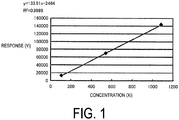
- FIG. 1 is a graph illustrating a calibration curve.
- the polyamide composition according to the present embodiment includes a polyamide having a site repeating a structure unit having at least one alkylene group and at least one amide bond, each of the at least one alkylene group has a carbon number of 1 to 3, the polyamide having a linear structure with a weight average molecular weight of 200000 or more, and the content of the included raw material monomer, which is the raw material of the structural unit, being less than 1000 ppm by mass.
- the polyamide included in the polyamide composition according to the present embodiment is a polyamide having a linear structure including one or more repeating structural sites formed of repeating structural units, and a structural site derived from an initiator.
- the structural unit forming the repeating structural site is a structural unit having at least one alkylene group and at least one amide bond, and each of the at least one alkylene group is an alkylene group having a carbon number of 1 to 3.
- the above-mentioned structural unit is not particularly limited as long as the structural unit has at least one alkylene group and at least one amide bond, but the structural unit preferably has one or two alkylene groups.
- the structural unit also preferably has one or two amide bonds.
- the number of the repeating structural units may be appropriately determined according to the weight average molecular weight of the repeating structural site of polyamide.
- the weight average molecular weight of the repeating structural site of polyamide is described below.
- the alkylene groups contained in the structural unit are not particularly limited provided that the number of carbon atoms is from 1 to 3, but the number of carbon atoms is more preferably 2 or 3, and particularly preferably 3.
- the alkylene group may be linear or branched.
- An example of an aspect of the structural unit according to the present embodiment is a structural unit represented by Formula (1) below.
- x is 2, 3 or 4.
- a polyamide having structural units represented by Formula (1) may be referred to as a "polyamide x" according to the number used for x in Formula (1).
- a polyamide for which x in Formula (1) is 4 is referred to as "polyamide 4".
- the weight average molecular weight (Mw) of the whole repeating structural unit of the polyamide according to the present embodiment is 200000 or greater.
- the weight average molecular weight of the whole repeating structural site means, when a plurality of repeating structural sites are included, the total weight average molecular weight of these repeating structural sites. Therefore, in a case where a plurality of repeating structural sites are included, when the total weight average molecular weight of the repeating structural sites is 200000 or more, a repeated structural site having a weight average molecular weight of less than 200000 may be included.
- the weight average molecular weight of the whole repeating structural site is not particularly limited as long as it is 200000 or more, but is preferably 250000 or more, and more preferably 300000 or more.
- the molecular weight of the repeating structural site of the polyamide in the present embodiment means the molecular weight in terms of methyl polymethacrylate (PMMA) measured by gel permeation chromatography (GPC).
- the polyamide according to the present embodiment has a structure in which one or more repeating structural sites are bonded to a structural site derived from an initiator.
- a plurality of repeating structural sites are included, each of the plurality of repeating structural sites is connected via a structural site derived from an initiator. Therefore, because the number of repeating structural sites is 1 or 2, the polyamide is a linear polyamide.
- linear means that one or two polyamide chains are bonded to a structural site derived from an initiator. Therefore, the structure of the whole polyamide is a linear structure even it is bent at the point of the structural site derived from an initiator.
- the content of the polyamide in the polyamide composition is not particularly limited, but is preferably 50% by mass or greater, more preferably 80% by mass or greater, and even more preferably 95% by mass or greater.
- the content of the raw material monomer used in the production of the polyamide that is included in the polyamide composition is not particularly limited as long as it is less than 1000 ppm by mass, but is preferably 500 ppm by mass or less, and more preferably 100 ppm by mass or less.
- the content of the raw material monomer included in the polyamide composition can be determined by gas chromatography (GC).
- GC gas chromatography
- the raw material monomer at a specific concentration is subjected to GC, and a calibration curve is created based on the GC results. Then, the detection limit (XDL) is calculated using the obtained calibration curve, and the maximum content of the raw material monomer that can be included is estimated from the assay of this detection limit.
- the content of the raw material monomer, which is used to produce polyamide, included in the polyamide composition according to the present embodiment is less than 1000 ppm by mass as described above. Additionally, the polyamide in the polyamide composition is polymerized. Therefore, the polyamide composition according to the present embodiment is suitable for the use in a wide range of fields such as cosmetic and industrial product fields. It is particularly suitable for the use in the cosmetic and industrial product fields because the amount of the residual raw material monomer is very small.
- the method for producing the polyamide composition according to the present embodiment will be described below.
- the polyamide composition is produced through a polymerization step in which the raw material monomer to be the above-described structural unit is polymerized in the presence of a basic catalyst and an initiator.
- the polymerization reaction can be terminated by adding a polymerization terminator.
- the raw material monomer according to the present embodiment is not particularly limited as long as it is a polymerizable compound that includes at least one alkylene group and at least one amide bond, each of the at least one alkylene group having a carbon number of 1 to 3.
- the raw material monomer is not particularly limited as long as it has at least one alkylene group, but preferably has one or two alkylene groups.
- the raw material monomer is not particularly limited as long as it has at least one alkylene group, but preferably has one or two amide bonds.
- Examples of an aspect of the raw material monomer include a compound capable of forming a structural unit represented by Formula (1) above through, for example, polymerization.
- Examples of such compounds include caprolactam, 2-pyrrolyl pyrrolidone, ⁇ -aminobutanoic acid, ⁇ -aminohexanoic acid, ⁇ -aminopentanoic acid, and 2-pyrrolidone.
- 2-pyrrolidone is preferable.
- the raw material monomer may be used alone, or two or more types thereof may be used in combination.
- the basic catalyst according to the present embodiment is not particularly limited as long as it can generate an anionic species in the raw material monomer.
- the basic catalysts include those used as polymerization catalysts for anionic polymerization, such as alkali metals and alkaline earth metals, and their hydrides, oxides, hydroxides, carbonates, carboxylates, alkylates, and alkoxides.
- the alkali metal include lithium, sodium, potassium, rubidium, and cesium. Among these, alkali metals and their hydrides are preferable, and alkali metals are more preferable.
- the basic catalyst may be used alone, or two or more types thereof may be used in combination.
- the usage of the basic polymerization catalyst is not particularly limited, but is from 0.1 to 4 mol%, preferably from 1 to 4 mol%, and more preferably from 2 to 4 mol% with reference to the total amount of the raw material monomer supplied. These ranges are preferable for achieving a high yield of the polyamide to be obtained.
- the initiator according to the present embodiment is not particularly limited as long as it is a compound that is commonly used in polymerization reaction of polyamide, and has one or two acyl structures.
- the compound having two acyl structures is intended to include those having a structure of X-CO-R-CO-X (wherein R is a hydrocarbon group and X is other than a hydrocarbon group).
- Preferable examples of the compound having an acyl structure include the acylated product of the raw material monomer.
- Examples of the compound having an acyl structure include imide compounds; carboxylic acid derivatives such as carboxylic acid halides and carboxylic acid esters; and amide compounds.
- imide compounds are preferable, and N,N'-adipoyl dipyrrolidone, terephthaloyl dipyrrolidone, and acetyl pyrrolidone are more preferable.
- the usage of the initiator is not particularly limited, but is more preferably from 0.3 to 2 mol%, and even more preferably from 0.5 to 1 mol% with reference to the total amount of raw material monomer supplied. In addition, the usage is preferably from 0.1 to 5 mol%, more preferably from 0.3 to 2 mol%, and even more preferably from 0.5 to 1 mol% with reference to the initial supply amount of the raw material monomer.
- water is used as a polymerization terminator. Therefore, in a case where water is included in the reaction system, the polymerization reaction may be inhibited. Therefore, in order to efficiently proceed the polymerization reaction, the water content in the reaction system, that is, the sum of the water content contained in the raw material monomer, basic catalyst, initiator, and the like is preferably 700 ppm by mass or less, more preferably 400 ppm by mass or less, and particularly preferably 100 ppm by mass or less.
- the polymerization terminator according to the present embodiment is not limited as long as it includes water.
- water a saline solution, or a polymerization terminator containing water commonly used as a polymerization terminator for ion polymerization reaction can be used.
- the polymerization terminators commonly used as polymerization terminators for ion polymerization reactions include benzoic acid, hydrochloric acid, phosphoric acid, metaphosphoric acid, acetic acid, lactic acid, glycolic acid, and alcohols such as methanol, ethanol, propyl alcohol, hexafluoropropyl alcohol, and butyl alcohol.
- the usage of the polymerization terminator is not particularly limited, but is preferably from 50 to 1000 parts by weight, and more preferably from 100 to 400 parts by weight with reference to 100 parts by weight of the polyamide polymerization reaction product.
- Additives may be added as necessary in the polymerization reaction.
- the additives include surfactants, antioxidants, stabilizers, dyes, and pigments. They may be used in combination of two or more types of them. The usage of the additive may be adjusted within a range that does not impair the object and effect of the present invention.
- the polymerization step according to the present embodiment may be performed, for example, as follows. Firstly, a basic catalyst is added to the raw material monomer, thereby generating an anionic species in a portion of the raw material monomer. Then, an initiator is added to cause polymerization reaction, thereby initiating the polymerization step.
- the raw material monomer is added by batchwise addition rather than adding all at once. That is, the raw material monomer is supplied to the reaction system in multiple portions. There is no limitation on the number of times of supply of the raw material monomer as long as it is added in divided portions, and is preferably two or more and eight or less, more preferably two or more and five or less, and even more preferably two.
- a high molecular weight polyamide is obtained by supplying the raw material monomer in multiple portions.
- the timing of additional supply of the raw material monomer is preferably between the time when the reaction becomes cloudy and then solidified and precipitated.
- the initial supply amount (charged amount A) of the raw material monomer and the supply amount B at each of the additional supplies are preferably A > B.
- the amount of the raw material monomer present in the first polymerization reaction stage is 100 mol%
- the amount of the raw material monomer in the first polymerization reaction stage is preferably adjusted such that the amount of the initiator present in the first polymerization reaction stage is from 0.1 to 5 mol%, more preferably from 0.3 to 2 mol%, and even more preferably from 0.5 to 1 mol%.
- the additional supply of the raw material monomer is preferably performed in such a manner that the amount of the initiator present in the second polymerization reaction stage is from 0.1 to 5 mol%, and more preferably from 0.3 to 2 mol%, and even more preferably from 0.5 to 1 mol%.
- the amount of the initiator present in the second polymerization reaction stage does not refer to the amount of the initiator remaining unreacted at the beginning of the second polymerization reaction stage, and means the total amount of the initiator supplied to the reaction system.
- the reaction temperature in the polymerization step may be, for example, from 15 to 100°C, preferably from 20 to 80°C, and more preferably from 25 to 50°C.
- the reaction time in the polymerization step may be, for example, from 1 hour to 1 year, preferably from 3 hours to 1 week, and more preferably from 6 hours to 24 hours.
- the polymerization reaction in the polymerization step is stopped by adding a polymerization terminator containing water in the reaction system.
- the timing of addition of the polymerization terminator is not particularly limited.
- water may be further added after termination of the polymerization reaction.
- the temperature of water added as a polymerization terminator is preferably from 20 to 100°C, more preferably from 60 to 95°C, and even more preferably 90°C.
- the system is allowed to stand for a certain time after the addition of water, it is preferably retained at a temperature within these ranges. The retention time may, for example, from 5 minutes to 24 hours.
- the amount of the residual raw material monomer in the obtained polyamide composition can be reduced simply by filtration. That is, the amount of the residual raw material monomer in the polyamide composition can be easily and safely set to less than 1000 ppm by mass.
- the polyamide composition according to the present embodiment described above can be prepared.
- the polyamide composition according to an embodiment of the present invention includes a polyamide having a site formed of repeating structural units having at least one alkylene group and at least one amide bond, each of the at least one alkylene group having a carbon number of 1 to 3, the polyamide having a linear structure with a weight average molecular weight of 200000 or greater, and the content of the included raw material monomer, which is a raw material of the structural unit, being less than 1000 ppm by mass.
- the structural unit is preferably represented by Formula (1). (wherein x is an integer from 2 to 4.)
- the method for producing a polyamide composition includes a polymerization step of polymerizing a raw material monomer, which is a raw material of the structural unit, in the presence of a basic catalyst and an initiator having two or less acyl structures, wherein in the polymerization step, the raw material monomer is supplied in multiple portions, and the polymerization step is terminated by addition of a polymerization initiator containing water.
- the initiator is preferably an imide compound.
- the raw material monomer is supplied in two portions in the polymerization step
- the polymerization step includes a first polymerization reaction before additional supply of the raw material monomer and a second polymerization reaction after additional supply of the raw material monomer, wherein the amount of the initiator present in the first polymerization reaction is preferably from 0.3 to 2 mol% when the amount of the raw material monomer present is 100 mol%, and the amount of the initiator present in the second polymerization reaction is preferably from 0.1 to 1.5 mol% when the total amount of the raw material monomer after additional supply of the raw material monomer is 100 mol%,.
- Second polymerization reaction 102 g (1.2 mol) of 2-pyrrolidone (2PDN) (moisture content: 22 ppm) as a raw material monomer was charged into a sealed flask equipped with stirring blades in a water bath at a temperature of 50°C, and 0.69 g (0.03 mol) of metal sodium (Na) as a basic catalyst was added thereto. After the sodium dissolved, 0.7 mol% of N, N'-adipyl-dipyrrolidone (A.P.) as an initiator was added to 2PDN. Then, the system immediately became clouded.
- 2PDN 2-pyrrolidone
- Second polymerization reaction after the system became clouded, 40.8 g of 2PDN was additionally supplied to the system, and the reaction was continued for 24 hours.
- the obtained polyamide composition was measured for its concentration (%) of the residual 2PDN according to the procedure described below.
- Measurement device GC-2010 Plus, available from Shimadzu Corporation Column: Rxi-5 ms: 15 m, 0.25 mm ID: 0.25 ⁇ m Column temperature: 50°C Heating program: 50°C (5 min) ⁇ 20°C/min ⁇ 250°C (5 min) FID temperature: 250°C Carrier gas: He
- FIG. 1 shows a calibration curve representing the relationship between the concentration of 2PDN and GC analysis result.
- the detection limit (X DL ) was calculated from the obtained calibration curve. On the basis of the standard deviation of the inclination of the calibration curve and 95% confidence limit, X DL was 15.037. From the assay of this detection limit, the concentration of the residual 2PDN was found to be less than 15 ppm by mass.
- HFIP hexafluoroisopropanol
- 0.2 g of the polyamide was dissolved in 10 ml of HFIP, and 40 ml of acetone was added to 10 ml of HFIP, thereby precipitating a polymer.
- the amount of 2-pyrrolidone was determined by GC analysis of the acetone solution after precipitation of the polymer.
- Measurement device "GC-2010 Plus” made by Shimadzu Corporation Column: Rxi-5 ms: 15 m, 0.25 mm ID: 0.25 ⁇ m Column temperature: 50°C Heating program: 50°C (5 min) ⁇ 20°C/min ⁇ 250°C (5 min) FID Temperature: 250°C Carrier gas: He
- the moisture content in 2PDN was measured as follows. Analysis of moisture content in 2-pyrolidone
- a polyamide composition was obtained in the same manner as in Example 1, except for the changes described above.
- the amount of A.P. present to total amount of 2PDN after additional supply corresponds to 0.35 mol%.
- 200 g of water as a polymerization terminator was added, thereby terminating the polymerization reaction.
- the polyamide composition containing this water was then retained at 90°C for 2 hours, and then filtered.
- the residue obtained by filtration was then dried at 60°C for 24 hours using a vacuum dryer to produce a sample. 2PDN in the sample was less than 15 ppm.
- the obtained polyamide composition was measured for its conversion ratio and Mw.
- a polyamide composition was obtained in the same manner as in Comparative Example 1, except that the loading of A.P. to 2PDN was changed to 0.5 mol%.
- the obtained polyamide composition was measured for its conversion ratio and Mw.
- a polyamide composition was obtained in the same manner as in Comparative Example 1, except that the loading of A.P. to 2PDN was changed to 0.35 mol%.
- the obtained polyamide composition was measured for its conversion ratio and Mw. These results are shown in Table 1.
- the obtained polyamide had a low molecular weight, so that the 2PDN amount in the sample obtained by filtration and drying after termination of polymerization was not measured.
- the polyamide composition of the present invention can be used in a wide range of fields such as cosmetic fields, medical fields, and industrial product fields.
Landscapes
- Chemical & Material Sciences (AREA)
- Health & Medical Sciences (AREA)
- Chemical Kinetics & Catalysis (AREA)
- Medicinal Chemistry (AREA)
- Polymers & Plastics (AREA)
- Organic Chemistry (AREA)
- Polyamides (AREA)
Applications Claiming Priority (2)
| Application Number | Priority Date | Filing Date | Title |
|---|---|---|---|
| JP2017075487 | 2017-04-05 | ||
| PCT/JP2018/003247 WO2018186015A1 (ja) | 2017-04-05 | 2018-01-31 | ポリアミド組成物、およびポリアミド組成物の製造方法 |
Publications (3)
| Publication Number | Publication Date |
|---|---|
| EP3584268A1 true EP3584268A1 (de) | 2019-12-25 |
| EP3584268A4 EP3584268A4 (de) | 2020-04-29 |
| EP3584268B1 EP3584268B1 (de) | 2021-01-27 |
Family
ID=63713442
Family Applications (1)
| Application Number | Title | Priority Date | Filing Date |
|---|---|---|---|
| EP18781921.4A Not-in-force EP3584268B1 (de) | 2017-04-05 | 2018-01-31 | Polyamidzusammensetzung und verfahren zur herstellung einer polyamidzusammensetzung |
Country Status (5)
| Country | Link |
|---|---|
| US (1) | US20200377655A1 (de) |
| EP (1) | EP3584268B1 (de) |
| JP (1) | JP6611987B2 (de) |
| CN (1) | CN110402266B (de) |
| WO (1) | WO2018186015A1 (de) |
Families Citing this family (2)
| Publication number | Priority date | Publication date | Assignee | Title |
|---|---|---|---|---|
| EP4059989B1 (de) * | 2019-11-11 | 2023-12-06 | Kureha Corporation | Verfahren zum produzieren von polyamid und polyamid |
| WO2022113993A1 (ja) | 2020-11-30 | 2022-06-02 | 東レ株式会社 | ポリアミド微粒子、およびその製造方法 |
Family Cites Families (13)
| Publication number | Priority date | Publication date | Assignee | Title |
|---|---|---|---|---|
| SE386194B (sv) * | 1970-06-09 | 1976-08-02 | Radiation Res Corp | Forfarande for polymerisation av 2-pyrrolidon i nervaro av en alkalisk katalysator och koldioxid |
| CS177763B1 (de) * | 1975-07-08 | 1977-08-31 | ||
| EP0033019B1 (de) * | 1980-01-22 | 1984-05-09 | Stamicarbon B.V. | Verfahren zur Herstellung von Polypyrrolidon |
| JP3453600B2 (ja) | 2001-03-15 | 2003-10-06 | 独立行政法人産業技術総合研究所 | 特殊構造を有する2−ピロリドン重合体およびその製造方法 |
| JP3699995B2 (ja) | 2002-02-14 | 2005-09-28 | 独立行政法人産業技術総合研究所 | ポリアミド4誘導体及びその製造法 |
| JP5283058B2 (ja) | 2007-12-28 | 2013-09-04 | 独立行政法人産業技術総合研究所 | 分岐構造を導入したポリアミド4共重合体及びその製造方法 |
| WO2014135625A1 (en) * | 2013-03-07 | 2014-09-12 | Basf Se | Preparation of polyamides by hydrolytic polymerization, postpolymerization and subsequent extraction |
| KR101568908B1 (ko) * | 2013-12-02 | 2015-11-12 | 지에스칼텍스 주식회사 | 입자상 폴리아미드 수지의 연속 제조장치 및 방법 |
| KR101533891B1 (ko) * | 2013-12-03 | 2015-07-03 | 지에스칼텍스 주식회사 | 폴리아미드 수지의 제조방법 |
| JP2016030771A (ja) * | 2014-07-28 | 2016-03-07 | 株式会社日本触媒 | ピロリドン系重合体の水性分散体 |
| JP2016132768A (ja) * | 2015-01-22 | 2016-07-25 | 株式会社リコー | ポリアミド4組成物、及びその製造方法 |
| US10138344B2 (en) * | 2015-03-19 | 2018-11-27 | Ricoh Company, Ltd. | Particulate polyamide, and method for preparing the particulate polyamide |
| JP6819919B2 (ja) * | 2015-03-19 | 2021-01-27 | 株式会社リコー | ポリアミド粒子及びその製造方法 |
-
2018
- 2018-01-31 EP EP18781921.4A patent/EP3584268B1/de not_active Not-in-force
- 2018-01-31 JP JP2019511074A patent/JP6611987B2/ja not_active Expired - Fee Related
- 2018-01-31 WO PCT/JP2018/003247 patent/WO2018186015A1/ja not_active Ceased
- 2018-01-31 CN CN201880017196.1A patent/CN110402266B/zh not_active Expired - Fee Related
- 2018-01-31 US US16/498,881 patent/US20200377655A1/en not_active Abandoned
Also Published As
| Publication number | Publication date |
|---|---|
| EP3584268B1 (de) | 2021-01-27 |
| CN110402266B (zh) | 2021-03-05 |
| JP6611987B2 (ja) | 2019-11-27 |
| CN110402266A (zh) | 2019-11-01 |
| EP3584268A4 (de) | 2020-04-29 |
| JPWO2018186015A1 (ja) | 2019-12-12 |
| US20200377655A1 (en) | 2020-12-03 |
| WO2018186015A1 (ja) | 2018-10-11 |
Similar Documents
| Publication | Publication Date | Title |
|---|---|---|
| EP2379619B2 (de) | Isotaktische polymilchsäure und verfahren zu ihrer herstellung | |
| US7812181B2 (en) | Process for producing glycolide and glycolic acid oligomer for production of glycolide | |
| FI89505B (fi) | Foerfarande foer framstaellning av polyestrar | |
| Wen et al. | Enzyme‐catalyzed ring‐opening polymerization of ethylene isopropyl phosphate | |
| JP5576291B2 (ja) | ポリ(α−ヒドロキシ酸)の疎水性高分子ブロックを含む高純度の両親媒性ブロック共重合体及びその製造方法 | |
| Jaffredo et al. | Organocatalyzed controlled ROP of β-lactones towards poly (hydroxyalkanoate) s: from β-butyrolactone to benzyl β-malolactone polymers | |
| EP3584268B1 (de) | Polyamidzusammensetzung und verfahren zur herstellung einer polyamidzusammensetzung | |
| AU2009311895B2 (en) | Highly purified polylactic acid or a derivative thereof, a salt of the same, and purification method thereof | |
| Karmel et al. | Uranium-mediated ring-opening polymerization of ε-caprolactone: a comparative study | |
| Ren et al. | Boric acid as biocatalyst for living ring-opening polymerization of ε-caprolactone | |
| Chen et al. | Reinvestigation of the ring-opening polymerization of ε-caprolactone with 1, 8-diazacyclo [5.4. 0] undec-7-ene organocatalyst in bulk | |
| Du et al. | Mechanistic investigation of cyclic ketene acetal radical ring-opening homo-and co-polymerization and preparation of PEO graft copolymers with tunable composition | |
| EP3873968B1 (de) | Kontrollierte herstellung von polyglykolsäure und glykolid | |
| EP1440992A1 (de) | Katalysatorzusammensetzung für die (Co)polymerisation von Lactid und Glycolid | |
| EP3841155B1 (de) | Verfahren zur kondensationspolymerisation von hydroxylterminierten polydiorganosiloxanen | |
| WO2018186014A1 (ja) | ポリアミド組成物 | |
| EP4059989B1 (de) | Verfahren zum produzieren von polyamid und polyamid | |
| Dove | Metal‐Free Catalysis in Ring‐Opening Polymerization | |
| Zhang et al. | Direct synthesis of α-Carboxyl-ω-Hydroxyl polymers by catalyst and initiator in the same molecule | |
| CN119081080B (zh) | 一种端基碳链长度可调控的乳酸-羟基乙酸共聚物及其制备方法和应用 | |
| KR20180088934A (ko) | 폴리아미드 합성 방법 | |
| EP4265666B1 (de) | Diboranbasierte metallfreie katalysatorsysteme für die herstellung von isotaktisch angereicherten aliphatischen polyethern, zugehöriges verfahren, aus dem verfahren erhaltener polyether und verwendung des katalysatorsystems | |
| Lee et al. | Catalytic behavior of silyl-amide complexes for lactide polymerization | |
| EP4349872A1 (de) | Ss-glucanesterderivat | |
| KR20260050976A (ko) | 폴리(3-하이드록시프로피온산) 조성물, 폴리(락트산-b-3-하이드록시프로피온산) 블록 공중합체 조성물, 이들 조성물 제조 방법 |
Legal Events
| Date | Code | Title | Description |
|---|---|---|---|
| STAA | Information on the status of an ep patent application or granted ep patent |
Free format text: STATUS: THE INTERNATIONAL PUBLICATION HAS BEEN MADE |
|
| PUAI | Public reference made under article 153(3) epc to a published international application that has entered the european phase |
Free format text: ORIGINAL CODE: 0009012 |
|
| STAA | Information on the status of an ep patent application or granted ep patent |
Free format text: STATUS: REQUEST FOR EXAMINATION WAS MADE |
|
| 17P | Request for examination filed |
Effective date: 20190916 |
|
| AK | Designated contracting states |
Kind code of ref document: A1 Designated state(s): AL AT BE BG CH CY CZ DE DK EE ES FI FR GB GR HR HU IE IS IT LI LT LU LV MC MK MT NL NO PL PT RO RS SE SI SK SM TR |
|
| AX | Request for extension of the european patent |
Extension state: BA ME |
|
| A4 | Supplementary search report drawn up and despatched |
Effective date: 20200326 |
|
| RIC1 | Information provided on ipc code assigned before grant |
Ipc: C08G 69/14 20060101AFI20200321BHEP Ipc: C08G 69/18 20060101ALI20200321BHEP Ipc: C08G 69/24 20060101ALI20200321BHEP |
|
| DAV | Request for validation of the european patent (deleted) | ||
| DAX | Request for extension of the european patent (deleted) | ||
| RIC1 | Information provided on ipc code assigned before grant |
Ipc: C08G 69/24 20060101ALI20200721BHEP Ipc: C08G 69/18 20060101ALI20200721BHEP Ipc: C08G 69/14 20060101AFI20200721BHEP |
|
| GRAP | Despatch of communication of intention to grant a patent |
Free format text: ORIGINAL CODE: EPIDOSNIGR1 |
|
| STAA | Information on the status of an ep patent application or granted ep patent |
Free format text: STATUS: GRANT OF PATENT IS INTENDED |
|
| INTG | Intention to grant announced |
Effective date: 20200914 |
|
| GRAS | Grant fee paid |
Free format text: ORIGINAL CODE: EPIDOSNIGR3 |
|
| GRAA | (expected) grant |
Free format text: ORIGINAL CODE: 0009210 |
|
| STAA | Information on the status of an ep patent application or granted ep patent |
Free format text: STATUS: THE PATENT HAS BEEN GRANTED |
|
| AK | Designated contracting states |
Kind code of ref document: B1 Designated state(s): AL AT BE BG CH CY CZ DE DK EE ES FI FR GB GR HR HU IE IS IT LI LT LU LV MC MK MT NL NO PL PT RO RS SE SI SK SM TR |
|
| REG | Reference to a national code |
Ref country code: GB Ref legal event code: FG4D |
|
| REG | Reference to a national code |
Ref country code: CH Ref legal event code: EP |
|
| REG | Reference to a national code |
Ref country code: AT Ref legal event code: REF Ref document number: 1358302 Country of ref document: AT Kind code of ref document: T Effective date: 20210215 |
|
| REG | Reference to a national code |
Ref country code: IE Ref legal event code: FG4D |
|
| REG | Reference to a national code |
Ref country code: DE Ref legal event code: R096 Ref document number: 602018012390 Country of ref document: DE |
|
| REG | Reference to a national code |
Ref country code: NL Ref legal event code: MP Effective date: 20210127 |
|
| REG | Reference to a national code |
Ref country code: LT Ref legal event code: MG9D |
|
| REG | Reference to a national code |
Ref country code: AT Ref legal event code: MK05 Ref document number: 1358302 Country of ref document: AT Kind code of ref document: T Effective date: 20210127 |
|
| PG25 | Lapsed in a contracting state [announced via postgrant information from national office to epo] |
Ref country code: LT Free format text: LAPSE BECAUSE OF FAILURE TO SUBMIT A TRANSLATION OF THE DESCRIPTION OR TO PAY THE FEE WITHIN THE PRESCRIBED TIME-LIMIT Effective date: 20210127 Ref country code: PT Free format text: LAPSE BECAUSE OF FAILURE TO SUBMIT A TRANSLATION OF THE DESCRIPTION OR TO PAY THE FEE WITHIN THE PRESCRIBED TIME-LIMIT Effective date: 20210527 Ref country code: NO Free format text: LAPSE BECAUSE OF FAILURE TO SUBMIT A TRANSLATION OF THE DESCRIPTION OR TO PAY THE FEE WITHIN THE PRESCRIBED TIME-LIMIT Effective date: 20210427 Ref country code: BG Free format text: LAPSE BECAUSE OF FAILURE TO SUBMIT A TRANSLATION OF THE DESCRIPTION OR TO PAY THE FEE WITHIN THE PRESCRIBED TIME-LIMIT Effective date: 20210427 Ref country code: FI Free format text: LAPSE BECAUSE OF FAILURE TO SUBMIT A TRANSLATION OF THE DESCRIPTION OR TO PAY THE FEE WITHIN THE PRESCRIBED TIME-LIMIT Effective date: 20210127 Ref country code: HR Free format text: LAPSE BECAUSE OF FAILURE TO SUBMIT A TRANSLATION OF THE DESCRIPTION OR TO PAY THE FEE WITHIN THE PRESCRIBED TIME-LIMIT Effective date: 20210127 Ref country code: GR Free format text: LAPSE BECAUSE OF FAILURE TO SUBMIT A TRANSLATION OF THE DESCRIPTION OR TO PAY THE FEE WITHIN THE PRESCRIBED TIME-LIMIT Effective date: 20210428 |
|
| PG25 | Lapsed in a contracting state [announced via postgrant information from national office to epo] |
Ref country code: AT Free format text: LAPSE BECAUSE OF FAILURE TO SUBMIT A TRANSLATION OF THE DESCRIPTION OR TO PAY THE FEE WITHIN THE PRESCRIBED TIME-LIMIT Effective date: 20210127 Ref country code: PL Free format text: LAPSE BECAUSE OF FAILURE TO SUBMIT A TRANSLATION OF THE DESCRIPTION OR TO PAY THE FEE WITHIN THE PRESCRIBED TIME-LIMIT Effective date: 20210127 Ref country code: LV Free format text: LAPSE BECAUSE OF FAILURE TO SUBMIT A TRANSLATION OF THE DESCRIPTION OR TO PAY THE FEE WITHIN THE PRESCRIBED TIME-LIMIT Effective date: 20210127 Ref country code: RS Free format text: LAPSE BECAUSE OF FAILURE TO SUBMIT A TRANSLATION OF THE DESCRIPTION OR TO PAY THE FEE WITHIN THE PRESCRIBED TIME-LIMIT Effective date: 20210127 Ref country code: SE Free format text: LAPSE BECAUSE OF FAILURE TO SUBMIT A TRANSLATION OF THE DESCRIPTION OR TO PAY THE FEE WITHIN THE PRESCRIBED TIME-LIMIT Effective date: 20210127 |
|
| REG | Reference to a national code |
Ref country code: CH Ref legal event code: PL |
|
| PG25 | Lapsed in a contracting state [announced via postgrant information from national office to epo] |
Ref country code: IS Free format text: LAPSE BECAUSE OF FAILURE TO SUBMIT A TRANSLATION OF THE DESCRIPTION OR TO PAY THE FEE WITHIN THE PRESCRIBED TIME-LIMIT Effective date: 20210527 Ref country code: LU Free format text: LAPSE BECAUSE OF NON-PAYMENT OF DUE FEES Effective date: 20210131 |
|
| REG | Reference to a national code |
Ref country code: BE Ref legal event code: MM Effective date: 20210131 |
|
| REG | Reference to a national code |
Ref country code: DE Ref legal event code: R097 Ref document number: 602018012390 Country of ref document: DE |
|
| PG25 | Lapsed in a contracting state [announced via postgrant information from national office to epo] |
Ref country code: MC Free format text: LAPSE BECAUSE OF FAILURE TO SUBMIT A TRANSLATION OF THE DESCRIPTION OR TO PAY THE FEE WITHIN THE PRESCRIBED TIME-LIMIT Effective date: 20210127 Ref country code: EE Free format text: LAPSE BECAUSE OF FAILURE TO SUBMIT A TRANSLATION OF THE DESCRIPTION OR TO PAY THE FEE WITHIN THE PRESCRIBED TIME-LIMIT Effective date: 20210127 Ref country code: CZ Free format text: LAPSE BECAUSE OF FAILURE TO SUBMIT A TRANSLATION OF THE DESCRIPTION OR TO PAY THE FEE WITHIN THE PRESCRIBED TIME-LIMIT Effective date: 20210127 Ref country code: SM Free format text: LAPSE BECAUSE OF FAILURE TO SUBMIT A TRANSLATION OF THE DESCRIPTION OR TO PAY THE FEE WITHIN THE PRESCRIBED TIME-LIMIT Effective date: 20210127 |
|
| PG25 | Lapsed in a contracting state [announced via postgrant information from national office to epo] |
Ref country code: DK Free format text: LAPSE BECAUSE OF FAILURE TO SUBMIT A TRANSLATION OF THE DESCRIPTION OR TO PAY THE FEE WITHIN THE PRESCRIBED TIME-LIMIT Effective date: 20210127 Ref country code: CH Free format text: LAPSE BECAUSE OF NON-PAYMENT OF DUE FEES Effective date: 20210131 Ref country code: SK Free format text: LAPSE BECAUSE OF FAILURE TO SUBMIT A TRANSLATION OF THE DESCRIPTION OR TO PAY THE FEE WITHIN THE PRESCRIBED TIME-LIMIT Effective date: 20210127 Ref country code: RO Free format text: LAPSE BECAUSE OF FAILURE TO SUBMIT A TRANSLATION OF THE DESCRIPTION OR TO PAY THE FEE WITHIN THE PRESCRIBED TIME-LIMIT Effective date: 20210127 Ref country code: LI Free format text: LAPSE BECAUSE OF NON-PAYMENT OF DUE FEES Effective date: 20210131 |
|
| PLBE | No opposition filed within time limit |
Free format text: ORIGINAL CODE: 0009261 |
|
| STAA | Information on the status of an ep patent application or granted ep patent |
Free format text: STATUS: NO OPPOSITION FILED WITHIN TIME LIMIT |
|
| 26N | No opposition filed |
Effective date: 20211028 |
|
| PG25 | Lapsed in a contracting state [announced via postgrant information from national office to epo] |
Ref country code: AL Free format text: LAPSE BECAUSE OF FAILURE TO SUBMIT A TRANSLATION OF THE DESCRIPTION OR TO PAY THE FEE WITHIN THE PRESCRIBED TIME-LIMIT Effective date: 20210127 Ref country code: IE Free format text: LAPSE BECAUSE OF NON-PAYMENT OF DUE FEES Effective date: 20210131 Ref country code: FR Free format text: LAPSE BECAUSE OF NON-PAYMENT OF DUE FEES Effective date: 20210327 Ref country code: ES Free format text: LAPSE BECAUSE OF FAILURE TO SUBMIT A TRANSLATION OF THE DESCRIPTION OR TO PAY THE FEE WITHIN THE PRESCRIBED TIME-LIMIT Effective date: 20210127 |
|
| PG25 | Lapsed in a contracting state [announced via postgrant information from national office to epo] |
Ref country code: SI Free format text: LAPSE BECAUSE OF FAILURE TO SUBMIT A TRANSLATION OF THE DESCRIPTION OR TO PAY THE FEE WITHIN THE PRESCRIBED TIME-LIMIT Effective date: 20210127 |
|
| PG25 | Lapsed in a contracting state [announced via postgrant information from national office to epo] |
Ref country code: IT Free format text: LAPSE BECAUSE OF FAILURE TO SUBMIT A TRANSLATION OF THE DESCRIPTION OR TO PAY THE FEE WITHIN THE PRESCRIBED TIME-LIMIT Effective date: 20210127 |
|
| PGFP | Annual fee paid to national office [announced via postgrant information from national office to epo] |
Ref country code: GB Payment date: 20220119 Year of fee payment: 5 Ref country code: DE Payment date: 20220119 Year of fee payment: 5 |
|
| PG25 | Lapsed in a contracting state [announced via postgrant information from national office to epo] |
Ref country code: IS Free format text: LAPSE BECAUSE OF FAILURE TO SUBMIT A TRANSLATION OF THE DESCRIPTION OR TO PAY THE FEE WITHIN THE PRESCRIBED TIME-LIMIT Effective date: 20210527 |
|
| PG25 | Lapsed in a contracting state [announced via postgrant information from national office to epo] |
Ref country code: BE Free format text: LAPSE BECAUSE OF NON-PAYMENT OF DUE FEES Effective date: 20210131 |
|
| PG25 | Lapsed in a contracting state [announced via postgrant information from national office to epo] |
Ref country code: NL Free format text: LAPSE BECAUSE OF NON-PAYMENT OF DUE FEES Effective date: 20210127 Ref country code: CY Free format text: LAPSE BECAUSE OF FAILURE TO SUBMIT A TRANSLATION OF THE DESCRIPTION OR TO PAY THE FEE WITHIN THE PRESCRIBED TIME-LIMIT Effective date: 20210127 |
|
| PG25 | Lapsed in a contracting state [announced via postgrant information from national office to epo] |
Ref country code: HU Free format text: LAPSE BECAUSE OF FAILURE TO SUBMIT A TRANSLATION OF THE DESCRIPTION OR TO PAY THE FEE WITHIN THE PRESCRIBED TIME-LIMIT; INVALID AB INITIO Effective date: 20180131 |
|
| REG | Reference to a national code |
Ref country code: DE Ref legal event code: R119 Ref document number: 602018012390 Country of ref document: DE |
|
| GBPC | Gb: european patent ceased through non-payment of renewal fee |
Effective date: 20230131 |
|
| PG25 | Lapsed in a contracting state [announced via postgrant information from national office to epo] |
Ref country code: GB Free format text: LAPSE BECAUSE OF NON-PAYMENT OF DUE FEES Effective date: 20230131 Ref country code: DE Free format text: LAPSE BECAUSE OF NON-PAYMENT OF DUE FEES Effective date: 20230801 |
|
| PG25 | Lapsed in a contracting state [announced via postgrant information from national office to epo] |
Ref country code: MK Free format text: LAPSE BECAUSE OF FAILURE TO SUBMIT A TRANSLATION OF THE DESCRIPTION OR TO PAY THE FEE WITHIN THE PRESCRIBED TIME-LIMIT Effective date: 20210127 |
|
| PG25 | Lapsed in a contracting state [announced via postgrant information from national office to epo] |
Ref country code: TR Free format text: LAPSE BECAUSE OF FAILURE TO SUBMIT A TRANSLATION OF THE DESCRIPTION OR TO PAY THE FEE WITHIN THE PRESCRIBED TIME-LIMIT Effective date: 20210127 |
|
| PG25 | Lapsed in a contracting state [announced via postgrant information from national office to epo] |
Ref country code: MT Free format text: LAPSE BECAUSE OF FAILURE TO SUBMIT A TRANSLATION OF THE DESCRIPTION OR TO PAY THE FEE WITHIN THE PRESCRIBED TIME-LIMIT Effective date: 20210127 |