EP3584277B1 - Caoutchouc de silicone antimicrobien, procédé de préparation associé et utilisation associée - Google Patents
Caoutchouc de silicone antimicrobien, procédé de préparation associé et utilisation associée Download PDFInfo
- Publication number
- EP3584277B1 EP3584277B1 EP18810066.3A EP18810066A EP3584277B1 EP 3584277 B1 EP3584277 B1 EP 3584277B1 EP 18810066 A EP18810066 A EP 18810066A EP 3584277 B1 EP3584277 B1 EP 3584277B1
- Authority
- EP
- European Patent Office
- Prior art keywords
- antimicrobial
- silicone rubber
- carboxylic anhydride
- acid
- polyamino acid
- Prior art date
- Legal status (The legal status is an assumption and is not a legal conclusion. Google has not performed a legal analysis and makes no representation as to the accuracy of the status listed.)
- Active
Links
Classifications
-
- C—CHEMISTRY; METALLURGY
- C08—ORGANIC MACROMOLECULAR COMPOUNDS; THEIR PREPARATION OR CHEMICAL WORKING-UP; COMPOSITIONS BASED THEREON
- C08L—COMPOSITIONS OF MACROMOLECULAR COMPOUNDS
- C08L83/00—Compositions of macromolecular compounds obtained by reactions forming in the main chain of the macromolecule a linkage containing silicon with or without sulfur, nitrogen, oxygen or carbon only; Compositions of derivatives of such polymers
- C08L83/10—Block- or graft-copolymers containing polysiloxane sequences
-
- C—CHEMISTRY; METALLURGY
- C08—ORGANIC MACROMOLECULAR COMPOUNDS; THEIR PREPARATION OR CHEMICAL WORKING-UP; COMPOSITIONS BASED THEREON
- C08J—WORKING-UP; GENERAL PROCESSES OF COMPOUNDING; AFTER-TREATMENT NOT COVERED BY SUBCLASSES C08B, C08C, C08F, C08G or C08H
- C08J7/00—Chemical treatment or coating of shaped articles made of macromolecular substances
- C08J7/12—Chemical modification
-
- A—HUMAN NECESSITIES
- A61—MEDICAL OR VETERINARY SCIENCE; HYGIENE
- A61K—PREPARATIONS FOR MEDICAL, DENTAL OR TOILETRY PURPOSES
- A61K8/00—Cosmetics or similar toiletry preparations
- A61K8/18—Cosmetics or similar toiletry preparations characterised by the composition
- A61K8/72—Cosmetics or similar toiletry preparations characterised by the composition containing organic macromolecular compounds
- A61K8/84—Cosmetics or similar toiletry preparations characterised by the composition containing organic macromolecular compounds obtained by reactions otherwise than those involving only carbon-carbon unsaturated bonds
- A61K8/89—Polysiloxanes
- A61K8/896—Polysiloxanes containing atoms other than silicon, carbon, oxygen and hydrogen, e.g. dimethicone copolyol phosphate
- A61K8/898—Polysiloxanes containing atoms other than silicon, carbon, oxygen and hydrogen, e.g. dimethicone copolyol phosphate containing nitrogen, e.g. amodimethicone, trimethyl silyl amodimethicone or dimethicone propyl PG-betaine
-
- A—HUMAN NECESSITIES
- A61—MEDICAL OR VETERINARY SCIENCE; HYGIENE
- A61L—METHODS OR APPARATUS FOR STERILISING MATERIALS OR OBJECTS IN GENERAL; DISINFECTION, STERILISATION OR DEODORISATION OF AIR; CHEMICAL ASPECTS OF BANDAGES, DRESSINGS, ABSORBENT PADS OR SURGICAL ARTICLES; MATERIALS FOR BANDAGES, DRESSINGS, ABSORBENT PADS OR SURGICAL ARTICLES
- A61L15/00—Chemical aspects of, or use of materials for, bandages, dressings or absorbent pads
- A61L15/16—Bandages, dressings or absorbent pads for physiological fluids such as urine or blood, e.g. sanitary towels, tampons
- A61L15/22—Bandages, dressings or absorbent pads for physiological fluids such as urine or blood, e.g. sanitary towels, tampons containing macromolecular materials
- A61L15/26—Macromolecular compounds obtained otherwise than by reactions only involving carbon-to-carbon unsaturated bonds; Derivatives thereof
-
- A—HUMAN NECESSITIES
- A61—MEDICAL OR VETERINARY SCIENCE; HYGIENE
- A61L—METHODS OR APPARATUS FOR STERILISING MATERIALS OR OBJECTS IN GENERAL; DISINFECTION, STERILISATION OR DEODORISATION OF AIR; CHEMICAL ASPECTS OF BANDAGES, DRESSINGS, ABSORBENT PADS OR SURGICAL ARTICLES; MATERIALS FOR BANDAGES, DRESSINGS, ABSORBENT PADS OR SURGICAL ARTICLES
- A61L15/00—Chemical aspects of, or use of materials for, bandages, dressings or absorbent pads
- A61L15/16—Bandages, dressings or absorbent pads for physiological fluids such as urine or blood, e.g. sanitary towels, tampons
- A61L15/42—Use of materials characterised by their function or physical properties
- A61L15/46—Deodorants or malodour counteractants, e.g. to inhibit the formation of ammonia or bacteria
-
- A—HUMAN NECESSITIES
- A61—MEDICAL OR VETERINARY SCIENCE; HYGIENE
- A61L—METHODS OR APPARATUS FOR STERILISING MATERIALS OR OBJECTS IN GENERAL; DISINFECTION, STERILISATION OR DEODORISATION OF AIR; CHEMICAL ASPECTS OF BANDAGES, DRESSINGS, ABSORBENT PADS OR SURGICAL ARTICLES; MATERIALS FOR BANDAGES, DRESSINGS, ABSORBENT PADS OR SURGICAL ARTICLES
- A61L26/00—Chemical aspects of, or use of materials for, wound dressings or bandages in liquid, gel or powder form
- A61L26/0009—Chemical aspects of, or use of materials for, wound dressings or bandages in liquid, gel or powder form containing macromolecular materials
- A61L26/0019—Chemical aspects of, or use of materials for, wound dressings or bandages in liquid, gel or powder form containing macromolecular materials obtained otherwise than by reactions only involving carbon-to-carbon unsaturated bonds
-
- A—HUMAN NECESSITIES
- A61—MEDICAL OR VETERINARY SCIENCE; HYGIENE
- A61L—METHODS OR APPARATUS FOR STERILISING MATERIALS OR OBJECTS IN GENERAL; DISINFECTION, STERILISATION OR DEODORISATION OF AIR; CHEMICAL ASPECTS OF BANDAGES, DRESSINGS, ABSORBENT PADS OR SURGICAL ARTICLES; MATERIALS FOR BANDAGES, DRESSINGS, ABSORBENT PADS OR SURGICAL ARTICLES
- A61L26/00—Chemical aspects of, or use of materials for, wound dressings or bandages in liquid, gel or powder form
- A61L26/0061—Use of materials characterised by their function or physical properties
- A61L26/0066—Medicaments; Biocides
-
- A—HUMAN NECESSITIES
- A61—MEDICAL OR VETERINARY SCIENCE; HYGIENE
- A61L—METHODS OR APPARATUS FOR STERILISING MATERIALS OR OBJECTS IN GENERAL; DISINFECTION, STERILISATION OR DEODORISATION OF AIR; CHEMICAL ASPECTS OF BANDAGES, DRESSINGS, ABSORBENT PADS OR SURGICAL ARTICLES; MATERIALS FOR BANDAGES, DRESSINGS, ABSORBENT PADS OR SURGICAL ARTICLES
- A61L29/00—Materials for catheters, medical tubing, cannulae, or endoscopes or for coating catheters
- A61L29/04—Macromolecular materials
- A61L29/06—Macromolecular materials obtained otherwise than by reactions only involving carbon-to-carbon unsaturated bonds
-
- A—HUMAN NECESSITIES
- A61—MEDICAL OR VETERINARY SCIENCE; HYGIENE
- A61L—METHODS OR APPARATUS FOR STERILISING MATERIALS OR OBJECTS IN GENERAL; DISINFECTION, STERILISATION OR DEODORISATION OF AIR; CHEMICAL ASPECTS OF BANDAGES, DRESSINGS, ABSORBENT PADS OR SURGICAL ARTICLES; MATERIALS FOR BANDAGES, DRESSINGS, ABSORBENT PADS OR SURGICAL ARTICLES
- A61L29/00—Materials for catheters, medical tubing, cannulae, or endoscopes or for coating catheters
- A61L29/14—Materials characterised by their function or physical properties, e.g. lubricating compositions
- A61L29/16—Biologically active materials, e.g. therapeutic substances
-
- A—HUMAN NECESSITIES
- A61—MEDICAL OR VETERINARY SCIENCE; HYGIENE
- A61L—METHODS OR APPARATUS FOR STERILISING MATERIALS OR OBJECTS IN GENERAL; DISINFECTION, STERILISATION OR DEODORISATION OF AIR; CHEMICAL ASPECTS OF BANDAGES, DRESSINGS, ABSORBENT PADS OR SURGICAL ARTICLES; MATERIALS FOR BANDAGES, DRESSINGS, ABSORBENT PADS OR SURGICAL ARTICLES
- A61L31/00—Materials for other surgical articles, e.g. stents, stent-grafts, shunts, surgical drapes, guide wires, materials for adhesion prevention, occluding devices, surgical gloves, tissue fixation devices
- A61L31/04—Macromolecular materials
- A61L31/06—Macromolecular materials obtained otherwise than by reactions only involving carbon-to-carbon unsaturated bonds
-
- A—HUMAN NECESSITIES
- A61—MEDICAL OR VETERINARY SCIENCE; HYGIENE
- A61L—METHODS OR APPARATUS FOR STERILISING MATERIALS OR OBJECTS IN GENERAL; DISINFECTION, STERILISATION OR DEODORISATION OF AIR; CHEMICAL ASPECTS OF BANDAGES, DRESSINGS, ABSORBENT PADS OR SURGICAL ARTICLES; MATERIALS FOR BANDAGES, DRESSINGS, ABSORBENT PADS OR SURGICAL ARTICLES
- A61L31/00—Materials for other surgical articles, e.g. stents, stent-grafts, shunts, surgical drapes, guide wires, materials for adhesion prevention, occluding devices, surgical gloves, tissue fixation devices
- A61L31/14—Materials characterised by their function or physical properties, e.g. injectable or lubricating compositions, shape-memory materials, surface modified materials
- A61L31/16—Biologically active materials, e.g. therapeutic substances
-
- A—HUMAN NECESSITIES
- A61—MEDICAL OR VETERINARY SCIENCE; HYGIENE
- A61Q—SPECIFIC USE OF COSMETICS OR SIMILAR TOILETRY PREPARATIONS
- A61Q17/00—Barrier preparations; Preparations brought into direct contact with the skin for affording protection against external influences, e.g. sunlight, X-rays or other harmful rays, corrosive materials, bacteria or insect stings
- A61Q17/005—Antimicrobial preparations
-
- C—CHEMISTRY; METALLURGY
- C08—ORGANIC MACROMOLECULAR COMPOUNDS; THEIR PREPARATION OR CHEMICAL WORKING-UP; COMPOSITIONS BASED THEREON
- C08J—WORKING-UP; GENERAL PROCESSES OF COMPOUNDING; AFTER-TREATMENT NOT COVERED BY SUBCLASSES C08B, C08C, C08F, C08G or C08H
- C08J7/00—Chemical treatment or coating of shaped articles made of macromolecular substances
- C08J7/12—Chemical modification
- C08J7/16—Chemical modification with polymerisable compounds
-
- C—CHEMISTRY; METALLURGY
- C08—ORGANIC MACROMOLECULAR COMPOUNDS; THEIR PREPARATION OR CHEMICAL WORKING-UP; COMPOSITIONS BASED THEREON
- C08J—WORKING-UP; GENERAL PROCESSES OF COMPOUNDING; AFTER-TREATMENT NOT COVERED BY SUBCLASSES C08B, C08C, C08F, C08G or C08H
- C08J7/00—Chemical treatment or coating of shaped articles made of macromolecular substances
- C08J7/12—Chemical modification
- C08J7/16—Chemical modification with polymerisable compounds
- C08J7/18—Chemical modification with polymerisable compounds using wave energy or particle radiation
-
- A—HUMAN NECESSITIES
- A61—MEDICAL OR VETERINARY SCIENCE; HYGIENE
- A61L—METHODS OR APPARATUS FOR STERILISING MATERIALS OR OBJECTS IN GENERAL; DISINFECTION, STERILISATION OR DEODORISATION OF AIR; CHEMICAL ASPECTS OF BANDAGES, DRESSINGS, ABSORBENT PADS OR SURGICAL ARTICLES; MATERIALS FOR BANDAGES, DRESSINGS, ABSORBENT PADS OR SURGICAL ARTICLES
- A61L2300/00—Biologically active materials used in bandages, wound dressings, absorbent pads or medical devices
- A61L2300/40—Biologically active materials used in bandages, wound dressings, absorbent pads or medical devices characterised by a specific therapeutic activity or mode of action
- A61L2300/404—Biocides, antimicrobial agents, antiseptic agents
-
- A—HUMAN NECESSITIES
- A61—MEDICAL OR VETERINARY SCIENCE; HYGIENE
- A61M—DEVICES FOR INTRODUCING MEDIA INTO, OR ONTO, THE BODY; DEVICES FOR TRANSDUCING BODY MEDIA OR FOR TAKING MEDIA FROM THE BODY; DEVICES FOR PRODUCING OR ENDING SLEEP OR STUPOR
- A61M25/00—Catheters; Hollow probes
- A61M25/0043—Catheters; Hollow probes characterised by structural features
- A61M2025/0056—Catheters; Hollow probes characterised by structural features provided with an antibacterial agent, e.g. by coating, residing in the polymer matrix or releasing an agent out of a reservoir
-
- C—CHEMISTRY; METALLURGY
- C08—ORGANIC MACROMOLECULAR COMPOUNDS; THEIR PREPARATION OR CHEMICAL WORKING-UP; COMPOSITIONS BASED THEREON
- C08G—MACROMOLECULAR COMPOUNDS OBTAINED OTHERWISE THAN BY REACTIONS ONLY INVOLVING UNSATURATED CARBON-TO-CARBON BONDS
- C08G77/00—Macromolecular compounds obtained by reactions forming a linkage containing silicon with or without sulfur, nitrogen, oxygen or carbon in the main chain of the macromolecule
- C08G77/42—Block-or graft-polymers containing polysiloxane sequences
- C08G77/452—Block-or graft-polymers containing polysiloxane sequences containing nitrogen-containing sequences
- C08G77/455—Block-or graft-polymers containing polysiloxane sequences containing nitrogen-containing sequences containing polyamide, polyesteramide or polyimide sequences
-
- C—CHEMISTRY; METALLURGY
- C08—ORGANIC MACROMOLECULAR COMPOUNDS; THEIR PREPARATION OR CHEMICAL WORKING-UP; COMPOSITIONS BASED THEREON
- C08J—WORKING-UP; GENERAL PROCESSES OF COMPOUNDING; AFTER-TREATMENT NOT COVERED BY SUBCLASSES C08B, C08C, C08F, C08G or C08H
- C08J2383/00—Characterised by the use of macromolecular compounds obtained by reactions forming in the main chain of the macromolecule a linkage containing silicon with or without sulfur, nitrogen, oxygen, or carbon only; Derivatives of such polymers
- C08J2383/04—Polysiloxanes
Definitions
- the invention relates to silicon rubber, a preparation method therefor and use thereof, in particular to antimicrobial silicon rubber, a preparation method therefor and use thereof.
- Silicone rubber has excellent bio-safety and mechanical properties. It has been widely used in medical, health care, cosmetics and other fields for its products such as urethral catheters, drainage tubes, respiratory catheters, cervical occlusion devices, and wound dressings. However, silicone rubber needs to be in contact with human tissues such as the urethra and skin for a long time during use. As an exogenous artificial material, the surface of the silicone rubber is prone to bacterial adhesion and proliferation, and even forming a biofilm, and as the silicone rubber retention time increases, the probability of bacterial infection increases.
- the biofilm as a "protective umbrella" for microorganisms, can resist the effects of antibiotics on microorganisms, and even enter human blood to cause sepsis and even endanger the lives of patients.
- the bacterial infection caused by the use of silicone rubber accounts for 40% of the total number of infections in the hospital each year, and is increasing year by year.
- the antimicrobial property of silicone rubber surface is of great importance.
- the development of antimicrobial silicone rubber and its products is of great significance for improving the retention period of silicone rubber, increasing the comfort of use, reducing the workload of medical care, and ensuring the safety of patients.
- Document CN104721875 discloses a silicone rubber which is used in medical dressings, which is grafted with an active compound that can be an aminoacid via a coupling agent.
- the first technical problem to be solved by the present invention is to provide an antimicrobial silicone rubber.
- the antimicrobial silicone rubber of the present invention provides a persistent antimicrobial effect and unlikely causes bacteria to develop any drug resistance; antibacterial active substances do not precipitate and enter cells to cause cytotoxicity problems, providing good biocompatibility with cells.
- the second technical problem to be solved by the invention is to provide a preparation method of the antimicrobial silicone rubber.
- the third technical problem to be solved by the present invention is to provide a use of the antimicrobial silicone rubber.
- the invention adopts the following technical solution: an antimicrobial silicone rubber, functional macromolecules being chemically bonded to the surface of the silicone rubber and containing vinyl or ethynyl, and the functional macromolecules being chemically bonded to the surface of the silicone rubber by means of vinyl or ethynyl;
- polyamino acid macromolecules can be purchased directly from the market, and can also be synthesized according to well-known methods by those skilled in the art.
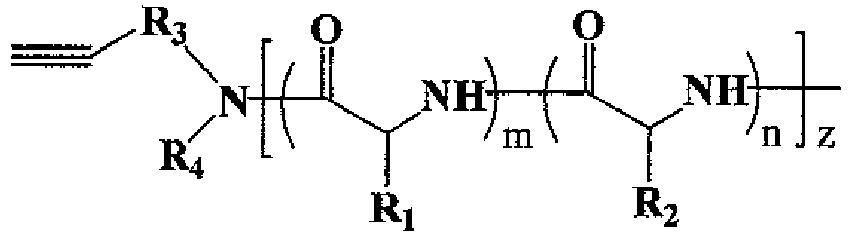
- the polyamino acid macromolecule is a polyamino acid homopolymer or a polyamino acid block copolymer obtained by ring-opening polymerization of an amino acid-N-carboxylic anhydride initiated by a primary or secondary amine molecule containing a vinyl or an alkynyl
- the specific preparation method is as follows: S1, dissolving an initiator and an amino acid-N-carboxylic anhydride A in N, N-dimethylformamide or tetrahydrofuran, wherein the mass ratio of the initiator to the amino acid-N-carboxylic anhydride A is 1:10-1:1000, the mass ratio of the amino acid-N-carboxylic anhydride A to the N, N-dimethylformamide or tetrahydrofuran is 1:5-1:100; introducing nitrogen for protection; stirring for the reaction at 10-40 °C for 12-96 hours; then adding amino acid-N-carboxylic anhydride B,
- a is an integer from 0 to 2000 and " ⁇ " is a chemical bonding point of R 3 , R 4 and there adjacent groups;
- amino acid-N-carboxylic anhydride A is selected from one or more of N ( ⁇ )-benzyloxycarbonyl-L-lysine-N-carboxylic anhydride, N'-benzyloxycarbonyl-L-ornithine, L-histidine-N-carboxylic anhydride, L-arginine-N-carboxylic anhydride;
- amino acid-N-carboxylic anhydride B is selected from one or more of N ( ⁇ )-benzyloxycarbonyl-L-lysine-N-carboxylic anhydride, N'- benzyloxycarbonyl-L -ornithine-N-carboxylic anhydride, L-histidine-N-carboxylic anhydride, L-arginine-N-carboxylic anhydride, L-alanine-N-carboxylic anhydride, L-leucine-N-carboxylic anhydride, L-isoleucine-N
- the functional macromolecule may further comprise a hydrophilic molecule selected from one of N-vinylpyrrolidone and derivatives thereof, acrylic acid and derivatives thereof, vinylphosphoric acid, wherein b is an integer of 5-500;
- the N-vinylpyrrolidone derivatives include, but are not limited to, 5-vinyl-2-pyrrolidone;
- the acrylic acid derivatives include, but are not limited to, acrylamide, hydroxyethyl acrylate, hydroxypropyl acrylate, hydroxybutyl acrylate, hydroxyethyl methacrylate, hydroxypropyl methacrylate, or hydroxybutyl methacrylate.
- the invention provides a preparation method of the antimicrobial silicone rubber, which comprises the following steps:
- the invention provides alternative preparation method of the antimicrobial silicone rubber, comprising the following steps:
- the conventional post-treatment comprises ultrasonic cleaning, drying, packaging and sterilization steps.
- the certain initiation measure is one of ultraviolet light irradiation-initiated grafting, ⁇ ray irradiation-initiated grafting, microwave-initiated grafting and heating-initiated grafting.
- the initiator is one or more of an azo radical initiator and a peroxide radical initiator; more preferably, the initiator includes, but is not limited to, one or more of ammonium persulfate, potassium persulfate, hydrogen peroxide, azobisisobutyramidine hydrochloride, and benzoyl peroxide.
- the surface of the silicone rubber is subjected to an activation treatment to construct a chemical reaction site on the surface thereof, wherein the chemical reaction site is surface chemically bonded with one or more of free radicals, unsaturated carbon-carbon bonds, and azide;
- the activation treatment method for the silicone rubber surface includes, but is not limited to, one or more of the following methods:
- the invention also provides uses of the antimicrobial silicone rubber in antimicrobial urethral catheters, antimicrobial wound dressings, antimicrobial respiratory catheters, an antimicrobial drainage tubes, antimicrobial gel, antimicrobial cervical occlusion devices or antimicrobial masks. Compared with the prior art, the present invention has the following beneficial effects:
- the invention discloses a preparation method of antimicrobial silicone rubber, comprising the following steps:
- the antimicrobial silicone rubber obtained in Example 1 was tested for antibacterial properties according to the standard ISO 22196:2011 "Measurement of Antibacterial Activity on Plastics And Other Non-Porous Surfaces", and the tested bacteria were Escherichia coli and Staphylococcus aureus; and the cytotoxicity test was performed based on the standard GB/T 16886.5- 2003 "Medical Device Biology Evaluation” Part 5: In vitro cytotoxicity test.
- the antimicrobial silicone rubber obtained in the example 1 has the antibacterial rates of 99.92% and 99.65% against Escherichia coli and Staphylococcus aureus respectively, and the cytotoxicity is grade 0.
- the invention discloses a preparation method of antimicrobial silicone rubber, comprising the following steps:
- the antibacterial property of the antibacterial silicone rubber obtained in Example 2 was tested according to the standard ISO 22196:2011 "Measurement of Antibacterial Activity on Plastics And Other Non-Porous Surfaces", and the tested bacteria were Staphylococcus aureus, Pseudomonas aeruginosa and Candida albicans; the cytotoxicity test was performed based on the standard GB/T 16886.5- 2003 "Medical Device Biology Evaluation” Part 5: In vitro cytotoxicity test, the tested cells were L929 mouse fibroblasts.
- the antimicrobial silicone rubber obtained in the example 2 has the antibacterial rates of 99.21%, 99.78% and 98.86% respectively against Staphylococcus aureus, Pseudomonas aeruginosa and Candida albicans, and the cytotoxicity is grade 0.
- the invention discloses a preparation method of antimicrobial silicone rubber, comprising the following steps:
- the antibacterial property of the antibacterial silicone rubber obtained in Example 3 was tested according to the standard ISO 22196:2011 "Measurement of Antibacterial Activity on Plastics And Other Non-Porous Surfaces", and the tested bacteria were Staphylococcus epidermidis, Escherichia coli and Pseudomonas aeruginosa; the cytotoxicity test was performed based on the standard GB/T 16886.5- 2003 "Medical Device Biology Evaluation" Part 5: In vitro cytotoxicity test, and the tested cells were L929 mouse fibroblasts.
- the antimicrobial silicone rubber obtained in the example 3 has the antibacterial rates of 96.81%, 95.94% and 98.89% respectively against Staphylococcus epidermidis, Escherichia coli and Pseudomonas aeruginosa, and the cytotoxicity is grade 0.
- the invention discloses a preparation method of antimicrobial silicone rubber, which comprises the following steps:
- the antibacterial property of the antibacterial silicone rubber obtained in Example 4 was tested according to the standard ISO 22196:2011 "Measurement of Antibacterial Activity on Plastics And Other Non-Porous Surfaces", and the tested bacteria were Staphylococcus aureus, Escherichia coli and Pseudomonas aeruginosa; the cytotoxicity test was performed based on the standard GB/T 16886.5- 2003 "Medical Device Biology Evaluation" Part 5: In vitro cytotoxicity test, and the tested cells were L929 mouse fibroblasts.
- the antimicrobial silicone rubber obtained in the example 4 has antibacterial rates of 99.81%, 99.94% and 99.89% respectively against Staphylococcus aureus, Escherichia coli and Pseudomonas aeruginosa, and the cytotoxicity is grade 0.
- the invention discloses a preparation method of antimicrobial silicone rubber, comprising the following steps:
- the antibacterial property of the antibacterial silicone rubber obtained in Example 5 was tested according to the standard ISO 22196:2011 "Measurement of Antibacterial Activity on Plastics And Other Non-Porous Surfaces", and the tested bacteria were Staphylococcus aureus, Escherichia coli and Pseudomonas aeruginosa; the cytotoxicity test was performed based on the standard GB/T 16886.5- 2003 "Medical Device Biology Evaluation" Part 5: In vitro cytotoxicity test, and the tested cells were L929 mouse fibroblasts.
- the antimicrobial silicone rubber obtained in the example 5 has antibacterial rates of 99.21%, 99.97% and 99.16% respectively against Staphylococcus aureus, Escherichia coli and Pseudomonas aeruginosa, and the cytotoxicity is grade 0.
- the invention discloses a preparation method of antimicrobial silicone rubber, comprising the following steps:
- the antibacterial property of the antibacterial silicone rubber obtained in Example 6 was tested according to the standard ISO 22196:2011 "Measurement of Antibacterial Activity on Plastics And Other Non-Porous Surfaces", and the tested bacteria were Staphylococcus aureus and Pseudomonas aeruginosa; the cytotoxicity test was performed based on the standard GB/T 16886.5- 2003 "Medical Device Biology Evaluation” Part 5: In vitro cytotoxicity test, and the tested cells were L929 mouse fibroblasts.
- the antimicrobial silicone rubber obtained in the example 6 has antibacterial rates of 99.88% and 99.75% respectively against Staphylococcus aureus and Pseudomonas aeruginosa, and the cytotoxicity is grade 0.
- the invention discloses a preparation method of antimicrobial silicone rubber, comprising the following steps:
- the antibacterial property of the antibacterial silicone rubber obtained in Example 7 was tested according to the standard ISO 22196:2011 "Measurement of Antibacterial Activity on Plastics And Other Non-Porous Surfaces", and the tested bacteria were Staphylococcus epidermidis and Pseudomonas aeruginosa; the cytotoxicity test was performed based on the standard GB/T 16886.5- 2003 "Medical Device Biology Evaluation” Part 5: In vitro cytotoxicity test, and the tested cells were L929 mouse fibroblasts.
- the antimicrobial silicone rubber obtained in the example 7 has antibacterial rates of 99.28% and 99.58% respectively against Staphylococcus epidermidis and Pseudomonas aeruginosa, and the cytotoxicity is grade 0.
- the invention discloses a preparation method of antimicrobial silicone rubber, comprising the following steps:
- the antibacterial property of the antibacterial silicone rubber obtained in Example 8 was tested according to the standard ISO 22196:2011 "Measurement of Antibacterial Activity on Plastics And Other Non-Porous Surfaces", and the tested bacteria were Staphylococcus epidermidis and Candida albicans; the cytotoxicity test was performed based on the standard GB/T 16886.5- 2003 "Medical Device Biology Evaluation” Part 5: In vitro cytotoxicity test, and the tested cells were L929 mouse fibroblasts.
- the antimicrobial silicone rubber obtained in the example 8 has antibacterial rates of 99.28% and 99.58% respectively against Staphylococcus epidermidis and Candida albicans, and the cytotoxicity is grade 0.
- the invention discloses a preparation method of antimicrobial silicone rubber, comprising the following steps:
- the antibacterial property of the antibacterial silicone rubber obtained in Example 9 was tested according to the standard ISO 22196:2011 "Measurement of Antibacterial Activity on Plastics And Other Non-Porous Surfaces", and the tested bacteria were Staphylococcus aureus and Pseudomonas aeruginosa; the cytotoxicity test was performed based on the standard GB/T 16886.5- 2003 "Medical Device Biology Evaluation” Part 5: In vitro cytotoxicity test, and the tested cells were L929 mouse fibroblasts.
- the antimicrobial silicone rubber obtained in the example 9 has antibacterial rates of 99.74% and 99.92% respectively against Staphylococcus aureus and Pseudomonas aeruginosa, and the cytotoxicity is grade 0.
- the invention discloses a preparation method of antimicrobial silicone rubber, comprising the following steps:
- the antibacterial property of the antibacterial silicone rubber obtained in Example 10 was tested according to the standard ISO 22196:2011 "Measurement of Antibacterial Activity on Plastics And Other Non-Porous Surfaces", and the tested bacteria were Staphylococcus aureus, and Candida albicans; the cytotoxicity test was performed based on the standard GB/T 16886.5- 2003 "Medical Device Biology Evaluation” Part 5: In vitro cytotoxicity test, the tested cells were L929 mouse fibroblasts.
- the antimicrobial silicone rubber obtained in the example 10 has antibacterial rates of 99.74% and 97.92% respectively against Staphylococcus aureus and Candida albicans, and the cytotoxicity is grade 0.
- the invention discloses a preparation method of antimicrobial silicone rubber, comprising the following steps:
- the antibacterial property of the antibacterial silicone rubber obtained in Example 11 was tested according to the standard ISO 22196:2011 "Measurement of Antibacterial Activity on Plastics And Other Non-Porous Surfaces", and the tested bacteria were Staphylococcus aureus, and Candida albicans; the cytotoxicity test was performed based on the standard GB/T 16886.5- 2003 "Medical Device Biology Evaluation” Part 5: In vitro cytotoxicity test, the tested cells were L929 mouse fibroblasts.
- the antimicrobial silicone rubber obtained in the example 11 has antibacterial rates of 99.74% and 97.92% respectively against Staphylococcus aureus and Candida albicans, and the cytotoxicity is grade 0.
- the invention discloses a preparation method of antimicrobial silicone rubber, comprising the following steps:
- the antibacterial property of the antibacterial silicone rubber obtained in Example 12 was tested according to the standard ISO 22196:2011 "Measurement of Antibacterial Activity on Plastics And Other Non-Porous Surfaces", and the tested bacteria were Staphylococcus aureus and Pseudomonas aeruginosa; the cytotoxicity test was performed based on the standard GB/T 16886.5- 2003 "Medical Device Biology Evaluation” Part 5: In vitro cytotoxicity test, and the tested cells were L929 mouse fibroblasts.
- the antimicrobial silicone rubber obtained in the example 12 has antibacterial rates of 96.74% and 92.92% respectively against Staphylococcus aureus and Pseudomonas aeruginosa, and the cytotoxicity is grade 0.
- the invention discloses a preparation method of antimicrobial silicone rubber, comprising the following steps:
- the antibacterial property of the antibacterial silicone rubber obtained in Example 13 was tested according to the standard ISO 22196:2011 "Measurement of Antibacterial Activity on Plastics And Other Non-Porous Surfaces", and the tested bacteria were Staphylococcus aureus, Escherichia coli and Pseudomonas aeruginosa; the cytotoxicity test was performed based on the standard GB/T 16886.5- 2003 "Medical Device Biology Evaluation" Part 5: In vitro cytotoxicity test, and the tested cells were L929 mouse fibroblasts.
- the antimicrobial silicone rubber obtained in the example 13 has antibacterial rates of 99.84%, 99.92% and 97.65% respectively against Staphylococcus aureus, Escherichia coli and Pseudomonas aeruginosa, and the cytotoxicity is grade 0.
- the invention discloses an antimicrobial silicone rubber and method thereof, comprising the following steps:
- the antibacterial property of the antibacterial silicone rubber obtained in Example 14 was tested according to the standard ISO 22196:2011 "Measurement of Antibacterial Activity on Plastics And Other Non-Porous Surfaces", and the tested bacteria were Staphylococcus aureus, Escherichia coli and Pseudomonas aeruginosa; the cytotoxicity test was performed based on the standard GB/T 16886.5- 2003 "Medical Device Biology Evaluation" Part 5: In vitro cytotoxicity test, and the tested cells were L929 mouse fibroblasts.
- the antimicrobial silicone rubber obtained in the example 14 has antibacterial rates of 99.44%, 99.88% and 96.65% respectively against Staphylococcus aureus, Escherichia coli and Pseudomonas aeruginosa, and the cytotoxicity is grade 0.
Landscapes
- Health & Medical Sciences (AREA)
- Chemical & Material Sciences (AREA)
- Life Sciences & Earth Sciences (AREA)
- Public Health (AREA)
- Veterinary Medicine (AREA)
- Animal Behavior & Ethology (AREA)
- General Health & Medical Sciences (AREA)
- Epidemiology (AREA)
- Chemical Kinetics & Catalysis (AREA)
- Medicinal Chemistry (AREA)
- Engineering & Computer Science (AREA)
- Polymers & Plastics (AREA)
- Organic Chemistry (AREA)
- Molecular Biology (AREA)
- Biomedical Technology (AREA)
- General Chemical & Material Sciences (AREA)
- Heart & Thoracic Surgery (AREA)
- Surgery (AREA)
- Vascular Medicine (AREA)
- Materials Engineering (AREA)
- Hematology (AREA)
- Dermatology (AREA)
- Birds (AREA)
- Toxicology (AREA)
- Materials For Medical Uses (AREA)
- Treatments Of Macromolecular Shaped Articles (AREA)
- Pharmaceuticals Containing Other Organic And Inorganic Compounds (AREA)
Claims (10)
- Caoutchouc de silicone antimicrobien, caractérisé en ce qu'une macromolécule fonctionnelle est chimiquement liée à la surface du caoutchouc de silicone et la macromolécule fonctionnelle contient du vinyle ou de l'éthynyle, et la macromolécule fonctionnelle est chimiquement liée à la surface du caoutchouc de silicone au moyen du vinyle ou de l'éthynyle ; la macromolécule fonctionnelle comprend une macromolécule de polyacide aminé, dont la structure moléculaire est montrée comme suit :





- Caoutchouc de silicone antimicrobien selon la revendication 1, caractérisé en ce que la macromolécule de polyacide aminé est un homopolymère de polyacide aminé ou un copolymère séquencé de polyacide aminé obtenu par polymérisation par ouverture de cycle d'un anhydride N-carboxylique d'acide aminé initiée par une molécule d'amine primaire ou secondaire contenant un groupe vinyle ou un groupe alcynyle, le procédé de préparation comprenant spécifiquement :S1, la dissolution d'un initiateur et d'un anhydride N-carboxylique d'acide aminé A dans du N, N-diméthylformamide ou du tétrahydrofurane, où le rapport en masse entre l'initiateur et l'anhydride N-carboxylique d'acide aminé A est de 1:10 à 1:1000, le rapport en masse entre l'anhydride N-carboxylique d'acide aminé et le N, N-diméthylformamide ou le tétrahydrofurane est de 1:5 à 1:100, et l'introduction d'azote pour protection ; l'agitation pour la réaction à 10 à 40 °C pendant 12 à 96 heures ; puis l'ajout d'anhydride N-carboxylique d'acide aminé B, dans lequel le rapport en masse entre l'anhydride N-carboxylique d'acide aminé B et l'anhydride N-carboxylique d'acide aminé A est de 0:1 à 1:1, et l'agitation pour la réaction à 10 à 40 °C pendant 12 à 96 heures ; après que la réaction est finie, la concentration de la solution sous pression réduite pour éliminer le solvant, la précipitation de la solution concentrée dans du diéthyléther, et le séchage pour obtenir un polyacide aminé ou un polyacide aminé avec un groupe protecteur ;l'initiateur répond à une formule développée suivante :
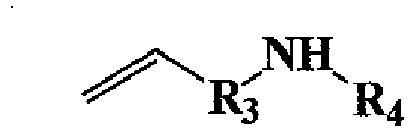


 où a est un nombre entier de 0 à 2000 et « * » est un point de liaison chimique de R3, R4 et de leurs groupes adjacents ;S2, la dissolution du polyacide aminé avec le groupe protecteur par de l'acide trifluoroacétique, l'ajout d'une solution mixte acide acétique glacial/bromure d'hydrogène à 33 % sous protection par azote et protection vis-à-vis de conditions de lumière, la mise en réaction pendant 1 à 3 heures à 20 à 40 °C, le décantage du produit par du diéthyléther, la filtration, le lavage et le séchage pour obtenir la macromolécule de polyacide aminé.
 - Caoutchouc de silicone antimicrobien selon la revendication 2, caractérisé en ce que :l'anhydride N-carboxylique d'acide aminé A est choisi parmi un ou plusieurs éléments parmi : l'anhydride N-carboxylique de N-(ε)-benzyloxycarbonyl-L-lysine, la N'-benzyloxycarbonyl-L-ornithine, l'anhydride N-carboxylique de L-histidine, et l'anhydride N-carboxylique de L-arginine ;l'anhydride N-carboxylique d'acide aminé B est choisi parmi un ou plusieurs éléments parmi : l'anhydride N-carboxylique de N-(ε)-benzyloxycarbonyl-L-lysine, l'anhydride N-carboxylique de N'-benzyloxycarbonyl-L-ornithine, l'anhydride N-carboxylique de L-histidine, l'anhydride N-carboxylique de L-arginine, l'anhydride N-carboxylique de L-alanine, l'anhydride N-carboxylique de L-leucine, l'anhydride N-carboxylique de L-isoleucine, l'anhydride N-carboxylique de L-valine, l'anhydride N-carboxylique de L-phénylalanine, l'anhydride N-carboxylique de L-méthionine, l'anhydride carboxylique d'acide γ-benzyl-L-glutamique, et l'anhydride carboxylique d'acide β-benzyl-L-aspartique.
- Caoutchouc de silicone antimicrobien selon la revendication 1, caractérisé en ce que :
la macromolécule fonctionnelle comprend en outre une molécule hydrophile choisie parmi la N-vinylpyrrolidone et ses dérivés, l'acide acrylique et ses dérivés, le phosphate de vinyle,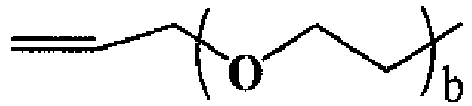
- Caoutchouc de silicone antimicrobien selon la revendication 4, caractérisé en ce que :
les dérivés de N-vinylpyrrolidone incluent, sans s'y limiter, la 5-vinyl-2-pyrrolidone ; les dérivés d'acide acrylique incluent, sans s'y limiter, l'acrylamide, l'acrylate d'hydroxyéthyle, l'acrylate d'hydroxypropyle, l'acrylate d'hydroxybutyle, le méthacrylate d'hydroxyéthyle, le méthacrylate d'hydroxypropyle ou le méthacrylate d'hydroxybutyle. - Procédé de préparation du caoutchouc de silicone antimicrobien de l'une quelconque des revendications 1 à 5, caractérisé en ce qu'il comprend les étapes suivantes :S01, la préparation d'une solution aqueuse de réaction fonctionnelle contenant des macromolécules de polyacides aminés et un initiateur, où la concentration en masse des macromolécules de polyacides aminés dans la solution aqueuse de réaction est de 0,1 à 95 %, et la masse de l'initiateur représente 0,01 à 4 % de la masse des macromolécules de polyacides aminés ;S02, le trempage du caoutchouc de silicone dans la solution aqueuse de réaction fonctionnelle, et l'application de certaines mesures d'initiation pour réagir pendant 0,05 à 12 heures ; etS03, le retrait du caoutchouc de silicone, et la réalisation d'un post-traitement classique pour obtenir le caoutchouc de silicone antimicrobien.
- Procédé de préparation du caoutchouc de silicone antimicrobien de l'une quelconque des revendications 1 à 5, caractérisé en ce qu'il comprend les étapes suivantes :S11, la préparation d'une solution aqueuse de réaction fonctionnelle contenant des macromolécules de polyacide aminé, des molécules hydrophiles et un initiateur, où la concentration en masse totale des macromolécules de polyacide aminé et des molécules hydrophiles de la solution aqueuse est de 0,1 à 95 %, le rapport en masse entre les macromolécules de polyacide aminé et les molécules hydrophiles est de 1:0 à 1:100, et la masse de l'initiateur représente 0,01 à 4 % de la masse totale des macromolécules de polyacide aminé et des molécules hydrophiles ;S12, le trempage du caoutchouc de silicone dans la solution de réaction fonctionnelle, et l'application d'une certaine mesure d'initiation pour réagir pendant 0,05 à 12 heures ; etS13, le retrait du caoutchouc de silicone, et la réalisation d'un post-traitement classique pour obtenir le caoutchouc de silicone antimicrobien.
- Procédé selon la revendication 6 ou 7, caractérisé en ce que :de préférence, le post-traitement classique inclut des étapes de nettoyage par ultrasons, de séchage, d'emballage et de stérilisation ;de préférence, la certaine mesure d'initiation adopte un greffage initié par irradiation de lumière ultraviolette, un greffage initié par rayonnement à rayons γ, un greffage initié par hyperfréquence, et un greffage initié par chauffage ;de préférence, l'initiateur est un ou plusieurs parmi un initiateur de radicaux azoïques et un initiateur de radicaux peroxyde ; de manière davantage préférée, l'initiateur inclut, sans s'y limiter, un ou plusieurs parmi le persulfate d'ammonium, le persulfate de potassium, le peroxyde d'hydrogène, le chlorhydrate d'azobisobutyramidine et le peroxyde de benzoyle.
- Procédé selon la revendication 6 ou 7, caractérisé en ce que :avant d'effectuer l'étape S02 et l'étape S12, la surface du caoutchouc de silicone est soumise à un traitement d'activation ;le procédé de traitement d'activation pour la surface de caoutchouc de silicone inclut, sans s'y limiter, un ou plusieurs des procédés suivants :procédé A : activation de la surface de caoutchouc de silicone en utilisant de l'argon, de l'hélium, du carbone, de l'azote, de l'oxygène, de l'hydrogène ou du plasma H2O, et la liaison de radicaux carbonés, de radicaux oxygénés ou de radicaux azotés sur la surface du caoutchouc de silicone ;procédé B : trempage du caoutchouc de silicone dans un agent oxydant tel que l'acide sulfurique, le peroxyde d'hydrogène, le permanganate de potassium, l'acide périodique, l'acide hypochloreux et similaire ou une solution mixte de ceux-ci pendant 0 à 120 minutes, lavage par ultrasons, trempage dans une ou plusieurs solutions mixtes d'un agent de couplage de vinylsilane ou d'un agent de couplage de méthacryloxy silane pendant 0,01 à 24 heures, et lavage par ultrasons pour lier des liaisons carbone-carbone insaturées sur la surface du caoutchouc de silicone ;procédé C : trempage de caoutchouc de silicone dans un agent oxydant tel que l'acide sulfurique, le peroxyde d'hydrogène, le permanganate de potassium, l'acide périodique, l'acide hypochloreux et similaires ou une solution mixte de ceux-ci pendant 0 à 120 minutes, lavage par ultrasons, trempage dans du chloropropyltriméthoxysilane pendant 0,01 à 24 heures, puis trempage du caoutchouc de silicone dans une solution de N,N-diméthylformamide contenant de l'azoture de sodium, traitement pendant 0,1 à 6 heures, et lavage par ultrasons pour lier des groupes azoture sur la surface du caoutchouc de silicone.
- Utilisations d'un caoutchouc de silicone antimicrobien de l'une quelconque des revendications 1 à 5 dans des cathéters urétraux antimicrobiens, des pansements antimicrobiens, des cathéters respiratoires antimicrobiens, des drains antimicrobiens, un gel antimicrobien, un dispositif antimicrobien d'occlusion du col de l'utérus ou des masques antimicrobiens.
Applications Claiming Priority (2)
| Application Number | Priority Date | Filing Date | Title |
|---|---|---|---|
| CN201710398252.8A CN107141502B (zh) | 2017-05-31 | 2017-05-31 | 一种抗菌硅橡胶、制备方法及其应用 |
| PCT/CN2018/081292 WO2018219035A1 (fr) | 2017-05-31 | 2018-03-30 | Caoutchouc de silicone antimicrobien, procédé de préparation associé et utilisation associée |
Publications (3)
| Publication Number | Publication Date |
|---|---|
| EP3584277A1 EP3584277A1 (fr) | 2019-12-25 |
| EP3584277A4 EP3584277A4 (fr) | 2021-01-27 |
| EP3584277B1 true EP3584277B1 (fr) | 2022-06-29 |
Family
ID=59780310
Family Applications (1)
| Application Number | Title | Priority Date | Filing Date |
|---|---|---|---|
| EP18810066.3A Active EP3584277B1 (fr) | 2017-05-31 | 2018-03-30 | Caoutchouc de silicone antimicrobien, procédé de préparation associé et utilisation associée |
Country Status (4)
| Country | Link |
|---|---|
| US (1) | US11001688B2 (fr) |
| EP (1) | EP3584277B1 (fr) |
| CN (1) | CN107141502B (fr) |
| WO (1) | WO2018219035A1 (fr) |
Families Citing this family (19)
| Publication number | Priority date | Publication date | Assignee | Title |
|---|---|---|---|---|
| CN107141502B (zh) * | 2017-05-31 | 2019-08-23 | 泰州度博迈医疗器械有限公司 | 一种抗菌硅橡胶、制备方法及其应用 |
| CN108864711A (zh) * | 2018-06-15 | 2018-11-23 | 王娟娟 | 一种用于芯片封装的有机硅胶材料及其制备方法 |
| CN111686310B (zh) * | 2019-03-11 | 2022-03-29 | 国家纳米科学中心 | 一种抗菌导尿管及其制备方法和应用 |
| US12383700B2 (en) | 2019-06-13 | 2025-08-12 | Hollister Incorporated | Reusable urinary catheter products |
| EP4628107A3 (fr) | 2019-06-25 | 2025-12-17 | Hollister Incorporated | Produits pour sondes urinaires réutilisables |
| CN111793463B (zh) * | 2020-07-29 | 2022-03-04 | 北京化工大学 | 一种抗菌防霉硅酮密封胶的制备方法及其产品 |
| CN112316195B (zh) * | 2020-10-30 | 2022-06-14 | 苏州度博迈医疗科技有限公司 | 一种丝瓜络抗菌敷料的制备方法 |
| CN112778967B (zh) * | 2020-12-25 | 2022-08-02 | 广州市白云化工实业有限公司 | 防霉抗菌硅酮密封胶组合物及其制备方法 |
| CN113198080B (zh) * | 2021-04-08 | 2022-01-04 | 湖南万脉医疗科技有限公司 | 一种抗凝水呼吸机管道及呼吸机 |
| CN116410510A (zh) * | 2021-12-31 | 2023-07-11 | 江苏百赛飞生物科技有限公司 | 一种材料表面改性的方法和基于该方法得到的表面改性的材料 |
| CN114479474B (zh) * | 2022-01-26 | 2024-03-01 | 广州万乐实业有限公司 | 一种抗菌性硅橡胶制品的制备方法及抗菌性硅橡胶制品 |
| CN115260680B (zh) * | 2022-08-05 | 2023-07-28 | 宁波博思特高分子材料科技有限公司 | 一种高耐候tpv复合材料及其制备方法 |
| CN115403930B (zh) * | 2022-09-27 | 2023-05-26 | 深圳深凯硅胶制品有限公司 | 公共交通工具手拉环硅胶抗菌套及制备方法 |
| CN115920141B (zh) * | 2022-12-12 | 2024-03-19 | 广东省人民医院 | 一种抗菌抗微生物黏附引流管及其制备方法 |
| CN116041768B (zh) * | 2022-12-13 | 2024-06-25 | 泰州度博迈医疗器械有限公司 | 一种pH响应的超滑抗菌硅橡胶及其制备方法 |
| CN116695457A (zh) * | 2023-05-31 | 2023-09-05 | 浙江德易遮阳科技股份有限公司 | 一种具有隔热凉感的遮阳材料加工方法 |
| CN116535859B (zh) * | 2023-07-06 | 2023-08-25 | 汕头市永昌钦发针织实业有限公司 | 一种柔性亲肤硅胶及其制备方法和在硅胶内衣中的应用 |
| CN117186653B (zh) * | 2023-08-16 | 2024-03-08 | 东莞市中瑞高分子材料有限公司 | 一种透气抗菌硅橡胶材料的制备方法及家纺中应用 |
| CN119505552B (zh) * | 2025-01-16 | 2025-04-25 | 山东英特医疗科技有限公司 | 一种可降解透气抗菌手套制备方法 |
Family Cites Families (11)
| Publication number | Priority date | Publication date | Assignee | Title |
|---|---|---|---|---|
| KR20010044838A (ko) * | 2001-03-31 | 2001-06-05 | 이근호 | 실리콘고무 재료의 아크릴산 플라즈마처리를 이용한은처리방법 |
| CN2778285Y (zh) | 2005-03-28 | 2006-05-10 | 山东百多安医疗器械有限公司 | 抗菌超滑导尿管 |
| CN201431691Y (zh) | 2009-07-08 | 2010-03-31 | 大连理工大学 | 一种抗菌亲水涂层导尿管 |
| CN101987887B (zh) * | 2009-08-06 | 2012-12-26 | 张义浜 | 一种改性硅橡胶及其改性方法和用途 |
| CN201558397U (zh) | 2009-08-11 | 2010-08-25 | 中国人民解放军第三军医大学第一附属医院 | 载缓释阿米卡星导尿管 |
| CN101912638A (zh) | 2010-07-26 | 2010-12-15 | 郭云童 | 纳米载银-二氧化硅导尿管及其生产方法 |
| CN102028973B (zh) | 2010-12-31 | 2014-02-26 | 南昌大学 | 一种硅橡胶/胶原基多孔皮肤支架材料的制备方法及用途 |
| US8962772B2 (en) * | 2013-06-26 | 2015-02-24 | International Business Machines Corporation | Antimicrobial surface modified silicone rubber and methods of preparation thereof |
| CN103768700B (zh) * | 2013-07-03 | 2015-11-18 | 苏州睿研纳米医学科技有限公司 | 蛋白抑菌导尿管及其制备方法 |
| CN104721875B (zh) * | 2015-03-18 | 2017-03-01 | 华南理工大学 | 一种亲水型硅橡胶医用敷料及其制备方法 |
| CN107141502B (zh) * | 2017-05-31 | 2019-08-23 | 泰州度博迈医疗器械有限公司 | 一种抗菌硅橡胶、制备方法及其应用 |
-
2017
- 2017-05-31 CN CN201710398252.8A patent/CN107141502B/zh active Active
-
2018
- 2018-03-30 WO PCT/CN2018/081292 patent/WO2018219035A1/fr not_active Ceased
- 2018-03-30 EP EP18810066.3A patent/EP3584277B1/fr active Active
- 2018-03-30 US US16/497,321 patent/US11001688B2/en active Active
Also Published As
| Publication number | Publication date |
|---|---|
| CN107141502A (zh) | 2017-09-08 |
| CN107141502B (zh) | 2019-08-23 |
| EP3584277A4 (fr) | 2021-01-27 |
| US20200017651A1 (en) | 2020-01-16 |
| EP3584277A1 (fr) | 2019-12-25 |
| WO2018219035A1 (fr) | 2018-12-06 |
| US11001688B2 (en) | 2021-05-11 |
Similar Documents
| Publication | Publication Date | Title |
|---|---|---|
| EP3584277B1 (fr) | Caoutchouc de silicone antimicrobien, procédé de préparation associé et utilisation associée | |
| US8697112B2 (en) | Method for treating a surface with a coating comprising a microencapsulated therapeutic agent and device with treated surface | |
| US7955636B2 (en) | Antimicrobial coating | |
| AU2009322136B2 (en) | Non-fouling, anti-microbial, anti-thrombogenic graft-from compositions | |
| EP2178990B1 (fr) | Composition de revêtement antimicrobienne photostable | |
| Xu et al. | Antibacterial nanoparticles with universal adhesion function based on dopamine and eugenol | |
| WO2011073403A1 (fr) | Dispositif médical pour utilisation de courte durée avec un agent antibactérien à libération rapide | |
| CN115814172B (zh) | 一种接枝于医疗器械表面的抗污损耐磨亲水润滑涂层及其制备方法 | |
| CN116271202B (zh) | 快速自修复可注射纳米复合抗菌水凝胶敷料及其制备方法 | |
| EP3723839B1 (fr) | Compositions de revêtement de copolymère de polyurée et procédés | |
| CN121197545B (zh) | 温敏响应型聚丙烯酸钠导尿管防漏涂层、制备方法及其应用 | |
| CN113694261B (zh) | 一种抗菌复合涂层及其制备方法和制品 | |
| CN107286339B (zh) | 一种抗菌硅橡胶的制备方法及其应用 | |
| CN115845151A (zh) | 一种亲水超滑的医用导管 | |
| CN112280088B (zh) | 一种长效抗菌硅橡胶及其制备方法 | |
| CN111803705A (zh) | 一种具有抗菌功能的羟基磷灰石复合材料及其制备方法和应用 | |
| CN120078961B (zh) | 一种高生物相容性抗菌复合材料及其制备方法和应用 | |
| CN120860334B (zh) | 一种带两性离子涂层的输尿管支架及其制备方法 | |
| CN118252985B (zh) | 一种茶多酚仿生胃造瘘管涂层及其制备方法 | |
| CN120775451A (zh) | 生理pH响应的抗菌、防细菌粘附的涂层及其制备方法和应用 | |
| JP2008245747A (ja) | 表皮親和性コーティング剤及び医療用具 | |
| CN120900006A (zh) | 一种用于聚氨酯导管表面的亲水润滑涂层及其制备方法 | |
| CN121714776A (zh) | 一种基于仿蛋白质键约束的抗菌润滑双功能医用导管涂层制备方法 | |
| CN117883637A (zh) | 一种抗菌涂层及其制备方法和应用 | |
| CN117205218A (zh) | 一种含甲基卡泰斯特的半月形缓释药膜及其制备方法 |
Legal Events
| Date | Code | Title | Description |
|---|---|---|---|
| STAA | Information on the status of an ep patent application or granted ep patent |
Free format text: STATUS: THE INTERNATIONAL PUBLICATION HAS BEEN MADE |
|
| PUAI | Public reference made under article 153(3) epc to a published international application that has entered the european phase |
Free format text: ORIGINAL CODE: 0009012 |
|
| STAA | Information on the status of an ep patent application or granted ep patent |
Free format text: STATUS: REQUEST FOR EXAMINATION WAS MADE |
|
| 17P | Request for examination filed |
Effective date: 20190915 |
|
| AK | Designated contracting states |
Kind code of ref document: A1 Designated state(s): AL AT BE BG CH CY CZ DE DK EE ES FI FR GB GR HR HU IE IS IT LI LT LU LV MC MK MT NL NO PL PT RO RS SE SI SK SM TR |
|
| AX | Request for extension of the european patent |
Extension state: BA ME |
|
| DAV | Request for validation of the european patent (deleted) | ||
| DAX | Request for extension of the european patent (deleted) | ||
| A4 | Supplementary search report drawn up and despatched |
Effective date: 20210113 |
|
| RIC1 | Information provided on ipc code assigned before grant |
Ipc: A61M 25/00 20060101ALI20201222BHEP Ipc: A61K 8/898 20060101ALI20201222BHEP Ipc: C08L 83/10 20060101ALI20201222BHEP Ipc: A61L 15/26 20060101ALI20201222BHEP Ipc: C08J 7/16 20060101AFI20201222BHEP |
|
| GRAP | Despatch of communication of intention to grant a patent |
Free format text: ORIGINAL CODE: EPIDOSNIGR1 |
|
| STAA | Information on the status of an ep patent application or granted ep patent |
Free format text: STATUS: GRANT OF PATENT IS INTENDED |
|
| INTG | Intention to grant announced |
Effective date: 20220125 |
|
| GRAS | Grant fee paid |
Free format text: ORIGINAL CODE: EPIDOSNIGR3 |
|
| GRAA | (expected) grant |
Free format text: ORIGINAL CODE: 0009210 |
|
| STAA | Information on the status of an ep patent application or granted ep patent |
Free format text: STATUS: THE PATENT HAS BEEN GRANTED |
|
| AK | Designated contracting states |
Kind code of ref document: B1 Designated state(s): AL AT BE BG CH CY CZ DE DK EE ES FI FR GB GR HR HU IE IS IT LI LT LU LV MC MK MT NL NO PL PT RO RS SE SI SK SM TR |
|
| REG | Reference to a national code |
Ref country code: CH Ref legal event code: EP |
|
| REG | Reference to a national code |
Ref country code: AT Ref legal event code: REF Ref document number: 1501332 Country of ref document: AT Kind code of ref document: T Effective date: 20220715 |
|
| REG | Reference to a national code |
Ref country code: IE Ref legal event code: FG4D |
|
| REG | Reference to a national code |
Ref country code: DE Ref legal event code: R096 Ref document number: 602018037396 Country of ref document: DE |
|
| REG | Reference to a national code |
Ref country code: LT Ref legal event code: MG9D |
|
| PG25 | Lapsed in a contracting state [announced via postgrant information from national office to epo] |
Ref country code: SE Free format text: LAPSE BECAUSE OF FAILURE TO SUBMIT A TRANSLATION OF THE DESCRIPTION OR TO PAY THE FEE WITHIN THE PRESCRIBED TIME-LIMIT Effective date: 20220629 Ref country code: NO Free format text: LAPSE BECAUSE OF FAILURE TO SUBMIT A TRANSLATION OF THE DESCRIPTION OR TO PAY THE FEE WITHIN THE PRESCRIBED TIME-LIMIT Effective date: 20220929 Ref country code: LT Free format text: LAPSE BECAUSE OF FAILURE TO SUBMIT A TRANSLATION OF THE DESCRIPTION OR TO PAY THE FEE WITHIN THE PRESCRIBED TIME-LIMIT Effective date: 20220629 Ref country code: HR Free format text: LAPSE BECAUSE OF FAILURE TO SUBMIT A TRANSLATION OF THE DESCRIPTION OR TO PAY THE FEE WITHIN THE PRESCRIBED TIME-LIMIT Effective date: 20220629 Ref country code: GR Free format text: LAPSE BECAUSE OF FAILURE TO SUBMIT A TRANSLATION OF THE DESCRIPTION OR TO PAY THE FEE WITHIN THE PRESCRIBED TIME-LIMIT Effective date: 20220930 Ref country code: FI Free format text: LAPSE BECAUSE OF FAILURE TO SUBMIT A TRANSLATION OF THE DESCRIPTION OR TO PAY THE FEE WITHIN THE PRESCRIBED TIME-LIMIT Effective date: 20220629 Ref country code: BG Free format text: LAPSE BECAUSE OF FAILURE TO SUBMIT A TRANSLATION OF THE DESCRIPTION OR TO PAY THE FEE WITHIN THE PRESCRIBED TIME-LIMIT Effective date: 20220929 |
|
| REG | Reference to a national code |
Ref country code: NL Ref legal event code: MP Effective date: 20220629 |
|
| REG | Reference to a national code |
Ref country code: AT Ref legal event code: MK05 Ref document number: 1501332 Country of ref document: AT Kind code of ref document: T Effective date: 20220629 |
|
| PG25 | Lapsed in a contracting state [announced via postgrant information from national office to epo] |
Ref country code: RS Free format text: LAPSE BECAUSE OF FAILURE TO SUBMIT A TRANSLATION OF THE DESCRIPTION OR TO PAY THE FEE WITHIN THE PRESCRIBED TIME-LIMIT Effective date: 20220629 Ref country code: LV Free format text: LAPSE BECAUSE OF FAILURE TO SUBMIT A TRANSLATION OF THE DESCRIPTION OR TO PAY THE FEE WITHIN THE PRESCRIBED TIME-LIMIT Effective date: 20220629 |
|
| PG25 | Lapsed in a contracting state [announced via postgrant information from national office to epo] |
Ref country code: NL Free format text: LAPSE BECAUSE OF FAILURE TO SUBMIT A TRANSLATION OF THE DESCRIPTION OR TO PAY THE FEE WITHIN THE PRESCRIBED TIME-LIMIT Effective date: 20220629 |
|
| PG25 | Lapsed in a contracting state [announced via postgrant information from national office to epo] |
Ref country code: SM Free format text: LAPSE BECAUSE OF FAILURE TO SUBMIT A TRANSLATION OF THE DESCRIPTION OR TO PAY THE FEE WITHIN THE PRESCRIBED TIME-LIMIT Effective date: 20220629 Ref country code: SK Free format text: LAPSE BECAUSE OF FAILURE TO SUBMIT A TRANSLATION OF THE DESCRIPTION OR TO PAY THE FEE WITHIN THE PRESCRIBED TIME-LIMIT Effective date: 20220629 Ref country code: RO Free format text: LAPSE BECAUSE OF FAILURE TO SUBMIT A TRANSLATION OF THE DESCRIPTION OR TO PAY THE FEE WITHIN THE PRESCRIBED TIME-LIMIT Effective date: 20220629 Ref country code: PT Free format text: LAPSE BECAUSE OF FAILURE TO SUBMIT A TRANSLATION OF THE DESCRIPTION OR TO PAY THE FEE WITHIN THE PRESCRIBED TIME-LIMIT Effective date: 20221031 Ref country code: ES Free format text: LAPSE BECAUSE OF FAILURE TO SUBMIT A TRANSLATION OF THE DESCRIPTION OR TO PAY THE FEE WITHIN THE PRESCRIBED TIME-LIMIT Effective date: 20220629 Ref country code: EE Free format text: LAPSE BECAUSE OF FAILURE TO SUBMIT A TRANSLATION OF THE DESCRIPTION OR TO PAY THE FEE WITHIN THE PRESCRIBED TIME-LIMIT Effective date: 20220629 Ref country code: AT Free format text: LAPSE BECAUSE OF FAILURE TO SUBMIT A TRANSLATION OF THE DESCRIPTION OR TO PAY THE FEE WITHIN THE PRESCRIBED TIME-LIMIT Effective date: 20220629 |
|
| PG25 | Lapsed in a contracting state [announced via postgrant information from national office to epo] |
Ref country code: PL Free format text: LAPSE BECAUSE OF FAILURE TO SUBMIT A TRANSLATION OF THE DESCRIPTION OR TO PAY THE FEE WITHIN THE PRESCRIBED TIME-LIMIT Effective date: 20220629 Ref country code: IS Free format text: LAPSE BECAUSE OF FAILURE TO SUBMIT A TRANSLATION OF THE DESCRIPTION OR TO PAY THE FEE WITHIN THE PRESCRIBED TIME-LIMIT Effective date: 20221029 |
|
| REG | Reference to a national code |
Ref country code: DE Ref legal event code: R097 Ref document number: 602018037396 Country of ref document: DE |
|
| PG25 | Lapsed in a contracting state [announced via postgrant information from national office to epo] |
Ref country code: AL Free format text: LAPSE BECAUSE OF FAILURE TO SUBMIT A TRANSLATION OF THE DESCRIPTION OR TO PAY THE FEE WITHIN THE PRESCRIBED TIME-LIMIT Effective date: 20220629 |
|
| PG25 | Lapsed in a contracting state [announced via postgrant information from national office to epo] |
Ref country code: DK Free format text: LAPSE BECAUSE OF FAILURE TO SUBMIT A TRANSLATION OF THE DESCRIPTION OR TO PAY THE FEE WITHIN THE PRESCRIBED TIME-LIMIT Effective date: 20220629 Ref country code: CZ Free format text: LAPSE BECAUSE OF FAILURE TO SUBMIT A TRANSLATION OF THE DESCRIPTION OR TO PAY THE FEE WITHIN THE PRESCRIBED TIME-LIMIT Effective date: 20220629 |
|
| PLBE | No opposition filed within time limit |
Free format text: ORIGINAL CODE: 0009261 |
|
| STAA | Information on the status of an ep patent application or granted ep patent |
Free format text: STATUS: NO OPPOSITION FILED WITHIN TIME LIMIT |
|
| 26N | No opposition filed |
Effective date: 20230330 |
|
| PG25 | Lapsed in a contracting state [announced via postgrant information from national office to epo] |
Ref country code: SI Free format text: LAPSE BECAUSE OF FAILURE TO SUBMIT A TRANSLATION OF THE DESCRIPTION OR TO PAY THE FEE WITHIN THE PRESCRIBED TIME-LIMIT Effective date: 20220629 |
|
| PG25 | Lapsed in a contracting state [announced via postgrant information from national office to epo] |
Ref country code: MC Free format text: LAPSE BECAUSE OF FAILURE TO SUBMIT A TRANSLATION OF THE DESCRIPTION OR TO PAY THE FEE WITHIN THE PRESCRIBED TIME-LIMIT Effective date: 20220629 |
|
| REG | Reference to a national code |
Ref country code: CH Ref legal event code: PL |
|
| REG | Reference to a national code |
Ref country code: BE Ref legal event code: MM Effective date: 20230331 |
|
| PG25 | Lapsed in a contracting state [announced via postgrant information from national office to epo] |
Ref country code: LU Free format text: LAPSE BECAUSE OF NON-PAYMENT OF DUE FEES Effective date: 20230330 |
|
| REG | Reference to a national code |
Ref country code: DE Ref legal event code: R082 Ref document number: 602018037396 Country of ref document: DE Representative=s name: LIPPERT STACHOW PATENTANWAELTE RECHTSANWAELTE , DE |
|
| REG | Reference to a national code |
Ref country code: IE Ref legal event code: MM4A |
|
| PG25 | Lapsed in a contracting state [announced via postgrant information from national office to epo] |
Ref country code: LI Free format text: LAPSE BECAUSE OF NON-PAYMENT OF DUE FEES Effective date: 20230331 Ref country code: IT Free format text: LAPSE BECAUSE OF FAILURE TO SUBMIT A TRANSLATION OF THE DESCRIPTION OR TO PAY THE FEE WITHIN THE PRESCRIBED TIME-LIMIT Effective date: 20220629 Ref country code: IE Free format text: LAPSE BECAUSE OF NON-PAYMENT OF DUE FEES Effective date: 20230330 Ref country code: CH Free format text: LAPSE BECAUSE OF NON-PAYMENT OF DUE FEES Effective date: 20230331 |
|
| PG25 | Lapsed in a contracting state [announced via postgrant information from national office to epo] |
Ref country code: BE Free format text: LAPSE BECAUSE OF NON-PAYMENT OF DUE FEES Effective date: 20230331 |
|
| PG25 | Lapsed in a contracting state [announced via postgrant information from national office to epo] |
Ref country code: BG Free format text: LAPSE BECAUSE OF FAILURE TO SUBMIT A TRANSLATION OF THE DESCRIPTION OR TO PAY THE FEE WITHIN THE PRESCRIBED TIME-LIMIT Effective date: 20220629 |
|
| PG25 | Lapsed in a contracting state [announced via postgrant information from national office to epo] |
Ref country code: BG Free format text: LAPSE BECAUSE OF FAILURE TO SUBMIT A TRANSLATION OF THE DESCRIPTION OR TO PAY THE FEE WITHIN THE PRESCRIBED TIME-LIMIT Effective date: 20220629 |
|
| PG25 | Lapsed in a contracting state [announced via postgrant information from national office to epo] |
Ref country code: CY Free format text: LAPSE BECAUSE OF FAILURE TO SUBMIT A TRANSLATION OF THE DESCRIPTION OR TO PAY THE FEE WITHIN THE PRESCRIBED TIME-LIMIT; INVALID AB INITIO Effective date: 20180330 |
|
| PG25 | Lapsed in a contracting state [announced via postgrant information from national office to epo] |
Ref country code: HU Free format text: LAPSE BECAUSE OF FAILURE TO SUBMIT A TRANSLATION OF THE DESCRIPTION OR TO PAY THE FEE WITHIN THE PRESCRIBED TIME-LIMIT; INVALID AB INITIO Effective date: 20180330 |
|
| PG25 | Lapsed in a contracting state [announced via postgrant information from national office to epo] |
Ref country code: TR Free format text: LAPSE BECAUSE OF FAILURE TO SUBMIT A TRANSLATION OF THE DESCRIPTION OR TO PAY THE FEE WITHIN THE PRESCRIBED TIME-LIMIT Effective date: 20220629 |
|
| PGFP | Annual fee paid to national office [announced via postgrant information from national office to epo] |
Ref country code: GB Payment date: 20260323 Year of fee payment: 9 |
|
| PGFP | Annual fee paid to national office [announced via postgrant information from national office to epo] |
Ref country code: DE Payment date: 20260313 Year of fee payment: 9 |
|
| PGFP | Annual fee paid to national office [announced via postgrant information from national office to epo] |
Ref country code: FR Payment date: 20260330 Year of fee payment: 9 |