EP3584652A1 - Procédé de fourniture d'instructions relatives au déroulement d'assemblage pour la réalisation d'un produit - Google Patents
Procédé de fourniture d'instructions relatives au déroulement d'assemblage pour la réalisation d'un produit Download PDFInfo
- Publication number
- EP3584652A1 EP3584652A1 EP18178189.9A EP18178189A EP3584652A1 EP 3584652 A1 EP3584652 A1 EP 3584652A1 EP 18178189 A EP18178189 A EP 18178189A EP 3584652 A1 EP3584652 A1 EP 3584652A1
- Authority
- EP
- European Patent Office
- Prior art keywords
- assembly
- product
- data
- instruction
- created
- Prior art date
- Legal status (The legal status is an assumption and is not a legal conclusion. Google has not performed a legal analysis and makes no representation as to the accuracy of the status listed.)
- Withdrawn
Links
Images

Classifications
-
- G—PHYSICS
- G06—COMPUTING OR CALCULATING; COUNTING
- G06Q—INFORMATION AND COMMUNICATION TECHNOLOGY [ICT] SPECIALLY ADAPTED FOR ADMINISTRATIVE, COMMERCIAL, FINANCIAL, MANAGERIAL OR SUPERVISORY PURPOSES; SYSTEMS OR METHODS SPECIALLY ADAPTED FOR ADMINISTRATIVE, COMMERCIAL, FINANCIAL, MANAGERIAL OR SUPERVISORY PURPOSES, NOT OTHERWISE PROVIDED FOR
- G06Q50/00—Information and communication technology [ICT] specially adapted for implementation of business processes of specific business sectors, e.g. utilities or tourism
- G06Q50/04—Manufacturing
-
- G—PHYSICS
- G05—CONTROLLING; REGULATING
- G05B—CONTROL OR REGULATING SYSTEMS IN GENERAL; FUNCTIONAL ELEMENTS OF SUCH SYSTEMS; MONITORING OR TESTING ARRANGEMENTS FOR SUCH SYSTEMS OR ELEMENTS
- G05B19/00—Program-control systems
- G05B19/02—Program-control systems electric
- G05B19/418—Total factory control, i.e. centrally controlling a plurality of machines, e.g. direct or distributed numerical control [DNC], flexible manufacturing systems [FMS], integrated manufacturing systems [IMS] or computer integrated manufacturing [CIM]
- G05B19/41805—Total factory control, i.e. centrally controlling a plurality of machines, e.g. direct or distributed numerical control [DNC], flexible manufacturing systems [FMS], integrated manufacturing systems [IMS] or computer integrated manufacturing [CIM] characterised by assembly
-
- G—PHYSICS
- G06—COMPUTING OR CALCULATING; COUNTING
- G06Q—INFORMATION AND COMMUNICATION TECHNOLOGY [ICT] SPECIALLY ADAPTED FOR ADMINISTRATIVE, COMMERCIAL, FINANCIAL, MANAGERIAL OR SUPERVISORY PURPOSES; SYSTEMS OR METHODS SPECIALLY ADAPTED FOR ADMINISTRATIVE, COMMERCIAL, FINANCIAL, MANAGERIAL OR SUPERVISORY PURPOSES, NOT OTHERWISE PROVIDED FOR
- G06Q10/00—Administration; Management
- G06Q10/06—Resources, workflows, human or project management; Enterprise or organisation planning; Enterprise or organisation modelling
- G06Q10/063—Operations research, analysis or management
- G06Q10/0633—Workflow analysis
-
- Y—GENERAL TAGGING OF NEW TECHNOLOGICAL DEVELOPMENTS; GENERAL TAGGING OF CROSS-SECTIONAL TECHNOLOGIES SPANNING OVER SEVERAL SECTIONS OF THE IPC; TECHNICAL SUBJECTS COVERED BY FORMER USPC CROSS-REFERENCE ART COLLECTIONS [XRACs] AND DIGESTS
- Y02—TECHNOLOGIES OR APPLICATIONS FOR MITIGATION OR ADAPTATION AGAINST CLIMATE CHANGE
- Y02P—CLIMATE CHANGE MITIGATION TECHNOLOGIES IN THE PRODUCTION OR PROCESSING OF GOODS
- Y02P90/00—Enabling technologies with a potential contribution to greenhouse gas [GHG] emissions mitigation
- Y02P90/02—Total factory control, e.g. smart factories, flexible manufacturing systems [FMS] or integrated manufacturing systems [IMS]
-
- Y—GENERAL TAGGING OF NEW TECHNOLOGICAL DEVELOPMENTS; GENERAL TAGGING OF CROSS-SECTIONAL TECHNOLOGIES SPANNING OVER SEVERAL SECTIONS OF THE IPC; TECHNICAL SUBJECTS COVERED BY FORMER USPC CROSS-REFERENCE ART COLLECTIONS [XRACs] AND DIGESTS
- Y02—TECHNOLOGIES OR APPLICATIONS FOR MITIGATION OR ADAPTATION AGAINST CLIMATE CHANGE
- Y02P—CLIMATE CHANGE MITIGATION TECHNOLOGIES IN THE PRODUCTION OR PROCESSING OF GOODS
- Y02P90/00—Enabling technologies with a potential contribution to greenhouse gas [GHG] emissions mitigation
- Y02P90/30—Computing systems specially adapted for manufacturing
Definitions
- a method for providing an instruction relating to an assembly process for creating a product is disclosed.
- a device which is set up to provide an instruction is disclosed, the instruction relating to an assembly process for creating a product.
- a disadvantage of this is that assembly methods available on site for creating the product are not taken into account in such an approach. This can lead to the fact that no specific assembly process can be recommended for an assembly process, but rather that a large number of possible assembly processes is output.
- the object of the invention is therefore to provide a method by means of which a preferred assembly process is output in a targeted manner.
- the object is therefore to provide technical means by means of which the above-mentioned method can be carried out.
- these tasks are achieved by a method for providing an instruction according to claim 1 and by a device for providing an instruction is set up, solved according to claim 14. Further configurations relating to these embodiments are claimed in the dependent claims.
- a method for providing an instruction relating to an assembly process for creating a product has the steps a) receiving product data that are characteristic of the creation of the product, b) receiving assembly data that is characteristic of an assembly arrangement with one or more assembly stations for creating the product, c) determining the instruction based on the received product data and the received assembly data and d) outputting the determined instruction.
- the output of the instruction as to which specific assembly process is preferred is based not only on specifics of the product to be created, but also on specifics of the locally available aids and / or resources.
- this leads to the fact that the instruction now issued is optimally coordinated with the respective circumstances, and on the other hand it reduces the number of proposed assembly processes, which results in improved efficiency and user-friendliness for determining the assembly process. Based on improved efficiency, new products can also be brought to market faster.
- This approach can also improve the reliability of the assembly process to be carried out, since assembly processes that match the product to be created but not the local resource are eliminated from the solution space and are therefore not issued to a user as instructions.
- a device which is set up to provide an instruction.
- the instruction concerns an assembly process for the creation of a product.
- the device has a first receiving device which is set up to receive product data which are characteristic of the creation of the product.
- the device also has a second receiving device which is set up to receive assembly data which are characteristic of an assembly arrangement for producing the product.
- the device also has a determination device which is set up to determine the instruction based on the received product data and the received assembly data.
- the device also has an output device which is set up to output the determined instruction.
- An instruction in the sense of the invention is to be understood as an output signal, on the basis of which a decision can be made about processes which relate to the creation of a product.
- the processes can relate to assembly processes.
- the decision can be made by a user.
- the instruction can include one or more recommendations for action, wherein the recommendations for action can be prioritized relative to one another.
- An assembly sequence in the sense of the invention is to be understood as a sequential procedure for creating a product using technical aids.
- the technical aids can include manual and / or automated technical tools.
- the assembly process can be implemented by an assembly arrangement which has one or more assembly stations. Different processes for creating and / or assembling the product can be carried out on different Assembly stations are accomplished during the assembly process.
- Product data in the sense of the invention is to be understood as information which includes specifications relating to a product to be created.
- Such specification can refer to a spatial structure in the final stage or an intermediate stage of the product to be created.
- Such specification can also refer to a spatial structure of individual components of the product to be created.
- Such specifications can also relate to the connectivity of different components of the product to be created.
- the specifications may further include information indicating the order in which the various components of the product to be created can be connected and / or assembled.
- Assembly data in the sense of the invention is to be understood as information which includes specifications relating to an assembly arrangement with one or more assembly stations.
- specifications can relate to a number of assembly stations provided, means of transport between the assembly stations provided and a directional dependency of such a means of transport.
- specifications can also relate to the equipment of one or more assembly stations of the assembly arrangement.
- Such equipment can relate, for example, to technical aids and / or tools provided on site as well as to accessibility and spatial resources for a technical operator.
- Such technical aids can include, for example, the ability of an assembly station to hold, rotate or add the product to be created or an intermediate product.
- the determined instruction has information regarding an assembly sequence of the product to be created. According to one embodiment of the method, at least one step of the assembly sequence one of the assembly stations assigned to the assembly arrangement.
- the instruction provides sequential instructions that specify how to implement an assembly process for creating the product in the given spatial assembly resources.
- a technical specialist who is responsible for planning the assembly process, can thus implement the instructions given on the spatial assembly conditions in the simplest and most user-friendly manner.
- the instruction is determined using a planning algorithm which is based on a virtual disassembly of the product to be created.
- the assembly resources are used to determine the instruction only for those processes for creating the product that have been verified as collision-free using the planning algorithm, whereas assembly processes that go hand in hand with a collision when assembling the product are not used for processing Be considered. This results in efficiency advantages in process control and the targeted determination of a recommended instruction.
- the assembly data comprise information relating to the ability of the one or more assembly stations of the assembly arrangement to be assembled.
- the assembly data comprise information relating to at least one means of transport between assembly stations of the assembly arrangement.
- the information in the assembly data has a directional dependency.
- the determined instruction includes a prioritization list of possible assembly processes.
- the prioritization list of the possible assembly processes is based on an achievable assembly time of the product to be created.
- the assembly data received further includes structural data which are necessary for the Main lines, which relate to final assembly of the product to be produced, and secondary lines, which relate to pre-assembly of the product to be produced, are characteristic in the assembly arrangement.
- the arrangement of a final assembly process relative to one or more pre-assembly processes is also taken into account, so that the local installation conditions and their links are taken into account in a particularly detailed manner when determining preferred assembly processes. This further optimizes the selection of preferred assembly processes.
- the product data have a three-dimensional CAD model of the product to be created.
- the assembly data received are based on an assembly simulation or on a real assembly configuration.
- the assembly data can be automated and thus made available in a user-friendly manner with little effort.
- changes in the assembly configuration can be taken into account in a particularly reliable manner.
- the determined instruction is output using a graphic visualization device.
- Such data preparation means that preferred assembly processes are output in the most user-friendly way possible.
- the device is set up to carry out a method according to one of the embodiments mentioned herein.
- a virtual disassembly in the sense of the invention is to be understood as an IT-based procedure in which the presence of collisions during the creation of the product is checked by means of a virtual disassembly of the finished product.
- Various potential assembly processes can be checked virtually.
- Such a virtual disassembly can be based on 3D CAD data and model the successive removal of individual components of the product, it being possible to check whether such a successive removal corresponds to a collision-free assembly process when the product is being created.
- the product data and the assembly data can be used for such a test.
- An assembly capability in the sense of the invention is to be understood as resources of individual assembly stations of the assembly regulations, on the basis of which a possible contribution of the individual assembly stations in the creation of the product can be determined.
- the assembly ability can be based on the technical aids provided at the respective assembly stations. Such technical aids can include manual and / or automated tools.
- the assembly capability of the individual assembly stations can also be based on given spatial capacities and the accessibility for a technical specialist.
- a prioritization list in the sense of the invention is to be understood as an orderly specification of information relating to an assembly process for creating a product.
- the information can include potential instructions regarding the assembly process.
- the prioritization list can also reproduce potential procedures in the assembly process in an orderly list, such a ranking corresponding to an IT-based recommendation for the procedure for assembling the product.
- Such an IT-based recommendation can, for example, be based on a virtual disassembly of the product to be created.
- Structural data in the sense of the invention is to be understood as information which includes specifications relating to the presence and / or configuration of subunits of the assembly type arrangement.
- Structural data of this type can include information that characterizes the design of a main line for the final assembly of the product to be created.
- Structural data of this type can also include information which characterizes the design of one or more secondary lines for the preparation of a pre-assembly of the product to be produced.
- the structural data may also include information that relates the one or more secondary lines relative to the main line.
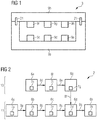
- a product 3 is shown schematically, which can be created by means of an assembly process, wherein the assembly process can be based on an instruction 1 provided according to one embodiment.
- This product 3 to be created can be formed from a multiplicity of identical or different components 9a-9h.
- the specific configuration of the product 3 to be created can at least partially specify a sequential sequence in which the components 9a-9h are to be assembled to form the product 3 to be created.
- first intermediate product which contains the components 9a, 9c, 9d and 9e
- second intermediate product which contains the components 9b, 9f, 9g, 9h
- the first intermediate product and the second intermediate product can subsequently be connected to one another in the course of a final assembly by the fastening means 21.
- the assembly arrangement 2 can have a plurality of assembly stations 6a-6h.
- Each of the assembly stations 6a-6h can have assembly accessories 7a-7h, the assembly accessories 7a-7h of the various assembly stations 6a-6h being the same or different.
- Such assembly accessories 7a-7h can, for example, enable manual and / or automated assembly of the components 9a-9h and / or the intermediate products.
- the assembly stations 6a-6h can be configured in one or more structures. According to the in Figure 2 In the illustrated embodiment, the assembly stations 6a-6h are structured in a main line 11, in which at least one final assembly is carried out, and in a secondary line 13, in which at least one mold assembly is carried out.
- the assembly in the main line 11 and the secondary line 13 can be carried out parallel to each other.
- the assembly stations 6a-6h can also be linked to means of transport 8a-8g, each assembly station 6a-6h being able to be connected to any number of conveyors 8a-8g.
- each of the means of transport 8a-8g is unidirectionally directed. Within the scope of the present disclosure, however, it is also conceivable and intended that at least one of the means of transport 8a-8g be directed in a multi-directional manner, for example bidirectionally.
- each assembly station 6a-6h can further be configured to perform one or more steps in the assembly sequence for creating the product 3. Specifics relating to the configuration of the assembly arrangement 2 can be implemented in the assembly data 5, for example. Furthermore, specifics regarding the presence of main lines 11 and secondary lines 13 can be implemented in the structural data 10.
- FIG. 3 A method 10 for providing an instruction 1 relating to an assembly process for the creation of a product 3 according to an embodiment is shown.
- the method 100 can receive product data 4 which are characteristic of the creation of the product 3.
- the product data 4 can have a three-dimensional CAD model of the product 3 to be created. It can be provided that for the application of the method, a user selects the three-dimensional CAD model of the product to be created as well as assembly skills from the assembly stations 6a-6h, which are to be used for assembling the product 3.
- the method 100 can receive assembly data 5 which are characteristic of an assembly arrangement 2 with one or more assembly stations 6 for creating the product 3.
- the assembly data 5 can include information relating to the ability to assemble the one or more assembly stations 6a-6h of the assembly arrangement 2, with solution-neutral skills being used to describe the assembly ability.
- the assembly data 5 can contain information relating to at least one means of transport 8a-8g between the assembly stations 6a-6h of the assembly arrangement 2 include.
- the information in the assembly data 5 can have a directional dependence.
- the received assembly data 5 may further include structural data 10 which are characteristic of the presence of main lines 11, which relate to final assembly of the product 3 to be created, and secondary lines 13, which relate to pre-assembly of the product 3 to be created, in the assembly arrangement 2.
- the received assembly data 5 can also be based on an assembly simulation or on a real assembly configuration.
- steps 110 and 115 can run parallel and side by side. However, it is also provided that steps 110 and 115 take place in succession, wherein both steps 110 and 115 can each be carried out before the other of the two steps.
- method 100 may further determine instruction 1 based on received product data 4 and received assembly data 5.
- the determined instruction 1 can have information regarding an assembly sequence of the product 3 to be created.
- the determination 120 of the instruction 1 can be carried out by means of a planning algorithm which is based on a virtual dismantling of the product 3 to be created.
- method 100 may also issue determined instruction 1.
- the determined instruction 1 can include a prioritization list of possible assembly processes.
- the prioritization list of the possible assembly processes can be based on an achievable assembly time of the product 3 to be created.
- the output 130 of the determined instruction 1 can take place by means of a graphic visualization device 15.
- a graphic visualization device 15 can be a screen, for example.
- Figure 4 is a device for providing an instruction 1 regarding an assembly process for the creation of a product 3 is set up, shown schematically according to one embodiment.
- the device can then have a first receiving device 17, which is set up to receive product data 4, which are characteristic of the creation of the product 3.
- the device 16 can furthermore have a second receiving device 18, which is set up to receive assembly data 5, which are characteristic of an assembly arrangement 2 for creating the product 3.
- the assembly data 5 can also have the structural data 10.
- the device 16 can also have a determination device 19, which is set up to determine the instruction 1 based on the received product data 4 and the received assembly data 5.
- the device 16 can furthermore have an output device 20 which is set up for outputting the determined instruction 1.
- the determined instruction 1 can be output via a graphic visualization device 15, for example in the form of a screen.
- the device 16 can also be set up to carry out the method 100 according to one of the preceding embodiments.
Landscapes
- Engineering & Computer Science (AREA)
- Business, Economics & Management (AREA)
- Human Resources & Organizations (AREA)
- Economics (AREA)
- Physics & Mathematics (AREA)
- General Physics & Mathematics (AREA)
- Strategic Management (AREA)
- Quality & Reliability (AREA)
- Manufacturing & Machinery (AREA)
- Theoretical Computer Science (AREA)
- General Business, Economics & Management (AREA)
- Entrepreneurship & Innovation (AREA)
- Marketing (AREA)
- Tourism & Hospitality (AREA)
- Automation & Control Theory (AREA)
- Primary Health Care (AREA)
- General Health & Medical Sciences (AREA)
- Health & Medical Sciences (AREA)
- Development Economics (AREA)
- Educational Administration (AREA)
- General Engineering & Computer Science (AREA)
- Game Theory and Decision Science (AREA)
- Operations Research (AREA)
- General Factory Administration (AREA)
Priority Applications (1)
| Application Number | Priority Date | Filing Date | Title |
|---|---|---|---|
| EP18178189.9A EP3584652A1 (fr) | 2018-06-18 | 2018-06-18 | Procédé de fourniture d'instructions relatives au déroulement d'assemblage pour la réalisation d'un produit |
Applications Claiming Priority (1)
| Application Number | Priority Date | Filing Date | Title |
|---|---|---|---|
| EP18178189.9A EP3584652A1 (fr) | 2018-06-18 | 2018-06-18 | Procédé de fourniture d'instructions relatives au déroulement d'assemblage pour la réalisation d'un produit |
Publications (1)
| Publication Number | Publication Date |
|---|---|
| EP3584652A1 true EP3584652A1 (fr) | 2019-12-25 |
Family
ID=62837564
Family Applications (1)
| Application Number | Title | Priority Date | Filing Date |
|---|---|---|---|
| EP18178189.9A Withdrawn EP3584652A1 (fr) | 2018-06-18 | 2018-06-18 | Procédé de fourniture d'instructions relatives au déroulement d'assemblage pour la réalisation d'un produit |
Country Status (1)
| Country | Link |
|---|---|
| EP (1) | EP3584652A1 (fr) |
Citations (2)
| Publication number | Priority date | Publication date | Assignee | Title |
|---|---|---|---|---|
| US20020123812A1 (en) * | 1998-12-23 | 2002-09-05 | Washington State University Research Foundation. | Virtual assembly design environment (VADE) |
| US6725184B1 (en) * | 1999-06-30 | 2004-04-20 | Wisconsin Alumni Research Foundation | Assembly and disassembly sequences of components in computerized multicomponent assembly models |
-
2018
- 2018-06-18 EP EP18178189.9A patent/EP3584652A1/fr not_active Withdrawn
Patent Citations (2)
| Publication number | Priority date | Publication date | Assignee | Title |
|---|---|---|---|---|
| US20020123812A1 (en) * | 1998-12-23 | 2002-09-05 | Washington State University Research Foundation. | Virtual assembly design environment (VADE) |
| US6725184B1 (en) * | 1999-06-30 | 2004-04-20 | Wisconsin Alumni Research Foundation | Assembly and disassembly sequences of components in computerized multicomponent assembly models |
Similar Documents
| Publication | Publication Date | Title |
|---|---|---|
| EP2266066B1 (fr) | Procédé et système de détection de propriétés de groupement | |
| EP2866111B1 (fr) | Test d'un appareil de commande au moyen d'un environnement de test | |
| DE10247050A1 (de) | System zum Vorbereiten der Kabelstrangherstellung | |
| WO2015082156A1 (fr) | Dispositif et procédé permettant de modifier les réglages opérationnels d'une installation technique | |
| DE10224650A1 (de) | Verfahren zur Entwicklung eines agentenbasierten Steuerungssystems für ein industrielles flexibles Produktionssystem | |
| EP3812949A1 (fr) | Jumeaux numériques configurables | |
| DE10029086C2 (de) | Verfahren zur automatischen Erstellung eines Arbeitsplans | |
| DE102010022263A1 (de) | Verfahren zur Optimierung einer Suchanfrage | |
| EP3584652A1 (fr) | Procédé de fourniture d'instructions relatives au déroulement d'assemblage pour la réalisation d'un produit | |
| EP1533674A2 (fr) | Méthode pour développer et implémenter un modèle décrivant formellement un système collaboratif comportant une pluralité de composants distribués, en particulier un système intelligent et flexible de production et/ou d'automatisation de processus | |
| EP3834121A1 (fr) | Procédé pour la mise en oeuvre de travaux de maintenance sur un ensemble de montage complexe | |
| DE102020113758A1 (de) | Vergleich von elektronischen steuereinheiten | |
| DE102012007321A1 (de) | Verfahren zum Betreiben eines Diagnosesystems und Diagnosesystem | |
| DE102018212801A1 (de) | Diagnose komplexer Systeme | |
| EP4139825A1 (fr) | Procédé mis en oeuvre par ordinateur pour produire un plan structurel numérique d'un ensemble commutateur électrique de manière partiellement automatisée | |
| DE102020208280A1 (de) | Verfahren zur Herstellung einer Bewegungsvorrichtung | |
| EP4004793B1 (fr) | Cinq niveaux de la constructibilité | |
| DE102013214197A1 (de) | Entwicklungsverfahren für ein technisches Produkt | |
| EP3764298A1 (fr) | Procédé de configuration de changement d'une installation de fabrication et/ou d'un produit et procédé de fabrication d'un produit, ainsi que dispositif de configuration et système | |
| EP2078994A1 (fr) | Appareil d'automatisation et son procédé de fonctionnement | |
| DE102015118729A1 (de) | Bionische Produktentwicklung | |
| DE102025121432A1 (de) | Verfahren zur Generierung von Planungsempfehlungen für Schweißanwendungen | |
| DE102023201929A1 (de) | Verfahren und Vorrichtung zum Bereitstellen von Konfigurationsvorschlägen für eine Konfiguration eines modularen Produktionssystems | |
| EP1067479A1 (fr) | Procedé et système pour la fabrication d'un produit comportant plusieurs parties | |
| DE102019208121A1 (de) | Aktive Datengenerierung unter Berücksichtigung von Unsicherheiten |
Legal Events
| Date | Code | Title | Description |
|---|---|---|---|
| PUAI | Public reference made under article 153(3) epc to a published international application that has entered the european phase |
Free format text: ORIGINAL CODE: 0009012 |
|
| STAA | Information on the status of an ep patent application or granted ep patent |
Free format text: STATUS: THE APPLICATION HAS BEEN PUBLISHED |
|
| AK | Designated contracting states |
Kind code of ref document: A1 Designated state(s): AL AT BE BG CH CY CZ DE DK EE ES FI FR GB GR HR HU IE IS IT LI LT LU LV MC MK MT NL NO PL PT RO RS SE SI SK SM TR |
|
| AX | Request for extension of the european patent |
Extension state: BA ME |
|
| STAA | Information on the status of an ep patent application or granted ep patent |
Free format text: STATUS: REQUEST FOR EXAMINATION WAS MADE |
|
| 17P | Request for examination filed |
Effective date: 20200120 |
|
| RBV | Designated contracting states (corrected) |
Designated state(s): AL AT BE BG CH CY CZ DE DK EE ES FI FR GB GR HR HU IE IS IT LI LT LU LV MC MK MT NL NO PL PT RO RS SE SI SK SM TR |
|
| STAA | Information on the status of an ep patent application or granted ep patent |
Free format text: STATUS: EXAMINATION IS IN PROGRESS |
|
| 17Q | First examination report despatched |
Effective date: 20201130 |
|
| STAA | Information on the status of an ep patent application or granted ep patent |
Free format text: STATUS: THE APPLICATION IS DEEMED TO BE WITHDRAWN |
|
| 18D | Application deemed to be withdrawn |
Effective date: 20210611 |