EP3584698A1 - Ausführungsvorrichtung für zwischencode - Google Patents
Ausführungsvorrichtung für zwischencode Download PDFInfo
- Publication number
- EP3584698A1 EP3584698A1 EP18305765.2A EP18305765A EP3584698A1 EP 3584698 A1 EP3584698 A1 EP 3584698A1 EP 18305765 A EP18305765 A EP 18305765A EP 3584698 A1 EP3584698 A1 EP 3584698A1
- Authority
- EP
- European Patent Office
- Prior art keywords
- register
- execution device
- stack
- content
- ordered sequence
- Prior art date
- Legal status (The legal status is an assumption and is not a legal conclusion. Google has not performed a legal analysis and makes no representation as to the accuracy of the status listed.)
- Withdrawn
Links
Images

Classifications
-
- G—PHYSICS
- G06—COMPUTING OR CALCULATING; COUNTING
- G06F—ELECTRIC DIGITAL DATA PROCESSING
- G06F9/00—Arrangements for program control, e.g. control units
- G06F9/06—Arrangements for program control, e.g. control units using stored programs, i.e. using an internal store of processing equipment to receive or retain programs
- G06F9/44—Arrangements for executing specific programs
- G06F9/455—Emulation; Interpretation; Software simulation, e.g. virtualisation or emulation of application or operating system execution engines
-
- G—PHYSICS
- G06—COMPUTING OR CALCULATING; COUNTING
- G06F—ELECTRIC DIGITAL DATA PROCESSING
- G06F8/00—Arrangements for software engineering
- G06F8/40—Transformation of program code
- G06F8/41—Compilation
- G06F8/44—Encoding
- G06F8/441—Register allocation; Assignment of physical memory space to logical memory space
-
- G—PHYSICS
- G06—COMPUTING OR CALCULATING; COUNTING
- G06F—ELECTRIC DIGITAL DATA PROCESSING
- G06F9/00—Arrangements for program control, e.g. control units
- G06F9/06—Arrangements for program control, e.g. control units using stored programs, i.e. using an internal store of processing equipment to receive or retain programs
- G06F9/44—Arrangements for executing specific programs
- G06F9/455—Emulation; Interpretation; Software simulation, e.g. virtualisation or emulation of application or operating system execution engines
- G06F9/45504—Abstract machines for programme code execution, e.g. Java virtual machine [JVM], interpreters, emulators
- G06F9/45508—Runtime interpretation or emulation, e g. emulator loops, bytecode interpretation
-
- G—PHYSICS
- G06—COMPUTING OR CALCULATING; COUNTING
- G06F—ELECTRIC DIGITAL DATA PROCESSING
- G06F9/00—Arrangements for program control, e.g. control units
- G06F9/06—Arrangements for program control, e.g. control units using stored programs, i.e. using an internal store of processing equipment to receive or retain programs
- G06F9/44—Arrangements for executing specific programs
- G06F9/455—Emulation; Interpretation; Software simulation, e.g. virtualisation or emulation of application or operating system execution engines
- G06F9/45504—Abstract machines for programme code execution, e.g. Java virtual machine [JVM], interpreters, emulators
- G06F9/45516—Runtime code conversion or optimisation
Definitions
- the present invention relates to execution devices. It relates particularly to execution devices of intermediate language instructions.
- Intermediate language (generally generated from a code written in a high level language) allows to develop program which are portable across different hardware platforms. Such intermediate languages rely on an interpreter (also called virtual machine) which translate the intermediate language instructions to low level instructions (also called native processor instructions or native instructions) that depends on the targeted hardware platform (i.e. from the processor). Contrary to systems where the program instructions are compiled in a code depending of the hardware platform before the program execution, intermediate language instructions are usually interpreted and translated at the time of the program execution. This lead to performance issue since the needed time can be long.
- the invention aims at solving the above mentioned technical problem.
- An object of the present invention is an execution device including both a memory area, a stack and a hardware unit comprising first and second hardware registers; an ordered sequence of elements being stored outside the execution device.
- the elements comprise bytecodes and operands.
- the first register has a content set to a targeted element read from the ordered sequence.
- the memory area includes a series of software components comprising a translation in native language for each bytecode of a predefined set of bytecodes. Each of said software components ends with a specific native instruction that requests to interpret and execute the content of the first register using said series.
- the hardware unit comprises a register manager adapted to automatically perform the following operations:
- the register manager may be adapted to automatically fetch the previous element preceding the targeted element in the ordered sequence and to check that said previous element is equal to the element previously interpreted.
- first boundaries may be allocated to the first register and each time a first preset event occurs, the register manager may be adapted to automatically check that the next element stays in said first boundaries.
- said first preset event may be the reading of the first register or any clock cycle.
- second boundaries may be allocated to the second register and, each time a second preset event occurs, the register manager may be adapted to automatically check that the top of the stack stays in the second boundaries.
- said second preset event may be the reading or writing of the second register or any clock cycle.
- all software components of the series may have a fixed predefined size.
- the series may include an additional software component comprising a jump to a set of instructions stored outside the series, said set of instructions ending with a return instruction.
- the bytecodes may be JavaTM bytecodes, DavilkTM instructions or intermediate language instructions.
- At least one of said translation may comprise an instruction requesting to interpret the content of the first register.
- Another object of the present invention is a system comprising the execution device of the invention and an ordered sequence.
- the system may be a chip, a system-on-a-chip, a computer machine, a phone, a secure element or a Machine-To-Machine module.
- the invention may apply to any types of electronic system comprising a hardware unit and a memory area.
- the invention provides a new design of a virtual machine intended to execute a program written in an intermediate language.
- native instruction means an instruction native to the underlying CPU/processor.
- a native instruction depends on a targeted CPU while an intermediate language instruction is independent of the CPU.
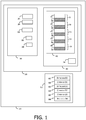
- Figure 1 shows schematically an example of a system 10 comprising an execution device 20 according to an embodiment of the invention.
- the execution device 20 comprises both a memory area 40 and a hardware unit 30.
- the hardware unit 30 comprises a first hardware register 31 and a second, hardware register 32, a register manager 33, a program counter 35 and a stack pointer 36.
- a program is assumed to have been developed in high level language like JavaTM and then converted in intermediate code like JavaTM bytecode.
- This converted program is an ordered sequence 50 of elements E1, ..., E6 which are stored outside the execution device as such. These elements typically comprise bytecodes and operands.
- the first element E1 comprises the bytecode B3.
- the second element E2 comprises the operand D1 to which the bytecode B3 applies.
- the third element E3 comprises the bytecode B1.
- the fourth and fifth element E4 and E5 comprise two operands D2 and D3 to which the bytecode B1 applies.
- the sixth element E6 comprises the bytecode B4.
- the content of the first register 31 is intended to be set to a targeted element read from the ordered sequence 50.
- the targeted element is the element that will be next processed by the execution device 20.
- the memory area 40 includes a stack 34 and a series 60 of software components C1, ..., C5 comprising a translation T1, ..., T5 in native language for each bytecode of a predefined set of bytecodes. More precisely, each of the software components comprises the translation of one bytecode of the set. In addition, each software component ends with a specific native instruction 99 that requests to interpret and execute the content of the first register 31 using the series 60.
- the register manager 33 is configured to automatically perform the following operations:
- the set of bytecodes whose translation is provided in the software components of the series 60 covers all bytecodes for a given intermediate language. For instance the set may cover all JavaTM bytecodes.
- some of the translations may contain an instruction requesting to interpret the content of the first register 31.
- a translation may contain a call to read the first register 31.
- Such a call allows to handle the operands of the ordered sequence 50.
- the bytecode B3 (corresponding to the first element E1 of the ordered sequence 50) is read through the first register 31 and triggers execution of the native instructions of the translation T3.
- the bytecode B3 is assumed to manage only one operand, thus its corresponding translation T3 comprises a native call to read the first register 31.
- the operand D1 (comprised in the second element E2) is provided to the execution device so that the translation T3 can take the operand D1 into account.
- the last instruction of the software component C3 is the specific native instruction 99 with is a call for reading the first register 31.
- the first software component C1 is selected and its corresponding translation T1 is executed.
- the corresponding translation T1 comprises two native calls to read the first register 31 so as to retrieve the operands D2 and D3 through the first register 31. Execution continues so on depending on both the ordered sequence 50 and the content of the software components.
- Figure 2A shows schematically a first example of the state of components belonging to the execution device 20 during execution of the converted program (i.e. ordered sequence) 50 written in intermediate language.
- the execution of the converted program 50 is assumed to be in progress.
- the first register 31 contains the content of the third element E3 of the ordered sequence 50.
- the first register 31 contains the value of the bytecode B1.
- the program counter 35 contains the value 4 which corresponds to the number of the next element to be treated in the ordered sequence 50. In other words, the program counter 35 references the next element (i.e. E4) to be treated in intermediate code.
- the stack 34 stores three items S1 to S3 and the stack pointer 36 references the top of the stack.
- the stack pointer 36 references the item S3.
- Figure 2B shows schematically a second example of the state of components belonging to the execution device 20 after reading the first hardware register 31.
- a request to read the first register 31 occurred and triggered the register manager 33 which has automatically updated the content of the first register 31 with the content of the next element (E4) that follows - in the ordered sequence 50 - the element (E3) whose content was previously stored in the first register 31.
- the register manager 33 also automatically increased the program counter 35 with an increment of 1.
- the program counter 35 is now set to 5.
- the second register 32, the stack 34 and the stack pointer 36 remain unchanged.
- Figure 2C shows schematically a second example of the state of components belonging to the execution device 20 after writing the second hardware register 32.
- the first register 31 and the program counter 35 remain unchanged.
- Figure 2D shows schematically a second example of the state of components belonging to the execution device 20 after reading the second hardware register 32.
- the first register 31 and the program counter 35 remain unchanged.
- One of the role of the stack is to store data which are produced by the interpretation/execution of the bytecodes. For example when two data must be added, the value of each data is stored in the stack then the result of the addition is put in the stack.
- all software components of the series 60 have a fixed predefined size. For example their size may be set to 8, 16 or 24 bytes.
- the series 60 may be stored in table of 255 entries having a sized fixed to 16 bytes for instance.
- the start address of a targeted software component can be computed in a simple way according to the order of the targeted software component. Thanks to this embodiment, the location of the next bytecode translation can by computed by a simple arithmetic computation, the hardware bus traffic is reduced and hardware caches stress is reduced.
- the series 60 can include at least one software component which comprises a jump to a set of instructions stored outside the series. In such a case, this set of instructions ends with a return instruction so that execution of the software component ends with the specific native instruction 99.
- This embodiment allows to manage bytecode translations that do not fit with a fixed predefined size or which are particularly complex.
- the execution device of the invention can apply to many types of intermediate language like JavaTM bytecodes, JavaCardTM bytecodes or DavilkTM instructions.
- the register manager 33 is configured to both automatically fetch (i.e. read) the previous element that precedes the targeted element in the ordered sequence 50 and to check that this previous element is equal to the element previously interpreted. For example, starting from the Figure 2A , when a request to read the first register 31 occurs, the register manager 33 read the element E2 from the ordered sequence 50 and checks the element which has just been interpreted is the element E2. This checking allows to verify that the element which has just been interpreted is genuine. This checking allows to detect a possible attack that managed to change the value of an element interpreted by the execution device 20. Since the register manager is implemented in hardware, this security checking can be done within a single clock cycle without performance penalty.
- boundaries may be allocated to the first register 31. Such boundaries may be set as a range of memory addresses for instance.
- the register manager 33 can be configured to automatically check that the next element to interpret stays in the boundaries allocated to the first register 31. If the next element is stored at an address which does not comply with the boundaries, a relevant action can be taken (e.g. error message, log of the attack attempt or stop running the execution device).
- An advantage of this embodiment is to detect an attack attempt aiming at interpreting data stored outside the genuine ordered sequence or to reroute bytecode execution.
- the preset event can be the reading (or receipt of a request to read the first register 31) of the first register 31.
- the register manager 33 can be configured to automatically check the compliance with the boundaries at each clock cycle.
- memory boundaries can be allocated to the second register 32.
- the register manager 33 can be adapted to automatically check that the top of the stack 34 stays in the memory boundaries. If the top of the stack 34 is not located in the boundaries, a security action can be performed.
- An advantage of this embodiment is to detect an attack attempt aiming at overflowing the memory range initially planned for the stack.
- the preset event can be the receipt of a request to read or write the second register 32.
- the register manager 33 can be configured to automatically check the compliance with the memory boundaries at each clock cycle.
- the invention is not restricted to a set of five bytecode translations and may apply to any set of intermediate language instructions.
- the invention does not impose a design constraint for developing applications in high level language and allows to use existing converters that generate intermediate languages. Programs already developed in intermediate language can be run by the execution device of the invention.
- the execution device of the invention relies in part on a series of software components which can be upgraded easily compared to hardware components.
- a bytecode translation in native instructions can be updated and a new bytecode translation can be added to the series.
- the execution device of the invention may be embedded in any electronic system like a chip, a system-on-a-chip, a computer machine, a phone, a secure element or a Machine-To-Machine module.
Landscapes
- Engineering & Computer Science (AREA)
- Software Systems (AREA)
- Theoretical Computer Science (AREA)
- Physics & Mathematics (AREA)
- General Engineering & Computer Science (AREA)
- General Physics & Mathematics (AREA)
- Devices For Executing Special Programs (AREA)
Priority Applications (2)
| Application Number | Priority Date | Filing Date | Title |
|---|---|---|---|
| EP18305765.2A EP3584698A1 (de) | 2018-06-19 | 2018-06-19 | Ausführungsvorrichtung für zwischencode |
| PCT/EP2019/064699 WO2019243057A1 (en) | 2018-06-19 | 2019-06-05 | Execution device for intermediate code |
Applications Claiming Priority (1)
| Application Number | Priority Date | Filing Date | Title |
|---|---|---|---|
| EP18305765.2A EP3584698A1 (de) | 2018-06-19 | 2018-06-19 | Ausführungsvorrichtung für zwischencode |
Publications (1)
| Publication Number | Publication Date |
|---|---|
| EP3584698A1 true EP3584698A1 (de) | 2019-12-25 |
Family
ID=63579295
Family Applications (1)
| Application Number | Title | Priority Date | Filing Date |
|---|---|---|---|
| EP18305765.2A Withdrawn EP3584698A1 (de) | 2018-06-19 | 2018-06-19 | Ausführungsvorrichtung für zwischencode |
Country Status (2)
| Country | Link |
|---|---|
| EP (1) | EP3584698A1 (de) |
| WO (1) | WO2019243057A1 (de) |
Cited By (1)
| Publication number | Priority date | Publication date | Assignee | Title |
|---|---|---|---|---|
| CN117785518A (zh) * | 2023-12-26 | 2024-03-29 | 珠海市芯动力科技有限公司 | 读写顺序错误的解决方法及相关装置 |
Families Citing this family (1)
| Publication number | Priority date | Publication date | Assignee | Title |
|---|---|---|---|---|
| CN119938219A (zh) * | 2024-12-18 | 2025-05-06 | 东信和平科技股份有限公司 | 字节码指令执行方法、虚拟机、设备、介质 |
Citations (2)
| Publication number | Priority date | Publication date | Assignee | Title |
|---|---|---|---|---|
| WO2003014921A1 (en) * | 2001-07-02 | 2003-02-20 | Nazomi Communications, Inc. | Intermediate language accelerator chip |
| US20070288909A1 (en) * | 2006-06-07 | 2007-12-13 | Hong Kong Applied Science and Technology Research Institute Company Limited | Hardware JavaTM Bytecode Translator |
-
2018
- 2018-06-19 EP EP18305765.2A patent/EP3584698A1/de not_active Withdrawn
-
2019
- 2019-06-05 WO PCT/EP2019/064699 patent/WO2019243057A1/en not_active Ceased
Patent Citations (2)
| Publication number | Priority date | Publication date | Assignee | Title |
|---|---|---|---|---|
| WO2003014921A1 (en) * | 2001-07-02 | 2003-02-20 | Nazomi Communications, Inc. | Intermediate language accelerator chip |
| US20070288909A1 (en) * | 2006-06-07 | 2007-12-13 | Hong Kong Applied Science and Technology Research Institute Company Limited | Hardware JavaTM Bytecode Translator |
Non-Patent Citations (1)
| Title |
|---|
| M ANTON ERTL ET AL: "The Structure and Performance of Efficient Interpreters", JOURNAL OF INSTRUCTION-LEVEL PARALLELISM, 1 November 2003 (2003-11-01), pages 1 - 25, XP055536001, Retrieved from the Internet <URL:https://www.jilp.org/vol5/v5paper12.pdf> [retrieved on 20181218] * |
Cited By (1)
| Publication number | Priority date | Publication date | Assignee | Title |
|---|---|---|---|---|
| CN117785518A (zh) * | 2023-12-26 | 2024-03-29 | 珠海市芯动力科技有限公司 | 读写顺序错误的解决方法及相关装置 |
Also Published As
| Publication number | Publication date |
|---|---|
| WO2019243057A1 (en) | 2019-12-26 |
Similar Documents
| Publication | Publication Date | Title |
|---|---|---|
| US11385872B2 (en) | Extending a virtual machine instruction set architecture | |
| US6907519B2 (en) | Systems and methods for integrating emulated and native code | |
| KR100463810B1 (ko) | 어드레스되는 구성요소의 물리적 특성에 관한 추측 실패를 검출하는 마이크로프로세서용 메모리 제어기 | |
| US11030105B2 (en) | Variable handles | |
| CN107041158B (zh) | 用于模块化反射的限制性访问控制 | |
| US8364461B2 (en) | Reusing invalidated traces in a system emulator | |
| US6704927B1 (en) | Static binding of dynamically-dispatched calls in the presence of dynamic linking and loading | |
| CN107924326B (zh) | 对经更新的类型的迁移方法进行覆盖 | |
| US9104449B2 (en) | Optimized execution of dynamic languages | |
| US20130326489A1 (en) | Method and system for translating non-native instructions | |
| TWI743698B (zh) | 解譯執行位元組碼指令流的方法及裝置 | |
| US6665708B1 (en) | Coarse grained determination of data dependence between parallel executed jobs in an information processing system | |
| CN101847096B (zh) | 包含栈变量函数的优化方法 | |
| KR100421687B1 (ko) | 개선된 마이크로프로세서를 위한 변환 메모리 보호 장치 | |
| EP3584698A1 (de) | Ausführungsvorrichtung für zwischencode | |
| Lemberger et al. | Nacpa: Native Checking with Parallel-Portfolio Analyses: (Competition Contribution) | |
| EP0950947B1 (de) | Statische Bindung von dynamisch abgesendeten Anrufen in Anwesenheit von dynamischer Verknüpfung und Ladung | |
| US7194736B2 (en) | Dynamic division optimization for a just-in-time compiler | |
| CN120255955A (zh) | 二进制翻译方法、装置、电子设备及可读存储介质 | |
| Pečimúth et al. | An Analysis of Compiled Code Reusability in Dynamic Compilation | |
| Ott et al. | Towards Just-In-Time Compiling of Operating Systems | |
| US8949868B2 (en) | Methods, systems and computer program products for dynamic linkage | |
| Towarek | Trip down the compute pipeline | |
| Mamdouh et al. | On-demand distributed on-card bytecode verification | |
| HK40006682A (en) | Saving/restoring guarded storage controls in a virtualized environment |
Legal Events
| Date | Code | Title | Description |
|---|---|---|---|
| PUAI | Public reference made under article 153(3) epc to a published international application that has entered the european phase |
Free format text: ORIGINAL CODE: 0009012 |
|
| STAA | Information on the status of an ep patent application or granted ep patent |
Free format text: STATUS: THE APPLICATION HAS BEEN PUBLISHED |
|
| AK | Designated contracting states |
Kind code of ref document: A1 Designated state(s): AL AT BE BG CH CY CZ DE DK EE ES FI FR GB GR HR HU IE IS IT LI LT LU LV MC MK MT NL NO PL PT RO RS SE SI SK SM TR |
|
| AX | Request for extension of the european patent |
Extension state: BA ME |
|
| STAA | Information on the status of an ep patent application or granted ep patent |
Free format text: STATUS: THE APPLICATION IS DEEMED TO BE WITHDRAWN |
|
| 18D | Application deemed to be withdrawn |
Effective date: 20200626 |