EP3585578B1 - Procédé pour évaluer la précision de la sonde d'humidité des agrégats dans la fabrication du béton - Google Patents
Procédé pour évaluer la précision de la sonde d'humidité des agrégats dans la fabrication du béton Download PDFInfo
- Publication number
- EP3585578B1 EP3585578B1 EP18758500.5A EP18758500A EP3585578B1 EP 3585578 B1 EP3585578 B1 EP 3585578B1 EP 18758500 A EP18758500 A EP 18758500A EP 3585578 B1 EP3585578 B1 EP 3585578B1
- Authority
- EP
- European Patent Office
- Prior art keywords
- concrete
- slump
- water
- aggregate
- mixture
- Prior art date
- Legal status (The legal status is an assumption and is not a legal conclusion. Google has not performed a legal analysis and makes no representation as to the accuracy of the status listed.)
- Active
Links
Images



Classifications
-
- B—PERFORMING OPERATIONS; TRANSPORTING
- B28—WORKING CEMENT, CLAY, OR STONE
- B28C—PREPARING CLAY; PRODUCING MIXTURES CONTAINING CLAY OR CEMENTITIOUS MATERIAL, e.g. PLASTER
- B28C7/00—Controlling the operation of apparatus for producing mixtures of clay or cement with other substances; Supplying or proportioning the ingredients for mixing clay or cement with other substances; Discharging the mixture
- B28C7/04—Supplying or proportioning the ingredients
- B28C7/0404—Proportioning
- B28C7/0409—Proportioning taking regard of the moisture content of the solid ingredients; Moisture indicators
-
- G—PHYSICS
- G01—MEASURING; TESTING
- G01N—INVESTIGATING OR ANALYSING MATERIALS BY DETERMINING THEIR CHEMICAL OR PHYSICAL PROPERTIES
- G01N33/00—Investigating or analysing materials by specific methods not covered by groups G01N1/00 - G01N31/00
- G01N33/38—Concrete; Lime; Mortar; Gypsum; Bricks; Ceramics; Glass
- G01N33/383—Concrete or cement
-
- B—PERFORMING OPERATIONS; TRANSPORTING
- B28—WORKING CEMENT, CLAY, OR STONE
- B28C—PREPARING CLAY; PRODUCING MIXTURES CONTAINING CLAY OR CEMENTITIOUS MATERIAL, e.g. PLASTER
- B28C5/00—Apparatus or methods for producing mixtures of cement with other substances, e.g. slurries, mortars, porous or fibrous compositions
- B28C5/42—Apparatus specially adapted for being mounted on vehicles with provision for mixing during transport
- B28C5/4203—Details; Accessories
- B28C5/4206—Control apparatus; Drive systems, e.g. coupled to the vehicle drive-system
- B28C5/422—Controlling or measuring devices
-
- B—PERFORMING OPERATIONS; TRANSPORTING
- B28—WORKING CEMENT, CLAY, OR STONE
- B28C—PREPARING CLAY; PRODUCING MIXTURES CONTAINING CLAY OR CEMENTITIOUS MATERIAL, e.g. PLASTER
- B28C7/00—Controlling the operation of apparatus for producing mixtures of clay or cement with other substances; Supplying or proportioning the ingredients for mixing clay or cement with other substances; Discharging the mixture
- B28C7/02—Controlling the operation of the mixing
- B28C7/022—Controlling the operation of the mixing by measuring the consistency or composition of the mixture, e.g. with supply of a missing component
- B28C7/024—Controlling the operation of the mixing by measuring the consistency or composition of the mixture, e.g. with supply of a missing component by measuring properties of the mixture, e.g. moisture, electrical resistivity, density
-
- B—PERFORMING OPERATIONS; TRANSPORTING
- B28—WORKING CEMENT, CLAY, OR STONE
- B28C—PREPARING CLAY; PRODUCING MIXTURES CONTAINING CLAY OR CEMENTITIOUS MATERIAL, e.g. PLASTER
- B28C7/00—Controlling the operation of apparatus for producing mixtures of clay or cement with other substances; Supplying or proportioning the ingredients for mixing clay or cement with other substances; Discharging the mixture
- B28C7/02—Controlling the operation of the mixing
- B28C7/022—Controlling the operation of the mixing by measuring the consistency or composition of the mixture, e.g. with supply of a missing component
- B28C7/026—Controlling the operation of the mixing by measuring the consistency or composition of the mixture, e.g. with supply of a missing component by measuring data of the driving system, e.g. rotational speed, torque, consumed power
-
- C—CHEMISTRY; METALLURGY
- C04—CEMENTS; CONCRETE; ARTIFICIAL STONE; CERAMICS; REFRACTORIES
- C04B—LIME, MAGNESIA; SLAG; CEMENTS; COMPOSITIONS THEREOF, e.g. MORTARS, CONCRETE OR LIKE BUILDING MATERIALS; ARTIFICIAL STONE; CERAMICS; REFRACTORIES; TREATMENT OF NATURAL STONE
- C04B40/00—Processes, in general, for influencing or modifying the properties of mortars, concrete or artificial stone compositions, e.g. their setting or hardening ability
- C04B40/0028—Aspects relating to the mixing step of the mortar preparation
- C04B40/0032—Controlling the process of mixing, e.g. adding ingredients in a quantity depending on a measured or desired value
-
- G—PHYSICS
- G01—MEASURING; TESTING
- G01N—INVESTIGATING OR ANALYSING MATERIALS BY DETERMINING THEIR CHEMICAL OR PHYSICAL PROPERTIES
- G01N11/00—Investigating flow properties of materials, e.g. viscosity, plasticity; Analysing materials by determining flow properties
- G01N2011/0046—In situ measurement during mixing process
-
- Y—GENERAL TAGGING OF NEW TECHNOLOGICAL DEVELOPMENTS; GENERAL TAGGING OF CROSS-SECTIONAL TECHNOLOGIES SPANNING OVER SEVERAL SECTIONS OF THE IPC; TECHNICAL SUBJECTS COVERED BY FORMER USPC CROSS-REFERENCE ART COLLECTIONS [XRACs] AND DIGESTS
- Y02—TECHNOLOGIES OR APPLICATIONS FOR MITIGATION OR ADAPTATION AGAINST CLIMATE CHANGE
- Y02W—CLIMATE CHANGE MITIGATION TECHNOLOGIES RELATED TO WASTEWATER TREATMENT OR WASTE MANAGEMENT
- Y02W30/00—Technologies for solid waste management
- Y02W30/50—Reuse, recycling or recovery technologies
- Y02W30/91—Use of waste materials as fillers for mortars or concrete
Definitions
- the present invention relates to the manufacture of construction materials which contain aggregates, and, more particularly, to detection or minimization of errors arising from inaccurate aggregate moisture sensors used in concrete ready-mix plant hoppers or conveyor belts, based on subsequent slump monitoring of slurried concrete prepared from the aggregates that were contained by the hoppers or conveyed by the conveyor belts.
- Concrete is typically made using a cementitious binder (e.g., Portland cement, often combined with limestone, fly ash, slag, or other pozzolan material), fine aggregate (e.g., sand), coarse aggregate (e.g., crushed gravel, stone), and water for initiating the hydration of the cementitious binder so that the mixture of these components hardens into a structure.
- a cementitious binder e.g., Portland cement, often combined with limestone, fly ash, slag, or other pozzolan material
- fine aggregate e.g., sand
- coarse aggregate e.g., crushed gravel, stone
- Some of these hoppers and/or conveyor belts contain a probe for sensing the moisture content of the aggregate (hereinafter "probe").
- the probes are often in communication with a computer processor unit that has been programmed to create a batch of concrete in accordance with a predetermined mix design.
- variations in the aggregate moistures are detected by the aggregate moisture probe and the batch water is adjusted based on the measurement from the aggregate moisture probe.
- the concrete batch can be made in a stationary mixer drum at the ready-mix plant or made in the mixer drum on a concrete delivery truck.
- the present inventors believe that is critical for the moisture probe in the aggregate hopper or conveyor belt to be accurate, because even minute errors can create profound effects in the properties of concrete made from the aggregate materials.
- an error as small as one percent point (1%) in the moisture level of sand aggregate used in a typical 3000 pounds per square inch (psi) (20700 kPa) concrete mix can mean that the sand, when used in the amount of 1800 pounds per cubic yard (pcy) (1070kg/m ⁇ 3), could contain an extra 18 pcy (10.7 kg/m ⁇ 3) of water. This is more than 2 gallons (7.6 L) of extra water per cubic yard (0.76 m ⁇ 3) of concrete. This is significant, as each gallon (3.8 L) of water per cubic yard (0.76 m ⁇ 3) of concrete can typically decrease the compressive strength of concrete by approximately 250 psi (1720 kPa).
- the concrete mix intended for a specified 3000 psi (20700 kPa) application is prepared using a sand aggregate dispensed from a hopper bin having a moisture probe that has an inaccuracy of one percent
- the concrete mix prepared from the sand and delivered to the job site could sustain a decrease of up to 500 psi (3450 kPa) in terms of strength.
- the present inventors believe that the delivered concrete made from the aggregate could miss a compressive strength target by as much as seventeen percent (17%).
- a number of errors can creep into the process.
- the state of the aggregates next to the probe may be quite different from the state of control aggregates poured into the top of the hopper.
- the probes are usually located near the bottom of hoppers.
- the aggregates located next to the probe may have been exposed to high temperatures or rain earlier in the storage period, such that the moisture level detected by the probe could be different from the aggregate loaded into the top of the hopper. Therefore, if calibration is based on the known moisture content of aggregate added onto material stored in the hopper, errors are introduced into the probe readings which can lead to adverse consequences.
- the present inventors believe that a novel method and system for minimizing errors (e.g., variations) in concrete properties or qualities caused by inaccurate aggregate moisture probe sensors are sorely needed in the concrete industry.
- JP 2000121578 A discloses an apparatus and a method in which the moisture of an aggregate to be measured is measured with high accuracy by using a working curve optimum for the aggregate to be measured and in which the measuring accuracy of the aggregate, which is updated so as to correspond to a change in the aggregate, is maintained.
- JP H03 76607 A discloses how to automatically correct a sand surface water rate preset value by driving a fuzzy inference on the basis of both the deviation amount of a load electric power value at the time of completion of the mixing with respect to the reference load electric power value preset at every mix for a mixer driving motor and the variation amount of a sand surface water rate preset value which constitutes a computation factor for measuring water.
- US 2014/104066 A1 discloses a method and system for detecting "sneak” additions of water or other fluid into the mixing drum of a concrete delivery vehicle having an automated rheology (e.g., slump) monitoring system.
- an automated rheology e.g., slump
- the present invention provides a novel method and system for minimizing errors, such as variations in the properties of concrete or concrete mixes, which said errors are due to inaccurate moisture probe sensors in hoppers that are used for storing and/or weighing aggregates or in conveyor belts used for transporting aggregates, based on rheology data obtained in real time through slump monitoring of slurried concrete mixtures prepared from aggregates dispensed from the hopper or conveyor belt.
- the present inventors believe that the use of probe sensors that measure concrete in a slurried (plastic and wet) state to detect inaccuracy of the aggregate moisture level sensors used in the aggregate hoppers or aggregate conveyor belts, that is to say, the probe sensors deployed in dry particle weighing bins or conveyor belts, is a surprising and elegant solution for addressing a problem that has long plagued the concrete industry.
- the term "slurried” as used herein means and refers to plastic concrete mixture comprising a hydratable cementitious binder (e.g., Ordinary Portland Cement preferably in combination with limestone, gypsum, fly ash, or other pozzolan material), aggregates, and water employed in an amount sufficient to initiate hydration of the cementitious binder to the point at which the concrete mixture begins to cure and to harden into a mass or structure. More typically, excess water (e.g., beyond that required to initiate hydration) is used to enhance workability of the plastic concrete.
- the plastic concrete may optionally contain one or more water-reducing admixtures, such as plasticizers or superplasticizers, which replace a portion of the hydration water while maintaining a given workability or "slump.”
- the signal could be transmitted to a manager at the concrete plant manager or foreman at the construction site, whereby the signal triggers an audible, visual, or vibratory alarm detected and emitted by mobile phone, indicating that the aggregate moisture sensor probe requires calibration or that the computer plant computer processor unit used for batching the concrete mixture requires adjustment.
- the signal could be transmitted to the processor unit of a batch mix unit at the concrete plant, to adjust the amount of components being introduced into a stationary batch mixer drum at the plant (if used) or into the mixer drum of the delivery truck, and/or to adjust the output of the aggregate moisture probe itself.
- An exemplary system of the present invention comprises a slump monitoring system comprising at least one sensor for measuring the hydraulic pressure required to rotate concrete in a mixer drum or at least one sensor for measuring force of a concrete mixture being rotated against the sensor during rotation within the mixer drum, the slump monitoring system having a processor unit being connected to the at least one sensor and being programed to perform the method described above for assessing accuracy of an aggregate moisture level probe which measures moisture level of aggregates used for making concrete in the mixer drum.
- An exemplary method for monitoring concrete ingredients comprises: (A) comparing currently monitored slump changes of a slurried concrete mixture, achieved after adding a unit volume or mass of material per unit volume of concrete, with slump changes predicted for the slurried concrete mixture based on previously monitored slump changes of a slurried concrete mixture, achieved after adding a unit volume or mass of material per unit volume of concrete; and (B) initiating at least one or more of the following actions, when the difference between expected and currently monitored slump changes meets or exceeds a predetermined threshold value: (i) sending a signal or alarm, to a concrete plant at which the concrete ingredients where batched from, indicating that the predetermined threshold value was met or exceeded; (ii) sending a signal or alarm, to a construction site at which a concrete mixture prepared from the ingredients batched is scheduled to be delivered, indicating that the predetermined threshold value was met or exceeded; (iii) sending a signal or alarm, to a computer processor unit that is monitoring the slump of a concrete mixture prepared from the ingredients batched, indicating
- cement which often contains pozzolanic material such as limestone, fly ash, granulated blast furnace slag), water and aggregates (e.g., sand, gravel) and optionally one or more chemical admixtures (e.g., plasticizers for increasing workability, set accelerator, set retarder, air entrainer, air detrainer, plastic shrinkage reducing admixtures, corrosion inhibitors (for rebar), or other admixtures for modifying a property of the concrete, whether in its plastic or hardened state.
- chemical admixtures e.g., plasticizers for increasing workability, set accelerator, set retarder, air entrainer, air detrainer, plastic shrinkage reducing admixtures, corrosion inhibitors (for rebar), or other admixtures for modifying a property of the concrete, whether in its plastic or hardened state.
- cement as used herein includes hydratable cement such as Portland cement which is produced by pulverizing clinker consisting of hydraulic calcium silicates, aluminates and aluminoferrites, and one or more forms of calcium sulfate (e.g., gypsum) as an interground additive.
- Portland cement is combined with one or more supplemental cementitious materials, such as fly ash, granulated blast furnace slag, limestone, natural pozzolans, or mixtures thereof, and provided as a blend.
- supplemental cementitious materials such as fly ash, granulated blast furnace slag, limestone, natural pozzolans, or mixtures thereof, and provided as a blend.
- cement and cement binder may also include supplemental cementitious materials which have been inter-ground with Portland cement during manufacture.
- cementitious may be used herein to refer to materials that comprise Portland cement or which otherwise function as a binder to hold together fine aggregates (e.g., sand) and coarse aggregates (e.g., crushed gravel, stone) which are used for constituting concrete.
- fine aggregates e.g., sand
- coarse aggregates e.g., crushed gravel, stone
- hydratable as used herein is intended to refer to cement or cementitious materials that are hardened by chemical interaction with water.
- Portland cement clinker is a partially fused mass primarily composed of hydratable calcium silicates.
- the calcium silicates are essentially a mixture of tricalcium silicate (3CaO ⁇ SiO 2 or "C 3 S” in cement chemists' notation) and dicalcium silicate (2CaO ⁇ SiO 2 , "C 2 S”) in which the former is the dominant form, with lesser amounts of tricalcium aluminate (3CaO ⁇ Al 2 O 3 , "C3A") and tetracalcium aluminoferrite (4CaO ⁇ Al 2 O 3 ⁇ Fe 2 O 3 , "C 4 AF").
- CaO ⁇ SiO 2 or "C 3 S” in cement chemists' notation
- dicalcium silicate (2CaO ⁇ SiO 2 , "C 2 S” dicalcium silicate
- aggregate means and refers to sand or stone particles used for construction materials such as concrete, mortar, and asphalt, and this typically involves granular particles of average size between 0 and 50 mm.
- Aggregates may comprise calciferous, siliceous or siliceous limestone minerals.
- Such aggregates may be natural (e.g., derived from glacial, alluvial, or marine deposits which are typically weathered such that the particles have smooth surfaces) or may be of the "manufactured" type, which are made using mechanical crushers or grinding devices.
- aggregate moisture meter or “aggregate moisture probe” will refer to a measuring device capable of determining the moisture content of an aggregate sample.
- Moisture meters can employ several different types of technologies such as (but not limited to) measuring electrical resistance ( See, e.g. US 4,780,665 ), measuring microwaves ( See, e.g. US 4,104,584 ), measuring nuclear resonance ( See e.g., US 2,999,381 ), and measuring infrared waves ( See, e.g. US 8,727,608 ).
- Commercial examples of aggregate moisture sensors for concrete aggregates include HYDRO-PROBE TM (Hydronix), SONO-VARIO TM (MESA Systems Co.), and RADARTRON TM (ScaleTron).
- SSD saturated, surface dry
- Preferred concrete slump management (monitoring) systems for managing slump or other rheological properties are commercially available from Verifi LLC, 62 Whittemore Avenue, Cambridge, Massachusetts, USA. The present inventors believe these are suitable for fulfilling the objectives of the present invention.
- the concept of "currently monitored” or “monitored” concrete mix load refers to the use of slump monitoring system data obtained during in-transit delivery of a given concrete load, and such currently monitored data is compared to data that was previously stored in memory which is accessible to the system processor unit. The historical data is used by the system processor to allow comparisons of current slump with "expected" or "predicted” slump.
- a majority of the patent references in the foregoing paragraph pertain to slump monitoring systems using hydraulic pressure sensors to monitor the energy required to rotate concrete contained within mixer drums and hence provide an indication of the slump or other rheology property of the concrete, and also using sensors to monitor the rotational speed and/or rotational direction of the mixer drum (e.g., such as by using two- or three-axis accelerometers on the rotating mixer drum).
- the present inventors believe that the present invention may be accomplished by use of hydraulic pressure sensors alone, which can monitor slump at a constant mixer rotational speed. However, it is preferred to use both hydraulic pressure sensors and rotational drum speed sensors together, as this is believed to contribute to greater accuracy and flexibility within the administration of slump monitoring protocols.
- the slump or rheology monitoring system may be based on use of a force sensor which is mounted within the drum, as taught for example in US Patent No. 8,848,061 and US Publication No. 2015/0051737 A1 of Berman (Sensocrete Inc./GCP Applied Technologies), US Patent No. 9,199,391 of Denis Beaupre et al. (I.B.B. Rheologie Inc.), or US Publication No. 2009/0171595 and WO 2007/060272 of Benegas .
- force sensors e.g., stress gauge, strain gauge
- rotational speed sensors or rotational direction sensors e.g., two- or three-axis accelerometers
- aggregate (designated as at 2), such as sand and/or crushed stones, are unloaded at a concrete ready-mix plant, and loaded using a conveyor belt (designated as at 6) into a storage hopper 8, which is typically open at top for receiving the aggregate material.
- the aggregate material 2 can then be loaded using another conveyor belt 6 into a weighing hopper (designated as at 10) from which the aggregate 2 can be conveyed or fed eventually into a concrete mixer drum 12.
- the mixer drum can be part of a stationary mixer device that is bolted to the floor and/or wall at the concrete plant, which is not forming part of the invention; or, as specifically illustrated in Fig.
- the mixer drum 12 can be mounted rotatably on a concrete delivery truck.
- the storage hopper 8 and/or weighing hopper 10 has an aggregate moisture level probe 14 which is connected to a batching computer processor unit 16 (CPU) which controls the amounts of cement, aggregates, water, and optionally other materials (e.g., chemical admixtures) dispensed at the ready-mix plant into the mixer drum 12.
- CPU computer processor unit 16
- the concrete mixer drum is mounted on a delivery truck 12 as shown in Fig. 1 , and automated slump monitoring device (designated as at 18) is installed on the concrete delivery truck 12 to monitor the slump of the concrete mix in the mixer drum 12 during in-transit delivery to the construction site.
- automated slump monitoring device (designated as at 18) is installed on the concrete delivery truck 12 to monitor the slump of the concrete mix in the mixer drum 12 during in-transit delivery to the construction site. It is important that the slump monitoring system processor is programmed to ensure that the concrete mix is homogeneous (uniform) when slump values are recorded (and this may be accomplished, for example, by ensuring that the energy required to rotate the drum does not vary within a cycle or drum rotation, across at least two or three successive drum rotations).
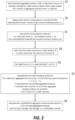
- Fig. 2 illustrates another exemplary method and system of the present invention for detecting when aggregate moisture probes require calibration, based on slump monitoring data obtained from numerous concrete mix loads made from the aggregates having moisture values sensed by the hopper and/or conveyor belt sensors.
- j For a given number of aggregate moisture sensors which are subjection to calibration, j , at least i loads, where i ⁇ j, are recorded by processor unit, including the batched aggregate content information, converted to their SSD (saturated, surface dry) states, B, preferably using the individual aggregate absorption values and moisture readings from the aggregate moisture probes (designated as at block 22 in Fig. 2 ).
- SSD saturated, surface dry
- the homogeneity of the concrete can be determined, for example, by monitoring slump (e.g., by measuring the hydraulic pressure required to rotate the mixer drum or the force of concrete rotated against an internal probe) after the batching sequence.
- a stable slump reading over successive drum rotations can indicate a homogenous concrete.
- the slump can be monitored using information from hydraulic sensors configured to measure the charge and discharge pressures required to rotate the drum; or, alternatively, slump can be monitored using a force probe mounted on the interior of the concrete mixer drum. Either hydraulic pressure sensors or force probes can provide signals from which slump of the concrete can be calculated.
- the slump deviation ( ⁇ S ) between the measured slump, S m , and the expected slump, S e , for the current batched materials and moisture contents is then determined using information from the aggregate moisture probes, as designated at 26 of Fig. 2 .
- the expected slump, S e can be determined in a number of ways. One way is to measure the slump for well-controlled laboratory tests where the same mix design and materials are used with known aggregate moisture levels (e.g., weighing the aggregate before heating at temperatures sufficient to drive out all moisture, and then weighing the aggregate after heating to determine actual moisture level). Another method may include compiling production data obtained from different concrete loads over time, relative to which the aggregate moisture probes have been accurately and freshly calibrated.
- slump readings are affected by inconsistencies due to the aggregate moisture probe (in) accuracy and/or due to changes in the material properties of the aggregate material or other components of the concrete mix (either of which may be designated hereinafter as "material change").
- material change the material change
- different sand aggregates or different cement binder constituents can have different inherent moisture absorption values, and these can affect the slump readings.
- adding a different aggregate or cement into the hoppers at the concrete ready-mix plant could give rise to a "material change” which affects the moisture level sensor readings and how these are used to compute slump in the concrete mix; and, conversely, such "material change” could affect the use of slump monitoring of the slurried concrete (as made from the aggregates) to determine if the aggregate moisture level sensors are inaccurate.
- the slump monitoring system is preferably programmed to detect if and when the slump response changes suddenly, which would indicate that properties of the concrete components have changed independently from the accuracy of the aggregate probe.
- the aggregate moisture corrections can be calculated.
- the slump response to a water addition of a known volume per unit volume of concrete, R is calculated (designated as at block 28 in Fig. 2 ).
- the water additions included in this data set may be further refined by only including mix designs, batched weights (which requires the weigh hoppers to be within specification), and/or material types which are similar to the currently batched concrete mix design.
- Other concrete plastic performance criteria such as the starting slump and air content can be used to filter the appropriate data set with which to calculate the slump dose response.
- environmental factors such as the ambient temperature and relative humidity can be used in a similar fashion.
- the present inventors also believe that historical data sets including initial slumps obtained with known total water contents (i.e. concrete loads batched with properly and freshly calibrated aggregate moisture probes) can also be used to determine the slump response, R.
- the initial slump can be measured by monitoring the slump after batching and determining the slump after the concrete has been mixed to achieve homogeneity. It is important to ensure that the concrete is uniformly mixed and slump value readings taken by the monitoring system are stable over two or three complete sequential drum rotations. In other words, the concrete components are mixed uniformly together and are not segregating. This state of equilibrium may be confirmed such as by rotating the concrete mix in the drum for two or three successive rotations during which detected slump readings confirm that slump is not changing more than, for example, one-half (0.5) inch slump during this period.
- This error can also be augmented by knowing any water added by the driver before the slump measurement, for example at the slump rack ( See e.g., US 9,466,203 ).
- the plant manager or quality-control manager can be alerted to the fact that the sensor requires, or was subject to recalibration.
- a notification can also be sent the plant manager or quality-control manager, if the corrected aggregate moisture level has led to a total water content that exceeds the maximum allowable water content for the given mix.
- the yield of the concrete mix i.e. the volume delivered in the truck
- the slump monitoring system in preferred embodiments of the present invention, is programmed to issue an alarm or indication that the concrete mix has a higher water content than specified, and to relay this information back to the plant manager or quality control manager.
- it may be useful to under batch the water by a certain level to allow the possibility of adjustment through the slump management system, and to program the slump management system to correct total batched water content which is the result of incorrect aggregate moisture probe readings or calibrations.
- the slump monitoring system processor may be programmed to send a signal to a processor at the ready-mix plant to (re)calibrate aggregate moisture probes, to correct value of aggregate moisture level values assigned to the values as detected by the aggregate moisture probes, to alert the concrete ready-mix plant manager (that the probes require recalibration), or a combination of the foregoing.
- slump monitored in stationary mixers including those used in precast operations can also be used to calibrate aggregate moisture probes.
- air monitoring systems such as disclosed for example in US Publication No. 2014/0297204 , may be used to send signals to ready-mix plant processors to calibrate aggregate moisture probes used in aggregate hoppers and/or conveyor belts (or to adjust for the inaccuracy of the probe in computation of aggregate moisture level), however said air monitoring systems do not form part of the invention.
- providers of cement and aggregate materials provide data sheets describing the properties of their materials, but these data sheets for the most part do not describe all characteristics that affect (e.g., cause fluctuations in) the performance of the concrete (See e.g., http://www.precast.org/2013/06/how-t-read-a-cement-mill-certificate-part-1/).
- the values reported do not include variability associated with the properties reported.
- Cement certificates also do not tend to indicate the water demand of the cements, nor the test results when used with supplementary materials such as fly ash, slag, or natural pozzolan, or with chemical admixtures.
- these certificates do not typically contain test data at different temperatures or in different concrete mix designs. In essence, the plant manager cannot easily use cement mill certificates to understand how concrete performance may differ from previous lots.
- the concrete plant manager, construction foreman, or other quality control supervisor can be notified that a material change has occurred.
- These slump responses are most readily available from slump management systems that automatically adjust the slump with additions of water or chemical admixtures. These additions and the subsequent slump changes can be recorded and used to calculate a slump response to a given water or chemical admixture volume per unit volume of concrete.
- embodiments of the present invention employ the use of information such as the mix designs, material types, or batch component weights to qualify which slump response a given concrete mix load contained in the mixer drum should be compared with.
- Other concrete plastic performance criteria such as the starting slump and air content can also be used to enable the slump monitoring system processor to filter from historical data (saved into memory) the appropriate data of expected air or slump properties for making comparisons to the monitored air or slump values of the current concrete load in the mixer drum.
- environmental factors such as ambient temperature and relative humidity can be used narrow the dataset from which comparisons can be made.
- a tolerance programed into the computer processor of the concrete monitoring system
- the system processor is programed to issue an alert (e.g., to the ready-mix plant manager or quality control supervisor at the construction site) indicating that a material change may have occurred.
- an alert e.g., to the ready-mix plant manager or quality control supervisor at the construction site
- the initial slump of the concrete in response to the total water content can be used to determine whether there has been a material change in the batch components (i.e., not just slump responses to incremental water/chemical admixture additions). For example, an initial slump after batching and mixing can be determined and compared with past loads to ensure that no changes in materials have been made, after checking to make sure the aggregate moisture meters are within calibration.
- an exemplary method of the present invention for assessing aggregate moisture probe accuracy in concrete manufacture comprises: (A) comparing currently monitored slump values of a slurried concrete mixture prepared from aggregates dispensed from a hopper or conveyor belt, with slump values predicted for the slurried concrete mixture based on the aggregate moisture level as detected by a probe in the hopper or conveyor belt from which the aggregates were dispensed to make the concrete mixture; and (B) initiating at least one or more of the following actions, when the difference between expected and currently monitored slump values meets or exceeds a predetermined threshold value: (i) sending a signal or alarm, to a concrete plant at which the aggregates were dispensed from the hopper or conveyor belt, indicating that the predetermined threshold value was met or exceeded; (ii) sending a signal or alarm, to a construction site at which a concrete mixture prepared from the aggregates dispensed from the hopper or conveyor belt is scheduled to be delivered, indicating that the predetermined threshold value was met or exceeded; (iii) sending
- the initiation of at least one or more actions in Step (B) is also based on data resulting from monitoring for changes in (i) previous average concrete slump increases achieved for a known unit volume or mass of water (or chemical admixture) addition into a known concrete load volume, (ii) previous ratios between the slump and aggregate moisture readings taken before and after the water (or chemical admixture) additions, or (iii) combinations thereof.
- the processor if a change is detected by the slump monitoring system processor as mentioned in steps (i)-(iv), the processor is programmed to send a signal or alarm to the concrete plant indicating that a material change may have occurred.
- the signal described above in step (B)(i) is sent to a visual or audible alarm to indicate at the concrete plant that the aggregate moisture sensor probe requires calibration or that the computer plant computer processor unit used for batching the concrete mixture requires adjustment.
- the aggregate moisture sensor probe is calibrated based on (i) the difference between expected and currently monitored slump values, (ii) previous slump changes achieved by a given unit volume or mass of water added per unit volume of concrete, (iii) previous slump changes achieved by a given unit volume or mass of chemical admixture added per unit volume of concrete; or (iv) combinations thereof.
- the signal described in step (B)(i) is sent by the slump monitoring process unit to the concrete plant computer processor unit which was used for batching the concrete mixture, whereby an adjustment is made in the amount of aggregate dispensed from the hopper or conveyor belt for a subsequent concrete load, an adjustment is made in the amount of water or chemical admixture used for making mixture subsequent concrete load, or an adjustments are made in the amounts of both aggregate and water and/or chemical admixture used for making mixture subsequent concrete load.
- the signal described in above step (B)(ii) is sent to a handheld mobile device located at the construction site at which the concrete mixture prepared from the aggregates dispensed from the hopper or conveyor belt is scheduled for delivery.
- the signal enables a construction site supervisor (or foreman), for example, to understand whether chemical admixtures, water, or mixture thereof can be added into the concrete mixture.
- the signal described in step (B)(iii) is sent to a computer processor unit which is continually monitoring the concrete mixture in-transit during delivery of the concrete mixture from a concrete plant to a pour event at a construction site.
- the concrete monitoring computer processor unit is programmed to receive the signal and to adjust the amount of water, the amount of chemical admixture, or the amounts of both water and chemical admixture into the concrete mixture being delivered to the construction site. Further exemplary methods include adjusting the maximum limit of water allowable for the concrete mixture being delivered to the construction site.
- the amount of water or chemical admixture to be added into the concrete mix contained in the rotating mixer drum can be calculated in a number of ways.
- the slump monitoring system on the concrete delivery truck can review the last 10 or 20 water or chemical admixture additions for past deliveries and calculate the average slump increase attained for a specified unit water or chemical admixture addition (by mass or volume).
- the slump monitoring system on the concrete delivery truck can record the last 10 or 20 deliveries and divide the total water added per load by the slump value achieved by this total water addition.
- the amount (by mass or volume) of added water may be calculated by comparing past ratios between either the total slump versus the total water, or the slump increase versus a water increase, or a combination thereof.
- the amount of water or chemical admixture to be added into the concrete mix in the mixer drum is calculated using information contained in an "electronic ticket" regarding the design of the concrete mixture as provided by a computer processor unit at the concrete plant to the slump monitoring computer processor unit of the concrete delivery truck.
- the electronic ticket may contain information concerning the amounts of cement, aggregates, and water in the batch concrete mixture, including any corrected water amounts.
- the computer processor unit which continually monitors the slump of the concrete mixture in-transit, that is, during delivery of the concrete mixture from the concrete plant to the pour event at a construction site, is located on the concrete delivery truck.
- other rheology parameters and plastic properties of the concrete may also be monitored such as concrete temperature.
- Environmental parameters such as ambient temperature and relative humidity may also be monitored.
- the slump monitoring computer processor unit is electrically or wirelessly connected to at least one sensor on the truck which provides a signal corresponding to the hydraulic pressure required to rotate the concrete mixture within the rotatable mixer drum located on the delivery truck or corresponding to the force of the concrete mixture being rotated against the sensor (which force sensor would be located within the mixer drum) during rotation of the mixer drum, and in this manner the slump values of the concrete mixture may be monitored on a continual basis and in real time during delivery. These monitored parameters can be used to qualify data within a database to more accurately determine the water or chemical admixture required to be added to the concrete.
- the aggregate moisture level probe is effective to measure surface water content, pore water content, or both, of the aggregates in the hopper or conveyor belt.
- the expected slump values are based on laboratory tests, wherein the slump is measured for the given mix design and all aggregate moisture is accounted (for example, by accurately measuring the batch water and the aggregate moistures); or, as an alternative approach, the expected slump values are based on concrete slump data produced by the concrete manufacturing plant where the aggregate moisture meters have been calibrated to within the manufacturer tolerances.
- the expected and currently monitored slump values are determined using a slump monitoring computer processor unit that is programed to take into account the absorptivity of the aggregates used for making the concrete mixture.
- the present invention also provides a system wherein a computer processor unit (CPU) is programmed to monitor concrete slump and to perform any of the foregoing methods.
- the CPU that is programed can be the slump monitoring system CPU, preferably mounted on the concrete delivery truck ( Fig. 1 , designated at 18).
- a method for monitoring concrete ingredients not forming part of the invention comprises: comparing currently monitored slump changes of a slurried concrete mixture, achieved after adding a unit volume or mass of material per unit volume of concrete, with slump changes predicted for the slurried concrete mixture based on previously monitored slump changes of a slurried concrete mixture, achieved after adding a unit volume or mass of material per unit volume of concrete; and initiating at least one or more of the following actions, when the difference between expected and currently monitored slump changes meets or exceeds a predetermined threshold value: (i) sending a signal or alarm, to a concrete plant at which the concrete ingredients where batched from, indicating that the predetermined threshold value was met or exceeded; (ii) sending a signal or alarm, to a construction site at which a concrete mixture prepared from the ingredients batched is scheduled to be delivered, indicating that the predetermined threshold value was met or exceeded; (iii) sending a signal or alarm, to a computer processor unit that is monitoring the slump of a concrete mixture prepared from the ingredients batched,
- the initiation of the alarm is also based on (i) information, contained in an electronic ticket, regarding the design of the concrete mixture as provided by a computer processor unit at the concrete plant to the slump monitoring computer processor unit of the concrete delivery truck, (ii) currently measured plastic properties of the concrete, (iii) ambient temperature or relative humidity, or (iv) a combination thereof.
- the signal described in step (B)(i) is sent by the slump monitoring process unit to the concrete plant computer processor unit which was used for batching the concrete mixture, whereby an adjustment is made in the amount of chemical admixture for a subsequent concrete load, an adjustment is made in the amount of water used for making mixture subsequent concrete load, or an adjustments are made in the amounts of both chemical admixture and water used for making mixture subsequent concrete load.
- the signal described in above step (B)(ii) is sent to a handheld mobile device located at the construction site at which the concrete mixture prepared from the materials batched is scheduled for delivery.
- the signal enables a construction site supervisor (or foreman), for example, to understand whether chemical admixtures, water, or mixture thereof can be added into the concrete mixture.
- the signal described in step (B)(iii) is sent to a computer processor unit which is continually monitoring the concrete mixture in-transit during delivery of the concrete mixture from a concrete plant to a pour event at a construction site.
- the concrete monitoring computer processor unit is programmed to receive the signal and to adjust the amount of water, the amount of chemical admixture, or the amounts of both water and chemical admixture into the concrete mixture being delivered to the construction site.
- the signal described in step (B)(i) is sent by the slump monitoring process unit to the concrete plant to notify a plant manager or batch man that the mix design used to create the slurried concrete mixture with the changed materials should be redesigned to take into account the material property change.
- a system not forming part of the invention is also provided wherein a computer processor unit (CPU) is programmed to monitor concrete slump and to perform any of the foregoing methods.
- the CPU that is programed can be the slump monitoring system CPU, preferably mounted on the concrete delivery truck ( Fig. 1 , designated at 18).
- the present inventors explain how the invention could be used to detect inaccuracy in the moisture sensor probes used in both a small aggregate hopper (e.g., sand) and a larger "coarse” aggregate hopper (e.g., stone) from which the respective aggregates are used to make concrete in a mixer drum.
- a small aggregate hopper e.g., sand
- a larger "coarse” aggregate hopper e.g., stone
- the following materials in the following amounts could be used: 290 pcy (pounds per cubic yard) (172 kg/m ⁇ 3) of water, 565 pcy (335 kg/m ⁇ 3) of cement, 1425 pcy (845 kg/m ⁇ 3) of sand (SSD) with a moisture probe reading of, for example, 5%; and 1700 pcy (1010 kg/m ⁇ 3) of stone (SSD) with a moisture probe reading of, for example, 1%.
- the absorption value for both sand and stone aggregates is assumed to be 0%.
- the slump reading for this first load is, as an example, 4" (10.2cm), which is (as an example) 2" (5.1cm) below the intended slump for the given mix design.
- 4" (10.2cm) which is (as an example) 2" (5.1cm) below the intended slump for the given mix design.
- there is a relationship based on the slump response for water additions for this first batch load which is a 2" (5.1 cm) difference in slump on account of a deficiency of water in the amount of 14 pcy (8.3 kg/m ⁇ 3).
- the following materials could be used in the following amounts: 275 pcy (163 kg/m ⁇ 3) of water, 625 pcy (371 kg/m ⁇ 3) of cement, 1450 pcy (860 kg/m ⁇ 3) of sand (SSD, same sand as above) with a moisture probe reading of (for example) 8%, and 1700 pcy of stone (SSD, same stone as above) with a moisture probe reading of (for example) 1%. Again, absorption values for both sand and stone aggregates is assumed to be 0%.
- the slump reading for this second load is (as an example) 6" (15.2cm), which is (for example) 2" (5.1 cm) below the intended slump for the given mix design.
- there is a relationship based on the slump response for water additions for this second batch load which is a 2" (5.1 cm) difference in slump on account of a deficiency of water in the amount of 15 pcy (8.9 kg/m ⁇ 3).
- the sand moisture probe for the first load can be corrected from an original reading of 5% to 1% while the second load can be corrected from an original reading of 8% to 4%.
- the sand moisture probe is off by -4%.
- the stone moisture probe for both loads can be corrected from original readings of 1% to 3.5%, which is a +2.5% difference. If, for example, a threshold difference of 0.5% is provided, then both the sand and stone moisture probes would be corrected based on the deviations calculated above.
- the present inventors believe the moisture level probes for the both the fine and sand aggregate (hoppers) can be calibrated.
- the next example demonstrates further features not according to the present invention wherein a material change in one or more of the concrete mix components can be detected based on how the concrete mix load in the mixer drum responds to water additions.
- a slump management system was used to collect production data for a given mix design at a given concrete ready-mix plant. For 1482 loads, the water required to reach the target slump (according to the batch ticket and based on the mix design), was recorded over a period of 115 days. This is shown in Fig. 3 , where the water required to reach the target slump is measured in pounds per cubic yard (kg/m ⁇ 3) of concrete. Around day 55 (represented by the dashed vertical line), a noticeable shift in the water required to reach target slump is seen. Because the total water required to reach the target slump incorporates information from the aggregate moisture meters, it is possible that a faulty aggregate moisture meter may be responsible for the shift.
- Fig. 4 water additions administered from the automatic slump management system were recorded over the same time period.
- the water demand is plotted over time, where the water demand represents the gallons (L) of water per cubic yard (m ⁇ 3) of concrete required to increase the slump one inch (25.4 mm).
- a simple moving average filter is also plotted to highlight the changes in water demand, which can also be seen around day 55. Because the water demands for these water additions are not influenced by the aggregate moisture meter readings (where as the total water versus initial slump does), a faulty aggregate meter can be ruled out leaving the probable cause of the shift due to a material change. Indeed, in this example, the concrete producer regularly calibrated their aggregate moisture probes, and furthermore, made a sand change at day 55.
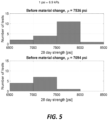
- Fig. 5 the resulting 28-day compressive strengths of concrete samples taken before and after the material change are shown. As evident from the set of histograms, the strength shows a marked decrease after the change in water demand of the sands.
Landscapes
- Chemical & Material Sciences (AREA)
- Engineering & Computer Science (AREA)
- Health & Medical Sciences (AREA)
- Life Sciences & Earth Sciences (AREA)
- Dispersion Chemistry (AREA)
- Ceramic Engineering (AREA)
- Physics & Mathematics (AREA)
- Pathology (AREA)
- Food Science & Technology (AREA)
- Medicinal Chemistry (AREA)
- Immunology (AREA)
- Analytical Chemistry (AREA)
- Biochemistry (AREA)
- General Health & Medical Sciences (AREA)
- General Physics & Mathematics (AREA)
- Structural Engineering (AREA)
- Mechanical Engineering (AREA)
- Materials Engineering (AREA)
- Organic Chemistry (AREA)
- Preparation Of Clay, And Manufacture Of Mixtures Containing Clay Or Cement (AREA)
- Investigating Or Analyzing Materials By The Use Of Electric Means (AREA)
- Investigating Or Analyzing Materials By The Use Of Ultrasonic Waves (AREA)
Claims (11)
- Procédé d'évaluation de la précision d'une sonde d'humidité d'agrégat dans la fabrication de béton, comprenant les étapes consistant à :(A) comparer les valeurs d'affaissement actuellement surveillées (Sm ) obtenues lors de la livraison d'une centrale à béton à un site de livraison de construction pour un événement de versement d'un mélange de béton coulé qui est uniformément mélangé dans un tambour malaxeur de camion de livraison de béton (12) et préparé à partir d'agrégats (2) distribué à partir d'une trémie (8) ou d'une bande transporteuse (6), avec des valeurs d'affaissement prédites pour le mélange de béton coulé (Se ), sur la base des niveaux d'humidité d'agrégat tels que détectés par une sonde (14) dans la trémie ou la bande transporteuse à partir de laquelle les agrégats ont été distribués pour fabriquer le mélange de béton coulé dans le tambour malaxeur de camion de livraison de béton ; et(B) lancer au moins une ou plusieurs des actions suivantes, lorsque la différence entre les valeurs d'affaissement prédites pour le mélange de béton coulé mélangé et les valeurs d'affaissement actuellement surveillées obtenues pendant la livraison du mélange de béton coulé uniformément mélangé atteint ou dépasse une valeur seuil prédéterminée :(i) envoyer un signal ou une alarme à la centrale à béton à laquelle les agrégats ont été distribués à partir de la trémie ou de la bande transporteuse, indiquant que la valeur seuil prédéterminée a été atteinte ou dépassée ;(ii) l'envoi d'un signal ou d'une alarme, à un site de livraison de construction, pour un événement au cours duquel un mélange de béton préparé à partir des agrégats distribués à partir de la trémie ou de la bande transporteuse doit être livré, indiquant que la valeur seuil prédéterminée a été atteinte ou dépassée ;(iii) envoyer un signal ou une alarme à une unité de traitement informatique qui surveille l'affaissement d'un mélange de béton préparé à partir des agrégats distribués depuis la trémie ou la bande transporteuse, indiquant que la valeur seuil prédéterminée a été atteinte ou dépassée ; ou(iv) effectuer une combinaison de l'une quelconque des actions (i) à (iii).
- Procédé selon la revendication 1, dans lequel l'initiation d'au moins une ou plusieurs actions à l'étape (B) est également basée sur des données résultant de la surveillance des changements dans (i) les changements d'affaissement précédents obtenus par une unité de volume ou de masse donnée d'eau ajoutée par unité de volume de béton, (ii) les changements d'affaissement antérieurs obtenus par unité de volume ou de masse donnée d'adjuvant chimique ajouté par unité de volume de béton, (iii) les rapports précédents entre les lectures d'affaissement et d'humidité des agrégats, ou (iv) les combinaisons de ceux-ci.
- Procédé selon la revendication 1, dans lequel, dans l'action (B)(i), le signal est envoyé à une alarme visuelle ou sonore pour indiquer à la centrale à béton que la sonde du capteur d'humidité des agrégats nécessite un étalonnage ou que l'unité de traitement informatique de la centrale à béton utilisée pour le dosage du mélange de béton nécessite un ajustement.
- Procédé selon la revendication 3, dans lequel la sonde de capteur d'humidité d'agrégat est calibrée sur la base (i) de la différence entre les valeurs d'affaissement attendues et actuellement surveillées, (ii) les changements d'affaissement précédents obtenus par une unité de volume ou de masse d'eau donnée ajoutée par unité de volume de béton, (iii) les changements d'affaissement antérieurs obtenus par une unité de volume ou de masse donnée d'adjuvant chimique ajouté par unité de volume de béton ; ou (iv) les combinaisons de ceux-ci.
- Procédé selon la revendication 1, dans lequel, dans l'action (B)(i), le signal est envoyé à une unité de traitement informatique de la centrale à béton utilisée pour doser le mélange de béton, moyennant quoi un ajustement est effectué dans la quantité d'agrégat distribué depuis la trémie ou la bande transporteuse pour une charge de béton ultérieure, un ajustement est effectué dans la quantité d'eau ou d'adjuvant chimique utilisée pour effectuer le mélange de charge de béton ultérieure, ou des ajustements sont faits dans les quantités d'agrégat et d'eau et/ou d'adjuvant chimique utilisées pour effectuer le mélange de charge de béton ultérieure.
- Procédé selon la revendication 1, dans lequel, dans l'action (B)(ii), le signal est envoyé à un appareil mobile portatif situé sur le chantier de construction sur lequel le mélange de béton préparé à partir des agrégats distribués à partir de la trémie ou de la bande transporteuse doit être livré, le signal permettant à un chef de chantier de comprendre si des adjuvants chimiques, de l'eau ou un mélange de ceux-ci peuvent être ajoutés au mélange de béton.
- Procédé selon la revendication 1, dans lequel, dans l'action (B)(iii), le signal est envoyé à une unité de traitement informatique qui surveille en permanence le mélange de béton pendant la livraison du mélange de béton d'une centrale à béton à un événement de coulée sur un chantier de construction, l'unité de traitement informatique de surveillance de béton étant programmée pour recevoir le signal et pour ajuster la quantité d'eau, la quantité d'adjuvant chimique ou la limite maximale d'eau admissible pour le mélange de béton livré au chantier de construction.
- Procédé selon la revendication 7, dans lequel la quantité d'eau ajoutée ou d'adjuvant chimique est déterminée sur la base (i) des augmentations d'affaissement antérieurs obtenues par une unité de volume ou de masse donnée d'eau ajoutée par unité de volume de béton ; (ii) des affaissements antérieurs obtenus par une quantité totale d'eau donnée ajoutée par unité de volume de béton ; ou (iii) une combinaison de ceux-ci.
- Procédé selon la revendication 8, dans lequel la quantité d'eau ou d'adjuvant chimique ajoutée est calculée sur la base (i) des informations contenues dans un ticket électronique concernant la conception du mélange de béton telles que fournies par une unité de traitement informatique à la centrale à béton à l'unité de traitement informatique de surveillance d'affaissement du camion de livraison de béton, et plus préférablement dans lequel le ticket électronique contient des informations concernant les quantités de ciment, d'agrégats et d'eau dans le mélange de béton dosé, y compris toute quantité corrigée, (ii) de l'affaissement actuellement mesuré ou d'une autre propriété rhéologique du mélange de béton à l'état de bouillie, (iii) de la température ambiante ou de l'humidité relative, ou (iv) d'une combinaison de ceux-ci.
- Procédé selon la revendication 7, dans lequel l'unité de traitement informatique, qui surveille l'affaissement du mélange de béton pendant la livraison du mélange de béton d'une centrale à béton à un événement de coulée sur un chantier de construction, est située sur le camion de livraison de béton, l'unité de traitement informatique de surveillance de l'affaissement étant connectée à au moins un capteur sur le camion, l'au moins un capteur fournissant un signal correspondant à la pression hydraulique requise pour faire tourner le mélange de béton dans un tambour malaxeur rotatif situé sur le camion de livraison ou à la force du mélange de béton étant mis en rotation contre le capteur pendant la rotation à l'intérieur du tambour malaxeur, moyennant quoi les valeurs d'affaissement du mélange de béton sont surveillées en continu et en temps réel pendant la livraison.
- Système ayant une unité de processeur informatique caractérisé en ce que ledit processeur informatique est programmé pour surveiller l'affaissement du béton et pour exécuter le procédé selon la revendication 1.
Priority Applications (1)
| Application Number | Priority Date | Filing Date | Title |
|---|---|---|---|
| EP23169675.8A EP4227055A1 (fr) | 2017-02-21 | 2018-02-20 | Procédé de contrôle des ingrédients du béton |
Applications Claiming Priority (2)
| Application Number | Priority Date | Filing Date | Title |
|---|---|---|---|
| US201762461449P | 2017-02-21 | 2017-02-21 | |
| PCT/US2018/018660 WO2018156469A1 (fr) | 2017-02-21 | 2018-02-20 | Limitation de la variation due à des sondes d'humidité d'agrégat de construction |
Related Child Applications (2)
| Application Number | Title | Priority Date | Filing Date |
|---|---|---|---|
| EP23169675.8A Division-Into EP4227055A1 (fr) | 2017-02-21 | 2018-02-20 | Procédé de contrôle des ingrédients du béton |
| EP23169675.8A Division EP4227055A1 (fr) | 2017-02-21 | 2018-02-20 | Procédé de contrôle des ingrédients du béton |
Publications (4)
| Publication Number | Publication Date |
|---|---|
| EP3585578A1 EP3585578A1 (fr) | 2020-01-01 |
| EP3585578A4 EP3585578A4 (fr) | 2021-03-24 |
| EP3585578B1 true EP3585578B1 (fr) | 2023-06-14 |
| EP3585578B8 EP3585578B8 (fr) | 2023-07-26 |
Family
ID=63254071
Family Applications (2)
| Application Number | Title | Priority Date | Filing Date |
|---|---|---|---|
| EP23169675.8A Pending EP4227055A1 (fr) | 2017-02-21 | 2018-02-20 | Procédé de contrôle des ingrédients du béton |
| EP18758500.5A Active EP3585578B8 (fr) | 2017-02-21 | 2018-02-20 | Procédé pour évaluer la précision de la sonde d'humidité des agrégats dans la fabrication du béton |
Family Applications Before (1)
| Application Number | Title | Priority Date | Filing Date |
|---|---|---|---|
| EP23169675.8A Pending EP4227055A1 (fr) | 2017-02-21 | 2018-02-20 | Procédé de contrôle des ingrédients du béton |
Country Status (8)
| Country | Link |
|---|---|
| US (2) | US11320415B2 (fr) |
| EP (2) | EP4227055A1 (fr) |
| AU (2) | AU2018225084B2 (fr) |
| BR (1) | BR112019017430B1 (fr) |
| CA (1) | CA3054076A1 (fr) |
| MX (2) | MX2019009916A (fr) |
| SG (1) | SG11201907724TA (fr) |
| WO (1) | WO2018156469A1 (fr) |
Families Citing this family (11)
| Publication number | Priority date | Publication date | Assignee | Title |
|---|---|---|---|---|
| WO2018041922A1 (fr) * | 2016-08-31 | 2018-03-08 | Command Alkon Dutch Tech B.V. | Sonde rhéologique |
| EP4227055A1 (fr) * | 2017-02-21 | 2023-08-16 | Verifi LLC | Procédé de contrôle des ingrédients du béton |
| EP3756845A1 (fr) * | 2019-06-26 | 2020-12-30 | Saint-Gobain Weber | Système de fabrication d'éléments à base de mortier |
| CN110261347B (zh) * | 2019-06-28 | 2023-12-12 | 三一汽车制造有限公司 | 物料含水率检测系统、物料含水率检测方法及搅拌站 |
| AU2021287242A1 (en) * | 2020-06-08 | 2023-02-02 | Gcp Applied Technologies Inc. | Adjusting concrete mixes and mix designs using diagnostic delta data curve |
| WO2022047404A1 (fr) * | 2020-08-31 | 2022-03-03 | Nitrocrete Ip, Llc | Système et procédé de commande d'un mélange de béton sur la base de propriétés de béton estimées |
| CN114170501B (zh) * | 2021-11-06 | 2025-05-02 | 北京中建建筑科学研究院有限公司 | 基于区块链系统的混凝土坍落度损失判别方法 |
| AU2023297849A1 (en) * | 2022-06-27 | 2025-01-02 | Cidra Concrete Systems Inc. | Hydraulic pressure (hp)/slump alerting technique |
| CN116973553B (zh) * | 2023-06-08 | 2024-04-12 | 山东博硕自动化技术有限公司 | 基于深度学习的在线物料识别与含水率测量方法及装置 |
| CN117452886B (zh) * | 2023-09-26 | 2024-04-09 | 中交第二航务工程局有限公司 | 基于机器感知和执行的混凝土无人管理系统 |
| CN121186095B (zh) * | 2025-09-28 | 2026-04-28 | 陕西正创工程检测有限公司 | 一种混凝土骨料含水量检测装置 |
Family Cites Families (49)
| Publication number | Priority date | Publication date | Assignee | Title |
|---|---|---|---|---|
| US2999381A (en) | 1958-04-23 | 1961-09-12 | Industrial Nucleonics Corp | Nuclear magnetic resonance measuring system |
| JPS5296096A (en) | 1976-02-06 | 1977-08-12 | Matsushita Electric Ind Co Ltd | Water-content detecting apparatus |
| GB2144240B (en) * | 1983-05-18 | 1986-10-01 | Ready Mixed Concrete | A system for controlling the mixing of concrete in a rotatable mixing drum |
| US4780665A (en) | 1986-09-30 | 1988-10-25 | Deere & Company | Apparatus and method for controlling sand moisture |
| JP2579821B2 (ja) * | 1989-08-19 | 1997-02-12 | 日工株式会社 | 生コン製造プラントにおける表面水率設定値補正方法 |
| JP2742852B2 (ja) * | 1992-06-12 | 1998-04-22 | 日工株式会社 | 生コンクリート製造方法 |
| AUPN296495A0 (en) * | 1995-05-15 | 1995-06-08 | Boral Resources (Vic) Pty Limited | Concrete mixing |
| FR2751911B1 (fr) * | 1996-07-31 | 2000-06-16 | Mbt Holding Ag | Systeme de controle et de distribution pour malaxeur a beton et procede d'utilisation |
| JP4125431B2 (ja) | 1998-10-20 | 2008-07-30 | パシフィックシステム株式会社 | キャリブレーション機能付水分計装置及び水分計装置におけるキャリブレーション方法 |
| US8727608B2 (en) | 2003-09-04 | 2014-05-20 | Flir Systems, Inc. | Moisture meter with non-contact infrared thermometer |
| JP5181086B2 (ja) * | 2004-02-13 | 2013-04-10 | ヴェリフィ・エルエルシー | 運搬車でスランプを計算し、報告する方法およびシステム |
| ES2281267B1 (es) | 2005-11-28 | 2008-09-01 | Eugenio Bonilla Benegas | Sistema de monitorizacion del amasado de conglomerados. |
| US20080273415A1 (en) * | 2007-05-02 | 2008-11-06 | Jonel Engineering | Apparatus and method for producing concrete |
| US8020431B2 (en) * | 2007-06-19 | 2011-09-20 | Verifi, LLC | Method and system for calculating and reporting slump in delivery vehicles |
| US8989905B2 (en) | 2007-06-19 | 2015-03-24 | Verifi Llc | Method and system for calculating and reporting slump in delivery vehicles |
| EP2269059B1 (fr) * | 2008-04-07 | 2015-01-07 | W.R. Grace & Co.-Conn. | Procédé pour surveiller la thixotropie dans un tambour de malaxage du béton |
| US8858061B2 (en) * | 2008-05-28 | 2014-10-14 | Dully Katzeff-Berman | Concrete slump measurement and control system |
| JP5713524B2 (ja) * | 2008-07-11 | 2015-05-07 | ダブリュー・アール・グレイス・アンド・カンパニー−コネチカット | コンクリートにおける粘土活性を改善するためのスランプ保持混和剤 |
| US8818561B2 (en) | 2009-03-27 | 2014-08-26 | Verifi Llc | Slump flow monitoring |
| CN102449478A (zh) * | 2009-03-27 | 2012-05-09 | 威瑞飞有限责任公司 | 监控混凝土的混合器波形分析 |
| US20110004332A1 (en) | 2009-07-01 | 2011-01-06 | Icrete International, Inc. | Method of designing a concrete compositions having desired slump with minimal water and plasticizer |
| US8557070B2 (en) * | 2009-09-14 | 2013-10-15 | Joel A. Stanley | Method of mounting objects to polymeric membranes |
| WO2011042880A1 (fr) | 2009-10-07 | 2011-04-14 | I.B.B. Rheologie Inc. | Sonde et procédé pour obtenir une valeur de propriété rhéologique |
| US10520410B2 (en) * | 2009-10-07 | 2019-12-31 | Command Alkon Incorporated | Probe and method for obtaining rheological property value |
| US9789629B2 (en) * | 2010-06-23 | 2017-10-17 | Verifi Llc | Method for adjusting concrete rheology based upon nominal dose-response profile |
| US8311678B2 (en) * | 2010-06-23 | 2012-11-13 | Verifi Llc | Method for adjusting concrete rheology based upon nominal dose-response profile |
| US10088454B2 (en) | 2011-10-18 | 2018-10-02 | Cidra Corporate Services, Inc. | Speed of sound and/or density measurement using acoustic impedance |
| WO2013059466A1 (fr) | 2011-10-18 | 2013-04-25 | Cidra Corporate Services Inc. | Procédé et appareil pour des applications de mesure de l'air en temps réel dans du béton fluide |
| MX345937B (es) | 2011-12-12 | 2017-02-27 | Verifi Llc | Gestion multivariada del aire atrapado y reologia en mezclas cementosas. |
| US8848061B2 (en) | 2012-06-27 | 2014-09-30 | Apple Inc. | Image and video quality assessment |
| CA2887601C (fr) * | 2012-10-15 | 2020-08-25 | Verifi Llc | Detection d'eau insidieuse pour vehicules de distribution de beton |
| US9550312B2 (en) * | 2012-10-15 | 2017-01-24 | Verifi Llc | Treating and reporting volume of concrete in delivery vehicle mixing drum |
| US9533429B2 (en) | 2013-02-27 | 2017-01-03 | Command Alkon, Inc. | System and process for mixing concrete having desired strength characteristics |
| AU2014334837B2 (en) * | 2013-10-18 | 2017-10-05 | Gcp Applied Technologies Inc. | Fast response time in slump monitoring systems |
| BR112016011056B1 (pt) | 2013-11-15 | 2022-01-18 | Verifi Llc | Sistema e método de rotação giroscópica |
| EP3131722B1 (fr) | 2014-04-14 | 2021-07-21 | Verifi LLC | Surveillance de la ségrégation dynamique du béton |
| WO2016023119A1 (fr) | 2014-08-15 | 2016-02-18 | I.B.B. Rheologie Inc. | Procédé et système pour la manipulation de béton prêt à l'emploi et procédé pour la production de données d'étalonnage |
| JP6768712B2 (ja) * | 2015-06-04 | 2020-10-14 | ベリフアイ・エルエルシー | コンクリート中へのバッチ処理後cma投与 |
| US10359413B2 (en) | 2015-07-01 | 2019-07-23 | Command Alkon Incorporated | Systems and methods for monitoring calibration of moisture sensors |
| CN109070385B (zh) * | 2015-12-07 | 2020-07-17 | 威瑞飞有限责任公司 | 宽速度范围混凝土监测校准 |
| MX2019003387A (es) * | 2016-09-26 | 2019-09-06 | Verifi Llc | Maximizacion de asentamiento previa al vertido del concreto suministrado. |
| EP4227055A1 (fr) * | 2017-02-21 | 2023-08-16 | Verifi LLC | Procédé de contrôle des ingrédients du béton |
| PL3664925T3 (pl) * | 2017-08-11 | 2024-06-24 | Gcp Applied Technologies Inc. | Pomiar szarej wody |
| US11726076B2 (en) * | 2017-08-22 | 2023-08-15 | Cidra Concrete Systems Inc. | Techniques for monitoring slump characteristic of concrete in a rotating container or drum |
| US11594305B2 (en) * | 2017-12-22 | 2023-02-28 | Verifi Llc | Managing concrete mix design catalogs |
| EP3956662A4 (fr) * | 2019-04-15 | 2022-12-14 | Concrete Data Sensors Pty Ltd | Dispositif et système de capteur de béton |
| KR102924558B1 (ko) * | 2019-08-01 | 2026-02-05 | 지씨피 어플라이드 테크놀로지스 인크. | 회전되는 콘크리트 용적 결정 |
| US11092528B2 (en) * | 2019-12-15 | 2021-08-17 | Neil Edward Bollin | Device and method for calibrating and correlating slump in a concrete mixer |
| ES2949539B2 (es) * | 2022-02-24 | 2025-08-29 | Juan Manuel Pereira | Metodo implementado por ordenador, producto de ordenador y sistema para medicion sin contacto de propiedades reologicas de un producto fluido derivado del cemento |
-
2018
- 2018-02-20 EP EP23169675.8A patent/EP4227055A1/fr active Pending
- 2018-02-20 EP EP18758500.5A patent/EP3585578B8/fr active Active
- 2018-02-20 US US16/486,998 patent/US11320415B2/en active Active
- 2018-02-20 BR BR112019017430-3A patent/BR112019017430B1/pt active IP Right Grant
- 2018-02-20 CA CA3054076A patent/CA3054076A1/fr active Pending
- 2018-02-20 AU AU2018225084A patent/AU2018225084B2/en active Active
- 2018-02-20 SG SG11201907724TA patent/SG11201907724TA/en unknown
- 2018-02-20 MX MX2019009916A patent/MX2019009916A/es unknown
- 2018-02-20 WO PCT/US2018/018660 patent/WO2018156469A1/fr not_active Ceased
-
2019
- 2019-08-20 MX MX2023007622A patent/MX2023007622A/es unknown
-
2022
- 2022-04-12 US US17/718,843 patent/US20220236248A1/en not_active Abandoned
-
2023
- 2023-06-07 AU AU2023203562A patent/AU2023203562B2/en active Active
Also Published As
| Publication number | Publication date |
|---|---|
| BR112019017430B1 (pt) | 2024-01-23 |
| AU2018225084B2 (en) | 2023-05-18 |
| AU2023203562A1 (en) | 2023-07-06 |
| AU2023203562B2 (en) | 2024-09-05 |
| EP3585578B8 (fr) | 2023-07-26 |
| EP3585578A4 (fr) | 2021-03-24 |
| EP4227055A1 (fr) | 2023-08-16 |
| AU2018225084A1 (en) | 2019-10-10 |
| US11320415B2 (en) | 2022-05-03 |
| WO2018156469A8 (fr) | 2019-09-19 |
| BR112019017430A2 (pt) | 2020-04-07 |
| WO2018156469A1 (fr) | 2018-08-30 |
| MX2019009916A (es) | 2019-12-05 |
| EP3585578A1 (fr) | 2020-01-01 |
| MX2023007622A (es) | 2023-07-14 |
| US20200018741A1 (en) | 2020-01-16 |
| SG11201907724TA (en) | 2019-09-27 |
| CA3054076A1 (fr) | 2018-08-30 |
| US20220236248A1 (en) | 2022-07-28 |
Similar Documents
| Publication | Publication Date | Title |
|---|---|---|
| AU2023203562B2 (en) | Minimizing variation due to construction aggregate moisture probes | |
| AU2018316229B2 (en) | Grey water measurement | |
| US8818561B2 (en) | Slump flow monitoring | |
| EP2585809B1 (fr) | Procédé d'ajustement de rhéologie du béton sur la base d'un profil dosage nominal-effet | |
| US20140107844A1 (en) | Method For Adjusting Concrete Rheology Based Upon Nominal Dose-Response Profile | |
| HK40014247B (en) | Method for assessing aggregate moisture probe accuracy in concrete manufacture | |
| HK40014247A (en) | Method for assessing aggregate moisture probe accuracy in concrete manufacture | |
| BR122022022950B1 (pt) | Método para monitorar ingredientes de concreto e sistema | |
| HK40081222A (en) | Grey water measurement | |
| HK40030356B (en) | Grey water measurement | |
| HK40030356A (en) | Grey water measurement |
Legal Events
| Date | Code | Title | Description |
|---|---|---|---|
| STAA | Information on the status of an ep patent application or granted ep patent |
Free format text: STATUS: THE INTERNATIONAL PUBLICATION HAS BEEN MADE |
|
| PUAI | Public reference made under article 153(3) epc to a published international application that has entered the european phase |
Free format text: ORIGINAL CODE: 0009012 |
|
| STAA | Information on the status of an ep patent application or granted ep patent |
Free format text: STATUS: REQUEST FOR EXAMINATION WAS MADE |
|
| 17P | Request for examination filed |
Effective date: 20190829 |
|
| AK | Designated contracting states |
Kind code of ref document: A1 Designated state(s): AL AT BE BG CH CY CZ DE DK EE ES FI FR GB GR HR HU IE IS IT LI LT LU LV MC MK MT NL NO PL PT RO RS SE SI SK SM TR |
|
| AX | Request for extension of the european patent |
Extension state: BA ME |
|
| RIN1 | Information on inventor provided before grant (corrected) |
Inventor name: STRAKA, JASON Inventor name: ROBERTS, MARK, F. Inventor name: BERODIER, ELISE Inventor name: GOLDSTEIN, GREGORY, A. Inventor name: TREGGER, NATHAN, A. |
|
| DAV | Request for validation of the european patent (deleted) | ||
| DAX | Request for extension of the european patent (deleted) | ||
| REG | Reference to a national code |
Ref country code: HK Ref legal event code: DE Ref document number: 40014247 Country of ref document: HK |
|
| RIC1 | Information provided on ipc code assigned before grant |
Ipc: G01N 33/38 20060101ALI20201117BHEP Ipc: B28C 7/04 20060101ALI20201117BHEP Ipc: B28C 5/42 20060101ALI20201117BHEP Ipc: B28C 7/02 20060101AFI20201117BHEP |
|
| A4 | Supplementary search report drawn up and despatched |
Effective date: 20210224 |
|
| RIC1 | Information provided on ipc code assigned before grant |
Ipc: B28C 5/42 20060101ALI20210218BHEP Ipc: B28C 7/04 20060101ALI20210218BHEP Ipc: G01N 33/38 20060101ALI20210218BHEP Ipc: B28C 7/02 20060101AFI20210218BHEP |
|
| REG | Reference to a national code |
Ref country code: DE Ref legal event code: R079 Free format text: PREVIOUS MAIN CLASS: B28C0007000000 Ipc: B28C0007020000 Ref country code: DE Ref legal event code: R079 Ref document number: 602018051854 Country of ref document: DE Free format text: PREVIOUS MAIN CLASS: B28C0007000000 Ipc: B28C0007020000 |
|
| RIC1 | Information provided on ipc code assigned before grant |
Ipc: G01N 33/38 20060101ALI20221117BHEP Ipc: B28C 5/42 20060101ALI20221117BHEP Ipc: B28C 7/04 20060101ALI20221117BHEP Ipc: B28C 7/02 20060101AFI20221117BHEP |
|
| GRAP | Despatch of communication of intention to grant a patent |
Free format text: ORIGINAL CODE: EPIDOSNIGR1 |
|
| STAA | Information on the status of an ep patent application or granted ep patent |
Free format text: STATUS: GRANT OF PATENT IS INTENDED |
|
| INTG | Intention to grant announced |
Effective date: 20230103 |
|
| GRAS | Grant fee paid |
Free format text: ORIGINAL CODE: EPIDOSNIGR3 |
|
| GRAA | (expected) grant |
Free format text: ORIGINAL CODE: 0009210 |
|
| STAA | Information on the status of an ep patent application or granted ep patent |
Free format text: STATUS: THE PATENT HAS BEEN GRANTED |
|
| AK | Designated contracting states |
Kind code of ref document: B1 Designated state(s): AL AT BE BG CH CY CZ DE DK EE ES FI FR GB GR HR HU IE IS IT LI LT LU LV MC MK MT NL NO PL PT RO RS SE SI SK SM TR |
|
| REG | Reference to a national code |
Ref country code: CH Ref legal event code: EP |
|
| REG | Reference to a national code |
Ref country code: DE Ref legal event code: R081 Ref document number: 602018051854 Country of ref document: DE Owner name: VERIFI LLC, ALPHARETTA, US Free format text: FORMER OWNER: VERIFI LLC, CAMBRIDGE, MA, US |
|
| P01 | Opt-out of the competence of the unified patent court (upc) registered |
Effective date: 20230522 |
|
| RAP4 | Party data changed (patent owner data changed or rights of a patent transferred) |
Owner name: VERIFI LLC |
|
| REG | Reference to a national code |
Ref country code: DE Ref legal event code: R096 Ref document number: 602018051854 Country of ref document: DE |
|
| REG | Reference to a national code |
Ref country code: CH Ref legal event code: PK Free format text: BERICHTIGUNG B8 |
|
| REG | Reference to a national code |
Ref country code: AT Ref legal event code: REF Ref document number: 1578914 Country of ref document: AT Kind code of ref document: T Effective date: 20230715 |
|
| P02 | Opt-out of the competence of the unified patent court (upc) changed |
Effective date: 20230613 |
|
| RAP4 | Party data changed (patent owner data changed or rights of a patent transferred) |
Owner name: VERIFI LLC |
|
| REG | Reference to a national code |
Ref country code: CH Ref legal event code: PK Free format text: BERICHTIGUNG B8 |
|
| REG | Reference to a national code |
Ref country code: SE Ref legal event code: TRGR |
|
| REG | Reference to a national code |
Ref country code: NL Ref legal event code: FP |
|
| REG | Reference to a national code |
Ref country code: LT Ref legal event code: MG9D |
|
| REG | Reference to a national code |
Ref country code: NO Ref legal event code: T2 Effective date: 20230614 |
|
| PG25 | Lapsed in a contracting state [announced via postgrant information from national office to epo] |
Ref country code: ES Free format text: LAPSE BECAUSE OF FAILURE TO SUBMIT A TRANSLATION OF THE DESCRIPTION OR TO PAY THE FEE WITHIN THE PRESCRIBED TIME-LIMIT Effective date: 20230614 |
|
| REG | Reference to a national code |
Ref country code: AT Ref legal event code: MK05 Ref document number: 1578914 Country of ref document: AT Kind code of ref document: T Effective date: 20230614 |
|
| PG25 | Lapsed in a contracting state [announced via postgrant information from national office to epo] |
Ref country code: RS Free format text: LAPSE BECAUSE OF FAILURE TO SUBMIT A TRANSLATION OF THE DESCRIPTION OR TO PAY THE FEE WITHIN THE PRESCRIBED TIME-LIMIT Effective date: 20230614 Ref country code: LV Free format text: LAPSE BECAUSE OF FAILURE TO SUBMIT A TRANSLATION OF THE DESCRIPTION OR TO PAY THE FEE WITHIN THE PRESCRIBED TIME-LIMIT Effective date: 20230614 Ref country code: LT Free format text: LAPSE BECAUSE OF FAILURE TO SUBMIT A TRANSLATION OF THE DESCRIPTION OR TO PAY THE FEE WITHIN THE PRESCRIBED TIME-LIMIT Effective date: 20230614 Ref country code: HR Free format text: LAPSE BECAUSE OF FAILURE TO SUBMIT A TRANSLATION OF THE DESCRIPTION OR TO PAY THE FEE WITHIN THE PRESCRIBED TIME-LIMIT Effective date: 20230614 Ref country code: GR Free format text: LAPSE BECAUSE OF FAILURE TO SUBMIT A TRANSLATION OF THE DESCRIPTION OR TO PAY THE FEE WITHIN THE PRESCRIBED TIME-LIMIT Effective date: 20230915 |
|
| PG25 | Lapsed in a contracting state [announced via postgrant information from national office to epo] |
Ref country code: FI Free format text: LAPSE BECAUSE OF FAILURE TO SUBMIT A TRANSLATION OF THE DESCRIPTION OR TO PAY THE FEE WITHIN THE PRESCRIBED TIME-LIMIT Effective date: 20230614 |
|
| PG25 | Lapsed in a contracting state [announced via postgrant information from national office to epo] |
Ref country code: SK Free format text: LAPSE BECAUSE OF FAILURE TO SUBMIT A TRANSLATION OF THE DESCRIPTION OR TO PAY THE FEE WITHIN THE PRESCRIBED TIME-LIMIT Effective date: 20230614 |
|
| PG25 | Lapsed in a contracting state [announced via postgrant information from national office to epo] |
Ref country code: IS Free format text: LAPSE BECAUSE OF FAILURE TO SUBMIT A TRANSLATION OF THE DESCRIPTION OR TO PAY THE FEE WITHIN THE PRESCRIBED TIME-LIMIT Effective date: 20231014 |
|
| PG25 | Lapsed in a contracting state [announced via postgrant information from national office to epo] |
Ref country code: SM Free format text: LAPSE BECAUSE OF FAILURE TO SUBMIT A TRANSLATION OF THE DESCRIPTION OR TO PAY THE FEE WITHIN THE PRESCRIBED TIME-LIMIT Effective date: 20230614 Ref country code: SK Free format text: LAPSE BECAUSE OF FAILURE TO SUBMIT A TRANSLATION OF THE DESCRIPTION OR TO PAY THE FEE WITHIN THE PRESCRIBED TIME-LIMIT Effective date: 20230614 Ref country code: RO Free format text: LAPSE BECAUSE OF FAILURE TO SUBMIT A TRANSLATION OF THE DESCRIPTION OR TO PAY THE FEE WITHIN THE PRESCRIBED TIME-LIMIT Effective date: 20230614 Ref country code: PT Free format text: LAPSE BECAUSE OF FAILURE TO SUBMIT A TRANSLATION OF THE DESCRIPTION OR TO PAY THE FEE WITHIN THE PRESCRIBED TIME-LIMIT Effective date: 20231016 Ref country code: IS Free format text: LAPSE BECAUSE OF FAILURE TO SUBMIT A TRANSLATION OF THE DESCRIPTION OR TO PAY THE FEE WITHIN THE PRESCRIBED TIME-LIMIT Effective date: 20231014 Ref country code: EE Free format text: LAPSE BECAUSE OF FAILURE TO SUBMIT A TRANSLATION OF THE DESCRIPTION OR TO PAY THE FEE WITHIN THE PRESCRIBED TIME-LIMIT Effective date: 20230614 Ref country code: CZ Free format text: LAPSE BECAUSE OF FAILURE TO SUBMIT A TRANSLATION OF THE DESCRIPTION OR TO PAY THE FEE WITHIN THE PRESCRIBED TIME-LIMIT Effective date: 20230614 Ref country code: AT Free format text: LAPSE BECAUSE OF FAILURE TO SUBMIT A TRANSLATION OF THE DESCRIPTION OR TO PAY THE FEE WITHIN THE PRESCRIBED TIME-LIMIT Effective date: 20230614 |
|
| PG25 | Lapsed in a contracting state [announced via postgrant information from national office to epo] |
Ref country code: PL Free format text: LAPSE BECAUSE OF FAILURE TO SUBMIT A TRANSLATION OF THE DESCRIPTION OR TO PAY THE FEE WITHIN THE PRESCRIBED TIME-LIMIT Effective date: 20230614 |
|
| REG | Reference to a national code |
Ref country code: DE Ref legal event code: R097 Ref document number: 602018051854 Country of ref document: DE |
|
| PLBE | No opposition filed within time limit |
Free format text: ORIGINAL CODE: 0009261 |
|
| STAA | Information on the status of an ep patent application or granted ep patent |
Free format text: STATUS: NO OPPOSITION FILED WITHIN TIME LIMIT |
|
| PG25 | Lapsed in a contracting state [announced via postgrant information from national office to epo] |
Ref country code: DK Free format text: LAPSE BECAUSE OF FAILURE TO SUBMIT A TRANSLATION OF THE DESCRIPTION OR TO PAY THE FEE WITHIN THE PRESCRIBED TIME-LIMIT Effective date: 20230614 |
|
| PG25 | Lapsed in a contracting state [announced via postgrant information from national office to epo] |
Ref country code: SI Free format text: LAPSE BECAUSE OF FAILURE TO SUBMIT A TRANSLATION OF THE DESCRIPTION OR TO PAY THE FEE WITHIN THE PRESCRIBED TIME-LIMIT Effective date: 20230614 |
|
| 26N | No opposition filed |
Effective date: 20240315 |
|
| PG25 | Lapsed in a contracting state [announced via postgrant information from national office to epo] |
Ref country code: SI Free format text: LAPSE BECAUSE OF FAILURE TO SUBMIT A TRANSLATION OF THE DESCRIPTION OR TO PAY THE FEE WITHIN THE PRESCRIBED TIME-LIMIT Effective date: 20230614 Ref country code: IT Free format text: LAPSE BECAUSE OF FAILURE TO SUBMIT A TRANSLATION OF THE DESCRIPTION OR TO PAY THE FEE WITHIN THE PRESCRIBED TIME-LIMIT Effective date: 20230614 |
|
| PG25 | Lapsed in a contracting state [announced via postgrant information from national office to epo] |
Ref country code: MC Free format text: LAPSE BECAUSE OF FAILURE TO SUBMIT A TRANSLATION OF THE DESCRIPTION OR TO PAY THE FEE WITHIN THE PRESCRIBED TIME-LIMIT Effective date: 20230614 |
|
| REG | Reference to a national code |
Ref country code: CH Ref legal event code: PL |
|
| PG25 | Lapsed in a contracting state [announced via postgrant information from national office to epo] |
Ref country code: LU Free format text: LAPSE BECAUSE OF NON-PAYMENT OF DUE FEES Effective date: 20240220 |
|
| PG25 | Lapsed in a contracting state [announced via postgrant information from national office to epo] |
Ref country code: CH Free format text: LAPSE BECAUSE OF NON-PAYMENT OF DUE FEES Effective date: 20240229 |
|
| PG25 | Lapsed in a contracting state [announced via postgrant information from national office to epo] |
Ref country code: LU Free format text: LAPSE BECAUSE OF NON-PAYMENT OF DUE FEES Effective date: 20240220 Ref country code: CH Free format text: LAPSE BECAUSE OF NON-PAYMENT OF DUE FEES Effective date: 20240229 |
|
| PG25 | Lapsed in a contracting state [announced via postgrant information from national office to epo] |
Ref country code: BG Free format text: LAPSE BECAUSE OF FAILURE TO SUBMIT A TRANSLATION OF THE DESCRIPTION OR TO PAY THE FEE WITHIN THE PRESCRIBED TIME-LIMIT Effective date: 20230614 |
|
| PG25 | Lapsed in a contracting state [announced via postgrant information from national office to epo] |
Ref country code: BG Free format text: LAPSE BECAUSE OF FAILURE TO SUBMIT A TRANSLATION OF THE DESCRIPTION OR TO PAY THE FEE WITHIN THE PRESCRIBED TIME-LIMIT Effective date: 20230614 |
|
| REG | Reference to a national code |
Ref country code: BE Ref legal event code: MM Effective date: 20240229 |
|
| PG25 | Lapsed in a contracting state [announced via postgrant information from national office to epo] |
Ref country code: BE Free format text: LAPSE BECAUSE OF NON-PAYMENT OF DUE FEES Effective date: 20240229 |
|
| PG25 | Lapsed in a contracting state [announced via postgrant information from national office to epo] |
Ref country code: IE Free format text: LAPSE BECAUSE OF NON-PAYMENT OF DUE FEES Effective date: 20240220 |
|
| PG25 | Lapsed in a contracting state [announced via postgrant information from national office to epo] |
Ref country code: IE Free format text: LAPSE BECAUSE OF NON-PAYMENT OF DUE FEES Effective date: 20240220 Ref country code: BE Free format text: LAPSE BECAUSE OF NON-PAYMENT OF DUE FEES Effective date: 20240229 |
|
| PG25 | Lapsed in a contracting state [announced via postgrant information from national office to epo] |
Ref country code: CY Free format text: LAPSE BECAUSE OF FAILURE TO SUBMIT A TRANSLATION OF THE DESCRIPTION OR TO PAY THE FEE WITHIN THE PRESCRIBED TIME-LIMIT; INVALID AB INITIO Effective date: 20180220 |
|
| PG25 | Lapsed in a contracting state [announced via postgrant information from national office to epo] |
Ref country code: HU Free format text: LAPSE BECAUSE OF FAILURE TO SUBMIT A TRANSLATION OF THE DESCRIPTION OR TO PAY THE FEE WITHIN THE PRESCRIBED TIME-LIMIT; INVALID AB INITIO Effective date: 20180220 |
|
| PGFP | Annual fee paid to national office [announced via postgrant information from national office to epo] |
Ref country code: NL Payment date: 20260121 Year of fee payment: 9 |
|
| PGFP | Annual fee paid to national office [announced via postgrant information from national office to epo] |
Ref country code: SE Payment date: 20260121 Year of fee payment: 9 |
|
| PGFP | Annual fee paid to national office [announced via postgrant information from national office to epo] |
Ref country code: GB Payment date: 20260121 Year of fee payment: 9 |
|
| PGFP | Annual fee paid to national office [announced via postgrant information from national office to epo] |
Ref country code: NO Payment date: 20260123 Year of fee payment: 9 Ref country code: DE Payment date: 20260121 Year of fee payment: 9 |
|
| PGFP | Annual fee paid to national office [announced via postgrant information from national office to epo] |
Ref country code: FR Payment date: 20260121 Year of fee payment: 9 |
|
| PGFP | Annual fee paid to national office [announced via postgrant information from national office to epo] |
Ref country code: TR Payment date: 20260126 Year of fee payment: 9 |