EP3586111B1 - Vorrichtung, system und verfahren zur röntgenbeugungsanalyse einer elektrode einer elektrochemischen zelle bei betriebstemperatur und unter strom - Google Patents
Vorrichtung, system und verfahren zur röntgenbeugungsanalyse einer elektrode einer elektrochemischen zelle bei betriebstemperatur und unter strom Download PDFInfo
- Publication number
- EP3586111B1 EP3586111B1 EP18718601.0A EP18718601A EP3586111B1 EP 3586111 B1 EP3586111 B1 EP 3586111B1 EP 18718601 A EP18718601 A EP 18718601A EP 3586111 B1 EP3586111 B1 EP 3586111B1
- Authority
- EP
- European Patent Office
- Prior art keywords
- electrode
- cell
- interconnector
- cover
- chamber
- Prior art date
- Legal status (The legal status is an assumption and is not a legal conclusion. Google has not performed a legal analysis and makes no representation as to the accuracy of the status listed.)
- Active
Links
Images




Classifications
-
- G—PHYSICS
- G01—MEASURING; TESTING
- G01N—INVESTIGATING OR ANALYSING MATERIALS BY DETERMINING THEIR CHEMICAL OR PHYSICAL PROPERTIES
- G01N23/00—Investigating or analysing materials by the use of wave or particle radiation, e.g. X-rays or neutrons, not covered by groups G01N3/00 – G01N17/00, G01N21/00 or G01N22/00
- G01N23/20—Investigating or analysing materials by the use of wave or particle radiation, e.g. X-rays or neutrons, not covered by groups G01N3/00 – G01N17/00, G01N21/00 or G01N22/00 by using diffraction of the radiation by the materials, e.g. for investigating crystal structure; by using scattering of the radiation by the materials, e.g. for investigating non-crystalline materials; by using reflection of the radiation by the materials
- G01N23/207—Diffractometry using detectors, e.g. using a probe in a central position and one or more displaceable detectors in circumferential positions
-
- G—PHYSICS
- G01—MEASURING; TESTING
- G01N—INVESTIGATING OR ANALYSING MATERIALS BY DETERMINING THEIR CHEMICAL OR PHYSICAL PROPERTIES
- G01N23/00—Investigating or analysing materials by the use of wave or particle radiation, e.g. X-rays or neutrons, not covered by groups G01N3/00 – G01N17/00, G01N21/00 or G01N22/00
- G01N23/20—Investigating or analysing materials by the use of wave or particle radiation, e.g. X-rays or neutrons, not covered by groups G01N3/00 – G01N17/00, G01N21/00 or G01N22/00 by using diffraction of the radiation by the materials, e.g. for investigating crystal structure; by using scattering of the radiation by the materials, e.g. for investigating non-crystalline materials; by using reflection of the radiation by the materials
- G01N23/20008—Constructional details of analysers, e.g. characterised by X-ray source, detector or optical system; Accessories therefor; Preparing specimens therefor
- G01N23/20016—Goniometers
-
- G—PHYSICS
- G01—MEASURING; TESTING
- G01N—INVESTIGATING OR ANALYSING MATERIALS BY DETERMINING THEIR CHEMICAL OR PHYSICAL PROPERTIES
- G01N23/00—Investigating or analysing materials by the use of wave or particle radiation, e.g. X-rays or neutrons, not covered by groups G01N3/00 – G01N17/00, G01N21/00 or G01N22/00
- G01N23/20—Investigating or analysing materials by the use of wave or particle radiation, e.g. X-rays or neutrons, not covered by groups G01N3/00 – G01N17/00, G01N21/00 or G01N22/00 by using diffraction of the radiation by the materials, e.g. for investigating crystal structure; by using scattering of the radiation by the materials, e.g. for investigating non-crystalline materials; by using reflection of the radiation by the materials
- G01N23/20008—Constructional details of analysers, e.g. characterised by X-ray source, detector or optical system; Accessories therefor; Preparing specimens therefor
- G01N23/20025—Sample holders or supports therefor
- G01N23/20033—Sample holders or supports therefor provided with temperature control or heating means
-
- H—ELECTRICITY
- H01—ELECTRIC ELEMENTS
- H01M—PROCESSES OR MEANS, e.g. BATTERIES, FOR THE DIRECT CONVERSION OF CHEMICAL ENERGY INTO ELECTRICAL ENERGY
- H01M8/00—Fuel cells; Manufacture thereof
- H01M8/10—Fuel cells with solid electrolytes
- H01M8/12—Fuel cells with solid electrolytes operating at high temperature, e.g. with stabilised ZrO2 electrolyte
-
- C—CHEMISTRY; METALLURGY
- C25—ELECTROLYTIC OR ELECTROPHORETIC PROCESSES; APPARATUS THEREFOR
- C25B—ELECTROLYTIC OR ELECTROPHORETIC PROCESSES FOR THE PRODUCTION OF COMPOUNDS OR NON-METALS; APPARATUS THEREFOR
- C25B1/00—Electrolytic production of inorganic compounds or non-metals
- C25B1/01—Products
- C25B1/02—Hydrogen or oxygen
- C25B1/04—Hydrogen or oxygen by electrolysis of water
-
- G—PHYSICS
- G01—MEASURING; TESTING
- G01N—INVESTIGATING OR ANALYSING MATERIALS BY DETERMINING THEIR CHEMICAL OR PHYSICAL PROPERTIES
- G01N2223/00—Investigating materials by wave or particle radiation
- G01N2223/05—Investigating materials by wave or particle radiation by diffraction, scatter or reflection
-
- G—PHYSICS
- G01—MEASURING; TESTING
- G01N—INVESTIGATING OR ANALYSING MATERIALS BY DETERMINING THEIR CHEMICAL OR PHYSICAL PROPERTIES
- G01N2223/00—Investigating materials by wave or particle radiation
- G01N2223/20—Sources of radiation
-
- G—PHYSICS
- G01—MEASURING; TESTING
- G01N—INVESTIGATING OR ANALYSING MATERIALS BY DETERMINING THEIR CHEMICAL OR PHYSICAL PROPERTIES
- G01N2223/00—Investigating materials by wave or particle radiation
- G01N2223/30—Accessories, mechanical or electrical features
- G01N2223/31—Accessories, mechanical or electrical features temperature control
- G01N2223/3106—Accessories, mechanical or electrical features temperature control heating, furnaces
-
- G—PHYSICS
- G01—MEASURING; TESTING
- G01N—INVESTIGATING OR ANALYSING MATERIALS BY DETERMINING THEIR CHEMICAL OR PHYSICAL PROPERTIES
- G01N2223/00—Investigating materials by wave or particle radiation
- G01N2223/30—Accessories, mechanical or electrical features
- G01N2223/317—Accessories, mechanical or electrical features windows
-
- G—PHYSICS
- G01—MEASURING; TESTING
- G01N—INVESTIGATING OR ANALYSING MATERIALS BY DETERMINING THEIR CHEMICAL OR PHYSICAL PROPERTIES
- G01N2223/00—Investigating materials by wave or particle radiation
- G01N2223/60—Specific applications or type of materials
-
- H—ELECTRICITY
- H01—ELECTRIC ELEMENTS
- H01M—PROCESSES OR MEANS, e.g. BATTERIES, FOR THE DIRECT CONVERSION OF CHEMICAL ENERGY INTO ELECTRICAL ENERGY
- H01M8/00—Fuel cells; Manufacture thereof
- H01M8/04—Auxiliary arrangements, e.g. for control of pressure or for circulation of fluids
- H01M8/04298—Processes for controlling fuel cells or fuel cell systems
- H01M8/04313—Processes for controlling fuel cells or fuel cell systems characterised by the detection or assessment of variables; characterised by the detection or assessment of failure or abnormal function
- H01M8/04537—Electric variables
- H01M8/04574—Current
-
- Y—GENERAL TAGGING OF NEW TECHNOLOGICAL DEVELOPMENTS; GENERAL TAGGING OF CROSS-SECTIONAL TECHNOLOGIES SPANNING OVER SEVERAL SECTIONS OF THE IPC; TECHNICAL SUBJECTS COVERED BY FORMER USPC CROSS-REFERENCE ART COLLECTIONS [XRACs] AND DIGESTS
- Y02—TECHNOLOGIES OR APPLICATIONS FOR MITIGATION OR ADAPTATION AGAINST CLIMATE CHANGE
- Y02E—REDUCTION OF GREENHOUSE GAS [GHG] EMISSIONS, RELATED TO ENERGY GENERATION, TRANSMISSION OR DISTRIBUTION
- Y02E60/00—Enabling technologies; Technologies with a potential or indirect contribution to GHG emissions mitigation
- Y02E60/30—Hydrogen technology
- Y02E60/36—Hydrogen production from non-carbon containing sources, e.g. by water electrolysis
-
- Y—GENERAL TAGGING OF NEW TECHNOLOGICAL DEVELOPMENTS; GENERAL TAGGING OF CROSS-SECTIONAL TECHNOLOGIES SPANNING OVER SEVERAL SECTIONS OF THE IPC; TECHNICAL SUBJECTS COVERED BY FORMER USPC CROSS-REFERENCE ART COLLECTIONS [XRACs] AND DIGESTS
- Y02—TECHNOLOGIES OR APPLICATIONS FOR MITIGATION OR ADAPTATION AGAINST CLIMATE CHANGE
- Y02E—REDUCTION OF GREENHOUSE GAS [GHG] EMISSIONS, RELATED TO ENERGY GENERATION, TRANSMISSION OR DISTRIBUTION
- Y02E60/00—Enabling technologies; Technologies with a potential or indirect contribution to GHG emissions mitigation
- Y02E60/30—Hydrogen technology
- Y02E60/50—Fuel cells
Definitions
- the present invention relates to the field of solid oxide fuel cells (SOFC) and that of high-temperature water electrolysis (HTE or HTE for High Temperature Water Vapor Electrolysis, respectively corresponding to the English acronyms HTE and HTSE).
- SOFC solid oxide fuel cells
- HTE or HTE for High Temperature Water Vapor Electrolysis respectively corresponding to the English acronyms HTE and HTSE.
- the invention relates more particularly to the study of the electrodes of solid oxide electrochemical cells (SOC) operating at high temperature used in SOFC batteries and EHT electrolysers. It makes it possible in particular to study the behaviour of an electrode of a SOC electrochemical cell in operation, i.e. under real temperature and current conditions, with the aim of better understanding the operation of SOFC batteries and EHT electrolysers.
- SOC solid oxide electrochemical cells
- SOFCs and EHT electrolysers consist of a plurality of elementary solid oxide electrochemical cells (SOCs) that are stacked and are electrically connected in series by means of interconnection plates, also called interconnectors. These SOC cells operate at high temperatures (typically between 600°C and 1000°C) and are each formed by a cathode and an anode, separated by an ionically conductive solid oxide electrolyte.
- SOCs elementary solid oxide electrochemical cells
- water vapor circulates at the cathode where hydrogen is generated in gaseous form
- a drain gas generally air, circulates at the anode and thus collects the oxygen generated in gaseous form at the anode.
- electrochemical cells allow them to operate in SOFC mode or in EHT mode depending on the direction of current flow, but different reaction mechanisms for these two operating modes result in different polarization overvoltages or concentration overvoltages.
- operation in SOFC mode or in EHT mode may require different architectures and microstructures to supply/evacuate the reactants/reaction products. Concerning the degradation mechanisms, some are identical for these two operating modes and others are specific to electrolysis.
- Fine electrochemical characterizations for example by impedance spectroscopy and voltammetry, are never associated with online ( in situ ) monitoring of modifications to the crystallographic structure of the electrodes studied.
- X-ray diffraction analyses can detect and measure the spacing of atomic layers in crystalline materials. In particular, they can identify crystalline phases and determine the structural arrangement and microstructure of materials. However, these analyses are not performed on the electrode material under current and are therefore not always representative of the actual ageing of the electrode.
- JP 2016 162587 discloses a device for performing measurements using X-rays of the XAFS or XRD type on a polymer electrolyte fuel cell (PEFC) in operation.
- PEFC polymer electrolyte fuel cell
- the electrochemical cell operates at high temperatures, that is to say at a temperature at least equal to 450°C, typically between 600°C and 1000°C.
- Interconnectors are, as is known, electrical and fluidic interconnection devices, which provide supply and distribution functions. current collection at an electrode, as well as gas circulation (distribution and/or collection).
- interconnectors are made of an electrically conductive material.
- the material chosen must be able to withstand atmospheres that can be highly reducing or oxidizing at the operating temperatures of the electrochemical cell (typically between 600 and 1000°C), as is the case, for example, with reducing atmospheres rich in water vapor H 2 O/H 2 on the cathode side of EHT electrolysers, reducing atmospheres rich in H 2 on the anode side in SOFC cells, oxidizing atmospheres rich in O 2 on the anode side in EHT reactors and oxidizing atmospheres rich in air on the cathode side in SOFC cells.
- the openwork portions of the openwork element form 65% of the surface area of the openwork element.
- the contact face of the first and second interconnectors is made of a chemically stable material whose X-ray diffraction spectrum does not interfere with the diffractogram of the cell studied.
- the contact face of the first and second interconnectors may be made of gold or platinum.
- the chamber further comprises means for cooling an outer wall of the casing, for example a liquid cooling circuit arranged around the casing.
- the cover has a window which is permeable to X-rays and therefore allows their passage.
- this window is composed of a sheet of an X-ray permeable material having an X-ray absorption of between 10% and 80% and resistant to a temperature of at least 800°C.
- the device further comprises means for adjusting the distance between the first interconnector and the cover, designed to bring the cell closer to or further away from the cover by relative translational movement along a central axis.
- adjustment means may for example be a threaded element, such as a threaded ring, used to support the cell in the cavity of the chamber and which cooperates with the casing of the chamber so that a rotation of the threaded element about the central axis results in a translation of the cell closer to or further away from the cover.
- the source and the detector belong to an X-ray diffractometer equipped with a goniometer and the device is sized so as to be positioned in place of the spinner (i.e. the rotating sample holder) of the goniometer.
- a goniometer is a device which allows the sequential adjustment of successive relative angular positions between the X-ray source, the sample on which the X-ray beam is directed and the X-ray detector.
- the cell is only supplied with current when the cell has reached its operating temperature.
- the diffractogram is obtained by diffractometry of the X-ray beam, that is, by measuring the diffraction of an X-ray beam emitted from the X-ray source, the beam passing through the window and the first interconnector to reach the first electrode and detection, by the detector, of the X-ray beam diffracted by the first electrode.
- the analysis method further comprises, before placing the elementary cell between the first and second interconnectors, the formation of a first contact layer on the first electrode and a second contact layer on the second electrode, the first and second contact layers being made of an electrically conductive material and having through holes, the first and second layers respectively covering 25 to 60% of the surface of the first and second electrodes.
- first and second electrically conductive layers made directly on the first and second electrodes of the elementary cell, makes it possible to obtain a minimal contact resistance (preferably less than 0.1 ohm.cm 2 ) between the interconnectors and the elementary cell studied, while allowing the passage of the X-ray beam (for the face opposite the first interconnector) and the circulation of gases.
- These contact layers with their through holes have the shape of a grid. Conventionally, a contact resistance greater than 0.3 ohm.cm 2 is obtained without these first and second contact layers.
- the presence of these first and second contact layers makes it possible to study the sample under a current density representative of the operating conditions of an electrochemical cell, without generating overvoltages harmful to the materials of the cell.
- the first and second contact layers are made of an electrically conductive material, preferably having an electrical conductivity greater than 500 S/cm, typically gold or platinum.
- They can be deposited by deposition technologies such as sputtering, PVD, etc. Preferably, they are screen printed.
- the first electrode is an oxygen electrode.
- the second electrode (counter electrode) may be made of platinum.
- the electrochemical cell is then what is called a half-cell.
- the first and second electrodes may also both be oxygen electrodes, the elementary electrochemical cell then being a symmetrical cell with oxygen electrodes.
- the two electrodes of the cell are oxygen electrodes and the reactive gas is air.
- air means a gas mixture comprising at least 5% O 2 in a neutral gas of the nitrogen or argon type.
- one of the electrodes consumes oxygen and operates in SOFC mode and the other electrode produces dioxygen O 2 and operates in EHT mode.
- the operating mode of the cell is therefore chosen according to the direction of current flow.
- the device according to the invention has numerous advantages.
- the holding device makes it possible to ensure the electrochemical operation of an elementary cell supplied with reactive gas, for example a symmetrical cell with oxygen electrodes supplied with air, as well as its analysis by conventional electrochemical characterization means (impedance spectroscopy and voltammetry in particular), while allowing the analysis of the surface of the first electrode (operating in anodic or cathodic polarization) by X-ray diffraction.
- reactive gas for example a symmetrical cell with oxygen electrodes supplied with air
- electrochemical characterization means impedance spectroscopy and voltammetry in particular
- the invention allows a non-destructive test of the electrochemical cell in operation.
- it allows the in situ analysis of the degradation mechanisms of the material of the first electrode.
- it allows the identification of the specific degradation mechanisms of the material as a function of a parameter chosen from temperature, current density and the anodic or cathodic polarization of the material (depending on the direction of passage of the chosen current).
- the invention makes it possible to ensure the electrochemical operation of an elementary electrochemical cell, preferably the operation in air of a symmetrical cell with an oxygen electrode, while allowing the analysis of the surface of the electrode in contact with the first interconnector (operating in anodic or cathodic polarization) by X-ray diffraction.
- the analysis of the cell by conventional electrochemical characterization means (impedance spectroscopy of voltammetry in particular) also remains possible.
- the electrodes of the electrochemical cell must support the current density flowing through them.
- electrodes are chosen that can support a current density of at least 2 Amperes/cm 2 .
- the electrode to be analyzed (the first electrode) is chosen in a material allowing the diffraction of X-rays (i.e. in a material allowing at least 30% of an X-ray beam to pass through). It should be remembered that X-rays have a wavelength of approximately between 0.01 nm and 10 nm (10 -11 m and 10 -8 m.
- an oxygen electrode can be used which allows an exchange of oxygen between the elementary electrochemical cell and an air flow.
- the first and second interconnectors must allow electrical contact with the electrode with which they are in contact. It is therefore necessary to choose a material that is a good electrical conductor (>10 S/cm). But the chemical interactions between the material of the interconnector and its electrode must be limited; ideally, the material of the interconnector must not chemically interfere with the electrode with which it is in contact. In addition, the peaks of the diffractogram (obtained by X-ray diffraction) of the material of the first interconnector must not overlap the peaks of the diffractogram of the first electrode. Gold or platinum are therefore generally chosen.
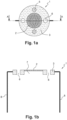
- the structure 3 of the interconnectors is preferably made of 316L stainless steel or Inconel TM and only the part in contact with the electrode (openwork element 2 or grooved element 4) is made of gold or platinum, or any other chemically stable material whose spectrum does not interfere with the diffractogram of the cell studied and whose melting temperature is greater than 1000°C.
- 400g/ cm2 are required to have a satisfactory contact force between a grid and an electrode.
- the grid is deposited directly on the first electrode.
- the first interconnector further comprises screws 5 made of an electrically insulating material resistant to temperatures above 1000°C, allowing the assembly of the first interconnector with the second interconnector, and openings 6, to allow the circulation of a gas.
- the second interconnector 10 is shown. Its contact face with the second electrode comprises a grooved element 4, here a ribbed projection, which allows circulation and gas exchange with the second electrode of the electrochemical cell, with which it is in contact.
- the second interconnector also comprises two power supplies 9 (in fact, a power supply wire and a voltage measurement wire) and two gas circulation lines 11 (distribution for one (reactive gas) and collection for the other (draining gas and gases produced by the electrochemical reaction)), a housing 12 for the means for heating the reactive gas and/or the cell in the chamber and a housing 13 (shown in dotted lines in the figure 2b ) for the means of measuring the cell temperature.
- power supplies 9 in fact, a power supply wire and a voltage measurement wire
- gas circulation lines 11 distributed for one (reactive gas) and collection for the other (draining gas and gases produced by the electrochemical reaction)
- a housing 12 for the means for heating the reactive gas and/or the cell in the chamber
- a housing 13 shown in dotted lines in the figure 2b
- the gas circulation pipes 11 can, for example, be made of 316 stainless steel.
- the cell (not shown) is placed between the two interconnectors (location 7) and the latter are then assembled ( figure 3 ).
- the assembly of the interconnectors can be ensured by two alumina screws (Al 2 0 3 ) (reference 5 in the figure 1 , but not represented in the figure 3 ) guaranteeing electrical insulation between the two interconnectors and providing excellent resistance thermal.
- a first and a second contact layer are deposited respectively on the first and on the second electrode of the electrochemical cell.
- These contact layers are for example screen-printed on the electrodes at temperature and under the study atmosphere of the cell and are typically made of gold or platinum.
- the conductive material of the first and second contact layers must be uniformly distributed over the entire surface of the first and second electrode to ensure good distribution of the current lines, while having through holes allowing the circulation of the gases produced, as well as the passage of the X-ray beam for the first electrode opposite the first interconnector.
- each contact layer covers between 25 and 60% of the surface of the electrode on which it is deposited.
- the through holes are configured to allow the gases to flow homogeneously throughout the electrochemical cell and to allow the X-ray beam to reach the cell along at least the axis of movement of the beam, preferably at an angle ranging from 20 to 160° relative to the plane formed by the surface of the first electrode.
- An example of contact layers is a screen-printed gold grid, composed of horizontal and vertical lines having a width of 500 ⁇ m, which are spaced 500 ⁇ m apart in the horizontal direction and 300 ⁇ m apart in the vertical direction. This produces through holes having the shape of rectangles of 300 ⁇ m ⁇ 500 ⁇ m, which are accessible by the X-ray beam. By orienting the beam in the direction of the largest side of the rectangles, incident angles are allowed in the widest possible range (20 to 160°).
- the thickness of the deposit of the contact layers is chosen so as to obtain sufficient contact with the electrode (i.e. a thickness of at least 200 nm) and to allow the X-ray beam to reach the electrode. The maximum thickness is for example calculated so that an incident X-ray beam with an angle of 20 and 160° can reach the sample material (i.e. a thickness typically of 2 ⁇ m).
- the interconnectors adopt a Kelvin type measurement configuration (4-point measurement), i.e. two current incoming wires and two voltage measuring wires are provided, in order to be able to perform four-wire electrochemical measurements.
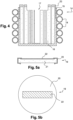
- the thermal and atmospheric confinement chamber 14 is shown. It comprises an envelope 15 which delimits an interior space which is lined with a thermal insulator 16 so as to define a cavity 17 for housing the electrochemical cell.
- Means 18 for cooling the outer wall of the casing 15 are arranged around the chamber.
- these cooling means 18 are a closed-circuit cooling liquid circulation which surrounds the chamber, such that the temperature delta between the temperature inside the chamber and the temperature outside the chamber is at least 750°C. Indeed, above 50°C, the X-ray source and the detector would risk being damaged.
- the chamber 14 also comprises a threaded ring 23 which cooperates with a corresponding thread located on the casing 15 of the body of the chamber.
- the cover 19 makes it possible to confine the atmosphere inside the chamber 14, while ensuring a thermal barrier with the outside. It can for example be composed of an envelope 20 whose interior is lined with a thermal insulator 21 ( Figure 5a ).
- the thermal insulators 16 and 17 used in the chamber must withstand the operating temperature of the electrochemical cell, without emitting pollutants by degassing.
- the operating temperature of the electrochemical cell is intended to be 800°C.
- the casing 15 forming the body of the chamber and the casing 20 forming the cover 19 can therefore, for example, be made of aluminum and the thermal insulators 16 and 17 can be based on calcium silicate, for example in Duratec TM 750 or Duratec TM 1000.
- the cover 19 includes a window 22 whose function is to allow the passage of an X-ray beam, while maintaining the thermal and atmospheric confinement of the chamber.
- the window 22 must therefore be weakly absorbent with respect to X-rays. Preferably, it is designed to allow the passage of X-rays at angles greater than 20°.
- the X-ray window 22 must withstand the operating temperature of the elementary electrochemical cell (in our example, 800°C) without emitting pollutants by degassing. In addition, it is preferable that it be inert in an oxidizing or reducing atmosphere.
- the X-ray passage window must make it possible to avoid thermal losses by convection as much as possible, while being able to produce X-ray diffractograms.
- the cover 19 has an aluminum casing 20, the interior of which is lined with Duratec TM 1000 and the X-ray window is made of a graphite sheet (purity of 99.9% atomic) with a thickness of 250 ⁇ m.
- the signal attenuation factor is thus 0.35.
- FIG 6 an exemplary embodiment of the holding device 30 according to the invention is shown.
- the elementary electrochemical cell 28 was placed between the first and second interconnectors 1 and 10.
- Heating means 24 for the reactive gas and/or the cell in the chamber to an operating temperature of the electrochemical cell have been inserted into the housing 12. It is preferable to choose a compact and reliable element capable of withstanding surface thermal loads of the order of 30 Watts/cm 2 .
- the heating means 24 are here a high-load heating cartridge made of boron nitride (diameter: 10 mm; length: 40 mm; power: 150 W; voltage: 230 V; cable length: 250 mm).
- the heating cartridge is preferably embedded in highly compressed magnesia and protected by a stainless steel shield (316 stainless steel or Inconel TM ) and the output is on ceramic beaded wires.
- the cartridge is made of contact with the second interconnector and will therefore heat it by thermal conduction, as will the gas(es) contained in the circulation pipes 11.
- the heating means 24 therefore make it possible here to heat both the reactive gas and the cell.
- Means 25 for measuring the temperature of the electrochemical cell have been inserted into the housing 13. This is for example a type K thermocouple: chromel/alumel.
- the means for supplying the chamber with reactive gas i.e. the openings 6 in the first interconnector and the circulation pipes 11 in the second interconnector, are arranged so as to obtain a homogeneous and symmetrical distribution of the reactive gas on the electrochemical cell.
- the perforated parts of the perforated element of the first interconnector are arranged so as to obtain a homogeneous and symmetrical distribution of the reactive gas on the electrochemical cell.
- the chamber is supplied with a constant gas flow of reactive gas.
- An X-ray diffractometer typically includes a device, called a goniometer, that allows synchronous rotation of the X-ray source 29 and the X-ray detector 31 about an axis passing through the sample plane.
- a Bragg-Brentano geometry goniometer is typically used with a ( ⁇ - ⁇ ) configuration in which the sample-detector distance remains constant regardless of the angle.
- a graduated circle materializes the diffraction angles fixed to the goniometer of the diffractometer.
- the holding device according to the invention can be designed to fit on the goniometer of a diffractometer, for example a diffractometer of the type D8 from Bruker, in place of the original spinner of the goniometer.
- the location of the spinner (rotating sample holder) is symbolized by the reference 32 in the figure 7 .
- its maximum size In order for the holding device to take the place of the goniometer spinner, its maximum size must correspond to the dimensions of the spinner. Its maximum size must generally be contained in a cylinder 20 cm high and 10 cm in diameter.
- LSCF strontium-doped lanthanum ferro-cobaltites of general formula La 1-x Sr x Co 1-y Fe y O 3- ⁇
- LSCF strontium-doped lanthanum ferro-cobaltites of general formula La 1-x Sr x Co 1-y Fe y O 3- ⁇
- YSZ yttrium-stabilized zirconium oxide
- the chamber was supplied with air with a constant gas flow at an average flow rate of 0.5 L/min and the cell was heated to a temperature of 800°C for a period of 150 h.
Landscapes
- Chemical & Material Sciences (AREA)
- Life Sciences & Earth Sciences (AREA)
- General Physics & Mathematics (AREA)
- Health & Medical Sciences (AREA)
- Physics & Mathematics (AREA)
- Analytical Chemistry (AREA)
- Biochemistry (AREA)
- General Health & Medical Sciences (AREA)
- Crystallography & Structural Chemistry (AREA)
- Immunology (AREA)
- Pathology (AREA)
- Engineering & Computer Science (AREA)
- Manufacturing & Machinery (AREA)
- Sustainable Development (AREA)
- Sustainable Energy (AREA)
- Chemical Kinetics & Catalysis (AREA)
- Electrochemistry (AREA)
- General Chemical & Material Sciences (AREA)
- Analysing Materials By The Use Of Radiation (AREA)
Claims (13)
- Vorrichtung zum Halten einer elektrochemischen Zelle unter Strom und bei einer Betriebstemperatur von mindestens 450 °C während einer Analyse einer ersten Elektrode der Zelle durch Röntgenstrahlbeugung, wobei die Zelle einen Festelektrolyten enthält, der zwischen der ersten Elektrode und einer zweiten Elektrode der Zelle eingefügt ist, wobei die Vorrichtung Folgendes umfasst:- eine erste (1) und eine zweite (10) Zwischenverbindung aus einem elektrisch leitenden Material, wobei die erste Zwischenverbindung eine Kontaktfläche aufweist, die dazu bestimmt ist, mit der ersten Elektrode in Kontakt zu gelangen, und dazu konfiguriert ist, eine Gaszirkulation und einen Gasaustausch zwischen der ersten Zwischenverbindung und der ersten Elektrode sowie einen Durchgang eines Röntgenstrahls bis zur ersten Elektrode zu ermöglichen, wobei die zweite Zwischenverbindung eine Kontaktfläche aufweist, die dazu bestimmt ist, mit der zweiten Elektrode in Kontakt zu gelangen, und dazu konfiguriert ist, eine Gaszirkulation und einen Gasaustausch zwischen der zweiten Zwischenverbindung und der zweiten Elektrode zu ermöglichen; und- Mittel (8, 9) zum Versorgen der ersten und der zweiten Zwischenverbindung mit Strom;wobei die Vorrichtung dadurch gekennzeichnet ist, dass sie ferner Folgendes umfasst:- eine thermische und atmosphärische Eindämmungskammer (14), die einen Körper umfasst, der einen inneren Hohlraum (17) zur Aufnahme eines Stapels definiert, der durch die elektrochemische Zelle gebildet wird, die sandwichartig zwischen der ersten und der zweiten Zwischenverbindung angeordnet ist, und die eine Abdeckung (19) umfasst, die dazu konfiguriert ist, den Hohlraum zu verschließen, wobei die Abdeckung mit einem Fenster (22) ausgestattet ist, das Röntgenstrahlen hindurchtreten lässt, wobei die erste Zwischenverbindung dazu bestimmt ist, vor der Abdeckung angeordnet zu sein, so dass Röntgenstrahlen, die durch das Fenster der Abdeckung hindurchtreten, durch die erste Zwischenverbindung hindurchtreten, um die erste Elektrode zu erreichen;- Mittel (6) zum Versorgen der Kammer mit einem reaktiven Gas;- Mittel zum Ableiten von mindestens einem Gas aus der Kammer; und- Mittel (24) zum Erwärmen der Zelle und/oder des reaktiven Gases in der Kammer auf eine Betriebstemperatur der elektrochemischen Zelle, wobei die Betriebstemperatur mindestens 450 °C beträgt;wobei die Kontaktfläche der ersten Zwischenverbindung ein perforiertes Element (2) ist, dessen perforierte Teile homogen angebracht sind und 30 % bis 80 % der Oberfläche des perforierten Elements ausmachen und derart angeordnet sind, dass sie eine homogene und symmetrische Verteilung des reaktiven Gases auf der elektrochemischen Zelle erzielen, wobei das perforierte Element ein Gitter ist;wobei die Kontaktfläche der zweiten Zwischenverbindung ein gerilltes Element (4) ist, zum Beispiel ein gerippter Vorsprung, das zum Verteilen und/oder Sammeln eines Gases ausgelegt ist.
- Vorrichtung nach Anspruch 1, wobei der Körper der Kammer eine Auskleidung (15), zum Beispiel aus Aluminium, umfasst, die ein Innenvolumen begrenzt, das mit einem thermisch isolierenden Material, zum Beispiel einer thermisch isolierenden Füllung auf Kalziumsilikatbasis, gefüllt ist, wodurch ermöglicht wird, den Hohlraum gegenüber der Außenseite der Kammer thermisch zu isolieren.
- Vorrichtung nach Anspruch 2, wobei die Kammer ferner Mittel (18) zum Kühlen einer Außenwand der Auskleidung, zum Beispiel eines Flüssigkeitskühlkreislaufs, umfasst, der um die Auskleidung herum angeordnet ist.
- Vorrichtung nach einem der Ansprüche 1 bis 3, wobei das Fenster der Abdeckung aus Grafit ist.
- Vorrichtung nach einem der Ansprüche 1 bis 4, die ferner Mittel (23) zum Einstellen des Abstands zwischen der ersten Zwischenverbindung und der Abdeckung umfasst, die dazu ausgebildet sind, die Zelle durch eine relative Translationsverschiebung entlang einer Mittelachse näher an die Abdeckung heran oder von dieser weg zu bewegen.
- Vorrichtung nach Anspruch 5, wobei die Einstellmittel ein Gewindeelement sind, das zum Tragen der Zelle im Hohlraum der Kammer verwendet wird und das mit der Auskleidung der Kammer so zusammenwirkt, dass eine Drehung des Gewindeelements um die Mittelachse in eine Verschiebung der Zelle näher an die Abdeckung heran oder von dieser weg übersetzt wird.
- System zum Analysieren einer ersten Elektrode einer elektrochemischen Zelle unter Strom und bei einer Betriebstemperatur von mindestens 450 °C durch Röntgenstrahlbeugung, wobei das System eine Haltevorrichtung wie in einem der Ansprüche 1 bis 6 beschrieben, eine Röntgenquelle zum Aussenden eines Röntgenstrahls und einen Röntgendetektor (31) zum Sammeln des von der ersten Elektrode gebeugten Strahls umfasst, wobei die Quelle so positioniert ist, dass ein von der Quelle ausgesendeter Röntgenstrahl durch das Fenster der Abdeckung der Haltevorrichtung hindurchtreten und die erste Elektrode der elektrochemischen Zelle erreichen kann, und wobei der Detektor so positioniert ist, dass er den von der ersten Elektrode gebeugten Röntgenstrahl detektiert.
- System nach Anspruch 7, das ferner Mittel zum Einstellen (26) der Position der Haltevorrichtung in Bezug auf die Röntgenquelle und den Detektor umfasst.
- System nach Anspruch 8, wobei die Mittel zum Einstellen der Position der Vorrichtung ein Goniometer sind, wobei die Haltevorrichtung auf dem Probenhalter des Goniometers positioniert ist.
- Verfahren zum Analysieren einer ersten Elektrode einer elektrochemischen Zelle im Betrieb durch Röntgenstrahlbeugung mit Hilfe eines Systems nach einem der Ansprüche 7 bis 9, wobei das Verfahren die folgenden Schritte umfasst:- Platzieren der Elementarzelle zwischen der ersten und der zweiten Zwischenverbindung, wobei die erste Elektrode der Zelle mit der Kontaktfläche der ersten Zwischenverbindung in Kontakt gebracht wird und die zweite Elektrode der Zelle mit der Kontaktfläche der zweiten Zwischenverbindung in Kontakt gebracht wird;- Platzieren des Stapels, der aus der Elementarzelle und der ersten und der zweiten Zwischenverbindung gebildet wird, in dem Hohlraum der Eindämmungskammer und Verschließen des Hohlraums mit Hilfe der Abdeckung, wobei die erste Zwischenverbindung vor der Abdeckung angeordnet ist;- Versorgen der Zelle mit einem reaktiven Gas;- Erwärmen der Zelle und/oder des reaktiven Gases im Hohlraum und Halten auf einer Betriebstemperatur der Zelle, wobei die Betriebstemperatur mindestens 450 °C beträgt;- Einstellen der Position der ersten Elektrode der Elementarzelle in Bezug auf die Röntgenquelle und den Röntgendetektor;- Versorgen der Zelle mit Strom;- Erstellen eines Diffraktogramms der ersten Elektrode.
- Analyseverfahren nach Anspruch 10, das ferner vor dem Platzieren der Elementarzelle zwischen der ersten und der zweiten Zwischenverbindung das Bilden einer ersten Kontaktschicht auf der ersten Elektrode und einer zweiten Kontaktschicht auf der zweiten Elektrode umfasst, wobei die erste und die zweite Kontaktschicht aus einem elektrisch leitenden Material bestehen und Durchgangslöcher aufweisen, wobei die erste und die zweite Schicht jeweils 25 bis 60 % der Oberfläche der ersten und der zweiten Elektrode bedecken.
- Analyseverfahren nach Anspruch 10 oder Anspruch 11, wobei mindestens die erste Elektrode eine Sauerstoffelektrode ist.
- Analyseverfahren nach Anspruch 11, wobei die beiden Elektroden Sauerstoffelektroden sind und das reaktive Gas Luft ist.
Applications Claiming Priority (2)
| Application Number | Priority Date | Filing Date | Title |
|---|---|---|---|
| FR1752782A FR3064748B1 (fr) | 2017-03-31 | 2017-03-31 | Dispositif, systeme et procede pour l'analyse par diffraction de rayons x d'une electrode d'une cellule electrochimique, en temperature et sous courant |
| PCT/FR2018/050782 WO2018178583A1 (fr) | 2017-03-31 | 2018-03-29 | Dispositif, système et procédé pour l'analyse par diffraction de rayons x d'une électrode d'une cellule électrochimique, en température et sous courant |
Publications (2)
| Publication Number | Publication Date |
|---|---|
| EP3586111A1 EP3586111A1 (de) | 2020-01-01 |
| EP3586111B1 true EP3586111B1 (de) | 2025-02-26 |
Family
ID=59031157
Family Applications (1)
| Application Number | Title | Priority Date | Filing Date |
|---|---|---|---|
| EP18718601.0A Active EP3586111B1 (de) | 2017-03-31 | 2018-03-29 | Vorrichtung, system und verfahren zur röntgenbeugungsanalyse einer elektrode einer elektrochemischen zelle bei betriebstemperatur und unter strom |
Country Status (5)
| Country | Link |
|---|---|
| US (1) | US11181492B2 (de) |
| EP (1) | EP3586111B1 (de) |
| ES (1) | ES3027202T3 (de) |
| FR (1) | FR3064748B1 (de) |
| WO (1) | WO2018178583A1 (de) |
Families Citing this family (2)
| Publication number | Priority date | Publication date | Assignee | Title |
|---|---|---|---|---|
| CN112864421B (zh) * | 2021-01-06 | 2022-05-17 | 西南大学 | 固体氧化物电池在线测试装置 |
| CN114235869B (zh) * | 2021-12-20 | 2024-05-14 | 西湖大学 | 基于多场耦合的高分辨原位x射线衍射系统及其测试方法 |
Citations (3)
| Publication number | Priority date | Publication date | Assignee | Title |
|---|---|---|---|---|
| JP2016066581A (ja) * | 2014-09-17 | 2016-04-28 | 大阪瓦斯株式会社 | セル間接続部材接合方法、セル間接続部材接合構造、および固体酸化物形燃料電池用セルの製造方法 |
| US20160285122A1 (en) * | 2015-03-24 | 2016-09-29 | Bloom Energy Corporation | Perimeter electrolyte reinforcement layer composition for solid oxide fuel cell electrolytes |
| JP2017016872A (ja) * | 2015-06-30 | 2017-01-19 | 株式会社ノリタケカンパニーリミテド | 固体酸化物形燃料電池用の電極材料とこれを用いた固体酸化物形燃料電池 |
Family Cites Families (4)
| Publication number | Priority date | Publication date | Assignee | Title |
|---|---|---|---|---|
| US5848122A (en) * | 1997-03-25 | 1998-12-08 | Advanced Technology Materials, Inc. | Apparatus for rapid in-situ X-ray stress measurement during thermal cycling of semiconductor wafers |
| FR3030892B1 (fr) * | 2014-12-17 | 2017-01-20 | Commissariat Energie Atomique | Dispositif electrochimique generateur d'electricite de type pile a combustible a oxyde solide |
| JP2016162587A (ja) * | 2015-03-02 | 2016-09-05 | 国立大学法人電気通信大学 | 固体高分子形燃料電池並びに計測装置及び方法 |
| FR3033941B1 (fr) | 2015-03-18 | 2017-04-21 | Commissariat Energie Atomique | Cellule de test d'appareillage de caracterisation de cellule de pile a combustible et procede de fabrication d'une telle cellule de test |
-
2017
- 2017-03-31 FR FR1752782A patent/FR3064748B1/fr active Active
-
2018
- 2018-03-29 EP EP18718601.0A patent/EP3586111B1/de active Active
- 2018-03-29 US US16/498,823 patent/US11181492B2/en active Active
- 2018-03-29 ES ES18718601T patent/ES3027202T3/es active Active
- 2018-03-29 WO PCT/FR2018/050782 patent/WO2018178583A1/fr not_active Ceased
Patent Citations (3)
| Publication number | Priority date | Publication date | Assignee | Title |
|---|---|---|---|---|
| JP2016066581A (ja) * | 2014-09-17 | 2016-04-28 | 大阪瓦斯株式会社 | セル間接続部材接合方法、セル間接続部材接合構造、および固体酸化物形燃料電池用セルの製造方法 |
| US20160285122A1 (en) * | 2015-03-24 | 2016-09-29 | Bloom Energy Corporation | Perimeter electrolyte reinforcement layer composition for solid oxide fuel cell electrolytes |
| JP2017016872A (ja) * | 2015-06-30 | 2017-01-19 | 株式会社ノリタケカンパニーリミテド | 固体酸化物形燃料電池用の電極材料とこれを用いた固体酸化物形燃料電池 |
Also Published As
| Publication number | Publication date |
|---|---|
| EP3586111A1 (de) | 2020-01-01 |
| FR3064748A1 (fr) | 2018-10-05 |
| FR3064748B1 (fr) | 2022-01-14 |
| US20210109043A1 (en) | 2021-04-15 |
| ES3027202T3 (en) | 2025-06-13 |
| US11181492B2 (en) | 2021-11-23 |
| WO2018178583A1 (fr) | 2018-10-04 |
Similar Documents
| Publication | Publication Date | Title |
|---|---|---|
| EP3391451B1 (de) | Eigenständiges system zum klemmen eines hochtemperatur-soec/sofc-stapels | |
| Wang et al. | Performance and stability analysis of SOFC containing thin and dense gadolinium-doped ceria interlayer sintered at low temperature | |
| EP2655691B1 (de) | Zelle zur herstellung von wasserstoff mit einer hochtemperatur-dampfelektrolysezelle | |
| EP2181203B1 (de) | Hochtemperatur- und hochdruckelektrolyseur mit allothermem betrieb und hoher produktionskapazität | |
| EP3625846B1 (de) | Wasser-elektrolysereaktor oder -koelektrolysereaktor (soec) oder brennstoffzelle (sofc) betrieben bei hohem druck beinhaltend eine einspannvorrichtung geeignet für diesen betrieb | |
| CA3126965C (fr) | Reacteur d'electrolyse ou de co-electrolyse (soec) ou pile a combustible (sofc) a empilement de cellules electrochimiques par modules preassembles, procede de realisation associe | |
| EP3476977B1 (de) | Reversible wiederholende einheit von wasser elektrolyse oder co-elektrolyse (soec) oder einer brennstoffzelle, die unter druck oder entkoppelter druckspannung arbeitet | |
| EP4315462B1 (de) | Verfahren zur herstellung eines stapels mit festoxiden vom typ soec/sofc und damit gebundenden stapel | |
| KR101215338B1 (ko) | 고체 산화물 연료전지용 전해질막, 그 제조방법 및 이를 채용한 연료전지 | |
| EP2580797A1 (de) | Verfahren zur herstellung einfacher elektrochemischer zellen für energie- oder wasserstofferzeugende elektrochemische systeme, insbesondere vom sofc- und hte-typ | |
| EP3586111B1 (de) | Vorrichtung, system und verfahren zur röntgenbeugungsanalyse einer elektrode einer elektrochemischen zelle bei betriebstemperatur und unter strom | |
| EP4013981B1 (de) | Festoxidstappel vom typ soec/sofc und hochtemperatur dichtes kupplungssystem | |
| FR3024289A1 (fr) | Dispositif de pile a combustible | |
| FR2983493A1 (fr) | Procede de fonctionnement d'un electrolyseur haute temperature comportant une etape de reduction du materiau des cathodes | |
| FR3057277A1 (fr) | Generateur de vapeur d'eau, pour reacteur d'electrolyse ou de co-electrolyse de l'eau (soec) ou pile a combustible (sofc) a fonctionnement sous pression | |
| EP3499625A1 (de) | Brennstoffzellensystem mit polymerelektrolytmembran und verringerter brenngas-leckage | |
| FR2920594A1 (fr) | Module coaxial de pile a combustible ou electrolyseur a interconnecteurs a billes | |
| CA3230063C (fr) | Interconnecteur pour empilement de cellules a oxydes solides de type soec/sofc comportant des elements en relief differents | |
| EP4388147B1 (de) | Interkonnektor für einen stapel von soec/sofc-festoxidzellen mit verschiedenen relief-elementen | |
| EP4092163B1 (de) | Anordnung aus einem festoxidstapel vom typ soec/sofc und einem dichten hochtemperatur-kupplungssystem mit kupplungsflansch | |
| WO2024245990A1 (fr) | Réacteur d'électrolyse ou de co-électrolyse de l'eau (soec) ou pile à combustible à empilement de cellules à oxydes solides, à interconnecteurs instrumentés par une sonde démontable de mesure de tension électrique | |
| WO2023222982A1 (fr) | Conducteur électrique rigide comportant des éléments raccordés entre eux par soudage tig, procédé de fabrication et utilisation d'un tel conducteur électrique | |
| FR3129533A1 (fr) | Système de conditionnement d’une pluralité d’empilements de cellules à oxydes solides de type SOEC/SOFC à haute température | |
| FR3157971A1 (fr) | Plaque de séparation d’interconnecteur à bord plié et empilement associé | |
| Geller | In Operando Mechanistic Studies of Heterogeneous Electrocatalysis on Solid Oxide Electrochemical Cell Materials |
Legal Events
| Date | Code | Title | Description |
|---|---|---|---|
| STAA | Information on the status of an ep patent application or granted ep patent |
Free format text: STATUS: UNKNOWN |
|
| STAA | Information on the status of an ep patent application or granted ep patent |
Free format text: STATUS: THE INTERNATIONAL PUBLICATION HAS BEEN MADE |
|
| PUAI | Public reference made under article 153(3) epc to a published international application that has entered the european phase |
Free format text: ORIGINAL CODE: 0009012 |
|
| STAA | Information on the status of an ep patent application or granted ep patent |
Free format text: STATUS: REQUEST FOR EXAMINATION WAS MADE |
|
| 17P | Request for examination filed |
Effective date: 20190924 |
|
| AK | Designated contracting states |
Kind code of ref document: A1 Designated state(s): AL AT BE BG CH CY CZ DE DK EE ES FI FR GB GR HR HU IE IS IT LI LT LU LV MC MK MT NL NO PL PT RO RS SE SI SK SM TR |
|
| AX | Request for extension of the european patent |
Extension state: BA ME |
|
| DAV | Request for validation of the european patent (deleted) | ||
| DAX | Request for extension of the european patent (deleted) | ||
| STAA | Information on the status of an ep patent application or granted ep patent |
Free format text: STATUS: EXAMINATION IS IN PROGRESS |
|
| 17Q | First examination report despatched |
Effective date: 20220506 |
|
| GRAP | Despatch of communication of intention to grant a patent |
Free format text: ORIGINAL CODE: EPIDOSNIGR1 |
|
| STAA | Information on the status of an ep patent application or granted ep patent |
Free format text: STATUS: GRANT OF PATENT IS INTENDED |
|
| INTG | Intention to grant announced |
Effective date: 20240927 |
|
| RAP3 | Party data changed (applicant data changed or rights of an application transferred) |
Owner name: UNIVERSITE DE TOURS Owner name: COMMISSARIAT A L'ENERGIE ATOMIQUE ET AUX ENERGIESALTERNATIVES |
|
| GRAS | Grant fee paid |
Free format text: ORIGINAL CODE: EPIDOSNIGR3 |
|
| GRAA | (expected) grant |
Free format text: ORIGINAL CODE: 0009210 |
|
| STAA | Information on the status of an ep patent application or granted ep patent |
Free format text: STATUS: THE PATENT HAS BEEN GRANTED |
|
| AK | Designated contracting states |
Kind code of ref document: B1 Designated state(s): AL AT BE BG CH CY CZ DE DK EE ES FI FR GB GR HR HU IE IS IT LI LT LU LV MC MK MT NL NO PL PT RO RS SE SI SK SM TR |
|
| REG | Reference to a national code |
Ref country code: GB Ref legal event code: FG4D Free format text: NOT ENGLISH |
|
| REG | Reference to a national code |
Ref country code: CH Ref legal event code: EP |
|
| REG | Reference to a national code |
Ref country code: DE Ref legal event code: R096 Ref document number: 602018079558 Country of ref document: DE |
|
| REG | Reference to a national code |
Ref country code: IE Ref legal event code: FG4D Free format text: LANGUAGE OF EP DOCUMENT: FRENCH |
|
| REG | Reference to a national code |
Ref country code: ES Ref legal event code: FG2A Ref document number: 3027202 Country of ref document: ES Kind code of ref document: T3 Effective date: 20250613 |
|
| REG | Reference to a national code |
Ref country code: NL Ref legal event code: MP Effective date: 20250226 |
|
| PG25 | Lapsed in a contracting state [announced via postgrant information from national office to epo] |
Ref country code: RS Free format text: LAPSE BECAUSE OF FAILURE TO SUBMIT A TRANSLATION OF THE DESCRIPTION OR TO PAY THE FEE WITHIN THE PRESCRIBED TIME-LIMIT Effective date: 20250526 |
|
| PG25 | Lapsed in a contracting state [announced via postgrant information from national office to epo] |
Ref country code: FI Free format text: LAPSE BECAUSE OF FAILURE TO SUBMIT A TRANSLATION OF THE DESCRIPTION OR TO PAY THE FEE WITHIN THE PRESCRIBED TIME-LIMIT Effective date: 20250226 |
|
| PG25 | Lapsed in a contracting state [announced via postgrant information from national office to epo] |
Ref country code: PL Free format text: LAPSE BECAUSE OF FAILURE TO SUBMIT A TRANSLATION OF THE DESCRIPTION OR TO PAY THE FEE WITHIN THE PRESCRIBED TIME-LIMIT Effective date: 20250226 |
|
| PGFP | Annual fee paid to national office [announced via postgrant information from national office to epo] |
Ref country code: ES Payment date: 20250519 Year of fee payment: 8 |
|
| REG | Reference to a national code |
Ref country code: LT Ref legal event code: MG9D |
|
| PG25 | Lapsed in a contracting state [announced via postgrant information from national office to epo] |
Ref country code: IS Free format text: LAPSE BECAUSE OF FAILURE TO SUBMIT A TRANSLATION OF THE DESCRIPTION OR TO PAY THE FEE WITHIN THE PRESCRIBED TIME-LIMIT Effective date: 20250626 Ref country code: NO Free format text: LAPSE BECAUSE OF FAILURE TO SUBMIT A TRANSLATION OF THE DESCRIPTION OR TO PAY THE FEE WITHIN THE PRESCRIBED TIME-LIMIT Effective date: 20250526 |
|
| PG25 | Lapsed in a contracting state [announced via postgrant information from national office to epo] |
Ref country code: NL Free format text: LAPSE BECAUSE OF FAILURE TO SUBMIT A TRANSLATION OF THE DESCRIPTION OR TO PAY THE FEE WITHIN THE PRESCRIBED TIME-LIMIT Effective date: 20250226 |
|
| PG25 | Lapsed in a contracting state [announced via postgrant information from national office to epo] |
Ref country code: HR Free format text: LAPSE BECAUSE OF FAILURE TO SUBMIT A TRANSLATION OF THE DESCRIPTION OR TO PAY THE FEE WITHIN THE PRESCRIBED TIME-LIMIT Effective date: 20250226 |
|
| PG25 | Lapsed in a contracting state [announced via postgrant information from national office to epo] |
Ref country code: PT Free format text: LAPSE BECAUSE OF FAILURE TO SUBMIT A TRANSLATION OF THE DESCRIPTION OR TO PAY THE FEE WITHIN THE PRESCRIBED TIME-LIMIT Effective date: 20250626 Ref country code: LV Free format text: LAPSE BECAUSE OF FAILURE TO SUBMIT A TRANSLATION OF THE DESCRIPTION OR TO PAY THE FEE WITHIN THE PRESCRIBED TIME-LIMIT Effective date: 20250226 |
|
| PG25 | Lapsed in a contracting state [announced via postgrant information from national office to epo] |
Ref country code: GR Free format text: LAPSE BECAUSE OF FAILURE TO SUBMIT A TRANSLATION OF THE DESCRIPTION OR TO PAY THE FEE WITHIN THE PRESCRIBED TIME-LIMIT Effective date: 20250527 Ref country code: BG Free format text: LAPSE BECAUSE OF FAILURE TO SUBMIT A TRANSLATION OF THE DESCRIPTION OR TO PAY THE FEE WITHIN THE PRESCRIBED TIME-LIMIT Effective date: 20250226 |
|
| REG | Reference to a national code |
Ref country code: AT Ref legal event code: MK05 Ref document number: 1771080 Country of ref document: AT Kind code of ref document: T Effective date: 20250226 |
|
| PG25 | Lapsed in a contracting state [announced via postgrant information from national office to epo] |
Ref country code: SE Free format text: LAPSE BECAUSE OF FAILURE TO SUBMIT A TRANSLATION OF THE DESCRIPTION OR TO PAY THE FEE WITHIN THE PRESCRIBED TIME-LIMIT Effective date: 20250226 |
|
| PG25 | Lapsed in a contracting state [announced via postgrant information from national office to epo] |
Ref country code: SM Free format text: LAPSE BECAUSE OF FAILURE TO SUBMIT A TRANSLATION OF THE DESCRIPTION OR TO PAY THE FEE WITHIN THE PRESCRIBED TIME-LIMIT Effective date: 20250226 |
|
| PG25 | Lapsed in a contracting state [announced via postgrant information from national office to epo] |
Ref country code: DK Free format text: LAPSE BECAUSE OF FAILURE TO SUBMIT A TRANSLATION OF THE DESCRIPTION OR TO PAY THE FEE WITHIN THE PRESCRIBED TIME-LIMIT Effective date: 20250226 |
|
| PGFP | Annual fee paid to national office [announced via postgrant information from national office to epo] |
Ref country code: IT Payment date: 20250630 Year of fee payment: 8 |
|
| PG25 | Lapsed in a contracting state [announced via postgrant information from national office to epo] |
Ref country code: AT Free format text: LAPSE BECAUSE OF FAILURE TO SUBMIT A TRANSLATION OF THE DESCRIPTION OR TO PAY THE FEE WITHIN THE PRESCRIBED TIME-LIMIT Effective date: 20250226 |
|
| PG25 | Lapsed in a contracting state [announced via postgrant information from national office to epo] |
Ref country code: EE Free format text: LAPSE BECAUSE OF FAILURE TO SUBMIT A TRANSLATION OF THE DESCRIPTION OR TO PAY THE FEE WITHIN THE PRESCRIBED TIME-LIMIT Effective date: 20250226 Ref country code: CZ Free format text: LAPSE BECAUSE OF FAILURE TO SUBMIT A TRANSLATION OF THE DESCRIPTION OR TO PAY THE FEE WITHIN THE PRESCRIBED TIME-LIMIT Effective date: 20250226 |
|
| REG | Reference to a national code |
Ref country code: CH Ref legal event code: H13 Free format text: ST27 STATUS EVENT CODE: U-0-0-H10-H13 (AS PROVIDED BY THE NATIONAL OFFICE) Effective date: 20251023 |
|
| PG25 | Lapsed in a contracting state [announced via postgrant information from national office to epo] |
Ref country code: RO Free format text: LAPSE BECAUSE OF FAILURE TO SUBMIT A TRANSLATION OF THE DESCRIPTION OR TO PAY THE FEE WITHIN THE PRESCRIBED TIME-LIMIT Effective date: 20250226 |
|
| PG25 | Lapsed in a contracting state [announced via postgrant information from national office to epo] |
Ref country code: SK Free format text: LAPSE BECAUSE OF FAILURE TO SUBMIT A TRANSLATION OF THE DESCRIPTION OR TO PAY THE FEE WITHIN THE PRESCRIBED TIME-LIMIT Effective date: 20250226 |
|
| PG25 | Lapsed in a contracting state [announced via postgrant information from national office to epo] |
Ref country code: LU Free format text: LAPSE BECAUSE OF NON-PAYMENT OF DUE FEES Effective date: 20250329 |
|
| REG | Reference to a national code |
Ref country code: DE Ref legal event code: R097 Ref document number: 602018079558 Country of ref document: DE |
|
| REG | Reference to a national code |
Ref country code: BE Ref legal event code: MM Effective date: 20250331 |
|
| PG25 | Lapsed in a contracting state [announced via postgrant information from national office to epo] |
Ref country code: MC Free format text: LAPSE BECAUSE OF FAILURE TO SUBMIT A TRANSLATION OF THE DESCRIPTION OR TO PAY THE FEE WITHIN THE PRESCRIBED TIME-LIMIT Effective date: 20250226 |
|
| PLBE | No opposition filed within time limit |
Free format text: ORIGINAL CODE: 0009261 |
|
| STAA | Information on the status of an ep patent application or granted ep patent |
Free format text: STATUS: NO OPPOSITION FILED WITHIN TIME LIMIT |
|
| PG25 | Lapsed in a contracting state [announced via postgrant information from national office to epo] |
Ref country code: BE Free format text: LAPSE BECAUSE OF NON-PAYMENT OF DUE FEES Effective date: 20250331 |
|
| PG25 | Lapsed in a contracting state [announced via postgrant information from national office to epo] |
Ref country code: CH Free format text: LAPSE BECAUSE OF NON-PAYMENT OF DUE FEES Effective date: 20250331 |
|
| PG25 | Lapsed in a contracting state [announced via postgrant information from national office to epo] |
Ref country code: IE Free format text: LAPSE BECAUSE OF NON-PAYMENT OF DUE FEES Effective date: 20250329 |
|
| 26N | No opposition filed |
Effective date: 20251127 |
|
| PGFP | Annual fee paid to national office [announced via postgrant information from national office to epo] |
Ref country code: GB Payment date: 20260324 Year of fee payment: 9 |
|
| PGFP | Annual fee paid to national office [announced via postgrant information from national office to epo] |
Ref country code: DE Payment date: 20260320 Year of fee payment: 9 |
|
| PGFP | Annual fee paid to national office [announced via postgrant information from national office to epo] |
Ref country code: FR Payment date: 20260324 Year of fee payment: 9 |