EP3586700A1 - Centrifugeuse et procédé d'extraction de jus - Google Patents
Centrifugeuse et procédé d'extraction de jus Download PDFInfo
- Publication number
- EP3586700A1 EP3586700A1 EP18179433.0A EP18179433A EP3586700A1 EP 3586700 A1 EP3586700 A1 EP 3586700A1 EP 18179433 A EP18179433 A EP 18179433A EP 3586700 A1 EP3586700 A1 EP 3586700A1
- Authority
- EP
- European Patent Office
- Prior art keywords
- sieve
- juice
- outlet
- juicer
- rotary
- Prior art date
- Legal status (The legal status is an assumption and is not a legal conclusion. Google has not performed a legal analysis and makes no representation as to the accuracy of the status listed.)
- Withdrawn
Links
- 238000000034 method Methods 0.000 title claims description 17
- 235000011389 fruit/vegetable juice Nutrition 0.000 claims abstract description 106
- 235000012041 food component Nutrition 0.000 claims description 34
- 239000005417 food ingredient Substances 0.000 claims description 34
- 230000005484 gravity Effects 0.000 claims description 8
- 238000002156 mixing Methods 0.000 abstract description 11
- 235000013305 food Nutrition 0.000 abstract description 5
- 239000007788 liquid Substances 0.000 description 15
- 235000013570 smoothie Nutrition 0.000 description 13
- 235000013399 edible fruits Nutrition 0.000 description 10
- 235000013311 vegetables Nutrition 0.000 description 8
- 238000005520 cutting process Methods 0.000 description 7
- 238000007873 sieving Methods 0.000 description 6
- 235000013361 beverage Nutrition 0.000 description 5
- 239000000203 mixture Substances 0.000 description 4
- 241000195940 Bryophyta Species 0.000 description 3
- 239000012530 fluid Substances 0.000 description 3
- 235000011929 mousse Nutrition 0.000 description 3
- 230000003068 static effect Effects 0.000 description 3
- 230000001419 dependent effect Effects 0.000 description 2
- 239000000835 fiber Substances 0.000 description 2
- 235000012055 fruits and vegetables Nutrition 0.000 description 2
- 238000000227 grinding Methods 0.000 description 2
- 239000002245 particle Substances 0.000 description 2
- 239000007787 solid Substances 0.000 description 2
- 229920002678 cellulose Polymers 0.000 description 1
- 239000001913 cellulose Substances 0.000 description 1
- 238000004590 computer program Methods 0.000 description 1
- 235000013325 dietary fiber Nutrition 0.000 description 1
- 238000010790 dilution Methods 0.000 description 1
- 239000012895 dilution Substances 0.000 description 1
- 230000000694 effects Effects 0.000 description 1
- 238000000605 extraction Methods 0.000 description 1
- 238000001914 filtration Methods 0.000 description 1
- 239000011521 glass Substances 0.000 description 1
- 239000004615 ingredient Substances 0.000 description 1
- 238000004519 manufacturing process Methods 0.000 description 1
- 239000008267 milk Substances 0.000 description 1
- 210000004080 milk Anatomy 0.000 description 1
- 235000013336 milk Nutrition 0.000 description 1
- 230000003287 optical effect Effects 0.000 description 1
- 238000003860 storage Methods 0.000 description 1
- 230000001360 synchronised effect Effects 0.000 description 1
- 230000009967 tasteless effect Effects 0.000 description 1
- XLYOFNOQVPJJNP-UHFFFAOYSA-N water Substances O XLYOFNOQVPJJNP-UHFFFAOYSA-N 0.000 description 1
Images
Classifications
-
- A—HUMAN NECESSITIES
- A47—FURNITURE; DOMESTIC ARTICLES OR APPLIANCES; COFFEE MILLS; SPICE MILLS; SUCTION CLEANERS IN GENERAL
- A47J—KITCHEN EQUIPMENT; COFFEE MILLS; SPICE MILLS; APPARATUS FOR MAKING BEVERAGES
- A47J19/00—Household machines for straining foodstuffs; Household implements for mashing or straining foodstuffs
- A47J19/02—Citrus fruit squeezers; Other fruit juice extracting devices
- A47J19/027—Centrifugal extractors
-
- A—HUMAN NECESSITIES
- A23—FOODS OR FOODSTUFFS; TREATMENT THEREOF, NOT COVERED BY OTHER CLASSES
- A23N—MACHINES OR APPARATUS FOR TREATING HARVESTED FRUIT, VEGETABLES OR FLOWER BULBS IN BULK, NOT OTHERWISE PROVIDED FOR; PEELING VEGETABLES OR FRUIT IN BULK; APPARATUS FOR PREPARING ANIMAL FEEDING- STUFFS
- A23N1/00—Machines or apparatus for extracting juice
- A23N1/02—Machines or apparatus for extracting juice combined with disintegrating or cutting
-
- A—HUMAN NECESSITIES
- A47—FURNITURE; DOMESTIC ARTICLES OR APPLIANCES; COFFEE MILLS; SPICE MILLS; SUCTION CLEANERS IN GENERAL
- A47J—KITCHEN EQUIPMENT; COFFEE MILLS; SPICE MILLS; APPARATUS FOR MAKING BEVERAGES
- A47J43/00—Implements for preparing or holding food, not provided for in other groups of this subclass
- A47J43/04—Machines for domestic use not covered elsewhere, e.g. for grinding, mixing, stirring, kneading, emulsifying, whipping or beating foodstuffs, e.g. power-driven
- A47J43/046—Machines for domestic use not covered elsewhere, e.g. for grinding, mixing, stirring, kneading, emulsifying, whipping or beating foodstuffs, e.g. power-driven with tools driven from the bottom side
-
- A—HUMAN NECESSITIES
- A47—FURNITURE; DOMESTIC ARTICLES OR APPLIANCES; COFFEE MILLS; SPICE MILLS; SUCTION CLEANERS IN GENERAL
- A47J—KITCHEN EQUIPMENT; COFFEE MILLS; SPICE MILLS; APPARATUS FOR MAKING BEVERAGES
- A47J43/00—Implements for preparing or holding food, not provided for in other groups of this subclass
- A47J43/04—Machines for domestic use not covered elsewhere, e.g. for grinding, mixing, stirring, kneading, emulsifying, whipping or beating foodstuffs, e.g. power-driven
- A47J43/07—Parts or details, e.g. mixing tools, whipping tools
- A47J43/0716—Parts or details, e.g. mixing tools, whipping tools for machines with tools driven from the lower side
-
- A—HUMAN NECESSITIES
- A47—FURNITURE; DOMESTIC ARTICLES OR APPLIANCES; COFFEE MILLS; SPICE MILLS; SUCTION CLEANERS IN GENERAL
- A47J—KITCHEN EQUIPMENT; COFFEE MILLS; SPICE MILLS; APPARATUS FOR MAKING BEVERAGES
- A47J43/00—Implements for preparing or holding food, not provided for in other groups of this subclass
- A47J43/04—Machines for domestic use not covered elsewhere, e.g. for grinding, mixing, stirring, kneading, emulsifying, whipping or beating foodstuffs, e.g. power-driven
- A47J43/07—Parts or details, e.g. mixing tools, whipping tools
- A47J43/0727—Mixing bowls
Definitions
- This invention relates to juicers.
- Healthy fruit (and/or vegetable) drinks are increasingly popular, and many different types of kitchen appliance are available for blending and/or juicing to create these drinks.
- the consistencies may be categorized as mousse, thick smoothie, thin smoothie, fibrous juice and clear juice.
- Juicers and more generally food processors, blenders, masticators, smoothie makers and other kitchen devices, produce beverages with one or two of these categories of consistency depending on the fruit or vegetable.
- blenders and smoothie makers generally produce mousse or thick smoothies because they keep all fibers in the beverage. By adding additional fluids like water or milk, the consistency can be changed to a thin smoothie or even a fibrous juice for some fruits.
- a disadvantage of this process is that the beverage is often tasteless because of the dilution.
- Masticators and centrifugal juicers generally produce mainly clear and fibrous juice consistencies by separating solid and liquid contents of the fruit or vegetables by the use of sieves and meshes. The consistency is strongly dependent on the fruit and device type. Some devices are also capable of producing smoothies as a second device setting.
- the consistency of the beverage mainly depends on the amount of solids (fibers) in the specific fruit or vegetable e.g. cellulose and on the processing principle.
- Examples in accordance with the invention provide a juicer for extracting juice from food ingredients comprising:
- This juicer is able to provide a controllable juice characteristic, by delivering a mixture of juice which was able to pass through the sieve and pulp which was not delivered to the outer sieve wall.
- the sieving is based on a centrifugal process by which juice is forced through the rotating sieve by centrifugal forces.
- the nature of the juice may for example be controllable simply based on a time sequence of the operation of the juicer.
- the juicer may be controlled to provide clear juice, cloudy juice, a thin smoothie or a thick smoothie. These time sequences may be preset for different food types (fruits, vegetables) and different desired juice consistencies.
- the time sequences define the starting of sieve rotation and the stopping of sieve rotation. A rotating sieve delivers juice through the sieve whereas a stopped sieve delivers juice/pulp directly to the juice outlet.
- the juicer may further comprise a combining system for combining juice which has passed through the outer sieve wall and pulp which has not passed the outer sieve wall, wherein the combined juice is provided to the juice outlet.
- the combining system may simply combine two flow paths to the outlet - the outlet may deliver the two types of fluid time-sequentially, so that mixing may take place in the eventual receptacle to which the juice is delivered.
- the combining system is for example adapted to combine pulp received by gravity, and juice received by centrifugal operation of the rotary sieve. This provides a simple way to deliver a mixture of juice and pulp to the outlet.
- the rotary sieve may comprise a ramp surface beneath the cavity outlet, with a pulp outlet at the bottom of the ramp surface and the outer sieve wall at the top of the ramp surface.
- the food ingredients (which are the pre-sieved but cut food ingredients) rise up the ramp surface by centrifugal operation when the rotary sieve is rotating and drop down the ramp surface when the rotary sieve is stationary.
- the juice outlet may thus be adapted to receive pulp when the sieve rotation is stopped and to receive juice when the sieve is rotating.
- the drive system is for example adapted to control the timing of the rotating of the sieve to control the consistency of the juice outlet.
- the drive system is for example adapted to provide pulsed timing of the rotating of the sieve with a controllable duty cycle.
- the duty cycle controls the times of juice collection and pulp collection. This provides a simply way to control the juice characteristics.
- the tool for example comprises a rotary cutter such as a blender tool.
- a blender tool This is used to perform an initial breaking up of a foodstuff (typically fruit or vegetable) before juice extraction by the sieve.
- the blender tool is for cutting and/or grinding and/or shredding the food ingredients thereby to release juice from the food ingredients.
- a rotary tool is preferred, for shredding, grinding or cutting, although other options are possible.
- the drive system is for example adapted to rotate the rotary sieve in one direction and the tool in an opposite direction.
- the drive system for example comprises a motor with a free wheeling clutch.
- the tool may be controllable with a first speed or range of speeds, and the rotary sieve is controllable with a different second speed or range of speeds. Different speeds are appropriate for cutting (blending) and for centrifugal sieving.
- the rotary cutter and the rotary sieve are for example adapted to rotate about an upright axis in use. This provides a compact arrangement, in which food ingredients may be loaded into the juicer from above.
- the sieve operation displaces the food ingredients radially outwardly.
- the invention also provides a method for extracting juice from food ingredients, comprising:
- This method combines pulp which has not passed through a sieve and juice which has passed through the sieve so that a juice consistency may be selected.
- the method may comprise combining pulp received by gravity and juice received by centrifugal operation of the rotary sieve.
- the method may comprise stopping the rotary sieve to deliver pulp and rotating the rotary sieve to deliver juice.
- There may for example be pulsed timing of the rotating of the sieve with a controllable duty cycle.
- the invention provides a juicer which combines a tool such as a rotary cutter and a rotary sieve. After processing with the tool (e.g. blending) the food to be juiced is passed to the rotary sieve. When the sieve rotates, juice is provided, and when the sieve stops, pulp is provided. In this way, the consistency of the outlet, namely the ratio of pulp and juice, may be controlled.
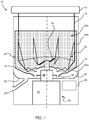
- Fig. 1 shows a juicer 10 for extracting juice from food ingredients. It shows a side view in cross section but also showing some details behind the cross section.
- the juicer comprises a cavity 12 for receiving the food ingredients from an open top, which is then closed by a lid 14.
- the cavity has an outlet which can be opened and closed.
- Two valves 16 are shown for this purpose. There may be a single outlet and associated valve, or two or more outlets and associated valves.
- the outlets and valves define the lowest point of the cavity so that food ingredients (once they are in liquid form) flow to the outlet or outlets under gravity.
- a rotary cutter 18 is in the cavity for cutting the food ingredients and thereby releasing juice.
- the rotary cutter is for example a blender tool, although any cutting tool for cutting, shredding or crushing may be used.
- the processing may result in a particle size of below 250 ⁇ m, for example with at least 90% of particles with a size of 250 ⁇ m or less.
- the cavity 12 has a set of ribs 20 around its inner wall. These function as flow breakers. They cause a recirculation of the food pieces, fluid and pulp during the blending process. As a result a smoother blend is achieved.
- a rotary sieve 22 is positioned for receiving food ingredients from the cavity 12 from the outlet or outlets.
- the rotary sieve has a base part 22a which is liquid impermeable and an outer sieve wall 22b.
- the outer sieve wall comprises an array of openings though which juice is able to pass when a centrifugal force is applied by rotation of the sieve.
- a drive system 24 is provided for rotating the rotary cutter 18 to cut the food ingredients in the cavity and for rotating the rotary sieve 22 so as to pass juice through the outer sieve wall 22b.
- the rotary cutter and the rotary sieve rotate about an upright axis in use in the example shown. This provides a compact arrangement, in which food ingredients may be loaded into the juicer from above with the lid removed.
- the drive system 24 comprises a motor 25 and a freewheeling clutch 26. Operation of the motor enables independent control of the rotating of the rotary cutter 18 and the rotating of the sieve 22.
- the drive system for example rotates the rotary sieve in one direction and the rotary cutter in an opposite direction. When one device is being rotated, the other is in a freewheel state by means of the clutch, and slows.
- the rotary cutter may be controllable with a first speed or range of speeds, and the rotary sieve is controllable with a different second speed or range of speeds. Different speeds are appropriate for cutting (blending) and for centrifugal sieving.
- the rotary cutter for example operates between 10000 and 25000 rpm under load.
- the centrifugal sieve operation for example operates generally between 500 and 5000 rpm, for example with a maximum in the range 6000 to 7000rpm. Higher rpm values may not be desired for safety reasons, whereas lower rpm values may give excessively long processing times.
- a controller 28 is used to control the opening and closing of the cavity by controlling the valves 16 as well as controlling the motor.
- the outer sieve wall 22b functions as a juice outlet.
- the sieve 22 also has an outlet 30 or set of outlets in the base part 22a which functions as a pulp outlet.
- the outlet valve 16 When the blended liquid from the cavity is released by the outlet valve 16, it can either flow further down to the outlet 30 under gravity or it can be driven centrifugally outwardly and up to the outer sieve wall 22b.
- the base part 22a comprises a ramp surface beneath the cavity outlet, with the pulp outlet 30 at the bottom of the ramp surface at a radially inner location and the outer sieve wall 22b at the top of the ramp surface at a radially outer location.
- the food ingredients (which are the pre-sieved but cut food ingredients) rise up the ramp surface by centrifugal forces when the rotary sieve is rotating and drop down the ramp surface when the rotary sieve is stationary.
- the rotation speed of the sieve is such that the pulp which cannot pass through the outer sieve wall 22b (or the majority of it) remains compressed against the outer sieve wall, and does not fall back down to the outlet 30 when the sieve rotation is halted.
- a collection tray 32 collects the liquid from the outer sieve wall 22b and from the outlet 30 of the sieve base part 22a.
- the liquid from the outer sieve wall is relatively clear whereas the liquid from the outlet 30 is relatively cloudy.
- the collection tray leads to a juice outlet 34 for providing the extracted juice.
- the collection tray may thus be considered to be a combining system which combines the juice which has passed through the outer sieve wall 22b and pulp which was not passed through the outer sieve wall.
- the collection tray basically combines the two flow paths to the juice outlet 34.
- the flow to the juice outlet 34 may comprise the two juice types in a time sequence (since one type is delivered during sieve rotation and the other type is delivered when the sieve is stationary). Final mixing then takes place in the eventual receptacle to which the juice is delivered.
- the mixing may then only take place in the vessel to which the two types of juice are provided from the respective outlets.
- the juice outlet 34 thus receives a mixture of juice which was able to pass through the sieve when the sieve was rotating and liquid including juice and pulp which was not delivered to the sieve wall.
- the sieving is based on a centrifugal process by which juice is forced through the rotating sieve by centrifugal forces.
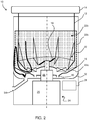
- Fig. 2 shows the flow path for blended liquid during sieve rotation.
- the liquid passes the valve 16, reaches the base wall 22a of the sieve, and is flung radially outwardly, away from the outlet 30 and towards the sieve outer wall 22b.
- the sieving operation provides relatively clear juice to the collection tray and then the juice outlet.
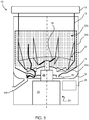
- Fig. 3 shows the flow path for blended liquid when the sieve is static.
- the liquid passes the valve 16, reaches the base wall 22a of the sieve, flows down to the outlet 30 under gravity and then passes to the collection tray and then the juice outlet.
- the nature of the juice provided to the outlet 34 may therefore be controlled simply based on a time sequence of the operation of the juicer as implemented by the controller 28.
- the controller for example receives an indication of the type of fruit or vegetable to be juiced, a quantity, and the desired juice consistency of the user, such as clear juice, cloudy juice, a thin smoothie or a thick smoothie.
- the controller selects a time sequence.
- the time sequence defines the duration of the initial blending process, with the valves 16 closed, the timing of the opening of the valves 16, and the starting and stopping of sieve rotation after the valves have been opened.
- the rotating sieve delivers juice through the sieve whereas the stopped sieve delivers juice/pulp directly to the juice outlet.
- the sieve operation may comprise only a single period of rotation and a static period.
- a pulses operation may instead be used with a duty cycle which determines the ratio of sieve operation to sieve non-operation. This provides a simple way to control the juice characteristics.
- the control of the valves 16 may also be synchronized with the sieve rotation. For example, a small amount of the blended liquid may be released to the sieve from the cavity at a time. That small amount is then processed by the sieve either as a single period of rotation and a static period (in either order) or as a pulsed rotation with controlled duty cycle. Alternatively, the valves maybe opened only once, to allow all the blended contents of the cavity to pass to the sieve (which is rotating, or stationary, or pulsed between the two).
- a clear juice may for example be obtained by rotating the sieve 100% of the time after the valves are open.
- a mousse may for example be obtained by not rotating the sieve at all, thus simply providing a blended output.
- a light smoothie may for example be obtained by rotating the sieve 80% to 90% of the time after the valves are open and the contents of the cavity flows to the sieve.
- a thick smoothie may for example be obtained by rotating the sieve 50% to 80% of the time after the valves are open and the contents of the cavity flows to the sieve.
- the valves have an opening size such that pulp can easily pass through.
- the flow rate from the cavity into the sieve is for example in the range 3 to 5 liters per minute.
- the blending time may typically be from 15 seconds to 1 minute and the filtering time may typically be from 15 seconds to 30 seconds.
- the invention may be applied to small kitchen appliances, for example for one glass of juice with a drum capacity of approximately 0.5 liters as well as to large devices for entire families with a drum capacity up to 5 liters.
- the cavity diameter may be of the order of 100mm and the cavity height may be of the order of 50mm.
- the dimensions may of course depend on the desired volume capacity of the cavity.
- a controlled combination of sieved and pre-sieved food ingredient is delivered by the juicer so that a cloudiness or thickness of the juice may be selected by the user.
- a computer program may be stored/distributed on a suitable medium, such as an optical storage medium or a solid-state medium supplied together with or as part of other hardware, but may also be distributed in other forms, such as via the Internet or other wired or wireless telecommunication systems. Any reference signs in the claims should not be construed as limiting the scope.
Landscapes
- Engineering & Computer Science (AREA)
- Food Science & Technology (AREA)
- Mechanical Engineering (AREA)
- Life Sciences & Earth Sciences (AREA)
- Chemical & Material Sciences (AREA)
- Polymers & Plastics (AREA)
- Food-Manufacturing Devices (AREA)
Priority Applications (5)
| Application Number | Priority Date | Filing Date | Title |
|---|---|---|---|
| EP18179433.0A EP3586700A1 (fr) | 2018-06-25 | 2018-06-25 | Centrifugeuse et procédé d'extraction de jus |
| PL19731294.5T PL3809929T3 (pl) | 2018-06-25 | 2019-06-20 | Wyciskarka do soków i sposób wyciskania soku |
| PCT/EP2019/066321 WO2020002118A1 (fr) | 2018-06-25 | 2019-06-20 | Extrracteur de jus et procédé d'extraction de jus |
| EP19731294.5A EP3809929B1 (fr) | 2018-06-25 | 2019-06-20 | Centrifugeuse et procédé d'extraction de jus |
| CN201980042662.6A CN112367885B (zh) | 2018-06-25 | 2019-06-20 | 榨汁机和榨汁方法 |
Applications Claiming Priority (1)
| Application Number | Priority Date | Filing Date | Title |
|---|---|---|---|
| EP18179433.0A EP3586700A1 (fr) | 2018-06-25 | 2018-06-25 | Centrifugeuse et procédé d'extraction de jus |
Publications (1)
| Publication Number | Publication Date |
|---|---|
| EP3586700A1 true EP3586700A1 (fr) | 2020-01-01 |
Family
ID=62778725
Family Applications (2)
| Application Number | Title | Priority Date | Filing Date |
|---|---|---|---|
| EP18179433.0A Withdrawn EP3586700A1 (fr) | 2018-06-25 | 2018-06-25 | Centrifugeuse et procédé d'extraction de jus |
| EP19731294.5A Active EP3809929B1 (fr) | 2018-06-25 | 2019-06-20 | Centrifugeuse et procédé d'extraction de jus |
Family Applications After (1)
| Application Number | Title | Priority Date | Filing Date |
|---|---|---|---|
| EP19731294.5A Active EP3809929B1 (fr) | 2018-06-25 | 2019-06-20 | Centrifugeuse et procédé d'extraction de jus |
Country Status (4)
| Country | Link |
|---|---|
| EP (2) | EP3586700A1 (fr) |
| CN (1) | CN112367885B (fr) |
| PL (1) | PL3809929T3 (fr) |
| WO (1) | WO2020002118A1 (fr) |
Families Citing this family (4)
| Publication number | Priority date | Publication date | Assignee | Title |
|---|---|---|---|---|
| PL429789A1 (pl) * | 2019-04-29 | 2020-11-02 | Dziadoń Anna | Mlekarko-blenderka do wytwarzania mleczka roślinnego, zwłaszcza dla gospodarstw domowych |
| CN111957409A (zh) * | 2020-09-03 | 2020-11-20 | 安徽理工大学 | 一种孔式香芋破碎机 |
| CN113768339A (zh) * | 2021-10-28 | 2021-12-10 | 中山市峻国电器有限公司 | 一种出汁率高的榨汁机 |
| CN116406971B (zh) * | 2021-12-29 | 2026-01-16 | 广东美的白色家电技术创新中心有限公司 | 料理机及其料理杯 |
Citations (2)
| Publication number | Priority date | Publication date | Assignee | Title |
|---|---|---|---|---|
| US2552572A (en) * | 1946-05-17 | 1951-05-15 | Westinghouse Electric Corp | Fruit juice extractor having cyclically varying velocity |
| WO2018086970A1 (fr) * | 2016-11-08 | 2018-05-17 | Koninklijke Philips N.V. | Centrifugeuse améliorée |
Family Cites Families (13)
| Publication number | Priority date | Publication date | Assignee | Title |
|---|---|---|---|---|
| JPH09224816A (ja) * | 1996-02-27 | 1997-09-02 | Sanyo Electric Co Ltd | ジューサー |
| JP3754135B2 (ja) * | 1996-08-06 | 2006-03-08 | 三洋電機株式会社 | ジューサー |
| US20040194643A1 (en) * | 2003-04-04 | 2004-10-07 | Prince Tikare | Texture synchronizer |
| JP2008225768A (ja) * | 2007-03-12 | 2008-09-25 | Toshiba Electric Appliance Co Ltd | ミキシング装置および飲料提供装置 |
| CN101543310A (zh) * | 2009-04-30 | 2009-09-30 | 林修鹏 | 一种环形水流式果蔬清洗机 |
| CN201481360U (zh) * | 2009-09-01 | 2010-05-26 | 宏柏实业股份有限公司 | 碗盘热烘及蔬果清洗复合机 |
| JP2012100821A (ja) * | 2010-11-09 | 2012-05-31 | Zojirushi Corp | 飲料製造装置 |
| US9867387B2 (en) * | 2012-08-16 | 2018-01-16 | Sunbeam Products, Inc. | Frozen beverage blending and dispensing appliance |
| US20150245651A1 (en) * | 2012-11-13 | 2015-09-03 | Koninklijke Philips N.V. | Juice extractor |
| WO2015185582A1 (fr) * | 2014-06-06 | 2015-12-10 | Koninklijke Philips N.V. | Extracteur de jus centrifuge |
| EP3175743B1 (fr) * | 2014-07-30 | 2020-05-27 | Coway Co., Ltd. | Ensemble tambour comportant un dispositif de commande d'évacuation de pulpe et centrifugeuse comprenant cet ensemble |
| CN106859269B (zh) * | 2015-12-10 | 2019-12-17 | 浙江绍兴苏泊尔生活电器有限公司 | 分离器和料理机 |
| CN207506351U (zh) * | 2017-05-16 | 2018-06-19 | 九阳股份有限公司 | 一种用于制作含果肉的果汁的榨汁机 |
-
2018
- 2018-06-25 EP EP18179433.0A patent/EP3586700A1/fr not_active Withdrawn
-
2019
- 2019-06-20 EP EP19731294.5A patent/EP3809929B1/fr active Active
- 2019-06-20 CN CN201980042662.6A patent/CN112367885B/zh active Active
- 2019-06-20 WO PCT/EP2019/066321 patent/WO2020002118A1/fr not_active Ceased
- 2019-06-20 PL PL19731294.5T patent/PL3809929T3/pl unknown
Patent Citations (2)
| Publication number | Priority date | Publication date | Assignee | Title |
|---|---|---|---|---|
| US2552572A (en) * | 1946-05-17 | 1951-05-15 | Westinghouse Electric Corp | Fruit juice extractor having cyclically varying velocity |
| WO2018086970A1 (fr) * | 2016-11-08 | 2018-05-17 | Koninklijke Philips N.V. | Centrifugeuse améliorée |
Also Published As
| Publication number | Publication date |
|---|---|
| WO2020002118A1 (fr) | 2020-01-02 |
| EP3809929A1 (fr) | 2021-04-28 |
| CN112367885B (zh) | 2024-08-30 |
| PL3809929T3 (pl) | 2024-10-28 |
| CN112367885A (zh) | 2021-02-12 |
| EP3809929B1 (fr) | 2024-08-07 |
Similar Documents
| Publication | Publication Date | Title |
|---|---|---|
| EP3809929B1 (fr) | Centrifugeuse et procédé d'extraction de jus | |
| EP1969980B1 (fr) | Mélangeur avec fonction de glace pilée | |
| JP3107553B2 (ja) | 果実と野菜の汁とパルプ抽出器 | |
| EP3809924B1 (fr) | Centrifugeuse et procédé d'extraction | |
| CN107771046A (zh) | 食品加工设备和方法 | |
| JP2022533014A (ja) | ジュース又は植物性ミルクを作るための遠心飲料メーカー | |
| CN112351711B (zh) | 榨汁机和榨汁方法 | |
| GB2412332A (en) | A combined juice extractor and mixer | |
| EP3586685A1 (fr) | Centrifugeuse et procédé de pressage | |
| US11930953B2 (en) | Apparatus and method for extracting juice from food ingredients | |
| US12035848B2 (en) | Preparation jar for a kitchen appliance, a lid for the preparation jar and a kitchen appliance | |
| US20040194643A1 (en) | Texture synchronizer | |
| RU2782668C1 (ru) | Центробежное устройство для приготовления напитков для получения сока или растительного молока | |
| CN110799068B (zh) | 榨汁设备和榨汁方法 |
Legal Events
| Date | Code | Title | Description |
|---|---|---|---|
| PUAI | Public reference made under article 153(3) epc to a published international application that has entered the european phase |
Free format text: ORIGINAL CODE: 0009012 |
|
| AK | Designated contracting states |
Kind code of ref document: A1 Designated state(s): AL AT BE BG CH CY CZ DE DK EE ES FI FR GB GR HR HU IE IS IT LI LT LU LV MC MK MT NL NO PL PT RO RS SE SI SK SM TR |
|
| AX | Request for extension of the european patent |
Extension state: BA ME |
|
| RAP1 | Party data changed (applicant data changed or rights of an application transferred) |
Owner name: KONINKLIJKE PHILIPS N.V. |
|
| STAA | Information on the status of an ep patent application or granted ep patent |
Free format text: STATUS: THE APPLICATION IS DEEMED TO BE WITHDRAWN |
|
| 18D | Application deemed to be withdrawn |
Effective date: 20200702 |