EP3586814B1 - Composition dentaire durcissable - Google Patents
Composition dentaire durcissable Download PDFInfo
- Publication number
- EP3586814B1 EP3586814B1 EP17897495.2A EP17897495A EP3586814B1 EP 3586814 B1 EP3586814 B1 EP 3586814B1 EP 17897495 A EP17897495 A EP 17897495A EP 3586814 B1 EP3586814 B1 EP 3586814B1
- Authority
- EP
- European Patent Office
- Prior art keywords
- inorganic particles
- group
- equal
- particle size
- particles
- Prior art date
- Legal status (The legal status is an assumption and is not a legal conclusion. Google has not performed a legal analysis and makes no representation as to the accuracy of the status listed.)
- Active
Links
Classifications
-
- A—HUMAN NECESSITIES
- A61—MEDICAL OR VETERINARY SCIENCE; HYGIENE
- A61K—PREPARATIONS FOR MEDICAL, DENTAL OR TOILETRY PURPOSES
- A61K6/00—Preparations for dentistry
- A61K6/80—Preparations for artificial teeth, for filling teeth or for capping teeth
- A61K6/884—Preparations for artificial teeth, for filling teeth or for capping teeth comprising natural or synthetic resins
- A61K6/887—Compounds obtained by reactions only involving carbon-to-carbon unsaturated bonds
-
- A—HUMAN NECESSITIES
- A61—MEDICAL OR VETERINARY SCIENCE; HYGIENE
- A61K—PREPARATIONS FOR MEDICAL, DENTAL OR TOILETRY PURPOSES
- A61K6/00—Preparations for dentistry
- A61K6/15—Compositions characterised by their physical properties
- A61K6/17—Particle size
-
- A—HUMAN NECESSITIES
- A61—MEDICAL OR VETERINARY SCIENCE; HYGIENE
- A61K—PREPARATIONS FOR MEDICAL, DENTAL OR TOILETRY PURPOSES
- A61K6/00—Preparations for dentistry
- A61K6/15—Compositions characterised by their physical properties
- A61K6/16—Refractive index
-
- A—HUMAN NECESSITIES
- A61—MEDICAL OR VETERINARY SCIENCE; HYGIENE
- A61K—PREPARATIONS FOR MEDICAL, DENTAL OR TOILETRY PURPOSES
- A61K6/00—Preparations for dentistry
- A61K6/60—Preparations for dentistry comprising organic or organo-metallic additives
- A61K6/62—Photochemical radical initiators
-
- A—HUMAN NECESSITIES
- A61—MEDICAL OR VETERINARY SCIENCE; HYGIENE
- A61K—PREPARATIONS FOR MEDICAL, DENTAL OR TOILETRY PURPOSES
- A61K6/00—Preparations for dentistry
- A61K6/70—Preparations for dentistry comprising inorganic additives
- A61K6/71—Fillers
- A61K6/76—Fillers comprising silicon-containing compounds
-
- A—HUMAN NECESSITIES
- A61—MEDICAL OR VETERINARY SCIENCE; HYGIENE
- A61K—PREPARATIONS FOR MEDICAL, DENTAL OR TOILETRY PURPOSES
- A61K6/00—Preparations for dentistry
- A61K6/70—Preparations for dentistry comprising inorganic additives
- A61K6/71—Fillers
- A61K6/77—Glass
-
- A—HUMAN NECESSITIES
- A61—MEDICAL OR VETERINARY SCIENCE; HYGIENE
- A61K—PREPARATIONS FOR MEDICAL, DENTAL OR TOILETRY PURPOSES
- A61K6/00—Preparations for dentistry
- A61K6/80—Preparations for artificial teeth, for filling teeth or for capping teeth
- A61K6/831—Preparations for artificial teeth, for filling teeth or for capping teeth comprising non-metallic elements or compounds thereof, e.g. carbon
-
- A—HUMAN NECESSITIES
- A61—MEDICAL OR VETERINARY SCIENCE; HYGIENE
- A61K—PREPARATIONS FOR MEDICAL, DENTAL OR TOILETRY PURPOSES
- A61K6/00—Preparations for dentistry
- A61K6/80—Preparations for artificial teeth, for filling teeth or for capping teeth
- A61K6/831—Preparations for artificial teeth, for filling teeth or for capping teeth comprising non-metallic elements or compounds thereof, e.g. carbon
- A61K6/836—Glass
-
- A—HUMAN NECESSITIES
- A61—MEDICAL OR VETERINARY SCIENCE; HYGIENE
- A61K—PREPARATIONS FOR MEDICAL, DENTAL OR TOILETRY PURPOSES
- A61K6/00—Preparations for dentistry
- A61K6/80—Preparations for artificial teeth, for filling teeth or for capping teeth
- A61K6/884—Preparations for artificial teeth, for filling teeth or for capping teeth comprising natural or synthetic resins
-
- C—CHEMISTRY; METALLURGY
- C08—ORGANIC MACROMOLECULAR COMPOUNDS; THEIR PREPARATION OR CHEMICAL WORKING-UP; COMPOSITIONS BASED THEREON
- C08L—COMPOSITIONS OF MACROMOLECULAR COMPOUNDS
- C08L33/00—Compositions of homopolymers or copolymers of compounds having one or more unsaturated aliphatic radicals, each having only one carbon-to-carbon double bond, and only one being terminated by only one carboxyl radical, or of salts, anhydrides, esters, amides, imides or nitriles thereof; Compositions of derivatives of such polymers
- C08L33/04—Homopolymers or copolymers of esters
- C08L33/06—Homopolymers or copolymers of esters of esters containing only carbon, hydrogen and oxygen, which oxygen atoms are present only as part of the carboxyl radical
- C08L33/10—Homopolymers or copolymers of methacrylic acid esters
- C08L33/12—Homopolymers or copolymers of methyl methacrylate
-
- C—CHEMISTRY; METALLURGY
- C08—ORGANIC MACROMOLECULAR COMPOUNDS; THEIR PREPARATION OR CHEMICAL WORKING-UP; COMPOSITIONS BASED THEREON
- C08L—COMPOSITIONS OF MACROMOLECULAR COMPOUNDS
- C08L43/00—Compositions of homopolymers or copolymers of compounds having one or more unsaturated aliphatic radicals, each having only one carbon-to-carbon double bond, and containing boron, silicon, phosphorus, selenium, tellurium or a metal; Compositions of derivatives of such polymers
- C08L43/04—Homopolymers or copolymers of monomers containing silicon
Definitions
- the present invention relates to a dental curable composition.
- Flowable composite resins generally include polymerizable monomers and inorganic fillers, and are widely used as materials for filling and repairing lost portions of teeth or dental caries.
- Patent Document 1 describes a dental curable composition including: a polymerizable monomer, inorganic particles (A), and inorganic particles (B).
- the inorganic particles (A) are surface-treated with a compound expressed by a general formula (1) and have a volume-median particle size of greater than or equal to 0.1 um and less than or equal to 0.9 ⁇ m.
- a group expressed by a general formula (A) and/or a group expressed by a general formula (B) is present at surfaces, and the average primary particle size is greater than or equal to 5 nm and less than or equal to 50 nm.
- Patent Document 2 relates to a dental mill blank.
- one aspect of the present invention has an object to provide a flowable composite resin that has reduced stringiness, suppresses liquid separation, and is able to satisfy polishability, abrasion resistance formability, handleability and flexural strength.
- a dental curable composition includes: polymerizable monomers; inorganic particles (A1) or the inorganic particles (A1) and inorganic particles (A2); and inorganic particles (B).
- the inorganic particles (A1) are surface-treated with a compound expressed by a general formula (in the formula, R 1 is a hydrogen atom or a methyl group, R 2 is a hydrolyzable group, R 3 is a hydrocarbon group having 1 to 6 carbon atoms, p is 2 or 3, and q is an integer greater than or equal to 6 and less than or equal to 13), and the inorganic particles (A1) have a volume-median particle size of greater than or equal to 0.1 ⁇ m and less than or equal to 0.9 ⁇ m.
- a compound expressed by a general formula in the formula, R 1 is a hydrogen atom or a methyl group, R 2 is a hydrolyzable group, R 3 is a hydrocarbon group having 1 to 6 carbon atoms, p is 2 or 3, and q is an integer greater than or equal to 6 and less than or equal to 13
- the inorganic particles (A2) are surface-treated with a compound expressed by a general formula (in the formula, R 1 is a hydrogen atom or a methyl group, R 2 is a hydrolyzable group, R 3 is a hydrocarbon group having 1 to 6 carbon atoms, p is 2 or 3, and q is an integer greater than or equal to 1 and less than or equal to 5), and the inorganic particles (A2) have a volume-median particle size of greater than or equal to 0.1 ⁇ m and less than or equal to 0.9 ⁇ m.
- a compound expressed by a general formula in the formula, R 1 is a hydrogen atom or a methyl group, R 2 is a hydrolyzable group, R 3 is a hydrocarbon group having 1 to 6 carbon atoms, p is 2 or 3, and q is an integer greater than or equal to 1 and less than or equal to 5
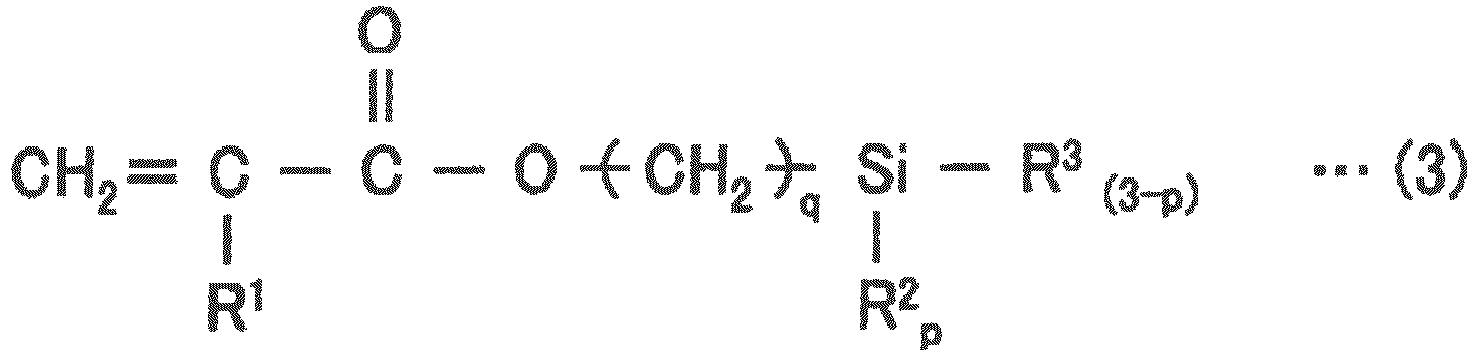
- the inorganic particles (B) are particles where a group expressed by a general formula (in the formula, R 4 and R 5 are independently a methyl group or an ethyl group) is present at surfaces, are particles where a group expressed by a general formula (in the formula R 6 , R 7 , and R 8 are independently a methyl group or an ethyl group) is present at surfaces, and/or are particles surface-treated with a compound expressed by a general formula (in the formula R 1 is a hydrogen atom or a methyl group, R 2 is a hydrolyzable group, R 3 is a hydrocarbon group having 1 to 6 carbon atoms, p is 2 or 3, and q is an integer greater than or equal to 1 and less than or equal to 6), and the inorganic particles (B) have an average primary particle size of greater than or equal to 5 nm and less than or equal to 50 nm.
- a ratio of a mass of the inorganic particles (B) to a total mass of the inorganic particles (Al), the inorganic particles (A2), and the inorganic particles (B) is greater than or equal to 0.001 and less than or equal to 0.015.
- the ratio of a mass of the inorganic particles (A1) to the total mass of the inorganic particles (A1), the inorganic particles (A2), and the inorganic particles (B) is greater than or equal to 0.2.
- the polymerizable monomers are (meth)acrylic esters.
- a flowable composite resin that has reduced stringiness, suppresses liquid separation, and is able to satisfy polishability, abrasion resistance formability, handleability and flexural strength.
- a dental curable composition of the present embodiment includes polymerizable monomers; inorganic particles (A1) or the inorganic particles (A1) and inorganic particles (A2); and inorganic particles (B).
- the inorganic particles (A1) are surface-treated with a compound expressed by the general formula (1). Therefore, it is possible to achieve the flexural strength, the abrasion resistance, and the polishability of a flowable composite resin.
- the volume-median particle size of the inorganic particles (Al) is 0.1 ⁇ m to 0.9 um, and is preferably 0.15 ⁇ m to 0.70 um.
- the volume-median particle size of the inorganic particles (A1) is less than 0.1 ⁇ m, the flexural strength of a flowable composite resin decreases.
- the volume-median particle size of the inorganic particles (A1) exceeds 0.9 ⁇ m, the flexural strength, the abrasion resistance, and the polishability of a flowable composite resin decrease.
- the inorganic particles (A2) are surface-treated with a compound expressed by the general formula (2). Therefore, it is possible to enhance achieve the formability and the handleability of a flowable composite resin.
- the volume-median particle size of the inorganic particles (A2) is 0.1 ⁇ m to 0.9 ⁇ m, and is preferably 0.15 ⁇ m to 0.70 ⁇ m.
- the volume-median particle size of the inorganic particles (A2) is greater than or equal to 0.1 ⁇ m, the flexural strength of a flowable composite resin can be enhanced.
- the volume-median particle size of the inorganic particles (A2) is less than or equal to 0.9 ⁇ m, the flexural strength, the abrasion resistance, and the polishability of a flowable composite resin can be enhanced.
- volume-median particle sizes of the inorganic particles (A1) and the inorganic particles (A2) can be measured by laser diffraction scattering.
- the inorganic particles (B) are particles where a group expressed by the general formula (A) is present at surfaces, are particles where a group expressed by the general formula (B) is present at surfaces, and/or are particles surface-treated with a compound expressed by the general formula (3).
- liquid separation of a flowable composite resin can be suppressed.
- the average primary particle size of the inorganic particles (B) is 5 nm to 50 nm, and is preferably 5 nm to 20 nm. When the average primary particle size of the inorganic particles (B) is less than 5 nm, manufacturing becomes difficult. When the average primary particle size of the inorganic particles (B) exceeds 50 nm, liquid separation of a flowable composite resin easily occurs.
- the average primary particle size of the inorganic particles (B) is the average value of the primary particle sizes of 100 inorganic particles (B) randomly selected after taking an electron micrograph.
- the ratio of the mass of the inorganic particles (B) to a total mass of the inorganic particles (A1), the inorganic particles (A2), and the inorganic particles (B) is between 0.001 and 0.015, and is preferably between 0.001 and 0.010.
- the ratio of the mass of the inorganic particles (B) to the total mass of the inorganic particles (A1), the inorganic particles (A2), and the inorganic particles (B) is less than 0.001, liquid separation of a flowable composite resin easily occurs.
- the ratio of the mass of the inorganic particles (A1) to the total mass of the inorganic particles (A1), the inorganic particles (A2), and the inorganic particles (B) is greater than or equal to 0.2. This makes it possible to enhance the formability and handleability of a flowable composite resin.
- the refractive index of a polymer of the polymerizable monomers is normally 1.52 to 1.58, and is preferably 1.53 to 1.58.
- the refractive index means a refractive index measured using an Abbe refractometer at 25 °C.
- the polymerizable monomers are (meth)acrylic esters.
- Examples of monofunctional (meth)acrylic esters include methyl (meth)acrylate, isobutyl (meth)acrylate, benzyl (meth)acrylate, lauryl (meth)acrylate, 2,3-dibromopropyl (meth)acrylate, 2-hydroxyethyl (meth)acrylate, 6-hydroxyhexyl (meth)acrylate, 10-hydroxydecyl (meth)acrylate, propylene glycol mono(meth)acrylate, glycerin mono(meth)acrylate, erythritol mono(meth)acrylate, (meth)acryloyloxydodecylpyridinium bromide, (meth)acryloyloxydodecylpyridinium chloride, (meth)acryloyloxyhexadecylpyridinium chloride, (meth)acryloyloxydecylammonium chloride, and the like.
- difunctional (meth)acrylic esters examples include ethylene glycol di(meth)acrylate, triethylene glycol di(meth)acrylate, propylene glycol di(meth)acrylate, neopentyl glycol di(meth)acrylate, 1,6-hexanediol di(meth)acrylate, 1,10-decanediol di(meth)acrylate, 2,2-bis[4-[3-(meth)acryloyloxy-2-hydroxypropoxy]phenyl]propane, 2,2-bis[4-(2-(meth)acryloyloxyethoxy)phenyl]propane, 2,2-bis[4-(meth)acryloyloxypolyethoxyphenyl]propane, 1,2-bis[3-(meth)acryloyloxy-2-hydroxypropoxy]ethane, pentaerythritol di(meth)acrylate, [2,2,4-trimethylhexamethylene bis(2-carbamoyl
- tri- or higher-functional (meth)acrylic esters examples include trimethylolpropane tri(meth)acrylate, trimethylolethane tri(meth)acrylate, tetramethylolmethane tri(meth)acrylate, pentaerythritol tetra(meth)acrylate, dipentaerythritol hexa(meth)acrylate, N,N' -(2,2,4-trimethylhexamethylene)bis[2-(aminocarboxy)propane-1,3-diol]tetramethacrylate, 1,7-diacryloyloxy-2,2,6,6-tetraacryloyloxymethyl-4-oxyheptane, and the like.
- the ratio of the mass of the polymerizable monomers to the total mass of the inorganic particles (A1), the inorganic particles (A2), and the inorganic particles (B) is normally between 0.1 and 1.5, and is preferably between 0.25 and 0.65.
- the inorganic particles (A) may be spherical, but are preferably irregularly shaped. Because this increases the specific surface area of the inorganic particles (A1), it is possible to increase the bondability with the polymerizable monomers, thus making it possible to enhance the flexural strength.
- R 2 in the general formula (1) is not limited in particular, and may be an alkoxy group such as a methoxy group, an ethoxy group, and a butoxy. group, a chlorine atom, an isocyanate group, or the like.
- R 3 in the general formula (1) may be an alkyl group having 1 to 6 carbon atoms, an alkenyl group having 2 to 6 carbon atoms, an alkynyl groups having 2 to 6 carbon atoms, or the like.
- An alkyl group having 1 to 6 carbon atoms may be linear, branched, or cyclic, and may be, for example, a methyl group, an ethyl group, an n-propyl group, an isopropyl group, an n-butyl group, an isobutyl group, a sec-butyl group, a tert-butyl group, an n-pentyl group, an isopentyl group, a neopentyl group, a tert-pentyl group, an n-hexyl group, a cyclopropyl group, a cyclobutyl group, a cyclopentyl group, a cyclohexyl group, or the like.
- An alkenyl group having 2 to 6 carbon atoms may be linear, branched, or cyclic, and may be, for example, a vinyl group, an allyl group, a methylvinyl group, a butenyl group, a pentenyl group, a hexenyl group, a cyclopropenyl group, a cyclobutenyl group, a cyclopentenyl group, a cyclohexenyl group, or the like.
- An alkynyl group having 2 to 6 carbon atoms may be linear, branched, or cyclic, and may be, for example, an ethynyl group, a 1-propynyl group, a 2-propynyl group, a 1-butynyl group, a 1-methyl-2-propynyl group, a 2-butynyl group, a 3-butynyl group, a 1-pentynyl group, a 1-ethyl-2-propynyl group, a 2-pentynyl group, a 3-pentynyl group, a 1-methyl-2-butynyl group, a 4-pentynyl group, a 1-methyl-3-butynyl group, a 2-methyl-3-butynyl group, a 1-hexynyl group, a 2-hexynyl group, a 1-ethyl-2-butynyl group, a 3-hexynyl
- q in the general formula (1) is an integer greater than or equal to 6 and less than or equal to 13, and is preferably an integer greater than or equal to 8 and less than or equal to 13.
- the compound expressed by the general formula (1) is not limited in particular, and may be 6-methacryloyloxyhexyltrimethoxysilane, 7-methacryloyloxyheptyltrimethoxysilane, 8-methacryloyloxyoctyltrimethoxysilane, 8-acryloyloxyoctyltrimethoxysilane, 8-methacryloyloxyoctyltriethoxysilane, 9-methacryloyloxynonyltrimethoxysilane, 10-methacryloyloxydecyltrimethoxysilane, 11-methacryloyloxyundecyltrimethoxysilane, 11-methacryloyloxyundecyldichloromethylsilane, 11-methacryloyloxyundecyltrichlorosilane, 11-methacryloyloxyundecyldimethoxymethylsilane, 12-
- 8-methacryloyloxyoctyltrimethoxysilane, 9-methacryloyloxynonyltrimethoxysilane, 10-methacryloyloxydecyltrimethoxysilane, and 11-methacryloyloxyundecyltrimethoxysilane are preferable.
- a method of surface-treating the inorganic particles (A1) is not limited in particular, and may be a method by which the inorganic particles (A1) before being surface-treated are sprayed with a solution obtained, by diluting the compound expressed by the general formula (1) diluted with a solvent, while being stirred in a mixing tank and are heated and dried for a certain time in the tank while being kept stirred, a method by which the inorganic particles (A1) before being surface-treated and a compound expressed by the general formula (1) are stirred and mixed in a solvent and are thereafter heated to be dried, or the like.
- the mass ratio of the compound expressed by the general formula (1) to the inorganic particles (A1) before being surface-treated is normally between 0.005 and 0.15, and is preferably between 0.01 and 0.13.
- the refractive index of the inorganic particles (A1) is normally 1.52 to 1.58, and is preferably 1.53 to 1.58.
- the difference between the refractive index of a polymer of the polymerizable monomers and the refractive index of the inorganic particles (A1) is normally 0.03 or less.
- a material constituting the inorganic particles (A1) before being surface-treated is not limited in particular, and may be various kinds of glass that contain silica as a principal component and contain, on an as-needed basis, an oxide of a heavy metal, boron, aluminum or the like (such as E glass, barium glass, and lanthanum glass-ceramics), various kinds of ceramics, a composite oxide (such as silica-titania composite oxide and silica-zirconia composite oxide), kaolin, clay minerals (such as montmorillonite), mica, ytterbium fluoride, yttrium fluoride, or the like, and two or more kinds of these may be used in combination as the material constituting the inorganic particles (A1) before being surface-treated.
- various kinds of glass that contain silica as a principal component and contain, on an as-needed basis, an oxide of a heavy metal, boron, aluminum or the like (such as E glass, barium glass, and lanthanum glass-cera
- a commercially available product of the inorganic particles (A1) may be G018-053, GM27884, 8235, GM31684 (which are manufactured by Schott AG), E2000, E3000 (which are manufactured by ESSTECH, Inc.), or the like.
- the inorganic particles (A2) are similar to the inorganic particles (A1).
- a compound expressed by the general formula (2) is similar to a compound expressed by the general formula (1) except that q is an integer greater than or equal to 1 and less than or equal to 5.
- q in the general formula (2) is an integer greater than or equal to 1 and less than or equal to 3.
- the compound expressed by the general formula (2) is not limited in particular, and may be 3-methacryloyloxypropyltrimethoxysilane, 3-acryloyloxypropyltrimethoxysilane, 3-methacryloyloxypropyltriethoxysilane, 3-methacryloyloxypropyldimethoxysilane, 4-methacryloyloxybutyltrimethoxysilane, or the like, and two or more kinds of these may be used in combination as the compound expressed by the general formula (2).
- 3-methacryloyloxypropyltrimethoxysilane is preferable.
- the inorganic particles (B) may be either spherical or irregularly shaped. Also, the inorganic particles (B) may be either primary particles that are not aggregated or secondary particles into which primary particles aggregate.
- the primary particle size is the average value of the long diameters and the short diameters of the inorganic particles (B).
- a method of surface-treating the inorganic particles (B) is not limited in particular, and may be a method by which the inorganic particles (B) before being surface-treated are sprayed with a solution obtained by diluting a silane coupling agent or a compound expressed by the general formula (3) with a solvent while being stirred in a mixing tank and are heated and dried for a certain time in the tank while being kept stirred, a method by which the inorganic particles (B) before being surface-treated and a silane coupling agent or a compound expressed by the general formula (3) are stirred and mixed in a solvent and are thereafter heated to be dried, or the like.
- a silane coupling agent is not limited in particular as long as it can introduce a group expressed by the chemical formula (A) and/or a group expressed by the chemical formula (B) onto a surface, and may be dimethyldichlorosilane, hexamethyldisilazane, or the like, and two or more kinds of these may be used in combination as the silane coupling agent.
- a compound expressed by the general formula (3) is similar to a compound expressed by the general formula (1) except that q is an integer greater than or equal to 1 and less than or equal to 6.
- q in the general formula (3) is an integer greater than or equal to 1 and less than or equal to 3.
- the compound expressed by the general formula (3) is not limited in particular, and may be 3-methacryloyloxypropyltrimethoxysilane, 3-acryloyloxypropyltrimethoxysilane, 3-methacryloyloxypropyltriethoxysilane, 3-methacryloyloxypropyldimethoxysilane, 4-methacryloyloxybutyltrimethoxysilane, or the like, and two or more kinds of these may be used in combination as the compound expressed by the general formula (3).
- 3-methacryloyloxypropyltrimethoxysilane is preferable.
- a material constituting the inorganic particles (B) before being surface-treated is not limited in particular, and may be an inorganic oxide such as silica, alumina, titania, or zirconia, a composite oxide thereof, calcium phosphate, hydroxylapatite, yttrium fluoride, ytterbium fluoride, barium titanate, potassium titanate, or the like.
- silica, alumina, titania, silica-alumina composite oxide, and silica-zirconia composite oxide are preferable.
- a commercially available product of the inorganic particles (B) before being surface-treated may be Aerosil 200, OX-50 (which are manufactured by Nippon Aerosil Co., Ltd.), or the like.
- a commercially available product of the inorganic particles (B) may be Aerosil R812, R972, RX-50 (which are manufactured by Nippon Aerosil Co., Ltd.), or the like.
- the refractive index of the inorganic particles (B) is normally 1.43 to 1.50, and is preferably 1.43 to 1.46.
- the difference between the refractive index of a polymer of the polymerizable monomers and the refractive index of the inorganic particles (B) is normally 0.05 or more.
- the dental curable composition may further include a polymerization initiator.
- a redox polymerization initiator In a case of curing the dental curable composition according to the present embodiment at room temperature, a redox polymerization initiator can be used.
- a redox polymerization initiator is not limited in particular, and may be an organic peroxide/amine system, an organic peroxide/amine/sulfinic acid (or a salt thereof) system, or the like.
- an oxidant and a reductant need to be in a configuration of being separately packaged and be mixed up immediately before use.
- An oxidant is not limited in particular, and may be an organic peroxide such as diacyl peroxides, peroxyesters, peroxycarbonates, dialkyl peroxides, peroxyketals, ketone peroxides, or hydroperoxides.
- diacyl peroxides examples include benzoyl peroxide, 2,4-dichlorobenzoyl peroxide, m-toluoyl peroxide, lauroyl peroxide, and the like.
- peroxyesters examples include t-butyl peroxybenzoate, di-t-butyl peroxyisophthalate, t-butyl peroxy-2-ethylhexanoate, and the like.
- peroxycarbonates examples include t-butyl peroxy isopropyl carbonate and the like.
- dialkyl peroxides examples include dicumyl peroxide, di-t-butyl peroxide, 2,5-dimethyl-2,5-bis(benzoylperoxy)hexane, and the like.
- peroxyketals examples include 1,1-bis(t-butylperoxy)-3,3,5-trimethylcyclohexane and the like.
- ketone peroxides examples include methyl ethyl ketone peroxide and the like.
- hydroperoxides examples include t-butyl hydroperoxide and the like.
- Examples of a reductant are not limited in particular, and include N,N-dimethylaniline, N,N-dimethyl-p-toluidine, N,N-dimethyl-m-toluidine, N,N-diethyl-p-toluidine, N,N-dimethyl-3,5-dimethylaniline, N,N-dimethyl-3,4-dimethylaniline, N,N-dimethyl-4-ethylaniline, N,N-dimethyl-4-isopropylaniline, N,N-dimethyl-4-t-butylaniline, N,N-dimethyl-3,5-di-t-butylaniline, N,N-bis(2-hydroxyethyl)-p-toluidine, N,N-bis(2-hydroxyethyl)-3,5-dimethylaniline, N,N-bis(2-hydroxyethyl)-3,4-dimethylaniline, N,N-bis(2-hydroxyethy
- an oxidation-reduction initiator such as a cumenehydroperxide/thiourea system, an ascorbic acid/Cu 2+ salt system, or an organic sulfinic acid (or salt thereof)/amine/inorganic peroxide system, tributylborane, organic sulfinic acid, etc., may also be used.
- a photopolymerization initiator can be used.
- a photopolymerization initiator is not limited in particular, and may be an oxidation-reduction initiator such as ⁇ -diketone/reductant, ketal/reductant, thioxanthone/reductant, or the like
- ⁇ -diketone examples include camphorquinone, benzyl, 2,3-pentanedione, and the like.
- ketal examples include benzyl dimethyl ketal, benzyl diethyl ketal, and the like.
- thioxanthone examples include 2-chlorothioxanthone, 2,4-diethylthioxantone, and the like.
- Examples of a reductant include tertiary amines such as Michler's ketone, 2-(dimethylamino)ethyl methacrylate, N,N-bis[(meth)acryloyloxyethyl]-N-methylamine, ethyl N,N-dimethylaminobenzoate, butyl 4-dimethylaminobenzoate, butoxyethyl 4-dimethylaminobenzoate, N-methyldiethanolamine, 4-dimethylaminobenzophenone, N,N-bis(2-hydroxyethyl)-p-toluidine, and dimethylaminophenanthrol; aldehydes such as citronellal, lauryl aldehyde, phthaldialdehyde, dimethylaminobenzaldehyde, and terephthalaldehyde; and compounds having a thiol group, such as 2-mercaptobenzoxazole, decanethiol,
- an organic peroxide may be added to an oxidation-reduction initiator.
- a photopolymerization initiator In a case of irradiating the dental curable composition according to the present embodiment with ultraviolet rays to cure the composition, a photopolymerization initiator can be used.
- a photopolymerization initiator is not limited in particular, and may be a benzoin alkyl ether, a benzyl dimethyl ketal, an acylphosphine oxide, an bisacylphosphine oxide, or the like.
- an acylphosphine oxide examples include 2,4,6-trimethylbenzoyldiphenylphosphine oxide, 2,6-dimethoxybenzoyldiphenylphosphine oxide, 2,6-dichlorobenzoyldiphenylphosphine oxide, 2,3,5,6-tetramethylbenzoyldiphenylphosphine oxide, benzoyl bis(2,6-dimethylphenyl)phosphonate, 2,4,6-trimethylbenzoylethoxyphenylphosphine oxide, and the like.
- Examples of a bisacylphosphine oxide include bis(2,6-dichlorobenzoyl)phenylphosphine oxide, bis(2,6-dichlorobenzoyl)-2,5-dimethylphenylphosphine oxide, bis(2,6-dichlorobenzoyl)-4-propylphenylphosphine oxide, bis(2,6-dichlorobenzoyl)-1-naphthylphosphine oxide, bis(2,6-dimethoxybenzoyl)phenylphosphine oxide, bis(2,6-dimethoxybenzoyl)-2,4,4-trimethylpentylphosphine oxide, bis(2,6-dimethoxybenzoyl)-2,5-dimethylphenylphosphine oxide, bis(2,4,6-trimethylbenzoyl)phenylphosphine oxide, and the like.
- a (bis)acylphosphine oxide may be substituted by a water-soluble substituent.
- a (bis)acylphosphine oxide may be used in combination with a reductant such as amines, aldehydes, mercaptans, or sulfinic acid salts.
- the mass ratio of the polymerization initiator to the polymerizable monomers is normally between 0.001 and 0.1, and is preferably between 0.002 and 0.05.
- the dental curable composition according to the present embodiment may further include a polymerization inhibitor, an ultraviolet absorber, a fluorescent agent, a pigment, and the like.
- a polymerization inhibitor is not limited in particular, and may be 3,5-dibutyl-4-hydroxytoluene, hydroquinone, dibutylhydroquinone, dibutylhydroquinone monomethyl ether, 2,6-t-butylphenol, 4-methoxyphenol, or the like, and two or more kinds of these may be used in combination as the polymerization inhibitor.
- the dental curable composition may be used as a paste in which the inorganic particles (A1) and/or the inorganic particles (A2); and the inorganic particles (B) are dispersed in the polymerizable monomers or may be used a molded body in which the polymerizable monomers; the inorganic particles (A1) and/or the inorganic particles (A2); and the inorganic particles (B) are dispersed in the cured polymerizable monomers.
- a cavity in an oral cavity can be directly filled with a paste in which the inorganic particles (A1) and/or the inorganic particles (A2); and the inorganic particles (B) are dispersed in the polymerizable monomers.
- the molded body can be attached inside the oral cavity using a dental adhesive.
- the dental curable composition is chemically polymerizable (and photopolymerizable)
- a composition containing an oxidant and a composition containing a reductant need to be in a configuration of being separately packaged and be mixed up immediately before use of the dental curable composition.
- the dental curable composition according to the present embodiment is preferably a flowable composite resin.
- the flowable composite resin may be either of an one-agent type or of a two-agent type.
- the extrusion strength of the flowable composite resin is normally 10 kgf or less. This makes it possible to enhance the formability and handleability of the flowable composite resin.
- the flowable composite resin is provided, for example, as a package that includes a syringe filled with the flowable composite resin, a plunger fitted into the syringe from the rear end side of the syringe, and a needle chip that is attached to the tip portion of the syringe.
- the package may include, for example, two syringes connected in parallel and two plungers connected in parallel, and a static mixer may be provided at the tip portion of each of the syringes.
- Irregularly-shaped barium glass particles GM27884 NanoFine 180 manufactured by Schott AG having a volume-median particle size of 0.18 ⁇ m were surface-treated with 8-methacryloyloxyoctyltrimethoxysilane to obtain inorganic particles (A-1) having a volume-median particle size of 0.18 ⁇ m.
- Inorganic particles (A1-2) having a volume-median particle size of 0.4 ⁇ m were obtained in the same manner as the inorganic particles (A1-1) except for using barium glass particles GM27884 Ultra Fine 0.4 (manufactured by Schott AG) having a volume-median particle size of 0.40 ⁇ m instead of irregularly-shaped barium glass particles GM27884 NanoFine 180 (manufactured by Schott AG) having a volume-median particle size of 0.18 ⁇ m.
- Inorganic particles (A1-3) having a volume-median particle size of 0.7 ⁇ m were obtained in the same manner as the inorganic particles (A1-1) except for using barium glass particles GM27884 Ultra Fine 2.0 (manufactured by Schott AG) having a volume-median particle size of 0.70 ⁇ m instead of irregularly-shaped barium glass particles GM27884 NanoFine 180 (manufactured by Schott AG) having a volume-median particle size of 0.18 ⁇ m.
- Inorganic particles (A1-4) having a volume-median particle size of 1.0 ⁇ m were obtained in the same manner as the inorganic particles (A1-1) except for using barium glass particles GM27884 Ultra Fine 2.0 (manufactured by Schott AG) having a volume-median particle size of 1.0 ⁇ m instead of irregularly-shaped barium glass particles GM27884 NanoFine 180 (manufactured by Schott AG) having a volume-median particle size of 0.18 ⁇ m.
- Inorganic particles (A2-1) having a volume-median particle size of 0.18 ⁇ m were obtained in the same manner as the inorganic particles (A1-1) except for using 3-methacryloyloxypropyltrimethoxysilane instead of 8-methacryloyloxyoctyltrimethoxysilane.
- Inorganic particles (A2-2) having a volume-median particle size of 0.4 ⁇ m were obtained in the same manner as the inorganic particles (A1-2) except for using 3-methacryloyloxypropyltrimethoxysilane instead of 8-methacryloyloxyoctyltrimethoxysilane.
- Inorganic particles (A2-3) having a volume-median particle size of 0.7 ⁇ m were obtained in the same manner as the inorganic particles (A1-3) except for using 3-methacryloyloxypropyltrimethoxysilane instead of 8-methacryloyloxyoctyltrimethoxysilane.
- Table 1 illustrates characteristics of the inorganic particles (A1) and (A2).
- Table 1 INORGANIC PARTICLES VOLUME-MEDIAN PARTICLE SIZE [ ⁇ m] SURFACE TREATMENT AGENT A1-1 0.18 8-METHACRYLOYLOXYOCTYLTRIMETHOXYSILANE A1-2 0.40 8-METHACRYLOYLOXYOCTYLTRIMETHOXYSILANE A1-3 0.70 8-METHACRYLOYLOXYOCTYLTRIMETHOXYSILANE A1-4 1.0 8-METHACRYLOYLOXYOCTYLTRIMETHOXYSILANE A2-1 0.18 3-METHACRYLOYLOXYPROPYLTRIMETHOXYSILANE A2-2 0.40 3-METHACRYLOYLOXYPROPYLTRIMETHOXYSILANE A2-3 0.70 3-METHACRYLOYLOXYPROPYLTRIMETHOXYSILANE
- the inorganic particles (A1) or the inorganic particles (A2) were dispersed for 30 minutes using an ultrasonic disperser to obtain a dispersion of the inorganic particles (A1) or the inorganic particles (A2). Then, the volume-median particle size of the inorganic particles (A1) or the inorganic particles (A2) was measured using a laser diffraction particle size distribution analyzer LA-950 (manufactured by HORIBA, Ltd).
- Silica particles Aerosil R812 (manufactured by Nippon Aerosil Co., Ltd.), having an average primary particle size of 7 nm and surface-treated with hexamethyldisilazane, were used as inorganic particles (B-1) .
- Silica particles Aerosil R972 manufactured by Nippon Aerosil Co., Ltd., having an average primary particle size of 16 nm and surface-treated with dimethyldichlorosilane, were used as inorganic particles (B-2).
- Silica particles Aerosil OX-50 manufactured by Nippon Aerosil Co., Ltd.
- silica particles Aerosil OX-50 having an average primary particle size of 40 nm were treated with 3-methacryloyloxypropyltrimethoxysilane to obtain inorganic particles (B-3) having an average primary particle size of 40 nm.
- Table 2 indicates characteristics of the inorganic particles (B).
- INORGANIC PARTICLES AVERAGE PRIMARY PARTICLE SIZE [nm] SURFACE TREATMENT AGENT B-1 7 HEXAMETHYLDISILAZANE B-2 16 DIMETHYLDICHLOROSILANE B-3 40 3-METHACRYLOYLOXYPROPYLTRIMETHOXYSILANE
- Electron micrographs of 100 inorganic particles (B) were subjected to image analysis using image analysis software WinROOF (manufactured by MITANI Corporation), and thereafter, the average primary particle size of the inorganic particles (B) was calculated as a volume average particle size.
- UDMA di-2-methacryloyloxyethyl-2,2,4-trimethylhexamethylene dicarbamate
- Bis-MEPP 2,2-bis[4-(2-methacryloyloxyethoxy)phenyl]propane
- 3G triethylene glycol dimethacrylate
- TMPT trimethylolpropane trimethacrylate
- Table 3 indicates characteristics of the flowable composite resins of Examples and Comparative Examples.
- Table 3 INORGANIC PARTICLES A1 INORGANIC PARTICLES A2 INORGANIC PARTICLES B EXTRUSION STRENGTH [kgf] TYPE ADDITIVE AMOUNT [PART] TYPE ADDITIVE AMOUNT [PART] TYPE ADDITIVE AMOUNT [PART] E1 A1-1 99.9 - - B-1 0.1 6 E2 A1-1 99.9 - - B-1 0.1 5 A1-2 E3 A1-1 98.5 - - B-2 1.5 3 A1-2 A1-3 E4 A1-1 20.0 A2-2 79.5 B-3 0.5 8 E5 A1-1 55.0 A2-1 44.0 B-1 1.0 4 A1-2 A2-2 B-2 A1-3 A2-3 E6 A1-2 59.0 A2-2 40.0 B-3 1.0 6 E7 A1-3 98.5 - - B-3 1.5 2 CE1 A1-2 100.0 - - - - 6 CE2 A1-4 99.0 -
- Extrusion strength was evaluated using a cylindrical polyolefin resin syringe (an MI filling container of 7.7 mm in inner diameter and 78.6 mm in length), a cylindrical plunger fitted into the syringe from the rear end side of the syringe, and a needle chip (20G) that is attached to the tip portion of the syringe.
- the needle of the needle chip is 0.65 mm in inner diameter and 13 mm in length, and is bent 50° at a position 7.5 mm from the tip.
- the syringe and the plunger are formed of a member opaque to environmental light.
- extrusion strength was measured at 25 °C, using a universal testing machine AG-IS (manufactured by Shimadzu Corporation). Specifically, while vertically retaining the storage container, a crosshead to which a jig for compressive strength test was attached was lowered at 10 mm/min to apply a load on and extrude the flowable composite resin, and a maximum load at the time was determined as extrusion strength.
- a ring made of acrylic resin having an inner diameter of 10 mm and a thickness of 2 mm was filled with a flowable composite resin, and a cylindrical rod made of plastic having a diameter of 5 mm was immersed in the central portion of the ring by 1 mm.
- a universal testing machine AG-IS manufactured by Shimadzu Corporation
- the cylindrical rod was pulled up at a speed of 50 mm/min, and the distance at which the paste was cut off was measured to determine the stringiness length. Note that a stringiness length of 30 mm or less was determined as being acceptable.
- the upper side and the lower side of the flowable composite resin were pressed with slide glasses.
- the flowable composite resin was cured by irradiating the upper surface and the lower surface at nine points on each surface with visible light for 10 seconds per point, using a G-Light Prima-II (manufactured by GC Corporation).
- the cured product was stored in distilled water at 37 °C for 24 hours to obtain a test piece. At this point, five test pieces were made.
- the flexural strength of the five test pieces was measured using a universal testing machine AG-IS (manufactured by Shimadzu Corporation) with the distance between support points being 20 mm and the crosshead speed being 1 mm/min, and thereafter, the average value was calculated to be determined as flexural strength. Note that a flexural strength of 160 MPa or more was determined as being acceptable.
- the upper side and the lower side of the flowable composite resin were pressed with slide glasses.
- the upper surface and the lower surface of the flowable composite resin were irradiated with visible light for 10 seconds using a G-Light Prima-II (manufactured by GC Corporation) to cure the flowable composite resin.
- the cured product was stored in distilled water at 37 °C for 24 hours to obtain a test piece.
- Each test piece was attached to a bite abrasion tester (manufactured by TOKYO GIKEN, INC.), and after polishing an unpolymerized layer with #1000 abrasive paper, the overall length of the test piece before testing was measured.
- a slurry obtained by mixing and kneading the equal amounts of glycerin and Acricone AC (manufactured by Mitsubishi Rayon Co., Ltd.) was laid on the bite abrasion tester, and a test assuming 100,000 vertical and lateral bites was conducted against a PMMA plate. After the test, the overall length of each test piece was measured.
- the abrasion resistance was evaluated by determining the difference between before and after the test as the amount of wear. Note that a wear of 10 ⁇ m or less was determined as being acceptable
- the upper side and the lower side of the flowable composite resin were pressed with slide glasses.
- the flowable composite resin was cured by irradiating the upper surface and the lower surface at nine points on each surface with visible light for 10 seconds per point, using a G-Light Prima-II (manufactured by GC Corporation).
- the cured product was extracted from the mold to obtain a test piece.
- a smooth surface of the test piece was polished under a dry condition, using #600 abrasive paper.
- polishing was performed for 10 seconds at a rotational speed of approximately 10,000 rpm using PRE SHINE (manufactured by GC Corporation), and thereafter, polishing was performed for 10 seconds at a rotational speed of approximately 10,000 rpm using DIA SHINE (manufactured by GC Corporation).
- the glossiness of the polished surface was measured at a measurement angle of 60°, using a glossmeter VG-2000 (manufactured by NIPPON DENSHOKU INDUSTRIES CO., LTD.), and its ratio to that of a mirror serving as 100 was determined as glossiness to evaluate the polishability. Note that a glossiness of 60% or more was determined as being acceptable.
- the above-described syringe was filled with 2.0 mL of a flowable composite resin, and then centrifuged at 760 g for 2 hours.
- 0.5 g of the flowable composite resin was extracted from each of the tip and the rear end of the syringe into a crucible, and then burned at 700° C.
- the weight after burning was measured to calculate the difference between the contents of the inorganic particles at the tip and the rear end of the syringe, and the liquid separation was evaluated. Note that the liquid separation was determined based on the following criteria.
- Table 4 indicates the evaluation results of the stringiness, the flexural strength, the abrasion resistance, the polishability, the formability, the handleability, and the liquid separation of the flowable composite resins.
- Table 4 STRINGINESS LENGTH [mm] FLEXURAL STRENGTH [MPa] AMOUNT OF WEAR [ ⁇ m] GLOSSINESS [%] FORMABILITY AND HANDLEABILITY LIQUID SEPARATION E1 20 161 3 73 B A E2 22 168 3 70 B A E3 26 162 7 64 B A E4 22 174 4 67 A A E5 23 169 7 63 A A E6 23 163 5 65 A A E7 26 163 9 61 B A CE1 21 167 5 65 B B CE2 21 138 32 32 B A CE3 51 162 3 72 B A
- the flowable composite resin of Comparative Example 2 contains inorganic particles (A1-4) having a volume-median particle size of 1.0 ⁇ m, the flexural strength, the abrasion resistance, and the polishability are low.
Landscapes
- Health & Medical Sciences (AREA)
- Oral & Maxillofacial Surgery (AREA)
- Life Sciences & Earth Sciences (AREA)
- Public Health (AREA)
- Animal Behavior & Ethology (AREA)
- General Health & Medical Sciences (AREA)
- Epidemiology (AREA)
- Veterinary Medicine (AREA)
- Plastic & Reconstructive Surgery (AREA)
- Chemical & Material Sciences (AREA)
- Inorganic Chemistry (AREA)
- Biophysics (AREA)
- Dental Preparations (AREA)
- Polymerisation Methods In General (AREA)
Claims (2)
- Composition dentaire durcissable comprenant :des monomères polymérisables ;des particules inorganiques A1 ou les particules inorganiques A1 et des particules inorganiques A2 ; etdes particules inorganiques B,dans laquelle les particules inorganiques A1 sont traitées en surface avec un composé exprimé par une formule générale
 - dans la formule, R1 est un atome d'hydrogène ou un groupe méthyle, R2 est un groupe hydrolysable, R3 est un groupe hydrocarboné ayant de 1 à 6 atomes de carbone, p est égal à 2 ou 3, et q est un nombre entier supérieur ou égal à 6 et inférieur ou égal à 13 - et les particules inorganiques A1 ont une taille de particule médiane en volume supérieure ou égale à 0,1 µm et inférieure ou égale à 0,9 µm,dans laquelle les particules inorganiques A2 sont traitées en surface avec un composé exprimé par une formule générale
 - dans la formule, R1 est un atome d'hydrogène ou un groupe méthyle, R2 est un groupe hydrolysable, R3 est un groupe hydrocarboné ayant de 1 à 6 atomes de carbone, p est égal à 2 ou 3, et q est un nombre entier supérieur ou égal à 1 et inférieur ou égal à 5 - et les particules inorganiques A2 ont une taille de particule médiane en volume supérieure ou égale à 0,1 µm et inférieure ou égale à 0,9 µm,dans laquelle les particules inorganiques B sont des particules dans lesquelles un groupe exprimé par la formule générale suivante
 - dans la formule, R4 et R5 sont indépendamment un groupe méthyle ou un groupe éthyle - est présent au niveau des surfaces, sont des particules dans lesquelles un groupe exprimé par une formule générale suivante
 - dans la formule R6, R7 et R8 sont indépendamment un groupe méthyle ou un groupe éthyle - est présent au niveau des surfaces, et/ou sont des particules traitées en surface avec un composé exprimé par une formule générale
 - dans la formule, R1 est un atome d'hydrogène ou un groupe méthyle, R2 est un groupe hydrolysable, R3 est un groupe hydrocarboné ayant de 1 à 6 atomes de carbone, p est égal à 2 ou 3, et q est un nombre entier supérieur ou égal à 1 et inférieur ou égal à 6 - et les particules inorganiques B ont une taille moyenne de particules primaires supérieure ou égale à 5 nm et inférieure ou égale à 50 nm,dans laquelle un rapport entre une masse des particules inorganiques B et une masse totale des particules inorganiques A1, des particules inorganiques A2, et des particules inorganiques B est supérieur ou égal à 0,001 et inférieur ou égal à 0,015,dans laquelle un rapport entre une masse des particules inorganiques A1 et la masse totale des particules inorganiques A1, des particules inorganiques A2, et des particules inorganiques B est supérieur ou égal à 0,2,dans laquelle la taille de particule médiane en volume et la taille moyenne de particules primaires sont déterminées comme indiqué dans la description, etdans laquelle les monomères polymérisables sont des esters (méth)acryliques.
 - Composition dentaire durcissable selon la revendication 1, dans laquelle la composition dentaire durcissable est une résine composite fluidifiable.
Applications Claiming Priority (2)
| Application Number | Priority Date | Filing Date | Title |
|---|---|---|---|
| JP2017035297 | 2017-02-27 | ||
| PCT/JP2017/043871 WO2018154911A1 (fr) | 2017-02-27 | 2017-12-06 | Composition durcissable à usage dentaire |
Publications (3)
| Publication Number | Publication Date |
|---|---|
| EP3586814A1 EP3586814A1 (fr) | 2020-01-01 |
| EP3586814A4 EP3586814A4 (fr) | 2020-11-25 |
| EP3586814B1 true EP3586814B1 (fr) | 2024-01-31 |
Family
ID=63253256
Family Applications (1)
| Application Number | Title | Priority Date | Filing Date |
|---|---|---|---|
| EP17897495.2A Active EP3586814B1 (fr) | 2017-02-27 | 2017-12-06 | Composition dentaire durcissable |
Country Status (5)
| Country | Link |
|---|---|
| US (1) | US10918578B2 (fr) |
| EP (1) | EP3586814B1 (fr) |
| JP (1) | JP6793241B2 (fr) |
| CN (1) | CN110325167A (fr) |
| WO (1) | WO2018154911A1 (fr) |
Families Citing this family (7)
| Publication number | Priority date | Publication date | Assignee | Title |
|---|---|---|---|---|
| CN110325167A (zh) * | 2017-02-27 | 2019-10-11 | 株式会社Gc | 齿科用硬化性组成物 |
| US11135137B2 (en) * | 2017-09-07 | 2021-10-05 | Gc Corporation | Dental photopolymerizable composition |
| JP6841915B2 (ja) * | 2018-08-08 | 2021-03-10 | 株式会社ジーシー | 歯科用硬化性組成物 |
| JP2021127309A (ja) * | 2020-02-12 | 2021-09-02 | 株式会社ジーシー | 歯科修復用コンポジットレジン |
| JP7754441B2 (ja) | 2021-03-31 | 2025-10-15 | 株式会社ジーシーMfg | 歯科用組成物の製造方法、及び歯科用組成物 |
| JP2025540069A (ja) | 2022-12-06 | 2025-12-11 | ソルベンタム インテレクチュアル プロパティズ カンパニー | 表面処理された充填剤、このような充填剤を含有する歯科用組成物、その製造方法及び使用 |
| JP2026060965A (ja) | 2024-09-28 | 2026-04-09 | 株式会社松風 | 高い機械的強度が得られる歯科用硬化性組成物 |
Family Cites Families (35)
| Publication number | Priority date | Publication date | Assignee | Title |
|---|---|---|---|---|
| US3324074A (en) * | 1965-01-06 | 1967-06-06 | Monsanto Co | Methacrylate polymers with fillers and coupling agents |
| JPH0667816B2 (ja) * | 1988-11-11 | 1994-08-31 | 株式会社クラレ | 歯科用修復材 |
| DE4009602A1 (de) * | 1990-03-26 | 1991-10-02 | Ivoclar Ag | Polymerisierbare dentalmasse |
| US6500004B2 (en) * | 2000-12-14 | 2002-12-31 | Ultradent Products, Inc. | Endodontic sealing compositions and methods for using such compositions |
| US7001932B2 (en) * | 1999-04-12 | 2006-02-21 | Dentsply Detrey Gmbh | Dental composite restorative material and method of restoring a tooth |
| WO2000061073A1 (fr) * | 1999-04-12 | 2000-10-19 | Dentsply International Inc. | Substance composite pour restauration dentaire, et procede de restauration d'une dent |
| DE60042038D1 (de) * | 1999-10-28 | 2009-05-28 | 3M Innovative Properties Co | Siliziumdioxid-Nanoteilchen in Form eines trockenen Pulvers |
| EP1236459B1 (fr) | 2000-07-19 | 2005-11-23 | Tokuyama Corporation | Materiau photopolymerisable pour protheses dentaires |
| US7275932B2 (en) * | 2001-09-20 | 2007-10-02 | Pentron Clinical Technologies, Llc | Self-curing system for endodontic sealant applications |
| US6593395B2 (en) * | 2001-05-16 | 2003-07-15 | Kerr Corporation | Dental composition containing discrete nanoparticles |
| US6890968B2 (en) * | 2001-05-16 | 2005-05-10 | Kerr Corporation | Prepolymerized filler in dental restorative composite |
| DE60216930T2 (de) * | 2001-08-10 | 2007-04-05 | Dentsply International Inc. | Hydrolysestabiler selbstätzender selbstgrundierender Einkomponenten-Dentalkleber |
| CN1319507C (zh) * | 2002-01-31 | 2007-06-06 | 3M创新有限公司 | 牙科糊剂、牙科制品和方法 |
| US20030199605A1 (en) * | 2002-04-23 | 2003-10-23 | Fischer Dan E. | Hydrophilic endodontic sealing compositions and methods for using such compositions |
| CN101115459B (zh) * | 2004-11-16 | 2012-03-21 | 3M创新有限公司 | 包括含磷表面处理的牙科填料 |
| CN102342889A (zh) * | 2004-11-16 | 2012-02-08 | 3M创新有限公司 | 包括酪蛋白酸盐的牙科组合物及其应用 |
| AU2005306857A1 (en) * | 2004-11-16 | 2006-05-26 | 3M Innovative Properties Company | Dental compositions with calcium phosphorus releasing glass |
| KR101277869B1 (ko) * | 2004-11-16 | 2013-07-30 | 쓰리엠 이노베이티브 프로퍼티즈 컴파니 | 포스페이트 염을 포함하는 치과용 충전제 및 조성물 |
| US7828550B2 (en) * | 2005-09-21 | 2010-11-09 | Ultradent Products, Inc. | Activating endodontic points and dental tools for initiating polymerization of dental compositions |
| US7951851B2 (en) * | 2007-02-01 | 2011-05-31 | Kuraray Medical Inc. | Curable composition for dental purposes |
| CN102014847B (zh) * | 2008-04-28 | 2013-12-04 | 可乐丽则武齿科株式会社 | 牙科用组合物及复合树脂 |
| WO2009133912A1 (fr) * | 2008-04-28 | 2009-11-05 | クラレメディカル株式会社 | Composition dentaire et résine composite |
| US8436078B2 (en) * | 2008-04-28 | 2013-05-07 | Kuraray Noritake Dental Inc. | Dental composition and composite resin |
| EP2163235A1 (fr) * | 2008-09-15 | 2010-03-17 | Ivoclar Vivadent AG | Matériaux dentaires dotés de modules de flexion élevés |
| WO2010068359A1 (fr) * | 2008-12-11 | 2010-06-17 | 3M Innovative Properties Company | Particules de phosphate de calcium traitées en surface pour soins buccaux et compositions dentaires |
| US9119774B2 (en) * | 2009-09-18 | 2015-09-01 | Premier Dental Products Company | Self-healing dental restorative formulations and related methods |
| JP5613772B2 (ja) | 2010-09-30 | 2014-10-29 | クラレノリタケデンタル株式会社 | 歯科用ミルブランク |
| KR101645836B1 (ko) * | 2012-02-10 | 2016-08-04 | 쇼와 덴코 가부시키가이샤 | 경화성 조성물 및 그 용도 |
| EP2902007B1 (fr) | 2012-09-27 | 2019-01-09 | Tokuyama Dental Corporation | Matériau de réparation de produit d'obturation dentaire |
| JP6224616B2 (ja) * | 2012-11-30 | 2017-11-01 | クラレノリタケデンタル株式会社 | 歯科用硬化性組成物及び歯科用フロアブルコンポジットレジン |
| DE102013100546B4 (de) * | 2013-01-18 | 2022-06-23 | Schott Ag | Dispersionen von nanoskaligen Dentalglaspartikeln und Verfahren zu deren Herstellung |
| CN107405261B (zh) * | 2015-03-20 | 2020-07-31 | 株式会社Gc | 牙科用固化性组合物及其制造方法 |
| JP6487793B2 (ja) * | 2015-06-26 | 2019-03-20 | クラレノリタケデンタル株式会社 | 歯科用硬化性組成物 |
| JP5833270B1 (ja) | 2015-08-10 | 2015-12-16 | ユニ・チャーム株式会社 | 使い捨て着用物品 |
| CN110325167A (zh) * | 2017-02-27 | 2019-10-11 | 株式会社Gc | 齿科用硬化性组成物 |
-
2017
- 2017-12-06 CN CN201780087382.8A patent/CN110325167A/zh active Pending
- 2017-12-06 EP EP17897495.2A patent/EP3586814B1/fr active Active
- 2017-12-06 JP JP2019501061A patent/JP6793241B2/ja active Active
- 2017-12-06 WO PCT/JP2017/043871 patent/WO2018154911A1/fr not_active Ceased
- 2017-12-06 US US16/488,673 patent/US10918578B2/en active Active
Also Published As
| Publication number | Publication date |
|---|---|
| EP3586814A1 (fr) | 2020-01-01 |
| US10918578B2 (en) | 2021-02-16 |
| JP6793241B2 (ja) | 2020-12-02 |
| EP3586814A4 (fr) | 2020-11-25 |
| US20190380918A1 (en) | 2019-12-19 |
| JPWO2018154911A1 (ja) | 2019-12-12 |
| WO2018154911A1 (fr) | 2018-08-30 |
| CN110325167A (zh) | 2019-10-11 |
Similar Documents
| Publication | Publication Date | Title |
|---|---|---|
| EP3586814B1 (fr) | Composition dentaire durcissable | |
| EP3272325B1 (fr) | Composition durcissable pour utilisation dentaire et procédé pour la préparer | |
| CN104797232B (zh) | 牙科用固化性组合物和牙科用流动复合树脂 | |
| AU2008211424B2 (en) | Curable composition for dental purposes | |
| US11446214B2 (en) | Curable dental composite | |
| EP3381435B1 (fr) | Agent adhésif dentaire et son procédé de fabrication | |
| EP4032522B1 (fr) | Composition durcissable pour dentisterie |
Legal Events
| Date | Code | Title | Description |
|---|---|---|---|
| STAA | Information on the status of an ep patent application or granted ep patent |
Free format text: STATUS: THE INTERNATIONAL PUBLICATION HAS BEEN MADE |
|
| PUAI | Public reference made under article 153(3) epc to a published international application that has entered the european phase |
Free format text: ORIGINAL CODE: 0009012 |
|
| STAA | Information on the status of an ep patent application or granted ep patent |
Free format text: STATUS: REQUEST FOR EXAMINATION WAS MADE |
|
| 17P | Request for examination filed |
Effective date: 20190829 |
|
| AK | Designated contracting states |
Kind code of ref document: A1 Designated state(s): AL AT BE BG CH CY CZ DE DK EE ES FI FR GB GR HR HU IE IS IT LI LT LU LV MC MK MT NL NO PL PT RO RS SE SI SK SM TR |
|
| AX | Request for extension of the european patent |
Extension state: BA ME |
|
| DAV | Request for validation of the european patent (deleted) | ||
| DAX | Request for extension of the european patent (deleted) | ||
| REG | Reference to a national code |
Ref country code: DE Ref legal event code: R079 Free format text: PREVIOUS MAIN CLASS: A61K0006080000 Ipc: A61K0006760000 Ref country code: DE Ref legal event code: R079 Ref document number: 602017078921 Country of ref document: DE Free format text: PREVIOUS MAIN CLASS: A61K0006080000 Ipc: A61K0006760000 |
|
| A4 | Supplementary search report drawn up and despatched |
Effective date: 20201028 |
|
| RIC1 | Information provided on ipc code assigned before grant |
Ipc: A61K 6/831 20200101ALI20201022BHEP Ipc: A61K 6/17 20200101ALI20201022BHEP Ipc: A61K 6/884 20200101ALI20201022BHEP Ipc: A61K 6/62 20200101ALI20201022BHEP Ipc: A61K 6/77 20200101ALI20201022BHEP Ipc: A61K 6/76 20200101AFI20201022BHEP |
|
| STAA | Information on the status of an ep patent application or granted ep patent |
Free format text: STATUS: EXAMINATION IS IN PROGRESS |
|
| 17Q | First examination report despatched |
Effective date: 20210512 |
|
| P01 | Opt-out of the competence of the unified patent court (upc) registered |
Effective date: 20230502 |
|
| GRAP | Despatch of communication of intention to grant a patent |
Free format text: ORIGINAL CODE: EPIDOSNIGR1 |
|
| STAA | Information on the status of an ep patent application or granted ep patent |
Free format text: STATUS: GRANT OF PATENT IS INTENDED |
|
| INTG | Intention to grant announced |
Effective date: 20230801 |
|
| GRAS | Grant fee paid |
Free format text: ORIGINAL CODE: EPIDOSNIGR3 |
|
| GRAA | (expected) grant |
Free format text: ORIGINAL CODE: 0009210 |
|
| STAA | Information on the status of an ep patent application or granted ep patent |
Free format text: STATUS: THE PATENT HAS BEEN GRANTED |
|
| AK | Designated contracting states |
Kind code of ref document: B1 Designated state(s): AL AT BE BG CH CY CZ DE DK EE ES FI FR GB GR HR HU IE IS IT LI LT LU LV MC MK MT NL NO PL PT RO RS SE SI SK SM TR |
|
| REG | Reference to a national code |
Ref country code: GB Ref legal event code: FG4D Ref country code: CH Ref legal event code: EP |
|
| REG | Reference to a national code |
Ref country code: DE Ref legal event code: R096 Ref document number: 602017078921 Country of ref document: DE |
|
| REG | Reference to a national code |
Ref country code: IE Ref legal event code: FG4D |
|
| REG | Reference to a national code |
Ref country code: LT Ref legal event code: MG9D |
|
| REG | Reference to a national code |
Ref country code: NL Ref legal event code: MP Effective date: 20240131 |
|
| PG25 | Lapsed in a contracting state [announced via postgrant information from national office to epo] |
Ref country code: IS Free format text: LAPSE BECAUSE OF FAILURE TO SUBMIT A TRANSLATION OF THE DESCRIPTION OR TO PAY THE FEE WITHIN THE PRESCRIBED TIME-LIMIT Effective date: 20240531 |
|
| PG25 | Lapsed in a contracting state [announced via postgrant information from national office to epo] |
Ref country code: LT Free format text: LAPSE BECAUSE OF FAILURE TO SUBMIT A TRANSLATION OF THE DESCRIPTION OR TO PAY THE FEE WITHIN THE PRESCRIBED TIME-LIMIT Effective date: 20240131 |
|
| PG25 | Lapsed in a contracting state [announced via postgrant information from national office to epo] |
Ref country code: GR Free format text: LAPSE BECAUSE OF FAILURE TO SUBMIT A TRANSLATION OF THE DESCRIPTION OR TO PAY THE FEE WITHIN THE PRESCRIBED TIME-LIMIT Effective date: 20240501 |
|
| REG | Reference to a national code |
Ref country code: AT Ref legal event code: MK05 Ref document number: 1653379 Country of ref document: AT Kind code of ref document: T Effective date: 20240131 |
|
| PG25 | Lapsed in a contracting state [announced via postgrant information from national office to epo] |
Ref country code: NL Free format text: LAPSE BECAUSE OF FAILURE TO SUBMIT A TRANSLATION OF THE DESCRIPTION OR TO PAY THE FEE WITHIN THE PRESCRIBED TIME-LIMIT Effective date: 20240131 Ref country code: HR Free format text: LAPSE BECAUSE OF FAILURE TO SUBMIT A TRANSLATION OF THE DESCRIPTION OR TO PAY THE FEE WITHIN THE PRESCRIBED TIME-LIMIT Effective date: 20240131 Ref country code: RS Free format text: LAPSE BECAUSE OF FAILURE TO SUBMIT A TRANSLATION OF THE DESCRIPTION OR TO PAY THE FEE WITHIN THE PRESCRIBED TIME-LIMIT Effective date: 20240430 |
|
| PG25 | Lapsed in a contracting state [announced via postgrant information from national office to epo] |
Ref country code: ES Free format text: LAPSE BECAUSE OF FAILURE TO SUBMIT A TRANSLATION OF THE DESCRIPTION OR TO PAY THE FEE WITHIN THE PRESCRIBED TIME-LIMIT Effective date: 20240131 |
|
| PG25 | Lapsed in a contracting state [announced via postgrant information from national office to epo] |
Ref country code: AT Free format text: LAPSE BECAUSE OF FAILURE TO SUBMIT A TRANSLATION OF THE DESCRIPTION OR TO PAY THE FEE WITHIN THE PRESCRIBED TIME-LIMIT Effective date: 20240131 |
|
| PG25 | Lapsed in a contracting state [announced via postgrant information from national office to epo] |
Ref country code: RS Free format text: LAPSE BECAUSE OF FAILURE TO SUBMIT A TRANSLATION OF THE DESCRIPTION OR TO PAY THE FEE WITHIN THE PRESCRIBED TIME-LIMIT Effective date: 20240430 Ref country code: NO Free format text: LAPSE BECAUSE OF FAILURE TO SUBMIT A TRANSLATION OF THE DESCRIPTION OR TO PAY THE FEE WITHIN THE PRESCRIBED TIME-LIMIT Effective date: 20240430 Ref country code: NL Free format text: LAPSE BECAUSE OF FAILURE TO SUBMIT A TRANSLATION OF THE DESCRIPTION OR TO PAY THE FEE WITHIN THE PRESCRIBED TIME-LIMIT Effective date: 20240131 Ref country code: LT Free format text: LAPSE BECAUSE OF FAILURE TO SUBMIT A TRANSLATION OF THE DESCRIPTION OR TO PAY THE FEE WITHIN THE PRESCRIBED TIME-LIMIT Effective date: 20240131 Ref country code: IS Free format text: LAPSE BECAUSE OF FAILURE TO SUBMIT A TRANSLATION OF THE DESCRIPTION OR TO PAY THE FEE WITHIN THE PRESCRIBED TIME-LIMIT Effective date: 20240531 Ref country code: HR Free format text: LAPSE BECAUSE OF FAILURE TO SUBMIT A TRANSLATION OF THE DESCRIPTION OR TO PAY THE FEE WITHIN THE PRESCRIBED TIME-LIMIT Effective date: 20240131 Ref country code: GR Free format text: LAPSE BECAUSE OF FAILURE TO SUBMIT A TRANSLATION OF THE DESCRIPTION OR TO PAY THE FEE WITHIN THE PRESCRIBED TIME-LIMIT Effective date: 20240501 Ref country code: FI Free format text: LAPSE BECAUSE OF FAILURE TO SUBMIT A TRANSLATION OF THE DESCRIPTION OR TO PAY THE FEE WITHIN THE PRESCRIBED TIME-LIMIT Effective date: 20240131 Ref country code: ES Free format text: LAPSE BECAUSE OF FAILURE TO SUBMIT A TRANSLATION OF THE DESCRIPTION OR TO PAY THE FEE WITHIN THE PRESCRIBED TIME-LIMIT Effective date: 20240131 Ref country code: BG Free format text: LAPSE BECAUSE OF FAILURE TO SUBMIT A TRANSLATION OF THE DESCRIPTION OR TO PAY THE FEE WITHIN THE PRESCRIBED TIME-LIMIT Effective date: 20240131 Ref country code: AT Free format text: LAPSE BECAUSE OF FAILURE TO SUBMIT A TRANSLATION OF THE DESCRIPTION OR TO PAY THE FEE WITHIN THE PRESCRIBED TIME-LIMIT Effective date: 20240131 |
|
| PG25 | Lapsed in a contracting state [announced via postgrant information from national office to epo] |
Ref country code: PL Free format text: LAPSE BECAUSE OF FAILURE TO SUBMIT A TRANSLATION OF THE DESCRIPTION OR TO PAY THE FEE WITHIN THE PRESCRIBED TIME-LIMIT Effective date: 20240131 Ref country code: PT Free format text: LAPSE BECAUSE OF FAILURE TO SUBMIT A TRANSLATION OF THE DESCRIPTION OR TO PAY THE FEE WITHIN THE PRESCRIBED TIME-LIMIT Effective date: 20240531 |
|
| PG25 | Lapsed in a contracting state [announced via postgrant information from national office to epo] |
Ref country code: SE Free format text: LAPSE BECAUSE OF FAILURE TO SUBMIT A TRANSLATION OF THE DESCRIPTION OR TO PAY THE FEE WITHIN THE PRESCRIBED TIME-LIMIT Effective date: 20240131 Ref country code: PT Free format text: LAPSE BECAUSE OF FAILURE TO SUBMIT A TRANSLATION OF THE DESCRIPTION OR TO PAY THE FEE WITHIN THE PRESCRIBED TIME-LIMIT Effective date: 20240531 Ref country code: PL Free format text: LAPSE BECAUSE OF FAILURE TO SUBMIT A TRANSLATION OF THE DESCRIPTION OR TO PAY THE FEE WITHIN THE PRESCRIBED TIME-LIMIT Effective date: 20240131 Ref country code: LV Free format text: LAPSE BECAUSE OF FAILURE TO SUBMIT A TRANSLATION OF THE DESCRIPTION OR TO PAY THE FEE WITHIN THE PRESCRIBED TIME-LIMIT Effective date: 20240131 |
|
| PG25 | Lapsed in a contracting state [announced via postgrant information from national office to epo] |
Ref country code: DK Free format text: LAPSE BECAUSE OF FAILURE TO SUBMIT A TRANSLATION OF THE DESCRIPTION OR TO PAY THE FEE WITHIN THE PRESCRIBED TIME-LIMIT Effective date: 20240131 |
|
| PG25 | Lapsed in a contracting state [announced via postgrant information from national office to epo] |
Ref country code: SM Free format text: LAPSE BECAUSE OF FAILURE TO SUBMIT A TRANSLATION OF THE DESCRIPTION OR TO PAY THE FEE WITHIN THE PRESCRIBED TIME-LIMIT Effective date: 20240131 |
|
| PG25 | Lapsed in a contracting state [announced via postgrant information from national office to epo] |
Ref country code: EE Free format text: LAPSE BECAUSE OF FAILURE TO SUBMIT A TRANSLATION OF THE DESCRIPTION OR TO PAY THE FEE WITHIN THE PRESCRIBED TIME-LIMIT Effective date: 20240131 Ref country code: CZ Free format text: LAPSE BECAUSE OF FAILURE TO SUBMIT A TRANSLATION OF THE DESCRIPTION OR TO PAY THE FEE WITHIN THE PRESCRIBED TIME-LIMIT Effective date: 20240131 |
|
| PG25 | Lapsed in a contracting state [announced via postgrant information from national office to epo] |
Ref country code: SK Free format text: LAPSE BECAUSE OF FAILURE TO SUBMIT A TRANSLATION OF THE DESCRIPTION OR TO PAY THE FEE WITHIN THE PRESCRIBED TIME-LIMIT Effective date: 20240131 |
|
| PG25 | Lapsed in a contracting state [announced via postgrant information from national office to epo] |
Ref country code: SM Free format text: LAPSE BECAUSE OF FAILURE TO SUBMIT A TRANSLATION OF THE DESCRIPTION OR TO PAY THE FEE WITHIN THE PRESCRIBED TIME-LIMIT Effective date: 20240131 Ref country code: SK Free format text: LAPSE BECAUSE OF FAILURE TO SUBMIT A TRANSLATION OF THE DESCRIPTION OR TO PAY THE FEE WITHIN THE PRESCRIBED TIME-LIMIT Effective date: 20240131 Ref country code: RO Free format text: LAPSE BECAUSE OF FAILURE TO SUBMIT A TRANSLATION OF THE DESCRIPTION OR TO PAY THE FEE WITHIN THE PRESCRIBED TIME-LIMIT Effective date: 20240131 Ref country code: EE Free format text: LAPSE BECAUSE OF FAILURE TO SUBMIT A TRANSLATION OF THE DESCRIPTION OR TO PAY THE FEE WITHIN THE PRESCRIBED TIME-LIMIT Effective date: 20240131 Ref country code: DK Free format text: LAPSE BECAUSE OF FAILURE TO SUBMIT A TRANSLATION OF THE DESCRIPTION OR TO PAY THE FEE WITHIN THE PRESCRIBED TIME-LIMIT Effective date: 20240131 Ref country code: CZ Free format text: LAPSE BECAUSE OF FAILURE TO SUBMIT A TRANSLATION OF THE DESCRIPTION OR TO PAY THE FEE WITHIN THE PRESCRIBED TIME-LIMIT Effective date: 20240131 |
|
| REG | Reference to a national code |
Ref country code: DE Ref legal event code: R097 Ref document number: 602017078921 Country of ref document: DE |
|
| PLBE | No opposition filed within time limit |
Free format text: ORIGINAL CODE: 0009261 |
|
| STAA | Information on the status of an ep patent application or granted ep patent |
Free format text: STATUS: NO OPPOSITION FILED WITHIN TIME LIMIT |
|
| 26N | No opposition filed |
Effective date: 20241101 |
|
| PG25 | Lapsed in a contracting state [announced via postgrant information from national office to epo] |
Ref country code: SI Free format text: LAPSE BECAUSE OF FAILURE TO SUBMIT A TRANSLATION OF THE DESCRIPTION OR TO PAY THE FEE WITHIN THE PRESCRIBED TIME-LIMIT Effective date: 20240131 |
|
| PGFP | Annual fee paid to national office [announced via postgrant information from national office to epo] |
Ref country code: CH Payment date: 20250101 Year of fee payment: 8 |
|
| PG25 | Lapsed in a contracting state [announced via postgrant information from national office to epo] |
Ref country code: MC Free format text: LAPSE BECAUSE OF FAILURE TO SUBMIT A TRANSLATION OF THE DESCRIPTION OR TO PAY THE FEE WITHIN THE PRESCRIBED TIME-LIMIT Effective date: 20240131 |
|
| PG25 | Lapsed in a contracting state [announced via postgrant information from national office to epo] |
Ref country code: LU Free format text: LAPSE BECAUSE OF NON-PAYMENT OF DUE FEES Effective date: 20241206 |
|
| PG25 | Lapsed in a contracting state [announced via postgrant information from national office to epo] |
Ref country code: IE Free format text: LAPSE BECAUSE OF NON-PAYMENT OF DUE FEES Effective date: 20241206 |
|
| REG | Reference to a national code |
Ref country code: CH Ref legal event code: U11 Free format text: ST27 STATUS EVENT CODE: U-0-0-U10-U11 (AS PROVIDED BY THE NATIONAL OFFICE) Effective date: 20260101 |
|
| PGFP | Annual fee paid to national office [announced via postgrant information from national office to epo] |
Ref country code: GB Payment date: 20251223 Year of fee payment: 9 |
|
| PGFP | Annual fee paid to national office [announced via postgrant information from national office to epo] |
Ref country code: FR Payment date: 20251223 Year of fee payment: 9 |
|
| PGFP | Annual fee paid to national office [announced via postgrant information from national office to epo] |
Ref country code: BE Payment date: 20251223 Year of fee payment: 9 |
|
| PG25 | Lapsed in a contracting state [announced via postgrant information from national office to epo] |
Ref country code: CY Free format text: LAPSE BECAUSE OF FAILURE TO SUBMIT A TRANSLATION OF THE DESCRIPTION OR TO PAY THE FEE WITHIN THE PRESCRIBED TIME-LIMIT; INVALID AB INITIO Effective date: 20171206 |
|
| PGFP | Annual fee paid to national office [announced via postgrant information from national office to epo] |
Ref country code: DE Payment date: 20251223 Year of fee payment: 9 |
|
| PGFP | Annual fee paid to national office [announced via postgrant information from national office to epo] |
Ref country code: IT Payment date: 20251231 Year of fee payment: 9 |