EP3587331B1 - Surveillance de l'état de santé d'éléments de tension d'un système d'ascenseur - Google Patents
Surveillance de l'état de santé d'éléments de tension d'un système d'ascenseur Download PDFInfo
- Publication number
- EP3587331B1 EP3587331B1 EP19182431.7A EP19182431A EP3587331B1 EP 3587331 B1 EP3587331 B1 EP 3587331B1 EP 19182431 A EP19182431 A EP 19182431A EP 3587331 B1 EP3587331 B1 EP 3587331B1
- Authority
- EP
- European Patent Office
- Prior art keywords
- tension member
- elevator system
- tension
- wear
- elevator
- Prior art date
- Legal status (The legal status is an assumption and is not a legal conclusion. Google has not performed a legal analysis and makes no representation as to the accuracy of the status listed.)
- Active
Links
Images




Classifications
-
- B—PERFORMING OPERATIONS; TRANSPORTING
- B66—HOISTING; LIFTING; HAULING
- B66B—ELEVATORS; ESCALATORS OR MOVING WALKWAYS
- B66B7/00—Other common features of elevators
- B66B7/12—Checking, lubricating, or cleaning means for ropes, cables or guides
- B66B7/1207—Checking means
- B66B7/1215—Checking means specially adapted for ropes or cables
- B66B7/1223—Checking means specially adapted for ropes or cables by analysing electric variables
-
- B—PERFORMING OPERATIONS; TRANSPORTING
- B66—HOISTING; LIFTING; HAULING
- B66B—ELEVATORS; ESCALATORS OR MOVING WALKWAYS
- B66B7/00—Other common features of elevators
- B66B7/12—Checking, lubricating, or cleaning means for ropes, cables or guides
- B66B7/1207—Checking means
- B66B7/1215—Checking means specially adapted for ropes or cables
-
- B—PERFORMING OPERATIONS; TRANSPORTING
- B66—HOISTING; LIFTING; HAULING
- B66B—ELEVATORS; ESCALATORS OR MOVING WALKWAYS
- B66B9/00—Kinds or types of lifts in, or associated with, buildings or other structures
-
- G—PHYSICS
- G01—MEASURING; TESTING
- G01N—INVESTIGATING OR ANALYSING MATERIALS BY DETERMINING THEIR CHEMICAL OR PHYSICAL PROPERTIES
- G01N27/00—Investigating or analysing materials by the use of electric, electrochemical, or magnetic means
- G01N27/72—Investigating or analysing materials by the use of electric, electrochemical, or magnetic means by investigating magnetic variables
- G01N27/82—Investigating or analysing materials by the use of electric, electrochemical, or magnetic means by investigating magnetic variables for investigating the presence of flaws
- G01N27/90—Investigating or analysing materials by the use of electric, electrochemical, or magnetic means by investigating magnetic variables for investigating the presence of flaws using eddy currents
- G01N27/904—Investigating or analysing materials by the use of electric, electrochemical, or magnetic means by investigating magnetic variables for investigating the presence of flaws using eddy currents with two or more sensors
-
- B—PERFORMING OPERATIONS; TRANSPORTING
- B66—HOISTING; LIFTING; HAULING
- B66B—ELEVATORS; ESCALATORS OR MOVING WALKWAYS
- B66B5/00—Applications of checking, fault-correcting, or safety devices in elevators
- B66B5/0006—Monitoring devices or performance analysers
- B66B5/0018—Devices monitoring the operating condition of the elevator system
-
- B—PERFORMING OPERATIONS; TRANSPORTING
- B66—HOISTING; LIFTING; HAULING
- B66B—ELEVATORS; ESCALATORS OR MOVING WALKWAYS
- B66B7/00—Other common features of elevators
- B66B7/12—Checking, lubricating, or cleaning means for ropes, cables or guides
- B66B7/1207—Checking means
- B66B7/1215—Checking means specially adapted for ropes or cables
- B66B7/123—Checking means specially adapted for ropes or cables by analysing magnetic variables
Definitions
- Exemplary embodiments pertain to the art of elevator systems. More particularly, the present disclosure relates to inspection and/or health monitoring of tension members of elevator systems, and especially of electrically-conductive tension members.
- Elevator systems utilize a suspension member operably connected to an elevator car and a counterweight in combination with, for example, a machine and traction sheave, to suspend and drive the elevator car along a hoistway.
- the suspension member is a belt having one or tension members retained in a jacket.
- the tension members may be formed from, for example, steel wires or other materials, such as a carbon fiber composite. The tension members support the load and the jacket hold the tension members and transfers shear forces to the traction sheave.
- one way of inspecting the belt for wear and/or breakage of the steel wires is to utilize electrical resistance-based systems, where an electrical resistance of the tension member is measured. A change in the electrical resistance, or a resistance value other than expected is indicative of wear and/or breakage of steel wires of the tension member.
- WO 2010/098756 A1 describes a device for detecting defects in a moving elevator traction member, where an eddy current sensor is arranged adjacent to the moving traction member.
- EP 2 020 394 A1 describes a coating abnormality detecting device for detecting damage to the coating body of a suspension means.
- an elevator system is provided in accordance with claim 1.
- the controller is configured to identify a weakest location of the tension member.
- the system includes multiple sets of transmitters and receivers, each set configured to evaluate a portion of the belt.
- the wear and/or damage includes one or more of breakage of the tension member, wrinkled fibers, variations in fiber density and/or amount of inter-fiber contact, or variations in a matrix material of the tension member.
- the health monitoring system is configured for continuous monitoring of the one or more tension members.
- the system includes multiple sets of transmitters and receivers, each set configured to evaluate at least one tension member of the one or more tension members.
- the sets of transmitters and receivers are staggered in location along the hoistway.
- At least one tension member of the one or more tension members includes a plurality of fibers disposed in a matrix material.
- the wear and/or damage includes one or more of breakage of fibers of the tension member(s), wrinkled fibers, variations in fiber density and/or amount of inter-fiber contact, or variations in a matrix material of the tension member(s).
- the one or more tension members are retained in a jacket.
- a method of health monitoring of an electrically-conductive tension member of an elevator system is provided in accordance to claim 10.
- a present evaluation is compared to one or more previous evaluations to determine progression of damage or wear of the tension member.
- multiple tension members of the elevator system are evaluated via multiple sets of transmitters and receivers.
- the tension member comprises a plurality of fibers located in a matrix material.
- the wear or damage includes one or more of breakage of fibers of the tension member, wrinkled fibers, variations in fiber density and/or amount of inter-fiber contact, or variations in a matrix material of the tension member.
- FIG. 1 Shown in FIG. 1 is a schematic view of an exemplary traction elevator system 10.
- the elevator system 10 includes an elevator car 14 operatively suspended or supported in a hoistway 12 with one or more suspension members, for example belts 16. While the following description, belts 16 are the suspension members utilized in the elevator system, one skilled in the art will readily appreciate that the present disclosure may be utilized with other suspension members, such as ropes.
- the one or more belts 16 interact with sheaves 18 and 52 to be routed around various components of the elevator system 10.
- Sheave 18 is configured as a diverter, deflector or idler sheave and sheave 52 is configured as a traction sheave, driven by a machine 50. Movement of the traction sheave 52 by the machine 50 drives, moves and/or propels (through traction) the one or more belts 16 that are routed around the traction sheave 52. Diverter, deflector or idler sheaves 18 are not driven by a machine 50, but help guide the one or more belts 16 around the various components of the elevator system 10. The one or more belts 16 could also be connected to a counterweight 22, which is used to help balance the elevator system 10 and reduce the difference in belt tension on both sides of the traction sheave during operation.
- the sheaves 18 and 52 each have a diameter, which may be the same or different from each other.
- the elevator system 10 could use two or more belts 16 for suspending and/or driving the elevator car 14
- the elevator system 10 could have various configurations such that either both sides of the one or more belts 16 engage the sheaves 18, 52 or only one side of the one or more belts 16 engages the sheaves 18, 52.
- the embodiment of FIG 1 shows a 1:1 roping arrangement in which the one or more belts 16 terminate at the car 14 and counterweight 22, while other embodiments may utilize other roping arrangements.
- the belts 16 are constructed to meet belt life requirements and have smooth operation, while being sufficiently strong to be capable of meeting strength requirements for suspending and/or driving the elevator car 14 and counterweight 22.
- FIG. 2 provides a cross-sectional schematic of an exemplary belt 16 construction or design.
- the belt 16 includes a plurality of tension members 24 extending longitudinally along the belt 16 and arranged across a belt width 26.
- the tension members 24 are at least partially enclosed in a jacket 28 to restrain movement of the tension members 24 in the belt 16 with respect to each other and to protect the tension members 24.
- the jacket 28 defines a traction side 30 configured to interact with a corresponding surface of the traction sheave 52.
- a primary function of the jacket 28 is to provide a sufficient coefficient of friction between the belt 16 and the traction sheave 52 to produce a desired amount of traction therebetween.
- the jacket 28 should also transmit the traction loads to the tension members 24.
- the jacket 28 should be wear resistant and protect the tension members 24 from impact damage, exposure to environmental factors, such as chemicals, for example.
- the belt 16 has a belt width 26 and a belt thickness 32, with an aspect ratio of belt width 26 to belt thickness 32 greater than one.
- the belt 16 further includes a back side 34 opposite the traction side 30 and belt edges 36 extending between the traction side 30 and the back side 34. While five tension members 24 are illustrated in the embodiment of FIG. 2 , other embodiments may include other numbers of tension members 24, for example, 6, 10 or 12 tension members 24. Further, while the tension members 24 of the embodiment of FIG. 2 are substantially identical, in other embodiments, the tension members 24 may differ from one another. While a belt 16 with a rectangular cross-section is illustrated in FIG. 2 , it is to be appreciated that belts 16 having other cross-sectional shapes are contemplated within the scope of the present disclosure.
- the tension member 24 may be a plurality of wires 38, for example, steel wires 38, which in some embodiments are formed into one or more strands 40.
- the tension member 24 may include a plurality of fibers 42, such as carbon fiber, glass fiber aramid fiber, or their combination, disposed in a matrix material 44.
- Materials such as polyurethane, vinylester, or epoxy may be utilized as the matrix material, as well as other thermoset materials and, for example, thermoset polyurethane materials.
- FIG. 3B While a circular cross-sectional tension member geometry is illustrated in the embodiment of FIG 3B , other embodiments may include different tension member cross-sectional geometries, such as rectangular (shown in FIG. 2A ) or ellipsoidal. While the cross-sectional geometries of the tension members 24 in FIG. 2 are shown as identical, in other embodiment the tension members' cross-sectional geometries may differ from one another.
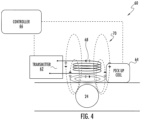
- the health monitoring system 60 is an eddy current system having a transmitter 62 and a receiver 64 operably connected to a controller 66.
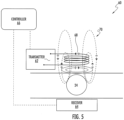
- the transmitter 62 and the receiver 64 are located at a same belt surface while in other embodiments, the system is a through transmission system such as shown in FIG. 5 . In such a system, the transmitter and the receiver 64 are located at opposing sides of the belt 16.
- the transmitter 62 includes a transmitter coil 68 through which an alternating current is flowed as directed by the controller 66, generating an oscillating magnetic field, depicted schematically at 70. Fluctuations in the magnetic field detected at the receiver 64, manifested in a change in impedance at the receiver 64, are indicative of irregularities in the tension members 24. Irregularities include breakage of fibers 42 or of the plurality of fibers 42, or breakage of wires, as a result of fatigue or impact damage. Further, fabrication-related anomalies such as wrinkled fibers, variations in fiber density and/or amount of inter-fiber contact also cause local variations which are detected via eddy current evaluation. Further, variations in the matrix material 44, such as voids, may also be detected.
- the evaluation utilizing the health monitoring system 60 is performed on the belt 16 at selected service intervals by a technician who utilizes the health monitoring system 60 as a field tool. It is to be appreciated that the evaluation may take place either in the hoistway 12, with the belt 16 in its installed position, or alternatively outside of the hoistway 12.
- the health monitoring system 60 may provide constant monitoring of the tension members 24 by, for example, mounting the health monitoring system 60 in the hoistway 12, with the transmitter 62 and the receiver 64 located at the same side of the belt 16.
- a single transmitter 62 and receiver 64 combination may be utilized, while in other embodiments, multiple sets of transmitters 62 and receivers 64 may be used to monitor different portions of the belt 16, such as different tension members 24 of the belt 16.
- the positions of the sets of transmitters 62 and receivers 64 may be staggered along the hoistway 12 to prevent interference and/or distortion of the evaluations.
- the condition of the tension members 24 may be continuously monitored, or alternatively evaluations may be performed at selected time intervals. Further, position information obtainable from an elevator control system may be used together with the controller 66 of the health monitoring system 60 to locate and map any anomalies or damage to the tension members 24. Such anomalies or damage may be subject to further inspection, or may be used as a baseline or reference in future evaluations, such that any progression or worsening of the tension member 24 condition may be determined.
- Use of the health monitoring system 60 which evaluates condition of the elevator belt 16 tension members 24 via non-contact eddy current inspection, provides an inspection method sensitive to breakage or damage of non-metallic tension members 24 of elevator systems 10, and allows for determining a location of such damage on the tension member 24. Thus, a weakest point of the tension member 24 may be determined, rather than merely the overall strength of the tension member 24, as with other evaluation systems and methods.
Landscapes
- Chemical & Material Sciences (AREA)
- Life Sciences & Earth Sciences (AREA)
- General Health & Medical Sciences (AREA)
- Automation & Control Theory (AREA)
- Chemical Kinetics & Catalysis (AREA)
- Electrochemistry (AREA)
- Physics & Mathematics (AREA)
- Structural Engineering (AREA)
- Analytical Chemistry (AREA)
- Health & Medical Sciences (AREA)
- Biochemistry (AREA)
- Engineering & Computer Science (AREA)
- General Physics & Mathematics (AREA)
- Immunology (AREA)
- Pathology (AREA)
- Lift-Guide Devices, And Elevator Ropes And Cables (AREA)
Claims (14)
- Système d'ascenseur (10), comprenant :une cage d'ascenseur (12) ;une cabine d'ascenseur (14) mobile le long de la cage d'ascenseur (12) ;un ou plusieurs éléments de tension électriquement conducteurs (24) connectés de manière fonctionnelle à la cabine d'ascenseur (14) pour déplacer la cabine d'ascenseur le long de la cage d'ascenseur (12) ; etun système de surveillance de l'état de santé (60) pour les un ou plusieurs éléments de tension (24) ;dans lequel le système de surveillance de l'état de santé (60) comprend :un émetteur (62) comportant une bobine émettrice (68) configurée pour être placée au niveau du ou des éléments de tension (24) ; un récepteur (64) configuré pour être positionné au niveau du ou des éléments de tension (24) ; etun dispositif de contrôle (66) connecté de manière fonctionnelle à l'émetteur (62) et au récepteur (64), le dispositif de contrôle (66) étant configuré pour :diriger un courant alternatif à travers la bobine émettrice (68), entraînant la génération d'un champ magnétique (70) et de courants de Foucault au niveau de la bobine émettrice (68) ; etévaluer des fluctuations du champ magnétique (70) détectées au niveau du récepteur (64), les fluctuations indiquant une usure et/ou un endommagement du ou des éléments de tension (24) ;caractérisé en ce que :
des emplacements d'usure et/ou d'endommagement du ou des éléments de tension (24) sont localisés sur le ou les éléments de tension (24) en utilisant des informations de position de système de contrôle d'ascenseur. - Système d'ascenseur (10) selon la revendication 1, dans lequel le dispositif de contrôle (66) est configuré pour identifier un emplacement le plus faible de l'élément de tension (24).
- Système d'ascenseur (10) selon la revendication 1 ou 2, comprenant en outre de multiples ensembles d'émetteurs (62) et de récepteurs (64), chaque ensemble étant configuré pour évaluer une partie de la courroie (16).
- Système d'ascenseur (10) selon une quelconque revendication précédente, dans lequel l'usure et/ou l'endommagement comporte(nt) une ou plusieurs parmi une rupture de l'élément de tension (24), des fibres froissées (42), des variations de la densité de fibres et/ou de la quantité de contact inter-fibres ou des variations d'un matériau de matrice (44) de l'élément de tension (24).
- Système d'ascenseur (10) selon une quelconque revendication précédente, dans lequel le système de surveillance de l'état de santé (60) est configuré pour une surveillance continue des un ou plusieurs éléments de tension (24).
- Système d'ascenseur (10) selon une quelconque revendication précédente, comprenant en outre de multiples ensembles d'émetteurs (62) et de récepteurs (64), chaque ensemble étant configuré pour évaluer au moins un élément de tension (24) des un ou plusieurs éléments de tension, et
éventuellement dans lequel les ensembles d'émetteurs (62) et de récepteurs (64) sont décalés en position le long de la cage d'ascenseur (12). - Système d'ascenseur (10) selon une quelconque revendication précédente, dans lequel au moins l'un des un ou plusieurs éléments de tension (24) comprend une pluralité de fibres (42) disposées dans un matériau de matrice (44).
- Système d'ascenseur (10) selon la revendication 7, dans lequel l'usure et/ou l'endommagement comporte une ou plusieurs parmi une rupture de fibres (42) du ou des éléments de tension (24), des fibres froissées, des variations de densité de fibres et/ou de quantité de contact inter-fibres ou des variations d'un matériau de matrice (44) du ou des éléments de tension (24) ; et/ou
dans lequel les un ou plusieurs éléments de tension (24) sont retenus dans une enveloppe (28). - Système d'ascenseur (10) selon une quelconque revendication précédente, dans lequel le dispositif de contrôle (66) est configuré pour comparer une évaluation actuelle à une ou plusieurs évaluations précédentes afin de déterminer la progression de l'endommagement ou de l'usure d'un élément de tension (24).
- Procédé de surveillance de l'état de santé d'un élément de tension électriquement conducteur (24) d'un système d'ascenseur (10), comprenant :la direction d'un courant alternatif à travers une bobine (68) d'un émetteur (62) situé au niveau d'un élément de tension (24) d'un système d'ascenseur (10) ;la génération d'un ou de plusieurs champs magnétiques (70) et courants de Foucault au niveau de l'émetteur (62) via le courant alternatif ; etl'évaluation de l'élément de tension (24) en détectant des fluctuations dans le champ magnétique (70) au niveau d'un récepteur (64) situé au niveau de l'élément de tension (24), les fluctuations indiquant une usure et/ou un endommagement de l'élément de tension (24) ;caractérisé par :
la détermination d'emplacements d'usure ou d'endommagement de l'élément de tension (24) sur l'élément de tension (24) en utilisant des informations de position de système de contrôle d'ascenseur. - Procédé selon la revendication 10, comprenant en outre la comparaison d'une évaluation actuelle à une ou plusieurs évaluations précédentes pour déterminer la progression de l'endommagement ou de l'usure de l'élément de tension (24).
- Procédé selon la revendication 10 ou 11, comprenant en outre l'évaluation de multiples éléments de tension (24) du système d'ascenseur (10) via de multiples ensembles d'émetteurs (62) et de récepteurs (64).
- Procédé selon l'une quelconque des revendications 10 à 12, dans lequel l'élément de tension (24) comprend une pluralité de fibres (42) disposées dans un matériau de matrice (44).
- Procédé selon la revendication 13, dans lequel l'usure et/ou l'endommagement comporte une ou plusieurs parmi une rupture de fibres (42) de l'élément de tension (24), des fibres froissées, des variations de densité de fibres et/ou de quantité de contact inter-fibres ou des variations d'un matériau de matrice (44) de l'élément de tension (24).
Applications Claiming Priority (1)
| Application Number | Priority Date | Filing Date | Title |
|---|---|---|---|
| US16/016,808 US11884516B2 (en) | 2018-06-25 | 2018-06-25 | Health monitoring of elevator system tension members |
Publications (2)
| Publication Number | Publication Date |
|---|---|
| EP3587331A1 EP3587331A1 (fr) | 2020-01-01 |
| EP3587331B1 true EP3587331B1 (fr) | 2023-11-08 |
Family
ID=67070690
Family Applications (1)
| Application Number | Title | Priority Date | Filing Date |
|---|---|---|---|
| EP19182431.7A Active EP3587331B1 (fr) | 2018-06-25 | 2019-06-25 | Surveillance de l'état de santé d'éléments de tension d'un système d'ascenseur |
Country Status (3)
| Country | Link |
|---|---|
| US (1) | US11884516B2 (fr) |
| EP (1) | EP3587331B1 (fr) |
| CN (1) | CN110626913A (fr) |
Families Citing this family (2)
| Publication number | Priority date | Publication date | Assignee | Title |
|---|---|---|---|---|
| EP4065498A4 (fr) * | 2019-11-27 | 2023-07-26 | KONE Corporation | Surveillance d'un système d'ascenseur |
| CN116963985A (zh) * | 2021-03-09 | 2023-10-27 | 通力股份公司 | 用于提升设备的绳索的状况监测的装置 |
Family Cites Families (28)
| Publication number | Priority date | Publication date | Assignee | Title |
|---|---|---|---|---|
| US5414353A (en) | 1993-05-14 | 1995-05-09 | Ndt Technologies, Inc. | Method and device for nondestructively inspecting elongated objects for structural defects using longitudinally arranged magnet means and sensor means disposed immediately downstream therefrom |
| US5992574A (en) * | 1996-12-20 | 1999-11-30 | Otis Elevator Company | Method and apparatus to inspect hoisting ropes |
| JP2003050230A (ja) | 2001-08-06 | 2003-02-21 | Toshiba Elevator Co Ltd | ワイヤロープ探傷装置 |
| US20030062226A1 (en) * | 2001-10-03 | 2003-04-03 | Stucky Paul A. | Elevator load bearing assembly having a ferromagnetic element that provides an indication of local strain |
| JP4101110B2 (ja) | 2003-05-08 | 2008-06-18 | 東京瓦斯株式会社 | 渦流探傷センサ |
| US7560920B1 (en) * | 2005-10-28 | 2009-07-14 | Innovative Materials Testing Technologies, Inc. | Apparatus and method for eddy-current scanning of a surface to detect cracks and other defects |
| KR100932589B1 (ko) * | 2006-05-25 | 2009-12-17 | 미쓰비시덴키 가부시키가이샤 | 엘리베이터 장치 |
| CN101778791A (zh) * | 2007-08-17 | 2010-07-14 | 因温特奥股份公司 | 具有承载机构状态检测装置的电梯系统和用于检测承载机构的状态的方法 |
| US8054092B2 (en) * | 2007-11-16 | 2011-11-08 | The Boeing Company | Corrosion detecting structural health sensor |
| WO2010098756A1 (fr) | 2009-02-26 | 2010-09-02 | Otis Elevator Company | Système d'inspection d'ascenseur |
| DE102010048917B4 (de) | 2010-10-11 | 2016-12-01 | Fraunhofer-Gesellschaft zur Förderung der angewandten Forschung e.V. | Wirbelstromflächensensor |
| PL396732A1 (pl) | 2011-10-24 | 2013-04-29 | Akademia Górniczo-Hutnicza im. Stanislawa Staszica w Krakowie | Uklad ciaglego wykrywania uszkodzen linek w plaskich ciegnach stalowo-tworzywowych |
| US20130214771A1 (en) * | 2012-01-25 | 2013-08-22 | Radiation Monitoring Devices, Inc. | Systems and methods for inspecting structures including pipes and reinforced concrete |
| PE20150994A1 (es) | 2012-09-04 | 2015-06-27 | Teijin Aramid Bv | Metodo para prueba no destructiva de cuerdas sinteticas y cuerda adecuada para uso en esto |
| US9075022B2 (en) | 2013-03-15 | 2015-07-07 | Whitehill Manufacturing Corporation | Synthetic rope, fiber optic cable and method for non-destructive testing thereof |
| KR101973067B1 (ko) | 2014-04-02 | 2019-08-16 | 허 마제스티 더 퀸 인 라이트 오브 캐나다 에즈 리프레젠티드 바이 더 미니스터 오브 내츄럴 리소시스 캐나다 | 합성 로프 또는 케이블의 분석 장치 및 그 용도의 방법 |
| CN106461611B (zh) | 2014-04-28 | 2019-12-27 | 东京制纲株式会社 | 钢丝绳的检查装置 |
| CN107430090B (zh) | 2015-03-11 | 2020-06-23 | 三菱电机株式会社 | 绳索损伤诊断检查装置和绳索损伤诊断检查方法 |
| JP6594065B2 (ja) | 2015-07-02 | 2019-10-23 | 株式会社日立ビルシステム | ロープ検査装置、および、ロープ検査システム |
| CN105293242B (zh) | 2015-11-25 | 2018-07-17 | 佛山住友富士电梯有限公司 | 一种电梯曳引绳检测装置 |
| US10197516B2 (en) | 2016-04-07 | 2019-02-05 | Ford Global Technologies, Llc | Non-contact quality control of fiber composites |
| CN105929022B (zh) | 2016-04-18 | 2017-06-27 | 山东科技大学 | 钢丝绳脉冲电涡流无损探伤检测装置及检测方法 |
| JP6715951B2 (ja) * | 2016-12-13 | 2020-07-01 | 三菱電機株式会社 | ワイヤーロープ探傷装置 |
| CN108217384B (zh) * | 2016-12-14 | 2021-07-06 | 奥的斯电梯公司 | 具有约束的电梯系统悬挂构件端接 |
| EP3336033A1 (fr) | 2016-12-19 | 2018-06-20 | KONE Corporation | Agencement d'un dispositif de levage |
| WO2018183151A1 (fr) * | 2017-03-27 | 2018-10-04 | Patagonia Pharmaceuticals, Llc | Compositions topiques et méthodes de traitement |
| EP3748351B1 (fr) * | 2018-02-01 | 2025-12-10 | Shimadzu Corporation | Dispositif d'inspection de câble métallique, système d'inspection de câble métallique et procédé d'inspection de câble métallique |
| US10882719B2 (en) * | 2018-03-29 | 2021-01-05 | Thyssenkrupp Elevator Ag | Composite elevator belt |
-
2018
- 2018-06-25 US US16/016,808 patent/US11884516B2/en active Active
-
2019
- 2019-06-24 CN CN201910548626.9A patent/CN110626913A/zh active Pending
- 2019-06-25 EP EP19182431.7A patent/EP3587331B1/fr active Active
Also Published As
| Publication number | Publication date |
|---|---|
| US11884516B2 (en) | 2024-01-30 |
| US20190389696A1 (en) | 2019-12-26 |
| CN110626913A (zh) | 2019-12-31 |
| EP3587331A1 (fr) | 2020-01-01 |
Similar Documents
| Publication | Publication Date | Title |
|---|---|---|
| CN106477411B (zh) | 方法、设施和电梯 | |
| US12358757B2 (en) | Wear detection for elevator system belt | |
| CN110002321B (zh) | 用于提升设备的绳索的状态监测的方法和装置 | |
| CN101058384B (zh) | 电梯设备和用于检查承载机构的方法 | |
| EP1461490B1 (fr) | Cable fabrique a partir de fibres synthetiques possedant un element ferromagnetique fournissant une indication de contrainte locale | |
| JP2003112876A (ja) | サスペンションロープ摩耗検出器 | |
| EP3647249A1 (fr) | Système in situ de surveillance de l'état d'un système d'ascenseur | |
| EP3587331A1 (fr) | Surveillance de l'état de santé d'éléments de tension d'un système d'ascenseur | |
| EP3640189B1 (fr) | Inspection basée sur la résistance des éléments de support d'un système d'ascenseur | |
| EP3640190B1 (fr) | Détection d'anomalies de surface d'un élément de tension de système d'ascenseur | |
| CN110386533A (zh) | 电梯张紧构件的健康监测 | |
| US20230416050A1 (en) | Arrangement for condition monitoring of a rope of a hoisting apparatus | |
| HK1235379A1 (zh) | 方法、设施和电梯 | |
| HK40099019A (en) | An arrangement for condition monitoring of a rope of a hoisting apparatus | |
| HK1235379B (en) | Method, arrangement and elevator | |
| CN121948243A (zh) | 电梯系统支撑构件的基于电阻的检查 | |
| HK1077605B (en) | Method of determining the condition of rope having a ferromagnetic element providing an indication of local strain |
Legal Events
| Date | Code | Title | Description |
|---|---|---|---|
| PUAI | Public reference made under article 153(3) epc to a published international application that has entered the european phase |
Free format text: ORIGINAL CODE: 0009012 |
|
| STAA | Information on the status of an ep patent application or granted ep patent |
Free format text: STATUS: THE APPLICATION HAS BEEN PUBLISHED |
|
| AK | Designated contracting states |
Kind code of ref document: A1 Designated state(s): AL AT BE BG CH CY CZ DE DK EE ES FI FR GB GR HR HU IE IS IT LI LT LU LV MC MK MT NL NO PL PT RO RS SE SI SK SM TR |
|
| AX | Request for extension of the european patent |
Extension state: BA ME |
|
| STAA | Information on the status of an ep patent application or granted ep patent |
Free format text: STATUS: REQUEST FOR EXAMINATION WAS MADE |
|
| 17P | Request for examination filed |
Effective date: 20200626 |
|
| RBV | Designated contracting states (corrected) |
Designated state(s): AL AT BE BG CH CY CZ DE DK EE ES FI FR GB GR HR HU IE IS IT LI LT LU LV MC MK MT NL NO PL PT RO RS SE SI SK SM TR |
|
| STAA | Information on the status of an ep patent application or granted ep patent |
Free format text: STATUS: EXAMINATION IS IN PROGRESS |
|
| 17Q | First examination report despatched |
Effective date: 20210915 |
|
| RIC1 | Information provided on ipc code assigned before grant |
Ipc: B66B 5/00 20060101ALN20230203BHEP Ipc: B66B 7/12 20060101AFI20230203BHEP |
|
| RIC1 | Information provided on ipc code assigned before grant |
Ipc: B66B 5/00 20060101ALN20230307BHEP Ipc: B66B 7/12 20060101AFI20230307BHEP |
|
| GRAP | Despatch of communication of intention to grant a patent |
Free format text: ORIGINAL CODE: EPIDOSNIGR1 |
|
| STAA | Information on the status of an ep patent application or granted ep patent |
Free format text: STATUS: GRANT OF PATENT IS INTENDED |
|
| RIC1 | Information provided on ipc code assigned before grant |
Ipc: B66B 5/00 20060101ALN20230417BHEP Ipc: B66B 7/12 20060101AFI20230417BHEP |
|
| INTG | Intention to grant announced |
Effective date: 20230516 |
|
| GRAS | Grant fee paid |
Free format text: ORIGINAL CODE: EPIDOSNIGR3 |
|
| GRAA | (expected) grant |
Free format text: ORIGINAL CODE: 0009210 |
|
| STAA | Information on the status of an ep patent application or granted ep patent |
Free format text: STATUS: THE PATENT HAS BEEN GRANTED |
|
| AK | Designated contracting states |
Kind code of ref document: B1 Designated state(s): AL AT BE BG CH CY CZ DE DK EE ES FI FR GB GR HR HU IE IS IT LI LT LU LV MC MK MT NL NO PL PT RO RS SE SI SK SM TR |
|
| REG | Reference to a national code |
Ref country code: GB Ref legal event code: FG4D |
|
| REG | Reference to a national code |
Ref country code: CH Ref legal event code: EP |
|
| REG | Reference to a national code |
Ref country code: DE Ref legal event code: R096 Ref document number: 602019040928 Country of ref document: DE |
|
| REG | Reference to a national code |
Ref country code: IE Ref legal event code: FG4D |
|
| REG | Reference to a national code |
Ref country code: LT Ref legal event code: MG9D |
|
| REG | Reference to a national code |
Ref country code: NL Ref legal event code: MP Effective date: 20231108 |
|
| PG25 | Lapsed in a contracting state [announced via postgrant information from national office to epo] |
Ref country code: GR Free format text: LAPSE BECAUSE OF FAILURE TO SUBMIT A TRANSLATION OF THE DESCRIPTION OR TO PAY THE FEE WITHIN THE PRESCRIBED TIME-LIMIT Effective date: 20240209 |
|
| PG25 | Lapsed in a contracting state [announced via postgrant information from national office to epo] |
Ref country code: IS Free format text: LAPSE BECAUSE OF FAILURE TO SUBMIT A TRANSLATION OF THE DESCRIPTION OR TO PAY THE FEE WITHIN THE PRESCRIBED TIME-LIMIT Effective date: 20240308 |
|
| PG25 | Lapsed in a contracting state [announced via postgrant information from national office to epo] |
Ref country code: LT Free format text: LAPSE BECAUSE OF FAILURE TO SUBMIT A TRANSLATION OF THE DESCRIPTION OR TO PAY THE FEE WITHIN THE PRESCRIBED TIME-LIMIT Effective date: 20231108 |
|
| REG | Reference to a national code |
Ref country code: AT Ref legal event code: MK05 Ref document number: 1629459 Country of ref document: AT Kind code of ref document: T Effective date: 20231108 |
|
| PG25 | Lapsed in a contracting state [announced via postgrant information from national office to epo] |
Ref country code: NL Free format text: LAPSE BECAUSE OF FAILURE TO SUBMIT A TRANSLATION OF THE DESCRIPTION OR TO PAY THE FEE WITHIN THE PRESCRIBED TIME-LIMIT Effective date: 20231108 |
|
| PG25 | Lapsed in a contracting state [announced via postgrant information from national office to epo] |
Ref country code: AT Free format text: LAPSE BECAUSE OF FAILURE TO SUBMIT A TRANSLATION OF THE DESCRIPTION OR TO PAY THE FEE WITHIN THE PRESCRIBED TIME-LIMIT Effective date: 20231108 |
|
| PG25 | Lapsed in a contracting state [announced via postgrant information from national office to epo] |
Ref country code: ES Free format text: LAPSE BECAUSE OF FAILURE TO SUBMIT A TRANSLATION OF THE DESCRIPTION OR TO PAY THE FEE WITHIN THE PRESCRIBED TIME-LIMIT Effective date: 20231108 |
|
| PG25 | Lapsed in a contracting state [announced via postgrant information from national office to epo] |
Ref country code: NL Free format text: LAPSE BECAUSE OF FAILURE TO SUBMIT A TRANSLATION OF THE DESCRIPTION OR TO PAY THE FEE WITHIN THE PRESCRIBED TIME-LIMIT Effective date: 20231108 Ref country code: LT Free format text: LAPSE BECAUSE OF FAILURE TO SUBMIT A TRANSLATION OF THE DESCRIPTION OR TO PAY THE FEE WITHIN THE PRESCRIBED TIME-LIMIT Effective date: 20231108 Ref country code: IS Free format text: LAPSE BECAUSE OF FAILURE TO SUBMIT A TRANSLATION OF THE DESCRIPTION OR TO PAY THE FEE WITHIN THE PRESCRIBED TIME-LIMIT Effective date: 20240308 Ref country code: GR Free format text: LAPSE BECAUSE OF FAILURE TO SUBMIT A TRANSLATION OF THE DESCRIPTION OR TO PAY THE FEE WITHIN THE PRESCRIBED TIME-LIMIT Effective date: 20240209 Ref country code: ES Free format text: LAPSE BECAUSE OF FAILURE TO SUBMIT A TRANSLATION OF THE DESCRIPTION OR TO PAY THE FEE WITHIN THE PRESCRIBED TIME-LIMIT Effective date: 20231108 Ref country code: BG Free format text: LAPSE BECAUSE OF FAILURE TO SUBMIT A TRANSLATION OF THE DESCRIPTION OR TO PAY THE FEE WITHIN THE PRESCRIBED TIME-LIMIT Effective date: 20240208 Ref country code: AT Free format text: LAPSE BECAUSE OF FAILURE TO SUBMIT A TRANSLATION OF THE DESCRIPTION OR TO PAY THE FEE WITHIN THE PRESCRIBED TIME-LIMIT Effective date: 20231108 Ref country code: PT Free format text: LAPSE BECAUSE OF FAILURE TO SUBMIT A TRANSLATION OF THE DESCRIPTION OR TO PAY THE FEE WITHIN THE PRESCRIBED TIME-LIMIT Effective date: 20240308 |
|
| PG25 | Lapsed in a contracting state [announced via postgrant information from national office to epo] |
Ref country code: SE Free format text: LAPSE BECAUSE OF FAILURE TO SUBMIT A TRANSLATION OF THE DESCRIPTION OR TO PAY THE FEE WITHIN THE PRESCRIBED TIME-LIMIT Effective date: 20231108 Ref country code: RS Free format text: LAPSE BECAUSE OF FAILURE TO SUBMIT A TRANSLATION OF THE DESCRIPTION OR TO PAY THE FEE WITHIN THE PRESCRIBED TIME-LIMIT Effective date: 20231108 Ref country code: PL Free format text: LAPSE BECAUSE OF FAILURE TO SUBMIT A TRANSLATION OF THE DESCRIPTION OR TO PAY THE FEE WITHIN THE PRESCRIBED TIME-LIMIT Effective date: 20231108 Ref country code: NO Free format text: LAPSE BECAUSE OF FAILURE TO SUBMIT A TRANSLATION OF THE DESCRIPTION OR TO PAY THE FEE WITHIN THE PRESCRIBED TIME-LIMIT Effective date: 20240208 Ref country code: LV Free format text: LAPSE BECAUSE OF FAILURE TO SUBMIT A TRANSLATION OF THE DESCRIPTION OR TO PAY THE FEE WITHIN THE PRESCRIBED TIME-LIMIT Effective date: 20231108 Ref country code: HR Free format text: LAPSE BECAUSE OF FAILURE TO SUBMIT A TRANSLATION OF THE DESCRIPTION OR TO PAY THE FEE WITHIN THE PRESCRIBED TIME-LIMIT Effective date: 20231108 |
|
| PG25 | Lapsed in a contracting state [announced via postgrant information from national office to epo] |
Ref country code: DK Free format text: LAPSE BECAUSE OF FAILURE TO SUBMIT A TRANSLATION OF THE DESCRIPTION OR TO PAY THE FEE WITHIN THE PRESCRIBED TIME-LIMIT Effective date: 20231108 |
|
| PG25 | Lapsed in a contracting state [announced via postgrant information from national office to epo] |
Ref country code: CZ Free format text: LAPSE BECAUSE OF FAILURE TO SUBMIT A TRANSLATION OF THE DESCRIPTION OR TO PAY THE FEE WITHIN THE PRESCRIBED TIME-LIMIT Effective date: 20231108 |
|
| PG25 | Lapsed in a contracting state [announced via postgrant information from national office to epo] |
Ref country code: SK Free format text: LAPSE BECAUSE OF FAILURE TO SUBMIT A TRANSLATION OF THE DESCRIPTION OR TO PAY THE FEE WITHIN THE PRESCRIBED TIME-LIMIT Effective date: 20231108 |
|
| PG25 | Lapsed in a contracting state [announced via postgrant information from national office to epo] |
Ref country code: SM Free format text: LAPSE BECAUSE OF FAILURE TO SUBMIT A TRANSLATION OF THE DESCRIPTION OR TO PAY THE FEE WITHIN THE PRESCRIBED TIME-LIMIT Effective date: 20231108 Ref country code: SK Free format text: LAPSE BECAUSE OF FAILURE TO SUBMIT A TRANSLATION OF THE DESCRIPTION OR TO PAY THE FEE WITHIN THE PRESCRIBED TIME-LIMIT Effective date: 20231108 Ref country code: RO Free format text: LAPSE BECAUSE OF FAILURE TO SUBMIT A TRANSLATION OF THE DESCRIPTION OR TO PAY THE FEE WITHIN THE PRESCRIBED TIME-LIMIT Effective date: 20231108 Ref country code: IT Free format text: LAPSE BECAUSE OF FAILURE TO SUBMIT A TRANSLATION OF THE DESCRIPTION OR TO PAY THE FEE WITHIN THE PRESCRIBED TIME-LIMIT Effective date: 20231108 Ref country code: EE Free format text: LAPSE BECAUSE OF FAILURE TO SUBMIT A TRANSLATION OF THE DESCRIPTION OR TO PAY THE FEE WITHIN THE PRESCRIBED TIME-LIMIT Effective date: 20231108 Ref country code: DK Free format text: LAPSE BECAUSE OF FAILURE TO SUBMIT A TRANSLATION OF THE DESCRIPTION OR TO PAY THE FEE WITHIN THE PRESCRIBED TIME-LIMIT Effective date: 20231108 Ref country code: CZ Free format text: LAPSE BECAUSE OF FAILURE TO SUBMIT A TRANSLATION OF THE DESCRIPTION OR TO PAY THE FEE WITHIN THE PRESCRIBED TIME-LIMIT Effective date: 20231108 |
|
| REG | Reference to a national code |
Ref country code: DE Ref legal event code: R097 Ref document number: 602019040928 Country of ref document: DE |
|
| PLBE | No opposition filed within time limit |
Free format text: ORIGINAL CODE: 0009261 |
|
| STAA | Information on the status of an ep patent application or granted ep patent |
Free format text: STATUS: NO OPPOSITION FILED WITHIN TIME LIMIT |
|
| 26N | No opposition filed |
Effective date: 20240809 |
|
| PG25 | Lapsed in a contracting state [announced via postgrant information from national office to epo] |
Ref country code: SI Free format text: LAPSE BECAUSE OF FAILURE TO SUBMIT A TRANSLATION OF THE DESCRIPTION OR TO PAY THE FEE WITHIN THE PRESCRIBED TIME-LIMIT Effective date: 20231108 |
|
| PG25 | Lapsed in a contracting state [announced via postgrant information from national office to epo] |
Ref country code: SI Free format text: LAPSE BECAUSE OF FAILURE TO SUBMIT A TRANSLATION OF THE DESCRIPTION OR TO PAY THE FEE WITHIN THE PRESCRIBED TIME-LIMIT Effective date: 20231108 |
|
| PG25 | Lapsed in a contracting state [announced via postgrant information from national office to epo] |
Ref country code: MC Free format text: LAPSE BECAUSE OF FAILURE TO SUBMIT A TRANSLATION OF THE DESCRIPTION OR TO PAY THE FEE WITHIN THE PRESCRIBED TIME-LIMIT Effective date: 20231108 |
|
| REG | Reference to a national code |
Ref country code: CH Ref legal event code: PL |
|
| PG25 | Lapsed in a contracting state [announced via postgrant information from national office to epo] |
Ref country code: LU Free format text: LAPSE BECAUSE OF NON-PAYMENT OF DUE FEES Effective date: 20240625 |
|
| GBPC | Gb: european patent ceased through non-payment of renewal fee |
Effective date: 20240625 |
|
| PG25 | Lapsed in a contracting state [announced via postgrant information from national office to epo] |
Ref country code: IE Free format text: LAPSE BECAUSE OF NON-PAYMENT OF DUE FEES Effective date: 20240625 |
|
| PG25 | Lapsed in a contracting state [announced via postgrant information from national office to epo] |
Ref country code: BE Free format text: LAPSE BECAUSE OF NON-PAYMENT OF DUE FEES Effective date: 20240630 Ref country code: CH Free format text: LAPSE BECAUSE OF NON-PAYMENT OF DUE FEES Effective date: 20240630 |
|
| PG25 | Lapsed in a contracting state [announced via postgrant information from national office to epo] |
Ref country code: GB Free format text: LAPSE BECAUSE OF NON-PAYMENT OF DUE FEES Effective date: 20240625 |
|
| REG | Reference to a national code |
Ref country code: BE Ref legal event code: MM Effective date: 20240630 |
|
| PG25 | Lapsed in a contracting state [announced via postgrant information from national office to epo] |
Ref country code: FI Free format text: LAPSE BECAUSE OF FAILURE TO SUBMIT A TRANSLATION OF THE DESCRIPTION OR TO PAY THE FEE WITHIN THE PRESCRIBED TIME-LIMIT Effective date: 20231108 |
|
| PG25 | Lapsed in a contracting state [announced via postgrant information from national office to epo] |
Ref country code: CY Free format text: LAPSE BECAUSE OF FAILURE TO SUBMIT A TRANSLATION OF THE DESCRIPTION OR TO PAY THE FEE WITHIN THE PRESCRIBED TIME-LIMIT; INVALID AB INITIO Effective date: 20190625 |
|
| PG25 | Lapsed in a contracting state [announced via postgrant information from national office to epo] |
Ref country code: HU Free format text: LAPSE BECAUSE OF FAILURE TO SUBMIT A TRANSLATION OF THE DESCRIPTION OR TO PAY THE FEE WITHIN THE PRESCRIBED TIME-LIMIT; INVALID AB INITIO Effective date: 20190625 |
|
| PG25 | Lapsed in a contracting state [announced via postgrant information from national office to epo] |
Ref country code: TR Free format text: LAPSE BECAUSE OF FAILURE TO SUBMIT A TRANSLATION OF THE DESCRIPTION OR TO PAY THE FEE WITHIN THE PRESCRIBED TIME-LIMIT Effective date: 20231108 |
|
| PGFP | Annual fee paid to national office [announced via postgrant information from national office to epo] |
Ref country code: DE Payment date: 20260520 Year of fee payment: 8 |
|
| PGFP | Annual fee paid to national office [announced via postgrant information from national office to epo] |
Ref country code: FR Payment date: 20260521 Year of fee payment: 8 |