EP3589053A2 - Procédé et appareil de gestion de detection de ressources de liaison latérale dans un système de communication sans fil - Google Patents
Procédé et appareil de gestion de detection de ressources de liaison latérale dans un système de communication sans fil Download PDFInfo
- Publication number
- EP3589053A2 EP3589053A2 EP19180733.8A EP19180733A EP3589053A2 EP 3589053 A2 EP3589053 A2 EP 3589053A2 EP 19180733 A EP19180733 A EP 19180733A EP 3589053 A2 EP3589053 A2 EP 3589053A2
- Authority
- EP
- European Patent Office
- Prior art keywords
- resource
- transmission
- scheduled
- resources
- candidate
- Prior art date
- Legal status (The legal status is an assumption and is not a legal conclusion. Google has not performed a legal analysis and makes no representation as to the accuracy of the status listed.)
- Withdrawn
Links
- 238000000034 method Methods 0.000 title claims abstract description 164
- 238000004891 communication Methods 0.000 title abstract description 33
- 230000005540 biological transmission Effects 0.000 claims abstract description 630
- 230000011664 signaling Effects 0.000 claims abstract description 196
- 230000000737 periodic effect Effects 0.000 claims description 24
- 238000005259 measurement Methods 0.000 claims description 14
- 238000010586 diagram Methods 0.000 description 10
- 230000008569 process Effects 0.000 description 7
- 208000037918 transfusion-transmitted disease Diseases 0.000 description 7
- 238000009795 derivation Methods 0.000 description 4
- 230000009471 action Effects 0.000 description 3
- 230000001143 conditioned effect Effects 0.000 description 3
- 238000013461 design Methods 0.000 description 3
- 239000011159 matrix material Substances 0.000 description 3
- 238000012545 processing Methods 0.000 description 3
- 230000006399 behavior Effects 0.000 description 2
- 238000004590 computer program Methods 0.000 description 2
- 238000005516 engineering process Methods 0.000 description 2
- 230000006870 function Effects 0.000 description 2
- 230000007774 longterm Effects 0.000 description 2
- 238000010295 mobile communication Methods 0.000 description 2
- 230000003287 optical effect Effects 0.000 description 2
- 239000002245 particle Substances 0.000 description 2
- 238000010187 selection method Methods 0.000 description 2
- 101150071746 Pbsn gene Proteins 0.000 description 1
- 230000006978 adaptation Effects 0.000 description 1
- 238000013459 approach Methods 0.000 description 1
- 230000000295 complement effect Effects 0.000 description 1
- 239000013256 coordination polymer Substances 0.000 description 1
- 230000001419 dependent effect Effects 0.000 description 1
- 238000012986 modification Methods 0.000 description 1
- 230000004048 modification Effects 0.000 description 1
- 238000012544 monitoring process Methods 0.000 description 1
- 230000008520 organization Effects 0.000 description 1
- 239000005022 packaging material Substances 0.000 description 1
- 230000004044 response Effects 0.000 description 1
Images





Classifications
-
- H—ELECTRICITY
- H04—ELECTRIC COMMUNICATION TECHNIQUE
- H04W—WIRELESS COMMUNICATION NETWORKS
- H04W72/00—Local resource management
- H04W72/20—Control channels or signalling for resource management
- H04W72/23—Control channels or signalling for resource management in the downlink direction of a wireless link, i.e. towards a terminal
-
- H—ELECTRICITY
- H04—ELECTRIC COMMUNICATION TECHNIQUE
- H04W—WIRELESS COMMUNICATION NETWORKS
- H04W76/00—Connection management
- H04W76/10—Connection setup
- H04W76/18—Management of setup rejection or failure
-
- H—ELECTRICITY
- H04—ELECTRIC COMMUNICATION TECHNIQUE
- H04W—WIRELESS COMMUNICATION NETWORKS
- H04W28/00—Network traffic management; Network resource management
- H04W28/16—Central resource management; Negotiation of resources or communication parameters, e.g. negotiating bandwidth or QoS [Quality of Service]
-
- H—ELECTRICITY
- H04—ELECTRIC COMMUNICATION TECHNIQUE
- H04W—WIRELESS COMMUNICATION NETWORKS
- H04W24/00—Supervisory, monitoring or testing arrangements
- H04W24/10—Scheduling measurement reports ; Arrangements for measurement reports
-
- H—ELECTRICITY
- H04—ELECTRIC COMMUNICATION TECHNIQUE
- H04W—WIRELESS COMMUNICATION NETWORKS
- H04W52/00—Power management, e.g. Transmission Power Control [TPC] or power classes
- H04W52/04—Transmission power control [TPC]
- H04W52/06—TPC algorithms
- H04W52/10—Open loop power control
-
- H—ELECTRICITY
- H04—ELECTRIC COMMUNICATION TECHNIQUE
- H04W—WIRELESS COMMUNICATION NETWORKS
- H04W72/00—Local resource management
- H04W72/04—Wireless resource allocation
- H04W72/044—Wireless resource allocation based on the type of the allocated resource
- H04W72/0446—Resources in time domain, e.g. slots or frames
-
- H—ELECTRICITY
- H04—ELECTRIC COMMUNICATION TECHNIQUE
- H04W—WIRELESS COMMUNICATION NETWORKS
- H04W72/00—Local resource management
- H04W72/50—Allocation or scheduling criteria for wireless resources
- H04W72/535—Allocation or scheduling criteria for wireless resources based on resource usage policies
-
- H—ELECTRICITY
- H04—ELECTRIC COMMUNICATION TECHNIQUE
- H04W—WIRELESS COMMUNICATION NETWORKS
- H04W72/00—Local resource management
- H04W72/50—Allocation or scheduling criteria for wireless resources
- H04W72/54—Allocation or scheduling criteria for wireless resources based on quality criteria
- H04W72/542—Allocation or scheduling criteria for wireless resources based on quality criteria using measured or perceived quality
-
- H—ELECTRICITY
- H04—ELECTRIC COMMUNICATION TECHNIQUE
- H04W—WIRELESS COMMUNICATION NETWORKS
- H04W76/00—Connection management
- H04W76/10—Connection setup
- H04W76/14—Direct-mode setup
Definitions
- This disclosure generally relates to wireless communication networks, and more particularly, to a method and apparatus for handling sensing for sidelink resource in a wireless communication system.
- IP Internet Protocol
- An exemplary network structure is an Evolved Universal Terrestrial Radio Access Network (E-UTRAN).
- E-UTRAN Evolved Universal Terrestrial Radio Access Network
- the E-UTRAN system can provide high data throughput in order to realize the above-noted voice over IP and multimedia services.
- a new radio technology for the next generation e.g., 5G
- 5G next generation
- changes to the current body of 3GPP standard are currently being submitted and considered to evolve and finalize the 3GPP standard.
- the UE receives a control signaling which schedules a resource of a first transmission, in which the control signaling informs and/or indicates that the scheduled resource is not kept for a next transmission.
- the UE performs energy sensing for candidate resources, in which one or more resources associated with the scheduled resource of the first transmission is not utilized for energy sensing.
- Wireless communication systems are widely deployed to provide various types of communication such as voice, data, and so on. These systems may be based on code division multiple access (CDMA), time division multiple access (TDMA), orthogonal frequency division multiple access (OFDMA), 3GPP LTE (Long Term Evolution) wireless access, 3GPP LTE-A or LTE-Advanced (Long Term Evolution Advanced), 3GPP2 UMB (Ultra Mobile Broadband), WiMax, 3GPP NR (New Radio) wireless access for 5G, or some other modulation techniques.
- CDMA code division multiple access
- TDMA time division multiple access
- OFDMA orthogonal frequency division multiple access
- 3GPP LTE Long Term Evolution
- 3GPP LTE-A or LTE-Advanced Long Term Evolution Advanced
- 3GPP2 UMB User Mobile Broadband
- WiMax Worldwide Interoperability for Microwave Access
- the exemplary wireless communication systems devices described below may be designed to support one or more standards such as the standard offered by a consortium named "3rd Generation Partnership Project” referred to herein as 3GPP, including: TS 36.213 V15.1.0 (2018-03), “E-UTRA; Physical layer procedures (Release 15) ; and TS 36.214 V15.1.0 (2018-03), “E-UTRA); Physical layer; Measurements (Release 15) .
- 3GPP 3rd Generation Partnership Project
- FIG. 1 shows a multiple access wireless communication system according to one embodiment of the invention.
- An access network 100 includes multiple antenna groups, one including 104 and 106, another including 108 and 110, and an additional including 112 and 114. In FIG. 1 , only two antennas are shown for each antenna group, however, more or fewer antennas may be utilized for each antenna group.
- Access terminal 116 is in communication with antennas 112 and 114, where antennas 112 and 114 transmit information to access terminal 116 over forward link 120 and receive information from access terminal 116 over reverse link 118.
- Access terminal (AT) 122 is in communication with antennas 106 and 108, where antennas 106 and 108 transmit information to access terminal (AT) 122 over forward link 126 and receive information from access terminal (AT) 122 over reverse link 124.
- communication links 118, 120, 124 and 126 may use different frequency for communication.
- forward link 120 may use a different frequency then that used by reverse link 118.
- antenna groups each are designed to communicate to access terminals in a sector of the areas covered by access network 100.
- the transmitting antennas of access network 100 may utilize beamforming in order to improve the signal-to-noise ratio of forward links for the different access terminals 116 and 122. Also, an access network using beamforming to transmit to access terminals scattered randomly through its coverage causes less interference to access terminals in neighboring cells than an access network transmitting through a single antenna to all its access terminals.
- An access network may be a fixed station or base station used for communicating with the terminals and may also be referred to as an access point, a Node B, a base station, an enhanced base station, an evolved Node B (eNB), a network node, a network, or some other terminology.
- An access terminal may also be called user equipment (UE), a wireless communication device, terminal, access terminal or some other terminology.
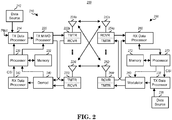
- FIG. 2 is a simplified block diagram of an embodiment of a transmitter system 210 (also known as the access network) and a receiver system 250 (also known as access terminal (AT) or user equipment (UE) in a MIMO system 200.
- a transmitter system 210 also known as the access network
- a receiver system 250 also known as access terminal (AT) or user equipment (UE) in a MIMO system 200.
- traffic data for a number of data streams is provided from a data source 212 to a transmit (TX) data processor 214.
- TX transmit
- each data stream is transmitted over a respective transmit antenna.
- TX data processor 214 formats, codes, and interleaves the traffic data for each data stream based on a particular coding scheme selected for that data stream to provide coded data.
- the coded data for each data stream may be multiplexed with pilot data using OFDM techniques.
- the pilot data is typically a known data pattern that is processed in a known manner and may be used at the receiver system to estimate the channel response.
- the multiplexed pilot and coded data for each data stream is then modulated (i.e., symbol mapped) based on a particular modulation scheme (e.g., BPSK, QPSK, M-PSK, or M-QAM) selected for that data stream to provide modulation symbols.
- a particular modulation scheme e.g., BPSK, QPSK, M-PSK, or M-QAM
- the data rate, coding, and modulation for each data stream may be determined by instructions performed by processor 230.
- TX MIMO processor 220 may further process the modulation symbols (e.g., for OFDM).
- TX MIMO processor 220 then provides N T modulation symbol streams to N T transmitters (TMTR) 222a through 222t.
- TMTR TX MIMO processor 220 applies beamforming weights to the symbols of the data streams and to the antenna from which the symbol is being transmitted.
- Each transmitter 222 receives and processes a respective symbol stream to provide one or more analog signals, and further conditions (e.g., amplifies, filters, and upconverts) the analog signals to provide a modulated signal suitable for transmission over the MIMO channel.
- N T modulated signals from transmitters 222a through 222t are then transmitted from N T antennas 224a through 224t, respectively.
- the transmitted modulated signals are received by N R antennas 252a through 252r and the received signal from each antenna 252 is provided to a respective receiver (RCVR) 254a through 254r.
- Each receiver 254 conditions (e.g., filters, amplifies, and down converts) a respective received signal, digitizes the conditioned signal to provide samples, and further processes the samples to provide a corresponding "received" symbol stream.
- An RX data processor 260 then receives and processes the N R received symbol streams from N R receivers 254 based on a particular receiver processing technique to provide N T "detected" symbol streams.
- the RX data processor 260 then demodulates, deinterleaves, and decodes each detected symbol stream to recover the traffic data for the data stream.
- the processing by RX data processor 260 is complementary to that performed by TX MIMO processor 220 and TX data processor 214 at transmitter system 210.
- a processor 270 periodically determines which pre-coding matrix to use (discussed below). Processor 270 formulates a reverse link message comprising a matrix index portion and a rank value portion.
- the reverse link message may comprise various types of information regarding the communication link and/or the received data stream.
- the reverse link message is then processed by a TX data processor 238, which also receives traffic data for a number of data streams from a data source 236, modulated by a modulator 280, conditioned by transmitters 254a through 254r, and transmitted back to transmitter system 210.
- the modulated signals from receiver system 250 are received by antennas 224, conditioned by receivers 222, demodulated by a demodulator 240, and processed by a RX data processor 242 to extract the reserve link message transmitted by the receiver system 250.
- Processor 230 determines which pre-coding matrix to use for determining the beamforming weights then processes the extracted message.
- FIG. 3 shows an alternative simplified functional block diagram of a communication device according to one embodiment of the invention.
- the communication device 300 in a wireless communication system can be utilized for realizing the UEs (or ATs) 116 and 122 in FIG. 1 or the base station (or AN) 100 in FIG. 1 , and the wireless communications system is preferably the LTE system or the NR system.
- the communication device 300 may include an input device 302, an output device 304, a control circuit 306, a central processing unit (CPU) 308, a memory 310, a program code 312, and a transceiver 314.
- CPU central processing unit
- the control circuit 306 executes the program code 312 in the memory 310 through the CPU 308, thereby controlling an operation of the communications device 300.
- the communications device 300 can receive signals input by a user through the input device 302, such as a keyboard or keypad, and can output images and sounds through the output device 304, such as a monitor or speakers.
- the transceiver 314 is used to receive and transmit wireless signals, delivering received signals to the control circuit 306, and outputting signals generated by the control circuit 306 wirelessly.
- the communication device 300 in a wireless communication system can also be utilized for realizing the AN 100 in FIG. 1 .
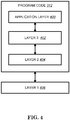
- FIG. 4 is a simplified block diagram of the program code 312 shown in FIG. 3 in accordance with one embodiment of the invention.
- the program code 312 includes an application layer 400, a Layer 3 portion 402, and a Layer 2 portion 404, and is coupled to a Layer 1 portion 406.
- the Layer 3 portion 402 generally performs radio resource control.
- the Layer 2 portion 404 generally performs link control.
- the Layer 1 portion 406 generally performs physical connections.
- 3GPP TS 36.213 V15.1.0 (2018-03 ) specifies the UE procedure for determining the subset of resources to be reported to higher layers in PSSCH resource selection in sidelink transmission mode 4 as quoted below:
- the UE When requested by higher layers in subframe n , the UE shall determine the set of resources to be reported to higher layers for PSSCH transmission according to the following steps.
- C resel is determined according to Subclause 14.1.1.4B.
- the UE shall report set S B to higher layers.
- S-RSSI Sidelink Received Signal Strength Indicator
- PSSCH-RSRP PSSCH Reference Signal Received Power
- PSSCH-RSRP PSSCH Reference Signal Received Power
- the reported value shall not be lower than the corresponding PSSCH-RSRP of any of the individual diversity branches Applicable for RRC_IDLE intra-frequency, RRC_IDLE inter-frequency, RRC_CONNECTED intra-frequency, RRC_CONNECTED inter-frequency •
- the power per resource element is determined from the energy received during the useful part of the symbol, excluding the CP.
- V2X and/or Pedestrian-to-Everything (P2X) transmissions there are at least two transmission modes: one is scheduled via the network, such as sidelink transmission mode 3 as disclosed in 3GPP TS 36.213 V15.1.0 (2018-03 ); another one is sensing-based transmission, such as sidelink transmission mode 4 as disclosed in 3GPP TS 36.213 V15.1.0 (2018-03 ). Since the sensing-based transmission is not scheduled by the network, the UE requires performing sensing before selecting a resource for transmission in order to avoid resource collision and interference from or in other UEs.
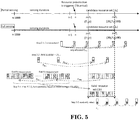
- the UE has a candidate resource set including multiple candidate resources as shown in FIG. 5 .
- the available candidate resource set is restricted with a time interval [ n + T 1 , n + T 2 ].
- the restricted time interval may be different depending on whether partially sensing is configured or not.
- Full sensing may mean that partially sensing is not configured.
- a candidate resource may mean one candidate single-subframe resource.
- One candidate resource may include one or multiple resource units.
- the resource unit may be a subchannel.
- the resource unit may include multiple (physical) resource blocks in a Transmission Time Interval (TTI).
- TTI Transmission Time Interval
- the UE may generate a valid resource set, wherein the valid resource set is a subset of the candidate resource set.
- the generation of the valid resource set may be performed via excluding some candidate resources from the candidate resource set, for instance, step 2-1 and step 2-2 as shown in FIG. 5 .
- the generation of the valid resource set may be performed via selecting some valid candidate resources, for instance, step 3-1 as shown in FIG. 5 .
- the UE selects one or some valid resources from the valid resource set to perform a transmission from the UE.
- the valid resource selection for transmission may be randomly selected from the valid resource set, for instance, step 3-2 as shown in FIG. 5 .
- the first excluding step is if the UE does not monitor/sense a TTI z , the UE cannot expect whether the candidate resources in TTI " z + P any " are occupied or not, wherein P any means any possible periodicity for a transmission.
- the first excluding step is shown as step 2-1 in FIG. 5 .
- the UE excludes the candidate resources in TTI " z + P any " and excludes the candidate resources for which the UE may have possible transmission occurred in TTI " z + P any ".
- the UE excludes the candidate resources in TTI " z + q ⁇ P any " and excludes the candidates resources for which the UE may have possible transmission occurred in TTI " z + q ⁇ P any ", wherein q is 1, 2, ..., 100/ P any .
- the parameter q means the UE excludes multiple candidate resources with a period P any within a time interval [ z, z +100].
- the possible transmission may mean a transmission on a selected valid resource.
- the possible transmission means a periodic transmission of a transmission on a selected valid resource.
- P any means any possible periodicity configured by higher layer.
- the second excluding step is the UE may exclude the candidate resources according to the received control signaling if the UE receives/detects a control signaling in a TTI m.
- the second excluding step is shown as step 2-2 in FIG. 5 . More specifically, if the UE receives/detects a control signal scheduling a transmission in a TTI m and the measurement result of the scheduled transmission and/or the control signal is over a threshold, the UE may exclude the candidate resources according to the received control signaling.
- the measurement result may be Reference Signal Received Power (RSRP). More specifically, the measurement result may be Physical Sidelink Shared Channel- Reference Signal Received Power (PSSCH-RSRP).
- RSRP Reference Signal Received Power
- PSSCH-RSRP Physical Sidelink Shared Channel- Reference Signal Received Power
- the control signaling may indicate the resources of the scheduled transmission and/or periodicity of the scheduled transmission, P RX .
- the excluded candidate resources are the resources of the next multiple scheduled transmissions based on the resources of the scheduled transmission and the periodicity of the scheduled transmission, such as for the case of P RX ⁇ 100ms.
- the next multiple scheduled transmissions may be with a period P RX within the time interval [ m, m +100].
- the UE may not exclude candidate resources according to the received control signaling.
- the UE may select some valid candidate resources from the remaining candidate resources as shown in step 3-1 in FIG. 5 .
- the UE may measure the resources in the sensing duration, wherein the measured resources are associated with the remaining candidate resources after steps 2-1 and 2-2. More specifically, for a remaining candidate resource, the associated measured resources in the sensing duration are in the occasions with multiple times of a time period from the remaining candidate resources. For instance, if the time period is 100 TTIs, the associated measured resources in the sensing duration are in the TTI "n-j ⁇ 100" , j is positive integer, for a remaining candidate resource in TTI n . Moreover, the associated measured resources in the sensing duration have the same frequency resources as the remaining candidate resource.
- the measurement may be a Sidelink- Received Signal Strength Indicator (S-RSSI) measurement.
- S-RSSI Sidelink- Received Signal Strength Indicator
- the UE can derive a metric for each remaining candidate resource.
- the metric for a remaining candidate resource may be a linear average of the S-RSSI measured from its associated measured resources in the sensing duration.
- the UE may select valid candidate resources based on the metric of each remaining candidate resource.
- an action is a remaining candidate resource with the smallest metric being selected as valid candidate resource and moved into a valid resource set. This action is repeated until the UE selects a number of remaining candidate resources as valid candidate resources and moves the number of remaining candidate resources into the valid resource set.
- the number may be larger than or equal to 20% of total candidate resources.
- the number may be larger than or equal to 20% of the cardinality of the candidate resource set.
- the UE can determine the valid resource set.
- the valid resource set may be reported to higher layers for transmission from the UE.
- the UE may select one or some of the valid resources from the valid resource set to perform transmission from the UE.
- the transmission from the UE may be a Physical Sidelink Shared Channel (PSSCH) transmission.
- PSSCH Physical Sidelink Shared Channel
- the sensing UE may exclude the candidate resources according to the received control signaling. If a control signaling indicates that there is no next scheduled transmission, the resource of the scheduled transmission is not kept in the next time, the scheduled transmission is the last transmission from the UE transmitting the control signaling, or the periodicity of the scheduled transmission is indicated as zero, the sensing UE may not exclude candidate resources according to the received control signaling.
- Such control signaling in a TTI m may not only schedule a transmission in a TTI m but also imply that the resource of the scheduled transmission will be clear after TTI m.
- control signaling also schedules a retransmission of the scheduled transmission in TTI "m + T gap "
- control signaling also implies that the resource of the retransmission of the scheduled transmission will be clear after TTI "m + T gap ".
- a transmitting UE transmitting such control signaling will not keep this resource for a scheduled transmission.
- a candidate resource associated with the resource of the scheduled transmission may be available for the sensing UE.
- the transmitting UE since the transmitting UE has already transmitted a scheduled transmission in TTI m and before TTI m, the derived metric of the associated candidate resource may not be low enough. It can be inferred that the sensing UE may not be able to move the associated candidate resource into a valid resource set. As a result, even though such control signaling implies that the resource of the scheduled transmission will be clear, the resource may be still not utilized for a long time, up to 1000ms.
- one alternative is the resources for energy sensing depend on the received control signaling. More specifically, if a received control signaling schedules a resource of a first transmission and also informs/indicates that the scheduled resource is not kept for the next transmission, the previous resource(s) associated with the scheduled resource of the first transmission is not utilized for energy sensing. Preferably, if a received control signaling schedules a resource of a first transmission and also informs/indicates that the first transmission is the last transmission (based on the scheduled resource), the previous resource(s) associated with the scheduled resource of the first transmission is not utilized for energy sensing.
- the previous resource(s) associated with the scheduled resource of the first transmission is not utilized for derivation of the metric.
- the energy sensing result of the previous resource(s) associated with the scheduled resource of the first transmission may be set to zero.
- the scheduled resource of the first transmission is not utilized for energy sensing.
- the scheduled resource of the first transmission is not utilized for the derivation of the metric.
- the energy sensing result of the scheduled resource of the first transmission may be set to zero.
- the latter resource(s) associated with the scheduled resource of the first transmission is utilized for energy sensing.
- the latter resource(s) associated with the scheduled resource of the first transmission is utilized for the derivation of the metric.
- the resource(s) after or posterior to the scheduled resource of the first transmission is utilized for energy sensing.
- the resource(s) after or posterior to the scheduled resource of the first transmission is utilized for derivation of the metric.
- the previous resource(s) associated with the scheduled resource of the first transmission means the resource(s) before the scheduled resource of the first transmission have the same frequency resources as the scheduled resource of the first transmission, and include the time difference on one or multiple times of a time period from the scheduled resource of the first transmission.
- the latter resource(s) associated with the scheduled resource of the first transmission means the resource(s) after the scheduled resource of the first transmission have the same frequency resources as the scheduled resource of the first transmission, and include the time difference on one or multiple times of a time period from the scheduled resource of the first transmission.
- the resource(s) after or posterior to the scheduled resource of the first transmission means the resource(s) after the scheduled resource of the first transmission have the same frequency resources as the scheduled resource of the first transmission, and include the time difference on one or multiple times of a time period from the scheduled resource of the first transmission.
- the previous resource(s) associated with the scheduled resource of the first transmission means the resource(s) before the scheduled resource of the first transmission are using the same identity (e.g., scheduling identity, Radio Network Temporary Identifier (RNTI), destination ID, source ID, UE ID, Semi-Persistent Scheduling (SPS) configuration index, grant free configuration index, combinations of previous IDs) as the scheduled resource of the first transmission, and include the time difference on one or multiple times of a time period from the scheduled resource of the first transmission.
- identity e.g., scheduling identity, Radio Network Temporary Identifier (RNTI), destination ID, source ID, UE ID, Semi-Persistent Scheduling (SPS) configuration index, grant free configuration index, combinations of previous IDs
- the latter resource(s) associated with the scheduled resource of the first transmission means the resource(s) after the scheduled resource of the first transmission are using the same identity (e.g. scheduling identity, RNTI, destination ID, source ID, UE ID, SPS configuration index, grant free configuration index, combinations of previous IDs) as the scheduled resource of the first transmission, and include the time difference on one or multiple times of a time period from the scheduled resource of the first transmission.
- identity e.g. scheduling identity, RNTI, destination ID, source ID, UE ID, SPS configuration index, grant free configuration index, combinations of previous IDs
- the resource(s) after or posterior to the scheduled resource of the first transmission means the resource(s) after the scheduled resource of the first transmission are using the same identity (e.g. scheduling identity, RNTI, destination ID, source ID, UE ID, SPS ID, grant free ID, combinations of previous IDs) as the scheduled resource of the first transmission, and include the time difference on one or multiple times of a time period from the scheduled resource of the first transmission.
- identity e.g. scheduling identity, RNTI, destination ID, source ID, UE ID, SPS ID, grant free ID, combinations of previous IDs
- the control signaling informs and/or indicates that the scheduled resource is not kept for the next transmission may mean that the control signaling indicates that there is no next scheduled transmission on the resource.
- control signaling informs and/or indicates that the scheduled resource is not kept for the next transmission may mean that the control signaling indicates that the resource of scheduled first transmission is not kept in next time.
- control signaling informs and/or indicates that the scheduled resource is not kept for the next transmission may mean that the periodicity of the scheduled transmission is indicated as zero.
- control signaling informs and/or indicates that the scheduled resource is not kept for the next transmission may mean that the scheduled transmission is not a periodic transmission.
- control signaling informs and/or indicates that the scheduled resource is not kept for the next transmission may mean that the scheduled transmission is a periodic transmission to be released.
- control signaling informs and/or indicates that the scheduled resource is not kept for the next transmission may mean that the scheduled transmission is the last transmission from the UE transmitting the control signaling (at least within many of time periods).
- control signaling informs and/or indicates that the first transmission is the last transmission may mean that the control signaling indicates that there is no next scheduled transmission on the resource (after the first transmission).
- control signaling informs and/or indicates that the first transmission is the last transmission may mean that the control signaling indicates that the resource of scheduled first transmission is not kept (after the first transmission).
- control signaling informs and/or indicates that the first transmission is the last transmission may mean that the periodicity of the scheduled (first) transmission is indicated as zero.
- control signaling informs and/or indicates that the first transmission is the last transmission may mean that the scheduled (first) transmission is not a periodic transmission.
- control signaling informs and/or indicates that the first transmission is the last transmission may mean that the scheduled (first) transmission is a periodic transmission to be released.
- a UE if a UE receives a signaling indicating that a candidate resource is clear, the UE does not perform energy sensing for the indicated candidate resource.
- the UE if a UE receives a signaling indicating that a candidate resource is clear, the UE performs energy sensing for the candidate resources, except for the indicated candidate resource.
- a UE may consider the indicated candidate resource as a valid resource.
- the UE may perform a second transmission on at least one of the valid resources.
- a UE may consider the metric of the indicated candidate resource as a specific value.
- the specific value is zero or is considered to be the smallest value.
- the specific value is the smallest value amongst the derived metrics for the candidate resources.
- the signaling may mean a control signaling which schedules a resource of a first transmission and informs and/or indicates that the scheduled resource is not kept for next transmission
- the indicated candidate resource may mean a candidate resource which is associated with the resource of the first transmission
- the signaling may mean a control signaling which schedules a resource of a first transmission and informs and/or indicates that the scheduled resource of the first transmission is not kept for the next time
- the indicated candidate resource may mean a candidate resource which is associated with the resource of the first transmission.
- the signaling may mean a control signaling which schedules a resource of a first transmission and informs and/or indicates that the scheduled (first) transmission is not a periodic transmission
- the indicated candidate resource may mean a candidate resource which is associated with the resource of the first transmission
- the signaling may mean a control signaling which schedules a resource of a first transmission and informs and/or indicates that the scheduled (first) transmission is a periodic transmission to be released, and the indicated candidate resource may mean a candidate resource which is associated with the resource of the first transmission.
- the signaling may mean a control signaling which schedules a resource of a first transmission and informs and/or indicates that the periodicity of the scheduled (first) transmission is indicated as zero, and the indicated candidate resource may mean a candidate resource which is associated with the resource of the first transmission.
- the signaling may mean a control signaling which schedules a resource of a first transmission and informs and/or indicates that the scheduled first transmission is the last transmission
- the indicated candidate resource may mean a candidate resource which is associated with the resource of the first transmission
- the indicated candidate resource may include the frequency resource of the scheduled first transmission in a frequency domain, and the indicated candidate resource may be with a time difference on one or multiple times of a time period from the resource of the scheduled first transmission.
- the UE does not perform energy sensing on a resource(s) which is associated with the indicated candidate resource.
- the resource(s) associated with the indicated candidate resource means the resource(s) before the indicated candidate resource have the same frequency resources as the indicated candidate resource and have a time difference on one or multiple times of a time period from the indicated candidate resource.
- the UE does not perform energy sensing on resource(s) which is associated with the scheduled resource of the first transmission.
- the resource(s) associated with the scheduled resource of the first transmission include previous resource(s) associated with the scheduled resource of the first transmission, the scheduled resource of the first transmission, the latter resource(s) associated with the scheduled resource of the first transmission, and/or resource(s) after/ posterior to the scheduled resource of the first transmission.
- the energy sensing result of the previous resource(s) associated with the scheduled resource of the first transmission, the scheduled resource of the first transmission, the latter resource(s) associated with the scheduled resource of the first transmission, and/or the resource(s) after/ posterior to the scheduled resource of the first transmission may be set as zero.
- the resource(s) associated with the scheduled resource of the first transmission include the previous resource(s) associated with the scheduled resource of the first transmission and the scheduled resource of the first transmission.
- the energy sensing result of the previous resource(s) associated with the scheduled resource of the first transmission and the scheduled resource of the first transmission may be set as zero.
- the previous resource(s) associated with the scheduled resource of the first transmission means the resource(s) before the scheduled resource of the first transmission have the same frequency resources as the scheduled resource of the first transmission, and include the time difference on one or multiple times of a time period from the scheduled resource of the first transmission.
- the latter resource(s) associated with the scheduled resource of the first transmission means the resource(s) after the scheduled resource of the first transmission have the same frequency resources as the scheduled resource of the first transmission, and include the time difference on one or multiple times of a time period from the scheduled resource of the first transmission.
- the resource(s) after/ posterior to the scheduled resource of the first transmission means the resource(s) after the scheduled resource of the first transmission have same frequency resources as the scheduled resource of the first transmission, and include the time difference on one or multiple times of a time period from the scheduled resource of the first transmission.
- the previous resource(s) associated with the scheduled resource of the first transmission means the resource(s) before the scheduled resource of the first transmission are using the same identity (e.g. scheduling identity, RNTI, destination ID, source ID, UE ID, SPS configuration index, grant free configuration index, combinations of previous IDs) as the scheduled resource of the first transmission, and include the time difference on one or multiple times of a time period from the scheduled resource of the first transmission.
- identity e.g. scheduling identity, RNTI, destination ID, source ID, UE ID, SPS configuration index, grant free configuration index, combinations of previous IDs
- the latter resource(s) associated with the scheduled resource of the first transmission means the resource(s) after the scheduled resource of the first transmission are using the same identity (e.g. scheduling identity, RNTI, destination ID, source ID, UE ID, SPS configuration index, grant free configuration index, combinations of previous IDs) as the scheduled resource of the first transmission, and include the time difference on one or multiple times of a time period from the scheduled resource of the first transmission.
- identity e.g. scheduling identity, RNTI, destination ID, source ID, UE ID, SPS configuration index, grant free configuration index, combinations of previous IDs
- the resource(s) after/ posterior to the scheduled resource of the first transmission means the resource(s) after the scheduled resource of the first transmission are using the same identity (e.g. scheduling identity, RNTI, destination ID, source ID, UE ID, SPS ID, grant free ID, combinations of previous IDs) as the scheduled resource of the first transmission, and include the time difference on one or multiple times of a time period from the scheduled resource of the first transmission.
- identity e.g. scheduling identity, RNTI, destination ID, source ID, UE ID, SPS ID, grant free ID, combinations of previous IDs
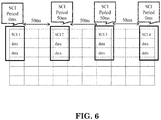
- the Sidelink Control Information (SCI) 1 could be indicating a single Medium Access Control (MAC) Protocol Data Unit (PDU) transmission or a release of multiple MAC PDU transmissions.
- SCI 1 Medium Access Control
- PDU Protocol Data Unit
- a SCI 2 is received by the same UE.
- the SCI 2 indicates a resource reservation period of 50ms.
- SCI 3 is received by the same UE.
- the SCI 2 indicates a resource reservation period of 50ms.
- a SCI 4 is received by the same UE.
- the SCI 4 will be interpreted as a release of multiple MAC PDU transmissions based on the SCI 3.
- SCI 3 and/or the SCI 2 and/or the data transmission corresponding to SCI 3 and/or the data transmission corresponding to SCI 2 could be considered as a resource associated with the transmission related to SCI 4.
- SCI 1 and the corresponding data transmission will not be considered as a resource associated with the transmission related to SCI 4/SCI 3/SCI 2.
- FIG. 7 Another possible example for a resource associated with the scheduled resource is shown in FIG. 7 .
- the UE will not consider SCI 1 as the resource associated with the transmission related to SCI 4/SCI 3/SCI 2.
- SCI 3 and/or the SCI 2 and/or the data transmission corresponding to SCI 3 and/or the data transmission corresponding to SCI 2 could be considered as a resource associated with the transmission related to SCI 4.
- FIG. 8 Another possible example for a resource associated with the scheduled resource is shown in FIG. 8 .
- the UE will not consider SCI 1 as a resource associated with a transmission related to SCI 4/SCI 3/SCI 2.
- the SCI 2 and /or the data transmission corresponding to SCI 2 are also not considered as a resource associated with the transmission related to SCI 4 due to an identity difference (e.g., Radio Network Temporary Identifier (RNTI)).
- RNTI Radio Network Temporary Identifier
- the SCI 3 and /or data transmission corresponding to SCI 3 will be considered as a resource associated with a transmission related to SCI 4.
- the UE considers the association based on the period information in each SCI and/or identity and/or frequency resource.
- a UE could conduct an energy sensing on the received control signal which indicates the scheduled first transmission is the last transmission, and the UE does not do the energy sensing on the resource(s) associated with the scheduled resource.
- An example is shown in FIG. 9 .
- the UE will still do energy sensing based on SCI 4 and/or the corresponding data transmission.
- the UE will not do an energy sensing based on the monitoring result of SCI 2 and SCI 3.
- the UE will not do energy sensing based on SCI 4/SCI 3/SCI 2 and the corresponding data transmissions.
- the SCI is the control signaling.
- the SCI with indicating period as 0ms is the control signaling.
- control signaling is the SCI.
- control signaling is a SCI with indicating period as 0ms.
- multiple MAC PDU transmissions mean a period transmission.
- multiple MAC PDUs are delivered in separate period transmissions, in which one (period) transmission delivers one MAC PDU.
- a single MAC PDU transmission means one shot transmission.
- a single MAC PDU transmission means a non-period transmission.
- the single MAC PDU transmission is delivered in one transmission.
- the energy sensing means that the UE performs a Received Signal Strength Indicator (RSSI) measurement.
- RSSI Received Signal Strength Indicator
- the metric means RSSI.
- the metric means linear average of a measured RSSI.
- the metric for a candidate resource means a linear average of a RSSI measured from the associated resources of the candidate resource.
- the association means that the associated resources of the candidate resource occur with the same frequency resources as the candidate resource and occur with a time difference on one or multiple times of another time period from the candidate resource.
- another time period is different from the time period of the first transmission.
- another time period is the same as the time period of the first transmission.
- control signaling and the first transmission are in the same Transmission Time Interval (TTI).
- TTI Transmission Time Interval
- control signaling and the first transmission are in different TTIs.
- control signaling and the first transmission are in different TTIs with a time gap.
- the time gap is indicated via the control signaling.
- control signaling and the first transmission are in different TTIs with the time difference on N times of a time period.
- N is indicated via the control signaling.
- N means there are N remaining (period) transmissions after the TTI of receiving the control signaling, and the first transmission is the last transmission.
- the N remaining transmissions are period transmissions with a periodicity of the time period.
- the time period may be fixed/specified.
- the time period may be configured via higher layer.
- the time period may be indicated in the signaling.
- the time period may be indicated in the control signaling.
- the time period may be indicated/derived based on a previous control signaling which schedules the previous resource.
- the candidate resource associated with the scheduled resource of the first transmission may not be excluded by the previous resource of the previous transmission, wherein the previous resource of the previous transmission is associated with the scheduled resource of the first transmission.
- the time period is the minimum time difference between the previous resource and the scheduled resource of the first transmission.
- the time period is derived according to Time Division Duplex (TDD) Downlink/Uplink (DL/UL) configuration of a cell.
- the UE performs sensing/receiving/transmission on the cell.
- the time period is derived according to the ratio of DL and UL of a cell.
- the time period is derived according to a configuration related to DL and UL TTI distribution of a cell.
- the time period is derived according to an indication related to DL and UL TTI distribution of a cell.
- the UE performs sensing/receiving/transmission on the cell.
- the time period is in a unit of the slot.
- the time period is derived according to an indication related to DL and UL TTI distribution of a cell.
- the time period is in a unit of a mini-slot.
- the time period is in a unit of a subframe.
- the time period is in a unit of a symbol.
- the time period is in a unit of mini-seconds.
- a TTI is a slot.
- a TTI is a subframe.
- a TTI is a mini-slot.
- a TTI is 1ms.
- the resource of the first transmission may include one or multiple subchannels.
- the resource of the first transmission may include one or multiple (physical) resource blocks.
- the candidate resource may include one or multiple subchannels.
- the candidate resource may include one or multiple (physical) resource blocks.
- the first transmission and/or the control signaling transmission is a device-to-device transmission.
- the first transmission and/or the control signaling transmission is a Vehicle-to-Everything (V2X) transmission.
- V2X Vehicle-to-Everything
- the first transmission and/or the control signaling transmission is a Pedestrian-to-Everything (P2X) transmission.
- P2X Pedestrian-to-Everything
- the first transmission and/or the control signaling transmission is on a LTE-V2X (PC5) interface.
- the first transmission and/or the control signaling transmission is a sidelink transmission.
- the previous transmission and/or the previous control signaling transmission is a device-to-device transmission.
- the previous transmission and/or the previous control signaling transmission is a V2X transmission.
- the previous transmission and/or the previous control signaling transmission is a P2X transmission.
- the previous transmission and/or the previous control signaling transmission is on PC5 interface.
- the previous transmission and/or the previous control signaling transmission is a sidelink transmission.
- the second transmission is device-to-device transmission.
- the second transmission is a V2X transmission.
- the second transmission is a P2X transmission.
- the second transmission is on a PC5 interface.
- the second transmission is a sidelink transmission.
- the UE receives a control signaling which schedules a resource of a first transmission, wherein the control signaling informs/indicates that the scheduled resource is not kept for next transmission; and the UE performs energy sensing for candidate resources, wherein resource(s) associated with the scheduled resource of the first transmission is not utilized for energy sensing.
- the UE receives a control signaling which schedules a resource of a first transmission, wherein the control signaling informs/indicates that the first transmission is the last transmission; and the UE performs energy sensing for candidate resources, wherein the resource(s) associated with the scheduled resource of the first transmission is not utilized for energy sensing.
- the energy sensing result of the resource(s) associated with the scheduled resource of the first transmission is set to zero.
- the resource(s) associated with the scheduled resource of the first transmission means the previous resource(s) associated with the scheduled resource of the first transmission.
- the previous resource(s) associated with the scheduled resource of the first transmission means the resource(s) before the scheduled resource of the first transmission have the same frequency resources as the scheduled resource of the first transmission, and have a time difference on one or multiple times of a time period from the scheduled resource of the first transmission.
- the energy sensing result of the previous resource(s) associated with the scheduled resource of the first transmission is set to zero.
- the resource(s) associated with the scheduled resource of the first transmission means the resource of the first transmission.
- the energy sensing result of the scheduled resource of the first transmission is set to zero.
- the resource(s) associated with the scheduled resource of the first transmission means the latter resource(s) associated with the scheduled resource of the first transmission.
- the resource(s) associated with the scheduled resource of the first transmission not utilized for energy sensing includes the previous resource(s) associated with the scheduled resource of the first transmission and the resource of the first transmission.
- the latter resource(s) associated with the scheduled resource of the first transmission is utilized for energy sensing.
- the resource(s) after/ posterior to the scheduled resource of the first transmission is utilized for energy sensing.
- the latter resource(s) associated with the scheduled resource of the first transmission means the resource(s) after the scheduled resource of the first transmission have the same frequency resources as the scheduled resource of the first transmission, and include the time difference on one or multiple times of a time period from the scheduled resource of the first transmission.
- the resource(s) after/ posterior to the scheduled resource of the first transmission means the resource(s) after the scheduled resource of the first transmission have the same frequency resources as the scheduled resource of the first transmission, and include the time difference on one or multiple times of a time period from the scheduled resource of the first transmission.
- the resource(s) associated with the scheduled resource of the first transmission not utilized for energy sensing includes the previous resource(s) associated with the scheduled resource of the first transmission, the resource of the first transmission, and the latter resource(s) associated with the scheduled resource of the first transmission.
- the energy sensing result of the latter previous resource(s) associated with the scheduled resource of the first transmission is set as zero.
- control signaling informs/indicates that the scheduled resource is not kept for the next transmission means that the control signaling indicates that there is no next scheduled transmission on the resource.
- control signaling informs/indicates that the scheduled resource is not kept for the next transmission means that the control signaling indicates that the resource of the scheduled first transmission is not kept in next time.
- control signaling informs/indicates that the scheduled resource is not kept for the next transmission means that the periodicity of the scheduled transmission is indicated as zero.
- control signaling informs/indicates that the scheduled resource is not kept for the next transmission means that the scheduled transmission is not a periodic transmission.
- control signaling informs/indicates that the scheduled resource is not kept for the next transmission means that the scheduled transmission is a periodic transmission to be released.
- control signaling informs/indicates that the scheduled resource is not kept for the next transmission means that the scheduled transmission is the last transmission.
- control signaling informs/indicates that the first transmission is the last transmission means that the control signaling indicates that there is no next scheduled transmission on the resource after the first transmission.
- control signaling informs/indicates that the first transmission is the last transmission means that the control signaling indicates that the resource of the scheduled first transmission is not kept after the first transmission.
- control signaling informs/indicates that the first transmission is the last transmission means that the periodicity of the scheduled transmission is indicated as zero.
- control signaling informs/indicates that the first transmission is the last transmission means that the scheduled transmission is not a periodic transmission.
- control signaling informs/indicates that the first transmission is the last transmission means that the scheduled transmission is a periodic transmission to be released.
- the UE receives a signaling indicates that a candidate resource is clear; and the UE performs energy sensing for candidate resources, except the indicated candidate resource.
- the signaling means a control signaling which schedules a resource of a first transmission and informs/indicates that the scheduled resource is not kept for the next transmission
- the indicated candidate resource means a candidate resource which is associated with the resource of the first transmission
- the signaling means a control signaling which schedules a resource of a first transmission and informs/indicates that the scheduled resource of the first transmission is not kept in the next time
- the indicated candidate resource means a candidate resource which is associated with the resource of the first transmission
- the signaling means a control signaling which schedules a resource of a first transmission and informs/indicates that the scheduled first transmission is not a periodic transmission
- the indicated candidate resource means a candidate resource which is associated with the resource of the first transmission
- the signaling means a control signaling which schedules a resource of a first transmission and informs/indicates that the scheduled first transmission is a periodic transmission to be released, and the indicated candidate resource means a candidate resource which is associated with the resource of the first transmission.
- the signaling means a control signaling which schedules a resource of a first transmission and informs/indicates that the periodicity of the scheduled (first) transmission is indicated as zero, and the indicated candidate resource means a candidate resource which is associated with the resource of the first transmission.
- the signaling means a control signaling which schedules a resource of a first transmission and informs/indicates that the scheduled first transmission is the last transmission
- the indicated candidate resource means a candidate resource which is associated with the resource of the first transmission
- the indicated candidate resource includes the frequency resource of the scheduled first transmission in a frequency domain, and the indicated candidate resource has a time difference on one or multiple times of a time period from the resource of the scheduled first transmission.
- the UE does not perform energy sensing on resource(s) which are associated with the indicated candidate resource.
- the resource(s) associated with the indicated candidate resource means the resource(s) before the indicated candidate resource have the same frequency resources as the indicated candidate resource, and include the time difference on one or multiple times of a time period from the indicated candidate resource.
- the UE does not perform energy sensing on a resource(s) which is associated with the scheduled resource of the first transmission.
- the resource(s) associated with the scheduled resource of the first transmission includes previous resource(s) associated with the scheduled resource of the first transmission, the scheduled resource of the first transmission, the latter resource(s) associated with the scheduled resource of the first transmission, and/or the resource(s) after/ posterior to the scheduled resource of the first transmission.
- the energy sensing result of the previous resource(s) associated with the scheduled resource of the first transmission, the scheduled resource of the first transmission, the latter resource(s) associated with the scheduled resource of the first transmission, and/or the resource(s) after/ posterior to the scheduled resource of the first transmission is set as zero.
- the resource(s) associated with the scheduled resource of the first transmission include previous resource(s) associated with the scheduled resource of the first transmission and the scheduled resource of the first transmission.
- the energy sensing result of the previous resource(s) associated with the scheduled resource of the first transmission and the scheduled resource of the first transmission is set as zero.
- the previous resource(s) associated with the scheduled resource of the first transmission means the resource(s) before the scheduled resource of the first transmission have the same frequency resources as the scheduled resource of the first transmission, and have a time difference on one or multiple times of a time period from the scheduled resource of the first transmission.
- the latter resource(s) associated with the scheduled resource of the first transmission means the resource(s) after the scheduled resource of the first transmission have the same frequency resources as the scheduled resource of the first transmission, and have a time difference on one or multiple times of a time period from the scheduled resource of the first transmission.
- the resource(s) after/ posterior to the scheduled resource of the first transmission means the resource(s) after the scheduled resource of the first transmission have the same frequency resources as the scheduled resource of the first transmission, and have the same time difference on one or multiple times of a time period from the scheduled resource of the first transmission.
- the UE receives a signaling indicates that a candidate resource is clear; the UE performs energy sensing for candidate resources; the UE selects valid resources from the candidate resources based on the energy sensing result of one or more candidate resources, wherein the indicated candidate resource is considered as a valid resource; and the UE performs a transmission on at least one of the valid resources.
- the signaling means a control signaling which schedules a resource of a first transmission and informs/indicates that the scheduled resource is not kept for the next transmission
- the indicated candidate resource means a candidate resource which is associated with the resource of the first transmission
- the signaling means a control signaling which schedules a resource of a first transmission and informs/indicates that the scheduled resource of the first transmission is not kept for the next time
- the indicated candidate resource means a candidate resource which is associated with the resource of the first transmission
- the signaling means a control signaling which schedules a resource of a first transmission and informs/indicates that the scheduled first transmission is not a periodic transmission
- the indicated candidate resource means a candidate resource which is associated with the resource of the first transmission
- the signaling means a control signaling which schedules a resource of a first transmission and informs/indicates that the scheduled first transmission is a periodic transmission to be released, and the indicated candidate resource means a candidate resource which is associated with the resource of the first transmission.
- the signaling means a control signaling which schedules a resource of a first transmission and informs/indicates that the periodicity of the scheduled (first) transmission is indicated as zero, and the indicated candidate resource means a candidate resource which is associated with the resource of the first transmission.
- the signaling means a control signaling which schedules a resource of a first transmission and informs/indicates that the scheduled first transmission is the last transmission
- the indicated candidate resource means a candidate resource which is associated with the resource of the first transmission
- the indicated candidate resource includes the frequency resource of the scheduled first transmission, and the indicated candidate resource have a same time difference on one or multiple times of a time period from the resource of the scheduled first transmission.
- the UE receives a signaling indicates that a candidate resource is clear; and the UE performs energy sensing to a derive metric for candidate resources, wherein the metric of the indicated candidate resource is set as a specific value.
- the specific value is zero or considered as the smallest value.
- the specific value is the smallest value among the derived metric for candidate resources.
- the signaling means a control signaling which schedules a resource of a first transmission and informs/indicates that the scheduled resource is not kept for the next transmission
- the indicated candidate resource means a candidate resource which is associated with the resource of the first transmission
- the signaling means a control signaling which schedules a resource of a first transmission and informs/indicates that the scheduled resource of the first transmission is not kept for the next time
- the indicated candidate resource means a candidate resource which is associated with the resource of the first transmission
- the signaling means a control signaling which schedules a resource of a first transmission and informs/indicates that the scheduled first transmission is not a periodic transmission
- the indicated candidate resource means a candidate resource which is associated with the resource of the first transmission
- the signaling means a control signaling which schedules a resource of a first transmission and informs/indicates that the scheduled first transmission is a periodic transmission to be released, and the indicated candidate resource means a candidate resource which is associated with the resource of the first transmission.
- the signaling means a control signaling which schedules a resource of a first transmission and informs/indicates that the periodicity of the scheduled (first) transmission is indicated as zero, and the indicated candidate resource means a candidate resource which is associated with the resource of the first transmission.
- the signaling means a control signaling which schedules a resource of a first transmission and informs/indicates that the scheduled first transmission is the last transmission
- the indicated candidate resource means a candidate resource which is associated with the resource of the first transmission
- the indicated candidate resource includes the frequency resource of the scheduled first transmission, and the indicated candidate resource have the same time difference on one or multiple times of a time period from the resource of the scheduled first transmission.
- the energy sensing means that the UE performs RSSI measurement.
- the metric means a RSSI.
- the metric means a linear average of a measured RSSI.
- the metric for a candidate resource means a linear average of a RSSI measured from associated resources of the candidate resource, wherein the association means that the associated resources of the candidate resource has the same frequency resources as the candidate resource, and has a time difference on one or multiple times of another time period from the candidate resource.
- the another time period is different from the time period of the first transmission.
- the another time period is the same as the time period of the first transmission.
- control signaling and the first transmission are in the same TTI.
- control signaling and the first transmission are in different TTIs.
- control signaling and the first transmission are in different TTIs with a time gap
- time gap is indicated via the control signaling.
- control signaling and the first transmission are in different TTIs with time difference on N times of a time period.
- N is indicated via the control signaling.
- N means there are N remaining transmissions after the TTI of receiving the control signaling, and the first transmission is the last transmission.
- the N remaining transmissions are period transmissions with periodicity of the time period.
- the time period is fixed/specified.
- the time period is configured by a higher layer.
- the time period is indicated in the signaling.
- the time period is indicated in the control signaling.
- the time period is indicated/derived from a previous control signaling which schedules the previous resource.
- the candidate resource associated with the scheduled resource of the first transmission is not excluded by the previous resource of the previous transmission, wherein the previous resource of the previous transmission is associated with the scheduled resource of the first transmission.
- the time period is the minimum time difference between the previous resource and the scheduled resource of the first transmission.
- the time period is derived according to the TDD DL/UL configuration of a cell, wherein the UE performs sensing/receiving/transmission on the cell.
- the time period is derived according to the ratio of DL and UL of a cell, wherein the UE performs sensing/receiving/transmission on the cell.
- the time period is derived according to a configuration related to DL and UL TTI distribution of a cell, wherein the UE performs sensing/receiving/transmission on the cell.
- the time period is derived according to an indication related to DL and UL TTI distribution of a cell, wherein the UE performs sensing/receiving/transmission on the cell.
- the time period is in a unit of slot.
- the time period is in unit of a mini-slot.
- the time period is in a unit of subframe.
- the time period is in a unit of symbol.
- the time period is in a unit of mini-seconds.
- a TTI is a slot, subframe, mini-slot, or is 1ms.
- the resource of the first transmission includes one or multiple subchannels.
- the resource of the first transmission includes one or multiple (physical) resource blocks.
- the candidate resource includes one or multiple subchannels.
- the candidate resource includes one or multiple (physical) resource blocks.
- the first transmission and/or the control signaling transmission is a device-to-device transmission.
- the first transmission and/or the control signaling transmission is a V2X transmission.
- the first transmission and/or the control signaling transmission is a P2X transmission.
- the first transmission and/or the control signaling transmission is on a PC5 interface.
- the first transmission and/or the control signaling transmission is a sidelink transmission.
- the previous transmission and/or the previous control signaling transmission is a device-to-device transmission
- the previous transmission and/or the previous control signaling transmission is a V2X transmission.
- the previous transmission and/or the previous control signaling transmission is a P2X transmission.
- the previous transmission and/or the previous control signaling transmission is on a PC5 interface.
- the previous transmission and/or the previous control signaling transmission is a sidelink transmission.
- the second transmission is a device-to-device transmission.
- the second transmission is a V2X transmission.
- the second transmission is a P2X transmission.
- the second transmission is on a PC5 interface.
- the second transmission is a sidelink transmission.
- control signaling is a SCI.
- control signaling is a SCI with an indicating period as 0ms.
- a candidate resource is indicated as clear means that the candidate resource is not utilized/kept/reserved for transmission by another UE.
- a candidate resource is indicated as clear via a signaling means that the candidate resource is not utilized/kept/reserved for transmission by a UE sending the signaling.
- a candidate resource is indicated as clear means that the UE can select the candidate resource for performing transmission.
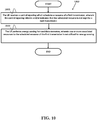
- FIG. 10 is a flow chart 1000 according to one exemplary embodiment from the perspective of a UE.
- the UE receives a control signaling which schedules a resource of a first transmission, wherein the control signaling informs and/or indicates that the scheduled resource is not kept for a next transmission.
- the UE performs energy sensing for candidate resources, wherein one or more resources associated with the scheduled resource of the first transmission is not utilized for energy sensing.
- the UE receives a second control signaling which schedules a resource of a second transmission, wherein the second control signaling informs and/or indicates that the scheduled resource of the second transmission is a periodic transmission; and the UE excludes a candidate resource associated with the scheduled resource of the second transmission, wherein one or more resources associated with the scheduled resource of the second transmission is not utilized for energy sensing.
- the UE performs energy sensing on one or more resources associated with the candidate resources, wherein the one or more resources not excluded by the control signaling are utilized for energy sensing.
- the one or more resources associated with the scheduled resource of the first transmission not utilized for energy sensing further comprises previous resource or resources associated with the scheduled resource of the first transmission and/or the resource of the first transmission, and wherein the previous resource or resources associated with the scheduled resource of the first transmission means the resource or resources before the scheduled resource of the first transmission have the same frequency resources as the scheduled resource of the first transmission, and include the time difference on one or multiple times of a time period from the scheduled resource of the first transmission.
- the time period is indicated and/or derived based on a previous control signaling which schedules the previous resource when there is a previous resource of a previous transmission before the scheduled resource of the first transmission and the previous resource is associated with the scheduled resource of the first transmission.
- the one or more resources associated with the scheduled resource of the second transmission not utilized for energy sensing further comprises the previous resource or resources associated with the scheduled resource of the second transmission and/or the resource of the second transmission, and the previous resource or resources associated with the scheduled resource of the second transmission means the resource or resources before the scheduled resource of the second transmission have the same frequency resources as the scheduled resource of the second transmission, and include the time difference on one or multiple times of a time period from the scheduled resource of the second transmission.
- an energy sensing result of the one or more resources associated with the scheduled resource of the first transmission and/or the previous resource or resources associated with the scheduled resource of the first transmission is set as zero.
- a latter resource or resources associated with the scheduled resource of the first transmission is utilized for energy sensing, wherein the latter resource or resources associated with the scheduled resource of the first transmission means the resource or resources after the scheduled resource of the first transmission have the same frequency resources as the scheduled resource of the first transmission, and include the time difference on one or multiple times of a time period from the scheduled resource of the first transmission.
- control signaling informs and/or indicates that the scheduled resource is not kept for the next transmission means that the scheduled transmission is not a periodic transmission.
- the energy sensing means that the UE performs a Received Signal Strength Indicator (RSSI) measurement.
- RSSI Received Signal Strength Indicator
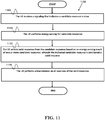
- FIG. 11 is a flow chart 1100 according to one exemplary embodiment from the perspective of a UE.
- the UE receives a signaling that indicates a candidate resource is clear.
- the UE performs energy sensing for candidate resources.
- the UE selects valid resources from the candidate resources based on an energy sensing result of one or more candidate resources, wherein the indicated candidate resource is considered a valid resource.
- the UE performs a transmission on at least one of the valid resources.
- the UE performs energy sensing for candidate resources does not include the indicated candidate resource.
- the signaling is a control signaling which schedules a resource of a first transmission and informs and/or indicates that the scheduled resource is not kept for the next transmission, and the indicated candidate resource is a candidate resource which is associated with the resource of the first transmission.
- the signaling is a control signaling which schedules a resource of a first transmission and informs and/or indicates that the scheduled first transmission is not a periodic transmission, and the indicated candidate resource is a candidate resource which is associated with the resource of the first transmission.
- the indicated candidate resource further comprises a frequency resource of the scheduled first transmission, and the indicated candidate resource include the time difference on one or multiple times of a time period from the resource of the scheduled first transmission.
- FIG. 12 is a flow chart 1200 according to one exemplary embodiment from the perspective of a UE.
- the UE receives a signaling that indicates a candidate resource is clear.
- the UE performs energy sensing to derive a metric for candidate resources, wherein the metric of the indicated candidate resource is set as a specific value.
- the specific value is zero or the smallest value among the derived metrics for the candidate resources.
- the signaling is a control signaling which schedules a resource of a first transmission and informs and/or indicates that the scheduled resource is not kept for the next transmission, and the indicated candidate resource is a candidate resource which is associated with the resource of the first transmission.
- the signaling is a control signaling which schedules a resource of a first transmission and informs and/or indicates that the scheduled first transmission is not a periodic transmission, and the indicated candidate resource is a candidate resource which is associated with the resource of the first transmission.
- the indicated candidate resource further comprises a frequency resource of the scheduled first transmission, and the indicated candidate resource include the time difference on one or multiple times of a time period from the resource of the scheduled first transmission.
- the device 300 includes a program code 312 stored in memory 310.
- the CPU 308 could execute program code 312 to (i) receive a control signaling which schedules a resource of a first transmission, wherein the control signaling informs and/or indicates that the scheduled resource is not kept for a next transmission, and (ii) perform energy sensing for candidate resources, wherein one or more resources associated with the scheduled resource of the first transmission is not utilized for energy sensing.
- the device includes a program code 312 stored in the memory 310.
- the CPU 308 could execute program code 312 to (i) receive a signaling that indicates a candidate resource is clear, (ii) perform energy sensing for candidate resources, (iii) select valid resources from the candidate resources based on an energy sensing result of one or more candidate resources, wherein the indicated candidate resource is considered a valid resource, and (iv) perform a transmission on at least one of the valid resources.
- the device includes a program code 312 stored in the memory 310.
- the CPU 308 could execute program code 312 to (i) receive a signaling that indicates a candidate resource is clear, and (ii) perform energy sensing to derive a metric for candidate resources, wherein the metric of the indicated candidate resource is set as a specific value.
- the CPU 308 can execute the program code 312 to perform all of the above-described actions and steps or others methods described herein.
- concurrent channels may be established based on pulse repetition frequencies. In some aspects concurrent channels may be established based on pulse position or offsets. In some aspects concurrent channels may be established based on time hopping sequences.
- the various illustrative logical blocks, modules, and circuits described in connection with the aspects disclosed herein may be implemented within or performed by an integrated circuit ("IC"), an access terminal, or an access point.
- the IC may comprise a general purpose processor, a digital signal processor (DSP), an application specific integrated circuit (ASIC), a field programmable gate array (FPGA) or other programmable logic device, discrete gate or transistor logic, discrete hardware components, electrical components, optical components, mechanical components, or any combination thereof designed to perform the functions described herein, and may execute codes or instructions that reside within the IC, outside of the IC, or both.
- a general purpose processor may be a microprocessor, but in the alternative, the processor may be any conventional processor, controller, microcontroller, or state machine.
- a processor may also be implemented as a combination of computing devices, e.g., a combination of a DSP and a microprocessor, a plurality of microprocessors, one or more microprocessors in conjunction with a DSP core, or any other such configuration.
- a software module e.g., including executable instructions and related data
- other data may reside in a data memory such as RAM memory, flash memory, ROM memory, EPROM memory, EEPROM memory, registers, a hard disk, a removable disk, a CD-ROM, or any other form of computer-readable storage medium known in the art.
- a sample storage medium may be coupled to a machine such as, for example, a computer/processor (which may be referred to herein, for convenience, as a "processor") such the processor can read information (e.g., code) from and write information to the storage medium.
- a sample storage medium may be integral to the processor.
- the processor and the storage medium may reside in an ASIC.
- the ASIC may reside in user equipment.
- the processor and the storage medium may reside as discrete components in user equipment.
- any suitable computer-program product may comprise a computer-readable medium comprising codes relating to one or more of the aspects of the disclosure.
- a computer program product may comprise packaging materials.
Landscapes
- Engineering & Computer Science (AREA)
- Computer Networks & Wireless Communication (AREA)
- Signal Processing (AREA)
- Quality & Reliability (AREA)
- Mobile Radio Communication Systems (AREA)
Applications Claiming Priority (1)
| Application Number | Priority Date | Filing Date | Title |
|---|---|---|---|
| US201862692524P | 2018-06-29 | 2018-06-29 |
Publications (2)
| Publication Number | Publication Date |
|---|---|
| EP3589053A2 true EP3589053A2 (fr) | 2020-01-01 |
| EP3589053A3 EP3589053A3 (fr) | 2020-03-11 |
Family
ID=66951847
Family Applications (1)
| Application Number | Title | Priority Date | Filing Date |
|---|---|---|---|
| EP19180733.8A Withdrawn EP3589053A3 (fr) | 2018-06-29 | 2019-06-18 | Procédé et appareil de gestion de detection de ressources de liaison latérale dans un système de communication sans fil |
Country Status (3)
| Country | Link |
|---|---|
| US (1) | US10893563B2 (fr) |
| EP (1) | EP3589053A3 (fr) |
| CN (1) | CN110662262A (fr) |
Cited By (1)
| Publication number | Priority date | Publication date | Assignee | Title |
|---|---|---|---|---|
| US20220361232A1 (en) * | 2020-02-05 | 2022-11-10 | Guangdong Oppo Mobile Telecommunications Corp., Ltd. | Method for resource indication and terminal device |
Families Citing this family (11)
| Publication number | Priority date | Publication date | Assignee | Title |
|---|---|---|---|---|
| EP3577967B1 (fr) * | 2017-02-06 | 2022-03-30 | Apple Inc. | Détection partielle et gestion des encombrements pour des communications entre véhicules au protocole long term evolution (lte) |
| WO2020017012A1 (fr) * | 2018-07-19 | 2020-01-23 | 株式会社Nttドコモ | Dispositif d'utilisateur et dispositif station de base |
| US20220183061A1 (en) * | 2019-04-30 | 2022-06-09 | Telefonaktiebolaget Lm Ericsson (Publ) | Transmitting and receiving an indication |
| WO2021212474A1 (fr) * | 2020-04-24 | 2021-10-28 | 华为技术有限公司 | Procédé, dispositif et système de transmission d'informations d'indication de ressources |
| CN116134949B (zh) * | 2020-08-06 | 2025-11-07 | 苹果公司 | 避免周期性资源冲突的方案 |
| EP4224923A4 (fr) * | 2020-10-16 | 2023-11-01 | Huawei Technologies Co., Ltd. | Procédé et appareil de détermination de ressources de transmission sur liaison latérale |
| EP4319319A4 (fr) * | 2021-03-25 | 2025-03-12 | LG Electronics Inc. | Procédé et dispositif pour effectuer une opération drx sl sur la base d'un temps de réveil recommandé dans nr v2x |
| EP4378249A4 (fr) * | 2021-07-29 | 2025-06-18 | Qualcomm Incorporated | Chronologie améliorée de signalisation de collision à venir |
| CN115734292A (zh) * | 2021-08-26 | 2023-03-03 | 华为技术有限公司 | 一种通信方法及装置 |
| WO2023121306A1 (fr) * | 2021-12-21 | 2023-06-29 | 엘지전자 주식회사 | Procédé et dispositif de fonctionnement de drx sl à base d'informations de ressource de réservation périodique dans v2x nr |
| CN116112598B (zh) * | 2022-11-17 | 2024-11-19 | 北京小米移动软件有限公司 | 信令发送方法及装置、电子设备、存储介质 |
Family Cites Families (7)
| Publication number | Priority date | Publication date | Assignee | Title |
|---|---|---|---|---|
| WO2015142141A1 (fr) * | 2014-03-21 | 2015-09-24 | Samsung Electronics Co., Ltd. | Procédé d'attribution de ressources basée sur la contention et appareil pour la communication d2d à faible puissance |
| EP3337274B1 (fr) | 2015-08-11 | 2023-11-15 | LG Electronics Inc. | Procédé d'émission et de réception d'un signal sans fil dans un système de communication sans fil et dispositif associé |
| WO2017048100A1 (fr) * | 2015-09-17 | 2017-03-23 | 엘지전자 주식회사 | Procédé et dispositif de transmission et de réception de message à l'aide d'un terminal v2x dans un système de communication sans fil |
| US10383147B2 (en) * | 2015-12-28 | 2019-08-13 | Samsung Electronics Co., Ltd. | Methods and apparatus for resource collision avoidance in vehicle to vehicle communication |
| US11240783B2 (en) | 2016-03-04 | 2022-02-01 | Lg Electronics Inc. | V2X transmission resource selecting method implemented by terminal in wireless communication system and terminal using same |
| RU2748670C2 (ru) * | 2016-08-08 | 2021-05-28 | Шарп Кабусики Кайся | Энергоэффективное использование ресурсов для обменов данными v2x |
| WO2018027528A1 (fr) * | 2016-08-09 | 2018-02-15 | Panasonic Intellectual Property Corporation Of America | Sélection et détection améliorées de ressources radio destinées aux transmissions v2x |
-
2019
- 2019-06-18 CN CN201910525107.0A patent/CN110662262A/zh active Pending
- 2019-06-18 US US16/444,863 patent/US10893563B2/en not_active Expired - Fee Related
- 2019-06-18 EP EP19180733.8A patent/EP3589053A3/fr not_active Withdrawn
Non-Patent Citations (2)
| Title |
|---|
| 3GPP TS 36.213 V15.1.0, March 2018 (2018-03-01) |
| 3GPP TS 36.214 V15.1.0, March 2018 (2018-03-01) |
Cited By (2)
| Publication number | Priority date | Publication date | Assignee | Title |
|---|---|---|---|---|
| US20220361232A1 (en) * | 2020-02-05 | 2022-11-10 | Guangdong Oppo Mobile Telecommunications Corp., Ltd. | Method for resource indication and terminal device |
| US12295007B2 (en) * | 2020-02-05 | 2025-05-06 | Guangdong Oppo Mobile Telecommunications Corp., Ltd. | Method for resource indication and terminal device |
Also Published As
| Publication number | Publication date |
|---|---|
| US10893563B2 (en) | 2021-01-12 |
| CN110662262A (zh) | 2020-01-07 |
| EP3589053A3 (fr) | 2020-03-11 |
| US20200008258A1 (en) | 2020-01-02 |
Similar Documents
| Publication | Publication Date | Title |
|---|---|---|
| US12369173B2 (en) | Method and apparatus of deriving feedback resource for sidelink transmission in a wireless communication system | |
| US10893563B2 (en) | Method and apparatus for handling sensing for sidelink resource in a wireless communication system | |
| US11937266B2 (en) | Method and apparatus of requesting resource for sidelink retransmission in a wireless communication system | |
| EP3799490B1 (fr) | Procédé et appareil de transmission de mesure de canal de dispositif à dispositif dans un système de communication sans fil | |
| US11683791B2 (en) | Method and apparatus for indicating time domain resource allocation of data transmission in a wireless communication system | |
| US10834704B2 (en) | Method and apparatus for resource selection in sidelink transmission in a wireless communication system | |
| KR102291675B1 (ko) | 무선 통신 시스템에 있어서 다중 디바이스-대-디바이스 전송을 핸들링하는 방법 및 장치 | |
| EP3547781B1 (fr) | Procédé et appareil de mise en tampon de données de liaison descendante tenant compte de la programmation inter-porteuses dans un système de communication sans fil | |
| KR102353396B1 (ko) | 무선 통신 시스템에 있어서 사이드링크 통신 스케줄링 모드를 개선하는 방법 및 장치 | |
| EP3866554A1 (fr) | Procédé et appareil de planification de transmission de liaison latérale de dispositif à dispositif dans un système de communication sans fil | |
| EP3817262A1 (fr) | Procédé et appareil de transmission de rapport de liaison latérale de dispositif à dispositif dans un système de communication sans fil | |
| US20210051700A1 (en) | Method and apparatus for beam indication considering cross carrier scheduling in a wireless communication system | |
| EP3547595A1 (fr) | Procédé et appareil de détermination de format de fente dans un système de communication sans fil | |
| US20130083748A1 (en) | Method and apparatus for processing csi (channel state information) in a wireless communication system | |
| US10091772B2 (en) | Method and apparatus for channel state information measurement in a wireless communication system | |
| JP2019036955A (ja) | 無線通信システムにおけるランダムアクセス設定のための方法及び装置 | |
| US9560664B2 (en) | Method and apparatus for DL-UL (downlink-uplink) interference management and traffic adaptation | |
| US20120236805A1 (en) | Method and apparatus for providing information to determine a cause of low quality of service in a wireless communication system | |
| US20250030470A1 (en) | Method and apparatus for handling sidelink reference signal for beam management in a wireless communication system | |
| CN120786453A (zh) | 无线通信系统中用于传送用户设备触发的报告的方法和设备 |
Legal Events
| Date | Code | Title | Description |
|---|---|---|---|
| PUAI | Public reference made under article 153(3) epc to a published international application that has entered the european phase |
Free format text: ORIGINAL CODE: 0009012 |
|
| STAA | Information on the status of an ep patent application or granted ep patent |
Free format text: STATUS: THE APPLICATION HAS BEEN PUBLISHED |
|
| AK | Designated contracting states |
Kind code of ref document: A2 Designated state(s): AL AT BE BG CH CY CZ DE DK EE ES FI FR GB GR HR HU IE IS IT LI LT LU LV MC MK MT NL NO PL PT RO RS SE SI SK SM TR |
|
| AX | Request for extension of the european patent |
Extension state: BA ME |
|
| PUAL | Search report despatched |
Free format text: ORIGINAL CODE: 0009013 |
|
| AK | Designated contracting states |
Kind code of ref document: A3 Designated state(s): AL AT BE BG CH CY CZ DE DK EE ES FI FR GB GR HR HU IE IS IT LI LT LU LV MC MK MT NL NO PL PT RO RS SE SI SK SM TR |
|
| AX | Request for extension of the european patent |
Extension state: BA ME |
|
| RIC1 | Information provided on ipc code assigned before grant |
Ipc: H04W 72/04 20090101AFI20200205BHEP |
|
| STAA | Information on the status of an ep patent application or granted ep patent |
Free format text: STATUS: REQUEST FOR EXAMINATION WAS MADE |
|
| 17P | Request for examination filed |
Effective date: 20200717 |
|
| RBV | Designated contracting states (corrected) |
Designated state(s): AL AT BE BG CH CY CZ DE DK EE ES FI FR GB GR HR HU IE IS IT LI LT LU LV MC MK MT NL NO PL PT RO RS SE SI SK SM TR |
|
| STAA | Information on the status of an ep patent application or granted ep patent |
Free format text: STATUS: EXAMINATION IS IN PROGRESS |
|
| 17Q | First examination report despatched |
Effective date: 20210209 |
|
| STAA | Information on the status of an ep patent application or granted ep patent |
Free format text: STATUS: THE APPLICATION IS DEEMED TO BE WITHDRAWN |
|
| 18D | Application deemed to be withdrawn |
Effective date: 20240103 |