EP3591925B1 - Système de chiffrement pour environnements peu fiables - Google Patents
Système de chiffrement pour environnements peu fiables Download PDFInfo
- Publication number
- EP3591925B1 EP3591925B1 EP18181091.2A EP18181091A EP3591925B1 EP 3591925 B1 EP3591925 B1 EP 3591925B1 EP 18181091 A EP18181091 A EP 18181091A EP 3591925 B1 EP3591925 B1 EP 3591925B1
- Authority
- EP
- European Patent Office
- Prior art keywords
- document
- party
- intermediate nodes
- sequences
- sequence
- Prior art date
- Legal status (The legal status is an assumption and is not a legal conclusion. Google has not performed a legal analysis and makes no representation as to the accuracy of the status listed.)
- Not-in-force
Links
Images

Classifications
-
- H—ELECTRICITY
- H04—ELECTRIC COMMUNICATION TECHNIQUE
- H04L—TRANSMISSION OF DIGITAL INFORMATION, e.g. TELEGRAPHIC COMMUNICATION
- H04L63/00—Network architectures or network communication protocols for network security
- H04L63/04—Network architectures or network communication protocols for network security for providing a confidential data exchange among entities communicating through data packet networks
- H04L63/0428—Network architectures or network communication protocols for network security for providing a confidential data exchange among entities communicating through data packet networks wherein the data content is protected, e.g. by encrypting or encapsulating the payload
- H04L63/0478—Network architectures or network communication protocols for network security for providing a confidential data exchange among entities communicating through data packet networks wherein the data content is protected, e.g. by encrypting or encapsulating the payload applying multiple layers of encryption, e.g. nested tunnels or encrypting the content with a first key and then with at least a second key
-
- H—ELECTRICITY
- H04—ELECTRIC COMMUNICATION TECHNIQUE
- H04L—TRANSMISSION OF DIGITAL INFORMATION, e.g. TELEGRAPHIC COMMUNICATION
- H04L63/00—Network architectures or network communication protocols for network security
- H04L63/04—Network architectures or network communication protocols for network security for providing a confidential data exchange among entities communicating through data packet networks
- H04L63/0428—Network architectures or network communication protocols for network security for providing a confidential data exchange among entities communicating through data packet networks wherein the data content is protected, e.g. by encrypting or encapsulating the payload
- H04L63/0442—Network architectures or network communication protocols for network security for providing a confidential data exchange among entities communicating through data packet networks wherein the data content is protected, e.g. by encrypting or encapsulating the payload wherein the sending and receiving network entities apply asymmetric encryption, i.e. different keys for encryption and decryption
-
- H—ELECTRICITY
- H04—ELECTRIC COMMUNICATION TECHNIQUE
- H04L—TRANSMISSION OF DIGITAL INFORMATION, e.g. TELEGRAPHIC COMMUNICATION
- H04L9/00—Cryptographic mechanisms or cryptographic arrangements for secret or secure communications; Network security protocols
- H04L9/14—Cryptographic mechanisms or cryptographic arrangements for secret or secure communications; Network security protocols using a plurality of keys or algorithms
Definitions
- the invention relates to the secure transmission of a document.
- the invention relates to the transmission of a document in an untrustworthy environment.
- a first and a second party exchange a service and a related consideration.
- the service can consist of or be represented by an electronic document, and the consideration can relate to a payment that can be processed electronically. If the parties do not trust each other, each party bears the risk that no consideration could be given for a service provided. For this problem, a notary that is trustworthy for both parties can be appointed who receives the service and the consideration, evaluates both and only forwards them if the service and consideration are in a predetermined relationship to one another.
- a method for transmitting a document from a first party to a second party includes steps of determining a sequence of m intermediate nodes, each intermediate node having a private cryptographic key for which a corresponding public cryptographic key is known; encrypting the document sequentially with the public keys of the intermediate nodes of the sequence; the transmission of the document to the owner of the public key with which this document was last encrypted and the decryption of the document with the private key of this owner; repeating the previous step until all intermediate nodes of the sequence have decrypted the document; and delivering the document to the second party.
- the steps mentioned are carried out for several different sequences, which are formed from a basic set of intermediate nodes.
- An intermediate node only knows where it received the document from and where it has to pass it on, but it does not know the number of decryptions that have already taken place or are still required on the way of the document from the first to the second party.
- the document only arrives at the second party or can only be used by the second party if all intermediate nodes of the sequence have been passed through. It is preferred that the sequence does not contain two identical intermediate nodes.
- An intermediate node can be formed as a person or as a device.
- An intermediate node is preferably formed as a communicatively networked device and can more preferably work automatically.
- the service can consist in the document itself, for example in that the document comprises an electronically transferable item such as a construction drawing, a text document, an image or a piece of music.
- the document can also enable access to a service, for example by the docu ment contains a cryptographic key or authentication that can be used to access the service is.
- the document can be linked to a service, an intermediate node only transmitting the document if it evaluates the service positively with regard to a predetermined criterion.
- each intermediate node can take on the role of a notary and evaluate the document.
- the intermediate nodes can be selected so that the assessment can be carried out competently.
- the second party may have rendered a consideration corresponding to the service; wherein the evaluation of the intermediate node comprises a check as to whether the consideration has been provided.
- the consideration consists in the transfer of money, an electronic currency or a monetary digital object.
- the transfer can be carried out using a blockchain.
- the blockchain can be stored on several servers in the form of a "distributed ledger". At least one of the intermediate nodes can be such a server and have a copy of the ledger, which represents a directory of transactions carried out using the blockchain.
- the integrity of the ledger can be ensured by constantly synchronizing its copies on different servers. A probability that the intermediate node can make an accurate and competent statement about the consideration made can be high.
- sequences of m intermediate nodes are determined and steps c) to f) are carried out for each of the determined sequences.
- the sequences are preferably determined from a basic set of n intermediate nodes.
- the document can then be transmitted concurrently over several paths via m intermediate nodes and each intermediate node can assess the document. This way, it is not necessary for both parties to find intermediate nodes that they all trust. It can be sufficient for each party to assume that at least half of the intermediate nodes contained in the basic set carry out the assessment either neutrally or in favor of the respective party.
- the first and second parties can agree on a specification for m before step a.
- the more intermediate nodes are included in a sequence the more intermediate nodes must give a positive assessment in order to enable complete decryption of the document.
- the more sequences that are used the greater the likelihood that the message will be fully decrypted at least once.
- all possible subsets of m intermediate nodes are formed from the basic set and a sequence is determined for each subset. In this way, by negotiating m between the parties, it is easier to weigh up between increased effort and increased security.
- a number of sequences of length m from the population of n intermediate nodes is determined by a binomial coefficient (n over m). This can become very large, especially with large m or small n, so that a large number of documents can be sent to intermediate nodes.
- intermediate nodes can be informed whose services are no longer required for the decryption, assessment and forwarding of a document.
- the m intermediate nodes of several or all sequences can be notified. Then at least one of the notified intermediate nodes can receive an already arrived or then discard incoming documents from the first to the second party.
- the sequences are usually determined by the first party.
- the second party does not know the number of intermediate nodes of all sequences and can therefore not decide which intermediate nodes are to be notified. In one embodiment, all n intermediate nodes are therefore notified, in particular by the second party.
- the second party notifies the first party and the first party notifies the intermediate nodes of the sequences used.
- the document comprises a preferably unencrypted identification and each intermediate node can check before decryption or forwarding whether an active document transfer is associated with the identification. If this is not the case, the intermediate node can discard the document.
- the document transfer can be set as active by the first party, preferably before it sends an encrypted document to one of the intermediate nodes
- Whether a document transfer is active can be stored at a central point.
- a dedicated server can be provided to manage active document transfers.
- the first party takes on this task for a document transfer assigned to it. If the second party receives the document at least once, it can set the corresponding document transfer from the first party to the second party to inactive on the server.
- An order of the intermediate nodes in a sequence can be determined randomly or pseudo-randomly. The selection of m intermediate nodes out of the n available intermediate nodes can thereby be more impartial.
- the multiple encryption of the document can also be carried out by the intermediate nodes.
- the first party can select an intermediate node, encrypt the document with its public key and transmit the result to the selected intermediate node together with an indication of encryptions still to be carried out.
- the receiving intermediate node can first decrement the specification. If the result is zero, he can deliver the document to the second party. He optionally encrypts the document with the second party's public key before it is delivered. Otherwise, if the decremented information is greater than zero, the intermediate node can select a further intermediate node, encrypt the document with its public key and send it the result. This intermediate node can do the same with the received document.
- the first party can also send an indication of the minimum number of keys with which the document should be encrypted and, as soon as this number of encryptions has been reached, an intermediate node can decide for itself whether to carry out a further encryption step or to deliver the document to the second party . This decision can be made at random with a predetermined probability.
- the document can be sent to a different intermediate node than the one with whose public key the document was last encrypted. The other intermediate node can in particular be determined randomly.
- the first party can legibly attach the sequence of the intermediate nodes that are to encrypt the document one after the other to the document. The intermediate nodes can encrypt and forward or deliver the document in the reverse order of the predetermined sequence.
- the first party can encrypt the document before step c and the second party can decrypt the document accordingly after step f. This can prevent an intermediate node, which forwards the document to the second party, from being in possession of the completely decrypted document that is present in plain text.
- the additional encryption can be carried out using a symmetrical or asymmetrical encryption method. In a preferred variant, the same asymmetrical encryption method is used as for the other encryptions for the intermediate nodes.
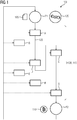
- Figure 1 shows an exemplary system 100. Using the system 100, a procedure is also explained below that can be understood as a method 100.
- a first party P1 and a second party P2 agree to exchange second services.
- a service in the form of a document 105 is to be transmitted from the first party P1 to the second party P2.
- An associated consideration is the transfer of an amount of money 110 from the second party P2 to the first party P1.
- the consideration is first provided in a chronological sequence in that the amount of money 110 is transferred.
- the amount of money 110 can in particular be represented by a digital currency such as Bitcoin, which is preferably based on a blockchain.
- a transaction can be cryptographically linked to a previous transaction, so that a transaction cannot be subsequently changed unnoticed.
- the blockchain is preferably kept in a distributed ledger 115 (for example: distributed register), i.e. a public directory that is replicated on a large number of different computers.
- a distributed ledger 115 for example: distributed register
- computers A to G are indicated as examples, which together implement the distributed ledger.
- the transfer of the amount of money 110 initially comprises a transaction that is entered in the local directory on one of the computers A to G.
- the transaction is later replicated to the other computers A to G so that they receive the same information about the transaction.
- the transfer of the consideration is shown as a solid line from the second party P2 to the first party P1.
- the replication of information about this transfer to all computers A to G is shown by broken lines.
- a computer A to G that has no information about a particular transaction may not yet have the most up-to-date information - or the transaction has not taken place.
- a computer A to G that has knowledge of the transaction could process information that is later recognized as untrue in the course of replication - or the information is correct and the transaction is valid.
- intermediate nodes are at the same time part or carriers of the distributed ledger 115.
- all computers A to G, which can serve as intermediate nodes, at the same time carry the distributed ledger 115 or a part thereof.
- those computers A to G, which represent intermediate nodes, and computers A to G, which carry the distributed ledger can also fall apart.
- Each intermediate node A to G is assigned a cryptographic key pair which comprises a public key and a private key. Encryption with a public key can only be reversed with the corresponding private key and vice versa.
- the public keys of one or more intermediate nodes A to G can, for example, be made accessible on a key server 120 or in some other way.
- a sequence 125 of intermediate nodes A to G is determined, via which the document 105 is to be transmitted from P1 to P2.
- the parties P1 and P2 can agree what length m the sequence 125 should have.
- the order of the intermediate nodes A to G in the sequence 125 is generally of secondary importance and can be chosen at random.
- a sequence 125 was chosen which runs from P1 via the intermediate node ADCG to P2.
- the first party P1 now encrypts the document 105 one after the other with the public keys of the sequence 125 in the reverse order of the planned transport.
- the plain text document 105 would be encrypted with G's public key
- the result of the encryption would then be encrypted with the public key of C
- the result in a corresponding manner with that of D and the result finally with the by A.
- the document 105 encrypted several times in this way can only be completely decrypted and made accessible to the second party P2 if all intermediate nodes A to G, whose public keys were used, decrypt the document 105 in the correct order with their respective private key and send the result to the forward the next intermediate node A to G or the second party P2.
- the document 105 is repeatedly encrypted in the manner described.
- One, several or all of the multiply encrypted documents 105 can also be made available to the second party P2, even before the latter has rendered the consideration in the form of the transfer of the amount of money 110.
- the document 105 can comprise an unencrypted part on the basis of which the second party can check the performance.
- the document 105 may include information at different levels of detail, and a less detailed view may be unencrypted, while a more detailed view may be encrypted.
- An unencrypted and an encrypted document 105 can also be used for the same purpose.
- Examples of such files 105 include CAD data, for example for the manufacture of a machine or for the construction of a building, or cadastral data for a property.
- the sequences 125 can be formed by selecting from a total of n intermediate nodes A to G m, specifically preferably randomly or pseudo-randomly. The selection is usually made by the sending first party P1. It is preferred that all different intermediate nodes A through G are used in each sequence 125. An order of the intermediate nodes A to G in a sequence 125 is initially not relevant. From the set of n intermediate nodes A to G, different sequences 125 can be formed “n over m” (binomial coefficient).
- all possible sequences 125 are formed for given n and m and the file 105 is correspondingly multiple encrypted as described above.
- the selection of m from n intermediate nodes A to G does not have to be systematic or exhaustive. However, it is preferred that any two of the sequences 125 formed are different in that one of the sequences 125 comprises at least one intermediate node A to G which the other sequence 125 does not comprise.
- the first party P1 or the second party P2 can transmit each of the multiply encrypted files 105 to the intermediate nodes A to G, whose public key was last used to encrypt the file 105.
- An identification of the intermediate nodes A to G can be contained in the document 105 in unencrypted form.
- An intermediate node A to G that receives the document 105 can decrypt it by one level using its private key. In most cases, however, the resulting document 105 will be encrypted again, specifically for a different intermediate node A to G.
- the information about which intermediate node A to G is involved can become readable through the decryption.
- the decrypting intermediate node A to G can then forward the document 105 to the next intermediate node A to G. If the document 105 is in plain text after decryption or if the next addressee is the second party P2, the document 105 can be delivered to them.
- the second Party P2 can optionally carry out an additional decryption if such was carried out by the first party before the chain encryption.
- the second party P2 counts as an intermediate node with regard to the forwarding and decryption and can carry out the last decryption in a corresponding manner.
- each intermediate node A to G which receives an encrypted document 105, carries out an assessment of the document 105 with respect to a predetermined criterion.
- the evaluation preferably includes the fact whether a consideration corresponding to the document 105 has been provided or not.
- the document 105 can include a corresponding reference to the consideration, here in the form of the transfer of the amount of money 110, preferably in unencrypted form.
- an intermediate node A to G is the carrier of the distributed ledger 115, it can carry out the assessment on the basis of locally available data. Otherwise, he can select one of the computers A to G that has or should have the information sought and make a corresponding request to it.
- the intermediate nodes A to G can discard the document 105 received. The subsequent intermediate nodes A to G then no longer carry out an assessment in this sequence 125. Otherwise, when the consideration has been provided, the intermediate nodes A to G can forward the document 105.
- the totality of the n intermediate nodes A to G can in a given case be subdivided into a first set of positively evaluating computers and a second set of negatively evaluating computers.
- the second party P2 can then receive a completely decrypted document 105 precisely when among the sequences 125 formed is at least one which exclusively contains intermediate nodes A to G of the first set. If each of the sequences 125 formed contains at least one intermediate node A to G of the second set, the document 105 is not delivered to P2.
- the second party sends a success message to the first party P1. This knows all intermediate nodes A to G of all sequences 125 it has formed and can notify the intermediate nodes A to G concerned directly.
- each intermediate node A to G can ask the first party P1 or the second party P2 before decryption or forwarding whether the upcoming step is still required or the transfer of the file 105 has already been successfully completed.
- a dedicated point that differs from P1 and P2 can also be formed for this information.
- the key server 120 can provide the information. The information can also be combined with the active notification from intermediate nodes A to G.
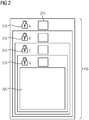
- Figure 2 shows an exemplary, multiply encrypted document 105 as it can be transmitted in a system 100 from the first party P1 to the second party P2.
- the document 105 shown is compatible with the in Figure 1 illustrated example by the actual useful data 205, in which the second party P2 is interested, one after the other the public keys of intermediate nodes G, C, D and A have been encrypted.
- the encryption is preferably carried out in such a way that it can be seen from the encrypted document 105, with the public key which of the intermediate nodes A to G the outermost - and only recognizable - encryption was carried out.
- an identification 210 (signature) of the encryption can be specified.
- a deliverable address for intermediate nodes A to G can also be specified or, for example, can be requested from key server 120 on the basis of identification 210.
- the document 105 can thus be transmitted to intermediate nodes A to G, which should be able to resolve the encryption.
- a unique identification 215 of the document 105 or an associated transfer from the sender P1 to the recipient P2 can be provided repeatedly on each encryption level, as shown, in order to avoid accidental or unauthorized changes.
- the transfer can include all documents 105 in any encryption that can be transmitted from the first party P1 to the second party P2 for the same reason. If the user data 205 has arrived at the second party P2, all other documents 105 of the same transfer lose their meaning.
- Figure 3 shows an exemplary representation of possible sequences 125 for the in the Figures 1 and 2 given example.
Landscapes
- Engineering & Computer Science (AREA)
- Computer Security & Cryptography (AREA)
- Computer Networks & Wireless Communication (AREA)
- Signal Processing (AREA)
- Computer Hardware Design (AREA)
- Computing Systems (AREA)
- General Engineering & Computer Science (AREA)
- Storage Device Security (AREA)
Claims (10)
- Procédé (100) pour transmettre un document (105) d'une première partie (P1) vers une deuxième partie (P2), le procédé (100) comprenant les étapes suivantes :a) détermination de différentes séquences (125) de respectivement m nœuds intermédiaires (A-G) à partir d'un ensemble de base de n nœuds intermédiaires (A-G) ;b) des ordinateurs servant de nœuds intermédiaires et chaque nœud intermédiaire (A-G) étant titulaire d'une clé cryptographique privée pour laquelle est connue une clé cryptographique publique correspondante ;c) cryptage du document (105) successivement avec les clés publiques des nœuds intermédiaires (A-G) d'une des séquences (125) ;d) transmission du document (105) au titulaire de la clé publique avec laquelle ledit document (105) a été crypté en dernier lieu, et décryptage du document (105) avec la clé privée de ce titulaire ;e) répétition de l'étape d jusqu'à ce que tous les nœuds intermédiaires (A-G) de la séquence (125) aient décrypté le document (105) etf) notification du document (105) à la deuxième partie (P2),g) les étapes c) à f) étant également exécutées pour toutes les autres séquences (125).
- Procédé (200) selon la revendication 1, deux quelconques des séquences formées (125) étant différentes en ce sens qu'une des séquences (125) comprend au moins un nœud intermédiaire (A-G) que l'autre séquence (125) ne comprend pas.
- Procédé (100) selon la revendication 1 ou 2, le document (105) représentant une prestation à laquelle est associée une contrepartie, le nœud intermédiaire (A-G) vérifiant si la contrepartie a été fournie et ne transmettant le document (105) que si c'est le cas.
- Procédé (100) selon la revendication 3, le nœud intermédiaire (A-G) étant impliqué dans la fourniture de la contrepartie.
- Procédé (100) selon l'une des revendications précédentes, la première et la deuxième partie (P2) se mettant d'accord, avant l'étape a, sur une détermination de m.
- Procédé (100) selon l'une des revendications précédentes, tous les sous-ensembles possibles de m nœuds intermédiaires (A-G) étant formés à partir de l'ensemble de base et une séquence (125) étant déterminée pour chaque sous-ensemble.
- Procédé (100) selon l'une des revendications précédentes, les respectivement m nœuds intermédiaires (A-G) de toutes les séquences (125) étant informés après la notification de l'un des documents (105) à la deuxième partie (P2) et au moins un des nœuds intermédiaires (A-G) rejetant ensuite de la première à la deuxième partie (P2) un document (105) déjà arrivé ou arrivant ensuite.
- Procédé (100) selon la revendication 7, la séquence (125) des nœuds intermédiaires (A-G) ayant été déterminée par la première partie (P1), et la deuxième partie (P2) informant la première partie (P1), et la première partie (P1) informant les nœuds intermédiaires (A-G).
- Procédé (100) selon l'une des revendications précédentes, une série des nœuds intermédiaires (A-G) étant déterminée aléatoirement dans une séquence (125).
- Procédé (100) selon l'une des revendications précédentes, la première partie (P1) cryptant le document (105) avant l'étape c) et la deuxième (P2) décryptant le document (105) en conséquence après l'étape f.
Priority Applications (2)
| Application Number | Priority Date | Filing Date | Title |
|---|---|---|---|
| EP18181091.2A EP3591925B1 (fr) | 2018-07-02 | 2018-07-02 | Système de chiffrement pour environnements peu fiables |
| PCT/EP2019/066221 WO2020007613A1 (fr) | 2018-07-02 | 2019-06-19 | Système de cryptage pour environnements non sécurisés |
Applications Claiming Priority (1)
| Application Number | Priority Date | Filing Date | Title |
|---|---|---|---|
| EP18181091.2A EP3591925B1 (fr) | 2018-07-02 | 2018-07-02 | Système de chiffrement pour environnements peu fiables |
Publications (2)
| Publication Number | Publication Date |
|---|---|
| EP3591925A1 EP3591925A1 (fr) | 2020-01-08 |
| EP3591925B1 true EP3591925B1 (fr) | 2020-08-26 |
Family
ID=62975838
Family Applications (1)
| Application Number | Title | Priority Date | Filing Date |
|---|---|---|---|
| EP18181091.2A Not-in-force EP3591925B1 (fr) | 2018-07-02 | 2018-07-02 | Système de chiffrement pour environnements peu fiables |
Country Status (2)
| Country | Link |
|---|---|
| EP (1) | EP3591925B1 (fr) |
| WO (1) | WO2020007613A1 (fr) |
Families Citing this family (1)
| Publication number | Priority date | Publication date | Assignee | Title |
|---|---|---|---|---|
| CN114389825B (zh) * | 2022-03-24 | 2022-07-08 | 腾讯科技(深圳)有限公司 | 一种基于区块链的数据通信方法和相关装置 |
-
2018
- 2018-07-02 EP EP18181091.2A patent/EP3591925B1/fr not_active Not-in-force
-
2019
- 2019-06-19 WO PCT/EP2019/066221 patent/WO2020007613A1/fr not_active Ceased
Non-Patent Citations (1)
| Title |
|---|
| None * |
Also Published As
| Publication number | Publication date |
|---|---|
| EP3591925A1 (fr) | 2020-01-08 |
| WO2020007613A1 (fr) | 2020-01-09 |
Similar Documents
| Publication | Publication Date | Title |
|---|---|---|
| DE3303846C2 (fr) | ||
| DE60304744T2 (de) | Verfahren,vorrichtung und computerprogramme zur erzeugung und/oder verwendungkonditionaler elektronischer signaturen zur meldung von statusänderungen | |
| DE69827410T2 (de) | Datenkommunikation | |
| DE19781841C2 (de) | Verfahren zum automatischen Entscheiden der Gültigkeit eines digitalen Dokuments von einer entfernten Stelle aus | |
| DE69917803T2 (de) | Nachrichtenidentifizierung mit vertraulichkeit, integrität und ursprungsauthentifizierung | |
| EP3033855B1 (fr) | Assistance à un déchiffrement de données chiffrées | |
| DE69420239T2 (de) | Verfahren und Netzwerk zur verschlüsselten Textübertragung innerhalb einer Gruppe von Einheiten unter Verwendung eines Schlüssels, der der Gruppe von Einheiten eigen ist in einem Netzwerk mit einer Vielzahl von Einheiten und einer Zentralstelle | |
| DE19823666B4 (de) | Verschlüsselungs-Kommunikationssystem | |
| DE602004007254T2 (de) | System und verfahren zum authentifizieren von dokumenten | |
| DE102021004548A1 (de) | Verfahren und transaktionssystem zum übertragen von token in einem elektronischen transaktionssystems | |
| DE112012000358B4 (de) | Unternehmensübergreifender Datenaustausch | |
| DE102013221159B3 (de) | Verfahren und System zum manipulationssicheren Bereitstellen mehrerer digitaler Zertifikate für mehrere öffentliche Schlüssel eines Geräts | |
| DE10248004A1 (de) | Verfahren und Vorrichtung zum Verschlüsseln von Daten | |
| DE102018009943A1 (de) | Verfahren zum Erzeugen einer blinden Signatur | |
| DE102020003739A1 (de) | Verfahren zur Verteilung und Aushandlung von Schlüsselmaterial | |
| EP2932677B1 (fr) | Procede de transmission securisee d'un message electronique | |
| EP3591925B1 (fr) | Système de chiffrement pour environnements peu fiables | |
| DE102018009950A1 (de) | Verfahren zum Erhalten einer blinden Signatur | |
| EP0884869A1 (fr) | Procédé d'affichage sécurisé lors de la transmission de fichiers ou de données entre utilisateurs | |
| DE102012106177A1 (de) | Sicheres Übertragungsverfahren | |
| WO2020144123A1 (fr) | Procédé et système de transmission d'informations | |
| EP3734486B1 (fr) | Procédé exécuté par ordinateur permettant de remplacer une chaîne de données | |
| DE102013106121A1 (de) | Verfahren zur Verschlüsselung von Daten | |
| EP1304827A1 (fr) | Procédé sécurisé de transmission de données | |
| DE10061102B4 (de) | System zur Statusabfrage von digitalen Zertifikaten |
Legal Events
| Date | Code | Title | Description |
|---|---|---|---|
| PUAI | Public reference made under article 153(3) epc to a published international application that has entered the european phase |
Free format text: ORIGINAL CODE: 0009012 |
|
| STAA | Information on the status of an ep patent application or granted ep patent |
Free format text: STATUS: THE APPLICATION HAS BEEN PUBLISHED |
|
| AK | Designated contracting states |
Kind code of ref document: A1 Designated state(s): AL AT BE BG CH CY CZ DE DK EE ES FI FR GB GR HR HU IE IS IT LI LT LU LV MC MK MT NL NO PL PT RO RS SE SI SK SM TR |
|
| AX | Request for extension of the european patent |
Extension state: BA ME |
|
| STAA | Information on the status of an ep patent application or granted ep patent |
Free format text: STATUS: REQUEST FOR EXAMINATION WAS MADE |
|
| 17P | Request for examination filed |
Effective date: 20200120 |
|
| RBV | Designated contracting states (corrected) |
Designated state(s): AL AT BE BG CH CY CZ DE DK EE ES FI FR GB GR HR HU IE IS IT LI LT LU LV MC MK MT NL NO PL PT RO RS SE SI SK SM TR |
|
| GRAP | Despatch of communication of intention to grant a patent |
Free format text: ORIGINAL CODE: EPIDOSNIGR1 |
|
| STAA | Information on the status of an ep patent application or granted ep patent |
Free format text: STATUS: GRANT OF PATENT IS INTENDED |
|
| INTG | Intention to grant announced |
Effective date: 20200330 |
|
| GRAS | Grant fee paid |
Free format text: ORIGINAL CODE: EPIDOSNIGR3 |
|
| GRAA | (expected) grant |
Free format text: ORIGINAL CODE: 0009210 |
|
| STAA | Information on the status of an ep patent application or granted ep patent |
Free format text: STATUS: THE PATENT HAS BEEN GRANTED |
|
| AK | Designated contracting states |
Kind code of ref document: B1 Designated state(s): AL AT BE BG CH CY CZ DE DK EE ES FI FR GB GR HR HU IE IS IT LI LT LU LV MC MK MT NL NO PL PT RO RS SE SI SK SM TR |
|
| REG | Reference to a national code |
Ref country code: GB Ref legal event code: FG4D Free format text: NOT ENGLISH |
|
| REG | Reference to a national code |
Ref country code: CH Ref legal event code: EP |
|
| REG | Reference to a national code |
Ref country code: AT Ref legal event code: REF Ref document number: 1307508 Country of ref document: AT Kind code of ref document: T Effective date: 20200915 |
|
| REG | Reference to a national code |
Ref country code: IE Ref legal event code: FG4D Free format text: LANGUAGE OF EP DOCUMENT: GERMAN |
|
| REG | Reference to a national code |
Ref country code: DE Ref legal event code: R096 Ref document number: 502018002271 Country of ref document: DE |
|
| REG | Reference to a national code |
Ref country code: CH Ref legal event code: NV Representative=s name: SIEMENS SCHWEIZ AG, CH |
|
| REG | Reference to a national code |
Ref country code: LT Ref legal event code: MG4D |
|
| PG25 | Lapsed in a contracting state [announced via postgrant information from national office to epo] |
Ref country code: BG Free format text: LAPSE BECAUSE OF FAILURE TO SUBMIT A TRANSLATION OF THE DESCRIPTION OR TO PAY THE FEE WITHIN THE PRESCRIBED TIME-LIMIT Effective date: 20201126 Ref country code: SE Free format text: LAPSE BECAUSE OF FAILURE TO SUBMIT A TRANSLATION OF THE DESCRIPTION OR TO PAY THE FEE WITHIN THE PRESCRIBED TIME-LIMIT Effective date: 20200826 Ref country code: NO Free format text: LAPSE BECAUSE OF FAILURE TO SUBMIT A TRANSLATION OF THE DESCRIPTION OR TO PAY THE FEE WITHIN THE PRESCRIBED TIME-LIMIT Effective date: 20201126 Ref country code: GR Free format text: LAPSE BECAUSE OF FAILURE TO SUBMIT A TRANSLATION OF THE DESCRIPTION OR TO PAY THE FEE WITHIN THE PRESCRIBED TIME-LIMIT Effective date: 20201127 Ref country code: LT Free format text: LAPSE BECAUSE OF FAILURE TO SUBMIT A TRANSLATION OF THE DESCRIPTION OR TO PAY THE FEE WITHIN THE PRESCRIBED TIME-LIMIT Effective date: 20200826 Ref country code: FI Free format text: LAPSE BECAUSE OF FAILURE TO SUBMIT A TRANSLATION OF THE DESCRIPTION OR TO PAY THE FEE WITHIN THE PRESCRIBED TIME-LIMIT Effective date: 20200826 Ref country code: PT Free format text: LAPSE BECAUSE OF FAILURE TO SUBMIT A TRANSLATION OF THE DESCRIPTION OR TO PAY THE FEE WITHIN THE PRESCRIBED TIME-LIMIT Effective date: 20201228 Ref country code: HR Free format text: LAPSE BECAUSE OF FAILURE TO SUBMIT A TRANSLATION OF THE DESCRIPTION OR TO PAY THE FEE WITHIN THE PRESCRIBED TIME-LIMIT Effective date: 20200826 |
|
| REG | Reference to a national code |
Ref country code: NL Ref legal event code: MP Effective date: 20200826 |
|
| PG25 | Lapsed in a contracting state [announced via postgrant information from national office to epo] |
Ref country code: PL Free format text: LAPSE BECAUSE OF FAILURE TO SUBMIT A TRANSLATION OF THE DESCRIPTION OR TO PAY THE FEE WITHIN THE PRESCRIBED TIME-LIMIT Effective date: 20200826 Ref country code: RS Free format text: LAPSE BECAUSE OF FAILURE TO SUBMIT A TRANSLATION OF THE DESCRIPTION OR TO PAY THE FEE WITHIN THE PRESCRIBED TIME-LIMIT Effective date: 20200826 Ref country code: LV Free format text: LAPSE BECAUSE OF FAILURE TO SUBMIT A TRANSLATION OF THE DESCRIPTION OR TO PAY THE FEE WITHIN THE PRESCRIBED TIME-LIMIT Effective date: 20200826 Ref country code: NL Free format text: LAPSE BECAUSE OF FAILURE TO SUBMIT A TRANSLATION OF THE DESCRIPTION OR TO PAY THE FEE WITHIN THE PRESCRIBED TIME-LIMIT Effective date: 20200826 Ref country code: IS Free format text: LAPSE BECAUSE OF FAILURE TO SUBMIT A TRANSLATION OF THE DESCRIPTION OR TO PAY THE FEE WITHIN THE PRESCRIBED TIME-LIMIT Effective date: 20201226 |
|
| PG25 | Lapsed in a contracting state [announced via postgrant information from national office to epo] |
Ref country code: EE Free format text: LAPSE BECAUSE OF FAILURE TO SUBMIT A TRANSLATION OF THE DESCRIPTION OR TO PAY THE FEE WITHIN THE PRESCRIBED TIME-LIMIT Effective date: 20200826 Ref country code: RO Free format text: LAPSE BECAUSE OF FAILURE TO SUBMIT A TRANSLATION OF THE DESCRIPTION OR TO PAY THE FEE WITHIN THE PRESCRIBED TIME-LIMIT Effective date: 20200826 Ref country code: DK Free format text: LAPSE BECAUSE OF FAILURE TO SUBMIT A TRANSLATION OF THE DESCRIPTION OR TO PAY THE FEE WITHIN THE PRESCRIBED TIME-LIMIT Effective date: 20200826 Ref country code: CZ Free format text: LAPSE BECAUSE OF FAILURE TO SUBMIT A TRANSLATION OF THE DESCRIPTION OR TO PAY THE FEE WITHIN THE PRESCRIBED TIME-LIMIT Effective date: 20200826 Ref country code: SM Free format text: LAPSE BECAUSE OF FAILURE TO SUBMIT A TRANSLATION OF THE DESCRIPTION OR TO PAY THE FEE WITHIN THE PRESCRIBED TIME-LIMIT Effective date: 20200826 |
|
| REG | Reference to a national code |
Ref country code: DE Ref legal event code: R097 Ref document number: 502018002271 Country of ref document: DE |
|
| PG25 | Lapsed in a contracting state [announced via postgrant information from national office to epo] |
Ref country code: AL Free format text: LAPSE BECAUSE OF FAILURE TO SUBMIT A TRANSLATION OF THE DESCRIPTION OR TO PAY THE FEE WITHIN THE PRESCRIBED TIME-LIMIT Effective date: 20200826 Ref country code: ES Free format text: LAPSE BECAUSE OF FAILURE TO SUBMIT A TRANSLATION OF THE DESCRIPTION OR TO PAY THE FEE WITHIN THE PRESCRIBED TIME-LIMIT Effective date: 20200826 |
|
| PG25 | Lapsed in a contracting state [announced via postgrant information from national office to epo] |
Ref country code: SK Free format text: LAPSE BECAUSE OF FAILURE TO SUBMIT A TRANSLATION OF THE DESCRIPTION OR TO PAY THE FEE WITHIN THE PRESCRIBED TIME-LIMIT Effective date: 20200826 |
|
| PLBE | No opposition filed within time limit |
Free format text: ORIGINAL CODE: 0009261 |
|
| STAA | Information on the status of an ep patent application or granted ep patent |
Free format text: STATUS: NO OPPOSITION FILED WITHIN TIME LIMIT |
|
| 26N | No opposition filed |
Effective date: 20210527 |
|
| PGFP | Annual fee paid to national office [announced via postgrant information from national office to epo] |
Ref country code: IT Payment date: 20210731 Year of fee payment: 4 Ref country code: FR Payment date: 20210721 Year of fee payment: 4 |
|
| REG | Reference to a national code |
Ref country code: DE Ref legal event code: R079 Ref document number: 502018002271 Country of ref document: DE Free format text: PREVIOUS MAIN CLASS: H04L0029060000 Ipc: H04L0065000000 |
|
| PGFP | Annual fee paid to national office [announced via postgrant information from national office to epo] |
Ref country code: DE Payment date: 20210917 Year of fee payment: 4 |
|
| PGFP | Annual fee paid to national office [announced via postgrant information from national office to epo] |
Ref country code: CH Payment date: 20211004 Year of fee payment: 4 |
|
| PG25 | Lapsed in a contracting state [announced via postgrant information from national office to epo] |
Ref country code: MC Free format text: LAPSE BECAUSE OF FAILURE TO SUBMIT A TRANSLATION OF THE DESCRIPTION OR TO PAY THE FEE WITHIN THE PRESCRIBED TIME-LIMIT Effective date: 20200826 |
|
| REG | Reference to a national code |
Ref country code: BE Ref legal event code: MM Effective date: 20210731 |
|
| PG25 | Lapsed in a contracting state [announced via postgrant information from national office to epo] |
Ref country code: LU Free format text: LAPSE BECAUSE OF NON-PAYMENT OF DUE FEES Effective date: 20210702 |
|
| PG25 | Lapsed in a contracting state [announced via postgrant information from national office to epo] |
Ref country code: IE Free format text: LAPSE BECAUSE OF NON-PAYMENT OF DUE FEES Effective date: 20210702 Ref country code: BE Free format text: LAPSE BECAUSE OF NON-PAYMENT OF DUE FEES Effective date: 20210731 |
|
| REG | Reference to a national code |
Ref country code: DE Ref legal event code: R119 Ref document number: 502018002271 Country of ref document: DE |
|
| REG | Reference to a national code |
Ref country code: CH Ref legal event code: PL |
|
| GBPC | Gb: european patent ceased through non-payment of renewal fee |
Effective date: 20220702 |
|
| PG25 | Lapsed in a contracting state [announced via postgrant information from national office to epo] |
Ref country code: LI Free format text: LAPSE BECAUSE OF NON-PAYMENT OF DUE FEES Effective date: 20220731 Ref country code: FR Free format text: LAPSE BECAUSE OF NON-PAYMENT OF DUE FEES Effective date: 20220731 Ref country code: CH Free format text: LAPSE BECAUSE OF NON-PAYMENT OF DUE FEES Effective date: 20220731 |
|
| PG25 | Lapsed in a contracting state [announced via postgrant information from national office to epo] |
Ref country code: GB Free format text: LAPSE BECAUSE OF NON-PAYMENT OF DUE FEES Effective date: 20220702 Ref country code: DE Free format text: LAPSE BECAUSE OF NON-PAYMENT OF DUE FEES Effective date: 20230201 |
|
| PG25 | Lapsed in a contracting state [announced via postgrant information from national office to epo] |
Ref country code: CY Free format text: LAPSE BECAUSE OF FAILURE TO SUBMIT A TRANSLATION OF THE DESCRIPTION OR TO PAY THE FEE WITHIN THE PRESCRIBED TIME-LIMIT Effective date: 20200826 |
|
| PG25 | Lapsed in a contracting state [announced via postgrant information from national office to epo] |
Ref country code: IT Free format text: LAPSE BECAUSE OF NON-PAYMENT OF DUE FEES Effective date: 20220702 Ref country code: HU Free format text: LAPSE BECAUSE OF FAILURE TO SUBMIT A TRANSLATION OF THE DESCRIPTION OR TO PAY THE FEE WITHIN THE PRESCRIBED TIME-LIMIT; INVALID AB INITIO Effective date: 20180702 |
|
| PG25 | Lapsed in a contracting state [announced via postgrant information from national office to epo] |
Ref country code: SI Free format text: LAPSE BECAUSE OF FAILURE TO SUBMIT A TRANSLATION OF THE DESCRIPTION OR TO PAY THE FEE WITHIN THE PRESCRIBED TIME-LIMIT Effective date: 20200826 |
|
| PG25 | Lapsed in a contracting state [announced via postgrant information from national office to epo] |
Ref country code: MK Free format text: LAPSE BECAUSE OF FAILURE TO SUBMIT A TRANSLATION OF THE DESCRIPTION OR TO PAY THE FEE WITHIN THE PRESCRIBED TIME-LIMIT Effective date: 20200826 |
|
| REG | Reference to a national code |
Ref country code: AT Ref legal event code: MM01 Ref document number: 1307508 Country of ref document: AT Kind code of ref document: T Effective date: 20230702 |
|
| PG25 | Lapsed in a contracting state [announced via postgrant information from national office to epo] |
Ref country code: MT Free format text: LAPSE BECAUSE OF FAILURE TO SUBMIT A TRANSLATION OF THE DESCRIPTION OR TO PAY THE FEE WITHIN THE PRESCRIBED TIME-LIMIT Effective date: 20200826 |
|
| PG25 | Lapsed in a contracting state [announced via postgrant information from national office to epo] |
Ref country code: AT Free format text: LAPSE BECAUSE OF NON-PAYMENT OF DUE FEES Effective date: 20230702 |
|
| PG25 | Lapsed in a contracting state [announced via postgrant information from national office to epo] |
Ref country code: AT Free format text: LAPSE BECAUSE OF NON-PAYMENT OF DUE FEES Effective date: 20230702 |
|
| PG25 | Lapsed in a contracting state [announced via postgrant information from national office to epo] |
Ref country code: TR Free format text: LAPSE BECAUSE OF FAILURE TO SUBMIT A TRANSLATION OF THE DESCRIPTION OR TO PAY THE FEE WITHIN THE PRESCRIBED TIME-LIMIT Effective date: 20200826 |