EP3594196B1 - Procédé de production de 2-butanol à partir de gammavalerolactone - Google Patents
Procédé de production de 2-butanol à partir de gammavalerolactone Download PDFInfo
- Publication number
- EP3594196B1 EP3594196B1 EP19184107.1A EP19184107A EP3594196B1 EP 3594196 B1 EP3594196 B1 EP 3594196B1 EP 19184107 A EP19184107 A EP 19184107A EP 3594196 B1 EP3594196 B1 EP 3594196B1
- Authority
- EP
- European Patent Office
- Prior art keywords
- butanol
- gvl
- reactor
- liquid phase
- area
- Prior art date
- Legal status (The legal status is an assumption and is not a legal conclusion. Google has not performed a legal analysis and makes no representation as to the accuracy of the status listed.)
- Active
Links
Images

Classifications
-
- B—PERFORMING OPERATIONS; TRANSPORTING
- B01—PHYSICAL OR CHEMICAL PROCESSES OR APPARATUS IN GENERAL
- B01J—CHEMICAL OR PHYSICAL PROCESSES, e.g. CATALYSIS OR COLLOID CHEMISTRY; THEIR RELEVANT APPARATUS
- B01J21/00—Catalysts comprising the elements, oxides, or hydroxides of magnesium, boron, aluminium, carbon, silicon, titanium, zirconium, or hafnium
- B01J21/06—Silicon, titanium, zirconium or hafnium; Oxides or hydroxides thereof
- B01J21/066—Zirconium or hafnium; Oxides or hydroxides thereof
-
- C—CHEMISTRY; METALLURGY
- C07—ORGANIC CHEMISTRY
- C07C—ACYCLIC OR CARBOCYCLIC COMPOUNDS
- C07C31/00—Saturated compounds having hydroxy or O-metal groups bound to acyclic carbon atoms
- C07C31/02—Monohydroxylic acyclic alcohols
- C07C31/12—Monohydroxylic acyclic alcohols containing four carbon atoms
-
- B—PERFORMING OPERATIONS; TRANSPORTING
- B01—PHYSICAL OR CHEMICAL PROCESSES OR APPARATUS IN GENERAL
- B01J—CHEMICAL OR PHYSICAL PROCESSES, e.g. CATALYSIS OR COLLOID CHEMISTRY; THEIR RELEVANT APPARATUS
- B01J23/00—Catalysts comprising metals or metal oxides or hydroxides, not provided for in group B01J21/00
- B01J23/38—Catalysts comprising metals or metal oxides or hydroxides, not provided for in group B01J21/00 of noble metals
- B01J23/40—Catalysts comprising metals or metal oxides or hydroxides, not provided for in group B01J21/00 of noble metals of the platinum group metals
- B01J23/46—Ruthenium, rhodium, osmium or iridium
- B01J23/462—Ruthenium
-
- B—PERFORMING OPERATIONS; TRANSPORTING
- B01—PHYSICAL OR CHEMICAL PROCESSES OR APPARATUS IN GENERAL
- B01J—CHEMICAL OR PHYSICAL PROCESSES, e.g. CATALYSIS OR COLLOID CHEMISTRY; THEIR RELEVANT APPARATUS
- B01J23/00—Catalysts comprising metals or metal oxides or hydroxides, not provided for in group B01J21/00
- B01J23/38—Catalysts comprising metals or metal oxides or hydroxides, not provided for in group B01J21/00 of noble metals
- B01J23/40—Catalysts comprising metals or metal oxides or hydroxides, not provided for in group B01J21/00 of noble metals of the platinum group metals
- B01J23/46—Ruthenium, rhodium, osmium or iridium
- B01J23/464—Rhodium
-
- C—CHEMISTRY; METALLURGY
- C07—ORGANIC CHEMISTRY
- C07B—GENERAL METHODS OF ORGANIC CHEMISTRY; APPARATUS THEREFOR
- C07B41/00—Formation or introduction of functional groups containing oxygen
- C07B41/02—Formation or introduction of functional groups containing oxygen of hydroxy or O-metal groups
-
- C—CHEMISTRY; METALLURGY
- C07—ORGANIC CHEMISTRY
- C07C—ACYCLIC OR CARBOCYCLIC COMPOUNDS
- C07C29/00—Preparation of compounds having hydroxy or O-metal groups bound to a carbon atom not belonging to a six-membered aromatic ring
- C07C29/132—Preparation of compounds having hydroxy or O-metal groups bound to a carbon atom not belonging to a six-membered aromatic ring by reduction of an oxygen containing functional group
- C07C29/136—Preparation of compounds having hydroxy or O-metal groups bound to a carbon atom not belonging to a six-membered aromatic ring by reduction of an oxygen containing functional group of >C=O containing groups, e.g. —COOH
- C07C29/147—Preparation of compounds having hydroxy or O-metal groups bound to a carbon atom not belonging to a six-membered aromatic ring by reduction of an oxygen containing functional group of >C=O containing groups, e.g. —COOH of carboxylic acids or derivatives thereof
- C07C29/149—Preparation of compounds having hydroxy or O-metal groups bound to a carbon atom not belonging to a six-membered aromatic ring by reduction of an oxygen containing functional group of >C=O containing groups, e.g. —COOH of carboxylic acids or derivatives thereof with hydrogen or hydrogen-containing gases
-
- C—CHEMISTRY; METALLURGY
- C07—ORGANIC CHEMISTRY
- C07D—HETEROCYCLIC COMPOUNDS
- C07D307/00—Heterocyclic compounds containing five-membered rings having one oxygen atom as the only ring hetero atom
- C07D307/02—Heterocyclic compounds containing five-membered rings having one oxygen atom as the only ring hetero atom not condensed with other rings
- C07D307/26—Heterocyclic compounds containing five-membered rings having one oxygen atom as the only ring hetero atom not condensed with other rings having one double bond between ring members or between a ring member and a non-ring member
- C07D307/30—Heterocyclic compounds containing five-membered rings having one oxygen atom as the only ring hetero atom not condensed with other rings having one double bond between ring members or between a ring member and a non-ring member with hetero atoms or with carbon atoms having three bonds to hetero atoms with at the most one bond to halogen, e.g. ester or nitrile radicals, directly attached to ring carbon atoms
- C07D307/32—Oxygen atoms
Definitions
- the present invention relates to selective production of 2-butanol from ⁇ -valerolactone (GVL) with a catalyst.
- VTL ⁇ -valerolactone
- 2-Butanol (sec-butanol, sec-butyl alcohol, methyl ethyl carbinol; C 4 H 10 O) is a colourless solvent with a characteristic alcohol odor. It is only moderately miscible with water but is miscible in all proportions with many organic solvents.
- 2-Butanol is produced commercially by the indirect hydration of fossil C-4 streams, usually n-butene.
- C-4 streams usually n-butene.
- butadiene and isobutylene are removed from the C-4 stream and the remaining butanes-butylenes stream (raffinate-2), usually rich in butene-2, is reacted with sulphuric acid.
- raffinate-2 usually rich in butene-2
- Addition of water hydrolyses the resulting sec-butyl hydrogen sulphate and di-sec-butyl sulphate to 2-butanol and sulphuric acid; di-sec-butyl ether is a by-product of side reactions.
- 2-butanol is used to make methyl ethyl ketone, which is used in surface coatings, adhesives, lube oil dewaxing, magnetic tape manufacture, printing inks, and in chemical uses.
- a minor amount of 2-butanol is employed as a direct solvent, as well as in blends with aromatic hydrocarbons, ketones and other alcohols.
- 2-Butanol is also used as an intermediate for manufacturing chemicals that are used for solvent applications, such as blended with aromatic hydrocarbons, ketones, and other alcohols for use as a solvent for nitrocellulosic and acrylic lacquers, and as a coupling agent for applications in hydraulic brake fluids, industrial cleaning compounds, and paint remover.
- 2-Butanol is also used as a raw material in the manufacture of sec-butyl acetate and in the production of a xanthate derivative that is a collector in ore flotation.
- Other uses include the manufacture of perfumes, fruit essences, dyestuffs, and wetting agents.
- ROZENBLIT ABIGAIL ET AL in "Reaction mechanism of aqueous-phase conversion of [gamma]-valerolactone (GVL) over a Ru/C catalyst", JOURNAL OF ENERGY CHEMISTRY, ELSEVIER, AMSTERDAM, NL, vol. 25, no. 6, 23 November 2016 (2016-11-23), pages 1008-1014 , discloses a process for preparing 2-butanol.
- JINKUN LV ET AL in "Catalytic conversion of biomassderived levulinic acid into alcohols over nanoporous Ru catalyst", CATALYSIS SCIENCE & TECHNOLOGY, vol. 8, no. 4, 1 January 2018 (2018-01-01), pages 975-979 , discloses another process for preparing 2-butanol.
- An advantage of the present process is that an effective and selective process for producing 2-butanol from a renewable feedstock in a controlled manner is achieved.
- the present invention it is possible to use GVL derived from a lignocellulosic source to produce 2-butanol and co-products.
- drawbacks relating to fossil raw materials can be avoided.
- a catalyst comprising at least one transition metal selected from the group consisting of iron, ruthenium, cobalt, rhodium and iridium, in a selective production of 2-butanol from GVL.
- a catalyst comprising at least one transition metal selected from the group consisting of iron, cobalt, rhodium and iridium, in a selective production of 2-butanol from GVL.
- An advantage of present use is high selectivity of 2-butanol production, and possibility to control co-product production by process conditions.
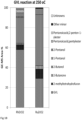
- Figures 1A and 1B show product distribution (according to GC-MS) in GVL hydrogenation experiments over Rh/ZrO 2 and Ru/ZrO 2 catalysts for liquid products obtained at 225 and 250 °C.
- the selectivity of 2-butanol production is at least 50% analysed as GC-MS area-%.
- the present process can be optimised for 2-butanol production, which is advantageous when co-products are not desired.
- Scheme 1 shows a simplified reaction scheme according to the invention, which depicts part of the compounds formed from GVL by the present selective hydrogenation.
- Compounds derived from pentanoic acid - also a hydrogenation product from GVL - are not included as they are of minor importance for the Rh- and Ru-catalysts.
- GC-MS area-% can be calculated as follows: the relative amount (area-%) of each compound in the product stream was determined by GC-MS. Each peak was integrated (https://goldbook.iupac.org/html/P/P04453.html) and the relative amount (area-%) was obtained by comparing the area of a single peak to the sum of the peaks in the GC-MS chromatogram.
- GVL and 2-butanol may be present primarily in the liquid phase, but to some degree also in the gas phase.
- lightest compounds such as methane and hydrogen, are primarily present in the gas phase.
- the feedstock contains at least 80 wt-% GVL.
- High GVL content of the feedstock is advantageous to provide a catalytic reaction process, which proceeds efficiently from GVL as the stating material to reaction products, in particular 2-butanol.
- the remaining part of the feedstock may contain water, levulinic acid, pentanoic acid, furfural, and/or sulphuric acid.
- the process can be used to process GVL-containing feed which contains further substances in addition to GVL.
- the process conditions provide 2-butanol in a liquid phase, wherein the ratio of 2-butanol to 2-methyltetrahydrofuran is at least 2 analysed as GC-MS area-%. In another embodiment the ratio of 2-butanol to 2-methyltetrahydrofuran is at least 2.0, 2.5, 3, 3.5, 4, 4.5, 5, 5.5 or 6 analysed as GC-MS area-%.
- the process can advantageously be used to produce high amount of 2-butanol. This can be achieved by selection of the catalyst and reaction conditions, such as temperature. Suitable reaction conditions can be selected by preferring process conditions that drive the reaction into the direction of 2-butanol production instead of 2-MTHF in Scheme 1.
- the process conditions provide 2-butanol in a liquid phase, and wherein the liquid phase comprises GVL, 2-butanol, 2-methyltetrahydrofuran and pentanol such as 1-pentanol or 2-pentanol.
- the liquid phase contains less than 80 GC-MS area-% GVL, preferably less than 80, 70, 60, 50, 40, 30 or 25 GC-MS area-% GVL.
- liquid phase contains at least 15 GC-MS area-% 2-butanol.
- the liquid phase contains at least 10 GC-MS area-% 2-butanol, preferably at least 10, 15, 20, 25, 30, 40, 50, 55 or 60 GC-MS area-% 2-butanol.
- the liquid phase contains 3-15 GC-MS area-% 2-MTHF, preferably 3-8, 4-6, 4-10, 5-15, 5-10, 6-11, 7-11, 7-10, or less than 15, less than 10, less than 8, less than 6 or less than 5 GC-MS area-% 2-2-MTHF.
- the liquid phase contains 2-8 GC-MS area-% 1-/2-pentanol, preferably 2-7 or 2.5-6.5 GC-MS area-% 1-/2-pentanol.
- the catalyst comprises Rh, Ru, or a combination thereof.
- the catalyst is provided on a support.
- the support is a solid porous support. This has an advantage of improved availability of the catalytically active metal by its dispersion on a porous solid material. Further, porous support may improve activity and selectivity of the catalyst.
- the support comprises Zr oxide, Al oxide, Ti oxide, silica, or a combination thereof.
- the catalyst comprises Rh/ZrO 2 or Ru/ZrO 2 , or a combination thereof. This has an advantage of high selectivity and yield.
- the temperature is maintained in the range 220-270 °C during production of 2-butanol. In a preferred embodiment the temperature is maintained in the range 220-255 °C.
- the temperature is maintained in the range 240-260°C during production of 2-butanol. In this temperature 2-butanol production pathway is even more preferred.
- the temperature is maintained at the selected range by cooling and heating the feedstock containing GVL.
- the temperature of the reactor is controlled by heat transfer by conduction, preferably through reactor walls.
- the temperature is controlled by diluting the feedstock.
- hydrogenation is typically an exothermic reaction, and temperature rise inside the reactor can be controlled by diluting the feedstock, which slows down the reaction and the resulting heat.
- the liquid phase comprises 2-butanol, 2-methyltetrahydrofuran, 2-pentanol, 1-pentanol, 2-butanone, pentanoic acid 2-penten-1-ylester, pentanoic acid pentylester.
- reaction temperature results into lower yield of 2-butanol with higher selectivity
- a higher temperature results into higher yield of 2-butanol and other reaction products.
- a higher temperature can be used to increase yield of 2-butanol, to produce further reaction products and to convert more GVL into reaction products.
- a lower reaction temperature can be selected to obtain a more selective 2-butanol production and less other reaction products.
- the feedstock containing GVL is heated to a temperature in the range 220-300 °C, preferably in the range 220-235, 220-230, 240-260, or 245-255°C, or about 225 or 250°C
- the temperature is maintained in the range 220-235, 220-230, 240-260, or 245-255°C, or about 225 or 250°C.
- the temperature is maintained at 220-230 °C, more preferably at about 225°C. In this temperature the process provides a liquid phase containing GVL, 2-butanol, 2-methyltetrahydrofuran and 2-pentanol.
- the temperature is maintained at 245-255°C, more preferably at about 250°C.
- the process provides a liquid phase containing 2-butanol, 2-methyltetrahydrofuran, 2-pentanol, 1-pentanol, 2-butanone, pentanoic acid 2-penten-1-ylester, and pentanoic acid pentylester.
- a pressure selected from the range 40-100 bar, preferably 50-90 bar, is maintained inside the reactor during production of 2-butanol. In another embodiment a pressure of 70-90 bar, 75-85 or about 80 bar is maintained inside the reactor.
- the process is a continuous process.
- the temperature of the process can be controlled by controlling the temperature of the feed which enters the reactor.
- the present process is carried out without adding further solvents.
- the present process is carried out without adding water, i.e. it is a "dry process".
- water has been identified as essential component to achieve selectivity to 2-butanol production.
- the present process was selective for 2-butanol.
- the process is a continuous flow process and the reactor is a fixed bed reactor.
- the selectivity is determined by determining the relative amount (area-%) of each compound in the product stream by GC-MS, integrating each peak, and comparing the area of a single peak to the sum of the peaks in the GC-MS chromatogram.
- reaction mixture contains at least 25 GC-MS area-% GVL.
- At least part of the unreacted GVL present in the liquid phase is recycled into the reactor. This has an advantage of higher total conversion of GVL, resulting into improved efficiency of the process.
- liquid phase contains at least 15 % 2-butanol analysed as GC-MS area-%.
- the pressure inside the reactor is controlled, and methane formed during the process is converted to hydrogen gas.
- methane formed during the process is converted to hydrogen gas.
- methane formed in the process is conducted outside the reactor through an outlet in the reactor wall, and conversion into hydrogen is carried out in a further conversion unit.
- the further conversion unit is in fluid connection with the reactor via at least one piping, such as a discharge piping for removing fluid from the reactor, and optionally via inlet piping for loading fluids into the reactor.
- At least part of the hydrogen gas obtained from methane is recycled to the reactor.
- the hydrogen gas is purified before feeding into the reactor.
- An advantage of obtaining methane and converting it to hydrogen gas is improved process economy.
- At least one further reaction product selected from 2-MTHF, 2-butanone, and pentyl pentanoate is recovered.
- Recovery of said further reaction products is advantageous because they can be used e.g. in manufacturing of solvents and flavouring agents.
- GVL is derived from a lignocellulosic source.
- An advantage of using GVL from a lignocellulosic source is that the produced 2-butanol is produced from a renewable source. Thus, problems relating to fossil feedstocks can be avoided.
- reaction product is at least one of 2-MTHF, 2-butanone, and pentyl pentanoate.
- the process comprises a further step of distilling and/or extracting the liquid phase to fractionate 2-butanol and other components.
- the amount of metal in the catalyst is less than 5 wt-%. In another embodiment the amount of metal in catalyst is less than 4 wt-%, 3 wt-%, 2 wt-%, 1 wt-% or 0.5 wt-%, preferably about 1 wt-%.
- the reactor is operated in a continuous mode.
- 2-butanol is recovered from the reactor in liquid phase.
- the process involves a step of separating a gas phase from a liquid phase.
- the gas phase is separated from the liquid phase to separate reaction products.
- reaction products are recovered from the reactor by conducting them into a product container.
- the product container is kept at an atmospheric pressure.
- the pressure of the reaction product feed from the reactor is reduced in a controlled manner before feeding into the product container, and gas-liquid separation is carried out to the reaction product feed before storing in the product container.
- light co-products in the gas phase and optionally in the liquid phase are stored in a cooled product container.
- At least part of the gas phase obtained during gas-liquid separation is recovered.
- selected co-products present in the gas phase are recovered by condensation
- H 2 /feed ratio is about 2000. In another embodiment the ratio is about 100-2000, preferably about 200-1000.
- the H 2 /feed can be calculated as follows: / GVL flow rate ml / h ⁇ 1000
- the liquid phase contains pentanoic acid 2-penten-1-ylester, 2-pentanol, pentanoic acid pentylester, 1-pentanol, 2-butanone, 2-butanol, 2-MTHF and GVL.
- At least part of the 2-butanol produced in the process is used to manufacture chemicals, fuels or fuel blends.
- the process is carried out at an industrial scale.
- steps a-c of the present process are carried out in the said sequence.
- the Ru/ZrO 2 and Rh/ZrO 2 catalysts were prepared using RuCl 3 •nH 2 O and Rh(NO 3 ) 3 , respectively, as metal precursors.
- the ZrO 2 support material was ground and sieved to the target particle size of 0.125-0.180 mm and calcined at 600 °C.
- the metal precursor was added by incipient wetness impregnation on the support and then dried at 100 °C overnight and calcined in air at 450 °C for 2 hours.
- the metal contents measured for the final catalysts were 0.85 wt-% Ru and 0.86 wt-% Rh.
- the hydrogenation of GVL over Rh/ZrO 2 and Ru/ZrO 2 was conducted in continuous flow fixed bed reactors. Five grams of catalyst was packed in the reactor without any inert material dilution. Commercial ⁇ -valerolactone (Sigma-Aldrich ⁇ 99 %) was used as received without any dilution.
- the catalysts were dried under nitrogen flow (10 l/h) at 120 °C for 1 hour. Heating rate was 0.5 °C/min. After drying, hydrogen flow was adjusted to 10 l/h and pressure was increased to 15 bar. The catalysts were reduced at 400 °C for 5 hours. Heating rate was 3 °C/min. After cooling down and soaking of the catalyst at 100 °C, test conditions were adjusted to WHSV 0.5 h-1, H 2 /feed ratio 2000 NL/L and pressure 80 bar. Only the temperature was varied during the hydrogenation experiment.
- reaction conditions used in the experiments are shown in Table 1.
- Table 1 Reaction conditions for the preparation of 2-butanol from GVL (the density of GVL used was 1.0259 g/cm 3 (50 °C).
- Weight-hourly-space-velocity is the mass flow rate of the reactants divided by the mass of the catalyst in the reactor
- the liquid product stream obtained in the hydrogenation experiment was analysed with offline Gas Chromatography - Mass Spectrometry, GC-MS (Agilent GC 6890A mit MSD 5973). Peaks in the GC chromatogram were assigned to various compounds by MS. The relative amount (area-%) of each compound in the product stream was determined by GC-MS. Each peak was integrated ( https://goldbook.iupac.org/html/P/P04453.html ) and the relative amount (area-%) was obtained by comparing the area of a single peak to the sum of the peaks in the GC-MS chromatogram. The amount of GVL (wt-%) was determined quantitatively with GC-FID from response factor that was calibrated with pure GVL.
- Gas Chromatography - Flame Ionization Detector or GC-FID is a very common analytical technique that is widely used in the petrochemical, pharmaceutical and natural gas markets.
- An FID typically uses a Hydrogen/Air flame into which the sample is passed to oxidise organic molecules and produces electrically charged particles (ions). The ions are collected and produce an electrical signal which is then measured.
- the conversion of GVL calculated from the quantitative amount of GVL remaining in the product was 50.5 and 69.8 wt-% for Rh/ZrO 2 at 225 and 250 °C, respectively, and 42.8 and 78.7 wt-% for Ru/ZrO 2 at 225 and 250 °C, respectively.
- Table 2 Product distribution, 2-butanol selectivity and 2-butanol-to-MTHF-ratio in organic liquid phases obtained at 225 and 250 °C with Rh/ZrO 2 and Ru/ZrO 2 catalysts (in GC area-%).
- Rh/ZrO 2 and Ru/ZrO 2 catalysts were superior in selectivity compared to selectivity values reported in the literature (e.g. over 5 wt-% Ru/C).
- a much lower amount of catalyst i.e. 1 wt-% Rh/ZrO 2 and Ru/ZrO 2 , was sufficient to achieve high selectivity and yield of the 2-butanol production.
Landscapes
- Chemical & Material Sciences (AREA)
- Organic Chemistry (AREA)
- Engineering & Computer Science (AREA)
- Materials Engineering (AREA)
- Chemical Kinetics & Catalysis (AREA)
- Organic Low-Molecular-Weight Compounds And Preparation Thereof (AREA)
- Preparation Of Compounds By Using Micro-Organisms (AREA)
Claims (19)
- Procédé de production sélective de 2-butanol à partir de y-valérolactone (GVL) comprenant les étapes de :a. fournir dans un réacteur au moins un catalyseur à base de métal de transition choisi dans le groupe constitué par le fer, le ruthénium, le cobalt, le rhodium et l'iridium ;b. chauffer une charge d'alimentation contenant du GVL, formant ainsi une charge d'alimentation de GVL chauffée ;c. former un mélange réactionnel en introduisant dans le réacteur :i. la charge d'alimentation de GVL chauffée ; etii. de l'hydrogène gazeux ; etd. maintenir la température du mélange réactionnel dans la plage allant de 220 à 300°C pour permettre la production sélective de produits de réaction comprenant du 2-butanol ;dans lequel aucune eau n'est ajoutée pendant le procédé.
- Le procédé de la revendication 1, dans lequel la sélectivité de la production de 2-butanol est d'au moins 50 %, analysée en pourcentage de surface en GC-MS.
- Le procédé de l'une quelconque des revendications 1 et 2, dans lequel la charge d'alimentation contient au moins 80 % en poids de GVL.
- Le procédé de l'une quelconque des revendications 1 à 3, dans lequel, dans les conditions du procédé, on fournit du 2-butanol dans une phase liquide, dans laquelle le rapport du 2-butanol au 2-méthyltétrahydrofurane est d'au moins 2, analysé en pourcentage de surface en GC-MS.
- Le procédé de l'une quelconque des revendications 1 à 4, dans lequel le catalyseur comprend du Rh, du Ru, ou une combinaison de ceux-ci.
- Le procédé de l'une quelconque des revendications 1 à 5, dans lequel le catalyseur est fourni sur un support.
- Le procédé de la revendication 6, dans lequel le support comprend de l'oxyde de Zr, de l'oxyde d'Al, de l'oxyde de Ti, de la silice, ou une combinaison de ceux-ci.
- Le procédé de l'une quelconque des revendications 1 à 7, dans lequel le catalyseur comprend du Rh/ZrO2 ou du Ru/ZrO2, ou une combinaison de ceux-ci.
- Le procédé de l'une quelconque des revendications 1 à 8, dans lequel la température est maintenue dans la plage allant de 220 à 270°C pendant la production de 2-butanol.
- Le procédé de l'une quelconque des revendications 1 à 10, dans lequel la température est maintenue dans la plage allant de 240 à 260°C pendant la production de 2-butanol.
- Le procédé de l'une quelconque des revendications 1 à 10, dans lequel, dans les conditions de procédé, on fournit du 2-butanol dans une phase liquide, et dans lequel la phase liquide comprend du GVL, du 2-butanol, du 2-méthyltétrahydrofurane et du 2-pentanol.
- Le procédé de la revendication 11, dans lequel la phase liquide comprend du 2-butanol, du 2-méthyltétrahydrofurane, du 2-pentanol, du 1-pentanol, de la 2-butanone, de l'acide pentanoïque 2-pentène-1-ylester, et du pentylester d'acide pentanoïque.
- Le procédé de l'une quelconque des revendications 1 à 12, dans lequel une pression choisie dans la plage allant de 40 à 100 bars, de préférence de 50 à 90 bars, est maintenue à l'intérieur du réacteur pendant la production de 2-butanol.
- Le procédé de l'une quelconque des revendications 1 à 13, dans lequel le procédé est un procédé continu.
- Le procédé de la revendication 14, dans lequel au moins une partie du GVL non réagi présent dans la phase liquide est recyclée dans le réacteur.
- Le procédé de l'une quelconque des revendications 4 à 15, dans lequel la phase liquide contient au moins au moins 15% de 2-butanol analysé en pourcentage de surface en GC-MS.
- Le procédé de l'une quelconque des revendications 13 à 16, dans lequel la pression à l'intérieur du réacteur est contrôlée, et du méthane formé au cours du procédé est converti en hydrogène gazeux.
- Le procédé des revendications 1 à 17 dans lequel au moins un autre produit de réaction choisi parmi le 2-MTHF, la 2-butanone et le pentanoate de pentyle est récupéré.
- Le procédé selon l'une quelconque des revendications 1 à 18, dans lequel le GVL est dérivé d'une source lignocellulosique.
Applications Claiming Priority (1)
| Application Number | Priority Date | Filing Date | Title |
|---|---|---|---|
| FI20185642A FI129646B (en) | 2018-07-13 | 2018-07-13 | Process for the production of 2-butanol from gamma-valerolactone |
Publications (3)
| Publication Number | Publication Date |
|---|---|
| EP3594196A1 EP3594196A1 (fr) | 2020-01-15 |
| EP3594196C0 EP3594196C0 (fr) | 2023-06-07 |
| EP3594196B1 true EP3594196B1 (fr) | 2023-06-07 |
Family
ID=67145696
Family Applications (1)
| Application Number | Title | Priority Date | Filing Date |
|---|---|---|---|
| EP19184107.1A Active EP3594196B1 (fr) | 2018-07-13 | 2019-07-03 | Procédé de production de 2-butanol à partir de gammavalerolactone |
Country Status (5)
| Country | Link |
|---|---|
| US (1) | US10865170B2 (fr) |
| EP (1) | EP3594196B1 (fr) |
| CA (1) | CA3049240A1 (fr) |
| ES (1) | ES2947088T3 (fr) |
| FI (1) | FI129646B (fr) |
Family Cites Families (2)
| Publication number | Priority date | Publication date | Assignee | Title |
|---|---|---|---|---|
| US5883266A (en) | 1998-01-16 | 1999-03-16 | Battelle Memorial Institute | Hydrogenated 5-carbon compound and method of making |
| JP6958783B2 (ja) * | 2016-10-31 | 2021-11-02 | 国立大学法人大阪大学 | 1炭素減炭反応用触媒、及びこれを用いた1炭素減炭化合物の製造方法 |
-
2018
- 2018-07-13 FI FI20185642A patent/FI129646B/en active IP Right Grant
-
2019
- 2019-07-03 ES ES19184107T patent/ES2947088T3/es active Active
- 2019-07-03 EP EP19184107.1A patent/EP3594196B1/fr active Active
- 2019-07-10 CA CA3049240A patent/CA3049240A1/fr active Pending
- 2019-07-11 US US16/508,777 patent/US10865170B2/en not_active Expired - Fee Related
Also Published As
| Publication number | Publication date |
|---|---|
| EP3594196C0 (fr) | 2023-06-07 |
| EP3594196A1 (fr) | 2020-01-15 |
| US20200017430A1 (en) | 2020-01-16 |
| FI20185642A1 (en) | 2020-01-14 |
| FI129646B (en) | 2022-06-15 |
| CA3049240A1 (fr) | 2020-01-13 |
| US10865170B2 (en) | 2020-12-15 |
| ES2947088T3 (es) | 2023-08-01 |
Similar Documents
| Publication | Publication Date | Title |
|---|---|---|
| US9862664B2 (en) | Process for the production of alkenols and use thereof for the production of 1,3-butadiene | |
| DK2162416T3 (en) | GAS PHASE PROCEDURE FOR PREPARING MONOAL ALCOHOL FROM GLYCEROL | |
| CN110637003B (zh) | 用于醛和/或醇的大规模制备的氢甲酰化方法 | |
| US10669221B2 (en) | Composition of catalysts for conversion of ethanol to N-butanol and higher alcohols | |
| CN105837420B (zh) | 从甘油制备丙烯醛的方法 | |
| CN107108397B (zh) | 用于生产二烯烃的方法 | |
| US2064254A (en) | Production of higher ketones | |
| US20120220804A1 (en) | Manufacture of dimethyl ether from crude methanol | |
| US8686195B2 (en) | Method for synthesizing acrolein from glycerol | |
| EP3594196B1 (fr) | Procédé de production de 2-butanol à partir de gammavalerolactone | |
| JP2002121160A (ja) | イソプロピルアルコールの製造方法 | |
| EP3015446B1 (fr) | Procédé de production d'alcool allylique et alcool allylique ainsi produit | |
| DE10044809A1 (de) | Verfahren zur Herstellung von Aldehyden | |
| CN108976183B (zh) | 一种由糠醛气相加氢制备γ-戊内酯的方法 | |
| US11028033B2 (en) | Method for producing terpene aldehydes and terpene ketones | |
| US9809517B2 (en) | Method for breakdown of formates | |
| SU666167A1 (ru) | Способ получени -алкиланилинов | |
| JP2005247840A (ja) | 1,3−プロパンジオールの製造方法及び該製造方法で得られる1,3−プロパンジオール | |
| EP2121554A1 (fr) | Condensation d'aldol | |
| Schütz et al. | A novel approach to timberwood fragrances | |
| WO2004009523A1 (fr) | Procede pour produire des cetals et des ethers d'enol |
Legal Events
| Date | Code | Title | Description |
|---|---|---|---|
| PUAI | Public reference made under article 153(3) epc to a published international application that has entered the european phase |
Free format text: ORIGINAL CODE: 0009012 |
|
| STAA | Information on the status of an ep patent application or granted ep patent |
Free format text: STATUS: THE APPLICATION HAS BEEN PUBLISHED |
|
| AK | Designated contracting states |
Kind code of ref document: A1 Designated state(s): AL AT BE BG CH CY CZ DE DK EE ES FI FR GB GR HR HU IE IS IT LI LT LU LV MC MK MT NL NO PL PT RO RS SE SI SK SM TR |
|
| AX | Request for extension of the european patent |
Extension state: BA ME |
|
| STAA | Information on the status of an ep patent application or granted ep patent |
Free format text: STATUS: REQUEST FOR EXAMINATION WAS MADE |
|
| 17P | Request for examination filed |
Effective date: 20200714 |
|
| RBV | Designated contracting states (corrected) |
Designated state(s): AL AT BE BG CH CY CZ DE DK EE ES FI FR GB GR HR HU IE IS IT LI LT LU LV MC MK MT NL NO PL PT RO RS SE SI SK SM TR |
|
| STAA | Information on the status of an ep patent application or granted ep patent |
Free format text: STATUS: EXAMINATION IS IN PROGRESS |
|
| 17Q | First examination report despatched |
Effective date: 20210415 |
|
| RIC1 | Information provided on ipc code assigned before grant |
Ipc: B01J 21/06 20060101ALI20221025BHEP Ipc: B01J 23/46 20060101ALI20221025BHEP Ipc: C07C 31/12 20060101ALI20221025BHEP Ipc: C07C 29/149 20060101AFI20221025BHEP |
|
| GRAP | Despatch of communication of intention to grant a patent |
Free format text: ORIGINAL CODE: EPIDOSNIGR1 |
|
| STAA | Information on the status of an ep patent application or granted ep patent |
Free format text: STATUS: GRANT OF PATENT IS INTENDED |
|
| INTG | Intention to grant announced |
Effective date: 20221208 |
|
| GRAS | Grant fee paid |
Free format text: ORIGINAL CODE: EPIDOSNIGR3 |
|
| GRAA | (expected) grant |
Free format text: ORIGINAL CODE: 0009210 |
|
| STAA | Information on the status of an ep patent application or granted ep patent |
Free format text: STATUS: THE PATENT HAS BEEN GRANTED |
|
| AK | Designated contracting states |
Kind code of ref document: B1 Designated state(s): AL AT BE BG CH CY CZ DE DK EE ES FI FR GB GR HR HU IE IS IT LI LT LU LV MC MK MT NL NO PL PT RO RS SE SI SK SM TR |
|
| REG | Reference to a national code |
Ref country code: GB Ref legal event code: FG4D |
|
| REG | Reference to a national code |
Ref country code: CH Ref legal event code: EP Ref country code: AT Ref legal event code: REF Ref document number: 1574655 Country of ref document: AT Kind code of ref document: T Effective date: 20230615 Ref country code: DE Ref legal event code: R096 Ref document number: 602019029801 Country of ref document: DE |
|
| U01 | Request for unitary effect filed |
Effective date: 20230615 |
|
| U07 | Unitary effect registered |
Designated state(s): AT BE BG DE DK EE FI FR IT LT LU LV MT NL PT SE SI Effective date: 20230622 |
|
| REG | Reference to a national code |
Ref country code: ES Ref legal event code: FG2A Ref document number: 2947088 Country of ref document: ES Kind code of ref document: T3 Effective date: 20230801 |
|
| REG | Reference to a national code |
Ref country code: NO Ref legal event code: T2 Effective date: 20230607 |
|
| U20 | Renewal fee for the european patent with unitary effect paid |
Year of fee payment: 5 Effective date: 20230726 |
|
| REG | Reference to a national code |
Ref country code: LT Ref legal event code: MG9D |
|
| PGFP | Annual fee paid to national office [announced via postgrant information from national office to epo] |
Ref country code: NO Payment date: 20230725 Year of fee payment: 5 Ref country code: GB Payment date: 20230727 Year of fee payment: 5 Ref country code: ES Payment date: 20230808 Year of fee payment: 5 |
|
| PG25 | Lapsed in a contracting state [announced via postgrant information from national office to epo] |
Ref country code: RS Free format text: LAPSE BECAUSE OF FAILURE TO SUBMIT A TRANSLATION OF THE DESCRIPTION OR TO PAY THE FEE WITHIN THE PRESCRIBED TIME-LIMIT Effective date: 20230607 Ref country code: HR Free format text: LAPSE BECAUSE OF FAILURE TO SUBMIT A TRANSLATION OF THE DESCRIPTION OR TO PAY THE FEE WITHIN THE PRESCRIBED TIME-LIMIT Effective date: 20230607 Ref country code: GR Free format text: LAPSE BECAUSE OF FAILURE TO SUBMIT A TRANSLATION OF THE DESCRIPTION OR TO PAY THE FEE WITHIN THE PRESCRIBED TIME-LIMIT Effective date: 20230908 |
|
| PG25 | Lapsed in a contracting state [announced via postgrant information from national office to epo] |
Ref country code: SK Free format text: LAPSE BECAUSE OF FAILURE TO SUBMIT A TRANSLATION OF THE DESCRIPTION OR TO PAY THE FEE WITHIN THE PRESCRIBED TIME-LIMIT Effective date: 20230607 |
|
| PG25 | Lapsed in a contracting state [announced via postgrant information from national office to epo] |
Ref country code: IS Free format text: LAPSE BECAUSE OF FAILURE TO SUBMIT A TRANSLATION OF THE DESCRIPTION OR TO PAY THE FEE WITHIN THE PRESCRIBED TIME-LIMIT Effective date: 20231007 |
|
| PG25 | Lapsed in a contracting state [announced via postgrant information from national office to epo] |
Ref country code: SM Free format text: LAPSE BECAUSE OF FAILURE TO SUBMIT A TRANSLATION OF THE DESCRIPTION OR TO PAY THE FEE WITHIN THE PRESCRIBED TIME-LIMIT Effective date: 20230607 Ref country code: SK Free format text: LAPSE BECAUSE OF FAILURE TO SUBMIT A TRANSLATION OF THE DESCRIPTION OR TO PAY THE FEE WITHIN THE PRESCRIBED TIME-LIMIT Effective date: 20230607 Ref country code: RO Free format text: LAPSE BECAUSE OF FAILURE TO SUBMIT A TRANSLATION OF THE DESCRIPTION OR TO PAY THE FEE WITHIN THE PRESCRIBED TIME-LIMIT Effective date: 20230607 Ref country code: IS Free format text: LAPSE BECAUSE OF FAILURE TO SUBMIT A TRANSLATION OF THE DESCRIPTION OR TO PAY THE FEE WITHIN THE PRESCRIBED TIME-LIMIT Effective date: 20231007 Ref country code: CZ Free format text: LAPSE BECAUSE OF FAILURE TO SUBMIT A TRANSLATION OF THE DESCRIPTION OR TO PAY THE FEE WITHIN THE PRESCRIBED TIME-LIMIT Effective date: 20230607 |
|
| PG25 | Lapsed in a contracting state [announced via postgrant information from national office to epo] |
Ref country code: PL Free format text: LAPSE BECAUSE OF FAILURE TO SUBMIT A TRANSLATION OF THE DESCRIPTION OR TO PAY THE FEE WITHIN THE PRESCRIBED TIME-LIMIT Effective date: 20230607 |
|
| REG | Reference to a national code |
Ref country code: CH Ref legal event code: PL |
|
| REG | Reference to a national code |
Ref country code: DE Ref legal event code: R097 Ref document number: 602019029801 Country of ref document: DE |
|
| PG25 | Lapsed in a contracting state [announced via postgrant information from national office to epo] |
Ref country code: MC Free format text: LAPSE BECAUSE OF FAILURE TO SUBMIT A TRANSLATION OF THE DESCRIPTION OR TO PAY THE FEE WITHIN THE PRESCRIBED TIME-LIMIT Effective date: 20230607 |
|
| PG25 | Lapsed in a contracting state [announced via postgrant information from national office to epo] |
Ref country code: MC Free format text: LAPSE BECAUSE OF FAILURE TO SUBMIT A TRANSLATION OF THE DESCRIPTION OR TO PAY THE FEE WITHIN THE PRESCRIBED TIME-LIMIT Effective date: 20230607 |
|
| PLBE | No opposition filed within time limit |
Free format text: ORIGINAL CODE: 0009261 |
|
| STAA | Information on the status of an ep patent application or granted ep patent |
Free format text: STATUS: NO OPPOSITION FILED WITHIN TIME LIMIT |
|
| REG | Reference to a national code |
Ref country code: IE Ref legal event code: MM4A |
|
| PG25 | Lapsed in a contracting state [announced via postgrant information from national office to epo] |
Ref country code: CH Free format text: LAPSE BECAUSE OF NON-PAYMENT OF DUE FEES Effective date: 20230731 |
|
| 26N | No opposition filed |
Effective date: 20240308 |
|
| PG25 | Lapsed in a contracting state [announced via postgrant information from national office to epo] |
Ref country code: IE Free format text: LAPSE BECAUSE OF NON-PAYMENT OF DUE FEES Effective date: 20230703 |
|
| PG25 | Lapsed in a contracting state [announced via postgrant information from national office to epo] |
Ref country code: IE Free format text: LAPSE BECAUSE OF NON-PAYMENT OF DUE FEES Effective date: 20230703 |
|
| U90 | Renewal fees not paid: noting of loss of rights |
Free format text: RENEWAL FEE NOT PAID FOR YEAR 06 Effective date: 20250214 |
|
| GBPC | Gb: european patent ceased through non-payment of renewal fee |
Effective date: 20240703 |
|
| PG25 | Lapsed in a contracting state [announced via postgrant information from national office to epo] |
Ref country code: NO Free format text: LAPSE BECAUSE OF NON-PAYMENT OF DUE FEES Effective date: 20240731 |
|
| PG25 | Lapsed in a contracting state [announced via postgrant information from national office to epo] |
Ref country code: GB Free format text: LAPSE BECAUSE OF NON-PAYMENT OF DUE FEES Effective date: 20240703 |
|
| U93 | Unitary patent lapsed |
Free format text: RENEWAL FEE NOT PAID Effective date: 20240731 |
|
| PG25 | Lapsed in a contracting state [announced via postgrant information from national office to epo] |
Ref country code: CY Free format text: LAPSE BECAUSE OF FAILURE TO SUBMIT A TRANSLATION OF THE DESCRIPTION OR TO PAY THE FEE WITHIN THE PRESCRIBED TIME-LIMIT; INVALID AB INITIO Effective date: 20190703 |
|
| PG25 | Lapsed in a contracting state [announced via postgrant information from national office to epo] |
Ref country code: HU Free format text: LAPSE BECAUSE OF FAILURE TO SUBMIT A TRANSLATION OF THE DESCRIPTION OR TO PAY THE FEE WITHIN THE PRESCRIBED TIME-LIMIT; INVALID AB INITIO Effective date: 20190703 |
|
| REG | Reference to a national code |
Ref country code: ES Ref legal event code: FD2A Effective date: 20250826 |
|
| PG25 | Lapsed in a contracting state [announced via postgrant information from national office to epo] |
Ref country code: ES Free format text: LAPSE BECAUSE OF NON-PAYMENT OF DUE FEES Effective date: 20240704 |
|
| PG25 | Lapsed in a contracting state [announced via postgrant information from national office to epo] |
Ref country code: TR Free format text: LAPSE BECAUSE OF FAILURE TO SUBMIT A TRANSLATION OF THE DESCRIPTION OR TO PAY THE FEE WITHIN THE PRESCRIBED TIME-LIMIT Effective date: 20230607 |