EP3594207A1 - Vorrichtung zur elektrochemischen stromspeicherung - Google Patents
Vorrichtung zur elektrochemischen stromspeicherung Download PDFInfo
- Publication number
- EP3594207A1 EP3594207A1 EP19186800.9A EP19186800A EP3594207A1 EP 3594207 A1 EP3594207 A1 EP 3594207A1 EP 19186800 A EP19186800 A EP 19186800A EP 3594207 A1 EP3594207 A1 EP 3594207A1
- Authority
- EP
- European Patent Office
- Prior art keywords
- energy storage
- storage device
- anodic
- polymer matrix
- cell
- Prior art date
- Legal status (The legal status is an assumption and is not a legal conclusion. Google has not performed a legal analysis and makes no representation as to the accuracy of the status listed.)
- Granted
Links
- 0 CC1c(c(*)c(*)c(*)c2*)c2N(*)c2c1c(*)c(*)c(*)c2* Chemical compound CC1c(c(*)c(*)c(*)c2*)c2N(*)c2c1c(*)c(*)c(*)c2* 0.000 description 3
Images
Classifications
-
- G—PHYSICS
- G02—OPTICS
- G02F—OPTICAL DEVICES OR ARRANGEMENTS FOR THE CONTROL OF LIGHT BY MODIFICATION OF THE OPTICAL PROPERTIES OF THE MEDIA OF THE ELEMENTS INVOLVED THEREIN; NON-LINEAR OPTICS; FREQUENCY-CHANGING OF LIGHT; OPTICAL LOGIC ELEMENTS; OPTICAL ANALOGUE/DIGITAL CONVERTERS
- G02F1/00—Devices or arrangements for the control of the intensity, colour, phase, polarisation or direction of light arriving from an independent light source, e.g. switching, gating or modulating; Non-linear optics
- G02F1/01—Devices or arrangements for the control of the intensity, colour, phase, polarisation or direction of light arriving from an independent light source, e.g. switching, gating or modulating; Non-linear optics for the control of the intensity, phase, polarisation or colour
- G02F1/15—Devices or arrangements for the control of the intensity, colour, phase, polarisation or direction of light arriving from an independent light source, e.g. switching, gating or modulating; Non-linear optics for the control of the intensity, phase, polarisation or colour based on an electrochromic effect
- G02F1/1506—Devices or arrangements for the control of the intensity, colour, phase, polarisation or direction of light arriving from an independent light source, e.g. switching, gating or modulating; Non-linear optics for the control of the intensity, phase, polarisation or colour based on an electrochromic effect caused by electrodeposition, e.g. electrolytic deposition of an inorganic material on or close to an electrode
-
- G—PHYSICS
- G02—OPTICS
- G02F—OPTICAL DEVICES OR ARRANGEMENTS FOR THE CONTROL OF LIGHT BY MODIFICATION OF THE OPTICAL PROPERTIES OF THE MEDIA OF THE ELEMENTS INVOLVED THEREIN; NON-LINEAR OPTICS; FREQUENCY-CHANGING OF LIGHT; OPTICAL LOGIC ELEMENTS; OPTICAL ANALOGUE/DIGITAL CONVERTERS
- G02F1/00—Devices or arrangements for the control of the intensity, colour, phase, polarisation or direction of light arriving from an independent light source, e.g. switching, gating or modulating; Non-linear optics
- G02F1/01—Devices or arrangements for the control of the intensity, colour, phase, polarisation or direction of light arriving from an independent light source, e.g. switching, gating or modulating; Non-linear optics for the control of the intensity, phase, polarisation or colour
- G02F1/15—Devices or arrangements for the control of the intensity, colour, phase, polarisation or direction of light arriving from an independent light source, e.g. switching, gating or modulating; Non-linear optics for the control of the intensity, phase, polarisation or colour based on an electrochromic effect
- G02F1/1514—Devices or arrangements for the control of the intensity, colour, phase, polarisation or direction of light arriving from an independent light source, e.g. switching, gating or modulating; Non-linear optics for the control of the intensity, phase, polarisation or colour based on an electrochromic effect characterised by the electrochromic material, e.g. by the electrodeposited material
- G02F1/1523—Devices or arrangements for the control of the intensity, colour, phase, polarisation or direction of light arriving from an independent light source, e.g. switching, gating or modulating; Non-linear optics for the control of the intensity, phase, polarisation or colour based on an electrochromic effect characterised by the electrochromic material, e.g. by the electrodeposited material comprising inorganic material
- G02F1/1525—Devices or arrangements for the control of the intensity, colour, phase, polarisation or direction of light arriving from an independent light source, e.g. switching, gating or modulating; Non-linear optics for the control of the intensity, phase, polarisation or colour based on an electrochromic effect characterised by the electrochromic material, e.g. by the electrodeposited material comprising inorganic material characterised by a particular ion transporting layer, e.g. electrolyte
-
- H—ELECTRICITY
- H01—ELECTRIC ELEMENTS
- H01G—CAPACITORS; CAPACITORS, RECTIFIERS, DETECTORS, SWITCHING DEVICES, LIGHT-SENSITIVE OR TEMPERATURE-SENSITIVE DEVICES OF THE ELECTROLYTIC TYPE
- H01G11/00—Hybrid capacitors, i.e. capacitors having different positive and negative electrodes; Electric double-layer [EDL] capacitors; Processes for the manufacture thereof or of parts thereof
- H01G11/04—Hybrid capacitors
-
- H—ELECTRICITY
- H01—ELECTRIC ELEMENTS
- H01G—CAPACITORS; CAPACITORS, RECTIFIERS, DETECTORS, SWITCHING DEVICES, LIGHT-SENSITIVE OR TEMPERATURE-SENSITIVE DEVICES OF THE ELECTROLYTIC TYPE
- H01G11/00—Hybrid capacitors, i.e. capacitors having different positive and negative electrodes; Electric double-layer [EDL] capacitors; Processes for the manufacture thereof or of parts thereof
- H01G11/22—Electrodes
- H01G11/30—Electrodes characterised by their material
- H01G11/48—Conductive polymers
-
- H—ELECTRICITY
- H01—ELECTRIC ELEMENTS
- H01G—CAPACITORS; CAPACITORS, RECTIFIERS, DETECTORS, SWITCHING DEVICES, LIGHT-SENSITIVE OR TEMPERATURE-SENSITIVE DEVICES OF THE ELECTROLYTIC TYPE
- H01G9/00—Electrolytic capacitors, rectifiers, detectors, switching devices, light-sensitive or temperature-sensitive devices; Processes of their manufacture
- H01G9/004—Details
- H01G9/02—Diaphragms; Separators
-
- H—ELECTRICITY
- H01—ELECTRIC ELEMENTS
- H01G—CAPACITORS; CAPACITORS, RECTIFIERS, DETECTORS, SWITCHING DEVICES, LIGHT-SENSITIVE OR TEMPERATURE-SENSITIVE DEVICES OF THE ELECTROLYTIC TYPE
- H01G9/00—Electrolytic capacitors, rectifiers, detectors, switching devices, light-sensitive or temperature-sensitive devices; Processes of their manufacture
- H01G9/004—Details
- H01G9/022—Electrolytes; Absorbents
- H01G9/035—Liquid electrolytes, e.g. impregnating materials
-
- H—ELECTRICITY
- H01—ELECTRIC ELEMENTS
- H01G—CAPACITORS; CAPACITORS, RECTIFIERS, DETECTORS, SWITCHING DEVICES, LIGHT-SENSITIVE OR TEMPERATURE-SENSITIVE DEVICES OF THE ELECTROLYTIC TYPE
- H01G9/00—Electrolytic capacitors, rectifiers, detectors, switching devices, light-sensitive or temperature-sensitive devices; Processes of their manufacture
- H01G9/004—Details
- H01G9/04—Electrodes or formation of dielectric layers thereon
- H01G9/042—Electrodes or formation of dielectric layers thereon characterised by the material
- H01G9/0425—Electrodes or formation of dielectric layers thereon characterised by the material specially adapted for cathode
-
- H—ELECTRICITY
- H01—ELECTRIC ELEMENTS
- H01G—CAPACITORS; CAPACITORS, RECTIFIERS, DETECTORS, SWITCHING DEVICES, LIGHT-SENSITIVE OR TEMPERATURE-SENSITIVE DEVICES OF THE ELECTROLYTIC TYPE
- H01G9/00—Electrolytic capacitors, rectifiers, detectors, switching devices, light-sensitive or temperature-sensitive devices; Processes of their manufacture
- H01G9/145—Liquid electrolytic capacitors
-
- H—ELECTRICITY
- H01—ELECTRIC ELEMENTS
- H01M—PROCESSES OR MEANS, e.g. BATTERIES, FOR THE DIRECT CONVERSION OF CHEMICAL ENERGY INTO ELECTRICAL ENERGY
- H01M10/00—Secondary cells; Manufacture thereof
- H01M10/05—Accumulators with non-aqueous electrolyte
-
- H—ELECTRICITY
- H01—ELECTRIC ELEMENTS
- H01M—PROCESSES OR MEANS, e.g. BATTERIES, FOR THE DIRECT CONVERSION OF CHEMICAL ENERGY INTO ELECTRICAL ENERGY
- H01M10/00—Secondary cells; Manufacture thereof
- H01M10/05—Accumulators with non-aqueous electrolyte
- H01M10/056—Accumulators with non-aqueous electrolyte characterised by the materials used as electrolytes, e.g. mixed inorganic/organic electrolytes
- H01M10/0564—Accumulators with non-aqueous electrolyte characterised by the materials used as electrolytes, e.g. mixed inorganic/organic electrolytes the electrolyte being constituted of organic materials only
- H01M10/0566—Liquid materials
- H01M10/0567—Liquid materials characterised by the additives
-
- H—ELECTRICITY
- H01—ELECTRIC ELEMENTS
- H01M—PROCESSES OR MEANS, e.g. BATTERIES, FOR THE DIRECT CONVERSION OF CHEMICAL ENERGY INTO ELECTRICAL ENERGY
- H01M4/00—Electrodes
- H01M4/02—Electrodes composed of, or comprising, active material
- H01M4/13—Electrodes for accumulators with non-aqueous electrolyte, e.g. for lithium-accumulators; Processes of manufacture thereof
- H01M4/137—Electrodes based on electro-active polymers
-
- H—ELECTRICITY
- H01—ELECTRIC ELEMENTS
- H01M—PROCESSES OR MEANS, e.g. BATTERIES, FOR THE DIRECT CONVERSION OF CHEMICAL ENERGY INTO ELECTRICAL ENERGY
- H01M4/00—Electrodes
- H01M4/02—Electrodes composed of, or comprising, active material
- H01M4/36—Selection of substances as active materials, active masses, active liquids
- H01M4/362—Composites
- H01M4/366—Composites as layered products
-
- H—ELECTRICITY
- H01—ELECTRIC ELEMENTS
- H01M—PROCESSES OR MEANS, e.g. BATTERIES, FOR THE DIRECT CONVERSION OF CHEMICAL ENERGY INTO ELECTRICAL ENERGY
- H01M4/00—Electrodes
- H01M4/02—Electrodes composed of, or comprising, active material
- H01M4/36—Selection of substances as active materials, active masses, active liquids
- H01M4/60—Selection of substances as active materials, active masses, active liquids of organic compounds
- H01M4/602—Polymers
- H01M4/606—Polymers containing aromatic main chain polymers
- H01M4/608—Polymers containing aromatic main chain polymers containing heterocyclic rings
-
- H—ELECTRICITY
- H01—ELECTRIC ELEMENTS
- H01M—PROCESSES OR MEANS, e.g. BATTERIES, FOR THE DIRECT CONVERSION OF CHEMICAL ENERGY INTO ELECTRICAL ENERGY
- H01M4/00—Electrodes
- H01M4/02—Electrodes composed of, or comprising, active material
- H01M4/64—Carriers or collectors
- H01M4/66—Selection of materials
-
- H—ELECTRICITY
- H01—ELECTRIC ELEMENTS
- H01M—PROCESSES OR MEANS, e.g. BATTERIES, FOR THE DIRECT CONVERSION OF CHEMICAL ENERGY INTO ELECTRICAL ENERGY
- H01M6/00—Primary cells; Manufacture thereof
- H01M6/14—Cells with non-aqueous electrolyte
- H01M6/18—Cells with non-aqueous electrolyte with solid electrolyte
-
- C—CHEMISTRY; METALLURGY
- C07—ORGANIC CHEMISTRY
- C07D—HETEROCYCLIC COMPOUNDS
- C07D241/00—Heterocyclic compounds containing 1,4-diazine or hydrogenated 1,4-diazine rings
- C07D241/36—Heterocyclic compounds containing 1,4-diazine or hydrogenated 1,4-diazine rings condensed with carbocyclic rings or ring systems
- C07D241/38—Heterocyclic compounds containing 1,4-diazine or hydrogenated 1,4-diazine rings condensed with carbocyclic rings or ring systems with only hydrogen or carbon atoms directly attached to the ring nitrogen atoms
- C07D241/46—Phenazines
- C07D241/48—Phenazines with hydrocarbon radicals, substituted by nitrogen atoms, directly attached to the ring nitrogen atoms
-
- C—CHEMISTRY; METALLURGY
- C07—ORGANIC CHEMISTRY
- C07D—HETEROCYCLIC COMPOUNDS
- C07D279/00—Heterocyclic compounds containing six-membered rings having one nitrogen atom and one sulfur atom as the only ring hetero atoms
- C07D279/10—1,4-Thiazines; Hydrogenated 1,4-thiazines
- C07D279/14—1,4-Thiazines; Hydrogenated 1,4-thiazines condensed with carbocyclic rings or ring systems
- C07D279/18—[b, e]-condensed with two six-membered rings
- C07D279/22—[b, e]-condensed with two six-membered rings with carbon atoms directly attached to the ring nitrogen atom
- C07D279/24—[b, e]-condensed with two six-membered rings with carbon atoms directly attached to the ring nitrogen atom with hydrocarbon radicals, substituted by amino radicals, attached to the ring nitrogen atom
- C07D279/28—[b, e]-condensed with two six-membered rings with carbon atoms directly attached to the ring nitrogen atom with hydrocarbon radicals, substituted by amino radicals, attached to the ring nitrogen atom with other substituents attached to the ring system
-
- G—PHYSICS
- G02—OPTICS
- G02F—OPTICAL DEVICES OR ARRANGEMENTS FOR THE CONTROL OF LIGHT BY MODIFICATION OF THE OPTICAL PROPERTIES OF THE MEDIA OF THE ELEMENTS INVOLVED THEREIN; NON-LINEAR OPTICS; FREQUENCY-CHANGING OF LIGHT; OPTICAL LOGIC ELEMENTS; OPTICAL ANALOGUE/DIGITAL CONVERTERS
- G02F1/00—Devices or arrangements for the control of the intensity, colour, phase, polarisation or direction of light arriving from an independent light source, e.g. switching, gating or modulating; Non-linear optics
- G02F1/01—Devices or arrangements for the control of the intensity, colour, phase, polarisation or direction of light arriving from an independent light source, e.g. switching, gating or modulating; Non-linear optics for the control of the intensity, phase, polarisation or colour
- G02F1/15—Devices or arrangements for the control of the intensity, colour, phase, polarisation or direction of light arriving from an independent light source, e.g. switching, gating or modulating; Non-linear optics for the control of the intensity, phase, polarisation or colour based on an electrochromic effect
- G02F1/1503—Devices or arrangements for the control of the intensity, colour, phase, polarisation or direction of light arriving from an independent light source, e.g. switching, gating or modulating; Non-linear optics for the control of the intensity, phase, polarisation or colour based on an electrochromic effect caused by oxidation-reduction reactions in organic liquid solutions, e.g. viologen solutions
-
- G—PHYSICS
- G02—OPTICS
- G02F—OPTICAL DEVICES OR ARRANGEMENTS FOR THE CONTROL OF LIGHT BY MODIFICATION OF THE OPTICAL PROPERTIES OF THE MEDIA OF THE ELEMENTS INVOLVED THEREIN; NON-LINEAR OPTICS; FREQUENCY-CHANGING OF LIGHT; OPTICAL LOGIC ELEMENTS; OPTICAL ANALOGUE/DIGITAL CONVERTERS
- G02F1/00—Devices or arrangements for the control of the intensity, colour, phase, polarisation or direction of light arriving from an independent light source, e.g. switching, gating or modulating; Non-linear optics
- G02F1/01—Devices or arrangements for the control of the intensity, colour, phase, polarisation or direction of light arriving from an independent light source, e.g. switching, gating or modulating; Non-linear optics for the control of the intensity, phase, polarisation or colour
- G02F1/15—Devices or arrangements for the control of the intensity, colour, phase, polarisation or direction of light arriving from an independent light source, e.g. switching, gating or modulating; Non-linear optics for the control of the intensity, phase, polarisation or colour based on an electrochromic effect
- G02F1/1514—Devices or arrangements for the control of the intensity, colour, phase, polarisation or direction of light arriving from an independent light source, e.g. switching, gating or modulating; Non-linear optics for the control of the intensity, phase, polarisation or colour based on an electrochromic effect characterised by the electrochromic material, e.g. by the electrodeposited material
- G02F1/1516—Devices or arrangements for the control of the intensity, colour, phase, polarisation or direction of light arriving from an independent light source, e.g. switching, gating or modulating; Non-linear optics for the control of the intensity, phase, polarisation or colour based on an electrochromic effect characterised by the electrochromic material, e.g. by the electrodeposited material comprising organic material
- G02F1/15165—Polymers
-
- G—PHYSICS
- G02—OPTICS
- G02F—OPTICAL DEVICES OR ARRANGEMENTS FOR THE CONTROL OF LIGHT BY MODIFICATION OF THE OPTICAL PROPERTIES OF THE MEDIA OF THE ELEMENTS INVOLVED THEREIN; NON-LINEAR OPTICS; FREQUENCY-CHANGING OF LIGHT; OPTICAL LOGIC ELEMENTS; OPTICAL ANALOGUE/DIGITAL CONVERTERS
- G02F1/00—Devices or arrangements for the control of the intensity, colour, phase, polarisation or direction of light arriving from an independent light source, e.g. switching, gating or modulating; Non-linear optics
- G02F1/01—Devices or arrangements for the control of the intensity, colour, phase, polarisation or direction of light arriving from an independent light source, e.g. switching, gating or modulating; Non-linear optics for the control of the intensity, phase, polarisation or colour
- G02F1/15—Devices or arrangements for the control of the intensity, colour, phase, polarisation or direction of light arriving from an independent light source, e.g. switching, gating or modulating; Non-linear optics for the control of the intensity, phase, polarisation or colour based on an electrochromic effect
- G02F1/1514—Devices or arrangements for the control of the intensity, colour, phase, polarisation or direction of light arriving from an independent light source, e.g. switching, gating or modulating; Non-linear optics for the control of the intensity, phase, polarisation or colour based on an electrochromic effect characterised by the electrochromic material, e.g. by the electrodeposited material
- G02F2001/15145—Devices or arrangements for the control of the intensity, colour, phase, polarisation or direction of light arriving from an independent light source, e.g. switching, gating or modulating; Non-linear optics for the control of the intensity, phase, polarisation or colour based on an electrochromic effect characterised by the electrochromic material, e.g. by the electrodeposited material the electrochromic layer comprises a mixture of anodic and cathodic compounds
-
- G—PHYSICS
- G02—OPTICS
- G02F—OPTICAL DEVICES OR ARRANGEMENTS FOR THE CONTROL OF LIGHT BY MODIFICATION OF THE OPTICAL PROPERTIES OF THE MEDIA OF THE ELEMENTS INVOLVED THEREIN; NON-LINEAR OPTICS; FREQUENCY-CHANGING OF LIGHT; OPTICAL LOGIC ELEMENTS; OPTICAL ANALOGUE/DIGITAL CONVERTERS
- G02F1/00—Devices or arrangements for the control of the intensity, colour, phase, polarisation or direction of light arriving from an independent light source, e.g. switching, gating or modulating; Non-linear optics
- G02F1/01—Devices or arrangements for the control of the intensity, colour, phase, polarisation or direction of light arriving from an independent light source, e.g. switching, gating or modulating; Non-linear optics for the control of the intensity, phase, polarisation or colour
- G02F1/15—Devices or arrangements for the control of the intensity, colour, phase, polarisation or direction of light arriving from an independent light source, e.g. switching, gating or modulating; Non-linear optics for the control of the intensity, phase, polarisation or colour based on an electrochromic effect
- G02F1/1514—Devices or arrangements for the control of the intensity, colour, phase, polarisation or direction of light arriving from an independent light source, e.g. switching, gating or modulating; Non-linear optics for the control of the intensity, phase, polarisation or colour based on an electrochromic effect characterised by the electrochromic material, e.g. by the electrodeposited material
- G02F1/1516—Devices or arrangements for the control of the intensity, colour, phase, polarisation or direction of light arriving from an independent light source, e.g. switching, gating or modulating; Non-linear optics for the control of the intensity, phase, polarisation or colour based on an electrochromic effect characterised by the electrochromic material, e.g. by the electrodeposited material comprising organic material
- G02F2001/1518—Ferrocene compounds
-
- H—ELECTRICITY
- H01—ELECTRIC ELEMENTS
- H01G—CAPACITORS; CAPACITORS, RECTIFIERS, DETECTORS, SWITCHING DEVICES, LIGHT-SENSITIVE OR TEMPERATURE-SENSITIVE DEVICES OF THE ELECTROLYTIC TYPE
- H01G11/00—Hybrid capacitors, i.e. capacitors having different positive and negative electrodes; Electric double-layer [EDL] capacitors; Processes for the manufacture thereof or of parts thereof
- H01G11/52—Separators
-
- H—ELECTRICITY
- H01—ELECTRIC ELEMENTS
- H01G—CAPACITORS; CAPACITORS, RECTIFIERS, DETECTORS, SWITCHING DEVICES, LIGHT-SENSITIVE OR TEMPERATURE-SENSITIVE DEVICES OF THE ELECTROLYTIC TYPE
- H01G11/00—Hybrid capacitors, i.e. capacitors having different positive and negative electrodes; Electric double-layer [EDL] capacitors; Processes for the manufacture thereof or of parts thereof
- H01G11/54—Electrolytes
- H01G11/58—Liquid electrolytes
- H01G11/62—Liquid electrolytes characterised by the solute, e.g. salts, anions or cations therein
-
- H—ELECTRICITY
- H01—ELECTRIC ELEMENTS
- H01M—PROCESSES OR MEANS, e.g. BATTERIES, FOR THE DIRECT CONVERSION OF CHEMICAL ENERGY INTO ELECTRICAL ENERGY
- H01M10/00—Secondary cells; Manufacture thereof
- H01M10/05—Accumulators with non-aqueous electrolyte
- H01M10/056—Accumulators with non-aqueous electrolyte characterised by the materials used as electrolytes, e.g. mixed inorganic/organic electrolytes
- H01M10/0564—Accumulators with non-aqueous electrolyte characterised by the materials used as electrolytes, e.g. mixed inorganic/organic electrolytes the electrolyte being constituted of organic materials only
- H01M10/0566—Liquid materials
- H01M10/0568—Liquid materials characterised by the solutes
-
- H—ELECTRICITY
- H01—ELECTRIC ELEMENTS
- H01M—PROCESSES OR MEANS, e.g. BATTERIES, FOR THE DIRECT CONVERSION OF CHEMICAL ENERGY INTO ELECTRICAL ENERGY
- H01M10/00—Secondary cells; Manufacture thereof
- H01M10/05—Accumulators with non-aqueous electrolyte
- H01M10/056—Accumulators with non-aqueous electrolyte characterised by the materials used as electrolytes, e.g. mixed inorganic/organic electrolytes
- H01M10/0564—Accumulators with non-aqueous electrolyte characterised by the materials used as electrolytes, e.g. mixed inorganic/organic electrolytes the electrolyte being constituted of organic materials only
- H01M10/0566—Liquid materials
- H01M10/0569—Liquid materials characterised by the solvents
-
- H—ELECTRICITY
- H01—ELECTRIC ELEMENTS
- H01M—PROCESSES OR MEANS, e.g. BATTERIES, FOR THE DIRECT CONVERSION OF CHEMICAL ENERGY INTO ELECTRICAL ENERGY
- H01M4/00—Electrodes
- H01M4/02—Electrodes composed of, or comprising, active material
- H01M2004/026—Electrodes composed of, or comprising, active material characterised by the polarity
- H01M2004/027—Negative electrodes
-
- H—ELECTRICITY
- H01—ELECTRIC ELEMENTS
- H01M—PROCESSES OR MEANS, e.g. BATTERIES, FOR THE DIRECT CONVERSION OF CHEMICAL ENERGY INTO ELECTRICAL ENERGY
- H01M4/00—Electrodes
- H01M4/02—Electrodes composed of, or comprising, active material
- H01M2004/026—Electrodes composed of, or comprising, active material characterised by the polarity
- H01M2004/028—Positive electrodes
-
- Y—GENERAL TAGGING OF NEW TECHNOLOGICAL DEVELOPMENTS; GENERAL TAGGING OF CROSS-SECTIONAL TECHNOLOGIES SPANNING OVER SEVERAL SECTIONS OF THE IPC; TECHNICAL SUBJECTS COVERED BY FORMER USPC CROSS-REFERENCE ART COLLECTIONS [XRACs] AND DIGESTS
- Y02—TECHNOLOGIES OR APPLICATIONS FOR MITIGATION OR ADAPTATION AGAINST CLIMATE CHANGE
- Y02E—REDUCTION OF GREENHOUSE GAS [GHG] EMISSIONS, RELATED TO ENERGY GENERATION, TRANSMISSION OR DISTRIBUTION
- Y02E60/00—Enabling technologies; Technologies with a potential or indirect contribution to GHG emissions mitigation
- Y02E60/10—Energy storage using batteries
-
- Y—GENERAL TAGGING OF NEW TECHNOLOGICAL DEVELOPMENTS; GENERAL TAGGING OF CROSS-SECTIONAL TECHNOLOGIES SPANNING OVER SEVERAL SECTIONS OF THE IPC; TECHNICAL SUBJECTS COVERED BY FORMER USPC CROSS-REFERENCE ART COLLECTIONS [XRACs] AND DIGESTS
- Y02—TECHNOLOGIES OR APPLICATIONS FOR MITIGATION OR ADAPTATION AGAINST CLIMATE CHANGE
- Y02E—REDUCTION OF GREENHOUSE GAS [GHG] EMISSIONS, RELATED TO ENERGY GENERATION, TRANSMISSION OR DISTRIBUTION
- Y02E60/00—Enabling technologies; Technologies with a potential or indirect contribution to GHG emissions mitigation
- Y02E60/13—Energy storage using capacitors
Definitions
- the present technology is generally related to electrochromic devices. More particularly, it is related to electrochromic devices having a persistent color memory and can provide a current during clearing for a substantial time period after being charged.
- an energy storage device includes a cathodic material in an activated state; and an anodic material in an activated state; wherein: the cathodic material is a viologen covalently attached to, or confined within, a first polymer matrix, the first polymer matrix configured to prevent or minimize substantial diffusion of the cathodic material in the activated state; and the anodic material is a phenazine, a phenothiazine, a triphenodithiazine, a carbazole, a indolocarbazole, a biscarbazole, or a ferrocene covalently attached to, or confined within, a second polymer matrix, the second polymer matrix configured to prevent or minimize substantial diffusion of the anodic material in the activated state.
- the activated cathodic and anodic materials may be separated by an electrolyte solution or gel layer in order to substantially minimize electron transfer between activated states.
- Illustrative energy storage devices include batteries, capacitors, super
- an energy storage device includes a first cell including an anodic material; a second cell including a cathodic material; a porous separator isolating the first cell from the second cell; wherein: the anodic material is a phenazine, a phenothiazine, a triphenodithiazine, a carbazole, a indolocarbazole, a biscarbazole, or a ferrocene; and the cathodic material is a viologen.
- the anodic and cathodic materials in their activated states are prevented or hindered from passage through the porous separator to stop or minimize electron transfer and deactivation of the activated states ( i.e. "self-erase").
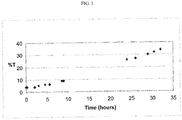
- FIG. 1 shows the percentage of transmission as a function of time at open circuit for a device according to Example 15.
- substituted refers to an alkyl, alkenyl, alkynyl, aryl, or ether group, as defined below (e.g., an alkyl group) in which one or more bonds to a hydrogen atom contained therein are replaced by a bond to non-hydrogen or non-carbon atoms.
- Substituted groups also include groups in which one or more bonds to a carbon(s) or hydrogen(s) atom are replaced by one or more bonds, including double or triple bonds, to a heteroatom.
- a substituted group will be substituted with one or more substituents, unless otherwise specified.
- a substituted group is substituted with 1, 2, 3, 4, 5, or 6 substituents.
- substituent groups include: halogens (i.e., F, Cl, Br, and I); hydroxyls; alkoxy, alkenoxy, alkynoxy, aryloxy, aralkyloxy, heterocyclyloxy, and heterocyclylalkoxy groups; carbonyls (oxo); carboxyls; esters; urethanes; oximes; hydroxylamines; alkoxyamines; aralkoxyamines; thiols; sulfides; sulfoxides; sulfones; sulfonyls; sulfonamides; amines; N-oxides; hydrazines; hydrazides; hydrazones; azides; amides; ureas; amidines; guanidines; enamines; imides; isocyanates; isothiocyanates; cyanates; thiocyanates; imines; nitro groups; nitriles (i.
- alkyl groups include straight chain and branched alkyl groups having from 1 to about 20 carbon atoms, and typically from 1 to 12 carbons or, in some embodiments, from 1 to 8 carbon atoms.
- alkyl groups include cycloalkyl groups as defined below. Alkyl groups may be substituted or unsubstituted. Examples of straight chain alkyl groups include methyl, ethyl, n-propyl, n-butyl, n-pentyl, n-hexyl, n-heptyl, and n-octyl groups.
- branched alkyl groups include, but are not limited to, isopropyl, sec-butyl, t-butyl, neopentyl, and isopentyl groups.
- Representative substituted alkyl groups may be substituted one or more times with, for example, amino, thio, hydroxy, cyano, alkoxy, and/or halo groups such as F, Cl, Br, and I groups.
- haloalkyl is an alkyl group having one or more halo groups. In some embodiments, haloalkyl refers to a per-haloalkyl group.
- Cycloalkyl groups are cyclic alkyl groups such as, but not limited to, cyclopropyl, cyclobutyl, cyclopentyl, cyclohexyl, cycloheptyl, and cyclooctyl groups.
- the cycloalkyl group has 3 to 8 ring members, whereas in other embodiments the number of ring carbon atoms range from 3 to 5, 6, or 7. Cycloalkyl groups may be substituted or unsubstituted.
- Cycloalkyl groups further include polycyclic cycloalkyl groups such as, but not limited to, norbornyl, adamantyl, bornyl, camphenyl, isocamphenyl, and carenyl groups, and fused rings such as, but not limited to, decalinyl, and the like. Cycloalkyl groups also include rings that are substituted with straight or branched chain alkyl groups as defined above.
- Representative substituted cycloalkyl groups may be mono-substituted or substituted more than once, such as, but not limited to: 2,2-; 2,3-; 2,4-; 2,5-; or 2,6-disubstituted cyclohexyl groups or mono-, di-, or trisubstituted norbornyl or cycloheptyl groups, which may be substituted with, for example, alkyl, alkoxy, amino, thio, hydroxy, cyano, and/or halo groups.
- Alkenyl groups are straight chain, branched or cyclic alkyl groups having 2 to about 20 carbon atoms, and further including at least one double bond. In some embodiments alkenyl groups have from 1 to 12 carbons, or, typically, from 1 to 8 carbon atoms. Alkenyl groups may be substituted or unsubstituted. Alkenyl groups include, for instance, vinyl, propenyl, 2-butenyl, 3-butenyl, isobutenyl, cyclohexenyl, cyclopentenyl, cyclohexadienyl, butadienyl, pentadienyl, and hexadienyl groups among others.
- Alkenyl groups may be substituted similarly to alkyl groups.
- aryl or “aromatic,” groups are cyclic aromatic hydrocarbons that do not contain heteroatoms.
- Aryl groups include monocyclic, bicyclic and polycyclic ring systems.
- aryl groups include, but are not limited to, phenyl, azulenyl, heptalenyl, biphenylenyl, indacenyl, fluorenyl, phenanthrenyl, triphenylenyl, pyrenyl, naphthacenyl, chrysenyl, biphenyl, anthracenyl, indenyl, indanyl, pentalenyl, and naphthyl groups.
- aryl groups contain 6-14 carbons, and in others from 6 to 12 or even 6-10 carbon atoms in the ring portions of the groups.
- aryl groups includes groups containing fused rings, such as fused aromatic-aliphatic ring systems (e.g., indanyl, tetrahydronaphthyl, and the like).
- Aryl groups may be substituted or unsubstituted.
- darkening time is defined as the time needed to reach 90% of the total transmission change from highest to lowest transmission values as measured on an electrochromic device.
- Typical solution-phase electrochromic devices contain at least one anodic (oxidizable) material, at least one cathodic (reducible) material, and a solvent.
- anodic (oxidizable) material Upon charging, i.e. activation, of the typical solution-phase devices to produce a colored state, internal diffusion processes lead to continual self-erasing that results in de-coloration upon removal of the charging source.
- sequestration of an anodic material in a polymer matrix and a cathodic material in a polymer matrix, or a chambered isolation of the materials in an electrochromic device results in electrochromic devices that are configured to maintain the charged, i.e. activated, state for prolonged periods of time in comparison to typical solution-phase electrochromic devices.
- the sequestration in separate polymer matrices or in isolated chambers prevents the activated anodic and cathodic materials from readily undergoing charge transfer processes leading to de-coloration. Further, because the activated species are maintained upon removing of the charging source, the activated electrochromic devices are also batteries.
- the cathodic and anodic compounds may be merely sequestered within the polymer matrix and separated from one another. Alternatively, the cathodic, the anodic, or the cathodic and the anodic compounds may be polymerized into the polymer matrix through functionalization of the anodic or cathodic materials.
- the electrochromic devices described herein include at least one chamber defined by a first substrate having a first conductive surface, a second substrate having a second conductive surface, and a sealing member joining the first substrate to the second substrate with the first and second conductive surfaces contacting the sealing member.
- the anodic material may be sequestered on the first conductive surface and the cathodic material may be sequestered on the second conductive surface.
- Within the chamber is disposed an electrolyte between the anodic and cathodic layers.
- the first and second substrates may be off-set to one another to allow for electric contact to be made with the first and second conductive surfaces, as is well established for other solution phase electrochromic devices.
- At least one chamber of the electrochromic device is further divided into a first chamber and a second chamber by a separator positioned between the first and second substrates.
- the first chamber is defined by the first substrate, sealing member and a first surface of the separator.
- the second chamber is defined the second substrate, sealing member, and a second surface of the separator, the second surface being located opposite to the first surface.
- the sealing member may also be divided as a first sealing member joining the first substrate to the first surface of the separator and a second sealing member joining the second substrate to the second surface of the separator.
- the separator allows the movement of electrolyte between the first and second chamber, but prevents or substantially minimizes the passage of activated cathodic and anodic materials between the same two chambers.
- an energy storage device may include a cathodic material in an activated state, and an anodic material in an activated state.
- the cathodic material may be a viologen covalently attached to, or confined within, a first polymer matrix, the first polymer matrix configured to prevent or minimize substantial diffusion of the cathodic material in the activated state.
- the viologen may be sequestered within the polymer matrix by being physically trapped within, or the viologen may be functionalized such that it is amenable to being polymerized or reacted with the polymer to be covalently bonded to the polymer.
- the energy storage device may be a battery, a capacitor, or a supercapacitor.
- an energy storage device including a first cell including an anodic material; a second cell including a cathodic material; and a porous separator isolating the first cell from the second cell.
- the separator includes an ion exchange membrane or a size-exclusion membrane.
- the energy storage device may be a battery, a capacitor, or a supercapacitor.
- the separator is a membrane.
- Illustrative membranes may include paper membranes, polymer membranes, ceramic membranes, glass membranes, composite membranes, ion-selective membranes, homogeneously dense membranes or porous size-exclusion membranes.
- Illustrative materials that may be used for membranes are: cellulose acetate; cellulose esters; nitrocellulose; polyvinylidenefluorides; polysulfones; polyacrylonitriles; polyamides; polypropylene; polyacrylates; polymethacrylates; polyethylene; polystyrenes; polyvinylchloride; negatively charged materials such as, but not limited to, sulfonated tetrafluoroethylene polymers and copolymers or Nafion®; positively charged materials such as, but not limited to, ammoniated polystyrene copolymers such as AMI-7001 from Membranes International Inc.; poly(vinyl pyridinium) co-polymers; poly(vinyl imidazolium) co-polymers; ceramic materials such as, but not limited to, aluminum oxide, titanium oxide, zirconium oxide, silicon oxide; and porous carbon; or a combination of any two or more such materials.
- an electrochromic device in another aspect, includes a cathodic material covalently attached to, or confined within, a first polymer matrix; and an anodic compound covalently attached to, or confined within, a second polymer matrix.
- the electrochromic device exhibits a high transmission state at short circuit and a low transmission state upon application of an electric potential, where the high transmission state is at least 5 times greater than the low transmission state; and the electrochromic device is configured to maintain a transmission percentage within 20% of the low transmission state for at least 5 hours at open circuit after application of a potential sufficient to reach to the low transmissions state.
- the low transmission state may range from about 0.001% to about 30%.
- the high transmission state range from about 50% to about 95%.
- a high transmission value does not vary by more than 5% from an initial high transmission value.
- the initial high transmission value is the state of the device prior to the application of an electric potential after device fabrication.
- the low transmission value does not vary by more than 5% from an initial low transmission value.
- the initial low transmission value is the low transmission value achieved upon the first charging of the device at a full voltage application.
- the cathodic material may be a viologen, a low-dimerizing viologen or a non-dimerizing viologen.
- the term low-dimerizing viologen is applied to some viologens that show dimerization characteristics to a lesser extent that dimerizing viologens.
- Illustrative viologens include, but are not limited to, methyl viologen, octyl viologen, benzyl viologen, polymeric viologens, and the viologens described in U.S. Patent Nos. 4,902,108 ; 6,188,505 ; 5,998,617 ; and 6,710,906 .
- viologens may include those of Formula (I), (III), or (IV):
- R 1 and R 2 are individually alkyl, siloxy alkyl, hydroxyalkyl, alkenyl, or aralkyl
- R 4 , R 6 , R 8 , and R 10 are individually H, OH, F, Cl, Br, I, CN, NO 2 , alkyl, alkoxy, or aryl
- R 3 , R 5 , R 7 , and R 9 are individually H, OH, F, Cl, Br, I, CN, NO 2 , alkyl, alkoxy, or aryl
- X is an anion.
- Formula (I) may be subject to the proviso that R 3 and R 5 , or R 7 and R 9 , or R 3 , R 5 , R 7 , and R 9 are individually secondary alkyl, tertiary alkyl, or aryl.
- R 1 and R 2 are individually alkyl, siloxyalkyl, hydroxyalkyl, alkenyl, or aralkyl;
- R 4 , R 6 , R 8 , R 10 are individually H, OH, F, Cl, Br, I, CN, NO 2 , alkyl, alkoxy, or aryl;
- R 3 , R 5 , R 7 , and R 9 are individually H, OH, F, Cl, Br, I, CN, NO 2 , alkyl, alkoxy or aryl;
- R 19 is (CH 2 ) n' or arylene, and n' is from 1 to 12;
- X is an anion; and wherein R 3 and R 5 , or R 7 and R 9 are individually secondary alkyl, tertiary alkyl, or aryl.
- R 1 and R 1' are individually alkyl, siloxyalkyl, hydroxyalkyl, alkenyl, or aralkyl;
- R 4 , R 6 , R 8 , R 10 , R 4' , R 6' , R 8' , and R 10' are individually H, OH, F, Cl, Br, I, CN, NO 2 , alkyl, alkoxy, or aryl;
- R 7 , R 9 , R 7' , and R 9' are individually H, OH, F, Cl, Br, I, CN, NO 2 , alkyl, alkoxy, or aryl;
- R 19 is (CH 2 ) n' or arylene, and n' is from 1 to 12;
- R 19 is (CH 2 ) n' or arylene, and n' is from 1 to 12.
- the counterion (anion) may be any of a halide, a borate, a fluoroborate, a tetraaryl borate, a hexafluoro metal or metalloid, a sulfate, a sulfonate, a sulfonamide, a carboxylate, a perchlorate, a tetrachloroferrate, or the like, or mixtures of any two or more thereof.
- Illustrative counterions/anions include, but are not limited to: F , Cl - , Br - , I - , BF 4 - , PF 6 - , SbF 6 - , AsF 6 - , ClO 4 - , SO 3 CF 3 - , N(CF 3 SO 2 ) 2 - , C(CF 3 SO 2 ) 3 - , N(SO 2 C 2 F 5 ) - , or BAr 4 - , wherein Ar is a aryl or a fluorinated aryl or a bis(trifluoromethyl) aryl group.
- X is a tetrafluoroborate or a bis(trifluoromethylsulfonyl) imide anion.
- the anodic material may be a phenazine, a phenothiazine, a triphenodithiazine, a carbazole, a indolocarbazole, a biscarbazole, or a ferrocene covalently attached to, or confined within, the second polymer matrix, the second polymer matrix configured to prevent or minimize substantial diffusion of the anodic material in the activated state.
- the anodic material may be sequestered within the polymer matrix by being physically trapped within, or the anodic material may be functionalized such that it is amenable to being polymerized or reacted with the polymer to be covalently bonded to the polymer.
- the anodic material may be a compound represented by:
- E is S or NR 10 ;
- R 1 and R 10 are individually an alkyl group interrupted by at least one ammonium group;
- each R 2 -R 9 are individually H, F, Cl, Br, I, CN, OR 11 , SR 11 , NO 2 , alkyl, alkoxy aryl, amino, or any two adjacent groups of R 2 -R 9 may join to form a monocyclic, polycyclic, or heterocyclic group;
- each R 11 is individually H or alkyl; and
- R 12 is an alkylene group.
- E is NR 10 and R 2 -R 9 are H or OR 11 .
- E is S and R 7 and R 8 join to form a heterocyclic group.
- the anodic material may be a compound represented by:
- R 14 is an alkyl group interrupted by at least one ammonium group.
- R 1 , R 10 , and R 14 may be represented by: or where R 15 -R 18 are individually H or alkyl; n is 1, 2, 3, 4, 5, 6, 7, 8, 9, 10, 11, or 12; n' is 1, 2, 3, 4, 5, 6, 7, 8, 9, 10, 11, or 12; and x is 1, 2, 3, 4, 5, 6, 7, 8, 9, 10, 11, or 12. In some embodiments, n is 4, x is 2, and n' is 11.
- the polymer matrix may be solid polymer or gel polymer.
- the polymer may be an acrylate-based polymer that is dissolved in a solvent which incorporates the anodic or cathodic material. This solution is then coated on the conductive surface of a substrate, where the solvent is then removed.
- the resultant film is an acrylate film that may be hard or tacky to the touch.
- the polymer film maybe a gel that contains solvent as well as the anodic or cathode material.
- the polymer film maybe subsequently cross-linked for increased mechanical stability.
- polymer matrix materials used in electrochromic devices can be found in US Patent Nos. 6,635,194 and 5,940,201 .
- the anodic or cathodic materials may also be part of the polymeric matrix with the anodic or cathodic material being covalently bound to the polymer. This may be accomplished with the presence of a functional group on the anodic or cathodic material that is reacted with the polymer or monomers that make up the polymer.
- a functional group on the anodic or cathodic material that is reacted with the polymer or monomers that make up the polymer.
- the anodic or cathodic materials may be bound into a polymer matrix via a condensation reaction or react with isocyanate functionality to form a polyurethane-based polymer matrix.
- Amines may also react with isocyanate functionalities to form urea and biuret linkages. It can be also anticipated that other cross-linked polymeric matrix can be formed using a multifunctional epoxy or polymers in combination with a curing agent like an amine, alcohol or anhydride or through base or acid catalyzed homopolymerization.
- Illustrative materials that may be used as the first and second polymer matrix materials include, but are not limited to, polymethylmethacrylate, polypropylene methacrylate, polystyrene, polyurethanes, polyethers, polyesters, polycarbonates, polysiloxanes, polysilanes, polyacrylonitriles, polymethacrylonitriles, polyamides, polyimides, polyvinylidenehalides, and co-polymer and combinations of thereof. Further examples of polymer matrix materials can be found in US Patent Nos. 6,635,194 and 5,940,201 .
- the energy storage devices may exhibit an open circuit voltage of 0.2 V to 1.2 V. In some embodiments, the energy storage devices may exhibit an open circuit voltage of 0.6 V to 0.8 V. The energy storage devices may exhibit a discharge current of 100 ⁇ A to 1000 ⁇ A.
- the electrolyte may include a solvent and a salt.
- the salt may be a metal salt or an ammonium salt.
- Illustrative solvents for use in the electrolyte may include, but are not limited to, 3-methylsulfolane, dimethyl sulfoxide, dimethyl formamide, tetraglyme and other polyethers; alcohols such as ethoxyethanol; nitriles, such as acetonitrile, glutaronitrile, 3-hydroxypropionitrile, and 2-methylglutaronitrile; ketones including 2-acetylbutyrolactone, and cyclopentanone; cyclic esters including beta-propiolactone, gamma-butyrolactone, and gamma-valerolactone; propylene carbonate (PC), ethylene carbonate; and homogenous mixtures of the same.
- PC propylene carbonate
- Illustrative salts include, but are not limited to, metal or ammonium salts, such as but not limited to Li + , Na + , K + , NR' 4 + , where each R' is individually H, alkyl, or cycloalkyl, of the following anions F - , Cl - , Br - , I - , BF 4 - , PF 6 - , SbF 6 - , AsF 6 - , ClO 4 - , SO 3 CF 3 - , N(CF 3 SO 2 ) 2 - , C(CF 3 SO 2 ) 3 - , N(SO 2 C 2 F 5 ) - , Al(OC(CF 3 ) 3 ) 4 - , or BAr 4 - , wherein Ar is an organic radicals, sodium atomsulfate, sodium atomide, sodium atomide, sodium phosulfate, sodium bicarbonate, sodium bicarbonate, sodium bicarbonate, sodium -
- the substrates and conductive coatings on the substrates those typically used in solution-based electrochromic devices may be used.
- the one or both substrates may be glass, metal, plastic, or ceramic.
- the conductive coating on one or more of the substrates may be transparent or opaque depending upon the intended use of the device. For example, where the device is a window, both coatings should be substantially transparent, and where the device is a mirror at least one coating is transparent.
- transparent conductive materials include, but are not limited to, fluorine doped tin oxide (FTO), indium/tin oxide (ITO), doped zinc oxide, indium zinc oxide, metal oxide/Ag/metal oxide, silver nano-wire coatings, carbon nanotubes, graphene coatings, wire grids, conductive polymers such as, but not limited to, poly(3,4-ethylenedioxythiophene) (PEDOT).
- FTO fluorine doped tin oxide
- ITO indium/tin oxide
- doped zinc oxide indium zinc oxide
- metal oxide/Ag/metal oxide silver nano-wire coatings
- silver nano-wire coatings such as, but not limited to, poly(3,4-ethylenedioxythiophene) (PEDOT).
- PEDOT poly(3,4-ethylenedioxythiophene)
- Non-transparent conductive coatings include metal coatings such as rhodium, chromium, nickel, silver, gold, and other metals, or mixtures of any two or
- Example 1 An indium tin oxide (ITO) coated piece of 3" x 3" glass (2.2 mm thickness) was coated with a mixture made by dissolving 0.69 grams of bis (11-hydroxyundecyl) viologen bis[bistrifluoromethanesulfonyl imide] (NTf) and 0.23 grams of HDT (aliphatic polyisocyanate available under the tradename BASONAT® HI from BASF) in a 7.0 gram solution of 9 wt% PMA (poly(methylacrylate)) in propylene carbonate (PC), plus 110 mircroliters of a 1% solution of dibutyltin diacetate (DBTDA) catalyst in PC thereby forming a first film.
- ITO indium tin oxide
- NTf bis (11-hydroxyundecyl) viologen bis[bistrifluoromethanesulfonyl imide]
- HDT aliphatic polyisocyanate available under the tradename BASONAT®
- This coating was made using a #10 Mayer rod to control thickness.
- a second piece of 3" x 3" glass (2.2 mm thickness) was coated with a solution made by dissolving 0.830 grams of triphenodithiazine diol from example 2 and 0.135 grams of HDT in 9 wt% PMA and 110 miroliters of DBTDA in PC thereby forming a second film.
- This film was also made with a #10 Mayer rod.
- the films were allowed to cure under a nitrogen atmosphere overnight in an oven (70 °C).
- the first and second films, on their respective glass substrates were positioned in a spaced-apart relationship facing each other and an epoxy seal was placed around the perimeter and cured to form a cell leaving offsets for attachment of electrical contacts.
- the distance between the two substrates was about 500 microns.
- the resulting cell was filled with a solution of 0.2 M tetraethylammonium tetrafluoroborate (TEABF 4 ) and a cross-linkable polymer matrix precursor in PC to form a polymeric electrolyte.
- TEABF 4 tetraethylammonium tetrafluoroborate
- Illustrative cross-linkable polymer matrices are described in U.S. Patent No. 6,635,194 . After filling and plugging of the cell, the cell was placed in an oven overnight to cure the polymeric electrolyte.
- Example 2
- the construction of the splat cell battery was the same as in Example 12.
- 0.106 g of the first gel containing the anodic polymer and 0.148 g of the second gel containing the cathodic gel were used.
- the separator for this example was a size exclusion membrane cut out of a cellulose ester dialysis tube membrane from SpectrumLabs.com with a molecular weight cut-off (MWCO) of 100-500 daltons.
- MWCO molecular weight cut-off
- the 3 cm x 3 cm square membrane was preconditioned in a solution of 0.100 M tetraethylammonium tetrafluoroborate in propylene carbonate overnight. Glass spacers, 600-630 microns in diameter were affixed in the four corners of the splat cell to assist in defining the cell spacing.
- the splat cell was held in a nitrogen atmosphere for an hour before charging for 10 minutes at 1.25 volts. Within the first minute of charging, the top gel (second gel) becomes very dark blue, which is an indication of reduction of the viologen. This splat cell is then left in open circuit for 10 minutes while still under a nitrogen atmosphere. At the end of the 10 minutes, the measured voltage was 0.680 V and the discharge current was 410 ⁇ A.
- the invention further relates to the following items:
Landscapes
- Chemical & Material Sciences (AREA)
- Engineering & Computer Science (AREA)
- Power Engineering (AREA)
- Chemical Kinetics & Catalysis (AREA)
- Electrochemistry (AREA)
- General Chemical & Material Sciences (AREA)
- Microelectronics & Electronic Packaging (AREA)
- Physics & Mathematics (AREA)
- Materials Engineering (AREA)
- Manufacturing & Machinery (AREA)
- Nonlinear Science (AREA)
- Composite Materials (AREA)
- General Physics & Mathematics (AREA)
- Inorganic Chemistry (AREA)
- Optics & Photonics (AREA)
- Condensed Matter Physics & Semiconductors (AREA)
- Secondary Cells (AREA)
- Hybrid Cells (AREA)
Applications Claiming Priority (4)
| Application Number | Priority Date | Filing Date | Title |
|---|---|---|---|
| US201462003335P | 2014-05-27 | 2014-05-27 | |
| US201462057811P | 2014-09-30 | 2014-09-30 | |
| PCT/US2015/032459 WO2015183821A1 (en) | 2014-05-27 | 2015-05-26 | Electrochemical energy storage devices |
| EP15799535.8A EP3164390B1 (de) | 2014-05-27 | 2015-05-26 | Elektrochrome vorrichtungen und verbindungen dafür |
Related Parent Applications (2)
| Application Number | Title | Priority Date | Filing Date |
|---|---|---|---|
| EP15799535.8A Division EP3164390B1 (de) | 2014-05-27 | 2015-05-26 | Elektrochrome vorrichtungen und verbindungen dafür |
| EP15799535.8A Division-Into EP3164390B1 (de) | 2014-05-27 | 2015-05-26 | Elektrochrome vorrichtungen und verbindungen dafür |
Publications (2)
| Publication Number | Publication Date |
|---|---|
| EP3594207A1 true EP3594207A1 (de) | 2020-01-15 |
| EP3594207B1 EP3594207B1 (de) | 2021-06-30 |
Family
ID=54699659
Family Applications (2)
| Application Number | Title | Priority Date | Filing Date |
|---|---|---|---|
| EP19186800.9A Active EP3594207B1 (de) | 2014-05-27 | 2015-05-26 | Vorrichtung zur elektrochemischen energiespeicherung |
| EP15799535.8A Active EP3164390B1 (de) | 2014-05-27 | 2015-05-26 | Elektrochrome vorrichtungen und verbindungen dafür |
Family Applications After (1)
| Application Number | Title | Priority Date | Filing Date |
|---|---|---|---|
| EP15799535.8A Active EP3164390B1 (de) | 2014-05-27 | 2015-05-26 | Elektrochrome vorrichtungen und verbindungen dafür |
Country Status (4)
| Country | Link |
|---|---|
| US (3) | US9964828B2 (de) |
| EP (2) | EP3594207B1 (de) |
| CN (1) | CN106660977B (de) |
| WO (1) | WO2015183821A1 (de) |
Families Citing this family (39)
| Publication number | Priority date | Publication date | Assignee | Title |
|---|---|---|---|---|
| AU2006306522B9 (en) | 2005-10-21 | 2011-12-08 | Deere & Company | Networked multi-role robotic vehicle |
| EP3594207B1 (de) * | 2014-05-27 | 2021-06-30 | Gentex Corporation | Vorrichtung zur elektrochemischen energiespeicherung |
| US10344208B2 (en) | 2014-06-09 | 2019-07-09 | iGlass Technology, Inc. | Electrochromic device and method for manufacturing electrochromic device |
| US10294415B2 (en) | 2014-06-09 | 2019-05-21 | iGlass Technology, Inc. | Electrochromic composition and electrochromic device using same |
| CN105489861A (zh) * | 2015-12-29 | 2016-04-13 | 深圳大学 | 一种蓄电池装置用的电极活性材料及其蓄电池装置 |
| BR112018014921A2 (pt) * | 2016-01-22 | 2018-12-18 | California Inst Of Techn | ?nanotubo de carbono vertical e composições químicas, artigos, arquiteturas e fabricação de bateria de íons de lítio? |
| CN106025394B (zh) * | 2016-05-20 | 2018-11-06 | 浙江工业大学 | 一种变色电源的制备方法 |
| US10745613B2 (en) | 2016-10-17 | 2020-08-18 | Gentex Corporation | Near-IR absorptive compounds and devices incorporating the same |
| KR101957151B1 (ko) * | 2016-12-07 | 2019-06-19 | 엘지디스플레이 주식회사 | 비올로겐 화합물과 이를 포함하는 전해질, 광 투과도 가변 패널 및 표시장치 |
| JP6989105B2 (ja) * | 2017-06-15 | 2022-01-05 | 国立大学法人千葉大学 | エレクトロクロミック表示素子 |
| CN110892320B (zh) | 2017-08-08 | 2022-05-10 | 金泰克斯公司 | 具有透明离子交换膜的电光装置 |
| JP7199869B2 (ja) * | 2017-10-10 | 2023-01-06 | キヤノン株式会社 | エレクトロクロミック素子、光学フィルタ、レンズユニット、撮像装置、および、窓材 |
| US10686181B2 (en) | 2017-10-17 | 2020-06-16 | Gentex Corporation | Isolated cell design in electro-optic devices |
| WO2019130274A1 (en) | 2017-12-29 | 2019-07-04 | Gentex Corporation | Single component electrochromic device having a tunable ir filter |
| US11520208B2 (en) | 2018-07-10 | 2022-12-06 | Gentex Corporation | System and method for multi-zone dimming window system |
| WO2020012362A1 (en) | 2018-07-10 | 2020-01-16 | Gentex Corporation | Light mapping system for vehicle passenger compartment |
| DE212019000345U1 (de) | 2018-07-12 | 2021-02-18 | Gentex Corporation | Fahrzeug mit elektro-optischen Fenstersystem |
| KR102123154B1 (ko) * | 2018-07-13 | 2020-06-15 | 순천대학교 산학협력단 | 마그네슘 이온 전지의 양극재와 이 양극재를 포함하는 마그네슘 이온 전지 |
| CN109796396A (zh) * | 2019-02-18 | 2019-05-24 | 山西医科大学 | 一种n-甲基-4,4’-联吡啶碘化物的制备方法 |
| EP3948414B1 (de) | 2019-03-29 | 2025-05-07 | Gentex Corporation | Elektrooptische unteranordnungen und anordnungen mit einer elektrochromen gelschicht |
| US11414594B2 (en) | 2019-04-09 | 2022-08-16 | Gentex Corporation | Low dimerizing viologen electrochromic compounds and devices |
| US11414595B2 (en) | 2019-06-03 | 2022-08-16 | Gentex Corporation | Electrochromic compounds and devices |
| US11906866B2 (en) | 2019-06-27 | 2024-02-20 | Gentex Corporation | Electrochromic films and methods of forming and using |
| EP4038450A4 (de) * | 2019-10-02 | 2023-10-25 | Gentex Corporation | Elektrooptische elemente und verfahren zum bilden |
| US20210240047A1 (en) * | 2020-02-05 | 2021-08-05 | Gentex Corporation | Electrochromic compounds |
| US11709407B2 (en) | 2020-02-14 | 2023-07-25 | Gentex Corporation | Immobilized buffers in electroactive devices |
| CN116783080B (zh) | 2021-02-19 | 2026-04-07 | 金泰克斯公司 | 对可调光装置进行无线供电和控制的方法 |
| WO2022175891A1 (en) | 2021-02-19 | 2022-08-25 | Gentex Corporation | Connection methods for power removable and/or movable dimmable device |
| CN113072688B (zh) * | 2021-04-15 | 2022-10-11 | 南京邮电大学 | 一类新型紫精聚合物及其制备方法与应用 |
| CN113328093B (zh) * | 2021-05-31 | 2023-04-28 | 湖北大学 | 一种金属离子电池有机电极材料、电极、电池以及制备方法 |
| CN115863756B (zh) * | 2021-09-27 | 2026-06-09 | 比亚迪股份有限公司 | 一种电解液及电池 |
| WO2023156919A1 (en) | 2022-02-16 | 2023-08-24 | Gentex Corporation | Electrochromic block copolymers and devices made with such copolymers |
| US20230266630A1 (en) * | 2022-02-18 | 2023-08-24 | Gentex Corporation | Electrochromic compounds for memory electrochromic devices |
| JP7852063B2 (ja) | 2022-02-18 | 2026-04-27 | ジェンテックス コーポレイション | 多層低電流電気光学アセンブリ |
| CN223022514U (zh) | 2022-03-22 | 2025-06-24 | 金泰克斯公司 | 具有串联电光元件的电光装置 |
| US12111556B2 (en) | 2022-04-06 | 2024-10-08 | Gentex Corporation | Multi-segment electro-optic apparatus and control methods |
| CN223320727U (zh) | 2022-04-18 | 2025-09-09 | 金泰克斯公司 | 电光装置 |
| US12619116B2 (en) * | 2022-04-21 | 2026-05-05 | Vitro Flat Glass Llc | Electrochromic devices including polymers having residues of ((meth)acrylate-amine cation bis(substituted-sulfonyl)imide anion)) monomer |
| CN121209169A (zh) * | 2025-11-27 | 2025-12-26 | 苏州创欣材料科技有限公司 | 无机/有机复合电致变色膜器件及其制造方法 |
Citations (10)
| Publication number | Priority date | Publication date | Assignee | Title |
|---|---|---|---|---|
| US4902108A (en) | 1986-03-31 | 1990-02-20 | Gentex Corporation | Single-compartment, self-erasing, solution-phase electrochromic devices, solutions for use therein, and uses thereof |
| US5294376A (en) | 1991-06-25 | 1994-03-15 | Gentex Corporation | Bipyridinium salt solutions |
| US5940201A (en) | 1997-04-02 | 1999-08-17 | Gentex Corporation | Electrochromic mirror with two thin glass elements and a gelled electrochromic medium |
| US5998617A (en) | 1997-04-02 | 1999-12-07 | Gentex Corporation | Electrochromic compounds |
| US6188505B1 (en) | 1999-08-19 | 2001-02-13 | Gentex Corporation | Color-stabilized electrochromic devices |
| US6193912B1 (en) | 1998-03-03 | 2001-02-27 | Gentex Corporation | Near infrared-absorbing electrochromic compounds and devices comprising same |
| US6635194B2 (en) | 2001-08-28 | 2003-10-21 | Gentex Corporation | Electrochromic medium having a self-healing cross-linked polymer gel and associated electrochromic device |
| US6710906B2 (en) | 1999-12-03 | 2004-03-23 | Gentex Corporation | Controlled diffusion coefficient electrochromic materials for use in electrochromic mediums and associated electrochromic devices |
| US20080310007A1 (en) * | 2007-06-18 | 2008-12-18 | Ajjer Llc | Laminated electrochromic devices and processes for forming the same |
| US8228590B2 (en) | 2010-08-09 | 2012-07-24 | Gentex Corporation | Electro-optic system configured to reduce a perceived color change |
Family Cites Families (15)
| Publication number | Priority date | Publication date | Assignee | Title |
|---|---|---|---|---|
| JPS5461B2 (de) * | 1973-11-21 | 1979-01-05 | ||
| US5840443A (en) * | 1995-07-31 | 1998-11-24 | Midwest Research Institute | Redox polymer electrodes for advanced batteries |
| US6525861B1 (en) | 2001-12-10 | 2003-02-25 | Gentex Corporation | Electrochromic device having a current-reducing additive |
| JP4140691B2 (ja) * | 2002-04-23 | 2008-08-27 | 住友電気工業株式会社 | レドックスフロー電池の運転方法 |
| US7046418B2 (en) | 2003-10-08 | 2006-05-16 | Gentex Corporation | Reversible electrodeposition devices and associated electrochemical media |
| FR2874064B1 (fr) * | 2004-08-09 | 2008-08-29 | Technilum | Ensemble de mobilier urbain. |
| US7428091B2 (en) * | 2004-11-15 | 2008-09-23 | Gentex Corporation | Electrochromic compounds and associated media and devices |
| KR100872727B1 (ko) * | 2007-02-02 | 2008-12-08 | 삼성전자주식회사 | 전기 변색 디스플레이 소자 및 이의 제조 방법 |
| JPWO2008146674A1 (ja) * | 2007-05-29 | 2010-08-19 | コニカミノルタホールディングス株式会社 | 表示素子 |
| FR2917848B1 (fr) * | 2007-06-25 | 2009-09-25 | Saint Gobain | Materiau electroactif renfermant des composes organiques a activites redox respectivement positive et negative, procede et kit de fabrication de ce materiau, dispositif electrocommandable et vitrages utlisant un tel materiau |
| US8592539B2 (en) * | 2010-08-16 | 2013-11-26 | University Of South Carolina | Preparation of cobaltocenium-containing monomers and their polymers |
| KR101843549B1 (ko) * | 2011-01-07 | 2018-03-30 | 삼성전자주식회사 | 전기 변색 소자 |
| WO2015175553A1 (en) * | 2014-05-13 | 2015-11-19 | Arizona Board Of Regents On Behalf Of Arizona State University | Electrochemical energy storage devices comprising self-compensating polymers |
| EP3594207B1 (de) * | 2014-05-27 | 2021-06-30 | Gentex Corporation | Vorrichtung zur elektrochemischen energiespeicherung |
| CN110892320B (zh) * | 2017-08-08 | 2022-05-10 | 金泰克斯公司 | 具有透明离子交换膜的电光装置 |
-
2015
- 2015-05-26 EP EP19186800.9A patent/EP3594207B1/de active Active
- 2015-05-26 EP EP15799535.8A patent/EP3164390B1/de active Active
- 2015-05-26 CN CN201580040323.6A patent/CN106660977B/zh active Active
- 2015-05-26 WO PCT/US2015/032459 patent/WO2015183821A1/en not_active Ceased
- 2015-05-26 US US14/721,934 patent/US9964828B2/en active Active
-
2017
- 2017-12-22 US US15/853,420 patent/US10481456B2/en active Active
-
2019
- 2019-10-07 US US16/595,056 patent/US10971718B2/en active Active
Patent Citations (10)
| Publication number | Priority date | Publication date | Assignee | Title |
|---|---|---|---|---|
| US4902108A (en) | 1986-03-31 | 1990-02-20 | Gentex Corporation | Single-compartment, self-erasing, solution-phase electrochromic devices, solutions for use therein, and uses thereof |
| US5294376A (en) | 1991-06-25 | 1994-03-15 | Gentex Corporation | Bipyridinium salt solutions |
| US5940201A (en) | 1997-04-02 | 1999-08-17 | Gentex Corporation | Electrochromic mirror with two thin glass elements and a gelled electrochromic medium |
| US5998617A (en) | 1997-04-02 | 1999-12-07 | Gentex Corporation | Electrochromic compounds |
| US6193912B1 (en) | 1998-03-03 | 2001-02-27 | Gentex Corporation | Near infrared-absorbing electrochromic compounds and devices comprising same |
| US6188505B1 (en) | 1999-08-19 | 2001-02-13 | Gentex Corporation | Color-stabilized electrochromic devices |
| US6710906B2 (en) | 1999-12-03 | 2004-03-23 | Gentex Corporation | Controlled diffusion coefficient electrochromic materials for use in electrochromic mediums and associated electrochromic devices |
| US6635194B2 (en) | 2001-08-28 | 2003-10-21 | Gentex Corporation | Electrochromic medium having a self-healing cross-linked polymer gel and associated electrochromic device |
| US20080310007A1 (en) * | 2007-06-18 | 2008-12-18 | Ajjer Llc | Laminated electrochromic devices and processes for forming the same |
| US8228590B2 (en) | 2010-08-09 | 2012-07-24 | Gentex Corporation | Electro-optic system configured to reduce a perceived color change |
Non-Patent Citations (1)
| Title |
|---|
| FUJINAMI T ET AL: "Polymer electrolyte bilayer films with photorechargeable battery characteristics", SOLID STATE IONICS, NORTH HOLLAND PUB. COMPANY. AMSTERDAM; NL, NL, vol. 92, no. 3, 11 November 1996 (1996-11-11), pages 165 - 169, XP004062901, ISSN: 0167-2738, DOI: 10.1016/S0167-2738(96)00474-2 * |
Also Published As
| Publication number | Publication date |
|---|---|
| EP3594207B1 (de) | 2021-06-30 |
| CN106660977A (zh) | 2017-05-10 |
| US9964828B2 (en) | 2018-05-08 |
| EP3164390A1 (de) | 2017-05-10 |
| US10481456B2 (en) | 2019-11-19 |
| EP3164390B1 (de) | 2019-09-18 |
| WO2015183821A1 (en) | 2015-12-03 |
| CN106660977B (zh) | 2020-09-01 |
| US10971718B2 (en) | 2021-04-06 |
| US20150346573A1 (en) | 2015-12-03 |
| US20180157139A1 (en) | 2018-06-07 |
| US20200050070A1 (en) | 2020-02-13 |
| EP3164390A4 (de) | 2018-04-04 |
Similar Documents
| Publication | Publication Date | Title |
|---|---|---|
| US10971718B2 (en) | Electrochemical energy storage devices | |
| US10464900B2 (en) | Electrochromic compounds with improved color stability in their radical states | |
| JP6886556B2 (ja) | 透明イオン交換膜を有する電気光学装置 | |
| EP3377590B1 (de) | Protisch-lösliche organische elektrochrome verbindungen | |
| US20230266630A1 (en) | Electrochromic compounds for memory electrochromic devices | |
| TW202348775A (zh) | 包括具有((甲基)丙烯酸酯-胺陽離子雙(經取代磺醯基)亞胺陰離子))單體之殘基的聚合物之電致變色裝置 | |
| TW202349089A (zh) | 包括作為陰極組分相對陰離子之陽極組分的電致變色裝置及組成物 | |
| CA3217377A1 (en) | Anodically-coloring electrochromic compounds, and devices and compositions containing same | |
| US12398229B2 (en) | High performance self-healing polymer gel electrolyte containing ionic side branches | |
| US12474612B2 (en) | Electro-optic devices made with SEBS membranes | |
| AU2023255480B2 (en) | Electrochromic devices and compositions including anodic component anions | |
| US20230339873A1 (en) | Electrochromic Devices and Compositions Including Anodic Component Anions | |
| TW202348774A (zh) | 包括聚((二烯丙基二甲基銨雙(經取代磺醯基)亞胺陰離子))之電致變色裝置及組成物 |
Legal Events
| Date | Code | Title | Description |
|---|---|---|---|
| PUAI | Public reference made under article 153(3) epc to a published international application that has entered the european phase |
Free format text: ORIGINAL CODE: 0009012 |
|
| STAA | Information on the status of an ep patent application or granted ep patent |
Free format text: STATUS: THE APPLICATION HAS BEEN PUBLISHED |
|
| AC | Divisional application: reference to earlier application |
Ref document number: 3164390 Country of ref document: EP Kind code of ref document: P |
|
| AK | Designated contracting states |
Kind code of ref document: A1 Designated state(s): AL AT BE BG CH CY CZ DE DK EE ES FI FR GB GR HR HU IE IS IT LI LT LU LV MC MK MT NL NO PL PT RO RS SE SI SK SM TR |
|
| STAA | Information on the status of an ep patent application or granted ep patent |
Free format text: STATUS: REQUEST FOR EXAMINATION WAS MADE |
|
| 17P | Request for examination filed |
Effective date: 20200618 |
|
| RBV | Designated contracting states (corrected) |
Designated state(s): AL AT BE BG CH CY CZ DE DK EE ES FI FR GB GR HR HU IE IS IT LI LT LU LV MC MK MT NL NO PL PT RO RS SE SI SK SM TR |
|
| STAA | Information on the status of an ep patent application or granted ep patent |
Free format text: STATUS: EXAMINATION IS IN PROGRESS |
|
| 17Q | First examination report despatched |
Effective date: 20201102 |
|
| REG | Reference to a national code |
Ref country code: DE Ref legal event code: R079 Ref document number: 602015071015 Country of ref document: DE Free format text: PREVIOUS MAIN CLASS: C07D0279240000 Ipc: H01M0004137000 |
|
| GRAP | Despatch of communication of intention to grant a patent |
Free format text: ORIGINAL CODE: EPIDOSNIGR1 |
|
| STAA | Information on the status of an ep patent application or granted ep patent |
Free format text: STATUS: GRANT OF PATENT IS INTENDED |
|
| RIC1 | Information provided on ipc code assigned before grant |
Ipc: H01G 11/04 20130101ALI20210114BHEP Ipc: C07D 279/24 20060101AFI20210114BHEP Ipc: H01G 11/52 20130101ALN20210114BHEP Ipc: G02F 1/15 20190101ALN20210114BHEP Ipc: H01M 4/36 20060101ALI20210114BHEP Ipc: H01M 10/05 20100101ALI20210114BHEP Ipc: H01G 9/145 20060101ALI20210114BHEP Ipc: H01M 6/18 20060101ALI20210114BHEP Ipc: H01M 4/137 20100101ALI20210114BHEP Ipc: H01M 10/0568 20100101ALN20210114BHEP Ipc: C07D 241/46 20060101ALI20210114BHEP Ipc: C07D 279/28 20060101ALN20210114BHEP Ipc: H01G 9/02 20060101ALI20210114BHEP Ipc: H01M 4/60 20060101ALI20210114BHEP Ipc: H01G 9/042 20060101ALI20210114BHEP Ipc: H01M 4/66 20060101ALI20210114BHEP Ipc: H01G 9/035 20060101ALI20210114BHEP Ipc: H01M 4/02 20060101ALI20210114BHEP Ipc: H01G 11/48 20130101ALI20210114BHEP Ipc: H01M 10/0569 20100101ALN20210114BHEP Ipc: C07D 241/48 20060101ALN20210114BHEP Ipc: H01G 11/62 20130101ALN20210114BHEP |
|
| INTG | Intention to grant announced |
Effective date: 20210127 |
|
| RIC1 | Information provided on ipc code assigned before grant |
Ipc: H01G 9/035 20060101ALI20210115BHEP Ipc: H01M 6/18 20060101ALI20210115BHEP Ipc: H01G 11/52 20130101ALN20210115BHEP Ipc: H01M 10/05 20100101ALI20210115BHEP Ipc: H01G 11/48 20130101ALI20210115BHEP Ipc: H01M 4/60 20060101ALI20210115BHEP Ipc: C07D 279/28 20060101ALN20210115BHEP Ipc: H01M 10/0568 20100101ALN20210115BHEP Ipc: H01M 4/36 20060101ALI20210115BHEP Ipc: H01G 11/04 20130101ALI20210115BHEP Ipc: G02F 1/15 20190101ALN20210115BHEP Ipc: H01M 4/66 20060101ALI20210115BHEP Ipc: H01G 11/62 20130101ALN20210115BHEP Ipc: C07D 241/48 20060101ALN20210115BHEP Ipc: H01M 10/0569 20100101ALN20210115BHEP Ipc: H01M 4/02 20060101ALN20210115BHEP Ipc: H01M 4/137 20100101AFI20210115BHEP |
|
| RIN1 | Information on inventor provided before grant (corrected) |
Inventor name: FRANZ, SUE Inventor name: THEISTE, DAVID A. Inventor name: GIRI, PUNAM Inventor name: LIN, RONGGUANG Inventor name: KLOEPPNER, LEROY C. |
|
| GRAS | Grant fee paid |
Free format text: ORIGINAL CODE: EPIDOSNIGR3 |
|
| GRAA | (expected) grant |
Free format text: ORIGINAL CODE: 0009210 |
|
| STAA | Information on the status of an ep patent application or granted ep patent |
Free format text: STATUS: THE PATENT HAS BEEN GRANTED |
|
| AC | Divisional application: reference to earlier application |
Ref document number: 3164390 Country of ref document: EP Kind code of ref document: P |
|
| AK | Designated contracting states |
Kind code of ref document: B1 Designated state(s): AL AT BE BG CH CY CZ DE DK EE ES FI FR GB GR HR HU IE IS IT LI LT LU LV MC MK MT NL NO PL PT RO RS SE SI SK SM TR |
|
| REG | Reference to a national code |
Ref country code: CH Ref legal event code: EP |
|
| REG | Reference to a national code |
Ref country code: AT Ref legal event code: REF Ref document number: 1407179 Country of ref document: AT Kind code of ref document: T Effective date: 20210715 |
|
| REG | Reference to a national code |
Ref country code: DE Ref legal event code: R096 Ref document number: 602015071015 Country of ref document: DE |
|
| REG | Reference to a national code |
Ref country code: IE Ref legal event code: FG4D |
|
| REG | Reference to a national code |
Ref country code: LT Ref legal event code: MG9D |
|
| PG25 | Lapsed in a contracting state [announced via postgrant information from national office to epo] |
Ref country code: FI Free format text: LAPSE BECAUSE OF FAILURE TO SUBMIT A TRANSLATION OF THE DESCRIPTION OR TO PAY THE FEE WITHIN THE PRESCRIBED TIME-LIMIT Effective date: 20210630 Ref country code: HR Free format text: LAPSE BECAUSE OF FAILURE TO SUBMIT A TRANSLATION OF THE DESCRIPTION OR TO PAY THE FEE WITHIN THE PRESCRIBED TIME-LIMIT Effective date: 20210630 Ref country code: BG Free format text: LAPSE BECAUSE OF FAILURE TO SUBMIT A TRANSLATION OF THE DESCRIPTION OR TO PAY THE FEE WITHIN THE PRESCRIBED TIME-LIMIT Effective date: 20210930 |
|
| REG | Reference to a national code |
Ref country code: NL Ref legal event code: MP Effective date: 20210630 |
|
| REG | Reference to a national code |
Ref country code: AT Ref legal event code: MK05 Ref document number: 1407179 Country of ref document: AT Kind code of ref document: T Effective date: 20210630 |
|
| PG25 | Lapsed in a contracting state [announced via postgrant information from national office to epo] |
Ref country code: LV Free format text: LAPSE BECAUSE OF FAILURE TO SUBMIT A TRANSLATION OF THE DESCRIPTION OR TO PAY THE FEE WITHIN THE PRESCRIBED TIME-LIMIT Effective date: 20210630 Ref country code: NO Free format text: LAPSE BECAUSE OF FAILURE TO SUBMIT A TRANSLATION OF THE DESCRIPTION OR TO PAY THE FEE WITHIN THE PRESCRIBED TIME-LIMIT Effective date: 20210930 Ref country code: SE Free format text: LAPSE BECAUSE OF FAILURE TO SUBMIT A TRANSLATION OF THE DESCRIPTION OR TO PAY THE FEE WITHIN THE PRESCRIBED TIME-LIMIT Effective date: 20210630 Ref country code: RS Free format text: LAPSE BECAUSE OF FAILURE TO SUBMIT A TRANSLATION OF THE DESCRIPTION OR TO PAY THE FEE WITHIN THE PRESCRIBED TIME-LIMIT Effective date: 20210630 Ref country code: GR Free format text: LAPSE BECAUSE OF FAILURE TO SUBMIT A TRANSLATION OF THE DESCRIPTION OR TO PAY THE FEE WITHIN THE PRESCRIBED TIME-LIMIT Effective date: 20211001 |
|
| PG25 | Lapsed in a contracting state [announced via postgrant information from national office to epo] |
Ref country code: ES Free format text: LAPSE BECAUSE OF FAILURE TO SUBMIT A TRANSLATION OF THE DESCRIPTION OR TO PAY THE FEE WITHIN THE PRESCRIBED TIME-LIMIT Effective date: 20210630 Ref country code: EE Free format text: LAPSE BECAUSE OF FAILURE TO SUBMIT A TRANSLATION OF THE DESCRIPTION OR TO PAY THE FEE WITHIN THE PRESCRIBED TIME-LIMIT Effective date: 20210630 Ref country code: SK Free format text: LAPSE BECAUSE OF FAILURE TO SUBMIT A TRANSLATION OF THE DESCRIPTION OR TO PAY THE FEE WITHIN THE PRESCRIBED TIME-LIMIT Effective date: 20210630 Ref country code: SM Free format text: LAPSE BECAUSE OF FAILURE TO SUBMIT A TRANSLATION OF THE DESCRIPTION OR TO PAY THE FEE WITHIN THE PRESCRIBED TIME-LIMIT Effective date: 20210630 Ref country code: PT Free format text: LAPSE BECAUSE OF FAILURE TO SUBMIT A TRANSLATION OF THE DESCRIPTION OR TO PAY THE FEE WITHIN THE PRESCRIBED TIME-LIMIT Effective date: 20211102 Ref country code: RO Free format text: LAPSE BECAUSE OF FAILURE TO SUBMIT A TRANSLATION OF THE DESCRIPTION OR TO PAY THE FEE WITHIN THE PRESCRIBED TIME-LIMIT Effective date: 20210630 Ref country code: NL Free format text: LAPSE BECAUSE OF FAILURE TO SUBMIT A TRANSLATION OF THE DESCRIPTION OR TO PAY THE FEE WITHIN THE PRESCRIBED TIME-LIMIT Effective date: 20210630 Ref country code: CZ Free format text: LAPSE BECAUSE OF FAILURE TO SUBMIT A TRANSLATION OF THE DESCRIPTION OR TO PAY THE FEE WITHIN THE PRESCRIBED TIME-LIMIT Effective date: 20210630 Ref country code: AT Free format text: LAPSE BECAUSE OF FAILURE TO SUBMIT A TRANSLATION OF THE DESCRIPTION OR TO PAY THE FEE WITHIN THE PRESCRIBED TIME-LIMIT Effective date: 20210630 |
|
| PG25 | Lapsed in a contracting state [announced via postgrant information from national office to epo] |
Ref country code: PL Free format text: LAPSE BECAUSE OF FAILURE TO SUBMIT A TRANSLATION OF THE DESCRIPTION OR TO PAY THE FEE WITHIN THE PRESCRIBED TIME-LIMIT Effective date: 20210630 |
|
| REG | Reference to a national code |
Ref country code: DE Ref legal event code: R097 Ref document number: 602015071015 Country of ref document: DE |
|
| PG25 | Lapsed in a contracting state [announced via postgrant information from national office to epo] |
Ref country code: DK Free format text: LAPSE BECAUSE OF FAILURE TO SUBMIT A TRANSLATION OF THE DESCRIPTION OR TO PAY THE FEE WITHIN THE PRESCRIBED TIME-LIMIT Effective date: 20210630 |
|
| PLBE | No opposition filed within time limit |
Free format text: ORIGINAL CODE: 0009261 |
|
| STAA | Information on the status of an ep patent application or granted ep patent |
Free format text: STATUS: NO OPPOSITION FILED WITHIN TIME LIMIT |
|
| PG25 | Lapsed in a contracting state [announced via postgrant information from national office to epo] |
Ref country code: AL Free format text: LAPSE BECAUSE OF FAILURE TO SUBMIT A TRANSLATION OF THE DESCRIPTION OR TO PAY THE FEE WITHIN THE PRESCRIBED TIME-LIMIT Effective date: 20210630 |
|
| 26N | No opposition filed |
Effective date: 20220331 |
|
| PG25 | Lapsed in a contracting state [announced via postgrant information from national office to epo] |
Ref country code: IT Free format text: LAPSE BECAUSE OF FAILURE TO SUBMIT A TRANSLATION OF THE DESCRIPTION OR TO PAY THE FEE WITHIN THE PRESCRIBED TIME-LIMIT Effective date: 20210630 |
|
| REG | Reference to a national code |
Ref country code: CH Ref legal event code: PL |
|
| REG | Reference to a national code |
Ref country code: BE Ref legal event code: MM Effective date: 20220531 |
|
| PG25 | Lapsed in a contracting state [announced via postgrant information from national office to epo] |
Ref country code: MC Free format text: LAPSE BECAUSE OF FAILURE TO SUBMIT A TRANSLATION OF THE DESCRIPTION OR TO PAY THE FEE WITHIN THE PRESCRIBED TIME-LIMIT Effective date: 20210630 Ref country code: LU Free format text: LAPSE BECAUSE OF NON-PAYMENT OF DUE FEES Effective date: 20220526 Ref country code: LI Free format text: LAPSE BECAUSE OF NON-PAYMENT OF DUE FEES Effective date: 20220531 Ref country code: CH Free format text: LAPSE BECAUSE OF NON-PAYMENT OF DUE FEES Effective date: 20220531 |
|
| PG25 | Lapsed in a contracting state [announced via postgrant information from national office to epo] |
Ref country code: LT Free format text: LAPSE BECAUSE OF FAILURE TO SUBMIT A TRANSLATION OF THE DESCRIPTION OR TO PAY THE FEE WITHIN THE PRESCRIBED TIME-LIMIT Effective date: 20210630 Ref country code: IE Free format text: LAPSE BECAUSE OF NON-PAYMENT OF DUE FEES Effective date: 20220526 |
|
| PG25 | Lapsed in a contracting state [announced via postgrant information from national office to epo] |
Ref country code: BE Free format text: LAPSE BECAUSE OF NON-PAYMENT OF DUE FEES Effective date: 20220531 |
|
| P01 | Opt-out of the competence of the unified patent court (upc) registered |
Effective date: 20230503 |
|
| PG25 | Lapsed in a contracting state [announced via postgrant information from national office to epo] |
Ref country code: MK Free format text: LAPSE BECAUSE OF FAILURE TO SUBMIT A TRANSLATION OF THE DESCRIPTION OR TO PAY THE FEE WITHIN THE PRESCRIBED TIME-LIMIT Effective date: 20210630 Ref country code: CY Free format text: LAPSE BECAUSE OF FAILURE TO SUBMIT A TRANSLATION OF THE DESCRIPTION OR TO PAY THE FEE WITHIN THE PRESCRIBED TIME-LIMIT Effective date: 20210630 |
|
| PG25 | Lapsed in a contracting state [announced via postgrant information from national office to epo] |
Ref country code: HU Free format text: LAPSE BECAUSE OF FAILURE TO SUBMIT A TRANSLATION OF THE DESCRIPTION OR TO PAY THE FEE WITHIN THE PRESCRIBED TIME-LIMIT; INVALID AB INITIO Effective date: 20150526 |
|
| PG25 | Lapsed in a contracting state [announced via postgrant information from national office to epo] |
Ref country code: MT Free format text: LAPSE BECAUSE OF FAILURE TO SUBMIT A TRANSLATION OF THE DESCRIPTION OR TO PAY THE FEE WITHIN THE PRESCRIBED TIME-LIMIT Effective date: 20210630 |
|
| PG25 | Lapsed in a contracting state [announced via postgrant information from national office to epo] |
Ref country code: TR Free format text: LAPSE BECAUSE OF FAILURE TO SUBMIT A TRANSLATION OF THE DESCRIPTION OR TO PAY THE FEE WITHIN THE PRESCRIBED TIME-LIMIT Effective date: 20210630 |
|
| PGFP | Annual fee paid to national office [announced via postgrant information from national office to epo] |
Ref country code: GB Payment date: 20260421 Year of fee payment: 12 |
|
| PGFP | Annual fee paid to national office [announced via postgrant information from national office to epo] |
Ref country code: DE Payment date: 20260421 Year of fee payment: 12 |
|
| PGFP | Annual fee paid to national office [announced via postgrant information from national office to epo] |
Ref country code: FR Payment date: 20260421 Year of fee payment: 12 |