EP3594306B1 - Composition pour élément de joint d'étanchéité et élément de joint d'étanchéité - Google Patents
Composition pour élément de joint d'étanchéité et élément de joint d'étanchéité Download PDFInfo
- Publication number
- EP3594306B1 EP3594306B1 EP18774865.2A EP18774865A EP3594306B1 EP 3594306 B1 EP3594306 B1 EP 3594306B1 EP 18774865 A EP18774865 A EP 18774865A EP 3594306 B1 EP3594306 B1 EP 3594306B1
- Authority
- EP
- European Patent Office
- Prior art keywords
- sealing member
- fluorine rubber
- particulate resin
- composition
- weight
- Prior art date
- Legal status (The legal status is an assumption and is not a legal conclusion. Google has not performed a legal analysis and makes no representation as to the accuracy of the status listed.)
- Active
Links
Images


Classifications
-
- C—CHEMISTRY; METALLURGY
- C08—ORGANIC MACROMOLECULAR COMPOUNDS; THEIR PREPARATION OR CHEMICAL WORKING-UP; COMPOSITIONS BASED THEREON
- C08L—COMPOSITIONS OF MACROMOLECULAR COMPOUNDS
- C08L27/00—Compositions of homopolymers or copolymers of compounds having one or more unsaturated aliphatic radicals, each having only one carbon-to-carbon double bond, and at least one being terminated by a halogen; Compositions of derivatives of such polymers
- C08L27/02—Compositions of homopolymers or copolymers of compounds having one or more unsaturated aliphatic radicals, each having only one carbon-to-carbon double bond, and at least one being terminated by a halogen; Compositions of derivatives of such polymers not modified by chemical after-treatment
- C08L27/12—Compositions of homopolymers or copolymers of compounds having one or more unsaturated aliphatic radicals, each having only one carbon-to-carbon double bond, and at least one being terminated by a halogen; Compositions of derivatives of such polymers not modified by chemical after-treatment containing fluorine atoms
- C08L27/16—Homopolymers or copolymers or vinylidene fluoride
-
- C—CHEMISTRY; METALLURGY
- C09—DYES; PAINTS; POLISHES; NATURAL RESINS; ADHESIVES; COMPOSITIONS NOT OTHERWISE PROVIDED FOR; APPLICATIONS OF MATERIALS NOT OTHERWISE PROVIDED FOR
- C09K—MATERIALS FOR MISCELLANEOUS APPLICATIONS, NOT PROVIDED FOR ELSEWHERE
- C09K3/00—Materials not provided for elsewhere
- C09K3/10—Materials in mouldable or extrudable form for sealing or packing joints or covers
- C09K3/1006—Materials in mouldable or extrudable form for sealing or packing joints or covers characterised by the chemical nature of one of its constituents
- C09K3/1009—Fluorinated polymers, e.g. PTFE
-
- C—CHEMISTRY; METALLURGY
- C08—ORGANIC MACROMOLECULAR COMPOUNDS; THEIR PREPARATION OR CHEMICAL WORKING-UP; COMPOSITIONS BASED THEREON
- C08L—COMPOSITIONS OF MACROMOLECULAR COMPOUNDS
- C08L27/00—Compositions of homopolymers or copolymers of compounds having one or more unsaturated aliphatic radicals, each having only one carbon-to-carbon double bond, and at least one being terminated by a halogen; Compositions of derivatives of such polymers
- C08L27/02—Compositions of homopolymers or copolymers of compounds having one or more unsaturated aliphatic radicals, each having only one carbon-to-carbon double bond, and at least one being terminated by a halogen; Compositions of derivatives of such polymers not modified by chemical after-treatment
- C08L27/12—Compositions of homopolymers or copolymers of compounds having one or more unsaturated aliphatic radicals, each having only one carbon-to-carbon double bond, and at least one being terminated by a halogen; Compositions of derivatives of such polymers not modified by chemical after-treatment containing fluorine atoms
-
- C—CHEMISTRY; METALLURGY
- C09—DYES; PAINTS; POLISHES; NATURAL RESINS; ADHESIVES; COMPOSITIONS NOT OTHERWISE PROVIDED FOR; APPLICATIONS OF MATERIALS NOT OTHERWISE PROVIDED FOR
- C09K—MATERIALS FOR MISCELLANEOUS APPLICATIONS, NOT PROVIDED FOR ELSEWHERE
- C09K3/00—Materials not provided for elsewhere
- C09K3/10—Materials in mouldable or extrudable form for sealing or packing joints or covers
-
- F—MECHANICAL ENGINEERING; LIGHTING; HEATING; WEAPONS; BLASTING
- F16—ENGINEERING ELEMENTS AND UNITS; GENERAL MEASURES FOR PRODUCING AND MAINTAINING EFFECTIVE FUNCTIONING OF MACHINES OR INSTALLATIONS; THERMAL INSULATION IN GENERAL
- F16J—PISTONS; CYLINDERS; SEALINGS
- F16J15/00—Sealings
- F16J15/16—Sealings between relatively-moving surfaces
- F16J15/32—Sealings between relatively-moving surfaces with elastic sealings, e.g. O-rings
- F16J15/3284—Sealings between relatively-moving surfaces with elastic sealings, e.g. O-rings characterised by their structure; Selection of materials
Definitions
- the present invention relates to a sealing member having slidability.
- Rubber is suitable as a sealing member because it is capable of ensuring a sealing property by its own rubber elasticity (repulsive force). Meanwhile, rubber has a high coefficient of friction due to its viscoelastic properties, and therefore has no slidability. For this reason, in order to seal between sliding members accompanied by relative sliding by using rubber, it is necessary to improve the slidability of the rubber.
- a lubricant such as a resin is used to improve the slidability of rubber.
- the slidability of rubber can be improved by coating the surface of the rubber with the lubricant (see, for example, Japanese Patent Application Laid-open No. 1995-227935 ).
- a crosslinkable mixture and a process for forming dielectric particles includes admixing a vinyl halide monomer and a crosslinker in a liquid dispersion medium to form a first mixture.
- a second mixture of an initiator and a stabilizer is prepared and added to the first mixture to form a third mixture in which the monomer polymerizes to form white crystalline polymer particles which are sonified for uniformity.
- the particles may be stained by exposure to a dehydrohalegenation reagent and dispersed in an electrophoretic fluid for use in an electrophoretic display.
- JP 2003 155382 A disclosing a cross-linked rubber composition that comprises a rubber cross-linked with a peroxide and an acrylic modified polyorganosiloxane.
- the rubber is preferably any one or more kinds of ethylene-propylene rubber (EPR) and ethylene-propylene-diene rubber (EPDM).
- a sealing material comprises the cross-liked rubber composition and is represented by an O-ring or a packing.
- the sealing material is suitable for sliding parts of water supply, food producing equipment or medical and sanitary machinery and appliances.
- a method for producing the cross-linked rubber composition comprises cross-linking a cross- linkable rubber composition containing an uncross-linked rubber, a peroxide cross-linking agent and an acrylic-modified polyorganosiloxane.
- Fluorine rubber is excellent in heat resistance, oil resistance, and chemical resistance, and has a performance that is different from that of another synthetic rubber such as nitrile rubber. For this reason, a sealing member formed of fluorine rubber can be used for various purposes. Then, it is desired to use fluorine rubber for also a sealing member for sealing between sliding members.
- the fluorine rubber has very high lubricity with respect to a general lubricant unlike other synthetic rubbers. For this reason, it is difficult to directly apply, to the fluorine rubber, the above-mentioned technology for improving the slidability of rubber by using the lubricant.
- the lubricant is not well retained on the surface of the fluorine rubber, and thus is easily peeled from the surface of the fluorine rubber. Further, it is difficult to disperse, in the fluorine rubber, a lubricant having a sufficient amount to improve the slidability of the fluorine rubber.
- a composition for a sealing member according to claim 1 is provided.
- the particulate resin includes a compatible portion and a lubrication portion, the compatible portion having compatibility with the fluorine rubber component, the lubrication portion having lubricity with respect to the fluorine rubber component.
- the particulate resin is dispersed in the fluorine rubber component by the action of the compatible portion of the particulate resin.
- the sealing member By forming the composition for a sealing member while the particulate resin is sufficiently dispersed in the fluorine rubber component, the sealing member according to an embodiment of the present invention is obtained.
- the particulate resin may contain not less than 40 weight% of silicone. With this configuration, the slidability of the sealing member is further improved.
- the particulate resin according to the invention is formed by a silicone-acrylic copolymer. With this configuration, the high slidability in the sealing member is maintained for a long time.
- the composition for a seal member may further include carbon. With this configuration, a sealing member having an appropriate hardness can be obtained.
- a sealing member according to an embodiment of the present invention includes: fluorine rubber; and a particulate resin.
- the particulate resin includes a compatible portion and a lubrication portion, the compatible portion having compatibility with the fluorine rubber, the lubrication portion having lubricity with respect to the fluorine rubber.
- the particulate resin may be present on a surface of the sealing member.
- this sealing member has high durability because the particulate resin is hard to be removed from the surface of the sealing member by the action of the compatible portion of the particulate resin.
- this sealing member has both the sealing property and slidability.
- the particulate resin is dispersed in the fluorine rubber.
- the particulate resin may contain not less than 40 weight% of silicone.
- the particulate resin is formed by a silicone-acrylic copolymer.
- the sealing member may further include carbon distributed in the fluorine rubber.
- Fig. 1 is a schematic diagram showing a partial cross section of a composition 10 for a sealing member according to this embodiment.
- the composition for a sealing member 10 is configured as a raw material for producing a sealing member 20 (see Fig. 3C ). That is, the sealing member 20 is obtained by molding the composition for a sealing member 10.
- the composition for a sealing member 10 includes an uncrosslinked fluorine rubber component 11 and a particulate resin 12.
- the particulate resin 12 is particulate (powdered), and uniformly dispersed in the fluorine rubber component 11.
- the particulate resin 12 is configured as a lubrication component of the composition for a sealing member 10.
- Fig. 2 is a schematic diagram showing an enlarged cross section of the particulate resin 12. Note that although the particulate resin 12 is shown in a spherical shape in Figs 1 and 2 , the shape of the particulate resin 12 can be arbitrarily changed. Further, although all the particulate resins 12 have similar shapes in Figs. 1 and 2 , the shape of each of the particulate resins 12 may differ.
- the particulate resin 12 includes a compatible portion 12a having compatibility with fluorine rubber, and a lubrication portion 12b having lubricity with respect to the fluorine rubber. Note that although the compatible portion 12a and the lubrication portion 12b are shown separated in one direction in Fig. 2 , the particulate resin 12 is not limited to such a configuration.
- the compatible portion 12a and the lubrication portion 12b may be distributed throughout the particulate resin 12.
- the particulate resin 12 may have a configuration in which the compatible portion 12a is dispersed in the lubrication portion 12b or, conversely, a configuration in which the lubrication portion 12b is dispersed in the compatible portion 12a.
- a particulate resin includes only the lubrication portion 12b, i.e., the particulate resin does not include the compatible portion 12a.
- This particulate resin does not having compatibility with the fluorine rubber component 11, i.e., has only lubricity with respect to the fluorine rubber component 11, and therefore tends to be separated from the fluorine rubber component 11.
- the particulate resin 12 includes the compatible portion 12a in addition to the lubrication portion 12b. Therefore, the particulate resin 12 is capable of remaining in the fluorine rubber component 11 due to the action of the compatible portion 12a. For this reason, it is possible to uniformly disperse the particulate resin 12 in the fluorine rubber component 11.
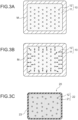
- Figs. 3A to 3C are each a cross-sectional view schematically showing a method of producing the sealing member 20 using the composition for a sealing member 10.
- the composition for a sealing member 10 is molded as the sealing member 20 by an arbitrary method. Examples of the method of molding the composition for a sealing member 10 include an injection molding method, an extrusion molding method, and a press molding method.
- Fig. 3A shows the state where a mold M is filled with the composition for a sealing member 10.
- the particulate resin 12 is uniformly dispersed in the fluorine rubber component 11 in the mold M.
- the shape of the mold M is determined in accordance with the shape of the sealing member 20, and the sealing member 20 having an arbitrary shape can be produced from the composition for a sealing member 10.
- Fig. 3B shows the state where the composition for a sealing member 10 deposited in the mold M is heated.
- crosslinking primary vulcanization
- the particulate resin 12 dispersed in the fluorine rubber component 11 moves toward the surface due to the action of the lubrication portion 12b.
- particulate resin 12 bleed out on the surface of the fluorine rubber component 11.
- the particulate resins 12 that have bleed out on the surface of the fluorine rubber component 11 are bonded to each other and integrated to form a surface layer portion 23 (see Fig. 3C ) covering the fluorine rubber component 11.
- the particulate resin 12 does not move.
- a molded body is taken out from the mold M. By performing secondary vulcanization on this molded body as necessary, the sealing member 20 is obtained.
- Fig. 3C shows the sealing member 20 produced by molding the composition for a sealing member 10.
- the sealing member 20 includes a body portion 22 and the surface layer portion 23.
- the body portion 22 constitutes the shape of the sealing member 20.
- the surface layer portion 23 covers the surface of the body portion 22.
- the body portion 22 is formed mainly of a fluorine rubber 21 produced by crosslinking the fluorine rubber component 11 contained in the composition for a sealing member 10. Further, in the body portion 22, the particulate resin 12 that has remained without bleeding on the surface of the fluorine rubber component 11 at the time of crosslinking is dispersed in the fluorine rubber 21.
- the fluorine rubber 21 is excellent in heat resistance, oil resistance, and chemical resistance.
- the sealing member 20 in which the body portion 22 is mainly formed of the fluorine rubber 21 is excellent in heat resistance, oil resistance, and chemical resistance. Therefore, the sealing member 20 achieves high durability in various applications.
- the surface layer portion 23 is obtained by bonding the particulate resin 12, it includes the compatible portion 12a having compatibility with the fluorine rubber 21 and the lubrication portion 12b having lubricity with respect to the fluorine rubber 21.
- the surface layer portion 23 typically has a configuration in which the compatible portion 12a and the lubrication portion 12b are distributed throughout the surface layer portion 23.
- the surface layer portion 23 formed on the surface of the sealing member 20 has high slidability due to the action of the lubrication portion 12b that is a self-lubricating component. Therefore, the sealing member 20 can achieve high slidability that cannot be achieved by only the fluorine rubber 21 because the surface layer portion 23 functions as a solid lubricating film.
- the surface layer portion 23 can achieve a high adhesion force of the surface layer portion 23 to the body portion 22 (fluorine rubber 21) by the action of the compatible portion 12a. As a result, the surface layer portion 23 has high durability because it becomes hard to peel from the body portion 22. Therefore, the sealing member 20 maintains high slidability for a long time.
- the particulate resin 12 is caused to bleed out at the time of molding to form the surface layer portion 23.
- the sealing member 20 achieves high slidability more reliably.
- the sealing member 20 since the particulate resin 12 is dispersed in the body portion 22, the particulate resin 12 is present on the surface of the body portion 22. Therefore, even in the case where the surface layer portion 23 is worn and the body portion 22 is exposed, the sealing member 20 is capable of ensuring slidability.
- the particulate resin 12 does not need to be dispersed in the body portion 22. That is, all the particulate resins 12 contained in the composition for a sealing member 10 may form the surface layer portion 23 of the sealing member 20.
- the particulate resin 12 only needs to be present on the surface thereof, and the particulate resin 12 does not necessarily need to form the film-shaped surface layer portion 23. That is, the sealing member 20 does not necessarily need to have a configuration in which the body portion 22 and the surface layer portion 23 can be clearly distinguished from each other.
- the particulate resin 12 only needs to be present on the surface thereof, and it does necessarily need to cause the particulate resin 12 to bleed out at the time of molding.
- the concentration of the particulate resin 12 may be approximately the same between the surface and the inside, or the concentration of the particulate resin 12 may be higher inside than on the surface.
- the resin forming the surface layer portion 23 and the particulate resin 12 of the sealing member 20 only needs to be a resin including the compatible portion 12a having compatibility with the fluorine rubber 21, and the lubrication portion 12b having lubricity with respect to the fluorine rubber 21.
- the configuration of the compatible portion 12a and the lubrication portion 12b in such a resin is not limited to a specific one.
- a silicone resin which has favorable slidability and a main skeleton of silicone having low surface energy, can be used as the resin forming the surface layer portion 23 and the particulate resin 12.
- the main skeleton of silicone becomes a self-lubricating component, and functions as the lubrication portion 12b.
- the silicone forming the silicone resin is not limited to a specific type one. Specific examples thereof include dimethyl silicone, methylphenyl silicone, amino-modified silicone, and epoxy-modified silicone.
- the configuration that functions as the compatible portion 12a may be bonded to the main skeleton of silicone.
- the configuration that functions as the compatible portion 12a only needs to have compatibility with the fluorine rubber 21, and can be realized by using, for example, various functional groups or various resins (e.g., acrylic resin).
- the silicone resin favorably contains 40 weight% or more of silicone in order to achieve sufficient lubricity. As a result, sufficiently high slidability can be achieved in the surface layer portion 23. Further, a sufficient amount of the particulate resin 12 bleeds out at the time of molding of the sealing member 20, and thus, the surface layer portion 23 is favorably formed.
- the silicone resin imparted with compatibility with the fluorine rubber 21 can be selected from commercially available products depending on the application of the sealing member 20, or the like.
- a silicone resin can be selected from Chaline (registered trademark) series, which is a silicone-acrylic copolymer manufactured by Nissin Chemical Industry Co., Ltd.
- the fluorine rubber 21 constituting the body portion 22 of the sealing member 20 is not limited to a specific one as long as it is rubber containing a fluorine atom.
- the fluorine rubber 21 for example, vinylidene fluoride fluororubber (FKM) mainly formed of vinylidene fluoride can be used.
- binary fluorine rubber 21 for example, vinylidene fluoride-hexafluoropropylene-, vinylidene fluoride-chlorotrifluoroethylene-, tetrafluoroethylene-perfluoro-, or tetrafluoroethylene-propylene-based one can be used.
- ternary fluorine rubber 21 for example, vinylidene fluoride-hexafluoropropylene-tetrafluoroethylene-, vinylidene fluoride-perfluoroalkyl vinyl ether-tetrafluoroethylene-, or tetrafluoroethylene-propylene-vinylidene fluoride-based one can be used.
- These ternary fluorine rubbers 21 are generally excellent in cold resistance.
- the fluorine rubber 21 a single type one may be used or a plurality of types may be combined for use.
- the degree of polymerization of the fluorine rubber 21 can be determined in accordance with the application of the sealing member 20 or the like so that an appropriate sealing property or slidability can be achieved.
- the body portion 22 of the sealing member 20 may contain an additive other than the fluorine rubber 21 and the particulate resin 12 as necessary.
- the body portion 22 may contain a curing agent for increasing the hardness as an example.
- the curing agent for example, powdery carbon (carbon black or the like) can be used.
- the body portion 22 may contain various additives such as a filler, a reinforcing material, and a pigment other than the curing agent.
- the configuration of the fluorine rubber component 11, and the particulate resin 12 in the composition for a sealing member 10 is determined in accordance with the configuration of the sealing member 20.
- the content of the particulate resin 12 in the composition for a sealing member 10 is not less than 0.5 parts by weight and not more than 50 parts by weight on the basis of 100 parts by weight of the fluorine rubber component 11.
- the content of the particulate resin 12 By setting the content of the particulate resin 12 to not less than 0.5 parts by weight, a sufficient amount of the particulate resin 12 bleeds out at the time of molding, and thus, the favorable surface layer portion 23 is formed. Further, by keeping the content of the particulate resin 12 at not more than 50 parts by weight, a favorable sealing property can be easily achieved by the action of the fluorine rubber 21 in the sealing member 20.
- the content of the particulate resin 12 in the composition for a sealing member 10 is favorably not less than 1 part by weight and not more than 20 parts by weight on the basis of 100 parts by weight of the fluorine rubber component 11.
- the sealing member 20 having both more favorable slidability and a more favorable sealing property can be achieved.
- the additive in the composition for a sealing member 10 is determined in accordance with the configuration of the sealing member 20. That is, the composition for a sealing member 10 may contain the curing agent described above. Further, the composition for a sealing member 10 may contain various additives such as a filler, a reinforcing material, and a pigment other than the curing agent.
- composition for a sealing member 10 may contain a crosslinking agent for crosslinking the fluorine rubber component 11 in advance.
- the crosslinking agent is not limited to a specific one.
- the crosslinking agent can be selected from commercially available crosslinking agents.
- As the crosslinking agent for example, a polyamine crosslinking-, polyol crosslinking-, or peroxide crosslinking-based one can be used.
- composition for a sealing member 10 may contain a processing aid.
- the processing aid include a fatty acid such as stearic acid and fatty acid metal salt.
- the processing aid hinders the movement of the particulate resin 12 during crosslinking of the fluorine rubber component 11, i.e., hinders formation of the surface layer portion 23 in some cases.
- the amount of the processing aid is favorably small. Specifically, it is favorable to keep the amount of the processing aid at not more than 3 parts by weight on the basis of 100 parts by weight of the fluorine rubber component 11. Further, it is more favorable that the composition for a sealing member 10 does not substantially contain a processing aid. Specifically, it is more favorable that the amount of the processing aid is kept at not more than 0.1 parts by weight.
- composition for a sealing member 10 may contain various additives such as a crosslinking aid and a retarder as necessary.
- Example 1-1 as the particulate resin 12 of the composition for a sealing member 10, one (lubricant 1) having the content of silicone of 70 weight% among Chaline (registered trademark) series manufactured by Nissin Chemical Industry Co., Ltd. was used. In Example 1-1, the content of the particulate resin 12 was set to 20 parts by weight on the basis of 100 parts by weight of the fluorine rubber component 11.
- Example 1-1 after kneading the composition for a sealing member 10 having the above-mentioned configuration, it was molded by the primary vulcanization at 170°C for 10 minutes into a spherical shape of 20 mm in outer diameter. Subsequently, secondary vulcanization was performed at 230°C for 4 hours on the spherical molded body. As a result, a sample of the sealing member 20 was obtained.
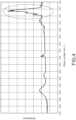
- Fig. 4 shows an infrared spectrum obtained as a result of infrared absorption analysis of the surface of the sample of the sealing member 20.
- a peak of absorbance of silicone is observed in a region surrounded by broken lines with a wave number of approximately 1100 cm -1 .
- the particulate resin 12 is present on the surface of the sample.
- Examples 1-2 to 1-5 samples of the sealing member 20 were prepared using the composition for a sealing member 10 in which the configuration of the particulate resin 12 is different from that of the composition for a sealing member 10 used in Example 1-1.
- Conditions for preparing each sample of the sealing member 20 according to Examples 1-2 to 1-5 were the same as that in Example 1-1.
- the content of the particulate resin 12 (lubricant 1) is different from that of Example 1-1. Specifically, the content of the particulate resin 12 on the basis of 100 parts by weight of the fluorine rubber component 11 was 10 parts by weight in Example 1-2, 5 parts by weight in Example 1-3, 1 part by weight Example 1-4, and 0.5 parts by weight in Example 1-5.
- Comparative Examples 1-1 to 1-12 samples of a sealing member were prepared using a composition for a sealing member having a configuration different from that of the composition for a sealing member 10 according to this embodiment.
- Conditions for preparing the samples of a sealing member according to Comparative Examples 1-1 to 1-12 were the same as that in Example 1-1.
- the content of the particulate resin 12 is less than that in this embodiment. Specifically, in Comparative Example 1-1, the content of the particulate resin 12 on the basis of 100 parts by weight of the fluorine rubber component 11 was 0.1 parts by weight. In Comparative Example 1-2, the content of the particulate resin 12 is 0 parts by weight, i.e., the particulate resin 12 is not used.
- Comparative Example 1-3 instead of the particulate resin 12 according to this embodiment, silicone oil (lubricant 2) was used. However, since the silicone oil has high lubricity with respect to the fluorine rubber component 11, it has been separated without being mixed with the fluorine rubber component 11. As a result, no sample of a sealing member was obtained in Comparative Example 1-3.
- Comparative Examples 1-4 to 1-12 samples of a sealing member were prepared using a composition for a sealing member containing a lubricant having a configuration different from that of the particulate resin 12 according to this embodiment.
- the configuration of the lubricant used in Comparative Examples 1-4 to 1-12 is different from that of the particulate resin 12 in that it does not include at least one of the compatible portion 12a and the lubrication portion 12b.
- Comparative Examples 1-4 to 1-6 respectively, lubricants 3 to 5, which were general lubricants, were used.
- lubricants 6 to 11 which were general processing aids (such as mold release agents) having a lubricity function, were used.
- the lubricants 3 to 11 used in Comparative Examples 1-4 to 1-12 are as follows.
- a slidability test was conducted on the samples obtained in Examples 1-1 to 1-5 and Comparative Examples 1-1, 1-2, and 1-4 to 1-12.
- a counterpart material to be slid a plate material having a surface roughness Ra of 0.4 um, on which hard chrome plating was performed, was used.
- the slidability test was conducted in a state where each sample was sandwiched with the counterpart material and compressed by 40%.
- a sample sandwiched with the counterpart material was placed on a testing machine (Autograph manufactured by Shimadzu Corporation.), and the resistance value (load) when the center part of the sample pushed in at a speed of 50 mm/min in the direction along the surface of the counterpart material was measured. As a result, for example, a graph as shown in Fig. 5 is obtained.
- Fig. 5 is a graph showing an example of the result of the slidability test.
- Fig. 5 the results obtained for the samples according to Example 1-2 and Comparative Example 1-2 are shown. It can be seen that in the example according to Example 1-2, the resistance value after starting sliding is lower than that of the sample according to Comparative Example 1-2.
- the slidability of each sample was evaluated on the basis of the resistance value when the sample was pushed in by 10 mm.
- the evaluation criteria of slidability of each sample were A to D shown below.
- Table 1 shows the evaluation results of the slidability of the samples according to Examples 1-1 to 1-5 and Comparative Examples 1-1, 1-2, and 1-4 to 1-12. Note that regarding Comparative Example 1-3 in which a sample of a sealing member was not obtained, the slidability was not evaluated. Further, Table 1 shows the content (parts by weight) of each component of each sample.
- Example 1-1 Example 1-2 Example 1-3
- Example 1-4 Example 1-5 Comparative Example 1-1 Comparative Example 1-2 Comparative Example 1-3 Comparative Example 1-4 Comparative Example 1-5 Comparative Example 1-6 Comparative Example 1-7 Comparative Example 1-8 Comparative Example 1-9 Comparative Example 1-10 Comparative Example 1-11 Comparative Example 1-12 Fluorine rubber component 100 100 100 100 100 100 100 100 100 100 100 100 100 100 100 100 100 100 100 100 100 100 100 100 100 100 100 100 100 100 100 100 100 100 100 100 100 100 100 100 100 100 100 100 100 100 100 100 100 100 100 100 100 100 100 100 100 100 100 100 100 100 100 100 100 100 100 100 100 100 100 100 100 100 100 100 100 100 100 100 100 100 100 100 100 100 100 100 100 100 100 100 100 100 100 100 100 100 100 100 100 100 100 100 100 100 100 100 100 100 100 100 100 100 100 100 100 100 100 100 100 100 100 100 100 100 100 100 100 100 100 100 100 100 100 100 100 100 100 100 100 100 100 100 100 100 100 100 100 100 100 100 100 100 100 100 100 100 100 100 100 100 100 100 100 100 100 100 100 100 100 100
- Examples 2-1 to 2-9 samples of the sealing member 20 were prepared by molding the composition for a sealing member 10 having a different content of carbon under the same conditions as those in Examples 1-1. Then, the slidability of each sample was evaluated similarly to Examples 1-1 to 1-5 and Comparative Examples 1-1, 1-2, and 1-4 to 1-12 described above.
- Table 2 shows the evaluation results of the samples according to Examples 2-1 to 2-9. Further, Table 2 shows the contents (parts by weight) of carbon and the lubricant 1 of each sample. Note that in Example 2-1, the content of carbon is 0 part by weight, i.e., carbon is not used. [Table 2] Example 2-1 Example 2-2 Example 2-3 Example 2-4 Example 2-5 Example 2-6 Example 2-7 Example 2-8 Example 2-9 Fluorine rubber component 100 100 100 100 100 100 100 100 100 100 100 100 100 100 100 100 100 100 100 100 100 100 100 100 100 Carbon 0 10 20 30 40 50 60 70 80 Lubricant 1 10 10 10 10 10 10 10 10 10 10 10 10 10 10 Slidability B B B B A A A A A A A A A A A A A A A A A A A A A A A A A A A A A A A A A A A A A A A A A A A A A A A A A A A A A A A A A A A A A A A A A A A A A A A A A A A A A A A A A A A A A
- the resistance value was not more than 50 N and favorable slidability was achieved. Further, in Examples 2-5 to 2-9 in which the content of carbon was not less than 40 parts by weight, the resistance value was not more than 40 N and particularly favorable slidability was achieved.
Landscapes
- Chemical & Material Sciences (AREA)
- Engineering & Computer Science (AREA)
- General Engineering & Computer Science (AREA)
- Organic Chemistry (AREA)
- Health & Medical Sciences (AREA)
- Mechanical Engineering (AREA)
- Chemical Kinetics & Catalysis (AREA)
- Medicinal Chemistry (AREA)
- Polymers & Plastics (AREA)
- Materials Engineering (AREA)
- Sealing Material Composition (AREA)
- Compositions Of Macromolecular Compounds (AREA)
- Gasket Seals (AREA)
- Sealing Devices (AREA)
Claims (7)
- Composition pour un élément d'étanchéité, comprenant :
100 parties en poids d'un composant caoutchouc fluoré non réticulé; et
1 à 20 (inclus) parties en poids d'une résine particulaire, la résine particulaire comprenant une partie compatible et une partie lubrifiante, la partie compatible ayant une compatibilité avec le composant caoutchouc fluoré, la partie lubrifiante ayant un pouvoir lubrifiant par rapport au composant caoutchouc fluoré, dans laquelle la résine particulaire est formée par un copolymère silicone-acrylique, et dans laquelle la résine particulaire est dispersée dans le caoutchouc fluoré. - Composition pour un élément d'étanchéité selon la revendication 1, dans laquelle la résine particulaire ne contient pas moins de 40 % en poids de silicone.
- Composition pour un élément d'étanchéité selon l'une quelconque des revendications 1 ou 2, comprenant en outre du carbone.
- Elément d'étanchéité, comprenant :100 parties en poids d'un composant caoutchouc fluoré non réticulé; et1 à 20 (inclus) parties en poids d'une résine particulaire ;
dans lequel la résine particulaire comprend une partie compatible et une partie lubrifiante, la partie compatible ayant une compatibilité avec le caoutchouc fluoré, la partie lubrifiante ayant un pouvoir lubrifiant par rapport au caoutchouc fluoré, dans lequel la résine particulaire est formée par un copolymère silicone-acrylique, et dans lequel la résine particulaire est dispersée dans le caoutchouc fluoré. - Elément d'étanchéité selon la revendication 4, dans lequel
la résine particulaire est présente sur une surface de l'élément d'étanchéité. - Elément d'étanchéité selon la revendication 4, dans lequel
la résine particulaire ne contient pas moins de 40 % en poids de silicone. - Elément d'étanchéité selon l'une quelconque des revendications 4 à 6, comprenant en outre.
du carbone réparti dans le caoutchouc fluoré.
Applications Claiming Priority (2)
| Application Number | Priority Date | Filing Date | Title |
|---|---|---|---|
| JP2017071924A JP6902904B2 (ja) | 2017-03-31 | 2017-03-31 | シール部材用組成物及びシール部材 |
| PCT/JP2018/012489 WO2018181351A1 (fr) | 2017-03-31 | 2018-03-27 | Composition pour élément de joint d'étanchéité et élément de joint d'étanchéité |
Publications (3)
| Publication Number | Publication Date |
|---|---|
| EP3594306A1 EP3594306A1 (fr) | 2020-01-15 |
| EP3594306A4 EP3594306A4 (fr) | 2021-01-13 |
| EP3594306B1 true EP3594306B1 (fr) | 2023-02-22 |
Family
ID=63676076
Family Applications (1)
| Application Number | Title | Priority Date | Filing Date |
|---|---|---|---|
| EP18774865.2A Active EP3594306B1 (fr) | 2017-03-31 | 2018-03-27 | Composition pour élément de joint d'étanchéité et élément de joint d'étanchéité |
Country Status (4)
| Country | Link |
|---|---|
| US (1) | US20200056029A1 (fr) |
| EP (1) | EP3594306B1 (fr) |
| JP (1) | JP6902904B2 (fr) |
| WO (1) | WO2018181351A1 (fr) |
Family Cites Families (6)
| Publication number | Priority date | Publication date | Assignee | Title |
|---|---|---|---|---|
| US4948852A (en) * | 1989-10-26 | 1990-08-14 | E. I. Du Pont De Nemours And Company | Peroxide-curable fluoroelastomers and chlorofluoroelastomers having bromine and iodine curesites and the preparation thereof |
| US5587424A (en) * | 1993-06-22 | 1996-12-24 | Bayer Aktiengesellschaft | Mixture of fluorocarbon rubber and silicone/acrylate core/shell rubber |
| JPH07227935A (ja) | 1994-02-18 | 1995-08-29 | Toyoda Gosei Co Ltd | ゴム基複合材及びその製造方法 |
| JP2003155382A (ja) * | 2001-11-20 | 2003-05-27 | Nippon Valqua Ind Ltd | 架橋ゴム組成物およびその用途 |
| JPWO2015141442A1 (ja) * | 2014-03-18 | 2017-04-06 | 株式会社リケン | シール部材及びその製造方法 |
| JP6656854B2 (ja) * | 2015-09-16 | 2020-03-04 | 株式会社リケン | シール部材 |
-
2017
- 2017-03-31 JP JP2017071924A patent/JP6902904B2/ja active Active
-
2018
- 2018-03-27 US US16/499,645 patent/US20200056029A1/en not_active Abandoned
- 2018-03-27 EP EP18774865.2A patent/EP3594306B1/fr active Active
- 2018-03-27 WO PCT/JP2018/012489 patent/WO2018181351A1/fr not_active Ceased
Also Published As
| Publication number | Publication date |
|---|---|
| WO2018181351A1 (fr) | 2018-10-04 |
| JP2018172544A (ja) | 2018-11-08 |
| JP6902904B2 (ja) | 2021-07-14 |
| EP3594306A1 (fr) | 2020-01-15 |
| EP3594306A4 (fr) | 2021-01-13 |
| US20200056029A1 (en) | 2020-02-20 |
Similar Documents
| Publication | Publication Date | Title |
|---|---|---|
| US3538028A (en) | Vulcanizater of compositions comprising a fluorine-containing copolymer and silicone gum | |
| US10035891B2 (en) | Modified thermoplastic polyurethane rolling film and preparation method | |
| DE4439366B4 (de) | Wasserdichtes Abdichtungsmittel für Verbindungselemente | |
| EP3662012B1 (fr) | Additif pour bases élastomères de silicone améliorant leurs propriétés de manipulation | |
| CN105860179B (zh) | 橡胶密封制品及其制备方法和应用 | |
| JP3009676B2 (ja) | フッ素ゴム成形品の製造方法 | |
| EP3467026A1 (fr) | Composition de perfluoroélastomère, et matériau de scellement | |
| EP3640295B1 (fr) | Composition de caoutchouc fluoré et matériau d'étanchéité à base de caoutchouc fluoré | |
| EP3594307B1 (fr) | Élément d'étanchéité | |
| EP3594306B1 (fr) | Composition pour élément de joint d'étanchéité et élément de joint d'étanchéité | |
| DE69124923T2 (de) | Vulkanisierbare Gummimischung | |
| JP2006168714A (ja) | 自動車ウェザーストリップ用コーティング組成物、自動車ウェザーストリップ用コーティング剤の製造方法および自動車ウェザーストリップ。 | |
| KR102531390B1 (ko) | 고무와 금속의 접착용 접착제 조성물 | |
| CN1268433A (zh) | 聚丙烯类薄膜及其多层薄膜 | |
| JPH0412750B2 (fr) | ||
| JP2017200982A (ja) | 摺動組成物、並びに、摺動部材及びその製造方法 | |
| JP2003026851A (ja) | 含浸体、該含浸体を含むポリオレフィン組成物およびその製造方法、並びに該組成物から得られる成形体 | |
| JP7495826B2 (ja) | ゴム組成物及びゴム組成物から成形されるシール材 | |
| JP3308900B2 (ja) | グラスラン用表面処理材料 | |
| DE2133131A1 (de) | Vulkanisierbare Mischungen auf der Basis fluorierter Co- oder Terpolymerer und deren Verwendung | |
| JP2589714B2 (ja) | 摺動材組成物 | |
| JP2001521963A (ja) | きしみ音抵抗性製品 | |
| WO2017175256A1 (fr) | Procédé de fabrication de bague de contact coulissante du type à écoulement, et joint et seringue utilisant une bague de contact coulissante | |
| DE19526527C2 (de) | (Ab)Dichtungs-Teil zum Wasserdichtmachen eines Steckverbinders | |
| JP2707103B2 (ja) | ペレット状弗素樹脂組成物 |
Legal Events
| Date | Code | Title | Description |
|---|---|---|---|
| STAA | Information on the status of an ep patent application or granted ep patent |
Free format text: STATUS: THE INTERNATIONAL PUBLICATION HAS BEEN MADE |
|
| PUAI | Public reference made under article 153(3) epc to a published international application that has entered the european phase |
Free format text: ORIGINAL CODE: 0009012 |
|
| STAA | Information on the status of an ep patent application or granted ep patent |
Free format text: STATUS: REQUEST FOR EXAMINATION WAS MADE |
|
| 17P | Request for examination filed |
Effective date: 20191010 |
|
| AK | Designated contracting states |
Kind code of ref document: A1 Designated state(s): AL AT BE BG CH CY CZ DE DK EE ES FI FR GB GR HR HU IE IS IT LI LT LU LV MC MK MT NL NO PL PT RO RS SE SI SK SM TR |
|
| AX | Request for extension of the european patent |
Extension state: BA ME |
|
| DAV | Request for validation of the european patent (deleted) | ||
| DAX | Request for extension of the european patent (deleted) | ||
| A4 | Supplementary search report drawn up and despatched |
Effective date: 20201215 |
|
| RIC1 | Information provided on ipc code assigned before grant |
Ipc: C08L 27/12 20060101ALI20201209BHEP Ipc: C08L 101/00 20060101ALI20201209BHEP Ipc: C08K 3/04 20060101ALI20201209BHEP Ipc: C09K 3/10 20060101AFI20201209BHEP Ipc: F16J 15/3284 20160101ALI20201209BHEP Ipc: F16J 15/10 20060101ALI20201209BHEP |
|
| GRAP | Despatch of communication of intention to grant a patent |
Free format text: ORIGINAL CODE: EPIDOSNIGR1 |
|
| STAA | Information on the status of an ep patent application or granted ep patent |
Free format text: STATUS: GRANT OF PATENT IS INTENDED |
|
| INTG | Intention to grant announced |
Effective date: 20221026 |
|
| RIN1 | Information on inventor provided before grant (corrected) |
Inventor name: YANAGAWA, HAJIME Inventor name: YAMAMOTO, NORIAKI Inventor name: GUNJI, YASUHIRO Inventor name: IRIE, SHIORI |
|
| GRAS | Grant fee paid |
Free format text: ORIGINAL CODE: EPIDOSNIGR3 |
|
| GRAA | (expected) grant |
Free format text: ORIGINAL CODE: 0009210 |
|
| STAA | Information on the status of an ep patent application or granted ep patent |
Free format text: STATUS: THE PATENT HAS BEEN GRANTED |
|
| AK | Designated contracting states |
Kind code of ref document: B1 Designated state(s): AL AT BE BG CH CY CZ DE DK EE ES FI FR GB GR HR HU IE IS IT LI LT LU LV MC MK MT NL NO PL PT RO RS SE SI SK SM TR |
|
| REG | Reference to a national code |
Ref country code: GB Ref legal event code: FG4D |
|
| REG | Reference to a national code |
Ref country code: CH Ref legal event code: EP |
|
| REG | Reference to a national code |
Ref country code: AT Ref legal event code: REF Ref document number: 1549531 Country of ref document: AT Kind code of ref document: T Effective date: 20230315 Ref country code: IE Ref legal event code: FG4D |
|
| REG | Reference to a national code |
Ref country code: DE Ref legal event code: R096 Ref document number: 602018046439 Country of ref document: DE |
|
| REG | Reference to a national code |
Ref country code: LT Ref legal event code: MG9D |
|
| P01 | Opt-out of the competence of the unified patent court (upc) registered |
Effective date: 20230509 |
|
| REG | Reference to a national code |
Ref country code: NL Ref legal event code: MP Effective date: 20230222 |
|
| REG | Reference to a national code |
Ref country code: AT Ref legal event code: MK05 Ref document number: 1549531 Country of ref document: AT Kind code of ref document: T Effective date: 20230222 |
|
| PG25 | Lapsed in a contracting state [announced via postgrant information from national office to epo] |
Ref country code: RS Free format text: LAPSE BECAUSE OF FAILURE TO SUBMIT A TRANSLATION OF THE DESCRIPTION OR TO PAY THE FEE WITHIN THE PRESCRIBED TIME-LIMIT Effective date: 20230222 Ref country code: PT Free format text: LAPSE BECAUSE OF FAILURE TO SUBMIT A TRANSLATION OF THE DESCRIPTION OR TO PAY THE FEE WITHIN THE PRESCRIBED TIME-LIMIT Effective date: 20230622 Ref country code: NO Free format text: LAPSE BECAUSE OF FAILURE TO SUBMIT A TRANSLATION OF THE DESCRIPTION OR TO PAY THE FEE WITHIN THE PRESCRIBED TIME-LIMIT Effective date: 20230522 Ref country code: NL Free format text: LAPSE BECAUSE OF FAILURE TO SUBMIT A TRANSLATION OF THE DESCRIPTION OR TO PAY THE FEE WITHIN THE PRESCRIBED TIME-LIMIT Effective date: 20230222 Ref country code: LV Free format text: LAPSE BECAUSE OF FAILURE TO SUBMIT A TRANSLATION OF THE DESCRIPTION OR TO PAY THE FEE WITHIN THE PRESCRIBED TIME-LIMIT Effective date: 20230222 Ref country code: LT Free format text: LAPSE BECAUSE OF FAILURE TO SUBMIT A TRANSLATION OF THE DESCRIPTION OR TO PAY THE FEE WITHIN THE PRESCRIBED TIME-LIMIT Effective date: 20230222 Ref country code: HR Free format text: LAPSE BECAUSE OF FAILURE TO SUBMIT A TRANSLATION OF THE DESCRIPTION OR TO PAY THE FEE WITHIN THE PRESCRIBED TIME-LIMIT Effective date: 20230222 Ref country code: ES Free format text: LAPSE BECAUSE OF FAILURE TO SUBMIT A TRANSLATION OF THE DESCRIPTION OR TO PAY THE FEE WITHIN THE PRESCRIBED TIME-LIMIT Effective date: 20230222 Ref country code: AT Free format text: LAPSE BECAUSE OF FAILURE TO SUBMIT A TRANSLATION OF THE DESCRIPTION OR TO PAY THE FEE WITHIN THE PRESCRIBED TIME-LIMIT Effective date: 20230222 |
|
| PG25 | Lapsed in a contracting state [announced via postgrant information from national office to epo] |
Ref country code: SE Free format text: LAPSE BECAUSE OF FAILURE TO SUBMIT A TRANSLATION OF THE DESCRIPTION OR TO PAY THE FEE WITHIN THE PRESCRIBED TIME-LIMIT Effective date: 20230222 Ref country code: PL Free format text: LAPSE BECAUSE OF FAILURE TO SUBMIT A TRANSLATION OF THE DESCRIPTION OR TO PAY THE FEE WITHIN THE PRESCRIBED TIME-LIMIT Effective date: 20230222 Ref country code: IS Free format text: LAPSE BECAUSE OF FAILURE TO SUBMIT A TRANSLATION OF THE DESCRIPTION OR TO PAY THE FEE WITHIN THE PRESCRIBED TIME-LIMIT Effective date: 20230622 Ref country code: GR Free format text: LAPSE BECAUSE OF FAILURE TO SUBMIT A TRANSLATION OF THE DESCRIPTION OR TO PAY THE FEE WITHIN THE PRESCRIBED TIME-LIMIT Effective date: 20230523 Ref country code: FI Free format text: LAPSE BECAUSE OF FAILURE TO SUBMIT A TRANSLATION OF THE DESCRIPTION OR TO PAY THE FEE WITHIN THE PRESCRIBED TIME-LIMIT Effective date: 20230222 |
|
| PG25 | Lapsed in a contracting state [announced via postgrant information from national office to epo] |
Ref country code: SM Free format text: LAPSE BECAUSE OF FAILURE TO SUBMIT A TRANSLATION OF THE DESCRIPTION OR TO PAY THE FEE WITHIN THE PRESCRIBED TIME-LIMIT Effective date: 20230222 Ref country code: RO Free format text: LAPSE BECAUSE OF FAILURE TO SUBMIT A TRANSLATION OF THE DESCRIPTION OR TO PAY THE FEE WITHIN THE PRESCRIBED TIME-LIMIT Effective date: 20230222 Ref country code: EE Free format text: LAPSE BECAUSE OF FAILURE TO SUBMIT A TRANSLATION OF THE DESCRIPTION OR TO PAY THE FEE WITHIN THE PRESCRIBED TIME-LIMIT Effective date: 20230222 Ref country code: DK Free format text: LAPSE BECAUSE OF FAILURE TO SUBMIT A TRANSLATION OF THE DESCRIPTION OR TO PAY THE FEE WITHIN THE PRESCRIBED TIME-LIMIT Effective date: 20230222 Ref country code: CZ Free format text: LAPSE BECAUSE OF FAILURE TO SUBMIT A TRANSLATION OF THE DESCRIPTION OR TO PAY THE FEE WITHIN THE PRESCRIBED TIME-LIMIT Effective date: 20230222 |
|
| REG | Reference to a national code |
Ref country code: CH Ref legal event code: PL |
|
| REG | Reference to a national code |
Ref country code: DE Ref legal event code: R097 Ref document number: 602018046439 Country of ref document: DE |
|
| PG25 | Lapsed in a contracting state [announced via postgrant information from national office to epo] |
Ref country code: SK Free format text: LAPSE BECAUSE OF FAILURE TO SUBMIT A TRANSLATION OF THE DESCRIPTION OR TO PAY THE FEE WITHIN THE PRESCRIBED TIME-LIMIT Effective date: 20230222 |
|
| REG | Reference to a national code |
Ref country code: BE Ref legal event code: MM Effective date: 20230331 |
|
| PG25 | Lapsed in a contracting state [announced via postgrant information from national office to epo] |
Ref country code: LU Free format text: LAPSE BECAUSE OF NON-PAYMENT OF DUE FEES Effective date: 20230327 |
|
| PLBE | No opposition filed within time limit |
Free format text: ORIGINAL CODE: 0009261 |
|
| STAA | Information on the status of an ep patent application or granted ep patent |
Free format text: STATUS: NO OPPOSITION FILED WITHIN TIME LIMIT |
|
| PG25 | Lapsed in a contracting state [announced via postgrant information from national office to epo] |
Ref country code: MC Free format text: LAPSE BECAUSE OF FAILURE TO SUBMIT A TRANSLATION OF THE DESCRIPTION OR TO PAY THE FEE WITHIN THE PRESCRIBED TIME-LIMIT Effective date: 20230222 |
|
| REG | Reference to a national code |
Ref country code: IE Ref legal event code: MM4A |
|
| GBPC | Gb: european patent ceased through non-payment of renewal fee |
Effective date: 20230522 |
|
| 26N | No opposition filed |
Effective date: 20231123 |
|
| PG25 | Lapsed in a contracting state [announced via postgrant information from national office to epo] |
Ref country code: SI Free format text: LAPSE BECAUSE OF FAILURE TO SUBMIT A TRANSLATION OF THE DESCRIPTION OR TO PAY THE FEE WITHIN THE PRESCRIBED TIME-LIMIT Effective date: 20230222 Ref country code: MC Free format text: LAPSE BECAUSE OF FAILURE TO SUBMIT A TRANSLATION OF THE DESCRIPTION OR TO PAY THE FEE WITHIN THE PRESCRIBED TIME-LIMIT Effective date: 20230222 Ref country code: LI Free format text: LAPSE BECAUSE OF NON-PAYMENT OF DUE FEES Effective date: 20230331 Ref country code: IE Free format text: LAPSE BECAUSE OF NON-PAYMENT OF DUE FEES Effective date: 20230327 Ref country code: CH Free format text: LAPSE BECAUSE OF NON-PAYMENT OF DUE FEES Effective date: 20230331 |
|
| PG25 | Lapsed in a contracting state [announced via postgrant information from national office to epo] |
Ref country code: BE Free format text: LAPSE BECAUSE OF NON-PAYMENT OF DUE FEES Effective date: 20230331 |
|
| PG25 | Lapsed in a contracting state [announced via postgrant information from national office to epo] |
Ref country code: GB Free format text: LAPSE BECAUSE OF NON-PAYMENT OF DUE FEES Effective date: 20230522 |
|
| PG25 | Lapsed in a contracting state [announced via postgrant information from national office to epo] |
Ref country code: BG Free format text: LAPSE BECAUSE OF FAILURE TO SUBMIT A TRANSLATION OF THE DESCRIPTION OR TO PAY THE FEE WITHIN THE PRESCRIBED TIME-LIMIT Effective date: 20230222 |
|
| PG25 | Lapsed in a contracting state [announced via postgrant information from national office to epo] |
Ref country code: BG Free format text: LAPSE BECAUSE OF FAILURE TO SUBMIT A TRANSLATION OF THE DESCRIPTION OR TO PAY THE FEE WITHIN THE PRESCRIBED TIME-LIMIT Effective date: 20230222 |
|
| PGFP | Annual fee paid to national office [announced via postgrant information from national office to epo] |
Ref country code: FR Payment date: 20250205 Year of fee payment: 8 |
|
| PGFP | Annual fee paid to national office [announced via postgrant information from national office to epo] |
Ref country code: IT Payment date: 20250226 Year of fee payment: 8 |
|
| PGFP | Annual fee paid to national office [announced via postgrant information from national office to epo] |
Ref country code: DE Payment date: 20250404 Year of fee payment: 8 |
|
| PG25 | Lapsed in a contracting state [announced via postgrant information from national office to epo] |
Ref country code: CY Free format text: LAPSE BECAUSE OF FAILURE TO SUBMIT A TRANSLATION OF THE DESCRIPTION OR TO PAY THE FEE WITHIN THE PRESCRIBED TIME-LIMIT; INVALID AB INITIO Effective date: 20180327 |
|
| PG25 | Lapsed in a contracting state [announced via postgrant information from national office to epo] |
Ref country code: HU Free format text: LAPSE BECAUSE OF FAILURE TO SUBMIT A TRANSLATION OF THE DESCRIPTION OR TO PAY THE FEE WITHIN THE PRESCRIBED TIME-LIMIT; INVALID AB INITIO Effective date: 20180327 |
|
| PG25 | Lapsed in a contracting state [announced via postgrant information from national office to epo] |
Ref country code: TR Free format text: LAPSE BECAUSE OF FAILURE TO SUBMIT A TRANSLATION OF THE DESCRIPTION OR TO PAY THE FEE WITHIN THE PRESCRIBED TIME-LIMIT Effective date: 20230222 |