EP3596183B1 - Composition adhésive de mastic plastifiée sans phtalate - Google Patents
Composition adhésive de mastic plastifiée sans phtalate Download PDFInfo
- Publication number
- EP3596183B1 EP3596183B1 EP18714565.1A EP18714565A EP3596183B1 EP 3596183 B1 EP3596183 B1 EP 3596183B1 EP 18714565 A EP18714565 A EP 18714565A EP 3596183 B1 EP3596183 B1 EP 3596183B1
- Authority
- EP
- European Patent Office
- Prior art keywords
- weight
- mastic
- composition
- adhesive
- adhesive sealant
- Prior art date
- Legal status (The legal status is an assumption and is not a legal conclusion. Google has not performed a legal analysis and makes no representation as to the accuracy of the status listed.)
- Active
Links
Classifications
-
- C—CHEMISTRY; METALLURGY
- C09—DYES; PAINTS; POLISHES; NATURAL RESINS; ADHESIVES; COMPOSITIONS NOT OTHERWISE PROVIDED FOR; APPLICATIONS OF MATERIALS NOT OTHERWISE PROVIDED FOR
- C09J—ADHESIVES; NON-MECHANICAL ASPECTS OF ADHESIVE PROCESSES IN GENERAL; ADHESIVE PROCESSES NOT PROVIDED FOR ELSEWHERE; USE OF MATERIALS AS ADHESIVES
- C09J183/00—Adhesives based on macromolecular compounds obtained by reactions forming in the main chain of the macromolecule a linkage containing silicon, with or without sulfur, nitrogen, oxygen, or carbon only; Adhesives based on derivatives of such polymers
- C09J183/04—Polysiloxanes
-
- C—CHEMISTRY; METALLURGY
- C09—DYES; PAINTS; POLISHES; NATURAL RESINS; ADHESIVES; COMPOSITIONS NOT OTHERWISE PROVIDED FOR; APPLICATIONS OF MATERIALS NOT OTHERWISE PROVIDED FOR
- C09J—ADHESIVES; NON-MECHANICAL ASPECTS OF ADHESIVE PROCESSES IN GENERAL; ADHESIVE PROCESSES NOT PROVIDED FOR ELSEWHERE; USE OF MATERIALS AS ADHESIVES
- C09J11/00—Features of adhesives not provided for in group C09J9/00, e.g. additives
- C09J11/02—Non-macromolecular additives
- C09J11/06—Non-macromolecular additives organic
-
- C—CHEMISTRY; METALLURGY
- C08—ORGANIC MACROMOLECULAR COMPOUNDS; THEIR PREPARATION OR CHEMICAL WORKING-UP; COMPOSITIONS BASED THEREON
- C08G—MACROMOLECULAR COMPOUNDS OBTAINED OTHERWISE THAN BY REACTIONS ONLY INVOLVING UNSATURATED CARBON-TO-CARBON BONDS
- C08G18/00—Polymeric products of isocyanates or isothiocyanates
- C08G18/06—Polymeric products of isocyanates or isothiocyanates with compounds having active hydrogen
- C08G18/08—Processes
- C08G18/10—Prepolymer processes involving reaction of isocyanates or isothiocyanates with compounds having active hydrogen in a first reaction step
- C08G18/12—Prepolymer processes involving reaction of isocyanates or isothiocyanates with compounds having active hydrogen in a first reaction step using two or more compounds having active hydrogen in the first polymerisation step
-
- C—CHEMISTRY; METALLURGY
- C08—ORGANIC MACROMOLECULAR COMPOUNDS; THEIR PREPARATION OR CHEMICAL WORKING-UP; COMPOSITIONS BASED THEREON
- C08G—MACROMOLECULAR COMPOUNDS OBTAINED OTHERWISE THAN BY REACTIONS ONLY INVOLVING UNSATURATED CARBON-TO-CARBON BONDS
- C08G18/00—Polymeric products of isocyanates or isothiocyanates
- C08G18/06—Polymeric products of isocyanates or isothiocyanates with compounds having active hydrogen
- C08G18/28—Polymeric products of isocyanates or isothiocyanates with compounds having active hydrogen characterised by the compounds used containing active hydrogen
- C08G18/40—High-molecular-weight compounds
- C08G18/48—Polyethers
- C08G18/4804—Two or more polyethers of different physical or chemical nature
- C08G18/4812—Mixtures of polyetherdiols with polyetherpolyols having at least three hydroxy groups
-
- C—CHEMISTRY; METALLURGY
- C08—ORGANIC MACROMOLECULAR COMPOUNDS; THEIR PREPARATION OR CHEMICAL WORKING-UP; COMPOSITIONS BASED THEREON
- C08G—MACROMOLECULAR COMPOUNDS OBTAINED OTHERWISE THAN BY REACTIONS ONLY INVOLVING UNSATURATED CARBON-TO-CARBON BONDS
- C08G18/00—Polymeric products of isocyanates or isothiocyanates
- C08G18/06—Polymeric products of isocyanates or isothiocyanates with compounds having active hydrogen
- C08G18/70—Polymeric products of isocyanates or isothiocyanates with compounds having active hydrogen characterised by the isocyanates or isothiocyanates used
- C08G18/72—Polyisocyanates or polyisothiocyanates
- C08G18/74—Polyisocyanates or polyisothiocyanates cyclic
- C08G18/76—Polyisocyanates or polyisothiocyanates cyclic aromatic
- C08G18/7614—Polyisocyanates or polyisothiocyanates cyclic aromatic containing only one aromatic ring
- C08G18/7621—Polyisocyanates or polyisothiocyanates cyclic aromatic containing only one aromatic ring being toluene diisocyanate including isomer mixtures
-
- C—CHEMISTRY; METALLURGY
- C09—DYES; PAINTS; POLISHES; NATURAL RESINS; ADHESIVES; COMPOSITIONS NOT OTHERWISE PROVIDED FOR; APPLICATIONS OF MATERIALS NOT OTHERWISE PROVIDED FOR
- C09D—COATING COMPOSITIONS, e.g. PAINTS, VARNISHES OR LACQUERS; FILLING PASTES; CHEMICAL PAINT OR INK REMOVERS; INKS; CORRECTING FLUIDS; WOODSTAINS; PASTES OR SOLIDS FOR COLOURING OR PRINTING; USE OF MATERIALS THEREFOR
- C09D5/00—Coating compositions, e.g. paints, varnishes or lacquers, characterised by their physical nature or the effects produced; Filling pastes
- C09D5/34—Filling pastes
-
- C—CHEMISTRY; METALLURGY
- C09—DYES; PAINTS; POLISHES; NATURAL RESINS; ADHESIVES; COMPOSITIONS NOT OTHERWISE PROVIDED FOR; APPLICATIONS OF MATERIALS NOT OTHERWISE PROVIDED FOR
- C09J—ADHESIVES; NON-MECHANICAL ASPECTS OF ADHESIVE PROCESSES IN GENERAL; ADHESIVE PROCESSES NOT PROVIDED FOR ELSEWHERE; USE OF MATERIALS AS ADHESIVES
- C09J11/00—Features of adhesives not provided for in group C09J9/00, e.g. additives
- C09J11/02—Non-macromolecular additives
- C09J11/04—Non-macromolecular additives inorganic
-
- C—CHEMISTRY; METALLURGY
- C09—DYES; PAINTS; POLISHES; NATURAL RESINS; ADHESIVES; COMPOSITIONS NOT OTHERWISE PROVIDED FOR; APPLICATIONS OF MATERIALS NOT OTHERWISE PROVIDED FOR
- C09J—ADHESIVES; NON-MECHANICAL ASPECTS OF ADHESIVE PROCESSES IN GENERAL; ADHESIVE PROCESSES NOT PROVIDED FOR ELSEWHERE; USE OF MATERIALS AS ADHESIVES
- C09J175/00—Adhesives based on polyureas or polyurethanes; Adhesives based on derivatives of such polymers
- C09J175/04—Polyurethanes
-
- C—CHEMISTRY; METALLURGY
- C09—DYES; PAINTS; POLISHES; NATURAL RESINS; ADHESIVES; COMPOSITIONS NOT OTHERWISE PROVIDED FOR; APPLICATIONS OF MATERIALS NOT OTHERWISE PROVIDED FOR
- C09J—ADHESIVES; NON-MECHANICAL ASPECTS OF ADHESIVE PROCESSES IN GENERAL; ADHESIVE PROCESSES NOT PROVIDED FOR ELSEWHERE; USE OF MATERIALS AS ADHESIVES
- C09J175/00—Adhesives based on polyureas or polyurethanes; Adhesives based on derivatives of such polymers
- C09J175/04—Polyurethanes
- C09J175/08—Polyurethanes from polyethers
-
- C—CHEMISTRY; METALLURGY
- C08—ORGANIC MACROMOLECULAR COMPOUNDS; THEIR PREPARATION OR CHEMICAL WORKING-UP; COMPOSITIONS BASED THEREON
- C08K—Use of inorganic or non-macromolecular organic substances as compounding ingredients
- C08K5/00—Use of organic ingredients
- C08K5/0008—Organic ingredients according to more than one of the "one dot" groups of C08K5/01 - C08K5/59
- C08K5/0016—Plasticisers
-
- C—CHEMISTRY; METALLURGY
- C08—ORGANIC MACROMOLECULAR COMPOUNDS; THEIR PREPARATION OR CHEMICAL WORKING-UP; COMPOSITIONS BASED THEREON
- C08K—Use of inorganic or non-macromolecular organic substances as compounding ingredients
- C08K5/00—Use of organic ingredients
- C08K5/04—Oxygen-containing compounds
- C08K5/10—Esters; Ether-esters
- C08K5/101—Esters; Ether-esters of monocarboxylic acids
- C08K5/103—Esters; Ether-esters of monocarboxylic acids with polyalcohols
Definitions
- the present invention relates to an adhesive mastic composition
- a plasticizer which is advantageously phthalate-free, as well as a ready-to-use article containing it.
- Sealants are widely used in the construction industry. They are used to assemble - by expansion joints - substrates, for example concrete or steel, and thanks to their mechanical properties, and in particular elastic, to obtain a stable joint to the dimensional variations induced by temperature changes. They are also used for bonding floor coverings, especially parquet.
- One-component sealant compositions comprise a moisture-crosslinkable prepolymer whose chemical structure is endowed with reactive, usually terminal, isocyanate or alkoxysilane groups.
- the reaction of these reactive groups with the water coming from the humidity of the air or of the substrate (called crosslinking reaction) allows, after the introduction of the mastic in the gap between the 2 substrates to be assembled, the creation of 'a solid three-dimensional polymeric network, which gives the adhesive seal thus created the desired mechanical properties.
- a first composition similar to that of a one-component sealant, is combined with a second composition which comprises a crosslinking agent, for example of the amine type.
- the 2 compositions are mixed at the time of application by a suitable device, and also extruded by the operator through a cannula in the gap between the 2 substrates to be assembled.
- the mastic compositions also include a plasticizer for the purpose of increasing the plasticity of the composition and decreasing its viscosity, thereby allowing the when applying the putty packaged in a cartridge, its easy flow by extrusion at the cannula.
- the plasticizer also makes it possible, during application, to improve the ability of the sealant to spread or to wet the surface of the substrates to be grouted.
- Esters of phthalic acid are commonly used for this purpose.
- the patent US 6,548,593 mentions, as a reference (see Table 2), a one-component mastic based on a moisture-crosslinkable prepolymer comprising, as plasticizer, diisodecylphthalate (also known under the acronym DIDP).
- phthalates can be dangerous for humans, since some of them have been classified by the European Chemicals Agency as carcinogenic, mutagenic or reprotoxic (CMR) substances. Therefore, it is very desirable, for public health purposes, to limit exposure to phthalates or even to substitute them with safer substances, in all industrial products in which they are used and to which the consumer and / or the manufacturer are likely to be exposed.
- CMR carcinogenic, mutagenic or reprotoxic
- plasticizers used in mastics can have the drawback of migrating (or diffusing) out of the crosslinked mastic, which can have several undesirable consequences at the level of the adhesive joint: an unattractive appearance linked to the presence of stains. the surface of the substrates in contact with said gasket, a loss of elasticity which risks causing a rupture in its mass (or cohesive rupture), or else a rupture at the interface between the gasket and the substrate (adhesive rupture).
- the object of the present invention is to provide an adhesive mastic composition based on a plasticizer, which is phthalate-free.
- Another object of the present invention is to provide such a mastic composition which comprises a plasticizer which does not migrate out of the crosslinked mastic.
- Another object of the present invention is to provide such a mastic composition resulting in a crosslinked joint which has mechanical properties of the same level as those obtained from DIDP.
- Another aim of the present invention is to provide a mastic composition, in particular a single component, resulting in a crosslinked joint which has improved mechanical properties compared to those obtained from DIDP, in particular in terms of elasticity.
- the present invention therefore relates firstly to an adhesive mastic composition according to claim 1.
- ester of formula (I) as defined in claim 1 acts as a plasticizer in said composition, and in particular makes it possible to retain, with respect to DIDP, the ability of said mastic to be extruded from the cartridge. application, without causing the disadvantage of the presence of phthalates in said composition. Said ester also does not give rise to diffusion (or migration) out of the crosslinked mastic, and moreover makes it possible to obtain a crosslinked adhesive seal which has the required mechanical properties, and even improved.
- Butyric acid also called n-butanoic acid
- valeric acid also called n-pentanoic acid
- a particularly preferred ester compound is pentaerythritol tetravalerate, corresponding to formula (I) in which R 1 , R 2 , R 3 and R 4 each represent the radical: -OC (O) -nC 4 H 9 and which is marketed under the trademark Pevalen TM by the company Perstorp.
- the adhesive mastic composition comprises from 5 to 35% by weight, preferably from 15 to 30% by weight, based on the weight of said composition, of the ester of formula (I).
- the sealant adhesive composition is a one-component sealant composition.
- the moisture-crosslinkable prepolymer included in the adhesive mastic composition according to the invention is a polyurethane containing -NCO end groups.
- Polyurethane prepolymers containing -NCO end groups react during the crosslinking reaction with moisture to form urea-type bonds which ensure the creation of a solid three-dimensional polymeric network constituting the adhesive joint.
- the mastic adhesive composition generally comprises 10 to 30% by weight, preferably 15 to 25% by weight, based on the weight of said composition, of the moisture crosslinkable prepolymer.
- the filler (s) which can be used in the adhesive mastic composition according to the invention can be chosen from mineral fillers and mixtures of organic fillers and mineral fillers.
- mineral filler (s) which can be used, it is possible to use any mineral filler (s) usually used in the field of mastic compositions.
- These charges are in the form of particles of various geometry. They can be for example spherical, fibrous, or have an irregular shape.
- clay, quartz, carbonate fillers are used.
- carbonate fillers are used, such as carbonates of alkali or alkaline earth metals, and more preferably calcium carbonate or chalk.
- These fillers can be untreated or treated, for example using an organic acid such as stearic acid, or a mixture of organic acids consisting mainly of stearic acid.
- hollow mineral microspheres such as hollow glass microspheres, and more particularly those made of sodium and calcium borosilicate or of aluminosilicate.
- the amount of mineral filler that can be used can in particular vary from 20 to 65% by weight, preferably from 20 to 50% by weight, and more preferably from 25 to 40% by weight of the weight of the adhesive mastic composition according to the invention.
- organic filler (s) which can be used, it is possible to use any organic filler (s) and in particular polymeric filler (s) usually used in field of putty compositions
- PVC polyvinyl chloride
- EVA ethylene vinyl acetate
- Kevlar® polyvinyl chloride
- PVC polyvinyl chloride
- EVA ethylene vinyl acetate
- Kevlar® aramid fibers
- hollow microspheres of expandable or non-expandable thermoplastic polymer Mention may in particular be made of hollow vinylidene chloride / acrylonitrile microspheres.
- PVC is used.
- the average particle size of the usable filler (s) is preferably less than or equal to 10 microns, more preferably less than or equal to 3 microns, in order to avoid their sedimentation in the adhesive mastic composition according to invention during storage.
- the average particle size is measured for a particle size distribution by volume and corresponding to 50% by volume of the sample of particles analyzed.
- the average particle size corresponds to the median diameter (D50 or Dv50) which corresponds to the diameter such that 50% of the particles by volume have a size smaller than said diameter.
- D50 or Dv50 the median diameter
- this value is expressed in micrometers and determined according to Standard NF ISO 13320-1 (1999) by laser diffraction on a device of the MALVERN type.
- crosslinking catalyst (s) which can be used in the adhesive mastic composition according to the invention, any catalyst (s) known to those skilled in the art can be used to catalyze the crosslinking of the mastic.
- NCO terminated polyurethane or prepolymer with alkoxysilyl end groups in the presence of water (or moisture).
- Water or humidity can be provided by the surface of the support or the surrounding environment, naturally (atmospheric humidity) or controlled (for example, in a room thermostatically controlled at a humidity relative between 40 and 70% at 23 ° C, or an oven up to 150 ° C) in contact with the composition according to the invention.
- This crosslinking results in the creation, between the polymer chains of the polyurethane, of urea-type bonds which lead to the formation of a three-dimensional polymer network.
- crosslinking catalysts have the advantage of not being carcinogenic, mutagenic and reprotoxic (CMR).
- the amount of crosslinking catalyst that can be used ranges from 0.05 to 0.5% by weight relative to the weight of the adhesive, mastic and / or surface coating composition according to the invention.
- Anti-sagging agent :
- the adhesive mastic composition according to the invention can also comprise an anti-sagging agent, in an amount generally between 5 and 25% w / w.
- Such an agent advantageously makes it possible, when the mastic is used to seal 2 substrates whose interstice is located in a vertical plane, to prevent sagging (also qualified as creep), under the effect of gravity, of the mastic freshly introduced by operator and not yet crosslinked on the surface.
- sagging also qualified as creep
- Such creep also designated by the English terms “sagging” or “slump” must be avoided because it leads, after complete completion of the crosslinking reaction, to a joint having a defect in flatness and dimensional homogeneity which is seriously detrimental. to its mechanical properties.
- the adhesive mastic composition according to the invention may further comprise at least one adjuvant chosen from adhesion promoters such as epoxysilanes, UV stabilizers (or anti-oxidants), pigments, dyes, and their mixture.
- adhesion promoters such as epoxysilanes, UV stabilizers (or anti-oxidants), pigments, dyes, and their mixture.
- the adhesive mastic composition according to the invention is preferably stored in an anhydrous environment, for example in an airtight package where the adhesive mastic composition is protected from moisture and preferably protected from light. .
- the present invention also relates to an article or packaging, ready for use, comprising the adhesive mastic composition according to the invention in a hermetic packaging protected from air, in particular protected from ambient humidity.
- a hermetic packaging protected from air, in particular protected from ambient humidity.
- the Airtight packaging also helps protect the composition from light.
- the airtight package can be an aluminum bag or an aluminum canister with a lid.
- a solution A of 17.17% w / w of n-Butylamine in 82.83% w / w of DIDP, and a solution B of 29.46% w / w of 4.4'- are prepared.
- the reaction is immediate and the temperature of the reactor reaches 140 ° C. at the end of manufacture.
- the Brookfield viscosity of the suspension measured at 23 ° C. is 15 Pa.s.
- Example B adhesive composition of mastic based on a polyurethane prepolymer with -NCO end groups comprising as plasticizer DIDP and as anti-sagging agent the thixotropic composition of Example A:
- Polyurethane was introduced into the composition as a solution in xylene.
- the mastic composition obtained is packaged in an aluminum cartridge, fitted with a cannula, with a view to its application by means of a gun for the tests described below.
- the purpose of this test is to assess the suitability for extrusion, through the cannula, of the mastic packaged in a cartridge, under the effect of the pressure exerted by the piston which is integral with the trigger of the gun actuated by the 'operator.
- the mastic is extruded under air pressure through a calibrated nozzle and the mass delivered is measured for one minute.
- the mastic to be tested is placed in a cup of cylindrical shape (diameter of 24 mm) terminated by an extrusion nozzle of diameter 4 mm and length of 22.5 mm, and is exerted, by means of a suitable apparatus , a pressure of 3 bars on the mastic, operating in an air-conditioned chamber at room temperature (23 ° C).
- the measured flow rate is indicated in g / minute in the Table below and corresponds to perfectly compliant mastic behavior.
- the 2 concrete substrates intended to be jointed are 2 identical parallelepiped-shaped substrates, having a length of 75 mm, a width of 12 mm and a height of 6 mm, the rectangular face of each substrate intended to be in contact with the joint 75 mm long and 12 mm high.
- the 2 aluminum substrates intended to be jointed are 2 identical parallelepiped-shaped substrates, having a length of 75 mm, a width of 25 mm and a height of 12 mm, the 2 rectangular faces intended to be in contact with the joint having 75 mm mm long and 12 mm high.
- the concrete (or aluminum) joints to be tested are prepared using the mastic of example B, so that the crosslinked mastic joint which binds the 2 substrates is centered on the corresponding rectangular faces, and has a shape parallelepiped 50 mm long, 12 mm wide and 12 mm high.
- Example 2 Details concerning the shape of the adhesive joint specimens and their preparation are given in European Standard EN 8339 (see ⁇ 6 and 7).
- the mastic of Example 2 is crosslinked by a stay of 28 days in an oven at 23 ° C and 50% relative humidity (according to method A indicated in the standard), followed by a cycle alternating stays in an oven at 70 ° C and stays in water at 23 ° C (according to method B indicated in the standard).
- Specimens of gaskets prepared according to B.3.1. are stretched in a traction machine, the movable jaw of which moves at a constant speed equal to 5.5 mm / minute.
- the applied stress and the elongation of the test piece (expressed in%) during its stretching are recorded.
- the 100% modulus, corresponding to the stress (in MPa) recorded for a 100% elongation of the joint, as well as the elongation (in%) measured at the rupture of the joint are indicated in the table below, for each type. of substrate: concrete or aluminum.
- the degree of creep (or sagging or slump) of a sealant used in a vertical joint is measured according to standard ASTM D 2202.
- Example C (reference) : thixotropic composition consisting of a suspension of 23.3% w / w of bis-urea in pentaerythritol tetravalerate
- Example A is repeated, replacing DIDP with pentaerythritol tetravalerate.
- Example 1 adhesive mastic composition based on a polyurethane prepolymer containing -NCO end groups comprising, as plasticizer, pentaerythritol tetravalerate and as anti-sagging agent the thixotropic composition of Example C:
- Example B Example 1 Plasticizer migration Annular radius (in mm) between 1 and 2 ⁇ 0.5 Flow after extrusion (in g / minute) 69 69 Modulus 100% (in MPa) concrete substrate 0.44 0.48 Elongation at break (in%) concrete substrate 480 563 Modulus 100% (in MPa) aluminum substrate 0.41 0.46 Elongation at break (in%) aluminum substrate 213 387 Creep distance (in mm) according to ASTM D 2202 ⁇ 2.5 ⁇ 2.5
- the 100% modulus (which indicates the cohesion of the adhesive joint) and the elongation at break (which corresponds to the elasticity of the adhesive joint) are each improved for Example 1 according to the invention compared to Example Reference B, both for concrete and aluminum substrates.
Landscapes
- Chemical & Material Sciences (AREA)
- Organic Chemistry (AREA)
- Chemical Kinetics & Catalysis (AREA)
- Polymers & Plastics (AREA)
- Health & Medical Sciences (AREA)
- Medicinal Chemistry (AREA)
- Inorganic Chemistry (AREA)
- Life Sciences & Earth Sciences (AREA)
- Engineering & Computer Science (AREA)
- Materials Engineering (AREA)
- Wood Science & Technology (AREA)
- Sealing Material Composition (AREA)
- Adhesives Or Adhesive Processes (AREA)
Description
- La présente invention a pour objet une composition adhésive de mastic comprenant un plastifiant, qui est avantageusement exempte de phtalate, ainsi qu'un article prêt à l'emploi la contenant.
- Les mastics sont largement utilisés dans le domaine de la construction. Ils sont mis en œuvre pour assembler - par des joints de dilatation - des substrats, par exemple en béton ou en acier, et permettre grâce à leurs propriétés mécaniques, et en particulier élastiques, d'obtenir un joint stable aux variations dimensionnelles induites par les changements de température. Ils sont également utilisés pour le collage des revêtements de sol, notamment des parquets.
- Généralement conditionnés, en vue d'une utilisation manuelle, dans des cartouches munies à une extrémité d'une canule, les mastics mono composants sont appliqués après avoir placé ladite cartouche dans un pistolet. La manipulation par l'opérateur de la gâchette du pistolet actionne un piston qui extrude le mastic au travers de la canule, et l'introduit dans l'interstice entre les 2 substrats à assembler, en vue de leur jointoiement.
- Les compositions de mastics mono composants comprennent un prépolymère réticulable à l'humidité dont la structure chimique est dotée de groupes réactifs, généralement terminaux, isocyanate ou alkoxysilane. La réaction de ces groupes réactifs avec l'eau provenant de l'humidité de l'air ou du substrat (dénommée réaction de réticulation) permet, après l'introduction du mastic dans l'interstice entre les 2 substrats à assembler, la création d'un réseau polymérique tridimensionnel solide, qui confère au joint adhésif ainsi créé les propriétés mécaniques souhaitées. L'obtention effective de ces propriétés mécaniques est atteinte lorsque la totalité de la quantité de mastic introduite est réticulée, ce qui peut nécessiter plusieurs jours.
- Dans le cas de mastics bi composants, une première composition, analogue à celle d'un mastic mono composant est combinée avec une deuxième composition qui comprend un agent de réticulation par exemple de type amine. Les 2 compositions sont mélangées au moment de l'application par un dispositif adapté, et également extrudées par l'opérateur au travers d'une canule dans l'interstice entre les 2 substrats à assembler.
- Les compositions de mastic comprennent également un agent plastifiant dans le but d'augmenter la plasticité de la composition et de diminuer sa viscosité, en permettant ainsi, au moment de l'application du mastic conditionné dans une cartouche, son écoulement aisé par extrusion au niveau de la canule. Le plastifiant permet également, lors de l'application, d'améliorer la capacité du mastic à s'étaler ou à mouiller la surface des substrats à jointoyer.
- Des esters de l'acide phtalique (ou phatlates) sont communément utilisés dans ce but. Ainsi, le brevet
US 6,548,593 mentionne, en tant que référence (cf Tableau 2), un mastic mono composant à base d'un prépolymère réticulable à l'humidité comprenant en tant que plastifiant du diisodécylphtalate (connu également sous le sigle DIDP). - Or il est bien connu que les phtalates peuvent être dangereux pour l'homme, puisque certains d'entre eux ont été classés par l'Agence Européenne des Produits Chimiques comme substances cancérogènes, mutagènes ou reprotoxiques (CMR). Par conséquent, il est très souhaitable, dans un but de santé publique, de limiter l'exposition aux phtalates ou même de les substituer par des substances plus sûres, dans tous les produits industriels dans lesquels ils sont utilisés et auxquels le consommateur et/ou le fabricant sont susceptibles d'être exposés.
- Par ailleurs, les plastifiants mis en œuvre dans les mastics peuvent présenter l'inconvénient de migrer (ou diffuser) hors du mastic réticulé, ce qui peut avoir plusieurs conséquences indésirables au niveau du joint adhésif : un aspect inesthétique lié à la présence de tâches à la surface des substrats au contact dudit joint, une perte d'élasticité risquant d'entraîner une rupture dans sa masse (ou rupture cohésive), ou encore une rupture à l'interface entre le joint et le substrat (rupture adhésive).
- La présente invention a pour but de fournir une composition adhésive de mastic à base d'un plastifiant, qui est exempte de phtalate.
- Un autre but de la présente invention est de fournir une telle composition de mastic qui comprend un plastifiant qui ne migre pas hors du mastic réticulé.
- Un autre but de la présente invention est de proposer une telle composition de mastic résultant en un joint réticulé qui possède des propriétés mécaniques de même niveau que celles obtenues à partir de DIDP.
- Un autre but de la présente invention est de proposer une composition de mastic, notamment mono composant, conduisant à un joint réticulé qui présente des propriétés mécaniques améliorées par rapport à celles obtenues à partir de DIDP, notamment en termes d'élasticité.
- Il a à présent été trouvé que ces buts peuvent être atteints, en totalité ou en partie, au moyen de la composition adhésive de mastic telle que définie ci-après.
- La présente invention concerne donc en premier lieu une composition adhésive de mastic selon la revendication 1.
- Il a été trouvé que l'ester de formule (I) telle que définie dans la revendication 1 agit comme un plastifiant dans ladite composition, et permet notamment de conserver, par rapport au DIDP, l'aptitude dudit mastic à être extrudé de la cartouche d'application, sans entraîner l'inconvénient de la présence de phtalates dans ladite composition. Ledit ester ne donne pas lieu, en outre, à diffusion (ou migration) hors du mastic réticulé, et permet de plus l'obtention d'un joint adhésif réticulé qui présente les propriétés mécaniques requises, et même améliorées.
- L'ester de formule générale (I) est obtenu par réaction d'un acide monocarboxylique avec un polyol, qui est :
- le pentaérythritol, de formule :

- L'acide butyrique (également dénommé acide n-butanoïque) ou l'acide valérique (également dénommé acide n-pentanoïque) sont mis en œuvre de façon préférée. Il est fait référence à la demande
WO 2012/026861 pour de plus amples détails concernant la préparation de l'ester de formule (I). - Un composé ester particulièrement préféré est le tétravalérate de pentaérythritol, répondant à la formule (I) dans laquelle R1, R2, R3 et R4 représentent chacun le radical :
-O-C(O)-nC4H9
et qui est commercialisé sous la marque Pevalen™ par la société Perstorp. - Selon un mode de réalisation préféré de l'invention, la composition adhésive de mastic comprend de 5 à 35% en poids, de préférence de 15 à 30% en poids, sur la base du poids de ladite composition, de l'ester de formule (I).
- La composition adhésive de mastic est une composition de mastic mono composant.
- Le prépolymère réticulable à l'humidité compris dans la composition adhésive de mastic selon l'invention est un polyuréthane à groupes terminaux -NCO.
- Les polyuréthanes à groupes terminaux -NCO sont préparés, de façon bien connue, en faisant réagir :
- un composé diisocyanate choisi par exemple parmi le diisocyanate de diphényle méthane (MDI), le toluène diisocyanate (TDI), l'isophorone diisocyanate (IPDI), le xylylène diisocyanate (XDI), l'hexaméthylène diisocyanate (HDI), avec
- un polyol ou composition de polyols possédant une masse molaire moyenne en nombre allant de 1000 à 18000 g/mol, de préférence un ou plusieurs polyéthers, et plus préférentiellement d'au moins un polyéther triol.
- Les prépolymères polyuréthanes à groupes terminaux -NCO réagissent durant la réaction de réticulation avec l'humidité en formant des liaisons de type urée qui assurent la création d'un réseau polymérique tridimensionnel solide constitutif du joint adhésif.
- La composition adhésive de mastic comprend généralement de 10 à 30% en poids, de préférence de 15 à 25% en poids, sur la base du poids de ladite composition, du prépolymère réticulable à l'humidité.
- Selon un mode de réalisation, ladite composition adhésive de mastic comprend :
- de 10 à 30 % en poids du prépolymère réticulable à l'humidité,
- de 5 à 35% en poids de l'ester de formule (I) tel que défini ci-dessus, comme plastifiant,
- de 20 à 70 % en poids d'au moins une charge, et
- de 0,01 à 1 % en poids d'au moins un catalyseur de réticulation,
- Selon un mode de réalisation préféré, la composition adhésive de mastic peut comprendre, par exemple, par rapport au poids total de la composition adhésive de mastic :
- de 15 à 25 % en poids d'au moins un prépolymère réticulable à l'humidité,
- de 15 à 30% en poids de l'ester de formule (I),
- de 40 à 70 % en poids de charge, et
- de 0,01 à 1 % en poids de catalyseur de réticulation, les pourcentages en poids étant exprimés par rapport au poids total de la composition adhésive de mastic.
- La (ou les) charge(s) utilisable(s) dans la composition adhésive de mastic selon l'invention peu(ven)t être choisie(s) parmi les charges minérales et les mélanges de charges organiques et de charges minérales.
- A titre d'exemple de charge(s) minérale(s) utilisable(s), on peut utiliser n'importe quelle(s) charge(s) minérale(s) habituellement utilisée(s) dans le domaine des compositions de mastic. Ces charges se présentent sous la forme de particules de géométrie diverse. Elles peuvent être par exemples sphériques, fibreuses, ou présenter une forme irrégulière.
- De préférence, on utilise de l'argile, du quartz, des charges carbonatées.
- Plus préférentiellement, on utilise des charges carbonatées, telles que les carbonates de métaux alcalin ou alcalino-terreux, et plus préférentiellement le carbonate de calcium ou la craie.
- Ces charges peuvent être non traitée ou traitées, par exemple à l'aide d'un acide organique tel que l'acide stéarique, ou d'un mélange d'acides organiques constitué majoritairement d'acide stéarique.
- On peut utiliser également des microsphères creuses minérales telles que des microsphères creuses de verre, et plus particulièrement celles en borosilicate de sodium et de calcium ou en aluminosilicate.
- La quantité de charge minérale pouvant être utilisée peut notamment varier de 20 à 65% en poids, de préférence de 20 à 50% en poids, et plus préférentiellement de 25 à 40% en poids du poids de la composition adhésive de mastic selon l'invention.
- A titre d'exemple de charge(s) organique(s) utilisable(s), on peut utiliser n'importe quelle(s) charge(s) organique(s) et notamment polymérique(s) habituellement utilisée(s) dans le domaine des compositions de mastic
- On peut utiliser par exemple du polychlorure de vinyle (PVC), des polyoléfines, du caoutchouc, de l'éthylène vinyl acétate (EVA), des fibres aramides telles que le Kevlar®.
- On peut utiliser également des microsphères creuses en polymère thermoplastique expansibles ou non expansibles. On peut notamment citer des microsphères creuses en chlorure de vinylidène/acrylonitrile.
- De préférence, on utilise du PVC.
- La taille moyenne de particule de la (des) charge(s) utilisable(s) est de préférence inférieure ou égale à 10 microns, plus préférentiellement inférieure ou égale à 3 microns, afin d'éviter leur sédimentation dans la composition adhésive de mastic selon l'invention au cours de son stockage.
- La taille moyenne de particule est mesurée pour une distribution granulométrique en volume et correspondant à 50% en volume de l'échantillon de particules analysé. Lorsque les particules sont sphériques, la taille moyenne de particule correspond au diamètre médian (D50 ou Dv50) qui correspond au diamètre tel que 50% des particules en volume ont une taille inférieure audit diamètre. Dans la présente demande, cette valeur est exprimée en micromètres et déterminée selon la Norme NF ISO 13320-1 (1999) par diffraction laser sur un appareil de type MALVERN.
- A titre de catalyseur(s) de réticulation utilisable(s) dans la composition adhésive de mastic selon l'invention, on peut utiliser n'importe quel catalyseur(s) connu(s) par l'homme du métier pour catalyser la réticulation du polyuréthane à terminaisons NCO ou du prépolymère à groupes terminaux alkoxysilyl, en présence d'eau (ou d'humidité). L'eau ou l'humidité peut être apportée par la surface du support ou le milieu environnant, de manière naturelle (humidité atmosphérique) ou contrôlée (par exemple, dans une chambre thermostatée à une humidité relative entre 40 et 70% à 23°C, ou un four allant jusqu'à 150°C) au contact de la composition selon l'invention. Cette réticulation se traduit par la création, entre les chaînes polymériques du polyuréthane, de liaisons de type urée qui conduisent à la formation d'un réseau polymérique tridimensionnel.
- On peut utiliser par exemple un ou plusieurs catalyseurs de réticulation choisis parmi le dilaurate de dioctyl d'étain (DOTL), les catalyseurs à base de bismuth, ou encore les catalyseurs aminés tertiaires tels que :
- le 1,8-diazabicyclo[5.4.0]undec-7-ène (DBU) :

- le 1,5-diazabicyclo[4.3.0]non-5-ène (DBN) :
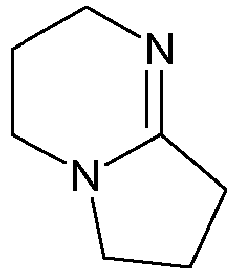
- l'éther diéthylique-2,2'-morpholine (DMDEE) :

- le 1,4-diazabicyclo[2.2.2]octane (DABCO) :

- Ces catalyseurs de réticulation présentent l'avantage de ne pas être cancérogènes, mutagènes et reprotoxiques (CMR).
- De préférence, la quantité de catalyseur de réticulation utilisable va de 0,05 à 0,5% en poids par rapport au poids de la composition adhésive, de mastic et/ou de revêtement de surface selon l'invention.
- La composition adhésive de mastic selon l'invention peut comprendre également un agent anti-coulure, dans une quantité généralement comprise entre 5 et 25 % en poids/poids.
- Un tel agent permet avantageusement, lorsque le mastic est utilisé pour jointoyer 2 substrats dont l'interstice est situé dans un plan vertical, de prévenir la coulure (qualifiée encore de fluage), sous l'effet de la gravité, du mastic fraîchement introduit par l'opérateur et non encore réticulé en surface. Un tel fluage (également désigné par les termes anglais de "sagging" ou "slump") doit être évité car il conduit, après achèvement complet de la réaction de réticulation, à un joint présentant un défaut de planéité et d'homogénéité dimensionnelle nuisant gravement à ses propriétés mécaniques.
- Selon une variante préférée, l'agent anti-coulure mis en œuvre est une composition thixotrope comprenant, sur la base du poids total de ladite composition :
- de 10 à 40 % en poids d'une bis-urée obtenue par réaction d'une amine aliphatique primaire avec un diisocyanate de masse molaire inférieure à 500 g/mole, et
- de 60 à 90 % en poids de l'ester de formule (I) tel que défini précédemment.
- Selon un mode de réalisation, l'agent anti-coulure mis en œuvre est une composition thixotrope constituée, sur la base du poids total de ladite composition :
- de 10 à 40 % en poids de ladite bis-urée, et
- de 60 à 90 % en poids de l'ester de formule (I).
- La mise en œuvre d'une bis-urée obtenue par réaction de la n-butylamine avec le 4,4'-diisocyanate de diphénylméthylène (ou 4,4'-MDI) est particulièrement avantageuse.
- La composition adhésive de mastic selon l'invention peut comprendre encore au moins un adjuvant choisi parmi les promoteurs d'adhérence tels que les époxysilanes, les stabilisants UV (ou anti-oxydants), les pigments, les colorants, et leur mélange. Lorsque ces adjuvants sont présents dans la composition, la somme totale de leur teneur est de préférence inférieure ou égale à 15% en poids par rapport au poids total de la composition adhésive de mastic selon l'invention.
- La composition adhésive de mastic selon l'invention est de préférence stockée dans un environnement anhydre, par exemple dans un conditionnement hermétique où la composition adhésive de mastic se trouve à l'abri de l'humidité et de préférence à l'abri de la lumière.
- La présente invention concerne également un article ou packaging, prêt à l'emploi, comprenant la composition adhésive de mastic selon l'invention dans un conditionnement hermétique à l'abri de l'air, en particulier à l'abri de l'humidité ambiante. De préférence, le conditionnement hermétique permet également de protéger la composition de la lumière. Par exemple, le conditionnement hermétique peut être un sac d'aluminium ou une cartouche d'aluminium munie d'un opercule.
- Les exemples suivants sont donnés à titre purement illustratif de l'invention et ne sauraient être interprétés pour en limiter la portée.
- On prépare tout d'abord une solution A de 17,17 % poids/poids de n-Butylamine dans 82,83 % poids/poids de DIDP, et une solution B de 29,46 % poids/poids de 4,4'-MDI dans 70,34 % poids/poids de DIDP. Les 2 solutions A et B sont chauffées à 100°C, puis introduites, chacune sous une pression de 100 bar, dans un réacteur, dans lequel elles sont pulvérisées en continu l'une sur l'autre dans un ratio A/B = 50,1 / 49,9 en poids, correspondant à un rapport molaire n-Butylamine/ MDI égal à 2. La réaction est immédiate et la température du réacteur atteint 140°C en fin de fabrication.
- En sortie de réacteur, on obtient une dispersion stable de 23,3 % poids/poids dans le DIDP d'une bis-urée, de formule :

- La viscosité Brookfield de la suspension mesurée à 23°C est de 15 Pa.s.
- On prépare, par simple mélange des ingrédients, la composition de mastic suivante dans laquelle les pourcentages sont des pourcentages poids/poids :
- 17 % de polyuréthane à groupements terminaux -NCO obtenu par réaction d'un mélange de 80% en poids de tolylène-2,4-diisocyanate et 20% en poids de tolylène-2,6-diioscyanate avec un mélange d'un polyéther diol de masse molaire 2000 g/mole et de polyéther triol de masse molaire 4200 g/mole.
- 25 % de charge carbonatée,
- 20 % en poids de PVC,
- 15 % en poids de la composition thixotrope de l'exemple A
- 10 % en poids de DIDP en tant que plastifiant
- 8 % en poids de xylène
- 5 % en poids d'autres additifs incluant le catalyseur de réticulation.
- Le polyuréthane a été introduit dans la composition sous la forme d'une solution dans le xylène.
- La composition de mastic obtenue est conditionnée dans une cartouche en aluminium, munie d'une canule, en vue de son application au moyen d'un pistolet pour les tests décrits ci-après.
- Ce test est un bon indicateur de la migration du plastifiant hors du mastic réticulé.
- On dépose, au moyen de la cartouche contenant la composition de l'exemple B, une masse de 1 g de mastic, sous la forme approximative d'une sphère, au centre d'une 1ère plaque de verre carrée de 5 cm de côté, qui a été préalablement placée horizontalement.
- On applique ensuite fortement, sur ladite masse de mastic et au moyen d'une pression manuelle, une 2ème plaque de verre identique à la 1ère, de manière à superposer les 2 plaques et à étaler ainsi le mastic sous la forme approximative d'un disque d'environ 4,5 cm de diamètre.
- On observe alors, à travers la plaque de verre supérieure, l'apparition d'un liquide transparent exudé par le disque comprimé de mastic, sous la forme d'un anneau entourant ledit disque, de rayon annulaire compris entre 1 et 2 mm.
- Ce test a pour but d'apprécier l'aptitude à l'extrusion, au travers de la canule, du mastic conditionné en cartouche, sous l'effet de la pression exercée par le piston qui est solidaire de la gâchette du pistolet actionnée par l'opérateur.
- On extrude dans ce but le mastic sous pression d'air au travers d'une buse calibrée et l'on mesure la masse débitée durant une minute.
- Le mastic à tester est placé dans un godet de forme cylindrique (diamètre de 24 mm) terminé par une buse d'extrusion de diamètre 4 mm et de longueur 22,5 mm, et l'on exerce, au moyen d'un appareillage adapté, une pression de 3 bars sur le mastic, en opérant dans une enceinte climatisée à température ambiante (23°C).
- Le débit mesuré est indiqué en g/minute dans le Tableau ci-dessous et correspond à un comportement du mastic parfaitement conforme.
- Ce test est réalisé pour un joint adhésif unissant 2 substrats en béton ainsi que pour un joint adhésif unissant 2 substrats en aluminium.
- Les 2 substrats de béton destinés à être jointoyés sont 2 substrats de forme parallélépipédique identiques, ayant une longueur de 75 mm, une largeur de 12 mm et une hauteur de 6 mm, la face rectangulaire de chaque substrat destinée à être en contact avec le joint ayant 75 mm de long et 12 mm de hauteur.
- Les 2 substrats en aluminium destinés à être jointoyés sont 2 substrats de forme parallélépipédique identiques, ayant une longueur de 75 mm, une largeur de 25 mm et une hauteur de 12 mm, les 2 faces rectangulaires destinées à être en contact avec le joint ayant 75 mm de long et 12 mm de hauteur.
- Les joints de béton (ou d'aluminium) à tester sont préparés en utilisant le mastic de l'exemple B, de telle façon que le joint de mastic réticulé qui lie les 2 substrats est centré sur les faces rectangulaires correspondantes, et a une forme de parallélépipède de longueur 50 mm, de largeur 12 mm et de hauteur 12 mm.
- Les détails concernant la forme des spécimens de joints adhésifs et leur préparation sont donnés dans la Norme Européenne EN 8339 (cf § 6 et 7). En particulier, le mastic de l'exemple 2 est réticulé par un séjour de 28 jours dans une étuve à 23°C et 50 % d'humidité relative (selon la méthode A indiquée dans la norme), suivi d'un cycle alternant séjours dans une étuve à 70°C et séjours dans l'eau à 23°C (selon la méthode B indiquée dans la norme).
- Les spécimens de joints préparés selon B.3.1. sont étirés dans une machine de traction, dont la mâchoire mobile se déplace à une vitesse constante égale à 5,5 mm/minute. On enregistre la contrainte appliquée et l'allongement de l'éprouvette (exprimé en %) durant son étirement.
- Le module 100%, correspondant à la contrainte (en MPa) enregistrée pour un allongement de 100% du joint, ainsi que l'allongement (en %) mesurés à la rupture du joint sont indiqués dans le tableau ci-après, pour chaque type de substrat : béton ou aluminium.
- Le degré de fluage (ou sagging ou slump) d'un mastic mis en œuvre dans un joint vertical est mesuré selon la norme ASTM D 2202.
- On observe une absence de fluage du mastic, soit une distance mesurée sur l'échelle graduée du dispositif inférieure à 2,5 mm.
- On répète l'exemple A en remplaçant le DIDP par le tétravalérate de pentaérythritol.
- On obtient une dispersion stable de 23,3 % poids/poids de la même bis-urée, dont la viscosité Brookfield mesurée à 23°C est de 16,7 Pa.s.
- On répète l'exemple B en remplaçant lors de la préparation du mastic :
- les 10 % de DIDP par 10 % de tétravalérate de pentaérythritol, et
- la composition thixotrope de l'exemple A par celle de l'exemple C.
- Les résultats des tests sont indiqués dans le tableau ci-dessous.
Exemple B Exemple 1 Migration du plastifiant Rayon annulaire (en mm) entre 1 et 2 < 0,5 Ecoulement après extrusion (en g/minute) 69 69 Module 100% (en MPa) substrat béton 0,44 0,48 Allongement à la rupture (en %) substrat béton 480 563 Module 100% (en MPa) substrat aluminium 0,41 0,46 Allongement à la rupture (en %) substrat aluminium 213 387 Distance de fluage (en mm) selon ASTM D 2202 < 2,5 < 2,5 - Ces résultats font apparaître pour le mastic de l'exemple 1 un comportement à l'extrusion lors de l'application en cartouche qui est identique à celui de l'exemple B.
- Le module à 100% (qui indique la cohésion du joint adhésif) et l'allongement à la rupture (qui correspond à l'élasticité du joint adhésif) sont chacun améliorés pour l'exemple 1 selon l'invention par rapport à l'exemple B de référence, aussi bien pour des substrats en béton que pour des substrats en aluminium.
Claims (8)
- Composition adhésive de mastic mono composant comprenant au moins un prépolymère réticulable à l'humidité constitué d'un polyuréthane à groupes terminaux -NCO et, comme agent plastifiant, un composé ester de formule (I) :
 - R1, R2 et R3, sont identiques et représentent chacun un radical oxycarbonylalkyle ayant 4 ou 5 atomes de carbone; et- R4 représente un radical : -CH2-R5 dans lequel R5 est identique à R1, R2 et R3.
 - Composition adhésive de mastic selon la revendication 1, caractérisée en ce que le composé ester de formule (I) est le tétravalérate de pentaérythritol.
- Composition adhésive de mastic selon l'une des revendications 1 à 2, caractérisée en ce qu'elle comprend de 5 à 35% en poids, sur la base du poids de ladite composition, de l'ester de formule (I).
- Composition adhésive de mastic selon l'une des revendications 1 à 3, caractérisée en ce qu'elle comprend de 15 à 30% en poids, sur la base du poids de ladite composition, de l'ester de formule (I).
- Composition adhésive de mastic selon l'une des revendications 1 à 4, caractérisée en ce qu'elle comprend :- de 10 à 30 % en poids du prépolymère réticulable à l'humidité,- de 5 à 35% en poids de l'ester de formule (I),- de 20 à 70 % en poids d'au moins une charge, et- de 0,01 à 1 % en poids d'au moins un catalyseur de réticulation,les pourcentages en poids étant exprimés par rapport au poids total de la composition adhésive de mastic.
- Composition adhésive de mastic selon l'une des revendications 1 à 5, caractérisée en ce qu'elle comprend :- de 15 à 25 % en poids du prépolymère réticulable à l'humidité,- de 15 à 30% en poids de l'ester de formule (I),- de 40 à 70 % en poids de charge, et- de 0,01 à 1 % en poids de catalyseur de réticulation, les pourcentages en poids étant exprimés par rapport au poids total de la composition adhésive de mastic.
- Article prêt à l'emploi, comprenant la composition adhésive de mastic telle que définie dans l'une des revendications 1 à 6 dans un conditionnement hermétique à l'abri de l'air.
- Article selon la revendication 7, caractérisé en ce que le conditionnement est une cartouche d'aluminium munie d'un opercule.
Applications Claiming Priority (2)
| Application Number | Priority Date | Filing Date | Title |
|---|---|---|---|
| FR1752055A FR3064003B1 (fr) | 2017-03-14 | 2017-03-14 | Composition adhesive de mastic plastifiee sans phtalate |
| PCT/FR2018/050585 WO2018172652A1 (fr) | 2017-03-14 | 2018-03-13 | Composition adhésive de mastic plastifiée sans phtalate |
Publications (2)
| Publication Number | Publication Date |
|---|---|
| EP3596183A1 EP3596183A1 (fr) | 2020-01-22 |
| EP3596183B1 true EP3596183B1 (fr) | 2021-07-21 |
Family
ID=58707837
Family Applications (1)
| Application Number | Title | Priority Date | Filing Date |
|---|---|---|---|
| EP18714565.1A Active EP3596183B1 (fr) | 2017-03-14 | 2018-03-13 | Composition adhésive de mastic plastifiée sans phtalate |
Country Status (4)
| Country | Link |
|---|---|
| US (1) | US11624006B2 (fr) |
| EP (1) | EP3596183B1 (fr) |
| FR (1) | FR3064003B1 (fr) |
| WO (1) | WO2018172652A1 (fr) |
Families Citing this family (3)
| Publication number | Priority date | Publication date | Assignee | Title |
|---|---|---|---|---|
| KR102658760B1 (ko) * | 2020-04-02 | 2024-04-19 | 주식회사 엘지화학 | 가소제 조성물 및 이를 포함하는 수지 조성물 |
| DE102020128608A1 (de) * | 2020-10-30 | 2022-05-05 | Klebchemie M.G. Becker GmbH & Co KG | Thermobeschleunigte Klebstoffzusammensetzungen auf Basis silanterminierter Polymere |
| FR3117502B1 (fr) * | 2020-12-16 | 2024-02-16 | Bostik Sa | Adhesif structural polyurethane bicomposant a proprietes ameliorees |
Family Cites Families (9)
| Publication number | Priority date | Publication date | Assignee | Title |
|---|---|---|---|---|
| US3925331A (en) * | 1971-06-03 | 1975-12-09 | Albright & Wilson | Polymeric sealants |
| DE69828466T2 (de) | 1997-01-21 | 2005-12-15 | The Yokohama Rubber Co., Ltd. | Bei raumtemperatur unter feuchtigkeit härtbare einkomponentige harzzusammensetzungen |
| EP1152019A1 (fr) | 2000-05-02 | 2001-11-07 | Sika AG, vorm. Kaspar Winkler & Co. | Agents thixotropes |
| ATE498642T1 (de) * | 2008-10-31 | 2011-03-15 | Sika Technology Ag | Alpha-silan enthaltende polyurethanzusammensetzung mit anisotropen materialeigenschaften |
| RU2559449C2 (ru) | 2010-08-23 | 2015-08-10 | Персторп АБ | Нефталатный пластификатор |
| FR3010409B1 (fr) * | 2013-09-11 | 2017-12-22 | Total Marketing Services | Plastifiant pour mastics, plastisols et adhesifs |
| FR3021658B1 (fr) * | 2014-05-28 | 2017-12-08 | Bostik Sa | Composition de polyurethane a terminaisons nco a base mdi non thermofusible et a faible teneur en monomere mdi, comprenant au moins un compose isocyanate de volume molaire particulier. |
| JP6763384B2 (ja) * | 2015-07-17 | 2020-09-30 | 横浜ゴム株式会社 | 接着剤組成物及びその製造方法 |
| FR3063915B1 (fr) * | 2017-03-14 | 2021-04-02 | Bostik Sa | Composition thixotrope utilisable comme agent anti-coulure pour des mastics |
-
2017
- 2017-03-14 FR FR1752055A patent/FR3064003B1/fr active Active
-
2018
- 2018-03-13 EP EP18714565.1A patent/EP3596183B1/fr active Active
- 2018-03-13 US US16/493,822 patent/US11624006B2/en active Active
- 2018-03-13 WO PCT/FR2018/050585 patent/WO2018172652A1/fr not_active Ceased
Non-Patent Citations (1)
| Title |
|---|
| None * |
Also Published As
| Publication number | Publication date |
|---|---|
| US20200071574A1 (en) | 2020-03-05 |
| FR3064003A1 (fr) | 2018-09-21 |
| US11624006B2 (en) | 2023-04-11 |
| FR3064003B1 (fr) | 2019-03-29 |
| EP3596183A1 (fr) | 2020-01-22 |
| WO2018172652A1 (fr) | 2018-09-27 |
Similar Documents
| Publication | Publication Date | Title |
|---|---|---|
| EP1935934B1 (fr) | Additif de rhéologie sous forme de pâte pré-activée | |
| EP3774972B1 (fr) | Composition a base de polyurethane | |
| EP0982333A1 (fr) | Formulations polyuréthane à base de polybutadiène hydroxylé catalysées par un dérivé de l'imidazole | |
| EP3596183B1 (fr) | Composition adhésive de mastic plastifiée sans phtalate | |
| EP3595805B1 (fr) | Composition thixotrope utilisable comme agent anti-coulure pour des mastics | |
| WO2020201364A1 (fr) | Procede de preparation de composition reticulable | |
| EP2949676B1 (fr) | Composition de polyuréthane à terminaisons nco à base de mdi non thermofusible et à faible teneur en monomère mdi, comprenant au moins un composé isocyanate de volume molaire particulier | |
| EP4177285A1 (fr) | Procede de preparation de copolyurethanes ioniques silyles a elasticite amelioree | |
| EP4048713A1 (fr) | Copolyurethane silyle ionique et composition de mastic le comprenant | |
| EP3394141B1 (fr) | Polyurethane a terminaison xdi et composition comprenant ledit polyurethane | |
| EP3394144B1 (fr) | Mastics polyurethane superelastiques | |
| EP3728386A1 (fr) | Procede de preparation d'une composition comprenant un polyurethane a terminaisons nco | |
| WO2024069084A1 (fr) | Polyurethane(s) ionique(s) eventuellement silyle(s) | |
| WO2023217795A1 (fr) | Composition comprenant un polymère silylé | |
| FR3120075A1 (fr) | Mastic pour conditions climatiques extremes de temperature et d'humidite | |
| EP4640729A1 (fr) | Composition reticulable a l humidite | |
| FR3136467A1 (fr) | Copolyuréthane silylé ionique |
Legal Events
| Date | Code | Title | Description |
|---|---|---|---|
| STAA | Information on the status of an ep patent application or granted ep patent |
Free format text: STATUS: UNKNOWN |
|
| STAA | Information on the status of an ep patent application or granted ep patent |
Free format text: STATUS: THE INTERNATIONAL PUBLICATION HAS BEEN MADE |
|
| PUAI | Public reference made under article 153(3) epc to a published international application that has entered the european phase |
Free format text: ORIGINAL CODE: 0009012 |
|
| STAA | Information on the status of an ep patent application or granted ep patent |
Free format text: STATUS: REQUEST FOR EXAMINATION WAS MADE |
|
| 17P | Request for examination filed |
Effective date: 20190826 |
|
| AK | Designated contracting states |
Kind code of ref document: A1 Designated state(s): AL AT BE BG CH CY CZ DE DK EE ES FI FR GB GR HR HU IE IS IT LI LT LU LV MC MK MT NL NO PL PT RO RS SE SI SK SM TR |
|
| AX | Request for extension of the european patent |
Extension state: BA ME |
|
| DAV | Request for validation of the european patent (deleted) | ||
| DAX | Request for extension of the european patent (deleted) | ||
| GRAP | Despatch of communication of intention to grant a patent |
Free format text: ORIGINAL CODE: EPIDOSNIGR1 |
|
| STAA | Information on the status of an ep patent application or granted ep patent |
Free format text: STATUS: GRANT OF PATENT IS INTENDED |
|
| INTG | Intention to grant announced |
Effective date: 20210224 |
|
| GRAS | Grant fee paid |
Free format text: ORIGINAL CODE: EPIDOSNIGR3 |
|
| GRAA | (expected) grant |
Free format text: ORIGINAL CODE: 0009210 |
|
| STAA | Information on the status of an ep patent application or granted ep patent |
Free format text: STATUS: THE PATENT HAS BEEN GRANTED |
|
| AK | Designated contracting states |
Kind code of ref document: B1 Designated state(s): AL AT BE BG CH CY CZ DE DK EE ES FI FR GB GR HR HU IE IS IT LI LT LU LV MC MK MT NL NO PL PT RO RS SE SI SK SM TR |
|
| REG | Reference to a national code |
Ref country code: GB Ref legal event code: FG4D Free format text: NOT ENGLISH |
|
| REG | Reference to a national code |
Ref country code: CH Ref legal event code: EP |
|
| REG | Reference to a national code |
Ref country code: DE Ref legal event code: R096 Ref document number: 602018020419 Country of ref document: DE |
|
| REG | Reference to a national code |
Ref country code: AT Ref legal event code: REF Ref document number: 1412616 Country of ref document: AT Kind code of ref document: T Effective date: 20210815 |
|
| REG | Reference to a national code |
Ref country code: IE Ref legal event code: FG4D Free format text: LANGUAGE OF EP DOCUMENT: FRENCH |
|
| REG | Reference to a national code |
Ref country code: NL Ref legal event code: FP |
|
| REG | Reference to a national code |
Ref country code: LT Ref legal event code: MG9D |
|
| REG | Reference to a national code |
Ref country code: AT Ref legal event code: MK05 Ref document number: 1412616 Country of ref document: AT Kind code of ref document: T Effective date: 20210721 |
|
| PG25 | Lapsed in a contracting state [announced via postgrant information from national office to epo] |
Ref country code: HR Free format text: LAPSE BECAUSE OF FAILURE TO SUBMIT A TRANSLATION OF THE DESCRIPTION OR TO PAY THE FEE WITHIN THE PRESCRIBED TIME-LIMIT Effective date: 20210721 Ref country code: FI Free format text: LAPSE BECAUSE OF FAILURE TO SUBMIT A TRANSLATION OF THE DESCRIPTION OR TO PAY THE FEE WITHIN THE PRESCRIBED TIME-LIMIT Effective date: 20210721 Ref country code: ES Free format text: LAPSE BECAUSE OF FAILURE TO SUBMIT A TRANSLATION OF THE DESCRIPTION OR TO PAY THE FEE WITHIN THE PRESCRIBED TIME-LIMIT Effective date: 20210721 Ref country code: SE Free format text: LAPSE BECAUSE OF FAILURE TO SUBMIT A TRANSLATION OF THE DESCRIPTION OR TO PAY THE FEE WITHIN THE PRESCRIBED TIME-LIMIT Effective date: 20210721 Ref country code: RS Free format text: LAPSE BECAUSE OF FAILURE TO SUBMIT A TRANSLATION OF THE DESCRIPTION OR TO PAY THE FEE WITHIN THE PRESCRIBED TIME-LIMIT Effective date: 20210721 Ref country code: LT Free format text: LAPSE BECAUSE OF FAILURE TO SUBMIT A TRANSLATION OF THE DESCRIPTION OR TO PAY THE FEE WITHIN THE PRESCRIBED TIME-LIMIT Effective date: 20210721 Ref country code: AT Free format text: LAPSE BECAUSE OF FAILURE TO SUBMIT A TRANSLATION OF THE DESCRIPTION OR TO PAY THE FEE WITHIN THE PRESCRIBED TIME-LIMIT Effective date: 20210721 Ref country code: BG Free format text: LAPSE BECAUSE OF FAILURE TO SUBMIT A TRANSLATION OF THE DESCRIPTION OR TO PAY THE FEE WITHIN THE PRESCRIBED TIME-LIMIT Effective date: 20211021 Ref country code: PT Free format text: LAPSE BECAUSE OF FAILURE TO SUBMIT A TRANSLATION OF THE DESCRIPTION OR TO PAY THE FEE WITHIN THE PRESCRIBED TIME-LIMIT Effective date: 20211122 Ref country code: NO Free format text: LAPSE BECAUSE OF FAILURE TO SUBMIT A TRANSLATION OF THE DESCRIPTION OR TO PAY THE FEE WITHIN THE PRESCRIBED TIME-LIMIT Effective date: 20211021 |
|
| PG25 | Lapsed in a contracting state [announced via postgrant information from national office to epo] |
Ref country code: PL Free format text: LAPSE BECAUSE OF FAILURE TO SUBMIT A TRANSLATION OF THE DESCRIPTION OR TO PAY THE FEE WITHIN THE PRESCRIBED TIME-LIMIT Effective date: 20210721 Ref country code: LV Free format text: LAPSE BECAUSE OF FAILURE TO SUBMIT A TRANSLATION OF THE DESCRIPTION OR TO PAY THE FEE WITHIN THE PRESCRIBED TIME-LIMIT Effective date: 20210721 Ref country code: GR Free format text: LAPSE BECAUSE OF FAILURE TO SUBMIT A TRANSLATION OF THE DESCRIPTION OR TO PAY THE FEE WITHIN THE PRESCRIBED TIME-LIMIT Effective date: 20211022 |
|
| REG | Reference to a national code |
Ref country code: DE Ref legal event code: R097 Ref document number: 602018020419 Country of ref document: DE |
|
| PG25 | Lapsed in a contracting state [announced via postgrant information from national office to epo] |
Ref country code: DK Free format text: LAPSE BECAUSE OF FAILURE TO SUBMIT A TRANSLATION OF THE DESCRIPTION OR TO PAY THE FEE WITHIN THE PRESCRIBED TIME-LIMIT Effective date: 20210721 |
|
| PLBE | No opposition filed within time limit |
Free format text: ORIGINAL CODE: 0009261 |
|
| STAA | Information on the status of an ep patent application or granted ep patent |
Free format text: STATUS: NO OPPOSITION FILED WITHIN TIME LIMIT |
|
| PG25 | Lapsed in a contracting state [announced via postgrant information from national office to epo] |
Ref country code: SM Free format text: LAPSE BECAUSE OF FAILURE TO SUBMIT A TRANSLATION OF THE DESCRIPTION OR TO PAY THE FEE WITHIN THE PRESCRIBED TIME-LIMIT Effective date: 20210721 Ref country code: SK Free format text: LAPSE BECAUSE OF FAILURE TO SUBMIT A TRANSLATION OF THE DESCRIPTION OR TO PAY THE FEE WITHIN THE PRESCRIBED TIME-LIMIT Effective date: 20210721 Ref country code: RO Free format text: LAPSE BECAUSE OF FAILURE TO SUBMIT A TRANSLATION OF THE DESCRIPTION OR TO PAY THE FEE WITHIN THE PRESCRIBED TIME-LIMIT Effective date: 20210721 Ref country code: EE Free format text: LAPSE BECAUSE OF FAILURE TO SUBMIT A TRANSLATION OF THE DESCRIPTION OR TO PAY THE FEE WITHIN THE PRESCRIBED TIME-LIMIT Effective date: 20210721 Ref country code: CZ Free format text: LAPSE BECAUSE OF FAILURE TO SUBMIT A TRANSLATION OF THE DESCRIPTION OR TO PAY THE FEE WITHIN THE PRESCRIBED TIME-LIMIT Effective date: 20210721 Ref country code: AL Free format text: LAPSE BECAUSE OF FAILURE TO SUBMIT A TRANSLATION OF THE DESCRIPTION OR TO PAY THE FEE WITHIN THE PRESCRIBED TIME-LIMIT Effective date: 20210721 |
|
| 26N | No opposition filed |
Effective date: 20220422 |
|
| PG25 | Lapsed in a contracting state [announced via postgrant information from national office to epo] |
Ref country code: MC Free format text: LAPSE BECAUSE OF FAILURE TO SUBMIT A TRANSLATION OF THE DESCRIPTION OR TO PAY THE FEE WITHIN THE PRESCRIBED TIME-LIMIT Effective date: 20210721 |
|
| REG | Reference to a national code |
Ref country code: BE Ref legal event code: MM Effective date: 20220331 |
|
| PG25 | Lapsed in a contracting state [announced via postgrant information from national office to epo] |
Ref country code: LU Free format text: LAPSE BECAUSE OF NON-PAYMENT OF DUE FEES Effective date: 20220313 Ref country code: IE Free format text: LAPSE BECAUSE OF NON-PAYMENT OF DUE FEES Effective date: 20220313 |
|
| PG25 | Lapsed in a contracting state [announced via postgrant information from national office to epo] |
Ref country code: BE Free format text: LAPSE BECAUSE OF NON-PAYMENT OF DUE FEES Effective date: 20220331 |
|
| P01 | Opt-out of the competence of the unified patent court (upc) registered |
Effective date: 20230525 |
|
| PG25 | Lapsed in a contracting state [announced via postgrant information from national office to epo] |
Ref country code: MK Free format text: LAPSE BECAUSE OF FAILURE TO SUBMIT A TRANSLATION OF THE DESCRIPTION OR TO PAY THE FEE WITHIN THE PRESCRIBED TIME-LIMIT Effective date: 20210721 Ref country code: CY Free format text: LAPSE BECAUSE OF FAILURE TO SUBMIT A TRANSLATION OF THE DESCRIPTION OR TO PAY THE FEE WITHIN THE PRESCRIBED TIME-LIMIT Effective date: 20210721 |
|
| PG25 | Lapsed in a contracting state [announced via postgrant information from national office to epo] |
Ref country code: HU Free format text: LAPSE BECAUSE OF FAILURE TO SUBMIT A TRANSLATION OF THE DESCRIPTION OR TO PAY THE FEE WITHIN THE PRESCRIBED TIME-LIMIT; INVALID AB INITIO Effective date: 20180313 |
|
| PG25 | Lapsed in a contracting state [announced via postgrant information from national office to epo] |
Ref country code: MT Free format text: LAPSE BECAUSE OF FAILURE TO SUBMIT A TRANSLATION OF THE DESCRIPTION OR TO PAY THE FEE WITHIN THE PRESCRIBED TIME-LIMIT Effective date: 20210721 |
|
| REG | Reference to a national code |
Ref country code: DE Ref legal event code: R081 Ref document number: 602018020419 Country of ref document: DE Owner name: BOSTIK SA, FR Free format text: FORMER OWNER: BOSTIK SA, COLOMBES, FR |
|
| PGFP | Annual fee paid to national office [announced via postgrant information from national office to epo] |
Ref country code: CH Payment date: 20250401 Year of fee payment: 8 |
|
| PG25 | Lapsed in a contracting state [announced via postgrant information from national office to epo] |
Ref country code: TR Free format text: LAPSE BECAUSE OF FAILURE TO SUBMIT A TRANSLATION OF THE DESCRIPTION OR TO PAY THE FEE WITHIN THE PRESCRIBED TIME-LIMIT Effective date: 20210721 |
|
| PGFP | Annual fee paid to national office [announced via postgrant information from national office to epo] |
Ref country code: NL Payment date: 20260213 Year of fee payment: 9 |
|
| REG | Reference to a national code |
Ref country code: CH Ref legal event code: U11 Free format text: ST27 STATUS EVENT CODE: U-0-0-U10-U11 (AS PROVIDED BY THE NATIONAL OFFICE) Effective date: 20260401 |
|
| PGFP | Annual fee paid to national office [announced via postgrant information from national office to epo] |
Ref country code: GB Payment date: 20260202 Year of fee payment: 9 |
|
| PGFP | Annual fee paid to national office [announced via postgrant information from national office to epo] |
Ref country code: DE Payment date: 20260204 Year of fee payment: 9 |
|
| PGFP | Annual fee paid to national office [announced via postgrant information from national office to epo] |
Ref country code: IT Payment date: 20260220 Year of fee payment: 9 |
|
| PGFP | Annual fee paid to national office [announced via postgrant information from national office to epo] |
Ref country code: FR Payment date: 20260209 Year of fee payment: 9 |