EP3596476B1 - Utilisation d'un ensemble de marqueurs pour déterminer le risque de rejet de rein - Google Patents
Utilisation d'un ensemble de marqueurs pour déterminer le risque de rejet de rein Download PDFInfo
- Publication number
- EP3596476B1 EP3596476B1 EP18714723.6A EP18714723A EP3596476B1 EP 3596476 B1 EP3596476 B1 EP 3596476B1 EP 18714723 A EP18714723 A EP 18714723A EP 3596476 B1 EP3596476 B1 EP 3596476B1
- Authority
- EP
- European Patent Office
- Prior art keywords
- alanine
- marker set
- kidney
- risk
- lactate
- Prior art date
- Legal status (The legal status is an assumption and is not a legal conclusion. Google has not performed a legal analysis and makes no representation as to the accuracy of the status listed.)
- Active
Links
Images




Classifications
-
- G—PHYSICS
- G01—MEASURING; TESTING
- G01N—INVESTIGATING OR ANALYSING MATERIALS BY DETERMINING THEIR CHEMICAL OR PHYSICAL PROPERTIES
- G01N33/00—Investigating or analysing materials by specific methods not covered by groups G01N1/00 - G01N31/00
- G01N33/48—Biological material, e.g. blood, urine; Haemocytometers
- G01N33/50—Chemical analysis of biological material, e.g. blood, urine; Testing involving biospecific ligand binding methods; Immunological testing
- G01N33/68—Chemical analysis of biological material, e.g. blood, urine; Testing involving biospecific ligand binding methods; Immunological testing involving proteins, peptides or amino acids
- G01N33/6893—Chemical analysis of biological material, e.g. blood, urine; Testing involving biospecific ligand binding methods; Immunological testing involving proteins, peptides or amino acids related to diseases not provided for elsewhere
-
- G—PHYSICS
- G01—MEASURING; TESTING
- G01N—INVESTIGATING OR ANALYSING MATERIALS BY DETERMINING THEIR CHEMICAL OR PHYSICAL PROPERTIES
- G01N33/00—Investigating or analysing materials by specific methods not covered by groups G01N1/00 - G01N31/00
- G01N33/48—Biological material, e.g. blood, urine; Haemocytometers
- G01N33/50—Chemical analysis of biological material, e.g. blood, urine; Testing involving biospecific ligand binding methods; Immunological testing
- G01N33/70—Chemical analysis of biological material, e.g. blood, urine; Testing involving biospecific ligand binding methods; Immunological testing involving creatine or creatinine
-
- G—PHYSICS
- G01—MEASURING; TESTING
- G01N—INVESTIGATING OR ANALYSING MATERIALS BY DETERMINING THEIR CHEMICAL OR PHYSICAL PROPERTIES
- G01N2800/00—Detection or diagnosis of diseases
- G01N2800/24—Immunology or allergic disorders
- G01N2800/245—Transplantation related diseases, e.g. graft versus host disease
-
- G—PHYSICS
- G01—MEASURING; TESTING
- G01N—INVESTIGATING OR ANALYSING MATERIALS BY DETERMINING THEIR CHEMICAL OR PHYSICAL PROPERTIES
- G01N2800/00—Detection or diagnosis of diseases
- G01N2800/50—Determining the risk of developing a disease
Definitions
- the instant invention relates to the in vitro use of a marker set for determining the risk of kidney rejection according to the preamble of claim 1, to the in vivo diagnostic use of the same marker set according to the preamble of claim 9 and to a method for analyzing an isolated urine sample in vitro according to the preamble of claim 10.
- WO 2012/045773 A9 discloses certain substances that are well suited for determining the according risk of kidney rejection, such as methyl malonate, lactate, methyl succinate, p-cresol, 3-hydroxy isovalerate, citrate, methyl guanidine, malonate, taurine, methyl guanidine, phenyl acetyl glycine, trigonelline, ⁇ -glucose, acetyl carnitine, phenyl acetate, and hippurate.
- substances that are well suited for determining the according risk of kidney rejection, such as methyl malonate, lactate, methyl succinate, p-cresol, 3-hydroxy isovalerate, citrate, methyl guanidine, malonate, taurine, methyl guanidine, phenyl acetyl glycine, trigonelline, ⁇ -glucose, acetyl carnitine, phenyl acetate, and hippurate.
- US 9,541,620 B2 discloses certain substances that might be used for determining the risk of kidney rejection. Thereby, it focuses on trimethylamine-N-oxide (TMAO) as most potent biomarker.
- TMAO trimethylamine-N-oxide
- WO 2002/010755 A2 describes that increased levels of creatinine or urea in the blood serum are an indication for a failure of a kidney transplant.
- a novel marker set as defined in claim 1, i.e., in an in vitro method for determining (predicting) the risk of kidney rejection of an individual after having received a kidney donation. This determining is done by urine analysis. While according to prior art techniques generally individual substances are used as marker, the inventors found out that a sufficiently high accuracy of an according analysis method can only be achieved if at least three substances are used as markers. Thus, the instantly claimed use of a marker set requires the presence of at least three substances to be included in the marker set.
- These substances are to be chosen from the group consisting of 3-hydroxy isovalerate, acetyl carnitine, alanine, citrate, dimethylamine, glucose, glucuronate, hippurate, lactate, malonate, methyl guanidine, methyl malonate, methyl succinate, p-cresol, phenyl acetate, phenylacetylglycine, phenylacetylglutamine, taurine, trigonelline, and urea.
- markers for determining the risk of kidney rejection after kidney transplantation in WO 2012/045773 A9 , namely 3-hydroxy isovalerate, acetyl carnitine, citrate, glucose, hippurate, lactate, malonate, methyl guanidine, methyl malonate, methyl succinate, p-cresol, phenyl acetate, phenylacetylglycine, taurine, and trigonelline.
- Alanine, dimethylamine, glucuronate, phenylacetylglutamine, and urea will also referred to in the following as newly identified marker substances.
- the higher performance and thus better suitability of the marker set comprising at least one of these newly identified marker substances, in particular alanine, will be explained in more detail with respect to the exemplary embodiments.
- alanine i.e., one of the newly identified marker substances is present in the marker set. It is likewise possible that two, three, four, five, or six newly identified marker substances are present in the marker set, wherein alanine is always present. It is also possible that the marker set exclusively comprises newly identified marker substances, wherein the marker set comprises always alanine.
- the individual substances being present in the marker set are used such that the concentration of these substances in a sample is determined. Then, the substance concentration can be used to calculate a score. The score is indicative for the risk of kidney rejection of an individual who previously underwent a kidney transplantation, i.e. who previously received a kidney donation.
- a group of high-risk, a group of intermediate risk, a group of low risk and a group of very low risk in order to classify the determined or predicted risk of kidney rejection in an easily accessible way. It is also possible to use only some of these groups (e.g., high risk, intermediate risk, low risk; or high risk, low risk, very low risk) or to define additional groups.
- the high-risk group such that at least 40%, in particular at least 45%, in particular at least 50% of the samples assigned to this group are samples from individuals that showed a kidney rejection.
- the group of intermediate risk is defined such that 8 to 20%, in particular 10 to 17%, in particular 11 to 15% of all samples assigned to this group are samples from individuals that encountered a kidney rejection.
- the group of low risk is defined such that 2 to 5%, in particular 2.5 to 4.5, in particular 3 to 4% of all samples assigned to this group are samples from individuals that encountered a kidney rejection.
- the group of very low risk is defined such that not more than 1.5%, in particular not more than 1%, in particular not more than 0.5% of all samples assigned to this group are samples from individuals that encountered a kidney rejection.
- the marker set comprises 1, 2, 3, 4, 5, 6, 7, 8, 9, 10, 11, 12, 13, 14, 15, 16, 17, 18, 19, 20 or 21 individual substances.
- 1, 2, 3, 4, 5 or 6 substances of the group consisting of alanine, dimethylamine, glucuronate, phenylacetylglutamine, and urea can be present in the marker set, wherein alanine is necessarily present in the marker set.
- the marker set necessarily comprises at least one substance chosen from the subgroup of newly identified marker substances consisting of dimethylamine, glucuronate, and urea. Besides alanine, these newly identified marker substances have been proven to be especially suited for enhancing the overall performance of the marker set for determining the risk of kidney rejection.
- the marker set necessarily comprises urea.
- Urea turned out to be one of the most suited substances to increase the overall performance of the marker set.
- the marker set comprises necessarily urea and alanine. In a further embodiment, the marker set necessarily comprises urea, alanine and glucuronate. In a further embodiment, the marker set comprises necessarily urea, alanine, and dimethylamine.
- the marker set comprises lactate and citrate as already principally known suited marker substances in combination with alanine.
- the marker set does not comprise dimethylamine, lactate, acetate and alanine at the same time.
- the marker set does not comprise only dimethylamine, lactate and alanine.
- the marker set does not comprise only dimethylamine, acetate and alanine.
- the marker set does not comprise only lactate, acetate and alanine.
- marker sets are particularly suited marker sets:
- the instant invention relates in an aspect also to the use of the same marker set for in vivo diagnostics of the risk of kidney rejection of an individual after having received a transplanted kidney.
- the invention relates to a marker set comprising at least three substances chosen from the group consisting of 3-hydroxy isovalerate, acetyl carnitine, alanine, citrate, dimethylamine, glucose, glucuronate, hippurate, lactate, malonate, methyl guanidine, methyl malonate, methyl succinate, p-cresol, phenyl acetate, phenylacetylglycine, phenylacetylglutamine, taurine, trigonelline, and urea, for use in in-vivo diagnostics by urine analysis of the risk of kidney rejection of an individual after having received a kidney donation, with the provision that the marker set comprises alanine.
- Embodiments of the in vitro use of the marker set explained above are likewise applicable to an in vivo use or the diagnostic use of the marker set in any desired combination.
- the claimed use of the marker set in in-vivo diagnostics constitutes another medical indication of this marker set. Thereby, alanine is always present in the marker set.
- the invention also relates to method of analyzing an isolated urine sample in vitro.
- This method comprises the steps explained in the following and makes use of a urine sample from an individual who has received a kidney donation is provided.
- This urine sample can be taken at any time after kidney transplantation, e.g., 0 days to 400 days after transplantation, in particular 1 day to 365 days after transplantation, in particular 2 days to 350 days after transplantation, in particular 3 days to 340 days after transplantation, in particular 4 days to 330 days after transplantation, in particular 5 days to 320 days after transplantation, in particular 6 days to 310 days after transplantation, in particular 7 days to 300 days after transplantation, in particular 8 days to 290 days after transplantation, in particular 10 days to 280 days after transplantation, in particular 11 days to 270 days after transplantation, in particular 12 days to 260 days after transplantation, in particular 13 days to 250 days after transplantation, in particular 14 days to 240 days after transplantation, in particular 15 days to 230 days after transplantation, in particular 16 days to 220
- NMR spectroscopy nuclear magnetic resonance spectroscopy
- the determined concentrations are afterwards used to calculate a score. Thereby, the score is indicative for the risk of kidney rejection of the individual.
- Parameter “I” can be, e.g., the signal intensity of an according signal observed in the evaluated measuring result.
- I can be the signal intensity of an NMR signal in an NMR spectrum if NMR spectroscopy is used as measuring technique.
- the calculated score is output and presented to the individual and/or to a third person such as a physician or medical staff.
- the output can be performed on a display (i.e., in an electronic way) or in printed form.
- a report indicating the score, optionally in combination with a comparative scale of possible scores and their meaning with respect to the risk of kidney rejection after kidney transplantation.
- the sample is grouped into one of at least two predefined groups on the basis of the calculated score.
- the according grouping can also be indicated on an according report.
- Using a urine sample is particularly suited for carrying out the method since urine samples are easily collectable from individuals and do not need any closer interaction with the body of the individual.
- the determined concentrations are, in an embodiment, normalized to the additionally determined concentration of creatinine. If a person, from whom the analyzed urine sample has been obtained, has ingested a big volume of liquid, his or her total urine volume is also big. At the same time, the overall concentration of the marker substances (and other substances) in the urine is in such a case generally lower than in a sample taken from a person who has ingested a lower volume of liquid and has a lower total urine volume. If the determined marker concentrations are divided by the creatinine concentration in the same urine sample (i.e., normalized to the creatinine concentration), these effects are erased.
- the score referred to above can form the basis of a diagnostic test being based on at least three metabolites.
- an extended score is calculated starting from the score by additionally considering at least one further value.
- This further value is chosen from the group consisting of a value being indicative for the concentration of creatinine in blood serum of the individual, a value being indicative for the glomerular filtration rate (GFR) of the individual, and a value being indicative for the estimated glomerular filtration rate (eGFR) of the individual.
- GFR glomerular filtration rate
- eGFR estimated glomerular filtration rate
- a decision support system is particularly suited to group different samples into different groups (such as different risk groups for a specific disease or indication like the risk of kidney rejection after kidney transplantation of an individual who has received a kidney donation). Based on such a grouping, a physician can be assisted in assessing the medical relevance of the obtained result or in making a diagnosis.
- the described in vitro method can also be regarded as a method for providing original data that can afterwards be used by a physician to make a diagnosis regarding the risk of kidney rejection after kidney transplantation. This diagnostic step does not form part of the claimed method.
- the creatinine concentration in a urine sample for normalizing the concentration of at least one other substance determined in the same urine sample, in particular by dividing the concentration of the other substance by the concentration of creatinine.
- This normalization method can, in an embodiment, combined with any other method or use described or claimed herein.
- the results depicted in Figures 1A to 3C are based on an analysis of more than 4200 urine samples from patients having obtained a kidney donation.
- the urine samples were taken from these patients in a time window between 14 days after transplantation and 365 days after transplantation.
- a training sample set (based on more than 870 samples) has been analyzed to identify suited marker substances.
- the identified suited marker substances have been tested on a validation sample set (more than 580 samples) to assess the performance of a determination of the risk of kidney rejection making use of these marker substances.
- Mid-stream urine samples were collected in standard plastic urine cups and aliquots of 1 ml were transferred into 1.5 ml sample tubes. The aliquots were frozen at -20°C within 8 hours after collection. For storage, the tubes were kept at -80°C. For NMR measurements, aliquots were allowed to thaw at room temperature. Upon complete thawing, 600 ⁇ l of the aliquot were mixed with 120 ⁇ l of Axinon ® urine additive solution. The mixture was centrifuged at 20000 g for 10 min and 600 ⁇ l of the supernatant was transferred to 5 mm NMR tubes and kept at 4-8°C until measurement.
- Samples were measured in batches of up to 93 samples per run.
- each run included one Axinon ® urine calibrator sample and two Axinon ® urine control samples (before and after the analytical urine samples, respectively) in order to assure ideal measurement conditions throughout the run.
- NMR spectra underwent automatic referencing, phase correction and baseline correction before further analysis.
- the NMR spectra underwent an automatic standardization and calibration procedure to minimize between-device, between-day and between-run effects.
- the quality of each of these spectra was assessed by a custom spectrum qualification algorithm that analyzes general spectral properties, e.g., offset and tilt of the baseline in selected spectral regions, and properties of selected indicator signals, e.g., signal position, shape and width. Spectra that did not meet the predefined quality criteria were excluded from further analysis.
- Successfully qualified spectra were divided into 403 bins of 0.04 ppm width positioned with 50% overlap between consecutive bins covering a spectral range from 0.96 to 9.04 ppm. The area from 4.5 to 5.0 ppm (water signal) was not considered in the analyses. Thus, a total of 377 bins for subsequent analysis remained.
- Quantification of specific signal peaks was done by fitting Pseudo-Voigt functions, which represent a linear combination of a Gaussian and a Lorentzian function, to each peak of interest. The resulting signal fits were checked for goodness of fit in order to reject results of insufficient fit quality.
- Suited marker substances were identified with the aid of the obtained NMR spectra in an iterative way by combining the NMR information with the additional information whether the underlying sample was taken from an individual that showed kidney rejection or from an individual that did not show kidney rejection.
- kidney rejection An individual who recovered well from kidney transplantation and did not show any significant abnormality was considered to be an individual that did not show kidney rejection.
- Individuals encountering kidney problems after kidney transplantation were subjected to a biopsy being the gold standard for determining whether or not the donated kidney is rejected. If the outcome of such a biopsy was that kidney rejection has been taken place or was about to take place, these individuals were considered to be individuals showing kidney rejection.
- the identified marker substances were tested in different combinations to assess their suitability for determining the risk of kidney rejection of an individual after kidney transplantation. In doing so, the result of the determination based on the marker substances (predicted risk) has been checked against clinical signs of kidney rejection and/or transplant dysfunction as well as the results of performed biopsies (histologically proven kidney rejection).
- ROC receiver operating characteristic
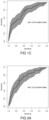
- Figure 1A shows an ROC plot of a model for determining the risk of kidney rejection taking into account lactate, citrate and trigonelline as marker substances (comparative example). These substances are already known from prior art to be used as substances for determining the risk of kidney rejection, but have not been described so far in this specific combination. To compensate for concentration differences, all substance concentrations determined in this and in the following examples have been normalized to the concentration of creatinine in urine. Thus, the concentration of creatinine in urine serves as internal standard. The resulting AUC is 0.714. This AUC is much better than a simply random prediction and also better than an according AUC of an individual substance used as marker for determining the risk of kidney rejection. Nonetheless, a further enhancement of the reliability of the prediction model is desired.
- Figure 2A shows an ROC plot of the model for determining the risk of kidney rejection taking into account lactate, citrate, trigonelline and glucose (comparative example). Using these four already known substances as marker substances, an AUC of 0.732 results.
- the performance of an according model for predicting the risk of kidney rejection can be significantly increased by including two newly identified marker substances into the model. If the model is based on lactate, citrate, urea and alanine, an AUC of 0.752 results, as shown in Figure 2D .
- Figure 2F shows an ROC plot of a model taking into account lactate, citrate, urea and alanine as marker substances (like the model underlying Figure 2D ).
- the AUC can be increased from 0.752 (cf. Figure 2D ) to 0.830, as shown in Figure 2F .
- the calculated score for the predicted risk of kidney rejection has been multiplied by the concentration of creatinine in the blood serum of the same individual, a urine sample of whom has been analyzed.
- FIG. 2G shows the performance of a model taking into account lactate, citrate, urea and alanine as marker substances (cf. Figure 2D ) and additionally considering the estimated glomerular filtration rate as further parameter. In doing so, the AUC increases from 0.752 (cf. Figure 2D ) to 0.836, as indicated in Figure 2G . Thereby, the score for predicting the risk of kidney rejection calculated on the basis of lactate, citrate, urea and alanine has been divided by the determined estimated glomerular filtration rate of the same individual, a urine sample of whom has been analyzed.
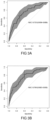
- FIG. 3A depicting an ROC plot of a model taking into account lactate, citrate, trigonelline, hippurate and glucose as marker substances (comparative example).
- the resulting AUC is 0.733 and thus only slightly higher than the AUC of a model taking into account lactate, citrate, trigonelline and glucose as marker substances (cf. Figure 2A ).
- the prediction quality of the model can be significantly increased, as indicated by a significantly increased AUC.
- a model is used for predicting the risk of kidney rejection after kidney transplantation that takes into account lactate, citrate, urea, alanine and glucuronate as marker substances, an AUC of 0.756 results, as indicated in Figure 3B .
- the newly identified marker substances alanine, dimethylamine, glucuronate, phenylacetylglutamine, and urea strongly increase the reliability and performance of prediction models for assessing the risk of kidney rejection after kidney transplantation if used alone or in combination with already known marker substances for this purpose.
- methods for determining or predicting the risk of kidney rejection after kidney transplantation can be performed with a much higher accuracy and reliability. This is likewise true for methods providing original data that can subsequently be used by a physician to make a diagnosis regarding the kidney rejection risk.
Landscapes
- Life Sciences & Earth Sciences (AREA)
- Health & Medical Sciences (AREA)
- Engineering & Computer Science (AREA)
- Molecular Biology (AREA)
- Chemical & Material Sciences (AREA)
- Biomedical Technology (AREA)
- Urology & Nephrology (AREA)
- Hematology (AREA)
- Immunology (AREA)
- Biotechnology (AREA)
- Microbiology (AREA)
- Cell Biology (AREA)
- Food Science & Technology (AREA)
- Medicinal Chemistry (AREA)
- Physics & Mathematics (AREA)
- Analytical Chemistry (AREA)
- Biochemistry (AREA)
- General Health & Medical Sciences (AREA)
- General Physics & Mathematics (AREA)
- Pathology (AREA)
- Proteomics, Peptides & Aminoacids (AREA)
- Investigating Or Analysing Biological Materials (AREA)
Claims (14)
- Utilisation d'un ensemble de marqueurs comprenant au moins trois substances choisies parmi le groupe constitué de 3-hydroxy-isovalérate, acétyl carnitine, alanine, citrate, diméthylamine, glucose, glucuronate, hippurate, lactate, malonate, méthyl guanidine, malonate de méthyle, succinate de méthyle, p-crésol, acétate de phényle, phénylacétylglycine, phénylacétylglutamine, taurine, trigonelline et urée, dans un procédé in vitro pour déterminer le risque de rejet de rein d'un individu après avoir obtenu un don de rein par analyse d'urine, à condition que l'ensemble de marqueurs comprenne de l'alanine.
- Utilisation selon la revendication 1, caractérisée en ce que l'ensemble de marqueurs comprend au moins une substance choisie parmi le groupe constitué de diméthylamine, glucuronate et urée.
- Utilisation selon la revendication 1, caractérisée en ce que l'ensemble de marqueurs comprend de l'urée.
- Utilisation selon l'une quelconque des revendications précédentes, caractérisée en ce que l'ensemble de marqueurs comprend du lactate et du citrate.
- Utilisation selon l'une quelconque des revendications précédentes, caractérisée en ce que l'ensemble de marqueurs ne comprend pas de la diméthylamine, du lactate, de l'acétate et de l'alanine simultanément.
- Utilisation selon l'une quelconque des revendications précédentes, caractérisée en ce que l'ensemble de marqueurs ne comprend pas seulement de la diméthylamine, du lactate et de l'alanine.
- Utilisation selon l'une quelconque des revendications précédentes, caractérisée en ce que l'ensemble de marqueurs ne comprend pas seulement de la diméthylamine, de l'acétate et de l'alanine.
- Utilisation selon l'une quelconque des revendications précédentes, caractérisée en ce que l'ensemble de marqueurs ne comprend pas seulement du lactate, de l'acétate et de l'alanine.
- Ensemble de marqueurs comprenant au moins trois substances choisies parmi le groupe constitué de 3-hydroxy-isovalérate, acétyl carnitine, alanine, citrate, diméthylamine, glucose, glucuronate, hippurate, lactate, malonate, méthyl guanidine, malonate de méthyle, succinate de méthyle, p-crésol, acétate de phényle, phénylacétylglycine, phénylacétylglutamine, taurine, trigonelline et urée, destiné à être utilisé dans des diagnostics in vivo du risque de rejet de rein d'un individu après avoir reçu un don de rein par analyse d'urine, à condition que l'ensemble de marqueurs comprenne de l'alanine.
- Procédé d'analyse in vitro d'un échantillon d'urine isolé, comprenant les étapes suivantes :a) détermination de la concentration d'au moins trois substances choisies parmi le groupe constitué de 3-hydroxy-isovalérate, acétyl carnitine, alanine, citrate, diméthylamine, glucose, glucuronate, hippurate, lactate, malonate, méthyl guanidine, malonate de méthyle, succinate de méthyle, p-crésol, acétate de phényle, phénylacétylglycine, phénylacétylglutamine, taurine, trigonelline et urée dans un échantillon d'urine provenant d'un individu qui a reçu un don de rein en analysant l'échantillon d'urine avec une technique de mesure adaptée, à condition que la concentration d'alanine soit déterminée, etb) calcul d'un score à partir des concentrations déterminées, le score étant indicatif du risque de rejet de rein de l'individu.
- Procédé selon la revendication 10, caractérisé en ce que les concentrations déterminées sont normalisées sur la concentration de créatinine dans le même échantillon d'urine.
- Procédé selon la revendication 10 ou 11, caractérisé en ce que l'échantillon d'urine est groupé dans un d'au moins deux groupes prédéfinis sur la base du score calculé.
- Procédé selon la revendication 10 ou 11, caractérisé en ce qu'un score étendu est calculé à partir du score en considérant de manière supplémentaire au moins une valeur du groupe consistant en une valeur indiquant la concentration de créatinine dans le sérum sanguin de l'individu, une valeur indiquant le taux de filtration glomérulaire de l'individu, et une valeur indiquant le taux de filtration glomérulaire estimé de l'individu.
- Procédé selon la revendication 13, caractérisé en ce que l'échantillon est groupé dans un d'au moins deux groupes prédéfinis sur la base du score étendu calculé, en fournissant ainsi un système d'aide à la décision.
Applications Claiming Priority (2)
| Application Number | Priority Date | Filing Date | Title |
|---|---|---|---|
| DE102017105566 | 2017-03-15 | ||
| PCT/EP2018/056414 WO2018167157A1 (fr) | 2017-03-15 | 2018-03-14 | Utilisation d'un ensemble de marqueurs pour déterminer le risque de rejet de rein |
Publications (2)
| Publication Number | Publication Date |
|---|---|
| EP3596476A1 EP3596476A1 (fr) | 2020-01-22 |
| EP3596476B1 true EP3596476B1 (fr) | 2024-01-10 |
Family
ID=61837730
Family Applications (1)
| Application Number | Title | Priority Date | Filing Date |
|---|---|---|---|
| EP18714723.6A Active EP3596476B1 (fr) | 2017-03-15 | 2018-03-14 | Utilisation d'un ensemble de marqueurs pour déterminer le risque de rejet de rein |
Country Status (9)
| Country | Link |
|---|---|
| US (2) | US20200003787A1 (fr) |
| EP (1) | EP3596476B1 (fr) |
| CN (2) | CN110431424B (fr) |
| AU (1) | AU2018234074B2 (fr) |
| CA (1) | CA3055004C (fr) |
| ES (1) | ES2973756T3 (fr) |
| HU (1) | HUE065802T2 (fr) |
| PL (1) | PL3596476T3 (fr) |
| WO (1) | WO2018167157A1 (fr) |
Family Cites Families (6)
| Publication number | Priority date | Publication date | Assignee | Title |
|---|---|---|---|---|
| GB0018614D0 (en) | 2000-07-28 | 2000-09-13 | Rose Marlene L | Organ transplant rejection and associated conditions |
| ITMI20010206A1 (it) * | 2001-02-02 | 2002-08-02 | Dompe Spa | Uso della metansolfonammide di (r)-ibuprofene e dei suoi sali non tossici per la preparazione di medicamenti per il trattamento e la prevenz |
| WO2008033575A2 (fr) * | 2006-09-15 | 2008-03-20 | Metabolon, Inc. | Procédés d'identification de cheminements biochimiques |
| US20110189680A1 (en) * | 2008-05-30 | 2011-08-04 | The University Of British Columbia | Methods of Diagnosing Rejection of a Kidney Allograft Using Genomic or Proteomic Expression Profiling |
| DE102010038014B4 (de) * | 2010-10-06 | 2021-10-07 | Numares Ag | Verwendung spezifischer Substanzen als Marker zur Bestimmung des Risikos einer Nierenabstoßung |
| US9535144B2 (en) | 2012-06-01 | 2017-01-03 | Liposcience, Inc. | NMR quantification of TMAO |
-
2018
- 2018-03-14 CA CA3055004A patent/CA3055004C/fr active Active
- 2018-03-14 AU AU2018234074A patent/AU2018234074B2/en not_active Ceased
- 2018-03-14 US US16/490,739 patent/US20200003787A1/en not_active Abandoned
- 2018-03-14 ES ES18714723T patent/ES2973756T3/es active Active
- 2018-03-14 CN CN201880017669.8A patent/CN110431424B/zh not_active Expired - Fee Related
- 2018-03-14 WO PCT/EP2018/056414 patent/WO2018167157A1/fr not_active Ceased
- 2018-03-14 PL PL18714723.6T patent/PL3596476T3/pl unknown
- 2018-03-14 CN CN202211561184.XA patent/CN115754308A/zh active Pending
- 2018-03-14 EP EP18714723.6A patent/EP3596476B1/fr active Active
- 2018-03-14 HU HUE18714723A patent/HUE065802T2/hu unknown
-
2024
- 2024-07-18 US US18/776,680 patent/US20240377416A1/en active Pending
Also Published As
| Publication number | Publication date |
|---|---|
| PL3596476T3 (pl) | 2024-06-17 |
| US20240377416A1 (en) | 2024-11-14 |
| AU2018234074A1 (en) | 2019-08-22 |
| CA3055004A1 (fr) | 2018-09-20 |
| HUE065802T2 (hu) | 2024-06-28 |
| US20200003787A1 (en) | 2020-01-02 |
| WO2018167157A1 (fr) | 2018-09-20 |
| CA3055004C (fr) | 2023-10-03 |
| CN110431424B (zh) | 2023-04-07 |
| AU2018234074B2 (en) | 2021-06-24 |
| CN110431424A (zh) | 2019-11-08 |
| ES2973756T3 (es) | 2024-06-24 |
| CN115754308A (zh) | 2023-03-07 |
| EP3596476A1 (fr) | 2020-01-22 |
Similar Documents
| Publication | Publication Date | Title |
|---|---|---|
| de Almeida et al. | Estimating the concentration of urea and creatinine in the human serum of normal and dialysis patients through Raman spectroscopy | |
| Guiu et al. | Prediction for steatosis in type-2 diabetes: clinico-biological markers versus 1H-MR spectroscopy | |
| US10076246B2 (en) | Method and apparatus for noninvasive quantitative detection of fibrosis in normal and viable myocardium by MRI | |
| EP3971910A1 (fr) | Procédé de prédiction de marqueurs caractéristiques pour au moins un échantillon médical et/ou un patient | |
| Eiras-Araújo et al. | Relative enhancement index can be used to quantify liver function in cirrhotic patients that undergo gadoxetic acid–enhanced MRI | |
| Lean et al. | Determination of grade and receptor status from the primary breast lesion by magnetic resonance spectroscopy | |
| EP3596476B1 (fr) | Utilisation d'un ensemble de marqueurs pour déterminer le risque de rejet de rein | |
| HK40018536B (en) | Use of a marker set for determining the risk of kidney rejection | |
| HK40018536A (en) | Use of a marker set for determining the risk of kidney rejection | |
| WO2011128256A1 (fr) | Marqueurs métaboliques permettant de diagnostiquer un cancer | |
| CN106706692A (zh) | 一种基于代谢组学技术的农药毒性评价方法 | |
| HK40088346A (zh) | 用於确定肾排斥风险的标志物组的用途 | |
| Bischoff et al. | Comparison of two methods for blood lead analysis in cattle: Graphite-furnace atomic absorption spectrometry and LeadCare® II system | |
| HK40017080A (en) | Use of a marker set for determining the risk of kidney rejection | |
| Wolfsberger et al. | Metabolite quantification: A fluorescence-based method for urine sample normalization prior to 1H-NMR analysis | |
| HK40017080B (en) | Use of a marker set for determining the risk of kidney rejection | |
| WO2025068209A1 (fr) | Utilisation d'un ensemble de marqueurs pour déterminer le risque de développer un cancer de la prostate résistant à la castration | |
| Kaehler et al. | Variance in intraindividual stability of vitreous humor for thanatochemistry | |
| WO2025068212A1 (fr) | Utilisation d'un ensemble de marqueurs pour le diagnostic d'un carcinome de la prostate | |
| WO2025068210A2 (fr) | Utilisation d'un ensemble de marqueurs pour déterminer l'agressivité d'une tumeur de la prostate | |
| WO2025068211A1 (fr) | Utilisation d'un ensemble de marqueurs pour différencier un carcinome de la prostate d'une modification bénigne de la prostate | |
| WO2018186434A1 (fr) | Procédé et système pour évaluer le risque de dégénérescence maculaire liée à l'âge | |
| Adib et al. | A-363 Effect of Hemolysis on Blood Gas and Chemistry Analytes using GEM Premier 7000 with iQM3 System | |
| WO2025008466A1 (fr) | Utilisation d'un biomarqueur pour déterminer le risque d'encéphalopathie hépatique chez un individu | |
| EP3786642A1 (fr) | Procédé de caractéristiques fonctionnelles de protéines pour la classification de patients à associer à une maladie spécifique |
Legal Events
| Date | Code | Title | Description |
|---|---|---|---|
| STAA | Information on the status of an ep patent application or granted ep patent |
Free format text: STATUS: UNKNOWN |
|
| STAA | Information on the status of an ep patent application or granted ep patent |
Free format text: STATUS: THE INTERNATIONAL PUBLICATION HAS BEEN MADE |
|
| PUAI | Public reference made under article 153(3) epc to a published international application that has entered the european phase |
Free format text: ORIGINAL CODE: 0009012 |
|
| STAA | Information on the status of an ep patent application or granted ep patent |
Free format text: STATUS: REQUEST FOR EXAMINATION WAS MADE |
|
| 17P | Request for examination filed |
Effective date: 20190805 |
|
| AK | Designated contracting states |
Kind code of ref document: A1 Designated state(s): AL AT BE BG CH CY CZ DE DK EE ES FI FR GB GR HR HU IE IS IT LI LT LU LV MC MK MT NL NO PL PT RO RS SE SI SK SM TR |
|
| AX | Request for extension of the european patent |
Extension state: BA ME |
|
| DAV | Request for validation of the european patent (deleted) | ||
| DAX | Request for extension of the european patent (deleted) | ||
| REG | Reference to a national code |
Ref country code: HK Ref legal event code: DE Ref document number: 40018536 Country of ref document: HK |
|
| STAA | Information on the status of an ep patent application or granted ep patent |
Free format text: STATUS: EXAMINATION IS IN PROGRESS |
|
| 17Q | First examination report despatched |
Effective date: 20210819 |
|
| GRAP | Despatch of communication of intention to grant a patent |
Free format text: ORIGINAL CODE: EPIDOSNIGR1 |
|
| STAA | Information on the status of an ep patent application or granted ep patent |
Free format text: STATUS: GRANT OF PATENT IS INTENDED |
|
| INTG | Intention to grant announced |
Effective date: 20230511 |
|
| P01 | Opt-out of the competence of the unified patent court (upc) registered |
Effective date: 20230525 |
|
| GRAS | Grant fee paid |
Free format text: ORIGINAL CODE: EPIDOSNIGR3 |
|
| GRAA | (expected) grant |
Free format text: ORIGINAL CODE: 0009210 |
|
| STAA | Information on the status of an ep patent application or granted ep patent |
Free format text: STATUS: THE PATENT HAS BEEN GRANTED |
|
| AK | Designated contracting states |
Kind code of ref document: B1 Designated state(s): AL AT BE BG CH CY CZ DE DK EE ES FI FR GB GR HR HU IE IS IT LI LT LU LV MC MK MT NL NO PL PT RO RS SE SI SK SM TR |
|
| REG | Reference to a national code |
Ref country code: GB Ref legal event code: FG4D |
|
| REG | Reference to a national code |
Ref country code: CH Ref legal event code: EP |
|
| REG | Reference to a national code |
Ref country code: DE Ref legal event code: R096 Ref document number: 602018063935 Country of ref document: DE |
|
| REG | Reference to a national code |
Ref country code: IE Ref legal event code: FG4D |
|
| REG | Reference to a national code |
Ref country code: NL Ref legal event code: FP |
|
| PGFP | Annual fee paid to national office [announced via postgrant information from national office to epo] |
Ref country code: NL Payment date: 20240320 Year of fee payment: 7 |
|
| PGFP | Annual fee paid to national office [announced via postgrant information from national office to epo] |
Ref country code: GB Payment date: 20240322 Year of fee payment: 7 |
|
| REG | Reference to a national code |
Ref country code: LT Ref legal event code: MG9D |
|
| PGFP | Annual fee paid to national office [announced via postgrant information from national office to epo] |
Ref country code: FR Payment date: 20240320 Year of fee payment: 7 |
|
| REG | Reference to a national code |
Ref country code: AT Ref legal event code: MK05 Ref document number: 1649296 Country of ref document: AT Kind code of ref document: T Effective date: 20240110 |
|
| REG | Reference to a national code |
Ref country code: ES Ref legal event code: FG2A Ref document number: 2973756 Country of ref document: ES Kind code of ref document: T3 Effective date: 20240624 |
|
| REG | Reference to a national code |
Ref country code: HU Ref legal event code: AG4A Ref document number: E065802 Country of ref document: HU |
|
| PG25 | Lapsed in a contracting state [announced via postgrant information from national office to epo] |
Ref country code: IS Free format text: LAPSE BECAUSE OF FAILURE TO SUBMIT A TRANSLATION OF THE DESCRIPTION OR TO PAY THE FEE WITHIN THE PRESCRIBED TIME-LIMIT Effective date: 20240510 |
|
| PG25 | Lapsed in a contracting state [announced via postgrant information from national office to epo] |
Ref country code: LT Free format text: LAPSE BECAUSE OF FAILURE TO SUBMIT A TRANSLATION OF THE DESCRIPTION OR TO PAY THE FEE WITHIN THE PRESCRIBED TIME-LIMIT Effective date: 20240110 |
|
| PG25 | Lapsed in a contracting state [announced via postgrant information from national office to epo] |
Ref country code: GR Free format text: LAPSE BECAUSE OF FAILURE TO SUBMIT A TRANSLATION OF THE DESCRIPTION OR TO PAY THE FEE WITHIN THE PRESCRIBED TIME-LIMIT Effective date: 20240411 |
|
| PG25 | Lapsed in a contracting state [announced via postgrant information from national office to epo] |
Ref country code: RS Free format text: LAPSE BECAUSE OF FAILURE TO SUBMIT A TRANSLATION OF THE DESCRIPTION OR TO PAY THE FEE WITHIN THE PRESCRIBED TIME-LIMIT Effective date: 20240410 Ref country code: HR Free format text: LAPSE BECAUSE OF FAILURE TO SUBMIT A TRANSLATION OF THE DESCRIPTION OR TO PAY THE FEE WITHIN THE PRESCRIBED TIME-LIMIT Effective date: 20240110 |
|
| PGFP | Annual fee paid to national office [announced via postgrant information from national office to epo] |
Ref country code: CH Payment date: 20240402 Year of fee payment: 7 |
|
| PGFP | Annual fee paid to national office [announced via postgrant information from national office to epo] |
Ref country code: ES Payment date: 20240417 Year of fee payment: 7 |
|
| PG25 | Lapsed in a contracting state [announced via postgrant information from national office to epo] |
Ref country code: AT Free format text: LAPSE BECAUSE OF FAILURE TO SUBMIT A TRANSLATION OF THE DESCRIPTION OR TO PAY THE FEE WITHIN THE PRESCRIBED TIME-LIMIT Effective date: 20240110 |
|
| PG25 | Lapsed in a contracting state [announced via postgrant information from national office to epo] |
Ref country code: RS Free format text: LAPSE BECAUSE OF FAILURE TO SUBMIT A TRANSLATION OF THE DESCRIPTION OR TO PAY THE FEE WITHIN THE PRESCRIBED TIME-LIMIT Effective date: 20240410 Ref country code: NO Free format text: LAPSE BECAUSE OF FAILURE TO SUBMIT A TRANSLATION OF THE DESCRIPTION OR TO PAY THE FEE WITHIN THE PRESCRIBED TIME-LIMIT Effective date: 20240410 Ref country code: LT Free format text: LAPSE BECAUSE OF FAILURE TO SUBMIT A TRANSLATION OF THE DESCRIPTION OR TO PAY THE FEE WITHIN THE PRESCRIBED TIME-LIMIT Effective date: 20240110 Ref country code: IS Free format text: LAPSE BECAUSE OF FAILURE TO SUBMIT A TRANSLATION OF THE DESCRIPTION OR TO PAY THE FEE WITHIN THE PRESCRIBED TIME-LIMIT Effective date: 20240510 Ref country code: HR Free format text: LAPSE BECAUSE OF FAILURE TO SUBMIT A TRANSLATION OF THE DESCRIPTION OR TO PAY THE FEE WITHIN THE PRESCRIBED TIME-LIMIT Effective date: 20240110 Ref country code: GR Free format text: LAPSE BECAUSE OF FAILURE TO SUBMIT A TRANSLATION OF THE DESCRIPTION OR TO PAY THE FEE WITHIN THE PRESCRIBED TIME-LIMIT Effective date: 20240411 Ref country code: BG Free format text: LAPSE BECAUSE OF FAILURE TO SUBMIT A TRANSLATION OF THE DESCRIPTION OR TO PAY THE FEE WITHIN THE PRESCRIBED TIME-LIMIT Effective date: 20240110 Ref country code: AT Free format text: LAPSE BECAUSE OF FAILURE TO SUBMIT A TRANSLATION OF THE DESCRIPTION OR TO PAY THE FEE WITHIN THE PRESCRIBED TIME-LIMIT Effective date: 20240110 |
|
| PGFP | Annual fee paid to national office [announced via postgrant information from national office to epo] |
Ref country code: IT Payment date: 20240429 Year of fee payment: 7 |
|
| PG25 | Lapsed in a contracting state [announced via postgrant information from national office to epo] |
Ref country code: PT Free format text: LAPSE BECAUSE OF FAILURE TO SUBMIT A TRANSLATION OF THE DESCRIPTION OR TO PAY THE FEE WITHIN THE PRESCRIBED TIME-LIMIT Effective date: 20240510 |
|
| PGFP | Annual fee paid to national office [announced via postgrant information from national office to epo] |
Ref country code: PL Payment date: 20240222 Year of fee payment: 7 |
|
| PG25 | Lapsed in a contracting state [announced via postgrant information from national office to epo] |
Ref country code: SE Free format text: LAPSE BECAUSE OF FAILURE TO SUBMIT A TRANSLATION OF THE DESCRIPTION OR TO PAY THE FEE WITHIN THE PRESCRIBED TIME-LIMIT Effective date: 20240110 Ref country code: PT Free format text: LAPSE BECAUSE OF FAILURE TO SUBMIT A TRANSLATION OF THE DESCRIPTION OR TO PAY THE FEE WITHIN THE PRESCRIBED TIME-LIMIT Effective date: 20240510 Ref country code: LV Free format text: LAPSE BECAUSE OF FAILURE TO SUBMIT A TRANSLATION OF THE DESCRIPTION OR TO PAY THE FEE WITHIN THE PRESCRIBED TIME-LIMIT Effective date: 20240110 |
|
| PGFP | Annual fee paid to national office [announced via postgrant information from national office to epo] |
Ref country code: HU Payment date: 20240410 Year of fee payment: 7 |
|
| PG25 | Lapsed in a contracting state [announced via postgrant information from national office to epo] |
Ref country code: DK Free format text: LAPSE BECAUSE OF FAILURE TO SUBMIT A TRANSLATION OF THE DESCRIPTION OR TO PAY THE FEE WITHIN THE PRESCRIBED TIME-LIMIT Effective date: 20240110 |
|
| REG | Reference to a national code |
Ref country code: DE Ref legal event code: R097 Ref document number: 602018063935 Country of ref document: DE |
|
| PG25 | Lapsed in a contracting state [announced via postgrant information from national office to epo] |
Ref country code: SM Free format text: LAPSE BECAUSE OF FAILURE TO SUBMIT A TRANSLATION OF THE DESCRIPTION OR TO PAY THE FEE WITHIN THE PRESCRIBED TIME-LIMIT Effective date: 20240110 |
|
| PG25 | Lapsed in a contracting state [announced via postgrant information from national office to epo] |
Ref country code: CZ Free format text: LAPSE BECAUSE OF FAILURE TO SUBMIT A TRANSLATION OF THE DESCRIPTION OR TO PAY THE FEE WITHIN THE PRESCRIBED TIME-LIMIT Effective date: 20240110 Ref country code: EE Free format text: LAPSE BECAUSE OF FAILURE TO SUBMIT A TRANSLATION OF THE DESCRIPTION OR TO PAY THE FEE WITHIN THE PRESCRIBED TIME-LIMIT Effective date: 20240110 |
|
| PG25 | Lapsed in a contracting state [announced via postgrant information from national office to epo] |
Ref country code: SK Free format text: LAPSE BECAUSE OF FAILURE TO SUBMIT A TRANSLATION OF THE DESCRIPTION OR TO PAY THE FEE WITHIN THE PRESCRIBED TIME-LIMIT Effective date: 20240110 |
|
| PG25 | Lapsed in a contracting state [announced via postgrant information from national office to epo] |
Ref country code: SM Free format text: LAPSE BECAUSE OF FAILURE TO SUBMIT A TRANSLATION OF THE DESCRIPTION OR TO PAY THE FEE WITHIN THE PRESCRIBED TIME-LIMIT Effective date: 20240110 Ref country code: SK Free format text: LAPSE BECAUSE OF FAILURE TO SUBMIT A TRANSLATION OF THE DESCRIPTION OR TO PAY THE FEE WITHIN THE PRESCRIBED TIME-LIMIT Effective date: 20240110 Ref country code: RO Free format text: LAPSE BECAUSE OF FAILURE TO SUBMIT A TRANSLATION OF THE DESCRIPTION OR TO PAY THE FEE WITHIN THE PRESCRIBED TIME-LIMIT Effective date: 20240110 Ref country code: EE Free format text: LAPSE BECAUSE OF FAILURE TO SUBMIT A TRANSLATION OF THE DESCRIPTION OR TO PAY THE FEE WITHIN THE PRESCRIBED TIME-LIMIT Effective date: 20240110 Ref country code: DK Free format text: LAPSE BECAUSE OF FAILURE TO SUBMIT A TRANSLATION OF THE DESCRIPTION OR TO PAY THE FEE WITHIN THE PRESCRIBED TIME-LIMIT Effective date: 20240110 Ref country code: CZ Free format text: LAPSE BECAUSE OF FAILURE TO SUBMIT A TRANSLATION OF THE DESCRIPTION OR TO PAY THE FEE WITHIN THE PRESCRIBED TIME-LIMIT Effective date: 20240110 |
|
| PLBE | No opposition filed within time limit |
Free format text: ORIGINAL CODE: 0009261 |
|
| STAA | Information on the status of an ep patent application or granted ep patent |
Free format text: STATUS: NO OPPOSITION FILED WITHIN TIME LIMIT |
|
| PG25 | Lapsed in a contracting state [announced via postgrant information from national office to epo] |
Ref country code: LU Free format text: LAPSE BECAUSE OF NON-PAYMENT OF DUE FEES Effective date: 20240314 |
|
| PG25 | Lapsed in a contracting state [announced via postgrant information from national office to epo] |
Ref country code: MC Free format text: LAPSE BECAUSE OF FAILURE TO SUBMIT A TRANSLATION OF THE DESCRIPTION OR TO PAY THE FEE WITHIN THE PRESCRIBED TIME-LIMIT Effective date: 20240110 |
|
| PG25 | Lapsed in a contracting state [announced via postgrant information from national office to epo] |
Ref country code: MC Free format text: LAPSE BECAUSE OF FAILURE TO SUBMIT A TRANSLATION OF THE DESCRIPTION OR TO PAY THE FEE WITHIN THE PRESCRIBED TIME-LIMIT Effective date: 20240110 Ref country code: LU Free format text: LAPSE BECAUSE OF NON-PAYMENT OF DUE FEES Effective date: 20240314 |
|
| REG | Reference to a national code |
Ref country code: BE Ref legal event code: MM Effective date: 20240331 |
|
| 26N | No opposition filed |
Effective date: 20241011 |
|
| PG25 | Lapsed in a contracting state [announced via postgrant information from national office to epo] |
Ref country code: BE Free format text: LAPSE BECAUSE OF NON-PAYMENT OF DUE FEES Effective date: 20240331 |
|
| PG25 | Lapsed in a contracting state [announced via postgrant information from national office to epo] |
Ref country code: IE Free format text: LAPSE BECAUSE OF NON-PAYMENT OF DUE FEES Effective date: 20240314 |
|
| PG25 | Lapsed in a contracting state [announced via postgrant information from national office to epo] |
Ref country code: IE Free format text: LAPSE BECAUSE OF NON-PAYMENT OF DUE FEES Effective date: 20240314 Ref country code: BE Free format text: LAPSE BECAUSE OF NON-PAYMENT OF DUE FEES Effective date: 20240331 |
|
| PG25 | Lapsed in a contracting state [announced via postgrant information from national office to epo] |
Ref country code: SI Free format text: LAPSE BECAUSE OF FAILURE TO SUBMIT A TRANSLATION OF THE DESCRIPTION OR TO PAY THE FEE WITHIN THE PRESCRIBED TIME-LIMIT Effective date: 20240110 |
|
| PG25 | Lapsed in a contracting state [announced via postgrant information from national office to epo] |
Ref country code: CY Free format text: LAPSE BECAUSE OF FAILURE TO SUBMIT A TRANSLATION OF THE DESCRIPTION OR TO PAY THE FEE WITHIN THE PRESCRIBED TIME-LIMIT; INVALID AB INITIO Effective date: 20180314 |
|
| PG25 | Lapsed in a contracting state [announced via postgrant information from national office to epo] |
Ref country code: FI Free format text: LAPSE BECAUSE OF FAILURE TO SUBMIT A TRANSLATION OF THE DESCRIPTION OR TO PAY THE FEE WITHIN THE PRESCRIBED TIME-LIMIT Effective date: 20240110 |
|
| REG | Reference to a national code |
Ref country code: CH Ref legal event code: H13 Free format text: ST27 STATUS EVENT CODE: U-0-0-H10-H13 (AS PROVIDED BY THE NATIONAL OFFICE) Effective date: 20251023 |
|
| REG | Reference to a national code |
Ref country code: NL Ref legal event code: MM Effective date: 20250401 |
|
| PG25 | Lapsed in a contracting state [announced via postgrant information from national office to epo] |
Ref country code: HU Free format text: LAPSE BECAUSE OF NON-PAYMENT OF DUE FEES Effective date: 20250315 |
|
| GBPC | Gb: european patent ceased through non-payment of renewal fee |
Effective date: 20250314 |
|
| PG25 | Lapsed in a contracting state [announced via postgrant information from national office to epo] |
Ref country code: TR Free format text: LAPSE BECAUSE OF FAILURE TO SUBMIT A TRANSLATION OF THE DESCRIPTION OR TO PAY THE FEE WITHIN THE PRESCRIBED TIME-LIMIT Effective date: 20240110 |
|
| PG25 | Lapsed in a contracting state [announced via postgrant information from national office to epo] |
Ref country code: NL Free format text: LAPSE BECAUSE OF NON-PAYMENT OF DUE FEES Effective date: 20250401 |
|
| PG25 | Lapsed in a contracting state [announced via postgrant information from national office to epo] |
Ref country code: GB Free format text: LAPSE BECAUSE OF NON-PAYMENT OF DUE FEES Effective date: 20250314 |
|
| PG25 | Lapsed in a contracting state [announced via postgrant information from national office to epo] |
Ref country code: FR Free format text: LAPSE BECAUSE OF NON-PAYMENT OF DUE FEES Effective date: 20250331 Ref country code: IT Free format text: LAPSE BECAUSE OF NON-PAYMENT OF DUE FEES Effective date: 20250314 |
|
| PG25 | Lapsed in a contracting state [announced via postgrant information from national office to epo] |
Ref country code: CH Free format text: LAPSE BECAUSE OF NON-PAYMENT OF DUE FEES Effective date: 20250331 |
|
| PGFP | Annual fee paid to national office [announced via postgrant information from national office to epo] |
Ref country code: DE Payment date: 20260213 Year of fee payment: 9 |
|
| PG25 | Lapsed in a contracting state [announced via postgrant information from national office to epo] |
Ref country code: PL Free format text: LAPSE BECAUSE OF NON-PAYMENT OF DUE FEES Effective date: 20250314 |
|
| REG | Reference to a national code |
Ref country code: ES Ref legal event code: FD2A Effective date: 20260430 |