EP3596876B1 - Vorrichtung zur elliptischen kurvenpunktmultiplikation und verfahren um eine nachricht im white-box zu signieren - Google Patents
Vorrichtung zur elliptischen kurvenpunktmultiplikation und verfahren um eine nachricht im white-box zu signieren Download PDFInfo
- Publication number
- EP3596876B1 EP3596876B1 EP18711335.2A EP18711335A EP3596876B1 EP 3596876 B1 EP3596876 B1 EP 3596876B1 EP 18711335 A EP18711335 A EP 18711335A EP 3596876 B1 EP3596876 B1 EP 3596876B1
- Authority
- EP
- European Patent Office
- Prior art keywords
- encoded
- multiplier
- base
- blinded
- point
- Prior art date
- Legal status (The legal status is an assumption and is not a legal conclusion. Google has not performed a legal analysis and makes no representation as to the accuracy of the status listed.)
- Active
Links
Images



Classifications
-
- H—ELECTRICITY
- H04—ELECTRIC COMMUNICATION TECHNIQUE
- H04L—TRANSMISSION OF DIGITAL INFORMATION, e.g. TELEGRAPHIC COMMUNICATION
- H04L9/00—Cryptographic mechanisms or cryptographic arrangements for secret or secure communications; Network security protocols
- H04L9/30—Public key, i.e. encryption algorithm being computationally infeasible to invert or user's encryption keys not requiring secrecy
- H04L9/3066—Public key, i.e. encryption algorithm being computationally infeasible to invert or user's encryption keys not requiring secrecy involving algebraic varieties, e.g. elliptic or hyper-elliptic curves
-
- H—ELECTRICITY
- H04—ELECTRIC COMMUNICATION TECHNIQUE
- H04L—TRANSMISSION OF DIGITAL INFORMATION, e.g. TELEGRAPHIC COMMUNICATION
- H04L9/00—Cryptographic mechanisms or cryptographic arrangements for secret or secure communications; Network security protocols
- H04L9/002—Countermeasures against attacks on cryptographic mechanisms
-
- H—ELECTRICITY
- H04—ELECTRIC COMMUNICATION TECHNIQUE
- H04L—TRANSMISSION OF DIGITAL INFORMATION, e.g. TELEGRAPHIC COMMUNICATION
- H04L9/00—Cryptographic mechanisms or cryptographic arrangements for secret or secure communications; Network security protocols
- H04L9/30—Public key, i.e. encryption algorithm being computationally infeasible to invert or user's encryption keys not requiring secrecy
- H04L9/3006—Public key, i.e. encryption algorithm being computationally infeasible to invert or user's encryption keys not requiring secrecy underlying computational problems or public-key parameters
- H04L9/3013—Public key, i.e. encryption algorithm being computationally infeasible to invert or user's encryption keys not requiring secrecy underlying computational problems or public-key parameters involving the discrete logarithm problem, e.g. ElGamal or Diffie-Hellman systems
-
- H—ELECTRICITY
- H04—ELECTRIC COMMUNICATION TECHNIQUE
- H04L—TRANSMISSION OF DIGITAL INFORMATION, e.g. TELEGRAPHIC COMMUNICATION
- H04L9/00—Cryptographic mechanisms or cryptographic arrangements for secret or secure communications; Network security protocols
- H04L9/32—Cryptographic mechanisms or cryptographic arrangements for secret or secure communications; Network security protocols including means for verifying the identity or authority of a user of the system or for message authentication, e.g. authorization, entity authentication, data integrity or data verification, non-repudiation, key authentication or verification of credentials
- H04L9/3247—Cryptographic mechanisms or cryptographic arrangements for secret or secure communications; Network security protocols including means for verifying the identity or authority of a user of the system or for message authentication, e.g. authorization, entity authentication, data integrity or data verification, non-repudiation, key authentication or verification of credentials involving digital signatures
- H04L9/3252—Cryptographic mechanisms or cryptographic arrangements for secret or secure communications; Network security protocols including means for verifying the identity or authority of a user of the system or for message authentication, e.g. authorization, entity authentication, data integrity or data verification, non-repudiation, key authentication or verification of credentials involving digital signatures using DSA or related signature schemes, e.g. elliptic based signatures, ElGamal or Schnorr schemes
-
- H—ELECTRICITY
- H04—ELECTRIC COMMUNICATION TECHNIQUE
- H04L—TRANSMISSION OF DIGITAL INFORMATION, e.g. TELEGRAPHIC COMMUNICATION
- H04L2209/00—Additional information or applications relating to cryptographic mechanisms or cryptographic arrangements for secret or secure communication H04L9/00
- H04L2209/08—Randomization, e.g. dummy operations or using noise
-
- H—ELECTRICITY
- H04—ELECTRIC COMMUNICATION TECHNIQUE
- H04L—TRANSMISSION OF DIGITAL INFORMATION, e.g. TELEGRAPHIC COMMUNICATION
- H04L2209/00—Additional information or applications relating to cryptographic mechanisms or cryptographic arrangements for secret or secure communication H04L9/00
- H04L2209/16—Obfuscation or hiding, e.g. involving white box
Definitions
- the invention relates to a point multiplication device, a point multiplication method and a computer readable medium.
- a secure signing system should have the following properties
- the first two requirements are the requirements for black box security. It is believed that a signature scheme such as the Elliptic Curve Digital Signature Algorithm (ECDSA) satisfies these requirements.
- EDSA Elliptic Curve Digital Signature Algorithm
- the third requirement is of a different nature, as there are many ways in which a private key could leak.
- the following is a non-exhaustive list of potential leaks.
- Patent applications EP3125145 and EP3038287 disclose elliptic curve point scalar multiplication in a white-box context.
- the paper "ECDSA Key Extraction from Mobile Devices via Nonintrusive Physical Side Channels" by Genkin D. et al, published at ACM CCS 2016 discloses countermeasures for ECDSA signatures involving splitting the random multiplier into multiple components.
- the inventors realized that many vulnerabilities in the ECDSA protocol are caused by the point multiplication operation on the elliptic curve that ECDSA comprises.
- Elliptic curve arithmetic is moreover an element of many other cryptographic protocols, making it even more desirable to have implementations of point multiplication with increased resistance against attack in the white-box model.
- An electronic point multiplication device for computing a point multiplication on an elliptic curve between a multiplier and a base point on the elliptic curve for use in a cryptographic protocol.
- the device comprises
- the required point multiplication kG is translated into multiple point multiplication with the base point G but also a number of additional auxiliary points.
- Attacking the system requires of the attacker that he either finds the multiplier k form the multiplication kG , or determines the relationship between the auxiliary points and the base point. Both of these would require solving a discrete logarithm problem on the elliptic curve, which is assumed to be impractically hard, e.g., requiring more resources than the assets protected by the cryptographic protocol are worth.
- an attacker may try to attack the system using fault attacks, however these are countered using the system of encoding; details are further explicated below.
- the blinded base multiplier and the multiple blinded auxiliary multipliers may be represented in a plain format during the performing of the blinded elliptic curve arithmetic.
- no protection in the form of a white-box implementation is needed.
- white-box protecting elliptic curve arithmetic is hard, as the elliptic curve algorithm is notoriously sensitive to side channel attacks. By spreading an elliptic curve multiplication over multiple auxiliary points, this weakness in elliptic curve cryptography is addressed; leading to implementations with increased resistance in the white-box model.
- embodiments combine white-box technology, e.g., operating on encoded data through look-up tables, with blinding, e.g., replacing a first plain computation with another second plain computation so that the desired first computation result may be derived from the second computation result.
- the point multiplication device is an electronic device, and may be, e.g., a mobile electronic device such as a mobile phone.
- the point multiplication device may also be, e.g., set-top box, smart-card, computer, etc.
- the point multiplication device and method described herein may be applied in a wide range of practical applications.
- Such practical applications include cryptographic protocols that include elliptic curve computations, in particular the ECDSA protocol.
- ECDSA may be used to sign data, e.g., in application that require authentication, integrity of data, etc.
- Such applications may include messaging applications, mail programs, financial applications, and the like.
- a method according to the invention may be implemented on a computer as a computer implemented method, or in dedicated hardware, or in a combination of both.
- Executable code for a method according to the invention may be stored on a computer program product.
- Examples of computer program products include memory devices, optical storage devices, integrated circuits, servers, online software, etc.
- the computer program product comprises non-transitory program code stored on a computer readable medium for performing a method according to the invention when said program product is executed on a computer.
- the computer program comprises computer program code adapted to perform all the steps of a method according to the invention when the computer program is run on a computer.
- the computer program is embodied on a computer readable medium.
- Another aspect of the invention provides a method of making the computer program available for downloading. This aspect is used when the computer program is uploaded into, e.g., Apple's App Store, Google's Play Store, or Microsoft's Windows Store, and when the computer program is available for downloading from such a store.
- Apple's App Store e.g., Apple's App Store, Google's Play Store, or Microsoft's Windows Store
- elliptic curve computations are difficult to protect as the computation is remarkably vulnerable to side channel attacks. They found that side channel attacks, even if they were originally targeted for a grey-box model, may often also be successfully applied in the white-box model. Even if a direct white-box implementation of elliptic curve computations were achieved, that operates on encoded data, then there is still a good chance that existing or future side channel attacks may break it.
- the attacker In a grey box model, the attacker has access to some partial side-channel information; e.g., the power use of the device. In the white-box model, the attacker has full access to the internal state.
- Elliptic curve computations are used in various cryptographic algorithms, e.g., where there may be a desire to hide a performed ECC point multiplication from a user of the system, e.g., an attacker in the white-box model.
- Examples of cryptographic algorithms employing elliptic curve computations include: elliptic curve Diffie-Hellman (ECDH) key agreement, the Elliptic Curve Integrated Encryption Scheme (ECIES), the Elliptic Curve Digital Signature Algorithm (ECDSA), the Edwards-curve Digital Signature Algorithm (EdDSA), the ECMQV key agreement scheme, and the ECQV implicit certificate scheme.
- ECDSA Elliptic Curve Digital Signature Algorithm
- the inventors found a way to perform ECC arithmetic on encoded data by dividing an elliptic curve computation for a single curve point over multiple curve points.
- the latter computations may even be performed in plain, although the lead-up to the multiple point arithmetic may be done in a white-box format, e.g., operating on encoded data.
- the security of the elliptic curve multiplication is related to the discrete logarithm problem for elliptic curves, which is presumed to be a difficult problem.
- ECDSA signing system is described together with a number of known attacks on ECDSA and possible countermeasures. Without countermeasures, these attacks could allow an attacker to retrieve the private key. Next, a few more advanced attacks are disclosed which even work when countermeasures are used against the less advanced attacks. It is desirable to find ECDSA implementations that protect also against these more advanced attacks.
- ECDSA ECDSA
- the function ⁇ maps an elliptic curve point, e.g., an elliptic curve point coordinate, to an integer.
- ⁇ may be mod q operation on the x-coordinate of the elliptic curve point.
- elliptic curve points may be compressed elliptic curve points. In a compressed elliptic curve point, only the sign of the y-coordinate maintained, or the y-coordinate may not be maintained at all.
- a solution to this problem is to use a deterministic algorithm for calculating an appropriate k from an input message M and optionally the private key x.
- the parameters of the pseudo-random number generator are chosen randomly at compile time, so that they are different for each implementation.
- a function that maps an input message, or a hash thereof to a random multiplier to replace a random number generator, is called a de-randomization function. Using de-randomization function make the signatures that an implementation generates a deterministic function of the input.
- Deterministic k in combination with linear or blockwise non-linear encoding of k can be attacked as follows using fault attacks. The attacker feeds the same message four times.
- Block encodings are commonly used in white box encodings as the bit size of the underlying values, e.g., of the multiplier k , can be much larger than the bit size of the largest encoding that can be accommodated.
- FIG. 1 schematically shows an example of an embodiment of a point multiplication device 100.
- Point multiplication device 100 is arranged to compute a point multiplication kG on an elliptic curve E between a multiplier k and a base point G on the elliptic curve E .
- a pointed out above point multiplication on an elliptic curve is a primitive needed for a number of cryptographic protocols.
- point multiplication device 100 may be used to compute an ECDSA signature. Such an example is detailed with respect to Fig. 4 .
- Point multiplication device 100 comprises a storage 110.
- Storage 110 stores parameters needed for the point multiplication, e.g., parameters derived from the cryptographic protocol in which it is used.
- storage 100 storages the base point G and also multiple pre-computed auxiliary points G i on the elliptic curve.
- the point multiplication kG is translated into a number of point multiplications for points G , and G i , in such a way that it is hard to recover k from the multipliers used with these points. This allows the elliptic curve arithmetic implementation to be less protected than other parts of point multiplication device 100, and even in plain.
- the elliptic curve arithmetic is not implemented in a white-box fashion, e.g., does not operate on encoded data.
- storage 110 may comprise additional data; some examples of which are given herein. For example, if point multiplication device 100 implements encoded parts, e.g., white-box implemented parts, using table networks operating on encoded data, then the look-up tables in the table network may be stored in storage 110.
- Point multiplication device 100 further comprises an input interface 120 arranged to receive a base hash h , 122 of an input message M .
- the input interface 120 may be an application programming interface (API) used by some application.
- point multiplication device 100 may be implemented as a subroutine of a larger application, e.g., an ECDSA application.
- Point multiplication device 100 may also be implemented as a cooperating application, e.g., a library, called by, say, an ECDSA application when needed.
- point multiplication device 100 comprises a hash unit arranged to receive the input message M and compute the hash h , 122.
- the output of the hash and the input to the point multiplication described below may be formed by input interface 120.
- Computing of base hash 122 may be done in plain, as the base hash is not confidential.
- the hash function unit may be adapted to compute the hash in an encoded manner. The latter is not necessary though.
- Input interface 120 may receive the input message in plain form.
- input interface may comprise or cooperate with a communication interface which is used to obtain base hash 122 or the input message M .
- the communication interface may be a wired interface, e.g., a wired connection.
- the communication interface may comprise a connection pad or connection port.
- the communication interface may also be digital wired network connection, or a wireless network connection, or a hybrid, etc.
- the communication interface may comprise an antenna.
- Point multiplication device 100 comprises a processor circuit arranged for the elliptic curve point multiplication.
- the execution of the elliptic curve point multiplication is implemented in a processor circuit, examples of which are shown below.
- Fig. 1 shows functional units that may be functional units of the processor circuit.
- Fig. 1 may be used as a blueprint of a possible functional organization of the processor circuit.
- the processor circuit is not shown separate from the units in Fig. 1 .
- the functional units shown in Fig. 1 may be wholly or partially implemented in hardware, e.g., a multiple semiconductor gates cooperating to implement one or more of the particular functional units shown in Fig. 1 .
- the electronic point multiplication device 100 may be wholly or partially implemented in computer instructions that are stored at the point multiplication device and are executable by a microprocessor of the point multiplication device.
- functional units are implemented partially in hardware, e.g., as coprocessors, e.g., crypto coprocessors, and partially in software stored an executed on the point multiplication device.
- the electronic point multiplication device 100 may be configured for a cryptographic protocol, such as the ECDSA signing operation.
- Point multiplication device 100 is configured to derive the multiplier k and multiple derived hashes h i from the base hash h , 122 in the form of a first set of multiple joint encodings.
- the first set comprises the multiple derived hashes each of which is jointly encoded with the multiplier k .
- point multiplication device 100 e.g., the processor circuit, may be configured with a first encoded computation network 130 arranged to compute the first set of multiple joint encodings.
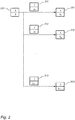
- Fig. 2 schematically shows an example of an embodiment of deriving a first set of multiple joint encodings.
- the system of Fig. 2 may be used by first encoded network 130.
- Show in Fig. 2 is a joint encoding of the base hash 201, e.g., base hash 122, with itself.
- Two blocks positioned above each other, as in 201, is used in Figs. 2 and 3 to indicate a joint encoding.
- a secret encoding is used.
- encodings for the various data items are chosen.
- such an encoding may be a bijective function, and may be randomly chosen.
- data is plain or in a plain format
- the data is represented in a public encoding.
- a letter represented in the program in, say, ASCII is plain, because the ASCII representation is public. But if the letter were mapped through a private or secret bijection, mapping 8 bits to 8 bits, then the letter is encoded.
- the notation ' Enc ' denotes an encoding with a private encoding.
- Such an encoding may be chosen randomly at compile time.
- the encoding may be a bijection that maps a bit sequence of a certain size to bit sequences of the same size.
- each encoding may be a different encoding, as the encoded networks that receive, operate on, or produce such encoded data may be adapted for any specific encoding. Using multiple different encodings, makes attack of the encoding harder. Even though the same notation ' Enc ' is used without super or sub scripts, it is understood that each one them, may be, and preferably, are, different encodings.
- the base hash 122 jointly encoded with itself 201 may be notated as Enc ( h , h ).
- a joint encoding may be a block-wise joint encoding, in which the inputs are partitioned into blocks and a smaller joint encoding is applied to a block of a first input and a block of a second input.
- the encodings may be byte-wise or nibble-wise joint encodings.
- a joint encoding Enc operating on a first data item a and a second data item b may comprise a sequence of smaller encodings, e.g., Enc i , the first and second data item being a first and second sequence of smaller data items a i , and b i ; the two sequences preferably have the same length.
- the smaller encoding Enc i may jointly encode a i and b i , e.g., as Enc i ( a i , b i ).
- the encoding Enc i may be a bijection.
- Enc i may be implemented as a look-up table.
- the smaller data items a i and b i may be nibbles or bytes, and Enc i may be a bijection from 8 bits to 8 bits or from 16 bits to 16 bits. These are convenient numbers, but encodings on other block sizes are also possible, e.g., in 3 or 5 bits.
- the smaller encodings Enc i may be chosen randomly, e.g., at compile time.
- first encoding network 130 receives the base hash 122 in the plain, e.g., in a public encoding, and first jointly encodes the base hash 122.
- the base hash may be received as a sequence of nibbles, each of which is jointly encoded with itself through a smaller encoding.
- Fig. 2 further shows a first set of jointly encoded function pairs ( f , g i ).
- An encoded function pair is an encoded computation network or part thereof such that a first component of the encoded function pair, e.g., f in this example, operates on a first component of a joint encoding, e.g., h in this example, and a second component of the encoded function pair, e.g., g i in this example, operates on a second component of a joint encoding, e.g., also h in this particular example.
- substitution layers may be efficiently implemented as a sequence of substitution boxes, e.g., implemented as look-up tables.
- Efficient implementations of linear operations on encoded inputs are also known.
- An example, of an SLT block cipher that may be adapted in this way is AES.
- Encoded network 130 may be implemented using white-box cryptography.
- a white-box implementation is a cryptographic implementation designed to withstand an attack in the white-box context. In the white-box context, the attacker has total visibility into software implementation and execution. Even so, the white-box implementation aims to prevent the extraction of secret keys from the program.
- white-box cryptography operations are performed on encoded data, e.g., by applying a bijective function on the data, possibly together with a salt.
- the computer program is then represented as a table network that operates on the encoded data.
- An example of such an implementation can be found in " White-Box Cryptography and an AES Implementation", by S. Chow et al. (incorporated by reference).
- a White-Box DES Implementation for DRM Applications by S. Chow , et al. a white-box implementation of the Data Encryption Standard (DES) is presented (incorporated by reference).
- DES Data Encryption Standard
- a table-network may be implemented as multiple encoded and cooperating look-up tables stored on a storage of the device.
- a table network receives one or more inputs and produces one or more outputs.
- multiple look-up tables may be used, e.g., stored in a table storage. Tables take inputs directly from the inputs and/or the outputs of other tables.
- a table may take a single input, two inputs, or more than two inputs.
- Fig. 2 shows that multiple jointly encoded function pairs, shown are jointly encoded function pairs 211-213, are applied to the jointly encoded base hash 201 to produce joint encodings of the multiplier and a diversified hash. Note that each of the pairs of joint encoded function pairs contains the same de-randomization function f , so that each of the produced joint encodings contains the multiplier k.
- Fig. 2 shows joint encodings 221-223, each of which contain the same multiplier. Note that the encodings used in the joint encodings, e.g., joint encodings 221-223, may be different.
- the used encoding is not known to the attacker, e.g., it may be secretly chosen by a designer, or even randomly at compile time.
- the number of joint encodings equals 2 n , in which n is a security parameter; preferably, n is at least 2.
- the de-randomization function f replaces a random number generator. It may take as input the base hash, but may in addition also receive as input the private key of point multiplication device 100.
- the hash diversification functions serve to diversify a single hash into multiple hashes. Both the de-randomization function and the diversification functions may be random functions. They may reduce their domain if needed. For example, if the base hash is SHA-256 hash with 256 bits, the functions f and/or g i may map to a smaller domain, e.g., to 80 bits.
- the jointly encoded functions apply to a singly encoded hash, Enc ( h ) instead of a joint encoding Enc ( h , h ).
- the jointly encoded function pairs apply directly to a plain representation h of the bash hash and incorporate encoding as well as the encoded function operations.
- a designer may fix a function template, e.g., an SLT type function, with a number of S-rounds and a number of L-rounds, e.g., 8 of each, a size of the substitution boxes, say 4 or 8 bits wide, a bit-size of the input and output, e.g., 256 and 80 respectively, and select the substitution boxes and linear transformation randomly within these parameters.
- the substitution boxes and linear transformations are preferably invertible. Other numbers of rounds or sizes of the s-box or linear transformations, etc., are possible.
- point multiplication device 100 In addition to computing a first set of multiple joint encodings, of the multiplier and the diversified hashes, point multiplication device 100 also computes a second set of multiple joint encodings.
- the second set of joint encodings also comprises the derived hashes though not necessarily the multipliers.
- the derived hashes in the second set are the same derived hashes as in the first set, although probably in a different encoding.
- the precise pairing chosen in the second set is not important.
- point multiplication device 100 e.g., the processor circuit, may comprise a second encoded computation network 135 to compute the second set.
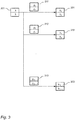
- Fig. 3 schematically shows an example of an embodiment of deriving a second set of multiple joint encodings.
- Fig. 3 is similar to Fig. 2 , and the same type of encodings, etc., that can be used in Fig. 2 may be used in Fig. 3 .
- Shown in Fig. 3 is a joint encoding 301 of the base hash 122 with itself. This may be the same encoding as 201, e.g., the same encoded data is used as an input to first encoded network 130 and to second encoded network 135.
- Second encoded network 135 comprises multiple encoded function pairs. Each function pair comprising at least two of the diversification functions g i . These function pairs could also comprise additional diversification functions to obtain jointly encoded triples of derived hashes, or even more, etc.
- Shown in Fig. 3 are jointly encoded functions 311-313, that produce joint encodings 321, 322 and 323.
- Point multiplication device 100 will eventually compute the point product of the multiplier k and the base point G as a sum of multiples of the base point and additional auxiliary points G i .
- the multiplier of the G and G i are sometimes computed from the first set and sometimes from the second set, so that an attacker cannot attack only one of the two sets; he is forced to attack both the first set and the second set simultaneously.
- the multiple pre-computed auxiliary points G i may have been obtained as a point multiplication between a pre-computed multiplier and the base point.
- this knowledge is embedded in the encoded networks, so that the processor circuit is able to blind a computation kG as multiple computation over the G and G i .
- An attacker is not able to reversely obtain k from the blinded computation since he cannot know with how much G was multiplied to obtain G i
- multiplier k together with h provides protection.
- the multiplier and the base hash are bitwise encoded together. Then there are three possible changes to an encoded bit pair that could be caused by a modification by the attacker:
- the processor circuit is configured to compute from the first set of multiple joint encodings A i a blinded base multiplier A , 131.
- first encoding network 130 may be configured to compute blinded base multiplier A as well.
- the processor circuit e.g., second encoded network 135, is configured to compute from the second set of multiple joint encodings B i multiple blinded auxiliary multipliers ⁇ i , 136.
- the multiple blinded auxiliary multipliers correspond to the multiple auxiliary points G i .
- the blinded base multiplier and the multiple blinded auxiliary multipliers may be represented in a plain format during the performing of the blinded elliptic curve arithmetic. In fact, in an embodiment these numbers may be plainly visible in any ordinary base 2 arithmetic, etc., plain to see for an attacker of this system.
- the particular computation of the blinded base multiplier and the multiple blinded auxiliary multipliers is encoded. For example, in an embodiment one may first compute the blinded base multiplier and the multiple blinded auxiliary multipliers in an encoded format, followed by a decoding step.
- the blinded base multiplier and the multiple blinded auxiliary multipliers are called blinded, not because they need to be encoded but because they blind the true ECC computation ( kG ) from the attacker.
- A may be computed in an encoded network, e.g., using Montgomery digit based arithmetic, taking the value A i as input.
- the constants ⁇ i , ⁇ i and C i were selected compile time in Z q , and may be hardcoded in the algorithm.
- one may first compute the values K and H i in encoded form, e.g., jointly encoded as ( K, H 0 , ..., H 2 n -1 ) and compute A therefrom.
- blinded base multiplier ( A ) is a weighted sum of the multipliers k i and diversified hashes h i in the first set of multiple joint encodings.
- the ECC computation AG will contain the correct result kG if the run is untampered, but blinded by a term ( ⁇ i C i H i ).
- the multiple blinded auxiliary multipliers ⁇ i are selected to correct for the latter term, e.g. for the diversified hashes in the weighted sum A .
- the recoding of the derived hashes is done so that it compensates for the auxiliary points which are later added to the base point multiplication.
- G 2 i [-( a i d i - b i c i ) -1 ( d i C 2i - c i C 2 i +1 ] G
- G 2 i +1 [-( a i d i - b i c i )- 1 (- b i C 2 i + a i ( C 2 i +1 )] G .
- the elliptic curve arithmetic is performed to obtain the point multiplication 141, kG of the multiplier k and the base point G .
- This computation is blinded in the sense, that different computations are performed visual to an attacker, the correct outcome kG can be derived from the outcomes of the blinded elliptic curve arithmetic but the correct input k cannot be derived from the inputs of the blinded elliptic curve arithmetic.
- the multiplier k has been distributed over the multiple new multipliers in a secret manner, as this part of the computation is done in encoded form the multiplier k cannot be recovered.
- the blinded elliptic curve arithmetic comprises computing the point addition of:
- the parameters are selected at compile time, and may be hardcoded in point multiplication device 100.
- the compiler may be configured to
- the multiplier is needed in some further part of the cryptographic protocol, it can be computed in an encoded network from the base hash again.
- the cryptographic protocol is ECDSA
- a further part of the algorithm is to compute the second component of the signature also needs the multiplier k . This can be provided by re-computing k from the base hash in an encoded network of the second part of the cryptographic protocol.
- that encoded network may comprise an encoding of the de-randomization function.
- Examples of computing different functions on a different, but jointly encoded variables may be found, e.g., in Computing device comprising a table network, WO/2014/095772 ; Cryptographic device for calculating a block cipher, WO/2017/173882 ; Secure data transformations, WO/2015/091172 , etc.
- the computation may work as follows:
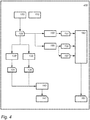
- FIG. 4 schematically shows an example of an embodiment of an ECDSA device 400.
- An important application of point multiplication device 100 is in an ECDSA device, such as ECDSA device 400.
- a pointed out above an ECDSA signature comprises two components, one of which is derived from an ECC point multiplication.
- Fig. 4 shows an ECDSA device 400, e.g., a device configured to compute an ECDSA signature for a message, which comprises a point multiplication device, such as point multiplication device 100. Similar reference signs in Fig. 4 correspond to similar functionality in Fig. 1 .
- ECDSA device 400 comprises a processor circuit, e.g., a processor circuit as in point multiplication device 100 but extended with additional functionality.
- ECDSA device 400 comprises an input interface 120 arranged to receive a base hash h , 122 of an input message M .
- the input interface may be an application interface, so that ECDSA device 400 is configured to receive or generate or otherwise obtain the input message.
- ECDSA device 400 may comprise a hash unit to produce the base has of the input message.
- ECDSA device 400 comprises a point multiplication device, such as point multiplication device 100 to compute a point multiplication kG on an elliptic curve between a multiplier k and a base point G on the elliptic curve E for use in a cryptographic protocol.
- the processor circuit of ECDSA device 400 may be configured for said point multiplication.
- the latter computation may be done in elliptic curve arithmetic unit 140, or in a separate unit.
- the computation of ⁇ may be done in plain.
- the second computation does not involve elliptic curve computations.
- an encoded arithmetic network could perform this computation.
- an encoded network of ECDSA device 400 may receive the base hash and comprise an encoding of the de-randomization function f . This allows such an encoded network to compute an encoding of the multiplier k .
- the encoded network further may use an encoding of the private key x, and the values r and h . The latter two may be received in plain or in an encoding. From these input the second component of an ECDSA signature may be computed.
- ECDSA device 400 is configured to a further first set of multiple joint encodings and a further second set of multiple joint encodings.
- ECDSA device 400 may comprise a third encoded computation network 150 configured to derive multiple derived hashes each of which is jointly encoded with the multiplier k .
- third encoded computation network 150 may be configured to apply multiple pairs of encoded functions ( f , g ' i ), where the g ' i are a further set of diversification functions.
- ECDSA device 400 may comprise a fourth encoded computation network 155 configured to derive the same multiple derived hashes as in the further first set but each being jointly encoded with the base hash h .
- fourth encoded computation network 155 may be configured to apply multiple pairs of encoded functions ( id,g' i ) , where the g ' i are the further set of diversification functions.
- id stands for the identity function. Note that even the identity function will not be visible as such, as it may produce its output in a different encoding then it received its input. Moreover, the joint encoding will also cause the base hash to be directly visible in the device.
- ECDSA device 400 may compute from the further second set of multiple joint encodings Y i a blinded base hash H , 156 as a weighted average of the encoded base hashes in the further second set, and a de-blinding T ', 157 value from the encoded base hashes and derived hashes. This computation may be done in an encoded network, and produce encoded values.
- the input interface may be selected from various alternatives.
- input interface may be a network interface to a local or wide area network, e.g., the Internet, a storage interface to an internal or external data storage, a keyboard, an application interface (API), etc.
- API application interface
- Storage 110 may be implemented as an electronic memory, say a flash memory, or magnetic memory, say hard disk or the like. Storage 110 may comprise multiple discrete memories together making up storage 110. Storage 110 may also be a temporary memory, say a RAM. In the case of a temporary storage 110, storage 110 contains some means to obtain data before use, say by obtaining them over an optional network connection (not shown).
- the devices 100 and 400 each comprise a microprocessor (not separately shown) which executes appropriate software stored at the devices 100 and 400; for example, that software may have been downloaded and/or stored in a corresponding memory, e.g., a volatile memory such as RAM or a non-volatile memory such as Flash (not separately shown).
- the devices 100 and 400 may, in whole or in part, be implemented in programmable logic, e.g., as field-programmable gate array (FPGA).
- FPGA field-programmable gate array
- Devices 100 and 400 may be implemented, in whole or in part, as a so-called application-specific integrated circuit (ASIC), i.e. an integrated circuit (IC) customized for their particular use.
- ASIC application-specific integrated circuit
- the circuits may be implemented in CMOS, e.g., using a hardware description language such as Verilog, VHDL etc.
- the device comprises a storage circuit, an input interface circuit, a first encoded computation network circuit, a second encoded computation network circuit, and an elliptic curve arithmetic unit circuit.
- the device may also comprise a third encoded computation network circuit, a fourth encoded computation network circuit, a sixth encoded computation network circuit.
- the circuits implement the corresponding units described herein.
- the circuits may be a processor circuit and storage circuit, the processor circuit executing instructions represented electronically in the storage circuits.
- a processor circuit may be implemented in a distributed fashion, e.g., as multiple sub-processor circuits.
- a storage may be distributed over multiple distributed sub-storages.
- Part or all of the memory may be an electronic memory, magnetic memory, etc.
- the storage may have volatile and a non-volatile part.
- Part of the storage may be read-only.
- the circuits may also be, FPGA, ASIC or the like.
- Fig. 5 schematically shows an example of an embodiment of a point multiplication method 500.
- the electronic point multiplication method 500 is arranged to compute a point multiplication kG on an elliptic curve between a multiplier k and a base point G on the elliptic curve E for use in a cryptographic protocol.
- method 500 may be implemented on an electronic device.
- Method 500 comprises
- Fig. 6 schematically shows an example of an embodiment of a ECDSA signature method.
- Method 600 comprises method 500 to compute the first component of the ECDSA signature.
- steps 540 and 550 may be executed, at least partially, in parallel.
- steps 540 and 550 may be executed, at least partially, in parallel.
- a given step may not have finished completely before a next step is started.
- a method according to the invention may be executed using software, which comprises instructions for causing a processor system to perform method 500 or 600.
- Software may only include those steps taken by a particular sub-entity of the system.
- the software may be stored in a suitable storage medium, such as a hard disk, a floppy, a memory, an optical disc, etc.
- the software may be sent as a signal along a wire, or wireless, or using a data network, e.g., the Internet.
- the software may be made available for download and/or for remote usage on a server.
- a method according to the invention may be executed using a bitstream arranged to configure programmable logic, e.g., a field-programmable gate array (FPGA), to perform the method.
- FPGA field-programmable gate array
- the invention also extends to computer programs, particularly computer programs on or in a carrier, adapted for putting the invention into practice.
- the program may be in the form of source code, object code, a code intermediate source, and object code such as partially compiled form, or in any other form suitable for use in the implementation of the method according to the invention.
- An embodiment relating to a computer program product comprises computer executable instructions corresponding to each of the processing steps of at least one of the methods set forth. These instructions may be subdivided into subroutines and/or be stored in one or more files that may be linked statically or dynamically.
- Another embodiment relating to a computer program product comprises computer executable instructions corresponding to each of the means of at least one of the systems and/or products set forth.
- Fig. 7a shows a computer readable medium 1000 having a writable part 1010 comprising a computer program 1020, the computer program 1020 comprising instructions for causing a processor system to perform a point multiplication method, according to an embodiment.
- the computer program 1020 may be embodied on the computer readable medium 1000 as physical marks or by means of magnetization of the computer readable medium 1000. However, any other suitable embodiment is conceivable as well.
- the computer readable medium 1000 is shown here as an optical disc, the computer readable medium 1000 may be any suitable computer readable medium, such as a hard disk, solid state memory, flash memory, etc., and may be non-recordable or recordable.
- the computer program 1020 comprises instructions for causing a processor system to perform said a point multiplication method.
- Fig. 7b shows in a schematic representation of a processor system 1140 according to an embodiment; for example, processor system 1140 may according to an embodiment of a point multiplication device or according to an embodiment of a ECDSA device.
- the processor system comprises one or more integrated circuits 1110.
- the architecture of the one or more integrated circuits 1110 is schematically shown in Fig. 7b .
- Circuit 1110 comprises a processing unit 1120, e.g., a CPU, for running computer program components to execute a method according to an embodiment and/or implement its modules or units.
- Circuit 1110 comprises a memory 1122 for storing programming code, data, etc. Part of memory 1122 may be read-only.
- Circuit 1110 may comprise a communication element 1126, e.g., an antenna, connectors or both, and the like. Circuit 1110 may comprise a dedicated integrated circuit 1124 for performing part or all of the processing defined in the method. Processor 1120, memory 1122, dedicated IC 1124 and communication element 1126 may be connected to each other via an interconnect 1130, say a bus. The processor system 1110 may be arranged for contact and/or contact-less communication, using an antenna and/or connectors, respectively.
- the point multiplication device may comprise a processor circuit and a memory circuit, the processor being arranged to execute software stored in the memory circuit.
- the processor circuit may be an Intel Core i7 processor, ARM Cortex-R8, etc.
- the memory circuit may be an ROM circuit, or a non-volatile memory, e.g., a flash memory.
- the memory circuit may be a volatile memory, e.g., an SRAM memory.
- the device may comprise a non-volatile software interface, e.g., a hard drive, a network interface, etc., arranged for providing the software.
- any reference signs placed between parentheses shall not be construed as limiting the claim.
- Use of the verb "comprise” and its conjugations does not exclude the presence of elements or steps other than those stated in a claim.
- the article "a” or “an” preceding an element does not exclude the presence of a plurality of such elements.
- the invention may be implemented by means of hardware comprising several distinct elements, and by means of a suitably programmed computer. In the device claim enumerating several means, several of these means may be embodied by one and the same item of hardware. The mere fact that certain measures are recited in mutually different dependent claims does not indicate that a combination of these measures cannot be used to advantage.
- references in parentheses refer to reference signs in drawings of exemplifying embodiments or to formulas of embodiments, thus increasing the intelligibility of the claim. These references shall not be construed as limiting the claim.
Landscapes
- Engineering & Computer Science (AREA)
- Computer Security & Cryptography (AREA)
- Computer Networks & Wireless Communication (AREA)
- Signal Processing (AREA)
- Theoretical Computer Science (AREA)
- Computing Systems (AREA)
- General Physics & Mathematics (AREA)
- Mathematical Analysis (AREA)
- Mathematical Optimization (AREA)
- Mathematical Physics (AREA)
- Pure & Applied Mathematics (AREA)
- Algebra (AREA)
- Physics & Mathematics (AREA)
- Storage Device Security (AREA)
Claims (13)
- Ein elektronisches Punktmultiplikationsgerät (100) für White-Box-Berechnungen einer Punktmultiplikation (kG) auf einer elliptischen Kurve mit einem Multiplikator (k) und einem Basispunkt (G) auf einer elliptischen Kurve (E) zum Generieren einer Signatur über einer Eingangsnachricht, wobei das Gerät Folgendes umfasst:einen Speicher (110) zum Speichern des Basispunkts (G) und mehrerer vorab berechneter Hilfspunkte (Gi) auf der elliptischen Kurve,eine Eingangsschnittstelle (120) zum Abrufen eines Basis-Hashwerts (h, 122) der Eingangsnachricht (M), einen Prozessor, der folgende Schritte durchführt: Ableiten des Multiplikators (k) und der abgeleiteten Hashwerte (hi) vom Basis-Hashwert (h) in Form eines ersten und zweiten Satzes mehrerer gemeinsamer Codierungen, wobei der erste Satz die abgeleiteten Hashwerte (Ai = Enc (k,hi), i = 0 ... 2n - 1, 221-223) umfasst, die gemeinsam mit dem Multiplikator (k) codiert werden, und wobei der zweite Satz zudem die abgeleiteten Hashwerte umfasst, die gemeinsam mit mindestens einem der weiteren abgeleiteten Hashwerte codiert (Bi = Enc (h2i, h2i+1), i = 0 ... n -1, 321-323) werden,Berechnen eines Blindbasismultiplikators (A, 131) anhand des ersten Satzes gemeinsamer Codierungen (Ai),Berechnen mehrerer Hilfsblindmultiplikatoren (ni, 136) anhand des zweiten Satzes gemeinsamer Codierungen (Bi), wobei die Hilfsblindmultiplikatoren den Hilfspunkten entsprechen (Gi),Durchführen einer Blindarithmetik für die elliptische Kurve, um die Punktmultiplikation (141) (kG) des Multiplikators (k) und des Basispunkts (G) durch das Berechnen der folgenden Punktaddition zu erhalten:die Punktmultiplikation des Basisblindmultiplikators und des Basispunkts der elliptischen Kurve, unddie mehrfachen Punktmultiplikationen eines Hilfsblindmultiplikators und eines Hilfspunkts, wobei es sich beim Basisblindmultiplikator (A) um die gewichtete Summe der codierten Multiplikatoren sowie der abgeleiteten Hashwerte des ersten Satzes mehrerer gemeinsamer Codierungen handelt. Hierbei werden die mehreren Hilfsblindmultiplikatoren (ni) ausgewählt, um die abgeleiteten Hashwerte in der gewichteten Summe zu korrigieren. Zudem handelt es sich bei der Signatur über der Eingangsnachricht um eine ECDSA-Signatur, wobei der zufällige skalare Multiplikator durch den Multiplikator k ersetzt wird.
- Ein Punktmultiplikationsgerät gemäß Anspruch 1, wobei der Basisblindmultiplikator und die Hilfsblindmultiplikatoren beim Durchführen der Blindarithmetik für die elliptische Kurve in einem einfachen Format dargestellt werden.
- Ein Punktmultiplikationsgerät gemäß einer der vorhergehenden Ansprüche, wobei der Prozessorschaltkreis mit einem ersten codierten Berechnungsnetzwerk (130) konfiguriert ist, das einen ersten Satz gemeinsam codierter Funktionspaare ((f, gi), 211-213) für die gemeinsame Codierung des Basis-Hashwerts mit sich selbst (Enc (h, h), 201) übernimmt, wobei es sich beim gemeinsam codierten Funktionspaar um eine gemeinsame Codierung einer Entrandomisierungsfunktion (f), mit der der Multiplikator (k) vom Basis-Hashwert (h) abgeleitet wird, sowie eine Hashwert-Diversifizierungsfunktion (gi) aus einem Satz von Hashwert-Diversifizierungsfunktionen (gi, 0 ≤ i ≤ 2n - 1) handelt.
- Ein Punktmultiplikationsgerät gemäß einer der vorhergehenden Ansprüche, wobei der Prozessorschaltkreis mit einem zweiten codierten Berechnungsnetzwerk (135) konfiguriert ist, das einen zweiten Satz gemeinsam codierter Funktionspaare ((g2i, g2i+1), 311-313) für die gemeinsame Codierung des Basis-Hashwerts mit sich selbst (Enc (h, h), 301) übernimmt, wobei es sich beim gemeinsam codierten Funktionspaar um eine gemeinsame Codierung von mindestens zwei Hashwert-Diversifizierungsfunktionen (gi) aus einem Satz von Hashwert-Diversifizierungsfunktionen (gi, 0 ≤ i ≤ 2n - 1) handelt.
- Ein Punktmultiplikationsgerät gemäß einer der Ansprüche 3 und 4, wobei Entrandomisierungsfunktion und/oder die Hashwert-Diversifizierungsfunktionen anhand einer SLT-Konstruktion konstruiert werden.
- Ein Punktmultiplikationsgerät gemäß einer der vorhergehenden Ansprüche, wobei es sich beim ersten und/oder zweiten Satz an gemeinsamen Codierungen um Byte- oder Nibble-weise gemeinsame Codierungen handelt.
- Ein Punktmultiplikationsgerät gemäß einer der vorhergehenden Ansprüche, wobei das erste und/oder zweite codierten Berechnungsnetzwerk für eine codierte ziffernbasierte Arithmetik konfiguriert ist.
- Ein Punktmultiplikationsgerät gemäß einer der vorhergehenden Ansprüche, wobei die vorab berechneten Hilfspunkte (Gi) als Punktmultiplikation eines vorab berechneten Multiplikators und des Basispunkts (G2i = -(aidi - bici)-1(diC2i - CiC2i+1)G, G2i+1 = -(aidi - bici)-1(-biC21+aiC2i+1) G) abgerufen wurden.
- Ein Punktmultiplikationsgerät gemäß einer der vorhergehenden Ansprüche, wobei der Prozessorschaltkreis eine erste Komponente (r = µ(([k]G)1))) der Signatur von der Punktmultiplikation (kG) auf der elliptischen Kurve zwischen dem Multiplikator (k) und dem Basispunkt (G) abruft.
- Ein Punktmultiplikationsgerät gemäß Anspruch 9, wobei der Prozessorschaltkreis eine zweite Komponente (s = (h + rx)k-1)) der Signatur berechnet, indem folgende Schritte durchgeführt werden:Ableiten des Multiplikators (k) und der abgeleiteten Hashwerte (ti) vom Basis-Hashwert (h) in Form eines weiteren ersten und zweiten Satzes mehrerer gemeinsamer Codierungen, wobei der erste Satz die abgeleiteten Hashwerte (Xi = Enc(k, ti), i = 0 ... 2n -1), die jeweils gemeinsam mit dem Multiplikator (k) codiert werden, wobei der zusätzliche zweite Satz die abgeleiteten Hashwerte (Yi = Enc(h, ti), i = 0 ... 2n -1) umfasst, die gemeinsam mit dem Basis-Hashwert (h) codiert werden,Berechnen eines Blindmultiplikators (B = K' · ΣiDiTi,), 151) als gewichteter Durchschnitt der codierten Multiplikatoren des ersten zusätzlichen Satzes (K' = ∑iyik'j) multipliziert mit dem gewichteten Durchschnitt der codierten Multiplikatoren sowie den abgeleiteten Hashwerten des zusätzlichen ersten Satzes (∑iDiTi' Ti = ti + ∑jδi,jk'j) anhand des ersten zusätzlichen Satzes mehrerer gemeinsamer Codierungen (Xi),Berechnen eines Basis-Blindhashwerts (H, 156) als gewichteter Durchschnitt der codierten Basis-Hashwerte des zweiten zusätzlichen Satzes (H = ∑iµih'i) und eines offenlegenden Werts (T', 157) als gewichteter Durchschnitt der codierten Basis-Hashwerte sowie der abgeleiteten Hashwerte (T' = ∑iDiT'i,T'i = ti + ∑jVi,jhj) anhand des zweiten zusätzlichen Satzes mehrerer gemeinsamer Codierungen (yi),Berechnen des Produkts des Kehrwerts des Blindmultiplikators (B-1), des offenlegenden Werts (T') und der Summe (xr + H) des Produkts der ersten Komponente der Signatur (r) multipliziert mit einem privaten Wert (x) und dem Hash-Blindwert (H) in einem codierten Berechnungsnetzwerk des Geräts.
- Eine elektronisches Punktmultiplikationsmethode (500) für White-Box-Berechnungen einer Punktmultiplikation (kG) auf einer elliptischen Kurve mit einem Multiplikator (k) und einem Basispunkt (G) auf einer elliptischen Kurve (E) zum Generieren einer Signatur über einer Eingangsnachricht, wobei die Methode Folgendes umfasst:Speichern (510) des Basispunkts (G) und mehrerer vorab berechneter Hilfspunkte (Gi) auf der elliptischen Kurve,Abrufen (520) eines Basis-Hashwerts (h, 122) der Eingangsnachricht (M),Ableiten (530) des Multiplikators (k) und der abgeleiteten Hashwerte (hi) vom Basis-Hashwert (h) in Form eines ersten und zweiten Satzes mehrerer gemeinsamer Codierungen, wobei der erste Satz die abgeleiteten Hashwerte (Ai = Enc (k,hi), i = 0 ... 2n - 1, 221-223) umfasst, die gemeinsam mit dem Multiplikator (k) codiert werden, und wobei der zweite Satz zudem die abgeleiteten Hashwerte umfasst, die gemeinsam mit mindestens einem der weiteren abgeleiteten Hashwerte codiert (Bi = Enc (h2i, h2i+1), i = 0 ... n -1, 321-323) werden,Berechnen (540) eines Blindbasismultiplikators (A, 131) anhand des ersten Satzes gemeinsamer Codierungen (Ai),Berechnen (550) mehrerer Hilfsblindmultiplikatoren (ni, 136) anhand des zweiten Satzes gemeinsamer Codierungen (Bi), wobei die Hilfsblindmultiplikatoren den Hilfspunkten entsprechen (Gi),Durchführen (560) einer Blindarithmetik für die elliptische Kurve, um die Punktmultiplikation (141) (kG) des Multiplikators (k) und des Basispunkts (G) durch das Berechnen der folgenden Punktaddition zu erhalten:die Punktmultiplikation des Basisblindmultiplikators und des Basispunkts der elliptischen Kurve, unddie mehrfachen Punktmultiplikationen eines Hilfsblindmultiplikators und eines Hilfspunkts, wobei es sich beim Basisblindmultiplikator (A) um die gewichtete Summe der codierten Multiplikatoren sowie der abgeleiteten Hashwerte des ersten Satzes mehrerer gemeinsamer Codierungen handelt. Hierbei werden die mehreren Hilfsblindmultiplikatoren (ni) ausgewählt, um die abgeleiteten Hashwerte in der gewichteten Summe zu korrigieren. Zudem handelt es sich bei der Signatur über der Eingangsnachricht um eine ECDSA-Signatur, wobei der zufällige skalare Multiplikator durch den Multiplikator k ersetzt wird.
- Eine Punktmultiplikationsmethode (600) gemäß Anspruch 11, wobei diese das Berechnen einer zweiten Komponente (s = (h + rx)k-1)) der Signatur umfasst, indem folgende Schritte durchgeführt werden:Ableiten (610) des Multiplikators (k) und der zusätzlichen abgeleiteten Hashwerte (ti) vom Basis-Hashwert (h) in Form eines zusätzlichen ersten und zweiten Satzes mehrerer gemeinsamer Codierungen, wobei der erste zusätzliche Satz die abgeleiteten Hashwerte (Xi = Enc(k, ti), i = 0 ... 2n -1) umfasst, die gemeinsam mit dem Multiplikator (k) codiert werden, und wobei der zusätzliche zweite Satz zudem die abgeleiteten Hashwerte (Yi = Enc(h, ti), i = 0 ... 2n -1) umfasst, die gemeinsam mit dem Basis-Hashwert (h) codiert werden,Berechnen (620) eines Blindmultiplikators (B = K' · ΣiDiTi,), 151) als gewichteter Durchschnitt der codierten Multiplikatoren des ersten zusätzlichen Satzes (K' = ∑i yik'i) multipliziert mit dem gewichteten Durchschnitt der codierten Multiplikatoren sowie den abgeleiteten Hashwerten des zusätzlichen ersten Satzes (∑iDiTi'Ti = ti + ∑jδi,jk'j) anhand des ersten zusätzlichen Satzes mehrerer gemeinsamer Codierungen (Xi),Berechnen (630) eines Basis-Blindhashwerts (H, 156) als gewichteter Durchschnitt der codierten Basis-Hashwerte des zweiten zusätzlichen Satzes (H = ∑iµih'i) und eines offenlegenden Werts (T', 157) als gewichteter Durchschnitt der codierten Basis-Hashwerte sowie der abgeleiteten Hashwerte (T' = ∑iDiT'i,T'i = ti + ∑jVi,jhj) anhand des zweiten zusätzlichen Satzes mehrerer gemeinsamer Codierungen (yi),Berechnen (640) des Produkts des Kehrwerts des Blindmultiplikators (B-1), des offenlegenden Werts (T') und der Summe (xr + H) des Produkts der ersten Komponente der Signatur (r) multipliziert mit einem privaten Wert (x) und dem Hash-Blindwert (H) in einem codierten Berechnungsnetzwerk des Geräts.
- Ein computerlesbares Medium (1000), das flüchtige oder nichtflüchtige Daten (1020) umfasst, bei denen es sich um Anweisungen handelt, die ein Prozessorsystem dazu veranlassen, die Methode in Anspruch 11 durchzuführen.
Applications Claiming Priority (2)
| Application Number | Priority Date | Filing Date | Title |
|---|---|---|---|
| EP17161578.4A EP3376705A1 (de) | 2017-03-17 | 2017-03-17 | Vorrichtung zur elliptischen kurvenpunktmultiplikation und verfahren im white-box |
| PCT/EP2018/056492 WO2018167198A1 (en) | 2017-03-17 | 2018-03-15 | Elliptic curve point multiplication device and method in a white-box context |
Publications (2)
| Publication Number | Publication Date |
|---|---|
| EP3596876A1 EP3596876A1 (de) | 2020-01-22 |
| EP3596876B1 true EP3596876B1 (de) | 2020-07-15 |
Family
ID=58358484
Family Applications (2)
| Application Number | Title | Priority Date | Filing Date |
|---|---|---|---|
| EP17161578.4A Withdrawn EP3376705A1 (de) | 2017-03-17 | 2017-03-17 | Vorrichtung zur elliptischen kurvenpunktmultiplikation und verfahren im white-box |
| EP18711335.2A Active EP3596876B1 (de) | 2017-03-17 | 2018-03-15 | Vorrichtung zur elliptischen kurvenpunktmultiplikation und verfahren um eine nachricht im white-box zu signieren |
Family Applications Before (1)
| Application Number | Title | Priority Date | Filing Date |
|---|---|---|---|
| EP17161578.4A Withdrawn EP3376705A1 (de) | 2017-03-17 | 2017-03-17 | Vorrichtung zur elliptischen kurvenpunktmultiplikation und verfahren im white-box |
Country Status (5)
| Country | Link |
|---|---|
| US (1) | US11290272B2 (de) |
| EP (2) | EP3376705A1 (de) |
| JP (1) | JP7123959B2 (de) |
| CN (1) | CN110663215B (de) |
| WO (1) | WO2018167198A1 (de) |
Families Citing this family (9)
| Publication number | Priority date | Publication date | Assignee | Title |
|---|---|---|---|---|
| US12483397B1 (en) * | 2018-04-13 | 2025-11-25 | Hushmesh Inc. | Use of cryptographic twins for secure storage and access of entity data |
| EP3607483B1 (de) * | 2019-03-15 | 2021-07-07 | Advanced New Technologies Co., Ltd. | Authentifizierung auf der basis eines wiederhergestellten öffentlichen schlüssels |
| EP3713148B1 (de) | 2019-03-22 | 2022-08-03 | Giesecke+Devrient Mobile Security GmbH | White-box-ecc-implementierung |
| US20220329439A1 (en) * | 2019-08-05 | 2022-10-13 | Securify Bilisim Teknolojileri Ve Guvenligi Egt. Dan. San. Ve Tic. Ltd. Sti. | Method for generating digital signatures |
| CN111314054B (zh) * | 2020-01-21 | 2020-12-15 | 衡阳师范学院 | 一种轻量级eceg分组密码实现方法、系统及存储介质 |
| CN111510299B (zh) * | 2020-04-10 | 2021-03-19 | 宁波富万信息科技有限公司 | 联合数字签名生成方法、电子设备和计算机可读介质 |
| US11502818B2 (en) * | 2020-05-06 | 2022-11-15 | King Saud University | System to secure encoding and mapping on elliptic curve cryptography (ECC) |
| WO2023113832A1 (en) * | 2021-12-17 | 2023-06-22 | Pqsecure Technologies, Llc | A low overhead method and architecture for side-channel attack resistance in elliptic curve arithmetic |
| CN114338039B (zh) * | 2021-12-28 | 2024-07-30 | 上海市数字证书认证中心有限公司 | 白盒处理后的椭圆曲线签名方法和系统 |
Family Cites Families (30)
| Publication number | Priority date | Publication date | Assignee | Title |
|---|---|---|---|---|
| US7599491B2 (en) | 1999-01-11 | 2009-10-06 | Certicom Corp. | Method for strengthening the implementation of ECDSA against power analysis |
| FR2807898B1 (fr) * | 2000-04-18 | 2002-06-28 | Gemplus Card Int | Procede de cryptographie sur courbes elliptiques |
| DE10161137B4 (de) * | 2001-12-12 | 2008-02-14 | Siemens Ag | Verfahren und System zum kryptographischen Bearbeiten von Daten |
| DE602005025084D1 (de) | 2004-02-13 | 2011-01-13 | Certicom Corp | Einseitige authentifikation |
| ATE507625T1 (de) * | 2005-11-03 | 2011-05-15 | Certicom Corp | Verfahren zur gleichzeitigen skalarmultiplikation |
| CN100414492C (zh) * | 2005-11-04 | 2008-08-27 | 北京浦奥得数码技术有限公司 | 一种椭圆曲线密码系统及实现方法 |
| JP4938766B2 (ja) * | 2006-04-28 | 2012-05-23 | パナソニック株式会社 | プログラム難読化システム、プログラム難読化装置及びプログラム難読化方法 |
| CA2698000C (en) * | 2007-09-04 | 2015-10-27 | Blackberry Limited | Signatures with confidential message recovery |
| JP2009182864A (ja) * | 2008-01-31 | 2009-08-13 | Hitachi Kokusai Electric Inc | 署名装置、検証装置、プログラム、署名方法、検証方法及びシステム |
| CN101610153A (zh) * | 2008-06-20 | 2009-12-23 | 航天信息股份有限公司 | 基于椭圆曲线签名算法的电子签章认证方法 |
| WO2010010430A2 (en) * | 2008-07-25 | 2010-01-28 | Lee Kok-Wah | Methods and systems to create big memorizable secrets and their applications in information engineering |
| JP2010139544A (ja) * | 2008-12-09 | 2010-06-24 | Renesas Electronics Corp | 剰余演算装置、及び剰余演算方法 |
| EP2348452B1 (de) * | 2009-12-18 | 2014-07-02 | CompuGroup Medical AG | Computerimplementiertes Verfahren zur Erzeugung eines Pseudonyms, computerlesbares Speichermedium und Computersystem |
| US8386790B2 (en) | 2010-02-25 | 2013-02-26 | GM Global Technology Operations LLC | Method of using ECDSA with winternitz one time signature |
| CA2792787C (en) | 2010-03-31 | 2017-07-25 | Irdeto Canada Corporation | System and method for protecting cryptographic assets from a white-box attack |
| KR101439804B1 (ko) * | 2010-12-27 | 2014-09-11 | 미쓰비시덴키 가부시키가이샤 | 연산 장치, 연산 장치의 타원 스칼라 곱셈 방법, 타원 스칼라 곱셈 프로그램이 기록된 컴퓨터 판독 가능한 기록 매체, 연산 장치의 잉여 연산 방법 및 잉여 연산 프로그램이 기록된 컴퓨터 판독 가능한 기록 매체 |
| US9300472B2 (en) | 2011-09-30 | 2016-03-29 | Nokia Technologies Oy | Method and apparatus for improving digital signatures |
| WO2013109932A1 (en) * | 2012-01-18 | 2013-07-25 | OneID Inc. | Methods and systems for secure identity management |
| EP2813029B1 (de) | 2012-02-09 | 2020-12-02 | Irdeto B.V. | System und verfahren zum erstellen und schützen kryptografischer schlüssel |
| CN105453481B (zh) | 2012-12-27 | 2019-02-26 | 皇家飞利浦有限公司 | 包括表网络的计算设备 |
| CN103475473B (zh) * | 2013-08-26 | 2016-10-05 | 数安时代科技股份有限公司 | 数字签名方法和设备、数字签名中密码运算方法和服务器 |
| CN103701598B (zh) * | 2013-12-05 | 2017-07-11 | 武汉信安珞珈科技有限公司 | 一种基于sm2签名算法的复核签名方法和数字签名设备 |
| US10256970B2 (en) | 2013-12-20 | 2019-04-09 | Konnklijke Philips N.V. | Secure data transformations |
| US9391773B2 (en) * | 2014-04-04 | 2016-07-12 | Qualcomm Incorporated | Elliptic curve point multiplication procedure resistant to side-channel information leakage |
| US9906368B2 (en) * | 2014-12-23 | 2018-02-27 | Nxp B.V. | General encoding functions for modular exponentiation encryption schemes |
| US9584320B1 (en) * | 2014-12-23 | 2017-02-28 | EMC IP Holding Company LLC | Blinding function in elliptic curve cryptography |
| JP6788610B2 (ja) | 2015-04-30 | 2020-11-25 | コーニンクレッカ フィリップス エヌ ヴェKoninklijke Philips N.V. | ブロック・サイファーを計算するための暗号装置 |
| EP3125145B1 (de) * | 2015-07-31 | 2019-04-03 | Nxp B.V. | Elliptische white-box-kurvenpunktmultiplikation |
| US10243738B2 (en) * | 2015-12-04 | 2019-03-26 | Microsoft Technology Licensing, Llc | Adding privacy to standard credentials |
| US10680810B2 (en) * | 2016-10-26 | 2020-06-09 | Nxp B.V. | Method of generating an elliptic curve cryptographic key pair |
-
2017
- 2017-03-17 EP EP17161578.4A patent/EP3376705A1/de not_active Withdrawn
-
2018
- 2018-03-15 EP EP18711335.2A patent/EP3596876B1/de active Active
- 2018-03-15 WO PCT/EP2018/056492 patent/WO2018167198A1/en not_active Ceased
- 2018-03-15 JP JP2019549551A patent/JP7123959B2/ja active Active
- 2018-03-15 CN CN201880032009.7A patent/CN110663215B/zh active Active
- 2018-03-15 US US16/493,116 patent/US11290272B2/en active Active
Non-Patent Citations (1)
| Title |
|---|
| SUNDER LAL ET AL: "Some Identity Based Strong Bi-Designated Verifier Signature Schemes", IACR, INTERNATIONAL ASSOCIATION FOR CRYPTOLOGIC RESEARCH, vol. 20070525:085540, 24 April 2007 (2007-04-24), pages 1 - 14, XP061002298 * |
Also Published As
| Publication number | Publication date |
|---|---|
| JP7123959B2 (ja) | 2022-08-23 |
| EP3376705A1 (de) | 2018-09-19 |
| US20200119918A1 (en) | 2020-04-16 |
| CN110663215A (zh) | 2020-01-07 |
| US11290272B2 (en) | 2022-03-29 |
| CN110663215B (zh) | 2024-03-08 |
| WO2018167198A1 (en) | 2018-09-20 |
| JP2020510879A (ja) | 2020-04-09 |
| EP3596876A1 (de) | 2020-01-22 |
Similar Documents
| Publication | Publication Date | Title |
|---|---|---|
| EP3596876B1 (de) | Vorrichtung zur elliptischen kurvenpunktmultiplikation und verfahren um eine nachricht im white-box zu signieren | |
| US12101415B2 (en) | Method of RSA signature or decryption protected using a homomorphic encryption | |
| EP3469762B1 (de) | Vorrichtung und verfahren zur berechnung einer blockchiffrierung | |
| EP3662612B1 (de) | Kryptographievorrichtung und -verfahren | |
| JP2008252299A (ja) | 暗号処理システム及び暗号処理方法 | |
| WO2003065639A2 (en) | System and method of hiding cryptographic private keys | |
| EP3363142B1 (de) | Kryptografische vorrichtung und codierungsvorrichtung | |
| EP3503459B1 (de) | Vorrichtung und verfahren zum schutz der ausführung einer kryptographischen operation | |
| US20200097256A1 (en) | A calculation device for encoded addition | |
| US7286666B1 (en) | Countermeasure method in an electric component implementing an elliptical curve type public key cryptography algorithm | |
| US20160149708A1 (en) | Electronic signature system | |
| EP3698262B1 (de) | Schutz der modularen inversionsoperation vor externen überwachungsangriffen | |
| EP3477889A1 (de) | Verwendung einer white-box in einem leckbeständigen primitiv | |
| EP3188000A1 (de) | System und verfahren zum verbergen eines kryptografischen geheimnisses mittels expansion | |
| KR100954844B1 (ko) | 오류 주입 공격에 안전한 crt-rsa 모듈러 지수승 알고리즘을 이용한 디지털 서명 방법, 그 장치 및 이를 기록한 기록매체 | |
| KR100699836B1 (ko) | 스칼라 곱에서 dfa 대책을 위한 장치 및 방법 | |
| Rahouma | Reviewing and applying security services with non-english letter coding to secure software applications in light of software trade-offs | |
| Krämer | Mathematical and Cryptological Background | |
| Barker et al. | Techniques to Enhance Security of an Authentication Protocol |
Legal Events
| Date | Code | Title | Description |
|---|---|---|---|
| STAA | Information on the status of an ep patent application or granted ep patent |
Free format text: STATUS: UNKNOWN |
|
| STAA | Information on the status of an ep patent application or granted ep patent |
Free format text: STATUS: THE INTERNATIONAL PUBLICATION HAS BEEN MADE |
|
| PUAI | Public reference made under article 153(3) epc to a published international application that has entered the european phase |
Free format text: ORIGINAL CODE: 0009012 |
|
| STAA | Information on the status of an ep patent application or granted ep patent |
Free format text: STATUS: REQUEST FOR EXAMINATION WAS MADE |
|
| 17P | Request for examination filed |
Effective date: 20191017 |
|
| AK | Designated contracting states |
Kind code of ref document: A1 Designated state(s): AL AT BE BG CH CY CZ DE DK EE ES FI FR GB GR HR HU IE IS IT LI LT LU LV MC MK MT NL NO PL PT RO RS SE SI SK SM TR |
|
| AX | Request for extension of the european patent |
Extension state: BA ME |
|
| GRAP | Despatch of communication of intention to grant a patent |
Free format text: ORIGINAL CODE: EPIDOSNIGR1 |
|
| STAA | Information on the status of an ep patent application or granted ep patent |
Free format text: STATUS: GRANT OF PATENT IS INTENDED |
|
| INTG | Intention to grant announced |
Effective date: 20200206 |
|
| RAP1 | Party data changed (applicant data changed or rights of an application transferred) |
Owner name: KONINKLIJKE PHILIPS N.V. |
|
| GRAS | Grant fee paid |
Free format text: ORIGINAL CODE: EPIDOSNIGR3 |
|
| GRAA | (expected) grant |
Free format text: ORIGINAL CODE: 0009210 |
|
| STAA | Information on the status of an ep patent application or granted ep patent |
Free format text: STATUS: THE PATENT HAS BEEN GRANTED |
|
| DAV | Request for validation of the european patent (deleted) | ||
| DAX | Request for extension of the european patent (deleted) | ||
| AK | Designated contracting states |
Kind code of ref document: B1 Designated state(s): AL AT BE BG CH CY CZ DE DK EE ES FI FR GB GR HR HU IE IS IT LI LT LU LV MC MK MT NL NO PL PT RO RS SE SI SK SM TR |
|
| REG | Reference to a national code |
Ref country code: CH Ref legal event code: EP Ref country code: GB Ref legal event code: FG4D |
|
| REG | Reference to a national code |
Ref country code: IE Ref legal event code: FG4D |
|
| REG | Reference to a national code |
Ref country code: DE Ref legal event code: R096 Ref document number: 602018006104 Country of ref document: DE |
|
| REG | Reference to a national code |
Ref country code: AT Ref legal event code: REF Ref document number: 1292172 Country of ref document: AT Kind code of ref document: T Effective date: 20200815 |
|
| REG | Reference to a national code |
Ref country code: LT Ref legal event code: MG4D |
|
| REG | Reference to a national code |
Ref country code: AT Ref legal event code: MK05 Ref document number: 1292172 Country of ref document: AT Kind code of ref document: T Effective date: 20200715 |
|
| REG | Reference to a national code |
Ref country code: NL Ref legal event code: MP Effective date: 20200715 |
|
| PG25 | Lapsed in a contracting state [announced via postgrant information from national office to epo] |
Ref country code: FI Free format text: LAPSE BECAUSE OF FAILURE TO SUBMIT A TRANSLATION OF THE DESCRIPTION OR TO PAY THE FEE WITHIN THE PRESCRIBED TIME-LIMIT Effective date: 20200715 Ref country code: LT Free format text: LAPSE BECAUSE OF FAILURE TO SUBMIT A TRANSLATION OF THE DESCRIPTION OR TO PAY THE FEE WITHIN THE PRESCRIBED TIME-LIMIT Effective date: 20200715 Ref country code: AT Free format text: LAPSE BECAUSE OF FAILURE TO SUBMIT A TRANSLATION OF THE DESCRIPTION OR TO PAY THE FEE WITHIN THE PRESCRIBED TIME-LIMIT Effective date: 20200715 Ref country code: PT Free format text: LAPSE BECAUSE OF FAILURE TO SUBMIT A TRANSLATION OF THE DESCRIPTION OR TO PAY THE FEE WITHIN THE PRESCRIBED TIME-LIMIT Effective date: 20201116 Ref country code: BG Free format text: LAPSE BECAUSE OF FAILURE TO SUBMIT A TRANSLATION OF THE DESCRIPTION OR TO PAY THE FEE WITHIN THE PRESCRIBED TIME-LIMIT Effective date: 20201015 Ref country code: ES Free format text: LAPSE BECAUSE OF FAILURE TO SUBMIT A TRANSLATION OF THE DESCRIPTION OR TO PAY THE FEE WITHIN THE PRESCRIBED TIME-LIMIT Effective date: 20200715 Ref country code: NO Free format text: LAPSE BECAUSE OF FAILURE TO SUBMIT A TRANSLATION OF THE DESCRIPTION OR TO PAY THE FEE WITHIN THE PRESCRIBED TIME-LIMIT Effective date: 20201015 Ref country code: GR Free format text: LAPSE BECAUSE OF FAILURE TO SUBMIT A TRANSLATION OF THE DESCRIPTION OR TO PAY THE FEE WITHIN THE PRESCRIBED TIME-LIMIT Effective date: 20201016 Ref country code: HR Free format text: LAPSE BECAUSE OF FAILURE TO SUBMIT A TRANSLATION OF THE DESCRIPTION OR TO PAY THE FEE WITHIN THE PRESCRIBED TIME-LIMIT Effective date: 20200715 Ref country code: SE Free format text: LAPSE BECAUSE OF FAILURE TO SUBMIT A TRANSLATION OF THE DESCRIPTION OR TO PAY THE FEE WITHIN THE PRESCRIBED TIME-LIMIT Effective date: 20200715 |
|
| PG25 | Lapsed in a contracting state [announced via postgrant information from national office to epo] |
Ref country code: RS Free format text: LAPSE BECAUSE OF FAILURE TO SUBMIT A TRANSLATION OF THE DESCRIPTION OR TO PAY THE FEE WITHIN THE PRESCRIBED TIME-LIMIT Effective date: 20200715 Ref country code: PL Free format text: LAPSE BECAUSE OF FAILURE TO SUBMIT A TRANSLATION OF THE DESCRIPTION OR TO PAY THE FEE WITHIN THE PRESCRIBED TIME-LIMIT Effective date: 20200715 Ref country code: LV Free format text: LAPSE BECAUSE OF FAILURE TO SUBMIT A TRANSLATION OF THE DESCRIPTION OR TO PAY THE FEE WITHIN THE PRESCRIBED TIME-LIMIT Effective date: 20200715 Ref country code: IS Free format text: LAPSE BECAUSE OF FAILURE TO SUBMIT A TRANSLATION OF THE DESCRIPTION OR TO PAY THE FEE WITHIN THE PRESCRIBED TIME-LIMIT Effective date: 20201115 |
|
| PG25 | Lapsed in a contracting state [announced via postgrant information from national office to epo] |
Ref country code: NL Free format text: LAPSE BECAUSE OF FAILURE TO SUBMIT A TRANSLATION OF THE DESCRIPTION OR TO PAY THE FEE WITHIN THE PRESCRIBED TIME-LIMIT Effective date: 20200715 |
|
| REG | Reference to a national code |
Ref country code: DE Ref legal event code: R097 Ref document number: 602018006104 Country of ref document: DE |
|
| PG25 | Lapsed in a contracting state [announced via postgrant information from national office to epo] |
Ref country code: IT Free format text: LAPSE BECAUSE OF FAILURE TO SUBMIT A TRANSLATION OF THE DESCRIPTION OR TO PAY THE FEE WITHIN THE PRESCRIBED TIME-LIMIT Effective date: 20200715 Ref country code: SM Free format text: LAPSE BECAUSE OF FAILURE TO SUBMIT A TRANSLATION OF THE DESCRIPTION OR TO PAY THE FEE WITHIN THE PRESCRIBED TIME-LIMIT Effective date: 20200715 Ref country code: EE Free format text: LAPSE BECAUSE OF FAILURE TO SUBMIT A TRANSLATION OF THE DESCRIPTION OR TO PAY THE FEE WITHIN THE PRESCRIBED TIME-LIMIT Effective date: 20200715 Ref country code: RO Free format text: LAPSE BECAUSE OF FAILURE TO SUBMIT A TRANSLATION OF THE DESCRIPTION OR TO PAY THE FEE WITHIN THE PRESCRIBED TIME-LIMIT Effective date: 20200715 Ref country code: CZ Free format text: LAPSE BECAUSE OF FAILURE TO SUBMIT A TRANSLATION OF THE DESCRIPTION OR TO PAY THE FEE WITHIN THE PRESCRIBED TIME-LIMIT Effective date: 20200715 Ref country code: DK Free format text: LAPSE BECAUSE OF FAILURE TO SUBMIT A TRANSLATION OF THE DESCRIPTION OR TO PAY THE FEE WITHIN THE PRESCRIBED TIME-LIMIT Effective date: 20200715 |
|
| PLBE | No opposition filed within time limit |
Free format text: ORIGINAL CODE: 0009261 |
|
| STAA | Information on the status of an ep patent application or granted ep patent |
Free format text: STATUS: NO OPPOSITION FILED WITHIN TIME LIMIT |
|
| PG25 | Lapsed in a contracting state [announced via postgrant information from national office to epo] |
Ref country code: AL Free format text: LAPSE BECAUSE OF FAILURE TO SUBMIT A TRANSLATION OF THE DESCRIPTION OR TO PAY THE FEE WITHIN THE PRESCRIBED TIME-LIMIT Effective date: 20200715 |
|
| 26N | No opposition filed |
Effective date: 20210416 |
|
| PG25 | Lapsed in a contracting state [announced via postgrant information from national office to epo] |
Ref country code: SK Free format text: LAPSE BECAUSE OF FAILURE TO SUBMIT A TRANSLATION OF THE DESCRIPTION OR TO PAY THE FEE WITHIN THE PRESCRIBED TIME-LIMIT Effective date: 20200715 |
|
| PG25 | Lapsed in a contracting state [announced via postgrant information from national office to epo] |
Ref country code: MC Free format text: LAPSE BECAUSE OF FAILURE TO SUBMIT A TRANSLATION OF THE DESCRIPTION OR TO PAY THE FEE WITHIN THE PRESCRIBED TIME-LIMIT Effective date: 20200715 |
|
| REG | Reference to a national code |
Ref country code: CH Ref legal event code: PL |
|
| REG | Reference to a national code |
Ref country code: BE Ref legal event code: MM Effective date: 20210331 |
|
| PG25 | Lapsed in a contracting state [announced via postgrant information from national office to epo] |
Ref country code: IE Free format text: LAPSE BECAUSE OF NON-PAYMENT OF DUE FEES Effective date: 20210315 Ref country code: LI Free format text: LAPSE BECAUSE OF NON-PAYMENT OF DUE FEES Effective date: 20210331 Ref country code: LU Free format text: LAPSE BECAUSE OF NON-PAYMENT OF DUE FEES Effective date: 20210315 Ref country code: CH Free format text: LAPSE BECAUSE OF NON-PAYMENT OF DUE FEES Effective date: 20210331 |
|
| PG25 | Lapsed in a contracting state [announced via postgrant information from national office to epo] |
Ref country code: BE Free format text: LAPSE BECAUSE OF NON-PAYMENT OF DUE FEES Effective date: 20210331 |
|
| PG25 | Lapsed in a contracting state [announced via postgrant information from national office to epo] |
Ref country code: CY Free format text: LAPSE BECAUSE OF FAILURE TO SUBMIT A TRANSLATION OF THE DESCRIPTION OR TO PAY THE FEE WITHIN THE PRESCRIBED TIME-LIMIT Effective date: 20200715 |
|
| PG25 | Lapsed in a contracting state [announced via postgrant information from national office to epo] |
Ref country code: HU Free format text: LAPSE BECAUSE OF FAILURE TO SUBMIT A TRANSLATION OF THE DESCRIPTION OR TO PAY THE FEE WITHIN THE PRESCRIBED TIME-LIMIT; INVALID AB INITIO Effective date: 20180315 |
|
| PG25 | Lapsed in a contracting state [announced via postgrant information from national office to epo] |
Ref country code: SI Free format text: LAPSE BECAUSE OF FAILURE TO SUBMIT A TRANSLATION OF THE DESCRIPTION OR TO PAY THE FEE WITHIN THE PRESCRIBED TIME-LIMIT Effective date: 20200715 |
|
| PG25 | Lapsed in a contracting state [announced via postgrant information from national office to epo] |
Ref country code: MK Free format text: LAPSE BECAUSE OF FAILURE TO SUBMIT A TRANSLATION OF THE DESCRIPTION OR TO PAY THE FEE WITHIN THE PRESCRIBED TIME-LIMIT Effective date: 20200715 |
|
| PG25 | Lapsed in a contracting state [announced via postgrant information from national office to epo] |
Ref country code: TR Free format text: LAPSE BECAUSE OF FAILURE TO SUBMIT A TRANSLATION OF THE DESCRIPTION OR TO PAY THE FEE WITHIN THE PRESCRIBED TIME-LIMIT Effective date: 20200715 |
|
| PG25 | Lapsed in a contracting state [announced via postgrant information from national office to epo] |
Ref country code: MT Free format text: LAPSE BECAUSE OF FAILURE TO SUBMIT A TRANSLATION OF THE DESCRIPTION OR TO PAY THE FEE WITHIN THE PRESCRIBED TIME-LIMIT Effective date: 20200715 |
|
| PGFP | Annual fee paid to national office [announced via postgrant information from national office to epo] |
Ref country code: GB Payment date: 20260319 Year of fee payment: 9 |
|
| PGFP | Annual fee paid to national office [announced via postgrant information from national office to epo] |
Ref country code: DE Payment date: 20260320 Year of fee payment: 9 |
|
| PGFP | Annual fee paid to national office [announced via postgrant information from national office to epo] |
Ref country code: FR Payment date: 20260323 Year of fee payment: 9 |