EP3597698A1 - Mélanges polymères réticulés - Google Patents
Mélanges polymères réticulés Download PDFInfo
- Publication number
- EP3597698A1 EP3597698A1 EP18184078.6A EP18184078A EP3597698A1 EP 3597698 A1 EP3597698 A1 EP 3597698A1 EP 18184078 A EP18184078 A EP 18184078A EP 3597698 A1 EP3597698 A1 EP 3597698A1
- Authority
- EP
- European Patent Office
- Prior art keywords
- rubber
- polymers
- ethylene
- styrene
- polymer
- Prior art date
- Legal status (The legal status is an assumption and is not a legal conclusion. Google has not performed a legal analysis and makes no representation as to the accuracy of the status listed.)
- Granted
Links
Images

Classifications
-
- C—CHEMISTRY; METALLURGY
- C08—ORGANIC MACROMOLECULAR COMPOUNDS; THEIR PREPARATION OR CHEMICAL WORKING-UP; COMPOSITIONS BASED THEREON
- C08L—COMPOSITIONS OF MACROMOLECULAR COMPOUNDS
- C08L21/00—Compositions of unspecified rubbers
-
- B—PERFORMING OPERATIONS; TRANSPORTING
- B60—VEHICLES IN GENERAL
- B60C—VEHICLE TYRES; TYRE INFLATION; TYRE CHANGING; CONNECTING VALVES TO INFLATABLE ELASTIC BODIES IN GENERAL; DEVICES OR ARRANGEMENTS RELATED TO TYRES
- B60C1/00—Tyres characterised by the chemical composition or the physical arrangement or mixture of the composition
Definitions
- the present invention relates to crosslinked polymer systems in which there is crosslinking via crosslinker polymers which, owing to their polymer chain sequence, form a directed secondary structure, possibly a tertiary structure or even quaternary structure, and to polymer compositions which are crosslinked via such crosslinkers, to an object, which comprises such a crosslinked polymer system, and a method for producing crosslinked polymer systems using such crosslinkers.
- crosslinker polymers which, owing to their polymer chain sequence, form a directed secondary structure, possibly a tertiary structure or even quaternary structure
- polymer compositions which are crosslinked via such crosslinkers
- an object which comprises such a crosslinked polymer system
- a method for producing crosslinked polymer systems using such crosslinkers In order to give polymer systems a desired internal structure, the polymers used are usually crosslinked with one another. The type and degree of crosslinking allow desired properties to be formed in objects made from the polymer mixture.
- Crosslinked polymer systems are used, for example
- Rubber mixtures
- Rubber (mixtures) are usually crosslinked by vulcanization, ie by chemical linking of the polymers, preferably with the aid of sulfur.
- Vulcanization with sulfur is used for polymer chains that contain double bonds.
- peroxides are used, for example, which also allow the linking (vulcanization) of saturated polymer chains.
- additional components are added to the rubber, for example fillers, plasticizers, anti-aging agents, other types of polymers, as well as processing and auxiliary substances.
- Rubber systems which contain, in addition to the solid connections of the polymer chains caused by the vulcanization, further crosslinking components which give the three-dimensional alignment of the polymer chains an additional structure.
- additional flexible links in a vulcanized rubber system, the additional links being made via introduced side chains, which provide flexible (releasable and newly formed) crosslinking sites due to non-covalent bonds.
- the non-covalent bonds allow a "reorientation" of the three-dimensional alignment of the polymer structures.
- a very similar system " Self-healing elastomers is described by Wu, J. et al.
- the object of the present invention was to provide a crosslinked polymer system which has a high degree of structural integrity even after stress, and which is elastic and resilient. Such a polymer system should be particularly suitable for the production of materials and objects that are subject to high stress, but at the same time have to be elastic and stable. This object is achieved by a crosslinked polymer system according to claim 1. Preferred embodiments and details can be found in the subclaims.
- the invention is also directed to a process for the production of such a polymer system, its use and to materials which contain or consist of such a polymer system.
- the polymers to be crosslinked can be all types of polymers which are usually used for producing elastic materials. These are in particular rubber (mixtures), including silicones (also known as silicone rubber).
- the polymers to be crosslinked are preferably rubber (mixtures), various compositions being able to be used depending on the desired field of use.
- the at least one rubber can be one or more types of rubber, for example and preferably selected from natural rubber, that is to say natural polyisoprene, synthetic polyisoprene, polybutadiene (butadiene rubber), a non-functionalized styrene-butadiene copolymer (styrene-butadiene- Rubber, which can be solution-polymerized (SSBR rubber) or emulsion-polymerized (ESBR rubber), epoxidized polyisoprene and / or styrene-isoprene rubber, isoprene-butadiene copolymer, butyl rubber, halobutyl rubber, in particular bromobutyl and / / or chlorobutyl rubber, polynorbornene, isoprene-isobutylene copolymer, ethylene-propylene-diene rubber, nitrile rubber, chloroprene rubber, acrylate rubber, fluorine rubber
- All of the rubbers or polymers mentioned can also be functionalized, that is to say contain groups which impart desired properties to the polymers.
- functionalizing groups are hydroxyl groups and / or ethoxy groups and / or epoxy groups and / or siloxane groups and / or amino groups and / or aminosiloxane and / or carboxy groups and / or phthalocyanine groups and /or Silane and / or sulfide and / or silane sulfide groups.
- Metal atoms can also be part of such functionalizations.
- the rubber mixture can, for example and preferably, contain at least one diene rubber known in the art, in particular enumerated above.
- At least one of the polymers used is preferred natural polyisoprene, synthetic polyisoprene, solvent-polymerized styrene-butadiene (SSBR), and / or butadiene rubber (BR).
- the natural and / or synthetic polyisoprene of all embodiments can be both cis-1,4-polyisoprene and 3,4-polyisoprene.
- Polyisoprene can be obtained by stereospecific polymerization in solution with Ziegler-Natta catalysts or using finely divided lithium alkyls. However, preference is given to using cis-1,4-polyisoprenes with a cis 1.4 content> 90% by weight. Natural rubber (NR) is such a cis-1,4 polyisoprene, the cis-1,4 content in natural rubber being greater than 99% by weight. A mixture of one or more natural polyisoprenes with one or more synthetic polyisoprene (s) is also conceivable.
- a low-cis polybutadiene is, for example, Li-BR (lithium-catalyzed butadiene rubber) with a cis content of 20 to 50% by weight. With a high-cis BR, particularly good abrasion properties and a low hysteresis of the rubber mixture are achieved.
- styrene-butadiene rubber styrene-butadiene copolymer
- SSBR solution-polymerized styrene-butadiene rubber
- ESBR emulsion-polymerized styrene-butadiene rubber
- the rubber mixture preferably contains at least two types of rubber, these preferably being selected from natural polyisoprene and / or synthetic polyisoprene and / or butadiene rubber and / or solution-polymerized styrene-butadiene rubber and / or emulsion-polymerized styrene-butadiene rubber ,
- the rubbers mentioned can optionally also be functionalized by suitable groups, for example by those as described above.
- Such a rubber mixture is particularly suitable for the production of environmentally friendly and low rolling resistance pneumatic tires, in particular their treads.
- Nitrile rubber, hydrogenated acrylonitrile butadiene rubber, chloroprene rubber, butyl rubber, halobutyl rubber or ethylene-propylene-diene rubber are used in particular in the manufacture of technical rubber articles, such as bellows, conveyor belts, belts, belts and hoses, as well as for shoe soles. These technical rubber articles are used everywhere in everyday life, e.g. in elevators, in the automotive industry, in the raw materials industry, in the food industry and in medical technology.
- the rubber mixture contains natural and / or synthetic polyisoprene in quantities of 0 to 50 phr, preferably 0 to 40 phr, particularly preferably in quantities of 0 to 30 phr, if present, preferably at least 0.1 phr, in particular 0.1 to 30 phr, and / or a butadiene rubber and / or styrene-butadiene rubber, which can optionally be hydrogenated.
- the butadiene rubber is preferably used in amounts of 2 to 60 phr, preferably in amounts of 2 to 50 phr, used particularly preferably in amounts of 5 to 50 phr, very particularly preferably in amounts of 10 to 50 phr and again particularly preferably in amounts of 10 to 46 phr. It is also possible that the rubber contains only one of the mentioned types of rubber, i.e. consists of this type (up to 100 phr)
- phr parts per hundred parts of rubber by weight
- the dosage of the parts by weight of the individual substances is always based on 100 parts by weight of the total mass of all rubbers present in the mixture.
- the polymers described in the polymer mixture are at least partially covalently bonded to one another via a crosslinker.
- a crosslinker according to the invention forms a covalent bond with at least two polymer strands of the above-described polymers, so that these polymer strands are covalently bonded to one another via the crosslinker.
- the crosslinker according to the present invention is itself a polymer, this crosslinker polymer comprising or being formed from monomers which, owing to their sequence in the polymer (primary structure), are able to bring about a directed arrangement of the polymer (secondary structure).
- the crosslinker polymer can also form an ordered tertiary structure, but this is not absolutely necessary for the present invention.
- the formation of a defined quaternary structure by arranging several polymer chains is also possible according to the invention, but is not absolutely necessary.
- a secondary structure predefined on the basis of the primary structure of the crosslinking polymer allows reversible “stretching” and directed “rearrangement” of the crosslinking polymer, the crosslinking polymer essentially being different due to the primary structure (due to the predefined sequence of the monomers) arranges again in its original secondary structure (and, if applicable, tertiary structure).
- the secondary and, if necessary, tertiary structure of the crosslinker polymer which is predetermined on the basis of the primary structure, is achieved by non-covalent bonds such as hydrogen bonds, ionic interactions, dipole interactions, electrostatic interactions, van der Waals forces, hydrophilic / hydrophobic interactions, liganding, Complexation, ⁇ stacking ( ⁇ - ⁇ interaction) and similar forces. These forces act between different monomers of the same polymer chain and thereby bring about a directional arrangement of the polymer to form its secondary structure (and possibly tertiary structure).
- the secondary and, if necessary, tertiary structure formed can be broken by external influences, for example by supplying energy, but essentially regresses when the external influence is removed (if the energy supplied does not permanently destroy the structure).
- the formation of the secondary or even the tertiary structure shortens the distance between the chain ends of the crosslinking polymer compared to its "extended" length.
- the crosslinking polymers are also able to structure the polymers covalently bonded to the crosslinking polymer, for example the rubber polymers described above, in the mixture by placing them in a three-dimensional space in one arrange a certain position to each other.
- An example of such a reversible arrangement of polymers crosslinked with crosslinker polymers is shown in Figure 1a shown.
- a peptide chain is used as the crosslinking polymer, which forms a helical structure due to its primary structure.
- the formation of other secondary structures in the crosslinking polymer is also possible, such as a leaflet structure, a loop structure or a hairpin structure ( Figure 1b ).
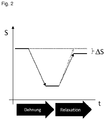
- the crosslinked polymer system is subject to the present Invention of a significantly lower hysteresis than comparable polymer systems with conventional crosslinking by sulfur vulcanization (see Figure 2 ).
- Suitable as a crosslinking agent is any polymer which, owing to its primary structure, forms a secondary structure within its own polymer chain and also carries chemically reactive groups on at least two of its monomers, preferably in the terminal region, particularly preferably on its respective terminal monomers a polymer of the polymer mixture to be crosslinked and / or another component of the composition can form a covalent bond.
- Such reactive groups for forming a covalent bond with the polymer chains of the polymers to be crosslinked and / or with other constituents of the composition are known to the person skilled in the art.
- R-SH can preferably be selected from -SH, R-Sx-R (in which R independently of one another for an aliphatic group with 1 to 24 C atoms and / or an aromatic group with 3 to 24 C atoms and / or a linker (one C chain) with at least one heteroatom, preferably selected from N, O and S, and x represents an integer from 2 to 8, preferably from 2 to 6, more preferably from 2 to 5, in particular 4, 3 or 2 ), Amine, amide, azide, cyanide, diazoalkane, alkoxy, nitrile oxide, nitrilimine, nitrone, aldehyde, ketone, carboxy, imide, thioketone, alkene, alkyne, Hydroxy, epoxy, thiotosylate, dithiocarbamate, silane sulfide, thioester or silane groups, without being limited to them.
- R-Sx-R in which R independently of one another for an alipha
- Such a crosslinking polymer can be represented by the formula X-Z-X, in which X independently of one another represents one of the reactive groups mentioned above and Z is the polymer which is capable of forming a secondary or tertiary structure.
- the polymer chain Z can be linear or branched, but is preferably linear.
- Polymers which are capable of forming a secondary structure or even of forming a tertiary structure are known in principle.
- examples of such polymers are oligopeptides, polypeptides or proteins which, owing to their primary structure (amino acid sequence), can form a helical structure ( ⁇ -helix or ⁇ -helix) or a ⁇ -sheet structure, which can also be arranged in a tertiary structure, DNA - or RNA single or double strands, for example loop-forming single strands, helix-forming double strands or "coiled-coil” -forming double strands, natural and synthetic block copolymers with repeating hydrophobic / hydrophilic blocks, repeating "hard (crystal-forming)" and "soft” blocks or repeating Blocks, one part of which is capable of forming non-covalent bonds, the other part of which is not limited to these.
- crosslinker polymers used are not restricted to a specific polymer type, as long as the polymer (s) can be described by the formula X-Z-X as indicated above.
- oligopeptides, polypeptides or proteins which have at least two reactive functional groups as defined for X in their amino acid chain. It is preferred that at least one of the functional group occurs in the terminal region of the peptide or protein, the term "terminal region" in connection with the polymers of the present invention meaning the last 5, 4, 3, 2 or the last monomer. It is particularly preferred that at least one of the reactive functional groups occurs on one of the two terminal amino acids, particularly preferably the terminal amino acids of the polymer chain each represent amino acids with one of the reactive functional side chains mentioned.
- An example of an amino acid with a corresponding reactive functional group is the cysteine that has a free SH group.
- “Oligopeptide” in the context of the present invention is understood by the person skilled in the art to mean an amino acid chain with at least 4 amino acids and up to 20 amino acids.
- “Polypeptide” is to be understood as an amino acid chain which comprises more than 20 amino acids and up to 100 amino acids.
- the term “peptide” refers to both an oligo and a polypeptide.
- An "amino acid sequence” that comprises more than 100 amino acids is referred to as "protein”. At least 4 amino acids are required in a peptide / protein to form an ⁇ -helical structure (one "turn” extends over 3.6 amino acids), and at least 5 amino acids to form a ⁇ -sheet structure. The formation of a ⁇ helix succeeds likewise only with at least 5 amino acids.
- Naturally occurring proteins or peptides can be used, in particular those which have a pronounced three-dimensional helix or sheet structure, or synthetic peptides or proteins which are produced and / or selected with the aspect of forming a secondary structure.
- the amino acids occurring in the peptides / proteins can be selected from all naturally occurring amino acids, as well as from synthetically modified amino acids.
- Synthetically modified amino acids can be modified either in the side group or in the peptide backbone (e.g. beta amino acids), or both in the side group and in the peptide backbone.
- DNA-binding proteins such as transcription factors (helix-loop-helix), transcription regulators (helix-turn-helix) , Silk proteins (leaflet) or myoglobin (8 helices), whereby these are only examples from an infinite number of proteins with corresponding structural elements.
- an oligopeptide is used as the crosslinking polymer, it is preferred that it comprises at least 4 amino acids, better but at least 13 amino acids, more preferably at least 16, even more preferably at least 20 amino acids. If a polypeptide or a protein is used, amino acid chains with at least 30, at least 40 or at least 50 amino acids are preferred, so that at least one pronounced secondary structure (helix or sheet) can form in the crosslinked polymer. If a protein with an amino acid chain of more than 100 amino acids is used, in addition to the formation of a secondary structure, a tertiary structure can also be formed.
- At least one helix or sheet structure is formed in the case of a protein or peptide as the crosslinking polymer used, particularly preferably at least one helix with at least one "revolution" (ie in the case of an ⁇ -helix a sequence which comprises at least 4 amino acids), better with at least 3 "cycles” (ie in the case of an ⁇ -helix a sequence which comprises at least 12 amino acids) ), preferably with at least 4 rounds, further preferably at least 5 rounds.
- the occurrence of more than one helix, for example two, three or four successive helix structures in a protein chain is also entirely preferred according to the invention.
- leaflet structures also meets the requirements for the crosslinker polymers according to the invention, as does the combination of helix and leaflet structures within the protein chain. It is also possible for different peptides and / or proteins to be used in a rubber composition for crosslinking the polymers to be crosslinked, these different peptides / proteins used being able to differ from one another both in their primary and in their secondary structure. Differences can exist in the chain length, the amino acid sequence and the amino acid modification, so that different secondary structures can develop here, on the one hand with regard to the expression (for example the number of revolutions of a helical structure or the number of "leaflets"), or the type (Helix, leaflet, or mixed structures) of the secondary structure. Such a variance of the peptides / proteins used can also be seen in a different molecular weight distribution of the peptides / proteins used.
- a peptide or protein as a crosslinking polymer at least one terminal amino acid of the polymer chain is a cysteine, the crosslinking polymer preferably contains at least two cysteines, particularly preferably both in the terminal position.
- Cysteine is a naturally occurring amino acid with a free SH group.
- nucleic acid chains include above all deoxribonucleic acid chains (DNA), but also ribonucleic acid chains (RNA) or peptide-nucleic acid conjugates.
- the nucleic acid chains can be single-stranded or double-stranded. In a preferred embodiment there are single-stranded nucleic acid chains, these having a sequence (primary structure) which has a Base pairing of the nucleic acid bases allows.
- a nucleic acid sequence is used which has a loop and at least one base pairing.
- a base pairing takes place over at least 2, preferably at least 3, more preferably at least 4, even more preferably at least 5, at least 6, at least 7 or at least 8 base pairs (this should be understood to mean that in each case 2 base pairs complementary nucleic acid bases are involved), it being particularly preferred that the nucleic acids involved in the base pairing follow one another in the sequence (with the "loop" nucleic acids in between).
- the nucleic acid chains according to the invention thus comprise at least 5 nucleic acids, preferably at least 6, at least 7, at least 8, at least 9 or at least 10 nucleic acids. It is advantageous for the stability of the loop structure if the base pairing takes place over at least a certain region, for example over at least 4, at least 6 or at least 8 successive bases.
- nucleic acid chains used must preferably comprise at least 10, preferably at least 14, more preferably at least 18 nucleic acids in order to be able to form such a structure (at least two non-complementary bases effect the "loop", that is to say the reversal of the nucleic acid chain). It is entirely preferred that the nucleic acid chains used can comprise more than 50, more than 70, more than 80 or even more than 100 nucleic acid monomers (nucleotides), it being possible for a plurality of secondary structures to be formed in a nucleic acid chain, which are connected, for example, via unpaired sequences , An example of such structures is the so-called “cloverleaf structure", which occurs naturally in tRNAs.
- the crosslinker polymers used can include naturally occurring nucleotides (adenine, guanine, thymine, cytosine, uracil) and / or also synthetic or synthetically modified nucleotides (example of a synthetic base pairing: dNaM-d5SICS and dNaM-dTPT3).
- sequence sequence in which a G-C pairing takes place within the nucleic acid chain will bring about a more stable structure than a sequence which leads to an A-T pairing.
- the sequences which lead to the formation of a base pairing which arises within the single-stranded nucleic acid chain can comprise any bases, but are "retrospectively complementary" to one another, i.e. the base pairing takes place after the nucleic acid chain "turns over" from a certain position and the bases of the following sequence form pairings with the bases of the previous sequence.
- Such a structure is referred to in the professional world as a "hairpin structure".
- Nucleic acid chains with hairpin structures occur naturally, the best known examples of which are tRNA molecules.
- Such hairpin structures can easily be incorporated into synthetic nucleic acid sequences; all that is required is a corresponding sequence of bases in the sequence.
- the sequences of the nucleic acid chains can also be chosen such that several hairpin structures are formed within the nucleic acid chain, which follow one another in the chain.
- nucleic acid chains are used as crosslinking polymers, functional reactive groups must be in the terminal region of the chain in order to form a covalent bond with the polymer chains to be crosslinked.
- the nucleic acids in the terminal region itself can be modified, or suitable molecules are conjugated to the chains.
- suitable amino acids such as cysteine.
- the crosslinking polymers can also be peptide-nucleic acid conjugates or protein-nucleic acid conjugates, it being possible here for the structural properties of both types of molecules in the conjugate to complement one another.
- conjugates which have a long nucleic acid portion Z and a single or more amino acids conjugated to them at both ends of the chain can also meet the requirements placed on the crosslinker polymers of the present invention.
- natural or synthetically produced block copolymers from any monomer units can meet the requirements for the crosslinker polymers, provided that they contain blocks that can interact with one another via one of the abovementioned forces and thereby give the block copolymer a defined secondary or even Give tertiary structure.
- crosslinking polymers can also be used for the crosslinking of the polymers to be crosslinked.
- the free reactive groups X of the crosslinker polymer for example the SH groups of a cysteine, but also all the other reactive functional groups mentioned above, are able to form a covalent bond in a chemical reaction with the polymers to be crosslinked, so that Crosslinker polymer is covalently bonded to the polymers of the rubber mixture, for example.
- Rubber is usually made by vulcanization, i.e. cross-linked by a chemical reaction.
- Vulcanization is the linking of the polymer chains of the rubber by using reactive groups contained therein (for example double bonds in the rubber polymer chains) for crosslinking.
- the best known way of vulcanizing polymer chains that contain double bonds is to crosslink them with sulfur or sulfur-containing molecules.
- vulcanization via peroxides or resins is also known (this can also be used if double bonds are present in the polymers).
- the polymers to be crosslinked contain reactive groups such as halogens or carboxy functions, metal oxide such as MgO or ZnO are also used.
- butadiene-styrene, butadiene-acrylonitrile and other rubbers can also be vulcanized purely thermally. A mixture of the vulcanization methods mentioned can also be used. In the case of silicone rubbers, the crosslinking reaction which releases acetic acid can also be used.
- the crosslinker polymers replace at least some of the compounds used for the crosslinking, for example the sulfur molecules or sulfur groups in reactive compounds, so that in addition to the conventional ones Vulcanization introduced di- or oligosulfide bonds for crosslinking the rubber polymers and crosslinks via the crosslinker polymers are present.
- the crosslinking via the crosslinker polymers according to the present invention can also be the only form of crosslinking in the polymer mixture. In this case, "normal" vulcanization is dispensed with.
- the crosslinker polymers can represent different types of polymers, or several different types of crosslinker polymers can also be used side by side.
- oligopeptides, polypeptides, proteins, DNA, RNA, natural or synthetic block copolymers or other synthetic polymers or mixtures of such polymers can be used as crosslinkers.
- the suitability and preference of individual polymers or mixtures thereof depends on the conditions under which the crosslinking takes place and the application for which the crosslinked polymer mixture is intended.
- the crosslinking polymers of the rubber mixture are used in an amount of 0.1 to 300, preferably 0.1 to 100 phr and particularly preferably 0.1 to 80 phr.
- the ratio of the polymers to be crosslinked and the crosslinker polymers in the mixture before crosslinking is 1:50 to 100: 1, based on the polymer molecules, preferably 1:10 to 20: 1, even more preferably 1: 1 to 3: 2 (number of polymer chains used).
- the vulcanization of the rubber mixture crosslinked according to the invention can be carried out in the presence of sulfur and / or sulfur donors with the aid of vulcanization accelerators, some vulcanization accelerators also being able to act as sulfur donors.
- the accelerator is selected from the group consisting of thiazole accelerators and / or mercapto accelerators and / or sulfenamide accelerators and / or thiocarbamate accelerators and / or thiuram accelerators and / or thiophosphate accelerators and / or thiourea accelerators and / or xanthates and accelerators and / or accelerators and / or accelerators and / or accelerators and / or accelerators and / or accelerators and / or accelerators and / or accelerators and / or accelerators and / or accelerators and / or accelerators and / or accelerators and / or accelerators and / or accelerators and / or accelerators and / or accelerators or accelerators morpholine.
- a sulfenamide accelerator which is selected from the group consisting of N-cyclohexyl-2-benzothiazolesufenamid (CBS) and / or N, N-dicyclohexylbenzothiazol-2-sulfenamide (DCBS) and / or N-tert-butyl-2 -benzothiazylsulfenamide (TBBS).
- CBS N-cyclohexyl-2-benzothiazolesufenamid
- DCBS N-dicyclohexylbenzothiazol-2-sulfenamide
- TBBS N-tert-butyl-2 -benzothiazylsulfenamide
- the rubber mixture contains a sulfur-donating substance, it is preferably selected from the group consisting of, for example, thiuram disulfides, such as, for example, tetrabenzylthiuram disulfide (TBzTD) and / or tetramethylthiuram disulfide (TMTD) and / or tetraethylthiuram disulfide (TETD), such as, and / or thasulfide (eg, tetrasulfide), such as and / or thasulfide (for example), and / or thulfide, such as, , and / or dithiophosphates, such as DipDis (bis (diisopropyl) thiophosphoryl disulfide) and / or bis (O, O-2-ethylhexyl thiophosphoryl) polysulfide (e
- thiuram disulfides such as, for example, tetrabenzyl
- Rhenocure SDT 50 (R) Rheinchemie GmbH
- / or zinc dichloryldithiophosphate e.g. Rhenocure ZDT / S (R) Rheinchemie GmbH
- / or zinc alkyldithiophosphate e.g. 1,6-bis (N, N-dibenzylthiocarbamoyldithio) hexane and / or diaryl polysulfides and / or dialkyl polysulfides.
- Suitable vulcanization accelerators are, for example, mercaptobenzothiazole, tetramethylthiuram disulfide, benzothiazole disulfide, diphenylguanidine, zinc dithiocarbamate, alkylphenol disulfide, zinc butyl xanthate, N-dicyclohexyl-2-benzothiazole-nolphenyl-2-benzothiazole-2-benzothiazole-2-benzyl-oxyphenyl-2-benzyl-oxyphenyl-2-benzol-2-enol-2-benzothiazole-2-benzol-2-enol-2-benzothiazole-2-benzol-2-enol-2-benzothiazole-2-enol-2-benzothiazole-2-enol-2-benzothiazole-2-enol-2-benzothiazole-2-enol-2-benzothiazole-2-enol-2-benzothiazole-2-enol-2
- a "conventional vulcanization" can be dispensed with and the rubber polymers are essentially or completely only by crosslinked the use of the crosslinker polymers described here.
- Crosslinking preferably takes place via the crosslinker polymers described here, however, in addition to crosslinking of the polymers via "conventional” vulcanization.
- the crosslinking via the crosslinking polymer takes place depending on the reactive functional group used on the crosslinking polymer under suitable reaction conditions. If sulfur-containing groups are used as reactive functional groups, the crosslinking takes place via a chemical reaction corresponding to the vulcanization, in which the crosslinker polymers at least partially replace the sulfur donors normally used.
- the rubber mixture according to the invention also preferably contains at least one filler such as silica, carbon black and, if appropriate, other known polar and / or non-polar fillers such as aluminosilicates and other silicates, chalk, kaolin, starch, magnesium oxide, zinc oxide, clay minerals such as bentonite, titanium dioxide and / or rubber gels , and carbon nanotubes (CNT) including discrete CNTs, so-called hollow carbon fibers (HCF) and modified CNT containing one or more functional groups, such as hydroxyl, carboxy and carbonyl groups) and / or graphite and / or graphenes and / or so-called "carbon-silica dual-phase filler".
- a filler such as silica, carbon black and, if appropriate, other known polar and / or non-polar fillers such as aluminosilicates and other silicates, chalk, kaolin, starch, magnesium oxide, zinc oxide, clay minerals such as bentonite, titanium
- the rubber mixture preferably contains 1 to 300 phr, particularly preferably 1 to 200 phr, very particularly preferably 1 to 150 phr, of at least one silica.
- the rubber mixture preferably contains 1 to 200 phr, particularly preferably 1 to 170 phr and very particularly preferably 1 to 100 phr of at least one carbon black.
- the silicas can be the silicas known to the person skilled in the art which are suitable as fillers for tire rubber mixtures.
- Precipitated silica is preferably used. It is particularly preferred if a finely divided, precipitated silica is used which has a nitrogen surface (BET surface area) (according to DIN ISO 9277 and DIN 66132) of 35 to 350 m 2 / g, preferably 60 to 260 m 2 / g, particularly preferably from 120 to 250 m 2 / g, and a CTAB surface (according to ASTM D 3765) from 30 to 400 m 2 / g, preferably from 60 to 250 m 2 / g, particularly preferably from 120 to 250 m 2 / g.
- BET surface area accordinging to DIN ISO 9277 and DIN 66132
- CTAB surface accordinging to ASTM D 3765
- the rubber mixture contains carbon black, all types of carbon black known to the person skilled in the art are conceivable.
- a carbon black is preferably used which has an iodine adsorption number according to ASTM D 1510 of 30 to 180 g / kg, preferably 30 to 130 kg / g, and a DBP number according to ASTM D 2414 of 80 to 200 ml / 100 g, preferably 100 up to 200 ml / 100g, particularly preferably 100 to 180 ml / 100g.
- the rubber mixture according to the invention can also contain a mixture of two or more of the fillers mentioned.
- the fillers mentioned can also be bound to the crosslinked polymers, in particular the rubber polymers, with the aid of the crosslinker polymers.
- crosslinking polymers are used which have at least one group reactive with the polymers to be crosslinked and one group reactive with the fillers. By reacting these groups with the polymers on the one hand and the fillers on the other hand, these fillers are covalently bound to the crosslinked polymers.
- the crosslinker polymers can thus replace at least some of the silanes usually used for this purpose.
- the fillers used can also be linked to one another via the crosslinker polymers used.
- Zinc oxide is not one of the fillers in the context of the present invention, but is preferably present in combination with stearic acid in the rubber mixture according to the invention.
- the rubber mixture preferably also contains other additives.
- additives can essentially be silane coupling agents for the connection of silica to the polymer chains of the rubbers contained, plasticizers, vulcanization accelerators, anti-ozone agents, anti-aging agents, antioxidants, adhesive resins, mastication aids and other activators or processing aids such as B. fatty acids or fatty acid derivatives such as metal soaps (z. B. zinc or calcium soaps) or Fatty acid esters or amides and / or metal complexes such as zinc ethyl hexanoate or mixtures thereof.
- B. fatty acids or fatty acid derivatives such as metal soaps (z. B. zinc or calcium soaps) or Fatty acid esters or amides and / or metal complexes such as zinc ethyl hexanoate or mixtures thereof.
- the proportion of the total amount of further additives is preferably 3 to 150 phr, preferably 3 to 100 phr and particularly preferably 5 to 100 phr.
- plasticizers used in the context of the present invention include all plasticizers known to the person skilled in the art, such as aromatic, naphthenic or paraffinic mineral oil plasticizers, such as e.g. MES (mild extraction solvate) or RAE (Residual Aromatic Extract) or TDAE (treated distillate aromatic extract), or Rubberto-Liquid-oils (RTL) or Biomass-to-Liquid-oils (BTL) preferably with a content of polycyclic aromatics from less than 3% by weight according to method IP 346 or vegetable oils, e.g.
- the present invention furthermore relates to the use of the crosslinked rubber mixture described for the production of an elastic material, for example for the production of rubber articles such as bellows, conveyor belts, air springs, belts, belts, for example V-belts, toothed belts, flat belts, V-ribbed belts, hoses, Shoe soles, profiles, seals, membranes, rubber rings, tactile sensors for medical applications or robot applications, or vehicle tires (including parts thereof).
- Another object of the invention is therefore an elastic material, in the production of which at least one crosslinked rubber mixture according to the invention was used.
- Vehicle tires are pneumatic vehicle tires and solid rubber tires, including tires for industrial and construction site vehicles, truck, car and two-wheel tires.
- the rubber mixture according to the invention can also be used for the production of certain Parts of such tires are used, for example for the production of the tread or a body mixture, including sidewall, inner soul, apex, belt, shoulder, squeegees, further inserts (eg run flat), belt profile, carcass, bead reinforcement and / or bandage.
Landscapes
- Chemical & Material Sciences (AREA)
- Health & Medical Sciences (AREA)
- Chemical Kinetics & Catalysis (AREA)
- Medicinal Chemistry (AREA)
- Polymers & Plastics (AREA)
- Organic Chemistry (AREA)
- Engineering & Computer Science (AREA)
- Mechanical Engineering (AREA)
- Compositions Of Macromolecular Compounds (AREA)
Priority Applications (2)
| Application Number | Priority Date | Filing Date | Title |
|---|---|---|---|
| EP18184078.6A EP3597698B1 (fr) | 2018-07-18 | 2018-07-18 | Mélanges polymères réticulés |
| ES18184078T ES2902664T3 (es) | 2018-07-18 | 2018-07-18 | Mezclas poliméricas reticuladas |
Applications Claiming Priority (1)
| Application Number | Priority Date | Filing Date | Title |
|---|---|---|---|
| EP18184078.6A EP3597698B1 (fr) | 2018-07-18 | 2018-07-18 | Mélanges polymères réticulés |
Publications (2)
| Publication Number | Publication Date |
|---|---|
| EP3597698A1 true EP3597698A1 (fr) | 2020-01-22 |
| EP3597698B1 EP3597698B1 (fr) | 2021-10-06 |
Family
ID=63113333
Family Applications (1)
| Application Number | Title | Priority Date | Filing Date |
|---|---|---|---|
| EP18184078.6A Active EP3597698B1 (fr) | 2018-07-18 | 2018-07-18 | Mélanges polymères réticulés |
Country Status (2)
| Country | Link |
|---|---|
| EP (1) | EP3597698B1 (fr) |
| ES (1) | ES2902664T3 (fr) |
Cited By (2)
| Publication number | Priority date | Publication date | Assignee | Title |
|---|---|---|---|---|
| CN119639422A (zh) * | 2025-02-17 | 2025-03-18 | 华鸿画家居股份有限公司 | 基于纳米杂化动态交联网络的改性蛋白胶黏剂及其制备方法和应用 |
| CN120536071A (zh) * | 2025-06-25 | 2025-08-26 | 厦门佳智科技有限公司 | 一种轮胎用自密封胶及其制备方法 |
Citations (12)
| Publication number | Priority date | Publication date | Assignee | Title |
|---|---|---|---|---|
| DE4005493A1 (de) * | 1989-02-21 | 1990-08-23 | Toyo Tire & Rubber Co | Kautschukmasse fuer reifen |
| DE19622169A1 (de) * | 1995-06-07 | 1996-12-12 | Semperit Reifen | Kautschukmischung |
| US5587411A (en) * | 1992-12-01 | 1996-12-24 | Sumitomo Rubber Industries, Ltd. | Rubber composition and method of producing rubber products using the same composition |
| EP1234852A1 (fr) * | 2001-02-23 | 2002-08-28 | Continental Aktiengesellschaft | Composition de caoutchouc pour bande de roulement d'un pneu |
| US20080108733A1 (en) * | 2006-11-07 | 2008-05-08 | Cooper Tire & Rubber Co. | Method and formulation for reinforcing elastomers |
| EP2098564A1 (fr) * | 2008-03-08 | 2009-09-09 | Continental Aktiengesellschaft | Composotion de caoutchouc et pneu ainsi fabriqué |
| WO2010049216A2 (fr) | 2008-10-30 | 2010-05-06 | Continental Reifen Deutschland Gmbh | Mélange de caoutchouc pour pneumatiques avec agent de vulcanisation amélioré |
| US20160237261A1 (en) | 2013-09-26 | 2016-08-18 | Ll JIA | Thermoset rubber reinforced by supramolecule building blocks |
| DE102015210422A1 (de) * | 2015-06-08 | 2016-12-08 | Continental Reifen Deutschland Gmbh | Kautschukmischung und Fahrzeugreifen |
| DE102015213667A1 (de) * | 2015-07-21 | 2017-01-26 | Continental Reifen Deutschland Gmbh | Kautschukmischung und Fahrzeugreifen |
| US20170342252A1 (en) * | 2014-12-18 | 2017-11-30 | Bridgestone Americas Tire Operations, Llc | Rubber compositions containing whey protein |
| EP3312204A1 (fr) * | 2010-10-13 | 2018-04-25 | ExxonMobil Chemical Patents Inc. | Modificateurs polymères hydrocarbonés fonctionnalisés par silane pour compositions élastomères |
-
2018
- 2018-07-18 ES ES18184078T patent/ES2902664T3/es active Active
- 2018-07-18 EP EP18184078.6A patent/EP3597698B1/fr active Active
Patent Citations (12)
| Publication number | Priority date | Publication date | Assignee | Title |
|---|---|---|---|---|
| DE4005493A1 (de) * | 1989-02-21 | 1990-08-23 | Toyo Tire & Rubber Co | Kautschukmasse fuer reifen |
| US5587411A (en) * | 1992-12-01 | 1996-12-24 | Sumitomo Rubber Industries, Ltd. | Rubber composition and method of producing rubber products using the same composition |
| DE19622169A1 (de) * | 1995-06-07 | 1996-12-12 | Semperit Reifen | Kautschukmischung |
| EP1234852A1 (fr) * | 2001-02-23 | 2002-08-28 | Continental Aktiengesellschaft | Composition de caoutchouc pour bande de roulement d'un pneu |
| US20080108733A1 (en) * | 2006-11-07 | 2008-05-08 | Cooper Tire & Rubber Co. | Method and formulation for reinforcing elastomers |
| EP2098564A1 (fr) * | 2008-03-08 | 2009-09-09 | Continental Aktiengesellschaft | Composotion de caoutchouc et pneu ainsi fabriqué |
| WO2010049216A2 (fr) | 2008-10-30 | 2010-05-06 | Continental Reifen Deutschland Gmbh | Mélange de caoutchouc pour pneumatiques avec agent de vulcanisation amélioré |
| EP3312204A1 (fr) * | 2010-10-13 | 2018-04-25 | ExxonMobil Chemical Patents Inc. | Modificateurs polymères hydrocarbonés fonctionnalisés par silane pour compositions élastomères |
| US20160237261A1 (en) | 2013-09-26 | 2016-08-18 | Ll JIA | Thermoset rubber reinforced by supramolecule building blocks |
| US20170342252A1 (en) * | 2014-12-18 | 2017-11-30 | Bridgestone Americas Tire Operations, Llc | Rubber compositions containing whey protein |
| DE102015210422A1 (de) * | 2015-06-08 | 2016-12-08 | Continental Reifen Deutschland Gmbh | Kautschukmischung und Fahrzeugreifen |
| DE102015213667A1 (de) * | 2015-07-21 | 2017-01-26 | Continental Reifen Deutschland Gmbh | Kautschukmischung und Fahrzeugreifen |
Non-Patent Citations (3)
| Title |
|---|
| "Progress in Polymer Science", vol. 34, 2009, ELSEVIER, pages: 811 - 851 |
| LIU, J. ET AL.: "Macromolecules, herausgegeben von der American Chemical Society am", 31 October 2016, pages: 8593 - 8604 |
| WU, J. ET AL.: "Advanced Material", vol. 29, 2017, article "selbstheilender Elastomere" |
Cited By (2)
| Publication number | Priority date | Publication date | Assignee | Title |
|---|---|---|---|---|
| CN119639422A (zh) * | 2025-02-17 | 2025-03-18 | 华鸿画家居股份有限公司 | 基于纳米杂化动态交联网络的改性蛋白胶黏剂及其制备方法和应用 |
| CN120536071A (zh) * | 2025-06-25 | 2025-08-26 | 厦门佳智科技有限公司 | 一种轮胎用自密封胶及其制备方法 |
Also Published As
| Publication number | Publication date |
|---|---|
| EP3597698B1 (fr) | 2021-10-06 |
| ES2902664T3 (es) | 2022-03-29 |
Similar Documents
| Publication | Publication Date | Title |
|---|---|---|
| EP3303004B1 (fr) | Mélange de caoutchouc et pneu de véhicule | |
| EP3150402B1 (fr) | Compose caoutchouc et pneu de vehicule | |
| EP3150401B1 (fr) | Compose caoutchouc et pneu de vehicule | |
| EP3150403B1 (fr) | Compose caoutchouc et pneu de vehicule | |
| EP3307556B1 (fr) | Mélange de caoutchouc et pneu de véhicule | |
| EP1211283A1 (fr) | Mélange de caoutchouc comprenant un silicate à couches expansées | |
| EP2977227B1 (fr) | Mélange de caoutchouc réticulable au soufre et pneu | |
| DE102015218746A1 (de) | Kautschukmischung und Fahrzeugreifen | |
| DE102015210422A1 (de) | Kautschukmischung und Fahrzeugreifen | |
| WO2018210471A1 (fr) | Mélange de caoutchouc réticulé au soufre pour pneumatiques de véhicule, contenant des nanotubes de carbone (cnt), pneumatique de véhicule comprenant le mélange de caoutchouc réticulé au soufre, et procédé de préparation du mélange de caoutchouc réticulé au soufre contenant des nanotubes de carbone | |
| EP3156443A1 (fr) | Mélange de caoutchouc et pneu de véhicule | |
| DE102019212916B4 (de) | Vernetzbare Kautschukmischung, Vulkanisat daraus, sowie Verwendung der Kautschukmischung bzw. des Vulkanisats | |
| EP3597698B1 (fr) | Mélanges polymères réticulés | |
| EP2987813B1 (fr) | Mélange de caoutchouc réticulable au soufre et pneu | |
| EP3720905B1 (fr) | Composition de caoutchouc réticulable au soufre, composition de caoutchouc réticulée et pneumatique | |
| EP3109064A1 (fr) | Procede de copolymerisation, melange de copolymere et de caoutchouc et son utilisation | |
| DE102018211763B4 (de) | Schwefelvernetzbare Kautschukmischung, Vulkanisat und Fahrzeugreifen | |
| DE102016210267A1 (de) | Schwefelvernetzbare Kautschukmischung und Fahrzeugluftreifen | |
| DE102021206251A1 (de) | Kautschukmischung und Reifen | |
| DE102019209825A1 (de) | Kautschukmischung und Reifen | |
| DE102019207526B4 (de) | Schwefelvernetzbare Kautschukmischung, Vulkanisat und Verwendung in einem Fahrzeugreifen | |
| DE102016207396A1 (de) | Schwefelvernetzbare Kautschukmischung und Fahrzeugluftreifen | |
| DE102015216308B4 (de) | Kautschukmischung, Verfahren zu deren Herstellung, Vulkanisat daraus und Verwendung zur Herstellung von Fahrzeugreifen | |
| DE102021206277A1 (de) | Kautschukmischung und Reifen | |
| EP4011643A1 (fr) | Mélange de caoutchouc et pneumatique de véhicule |
Legal Events
| Date | Code | Title | Description |
|---|---|---|---|
| PUAI | Public reference made under article 153(3) epc to a published international application that has entered the european phase |
Free format text: ORIGINAL CODE: 0009012 |
|
| STAA | Information on the status of an ep patent application or granted ep patent |
Free format text: STATUS: THE APPLICATION HAS BEEN PUBLISHED |
|
| AK | Designated contracting states |
Kind code of ref document: A1 Designated state(s): AL AT BE BG CH CY CZ DE DK EE ES FI FR GB GR HR HU IE IS IT LI LT LU LV MC MK MT NL NO PL PT RO RS SE SI SK SM TR |
|
| AX | Request for extension of the european patent |
Extension state: BA ME |
|
| STAA | Information on the status of an ep patent application or granted ep patent |
Free format text: STATUS: REQUEST FOR EXAMINATION WAS MADE |
|
| 17P | Request for examination filed |
Effective date: 20200722 |
|
| RBV | Designated contracting states (corrected) |
Designated state(s): AL AT BE BG CH CY CZ DE DK EE ES FI FR GB GR HR HU IE IS IT LI LT LU LV MC MK MT NL NO PL PT RO RS SE SI SK SM TR |
|
| RAP1 | Party data changed (applicant data changed or rights of an application transferred) |
Owner name: CONTINENTAL REIFEN DEUTSCHLAND GMBH |
|
| STAA | Information on the status of an ep patent application or granted ep patent |
Free format text: STATUS: EXAMINATION IS IN PROGRESS |
|
| 17Q | First examination report despatched |
Effective date: 20210112 |
|
| GRAP | Despatch of communication of intention to grant a patent |
Free format text: ORIGINAL CODE: EPIDOSNIGR1 |
|
| STAA | Information on the status of an ep patent application or granted ep patent |
Free format text: STATUS: GRANT OF PATENT IS INTENDED |
|
| RIC1 | Information provided on ipc code assigned before grant |
Ipc: C08L 21/00 20060101AFI20210527BHEP Ipc: B60C 1/00 20060101ALI20210527BHEP |
|
| INTG | Intention to grant announced |
Effective date: 20210621 |
|
| GRAS | Grant fee paid |
Free format text: ORIGINAL CODE: EPIDOSNIGR3 |
|
| GRAA | (expected) grant |
Free format text: ORIGINAL CODE: 0009210 |
|
| STAA | Information on the status of an ep patent application or granted ep patent |
Free format text: STATUS: THE PATENT HAS BEEN GRANTED |
|
| AK | Designated contracting states |
Kind code of ref document: B1 Designated state(s): AL AT BE BG CH CY CZ DE DK EE ES FI FR GB GR HR HU IE IS IT LI LT LU LV MC MK MT NL NO PL PT RO RS SE SI SK SM TR |
|
| REG | Reference to a national code |
Ref country code: GB Ref legal event code: FG4D Free format text: NOT ENGLISH |
|
| REG | Reference to a national code |
Ref country code: CH Ref legal event code: EP Ref country code: AT Ref legal event code: REF Ref document number: 1436202 Country of ref document: AT Kind code of ref document: T Effective date: 20211015 |
|
| REG | Reference to a national code |
Ref country code: DE Ref legal event code: R096 Ref document number: 502018007336 Country of ref document: DE |
|
| REG | Reference to a national code |
Ref country code: IE Ref legal event code: FG4D Free format text: LANGUAGE OF EP DOCUMENT: GERMAN |
|
| REG | Reference to a national code |
Ref country code: LT Ref legal event code: MG9D |
|
| REG | Reference to a national code |
Ref country code: NL Ref legal event code: MP Effective date: 20211006 |
|
| REG | Reference to a national code |
Ref country code: ES Ref legal event code: FG2A Ref document number: 2902664 Country of ref document: ES Kind code of ref document: T3 Effective date: 20220329 |
|
| PG25 | Lapsed in a contracting state [announced via postgrant information from national office to epo] |
Ref country code: RS Free format text: LAPSE BECAUSE OF FAILURE TO SUBMIT A TRANSLATION OF THE DESCRIPTION OR TO PAY THE FEE WITHIN THE PRESCRIBED TIME-LIMIT Effective date: 20211006 Ref country code: LT Free format text: LAPSE BECAUSE OF FAILURE TO SUBMIT A TRANSLATION OF THE DESCRIPTION OR TO PAY THE FEE WITHIN THE PRESCRIBED TIME-LIMIT Effective date: 20211006 Ref country code: FI Free format text: LAPSE BECAUSE OF FAILURE TO SUBMIT A TRANSLATION OF THE DESCRIPTION OR TO PAY THE FEE WITHIN THE PRESCRIBED TIME-LIMIT Effective date: 20211006 Ref country code: BG Free format text: LAPSE BECAUSE OF FAILURE TO SUBMIT A TRANSLATION OF THE DESCRIPTION OR TO PAY THE FEE WITHIN THE PRESCRIBED TIME-LIMIT Effective date: 20220106 |
|
| PG25 | Lapsed in a contracting state [announced via postgrant information from national office to epo] |
Ref country code: IS Free format text: LAPSE BECAUSE OF FAILURE TO SUBMIT A TRANSLATION OF THE DESCRIPTION OR TO PAY THE FEE WITHIN THE PRESCRIBED TIME-LIMIT Effective date: 20220206 Ref country code: SE Free format text: LAPSE BECAUSE OF FAILURE TO SUBMIT A TRANSLATION OF THE DESCRIPTION OR TO PAY THE FEE WITHIN THE PRESCRIBED TIME-LIMIT Effective date: 20211006 Ref country code: PT Free format text: LAPSE BECAUSE OF FAILURE TO SUBMIT A TRANSLATION OF THE DESCRIPTION OR TO PAY THE FEE WITHIN THE PRESCRIBED TIME-LIMIT Effective date: 20220207 Ref country code: PL Free format text: LAPSE BECAUSE OF FAILURE TO SUBMIT A TRANSLATION OF THE DESCRIPTION OR TO PAY THE FEE WITHIN THE PRESCRIBED TIME-LIMIT Effective date: 20211006 Ref country code: NO Free format text: LAPSE BECAUSE OF FAILURE TO SUBMIT A TRANSLATION OF THE DESCRIPTION OR TO PAY THE FEE WITHIN THE PRESCRIBED TIME-LIMIT Effective date: 20220106 Ref country code: NL Free format text: LAPSE BECAUSE OF FAILURE TO SUBMIT A TRANSLATION OF THE DESCRIPTION OR TO PAY THE FEE WITHIN THE PRESCRIBED TIME-LIMIT Effective date: 20211006 Ref country code: LV Free format text: LAPSE BECAUSE OF FAILURE TO SUBMIT A TRANSLATION OF THE DESCRIPTION OR TO PAY THE FEE WITHIN THE PRESCRIBED TIME-LIMIT Effective date: 20211006 Ref country code: HR Free format text: LAPSE BECAUSE OF FAILURE TO SUBMIT A TRANSLATION OF THE DESCRIPTION OR TO PAY THE FEE WITHIN THE PRESCRIBED TIME-LIMIT Effective date: 20211006 Ref country code: GR Free format text: LAPSE BECAUSE OF FAILURE TO SUBMIT A TRANSLATION OF THE DESCRIPTION OR TO PAY THE FEE WITHIN THE PRESCRIBED TIME-LIMIT Effective date: 20220107 |
|
| REG | Reference to a national code |
Ref country code: DE Ref legal event code: R097 Ref document number: 502018007336 Country of ref document: DE |
|
| PG25 | Lapsed in a contracting state [announced via postgrant information from national office to epo] |
Ref country code: SM Free format text: LAPSE BECAUSE OF FAILURE TO SUBMIT A TRANSLATION OF THE DESCRIPTION OR TO PAY THE FEE WITHIN THE PRESCRIBED TIME-LIMIT Effective date: 20211006 Ref country code: SK Free format text: LAPSE BECAUSE OF FAILURE TO SUBMIT A TRANSLATION OF THE DESCRIPTION OR TO PAY THE FEE WITHIN THE PRESCRIBED TIME-LIMIT Effective date: 20211006 Ref country code: RO Free format text: LAPSE BECAUSE OF FAILURE TO SUBMIT A TRANSLATION OF THE DESCRIPTION OR TO PAY THE FEE WITHIN THE PRESCRIBED TIME-LIMIT Effective date: 20211006 Ref country code: EE Free format text: LAPSE BECAUSE OF FAILURE TO SUBMIT A TRANSLATION OF THE DESCRIPTION OR TO PAY THE FEE WITHIN THE PRESCRIBED TIME-LIMIT Effective date: 20211006 Ref country code: DK Free format text: LAPSE BECAUSE OF FAILURE TO SUBMIT A TRANSLATION OF THE DESCRIPTION OR TO PAY THE FEE WITHIN THE PRESCRIBED TIME-LIMIT Effective date: 20211006 Ref country code: CZ Free format text: LAPSE BECAUSE OF FAILURE TO SUBMIT A TRANSLATION OF THE DESCRIPTION OR TO PAY THE FEE WITHIN THE PRESCRIBED TIME-LIMIT Effective date: 20211006 |
|
| PLBE | No opposition filed within time limit |
Free format text: ORIGINAL CODE: 0009261 |
|
| STAA | Information on the status of an ep patent application or granted ep patent |
Free format text: STATUS: NO OPPOSITION FILED WITHIN TIME LIMIT |
|
| 26N | No opposition filed |
Effective date: 20220707 |
|
| PG25 | Lapsed in a contracting state [announced via postgrant information from national office to epo] |
Ref country code: AL Free format text: LAPSE BECAUSE OF FAILURE TO SUBMIT A TRANSLATION OF THE DESCRIPTION OR TO PAY THE FEE WITHIN THE PRESCRIBED TIME-LIMIT Effective date: 20211006 |
|
| PG25 | Lapsed in a contracting state [announced via postgrant information from national office to epo] |
Ref country code: SI Free format text: LAPSE BECAUSE OF FAILURE TO SUBMIT A TRANSLATION OF THE DESCRIPTION OR TO PAY THE FEE WITHIN THE PRESCRIBED TIME-LIMIT Effective date: 20211006 |
|
| PG25 | Lapsed in a contracting state [announced via postgrant information from national office to epo] |
Ref country code: MC Free format text: LAPSE BECAUSE OF FAILURE TO SUBMIT A TRANSLATION OF THE DESCRIPTION OR TO PAY THE FEE WITHIN THE PRESCRIBED TIME-LIMIT Effective date: 20211006 |
|
| REG | Reference to a national code |
Ref country code: CH Ref legal event code: PL |
|
| GBPC | Gb: european patent ceased through non-payment of renewal fee |
Effective date: 20220718 |
|
| REG | Reference to a national code |
Ref country code: BE Ref legal event code: MM Effective date: 20220731 |
|
| PG25 | Lapsed in a contracting state [announced via postgrant information from national office to epo] |
Ref country code: LU Free format text: LAPSE BECAUSE OF NON-PAYMENT OF DUE FEES Effective date: 20220718 Ref country code: LI Free format text: LAPSE BECAUSE OF NON-PAYMENT OF DUE FEES Effective date: 20220731 Ref country code: CH Free format text: LAPSE BECAUSE OF NON-PAYMENT OF DUE FEES Effective date: 20220731 |
|
| PG25 | Lapsed in a contracting state [announced via postgrant information from national office to epo] |
Ref country code: IT Free format text: LAPSE BECAUSE OF FAILURE TO SUBMIT A TRANSLATION OF THE DESCRIPTION OR TO PAY THE FEE WITHIN THE PRESCRIBED TIME-LIMIT Effective date: 20211006 Ref country code: GB Free format text: LAPSE BECAUSE OF NON-PAYMENT OF DUE FEES Effective date: 20220718 Ref country code: BE Free format text: LAPSE BECAUSE OF NON-PAYMENT OF DUE FEES Effective date: 20220731 |
|
| PG25 | Lapsed in a contracting state [announced via postgrant information from national office to epo] |
Ref country code: IE Free format text: LAPSE BECAUSE OF NON-PAYMENT OF DUE FEES Effective date: 20220718 |
|
| REG | Reference to a national code |
Ref country code: DE Ref legal event code: R081 Ref document number: 502018007336 Country of ref document: DE Owner name: CONTINENTAL REIFEN DEUTSCHLAND GMBH, DE Free format text: FORMER OWNER: CONTINENTAL REIFEN DEUTSCHLAND GMBH, 30165 HANNOVER, DE |
|
| PG25 | Lapsed in a contracting state [announced via postgrant information from national office to epo] |
Ref country code: HU Free format text: LAPSE BECAUSE OF FAILURE TO SUBMIT A TRANSLATION OF THE DESCRIPTION OR TO PAY THE FEE WITHIN THE PRESCRIBED TIME-LIMIT; INVALID AB INITIO Effective date: 20180718 |
|
| PG25 | Lapsed in a contracting state [announced via postgrant information from national office to epo] |
Ref country code: MK Free format text: LAPSE BECAUSE OF FAILURE TO SUBMIT A TRANSLATION OF THE DESCRIPTION OR TO PAY THE FEE WITHIN THE PRESCRIBED TIME-LIMIT Effective date: 20211006 Ref country code: CY Free format text: LAPSE BECAUSE OF FAILURE TO SUBMIT A TRANSLATION OF THE DESCRIPTION OR TO PAY THE FEE WITHIN THE PRESCRIBED TIME-LIMIT Effective date: 20211006 |
|
| PG25 | Lapsed in a contracting state [announced via postgrant information from national office to epo] |
Ref country code: TR Free format text: LAPSE BECAUSE OF FAILURE TO SUBMIT A TRANSLATION OF THE DESCRIPTION OR TO PAY THE FEE WITHIN THE PRESCRIBED TIME-LIMIT Effective date: 20211006 |
|
| REG | Reference to a national code |
Ref country code: AT Ref legal event code: MM01 Ref document number: 1436202 Country of ref document: AT Kind code of ref document: T Effective date: 20230718 |
|
| PG25 | Lapsed in a contracting state [announced via postgrant information from national office to epo] |
Ref country code: MT Free format text: LAPSE BECAUSE OF FAILURE TO SUBMIT A TRANSLATION OF THE DESCRIPTION OR TO PAY THE FEE WITHIN THE PRESCRIBED TIME-LIMIT Effective date: 20211006 |
|
| PG25 | Lapsed in a contracting state [announced via postgrant information from national office to epo] |
Ref country code: AT Free format text: LAPSE BECAUSE OF NON-PAYMENT OF DUE FEES Effective date: 20230718 |
|
| PG25 | Lapsed in a contracting state [announced via postgrant information from national office to epo] |
Ref country code: AT Free format text: LAPSE BECAUSE OF NON-PAYMENT OF DUE FEES Effective date: 20230718 |
|
| PGFP | Annual fee paid to national office [announced via postgrant information from national office to epo] |
Ref country code: ES Payment date: 20250827 Year of fee payment: 8 |
|
| PGFP | Annual fee paid to national office [announced via postgrant information from national office to epo] |
Ref country code: DE Payment date: 20250731 Year of fee payment: 8 |
|
| PGFP | Annual fee paid to national office [announced via postgrant information from national office to epo] |
Ref country code: FR Payment date: 20250725 Year of fee payment: 8 |
|
| PGFP | Annual fee paid to national office [announced via postgrant information from national office to epo] |
Ref country code: AT Payment date: 20260410 Year of fee payment: 5 |