EP3597775A1 - Procédé de détection et de quantification de petites molécules et plateforme fluidique pour sa réalisation - Google Patents
Procédé de détection et de quantification de petites molécules et plateforme fluidique pour sa réalisation Download PDFInfo
- Publication number
- EP3597775A1 EP3597775A1 EP18184111.5A EP18184111A EP3597775A1 EP 3597775 A1 EP3597775 A1 EP 3597775A1 EP 18184111 A EP18184111 A EP 18184111A EP 3597775 A1 EP3597775 A1 EP 3597775A1
- Authority
- EP
- European Patent Office
- Prior art keywords
- analyte
- oligonucleotide
- rna
- interest
- coupled
- Prior art date
- Legal status (The legal status is an assumption and is not a legal conclusion. Google has not performed a legal analysis and makes no representation as to the accuracy of the status listed.)
- Withdrawn
Links
- 238000001514 detection method Methods 0.000 title claims abstract description 45
- 238000000034 method Methods 0.000 title claims abstract description 44
- 238000011002 quantification Methods 0.000 title claims abstract description 16
- 150000003384 small molecules Chemical class 0.000 title claims description 13
- 239000012491 analyte Substances 0.000 claims abstract description 65
- 108091034117 Oligonucleotide Proteins 0.000 claims abstract description 64
- 108091008102 DNA aptamers Proteins 0.000 claims abstract description 50
- 108091008103 RNA aptamers Proteins 0.000 claims abstract description 50
- 239000012530 fluid Substances 0.000 claims abstract description 42
- 108091023037 Aptamer Proteins 0.000 claims abstract description 39
- JLCPHMBAVCMARE-UHFFFAOYSA-N [3-[[3-[[3-[[3-[[3-[[3-[[3-[[3-[[3-[[3-[[3-[[5-(2-amino-6-oxo-1H-purin-9-yl)-3-[[3-[[3-[[3-[[3-[[3-[[5-(2-amino-6-oxo-1H-purin-9-yl)-3-[[5-(2-amino-6-oxo-1H-purin-9-yl)-3-hydroxyoxolan-2-yl]methoxy-hydroxyphosphoryl]oxyoxolan-2-yl]methoxy-hydroxyphosphoryl]oxy-5-(5-methyl-2,4-dioxopyrimidin-1-yl)oxolan-2-yl]methoxy-hydroxyphosphoryl]oxy-5-(6-aminopurin-9-yl)oxolan-2-yl]methoxy-hydroxyphosphoryl]oxy-5-(6-aminopurin-9-yl)oxolan-2-yl]methoxy-hydroxyphosphoryl]oxy-5-(6-aminopurin-9-yl)oxolan-2-yl]methoxy-hydroxyphosphoryl]oxy-5-(6-aminopurin-9-yl)oxolan-2-yl]methoxy-hydroxyphosphoryl]oxyoxolan-2-yl]methoxy-hydroxyphosphoryl]oxy-5-(5-methyl-2,4-dioxopyrimidin-1-yl)oxolan-2-yl]methoxy-hydroxyphosphoryl]oxy-5-(4-amino-2-oxopyrimidin-1-yl)oxolan-2-yl]methoxy-hydroxyphosphoryl]oxy-5-(5-methyl-2,4-dioxopyrimidin-1-yl)oxolan-2-yl]methoxy-hydroxyphosphoryl]oxy-5-(5-methyl-2,4-dioxopyrimidin-1-yl)oxolan-2-yl]methoxy-hydroxyphosphoryl]oxy-5-(6-aminopurin-9-yl)oxolan-2-yl]methoxy-hydroxyphosphoryl]oxy-5-(6-aminopurin-9-yl)oxolan-2-yl]methoxy-hydroxyphosphoryl]oxy-5-(4-amino-2-oxopyrimidin-1-yl)oxolan-2-yl]methoxy-hydroxyphosphoryl]oxy-5-(4-amino-2-oxopyrimidin-1-yl)oxolan-2-yl]methoxy-hydroxyphosphoryl]oxy-5-(4-amino-2-oxopyrimidin-1-yl)oxolan-2-yl]methoxy-hydroxyphosphoryl]oxy-5-(6-aminopurin-9-yl)oxolan-2-yl]methoxy-hydroxyphosphoryl]oxy-5-(4-amino-2-oxopyrimidin-1-yl)oxolan-2-yl]methyl [5-(6-aminopurin-9-yl)-2-(hydroxymethyl)oxolan-3-yl] hydrogen phosphate Polymers Cc1cn(C2CC(OP(O)(=O)OCC3OC(CC3OP(O)(=O)OCC3OC(CC3O)n3cnc4c3nc(N)[nH]c4=O)n3cnc4c3nc(N)[nH]c4=O)C(COP(O)(=O)OC3CC(OC3COP(O)(=O)OC3CC(OC3COP(O)(=O)OC3CC(OC3COP(O)(=O)OC3CC(OC3COP(O)(=O)OC3CC(OC3COP(O)(=O)OC3CC(OC3COP(O)(=O)OC3CC(OC3COP(O)(=O)OC3CC(OC3COP(O)(=O)OC3CC(OC3COP(O)(=O)OC3CC(OC3COP(O)(=O)OC3CC(OC3COP(O)(=O)OC3CC(OC3COP(O)(=O)OC3CC(OC3COP(O)(=O)OC3CC(OC3COP(O)(=O)OC3CC(OC3COP(O)(=O)OC3CC(OC3COP(O)(=O)OC3CC(OC3CO)n3cnc4c(N)ncnc34)n3ccc(N)nc3=O)n3cnc4c(N)ncnc34)n3ccc(N)nc3=O)n3ccc(N)nc3=O)n3ccc(N)nc3=O)n3cnc4c(N)ncnc34)n3cnc4c(N)ncnc34)n3cc(C)c(=O)[nH]c3=O)n3cc(C)c(=O)[nH]c3=O)n3ccc(N)nc3=O)n3cc(C)c(=O)[nH]c3=O)n3cnc4c3nc(N)[nH]c4=O)n3cnc4c(N)ncnc34)n3cnc4c(N)ncnc34)n3cnc4c(N)ncnc34)n3cnc4c(N)ncnc34)O2)c(=O)[nH]c1=O JLCPHMBAVCMARE-UHFFFAOYSA-N 0.000 claims abstract description 10
- 239000011324 bead Substances 0.000 claims description 49
- 239000003550 marker Substances 0.000 claims description 36
- 238000006243 chemical reaction Methods 0.000 claims description 31
- 239000002773 nucleotide Substances 0.000 claims description 22
- 125000003729 nucleotide group Chemical group 0.000 claims description 22
- 239000006228 supernatant Substances 0.000 claims description 21
- 230000000295 complement effect Effects 0.000 claims description 18
- 230000014759 maintenance of location Effects 0.000 claims description 18
- 108020004414 DNA Proteins 0.000 claims description 10
- 239000011325 microbead Substances 0.000 claims description 10
- 230000007613 environmental effect Effects 0.000 claims description 5
- 239000000463 material Substances 0.000 claims description 5
- 239000002245 particle Substances 0.000 claims description 5
- 239000002096 quantum dot Substances 0.000 claims description 5
- 108090000790 Enzymes Proteins 0.000 claims description 4
- 102000004190 Enzymes Human genes 0.000 claims description 4
- 238000004891 communication Methods 0.000 claims description 4
- 239000003814 drug Substances 0.000 claims description 4
- 229940079593 drug Drugs 0.000 claims description 4
- 108091028043 Nucleic acid sequence Proteins 0.000 claims description 3
- 239000000356 contaminant Substances 0.000 claims description 3
- 239000003344 environmental pollutant Substances 0.000 claims description 3
- 239000002207 metabolite Substances 0.000 claims description 3
- 239000003053 toxin Substances 0.000 claims description 3
- 231100000765 toxin Toxicity 0.000 claims description 3
- 108700012359 toxins Proteins 0.000 claims description 3
- 210000004369 blood Anatomy 0.000 claims description 2
- 239000008280 blood Substances 0.000 claims description 2
- 210000001175 cerebrospinal fluid Anatomy 0.000 claims description 2
- 210000003608 fece Anatomy 0.000 claims description 2
- 210000002381 plasma Anatomy 0.000 claims description 2
- 210000003296 saliva Anatomy 0.000 claims description 2
- 210000000582 semen Anatomy 0.000 claims description 2
- 210000002966 serum Anatomy 0.000 claims description 2
- 239000007787 solid Substances 0.000 claims description 2
- 210000002700 urine Anatomy 0.000 claims description 2
- 238000003556 assay Methods 0.000 description 29
- HZAXFHJVJLSVMW-UHFFFAOYSA-N 2-Aminoethan-1-ol Chemical compound NCCO HZAXFHJVJLSVMW-UHFFFAOYSA-N 0.000 description 14
- YBJHBAHKTGYVGT-ZKWXMUAHSA-N (+)-Biotin Chemical compound N1C(=O)N[C@@H]2[C@H](CCCCC(=O)O)SC[C@@H]21 YBJHBAHKTGYVGT-ZKWXMUAHSA-N 0.000 description 8
- 238000002835 absorbance Methods 0.000 description 8
- 230000000007 visual effect Effects 0.000 description 8
- 238000012986 modification Methods 0.000 description 5
- 230000004048 modification Effects 0.000 description 5
- 108010090804 Streptavidin Proteins 0.000 description 4
- 229960002685 biotin Drugs 0.000 description 4
- 235000020958 biotin Nutrition 0.000 description 4
- 239000011616 biotin Substances 0.000 description 4
- 230000008878 coupling Effects 0.000 description 4
- 238000010168 coupling process Methods 0.000 description 4
- 238000005859 coupling reaction Methods 0.000 description 4
- 238000000926 separation method Methods 0.000 description 4
- 238000001179 sorption measurement Methods 0.000 description 4
- 238000012360 testing method Methods 0.000 description 4
- 102000053602 DNA Human genes 0.000 description 3
- 238000011088 calibration curve Methods 0.000 description 3
- 238000011161 development Methods 0.000 description 3
- 230000018109 developmental process Effects 0.000 description 3
- 238000005516 engineering process Methods 0.000 description 3
- 238000003018 immunoassay Methods 0.000 description 3
- 239000004005 microsphere Substances 0.000 description 3
- 239000002105 nanoparticle Substances 0.000 description 3
- 239000013642 negative control Substances 0.000 description 3
- 108090000623 proteins and genes Proteins 0.000 description 3
- 102000004169 proteins and genes Human genes 0.000 description 3
- 239000002904 solvent Substances 0.000 description 3
- 238000005406 washing Methods 0.000 description 3
- 108010001336 Horseradish Peroxidase Proteins 0.000 description 2
- XEEYBQQBJWHFJM-UHFFFAOYSA-N Iron Chemical compound [Fe] XEEYBQQBJWHFJM-UHFFFAOYSA-N 0.000 description 2
- UQSXHKLRYXJYBZ-UHFFFAOYSA-N Iron oxide Chemical compound [Fe]=O UQSXHKLRYXJYBZ-UHFFFAOYSA-N 0.000 description 2
- 108020004682 Single-Stranded DNA Proteins 0.000 description 2
- 210000004027 cell Anatomy 0.000 description 2
- 229920002678 cellulose Polymers 0.000 description 2
- 239000001913 cellulose Substances 0.000 description 2
- 239000003153 chemical reaction reagent Substances 0.000 description 2
- 238000012875 competitive assay Methods 0.000 description 2
- 230000000875 corresponding effect Effects 0.000 description 2
- 230000023077 detection of light stimulus Effects 0.000 description 2
- 239000003085 diluting agent Substances 0.000 description 2
- 238000006073 displacement reaction Methods 0.000 description 2
- 238000007306 functionalization reaction Methods 0.000 description 2
- PCHJSUWPFVWCPO-UHFFFAOYSA-N gold Chemical compound [Au] PCHJSUWPFVWCPO-UHFFFAOYSA-N 0.000 description 2
- 239000010931 gold Substances 0.000 description 2
- 229910052737 gold Inorganic materials 0.000 description 2
- 238000000338 in vitro Methods 0.000 description 2
- 238000005259 measurement Methods 0.000 description 2
- XLYOFNOQVPJJNP-UHFFFAOYSA-N water Substances O XLYOFNOQVPJJNP-UHFFFAOYSA-N 0.000 description 2
- 108091032973 (ribonucleotides)n+m Proteins 0.000 description 1
- UAIUNKRWKOVEES-UHFFFAOYSA-N 3,3',5,5'-tetramethylbenzidine Chemical compound CC1=C(N)C(C)=CC(C=2C=C(C)C(N)=C(C)C=2)=C1 UAIUNKRWKOVEES-UHFFFAOYSA-N 0.000 description 1
- FWMNVWWHGCHHJJ-SKKKGAJSSA-N 4-amino-1-[(2r)-6-amino-2-[[(2r)-2-[[(2r)-2-[[(2r)-2-amino-3-phenylpropanoyl]amino]-3-phenylpropanoyl]amino]-4-methylpentanoyl]amino]hexanoyl]piperidine-4-carboxylic acid Chemical compound C([C@H](C(=O)N[C@H](CC(C)C)C(=O)N[C@H](CCCCN)C(=O)N1CCC(N)(CC1)C(O)=O)NC(=O)[C@H](N)CC=1C=CC=CC=1)C1=CC=CC=C1 FWMNVWWHGCHHJJ-SKKKGAJSSA-N 0.000 description 1
- 238000010521 absorption reaction Methods 0.000 description 1
- 238000004458 analytical method Methods 0.000 description 1
- 239000000427 antigen Substances 0.000 description 1
- 108091007433 antigens Proteins 0.000 description 1
- 102000036639 antigens Human genes 0.000 description 1
- RIIWUGSYXOBDMC-UHFFFAOYSA-N benzene-1,2-diamine;hydron;dichloride Chemical compound Cl.Cl.NC1=CC=CC=C1N RIIWUGSYXOBDMC-UHFFFAOYSA-N 0.000 description 1
- 230000000903 blocking effect Effects 0.000 description 1
- 230000002860 competitive effect Effects 0.000 description 1
- 230000002596 correlated effect Effects 0.000 description 1
- 239000007819 coupling partner Substances 0.000 description 1
- 230000003247 decreasing effect Effects 0.000 description 1
- 230000001419 dependent effect Effects 0.000 description 1
- 238000013461 design Methods 0.000 description 1
- 238000003795 desorption Methods 0.000 description 1
- 238000012377 drug delivery Methods 0.000 description 1
- 238000002474 experimental method Methods 0.000 description 1
- 239000000835 fiber Substances 0.000 description 1
- 229910052739 hydrogen Inorganic materials 0.000 description 1
- 239000001257 hydrogen Substances 0.000 description 1
- 125000004435 hydrogen atom Chemical group [H]* 0.000 description 1
- 238000011065 in-situ storage Methods 0.000 description 1
- 230000035987 intoxication Effects 0.000 description 1
- 231100000566 intoxication Toxicity 0.000 description 1
- 229910052742 iron Inorganic materials 0.000 description 1
- 238000002372 labelling Methods 0.000 description 1
- 239000003446 ligand Substances 0.000 description 1
- 238000004949 mass spectrometry Methods 0.000 description 1
- 239000011859 microparticle Substances 0.000 description 1
- 238000002156 mixing Methods 0.000 description 1
- 108020004707 nucleic acids Proteins 0.000 description 1
- 102000039446 nucleic acids Human genes 0.000 description 1
- 150000007523 nucleic acids Chemical class 0.000 description 1
- 150000002894 organic compounds Chemical class 0.000 description 1
- 238000002360 preparation method Methods 0.000 description 1
- 238000000746 purification Methods 0.000 description 1
- 230000008929 regeneration Effects 0.000 description 1
- 238000011069 regeneration method Methods 0.000 description 1
- 230000035945 sensitivity Effects 0.000 description 1
- 239000002689 soil Substances 0.000 description 1
- 239000000126 substance Substances 0.000 description 1
- 239000000758 substrate Substances 0.000 description 1
- 230000009897 systematic effect Effects 0.000 description 1
- 210000001519 tissue Anatomy 0.000 description 1
- 238000012546 transfer Methods 0.000 description 1
Images


Classifications
-
- C—CHEMISTRY; METALLURGY
- C12—BIOCHEMISTRY; BEER; SPIRITS; WINE; VINEGAR; MICROBIOLOGY; ENZYMOLOGY; MUTATION OR GENETIC ENGINEERING
- C12Q—MEASURING OR TESTING PROCESSES INVOLVING ENZYMES, NUCLEIC ACIDS OR MICROORGANISMS; COMPOSITIONS OR TEST PAPERS THEREFOR; PROCESSES OF PREPARING SUCH COMPOSITIONS; CONDITION-RESPONSIVE CONTROL IN MICROBIOLOGICAL OR ENZYMOLOGICAL PROCESSES
- C12Q1/00—Measuring or testing processes involving enzymes, nucleic acids or microorganisms; Compositions therefor; Processes of preparing such compositions
- C12Q1/68—Measuring or testing processes involving enzymes, nucleic acids or microorganisms; Compositions therefor; Processes of preparing such compositions involving nucleic acids
- C12Q1/6813—Hybridisation assays
- C12Q1/6816—Hybridisation assays characterised by the detection means
- C12Q1/6825—Nucleic acid detection involving sensors
-
- C—CHEMISTRY; METALLURGY
- C12—BIOCHEMISTRY; BEER; SPIRITS; WINE; VINEGAR; MICROBIOLOGY; ENZYMOLOGY; MUTATION OR GENETIC ENGINEERING
- C12Q—MEASURING OR TESTING PROCESSES INVOLVING ENZYMES, NUCLEIC ACIDS OR MICROORGANISMS; COMPOSITIONS OR TEST PAPERS THEREFOR; PROCESSES OF PREPARING SUCH COMPOSITIONS; CONDITION-RESPONSIVE CONTROL IN MICROBIOLOGICAL OR ENZYMOLOGICAL PROCESSES
- C12Q1/00—Measuring or testing processes involving enzymes, nucleic acids or microorganisms; Compositions therefor; Processes of preparing such compositions
- C12Q1/68—Measuring or testing processes involving enzymes, nucleic acids or microorganisms; Compositions therefor; Processes of preparing such compositions involving nucleic acids
- C12Q1/6813—Hybridisation assays
- C12Q1/6816—Hybridisation assays characterised by the detection means
- C12Q1/6823—Release of bound markers
-
- C—CHEMISTRY; METALLURGY
- C12—BIOCHEMISTRY; BEER; SPIRITS; WINE; VINEGAR; MICROBIOLOGY; ENZYMOLOGY; MUTATION OR GENETIC ENGINEERING
- C12Q—MEASURING OR TESTING PROCESSES INVOLVING ENZYMES, NUCLEIC ACIDS OR MICROORGANISMS; COMPOSITIONS OR TEST PAPERS THEREFOR; PROCESSES OF PREPARING SUCH COMPOSITIONS; CONDITION-RESPONSIVE CONTROL IN MICROBIOLOGICAL OR ENZYMOLOGICAL PROCESSES
- C12Q1/00—Measuring or testing processes involving enzymes, nucleic acids or microorganisms; Compositions therefor; Processes of preparing such compositions
- C12Q1/68—Measuring or testing processes involving enzymes, nucleic acids or microorganisms; Compositions therefor; Processes of preparing such compositions involving nucleic acids
- C12Q1/6813—Hybridisation assays
- C12Q1/6834—Enzymatic or biochemical coupling of nucleic acids to a solid phase
-
- C—CHEMISTRY; METALLURGY
- C12—BIOCHEMISTRY; BEER; SPIRITS; WINE; VINEGAR; MICROBIOLOGY; ENZYMOLOGY; MUTATION OR GENETIC ENGINEERING
- C12N—MICROORGANISMS OR ENZYMES; COMPOSITIONS THEREOF; PROPAGATING, PRESERVING, OR MAINTAINING MICROORGANISMS; MUTATION OR GENETIC ENGINEERING; CULTURE MEDIA
- C12N2310/00—Structure or type of the nucleic acid
- C12N2310/10—Type of nucleic acid
- C12N2310/16—Aptamers
-
- C—CHEMISTRY; METALLURGY
- C12—BIOCHEMISTRY; BEER; SPIRITS; WINE; VINEGAR; MICROBIOLOGY; ENZYMOLOGY; MUTATION OR GENETIC ENGINEERING
- C12N—MICROORGANISMS OR ENZYMES; COMPOSITIONS THEREOF; PROPAGATING, PRESERVING, OR MAINTAINING MICROORGANISMS; MUTATION OR GENETIC ENGINEERING; CULTURE MEDIA
- C12N2310/00—Structure or type of the nucleic acid
- C12N2310/30—Chemical structure
- C12N2310/35—Nature of the modification
- C12N2310/351—Conjugate
- C12N2310/3517—Marker; Tag
-
- C—CHEMISTRY; METALLURGY
- C12—BIOCHEMISTRY; BEER; SPIRITS; WINE; VINEGAR; MICROBIOLOGY; ENZYMOLOGY; MUTATION OR GENETIC ENGINEERING
- C12Q—MEASURING OR TESTING PROCESSES INVOLVING ENZYMES, NUCLEIC ACIDS OR MICROORGANISMS; COMPOSITIONS OR TEST PAPERS THEREFOR; PROCESSES OF PREPARING SUCH COMPOSITIONS; CONDITION-RESPONSIVE CONTROL IN MICROBIOLOGICAL OR ENZYMOLOGICAL PROCESSES
- C12Q2525/00—Reactions involving modified oligonucleotides, nucleic acids, or nucleotides
- C12Q2525/10—Modifications characterised by
- C12Q2525/205—Aptamer
-
- C—CHEMISTRY; METALLURGY
- C12—BIOCHEMISTRY; BEER; SPIRITS; WINE; VINEGAR; MICROBIOLOGY; ENZYMOLOGY; MUTATION OR GENETIC ENGINEERING
- C12Q—MEASURING OR TESTING PROCESSES INVOLVING ENZYMES, NUCLEIC ACIDS OR MICROORGANISMS; COMPOSITIONS OR TEST PAPERS THEREFOR; PROCESSES OF PREPARING SUCH COMPOSITIONS; CONDITION-RESPONSIVE CONTROL IN MICROBIOLOGICAL OR ENZYMOLOGICAL PROCESSES
- C12Q2537/00—Reactions characterised by the reaction format or use of a specific feature
- C12Q2537/10—Reactions characterised by the reaction format or use of a specific feature the purpose or use of
- C12Q2537/161—A competitive reaction step
-
- C—CHEMISTRY; METALLURGY
- C12—BIOCHEMISTRY; BEER; SPIRITS; WINE; VINEGAR; MICROBIOLOGY; ENZYMOLOGY; MUTATION OR GENETIC ENGINEERING
- C12Q—MEASURING OR TESTING PROCESSES INVOLVING ENZYMES, NUCLEIC ACIDS OR MICROORGANISMS; COMPOSITIONS OR TEST PAPERS THEREFOR; PROCESSES OF PREPARING SUCH COMPOSITIONS; CONDITION-RESPONSIVE CONTROL IN MICROBIOLOGICAL OR ENZYMOLOGICAL PROCESSES
- C12Q2563/00—Nucleic acid detection characterized by the use of physical, structural and functional properties
- C12Q2563/143—Magnetism, e.g. magnetic label
-
- C—CHEMISTRY; METALLURGY
- C12—BIOCHEMISTRY; BEER; SPIRITS; WINE; VINEGAR; MICROBIOLOGY; ENZYMOLOGY; MUTATION OR GENETIC ENGINEERING
- C12Q—MEASURING OR TESTING PROCESSES INVOLVING ENZYMES, NUCLEIC ACIDS OR MICROORGANISMS; COMPOSITIONS OR TEST PAPERS THEREFOR; PROCESSES OF PREPARING SUCH COMPOSITIONS; CONDITION-RESPONSIVE CONTROL IN MICROBIOLOGICAL OR ENZYMOLOGICAL PROCESSES
- C12Q2563/00—Nucleic acid detection characterized by the use of physical, structural and functional properties
- C12Q2563/149—Particles, e.g. beads
Definitions
- the present invention relates to methods for the detection and/or quantification of an analyte of interest in a fluid sample, comprising the use of analyte-specific RNA or DNA aptamers and displaceable oligonucleotides that bind to the binding region of said aptamers.
- the present invention further relates to microfluidic devices that can be used in said methods.
- Oligonucleotide aptamers stand out as a promising alternative to antibodies and similar specific proteinaceous binding molecules due to their stability, fast binding kinetics and reversibility of the binding.
- Aptamers are single stranded DNA or RNA sequences selected in vitro for binding to a target analyte, e.g. through a process known as SELEX (Systematic Evolution of Ligands by EXponential Enrichment).
- SELEX Systematic Evolution of Ligands by EXponential Enrichment
- Magnetic beads are micro- or nano-sized particles containing iron or iron oxide. Magnetic mono-sized particles provide a large and uniform surface area for attaching functional molecules, such as antibodies, enzymes, DNA or aptamers. This can be achieved through various covalent and non-covalent strategies.
- the uniqueness of magnetic beads is the exceptionally fast separation of the same in fluid media using external magnetic forces. This allows for a hybrid assay which is fast due to the easy and efficient mixing and allows including washing steps when needed. These properties made magnetic beads suitable for use in various applications, such as cell preparation, immunoassays, bioseparation and targeted drug delivery.
- Lateral flow assays are a class of paper or fiber based POC assays. Lateral flow immunoassays (LFIA) are simple, fast and can provide reliable results within a few minutes. Thus, lateral flow assays (LFA) or similar fluidic assays provide a rapid and cost-effective means to detect targets in situ.
- LFA lateral flow assays
- producing these type of test strips requires immobilization of antibodies or antigens on the surface of the test strips which can affect the conformation and stability of the reagents.
- the commonly used sandwich or competitive formats are unsuitable for the detection of small molecules. This is due to the small size of the target molecules, hindering the efficient labeling for a competitive assay and the unavailability of two different binding epitopes required for sandwich assays.
- the technical problem underlying the present invention is the provision of respective methods and devices for the detection and quantification of small molecule analytes.
- the present invention relates to a method for the detection and/or quantification of an analyte of interest in a fluid sample, comprising the steps of:
- the term "detection" with regard to the analyte of interest relates to the mere determination of whether said analyte of interest is present or absent in the sample, whereas the term “quantification” with regard to said analyte relates to the determination of the actual amount of analyte in the sample.
- the analyte of interest to be detected and/or quantified with the methods of the present invention is not particularly limited in any way, provided that it is an analyte for which an RNA or DNA aptamer binding specifically to it can be generated. Considering the fact that such aptamers can be generated for a wide range of targets, including small molecules, proteins, nucleic acids, and even cells, tissues and organisms, this does not constitute a significant restriction.
- the analyte of interest is a small molecule, e.g. a low molecular weight organic compound, e.g. having a molecular weight of below about 900 Da.
- the target analyte is a small molecule analyte selected from the group consisting of drugs, metabolites, toxins, environmental pollutants, and food contaminants, including target analytes of clinical and non-clinical relevance.
- analyte of interest a small molecule analyte selected from the group consisting of drugs, metabolites, toxins, environmental pollutants, and food contaminants, including target analytes of clinical and non-clinical relevance.
- target analyte is a small molecule analyte selected from the group consisting of drugs, metabolites, toxins, environmental pollutants, and food contaminants, including target analytes of clinical and non-clinical relevance.
- Suitable samples can be diluted or undiluted samples that are natively fluid, e.g. blood, blood serum, blood plasma, urine, cerebrospinal fluid, saliva, semen, environmental samples such as water samples, and fluid comestibles. Further, suitable samples can also derive from non-fluid samples that have been dissolved in a suitable solvent to bring them into a fluid state. Respective non-fluid sample materials include e.g. fecal matter, environmental samples such as soil samples, and solid comestibles. Suitable diluents and solvents are not particularly limited and are known in the art, wherein aqueous diluents and solvents, in particular water, are preferred.
- a fluid sample that is to be analyzed for the presence and/or quantity of the analyte of interest is provided in a reaction vessel.
- Suitable reaction vessels are not particularly limited, and include e.g. standard micro reaction tubes ("Eppendorf” tubes), microtiter plates, and the like.
- the reaction vessel is a microfluidic device, preferably a microfluidic device comprising:
- fluid flow from the fluid inlet towards the fluid outlet can be either controlled actively, e.g. by using respective pumps known in the art, or passively using capillary forces.
- the microfluidic device used in the methods of the present invention is the microfluidic device according to the second aspect of the present invention as defined hereinafter.
- an RNA or DNA aptamer and an oligonucleotide are added to the sample in the reaction vessel either subsequently, in any order, or concurrently, i.e., either the RNA or DNA aptamer is added first, and then the oligonucleotide, the oligonucleotide is added first, and then the RNA or DNA aptamer, or both the RNA or DNA aptamer and the oligonucleotide are added concurrently.
- the RNA or DNA aptamer and the oligonucleotide are combined with each other, optionally incubated with each other for a brief time, and then concurrently added to the sample in the reaction vessel.
- one of the RNA or DNA aptamer and the oligonucleotide is coupled to a magnetic bead, and the other is coupled to the detectable marker, i.e., said RNA or DNA aptamer is coupled to a magnetic bead and said oligonucleotide is coupled to a detectable marker; or said RNA or DNA aptamer is coupled to a detectable marker and said oligonucleotide is coupled to a magnetic bead.
- the RNA or DNA aptamer is coupled to a magnetic bead and the oligonucleotide is coupled to a detectable marker.
- Coupling includes direct coupling, i.e., forming a covalent or non-covalent (e.g. ionic, van der Waals or hydrogen) bond between the coupling partners, or indirect coupling via the use of binding systems known in the art, e.g. the biotin-streptavidin system.
- the RNA or DNA aptamers and oligonucleotides employed in the present invention are biotinylated, e.g. in the 3' position, and the magnetic beads and detectable markers are coated with streptavidin, thus facilitating binding of the former to the latter.
- said RNA or DNA aptamer comprises a binding region that is capable of binding the analyte of interest with a first affinity
- said oligonucleotide comprises a nucleotide sequence that is complementary to a nucleotide sequence of said RNA or DNA aptamer that forms at least a part of the aptamer's binding region, wherein said nucleotide sequences bind to each other via Watson-Crick pairing with a second affinity, wherein said second affinity is lower than said first affinity.
- binding affinities of RNA or DNA aptamers to their binding partner are generally much larger than the Watson-Crick binding affinities of short oligonucleotide stretches to each other, so that the latter prerequisite is generally easily fulfilled.
- Methods of generating RNA or DNA aptamers binding to a desired analyte of interest are not particularly limited and are known in the art. They include the SELEX method known in the art. Further, the generation of oligonucleotides that comprise a nucleotide sequence that is complementary to a nucleotide sequence of said RNA or DNA aptamer that forms at least a part of the aptamer's binding region is known in the art. In preferred embodiments, the oligonucleotide is a DNA oligonucleotide.
- Detectable markers that can be used in the methods of the present invention are not particularly limited and are known in the art. They include e.g. fluorophores, colored particles such as e.g. dyed microbeads, quantum dots, and chromogenic enzymes that catalyze a color reaction, such as e.g. horseradish peroxidase.
- the detectable marker is a marker advantageously allowing visual detection, e.g. by the naked eye, such as e.g. dyed microbeads.
- the oligonucleotide's nucleotide sequence that is complementary to a nucleotide sequence of the RNA or DNA aptamer that forms at least a part of the aptamer's binding region has preferably a length of 5 to 15, more preferably 6 to 14, 7 to 13, 8 to 12, or 9 to 11 nucleotides, most preferably of about 10 nucleotides.
- the oligonucleotide consists entirely of this nucleotide sequence, i.e., the oligonucleotide has a length of 5 to 15, more preferably 6 to 14, 7 to 13, 8 to 12, or 9 to 11 nucleotides, most preferably of about 10 nucleotides.
- said length can vary depending on the used aptamer and the affinity to the target. Further, said length can be easily optimized to achieve the condition that the above second affinity is lower than the above first affinity. This can include by varying the above length and/or including nucleotide mismatches Methods to determine the respective binding strengths are known in the art and include e.g. the use of common DNA thermodynamics analysis in order to determine the affinity of the complementary oligonucleotide to the aptamer and optimize it.
- the part of the DNA or RNA aptamer's binding region to which the oligonucleotide is complementary preferably has a length of 3 to 20, more preferably 3 to 17, 4 to 16, 5 to 15, 6 to 14, 7 to 13, 8 to 12, or 9 to 11 nucleotides, most preferably of about 10 nucleotides.
- the reaction vessel is subjected to a magnetic field, e.g. by placing the reaction vessel in direct contact with a magnet or by placing the reaction vessel in the vicinity of a magnet, so that the magnetic bead-coupled moiety, i.e. the magnetic bead-coupled RNA or DNA aptamers or the magnetic bead-coupled oligonucleotides are sequestered to an inner surface of the reaction vessel.
- a magnetic field e.g. by placing the reaction vessel in direct contact with a magnet or by placing the reaction vessel in the vicinity of a magnet, so that the magnetic bead-coupled moiety, i.e. the magnetic bead-coupled RNA or DNA aptamers or the magnetic bead-coupled oligonucleotides are sequestered to an inner surface of the reaction vessel.
- the entire complex of magnetic bead-coupled moiety and detectable marker-coupled moiety, bound to each other via Watson-Crick pairing of the oligonucleotide to the RNA or DNA aptamer, is sequestered to the inner surface of the reaction vessel, so that no detectable marker remains in the sample supernatant.
- the analyte of interest displaces the oligonucleotide from the aptamer, or the analyte prevents the oligonucleotide from binding to the aptamer in the first place, due to the higher binding affinity of analyte to aptamer as compared to the affinity of Watson-Crick pairing of oligonucleotide to aptamer, so that the magnetic bead-coupled moiety, i.e., either magnetic bead-coupled aptamer with bound analyte or magnetic bead-coupled oligonucleotide, is sequestered to the inner surface of the reaction vessel, whereas the detectable marker-coupled moiety, i.e., the detectable marker-coupled oligonucleotide or the detectable maker-coupled aptamer with bound analyte, remain in the sample supernatant and can be detected therein.
- the detectable marker-coupled moiety i.e.
- step (d) of the methods of the present invention the presence or absence of the detectable marker in the sample supernatant is detected and/or the amount of the detectable marker in the sample supernatant is determined.
- Means for detecting a given detectable marker are not particularly limited and are known in the art. They include any suitable visual or instrumental means.
- the detectable marker is a dyed microbead, advantageously allowing visual detection of the marker in the sample supernatant, e.g. by the naked eye.
- the detectable marker is a chromogenic enzyme catalyzing a color reaction
- step (d) of the methods of the present invention encompasses the addition of a suitable substrate, such as e.g.
- means for determining the amount of detectable marker in the sample supernatant for a given marker are not particularly limited and are known in the art. They include e.g. photometric (absorbance) measurements and the use of calibration curves using known amounts of analyte, the detection of light emission of fluorophores as detectable marker, as well as other suitable instrumental means known in the art.
- step (e) of the methods of the present invention the presence or absence of the analyte of interest and/or the amount of the analyte of interest in the sample are determined, wherein the presence of detectable marker in the sample supernatant indicates that the RNA or DNA aptamer has bound the analyte of interest, so that the oligonucleotide has been displaced by the analyte of interest from the RNA or DNA aptamer or has been prevented from binding to the same, the magnetic bead-coupled RNA or DNA aptamer or the magnetic bead-coupled oligonucleotide has been sequestered to an inner surface of the reaction vessel, and the detectable maker-coupled oligonucleotide or the detectable maker-coupled RNA or DNA aptamer remains in the sample supernatant, thus indicating the presence of the analyte of interest in the sample. Further, the amount of detectable marker in the sample supernatant positively correlates with the amount of
- the methods of the present invention have been described for the detection of one analyte of interest, using one pair of RNA or DNA aptamer and oligonucleotide (oligonucleotide/aptamer pair).
- the methods of the present invention can be used for the concurrent detection and/or quantification of more than one analyte of interest in the fluid sample.
- step (b) of the methods of the present invention comprises the addition of one oligonucleotide/aptamer pair for each analyte of interest, wherein the detectable markers of each oligonucleotide/aptamer pair can be distinguished from each other
- step (d) of the methods of the present invention comprises the detection of the presence or absence and/or the determination of the amount of each detectable marker
- step (e) of the methods of the present invention comprises determining the presence or absence and/or the amount of each analyte of interest in the sample.
- Means for the detection and/or quantification of more than one detectable markers in the sample supernatant are not particularly limited and are known in the art. They include e.g. photometric (absorbance) measurements at different wavelengths, the detection of light emission of different fluorophores as detectable marker as well as any other suitable instrumental means known in the art. Further, also visual detection of e.g. different dyed microbeads can be used in this respect, provided that these differ in a further characteristic allowing separation of different dyed microbeads from each other. This characteristic may be the size of the microbeads, allowing for embodiments including the separation of different sized microbeads, e.g. in the devices of the present invention. Respective separation methods are not particularly limited and are known in the art.
- the methods of the present invention are preferably in vitro methods, i.e ., they are not performed on the human or animal body.
- the present invention relates to a microfluidic device, comprising
- the sequestering zone and the detection zone of the microfluidic device of the present invention are preferably fluid reservoirs formed within the device. Further, materials for forming the absorbing pad in the detection zone are not particularly limited and are known in the art. They include e.g. cellulose.
- Fluid flow from the fluid inlet towards the fluid outlet can be either controlled actively, e.g. by using respective pumps known in the art, or passively using capillary forces.
- the term "about” as used herein refers to a modification of the specified amount of ⁇ 10%, preferably ⁇ 5, 3, 2, or 1%.
- the term “about 900 Da” can refer to a molecular weight of 810 to 990 Da, and the term “about 10” can refer to a range of 9 to 11.
- the present invention provides an assay system based on strand displacement and a combination of magnetic and dyed microbeads. This system mimics a lateral flow system, however, there is no need to immobilize the reagents on a test strip or cassette and the assay allows for a combination of different detectable markers for multiplexing.
- the signal is inversely related to the concentration of the target
- the signal intensity in the sample supernatant is positively correlated with the amount of target analyte.
- the aim of the present invention was the development of a fast quantitive assay for small molecules such as drugs, metabolites, toxins and environmental pollutants.
- This assay is also able to work with minimum equipment or none equipment at all, and allows non-trained personnel and home users to use it through visual detection. Thus, it will have a great potential for various applications, such as e.g. the detection and quantification of drugs of abuse or intoxication, environmental or food contaminants and clinical applications in a simple POC format.
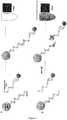
- the principle of the assay of the present invention is making use of strand displacement, where an aptamer specific for a certain target analyte is used in combination with a complementary strand.
- This complementary strand competes with the target and thus can be used for quantification.
- the assay principle is shown in detail in Figure 1 .
- the detection molecule here is a blue micro bead that allows the quantification either visually or by measuring the absorbance.
- the assay is very flexible and can make use of other detection molecules such as quantum dots. This allows for easy multiplexing.
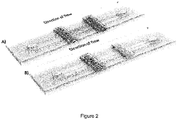
- the assay of the present invention can be used in connection with a microfluidic device ( Figure 2 ) and combined with a POC detector for quantification. The parameters of such device and its design are adapted and optimized in such a way that no user interference is necessary.
- the methods of the present invention do not require the immobilization of proteins or any of the assay components on e.g. a test strip.
- the detection can be both visual and instrumental through measuring absorbance.
- the assay components can be regenerated, e.g. the sensor magnetic beads and the fluidic device after washing.
- the principle of the present invention allows for multiplexing through changing the label to e.g. quantum dots or similar or even using colored particles with different absorbance wavelength.
- the assay kinetics and flow speeds can be adapted through active fluidic control (pump) allowing faster results.
- Aptamers and oligonucleotides were purchased from Integrated DNA Technology (Coralville, IA). Name Ethanolamine aptamer Sequence ATTCAATTTGAGGCGGGTGGGTGGGTTGAAT/3Bio/ (SEQ ID NO: 1) 5' Modification none 3' Modification Biotin Supplier Integrated DNA Technology (Coralville, IA) Concentration 100 ⁇ M Molecular weight 101 kDa Name Et 10_3 (complementary strand) Sequence CCACCCACCC/3Bio/ (SEQ ID NO: 2) 5' Modification none 3' Modification Biotin Supplier Integrated DNA Technology (Coralville, IA) Concentration 100 ⁇ M Molecular weight 33 kDa
- microparticles were supplied by Bangs Labs Inc., Indiana, USA as follows: Name Streptavidin Coated Magnetic Classical Mean diameter 0.36 ⁇ m Binding capacity 1.24 ⁇ M biotin/mg microspheres Concentration 10 mg/ml Name Streptavidin Coated Microspheres (Cabo Blue) Mean diameter 0.192 ⁇ m Binding capacity 2.55 ⁇ M biotin/mg microspheres Concentration 10 mg/ml
- the functionalization of the beads was done according to the manufacturer's instructions.
- streptavidin-coated beads were reacted with the corresponding biotinylated oligonucleotide, wherein the magnetic beads were functionalized with the ethanolamine aptamer and the blue beads with the complementary strand.
- the aptamer was selected and optimized as known in the art.
- the beads were successfully functionalized and the non-specific adsorption was minimal.
- the results also revealed that the volume should be decreased in order to increase the color intensity.
- the functionalized magnetic beads and blue beads were allowed first to react together. Then, the supernatant was discarded to leave a magnetic beads-blue beads sensor. Then this was reacted with the target (50 ⁇ L) at 100 nM and 10 nM of ethanolamine.
- the 10 nM concentration lead to a visual color change in comparison to the control.
- 10 nM of ethanolamine which corresponds to a concentration of 610 picograms/ml could be detected.
Landscapes
- Chemical & Material Sciences (AREA)
- Organic Chemistry (AREA)
- Life Sciences & Earth Sciences (AREA)
- Zoology (AREA)
- Proteomics, Peptides & Aminoacids (AREA)
- Health & Medical Sciences (AREA)
- Engineering & Computer Science (AREA)
- Wood Science & Technology (AREA)
- Analytical Chemistry (AREA)
- Microbiology (AREA)
- Physics & Mathematics (AREA)
- Molecular Biology (AREA)
- Immunology (AREA)
- Biotechnology (AREA)
- Biophysics (AREA)
- Biochemistry (AREA)
- Bioinformatics & Cheminformatics (AREA)
- General Engineering & Computer Science (AREA)
- General Health & Medical Sciences (AREA)
- Genetics & Genomics (AREA)
- Measuring Or Testing Involving Enzymes Or Micro-Organisms (AREA)
Priority Applications (1)
| Application Number | Priority Date | Filing Date | Title |
|---|---|---|---|
| EP18184111.5A EP3597775A1 (fr) | 2018-07-18 | 2018-07-18 | Procédé de détection et de quantification de petites molécules et plateforme fluidique pour sa réalisation |
Applications Claiming Priority (1)
| Application Number | Priority Date | Filing Date | Title |
|---|---|---|---|
| EP18184111.5A EP3597775A1 (fr) | 2018-07-18 | 2018-07-18 | Procédé de détection et de quantification de petites molécules et plateforme fluidique pour sa réalisation |
Publications (1)
| Publication Number | Publication Date |
|---|---|
| EP3597775A1 true EP3597775A1 (fr) | 2020-01-22 |
Family
ID=62985918
Family Applications (1)
| Application Number | Title | Priority Date | Filing Date |
|---|---|---|---|
| EP18184111.5A Withdrawn EP3597775A1 (fr) | 2018-07-18 | 2018-07-18 | Procédé de détection et de quantification de petites molécules et plateforme fluidique pour sa réalisation |
Country Status (1)
| Country | Link |
|---|---|
| EP (1) | EP3597775A1 (fr) |
Citations (5)
| Publication number | Priority date | Publication date | Assignee | Title |
|---|---|---|---|---|
| WO2001040790A1 (fr) * | 1999-11-30 | 2001-06-07 | Quantum Design, Inc. | Procede et dispositif permettant de mesurer des accumulations de particules magnetiques |
| WO2009104075A2 (fr) * | 2008-02-21 | 2009-08-27 | Otc Biotechnologies, Llc | Procédés de production de conjugué fluorophore-bille magnétique-aptamère adhérent au plastique et autres dosages sandwich |
| WO2017074658A1 (fr) * | 2015-10-27 | 2017-05-04 | The Trustees Of The University Of Pennsylvania | Filtres de séparation magnétique et dispositifs microfluidiques utilisant des filtres de séparation magnétique |
| WO2017180549A1 (fr) * | 2016-04-12 | 2017-10-19 | Dots Technology Corp. | Détection d'allergènes par magnétisme |
| WO2018089391A1 (fr) * | 2016-11-08 | 2018-05-17 | Dots Technology Corp. | Agents de détection d'allergènes et dosages |
-
2018
- 2018-07-18 EP EP18184111.5A patent/EP3597775A1/fr not_active Withdrawn
Patent Citations (5)
| Publication number | Priority date | Publication date | Assignee | Title |
|---|---|---|---|---|
| WO2001040790A1 (fr) * | 1999-11-30 | 2001-06-07 | Quantum Design, Inc. | Procede et dispositif permettant de mesurer des accumulations de particules magnetiques |
| WO2009104075A2 (fr) * | 2008-02-21 | 2009-08-27 | Otc Biotechnologies, Llc | Procédés de production de conjugué fluorophore-bille magnétique-aptamère adhérent au plastique et autres dosages sandwich |
| WO2017074658A1 (fr) * | 2015-10-27 | 2017-05-04 | The Trustees Of The University Of Pennsylvania | Filtres de séparation magnétique et dispositifs microfluidiques utilisant des filtres de séparation magnétique |
| WO2017180549A1 (fr) * | 2016-04-12 | 2017-10-19 | Dots Technology Corp. | Détection d'allergènes par magnétisme |
| WO2018089391A1 (fr) * | 2016-11-08 | 2018-05-17 | Dots Technology Corp. | Agents de détection d'allergènes et dosages |
Similar Documents
| Publication | Publication Date | Title |
|---|---|---|
| JP7410912B2 (ja) | Gmrによるバイオマーカの検出における被検物質の検知のためのシステムおよび方法 | |
| JP4659734B2 (ja) | 一ステップオリゴクロマトグラフィー装置及びその使用方法 | |
| CA2252912C (fr) | Methode d'essai, trousse et dispositif d'analyse | |
| EP3508851A2 (fr) | Particules fluorescentes pour agent de diagnostic et réactif de dosage immunologique l'employant | |
| He et al. | Simultaneously responsive microfluidic chip aptasensor for determination of kanamycin, aflatoxin M1, and 17β-estradiol based on magnetic tripartite DNA assembly nanostructure probes | |
| US20230085052A1 (en) | Systems and methods for sensing analytes in gmr-based detection of biomarkers | |
| CA2473244C (fr) | Procede et dispositif de dosage de lipoproteines a densite elevee | |
| Fang et al. | Unambiguous discrimination of multiple protein biomarkers by nanopore sensing with double-stranded DNA-based probes | |
| WO2005033707A1 (fr) | Nouvelle application de nanotechnologie et de technologies de capteur pour des diagnostics ex-vivo | |
| US20140228234A1 (en) | Target-recognition compositions comprising novel synthetic conjugates for trapping and diagnosis of a target molecule | |
| Mao et al. | Simultaneous detection of nucleic acid and protein using gold nanoparticles and lateral flow device | |
| JP2002530648A (ja) | 生物学的サンプルの分析装置および方法 | |
| SE533515C2 (sv) | Analysförfarande för samtidig analys av flera analyter | |
| BR0206145A (pt) | Sistema de teste indicador com tira reagente para uso em lìquidos para a detecção e/ou determinação de sequências especìficas de ácido nucléico | |
| KR101862439B1 (ko) | 마이크로rna와 같은 특이적 핵산 서열의 탐지를 위한 면역분석법 | |
| US8029985B2 (en) | Amplified bioassay | |
| US11435371B2 (en) | Device, system method and kit for isolating an analyte from a body fluid sample | |
| EP4192978A1 (fr) | Dosage à analytes multiples pour la détection simultanée d'acide nucléique et d'analytes | |
| JP2018506020A (ja) | 核酸増幅と組合せたイムノアッセイによる固体支持体上の被検体検出 | |
| Xu et al. | Multiplex biomarker analysis biosensor for detection of hepatitis B virus | |
| AU773046B2 (en) | Test system for detecting different markers, and production and use thereof | |
| JPH05107249A (ja) | リガンド・レセプター反応の高感度検出法 | |
| US20100022024A1 (en) | Method for testing performance of reagents containing microparticles | |
| Sett | Threading Precision: Recent Advances and Emerging Trends in Aptamer-Based Nanopore Sensing | |
| CN107430119A (zh) | 固体载体上的官能团的定量 |
Legal Events
| Date | Code | Title | Description |
|---|---|---|---|
| PUAI | Public reference made under article 153(3) epc to a published international application that has entered the european phase |
Free format text: ORIGINAL CODE: 0009012 |
|
| AK | Designated contracting states |
Kind code of ref document: A1 Designated state(s): AL AT BE BG CH CY CZ DE DK EE ES FI FR GB GR HR HU IE IS IT LI LT LU LV MC MK MT NL NO PL PT RO RS SE SI SK SM TR |
|
| AX | Request for extension of the european patent |
Extension state: BA ME |
|
| STAA | Information on the status of an ep patent application or granted ep patent |
Free format text: STATUS: THE APPLICATION IS DEEMED TO BE WITHDRAWN |
|
| 18D | Application deemed to be withdrawn |
Effective date: 20200723 |