EP3598657B1 - Verfahren zur konfiguration eines mu-mimo-drahtlossenders - Google Patents
Verfahren zur konfiguration eines mu-mimo-drahtlossenders Download PDFInfo
- Publication number
- EP3598657B1 EP3598657B1 EP18184437.4A EP18184437A EP3598657B1 EP 3598657 B1 EP3598657 B1 EP 3598657B1 EP 18184437 A EP18184437 A EP 18184437A EP 3598657 B1 EP3598657 B1 EP 3598657B1
- Authority
- EP
- European Patent Office
- Prior art keywords
- cidx
- wireless
- mimo
- wireless transmitter
- concurrent
- Prior art date
- Legal status (The legal status is an assumption and is not a legal conclusion. Google has not performed a legal analysis and makes no representation as to the accuracy of the status listed.)
- Active
Links
Images




Classifications
-
- H—ELECTRICITY
- H04—ELECTRIC COMMUNICATION TECHNIQUE
- H04B—TRANSMISSION
- H04B7/00—Radio transmission systems, i.e. using radiation field
- H04B7/02—Diversity systems; Multi-antenna system, i.e. transmission or reception using multiple antennas
- H04B7/04—Diversity systems; Multi-antenna system, i.e. transmission or reception using multiple antennas using two or more spaced independent antennas
- H04B7/0413—MIMO systems
- H04B7/0452—Multi-user MIMO systems
-
- H—ELECTRICITY
- H04—ELECTRIC COMMUNICATION TECHNIQUE
- H04W—WIRELESS COMMUNICATION NETWORKS
- H04W72/00—Local resource management
- H04W72/04—Wireless resource allocation
- H04W72/044—Wireless resource allocation based on the type of the allocated resource
- H04W72/046—Wireless resource allocation based on the type of the allocated resource the resource being in the space domain, e.g. beams
Definitions
- the present invention generally relates to a method for configuring a MU-MIMO ("Multi-User - Multiple Inputs Multiple Outputs”) wireless transmitter for transmitting a frame toward a plurality of MIMO wireless receivers, wherein the wireless transmitter transmits the frame using an analog precoder connected to a massive transmit antennas arrangement.
- the invention is more particularly suitable for millimeter wave wireless transmissions.
- a DFT Discrete Fourier Transform
- a subset of Np ⁇ Na beams from the codebook CB can be selected and used concurrently for transmitting a frame, thus creating a combination of concurrent beams.
- phases switching is fast enough, the combination of concurrent beams can be changed from one frame to another without significant overhead on overall throughput. It means that the same combination of concurrent beams is used for transmitting one or more whole frames, i.e. for all time and frequency resources used to transmit said one or more whole frames.
- the configurations of the combination of concurrent beams are selected so as to maximize received power or SINR ("Signal-plus-Interference-to-Noise Ratio") toward wireless receivers.
- SINR Signal-plus-Interference-to-Noise Ratio
- a digital precoder, placed upstream the analog precoder, can then be computed in order to mitigate interference observed between the concurrent beams in use.
- time and frequency resources allocation to the wireless receivers is performed by taking account of an amount of data to be delivered to each wireless receiver (which depends on application layer requirements), further of a quality of a wireless channel from the wireless transmitter to each wireless receiver (which depends on position of each wireless receiver with respect to the wireless transmitter and on channel realization toward each wireless receiver), and further by optimizing a proportional fairness metric between the wireless receivers.
- the wireless transmitter such as cellular telecommunication network base station
- the document US 2008/0069058 A1 discloses a method for performing a signal transmission from a base station of a cellular radio network to mobile terminals by using a plurality of oriented radio beams, wherein a candidate set of radio beams is defined and acknowledgements from the terminals enable defining suitable combinations of radio beams for a subsequent signal transmission from the base station to the terminals.
- the present invention concerns a method according to claim 1 for configuring a wireless transmitter comprising a massive transmit antennas arrangement, a set of modulators and an analog precoder mixing modulated analog signals output by the set of modulators onto respective inputs of the massive transmit antennas arrangement, the wireless transmitter further comprising a codebook storing candidate predefined beam configurations corresponding to a specific phase pattern configuration of the analog precoder, transmissions of frames by the wireless transmitter being performed onto respective M time and frequency resources by using combinations of concurrent beam configurations among the candidate predefined beam configurations stored in the codebook so as to perform MU-MIMO transmissions toward wireless receivers, the method being implemented by the wireless transmitter.
- the wireless transmitter further comprises an MU-MIMO fair scheduler, referred to as online MU-MIMO fair scheduler, determining which combinations of concurrent beams to be applied onto the time and frequency resources so as to take into account a fairness constraint between the wireless receivers in view of effective channel conditions toward the wireless receivers, wherein the wireless transmitter performs a frame transmission onto the time and frequency resources by configuring the analog precoder according to the combinations of concurrent beams determined by the online fair scheduler.
- an MU-MIMO fair scheduler referred to as online MU-MIMO fair scheduler
- the wireless transmitter further comprises another MU-MIMO fair scheduler, referred to as offline MU-MIMO fair scheduler, implementing a first configuration phase in which the offline MU-MIMO fair scheduler determines candidate combinations of concurrent beams by using long-term statistics associated to performance of transmissions from the wireless transmitter toward the wireless receivers and by taking into account the fairness constraint between the wireless receivers
- the method is such that the online fair scheduler implements a second configuration phase in which the online MU-MIMO fair scheduler selects the combinations of concurrent beams to be applied onto the time and frequency resources among the candidate combinations of concurrent beams determined by the offline MU-MIMO fair scheduler during the first configuration phase, wherein the wireless receivers effectively targeted with any one of the candidate combinations of concurrent beams are defined by the online MU-MIMO fair scheduler during the second configuration phase
- the offline MU-MIMO fair scheduler optimizes an alpha-fair criterion, which leads to the following utility function, where the Np beam configurations showing the best long-term statistics
- the wireless transmitter reinitiates the first configuration phase when receive conditions of the MU-MIMO transmissions have changed compared with a preceding frame transmission.
- the candidate combinations of concurrent beams are adequate over time.
- the receive conditions of the MU-MIMO transmissions have changed compared with a preceding frame transmission when at least one of the following conditions is faced: when the long-term statistics of at least one wireless receiver have changed since the preceding frame transmission; when the wireless transmitter has not enough data anymore to be transmitted to at least one wireless receiver since the preceding frame transmission; when the wireless transmitter has received new data to be transmitted to at least one wireless receiver for which there was precedingly not enough data to be transmitted thereto for the preceding frame transmission; when there is a change, since the preceding frame transmission, in the wireless receivers that are active among all the wireless receivers of a transmission system to which the wireless transmitter belongs; and when there is a change, since the preceding frame transmission, in the wireless receivers presence in the transmission system.
- adequation of the candidate combinations of concurrent beams over time is reinforced.
- the wireless transmitter further comprises a digital precoder placed upstream the set of modulators, and the online MU-MIMO fair scheduler determines and further applies configurations of the digital precoder during the second configuration phase, namely one configuration of the digital precoder for each one of the time and frequency resources.
- inter-receiver interference mitigation is achieved on a per time and frequency resource basis.
- the wireless transmitter determines the union of the beam configurations appearing in the candidate combinations of concurrent beams and requests the wireless receivers to feedback Channel State Information (CSI) data related to said beam configurations of the union so as to determine the effective channel conditions toward the wireless receivers.
- CSI Channel State Information
- the present invention also concerns a computer program that can be downloaded from a communication network and/or stored on a non-transitory information storage medium that can be read by a processing device such as a microprocessor.
- This computer program comprises instructions for causing implementation of the aforementioned method, when said program is run by the processing device.
- the present invention also concerns a non-transitory information storage medium, storing such a computer program.
- the present invention also concerns a wireless transmitter according to claim 8 comprising a massive transmit antennas arrangement, a set of modulators and an analog precoder mixing modulated analog signals output by the set of modulators onto respective inputs of the massive transmit antennas arrangement, the wireless transmitter further comprising a codebook storing candidate predefined beam configurations corresponding to a specific phase pattern configuration of the analog precoder, transmissions of frames by the wireless transmitter being performed onto respective M time and frequency resources by using combinations of concurrent beam configurations among the candidate predefined beam configurations stored in the codebook so as to perform Multi-User Multiple-Inputs Multiple-Outputs MU-MIMO transmissions toward wireless receivers.
- the wireless transmitter further comprises an MU-MIMO fair scheduler, referred to as online MU-MIMO fair scheduler, determining which combinations of concurrent beams to be applied onto the time and frequency resources so as to take into account a fairness constraint between the wireless receivers in view of effective channel conditions toward the wireless receivers, wherein the wireless transmitter further comprises means for performing a frame transmission onto the time and frequency resources by configuring the analog precoder according to the combinations of concurrent beams determined by the online fair scheduler.
- an MU-MIMO fair scheduler referred to as online MU-MIMO fair scheduler
- the wireless transmitter further comprises another MU-MIMO fair scheduler, referred to as offline MU-MIMO fair scheduler, implementing a first configuration phase in which the offline MU-MIMO fair scheduler is configured to determine candidate combinations of concurrent beams by using long-term statistics associated to performance of transmissions from the wireless transmitter toward the wireless receivers and by taking into account the fairness constraint between the wireless receivers, and the online fair scheduler implements a second configuration phase in which the online MU-MIMO fair scheduler is configured to select the combinations of concurrent beams to be applied onto the time and frequency resources among the candidate combinations of concurrent beams determined by the offline MU-MIMO fair scheduler during the first configuration phase, wherein the wireless receivers effectively targeted with any one of the candidate combinations of concurrent beams are defined by the online MU-MIMO fair scheduler during the second configuration phase, wherein the offline MU-MIMO fair scheduler optimizes an alpha-fair criterion, which leads to the following utility function, where the Np beam configurations showing the best long-term statistics metric values
- Fig. 1 schematically represents a transmission system in which the present invention may be implemented.
- the transmission system comprises a wireless transmitter TX 110 and a plurality of Ktot ( Ktot > 1) wireless receivers RX 1 121, RX 2 122,..., RX Ktot 123 toward which the transmitter TX 110 transmits frames.
- the wireless transmitter TX 110 uses beamforming 130, which is a signal processing technique used with transmit antennas arrays for directional signal transmission in such a way that signals in particular transmission directions experience constructive interference while signals in other transmission directions experience destructive interference.
- the wireless transmitter TX 110 is for example a base station and the wireless receivers RX 1 121, RX 2 122,..., RX Ktot 123 are mobile terminals.
- the wireless transmitter TX 110 further comprises an analog precoder 204 and a set of Np modulators 203.
- the wireless transmitter TX 110 optionally further comprises a digital precoder 202.
- Na analog signals 214 are input to the massive transmit antennas arrangement 205 from the analog precoder 204.
- the analog precoder 204 mixes Np modulated analog signals 213 onto the Na inputs of the massive transmit antennas arrangement 205.
- the analog precoder 204 duplicates each one of the Np modulated analog signals 213 into Na copies thereof, performs a phase rotation of each signal copy, routes each phase-rotated signal copy to one transmit antenna input, and sums all rotated signal copies arriving at each transmit antenna input, thus generating Np equivalent beams (one beam for each one of the Np modulated analog signals 213).
- the Np modulated analog signals 213 are generated by the set of Np modulators 203 from respective Np digital signals 212.
- Each modulator comprises a baseband unit, adapted for example to generate an OFDM ("Orthogonal Frequency Division Multiplex") baseband signal and a radio frequency circuit that transposes the baseband signal around a carrier frequency.
- the input of a modulator 203 is typically a set of symbols, each symbol being associated to one time and frequency resource defined by the baseband signal. For example, when considering an OFDM baseband signal, the time and frequency resources are defined by the subcarriers of the OFDM modulation during a predefined time slot.
- the digital precoder 202 is placed upstream the analog precoder 204, and more particularly upstream the set of Np modulators 203.
- the digital precoder 202 spatially mixes Np symbols 211 addressed to Np ⁇ Ktot co-scheduled wireless receivers among the Ktot wireless receivers RX 1 121, RX 2 122,..., RX Ktot 123, so as to generate the aforementioned Np digital signals 212.
- the Np symbols 211 are provided by upper layers 201 within a transmission protocol stack of the wireless transmitter TX 110.
- one of the symbol targets a given wireless receiver, and is a QAM ("Quadrature Amplitude Modulation") symbol carrying coded bits belonging to a codeword of an error correcting code associated with an information word, said information word resulting from a segmentation of data present in a buffer associated with said wireless receiver and stored in the wireless transmitter TX 110.
- the integer Np thus represents a quantity of simultaneous spatial streams, which is, for simplicity purpose, assumed equal to the quantity of wireless receivers simultaneously ( i.e. at the same time) served by the wireless transmitter TX 110.
- the wireless transmitter TX 110 keeps track of a mapping between the Np spatial streams for each frame and the wireless receivers targeted by said spatial streams for said frame.
- the Np symbols 211 are directly input to the set of Np modulators 203.
- the generated beams are wideband, which means that equivalent antenna gain observed by any wireless receiver is identical over the whole transmission band.
- the configuration of the analog precoder 204 cannot be changed across the frequency domain, contrary to the configuration of the digital precoder 202, which can be computed independently from one subcarrier (or group of subcarriers) to another in a multicarrier transmission system (e.g. OFDM) context.
- OFDM multicarrier transmission system
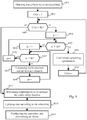
- Fig. 3 schematically represents an algorithm for configuring the wireless transmitter TX 110 for transmitting a frame toward Np wireless receivers.
- the wireless transmitter TX 110 detects that data has to be transmitted toward at least one of the Ktot wireless receivers. Said data has to be included in a frame.
- the frame has to be transmitted on several time and frequency resources, which are usually called Physical Resource Blocks (PRB) in 3GPP LTE-based systems.
- PRB Physical Resource Blocks
- each time and frequency resource contains 12 contiguous subcarriers across 7 contiguous OFDM symbols in a given time slot, and a 20 MHz wideband contains 100 PRBs in the frequency domain.
- PRB Physical Resource Blocks
- each time and frequency resource contains 12 contiguous subcarriers across 7 contiguous OFDM symbols in a given time slot, and a 20 MHz wideband contains 100 PRBs in the frequency domain.
- M time and frequency resources, which have to be appropriately selected by the wireless transmitter TX 110 as described hereafter.
- data addressed to Np different wireless receivers can be spatially multiplexed on each time and frequency resource, and that the wireless receivers served on two different time and
- the wireless transmitter TX 110 checks whether or not receive conditions have changed compared with a preceding frame transmission. In other words, the wireless transmitter TX 110 checks whether the situation of at least one of the wireless receivers of the transmission system has changed. The situation of at least one wireless receiver is said to have changed when long-term statistics, considered herein to determine candidate combinations of concurrent beams which can be applied for transmitting a frame ( i.e. among which selection has to be made), have changed since the last frame transmission.
- the situation of at least one wireless receiver is said to have changed when the wireless transmitter TX 110 has not enough data anymore to be transmitted thereto (getting below a predefined threshold), or when the wireless transmitter TX 110 has received new data to be transmitted thereto whereas there was precedingly not enough data to be transmitted thereto (getting above the predefined threshold).
- a particular embodiment for determining whether receive conditions have changed compared with said preceding frame transmission is detailed hereafter with respect to Fig. 4 .
- the wireless transmitter TX 110 is able to determine which wireless receivers ARX 1 , ARX 2 ,..., ARX K are active in the transmission system (a change in the wireless receivers active in the transmission system can be considered as a change in the receive conditions) among the Ktot wireless receivers.
- a step S303 is performed; otherwise, a step S304 is performed.
- the wireless transmitter TX 110 determines new candidate combinations of concurrent beams which can be applied for transmitting the frame.
- the candidate combinations of concurrent beams are obtained by an offline MU-MIMO fair scheduler using long-term statistics associated to the wireless receivers to be served, so as to take into account a fairness constraint between the wireless receivers. This represents a first configuration phase.
- the long-term statistics are representative of statistical performance of wireless transmissions from the wireless transmitter TX 110 to the K active wireless receivers ARX 1 , ARX 2 ,..., ARX K over time.
- the long-term statistics are in particular SINR and covariance matrices resulting from observations made by the K active wireless receiver ARX 1 , ARX 2 ,..., ARX K over time during transmissions performed by the wireless transmitter TX 110.
- This approach allows selecting a subset of predefined possible combinations of concurrent beams which actually fits with the transmission channel situations statistically experienced by the active wireless receivers ARX 1 , ARX 2 ,..., ARX K . However, this does not accurately take into account channel realization and capability of the digital precoder 202 (when present) to mitigate inter-receiver interference. This is performed in a second configuration phase implemented by an online MU-MIMO fair scheduler, as described hereafter.
- the wireless transmitter TX 110 reuses the candidate combinations of concurrent beams used for said preceding frame transmission, since the receive conditions remain substantially the same and no impact has been observed on the long-term statistics. Then the step S305 is performed.
- the wireless transmitter TX 110 obtain CSIT ("Channel State Information at Transmitter")-related data.
- the CSIT-related data are derived from CSI ("Channel State Information") fed back by the active wireless receivers ARX 1 , ARX 2 ,..., ARX K to the transmitter TX 110.
- the CSIT-related data provide a representation of actual transmission channels between the wireless transmitter TX 110 and the Np wireless receivers to be served. Building CSIT-related data from CSI fed back by wireless receivers is widely addressed in the prior art. A particular embodiment for gathering CSI is detailed hereafter with respect to Fig. 9 .
- the wireless transmitter TX 110 performs a scheduling according to the CSIT-related data obtained in the step S305 and according to the candidate combinations of concurrent beams resulting from the step S303 or S304.
- the wireless transmitter TX 110 can compute, for each time and frequency resource to be used to transmit the frame, a multi-user scheduling metric value for each one of said candidate combinations of concurrent beams, and then select the candidate combination of concurrent beams to be effectively applied for said time and frequency resource, as well as group of addressed wireless receivers, and optionally digital precoder configuration, so as to optimize the multi-user scheduling metric.
- the wireless transmitter TX 110 implements an online MU-MIMO fair scheduler. Particular embodiments for performing adequate scheduling are detailed hereafter with respect to Figs. 7 and 8 .
- the wireless transmitter TX 110 builds the frame and transmits, on the time and frequency resources that were identified to be used to transmit the frame, the built frame according to the combination of concurrent beams, group of targeted wireless receivers, and optionally digital precoder configuration, which result from the scheduling performed in the step S306.
- redundancy can be introduced so as to fill up said time and frequency resources.
- Fig. 4 schematically represents an algorithm for deciding whether candidate combinations of concurrent beams have to be updated for transmitting a frame toward Np wireless receivers, in a particular embodiment.
- the wireless transmitter TX 110 determines which wireless receivers are present in the transmission system. Indeed, a wireless receiver may have been turned on or off, or may have experienced a handover toward another cell.
- a step S402 the wireless transmitter TX 110 checks whether or not there is a change in the wireless receivers presence in the transmission system compared with a preceding frame transmission.
- a step S403 is performed; otherwise, a step S407 is performed.
- the wireless transmitter TX 110 determines which K active wireless receivers ARX 1 , ARX 2 ,..., ARX K among the Ktot wireless receivers are concerned by the frame to be transmitted.
- activity of each wireless receiver is monitored.
- the wireless transmitter TX 110 may consider that said wireless receiver is not concerned by the frame to be transmitted.
- activity monitoring is implemented through data buffers filing rate monitoring.
- At least one data buffer in the wireless transmitter TX 110 is associated with each wireless receiver RX 1 121, RX 2 122,..., RX Ktot 123, for instance at application layer and/or at transport layer.
- the wireless transmitter TX 110 When the filing rate of such a data buffer is below a predefined threshold, the wireless transmitter TX 110 considers that the wireless receiver RX 1 121, RX 2 122,..., RX Ktot 123 associated with said data buffer is not concerned by the frame to be transmitted. Thus, only the wireless receivers which data buffer filling rate is above a predefined threshold belong to the set of active wireless receivers ARX 1 , ARX 2 ,..., ARX K .. In a particular embodiment, in a manner complementary to the above approach, when the average data throughput on a given time window, which is typically much longer than a frame time duration, associated with a given wireless receiver is below a given threshold, said wireless receiver is considered as inactive.
- a step S404 the wireless transmitter TX 110 checks whether or not there is a change in the K active wireless receivers concerned by the frame to be transmitted compared with said preceding frame transmission.
- a step S405 is performed; otherwise, the step S407 is performed.
- the wireless transmitter TX 110 determines whether long-term statistics, related to each one of the K active wireless receiver which was already present in the transmission system when said preceding frame transmission has occurred, have changed since said preceding frame transmission.
- the long-term statistics are SINR and covariance matrices resulting from observations made by the active wireless receivers ARX 1 , ARX 2 ,..., ARX K over time during transmissions performed by the wireless transmitter TX 110.
- Such long-term statistics are computed from noise power observed by the active wireless receivers ARX 1 , ARX 2 ,..., ARX K , and averaged wideband power observed by the active wireless receivers ARX 1 , ARX 2 ,..., ARX K from the wireless transmitter TX 110 and from any other interfering transmitter (such as another base station).
- a step S406 the wireless transmitter TX 110 checks whether or not the long-term statistics have changed. When the long-term statistics have changed, the step S407 is performed; otherwise, a step S408 is performed.
- the wireless transmitter TX 110 considers that the receive conditions have changed compared with said preceding frame transmission, and thus the candidate combinations of concurrent beams shall be re-processed.
- the wireless transmitter TX 110 considers that the receive conditions have not changed compared with said preceding frame transmission, and thus preceding candidate combinations of concurrent beams can be re-used.
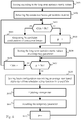
- Fig. 5 schematically represents an algorithm for determining the candidate combinations of concurrent beams which can be applied for transmitting a frame toward Np wireless receivers.
- the wireless transmitter TX 110 has identified the K wireless receivers that are supposed to be active in the transmission system for the frame transmission to be considered.
- the active wireless receivers ARX 1 , ARX 2 ,..., ARX K are indexed from 1 to K.
- Each candidate predefined beam configuration stored in the codebook CB corresponds to a specific phase pattern configuration of the analog precoder 204.
- the selected Nc candidate combinations of concurrent beams are then further used as a basis for appropriately grouping the wireless receivers in the scheduling process, either in the first configuration phase or in the second configuration phase, as detailed hereafter.
- One main challenge of MU-MIMO transmissions relates to group creation, i.e. deciding which wireless receivers should be grouped together on the same time and frequency resource(s). Indeed, dynamically building groups according to a fairness constraint usually requires too large scheduling processing complexity. Complexity is further increased by an additional degree of freedom provided by the variety of possible combinations of concurrent beams which can be selected for each frame transmission. Thus, it is proposed to semi-statically select the Nc candidate combinations C(1), ...,C(Nc) of concurrent beams using the aforementioned long-term statistics, in a manner compliant with the fairness constraint.
- Initialization consists in assigning default values to temporary parameters used for determining the adequate candidate combinations of concurrent beams.
- an index Cidx is set to "1”
- a theoretical average rate parameter Rav1 ( j ) is set to "0”
- j is an index such that 0 ⁇ j ⁇ K +1 .
- the theoretical average rate parameter Rav1 ( j ) is initialized with a value corresponding to the theoretical average rate achieved so far for the active wireless receiver ARX 1 , ARX 2 ,..., ARX K identified by the index j, or with a value corresponding to an effective total or average rate achieved so far for the active wireless receiver ARX 1 , ARX 2 ,..., ARX K identified by the index j, (see parameter Rav2 ( j ) hereafter).
- the wireless transmitter TX 110 obtains long-term statistics metric values for each one of the K wireless receivers active in the transmission system and for each one of the Nb candidate beam configurations stored in the codebook CB.
- the wireless transmitter TX 110 thus obtains a value of a metric of long-term transmission performance associated with transmission from the wireless transmitter TX 110 to each one of said K active wireless receivers ARX 1 , ARX 2 ,..., ARX K via each one of said Nb candidate beam configurations that can be used concurrently.
- the long-term statistics metric is for example Shannon capacity log 2 ( 1 + SINR ) based on long-term SINR computed from useful signal power received through the candidate beam configuration in question, and average interference power received from any potential interfering transmitter (such as neighboring base stations), and noise level. These power values are computed by the wireless receiver in question and periodically fed back to the wireless transmitter TX 110. The data rate required for such a feedback has no significant impact on performance of transmissions from the wireless receiver in question since periodicity of feedback is in general large and corresponding amount of fed back data is rather low. Such a long-term statistics metric ignores intra-cell interference, i.e. the fact that other wireless receivers may be using beam configurations that may generate interference.
- Intra-cell interference can be managed by appropriately configuring the digital precoder 202 during the second configuration phase implemented by the online MU-MIMO fair scheduler.
- the long-term statistics metric may however take into account long-term intra-cell interference, as measured by the wireless receiver in question and fed back to wireless transmitter TX 110.
- Such long-term intra-cell interference may then be added to inter-cell interference in order to refine SINR values.
- the long-term statistics metric values are for example extracted from a look-up table (LUT) providing association of system rate with long term SINR.
- LUT look-up table
- Such a look-up table is pre-computed from different transmission modes including several modulation schemes, such as QAM schemes, and error correcting code rates.
- the wireless transmitter TX 110 retains, as candidate combinations of concurrent beams, the combinations of concurrent beams which optimize a utility function (as known as figure of merit) of the offline MU-MIMO fair scheduler.
- the utility function of the offline MU-MIMO fair scheduler aims at taking into account by anticipation a fairness criterion intended to be applied in the scope of a utility function of the online MU-MIMO fair scheduler during the second configuration phase.
- the utility function of the offline MU-MIMO fair scheduler and the utility function of the online MU-MIMO fair scheduler diverge in that the utility function of the offline MU-MIMO fair scheduler uses the long-term statistics metric values to anticipate potential scheduling result, whereas the utility function of the online MU-MIMO fair scheduler uses effective channel conditions to decide scheduling to be effectively applied.
- the denotation P(p,Cidx) shall be understood as an (absolute) identifier of the beam configuration represented by the value of the relative index p among the concurrent beams forming the combination of concurrent beams represented by the value of the index Cidx.
- the denotation U(p, Cidx) shall be understood as an (absolute) identifier of the wireless receiver associated with the beam configuration represented by the value of the relative index p among the concurrent beams forming the combination of concurrent beams represented by the value of the index Cidx.
- the average rate parameter Rav1(j) is said to be "theoretical" since the offline MU-MIMO fair scheduler operates on estimations based on the long-term statistics metric values and not on effective CSI-data.
- the result of the optimization provides the Nc candidate combinations C(1),...,C(Nc) of concurrent beams which provide the Nc best values (i.e. highest values, when relying on the utility function expressed above) of the utility function, in association with the Np wireless receivers among said K active wireless receivers ARX 1 , ARX 2 ,..., ARX K , as well as the Np corresponding respective concurrent beam configurations, which optimize the utility function.
- the wireless transmitter TX 110 In order to unambiguously identify the beam configurations used to build each combination of concurrent beams which have been indexed by the values of the index Cidx from 1 to Nc, the wireless transmitter TX 110 needs to retrieve beam configuration identifier values which are absolute among the Nb beam configurations stored in the codebook CB. Indeed, the index p identifies beam configurations only in a relative manner. The wireless transmitter TX 110 thus retrieves, for each candidate combination C(1), ...,C(Nc) of concurrent beams, the effective beam configurations B(p,Cidx) used at each port p out of the Np concurrently used in said combination of concurrent beams.
- the denotation B(p,Cidx) shall be understood as an (absolute) identifier of the beam configuration, among the Nb beam configurations stored in the codebook CB, represented by the value of the relative index p among the concurrent beams forming the combination of concurrent beams represented by the value of the index Cidx.
- the optimization is performed by randomly selecting pairs of wireless receivers and beams configurations, and by retaining the Np ones providing the best result of the utility function.
- the optimization is performed by executing the algorithm described hereafter with respect to Fig. 6 .
- the wireless transmitter TX 110 ends the first configuration phase.
- the wireless transmitter TX 110 has thus selected the Nc candidate combinations C(1),...,C(Nc) of concurrent beams which can be used for performing the effective scheduling in the second configuration phase and corresponding transmission of at least one frame.
- the candidate combinations C(1), ...,C(Nc) therefore consist of respective distinct sets of absolute identifiers B(p,Cidx) as defined above.
- the Np wireless receivers supposed to be targeted with each one of the Nc candidate combinations C(1), ...,C(Nc) of concurrent beams are defined by the offline MU-MIMO fair scheduler during the first configuration phase.
- the Np wireless receivers effectively addressed with any one of the Nc candidate combinations C(1), ...,C(Nc) of concurrent beams are defined by the online MU-MIMO fair scheduler during the second configuration phase. More details are provided hereafter with respect to Figs. 7 and 8 .
- Fig. 6 schematically represents an algorithm for determining the candidate combinations of concurrent beams which can be applied for transmitting the frame toward the plurality of wireless receivers, in a particular embodiment. More particularly, the algorithm of Fig. 6 provides an exemplary detailed embodiment of the steps S502 and S503. It is thus considered that, at the beginning of the algorithm of Fig. 6 , the initializing step S501 has been performed beforehand.
- the wireless transmitter TX 110 sorts, for each wireless receiver among the K active wireless receivers ARX 1 , ARX 2 ,..., ARX K , the Nb beam configurations in performance-decreasing order of the long-term statistics metric values.
- the wireless transmitter TX 110 retains, for each wireless receiver among the K active wireless receivers ARX 1 , ARX 2 ,..., ARX K , the top Np beam configurations as sorted in the step S601. It is indeed not needed here to consider more than Np beam configurations per wireless receiver, since Np represents the quantity of beams that can be used concurrently, which means that, in the worst case, any wireless receiver is supposed to be associated with its Np-th worst beam (among all possible concurrent beams described in the codebook CB). At that time, the wireless transmitter TX 110 builds the index mapping function UEBI.
- a step S603 the wireless transmitter TX 110 checks whether or not the value of the index Cidx is greater than Nc. It is reminded that the index Cidx has been initialized to "1" in the step S501. If the value of the index Cidx is greater than Nc, a step S604 is performed; otherwise, a step S605 is performed.
- the wireless transmitter TX 110 retrieves, for each combination of concurrent beams which have been indexed by the values of the index Cidx from 1 to Nc, the effective beam configurations B(p,Cidx) used at each port p out of the Np concurrently used in said combination of concurrent beams. Indeed, since in the step S602 only the top Np beam configurations have been retained for each wireless receiver, the index p identifies beam configurations in a relative manner.
- the effective concurrent beams of each candidate combination C(1), ...,C(Nc) shall be identified, in an absolute manner (thanks to the index mapping function UEBI( ) expressed above), so as to accurately define said candidate combination C(1), ...,C(Nc) of concurrent beams and allow appropriately configuring later on the analog precoder 204 during frame transmissions.
- the wireless transmitter TX 110 sets the index p to "1".
- the wireless transmitter TX 110 stores the long-term statistics metric values in a temporary parameter m' .
- a step S607 the wireless transmitter TX 110 checks whether or not the index p is greater than Np. If the index p is greater than Np, a step S608 is performed; otherwise, a step S609 is performed.
- the index Cidx is incremented by one unit. In other words, the wireless transmitter TX 110 moves to determining another candidate combination of concurrent beams. Then the step S603 is repeated.
- the wireless transmitter TX 110 stores a beam configuration that maximizes an average-rate-based alpha-fair utility function of the offline scheduler for the current values of the index p and the index Cidx.
- the wireless transmitter TX 110 updates the average data rate Rav1(j') according to the result of the step S609. In other words, the wireless transmitter TX 110 adds m'(i', j ' ) to the contents of Rav1(j') and stores the result in Rav1(j').
- a step S611 the wireless transmitter TX 110 resets (sets to a null value) the temporary parameter m'(i',j') for the indexes couple (i',j' ) selected in the step S609.
- the concerned beam configuration cannot be attributed again to the same wireless receiver.
- the quantity of beam configurations that can be allocated to each wireless receiver is upper bounded.
- the upper bound is for example equal to the quantity of receive antennas of said wireless receiver.
- the wireless transmitter TX 110 ensures that the quantity of beam configurations associated with any wireless receiver does not exceed such a predefined upper bound for said wireless receiver.
- the wireless transmitter TX 110 resets the temporary parameter m' for said wireless receiver, so that no further beam configuration is selected for said wireless receiver in the candidate combination C(Cidx) under definition.
- a step S612 the wireless transmitter TX 110 increments by one unit the index p. In other words, the wireless transmitter TX 110 moves to determining another beam configuration that would be added to the on-the-way definition of the candidate combination identified by the value of the index Cidx. Then the step S607 is repeated.
- Fig. 7 schematically represents an algorithm for performing scheduling and transmitting a frame toward the concerned plurality of wireless receivers, in a first scheduling particular embodiment (not claimed).
- a step S701 the wireless transmitter TX 110 detects that a frame has to be transmitted. This frame shall be processed by the online scheduler.
- the wireless transmitter TX 110 sets the index Cidx to "1".
- a step S703 the wireless transmitter TX 110 checks whether or not the index Cidx is greater than Nc. When the index Cidx is greater than Nc, a step S715 is performed; otherwise, a step S704 is performed.
- the wireless transmitter TX 110 sets the index p to "1".
- a step S705 the wireless transmitter TX 110 checks whether or not the index p is greater than Np. When the index p is greater than Np, a step S706 is performed; otherwise, a step S711 is performed.
- the wireless transmitter TX 110 sets an index m to "1".
- the index m is used to identify any time and frequency resources among the M time and frequency resources to be used to transmit the frame.
- a step S707 the wireless transmitter TX 110 checks whether or not the value of the index m is greater than M. When the index m is greater than M, a step S708 is performed; otherwise, a step S709 is performed.
- the wireless transmitter TX 110 increments the index p by one unit. In other words, the wireless transmitter TX 110 selects the next beam configuration of the candidate combination C(Cidx) of concurrent beams. Then the step S705 is repeated.
- the wireless transmitter TX 110 computes useful channels Hu(p,m) of the wireless receiver identified by U(p, Cidx) resulting from the CSIT-related data for the resource identified by the index m , by selecting the channels associated to the beam configuration identified by B(p,Cidx). Moreover, the wireless transmitter TX 110 computes interference channels Hi(p,m) of the wireless receiver identified by U(p,Cidx) resulting from the CSIT-related data, by selecting the channels associated to the beam configurations identified by B(1,Cidx),..., B(p-1,Cidx), B(p + 1,Cidx), ..., B(Np,Cidx), i.e. the beam configuration identified by B(p,Cidx) being excluded.
- the wireless transmitter TX 110 increments the index m by one unit. In other words, the wireless transmitter TX 110 considers another time and frequency resource among the M time and frequency resources to be used to transmit the frame. Then the step S707 is repeated.
- the wireless transmitter TX 110 optionally computes M configurations of the digital precoder 202 (one configuration for each one of the M time and frequency resources to be used to transmit the frame), from the useful channels Hu(p,m) and interference channels Hi(p,m) computed over the successive iterations of the step S709 for the candidate combination C(Cidx) of concurrent beams.
- the wireless transmitter TX 110 computes, and stores, instantaneous rates r(p,Cidx,m) (which means the following set of instantaneous rates r(1,Cidx,m),...,r(Np,Cidx,m)) expected to be achieved for each one of the Np wireless receivers targeted by the frame over the time and frequency resource m , according to the useful channels Hu(p,m) and optionally to the precoder configurations computed in the step S711.
- instantaneous rates r(p,Cidx,m) which means the following set of instantaneous rates r(1,Cidx,m),...,r(Np,Cidx,m)
- the denotation r(p,Cidx,m) refers herein thus to the instantaneous rate expected to be achieved via the time and frequency resource m among the M time and frequency resources, for the wireless receiver identified by the value of the index p using the candidate combination C(Cidx) of concurrent beams. This instantaneous rate computation is performed for each time and frequency resource m among the M time and frequency resources.
- the wireless transmitter TX 110 computes, and stores, values of the online utility function.
- said total rate Rav2(i) is reset when the wireless receiver in question becomes active again (after some period during which said wireless receiver has been inactive or considered as such).
- said total rate Rav2(i) is initialized when the wireless receiver in question is declared in the transmission system (and becomes thus part of the Ktot wireless receivers of the transmission system).
- said total rate Rav2(i) is reset periodically, so as to regularly refresh said total rate Rav2(i) and thus get rid of potential computation errors.
- the wireless transmitter TX 110 increments the index Cidx by one unit. In other words, the wireless transmitter TX 110 selects another combination of concurrent beams among the candidate combinations C(1), ...,C(Nc) of concurrent beams which were resulting from the first configuration phase implemented by the offline MU-MIMO fair scheduler. Then the step S703 is repeated.
- the wireless transmitter TX 110 performs scheduling so as to optimize the online utility function.
- the wireless transmitter TX 110 retains the candidate combination of concurrent beams among the candidate combinations C(1),...,C(Nc) which shows the best performance according to the online utility function.
- the wireless transmitter TX 110 updates the rates Rav2(i) according to the scheduling decision made in the step S715.
- the wireless transmitter TX 110 retrieves the wireless receivers U ( p, Cidx) for which data are transmitted in the frame in question and updates their respective rates Rav2 in accordance to the made scheduling decision.
- the other wireless receivers being not served by the frame in question, the wireless transmitter TX 110 updates their respective rates Rav2 in accordance (to take into account that the instantaneous rate for the non-served wireless receivers is null for the frame in question).
- the wireless transmitter TX 110 configures itself according to the combination of beam configurations resulting from the step S715 and transmits the frame over the M time and frequency resources accordingly.
- the same group of wireless receivers is selected for the whole band since the beam configurations identified by B ( 1,Cidx ) ,.., B(Np,Cidx) and the wireless receivers identified by U(1,Cidx),.., U(Np,Cidx) are wideband.
- the online MU-MIMO fair scheduler is working in the time domain only, which limits flexibility of the scheduling process.
- Another approach is to not take into account the group of wireless receivers as proposed at the end of first configuration phase implemented by the offline MU-MIMO fair scheduler. This aspect is detailed with respect to Fig. 8 hereafter.
- Fig. 8 schematically represents an algorithm for performing scheduling and transmitting frame toward the concerned plurality of wireless receivers, in a second scheduling particular embodiment.
- a step S801 the wireless transmitter TX 110 detects that a frame has to be transmitted. This frame shall be processed by the online scheduler.
- the wireless transmitter TX 110 sets the index Cidx to "1".
- a step S803 the wireless transmitter TX 110 checks whether or not the index Cidx is greater than Nc. When the index Cidx is greater than Nc, a step S813 is performed; otherwise, a step S804 is performed.
- the wireless transmitter TX 110 sets the index p to "1".
- a step S805 the wireless transmitter TX 110 checks whether or not the index p is greater than Np. When the index p is greater than Np, a step S806 is performed; otherwise, a step S811 is performed.
- the wireless transmitter TX 110 sets an index m to "1".
- the index m is used to identify any time and frequency resources among the M time and frequency resources to be used to transmit the frame.
- a step S807 the wireless transmitter TX 110 checks whether or not the value of the index m is greater than M. When the index m is greater than M, a step S808 is performed; otherwise, a step S809 is performed.
- the wireless transmitter TX 110 increments the index p by one unit. In other words, the wireless transmitter TX 110 selects the next beam configuration of the candidate combination C(Cidx) of concurrent beams. Then the step S805 is repeated.
- the wireless transmitter TX 110 computes useful channels Hu ( p,m,1 ) ,... Hu(p,m,K) respectively of the K active wireless receivers ARX 1 , ARX 2 ,..., ARX K .
- Said useful channels result from the CSIT-related data for the time and frequency resource identified by the index m , by selecting the channels associated to the beam configuration identified by B(p,Cidx).
- the wireless transmitter TX 110 computes interference channels Hi(p,m,1),..., Hi(p,m,K) of the K active wireless receivers.
- Said interference channels result also from the CSIT-related data, by selecting the channels associated with the beam configurations identified by B(1,Cidx),..., B(p-1,Cidx), B(p + 1,Cidx),..., B(Np,Cidx).
- the association between the beams configurations and the targeted wireless receivers is not fixed in the scope of the algorithm of Fig. 8 (contrary to the scope of the algorithm of Fig. 7 ). This explains why the useful channels Hu ( p,m,1 ) ,... Hu(p,m,K) and interference channels Hi(p,m,1),..., Hi(p,m,K) are determined here for each one of the K active wireless receivers ARX 1 , ARX 2 ,..., ARX K .
- the wireless transmitter TX 110 increments the index m by one unit. In other words, the wireless transmitter TX 110 considers another time and frequency resource among the M time and frequency resources to be used to transmit the frame. Then the step S807 is repeated.
- the wireless transmitter TX 110 performs an online MU-MIMO scheduling estimation for the selected candidate combination C(Cidx) of concurrent beams. It is referred to online MU-MIMO scheduling "estimation" here, since no MU-MIMO scheduling decision is made in the step S811. Indeed, the wireless transmitter TX 110 performs optimization only for the selected candidate combination C(Cidx) of concurrent beams at this step. Decision about the candidate combination C(1), ...,C(Nc) to be effectively used for transmitting the frame in question is made later on (see step S813 below). It can consequently be considered in other words that the wireless transmitter TX 110 thus performs a Cidx-limited online MU-MIMO scheduling estimation.
- the online MU-MIMO scheduling estimation takes as input the useful channels Hu ( p,m,1 ) ,... Hu(p,m,K) and interference channels Hi(p,m,1),..., Hi(p,m,K) computed in the step S809.
- the online MU-MIMO scheduling estimation further takes as input the rate Rav2(i) for each one of the K active wireless receivers ARX 1 , ARX 2 ,..., ARX K , wherein Rav2(i) is (as already expressed with respect to Fig.
- said total rate Rav2(i) is reset when the wireless receiver in question becomes active again (after some period during which said wireless receiver has been inactive or considered as such).
- said total rate Rav2(i) is initialized when the wireless receiver in question is declared in the transmission system (and becomes thus part of the Ktot wireless receivers of the transmission system).
- said total rate Rav2(i) is reset periodically, so as to regularly refresh said total rate Rav2(i) and thus get rid of potential computation errors.
- the online MU-MIMO scheduling estimation gives as output a set of M sets of Np wireless receivers identified by U'(p, Cidx, 1),..., U' ( p, Cidx, M ), which optimizes the online utility function.
- the denotation U'(p,Cidx,m), with m from 1 to M, shall be understood as an (absolute) identifier of the wireless receiver associated with the beam configuration represented by the value of the relative index p among the concurrent beams forming the combination C(Cidx) of concurrent beams when transmitting data over the time and frequency resource m among the M time and frequency resources to be used to transmit the frame in question.
- the wireless transmitter TX 110 takes into account rate improvement that can be achieved by the digital precoder 202 when present.
- the step S811 is performed by exhaustively testing all possible sets of wireless receivers mapping to the Np beam configurations constituting the candidate combination C(Cidx) of concurrent beams via each one of the M time and frequency resources to be used for transmitting the frame in question.
- the step S811 is performed by using a random subset of all the possible sets of wireless receivers mapping to the Np beam configurations constituting the candidate combination C(Cidx) of concurrent beams via each one of the M time and frequency resources.
- the step S811 is performed by testing over the sets of groups of wireless receivers which were resulting from the offline MU-MIMO scheduler.
- the step S811 is performed by defining, time and frequency resource after time and frequency resource (i.e. by performing optimization from time and frequency resource index going from 1 to M) which wireless receivers to be grouped together along with the adequate precoder configuration.
- time and frequency resource i.e. by performing optimization from time and frequency resource index going from 1 to M
- this can be achieved as disclosed in the document " Simplified fair scheduling and antenna selection algorithms for multiuser MIMO orthogonal space-division multiplexing downlink", Shreeram Sigdel and Witold A Krzymien, IEEE Transactions on Vehicular Technology, vol.58, issue 3, pp.1329-1344, March 2009 .
- the wireless transmitter TX 110 stores the optimized value of the online utility function along with an identification of the wireless receivers U' ( p, Cidx, m ) targeted by the frame in question in view of the online MU-MIMO scheduling estimation for said candidate combination C(Cidx) of concurrent beams.
- the wireless transmitter TX 110 further stores the instantaneous rate r'(p, Cidx, m) that would be obtained for each one of said wireless receiver wireless receivers U'(p, Cidx, m) if said candidate combination C(Cidx) of concurrent beams is finally retained by the online MU-MIMO scheduler (see below).
- the wireless transmitter TX 110 increments the index Cidx by one unit. In other words, the wireless transmitter TX 110 selects another combination of concurrent beams among the candidate combinations C(1), ...,C(Nc) of concurrent beams which were resulting from the first configuration phase implemented by the offline MU-MIMO fair scheduler. Then the step S803 is repeated.
- the wireless transmitter TX 110 performs scheduling so as to optimize the online utility function.
- the wireless transmitter TX 110 retains the candidate combination C(1), ...,C(Nc) of beam configurations which shows the best performance according to the online utility function.
- the wireless transmitter TX 110 updates the rates Rav2(i) according to the scheduling decision made in the step S813. For each value of the index m from 1 to M, the wireless transmitter TX 110 retrieves the wireless receivers U'(p, Cidx,m ) for which data are transmitted in the frame in question and updates their respective rates Rav2 in accordance to the made scheduling decision. The other wireless receivers being not served by the frame in question, the wireless transmitter TX 110 updates their respective rates Rav2 in accordance (to take into account that the instantaneous rate for the non-served wireless receivers is null for the frame in question).
- the wireless transmitter TX 110 configures itself according to the combination of beam configurations resulting from the step S813 and transmits the frame over the M time and frequency resources accordingly.
- Fig. 9 schematically represents an algorithm for collecting channels observations. Indeed, knowledge by the wireless transmitter TX 110 of the MIMO channels observed by each wireless receiver is needed to build CSIT-related data. Typically, pilot signals are transmitted by the wireless transmitter TX 110, thus allowing each wireless receiver to estimate MIMO channel characteristics.
- the wireless transmitter TX 110 selects beam configurations to be used for transmitting the pilot signals toward the wireless receivers.
- the wireless transmitter TX 110 In practice, not all the MIMO channels need to be known by the wireless transmitter TX 110. Indeed, by considering the candidate combinations C(1), ..., C(Nc) of concurrent beams, it is highly probable that many of the Nb candidate beam configurations stored in the codebook CB are not present therein. Indeed, for a given spatial distribution of the wireless receivers, some places in the radio coverage area of the wireless transmitter TX 110, and pointed by a given beam configuration, have no active wireless receiver among the active wireless receivers ARX 1 , ARX 2 ,..., ARX K . This involves that such a given beam configuration does not generate neither useful signal nor interference towards the active wireless receivers, and knowledge of corresponding MIMO channels is therefore non-necessary.
- each candidate combination C(1), ..., C(Nc) of concurrent beams is defined by the offline MU-MIMO scheduler in association with the wireless receivers to be targeted by said candidate combination of concurrent beams.
- all the possible MIMO channels for each candidate combination C(1), ..., C(Nc) of concurrent beams are completely characterized.
- pilot signals for any beam configuration used in said candidate combinations C(1), ..., C(Nc) of concurrent beams. This reduces the quantity of needed pilot signals, which either improves channel estimation or reduces overhead.
- a CSI feedback is thus obtained by the wireless transmitter TX 110 from the corresponding wireless receivers only on the MIMO channels characterized by the candidate combinations C(1), ..., C(Nc) of concurrent beams.
- the wireless transmitter TX 110 determines the union of the beam configurations appearing in the different candidate combinations C(1), ..., C(Nc) of concurrent beams and requests the wireless receivers to feedback CSI data related to said beam configurations of the union. Then the wireless transmitter TX 110 reassembles CSI-data related to said beam configurations in view of the candidate combinations C(1), ..., C(Nc) of concurrent beams and is thus able to reconstruct the desired MIMO channels representations.
- each candidate combination C(1), ..., C(Nc) of concurrent beams is defined by the offline MU-MIMO scheduler in association with the wireless receivers to be optionally targeted by said candidate combination C(1), ..., C(Nc) of concurrent beams from the standpoint of the offline MU-MIMO scheduler. It means that appropriately grouping the wireless receivers can be reviewed by the online MU-MIMO scheduler. In order to do so, and optionally to compute the appropriate digital precoder configuration, the wireless transmitter TX 110 needs to know all the potential MIMO channels that can be used.
- a CSI report is required by the wireless transmitter TX 110 from all the wireless receivers for all the beam configurations used in the candidate combinations C(1), ..., C(Nc) of concurrent beams. Then the wireless transmitter TX 110 is able to reconstruct all the MIMO channels associated with any association of wireless receivers for each candidate combinations C(1), ..., C(Nc) of concurrent beams.
- the wireless transmitter TX 110 transmits pilot signals by using the beam configurations selected in the step S901.
- the wireless transmitter TX 110 receives CSI-related data from the concerned wireless receivers.
- the wireless transmitter TX 110 obtains the CSI-related data for each time and frequency resource m among the M time and frequency resources used to transmit the frame in question by extrapolating the CSI-related data thus received from the wireless receivers.
- Fig. 10 schematically represents an example hardware architecture of the wireless transmitter TX 110.
- the wireless transmitter TX 110 comprises at least the following components interconnected by a communications bus 1010: a processor, microprocessor, microcontroller or CPU ("Central Processing Unit") 1001; a RAM ("Random-Access Memory”) 1002; a ROM ("Read-Only Memory”) 1003; an HDD (“Hard-Disk Drive”) or an SD (“Secure Digital”) card reader 1004, or any other device adapted to read information stored on non-transitory information storage medium; and a communication interface COM 1005.
- a processor, microprocessor, microcontroller or CPU Central Processing Unit
- RAM Random-Access Memory
- ROM Read-Only Memory
- HDD Hard-Disk Drive
- SD Secure Digital
- the communication interface COM 1005 enables the wireless transmitter TX 110 to transmit frames to the wireless receivers RX 1 121, RX 2 122,..., RX Ktot 123 and to receive feedback information from the wireless receivers RX 1 121, RX 2 122,..., RX Ktot 123.
- the communication interface COM 1005 comprises the digital precoder 132, the modulators 134, the analog precoder 135 and the massive antennas set 136.
- CPU 1001 is capable of executing instructions loaded into RAM 1002 from ROM 1003 or from an external memory, such as an SD card via the SD card reader 1004. After the wireless transmitter TX 110 has been powered on, CPU 1001 is capable of reading instructions from RAM 1002 and executing these instructions.
- the instructions form one computer program that causes CPU 1001 to perform some or all of the steps of the algorithms described hereafter.
- any and all steps of the algorithm described herein may be implemented in software by execution of a set of instructions or program by a programmable computing machine, such as a PC ("Personal Computer"), a DSP ("Digital Signal Processor") or a microcontroller; or else implemented in hardware by a machine or a dedicated chip or chipset, such as an FPGA ("Field-Programmable Gate Array”) or an ASIC ("Application-Specific Integrated Circuit").
- the wireless transmitter TX 110 comprises processing electronics circuitry configured for implementing the relevant steps as described herein.
Landscapes
- Engineering & Computer Science (AREA)
- Computer Networks & Wireless Communication (AREA)
- Signal Processing (AREA)
- Mobile Radio Communication Systems (AREA)
- Radio Transmission System (AREA)
Claims (8)
- Verfahren zum Konfigurieren eines drahtlosen Senders (110) mit einer massiven Sendeantennenanordnung (205), einer Gruppe von Modulatoren (203) und einem analogen Vorcodierer (204), der durch die Gruppe von Modulatoren (203) ausgegebene modulierte analoge Signale auf jeweilige Eingaben der massiven Sendeantennenanordnung (205) mischt, wobei der drahtlose Sender (110) weiterhin ein Codebuch umfasst, das als Kandidaten vordefinierte Strahlkonfigurationen entsprechend einer spezifischen Phasencharakteristik-Konfiguration des analogen Vorcodierers (204) speichert, wobei Sendungen von Frames durch den drahtlosen Sender (110) auf jeweilige M Zeit- und Frequenzressourcen durch Verwenden von Kombinationen von gleichlaufenden Strahlkonfigurationen unter den im Codebuch gespeicherten als Kandidaten vordefinierten Strahlkonfigurationen durchgeführt werden, um Sendungen mit mehreren Eingaben und mehreren Ausgaben für mehrere Anwender, d.h. MU-MIMO, in Richtung zu drahtlosen Empfängern (121, 122, 123) durchzuführen, wobei das Verfahren durch den drahtlosen Sender (110) implementiert ist,wobei der drahtlose Sender (110) weiterhin einen fairen Scheduler für MU-MIMO umfasst, auf den als fairer online-Scheduler für MU-MIMO Bezug genommen wird, zum Bestimmen (S306, S715, S813), welche Kombinationen von gleichlaufenden Strahlen auf die Zeit- und Frequenzressourcen anzuwenden sind, um eine Fairness-Beschränkung zwischen den drahtlosen Empfängern (121, 122, 123) angesichts effektiver Kanalbedingungen in Richtung zu den drahtlosen Empfängern (121, 122, 123) zu berücksichtigen, wobei der drahtlose Sender (110) eine Framesendung (S307, S717, S815) auf die Zeit- und Frequenzressourcen durch Konfigurieren des analogen Vorcodierers (204) gemäß den Kombinationen von durch den fairen online-Scheduler bestimmten gleichlaufenden Strahlen durchführt,wobei der drahtlose Sender (110) weiterhin einen weiteren fairen Scheduler für MU-MIMO umfasst, auf den als fairer offline-Scheduler für MU-MIMO Bezug genommen wird, der eine erste Konfigurationsphase implementiert, in welcher der faire offline-Scheduler für MU-MIMO Kandidatenkombinationen von gleichlaufenden Strahlen durch Verwenden von langzeitigen Statistiken, die mit einer Leistungsfähigkeit von Sendungen vom drahtlosen Sender (110) in Richtung zu den drahtlosen Empfängern (121, 122, 123) assoziiert sind, und durch Berücksichtigen der Fairnessbeschränkung zwischen den drahtlosen Empfängern (121, 122, 123) bestimmt (S303),wobei der faire online-Scheduler eine zweite Konfigurationsphase implementiert, in welcher der faire online-Scheduler für MU-MIMO die Kombinationen von gleichlaufenden Strahlen, um auf die Zeit- und Frequenzressourcen angewendet zu werden, unter den durch den fairen offline-Scheduler für MU-MIMO während der ersten Konfigurationsphase bestimmten Kandidatenkombinationen von gleichlaufenden Strahlen auswählt (S306, S715, S813),wobei die drahtlosen Empfänger (121, 122, 123), auf die mit irgendeiner der Kandidatenkombinationen von gleichlaufenden Strahlen effektiv abgezielt ist, durch den fairen online-Scheduler für MU-MIMO während der zweiten Konfigurationsphase definiert werden,wobei der faire offline-Scheduler für MU-MIMO ein alpha-faires Kriterium optimiert, was zu der folgenden Nutzenfunktion führt, wobei die Np Strahlkonfigurationen, die die besten metrischen Werte einer langzeitigen Statistik zeigen, für jeden drahtlosen Empfänger (121, 122, 123) im Voraus zurückbehalten worden sind:
 und wobei der faire online-Scheduler für MU-MIMO das alpha-faire Kriterium optimiert, was zu der folgenden Nutzenfunktion führt:
- Verfahren nach Anspruch 1, wobei der drahtlose Sender (110) die erste Konfigurationsphase erneut initiiert, wenn Empfangsbedingungen der MU-MIMO-Sendungen sich im Vergleich mit einer vorangehenden Framesendung geändert haben.
- Verfahren nach Anspruch 2, wobei die Empfangsbedingungen der MU-MIMO-Sendungen sich im Vergleich mit einer vorangehenden Framesendung geändert haben, wenn man wenigstens einer der folgenden Bedingungen begegnet:- wenn die langzeitigen Statistiken von wenigstens einem drahtlosen Empfänger (121, 122, 123) sich seit der vorangehenden Framesendung geändert haben;- wenn der drahtlose Sender (110) seit der vorangehenden Framesendung nicht mehr genügend Daten hat, um zu wenigstens einem drahtlosen Empfänger (121, 122, 123) gesendet zu werden;- wenn der drahtlose Sender neue Daten empfangen hat, um zu wenigstens einem drahtlosen Empfänger (121, 122, 123) gesendet zu werden, für welchen es für die vorangehende Framesendung vorangehend nicht genügend Daten gab, um dorthin gesendet zu werden;- wenn es seit der vorangehenden Framesendung eine Änderung in Bezug auf die drahtlosen Empfänger (121, 122, 123) gibt, die unter allen drahtlosen Empfängern (121, 122, 123) eines Sendesystems aktiv sind, zu welchem der drahtlose Sender (110) gehört; und- wenn es seit der vorangehenden Framesendung eine Änderung in Bezug auf ein Vorhandensein der drahtlosen Empfänger (121, 122, 123) im Übertragungssystem gibt.
- Verfahren nach einem der Ansprüche 1 bis 3, wobei der drahtlose Sender weiterhin einen digitalen Vorcodierer (202) umfasst, der stromauf von der Gruppe von Modulatoren (203) platziert ist, und der faire online-Scheduler für MU-MIMO Konfigurationen des digitalen Vorcodierers (202) während der zweiten Konfigurationsphase bestimmt und sie weiterhin anwendet, nämlich eine Konfiguration des digitalen Vorcodierers (202) für jede einzelne der Zeit- und Frequenzressourcen.
- Verfahren nach einem der Ansprüche 1 bis 4, wobei der drahtlose Sender (110) die Vereinigung von Strahlkonfigurationen bestimmt, die in den Kandidatenkonfigurationen von gleichlaufenden Strahlen erscheinen, und die drahtlosen Empfänger (121, 122, 123) anfragt, Kanalzustandsinformationsdaten in Bezug auf die Strahlkonfigurationen der Vereinigung zurückzuführen, um die effektiven Kanalbedingungen in Richtung zu den drahtlosen Empfängern (121, 122, 123) zu bestimmen.
- Computerprogrammprodukt, das Programmcodeanweisungen umfasst, die in eine programmierbare Vorrichtung geladen werden können, zum Implementieren des Verfahrens nach einem der Ansprüche 1 bis 5, wenn die Programmcodeanweisungen durch die programmierbare Vorrichtung laufengelassen werden.
- Nichtflüchtiges Informationsspeichermedium, das ein Computerprogramm speichert, das Programmcodeanweisungen umfasst, die in eine programmierbare Vorrichtung geladen werden können, zum Implementieren des Verfahrens nach einem der Ansprüche 1 bis 5, wenn die Programmcodeanweisungen durch die programmierbare Vorrichtung laufengelassen werden.
- Drahtloser Sender (110) mit einer massiven Sendeantennenanordnung (205), einer Gruppe von Modulatoren (203) und einem analogen Vorcodierer (204), der durch die Gruppe von Modulatoren (203) ausgegebene modulierte analoge Signale auf jeweilige Eingaben der massiven Sendeantennenanordnung (205) mischt, wobei der drahtlose Sender (110) weiterhin ein Codebuch umfasst, das als Kandidaten vordefinierte Strahlkonfigurationen entsprechend einer spezifischen Phasencharakteristik-Konfiguration des analogen Vorcodierers (204) speichert, wobei der drahtlose Sender dazu geeignet ist, Frames auf jeweilige M Zeit- und Frequenzressourcen durch Verwenden von Kombinationen von gleichlaufenden Strahlkonfigurationen unter den im Codebuch gespeicherten als Kandidaten vordefinierten Strahlkonfigurationen zu senden, um Sendungen mit mehreren Eingaben und mehreren Ausgaben für mehrere Anwender, d.h. MU-MIMO, in Richtung zu drahtlosen Empfängern (121, 122, 123) durchzuführen,wobei der drahtlose Sender (110) weiterhin einen fairen Scheduler für MU-MIMO umfasst, auf den als fairer online-Scheduler für MU-MIMO Bezug genommen wird, zum Bestimmen (S306, S715, S813), welche Kombinationen von gleichlaufenden Strahlen auf die Zeit- und Frequenzressourcen anzuwenden sind, um eine Fairness-Beschränkung zwischen den drahtlosen Empfängern (121, 122, 123) angesichts effektiver Kanalbedingungen in Richtung zu den drahtlosen Empfängern (121, 122, 123) zu berücksichtigen, wobei der drahtlose Sender (110) weiterhin eine Einrichtung zum Durchführen einer Framesendung (S307, S717, S815) auf die Zeit- und Frequenzressourcen durch Konfigurieren des analogen Vorcodierers (204) gemäß den Kombinationen von durch den fairen online-Scheduler bestimmten gleichlaufenden Strahlen umfasst,wobei der drahtlose Sender (110) weiterhin einen weiteren fairen Scheduler für MU-MIMO umfasst, auf den als fairer offline-Scheduler für MU-MIMO Bezug genommen wird, zum Implementieren einer ersten Konfigurationsphase, in welcher der faire offline-Scheduler für MU-MIMO konfiguriert ist, um Kandidatenkombinationen von gleichlaufenden Strahlen durch Verwenden von langzeitigen Statistiken, die mit einer Leistungsfähigkeit von Sendungen vom drahtlosen Sender (110) in Richtung zu den drahtlosen Empfängern (121, 122, 123) assoziiert sind, und durch Berücksichtigen der Fairnessbeschränkung zwischen den drahtlosen Empfängern (121, 122, 123) zu bestimmen (S303),wobei der faire online-Scheduler konfiguriert ist, um eine zweite Konfigurationsphase zu implementieren, in welcher der faire online-Scheduler für MU-MIMO konfiguriert ist, um die Kombinationen von gleichlaufenden Strahlen, um auf die Zeit- und Frequenzressourcen angewendet zu werden, unter den Kandidatenkombinationen von durch den fairen offline-Scheduler für MU-MIMO während der ersten Konfigurationsphase bestimmten Kandidatenkombinationen von gleichlaufenden Strahlen auszuwählen (S306, S715, S813),wobei die drahtlosen Empfänger (121, 122, 123), auf die mit irgendeiner der Kandidatenkombinationen von gleichlaufenden Strahlen effektiv abgezielt ist, durch den fairen online-Scheduler für MU-MIMO während der zweiten Konfigurationsphase definiert werden,wobei der faire offline-Scheduler für MU-MIMO konfiguriert ist, um ein alpha-faires Kriterium zu optimieren, was zu der folgenden Nutzenfunktion führt, wobei die Np Strahlkonfigurationen, die die besten metrischen Werte einer langzeitigen Statistik zeigen, für jeden drahtlosen Empfänger (121, 122, 123) im Voraus zurückbehalten worden sind:
 und wobei der faire online-Scheduler für MU-MIMO konfiguriert ist, um das alpha-faire Kriterium zu optimieren, was zu der folgenden Nutzenfunktion führt:
Priority Applications (5)
| Application Number | Priority Date | Filing Date | Title |
|---|---|---|---|
| EP18184437.4A EP3598657B1 (de) | 2018-07-19 | 2018-07-19 | Verfahren zur konfiguration eines mu-mimo-drahtlossenders |
| JP2020569219A JP2021526767A (ja) | 2018-07-19 | 2019-06-04 | ワイヤレス送信機を構成する方法、コンピュータプログラム製品、記憶媒体、及びワイヤレス送信機 |
| US15/734,062 US11159209B2 (en) | 2018-07-19 | 2019-06-04 | Method for configuring wireless transmitter, computer program product, storage medium, and wireless transmitter |
| PCT/JP2019/022842 WO2020017186A1 (en) | 2018-07-19 | 2019-06-04 | Method for configuring wireless transmitter, computer program product, storage medium, and wireless transmitter |
| CN201980040025.5A CN112385150A (zh) | 2018-07-19 | 2019-06-04 | 配置无线发送机的方法、计算机程序产品、存储介质和无线发送机 |
Applications Claiming Priority (1)
| Application Number | Priority Date | Filing Date | Title |
|---|---|---|---|
| EP18184437.4A EP3598657B1 (de) | 2018-07-19 | 2018-07-19 | Verfahren zur konfiguration eines mu-mimo-drahtlossenders |
Publications (2)
| Publication Number | Publication Date |
|---|---|
| EP3598657A1 EP3598657A1 (de) | 2020-01-22 |
| EP3598657B1 true EP3598657B1 (de) | 2021-06-09 |
Family
ID=63012888
Family Applications (1)
| Application Number | Title | Priority Date | Filing Date |
|---|---|---|---|
| EP18184437.4A Active EP3598657B1 (de) | 2018-07-19 | 2018-07-19 | Verfahren zur konfiguration eines mu-mimo-drahtlossenders |
Country Status (5)
| Country | Link |
|---|---|
| US (1) | US11159209B2 (de) |
| EP (1) | EP3598657B1 (de) |
| JP (1) | JP2021526767A (de) |
| CN (1) | CN112385150A (de) |
| WO (1) | WO2020017186A1 (de) |
Families Citing this family (5)
| Publication number | Priority date | Publication date | Assignee | Title |
|---|---|---|---|---|
| CN114600386A (zh) * | 2019-10-23 | 2022-06-07 | 瑞典爱立信有限公司 | 用于具有四个相关且未校准天线的下行链路系统的相位误差补偿 |
| WO2021171167A1 (en) | 2020-02-26 | 2021-09-02 | Telefonaktiebolaget Lm Ericsson (Publ) | Timing error estimation/compensation for 5g nr downlink systems with uncalibrated antennas |
| US12143183B2 (en) * | 2022-02-28 | 2024-11-12 | Nokia Solutions And Networks Oy | Beam and antenna array split configuration optimization |
| JP7807556B2 (ja) * | 2022-08-26 | 2026-01-27 | Ntt株式会社 | 基地局装置、通信システム、ビーム探索方法及びプログラム |
| WO2024173111A1 (en) * | 2023-02-13 | 2024-08-22 | Kyocera Corporation | Multiple user multiple input multiple output (mu-mimo) transmission precoder management using precoder assigned regions |
Family Cites Families (2)
| Publication number | Priority date | Publication date | Assignee | Title |
|---|---|---|---|---|
| DE102004028703A1 (de) * | 2004-06-14 | 2005-12-29 | Siemens Ag | Verfahren zur Zuweisung von Übertragungskapazitäten bei einer Signalübertragung, Basisstation und mobiles Endgerät |
| CN104770036B (zh) * | 2012-10-30 | 2019-03-08 | 华为技术有限公司 | 用于实现无线系统中最佳效率-Jain公平性的系统和方法 |
-
2018
- 2018-07-19 EP EP18184437.4A patent/EP3598657B1/de active Active
-
2019
- 2019-06-04 US US15/734,062 patent/US11159209B2/en not_active Expired - Fee Related
- 2019-06-04 JP JP2020569219A patent/JP2021526767A/ja not_active Withdrawn
- 2019-06-04 WO PCT/JP2019/022842 patent/WO2020017186A1/en not_active Ceased
- 2019-06-04 CN CN201980040025.5A patent/CN112385150A/zh not_active Withdrawn
Also Published As
| Publication number | Publication date |
|---|---|
| US20210226676A1 (en) | 2021-07-22 |
| US11159209B2 (en) | 2021-10-26 |
| EP3598657A1 (de) | 2020-01-22 |
| CN112385150A (zh) | 2021-02-19 |
| JP2021526767A (ja) | 2021-10-07 |
| WO2020017186A1 (en) | 2020-01-23 |
Similar Documents
| Publication | Publication Date | Title |
|---|---|---|
| US11159209B2 (en) | Method for configuring wireless transmitter, computer program product, storage medium, and wireless transmitter | |
| US9635642B2 (en) | Method and apparatus for transmitting/receiving CSI-RS operating in massive MIMO system FDD mode | |
| CN103037397B (zh) | 干扰测量指示方法和干扰测量方法及相关设备和通信系统 | |
| KR102064939B1 (ko) | 다수의 이차원 배열 안테나를 사용하는 이동통신 시스템에서의 피드백 송수신 방법 및 장치 | |
| KR101978776B1 (ko) | 다수의 안테나를 사용하는 이동통신 시스템에서 피드백 송수신 방법 및 장치 | |
| EP2798749B1 (de) | Kanalstatusinformations-feedbackvorrichtung und verfahren in einem im fdd-modus betriebenen drahtlosen kommunikationssystem | |
| KR101971079B1 (ko) | 이동통신 시스템에서 피드백 송수신 방법 및 장치 | |
| US9225404B2 (en) | Hybrid beamforming for data transmission | |
| US10965410B2 (en) | Communication method and apparatus in full-dimensional multiple-input multiple-output mobile communication system | |
| US9331756B2 (en) | Method and system for wireless communications, corresponding network and computer program product | |
| EP2701333B1 (de) | Verfahren und Vorrichtung zum Übertragen von Kanalfeedbackinformationen in einem drahtlosen Kommunikationssystem und Verfahren und Vorrichtung zum Empfangen von Kanalfeedbackinformationen in einem drahtlosen Kommunikationssystem | |
| US11177982B2 (en) | System and method for providing explicit feedback in the uplink | |
| EP2930873A1 (de) | Verfahren zur meldung von kanalstatusinformationen, benutzergerät und basisstation | |
| CN103081387B (zh) | 无线通信装置、无线通信系统和无线通信方法 | |
| CN119384800A (zh) | 用于在全双工通信系统中测量终端之间的干扰的方法和设备 | |
| CN110622438B (zh) | 在无线通信系统中发送反馈信息的方法及其设备 | |
| EP2387832B1 (de) | Übertragen von ersten und zweiten kanalqualitätsinformationen zwischen zwei netzelementen | |
| KR102107296B1 (ko) | 다중 사용자 다중 셀 mimo 채널의 간섭 정렬 방법 | |
| JP5958592B2 (ja) | 移動局および基地局 | |
| Ng et al. | Power and bandwidth allocation in cooperative dirty paper coding | |
| CN122026971A (zh) | 波束管理方法、网络侧设备及终端 | |
| JP5958591B2 (ja) | 移動局、基地局および無線通信方法 |
Legal Events
| Date | Code | Title | Description |
|---|---|---|---|
| PUAI | Public reference made under article 153(3) epc to a published international application that has entered the european phase |
Free format text: ORIGINAL CODE: 0009012 |
|
| STAA | Information on the status of an ep patent application or granted ep patent |
Free format text: STATUS: THE APPLICATION HAS BEEN PUBLISHED |
|
| AK | Designated contracting states |
Kind code of ref document: A1 Designated state(s): AL AT BE BG CH CY CZ DE DK EE ES FI FR GB GR HR HU IE IS IT LI LT LU LV MC MK MT NL NO PL PT RO RS SE SI SK SM TR |
|
| AX | Request for extension of the european patent |
Extension state: BA ME |
|
| STAA | Information on the status of an ep patent application or granted ep patent |
Free format text: STATUS: REQUEST FOR EXAMINATION WAS MADE |
|
| 17P | Request for examination filed |
Effective date: 20200722 |
|
| RBV | Designated contracting states (corrected) |
Designated state(s): AL AT BE BG CH CY CZ DE DK EE ES FI FR GB GR HR HU IE IS IT LI LT LU LV MC MK MT NL NO PL PT RO RS SE SI SK SM TR |
|
| GRAP | Despatch of communication of intention to grant a patent |
Free format text: ORIGINAL CODE: EPIDOSNIGR1 |
|
| STAA | Information on the status of an ep patent application or granted ep patent |
Free format text: STATUS: GRANT OF PATENT IS INTENDED |
|
| INTG | Intention to grant announced |
Effective date: 20210215 |
|
| GRAS | Grant fee paid |
Free format text: ORIGINAL CODE: EPIDOSNIGR3 |
|
| GRAA | (expected) grant |
Free format text: ORIGINAL CODE: 0009210 |
|
| STAA | Information on the status of an ep patent application or granted ep patent |
Free format text: STATUS: THE PATENT HAS BEEN GRANTED |
|
| AK | Designated contracting states |
Kind code of ref document: B1 Designated state(s): AL AT BE BG CH CY CZ DE DK EE ES FI FR GB GR HR HU IE IS IT LI LT LU LV MC MK MT NL NO PL PT RO RS SE SI SK SM TR |
|
| REG | Reference to a national code |
Ref country code: GB Ref legal event code: FG4D |
|
| REG | Reference to a national code |
Ref country code: CH Ref legal event code: EP Ref country code: AT Ref legal event code: REF Ref document number: 1401336 Country of ref document: AT Kind code of ref document: T Effective date: 20210615 |
|
| REG | Reference to a national code |
Ref country code: DE Ref legal event code: R096 Ref document number: 602018018266 Country of ref document: DE |
|
| REG | Reference to a national code |
Ref country code: IE Ref legal event code: FG4D |
|
| REG | Reference to a national code |
Ref country code: LT Ref legal event code: MG9D |
|
| PG25 | Lapsed in a contracting state [announced via postgrant information from national office to epo] |
Ref country code: FI Free format text: LAPSE BECAUSE OF FAILURE TO SUBMIT A TRANSLATION OF THE DESCRIPTION OR TO PAY THE FEE WITHIN THE PRESCRIBED TIME-LIMIT Effective date: 20210609 Ref country code: HR Free format text: LAPSE BECAUSE OF FAILURE TO SUBMIT A TRANSLATION OF THE DESCRIPTION OR TO PAY THE FEE WITHIN THE PRESCRIBED TIME-LIMIT Effective date: 20210609 Ref country code: LT Free format text: LAPSE BECAUSE OF FAILURE TO SUBMIT A TRANSLATION OF THE DESCRIPTION OR TO PAY THE FEE WITHIN THE PRESCRIBED TIME-LIMIT Effective date: 20210609 Ref country code: BG Free format text: LAPSE BECAUSE OF FAILURE TO SUBMIT A TRANSLATION OF THE DESCRIPTION OR TO PAY THE FEE WITHIN THE PRESCRIBED TIME-LIMIT Effective date: 20210909 |
|
| PGFP | Annual fee paid to national office [announced via postgrant information from national office to epo] |
Ref country code: FR Payment date: 20210729 Year of fee payment: 4 |
|
| REG | Reference to a national code |
Ref country code: AT Ref legal event code: MK05 Ref document number: 1401336 Country of ref document: AT Kind code of ref document: T Effective date: 20210609 |
|
| REG | Reference to a national code |
Ref country code: NL Ref legal event code: MP Effective date: 20210609 |
|
| PG25 | Lapsed in a contracting state [announced via postgrant information from national office to epo] |
Ref country code: NO Free format text: LAPSE BECAUSE OF FAILURE TO SUBMIT A TRANSLATION OF THE DESCRIPTION OR TO PAY THE FEE WITHIN THE PRESCRIBED TIME-LIMIT Effective date: 20210909 Ref country code: LV Free format text: LAPSE BECAUSE OF FAILURE TO SUBMIT A TRANSLATION OF THE DESCRIPTION OR TO PAY THE FEE WITHIN THE PRESCRIBED TIME-LIMIT Effective date: 20210609 Ref country code: RS Free format text: LAPSE BECAUSE OF FAILURE TO SUBMIT A TRANSLATION OF THE DESCRIPTION OR TO PAY THE FEE WITHIN THE PRESCRIBED TIME-LIMIT Effective date: 20210609 Ref country code: SE Free format text: LAPSE BECAUSE OF FAILURE TO SUBMIT A TRANSLATION OF THE DESCRIPTION OR TO PAY THE FEE WITHIN THE PRESCRIBED TIME-LIMIT Effective date: 20210609 Ref country code: GR Free format text: LAPSE BECAUSE OF FAILURE TO SUBMIT A TRANSLATION OF THE DESCRIPTION OR TO PAY THE FEE WITHIN THE PRESCRIBED TIME-LIMIT Effective date: 20210910 |
|
| PGFP | Annual fee paid to national office [announced via postgrant information from national office to epo] |
Ref country code: DE Payment date: 20210730 Year of fee payment: 4 |
|
| PG25 | Lapsed in a contracting state [announced via postgrant information from national office to epo] |
Ref country code: ES Free format text: LAPSE BECAUSE OF FAILURE TO SUBMIT A TRANSLATION OF THE DESCRIPTION OR TO PAY THE FEE WITHIN THE PRESCRIBED TIME-LIMIT Effective date: 20210609 Ref country code: EE Free format text: LAPSE BECAUSE OF FAILURE TO SUBMIT A TRANSLATION OF THE DESCRIPTION OR TO PAY THE FEE WITHIN THE PRESCRIBED TIME-LIMIT Effective date: 20210609 Ref country code: SK Free format text: LAPSE BECAUSE OF FAILURE TO SUBMIT A TRANSLATION OF THE DESCRIPTION OR TO PAY THE FEE WITHIN THE PRESCRIBED TIME-LIMIT Effective date: 20210609 Ref country code: SM Free format text: LAPSE BECAUSE OF FAILURE TO SUBMIT A TRANSLATION OF THE DESCRIPTION OR TO PAY THE FEE WITHIN THE PRESCRIBED TIME-LIMIT Effective date: 20210609 Ref country code: RO Free format text: LAPSE BECAUSE OF FAILURE TO SUBMIT A TRANSLATION OF THE DESCRIPTION OR TO PAY THE FEE WITHIN THE PRESCRIBED TIME-LIMIT Effective date: 20210609 Ref country code: NL Free format text: LAPSE BECAUSE OF FAILURE TO SUBMIT A TRANSLATION OF THE DESCRIPTION OR TO PAY THE FEE WITHIN THE PRESCRIBED TIME-LIMIT Effective date: 20210609 Ref country code: PT Free format text: LAPSE BECAUSE OF FAILURE TO SUBMIT A TRANSLATION OF THE DESCRIPTION OR TO PAY THE FEE WITHIN THE PRESCRIBED TIME-LIMIT Effective date: 20211011 Ref country code: CZ Free format text: LAPSE BECAUSE OF FAILURE TO SUBMIT A TRANSLATION OF THE DESCRIPTION OR TO PAY THE FEE WITHIN THE PRESCRIBED TIME-LIMIT Effective date: 20210609 Ref country code: AT Free format text: LAPSE BECAUSE OF FAILURE TO SUBMIT A TRANSLATION OF THE DESCRIPTION OR TO PAY THE FEE WITHIN THE PRESCRIBED TIME-LIMIT Effective date: 20210609 |
|
| PG25 | Lapsed in a contracting state [announced via postgrant information from national office to epo] |
Ref country code: PL Free format text: LAPSE BECAUSE OF FAILURE TO SUBMIT A TRANSLATION OF THE DESCRIPTION OR TO PAY THE FEE WITHIN THE PRESCRIBED TIME-LIMIT Effective date: 20210609 |
|
| REG | Reference to a national code |
Ref country code: CH Ref legal event code: PL |
|
| REG | Reference to a national code |
Ref country code: DE Ref legal event code: R097 Ref document number: 602018018266 Country of ref document: DE |
|
| PG25 | Lapsed in a contracting state [announced via postgrant information from national office to epo] |
Ref country code: MC Free format text: LAPSE BECAUSE OF FAILURE TO SUBMIT A TRANSLATION OF THE DESCRIPTION OR TO PAY THE FEE WITHIN THE PRESCRIBED TIME-LIMIT Effective date: 20210609 |
|
| REG | Reference to a national code |
Ref country code: BE Ref legal event code: MM Effective date: 20210731 |
|
| PLBE | No opposition filed within time limit |
Free format text: ORIGINAL CODE: 0009261 |
|
| STAA | Information on the status of an ep patent application or granted ep patent |
Free format text: STATUS: NO OPPOSITION FILED WITHIN TIME LIMIT |
|
| PG25 | Lapsed in a contracting state [announced via postgrant information from national office to epo] |
Ref country code: LI Free format text: LAPSE BECAUSE OF NON-PAYMENT OF DUE FEES Effective date: 20210731 Ref country code: DK Free format text: LAPSE BECAUSE OF FAILURE TO SUBMIT A TRANSLATION OF THE DESCRIPTION OR TO PAY THE FEE WITHIN THE PRESCRIBED TIME-LIMIT Effective date: 20210609 Ref country code: CH Free format text: LAPSE BECAUSE OF NON-PAYMENT OF DUE FEES Effective date: 20210731 |
|
| 26N | No opposition filed |
Effective date: 20220310 |
|
| PG25 | Lapsed in a contracting state [announced via postgrant information from national office to epo] |
Ref country code: LU Free format text: LAPSE BECAUSE OF NON-PAYMENT OF DUE FEES Effective date: 20210719 Ref country code: AL Free format text: LAPSE BECAUSE OF FAILURE TO SUBMIT A TRANSLATION OF THE DESCRIPTION OR TO PAY THE FEE WITHIN THE PRESCRIBED TIME-LIMIT Effective date: 20210609 |
|
| PG25 | Lapsed in a contracting state [announced via postgrant information from national office to epo] |
Ref country code: IT Free format text: LAPSE BECAUSE OF FAILURE TO SUBMIT A TRANSLATION OF THE DESCRIPTION OR TO PAY THE FEE WITHIN THE PRESCRIBED TIME-LIMIT Effective date: 20210609 Ref country code: IE Free format text: LAPSE BECAUSE OF NON-PAYMENT OF DUE FEES Effective date: 20210719 Ref country code: BE Free format text: LAPSE BECAUSE OF NON-PAYMENT OF DUE FEES Effective date: 20210731 |
|
| REG | Reference to a national code |
Ref country code: DE Ref legal event code: R119 Ref document number: 602018018266 Country of ref document: DE |
|
| GBPC | Gb: european patent ceased through non-payment of renewal fee |
Effective date: 20220719 |
|
| PG25 | Lapsed in a contracting state [announced via postgrant information from national office to epo] |
Ref country code: FR Free format text: LAPSE BECAUSE OF NON-PAYMENT OF DUE FEES Effective date: 20220731 |
|
| PG25 | Lapsed in a contracting state [announced via postgrant information from national office to epo] |
Ref country code: GB Free format text: LAPSE BECAUSE OF NON-PAYMENT OF DUE FEES Effective date: 20220719 Ref country code: DE Free format text: LAPSE BECAUSE OF NON-PAYMENT OF DUE FEES Effective date: 20230201 |
|
| PG25 | Lapsed in a contracting state [announced via postgrant information from national office to epo] |
Ref country code: CY Free format text: LAPSE BECAUSE OF FAILURE TO SUBMIT A TRANSLATION OF THE DESCRIPTION OR TO PAY THE FEE WITHIN THE PRESCRIBED TIME-LIMIT Effective date: 20210609 |
|
| PG25 | Lapsed in a contracting state [announced via postgrant information from national office to epo] |
Ref country code: HU Free format text: LAPSE BECAUSE OF FAILURE TO SUBMIT A TRANSLATION OF THE DESCRIPTION OR TO PAY THE FEE WITHIN THE PRESCRIBED TIME-LIMIT; INVALID AB INITIO Effective date: 20180719 |
|
| PG25 | Lapsed in a contracting state [announced via postgrant information from national office to epo] |
Ref country code: MK Free format text: LAPSE BECAUSE OF FAILURE TO SUBMIT A TRANSLATION OF THE DESCRIPTION OR TO PAY THE FEE WITHIN THE PRESCRIBED TIME-LIMIT Effective date: 20210609 |
|
| PG25 | Lapsed in a contracting state [announced via postgrant information from national office to epo] |
Ref country code: MT Free format text: LAPSE BECAUSE OF FAILURE TO SUBMIT A TRANSLATION OF THE DESCRIPTION OR TO PAY THE FEE WITHIN THE PRESCRIBED TIME-LIMIT Effective date: 20210609 |
|
| PG25 | Lapsed in a contracting state [announced via postgrant information from national office to epo] |
Ref country code: TR Free format text: LAPSE BECAUSE OF FAILURE TO SUBMIT A TRANSLATION OF THE DESCRIPTION OR TO PAY THE FEE WITHIN THE PRESCRIBED TIME-LIMIT Effective date: 20210609 |