EP3599737A1 - Procédé pour créer une clé cryptographique primaire avec des règles de transformation définies par le propriétaire - Google Patents
Procédé pour créer une clé cryptographique primaire avec des règles de transformation définies par le propriétaire Download PDFInfo
- Publication number
- EP3599737A1 EP3599737A1 EP18306005.2A EP18306005A EP3599737A1 EP 3599737 A1 EP3599737 A1 EP 3599737A1 EP 18306005 A EP18306005 A EP 18306005A EP 3599737 A1 EP3599737 A1 EP 3599737A1
- Authority
- EP
- European Patent Office
- Prior art keywords
- key
- cryptographic
- transformation operation
- template
- allowed
- Prior art date
- Legal status (The legal status is an assumption and is not a legal conclusion. Google has not performed a legal analysis and makes no representation as to the accuracy of the status listed.)
- Withdrawn
Links
- 230000009466 transformation Effects 0.000 title claims abstract description 90
- 238000000034 method Methods 0.000 title claims abstract description 27
- 238000009795 derivation Methods 0.000 claims description 60
- 230000001960 triggered effect Effects 0.000 claims description 16
- 101100041125 Arabidopsis thaliana RST1 gene Proteins 0.000 description 11
- 101100443250 Saccharomyces cerevisiae (strain ATCC 204508 / S288c) DIG1 gene Proteins 0.000 description 11
- 101100443251 Saccharomyces cerevisiae (strain ATCC 204508 / S288c) DIG2 gene Proteins 0.000 description 6
- 101100041128 Schizosaccharomyces pombe (strain 972 / ATCC 24843) rst2 gene Proteins 0.000 description 6
- 238000012795 verification Methods 0.000 description 4
- 230000008901 benefit Effects 0.000 description 3
- 230000007246 mechanism Effects 0.000 description 3
- 230000008569 process Effects 0.000 description 3
- VBMOHECZZWVLFJ-GXTUVTBFSA-N (2s)-2-[[(2s)-6-amino-2-[[(2s)-6-amino-2-[[(2s,3r)-2-[[(2s,3r)-2-[[(2s)-6-amino-2-[[(2s)-2-[[(2s)-6-amino-2-[[(2s)-2-[[(2s)-2-[[(2s)-2,6-diaminohexanoyl]amino]-5-(diaminomethylideneamino)pentanoyl]amino]propanoyl]amino]hexanoyl]amino]propanoyl]amino]hexan Chemical compound NC(N)=NCCC[C@@H](C(O)=O)NC(=O)[C@H](CCCCN)NC(=O)[C@H](CCCCN)NC(=O)[C@H]([C@@H](C)O)NC(=O)[C@H]([C@H](O)C)NC(=O)[C@H](CCCCN)NC(=O)[C@H](C)NC(=O)[C@H](CCCCN)NC(=O)[C@H](C)NC(=O)[C@H](CCCN=C(N)N)NC(=O)[C@@H](N)CCCCN VBMOHECZZWVLFJ-GXTUVTBFSA-N 0.000 description 2
- 102100021029 Activating signal cointegrator 1 complex subunit 3 Human genes 0.000 description 2
- 101100056848 Homo sapiens ASCC3 gene Proteins 0.000 description 2
- 101100365885 Saccharomyces cerevisiae (strain ATCC 204508 / S288c) SLH1 gene Proteins 0.000 description 2
- 108010068904 lysyl-arginyl-alanyl-lysyl-alanyl-lysyl-threonyl-threonyl-lysyl-lysyl-arginine Proteins 0.000 description 2
- 230000008859 change Effects 0.000 description 1
- 238000010276 construction Methods 0.000 description 1
- 238000003780 insertion Methods 0.000 description 1
- 230000037431 insertion Effects 0.000 description 1
- 238000012986 modification Methods 0.000 description 1
- 230000004048 modification Effects 0.000 description 1
- 238000012546 transfer Methods 0.000 description 1
Images
Classifications
-
- H—ELECTRICITY
- H04—ELECTRIC COMMUNICATION TECHNIQUE
- H04L—TRANSMISSION OF DIGITAL INFORMATION, e.g. TELEGRAPHIC COMMUNICATION
- H04L9/00—Cryptographic mechanisms or cryptographic arrangements for secret or secure communications; Network security protocols
- H04L9/08—Key distribution or management, e.g. generation, sharing or updating, of cryptographic keys or passwords
- H04L9/088—Usage controlling of secret information, e.g. techniques for restricting cryptographic keys to pre-authorized uses, different access levels, validity of crypto-period, different key- or password length, or different strong and weak cryptographic algorithms
-
- H—ELECTRICITY
- H04—ELECTRIC COMMUNICATION TECHNIQUE
- H04L—TRANSMISSION OF DIGITAL INFORMATION, e.g. TELEGRAPHIC COMMUNICATION
- H04L9/00—Cryptographic mechanisms or cryptographic arrangements for secret or secure communications; Network security protocols
- H04L9/08—Key distribution or management, e.g. generation, sharing or updating, of cryptographic keys or passwords
- H04L9/0861—Generation of secret information including derivation or calculation of cryptographic keys or passwords
Definitions
- the present invention relates to a method to create a primary cryptographic key intended to be used in at least one cryptographic transformation operation triggered by a user and which results in at least a secondary key, the cryptographic transformation operation being performed in a secure device where the user triggers the cryptographic transformation operation by defining cryptographic transformation operation parameters and/or cryptographic attributes for the secondary key in a request template.
- the invention allows an owner of a key value to create a primary cryptographic key from the key value intended to be used in at least one cryptographic transformation operation.
- the invention also pertains to a key obtained using said method and to a secure device adapted to use the cryptographic key obtained with the invention.
- each key has a set of attributes, composed by properties, defining what can be done to the key, and usages, defining what the key can be used for.
- PKCS#11 specifies the following attributes for secrets, amongst others, properties like "ID” or “Sensitive” and usages, like Derive, Encrypt, Decrypt, Sign, Verify, Allowed mechanisms.
- Some specific cryptographic transformation operations on a key such as export and derivation, result in a new key, with its own key value and set of attributes.
- the user who triggers such a cryptographic transformation operation is responsible to specify these new attributes.
- the creator or owner of the key cannot have any control on the so decided attributes.
- PKCS#11 the user has to provide a template describing the wanted attributes when calling such cryptographic transformation operations.
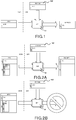
- the user USR can change the key attributes. This situation is schematically shown on figure 1 where a primary key KEY1 created by an owner OWN has wrap WRP for attribute ATT.
- This key KEY1 can thus be used in wrapping mechanisms. It can also be exported.
- the key KEY1 is available at a secure device SD owned by a user USR which is different from the owner OWN.
- the user USR can, for example, proceed to an export EXP of the key KEY1 while changing the attribute of the resulting exported key EXP KEY2 (secondary key).
- the user USR fills a request template RQT including a chosen attribute ATT for the key resulting from the export EXP.
- This attribute ATT is here decryption DEC, instead of wrap WRP as it should normally be the case. An attacker will thus be able to mount an attack enabling to retrieve any key protected by the key KEY1.
- the attacker thus access the value of the encryption final key and can compromise any secret protected by it.
- the present invention aims at avoiding the above-mentioned malicious attacks.
- the present invention is defined, in its broadest sense, as a method to create a primary cryptographic key with owner-defined transformation rules intended to be used in at least one cryptographic transformation operation triggered by a user and which results in at least a secondary key, the cryptographic transformation operation being performed in a secure device where the user triggers the cryptographic transformation operation by defining cryptographic transformation operation parameters and/or cryptographic attributes for the secondary key in a request template, said method comprising the step to insert, by the owner, in the primary cryptographic key, at least an attribute stating the usage of the primary cryptographic key and one cryptographic transformation operation restriction template comprising allowed cryptographic transformation operation parameters and/or allowed cryptographic attributes for the secondary key, said restriction template being then read in the secure device, once a cryptographic transformation operation is triggered by the user with a request template and before performing the cryptographic transformation operation, the cryptographic transformation operation being performed by the secure device only in the case where the user-defined cryptographic transformation operation parameters and/or cryptographic attributes in the request template correspond to the ones allowed in the restriction template inserted in the primary
- the invention allows the creator and owner of the primary key to specify, during creation of this primary key, what could be the resulting attributes of any new key obtained by transformation cryptographic transformation operations using the primary key.
- primary does not make reference to specific properties that can be thus designated in standard or other context. Those terms are for the ease of reading the claims and to help in the understanding of the invention.
- Primary and “secondary” are defined as the input and output of an operation.
- the “secondary” key of a first operation can become the "primary” key of any following operation.
- the secondary key can have the same value of the primary one, typically in case of exportation of the key while metadata like attributes are different.
- Attributes for the secondary key stands for any attributes the secondary key may have: derivation key, encryption key, attributes' heritage from the primary key, key owner identifier etc...
- Operation stands for the designation of the operation: derivation, exportation, importation, copy, backup, wrapping and Operation parameters stands for the parameters to be used during the operation (like diversifiers, date limit for operations etc)
- the cryptographic transformation operation which results in a secondary key is a key exportation/importation or a key derivation or a copy or a backup or a wrapping.
- the invention consists in adding, when needed, a collection of allowed operation parameters/attribute to the key for a given operation.
- Attributes and operation parameters provided by a user for a given operation are then compared to the list of operation parameters/attribute allowed in the restriction template in the primary key:
- the invention gives the primary key new properties which solve the above presented security problems.
- a key can only be transformed using pre-determined attributes specified at key's creation by its owner, so the scheme's security is no longer based on trusting the caller but is instead handled natively by the cryptographic system following the constraints specified by the key's creator.
- allowed cryptographic attributes for the secondary key includes at least one usage of the secondary key.
- a primary key could be specified such as it could only be derived into an encryption key.
- the same operation can be potentially linked to several different attributes sets for the secondary key, such that a key can have several restriction templates restricting a same operation but with different attributes for the obtained secondary key.
- a primary key could be specified such as it could only be derived either into an encryption key or into a signature key.
- allowed cryptographic attributes for the secondary key include an attributes heritage attribute setting that the attributes of the secondary are inherited from the primary key.
- This embodiment enables to simply transfer the attribute of the primary key to the secondary key.
- each allowed operation through several restriction template can specify allowed parameters for this operation. These parameters are specific to the operation used, i.e. export, derivation..., and to the cryptographic mechanism employed. These parameters can be business-specific
- the cryptographic transformation operation being a derivation
- the allowed cryptographic transformation operation parameters include at least a diversifier or a diversifier pattern.
- the derivation restriction includes at least a diversifier restriction. Then the secure device will refuse to perform the operation as soon as the diversifier is not conform to the provided restrictions.
- the term "diversifier” indeed refers to diversification patterns as the listing of all possible diversifiers would be often not possible. For example a diversification pattern like: 80 01 XX XX XX XX 7F where 'X' can take any value. At opposite these diversification patterns can also refer to a rejected mask of diversifiers that should not be accepted for the operation.
- the allowed cryptographic transformation operation parameters include at least a limit date for operation.
- the restriction applies to the operation to be performed itself and prevents the execution of the invention if the limit date is exceeded.
- allowed cryptographic attributes for the secondary key include an owner identifier.
- the owner identifier to be an attribute of the secondary key enables to track the origin of the secondary key.
- the restriction template comprises several levels.
- Such an embodiment enables the creator of the key to control a whole chain of use of the primary key in any secure device wherever the primary key, the secondary key or whichever successive key will be used.
- the operations can be successively performed in a same and single secure device or in several of such devices.
- nested restriction templates are also possible, meaning that one restriction template can contain its own set of allowed restriction templates that will be applied to the next resulting key.
- the restriction comprises several levels of mixed cryptographic transformation operations chosen among derivation, exportation, importation, copy, backup, wrapping.
- the restriction comprises multiple levels of cryptographic transformation operations.
- a key could be specified such as it could only be derived into a key that could only be derived into an encryption key.
- the restriction template comprises two levels corresponding to a double derivation.
- restriction template comprises several levels comprising at least an exportation/importation of the primary key.
- the present invention also relates to a primary cryptographic key with owner-defined transformation rules obtained according to a method of any one of preceding claims and being thus adapted to be used in at least one cryptographic transformation operation which results in at least a secondary key, said cryptographic key comprising at least an attribute stating the usage of the cryptographic key and at least an additional restriction template comprising allowed cryptographic transformation operation parameters and/or allowed cryptographic attributes for the secondary key, said restriction template and said attribute being then read in the secure device before performing a cryptographic transformation operation which results in at least a secondary key after trigger by a user with a request template, the cryptographic transformation operation being performed by the secure device only in the case where the user-defined cryptographic transformation operation parameters and/or cryptographic attributes in the request template correspond to the ones allowed in the restriction template inserted in the primary key, the secondary key being thus necessarily obtained while using, in the cryptographic transformation operation as triggered by the user, one cryptographic transformation operation parameter as allowed in restriction template or the secondary key having thus necessarily one cryptographic attribute as allowed in restriction template.
- Such a cryptographic key constructed according to the invention can be deeply trusted by the owner as any malicious use is prohibited directly and naturally from the structure and the content of the key itself. The usage of the key is thus always under the control of the owner.
- This invention also relates to a secure device adapted to receive primary cryptographic keys from an owner, said secure device comprising at least a cryptographic module adapted to perform cryptographic transformation operation using received primary cryptographic keys, said cryptographic transformation operations being triggered by a user while providing cryptographic transformation operations parameters and/or cryptographic attributes for a secondary key to be obtained from said primary key in a request template, said secure device further comprising a request template module adapted to receive a request template filled by a user of the secure device, an operation triggering module adapted to read the content of the received primary cryptographic key and the content of the request template received from the user and to compare these contents and to send a triggering signal to the cryptographic module only in the case where the user-defined cryptographic transformation operation parameters and/or cryptographic attributes in the request template correspond to the ones allowed in the restriction template inserted in the primary key, the secondary key being thus necessarily obtained while using, in the cryptographic transformation operation as triggered by the user, one cryptographic transformation operation parameter as allowed in restriction template or the secondary key having thus necessarily one cryptographic attribute as
- one or more embodiments comprise the features hereinafter fully described and particularly pointed out in the claims.
- FIG. 2A shows a key KEY1 as created according to the invention.
- This key is typically created onboard a Hardware Security Module.
- ATT which is here encryption ENC
- it further comprises restriction template(s) RST.
- Those restriction templates RST list restrictions to be applied to any key that can result from a specific operation to be performed by a secure device with this primary key KEY1.
- the key KEY1 is created by inserting a restriction template RST for any export operation EXP.
- This restriction lists an attribute ATT possible for the key to be obtained, here decryption DEC.
- an export operation EXP is triggered by a user USR using a request template RQT at a secure device SD. While receiving the request template RQT, the secure device SD reads the restriction template RST in the key KEY1.
- the restriction template RST here limits the exportation EXP of the key KEY1.
- the usage for a key to be exported is restricted to a decryption DEC usage. It appears in the restriction template RST as shown on figures 2A and 2B .
- the secure device SD is such that, the attribute requested by the user, here wrapping WRP, not being in the list in the restriction template RST for export EXP, the operation is not performed by the secure device SD as shown on figure 2B .
- the primary key KEY1 can only encrypt or be exported as a decryption key. So when appropriate key attributes are requested by the user USR during an export operation, a decryption key will be obtained as shown on figure 2A . But if attributes provided are not in the set of allowed operation/attributes couples of this key for this operation, then it will fail as shown on figure 2B .
- restriction can also be a list of prohibited attribute(s) or operation parameter(s) instead of allowed attribute(s) or operation parameter(s) while remaining in the scope of the invention.
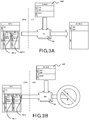
- FIGS 3A and 3B show another example where the invention is implemented.
- a primary key KEY1 is created with a derivation attribute DV.
- This key KEY1 is thus dedicated to be derived. This already restricts the use of the key KEY1 in a secure device SD to derivation.
- a user USR can request a primary key KEY1 to be derived in a secondary key having any kind of usage. Any differentiator can also be used. It renders the derivation by a user USR different from the owner OWN of the primary key KEY1 not secured.
- a key KEY1 is created with the insertion of several attributes stored in several restriction templates RST readable by a secure device SD as in the case of figure 2 .
- the first restriction template RST1 concerns a derivation operation to create a key having a usage of encryption ENC and a sensitive property SEN.
- the second restriction RST2 concerns the derivation towards a key having verification VER as usage.
- the secure device SD will refuse to derive the primary key KEY1 in a derivation key as the derivation usage is not allowed by the restrictions.
- the example of figure 3A proposes a second level of restriction by qualifying a parameter PAR to be used in the derivation.
- the parameter is a possible diversifier pattern to be used for each of the two possible operations.
- any other diversifier not matching the diversifier pattern DIVA will lead to a refused operation in a secure device SD of the invention.
- FIG 3B where the user USR filled the template to request a sensitive encryption key to be derived from primary key KEY1 using a diversifier DIVB.
- this diversifier DIVB does not match the diversifier pattern DIVA present in the restriction RST1 relative to the derivation operation using encryption ENC and sensitive SEN attributes, the operation is refused by the secure device SD.
- the main/primary key can only be derived into either a sensitive encryption key or an exportable signature verification key, depending on the derivation parameters given in the request template. So when appropriate key attributes and operation parameters are provided by the user USR while triggering the derivation operation DV as shown on figure 3A , either one of the possible keys can be obtained. Trying to switch attributes and operation parameters between the two possible restriction templates RQT1 or RQT2 would fail as shown on figure 3B .
- the primary key KEY1 could be derived only in two kinds of key: a secondary key DV KEY2 having encryption ENC and sensitive SEN as attributes only in the case where the requested diversifier is DIVA (case of figure 3A ), or a secondary key having verification VER as attribute only when the requested diversifier is DIVB.
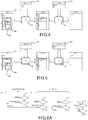
- Figure 4 represents another example where the invention is implemented in a double derivation context.
- a primary key KEY1 is created with a two levels restriction template RST regarding the derivation possibility of KEY1 which is a sensitive derivation key.
- the first restriction RST1 concerns the possibilities regarding the possible usages of a secondary key DV KEY2 which will be generated in the cryptographic transformation operation authorized by the attribute of the primary key KEY1.
- Another restriction RST2 inserted in the first restriction template RST1 gives the attributes according to the invention for a third key DV KEY3 which will be generated using the secondary key DV KEY2 generated according to the first restriction template RST1.
- a user USR fills a template RQT1 for a derivation operation DV for the primary key KEY1 to be derived in a secondary key DV KEY2 having an attribute of derivation DV and a sensitive SEN property.
- the derivation is performed by the secure device SD operated by the user USR. Otherwise the derivation operation is refused by the secure device SD.
- the same user USR or even another user using the same or a different secure device SD fills a new request template RQT2 for a derivation operation DV for the secondary key DV KEY2 to be derived in a third key DV KEY3 having an attribute of encryption ENC.
- the second restriction template RST2 comprises this attribute ENC for the derived key
- the derivation is performed by the secure device SD operated by the user USR. Otherwise the derivation operation is refused by the secure device SD.
- the main/primary key KEY1 can only be derived into a sensitive key that can itself only be derived into an exportable encryption key.
- Figure 5 shows a last example of implementation of the invention.
- a primary key KEY1 having an encryption attribute ENC can be exported using a secure device SD1 operated by a user USR.
- the user USR fills a request template RQT1 with export parameters EXP PAR.
- no attribute are specified and the obtained key will thus not have any usage except that it can be imported.
- the invention enables to strongly control, at the creator place, the diverse usage of the key and how the invention is useful for trusting the subsequent possible uses of the obtained keys.
- the export operation is performed by the secure device SD1.
- the obtained key EXP KEY2 contains a further restriction template RST2 which specifies which kind of key can be obtained while then importing the key EXP KEY2, here a decryption key IMP KEY3. If ever the user USR of the secure device SD2 for the second operation fills a template while specifying another attribute ATT, the secure device SD2 will not perform the operation. It is noted here that the secure device can also be a same and single secure device SD.
- the primary key KEY1 which is an encryption key will necessarily become, when exported, a key without specific usage that can only be imported as a decryption key.
- FIG. 6 schematically shows the method of the invention.
- a key value VKEY1 is provided at the entrance of the method of the invention.
- the cryptographic key of the invention is generally created on board a secure device of the owner/creator of the key, typically a Hardware Security Module (HSM).
- HSM Hardware Security Module
- a classical first step S1 is performed by associating at least an attribute ATT to the key value VKEY1. It is here noted that several attributes can be here inserted in the final key KEY1 and that properties can also be inserted. Such attribute directly define what can be done with the primary key KEY1. For example an encryption attribute ENC will enable a secure device to encrypt data or to export the primary key KEY1. It will not be allowed to make any derivation with this key. This is currently defined in standards concerning the construction of cryptographic key.
- the original step S2 of the invention is performed by inserting at least a restriction template RST having allowed operation parameter PAR and/or allowed attribute ATT to be applied to the creation of any secondary key and to the secondary key that would result from the use of the created primary key KEY1 while performing operations compatible with the attribute(s) ATT and the parameters PAR of the operation in the restriction template(s) RST of the key KEY1.
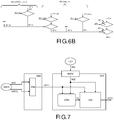
- Figure 6A schematically shows the possibilities offered by the invention in terms of levels of operations and of quantity of restrictions at a same level of operation. It shows n restrictions RSTi in the RST collection, inserted at a first level. This corresponds for example to the case shown on figure 3 .
- two of the restrictions at this first level are also restricted at a second level by a nested RST1,x and nested RSTn,x.
- RSTn a nested RST collection is inserted, itself constituted by several restrictions RSTn,1 to RSTn,j.
- Such a nesting of restrictions corresponds for example to the exemplary cases shown on figures 4 and 5 .
- Figure 6B shows a case where two levels of restrictions are inserted in key KEY1. At a first level concerning the first operation to be applied to the KEY1, three restrictions are found.
- RST1 corresponds for example to a restriction on the differentiator and to a decryption DEC usage for the secondary key in the restriction template RST1.
- RST2 can be a restriction template concerning another differentiator pattern for a decryption key to be obtained.
- Said obtained derivation key KEY2 being further restricted by nested restriction templates RST31 and RST32 for the operation parameters (diversifiers ...) that can be applied on the derivation or exportation and for the attribute of the key that will be obtained.
- Figure 7 shows a user secure device USD of the invention. It is adapted to receive a key KEY1 having a set of restriction templates RSTi from, typically another secure device OSD owned by an owner OWN.
- a key provisioning module KPM transforms a key value VKEY1 and a set of restriction templates RSTi in a primary cryptographic key KEY1 according to the invention.
- the user secure device USD comprises a cryptographic module CM adapted to perform cryptographic transformation operation using cryptographic keys KEY1 as received at the key provision module KPM. Said cryptographic transformation operations are triggered by a user USR by providing cryptographic transformation operations parameters in a request template RQT.
- the secure device SD further comprises a request template module RQTM adapted to receive the request template RQT filled by the user USR of the secure device SD. It comprises also an operation triggering module OTM adapted to read the content of the received cryptographic key KEY1 and the content of the request template RQT received from the user USR. It is further adapted to compare these contents, more particularly the restriction templates RST having restrictions on the cryptographic transformation operation parameters and/or cryptographic attributes and the operation parameters and/or cryptographic attributes as present in the request template RQT.
- the operation triggering module OTM is adapted to send a triggering signal TS to the cryptographic module CM only in the case where the user-defined cryptographic transformation operation parameters and/or cryptographic attributes in the request template RQT correspond to one of the ones allowed in the restriction templates RST inserted in the primary key KEY1.
- the key owner can specify the attributes of all sub-keys that can be produced from this key.
- Such a features is indeed mandatory for protecting the secrets of the owner of the key or of any other users in the chain of use of a key or of keys obtained from a key. It enables to strongly protect secrets at several levels.
- the invention can be easily adapted to several of the current Key Management standards like PKCS11 or KMIP and others.
- the invention also enables to enforce business-specific parameters in cryptographic transformation operations, among which the diversifiers.
Landscapes
- Engineering & Computer Science (AREA)
- Computer Security & Cryptography (AREA)
- Computer Networks & Wireless Communication (AREA)
- Signal Processing (AREA)
- Storage Device Security (AREA)
Priority Applications (2)
| Application Number | Priority Date | Filing Date | Title |
|---|---|---|---|
| EP18306005.2A EP3599737A1 (fr) | 2018-07-24 | 2018-07-24 | Procédé pour créer une clé cryptographique primaire avec des règles de transformation définies par le propriétaire |
| PCT/EP2019/069085 WO2020020699A1 (fr) | 2018-07-24 | 2019-07-16 | Procédé de création d'une clé cryptographique primaire présentant des règles de transformation définies par le propriétaire |
Applications Claiming Priority (1)
| Application Number | Priority Date | Filing Date | Title |
|---|---|---|---|
| EP18306005.2A EP3599737A1 (fr) | 2018-07-24 | 2018-07-24 | Procédé pour créer une clé cryptographique primaire avec des règles de transformation définies par le propriétaire |
Publications (1)
| Publication Number | Publication Date |
|---|---|
| EP3599737A1 true EP3599737A1 (fr) | 2020-01-29 |
Family
ID=63678572
Family Applications (1)
| Application Number | Title | Priority Date | Filing Date |
|---|---|---|---|
| EP18306005.2A Withdrawn EP3599737A1 (fr) | 2018-07-24 | 2018-07-24 | Procédé pour créer une clé cryptographique primaire avec des règles de transformation définies par le propriétaire |
Country Status (2)
| Country | Link |
|---|---|
| EP (1) | EP3599737A1 (fr) |
| WO (1) | WO2020020699A1 (fr) |
Citations (3)
| Publication number | Priority date | Publication date | Assignee | Title |
|---|---|---|---|---|
| EP0729252A2 (fr) * | 1995-02-24 | 1996-08-28 | International Computers Limited | Administration de clés cryptographiques |
| WO2013049689A1 (fr) * | 2011-09-29 | 2013-04-04 | Amazon Technologies, Inc. | Dérivation de clé en fonction d'un paramètre |
| US20140140512A1 (en) * | 2011-06-18 | 2014-05-22 | Ted A. Hadley | Requested and allowed cryptographic operations comparison |
-
2018
- 2018-07-24 EP EP18306005.2A patent/EP3599737A1/fr not_active Withdrawn
-
2019
- 2019-07-16 WO PCT/EP2019/069085 patent/WO2020020699A1/fr not_active Ceased
Patent Citations (3)
| Publication number | Priority date | Publication date | Assignee | Title |
|---|---|---|---|---|
| EP0729252A2 (fr) * | 1995-02-24 | 1996-08-28 | International Computers Limited | Administration de clés cryptographiques |
| US20140140512A1 (en) * | 2011-06-18 | 2014-05-22 | Ted A. Hadley | Requested and allowed cryptographic operations comparison |
| WO2013049689A1 (fr) * | 2011-09-29 | 2013-04-04 | Amazon Technologies, Inc. | Dérivation de clé en fonction d'un paramètre |
Also Published As
| Publication number | Publication date |
|---|---|
| WO2020020699A1 (fr) | 2020-01-30 |
Similar Documents
| Publication | Publication Date | Title |
|---|---|---|
| EP3174238B1 (fr) | Protection contre des attaques en faute de la mise en oeuvre boite blanche d'un réseau de feistel | |
| EP3711260B1 (fr) | Pile d'opérations de blockchain pour blockchain réinscriptible | |
| US20140223580A1 (en) | Method of and apparatus for processing software using hash function to secure software, and computer-readable medium storing executable instructions for performing the method | |
| CN114372276A (zh) | 一种数据安全防护方法、装置、电子设备及存储介质 | |
| EP2924677A1 (fr) | Division de s-box dans une implémentation en boîte blanche pour résister aux attaques | |
| US9485226B2 (en) | Method for including an implicit integrity or authenticity check into a white-box implementation | |
| CN105024992B (zh) | 在单个白箱实现中实现使用相关安全性设置 | |
| EP3291123B1 (fr) | Des contraintes de futurs pour chaîne de confiance hiérarchique | |
| Giereth | On partial encryption of rdf-graphs | |
| US9641337B2 (en) | Interface compatible approach for gluing white-box implementation to surrounding program | |
| CN105978680B (zh) | 一种加密钥的加密运算方法 | |
| CN105721134B (zh) | 使用带有多个外部编码的单个白盒实现 | |
| CN106209346B (zh) | 白盒密码技术交错查找表 | |
| EP2960891B1 (fr) | Procédé permettant d'introduire la dépendance d'implémentation d'une boîte blanche sur un ensemble de chaînes | |
| CN105281893B (zh) | 用于引入白箱实现对串集合的依赖性的方法 | |
| EP2940925B1 (fr) | MISE EN oeUVRE DE RÉGLAGES DE SÉCURITÉ EN FONCTION de l'utilisation DANS UNE IMPLÉMENTATION À BOÎTE BLANCHE UNIQUE | |
| EP3599737A1 (fr) | Procédé pour créer une clé cryptographique primaire avec des règles de transformation définies par le propriétaire | |
| EP3413509B1 (fr) | Calcul cmac utilisant des implémentations de boîte blanche avec des encodages externes | |
| EP2940917A1 (fr) | Empreinte comportementale dans une implémentation de boîte blanche | |
| EP2940677A1 (fr) | Procédé d'inclusion d'une vérification d'authenticité ou d'intégrité implicite dans une implémentation en boîte blanche | |
| US11985237B2 (en) | Key identifier derivation and management systems and methods | |
| CN106919846B (zh) | 一种消息中间件处理方法和系统 | |
| EP2940919A1 (fr) | Réalisation d'une autorisation via un comportement fonctionnel incorrect d'une implémentation de boîte blanche | |
| EP2940918B1 (fr) | Approche compatible avec une interface pour le collage d'une implémentation de boîte blanche à un programme environnant | |
| Geuer-Pollmann | Confidentiality of XML documents by Pool Encryption |
Legal Events
| Date | Code | Title | Description |
|---|---|---|---|
| PUAI | Public reference made under article 153(3) epc to a published international application that has entered the european phase |
Free format text: ORIGINAL CODE: 0009012 |
|
| STAA | Information on the status of an ep patent application or granted ep patent |
Free format text: STATUS: THE APPLICATION HAS BEEN PUBLISHED |
|
| AK | Designated contracting states |
Kind code of ref document: A1 Designated state(s): AL AT BE BG CH CY CZ DE DK EE ES FI FR GB GR HR HU IE IS IT LI LT LU LV MC MK MT NL NO PL PT RO RS SE SI SK SM TR |
|
| AX | Request for extension of the european patent |
Extension state: BA ME |
|
| STAA | Information on the status of an ep patent application or granted ep patent |
Free format text: STATUS: THE APPLICATION IS DEEMED TO BE WITHDRAWN |
|
| 18D | Application deemed to be withdrawn |
Effective date: 20200730 |