EP3600206B1 - Système d'utérus synthétique et placenta - Google Patents
Système d'utérus synthétique et placenta Download PDFInfo
- Publication number
- EP3600206B1 EP3600206B1 EP17720364.3A EP17720364A EP3600206B1 EP 3600206 B1 EP3600206 B1 EP 3600206B1 EP 17720364 A EP17720364 A EP 17720364A EP 3600206 B1 EP3600206 B1 EP 3600206B1
- Authority
- EP
- European Patent Office
- Prior art keywords
- artificial
- amniotic fluid
- womb
- newborn
- chamber
- Prior art date
- Legal status (The legal status is an assumption and is not a legal conclusion. Google has not performed a legal analysis and makes no representation as to the accuracy of the status listed.)
- Active
Links
Images


Classifications
-
- A—HUMAN NECESSITIES
- A61—MEDICAL OR VETERINARY SCIENCE; HYGIENE
- A61G—TRANSPORT, PERSONAL CONVEYANCES, OR ACCOMMODATION SPECIALLY ADAPTED FOR PATIENTS OR DISABLED PERSONS; OPERATING TABLES OR CHAIRS; CHAIRS FOR DENTISTRY; FUNERAL DEVICES
- A61G11/00—Baby-incubators; Couveuses
-
- A—HUMAN NECESSITIES
- A01—AGRICULTURE; FORESTRY; ANIMAL HUSBANDRY; HUNTING; TRAPPING; FISHING
- A01N—PRESERVATION OF BODIES OF HUMANS OR ANIMALS OR PLANTS OR PARTS THEREOF; BIOCIDES, e.g. AS DISINFECTANTS, AS PESTICIDES OR AS HERBICIDES; PEST REPELLANTS OR ATTRACTANTS; PLANT GROWTH REGULATORS
- A01N1/00—Preservation of bodies of humans or animals, or parts thereof
- A01N1/10—Preservation of living parts
- A01N1/14—Mechanical aspects of preservation; Apparatus or containers therefor
- A01N1/142—Apparatus
- A01N1/143—Apparatus for organ perfusion
-
- A—HUMAN NECESSITIES
- A61—MEDICAL OR VETERINARY SCIENCE; HYGIENE
- A61G—TRANSPORT, PERSONAL CONVEYANCES, OR ACCOMMODATION SPECIALLY ADAPTED FOR PATIENTS OR DISABLED PERSONS; OPERATING TABLES OR CHAIRS; CHAIRS FOR DENTISTRY; FUNERAL DEVICES
- A61G10/00—Treatment rooms or enclosures for medical purposes
- A61G10/02—Treatment rooms or enclosures for medical purposes with artificial climate; with means to maintain a desired pressure, e.g. for germ-free rooms
-
- A—HUMAN NECESSITIES
- A61—MEDICAL OR VETERINARY SCIENCE; HYGIENE
- A61M—DEVICES FOR INTRODUCING MEDIA INTO, OR ONTO, THE BODY; DEVICES FOR TRANSDUCING BODY MEDIA OR FOR TAKING MEDIA FROM THE BODY; DEVICES FOR PRODUCING OR ENDING SLEEP OR STUPOR
- A61M1/00—Suction or pumping devices for medical purposes; Devices for carrying-off, for treatment of, or for carrying-over, body-liquids; Drainage systems
- A61M1/36—Other treatment of blood in a by-pass of the natural circulatory system, e.g. temperature adaptation, irradiation ; Extra-corporeal blood circuits
- A61M1/3621—Extra-corporeal blood circuits
-
- A—HUMAN NECESSITIES
- A61—MEDICAL OR VETERINARY SCIENCE; HYGIENE
- A61M—DEVICES FOR INTRODUCING MEDIA INTO, OR ONTO, THE BODY; DEVICES FOR TRANSDUCING BODY MEDIA OR FOR TAKING MEDIA FROM THE BODY; DEVICES FOR PRODUCING OR ENDING SLEEP OR STUPOR
- A61M2202/00—Special media to be introduced, removed or treated
- A61M2202/0007—Special media to be introduced, removed or treated introduced into the body
-
- A—HUMAN NECESSITIES
- A61—MEDICAL OR VETERINARY SCIENCE; HYGIENE
- A61M—DEVICES FOR INTRODUCING MEDIA INTO, OR ONTO, THE BODY; DEVICES FOR TRANSDUCING BODY MEDIA OR FOR TAKING MEDIA FROM THE BODY; DEVICES FOR PRODUCING OR ENDING SLEEP OR STUPOR
- A61M2202/00—Special media to be introduced, removed or treated
- A61M2202/04—Liquids
- A61M2202/0494—Obstetrical, amniotic fluid
-
- A—HUMAN NECESSITIES
- A61—MEDICAL OR VETERINARY SCIENCE; HYGIENE
- A61M—DEVICES FOR INTRODUCING MEDIA INTO, OR ONTO, THE BODY; DEVICES FOR TRANSDUCING BODY MEDIA OR FOR TAKING MEDIA FROM THE BODY; DEVICES FOR PRODUCING OR ENDING SLEEP OR STUPOR
- A61M2210/00—Anatomical parts of the body
- A61M2210/14—Female reproductive, genital organs
- A61M2210/1433—Uterus
- A61M2210/1466—Umbilical cord
-
- A—HUMAN NECESSITIES
- A61—MEDICAL OR VETERINARY SCIENCE; HYGIENE
- A61M—DEVICES FOR INTRODUCING MEDIA INTO, OR ONTO, THE BODY; DEVICES FOR TRANSDUCING BODY MEDIA OR FOR TAKING MEDIA FROM THE BODY; DEVICES FOR PRODUCING OR ENDING SLEEP OR STUPOR
- A61M2240/00—Specially adapted for neonatal use
Definitions
- the human placenta is a complicated fetal organ which, on the one hand, assumes the important supply function for the embryo or foetus. This includes, for example, a transplacental active and/or passive transport of oxygen, amino acids, fatty acids, microelements, vitamins, water, electrolytes, growth factors, hormones, cytokines and other regulatory substances (NO, etc.). Substances such as amino acids, hormones and NO are also partially synthesized in the placenta itself. Because the fetal kidneys do not yet have a disposal function "in utero," they produce a dilute hypo-osmotic alkaline fluid, which is the major portion of total amniotic fluid.
- a fetus drinks about 250 to 300 ml/kg of amniotic fluid daily ( Gilbert WM and Brace RA. Semin perinatole. 1993 ). Fetal metabolites such as bilirubin or CO 2 are eliminated via the placenta. Thereafter, the maternal kidneys and lungs take over the disposal function.
- the placenta also provides an important barrier for maternal bacteria and viruses to keep them away from the developing child. Only the IgG antibodies pass through the placenta.
- the amnion or the fruit sac which already from the 4.-5. SSW, which surrounds the embryo and its umbilical cord, consists of 2 layers: amnial and chorial membranes.
- the function is mainly the boundary between the fetus and the uterus ( Bernischke et al. Pathology of the human placenta. Springer Verlag, 2012 ).
- Cytokines and prostaglandins are synthesized in the amniotic membrane and it plays a part in amniotic fluid production.
- the amniotic fluid is also involved in the direct transmission of maternal sounds, such as heartbeat, breathing, bowel sounds, but also the mother's voice, directly to the ear of the fetus.
- Artificial life support systems, neonatal incubators or artificial wombs are known. That's how it describes U.S. Patent 5,218,958 a life support system for a preterm infant that is embedded in the mother's natural placenta over the umbilical cord.
- the system includes upper and lower chambers separated by a vaulted partition.
- the lower chamber contains physiological fluid in which the preterm infant is placed, while the upper chamber has an oxygenated atmosphere and nutrient ports to deliver nutrients to the placenta. In this system, the basic physiological care of the premature baby can be made possible.
- the WO 2012/093087 A1 describes an aqueous composition with reduced chloride content that can be used as an amniotic fluid substitute.
- the structure of a life support system for premature babies or an artificial uterus is not described.
- the U.S. 2014/0255253 A1 describes an artificial uterus equipped with an oxygen supply device for the premature infant.
- the device comprises a gas-permeable membrane and a vascular network via which, for example, liquids containing nutrients can be supplied.
- Oxygen is delivered via an oxygenator via the umbilical cord using an umbilical catheter (umbilical cord catheter) that includes a venous catheter and an arterial catheter.
- umbilical catheter umbilical cord catheter
- a gas mixture containing 40% oxygen in nitrogen was administered via this catheter system. The securing of the catheter or its exact structure is not described.
- WO 2014/145494 A1 Another way of oxygenating a premature baby describes the WO 2014/145494 A1 , in which the circulatory system of the premature baby is coupled to an extracorporeal membrane, which is part of an oxygen supply system.
- the oxygenator is enriched with fetal blood.
- the incubation chamber contains a sterile liquid and can be warmed up if necessary.
- the system provides for the premature baby to be supplied with nutrients intravenously in the incubation chamber.
- inlets and outlets and, if necessary, a pump with at least one filter are also provided in the incubation chamber. The risk of infection and the risk of developing sepsis are very high.
- the DE 20 2014 103 422 U1 describes a uterine replica incubator having a lumen for housing a newborn and an environmental modification system configured to vary at least one parameter in a predetermined time cycle to replicate the human intrauterine environment.
- This includes, for example, a light filter, a noise absorber, a shock absorber.
- parameters can also be generated, including, for example, a light system, an olfactory system, a sound system or a movement system.
- the physiological requirements of an extremely premature baby embedded in a uterus are not discussed. Rather, it is about providing a consistent, safe, and calm environment for a newborn.
- the WO 2016/154319 A1 describes an artificial uterus and a method for its manufacture, in which microfluidic channels are provided, which are arranged between a membrane in such a way that liquid can be transported through the membrane. Furthermore, cell layers of at least two different cell types are provided, which adhere to the two sides of the membrane.
- the first cell type is, for example, primary human placental villous endothelial cells, while the second cell type includes choriocarcinoma cells.
- amniotic fluid replacement solutions described are unsuitable simply because of a too low pH value, increased osmolarity, the lack of microelements, glucose and an insufficient NaCl concentration.
- Extracorporeal membrane oxygenation which is usually veno-venous
- ECMO Extracorporeal membrane oxygenation
- CLS systems extracorporeal life support
- a hemodynamic relief of the heart is also possible, since there is a circulatory support.
- a veno-arterial ECLS and a veno-venous ECMO.
- the blood is transported from the patient's venous system by means of a pump and after passage through the oxygenator again supplied to the arterial system.
- the oxygen supply of the organism consists of the ECMO/ECLS flow and the remaining circulatory function of the patient. Connection to the extracorporeal circuit is usually via cannulas. In newborns and small children, the vessels in the neck (ie the carotid artery or jugular vein) are often used for cannulation because they have the largest diameter. However, this could lead to irreversible damage due to hypoperfusion of the brain.
- the WO 2016/205622 A1 describes a method and apparatus configured to provide extracorporeal support to preterm infants.
- the amniotic fluid circuit is configured to allow amniotic fluid to enter and exit the amniotic chamber to maintain a fluid pressure in the amniotic chamber within a predetermined range.
- the fruit cycle can be a closed system.
- the object of the present invention to provide an improved artificial uterus system for the life support of newborns, in particular extremely premature babies between 21/0 and 28/0 weeks of gestation, with which the overall life expectancy of the premature baby can be increased.
- the uterus system initially comprises an artificial space of the artificial uterus formed by an at least partially ultrasound-permeable wall with a lumen for receiving amniotic fluid and a premature baby.
- ultrasound-permeable material for the wall of the cavity of the uterus ultrasound measurements are possible, which are preferably carried out with probes in a frequency range of 1 to 15 MHz, preferably in a frequency range of 3.5 to 12 MHz or ranges in between.
- preferred materials for the wall of the cavity of the artificial uterus are transparent plastics or other ultrasound-permeable materials.
- the wall is also translucent.
- the wall consists of a material that is either dark in color due to shading of the interior or has a light-repellent effect when exposed to light.
- the system also includes at least one access for supplying the premature baby with amniotic fluid in the space of the artificial uterus.
- Nutrients, hormones, growth factors or other vital substances and compounds are preferably dissolved in the amniotic fluid.
- a dialysis facility is also provided in order to dispose of the decomposition products of the premature baby.
- An oxygenator and/or a gassing device ensures that the premature baby is supplied with oxygen, either with oxygen, an oxygen-containing gas mixture or with Carbogen ® .
- the inventor of the present invention has found that the devices and methods described in the prior art are insufficient on their own since they do not take into account the intraaminal pressure in the uterus. According to the invention it is therefore provided that means are provided to maintain an intraamnial pressure acting on the newborn in the space of the artificial uterus of >0 mbar in addition to atmospheric pressure.
- a pressure acting on the neonate of between 2 mBar and 1000 mBar, preferably between 5 mBar and 600 mBar, preferably between 5 mBar and 100 mBar, or ranges in between, is maintained in the space of the artificial uterus in addition to atmospheric pressure.
- the atmospheric pressure is usually 1 bar (approx. 1013 hPa).
- the absolute pressure in the artificial uterus is therefore preferably up to 2 bar or any values in between. Alternatively, it is also possible to apply an absolute pressure of 5 mbar to 2 bar. Intermediate ranges or intermediate values of the ranges mentioned above are also covered by the invention.
- Devices or means are provided for maintaining the intra-amniotic pressure, such as a pump or a pressurized container filled with artificial amniotic fluid or an oxygen mixture.
- the intraamnial pressure maintenance in the artificial uterus is achieved in a preferred variant in that a pump is provided for the transport of amniotic fluid and/or for amniotic fluid gassing.
- a pump is provided for the transport of amniotic fluid and/or for amniotic fluid gassing.
- a pressurized container eg filled with amniotic fluid or an oxygen mixture
- the pressure acting on the newborn can also be built up by a liquid column, for example amniotic fluid filled in the space, which acts on the newborn and builds up a pressure >0 mbar, preferably >0 mbar and 1 bar, in addition to atmospheric pressure (1 bar). .
- the pressure in the room can also be built up by gassing.
- the space can be closed or at least open on one side. A (preferably upwards) open space would be conceivable, for example, when using (fruit) water in which the newborn is embedded.
- the oxygenator and dialysis machine are connected to a port system, which in turn is connected to the premature baby's umbilical cord.
- the port system according to the invention consists of at least two catheters for connecting the umbilical vein and at least one umbilical artery of the premature baby.
- the port system according to the invention preferably comprises a catheter for the umbilical vein and two catheters for the two umbilical arteries. Furthermore, a stent connected to the catheters is provided, via which the port system is anchored to the umbilical cord.
- the inventor has further recognized that the best physiological access to the circulatory system of the extremely premature infant is through the umbilical cord.
- the problem is that the umbilical cord falls off shortly after birth, usually within 3 to 4 days. This makes it seemingly impossible to use the umbilical cord for long-term care of the premature baby.
- permanent catheterization of the intrahepatic umbilical vein via the umbilicus is associated with a significant risk of developing omphalitis or sepsis in the preterm infant.
- the port system enables at least one venous and one arterial catheter, preferably one venous and two arterial catheters, to be fixed to the umbilical cord in order to avoid unintentional tearing off even if the child moves in the space of the artificial uterus.
- Part of the port system is preferably located in the amniotic fluid of the artificial uterus, which also prevents possible pressure necrosis of the umbilical cord.
- the port system according to the invention is preferably watertight.
- the catheter for the umbilical vein preferably has a diameter of between 3 and 10 mm, while the catheters for the two umbilical arteries preferably have a diameter of 2 to 7 mm or even ranges in between.
- the port system according to the invention is preferably connected to an ECMO device as an oxygenator, with the enrichment with oxygen preferably taking place with donated fetal umbilical cord blood.
- the premature baby is transferred by detaching the natural placenta from the umbilical cord and immediately embedding it in the space of the artificial uterus of the artificial uterus system according to the invention that is filled with artificial amniotic fluid.
- the stent of the port system is preferably arranged at the end of the tube system in order not to reduce the diameter of the catheterized vessel unnecessarily, to guarantee secure fixation and also to enable the umbilical cord to be fixed later to the ECMO access/exit of the artificial uterus system.
- the catheters of the port system are preferably guided through a holder which is designed in such a way that it completely encompasses the umbilical cord of the premature baby from the outside.
- the stent of the port system according to the invention is preferably designed in such a way that the catheters can be connected to the inner wall of the umbilical cord.
- the port system is preferably fixed via the stent via a large number of small gripping elements or hooks which snap into place with the inner wall of the premature baby's umbilical cord.
- the associated possibility of developing aseptic pressure necrosis is not critical in this case, since the umbilical cord is cut off in the stented area at regular intervals, preferably every three to five days, but no later than after seven days.
- Recathetization of the umbilical cord vessels also avoids necrosis and bacterial or viral infection and colonization of the distal end of the umbilical cord.
- the cut stump of the umbilical cord can be subjected to a microbiological examination. Due to its length of 60 to 80 cm, the human umbilical cord offers the possibility of simply and efficiently carrying out recathetization at regular time intervals, with the reduction preferably being between 3 and 5 cm.
- the port system according to the invention preferably comprises a clamp for fixing the port to the umbilical cord from the outside.
- a clamp for fixing the port to the umbilical cord from the outside.
- transcutaneous fetal care via Carbogen ® or oxygen gassing is also possible.
- Carbogen ® fumigation provides a gas mixture consisting of about 5 parts by volume of carbon dioxide (CO 2 ) and 95 parts by volume of oxygen (O 2 ).
- the oxygenator preferably applies the Carbogen® gas mixture or oxygen directly to the artificial uterus.
- amniotic fluid supplied to the artificial uterus is treated with Carbogen® or O 2 either before it is supplied into the space of the artificial uterus or by treating amniotic fluid which is already in the space of the artificial uterus.
- Oxygen can be taken in by extremely premature babies either through the umbilical cord or through gassing through the skin.
- the O 2 saturation in the amniotic fluid of the artificial uterus is preferably recorded using a measuring device. Furthermore, the pressure and/or the temperature or a sonography can also be performed via the measuring device provided according to the invention.
- the amniotic fluid supplied to the artificial uterus is preheated to a temperature of preferably 37° to 39°C by an amniotic fluid preheating device.
- the space in the artificial uterus can preferably be kept at a temperature of between 37° and 38° C. by means of an appropriate heating device.
- the artificial uterus comprises connections for ECMO/ECLS tubes for amniotic fluid introduction and amniotic fluid drainage, for amniotic fluid gassing and/or for urinary drainage.
- the composition of the artificial amniotic fluid is also decisive for the successful survival and further development of the premature baby. If the composition of the amniotic fluid is insufficient, there is a risk that the fetal internal organs, umbilical cord, amnion, skin, eyes or mucous membranes will suffer irreversible damage.
- the inventor has also found that fetuses below the 28th week of pregnancy are not able to convert, metabolize or tolerate the commercially available amino acids ( Tchirikov M et. al. J Perinat Med. 2016 ).
- the commercial solutions used to date contain amino acid concentrations that sometimes deviate drastically (sometimes up to 100 times) from the physiological conditions in fetal plasma ( Tchirikov M et. al. J Perinat Med. 2016 ).
- Some amino acids are not even present in commercial supplements. If such an amino acid substitution is made, the fetus under 1000 g will not grow. Half of these fetuses die intrauterine or within a week after delivery.
- the amniotic fluid used according to the invention therefore comprises a nutrient composition whose concentrations correspond to the physiological situation in the fetus at the respective gestational age.
- concentration of fatty acids, vitamins, microelements, growth factors, hormones, electrolytes, cytokines and other regulatory substances is constantly checked, adjusted and substituted if necessary.
- the space of the artificial womb of the womb system according to the invention preferably comprises artificial amniotic fluid, which has the following composition. conc.
- amniotic fluid is preferably preheated to a temperature between 37 and 39° C. before being introduced into the artificial womb and at the same time gassed with oxygen or an oxygen-containing gas mixture.
- a container that can hold a pressure of up to 2 bar is preferably provided for this purpose.
- pressure gauges are preferably integrated in the wall.
- systems for measuring fetal O 2 saturation, ECG electrodes and temperature probes are planned.
- the fetal O 2 saturation is kept at 70-80% in the artificial uterine system after the umbilical cord is removed by the oxygenator and/or, if necessary, by gassing the amniotic fluid. Then there is a controlled increase in O 2 saturation to 89-94%.
- the uterine system also includes at least one access for the implementation of an additional artificial respiration, from the 23rd/24th SSW could occur.
- the temperature in the space of the artificial uterus is preferably kept constant at a temperature between 36 and 38°C by a temperature control device, preferably between 36.5 and 37.5°C.
- the body cooling function is said to be present even in the case of asphyxia.
- the space of the artificial uterus is mounted on a moving device. This is intended to reproduce the movement of the mother onto the fetus. If necessary, a scale can also be provided in order to be able to carry out regular weight measurements on the fetus.
- mother sounds are played in the artificial uterus via an audio device.
- maternal sounds are the mother's voice, breathing, bowel sounds and heartbeat. These are preferably recorded by the mother using a recording device and played into the space of the artificial uterus for the premature baby via an audio device.
- the mother's voice or songs sung can be played directly when the parents visit, for which purpose the wall of the space of the artificial uterus is preferably designed to be sound-permeable. It is true that the playing of music or noises in patients is known in principle, but such variants do not include the playing of internal maternal sounds such as breathing, intestinal sounds or the heartbeat.
- the aim of the audio effect according to the invention is to normalize the fetal programming and, if necessary, to steer it in a positive direction.
- the production of catabolic stress hormones e.g. adrenaline, noradrenaline or cortisone
- the combination of different noises is also possible.
- Premature birth is preferably before the 28th week of pregnancy.
- the uterine system and the method according to the invention which is not part of the invention, also work in normal newborns, i.e. newborns who have limited life support, for example due to congenital defects or due to undeveloped functions. These include, for example, newborns with hypoplasia of the lungs.
- ECMO treatment via the umbilical cord is an option for these children. It is advantageous here that the child and thus the umbilical cord are embedded in artificial amniotic fluid in the uterine system according to the invention. This means that the newborn or extremely premature baby does not suffer any pain, for example from the use of cannulas or catheterisation.
- an at least partially ultrasound-permeable space with a lumen for receiving amniotic fluid and a newborn baby, preferably an extremely premature baby before the end of the 28th week of pregnancy, is provided.
- the newborn or premature baby is then supplied with nutrients and oxygen in the uterine system.
- Fetal waste products are discharged via a dialysis facility.
- an intraamnial pressure of >0 mbar preferably between 2 mbar and 1000 mbar, preferably between 5 mbar and 600 mbar, preferably between 5 mbar and 100 mbar, in addition to the atmospheric pressure (1st Bar) is maintained, with all intermediate ranges or intermediate values also being encompassed by the present invention.
- preheated artificial amniotic fluid is introduced into the artificial uterus, preferably 2 l to 20 l daily. If the lumen is closed, the pressure is applied directly in the lumen by various means (eg gassing or liquid supply). In a variant, the lumen can also be open to one side, so that the pressure acts directly on the newborn.
- the requirement is that the pressure should be > 0 mbar in addition to the ambient pressure (atmospheric pressure).
- the medical upper limit should certainly be an absolute pressure of 2 bar, unless certain conditions of the newborn require a higher pressure application.
- the intraamnial pressure in the space or lumen of the artificial uterus is >0 mbar and preferably corresponds to the intraamnial pressure a natural womb of a living mother.
- the method is characterized in that a port system is provided which is connected to an oxygenator for the oxygen supply and the dialysis device.
- the port system consists of at least two catheters for connecting the umbilical vein and an umbilical artery and a stent connected to the catheters, which serves to anchor the port system to the umbilical cord.
- the artificial womb system comprises an artificial space 1 of the artificial womb formed by an at least partially ultrasound-permeable wall 2 with a lumen 14 for receiving amniotic fluid 15 and a premature baby.
- the amniotic fluid 15 can be provided in a storage container, for example, which preferably has a heating device, via which the amniotic fluid 15 can be preheated. Typically, the preheating takes place to a temperature between 38 and 39° C, although higher temperatures are also possible, depending on the design of the lines, the container or other system components.
- the amniotic fluid is preferably preheated via an amniotic fluid preheating device 6, with which the amniotic fluid 15 fed to the space 1 of the artificial uterus is preheated to a temperature of up to 39.degree.
- the amniotic fluid finally reaches the space 1 of the artificial uterus via a pump 11 via an access 3 .
- a port system 20 connects an umbilical vein and an umbilical artery of an umbilical cord 21 to an oxygenator 8. Another Umbilical artery is connected to an oxygenator 9.
- the oxygenator 8 and the dialysis device 9 communicate with one another.
- the oxygenator 8 provides an oxygen supply, with or without a pump as required.
- ECMO/ECLS care is preferred. Merely providing care for the premature baby via the port system 20 according to the invention led to a significant increase in the survival rate of the treated fetuses.
- Donated umbilical cord blood is preferably used in the ECMO application, which also counteracts a reduction in the Hb content. The substitution of nutritional and growth factors can also be partially improved with the donated umbilical cord blood.
- the wall 2 of the space 1 of the artificial uterus is preferably designed to be transparent, but should be clearly attenuated by light and transparent to ultrasound.
- the space in the artificial uterus 1 can be opened from above through an oval opening 10 .
- the space 1 of the artificial uterus can be sterilized and the lumen 14 preferably has a volume of 2 to 5 l.
- Various access points 30 are provided, for example for connecting ECMO tubes, for amniotic fluid gassing or for nutrient supply.
- the wall 2 of the space 1 is double-sided in order to maintain an amniotic fluid temperature of 37 to 38°.
- the artificial uterus with the space 1 of the artificial uterus should preferably be able to withstand a pressure of up to 2 bar in the case of hypobaric oxygenation (HBOT).
- the intraamnial pressure is usually between 5 mbar and 100 mbar.
- Any pressure gauges can be integrated in the wall 2 of the space 1 of the artificial uterus.
- For artificial respiration is from the 23./24.
- the amniotic fluid 15 supplied to the space 1 of the artificial uterus is preferably charged with a gas mixture 7 ( Carbogen® gas mixture) consisting of about 5 parts by volume of carbon dioxide and 95 parts by volume of oxygen or O 2 .
- a gas mixture 7 Carbogen® gas mixture
- the Carbogen® gas mixture or O 2 7 can also be applied directly to the amniotic fluid 15 of the uterine system.
- Samples for a measuring device 16 can be taken via a measuring supply line 4 in order to record, for example, the pO 2 in the amniotic fluid 15 of the space 1 of the artificial uterus, the pressure and/or the temperature, O 2 saturation of the fetus 21 . Sonography can also be performed. The analysis of Measured data from the measuring device 16 takes place via an analysis device 13. Maternal noises can be played into the space 1 of the artificial uterus via an audio device 12.
- the port system 20 is connected to the umbilical cord 21 of the premature baby via a holder 26 .
- the holder 26 surrounds the outside of the umbilical cord 21 around the full circumference.
- a first catheter 25 is inserted into the umbilical vein.
- Another catheter 23 is inserted into an umbilical artery.
- the port system 20 according to the invention comprises a first catheter 25 for the umbilical vein and two further catheters 23 for the two umbilical cord arteries.
- the umbilical vein and an umbilical artery serve to supply oxygen and are connected to the oxygenator 8 .
- the second umbilical artery is connected to the dialysis device 9 for disposal of the urine.
- a preterm infant drinks approximately 250 to 300 ml/kg of amniotic fluid, so elimination of fetal metabolites (eg, bilirubin, CO 2 ) is essential.
- the umbilical cord 21 and the holder 26 of the port system 20 are held by a clamp 22.
- the holder 26 preferably comprises a finger-like projection 28 which accommodates the umbilical cord 21 and the blood vessels integrated therein and which withstands the compressive force of the clip 22 . Part of the uterine wall 29 is also shown.
- the catheters 23, 25 have a stent 24, which in the variant shown consists of gripping elements or hooks that grip the inner wall of a blood vessel 31 of the umbilical cord 21 in a non-positive manner.
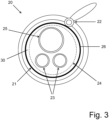
- the port system 20 in cross section.
- the catheter 25 for the umbilical vein and the two catheters 23 for the umbilical cord arteries can be seen.
- the stent 24 which consists of a wire mesh and is wrapped around the catheters 23 , 25 , can also be seen.
- the stent 24 fixes the port system 20 to the inner wall of the blood vessel 30.
- An additional clamp 22 ensures that the port system 20 is fixed via the holder 26.
- the artificial uterus system according to the invention has been successfully tested in the clinic in an animal model.
- the advantages of the port system 20 and the maintenance of the pressure in the lumen 14 of the uterine system between 5 mbar and 100 mbar have proven to be particularly advantageous in order to reduce the physiological fetal O 2 saturation to keep constant, to increase the life expectancy of extremely premature babies and to reduce the morbidity rate.
- the number of cases of sepsis was significantly reduced, since the port system 20 according to the invention allows the two catheters 23, 25 to be changed quickly and easily by shortening the umbilical cord.
- the umbilical cord piece in question of the umbilical cord 21 is removed during the re-catheterization so that new catheters 23, 25 can be inserted.
- the umbilical cord 21 is sufficiently long to be able to carry out several re-catheterizations.
- the sterile conditions of the artificial uterus system also brought the case of late ("late onset”) sepsis" under control, which occurs in about 40% of premature babies in the 25th week of pregnancy ( Stoll et al., Trends in Care Practices, Morbidity, and Mortality of Extremely Preterm Neonates, JAMA, 2015 ).
- the uterine system according to the invention also enables a rapid change of amniotic fluid while at the same time keeping the temperature and the pressure in the uterine system constant.
- Bacterial and/or Pinz colonization of the uterine system, umbilical cord, fetal skin and mucous membrane is prevented by flushing it out ("flushing out") with 2 l to 20 l of amniotic fluid per day.
- the fetal waste products that are excreted through the fetal skin and mucous membrane can also be transported out of the room with the artificial amniotic fluid.
- Additional gassing of the amniotic fluid can be used to maintain the oxygen supply to the fetal tissue, since the fetal skin is extremely thin and permeable to gas. If necessary, the CO 2 concentration in the mixture can be reduced to a value of less than 5%.
- gassing is carried out in the closed uterine system under gentle hyperbaric conditions of 5 mBbar to 100 mBar. Adequate oxygenation is particularly important for the premature infant during regular replacement/renewal of the apparatus and/or the catheter system.
- the amniotic fluid fed into the artificial womb preferably comprises a composition that is adapted to the developmental stage of the premature baby.
- Amniotic fluid can be used with or without surfactant/glucose.
- the amniotic fluid has the following composition: Na 143.8 mmol/l, K 3.9 mmol/l, Ca 1.6 mmol/l, Mg 0.57 mmol/l, CI 109.5 mmol/l, P 3.3 mg/dl, lactate 9.1 mmol/l, citrate 66.5 mg/dl, HCO 16.9 mmol/l, Cu 16 ⁇ g/dl, Se ⁇ 13.3 ⁇ g/dl, Zn 10-24 ⁇ g/dl, pH 8.0, osmolarity ⁇ 271.
- trace elements such as boron, chromium, iron, fluorine, iodine, cobalt, lithium, manganese, molybdenum, nickel, silicon and vanadium, amino acids, growth factors, vitamins and hormones can supplement the artificial amniotic fluid.
- the amniotic fluid is gassed with a Carbogen ® gas mixture or O 2 for amniotic fluid exchange in the artificial uterus or in a separate vessel. Temperature was maintained between 37° and 39°C except during body cooling following asphyxia. The amniotic fluid is exchanged after 4 to 6 hours. A complete exchange should take place after 24 hours at the latest in order to avoid infections and colonization.
- the artificial amniotic fluid pumped out through an outlet is used to analyze kidney function.
- the amniotic fluid gassed with an oxygen/Carbogen ® can also be used in a continuous regime as part of a "flush out" application up to 20-30 l/day.
- the ability to cut the umbilical cord 21 as part of the fixation of the port system 20 of the present invention is an effective method of preventing aseptic pressure necrosis, bacterial and fungal colonization, and infection of preterm infants. In the clinical trials, a weekly reduction in umbilical cord length of approximately 5 cm was performed without complications.
Landscapes
- Health & Medical Sciences (AREA)
- Life Sciences & Earth Sciences (AREA)
- General Health & Medical Sciences (AREA)
- Veterinary Medicine (AREA)
- Public Health (AREA)
- Animal Behavior & Ethology (AREA)
- Vascular Medicine (AREA)
- Heart & Thoracic Surgery (AREA)
- Engineering & Computer Science (AREA)
- Anesthesiology (AREA)
- Gynecology & Obstetrics (AREA)
- Cardiology (AREA)
- Pediatric Medicine (AREA)
- Pregnancy & Childbirth (AREA)
- Biomedical Technology (AREA)
- Hematology (AREA)
- Dentistry (AREA)
- Wood Science & Technology (AREA)
- Zoology (AREA)
- Environmental Sciences (AREA)
- Pulmonology (AREA)
- Medicines Containing Material From Animals Or Micro-Organisms (AREA)
Claims (11)
- Système d'utérus artificiel destiné au maintien en vie de nouveau-nés, en particulier de prématurés extrêmes entre 21/0 et 28/0 semaines de grossesse, ledit système comprenant :- un espace (1) de l'utérus artificiel qui est formé par une paroi (2) au moins partiellement transparente aux ultrasons et qui comporte une lumière (14) destinée à maintenir une pression intra-amniale physiologique et à recevoir le liquide amniotique artificiel (15) et un nouveau-né ou prématuré,- au moins un accès destiné à alimenter en nutriments le prématuré se trouvant dans l'utérus artificiel,- un oxygénateur (8) et/ou un dispositif d'apport de gaz destiné à fournir de l'oxygène au nouveau-né ou au prématuré,- des moyens étant prévus pour maintenir une pression intra-amniale, agissant sur le nouveau-né, de > 0 mbar dans l'espace (1) de l'utérus artificiel en plus de la pression atmosphérique, les moyens étant des moyens d'apport de gaz et/ou du liquide amniotique qui agissent sur le nouveau-né dans l'espace (1), caractérisé en ce qu'un dispositif de dialyse (9) est prévu et- l'oxygénateur (8) et le dispositif de dialyse (9) sont reliés au cordon ombilical (21) du nouveau-né ou du prématuré par le biais d'un système d'orifices (20), le système d'orifices (20) comprenant un premier cathéter (25) destiné à être relié à la veine ombilicale et au moins un autre cathéter (23) destiné à être relié à au moins une artère ombilicale du nouveau-né ou du prématuré et un stent (24) destiné à la fixation.
- Système d'utérus artificiel selon la revendication 1, caractérisé en ce qu'une pompe (11) est prévue qui transporte le liquide amniotique (15) ou l'oxygène jusque dans l'espace (1) de l'utérus pour maintenir une pression intra-amniale > 0 mbar, de préférence entre 2 mbar et 1000 mbar, en plus de la pression atmosphérique.
- Système d'utérus artificiel selon l'une des revendications 1 et 2, caractérisé en ce que les cathéters (23, 25) du système d'orifices (20) sont guidés à travers un support (26) qui est conçu de manière à s'engager entièrement autour du cordon ombilical (21) du nouveau-né ou du prématuré depuis le côté extérieur et en ce que le stent (24), relié aux cathéters (23, 25), est conçu de manière à ce que les cathéters (23, 25) puissent être reliés à une paroi interne d'un vaisseau sanguin (30) du cordon ombilical (21).
- Système d'utérus artificiel selon l'une des revendications 1 à 3, caractérisé en ce que le stent (24) comprend un grand nombre de crochets destinés à fixer le système d'orifices (20) sur la paroi interne du vaisseau sanguin (30).
- Système d'utérus artificiel selon l'une des revendications 1 à 4, caractérisé en ce qu'un dispositif de commande de température est prévu, qui maintient une température constante entre 36,5 et 37,5 °C dans l'espace (1) de l'utérus artificiel.
- Système d'utérus artificiel selon l'une des revendications 1 à 5, caractérisé en ce que le système comprend des raccords destinés à des tubes ECMO/ECLS pour l'introduction et le drainage du liquide amniotique, pour l'apport de gaz dans le liquide amniotique et/ou pour le drainage des déchets et de l'urine du nouveau-né ou du prématuré.
- Système d'utérus artificiel selon l'une des revendications 1 à 6, caractérisé en ce que l'espace (1) de l'utérus artificiel comprend du liquide amniotique artificiel (15) qui a la composition suivante :
conc. Osmolarité [mosm/l] 240 à 300 Azote [mmol/l] 130 à 145 Potassium [mmol/l] 3,5 à 4,5 Calcium [mmol/l] 1 à 2,5 Magnésium [mmol/l] 0 à 2 Chlorure [mmol/l] 100 à 120 Urée [mg/dl] 0 à 10 Acide urique [mg/dl] 0 à 5 Phosphate [mg/dl] 0 à 8 Glucose [mg/dl] 0 à 340 Lactate [mmol/l] 0 à 20 Citrate [mg/l] 0 à 100 Hydrogénocarbonate [mmol/1] 5 à 100 Albumine total [g/l] 0 à 10 Albumen [g/dl] 0 à 5 Cuivre [µg/dl] 0 à 150 Sélénium [µg/dl] 0 à 50 Zinc [µg/dl] 0 à 30 Lipides totaux [mg/1] 0 à 2000 Phosphatidylcholine (PC) [mg/l] (de préférence 80 % des lipides totaux) 0 à 1000 - Système d'utérus artificiel selon l'une des revendications 1 à 7, caractérisé en ce que l'oxygénateur (8) soumet l'espace (1) de l'utérus artificiel ou le liquide amniotique (15) amené à l'espace (1) à un mélange gazeux (7) comprenant environ 5 parties en volume de dioxyde de carbone (CO2) et 95 parties en volume d'oxygène (O2) ou seulement Oz.
- Système d'utérus artificiel selon l'une des revendications 1 à 8, caractérisé en ce qu'un dispositif de mesure (16) est également prévu pour détecter la saturation en O2 des prématurés, la pO2 dans le liquide amniotique (15) du système, la pression et/ou la température dans l'utérus artificiel ou pour l'échographie.
- Système d'utérus artificiel selon l'une des revendications 1 à 9, caractérisé en ce qu'un dispositif de préchauffage de liquide amniotique (6) est prévu, qui préchauffe le liquide amniotique (15) à amener à l'espace (1) à une température pouvant atteindre 39 °C.
- Système d'utérus artificiel selon l'une des revendications 1 à 10, caractérisé en ce que l'utérus artificiel est monté sur un dispositif de déplacement et/ou une balance.
Applications Claiming Priority (2)
| Application Number | Priority Date | Filing Date | Title |
|---|---|---|---|
| EP2017056704 | 2017-03-21 | ||
| PCT/EP2017/057829 WO2018171905A1 (fr) | 2017-03-21 | 2017-04-03 | Système d'utérus synthétique et placenta |
Publications (3)
| Publication Number | Publication Date |
|---|---|
| EP3600206A1 EP3600206A1 (fr) | 2020-02-05 |
| EP3600206B1 true EP3600206B1 (fr) | 2023-06-07 |
| EP3600206C0 EP3600206C0 (fr) | 2023-06-07 |
Family
ID=58644998
Family Applications (1)
| Application Number | Title | Priority Date | Filing Date |
|---|---|---|---|
| EP17720364.3A Active EP3600206B1 (fr) | 2017-03-21 | 2017-04-03 | Système d'utérus synthétique et placenta |
Country Status (4)
| Country | Link |
|---|---|
| US (1) | US11484026B2 (fr) |
| EP (1) | EP3600206B1 (fr) |
| DE (1) | DE112017007295A5 (fr) |
| WO (1) | WO2018171905A1 (fr) |
Families Citing this family (25)
| Publication number | Priority date | Publication date | Assignee | Title |
|---|---|---|---|---|
| CA2905619C (fr) | 2013-03-15 | 2021-06-01 | The Children's Hospital Of Philadelphia | Systeme de support de vie extracorporel et ses procedes d'utilisation |
| KR20180041118A (ko) | 2015-06-19 | 2018-04-23 | 더 칠드런스 호스피탈 오브 필라델피아 | 조산 태아의 체외 지원을 위한 방법 및 장치 |
| AU2016349390A1 (en) | 2015-11-06 | 2018-05-10 | Amnion Life, LLC | Premature infant amniotic bath incubator |
| MX2019006987A (es) | 2016-12-14 | 2019-08-16 | Childrens Hospital Philadelphia | Sistema y metodo configurados para proveer soporte extracorporeo para fetos prematuros. |
| EP3600206B1 (fr) | 2017-03-21 | 2023-06-07 | Michael Tchirikov | Système d'utérus synthétique et placenta |
| US10441490B2 (en) | 2018-01-09 | 2019-10-15 | Amnion Life, LLC | Systems, methods, and devices for artificial placentas and amniotic bed incubators |
| DE102018126634A1 (de) * | 2018-10-25 | 2020-04-30 | Prenatal International GmbH Halle | Vorrichtung mit künstlichem Kiemensystem und Verfahren für die Lebenserhaltung eines Neugeborenen |
| US12440412B2 (en) * | 2019-03-29 | 2025-10-14 | Technische Universiteit Eindhoven | Incubation system for liquid-based incubation of prematurely born infants |
| US20240099743A1 (en) * | 2019-10-12 | 2024-03-28 | Technische Universiteit Endhoven | Foetal extraction device |
| US20210283011A1 (en) * | 2020-03-12 | 2021-09-16 | Gary Hailey | Wellness Device |
| JP7682924B2 (ja) | 2020-04-29 | 2025-05-26 | ザ・チルドレンズ・ホスピタル・オブ・フィラデルフィア | カニューレ挿入システムおよびその使用方法 |
| CN111803255B (zh) * | 2020-07-20 | 2022-02-25 | 滨州医学院烟台附属医院 | 一种妇产科用产妇喂奶装置 |
| US11975136B2 (en) * | 2020-09-15 | 2024-05-07 | Hilltop BioSciences, Inc. | System and method for aseptic collection of mammalian amniotic fluid |
| EP4213788A4 (fr) * | 2020-09-15 | 2024-09-04 | The Children's Hospital Of Philadelphia | Ensemble chambre pour foetus prématuré |
| EP4062919A1 (fr) | 2021-03-24 | 2022-09-28 | Prenatal International GmbH | Au moins une composition à base de liquide amniotique humain destinée à l'utilisation dans un procédé de nutrition entérale, de supplémentation nutritionnelle entérale et/ou de traitement et/ou d'alimentation des couches peu capillaires |
| CA3114035C (fr) * | 2021-04-01 | 2022-03-29 | Marc Garrity | Modules pour la therapie d`oxygene hyperbare submergee et methodes et systemes connexes |
| EP4329840A4 (fr) * | 2021-04-28 | 2025-02-26 | The Children's Hospital Of Philadelphia | Plateau de transfert et chariot d'amorçage pour canulation néonatale et méthodes associées |
| JP2024543234A (ja) * | 2021-10-20 | 2024-11-19 | ザ・チルドレンズ・ホスピタル・オブ・フィラデルフィア | 生理食塩水およびその製造方法ならびに使用方法 |
| CN115919584B (zh) * | 2023-01-09 | 2023-05-26 | 首都儿科研究所附属儿童医院 | 一种仿生子宫系统 |
| DE102023110564B4 (de) * | 2023-04-25 | 2026-04-23 | Charité - Universitätsmedizin Berlin, Körperschaft des öffentlichen Rechts | Künstliche Gebärmutter |
| CN116747292A (zh) * | 2023-08-10 | 2023-09-15 | 四川大学华西第二医院 | 一种人工模拟羊膜液生物液体及其制备方法 |
| DE102024116589B3 (de) * | 2024-06-13 | 2025-11-20 | Rheinisch-Westfälische Technische Hochschule Aachen, abgekürzt RWTH Aachen, Körperschaft des öffentlichen Rechts | Künstliches Gebärmuttersystem und Verfahren zu dessen Herstellung |
| CN119327022B (zh) * | 2024-12-19 | 2025-04-22 | 中国人民解放军总医院第七医学中心 | 一种用于人工子宫的顺序球囊搏动血泵、系统及方法 |
| CN119746195A (zh) * | 2025-01-13 | 2025-04-04 | 北京清瀚医疗科技有限公司 | 一种体外生命支持系统 |
| CN120168755B (zh) * | 2025-01-13 | 2025-10-24 | 北京清瀚医疗科技有限公司 | 一种膜式氧合器及体外生命支持系统 |
Citations (4)
| Publication number | Priority date | Publication date | Assignee | Title |
|---|---|---|---|---|
| US5207639A (en) * | 1991-02-21 | 1993-05-04 | Cooper William I | Fetal lung apparatus |
| US20070010005A1 (en) * | 2005-07-08 | 2007-01-11 | James Sitzmann | Neonatal support system and related devices and methods of use |
| WO2014145494A1 (fr) * | 2013-03-15 | 2014-09-18 | The Children's Hospital Of Philadelphia | Système de support de vie extracorporel et ses procédés d'utilisation |
| WO2016205622A1 (fr) * | 2015-06-19 | 2016-12-22 | The Children's Hospital Of Philadelphia | Méthode et appareil de support extracorporel de fœtus prématuré |
Family Cites Families (9)
| Publication number | Priority date | Publication date | Assignee | Title |
|---|---|---|---|---|
| US5218958A (en) | 1991-02-21 | 1993-06-15 | Cooper William I | Placental chamber - artificial uterus |
| US20040193096A1 (en) * | 2003-03-25 | 2004-09-30 | Cooper William Isaac | Conceptus chamber |
| ES2738914T3 (es) | 2011-01-05 | 2020-01-27 | Prenatal Int Gmbh | Composición acuosa hipotónica con bajo contenido de cloruro, con o sin fosfolípidos |
| WO2013026148A1 (fr) | 2011-08-23 | 2013-02-28 | Mcmaster University | Placenta artificiel |
| DE202014103422U1 (de) | 2013-11-05 | 2014-08-04 | Aspect Imaging Ltd. | Ein eine Gebärmutter nachbildender Inkubator |
| EP3274079A4 (fr) | 2015-03-24 | 2018-12-19 | The Trustees Of The University Of Pennsylvania | Placenta artificiel et procédés de préparation |
| US9700279B2 (en) * | 2015-04-30 | 2017-07-11 | Sound the Bell, LLC | Hands-free stethoscope |
| AU2016349390A1 (en) * | 2015-11-06 | 2018-05-10 | Amnion Life, LLC | Premature infant amniotic bath incubator |
| EP3600206B1 (fr) | 2017-03-21 | 2023-06-07 | Michael Tchirikov | Système d'utérus synthétique et placenta |
-
2017
- 2017-04-03 EP EP17720364.3A patent/EP3600206B1/fr active Active
- 2017-04-03 DE DE112017007295.6T patent/DE112017007295A5/de not_active Withdrawn
- 2017-04-03 US US16/496,233 patent/US11484026B2/en active Active
- 2017-04-03 WO PCT/EP2017/057829 patent/WO2018171905A1/fr not_active Ceased
Patent Citations (4)
| Publication number | Priority date | Publication date | Assignee | Title |
|---|---|---|---|---|
| US5207639A (en) * | 1991-02-21 | 1993-05-04 | Cooper William I | Fetal lung apparatus |
| US20070010005A1 (en) * | 2005-07-08 | 2007-01-11 | James Sitzmann | Neonatal support system and related devices and methods of use |
| WO2014145494A1 (fr) * | 2013-03-15 | 2014-09-18 | The Children's Hospital Of Philadelphia | Système de support de vie extracorporel et ses procédés d'utilisation |
| WO2016205622A1 (fr) * | 2015-06-19 | 2016-12-22 | The Children's Hospital Of Philadelphia | Méthode et appareil de support extracorporel de fœtus prématuré |
Also Published As
| Publication number | Publication date |
|---|---|
| EP3600206A1 (fr) | 2020-02-05 |
| DE112017007295A5 (de) | 2020-01-02 |
| US11484026B2 (en) | 2022-11-01 |
| US20200323197A1 (en) | 2020-10-15 |
| EP3600206C0 (fr) | 2023-06-07 |
| WO2018171905A1 (fr) | 2018-09-27 |
Similar Documents
| Publication | Publication Date | Title |
|---|---|---|
| WO2018171905A1 (fr) | Système d'utérus synthétique et placenta | |
| DE60030682T3 (de) | Zweiteilige Bicarbonatlösung für die Peritonealdialyse oder als Substitutionslösung für die kontinuierliche Nierensubstitutionstherapie | |
| DE69123569T2 (de) | Medium zur aufbewahrung von blutplättchen | |
| DE69901885T2 (de) | Vorrichtung zur cerebralen wiederbelebung | |
| Kuwabara et al. | Development of extrauterine fetal incubation system using extracorporeal membrane oxygenator | |
| EP3870249A1 (fr) | Dispositif à système de branchies artificielles et son utilisation pour le maintien en vie d'un nouveau-né | |
| DE19622184A1 (de) | Tragbares Gerät zur Langzeit-Perfusion von menschlichen und tierischen Geweben, als Herz-Lungen-Nieren-Leber-Maschine, für die umfassende, funktionell stützende Behandlung und besonders auch für die lebenserhaltende Notfall-Perfusion, zur Notfall-Versorgung von Patienten | |
| JP2018527042A (ja) | 早産児の生体外支援のための方法および器具 | |
| JPH02198562A (ja) | 組織酸素低下および虚血性障害治療のための酸素添加合成栄養物の脈管外循環装置 | |
| JPS58185163A (ja) | 発作治療のための組織酸素低下および虚血性障害処置用酸素添加合成栄養物の脈管外循環 | |
| Auld | Delayed closure of the ductus arteriosus | |
| Bird | Artificial placenta: Analysis of recent progress | |
| US12440412B2 (en) | Incubation system for liquid-based incubation of prematurely born infants | |
| DE2809303A1 (de) | Verfahren und vorrichtung zur kontinuierlichen ambulanten peritonealdialyse (bauchfellspuelung) | |
| EP3041495B1 (fr) | Préparations pour une meilleure oxygénation des tissus par respiration péritonéale | |
| US20140221735A1 (en) | Nondestructive means of ectopic pregnancy management | |
| Mitcheson et al. | Clinical aspects of polycystic disease of the kidneys. | |
| Aladjem et al. | Experimental induction of a toxemia-like syndrome in the pregnant beagle | |
| Lewin | Changing attitudes to the management of severe head injuries | |
| TWM507742U (zh) | 導引式神經接合導管 | |
| Hruban et al. | Hypoglycemia resulting from insecticide poisoning: report of a case | |
| DE20213451U1 (de) | Nabelschnur-ECMO | |
| Rooth | Frontiers in perinatal medicine | |
| Taylor et al. | Attempts to make an “artificial uterus”: Part I. The adaptation of blood pumps and oxygenator for this purpose | |
| Cepeda et al. | 943 GLUCOSE INTOLERANCE IN PREMATURE INFANTS WITH MASSIVE INTRACRANIAL HEMORRHAGE (ICH) |
Legal Events
| Date | Code | Title | Description |
|---|---|---|---|
| STAA | Information on the status of an ep patent application or granted ep patent |
Free format text: STATUS: UNKNOWN |
|
| STAA | Information on the status of an ep patent application or granted ep patent |
Free format text: STATUS: THE INTERNATIONAL PUBLICATION HAS BEEN MADE |
|
| PUAI | Public reference made under article 153(3) epc to a published international application that has entered the european phase |
Free format text: ORIGINAL CODE: 0009012 |
|
| STAA | Information on the status of an ep patent application or granted ep patent |
Free format text: STATUS: REQUEST FOR EXAMINATION WAS MADE |
|
| 17P | Request for examination filed |
Effective date: 20191016 |
|
| AK | Designated contracting states |
Kind code of ref document: A1 Designated state(s): AL AT BE BG CH CY CZ DE DK EE ES FI FR GB GR HR HU IE IS IT LI LT LU LV MC MK MT NL NO PL PT RO RS SE SI SK SM TR |
|
| AX | Request for extension of the european patent |
Extension state: BA ME |
|
| DAV | Request for validation of the european patent (deleted) | ||
| DAX | Request for extension of the european patent (deleted) | ||
| STAA | Information on the status of an ep patent application or granted ep patent |
Free format text: STATUS: EXAMINATION IS IN PROGRESS |
|
| 17Q | First examination report despatched |
Effective date: 20201007 |
|
| GRAP | Despatch of communication of intention to grant a patent |
Free format text: ORIGINAL CODE: EPIDOSNIGR1 |
|
| STAA | Information on the status of an ep patent application or granted ep patent |
Free format text: STATUS: GRANT OF PATENT IS INTENDED |
|
| INTG | Intention to grant announced |
Effective date: 20220401 |
|
| RIN1 | Information on inventor provided before grant (corrected) |
Inventor name: TCHIRIKOV, MICHAEL |
|
| GRAJ | Information related to disapproval of communication of intention to grant by the applicant or resumption of examination proceedings by the epo deleted |
Free format text: ORIGINAL CODE: EPIDOSDIGR1 |
|
| STAA | Information on the status of an ep patent application or granted ep patent |
Free format text: STATUS: EXAMINATION IS IN PROGRESS |
|
| INTC | Intention to grant announced (deleted) | ||
| GRAS | Grant fee paid |
Free format text: ORIGINAL CODE: EPIDOSNIGR3 |
|
| STAA | Information on the status of an ep patent application or granted ep patent |
Free format text: STATUS: GRANT OF PATENT IS INTENDED |
|
| GRAP | Despatch of communication of intention to grant a patent |
Free format text: ORIGINAL CODE: EPIDOSNIGR1 |
|
| INTG | Intention to grant announced |
Effective date: 20221017 |
|
| GRAA | (expected) grant |
Free format text: ORIGINAL CODE: 0009210 |
|
| STAA | Information on the status of an ep patent application or granted ep patent |
Free format text: STATUS: THE PATENT HAS BEEN GRANTED |
|
| AK | Designated contracting states |
Kind code of ref document: B1 Designated state(s): AL AT BE BG CH CY CZ DE DK EE ES FI FR GB GR HR HU IE IS IT LI LT LU LV MC MK MT NL NO PL PT RO RS SE SI SK SM TR |
|
| REG | Reference to a national code |
Ref country code: GB Ref legal event code: FG4D Free format text: NOT ENGLISH |
|
| REG | Reference to a national code |
Ref country code: CH Ref legal event code: EP Ref country code: AT Ref legal event code: REF Ref document number: 1572671 Country of ref document: AT Kind code of ref document: T Effective date: 20230615 |
|
| REG | Reference to a national code |
Ref country code: DE Ref legal event code: R096 Ref document number: 502017014840 Country of ref document: DE |
|
| U01 | Request for unitary effect filed |
Effective date: 20230627 |
|
| U07 | Unitary effect registered |
Designated state(s): AT BE BG DE DK EE FI FR IT LT LU LV MT NL PT SE SI Effective date: 20230714 |
|
| REG | Reference to a national code |
Ref country code: LT Ref legal event code: MG9D |
|
| PG25 | Lapsed in a contracting state [announced via postgrant information from national office to epo] |
Ref country code: NO Free format text: LAPSE BECAUSE OF FAILURE TO SUBMIT A TRANSLATION OF THE DESCRIPTION OR TO PAY THE FEE WITHIN THE PRESCRIBED TIME-LIMIT Effective date: 20230907 Ref country code: ES Free format text: LAPSE BECAUSE OF FAILURE TO SUBMIT A TRANSLATION OF THE DESCRIPTION OR TO PAY THE FEE WITHIN THE PRESCRIBED TIME-LIMIT Effective date: 20230607 |
|
| PG25 | Lapsed in a contracting state [announced via postgrant information from national office to epo] |
Ref country code: RS Free format text: LAPSE BECAUSE OF FAILURE TO SUBMIT A TRANSLATION OF THE DESCRIPTION OR TO PAY THE FEE WITHIN THE PRESCRIBED TIME-LIMIT Effective date: 20230607 Ref country code: HR Free format text: LAPSE BECAUSE OF FAILURE TO SUBMIT A TRANSLATION OF THE DESCRIPTION OR TO PAY THE FEE WITHIN THE PRESCRIBED TIME-LIMIT Effective date: 20230607 Ref country code: GR Free format text: LAPSE BECAUSE OF FAILURE TO SUBMIT A TRANSLATION OF THE DESCRIPTION OR TO PAY THE FEE WITHIN THE PRESCRIBED TIME-LIMIT Effective date: 20230908 |
|
| PG25 | Lapsed in a contracting state [announced via postgrant information from national office to epo] |
Ref country code: SK Free format text: LAPSE BECAUSE OF FAILURE TO SUBMIT A TRANSLATION OF THE DESCRIPTION OR TO PAY THE FEE WITHIN THE PRESCRIBED TIME-LIMIT Effective date: 20230607 |
|
| PG25 | Lapsed in a contracting state [announced via postgrant information from national office to epo] |
Ref country code: IS Free format text: LAPSE BECAUSE OF FAILURE TO SUBMIT A TRANSLATION OF THE DESCRIPTION OR TO PAY THE FEE WITHIN THE PRESCRIBED TIME-LIMIT Effective date: 20231007 |
|
| PG25 | Lapsed in a contracting state [announced via postgrant information from national office to epo] |
Ref country code: SM Free format text: LAPSE BECAUSE OF FAILURE TO SUBMIT A TRANSLATION OF THE DESCRIPTION OR TO PAY THE FEE WITHIN THE PRESCRIBED TIME-LIMIT Effective date: 20230607 Ref country code: SK Free format text: LAPSE BECAUSE OF FAILURE TO SUBMIT A TRANSLATION OF THE DESCRIPTION OR TO PAY THE FEE WITHIN THE PRESCRIBED TIME-LIMIT Effective date: 20230607 Ref country code: RO Free format text: LAPSE BECAUSE OF FAILURE TO SUBMIT A TRANSLATION OF THE DESCRIPTION OR TO PAY THE FEE WITHIN THE PRESCRIBED TIME-LIMIT Effective date: 20230607 Ref country code: IS Free format text: LAPSE BECAUSE OF FAILURE TO SUBMIT A TRANSLATION OF THE DESCRIPTION OR TO PAY THE FEE WITHIN THE PRESCRIBED TIME-LIMIT Effective date: 20231007 Ref country code: CZ Free format text: LAPSE BECAUSE OF FAILURE TO SUBMIT A TRANSLATION OF THE DESCRIPTION OR TO PAY THE FEE WITHIN THE PRESCRIBED TIME-LIMIT Effective date: 20230607 |
|
| PG25 | Lapsed in a contracting state [announced via postgrant information from national office to epo] |
Ref country code: PL Free format text: LAPSE BECAUSE OF FAILURE TO SUBMIT A TRANSLATION OF THE DESCRIPTION OR TO PAY THE FEE WITHIN THE PRESCRIBED TIME-LIMIT Effective date: 20230607 |
|
| REG | Reference to a national code |
Ref country code: DE Ref legal event code: R097 Ref document number: 502017014840 Country of ref document: DE |
|
| PLBE | No opposition filed within time limit |
Free format text: ORIGINAL CODE: 0009261 |
|
| STAA | Information on the status of an ep patent application or granted ep patent |
Free format text: STATUS: NO OPPOSITION FILED WITHIN TIME LIMIT |
|
| 26N | No opposition filed |
Effective date: 20240308 |
|
| PG25 | Lapsed in a contracting state [announced via postgrant information from national office to epo] |
Ref country code: MC Free format text: LAPSE BECAUSE OF FAILURE TO SUBMIT A TRANSLATION OF THE DESCRIPTION OR TO PAY THE FEE WITHIN THE PRESCRIBED TIME-LIMIT Effective date: 20230607 |
|
| PG25 | Lapsed in a contracting state [announced via postgrant information from national office to epo] |
Ref country code: MC Free format text: LAPSE BECAUSE OF FAILURE TO SUBMIT A TRANSLATION OF THE DESCRIPTION OR TO PAY THE FEE WITHIN THE PRESCRIBED TIME-LIMIT Effective date: 20230607 |
|
| REG | Reference to a national code |
Ref country code: CH Ref legal event code: PL |
|
| U90 | Renewal fees not paid: noting of loss of rights |
Free format text: RENEWAL FEE NOT PAID FOR YEAR 08 Effective date: 20241118 |
|
| GBPC | Gb: european patent ceased through non-payment of renewal fee |
Effective date: 20240403 |
|
| PG25 | Lapsed in a contracting state [announced via postgrant information from national office to epo] |
Ref country code: GB Free format text: LAPSE BECAUSE OF NON-PAYMENT OF DUE FEES Effective date: 20240403 |
|
| PG25 | Lapsed in a contracting state [announced via postgrant information from national office to epo] |
Ref country code: GB Free format text: LAPSE BECAUSE OF NON-PAYMENT OF DUE FEES Effective date: 20240403 Ref country code: CH Free format text: LAPSE BECAUSE OF NON-PAYMENT OF DUE FEES Effective date: 20240430 |
|
| U93 | Unitary patent lapsed |
Free format text: RENEWAL FEE NOT PAID Effective date: 20240430 |
|
| PG25 | Lapsed in a contracting state [announced via postgrant information from national office to epo] |
Ref country code: IE Free format text: LAPSE BECAUSE OF NON-PAYMENT OF DUE FEES Effective date: 20240403 |
|
| PG25 | Lapsed in a contracting state [announced via postgrant information from national office to epo] |
Ref country code: CY Free format text: LAPSE BECAUSE OF FAILURE TO SUBMIT A TRANSLATION OF THE DESCRIPTION OR TO PAY THE FEE WITHIN THE PRESCRIBED TIME-LIMIT; INVALID AB INITIO Effective date: 20170403 |
|
| PG25 | Lapsed in a contracting state [announced via postgrant information from national office to epo] |
Ref country code: HU Free format text: LAPSE BECAUSE OF FAILURE TO SUBMIT A TRANSLATION OF THE DESCRIPTION OR TO PAY THE FEE WITHIN THE PRESCRIBED TIME-LIMIT; INVALID AB INITIO Effective date: 20170403 |
|
| PG25 | Lapsed in a contracting state [announced via postgrant information from national office to epo] |
Ref country code: TR Free format text: LAPSE BECAUSE OF FAILURE TO SUBMIT A TRANSLATION OF THE DESCRIPTION OR TO PAY THE FEE WITHIN THE PRESCRIBED TIME-LIMIT Effective date: 20230607 |