EP3600655B1 - Methode d'identification d'un materiau catalytique stabile au vieillissement hydrothermal - Google Patents
Methode d'identification d'un materiau catalytique stabile au vieillissement hydrothermal Download PDFInfo
- Publication number
- EP3600655B1 EP3600655B1 EP18770162.8A EP18770162A EP3600655B1 EP 3600655 B1 EP3600655 B1 EP 3600655B1 EP 18770162 A EP18770162 A EP 18770162A EP 3600655 B1 EP3600655 B1 EP 3600655B1
- Authority
- EP
- European Patent Office
- Prior art keywords
- cations
- perturbed
- copper
- peak
- samples
- Prior art date
- Legal status (The legal status is an assumption and is not a legal conclusion. Google has not performed a legal analysis and makes no representation as to the accuracy of the status listed.)
- Active
Links
Images






Classifications
-
- B—PERFORMING OPERATIONS; TRANSPORTING
- B01—PHYSICAL OR CHEMICAL PROCESSES OR APPARATUS IN GENERAL
- B01J—CHEMICAL OR PHYSICAL PROCESSES, e.g. CATALYSIS OR COLLOID CHEMISTRY; THEIR RELEVANT APPARATUS
- B01J29/00—Catalysts comprising molecular sieves
- B01J29/04—Catalysts comprising molecular sieves having base-exchange properties, e.g. crystalline zeolites
- B01J29/041—Mesoporous materials having base exchange properties, e.g. Si/Al-MCM-41
- B01J29/042—Mesoporous materials having base exchange properties, e.g. Si/Al-MCM-41 containing iron group metals, noble metals or copper
- B01J29/044—Iron group metals or copper
-
- B—PERFORMING OPERATIONS; TRANSPORTING
- B01—PHYSICAL OR CHEMICAL PROCESSES OR APPARATUS IN GENERAL
- B01J—CHEMICAL OR PHYSICAL PROCESSES, e.g. CATALYSIS OR COLLOID CHEMISTRY; THEIR RELEVANT APPARATUS
- B01J29/00—Catalysts comprising molecular sieves
- B01J29/04—Catalysts comprising molecular sieves having base-exchange properties, e.g. crystalline zeolites
- B01J29/06—Crystalline aluminosilicate zeolites; Isomorphous compounds thereof
- B01J29/70—Crystalline aluminosilicate zeolites; Isomorphous compounds thereof of types characterised by their specific structure not provided for in groups B01J29/08 - B01J29/65
- B01J29/72—Crystalline aluminosilicate zeolites; Isomorphous compounds thereof of types characterised by their specific structure not provided for in groups B01J29/08 - B01J29/65 containing iron group metals, noble metals or copper
- B01J29/76—Iron group metals or copper
-
- B—PERFORMING OPERATIONS; TRANSPORTING
- B01—PHYSICAL OR CHEMICAL PROCESSES OR APPARATUS IN GENERAL
- B01J—CHEMICAL OR PHYSICAL PROCESSES, e.g. CATALYSIS OR COLLOID CHEMISTRY; THEIR RELEVANT APPARATUS
- B01J29/00—Catalysts comprising molecular sieves
- B01J29/04—Catalysts comprising molecular sieves having base-exchange properties, e.g. crystalline zeolites
- B01J29/06—Crystalline aluminosilicate zeolites; Isomorphous compounds thereof
- B01J29/70—Crystalline aluminosilicate zeolites; Isomorphous compounds thereof of types characterised by their specific structure not provided for in groups B01J29/08 - B01J29/65
- B01J29/72—Crystalline aluminosilicate zeolites; Isomorphous compounds thereof of types characterised by their specific structure not provided for in groups B01J29/08 - B01J29/65 containing iron group metals, noble metals or copper
- B01J29/76—Iron group metals or copper
- B01J29/763—CHA-type, e.g. Chabazite, LZ-218
-
- B—PERFORMING OPERATIONS; TRANSPORTING
- B01—PHYSICAL OR CHEMICAL PROCESSES OR APPARATUS IN GENERAL
- B01D—SEPARATION
- B01D53/00—Separation of gases or vapours; Recovering vapours of volatile solvents from gases; Chemical or biological purification of waste gases, e.g. engine exhaust gases, smoke, fumes, flue gases, aerosols
- B01D53/34—Chemical or biological purification of waste gases
- B01D53/92—Chemical or biological purification of waste gases of engine exhaust gases
- B01D53/94—Chemical or biological purification of waste gases of engine exhaust gases by catalytic processes
- B01D53/9404—Removing only nitrogen compounds
- B01D53/9409—Nitrogen oxides
- B01D53/9413—Processes characterised by a specific catalyst
- B01D53/9418—Processes characterised by a specific catalyst for removing nitrogen oxides by selective catalytic reduction [SCR] using a reducing agent in a lean exhaust gas
-
- B—PERFORMING OPERATIONS; TRANSPORTING
- B01—PHYSICAL OR CHEMICAL PROCESSES OR APPARATUS IN GENERAL
- B01D—SEPARATION
- B01D53/00—Separation of gases or vapours; Recovering vapours of volatile solvents from gases; Chemical or biological purification of waste gases, e.g. engine exhaust gases, smoke, fumes, flue gases, aerosols
- B01D53/34—Chemical or biological purification of waste gases
- B01D53/92—Chemical or biological purification of waste gases of engine exhaust gases
- B01D53/94—Chemical or biological purification of waste gases of engine exhaust gases by catalytic processes
- B01D53/9459—Removing one or more of nitrogen oxides, carbon monoxide, or hydrocarbons by multiple successive catalytic functions; systems with more than one different function, e.g. zone coated catalysts
- B01D53/9463—Removing one or more of nitrogen oxides, carbon monoxide, or hydrocarbons by multiple successive catalytic functions; systems with more than one different function, e.g. zone coated catalysts with catalysts positioned on one brick
- B01D53/9468—Removing one or more of nitrogen oxides, carbon monoxide, or hydrocarbons by multiple successive catalytic functions; systems with more than one different function, e.g. zone coated catalysts with catalysts positioned on one brick in different layers
-
- B—PERFORMING OPERATIONS; TRANSPORTING
- B01—PHYSICAL OR CHEMICAL PROCESSES OR APPARATUS IN GENERAL
- B01D—SEPARATION
- B01D53/00—Separation of gases or vapours; Recovering vapours of volatile solvents from gases; Chemical or biological purification of waste gases, e.g. engine exhaust gases, smoke, fumes, flue gases, aerosols
- B01D53/34—Chemical or biological purification of waste gases
- B01D53/92—Chemical or biological purification of waste gases of engine exhaust gases
- B01D53/94—Chemical or biological purification of waste gases of engine exhaust gases by catalytic processes
- B01D53/9459—Removing one or more of nitrogen oxides, carbon monoxide, or hydrocarbons by multiple successive catalytic functions; systems with more than one different function, e.g. zone coated catalysts
- B01D53/9463—Removing one or more of nitrogen oxides, carbon monoxide, or hydrocarbons by multiple successive catalytic functions; systems with more than one different function, e.g. zone coated catalysts with catalysts positioned on one brick
- B01D53/9472—Removing one or more of nitrogen oxides, carbon monoxide, or hydrocarbons by multiple successive catalytic functions; systems with more than one different function, e.g. zone coated catalysts with catalysts positioned on one brick in different zones
-
- B—PERFORMING OPERATIONS; TRANSPORTING
- B01—PHYSICAL OR CHEMICAL PROCESSES OR APPARATUS IN GENERAL
- B01J—CHEMICAL OR PHYSICAL PROCESSES, e.g. CATALYSIS OR COLLOID CHEMISTRY; THEIR RELEVANT APPARATUS
- B01J23/00—Catalysts comprising metals or metal oxides or hydroxides, not provided for in group B01J21/00
- B01J23/38—Catalysts comprising metals or metal oxides or hydroxides, not provided for in group B01J21/00 of noble metals
- B01J23/40—Catalysts comprising metals or metal oxides or hydroxides, not provided for in group B01J21/00 of noble metals of the platinum group metals
- B01J23/42—Platinum
-
- B—PERFORMING OPERATIONS; TRANSPORTING
- B01—PHYSICAL OR CHEMICAL PROCESSES OR APPARATUS IN GENERAL
- B01J—CHEMICAL OR PHYSICAL PROCESSES, e.g. CATALYSIS OR COLLOID CHEMISTRY; THEIR RELEVANT APPARATUS
- B01J29/00—Catalysts comprising molecular sieves
- B01J29/04—Catalysts comprising molecular sieves having base-exchange properties, e.g. crystalline zeolites
- B01J29/06—Crystalline aluminosilicate zeolites; Isomorphous compounds thereof
- B01J29/064—Crystalline aluminosilicate zeolites; Isomorphous compounds thereof containing iron group metals, noble metals or copper
- B01J29/072—Iron group metals or copper
-
- B—PERFORMING OPERATIONS; TRANSPORTING
- B01—PHYSICAL OR CHEMICAL PROCESSES OR APPARATUS IN GENERAL
- B01J—CHEMICAL OR PHYSICAL PROCESSES, e.g. CATALYSIS OR COLLOID CHEMISTRY; THEIR RELEVANT APPARATUS
- B01J29/00—Catalysts comprising molecular sieves
- B01J29/82—Phosphates
-
- B—PERFORMING OPERATIONS; TRANSPORTING
- B01—PHYSICAL OR CHEMICAL PROCESSES OR APPARATUS IN GENERAL
- B01J—CHEMICAL OR PHYSICAL PROCESSES, e.g. CATALYSIS OR COLLOID CHEMISTRY; THEIR RELEVANT APPARATUS
- B01J29/00—Catalysts comprising molecular sieves
- B01J29/86—Borosilicates; Aluminoborosilicates
-
- B—PERFORMING OPERATIONS; TRANSPORTING
- B01—PHYSICAL OR CHEMICAL PROCESSES OR APPARATUS IN GENERAL
- B01J—CHEMICAL OR PHYSICAL PROCESSES, e.g. CATALYSIS OR COLLOID CHEMISTRY; THEIR RELEVANT APPARATUS
- B01J35/00—Catalysts, in general, characterised by their form or physical properties
- B01J35/19—Catalysts containing parts with different compositions
-
- B—PERFORMING OPERATIONS; TRANSPORTING
- B01—PHYSICAL OR CHEMICAL PROCESSES OR APPARATUS IN GENERAL
- B01J—CHEMICAL OR PHYSICAL PROCESSES, e.g. CATALYSIS OR COLLOID CHEMISTRY; THEIR RELEVANT APPARATUS
- B01J35/00—Catalysts, in general, characterised by their form or physical properties
- B01J35/50—Catalysts, in general, characterised by their form or physical properties characterised by their shape or configuration
- B01J35/56—Foraminous structures having flow-through passages or channels, e.g. grids or three-dimensional [3D] monoliths
-
- B—PERFORMING OPERATIONS; TRANSPORTING
- B01—PHYSICAL OR CHEMICAL PROCESSES OR APPARATUS IN GENERAL
- B01J—CHEMICAL OR PHYSICAL PROCESSES, e.g. CATALYSIS OR COLLOID CHEMISTRY; THEIR RELEVANT APPARATUS
- B01J35/00—Catalysts, in general, characterised by their form or physical properties
- B01J35/70—Catalysts, in general, characterised by their form or physical properties characterised by their crystalline properties, e.g. semi-crystalline
- B01J35/77—Compounds characterised by their crystallite size
-
- B—PERFORMING OPERATIONS; TRANSPORTING
- B01—PHYSICAL OR CHEMICAL PROCESSES OR APPARATUS IN GENERAL
- B01J—CHEMICAL OR PHYSICAL PROCESSES, e.g. CATALYSIS OR COLLOID CHEMISTRY; THEIR RELEVANT APPARATUS
- B01J37/00—Processes, in general, for preparing catalysts; Processes, in general, for activation of catalysts
- B01J37/02—Impregnation, coating or precipitation
- B01J37/024—Multiple impregnation or coating
- B01J37/0244—Coatings comprising several layers
-
- B—PERFORMING OPERATIONS; TRANSPORTING
- B01—PHYSICAL OR CHEMICAL PROCESSES OR APPARATUS IN GENERAL
- B01J—CHEMICAL OR PHYSICAL PROCESSES, e.g. CATALYSIS OR COLLOID CHEMISTRY; THEIR RELEVANT APPARATUS
- B01J37/00—Processes, in general, for preparing catalysts; Processes, in general, for activation of catalysts
- B01J37/02—Impregnation, coating or precipitation
- B01J37/024—Multiple impregnation or coating
- B01J37/0246—Coatings comprising a zeolite
-
- B—PERFORMING OPERATIONS; TRANSPORTING
- B01—PHYSICAL OR CHEMICAL PROCESSES OR APPARATUS IN GENERAL
- B01J—CHEMICAL OR PHYSICAL PROCESSES, e.g. CATALYSIS OR COLLOID CHEMISTRY; THEIR RELEVANT APPARATUS
- B01J37/00—Processes, in general, for preparing catalysts; Processes, in general, for activation of catalysts
- B01J37/08—Heat treatment
- B01J37/10—Heat treatment in the presence of water, e.g. steam
-
- F—MECHANICAL ENGINEERING; LIGHTING; HEATING; WEAPONS; BLASTING
- F01—MACHINES OR ENGINES IN GENERAL; ENGINE PLANTS IN GENERAL; STEAM ENGINES
- F01N—GAS-FLOW SILENCERS OR EXHAUST APPARATUS FOR MACHINES OR ENGINES IN GENERAL; GAS-FLOW SILENCERS OR EXHAUST APPARATUS FOR INTERNAL-COMBUSTION ENGINES
- F01N3/00—Exhaust or silencing apparatus having means for purifying, rendering innocuous, or otherwise treating exhaust
- F01N3/08—Exhaust or silencing apparatus having means for purifying, rendering innocuous, or otherwise treating exhaust for rendering innocuous
- F01N3/10—Exhaust or silencing apparatus having means for purifying, rendering innocuous, or otherwise treating exhaust for rendering innocuous by thermal or catalytic conversion of noxious components of exhaust
- F01N3/18—Exhaust or silencing apparatus having means for purifying, rendering innocuous, or otherwise treating exhaust for rendering innocuous by thermal or catalytic conversion of noxious components of exhaust characterised by methods of operation; Control
- F01N3/20—Exhaust or silencing apparatus having means for purifying, rendering innocuous, or otherwise treating exhaust for rendering innocuous by thermal or catalytic conversion of noxious components of exhaust characterised by methods of operation; Control specially adapted for catalytic conversion
- F01N3/206—Adding periodically or continuously substances to exhaust gases for promoting purification, e.g. catalytic material in liquid form, NOx reducing agents
- F01N3/2066—Selective catalytic reduction [SCR]
-
- G—PHYSICS
- G01—MEASURING; TESTING
- G01N—INVESTIGATING OR ANALYSING MATERIALS BY DETERMINING THEIR CHEMICAL OR PHYSICAL PROPERTIES
- G01N21/00—Investigating or analysing materials by the use of optical means, i.e. using sub-millimetre waves, infrared, visible or ultraviolet light
- G01N21/17—Systems in which incident light is modified in accordance with the properties of the material investigated
- G01N21/25—Colour; Spectral properties, i.e. comparison of effect of material on the light at two or more different wavelengths or wavelength bands
- G01N21/31—Investigating relative effect of material at wavelengths characteristic of specific elements or molecules, e.g. atomic absorption spectrometry
- G01N21/35—Investigating relative effect of material at wavelengths characteristic of specific elements or molecules, e.g. atomic absorption spectrometry using infrared light
- G01N21/3563—Investigating relative effect of material at wavelengths characteristic of specific elements or molecules, e.g. atomic absorption spectrometry using infrared light for analysing solids; Preparation of samples therefor
-
- B—PERFORMING OPERATIONS; TRANSPORTING
- B01—PHYSICAL OR CHEMICAL PROCESSES OR APPARATUS IN GENERAL
- B01D—SEPARATION
- B01D2255/00—Catalysts
- B01D2255/10—Noble metals or compounds thereof
- B01D2255/102—Platinum group metals
-
- B—PERFORMING OPERATIONS; TRANSPORTING
- B01—PHYSICAL OR CHEMICAL PROCESSES OR APPARATUS IN GENERAL
- B01D—SEPARATION
- B01D2255/00—Catalysts
- B01D2255/20—Metals or compounds thereof
- B01D2255/207—Transition metals
- B01D2255/20761—Copper
-
- B—PERFORMING OPERATIONS; TRANSPORTING
- B01—PHYSICAL OR CHEMICAL PROCESSES OR APPARATUS IN GENERAL
- B01D—SEPARATION
- B01D2255/00—Catalysts
- B01D2255/50—Zeolites
-
- B—PERFORMING OPERATIONS; TRANSPORTING
- B01—PHYSICAL OR CHEMICAL PROCESSES OR APPARATUS IN GENERAL
- B01D—SEPARATION
- B01D2255/00—Catalysts
- B01D2255/90—Physical characteristics of catalysts
- B01D2255/902—Multilayered catalyst
- B01D2255/9022—Two layers
-
- B—PERFORMING OPERATIONS; TRANSPORTING
- B01—PHYSICAL OR CHEMICAL PROCESSES OR APPARATUS IN GENERAL
- B01D—SEPARATION
- B01D2255/00—Catalysts
- B01D2255/90—Physical characteristics of catalysts
- B01D2255/903—Multi-zoned catalysts
- B01D2255/9032—Two zones
-
- B—PERFORMING OPERATIONS; TRANSPORTING
- B01—PHYSICAL OR CHEMICAL PROCESSES OR APPARATUS IN GENERAL
- B01D—SEPARATION
- B01D2255/00—Catalysts
- B01D2255/90—Physical characteristics of catalysts
- B01D2255/915—Catalyst supported on particulate filters
- B01D2255/9155—Wall flow filters
-
- B—PERFORMING OPERATIONS; TRANSPORTING
- B01—PHYSICAL OR CHEMICAL PROCESSES OR APPARATUS IN GENERAL
- B01J—CHEMICAL OR PHYSICAL PROCESSES, e.g. CATALYSIS OR COLLOID CHEMISTRY; THEIR RELEVANT APPARATUS
- B01J2229/00—Aspects of molecular sieve catalysts not covered by B01J29/00
- B01J2229/10—After treatment, characterised by the effect to be obtained
- B01J2229/18—After treatment, characterised by the effect to be obtained to introduce other elements into or onto the molecular sieve itself
-
- B—PERFORMING OPERATIONS; TRANSPORTING
- B01—PHYSICAL OR CHEMICAL PROCESSES OR APPARATUS IN GENERAL
- B01J—CHEMICAL OR PHYSICAL PROCESSES, e.g. CATALYSIS OR COLLOID CHEMISTRY; THEIR RELEVANT APPARATUS
- B01J2229/00—Aspects of molecular sieve catalysts not covered by B01J29/00
- B01J2229/30—After treatment, characterised by the means used
- B01J2229/42—Addition of matrix or binder particles
-
- B—PERFORMING OPERATIONS; TRANSPORTING
- B01—PHYSICAL OR CHEMICAL PROCESSES OR APPARATUS IN GENERAL
- B01J—CHEMICAL OR PHYSICAL PROCESSES, e.g. CATALYSIS OR COLLOID CHEMISTRY; THEIR RELEVANT APPARATUS
- B01J2235/00—Indexing scheme associated with group B01J35/00, related to the analysis techniques used to determine the catalysts form or properties
- B01J2235/10—Infrared [IR]
-
- B—PERFORMING OPERATIONS; TRANSPORTING
- B01—PHYSICAL OR CHEMICAL PROCESSES OR APPARATUS IN GENERAL
- B01J—CHEMICAL OR PHYSICAL PROCESSES, e.g. CATALYSIS OR COLLOID CHEMISTRY; THEIR RELEVANT APPARATUS
- B01J2235/00—Indexing scheme associated with group B01J35/00, related to the analysis techniques used to determine the catalysts form or properties
- B01J2235/30—Scanning electron microscopy; Transmission electron microscopy
-
- G—PHYSICS
- G01—MEASURING; TESTING
- G01N—INVESTIGATING OR ANALYSING MATERIALS BY DETERMINING THEIR CHEMICAL OR PHYSICAL PROPERTIES
- G01N21/00—Investigating or analysing materials by the use of optical means, i.e. using sub-millimetre waves, infrared, visible or ultraviolet light
- G01N21/17—Systems in which incident light is modified in accordance with the properties of the material investigated
- G01N21/25—Colour; Spectral properties, i.e. comparison of effect of material on the light at two or more different wavelengths or wavelength bands
- G01N21/31—Investigating relative effect of material at wavelengths characteristic of specific elements or molecules, e.g. atomic absorption spectrometry
- G01N21/35—Investigating relative effect of material at wavelengths characteristic of specific elements or molecules, e.g. atomic absorption spectrometry using infrared light
- G01N2021/3595—Investigating relative effect of material at wavelengths characteristic of specific elements or molecules, e.g. atomic absorption spectrometry using infrared light using FTIR
-
- Y—GENERAL TAGGING OF NEW TECHNOLOGICAL DEVELOPMENTS; GENERAL TAGGING OF CROSS-SECTIONAL TECHNOLOGIES SPANNING OVER SEVERAL SECTIONS OF THE IPC; TECHNICAL SUBJECTS COVERED BY FORMER USPC CROSS-REFERENCE ART COLLECTIONS [XRACs] AND DIGESTS
- Y02—TECHNOLOGIES OR APPLICATIONS FOR MITIGATION OR ADAPTATION AGAINST CLIMATE CHANGE
- Y02T—CLIMATE CHANGE MITIGATION TECHNOLOGIES RELATED TO TRANSPORTATION
- Y02T10/00—Road transport of goods or passengers
- Y02T10/10—Internal combustion engine [ICE] based vehicles
- Y02T10/12—Improving ICE efficiencies
Definitions
- the present invention relates to a method for identifying a catalytic material, in particular to a method for identifying a catalytic material that is stable toward aging at 800°C for 16 hours in the presence of 10% H 2 O/air.
- zeolites are employed in the catalysis of certain chemical reactions for example the selective catalytic reduction (SCR) of nitrogen oxides with a reductant such as ammonia, urea or hydrocarbons.
- SCR selective catalytic reduction
- Zeolites are crystalline materials having rather uniform pore sizes which range from about 0.3 to about 2.5 nm (about 3 to about 25 Angstroms) in diameter, depending upon the type of zeolite.
- Catalysts employed in the SCR process must be able to retain good catalytic activity over the wide range of temperatures found in practical applications, including hydrothermal conditions with temperatures ranging, for example, from about 150°C to about 800°C or higher.
- Hydrothermal conditions are encountered by SCR catalysts, as water is a byproduct of fuel combustion.
- High temperature hydrothermal conditions occur in exhaust applications, for example, during the regeneration of a diesel particulate filter (DPF) or catalyzed soot filter (CSF), a component of exhaust gas treatment systems used for the removal of carbonaceous particles.
- DPF diesel particulate filter
- CSF catalyzed soot filter
- the SCR process converts nitrogen oxides (NOx) to nitrogen (N 2 ) and water (H 2 O).
- Nitrogen oxides (NOx) may include N 2 O, NO, N 2 O 3 , NO 2 , N 2 O 4 , N 2 O 5 or HNO 3 . It would be desirable to have improved articles, systems and processes to convert NOx selectively within internal combustion engine exhaust streams to N 2 . Improvements in high temperature hydrothermal durability are required for short duration transients where exhaust temperatures may reach 750°C, 800°C, 850°C or even 900°C. Particularly important are improvements in low temperature NOx performance, for example from about 150°C to about 300°C, after high temperature hydrothermal aging.
- the present invention provides a method for identifying a catalytic material that is stable toward aging at 800°C for 16 hours in the presence of 10% H 2 O/air, the method comprising:
- the present invention provides a method for identifying a catalytic material that is stable toward aging at 800°C for 16 hours in the presence of 10% H 2 O/air, the method comprising:
- the identified catalytic materials are suitable for treatment of exhaust gas streams of internal combustion engines, for example gasoline, light-duty diesel and heavy duty diesel engines.
- the catalytic materials are also suitable for treatment of emissions from stationary industrial processes or for catalysis in chemical reaction processes.
- Molecular sieves refer to materials having an extensive three-dimensional network of oxygen ions containing generally tetrahedral type sites and having a pore distribution of relatively uniform pore size.
- a zeolite is a specific example of a molecular sieve, further including silicon and aluminum.
- Reference to a "non-zeolite-support" or “non-zeolitic support” in a catalyst layer refers to a material that is not a zeolite. Examples of such non-zeolitic supports include, but are not limited to, high surface area refractory metal oxides.
- Molecular sieves comprise small pore, medium pore, and large pore molecular sieves or combinations thereof.
- a small pore molecular sieve contains channels defined by up to eight tetrahedral atoms.
- a medium pore molecular sieve contains channels defined by ten-membered rings.
- a large pore molecular sieve contains channels defined by rings of at least twelve tetrahedral atoms.
- Small pore molecular sieves have an 8-ring opening and may have for instance a double 6- ring (D6R) or 6-ring structural unit.
- the cage building units include the CHA cage, various modifications of the CHA cage, LTA cage, GME cage and the like.
- Small pore molecular sieves are selected from the group consisting of aluminosilicate molecular sieves, metal-containing aluminosilicate molecular sieves, aluminophosphate (ALPO) molecular sieves, metal-containing aluminophosphate (MeALPO) molecular sieves, silico- aluminophosphate (SAPO) molecular sieves, and metal-containing silico-aluminophosphate (MeSAPO) molecular sieves and mixtures thereof.
- APO aluminophosphate
- MeALPO metal-containing aluminophosphate
- SAPO silico- aluminophosphate
- MeSAPO metal-containing silico-aluminophosphate
- small pore molecular sieves are selected from the group consisting of framework types AEI, AFT, AFV, AFX, AVL, CHA, DDR, EAB, EEI, ERI, I FY, IRN, KFI, LEV, LTA, LTN, MER, MWF, NPT, PAU, RHO, RTE, RTH, SAS, SAT, SAV, SFW, TSC, UFI and mixtures or intergrowths thereof.
- the small pore molecular sieve is selected from the group of framework types CHA, LEV, AEI, AFT, AFX, ERI, LTA, SFW, KFI and DDR.
- Medium pore molecular sieves are selected from the group consisting of framework types AEL, AFO, AHT, BOF, BOZ, CGF, CGS, CHI, DAC, EUO, FER, HEU, IMF, ITH, ITR, JRY, JSR, JST, LAU, LOV, MEL, MFI, MFS, MRE, MTT, MVY, MWW, NAB, NAT, NES, OBW, PAR, PCR, PON, PUN, RRO, RSN, SFF, SFG, STF, STI, STT, STW, SVR, SZR, TER, TON, TUN, UOS, VSV, WEI, WEN and mixtures or intergrowths thereof.
- the medium pore molecular sieves are selected from the group consisting of framework types FER, MEL, MFI and STT.
- Large pore molecular sieves are selected from the group consisting of framework types AFI, AFR, AFS, AFY, ASV, ATO, ATS, BEA, BEC, BOG, BPH, BSV, CAN, CON, CZP, DFO, EMT, EON, EZT, FAU, GME, GON, IFR, ISV, ITG, IWR.
- the large pore molecular sieves are selected from the group consisting of framework types AFI, BEA, FAU, MAZ, MOR and OFF.
- molecular sieves comprise a framework type selected from the group consisting of AEI, BEA (beta zeolites), CHA (chabazite), FAU (zeolite Y), FER (ferrierite), MFI (ZSM-5) and MOR (mordenite).
- zeolites having these structures include chabazite, faujasite, zeolite Y, ultrastable zeolite Y, beta zeolite, mordenite, silicalite, zeolite X and ZSM-5.
- Useful molecular sieves have 8-ring pore openings and double-six ring secondary building units, for example, those having structure types AEI, AFT, AFX, CHA, EAB, ERI, KFI, LEV, SAS, SAT or SAV. Included are any and all isotopic framework materials such as SAPO, ALPO and MeAPO materials having the same structure type.
- Aluminosilicate zeolite structures do not include phosphorus or other metals isomorphically substituted in the framework. That is, "aluminosilicate zeolite” excludes aluminophosphate materials such as SAPO, ALPO and MeAPO materials, while the broader term “zeolite” includes aluminosilicates and aluminophosphates.
- the molecular sieve has the CHA crystal structure. Copper-containing chabazite is abbreviated as CuCHA.
- the molecular sieve can have the SAPO crystal structure - i.e., CuSAPO.
- a synthetic 8-ring small pore molecular sieve (for example having the CHA structure) may be prepared via mixing a source of silica, a source of alumina and a structure directing agent under alkaline aqueous conditions.
- Typical silica sources include various types of fumed silica, precipitated silica and colloidal silica, as well as silicon alkoxides.
- Typical alumina sources include boehmites, pseudo-boehmites, aluminum hydroxides, aluminum salts such as aluminum sulfite or sodium aluminate and aluminum alkoxides. Sodium hydroxide is typically added to the reaction mixture.
- a typical structure directing agent for this synthesis is adamantyltrimethyl ammonium hydroxide, although other amines and/or quaternary ammonium salts may be substituted or added.
- the reaction mixture is heated in a pressure vessel with stirring to yield a crystalline product.
- Typical reaction temperatures are in the range of from about 100°C to about 200°C, for instance from about 135°C to about 170°C.
- Typical reaction times are between 1 hr and 30 days and in some embodiments, from 10 hours to 3 days.
- the pH is optionally adjusted to between 6 and 10, for example between 7 and 7.5 and the product is filtered and washed with water. Any acid can be used for pH adjustment, for instance nitric acid.
- the product may be centrifuged.
- Organic additives may be used to help with the handling and isolation of the solid product.
- Spray-drying is an optional step in the processing of the product.
- the solid product is thermally treated in air or nitrogen.
- each gas treatment can be applied in various sequences or mixtures of gases can be applied. Typical calcination temperatures are in from about 400°C to about 850°C.
- Molecular sieves having a CHA structure may be prepared for instance according to methods disclosed in U.S. 4,544,538 A and U.S. 6,709,644 B2 .
- the molecular sieves may have a silica-to-alumina ratio (SAR) of about 1 to about 1000. In some embodiments, the molecular sieve may have an SAR of about 2 to about 750, about 5 to about 250, or about 5 to about 50.
- SAR silica-to-alumina ratio
- the molecular sieve contains ion-exchanged copper where the atomic percentage (atomic % or at%) of ion-exchanged copper in a Cu +2 state in a fresh sample compared to the atomic % of ion-exchanged copper in a Cu +2 state in the sample aged at 800°C for 16 hours in the presence of 10% H 2 O/air remains stable.
- the atomic percentages for a fresh sample versus an aged sample are within 20%, within 15%, within 10%, or within 5% of each other.
- the atomic percentage of ion- exchanged copper in Cu +2 state means relative to all ion-exchanged copper.
- the copper present in the ion-exchange sites (ion-exchanged copper) of the molecular sieves is ⁇ 50 at% (atomic percent) Cu +2 .
- Other ion-exchanged copper is in the form of, for example, Cu(OH) +1 . This is after exposure to air and/or moisture and thus after oxidation.
- the Cu +2 atomic percentage is determined based upon analysis of infrared spectra of fresh and aged samples that allow for identification of the relative copper species present in the copper-exchanged catalytic material.
- the ion-exchanged copper is identified via DRIFT spectroscopy (Diffuse Reflectance Infrared Fourier Transform spectroscopy) carried out using known methods. Copper species may be detected by monitoring perturbed T-O-T bond (Si-O-Al and Si-O-Si) vibrations of a molecular sieve. Structural vibrations of T-O-T bonds of molecular sieves exhibit absorption peaks from about 1350 cm -1 to about 920 cm -1 and about 850 cm -1 to about 620 cm -1 for asymmetric and symmetric vibration modes, respectively.
- DRIFT spectroscopy Diffuse Reflectance Infrared Fourier Transform spectroscopy
- Perturbed T-O-T bond vibrations are observed when copper ions are exchanged into cationic positions of a molecular sieve, due to strong interactions between copper ions and framework oxygen. Peak positions depend on the nature of the copper ions and the structure of the molecular sieve framework. Peak intensity and peak integrated area can depend on the quantity of copper ions in the exchange sites. Accordingly, DRIFT spectroscopy is effective for qualitative analysis of the nature of the copper-exchanged molecular sieve catalytic material. In general, this invention contemplates using for characterization any vibrational modes that are perturbed (i.e., shifted) due to the presence of different species of metallic ions interacting with the T-O-T framework of the molecular sieves. For example, as disclosed herein, copper species are detected by monitoring perturbed T-O-T asymmetric stretching vibrational modes by using DRIFT spectroscopy.
- DRIFT spectroscopy is performed as disclosed below. See, also, Luo et al., "Identification of two types of Cu sites in Cu/SSZ-13 and their unique responses to hydrothermal aging and sulfur poisoning," Catalysis Today, 267 (2016), 3-9 ; and Kwak et al., "two different cationic positions in Cu-SSZ-13?,” Chem. Commun., 2012, 48, 4758-4760 .
- the term "exhibiting a Cu +2 peak and a Cu(OH) +1 peak” refers to the perturbed absorptions that are identified in the DRIFT spectra.
- infrared absorptions at ca. 900 cm -1 and ca. 950 cm -1 corresponding to perturbed T-O-T asymmetric stretching vibrations can be correlated to the presence of Cu +2 and Cu(OH) +1 , respectively.
- infrared absorptions at ca. 900 cm -1 and ca. 970 cm -1 corresponding to perturbed asymmetric stretching vibrations can be correlated to the presence of Cu +2 and Cu(OH) +1 , respectively.
- Cu +2 balancing the charge of an Al pair is more hydrothermally stable than Cu(OH) +1 associated with a single Al, thus providing catalysts capable of high NOx reduction activity and high hydrothermal stability.
- Cu cations balance the charge created by Si substituting for P in a SAPO molecular sieve.
- the perturbed T-O-T bond vibrations for SAPO are related to the structural vibrations due to the Si, Al and P in the tetrahedral "T" sites.
- catalysts with a higher relative percentage of Cu +2 in the molecular sieve framework (as determined via DRIFT analysis as discussed above through identification of perturbed TO-T bonds, such as those corresponding to perturbed T-O-T asymmetric stretching vibrations) can be identified and can provide improved catalytic performance and aging stability.
- Stability is associated with a defined ratio between the integrated peak area of the perturbed T-O-T asymmetric stretching peak corresponding to the Cu +2 cations (e.g., the peak for perturbed T-O-T bonds at about 900 cm -1 in a DRIFT spectrum) and the integrated peak area of the perturbed T-O-T asymmetric stretching peak corresponding to the Cu(OH) +1 cations (e.g., the peak for perturbed T-O-T bonds at about 950 cm -1 in a DRIFT spectrum for CuCHA or at about 970 cm -1 in a DRIFT spectrum for CuSAPO).
- the ratio of the integrated peak area for perturbed T-O-T asymmetric stretching peaks corresponding to Cu +2 relative to peaks corresponding to Cu(OH) -1 is to be ⁇ 1, ⁇ 1.2, or ⁇ 1.5.
- the ratio of the integrated peak areas can be 1 to about 5, about 1.2 to about 4, or about 1.5 to about 3.
- Suitable copper-exchanged molecular sieves can be identified in relation to the contribution to the total peak area of the perturbed T-O-T asymmetric stretching vibrational peaks by the perturbed T-O-T asymmetric stretching vibrational peak for Cu +2 .
- area Cu +2 is the integrated peak area perturbed T-O-T asymmetric stretching vibrational peaks corresponding to Cu +2 (i.e., the peak at about 900 cm -1 in the DRIFT spectrum)
- area Cu(OH) +1 is the integrated peak area for perturbed T-O-T asymmetric stretching vibrational peaks corresponding to Cu(OH) +1 (i.e., the peak at about 950 cm -1 in the DRIFT spectrum for CuCHA and at about 970 cm -1 in the DRIFT spectrum for CuSAPO).
- the percentage of the total peak area that is attributable to the perturbed T-O-T asymmetric stretching vibrational peak for Cu +2 is at least 50%, at least 55%, or at least 60%, such as about 55% to about 95%, about 60% to about 90%, or about 65% to about 85%.
- the foregoing ratio and percentage is substantially unchanged between the fresh state and the aged state for the copper-exchanged molecular sieve.
- the percentage of the total peak area corresponding to perturbed T-O-T asymmetric stretching vibrations that is attributable to the perturbed T-O-T asymmetric stretching vibrational peak for Cu +2 is increased by ⁇ 20% or ⁇ 10%.
- the copper-containing molecular sieves are prepared for example via ion-exchange from for example a Na + containing molecular sieve (Na + form).
- Na + form generally refers to the calcined form without any ion exchange.
- the molecular sieve generally contains a mixture of Na + and H + cations in the exchange sites. The fraction of sites occupied by Na + cations varies depending on the specific zeolite batch and recipe.
- the alkali metal molecular sieves are NH 4 + -exchanged and the NH 4 + form is employed for ion-exchange with copper.
- the NH 4 + -exchanged molecular sieve is calcined to the H + -form which may also be employed for ion-exchange with copper.
- Copper is ion-exchanged into molecular sieves with alkali metal, NH 4 + or H + forms with copper salts such as copper acetate, copper sulfate and the like, for example as disclosed in U.S. 9,242,238 B2 .
- a Na + , NH 4 + or H + form of a molecular sieve is mixed with an aqueous salt solution and agitated at an elevated temperature for a suitable time. The slurry is filtered and the filter cake is washed and dried.
- a catalytically active metal may be included during a molecular sieve synthetic process such that a tailored colloid contains a structure directing agent, a silica source, an alumina source and a metal ion (e.g. copper) source, as disclosed in U.S. 9,272,272 B2 .
- the total amount of copper in the molecular sieve is for example about 1.0 wt.% to about 10 wt.%, based on the total weight of the copper-containing molecular sieve. In some embodiments, the total amount of copper in the molecular sieve can be about 1.5 wt.% to about 9 wt.%, about 2.0 wt.% to about 8 wt.%, or about 3.0 wt.% to about 7 wt.%, based on the total weight of the copper-containing molecular sieve.
- the total amount of copper includes ion-exchanged copper and copper associated with the molecular sieve but not ion-exchanged.
- Amounts of copper in a molecular sieve are reported as the oxide, CuO.
- the total dry weight of the molecular sieve includes the any added/exchanged metals like copper.
- the total amount of copper in a molecular sieve may also be defined by the copper-to-aluminum atomic ratio.
- the Cu/AI atomic ratio may be about 0.20 to about 0.50.
- the Cu/AI atomic ratio can be about 0.25 to about 0.50, about 0.3 to about 0.50, or about 0.35 to about 0.50.
- the molecular sieves containing copper may each have a sodium content (reported as Na 2 0 on a volatile free basis) of below 2 wt.%, based on the total weight of the catalyst composition. In more specific embodiments, sodium content is below 2500 ppm.
- the molecular sieves may each have an atomic sodium-to-aluminum ratio of less than about 0.7, for example about 0.02 to about 0.7.
- the molecular sieves may each have an atomic copper to sodium ratio of greater than about 0.5, for example about 0.5 to about 50.
- the present copper-containing molecular sieves may exhibit a BET surface area, determined according to DIN 66131, of at least about 400 m 2 /g, at least about 550 m 2 /g, or at least about 650 m 2 /g, for example, about 400 to about 750 m 2 /g or, about 500 to about 750 m 2 /g.
- the present molecular sieves may have a mean crystal size of about 10 nanometers to about 20 microns, preferably about 0.1 microns to about 2.0 microns as determined via Scanning Electron Microscopy (SEM).
- the mean crystal size is ⁇ 0.5 microns or ⁇ 2.0 microns.
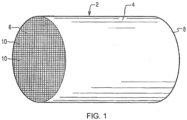
- FIGS. 1 to 4 illustrate substrates, washcoated substrates and coating configurations according to embodiments outside the scope of the claimed invention.
- freshness defines the state of the catalyst article immediately following preparation and the term “fresh catalyst activity” defines the catalyst performance in the "fresh” condition.
- aged defines the state of the catalyst article following hydrothermal aging for a defined period of time, and the term “aged catalyst activity” defines the catalyst performance in the "aged” condition.
- the present invention relates to methods for identifying useful catalytic materials.
- DRIFT spectroscopy in particular makes it possible to evaluate a plurality of samples of copper-containing molecular sieves and identify materials that would be expected to be useful as a catalytic material, and more particularly to identify materials that can exhibit aging stability.
- a method for identification of catalytic materials comprises first providing a plurality of samples that each comprise particles of a copper-containing molecular sieve containing ion-exchanged copper as Cu +2 cations and as Cu(OH) +1 cations, wherein the molecular sieve has the CHA framework.
- the various samples can be in particulate form or may be milled as necessary to provide the necessary form for subjecting the particles of the copper-containing molecular sieve to Diffuse Reflectance Infrared Fourier Transform (DRIFT) spectroscopy.
- DRIFT spectroscopy is carried out so as to evaluate perturbed T-O-T vibrational peaks corresponding to the Cu +2 cations in the copper-containing molecular sieve and perturbed TO-T vibrational peaks corresponding to the Cu(OH) +1 cations in the copper-containing molecular sieve.
- such information can be used to identify the nature of the copper cations in the copper-containing molecular sieve.
- such information can be directly related to the NOx conversion activity and the aging stability that would be expected in the copper-containing molecular sieve.
- the present methods thus further can include selecting one or more of the samples whereby the DRIFT data indicates usefulness as otherwise discussed herein.
- a useful sample is identified wherein the copper-containing molecular sieve exhibits a ratio for an integrated peak area of the perturbed T-O-T vibrational peak corresponding to the Cu +2 cations to a peak integration area of the perturbed T-O-T vibrational peak corresponding to the Cu(OH) +1 cations that is ⁇ 1.
- a percentage of the total integrated peak area that is attributable to the integrated peak area for the perturbed T-O-T asymmetric stretching vibrational peak corresponding to the Cu +2 cations is calculated by dividing the integrated peak area for the perturbed T-O-T asymmetric stretching vibrational peak corresponding to the Cu +2 cations by a total peak integration area for the perturbed TO-T bond vibrational peak corresponding to the Cu +2 cations and the perturbed T- O-T asymmetric stretching vibrational peak corresponding to the Cu(OH) +1 cations combined.
- the present methods thus includes selecting one or more samples wherein the percentage of the total integrated peak area that is attributable to the perturbed T-O-T bond vibrational peak for Cu +2 cations is ⁇ 50%.
- the plurality of samples subjected to the DRIFT spectroscopy as discussed above are in a fresh state.
- the method further comprises aging the plurality of samples at a temperature of about 800°C for a time of about 16 hours in the presence of air with an H 2 0 content of about 10 mol% to form aged samples.
- the methods comprises subjecting the aged samples to the DRIFT spectroscopy and selecting one or more of the samples, wherein the percentage of the total integrated peak area that is attributable to the perturbed T-O-T asymmetric stretching vibrational peak corresponding to the Cu +2 cations for the copper-containing molecular sieve in an aged state is increased by ⁇ 20% relative to the percentage of the total integrated peak area that is attributable to the perturbed T-O- T asymmetric stretching vibrational peak corresponding to the Cu +2 cations for the copper- containing molecular sieve in the fresh state.
- the articles “a” and “an” herein refer to one or to more than one (e.g. at least one) of the grammatical object. Any ranges cited herein are inclusive.
- the term “about” used throughout is used to describe and account for small fluctuations. For instance, “about” may mean the numeric value may be modified by ⁇ 5%, ⁇ 4%, ⁇ 3%, ⁇ 2%, ⁇ 1%, ⁇ 0.5%, ⁇ 0.4%, ⁇ 0.3%, ⁇ 0.2%, ⁇ 0.1 % or ⁇ 0.05%. All numeric values are modified by the term “about” whether or not explicitly indicated. Numeric values modified by the term “about” include the specific identified value. For example "about 5.0” includes 5.0.
- Weight percent if not otherwise indicated, is based on an entire composition free of any volatiles, that is, based on dry solids content.
- Catalytic coatings containing CuCHA zeolite having a SAR of 17, 4.0 wt.% CuO and a Cu/AI ratio of 0.295 and zirconium oxide binder were disposed via a washcoat process on cellular ceramic monoliths having a cell density of 400 cpsi and a wall thickness of 6 mil.
- the coated monoliths were dried at 110°C and calcined at about 550°C for 1 hour.
- the coating process provided a catalyst loading of 2.1 g/in 3 of which 5% is zirconium oxide binder.
- Catalytic coatings containing CuCHA zeolite having a SAR of 20, 3.8 wt.% CuO and a Cu/AI ratio of 0.325 and zirconium oxide binder were disposed via a washcoat process on cellular ceramic monoliths having a cell density of 400 cpsi and a wall thickness of 6 mil.
- the coated monoliths were dried at 110°C and calcined at about 550°C for 1 hour.
- the coating process provided a catalyst loading of 2.1 g/in 3 of which 5% is zirconium oxide binder.
- Catalytic coatings containing CuCHA zeolite having a SAR of 25, 3.5 wt.% CuO and a Cu/AI ratio of 0.365 and zirconium oxide binder were disposed via a washcoat process on cellular ceramic monoliths having a cell density of 400 cpsi and a wall thickness of 6 mil.
- the coated monoliths were dried at 110°C and calcined at about 550°C for 1 hour.
- the coating process provided a catalyst loading of 2.1 g/in 3 of which 5% is zirconium oxide binder.
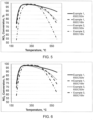
- NOx conversions were measured in a laboratory reactor at a gas hourly volume-based space velocity of 80000 h -1 under pseudo-steady state conditions in a gas mixture of 500 ppm NO, 500 ppm NH 3 , 10% O 2 , 5% H 2 O, balance N 2 in a temperature ramp of 0.5°C/min from 200°C to 600°C. NOx conversion is reported as mol% and measured as NO and N0 2 .
- FIG. 5 shows NOx conversion of Illustrative Example 1 relative to Illustrative Example 2.
- FIG. 6 shows NOx conversion of Illustrative Example 1 relative to Illustrative Example 3.
- Illustrative Example 1 was superior regarding NOx conversion under both aging conditions.
- DRIFT measurements were performed on a THERMO NICOLET FT-I R instrument with a MCT (HgCdTe) detector and a Harrick environmental chamber with ZnSe windows. Samples were ground to a fine powder with mortar and pestle and placed into the sample cup. The powder was dehydrated at 400°C for 1 hour in flowing Ar at 40 mL/min and cooled to 30°C and the spectra was recorded using KBr as a reference. Copper species in zeolite were identified by monitoring the perturbed T-O-T bond (Si-O-Al and Si-O-Si) vibrations by infrared spectroscopy.
- the structural vibrations of T-O-T bonds in zeolite have absorption peaks at 1350-920 cm -1 and 850- 620 cm -1 for asymmetric and symmetric vibration modes, respectively.
- the perturbed T-O-T bond vibrations are observed when copper ions are exchanged into cationic position of zeolite structures, due to strong interaction between copper ions and neighbouring oxygen atoms in the framework.
- the peak position depends on the status of charge compensated cations and the structure of the zeolite framework.
- the peak intensity depends on the quantity of charge compensated cations in the exchanged sites.
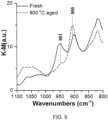
- DRIFT spectra of the CuCHA samples of Illustrative Examples 1, 2 and 3 in the fresh state are shown in FIG. 7 .
- two new perturbed absorptions appeared at 900 and 950 cm -1 .
- the peak at 900 cm -1 was attributed to perturbed T-O-T asymmetric stretching vibrations with Cu 2+ associated with an Al pair, and the peak at 950 cm -1 was attributed to perturbed T-O-T asymmetric stretching vibrations with Cu(OH) + associated with a single Al. Peak fitting was carried out in Origin 9.1 software.
- the peaks were modeled as Gaussian peaks and peak fitting was performed until a chi-squared tolerance value of 1 E-6 was reached.
- the peak areas associated with the 900 and 950 cm -1 perturbed vibrational modes of the fresh samples are listed in Table 1.
- the perturbed T-O-T peak at 900 cm -1 evidencing Cu 2+ ion associated with an Al pair has the greatest area, implying that Cu +2 is the dominant copper species in Illustrative Example 1, and the 900 cm -1 peak area is 71 % of the total peak areas including the sum of peak areas at 900 and 950 cm -1 .
- Illustrative Examples 2 and 3 comprise a large quantity of Cu(OH) +1 in addition to Cu 2+ (as evidenced by increased areas under the T-O-T peaks at 950 cm -1 ) and the percentage of 900 cm -1 peak area relative to the sum total of the peak areas including 900 and 950 cm -1 ) was only 47% and 43%, respectively.
- Illustrative Example 1 shows high NO x reduction activity and high hydrothermal stability; without being bound by theory, it is believed Cu 2+ ion balancing the charge of an Al pair is more stable than Cu(OH) +1 balancing the charge of a single Al.
- the % peak area of the 900 cm -1 peak for the copper-exchanged molecular sieve in Illustrative Example 1 increases by only about 4% upon aging (3/71).
- the % peak area of the 900 cm -1 peak for the copper-exchanged molecular sieve in Illustrative Example 3 increased about 77% (33/43).
- the copper-exchanged molecular sieve of Illustrative Example 1 showed the desired aging stability as well as the increased NOx conversion performance as discussed in Illustrative Example 4.
- Catalytic materials containing CuSAPO were prepared. Specifically, Cu exchange using 0.2 M copper acetate was carried on NH 4 -SAPO-34 at 80°C for 2 hours. The sample was filtered, washed with DI water and dried at 90°C then calcined at 450°C for 2 hours. The obtained CuSAPO-34 had a copper content of 3.3 wt. %, expressed as CuO. The CuSAPO material was evaluated to confirm that the stability may be achieved for various types of molecular sieves.
- NOx conversions were measured in a laboratory reactor at a gas hourly volume-based space velocity of 80000 h -1 under steady state conditions in a gas mixture of 500 ppm NO, 500 ppm NH 3 , 10% O 2 , 5% H 2 O, balance N 2 in temperatures of 175, 200, 225, 250, 400, 550 and 575°C. NOx conversion was reported as mol% and measured as NO and NO 2 .
- the CuSAPO from Illustrative Example 6 and the CuCHA from Illustrative Example 3 were hydrothermally aged in the presence of 10% H 2 O/air at 800°C for 16 hours.
- FIG. 10 shows NOx conversion of Illustrative Example 6 relative to Illustrative Example 3.
- Illustrative Example 6 shows high NOx conversion in the fresh state and after aging.
- Example 8 DRIFT Spectroscopy for Illustrative Example 6
- Example 5 The DRIFT spectrum of the sample from Example 6 is shown in FIG. 11 .
- Perturbed T-O-T bonds at ca. 900 and 970 cm -1 are attributed to the asymmetric stretching vibration of the T-O-T bond with Cu 2+ associated with a Si pair and the asymmetric stretching vibration of the T-O-T bond with Cu(OH) + associated with a single Si, respectively.
- Peak fitting was again carried out in Origin 9.1 software. In the peak fitting, the peaks were modeled as Gaussian peaks and peak fitting was performed until a chi- squared tolerance value of 1 E-6 was reached.
- the perturbed T-O-T peak at 900 cm -1 evidencing Cu 2+ ion associated with a Si pair has the greatest area implying that Cu +2 was the dominant copper species in Illustrative Example 6.
Landscapes
- Chemical & Material Sciences (AREA)
- Engineering & Computer Science (AREA)
- Chemical Kinetics & Catalysis (AREA)
- Materials Engineering (AREA)
- Organic Chemistry (AREA)
- Health & Medical Sciences (AREA)
- Analytical Chemistry (AREA)
- Combustion & Propulsion (AREA)
- Biomedical Technology (AREA)
- Environmental & Geological Engineering (AREA)
- General Chemical & Material Sciences (AREA)
- Oil, Petroleum & Natural Gas (AREA)
- Physics & Mathematics (AREA)
- Crystallography & Structural Chemistry (AREA)
- Spectroscopy & Molecular Physics (AREA)
- Pathology (AREA)
- Life Sciences & Earth Sciences (AREA)
- Biochemistry (AREA)
- General Health & Medical Sciences (AREA)
- General Physics & Mathematics (AREA)
- Immunology (AREA)
- Dispersion Chemistry (AREA)
- Toxicology (AREA)
- Mechanical Engineering (AREA)
- General Engineering & Computer Science (AREA)
- Thermal Sciences (AREA)
- Catalysts (AREA)
- Exhaust Gas Treatment By Means Of Catalyst (AREA)
- Exhaust Gas After Treatment (AREA)
Claims (1)
- Procédé permettant d'identifier un matériau catalytique qui est stable au vieillissement à 800 °C pendant 16 heures en présence de 10 % d'H2O/air, le procédé comprenant :la fourniture d'une pluralité d'échantillons qui comprennent chacun des particules d'un tamis moléculaire contenant du cuivre contenant du cuivre ayant subi un échange d'ions en tant que cations Cu+2 et en tant que cations Cu(OH)+1, dans lequel le tamis moléculaire a une structure CHA ;le fait de soumettre les particules du tamis moléculaire contenant du cuivre à une spectroscopie à transformée de Fourier infrarouge à réflectance diffuse (DRIFT) de façon à évaluer des pics vibratoires d'étirement asymétrique T-O-T perturbés correspondent aux cations Cu+2 dans le tamis moléculaire contenant du cuivre et des pics vibratoires d'étirement asymétrique T-O-T perturbés correspondent aux cations Cu(OH)+1 dans le tamis moléculaire contenant du cuivre, dans lequel le tamis moléculaire contenant du cuivre présente les pics vibratoires d'étirement asymétrique T-O-T perturbés correspondant aux cations Cu+2 et aux cations Cu(OH)+1 à environ 900 cm-1 et environ 950 cm-1, respectivement, dans le spectre infrarouge, ou dans lequel le tamis moléculaire contenant du cuivre présente des pics vibratoires d'étirement asymétrique T-O-T perturbés correspondant aux cations Cu+2 et aux cations Cu(OH)+1 à environ 900 cm-1 et environ 970 cm-1, respectivement, dans le spectre infrarouge ; etla sélection d'un ou plusieurs des échantillons dans lequel le tamis moléculaire contenant du cuivre présente un rapport pour une aire de pic intégrée du pic vibratoire d'étirement asymétrique T-O-T perturbé correspondant aux cations Cu+2 à une aire de pic intégrée du pic vibratoire d'étirement asymétrique T-O-T perturbé correspondant aux cations Cu(OH)+1 qui est ≥ 1 ; dans lequel un pourcentage de l'aire de pic intégrée totale qui est attribuable au pic vibratoire d'étirement asymétrique T-O-T perturbé correspondant aux cations Cu+2 calculée en divisant l'aire de pic intégrée pour le pic vibratoire d'étirement asymétrique T-O-T perturbé correspondant aux cations Cu+2 par une aire d'intégration de pic pour le pic vibratoire d'étirement asymétrique T-O-T perturbé correspondant aux cations Cu+2 et au pic vibratoire d'étirement asymétrique T-O-T perturbé correspondant aux cations Cu(OH)+1 combinés, et dans lequel le procédé comprend la sélection d'un ou plusieurs échantillons dans lequel le pourcentage de l'aire totale d'intégration de pic qui est attribuable au pic vibratoire d'étirement asymétrique T-O-T perturbé pour les cations Cu+2 est ≥ 50 %,dans lequel la pluralité d'échantillons est soumise à la spectroscopie DRIFT dans un état frais, dans lequel le procédé comprend en outre :le vieillissement de la pluralité d'échantillons à une température d'environ 800 °C pendant une durée d'environ 16 heures en présence d'air avec une teneur en H2O d'environ 10 % en moles pour former des échantillons ayant vieilli ;le fait de soumettre les échantillons ayant vieilli à la spectroscopie DRIFT ; etla sélection d'un ou plusieurs des échantillons dans lequel la contribution à l'aire totale de pic intégrée par le pic vibratoire d'étirement asymétrique T-O-T perturbé correspondant aux cations Cu+2 pour le ou les échantillons dans un état ayant vieilli est augmentée de ≤ 20 % par rapport à la contribution à l'aire totale de pic intégrée par le pic vibratoire d'étirement asymétrique T-O-T perturbé correspondant aux cations Cu+2 pour le ou les échantillons dans l'état frais.
Applications Claiming Priority (2)
| Application Number | Priority Date | Filing Date | Title |
|---|---|---|---|
| US201762473651P | 2017-03-20 | 2017-03-20 | |
| PCT/IB2018/051874 WO2018172940A1 (fr) | 2017-03-20 | 2018-03-20 | Articles et systèmes de réduction catalytique sélective |
Publications (3)
| Publication Number | Publication Date |
|---|---|
| EP3600655A1 EP3600655A1 (fr) | 2020-02-05 |
| EP3600655A4 EP3600655A4 (fr) | 2021-06-02 |
| EP3600655B1 true EP3600655B1 (fr) | 2024-01-24 |
Family
ID=63584262
Family Applications (1)
| Application Number | Title | Priority Date | Filing Date |
|---|---|---|---|
| EP18770162.8A Active EP3600655B1 (fr) | 2017-03-20 | 2018-03-20 | Methode d'identification d'un materiau catalytique stabile au vieillissement hydrothermal |
Country Status (6)
| Country | Link |
|---|---|
| US (2) | US20200108373A1 (fr) |
| EP (1) | EP3600655B1 (fr) |
| JP (2) | JP2020514042A (fr) |
| KR (1) | KR102604454B1 (fr) |
| CN (1) | CN110621402B (fr) |
| WO (1) | WO2018172940A1 (fr) |
Families Citing this family (9)
| Publication number | Priority date | Publication date | Assignee | Title |
|---|---|---|---|---|
| JP6693406B2 (ja) * | 2016-12-20 | 2020-05-13 | 三菱自動車工業株式会社 | 排気ガス浄化装置 |
| JP6928488B2 (ja) * | 2017-06-09 | 2021-09-01 | 旭化成株式会社 | Mwf型ゼオライト |
| CN110227540B (zh) * | 2019-05-10 | 2020-09-08 | 四川大学 | Afi-cha混晶分子筛及以其为载体的nh3-scr催化剂以及它们的制备方法 |
| CN111359656B (zh) * | 2020-03-16 | 2020-12-11 | 中山大学 | 一种脱硝催化剂Cu-SSZ-52及其制备方法和应用 |
| US12168951B2 (en) | 2020-04-21 | 2024-12-17 | Cummins Inc. | Systems and methods for selective catalytic reduction and/or ammonia slip catalyst sulfur protection |
| CN115697551A (zh) * | 2020-09-17 | 2023-02-03 | 巴斯夫公司 | 催化颗粒过滤器 |
| CN112495426B (zh) * | 2021-01-29 | 2021-05-18 | 山东国瓷功能材料股份有限公司 | 铜分子筛催化剂及其制备方法和用途 |
| CN113484275B (zh) * | 2021-07-08 | 2023-01-31 | 云南中烟工业有限责任公司 | 基于中红外光谱采用分峰分析技术快速预测新鲜烟叶中油分含量的方法 |
| KR102808855B1 (ko) * | 2022-08-09 | 2025-05-20 | 주식회사 에코프로에이치엔 | 제올라이트 및 금속 산화물을 포함하는 배출물 처리 촉매 |
Family Cites Families (25)
| Publication number | Priority date | Publication date | Assignee | Title |
|---|---|---|---|---|
| US93477A (en) * | 1869-08-10 | Improved process of preparing- iceland and irish moss for use in food | ||
| US3434062A (en) | 1965-06-21 | 1969-03-18 | James R Cox | Drift detector |
| US4458097A (en) * | 1982-04-30 | 1984-07-03 | Union Carbide Corporation | Conversion of certain hydrocarbons using divalent-copper-containing ZSM-5 type catalyst |
| US4544538A (en) | 1982-07-09 | 1985-10-01 | Chevron Research Company | Zeolite SSZ-13 and its method of preparation |
| WO1991006508A1 (fr) * | 1989-10-31 | 1991-05-16 | Mitsubishi Jukogyo Kabushiki Kaisha | Catalyseur de decomposition d'oxyde d'azote et procede d'epuration d'un gaz d'echappement contenant de l'oxyde d'azote |
| US6709644B2 (en) | 2001-08-30 | 2004-03-23 | Chevron U.S.A. Inc. | Small crystallite zeolite CHA |
| US7229597B2 (en) | 2003-08-05 | 2007-06-12 | Basfd Catalysts Llc | Catalyzed SCR filter and emission treatment system |
| MX2009009095A (es) | 2007-02-27 | 2009-09-14 | Basf Catalysts Llc | Catalizadores de zeolita cha de cobre. |
| EP2297036B1 (fr) | 2008-05-21 | 2014-04-16 | Basf Se | Procédé de synthèse directe de zéolithes contenant du cu et dotées d'une structure cha |
| WO2010121257A1 (fr) * | 2009-04-17 | 2010-10-21 | Johnson Matthey Public Limited Company | Catalyseurs à base de cuivre supportés par des tamis moléculaires à petits pores, durables vis-à-vis d'un vieillissement pauvre/riche pour la réduction d'oxyde d'azotes |
| WO2011061841A1 (fr) | 2009-11-19 | 2011-05-26 | イビデン株式会社 | Structure en nid d'abeille et appareil de purification des gaz d'échappement |
| GB2475740B (en) * | 2009-11-30 | 2017-06-07 | Johnson Matthey Plc | Catalysts for treating transient NOx emissions |
| US9352307B2 (en) * | 2010-04-08 | 2016-05-31 | Basf Corporation | Cu-CHA/Fe-MFI mixed zeolite catalyst and process for the treatment of NOx in gas streams |
| US8293182B2 (en) | 2010-05-05 | 2012-10-23 | Basf Corporation | Integrated SCR and AMOx catalyst systems |
| US8956992B2 (en) | 2011-10-27 | 2015-02-17 | GM Global Technology Operations LLC | SCR catalysts preparation methods |
| MX387698B (es) | 2012-10-19 | 2025-03-11 | Basf Mobile Emissions Catalysts Llc | Composiciones de catalizador de tamiz molecular de poro pequeño de 8 anillos de metales mezclados, artículos catalíticos y métodos. |
| DE102012023049A1 (de) * | 2012-11-26 | 2014-05-28 | Volkswagen Aktiengesellschaft | SCR-Abgasnachbehandlungseinrichtung sowie Kraftfahrzeug mit einer solchen |
| US9802182B2 (en) * | 2013-03-13 | 2017-10-31 | Basf Corporation | Stabilized metal-exchanged SAPO material |
| US9561469B2 (en) * | 2014-03-24 | 2017-02-07 | Johnson Matthey Public Limited Company | Catalyst for treating exhaust gas |
| WO2015193210A1 (fr) * | 2014-06-16 | 2015-12-23 | Umicore Ag & Co. Kg | Système de traitement de gaz d'échappement |
| US9764313B2 (en) * | 2014-06-18 | 2017-09-19 | Basf Corporation | Molecular sieve catalyst compositions, catalyst composites, systems, and methods |
| MX388605B (es) | 2014-10-30 | 2025-03-20 | Basf Mobile Emissions Catalysts Llc | Composiciones catalizadoras de tamices moleculares de cristales grandes con metales mixtos, articulos cataliticos, sistemas y metodos. |
| GB2540832B (en) * | 2015-02-20 | 2019-04-17 | Johnson Matthey Plc | Bi-metal molecular sieve catalysts |
| JP6916117B2 (ja) * | 2015-06-18 | 2021-08-11 | ジョンソン、マッセイ、パブリック、リミテッド、カンパニーJohnson Matthey Public Limited Company | 低n2o形成性を有するアンモニアスリップ触媒 |
| CN107847863B (zh) * | 2015-06-18 | 2021-08-27 | 庄信万丰股份有限公司 | 分区的排气系统 |
-
2018
- 2018-03-20 WO PCT/IB2018/051874 patent/WO2018172940A1/fr not_active Ceased
- 2018-03-20 EP EP18770162.8A patent/EP3600655B1/fr active Active
- 2018-03-20 JP JP2019552011A patent/JP2020514042A/ja active Pending
- 2018-03-20 US US16/495,574 patent/US20200108373A1/en not_active Abandoned
- 2018-03-20 CN CN201880032231.7A patent/CN110621402B/zh active Active
- 2018-03-20 KR KR1020197029729A patent/KR102604454B1/ko active Active
-
2021
- 2021-03-19 US US17/206,963 patent/US11724248B2/en active Active
-
2023
- 2023-04-17 JP JP2023067456A patent/JP7603737B2/ja active Active
Also Published As
| Publication number | Publication date |
|---|---|
| JP2020514042A (ja) | 2020-05-21 |
| JP7603737B2 (ja) | 2024-12-20 |
| KR102604454B1 (ko) | 2023-11-22 |
| CN110621402A (zh) | 2019-12-27 |
| US20200108373A1 (en) | 2020-04-09 |
| EP3600655A1 (fr) | 2020-02-05 |
| CN110621402B (zh) | 2023-04-14 |
| EP3600655A4 (fr) | 2021-06-02 |
| JP2023099027A (ja) | 2023-07-11 |
| WO2018172940A1 (fr) | 2018-09-27 |
| US20210229079A1 (en) | 2021-07-29 |
| US11724248B2 (en) | 2023-08-15 |
| KR20190122844A (ko) | 2019-10-30 |
Similar Documents
| Publication | Publication Date | Title |
|---|---|---|
| EP3600655B1 (fr) | Methode d'identification d'un materiau catalytique stabile au vieillissement hydrothermal | |
| US10792648B2 (en) | Mixed metal large crystal molecular sieve catalyst compositions, catalytic articles, systems and methods | |
| EP2908947B1 (fr) | Compositions de catalyseur à tamis moléculaire à petits pores et à 8 noyaux à base d'un métal mixte et procédés catalytiques | |
| US11633726B2 (en) | Zeolite with reduced extra-framework aluminum | |
| RU2727801C2 (ru) | Каталитические композиции молекулярного сита, каталитические композиты, системы и способы | |
| US12012885B2 (en) | SCR catalyst for the treatment of an exhaust gas of a diesel engine | |
| US11358130B2 (en) | Surface-treated silicoaluminophosphate molecular sieve | |
| US11660586B2 (en) | In-situ copper ion-exchange on pre-exchanged copper zeolitic material | |
| US9889437B2 (en) | Isomorphously substituted catalyst | |
| US20230129815A1 (en) | A selective catalytic reduction catalyst and a process for preparing a selective catalytic reduction catalyst | |
| JP7516560B2 (ja) | 銅促進ゼオライトを調製する方法 | |
| WO2024245289A1 (fr) | Composite d'oxyde à base de manganèse et de zéolite utile comme catalyseur de réduction catalytique sélective par nh3 | |
| US12297760B2 (en) | Catalytic system comprising antimony-containing catalyst |
Legal Events
| Date | Code | Title | Description |
|---|---|---|---|
| STAA | Information on the status of an ep patent application or granted ep patent |
Free format text: STATUS: THE INTERNATIONAL PUBLICATION HAS BEEN MADE |
|
| PUAI | Public reference made under article 153(3) epc to a published international application that has entered the european phase |
Free format text: ORIGINAL CODE: 0009012 |
|
| STAA | Information on the status of an ep patent application or granted ep patent |
Free format text: STATUS: REQUEST FOR EXAMINATION WAS MADE |
|
| 17P | Request for examination filed |
Effective date: 20191021 |
|
| AK | Designated contracting states |
Kind code of ref document: A1 Designated state(s): AL AT BE BG CH CY CZ DE DK EE ES FI FR GB GR HR HU IE IS IT LI LT LU LV MC MK MT NL NO PL PT RO RS SE SI SK SM TR |
|
| AX | Request for extension of the european patent |
Extension state: BA ME |
|
| DAV | Request for validation of the european patent (deleted) | ||
| DAX | Request for extension of the european patent (deleted) | ||
| RIC1 | Information provided on ipc code assigned before grant |
Ipc: B01J 29/74 20060101ALI20201127BHEP Ipc: B01J 29/76 20060101AFI20201127BHEP Ipc: B01J 37/02 20060101ALI20201127BHEP Ipc: B01J 35/00 20060101ALI20201127BHEP Ipc: B01J 29/072 20060101ALI20201127BHEP Ipc: B01J 29/82 20060101ALI20201127BHEP Ipc: B01J 29/86 20060101ALI20201127BHEP Ipc: B01J 37/10 20060101ALI20201127BHEP Ipc: B01D 53/94 20060101ALI20201127BHEP Ipc: F01N 3/20 20060101ALI20201127BHEP Ipc: B01J 35/04 20060101ALI20201127BHEP |
|
| A4 | Supplementary search report drawn up and despatched |
Effective date: 20210506 |
|
| RIC1 | Information provided on ipc code assigned before grant |
Ipc: B01J 29/76 20060101AFI20210429BHEP Ipc: B01J 37/10 20060101ALI20210429BHEP Ipc: B01J 29/82 20060101ALI20210429BHEP Ipc: B01J 29/86 20060101ALI20210429BHEP Ipc: B01J 29/74 20060101ALI20210429BHEP Ipc: B01J 37/02 20060101ALI20210429BHEP Ipc: F01N 3/20 20060101ALI20210429BHEP Ipc: B01J 35/04 20060101ALI20210429BHEP Ipc: B01J 29/072 20060101ALI20210429BHEP Ipc: B01J 35/00 20060101ALI20210429BHEP Ipc: B01D 53/94 20060101ALI20210429BHEP |
|
| STAA | Information on the status of an ep patent application or granted ep patent |
Free format text: STATUS: EXAMINATION IS IN PROGRESS |
|
| 17Q | First examination report despatched |
Effective date: 20230103 |
|
| GRAP | Despatch of communication of intention to grant a patent |
Free format text: ORIGINAL CODE: EPIDOSNIGR1 |
|
| STAA | Information on the status of an ep patent application or granted ep patent |
Free format text: STATUS: GRANT OF PATENT IS INTENDED |
|
| INTG | Intention to grant announced |
Effective date: 20230901 |
|
| GRAS | Grant fee paid |
Free format text: ORIGINAL CODE: EPIDOSNIGR3 |
|
| GRAA | (expected) grant |
Free format text: ORIGINAL CODE: 0009210 |
|
| STAA | Information on the status of an ep patent application or granted ep patent |
Free format text: STATUS: THE PATENT HAS BEEN GRANTED |
|
| AK | Designated contracting states |
Kind code of ref document: B1 Designated state(s): AL AT BE BG CH CY CZ DE DK EE ES FI FR GB GR HR HU IE IS IT LI LT LU LV MC MK MT NL NO PL PT RO RS SE SI SK SM TR |
|
| REG | Reference to a national code |
Ref country code: GB Ref legal event code: FG4D |
|
| REG | Reference to a national code |
Ref country code: CH Ref legal event code: EP |
|
| REG | Reference to a national code |
Ref country code: IE Ref legal event code: FG4D |
|
| REG | Reference to a national code |
Ref country code: DE Ref legal event code: R096 Ref document number: 602018064515 Country of ref document: DE |
|
| P01 | Opt-out of the competence of the unified patent court (upc) registered |
Effective date: 20240119 |
|
| REG | Reference to a national code |
Ref country code: LT Ref legal event code: MG9D |
|
| REG | Reference to a national code |
Ref country code: NL Ref legal event code: MP Effective date: 20240124 |
|
| PG25 | Lapsed in a contracting state [announced via postgrant information from national office to epo] |
Ref country code: NL Free format text: LAPSE BECAUSE OF FAILURE TO SUBMIT A TRANSLATION OF THE DESCRIPTION OR TO PAY THE FEE WITHIN THE PRESCRIBED TIME-LIMIT Effective date: 20240124 |
|
| PG25 | Lapsed in a contracting state [announced via postgrant information from national office to epo] |
Ref country code: NL Free format text: LAPSE BECAUSE OF FAILURE TO SUBMIT A TRANSLATION OF THE DESCRIPTION OR TO PAY THE FEE WITHIN THE PRESCRIBED TIME-LIMIT Effective date: 20240124 |
|
| PG25 | Lapsed in a contracting state [announced via postgrant information from national office to epo] |
Ref country code: IS Free format text: LAPSE BECAUSE OF FAILURE TO SUBMIT A TRANSLATION OF THE DESCRIPTION OR TO PAY THE FEE WITHIN THE PRESCRIBED TIME-LIMIT Effective date: 20240524 |
|
| PG25 | Lapsed in a contracting state [announced via postgrant information from national office to epo] |
Ref country code: LT Free format text: LAPSE BECAUSE OF FAILURE TO SUBMIT A TRANSLATION OF THE DESCRIPTION OR TO PAY THE FEE WITHIN THE PRESCRIBED TIME-LIMIT Effective date: 20240124 |
|
| PG25 | Lapsed in a contracting state [announced via postgrant information from national office to epo] |
Ref country code: GR Free format text: LAPSE BECAUSE OF FAILURE TO SUBMIT A TRANSLATION OF THE DESCRIPTION OR TO PAY THE FEE WITHIN THE PRESCRIBED TIME-LIMIT Effective date: 20240425 |
|
| REG | Reference to a national code |
Ref country code: AT Ref legal event code: MK05 Ref document number: 1651754 Country of ref document: AT Kind code of ref document: T Effective date: 20240124 |
|
| PG25 | Lapsed in a contracting state [announced via postgrant information from national office to epo] |
Ref country code: RS Free format text: LAPSE BECAUSE OF FAILURE TO SUBMIT A TRANSLATION OF THE DESCRIPTION OR TO PAY THE FEE WITHIN THE PRESCRIBED TIME-LIMIT Effective date: 20240424 Ref country code: HR Free format text: LAPSE BECAUSE OF FAILURE TO SUBMIT A TRANSLATION OF THE DESCRIPTION OR TO PAY THE FEE WITHIN THE PRESCRIBED TIME-LIMIT Effective date: 20240124 |
|
| PG25 | Lapsed in a contracting state [announced via postgrant information from national office to epo] |
Ref country code: ES Free format text: LAPSE BECAUSE OF FAILURE TO SUBMIT A TRANSLATION OF THE DESCRIPTION OR TO PAY THE FEE WITHIN THE PRESCRIBED TIME-LIMIT Effective date: 20240124 |
|
| PG25 | Lapsed in a contracting state [announced via postgrant information from national office to epo] |
Ref country code: AT Free format text: LAPSE BECAUSE OF FAILURE TO SUBMIT A TRANSLATION OF THE DESCRIPTION OR TO PAY THE FEE WITHIN THE PRESCRIBED TIME-LIMIT Effective date: 20240124 |
|
| PG25 | Lapsed in a contracting state [announced via postgrant information from national office to epo] |
Ref country code: RS Free format text: LAPSE BECAUSE OF FAILURE TO SUBMIT A TRANSLATION OF THE DESCRIPTION OR TO PAY THE FEE WITHIN THE PRESCRIBED TIME-LIMIT Effective date: 20240424 Ref country code: NO Free format text: LAPSE BECAUSE OF FAILURE TO SUBMIT A TRANSLATION OF THE DESCRIPTION OR TO PAY THE FEE WITHIN THE PRESCRIBED TIME-LIMIT Effective date: 20240424 Ref country code: LT Free format text: LAPSE BECAUSE OF FAILURE TO SUBMIT A TRANSLATION OF THE DESCRIPTION OR TO PAY THE FEE WITHIN THE PRESCRIBED TIME-LIMIT Effective date: 20240124 Ref country code: IS Free format text: LAPSE BECAUSE OF FAILURE TO SUBMIT A TRANSLATION OF THE DESCRIPTION OR TO PAY THE FEE WITHIN THE PRESCRIBED TIME-LIMIT Effective date: 20240524 Ref country code: HR Free format text: LAPSE BECAUSE OF FAILURE TO SUBMIT A TRANSLATION OF THE DESCRIPTION OR TO PAY THE FEE WITHIN THE PRESCRIBED TIME-LIMIT Effective date: 20240124 Ref country code: GR Free format text: LAPSE BECAUSE OF FAILURE TO SUBMIT A TRANSLATION OF THE DESCRIPTION OR TO PAY THE FEE WITHIN THE PRESCRIBED TIME-LIMIT Effective date: 20240425 Ref country code: FI Free format text: LAPSE BECAUSE OF FAILURE TO SUBMIT A TRANSLATION OF THE DESCRIPTION OR TO PAY THE FEE WITHIN THE PRESCRIBED TIME-LIMIT Effective date: 20240124 Ref country code: ES Free format text: LAPSE BECAUSE OF FAILURE TO SUBMIT A TRANSLATION OF THE DESCRIPTION OR TO PAY THE FEE WITHIN THE PRESCRIBED TIME-LIMIT Effective date: 20240124 Ref country code: BG Free format text: LAPSE BECAUSE OF FAILURE TO SUBMIT A TRANSLATION OF THE DESCRIPTION OR TO PAY THE FEE WITHIN THE PRESCRIBED TIME-LIMIT Effective date: 20240124 Ref country code: AT Free format text: LAPSE BECAUSE OF FAILURE TO SUBMIT A TRANSLATION OF THE DESCRIPTION OR TO PAY THE FEE WITHIN THE PRESCRIBED TIME-LIMIT Effective date: 20240124 |
|
| PG25 | Lapsed in a contracting state [announced via postgrant information from national office to epo] |
Ref country code: PL Free format text: LAPSE BECAUSE OF FAILURE TO SUBMIT A TRANSLATION OF THE DESCRIPTION OR TO PAY THE FEE WITHIN THE PRESCRIBED TIME-LIMIT Effective date: 20240124 Ref country code: PT Free format text: LAPSE BECAUSE OF FAILURE TO SUBMIT A TRANSLATION OF THE DESCRIPTION OR TO PAY THE FEE WITHIN THE PRESCRIBED TIME-LIMIT Effective date: 20240524 |
|
| RAP2 | Party data changed (patent owner data changed or rights of a patent transferred) |
Owner name: BASF MOBILE EMISSIONS CATALYSTS LLC |
|
| PG25 | Lapsed in a contracting state [announced via postgrant information from national office to epo] |
Ref country code: SE Free format text: LAPSE BECAUSE OF FAILURE TO SUBMIT A TRANSLATION OF THE DESCRIPTION OR TO PAY THE FEE WITHIN THE PRESCRIBED TIME-LIMIT Effective date: 20240124 Ref country code: PT Free format text: LAPSE BECAUSE OF FAILURE TO SUBMIT A TRANSLATION OF THE DESCRIPTION OR TO PAY THE FEE WITHIN THE PRESCRIBED TIME-LIMIT Effective date: 20240524 Ref country code: PL Free format text: LAPSE BECAUSE OF FAILURE TO SUBMIT A TRANSLATION OF THE DESCRIPTION OR TO PAY THE FEE WITHIN THE PRESCRIBED TIME-LIMIT Effective date: 20240124 Ref country code: LV Free format text: LAPSE BECAUSE OF FAILURE TO SUBMIT A TRANSLATION OF THE DESCRIPTION OR TO PAY THE FEE WITHIN THE PRESCRIBED TIME-LIMIT Effective date: 20240124 |
|
| PG25 | Lapsed in a contracting state [announced via postgrant information from national office to epo] |
Ref country code: DK Free format text: LAPSE BECAUSE OF FAILURE TO SUBMIT A TRANSLATION OF THE DESCRIPTION OR TO PAY THE FEE WITHIN THE PRESCRIBED TIME-LIMIT Effective date: 20240124 |
|
| PG25 | Lapsed in a contracting state [announced via postgrant information from national office to epo] |
Ref country code: SM Free format text: LAPSE BECAUSE OF FAILURE TO SUBMIT A TRANSLATION OF THE DESCRIPTION OR TO PAY THE FEE WITHIN THE PRESCRIBED TIME-LIMIT Effective date: 20240124 |
|
| PG25 | Lapsed in a contracting state [announced via postgrant information from national office to epo] |
Ref country code: CZ Free format text: LAPSE BECAUSE OF FAILURE TO SUBMIT A TRANSLATION OF THE DESCRIPTION OR TO PAY THE FEE WITHIN THE PRESCRIBED TIME-LIMIT Effective date: 20240124 Ref country code: EE Free format text: LAPSE BECAUSE OF FAILURE TO SUBMIT A TRANSLATION OF THE DESCRIPTION OR TO PAY THE FEE WITHIN THE PRESCRIBED TIME-LIMIT Effective date: 20240124 |
|
| REG | Reference to a national code |
Ref country code: DE Ref legal event code: R097 Ref document number: 602018064515 Country of ref document: DE |
|
| PG25 | Lapsed in a contracting state [announced via postgrant information from national office to epo] |
Ref country code: SK Free format text: LAPSE BECAUSE OF FAILURE TO SUBMIT A TRANSLATION OF THE DESCRIPTION OR TO PAY THE FEE WITHIN THE PRESCRIBED TIME-LIMIT Effective date: 20240124 |
|
| PG25 | Lapsed in a contracting state [announced via postgrant information from national office to epo] |
Ref country code: SM Free format text: LAPSE BECAUSE OF FAILURE TO SUBMIT A TRANSLATION OF THE DESCRIPTION OR TO PAY THE FEE WITHIN THE PRESCRIBED TIME-LIMIT Effective date: 20240124 Ref country code: SK Free format text: LAPSE BECAUSE OF FAILURE TO SUBMIT A TRANSLATION OF THE DESCRIPTION OR TO PAY THE FEE WITHIN THE PRESCRIBED TIME-LIMIT Effective date: 20240124 Ref country code: RO Free format text: LAPSE BECAUSE OF FAILURE TO SUBMIT A TRANSLATION OF THE DESCRIPTION OR TO PAY THE FEE WITHIN THE PRESCRIBED TIME-LIMIT Effective date: 20240124 Ref country code: EE Free format text: LAPSE BECAUSE OF FAILURE TO SUBMIT A TRANSLATION OF THE DESCRIPTION OR TO PAY THE FEE WITHIN THE PRESCRIBED TIME-LIMIT Effective date: 20240124 Ref country code: DK Free format text: LAPSE BECAUSE OF FAILURE TO SUBMIT A TRANSLATION OF THE DESCRIPTION OR TO PAY THE FEE WITHIN THE PRESCRIBED TIME-LIMIT Effective date: 20240124 Ref country code: CZ Free format text: LAPSE BECAUSE OF FAILURE TO SUBMIT A TRANSLATION OF THE DESCRIPTION OR TO PAY THE FEE WITHIN THE PRESCRIBED TIME-LIMIT Effective date: 20240124 |
|
| REG | Reference to a national code |
Ref country code: CH Ref legal event code: PL |
|
| PG25 | Lapsed in a contracting state [announced via postgrant information from national office to epo] |
Ref country code: LU Free format text: LAPSE BECAUSE OF NON-PAYMENT OF DUE FEES Effective date: 20240320 |
|
| PG25 | Lapsed in a contracting state [announced via postgrant information from national office to epo] |
Ref country code: MC Free format text: LAPSE BECAUSE OF FAILURE TO SUBMIT A TRANSLATION OF THE DESCRIPTION OR TO PAY THE FEE WITHIN THE PRESCRIBED TIME-LIMIT Effective date: 20240124 |
|
| PG25 | Lapsed in a contracting state [announced via postgrant information from national office to epo] |
Ref country code: MC Free format text: LAPSE BECAUSE OF FAILURE TO SUBMIT A TRANSLATION OF THE DESCRIPTION OR TO PAY THE FEE WITHIN THE PRESCRIBED TIME-LIMIT Effective date: 20240124 Ref country code: LU Free format text: LAPSE BECAUSE OF NON-PAYMENT OF DUE FEES Effective date: 20240320 |
|
| PLBE | No opposition filed within time limit |
Free format text: ORIGINAL CODE: 0009261 |
|
| STAA | Information on the status of an ep patent application or granted ep patent |
Free format text: STATUS: NO OPPOSITION FILED WITHIN TIME LIMIT |
|
| PG25 | Lapsed in a contracting state [announced via postgrant information from national office to epo] |
Ref country code: IT Free format text: LAPSE BECAUSE OF FAILURE TO SUBMIT A TRANSLATION OF THE DESCRIPTION OR TO PAY THE FEE WITHIN THE PRESCRIBED TIME-LIMIT Effective date: 20240124 |
|
| REG | Reference to a national code |
Ref country code: BE Ref legal event code: MM Effective date: 20240331 |
|
| GBPC | Gb: european patent ceased through non-payment of renewal fee |
Effective date: 20240424 |
|
| PG25 | Lapsed in a contracting state [announced via postgrant information from national office to epo] |
Ref country code: IT Free format text: LAPSE BECAUSE OF FAILURE TO SUBMIT A TRANSLATION OF THE DESCRIPTION OR TO PAY THE FEE WITHIN THE PRESCRIBED TIME-LIMIT Effective date: 20240124 |
|
| 26N | No opposition filed |
Effective date: 20241025 |
|
| PG25 | Lapsed in a contracting state [announced via postgrant information from national office to epo] |
Ref country code: BE Free format text: LAPSE BECAUSE OF NON-PAYMENT OF DUE FEES Effective date: 20240331 |
|
| PG25 | Lapsed in a contracting state [announced via postgrant information from national office to epo] |
Ref country code: GB Free format text: LAPSE BECAUSE OF NON-PAYMENT OF DUE FEES Effective date: 20240424 |
|
| PG25 | Lapsed in a contracting state [announced via postgrant information from national office to epo] |
Ref country code: FR Free format text: LAPSE BECAUSE OF NON-PAYMENT OF DUE FEES Effective date: 20240324 |
|
| PG25 | Lapsed in a contracting state [announced via postgrant information from national office to epo] |
Ref country code: IE Free format text: LAPSE BECAUSE OF NON-PAYMENT OF DUE FEES Effective date: 20240320 |
|
| PG25 | Lapsed in a contracting state [announced via postgrant information from national office to epo] |
Ref country code: IE Free format text: LAPSE BECAUSE OF NON-PAYMENT OF DUE FEES Effective date: 20240320 Ref country code: GB Free format text: LAPSE BECAUSE OF NON-PAYMENT OF DUE FEES Effective date: 20240424 Ref country code: FR Free format text: LAPSE BECAUSE OF NON-PAYMENT OF DUE FEES Effective date: 20240324 Ref country code: BE Free format text: LAPSE BECAUSE OF NON-PAYMENT OF DUE FEES Effective date: 20240331 Ref country code: CH Free format text: LAPSE BECAUSE OF NON-PAYMENT OF DUE FEES Effective date: 20240331 |
|
| PGFP | Annual fee paid to national office [announced via postgrant information from national office to epo] |
Ref country code: DE Payment date: 20250218 Year of fee payment: 8 |
|
| PG25 | Lapsed in a contracting state [announced via postgrant information from national office to epo] |
Ref country code: SI Free format text: LAPSE BECAUSE OF FAILURE TO SUBMIT A TRANSLATION OF THE DESCRIPTION OR TO PAY THE FEE WITHIN THE PRESCRIBED TIME-LIMIT Effective date: 20240124 |
|
| PG25 | Lapsed in a contracting state [announced via postgrant information from national office to epo] |
Ref country code: CY Free format text: LAPSE BECAUSE OF FAILURE TO SUBMIT A TRANSLATION OF THE DESCRIPTION OR TO PAY THE FEE WITHIN THE PRESCRIBED TIME-LIMIT; INVALID AB INITIO Effective date: 20180320 |
|
| PG25 | Lapsed in a contracting state [announced via postgrant information from national office to epo] |
Ref country code: HU Free format text: LAPSE BECAUSE OF FAILURE TO SUBMIT A TRANSLATION OF THE DESCRIPTION OR TO PAY THE FEE WITHIN THE PRESCRIBED TIME-LIMIT; INVALID AB INITIO Effective date: 20180320 |
|
| PG25 | Lapsed in a contracting state [announced via postgrant information from national office to epo] |
Ref country code: TR Free format text: LAPSE BECAUSE OF FAILURE TO SUBMIT A TRANSLATION OF THE DESCRIPTION OR TO PAY THE FEE WITHIN THE PRESCRIBED TIME-LIMIT Effective date: 20240124 |