EP3601064B1 - Procédé de préparation consolidée de commandes et d'emballage d'articles, installation de préparation de commandes et de conditionnement et contenant de préparation de commandes - Google Patents
Procédé de préparation consolidée de commandes et d'emballage d'articles, installation de préparation de commandes et de conditionnement et contenant de préparation de commandes Download PDFInfo
- Publication number
- EP3601064B1 EP3601064B1 EP18719431.1A EP18719431A EP3601064B1 EP 3601064 B1 EP3601064 B1 EP 3601064B1 EP 18719431 A EP18719431 A EP 18719431A EP 3601064 B1 EP3601064 B1 EP 3601064B1
- Authority
- EP
- European Patent Office
- Prior art keywords
- order
- picking
- container
- transport packaging
- station
- Prior art date
- Legal status (The legal status is an assumption and is not a legal conclusion. Google has not performed a legal analysis and makes no representation as to the accuracy of the status listed.)
- Active
Links
Images











Classifications
-
- B—PERFORMING OPERATIONS; TRANSPORTING
- B65—CONVEYING; PACKING; STORING; HANDLING THIN OR FILAMENTARY MATERIAL
- B65B—MACHINES, APPARATUS OR DEVICES FOR, OR METHODS OF, PACKAGING ARTICLES OR MATERIALS; UNPACKING
- B65B5/00—Packaging individual articles in containers or receptacles, e.g. bags, sacks, boxes, cartons, cans, jars
- B65B5/06—Packaging groups of articles, the groups being treated as single articles
-
- B—PERFORMING OPERATIONS; TRANSPORTING
- B65—CONVEYING; PACKING; STORING; HANDLING THIN OR FILAMENTARY MATERIAL
- B65B—MACHINES, APPARATUS OR DEVICES FOR, OR METHODS OF, PACKAGING ARTICLES OR MATERIALS; UNPACKING
- B65B35/00—Supplying, feeding, arranging or orientating articles to be packaged
- B65B35/10—Feeding, e.g. conveying, single articles
-
- B—PERFORMING OPERATIONS; TRANSPORTING
- B65—CONVEYING; PACKING; STORING; HANDLING THIN OR FILAMENTARY MATERIAL
- B65G—TRANSPORT OR STORAGE DEVICES, e.g. CONVEYORS FOR LOADING OR TIPPING, SHOP CONVEYOR SYSTEMS OR PNEUMATIC TUBE CONVEYORS
- B65G1/00—Storing articles, individually or in orderly arrangement, in warehouses or magazines
- B65G1/02—Storage devices
- B65G1/04—Storage devices mechanical
- B65G1/137—Storage devices mechanical with arrangements or automatic control means for selecting which articles are to be removed
- B65G1/1373—Storage devices mechanical with arrangements or automatic control means for selecting which articles are to be removed for fulfilling orders in warehouses
- B65G1/1378—Storage devices mechanical with arrangements or automatic control means for selecting which articles are to be removed for fulfilling orders in warehouses the orders being assembled on fixed commissioning areas remote from the storage areas
Definitions
- the invention relates to a method for the consolidated picking and packing of articles, a picking and packing system and a use of a picking container for this.
- DE 10 146 790 A1 a method and a device for filling cuboid containers with filled envelopes, which are introduced into the container with their surfaces lying one on top of the other
- DE 100 19 485 A1 a method and a device for unloading and / or loading trays which have a base, at least two opposite side walls and an open top for receiving at least one piece goods.
- DE 37 08 896 A1 relates to a device for automatically filling a container, in particular a cardboard box, with an item, in particular a stacked item, and for applying a cover to the filled cardboard box that overlaps the walls of the container.
- the DE 38 13 309 A1 describes a method and an arrangement for the transport-safe packaging of consignments.
- a transport packaging such as a cardboard box with an open top wall is provided, the articles and a film bag above them are arranged in the cardboard box before a lid closes the opening of the cardboard box.
- the foil pouch has a tube-like mouthpiece that protrudes outwardly from the cardboard box, so that the foil pouch can be inflated and welded to the mouthpiece after the lid has been fixed to the cardboard box, so that the items in the cardboard box are prevented from falling over during transport preserve.
- WO 2013/070197 A1 discloses a system and method for bag dispensing.
- the bag dispensing system has a box and several bag protectors.
- a bag protector consists of a bottom wall which is designed to support a bag made of flexible material, and two side walls which extend from the bottom wall towards one another so that they meet at their upper ends to receive an opening portion of a bag.
- the goods in the bag are thus during transport by the bag protector and the surrounding box is protected, in which the bag protectors can be arranged alternately with the bottom wall down and up due to their tapered profile to save space.
- DE 10 2013 108 934 A1 a system and a method for picking articles are known that are buffered in order or picking containers. After an order has been received, a place in the picking area and an order container located in this place are assigned to this order. After transferring all the articles according to the order to the order container, it is manually placed on a conveyor and transported to a control and packing area so that space in the picking area is free for a new order container and a new order. The packaging of the picked items from the order container in transport packaging is not described.
- DE 10 2013 108 934 A1 discloses a picking and packing system according to the preamble of claim 5. Z
- the task still unsolved is the task of transporting the items picked according to an order without the use of employees in a non-rigid transport packaging such as a paper bag, a bag made of cardboard or a plastic bag for orders made up of several parts in the targeted throughput class, e.g. 10,000 Parts per hour runs out, to be packed safely for transport.
- a non-rigid transport packaging such as a paper bag, a bag made of cardboard or a plastic bag for orders made up of several parts in the targeted throughput class, e.g. 10,000 Parts per hour runs out, to be packed safely for transport.
- the object of the present invention is to provide a method in which the items picked according to the order are packed fully automatically and reliably in a transport packaging such as a paper bag, a plastic bag or a plastic bag.
- the further object of providing a device suitable for carrying out the method is achieved by the picking and packing system having the features of independent claim 5 and by using a picking container with the features of independent claim 15.
- consolidated picking is understood to mean the time-saving combination of individual parts into a whole, for example when several orders contain the same article, so that the number of these articles required for the various orders are made available together to then be put into the picking containers that contain the Orders are assigned to be handed over.
- a picking container in the process according to the invention can be identified, for example, via an identification feature such as a bar or QR code or via an RFID transponder, for example in order to be assigned to a specific order.
- the transfer point can result from the process dynamics if there are several transfer points; the process dynamics determine the place.
- the automatic control assigns each order to a specific picking container, not a specific transfer point, so that the items to be transferred according to an order are transferred to the (any) transfer point determined by the process dynamics at which the assigned picking container is located.
- Each order picking container thus serves as a dynamic sorter end point in the sense of a flexible target chute and is transported to the other, subsequent process zones after the article has been transferred. After emptying the picking container and separating it from the transport packaging, the picking container can be assigned to a new order and transported to a transfer point for the corresponding article transfer, which in turn is any transfer point determined by the process dynamics.
- the process enables the fully automatic consolidated picking and packing up to the making of a commissioned article collation in transport packaging such as paper or plastic bags or plastic bags or e.g. B. bag-like transport packaging made of a non-rigid material and having a filling opening.
- transport packaging such as paper or plastic bags or plastic bags or e.g. B. bag-like transport packaging made of a non-rigid material and having a filling opening.
- this transport packaging has the advantage that it can be adapted to the actual volume of the item: For example, a paper bag can be folded or turned over from the opening after it has been filled.
- the continuous, clocked process which primarily relates to the constant transport of the order picking container, is intended to ensure predetermined throughput times and reduce the need for employees, since all process steps are controlled fully automatically by one or more control devices or in conjunction with suitable sensors can run in a regulated manner.
- paper bags are preferred because, for ecological reasons, plastic bags or sacks can be dispensed with.
- the process allows the highest possible process reliability, especially for critical goods such as B, shoeboxes with loose lids.
- the method is particularly advantageous for handling small orders with an article number below five, but can also be used - depending on the article size - for orders with a larger number of articles.
- the picking containers that are used to carry out the method in a corresponding picking and packing system can be designed differently. Depending on the type of picking container used, the devices of the system and, accordingly, also individual details of the process steps can differ.
- One type of usable order picking container has a container base body which extends perpendicular to its bottom surface, with the bottom surface being the outer bottom surface, i. H. Stand area of the order-picking container is meant with which the order-picking container stands on a surface, for example a conveying device or a processing station.
- another embodiment of a usable order picking container has a "heel", i. That is, the container main body is inclined at a predetermined angle, which is not 90 °, to the bottom surface.
- the container base body can be designed such that the opening delimited by the upper container edge is inclined with respect to this bottom surface, so that the container edge (in relation to the bottom surface) has a highest and lowest point or at least a higher and a lower edge.
- a wedge can be arranged on the inner bottom in the base body, so that the inner bottom surface is also inclined with respect to the bottom surface of the order-picking container.
- the picking container which is moved to transfer the article to the predetermined transfer point, can be tilted with its opening in the direction of an article delivery device, so that the at least one article provided by the delivery device according to the order gently into the Picking container slips.
- Tilting can be dispensed with for "heeling" order picking containers - this depends on the tilting angle that is provided for the article transfer and which is preferably selected so that the article slides into the order picking container as gently as possible, but also without jamming. This means that a "heeling" order picking container is also tilted if its inclination is smaller than the desired tilting angle.
- the picking container In the case of picking containers that have a lowest point or a lower edge and / or a wedge on the bottom at the edge of the container that delimits the container opening, the picking container is moved to the transfer point in step a) so that the side of the picking container faces the article -Delivery device has, which has the lowest point or the lower edge on the container edge, and / or on which an acute-angled side of the wedge is arranged. That is, in the event that the picking container has both a container edge with the lowest point or lower edge and a wedge, the wedge is arranged in the picking container such that the acute-angled side of the wedge is arranged on the side with the lowest point or the lower edge.
- the direction of the upward movement can depend on the embodiment of the picking container used: While a picking container with a base body extending perpendicular to the base surface straight up into the direct Transport packaging provided can be moved, a "heeling" order picking container with a base body tilted relative to the vertical is moved in an upward movement superimposed with a horizontal movement component, i.e. on an inclined upward course, in order to be inclined accordingly and offset with respect to the packing station provided transport packaging to be able to be introduced.
- the inclination of the inclined upward course as well as the offset of the provided transport packaging from the packing station are dependent on the inclination of the picking container.
- a picking and packing system for the automatic consolidated picking and packing of articles for shipping has picking containers and several conveying devices for picking containers as well as delivery and transfer devices for articles and a control device for controlling the entire system for automatic consolidated picking and packing of articles for shipping in one continuous process.
- the conveying devices for order picking containers connect at least one transfer station for transfer the article in the picking container and at least one packing station for packing the article in a transport packaging.
- the packing station which enables packing in the transport packaging, has a packing station for the order-picking container, above which a device for providing transport packaging with a downward-facing opening is arranged.
- the opening of the transport packaging is dimensioned to accommodate the picking container. So that the order-picking container can be received in the transport packaging, the packing station or the device for providing the transport packaging or both are designed to move towards one another.
- the packing station can preferably be moved upwards while the transport packaging is held stationary.
- the order picking and packing system In order to transfer the articles compiled in the order picking container into the transport packaging, the order picking and packing system has a transferring and separating station, which is connected to the packing station via conveying devices for order picking containers, and which has a turning device for the order picking containers for performing a turning movement has on the vertical and subsequently a separating device for separating the picking container from the transport packaging.
- the order-picking and packing system can have a return device for the order-picking containers, which has a second turning device for the order-picking containers for performing a turning movement in relation to the vertical.
- the order-picking and packing system can have a closing station which, for closing the transport packaging, connects to the transferring and separating station via appropriate conveying devices.
- the closing station preferably has a device for turning over or turning the transport packaging inside out from the opening side according to a filling volume occupied by the at least one article in the transport packaging, as well as a device for fixing the envelope, for example by gluing, welding, stapling or preferably sewing.
- the transfer station can have a plurality of transfer points, which - at least for the embodiment with a non-tilting order picking container - are each assigned a tilting ramp that connects a level of the transfer point with an overlying level of a delivery device for the articles alone or in conjunction with a transfer device of the delivery device connects a predetermined angle of inclination, wherein the tilting ramp is designed to support the order-picking container at the predetermined angle of inclination, an opening of the order-picking container for receiving the articles facing in the direction of the delivery device, and erect again after filling.
- the transfer points are also connected by conveyor systems.
- systems according to the invention can also have tilting ramps at the transfer points for "heeling" order picking containers whose base body is inclined relative to the vertical; depending on the extent of the inclination of the "heeling” order picking container, however, tilting ramps can be dispensed with and the transfer points corresponding to the "heeling" order picking container are set up in relation to the delivery device or its transfer device in such a way that the opening of the "heeling" order picking container is suitable for receiving the article points in the direction of the delivery device.
- an automated device can also be used for this purpose, which determines the direction of inclination of the "heeling” picking containers and inserts them into the system in the correct orientation so that the container opening at the processing stations points in the correct direction.
- the order-picking and packing system can also have an addition station for a predetermined addition, which is arranged along the conveying devices between the transfer station and the packing station.
- the grain sizing and packing system can have a labeling station for labeling the transport packaging, which is arranged along the conveying devices between the packing station and the transferring and separating station.
- the adding station can have a printer device for printing accompanying forms, the printer device being aligned and / or designed such that a form output lies above a level defined by the opening of the picking container conveyed along the conveying devices.
- the device for providing the transport packaging can have a magazine device with compartments for transport packaging with different formats, a selection device for selecting and separating a transport packaging of a certain format and a clamping and holding device for an unfolded transport packaging with an opening pointing downwards.
- the device for providing the transport packaging can be equipped with appropriate sensors so that, in accordance with the specifications of the control device, the appropriate transport packaging is not only selected, separated and stretched by the selection device, but also the supply of transport packaging in each magazine device is monitored and the correct allocation of new transport packaging is monitored , which are delivered in stacks, can take place automatically to the respective magazine device.
- At least one lifting device ensures the relative movement between the packing station and the device for providing the transport packaging.
- the packing station or the device for providing the transport packaging or its clamping and holding device is or are connected to a lifting device or can be connected to it.
- both the packing station and the device for providing the transport packaging or its clamping and holding device can each be connected to a lifting device.
- a preferred variant provides that the packing station is connected to a lifting device, since this variant is easier to implement in terms of apparatus than a movable device for providing the transport packaging or its clamping and holding device.
- a lifting device can have one or more lifting cylinders, scissors and / or an elevator or lifting device, including, for example, at least one circulating conveyor.
- the transferring and separating station can have, as a turning device, a semi-looping path with guide means for the picking container and a parallel stabilizing path for supporting a base of the transport packaging.
- the transferring and separating station can have tracks that diverge with respect to the vertical for guiding and conveying the picking container and the transport packaging, with the upper track for guiding and conveying the picking containers adjacent to the half-loop track and the lower track for guiding and conveying the shipping packaging connect the stabilization track.
- the upper track for guiding and conveying the order picking container be designed as a rising ramp.
- the rising ramp can also diverge with respect to the horizontal in order to pull the order picking container out of the transport packaging parallel to the extension of its base body and thus avoid tilting.
- the guide means in the semi-looping track and in the upper track can preferably be lateral guide rails which are designed to engage with rolling devices of the picking container which are arranged laterally on the latter near the floor.
- the transferring and separating station can have a space-saving lifting device for the picking containers as a separating device, which is connected to the half-looping track.
- a stopping place is provided underneath the lift device along a discharge path, which, as with the diverging paths, adjoins the stabilization path. While the order-picking container is being pulled out of the transport packaging with the lifting device, it remains in the stopping place before it is conveyed to the locking station via the discharge conveyor.
- the lifting device can preferably have at least one circulating conveyor, which is designed with at least one engagement element for engagement with a turned order picking container.
- a circulating conveyor can be used which only engages the picking container on one side.
- a pair of circulating conveyors can be used, which on both sides, simultaneously coordinated with one another, come into engagement with the picking container in order to lift it.
- the lifting device can be designed to perform a vertical upward movement (for "normal” order picking containers) or to execute an inclined upward movement (for "heeling” order picking containers), the incline of the outward movement being adapted accordingly to the inclination of the order picking container to enable the picking container to be pulled out of the transport packaging without tilting.
- the order-picking and packing system has at least one control device. All devices and conveying devices of the system according to the invention are connected to the control device, in order to carry out the commissioning and consolidation and packing of the articles for shipping in a fully automatic process, the devices and conveyors of the system preferably being at least partially equipped with a sensor system that is coupled to the at least one control device to regulate the processes.
- the picking and packing system can have a sensor system, e.g. B. Readers, for the detection of a unique identifier to distinguish each picking container, which can be, for example, a bar, QR code or RFID chip attached to each picking container.
- the corresponding reading devices can then be arranged at the transfer station at the packing station, at each adding station, labeling station, closing station and / or at all conveyor-related decision positions along the conveyor devices for assigning the picking containers by the control device.
- a conveyor-related decision position along the conveyor devices is, for example, in the transfer station, which has a large number of transfer stations that can be used in parallel.
- the picking containers can be assigned to a specific order and a transfer point at which the order-related item transfer takes place via the respective identification feature.
- each transfer point could be equipped with a reader for identifying the respective order picking container.
- Further conveyor-related decision-making positions along the conveyor systems are in particular in the system sections or stations that also have several processing stations that work in parallel and convey in parallel, e.g. B. via switches, are integrated into the conveyor circuit, so that the decision positions, at which appropriate reading devices are to be provided for identification, are upstream of these switches.
- System sections with such parallel processing stations and the corresponding decision positions for assigning the picking containers can in particular be the adding station with parallel adding stations, the packing station with parallel packing stations and the locking station with parallel and / or different locking devices.
- the processing stations with parallel processing stations can not only increase the processing throughput, but also avoid downtime if a fault occurs at one of the processing stations, since the picking containers can then be assigned to the parallel processing stations by the control device.
- the transfer station can have sensor devices, preferably on the transfer devices, which are placed in such a way that an article transfer that has taken place and / or protruding articles that protrude from the picking container in the transfer position can be detected.
- the control device will cause the filled picking container to be erected and conveyed further.
- the filled picking container is controlled by the control device, e.g. B. by actuating the tilting ramp, initially also erected to allow the protruding article to slide into the container, but then tilted again to complete the order and / or to check whether the article is still standing. Only when the order is complete and there are no longer any items is the picking container conveyed further after being erected.
- a further alternative or additional sensor system can be provided for the device for providing the transport packaging on each magazine device for monitoring a supply of transport packaging and for automatically assigning new transport packaging.
- each cassette carrier can have a corresponding sensor system for determining and controlling the fill level and the position of the respective cassette carrier. In this way, the necessary replenishment of transport packaging can be scheduled punctually by the control device in order to minimize or avoid failures or downtimes at the packing stations.
- the picking and packing system - depending on the type of execution, if this z. B, which provides for the use of different transport packaging formats - have sensors for the closing station for detecting the height of the transport packaging conveyed past in order to assign the respective transport packaging to a suitable closing device depending on its format.
- the sealing station can have one or more filling level sensors to detect the filling level of the articles in the transport packaging so that the control device can determine the number of envelopes for sealing the transport packaging and can assign the transport packaging to the corresponding devices for turning or turning the transport packaging inside out from the opening side.
- sensors for controlling and regulating the order picking and packing system can be provided, for example weighing sensors if the weight of the items put together in the order picking container for the selection of the packaging material or for shipping is of interest, or sensor devices to detect malfunctions of the devices at the processing stations or the conveying devices.
- a use according to the invention of a picking container provides for the use in a picking and packing system according to the invention for carrying out a method according to the invention.
- the order-picking container has an opening which is inclined with respect to a floor surface of the order-picking container. Furthermore, the order-picking container has lateral rolling devices near the floor, which are designed to engage in the lateral guide rails for conveyance through the turning and separating device.
- the order picking container can have a base body that provides the inclined opening.
- the base body the cross section of which corresponds to the cross section of the transport packaging, can be arranged in a trough-like stabilizing device which increases the base area and provides the bottom surface of the order picking container.
- the rolling devices are then arranged to the side of the tub rim.
- the base body can be arranged at right angles to the bottom surface in the stabilizing device, the opening inclined with respect to the bottom surface of the picking container being provided in that a container edge delimiting the opening has a lowest point and a highest point which forms a guide corner for threading into the transport packaging.
- the base body can be inclined at a predetermined angle to the floor surface, preferably in the stabilizing device, the opening inclined with respect to the floor surface of the order picking container being provided with a lower edge and a higher edge.
- An inclined base body can also have a container edge with a lowest and a highest point in order to provide the guide corner for threading.
- the fixed inclination of the base body makes it possible to avoid that packaging-critical goods such as. B. open shoeboxes with a loose lid after transferring them to the picking container and also during further transport through the system, since the articles are in contact with a container wall which is the container wall which is "overturned” in the inclined state.
- the container edge can be rounded at least in sections around the opening.
- a circumferential bead or bead-like sections can be provided on the edge of the picking container on the opening side, which simplify threading or slipping over, for example, a paper bag and at the same time protect it; for this purpose, the bead is tapered upwards and rounded on the surface that touches the paper bag to be covered.
- a wedge In order to support the article on the lower container wall of a "sloping" order picking container, a wedge can be arranged in the base body in such a way that the acute-angled side of the wedge is arranged on the side of the base body which has the lowest point or the lower edge having the container edge delimiting the opening.
- Such a wedge can also be arranged in a "normal" order picking container, the base body of which extends vertically, in order to reduce the unwanted opening of the goods critical to packaging after the transfer of the articles when the order picking container is erected again.
- This wedge also advantageously prevents the articles from tipping or slipping in the picking container during further transport through the system.
- the acute-angled side of the wedge is arranged on the side of the base body which has the lowest point on the container edge, since this is the "lower" container wall when the order-picking container is tilted to transfer the articles to the delivery device.
- the wedge can preferably be made of an elastic shock-absorbing material, for example a foam, in order to dampen the impact of the articles filled in and to hold the edge of the lid in a stabilizing manner.
- an elastic shock-absorbing material for example a foam
- the order-picking container itself can consist of a frame made of rigid material that is planked with walls and floor panels that can be made of wood, plastic, metal or other suitable panel materials. But he can also be a be a one-piece cast body, the shape of which also includes the "threading aids" (bead sections), so that only the rollers and their fastenings need to be attached as separate parts.
- the invention relates to a method for the automatic consolidated picking and packing of articles for dispatch, to a picking and packing system with which the method can be carried out, and to the use of a picking container in this system for carrying out the method.
- Fig. 1 shows a flow diagram of the method according to the invention, in which the optional steps of a particularly advantageous embodiment are indicated by dashed lines.
- Fig. 2 shows an overall system of three commissioning and packing systems according to the invention that work in parallel for single item orders, ie orders that consist of only one article.
- the transfer point 10, at which each article is transferred to a picking container according to the order, is provided here by a tilting section 11 'between the conveying devices 9, 14, which enables a "twisting" conveyance of the commissioning container, whereby it is inclined from a vertical transport direction into an "inclined”"
- the transfer layer is transferred to allow the article to slide in gently.
- a defined cycle time can be given here for cyclical operation.
- an addition station 19 for forms and advertising material (as additions, for example; small "gifts” of any other kind can also be provided as additions for the recipient), from where the picking containers below the platform 35 to the or the packing stations.
- the devices 21 for providing the transport packaging are located on the platform 35 in order to provide an opened transport packaging with the opening pointing downwards at each packing station above a picking container arranged there. What can be seen here are cassette carriers with different packaging formats of a magazine device which is part of device 21. After passing through the semi-looping track 31 to transfer the article into the transport packaging and after the picking container has been separated from the transport packaging by means of the ramp 33, these can be fed to a device 40 for closing the transport packaging via the conveyor track 34. The emptied order-picking containers are made available again to the transfer point 10 for the order-picking of the next order via a return turning device 31R.
- Fig. 3 shows a picking and packing system according to the invention, this time with a transfer station with several transfer stations 10 for multi-post orders, the Articles of an order are transferred into the order picking container, which is provided inclined at a transfer point, before the other stations as in Fig. 2 be run through.
- a system section with a plurality of cassette carriers 21 ' is also shown, in which the various transport packaging is provided and the cassette carriers of the magazine device are filled.
- an opening management of the transport packaging including batch tracking of the packaging can take place here, which is carried out for quality assurance reasons for fully automatic operation, since the detection of quality defects in the ongoing process, e.g. B. tearing open the packaging when stretching, would be disadvantageous.
- Fig. 4 shows an example of a system section with an adding station 19, a packing station with three parallel packing stations 20 and a labeling station 29.
- the system section with the packing stations 20 is shown in the illustrations in FIG Fig. 2 and 3 covered by the platform 35, under which these stations are arranged,
- a picking and packing system according to the invention with regard to the number of processing stations working in parallel (transfer stations, adding stations, packing stations, labeling stations, transferring and separating stations and closing stations ) and the number of parallel or serially arranged processing stations (transfer stations, addition stations, packing stations and labeling stations) contained therein is in no way limited to the examples shown in the figures. It is obvious that the system can be designed variably with regard to the system components as required.
- the plants from Fig. 2 and Fig. 3 can be contained side by side in an overall system and, depending on the order situation, can be operated in parallel if necessary, whereby the orders with only one article in the systems according to Fig. 2 be settled while in the facility in Fig. 3 the multi-point orders are processed. If there is a lower number or density of orders, the system can also deliver Fig. 3 the line item orders are processed, which is then cheaper, as well as the system according to Fig. 2 keep in operation.
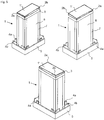
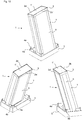
- the method that can be carried out with such a picking and packing system according to the invention provides for the provision of a suitable picking container 1, as is exemplified in FIG Fig. 5 or Fig. 12 each shown in three views.
- a suitable picking container 1 as is exemplified in FIG Fig. 5 or Fig. 12 each shown in three views.
- the order-picking container 1 the article or articles are put together according to an order or according to an order in order to be packed for shipping.
- the picking container 1 in Fig. 5 which in this exemplary embodiment has an essentially cuboid base body 6, has a rectangular trapezoidal wall surface opposite to the bottom surface 5 '(cf. Figure 6b ) inclined opening 1 'so that the container edge has a lowest point 2a and a highest point 2b which forms a guide corner which, together with the rounded corners 3 at the corners, facilitates insertion into the transport packaging 100.
- the base body 6 is arranged in a trough 5, the contact surface of which is larger than that of the base body 6.
- the order-picking container 1 has laterally longitudinal rollers 4a near the floor, and in the example shown also transverse rollers 4b, which contribute to safe guidance in a stable horizontal conveying process. Together with the tub 5, they contribute to safe guidance during horizontal conveyance, particularly with different loading / filling states based on the respective center of gravity, in order to prevent the picking container 1 from tipping over.
- the rollers 4a, 4b are attached to a frame 7 which also delimits the base body 6.
- rollers 4a, 4b are attached to the tub 5 or to the base body 6 itself.
- the base body 6 does not have to be in one piece with the frame 7 in the variant; it can also be formed from panels that are fastened to the frame.
- Rollers facing away from one another ie either longitudinal rollers 4a or transverse rollers 4b, preferably the longitudinal rollers 4a, serve to convey the order-picking container 1 in lateral rails for turning and overhead conveyance.
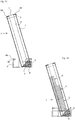
- Fig. 12 and also in Figures 13 and 14 shows an alternative embodiment of a picking container 1 for the use according to the invention, which differs from the one shown in FIG Fig. 5 primarily differs in that the base body 6 is inclined by an angle ⁇ with respect to the standing or floor surface 5 ′, which is defined by the trough-shaped stabilizing device 5. As a result of this inclination, the cuboid base body 6 has a lower edge 2a 'and a higher edge 2b' on the container edge delimiting the opening 1 ', which is therefore also inclined with respect to the (standing) floor surface 5' of the order picking container 1.
- a chock 8 ' is provided with which the base body 6 is fixed in the tub 5.
- the tilting moment of the "heeling" order picking container 1 can also be counteracted with this chock 8 ′.
- further support elements not shown here, can also be provided.
- Figures 13 and 14 furthermore show a wedge 8, which is preferably made of foam material, and which is arranged in the base body 6 on the inner bottom thereof, the acute-angled side of the wedge 8 being arranged on the side of the base body 6 which the lower edge 2a 'on which the Has opening 1 'delimiting the container edge
- the foam wedge 8 supports, as in Fig. 14 it can be seen that the articles A are in contact with the "lower" container wall of the "heeling" order picking container 1, dampens the impact of the filled articles A and also holds the edge of the lid of the lowest article A in a stabilizing manner.
- a non-"heeling" order picking container can also be equipped with such a foam wedge in the base body in order to reduce the unwanted opening of the goods with loose lids after the articles have been transferred when the order picking container is erected again and also during further transport through the System to reduce tilting or slipping of the articles in the picking container.
- the acute-angled side of the wedge is arranged on the side of the base body which has the lowest point on the container edge, since this is the "lower" container wall when the order-picking container is tilted to transfer the articles to the delivery device.
- each article A from the order is delivered to a transfer point 10 predetermined for article A or the respective picking container 1 (cf. Fig. 2 , 3 , 6th and 7th ) transferred from a delivery device 15 to the picking container 1.
- step a) the picking container 1, which was conveyed by conveyor devices 9 to the predetermined transfer point 10, as in FIG Figure 6a and 7a is shown, with its opening 1 ', preferably tilted over its broad side with the highest corner point 2b, in the direction of the article delivery device 15, which is shown in FIG Figure 6b and 7b is shown so that the corresponding item A, as in Figure 7c shown, can slide over the transfer device 12 into the picking container 1.
- the order picking container 1 can also be tilted over any other side.
- the transfer stations 10 of the transfer station of a picking and packing system each have an associated tilting ramp 11, which connects a level of the transfer station 10 with an overlying level of the delivery device 15 for the articles A at a predetermined angle of inclination.
- the transfer device 12 of the delivery device 15 supplements the tilting ramp 11, which supports the picking container 1 at the predetermined angle of inclination and erects it again after the article has been transferred.
- a transfer station for "heeling" order picking containers 1 can correspond to the above, with only the tilting ramp being adjusted with regard to its tilt angle so that the base body of the "heeling" order picking container has the desired inclination towards the delivery device or transfer device at the transfer point.
- the transfer station can dispense with tilting ramps.
- the transfer device 12 in the in Fig. 6 also has a sensor device 16, here a light barrier sensor, the “light barrier” being symbolized as a line.
- This sensor device 16 is primarily intended to "acknowledge" a filling that has taken place, but can also be used as an overfill control. If, for example, more than one article is to be put together in the picking container 1, and there are one or more bulky articles among these articles, if this article A is in an unfavorable position in the picking container 1, the article A protrudes beyond the opening 1 'of the picking container 1 come out.
- This protruding article can then be detected by the sensor device 16, so that the control causes the picking container 1 to move vertically out of the inclined transfer position when a protruding protrusion is detected, in order to rearrange the articles in the picking container 1 and completely remove the protruding article A. to slide into the picking container 1. If further articles are then to be transferred to the picking container 1 in order to complete the order, the latter is tilted again until it is completely filled with all the articles in accordance with the order. If, when the picking container 1 is tilted again, the sensor 16 responds again without any further article transfer due to a persistent overhang, the filling is interrupted and a correction case or a fault message for manual correction by an employee is automatically issued.
- a picking container 1 can be conveyed to other transfer points 10 to take over other articles from the order, but according to the invention it is primarily provided that all, even different, articles of an order can be delivered to a transfer point 10 receives.
- the picking container 1 assigned to an order remains at a transfer point 10 until all articles assigned to it or the order have been sorted and discharged by the transfer device.
- the picking containers are provided with unique identification features that can be automatically recorded using a corresponding reader, such as bar or QR codes or RFID transponders, with the corresponding bar / QR code or RFID reading stations integrated at all transfer points or decision-making positions in terms of conveyor technology so that the corresponding information regarding the picking container identity and the dynamic order identity at the transfer points, the adding stations for delivery notes, invoices, flyers, etc., the packing stations, and the labeling stations can be used for control purposes.
- a corresponding reader such as bar or QR codes or RFID transponders
- the corresponding bar / QR code or RFID reading stations integrated at all transfer points or decision-making positions in terms of conveyor technology so that the corresponding information regarding the picking container identity and the dynamic order identity at the transfer points, the adding stations for delivery notes, invoices, flyers, etc., the packing stations, and the labeling stations can be used for control purposes.
- the picking container 1 filled with the article or articles according to the order can pass an addition station 19 for a predetermined addition in front of the packing station, which can consist of a delivery note, invoice, flyers or sample packs, which are arranged along the conveying devices 14 is.
- an addition station 19 for a predetermined addition in front of the packing station, which can consist of a delivery note, invoice, flyers or sample packs, which are arranged along the conveying devices 14 is.
- three parallel addition stations 19 are shown, but more or fewer addition stations can also be provided.
- the addition of the forms or advertising material can be controlled automatically, with order-specific accompanying forms such as delivery notes and invoices online by a printer device (not shown).
- turret arrangement is meant an alternating operation of two (or more) devices, one device being in a position which represents a “productive" working position in which the printing of the forms and dispensing of the forms into the order picking container is carried out by dropping them while the picking container is clock-bound.
- the device If there is a need for paper or toner or a technical malfunction of the device in the "productive" working position, the device, which has been in the "passive" rest position until then, is brought into the "productive" working position by turning or turning, so that operation can continue without interruption while the employee has access to the device that is now in the rest position, the rest position being outside the automatic area, which is protected by a corresponding housing. In this way, the employee can make the device to be refilled or repaired ready for use again.
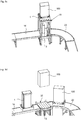
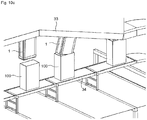
- the picking container 1 filled with article (s) and optionally with the addition is moved to a predetermined packing station 20, which is in Fig. 4 - there are shown three parallel packing stations 20 - and Fig. 8 is shown in an image sequence a) to d) according to one embodiment.
- a device 21 (schematically dashed in FIG Figure 8a shown) a transport packaging 100 is provided with a downwardly pointing opening 101, which is dimensioned for receiving the order-picking container 1.
- Figure 8b is the Picking container 1 arranged on the packing station 20, above which a transport packaging 100 is provided, stretched out with the opening 101 pointing downwards.
- the device 21 for providing the transport packaging 100 has a magazine device with compartments for transport packaging 100 with different formats and also a selection device for selecting and separating each transport packaging 100 of a predetermined format and a clamping and holding device for the unfolded transport packaging 100.
- the transport packaging 100 is selected with a specific format in accordance with a specification which is defined by a quantity / a volume of the articles of the order.
- the magazine device can have a folding mechanism and provide the different formats in a type of cassette carrier.
- the transport packaging of one format is usually folded up as a stack by the supplier and delivered lying or horizontally arranged.
- the cassette carrier has a receptacle for receiving the stack from the lying, folded-up transport packagings.
- the cassette carrier With the folding mechanism of the magazine device, the cassette carrier can be pivoted so that the folded transport packaging is then arranged on edge or essentially vertically so that an individual transport packaging can be removed more easily from the stack by a separating device.
- the device 21 is designed to automatically dispense the packaging formats from the magazine device with variable format provision to cover the different order sizes.
- the transport packaging 100 differ only in terms of their height, but the format of the bottom surface remains the same, in order not only to simplify the clamping of the transport packaging 100 in the device 21 - in this way, picking containers 1 of the same size can be used. Only the transport packaging 100 is selected with regard to its height in terms of the order size, the cross-sectional shapes / base areas of the order picking container 1 and transport packaging 100 being designed to be corresponding.
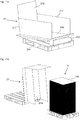
- Fig. 11 shows in a) a foldable cassette carrier 21 ', which is used to hold a stack S of folded transport packaging 100 lying on top of one another (which are delivered as a stack S on a conventional pallet, see FIG Figure 11b ) with a is formed from a sloping bottom 210 and two side walls 211 and a rear wall 212 delimited container.
- the cassette carrier 21 ' On the open side, the highest point of the inclined floor 210, the cassette carrier 21 'has an articulated connection 213, via which the inclined floor 210 is connected to a pallet base 214.
- the container is pivoted so that the inclined Bottom 210, as in Figure 11b ) can be seen, is arranged on edge.
- the stack S is, as in Figure 11c ) shown, received between the side walls 211, whereupon the container is pivoted back so that the transport packaging 100 of the stack S, as in FIG Figure 11d ) can be seen, are held upright in the container.
- the almost vertically arranged transport packaging 100 can be supported on the rear wall 212 as a result of the inclination of the inclined bottom 210, so that the stack S is also stabilized in this orientation in order to allow automated machine removal of the foremost transport packaging 100 by a separating or gripping device allow.
- the foldable cassette carrier 21 ' can be moved with the pallet base 214 and is equipped with suitable sensors that are connected to the control device of the system so that it can determine and control the filling level and position of the respective cassette carrier.
- the control device can thus transport the order-picking containers to be packed to another packing station while the cassette carrier is being loaded with a new stack of packaging.
- another cassette carrier equipped with packaging can be made available in good time so that it can be quickly exchanged for an empty cassette carrier so that the packing station does not have to be shut down.
- the control device can also ensure that, if a cassette carrier for transport packaging of a certain format is empty, ensure that only those orders are packed for the duration of the re-equipping with the certain format at this packing station for which another packaging format is provided at this packing station is.
- the order-picking container 1 which, as it were, represents a "negative shape” that moves into the opened transport packaging 100, which represents the "positive shape", ensures a safe, constant working level.
- the height of the picking container 1 can be chosen so large in relation to the base area that a large variety of different articles can be picked up when putting together an order.
- the variability of the transport packaging 100 relates to its (height) format, which is selected appropriately for the assembled articles of each order.
- the device for providing the transport packaging 100 can be controlled automatically to provide a correspondingly suitable packaging format, but the use of a Uniform Kotnmissionier portions 1 preferred, since constant working height conditions are maintained and thus a very high process reliability is achieved when automatically adding the forms etc., with an additional optional monitoring of protrusions and when inserting into the transport packaging in the packing station.
- An embodiment of the order-picking and packing system can thus also have an optional monitoring device for monitoring protrusions, which can be arranged along the conveying devices 14 between the adding station 19 and the packing station 20.
- a sorting device can be provided along the conveying devices 14 which, when an overhang is detected on a picking container 1, moves the latter onto a bypass conveyor path, which enables troubleshooting. This can be done automatically, for example, by a gentle vibrating device, so that the article / addition is better placed in the order picking container 1 and no longer protrudes. If necessary, however, it may also be necessary for an employee to intervene before the picking container 1 is fed back to the conveying devices 14, which lead to the packing station 20.
- step c) in Figure 8c ) and the foremost packing station 20 in Fig. 4 is shown the order-picking container 1 is introduced through the opening 101 into the transport packaging 100, in that the packing station 20 is moved upwards by a lifting device 13. Insertion is facilitated by the guide corner 2b and the rounded portions 3 on the edge of the picking container 1.
- Figure 8d ) shows the further transport of the order picking container 1 with the transport packaging 100 pulled over it via conveying devices 22 which lead to the transferring and separating station 30 ( Fig. 9 and 10 ), while the next picking container 1 moves to the packing station 20 and another transport packaging 100 is provided.
- a packing station (not shown figuratively) for a system according to the invention which uses “heeling” picking containers is modified in accordance with the requirements specified by the inclination of the base body.
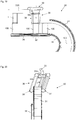
- the devices for providing the transport packaging can be arranged horizontally offset with a downward-facing opening, as shown in FIG Fig. 23 is shown schematically, and the respective lifting device can be designed to perform a correspondingly inclined upward movement t 1 , which is adapted to the inclination of the base body.
- the transport packaging is then provided by the provision device in a correspondingly inclined manner, so that the base body of the order-picking container can slide into the transport packaging without knocks or creases.
- the transport packaging can be provided inclined, but vertically directly above the packing station, as shown schematically in FIG Fig. 24 it is indicated when the upward movement of the packing station follows, for example, a coordinated zigzag course t 2 in order to introduce the inclined base body into the transport packaging.
- the first variant can be preferred, since a straight, inclined movement is significantly easier to provide, whereas a lifting device for a zigzag course is more complicated and expensive.
- the lifting device 13 can be provided, for example, by a lifting cylinder, as shown in FIG Figure 8a -d can be seen.
- the lifting cylinder In order to carry out an oblique upward movement t 1 in the case of "heeling" order picking containers, the lifting cylinder can be arranged at an angle corresponding to the inclination of the order picking container.
- lifting devices are also conceivable, which, according to the present understanding, should include all devices with which a picking container at the packing station can be lifted from the level of the conveying devices 22 into the transport packaging 100 provided above this level.
- Lifting devices according to the invention therefore also include, for example, but not exclusively, lifting scissors, elevator or lifting devices.
- An exemplary lifting device for lifting a "heeling" order picking container is shown in connection with an alternative separation station on the basis of FIG Figures 15-18 described, but there with a reversed order picking container.
- the lifting device shown there consists of two circulating conveyors, which are designed similarly to paternoster lifts, but can easily be used as a lifting device for a picking container at a packing station.
- the filled picking container 1 arranged in the transport packaging 100 is conveyed via the conveying devices 22 to the transferring and separating station 30, the filled picking container 1 arranged in the transport packaging 100 can have a labeling station 29 (cf. Fig. 2 and Fig. 4 ) happen, which in the examples shown has four labeling devices - the number of which can, however, vary - so that the transport packaging 100 can be provided with a shipping label that can be automatically stuck on.
- the order-related shipping data are usually printed online by a thermal printer onto the labels made of thermally sensitive paper provided by a label roll, pulled off the roll and applied to the packaging. The number of labeling devices used depends on the throughput of the system.
- two labeling devices are required - the number of four devices here, as in the case of the adding station, is due to the specification of tear-free automated operation. This means that two labeling devices are in the working position and two are in the rest position, which are then automatically used when the active devices need a supply of label rolls or have other malfunctions, which are then remedied by employees.
- the label is attached to the transport packaging 100 at a point that is still clearly visible after the transport packaging 100 is subsequently closed.
- the label can therefore preferably be attached near the bottom of the transport packaging 100, which corresponds to an upper section of the order-picking container 1 in the slipped-over arrangement on the order-picking container 1.
- the labeling of the transport packaging 100 which is still drawn up over the picking container 1 and stabilized by it, thus takes place under constant and therefore very process-reliable conditions at a working level in a constant working level, before the transferring of the article (s) from the picking container 1 in step e) the transport packaging 100 takes place by means of a turning movement, preferably by 180 "with respect to the vertical, in order to stabilize the transport packaging 100 until it is arranged upright with the opening pointing upwards.
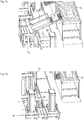
- the transferring and separating station 30 has a turning device for transferring, which in the present example in Fig. 9 and 10 consists of a half-looping track 31 for the picking container 1 and a corresponding stabilizing track 32 for the bottom of the transport packaging 100 for performing a 180 ° turn with respect to the vertical.
- a separating device is provided which lifts the order picking container 1 out of the transport packaging 100, which according to one embodiment is carried out by guiding and conveying the order picking container 1 and the transport packaging 100 along in relation to the vertical diverging tracks 33, 34 takes place.
- a turning device for transferring which in the present example in Fig. 9 and 10 consists of a half-looping track 31 for the picking container 1 and a corresponding stabilizing track 32 for the bottom of the transport packaging 100 for performing a 180 ° turn with respect to the vertical.
- the order-picking container 1 is guided along a rising ramp 33, while the transport packaging 100, which now contains the articles, is conveyed further horizontally along the conveyor track 34.
- the order-picking container 1 and the transport packaging 100 are thus dynamically decoupled, ie separated, by the synchronous conveying along the ramp 33 or the conveyor track 34.
- a turning device and a separating device are adapted accordingly for a "heeling" picking container:
- the half-looping track and the stabilizing track will be offset from one another according to the extent of the inclination of the picking container in order to move the bottom of the transport packaging with the during the turning movement when the picking container follows the half-looping track To support stabilization track.
- the subsequent separating device is modified in such a way that the order picking container moves along the direction of inclination of its base body so that the order picking container is pulled straight out of the transport packaging without getting stuck.
- the rising ramp of the separating device can also be arranged to diverge in the horizontal direction from the conveyor track of the transport packaging.
- Corresponding guide means are provided there so that the order-picking container 1 can be moved through the half-looping track 31 and along the ramp 33.
- these are lateral guide rails 31 ', which are designed to engage with the longitudinal rollers 4a of the picking container 1 to convey the same through the half loop, since the picking container 1 is conveyed in the longitudinal direction to reduce the tendency to tip.
- a tapering inlet area of the rail 31 'for the rollers 4a can be seen.
- the lateral guide to show the longitudinal rollers is partially omitted and the remaining wall is indicated by dashed lines.
- such a half-looping track 21 and the ramp 33 can of course also be designed for a transversely conveyed order picking container 1, with the transverse rollers 4b then engaging the guide rails.
- a further development of the picking container 1, not shown, can also provide that it has an integrated pendulum suspension in order to avoid a tilt-free upward conveying movement in the ramp 33 when it is carried out from the transport packaging 100, in that the base body 6 of the picking container 1 pendulates freely in the horizontal when moving upward can be held.
- a transferring and separating station 30 of an alternative embodiment as in FIG Figures 19 to 21 shown, have a space-saving separating device in the form of a lifting device 36 connected to the turning device, which in this example also consists of a half-looping track 31 for the picking container 1 and a corresponding stabilizing track 32 for the bottom of the transport packaging 100 for performing a 180 ° turn in With respect to the vertical.
- the half-looping track 31 and the stabilizing track 32 are offset from one another in the horizontal direction according to the inclination of the "heeling" picking container 1.
- the turned order picking container 1 After passing the turning device, ie after leaving the semi-looping path 31, the turned order picking container 1 is turned over, as will be explained in more detail below and in connection with Figures 15 to 18 is described, detected by the separating device designed as a lifting device 36 and guided obliquely upward according to the inclination of the "heeling" order picking container 1 and thus separated from the filled transport packaging 100, which during the separating phase on a holding place 36 'along the conveying path 34 below the lifting device 36 holds and is only conveyed away in the direction of the locking station after the separation has taken place.
- the separating device designed as a lifting device 36 and guided obliquely upward according to the inclination of the "heeling" order picking container 1 and thus separated from the filled transport packaging 100, which during the separating phase on a holding place 36 'along the conveying path 34 below the lifting device 36 holds and is only conveyed away in the direction of the locking station after the separation has taken place.
- a return path 33R connects to the upper end of the lifting device, into which the turned order picking container 1 is transferred by means of a horizontal conveyor 39.
- the turned (and therefore empty) order picking containers 1 can be fed to a return turning device via the return path 33R, so that they can then be fed back to the transfer station with the transfer stations with the opening facing upwards after being assigned to a new order.
- the height difference that is to be bridged with the lifting device 36 results from the heights of the transport packaging 100 and the picking container 1, which results in the positioning of the return path 33R and the horizontal conveyor 39.
- the horizontal conveyor 39 which is also shown in Figs. 15-18 can be seen, in the example shown is a horizontally arranged circulating conveyor 19, consisting of a circulating chain or a belt or belt 39a, which is driven guided around two deflection rollers 39b.
- the black arrows show the direction of rotation of the belt 39a, on which three driver or engagement elements 39c are arranged at an even distance.
- driver or engagement elements 39c plate sections are simply provided here, which are fastened to the circulating belt 39a perpendicular to the conveying direction.
- the circulating conveyor 39 is arranged in relation to the lifting device 36 and the return path 33R in such a way that a reversed order picking container 1, which is received in the lifting device 36 at height h H of the half-looping path 31, leaves the lifting device when the height h R of the return path 33R is reached 36 is pushed horizontally into the return path 33R in that one of the driver elements 39c comes to rest on a wall section of the picking container 1 or its trough-like stabilizing device 5 close to the floor and takes the picking container 1 along in the conveying direction of the horizontal circulating conveyor 39.
- the speed of the horizontal circulating conveyor 39 is matched to the speed of the lifting device 36 in order to be able to convey a picking container on in good time which reaches the transfer position at height h R.
- a picking container 1 is shown in each case in the lifting device 36 in the transfer position at height h R for transfer to the return path 33R.
- Fig. 16 and 18th show a picking container 1, which can be seen in the lifting device 36 in the receiving position at height h H corresponding to the exit of the half-looping track 31.
- the lifting device 36 consists of two circulating conveyors 37, 38 which, according to the inclination of the base body 6 relative to the standing or floor surface 5 ', which is defined by the trough-shaped stabilizing device 5, run obliquely around the "heeling" order picking container 1 to be able to lift out smoothly from the transport packaging 100.
- Each circulating conveyor 37, 38 consists of a pair of parallel circulating chains, belts or belts 37a, 38a, each of which is driven around two deflecting rollers 37b, 38b.
- the black arrows show the direction of rotation of the belts 37a, 38a.
- three driver or engagement elements 37c, 38c are arranged at an even distance.
- both circulating conveyors 37, 38 must have the same number of driver or engagement elements 37c, 38c and their circulating positions be matched to one another in order to be able to pick up the order picking container 1 exactly, so that its base body 6 is moved parallel to the circulating conveyors 37, 38.
- their rotational positions are to be coordinated so that the entrainment or engagement elements 37c, 38c facing each other are at the same height in the upward movement lie.
- deviating rotary positions of the respective driver or engagement elements 37c, 38c can also be provided in order to move the base body 6 in one direction to the circulating conveyors 37, 38 parallel movement.
- driver or engagement elements 37c, 38c plate sections are also provided here, which are fastened to the circulating belt pairs 37a, 38a perpendicular to the conveying direction. Due to the intended non-central arrangement of the inclined base body 6 in the trough-shaped stabilizing device 5, with which the driver or engagement elements 37c, 38c come into engagement, the plate-like driver or engagement elements 37c of the circulating conveyor 37 close to the container are narrower than the plate-like drivers - or engagement elements 38c of the circulating conveyor 38 remote from the container, as before all in Figures 17 and 18 is easy to see. "Close to the container” and "remote from the container” mean the distance between the base body 6 and the respective circulating conveyor 37, 38.
- the lifting device 36 as a separating device opens up the possibility of connecting a return path in the opposite direction if the horizontal circulating conveyor 39 were operated in the opposite direction and / or to connect the return turning device directly.
- a lifting device is used in a system for “normal” order picking containers 1.
- a lifting device for non-heeling order picking containers will have circulating conveyors which move vertically upwards and which are symmetrically spaced from the base body and whose entrainment or engagement elements can consequently have the same width.
- the emptied order picking container 1 is assigned to an order by the control device after passing through another turning device so that the opening 1 'of the order picking container 1 faces upwards again and is moved again to the transfer station via conveying devices 9.
- the transport packaging 100 in which the articles and possibly also the add-on are now located, and which already has the shipping label, is transported to the closing station 40, where the transport packaging 100 is turned over or turned inside out from the opening side without adding fillers is closed.
- the closing station can have one or more folding devices for this purpose, starting with an inlet passage in which the opposite sides of the transport packaging are brought together at the top of the opening and, if necessary, also pre-bent or preferably pre-bent.
- the inlet passage can be formed, for example, by a converging pair of rails or the like, which is supplemented with a profile rail in order to produce the desired pre-fold (or bend).
- At least one further folding device (or bending device) in order to produce a folded envelope (or a turned-up bend) from the opening side on the continuously conveyed transport packaging to close the transport packaging.
- a further folding device or bending device
- the envelope or roll-over process is thus designed to be variable, but depends only to a certain extent on the filling quantity or the filling volume, since the format of the transport packaging 100 can be selected according to a quantity / a volume of the articles of an order, by the number of limit envelopes required to secure items.
- different closure devices are provided for the different formats of the transport packaging, which differ primarily with regard to the positioning of the folding devices in relation to the conveyor track for the transport packaging.
- the height of the inlet passage can thus be matched to the height of the transport packaging.
- Different closure devices can thus be operated in parallel in a closure station, the assignment of the filled transport packaging to the correct closure device in an automatically controlled manner depending on its format. For example, via a sensor system (sensor system means one or more sensors) that detects the height of the transport packaging conveyed past or the labels from which the corresponding information for assigning the respective transport packaging can be determined.
- the information required for the controlled assignment of the transport packaging to the correct closure station can also be obtained after separation from the identification feature of the picking container, which the control device can assign to the corresponding order and thus the packaging format used, since the transport packaging leave the separator in the same order as the picking containers.
- a filling level sensor can be used, for example, so that the number of folding processes for each transport packaging is determined by the control device and the respective transport packaging is then determined with the corresponding Conveyors is transported to the required folding devices.
- the envelope is still being fixed. This can preferably be done by sewing or a suitable double-sided adhesive tape, but alternatively, for example, also by hot bonding or stapling.
- the transport packaging can preferably be sewn, with the sewing station required for this being able to be arranged next to the folding devices.
- the closure by sewing with an automatic thread cutter can be done in a single-thread chain stitch, which allows the recipient to open it easily later. Tacking as a fixation of the closure can also take place after folding, but stapled closures are more difficult for the recipient to open and are therefore less preferred.
- the adding station (refilling of toner / paper) and the labeling station (refilling of label rolls), parallel devices are also provided for the closing station, so that in the event of a fault or if an active device needs to be refilled or serviced, a device that was previously passive is automatic takes over the operation, the switching of the supply of the transport packaging to be closed also takes place automatically, while the adhesive tape or other adhesive material can be filled in by employees in the other, now passive device.
- the order picking and packing system allows the use of the simplest conveying and handling technology elements with only linear movements and thus ensures the highest system / machine availability.
- the method according to the invention enables very high throughput dynamics - 10,000 parts per hour should be put through with stable process reliability through suitable decoupling.
Landscapes
- Engineering & Computer Science (AREA)
- Mechanical Engineering (AREA)
- Warehouses Or Storage Devices (AREA)
Claims (19)
- Procédé de préparation de commandes et d'emballage consolidé automatique d'articles (A) destinés à l'expédition, un conteneur de prélèvement (1) dans lequel des articles (A) sont regroupés conformément à une commande, étant mis à disposition,
comprenant les étapesa) Disposer du conteneur de prélèvement (1) dans un point de transfert (10) et transférer au moins d'un article (A) mis à disposition conformément à la commande dans le conteneur de prélèvement (1),b) Déplacer du conteneur de prélèvement (1) rempli au moins d'un article (A) dans un point d'emballage (20) prédéfini et, au-dessus du point d'emballage (20), mettre à disposition d'un emballage de transport (100) avec une ouverture (101) tournée vers le bas, qui est dimensionnée pour recevoir le conteneur de prélèvement (1),c) Disposer du conteneur de prélèvement (1) par l'ouverture (101) dans l'emballage de transport (100),d) Déplacer du conteneur de prélèvement (1) rempli, disposé dans l'emballage de transport (100), vers une station de transvasement et de séparation (30),e) Transvaser au moins d'un article (A) du conteneur de prélèvement (1) dans l'emballage de transport (100) par un mouvement de renversement par rapport à la verticale,f) Séparer du conteneur de prélèvement (1) de l'emballage de transport (100) dans lequel se trouve au moins un article (A) etg) Fermer de l'emballage de transport (100),toutes les étapes du procédé étant réalisées de façon mécanique et automatisée dans un processus continu. - Procédé conformément à la revendication 1, dans l'étape a), le conteneur de prélèvement (1) étant déplacé sur le point de transfert (10) et étant basculé avec son ouverture (1') en direction d'un dispositif de livraison d'articles (15) de sorte qu'au moins un article (A) mis à disposition par le dispositif de livraison (15) conformément à la commande glisse dans le conteneur de prélèvement (1).
- Procédé conformément à la revendication 2, dans l'étape a), le conteneur de prélèvement (1) étant déplacé sur le point de transfert (10) de façon à ce qu'un côté du conteneur de prélèvement (1) soit tourné vers le dispositif de livraison d'articles (15),- qui présente un point le plus bas (2a) ou un bord plus bas (2a') sur la paroi du conteneur limitant l'ouverture (1') et/ou- sur lequel se trouve un côté à angle aigu d'une clavette (8) qui est disposée au fond du conteneur de prélèvement (1),
- Procédé conformément au moins à l'une des revendications 1 à 3, le procédé comprenant au moins l'une des étapes suivantes:- conformément à la commande, répéter de l'étape a) pour au moins un autre article (A) sur un autre point de transfert (20) prédéfini ou sur le même point de transfert,- avant l'étape b), déplacer du conteneur de prélèvement (1) sur un point d'ajout (19) prédéfini et transférer d'un ajout prédéfini dans le conteneur de prélèvement (1),- dans l'étape b) pour la mise à disposition de l'emballage de transport (100), sélecter d'un emballage de transport (100) avec un format défini conformément à une spécification qui est définie par une quantité et/ou un volume d'articles (A) de la commande, dans un dispositif chargeur, ouvrir et maintenir de l'emballage de transport (100),- dans l'étape c), déplacer vers le haut du conteneur de prélèvement (1) pour introduire dans l'emballage de transport (100) par l'ouverture (101),
pendant l'étape d), passage dans une station d'étiquetage (29) et étiqueter de l'emballage de transport (100),- dans l'étape e) lors du mouvement de renversement qui est effectué de préférence à 180°, guider du conteneur de prélèvement (1) rempli, disposé dans l'emballage de transport (100), dans une voie en demi-boucle (31), un fond de l'emballage de transport (100) étant soutenu par une voie de stabilisation (32) appropriée,- dans l'étape f), lever du conteneur de prélèvement (1) de l'emballage de transport (100) par le guider du conteneur de prélèvement (1) et de l'emballage de transport (100) le long de voies (33, 34) divergentes par rapport à la verticale, le conteneur de prélèvement (1) étant de préférence guidé le long d'une rampe montante (33),- dans l'étape g) pour fermer, rabatter ou retourner de l'emballage de transport (100) depuis la face d'ouverture jusqu'à au moins un article et fixer de la partie rabattue ou retournée,- parallèlement à l'étape g), retourner du conteneur de prélèvement (1) vidé avec la réalisation d'un autre mouvement de renversement par rapport à la verticale et déplacer du conteneur de prélèvement (1) vers la station de transfert pour la prise en charge d'articles (A) conformément à une autre commande. - Installation de préparation de commandes et d'emballage pour la préparation de commandes et l'emballage automatisés d'articles (A) destinés à l'expédition, l'installation de préparation de commandes et d'emballage présentant une pluralité de conteneurs de prélèvement (1) et une pluralité de convoyeurs (9, 14, 22) pour les conteneurs de prélèvement (1) et les dispositifs de livraison et de transfert pour articles (A),
les convoyeurs (9, 14, 22) pour les conteneurs de prélèvement (1) reliant au moins une station de transfert pour le transfert des articles (A) dans les conteneurs de prélèvement (1) et au moins une station d'emballage pour l'emballage des articles (A) dans un emballage de transport (100),
caractérisée en ce que
la station d'emballage présente un point d'emballage (20) au-dessus duquel est disposé un dispositif (21) pour la mise à disposition de l'emballage de transport (100) avec une ouverture (101) tournée vers le bas, qui est dimensionnée pour la réception temporaire du conteneur de prélèvement (1), le point d'emballage (20) ou le dispositif de mise à disposition de l'emballage de transport (100) ou les deux étant conçus pour l'exécution d'un mouvement relatif l'un par rapport à l'autre,
et en ce que
l'installation de préparation de commandes et d'emballage présente une station de transvasement et de séparation (30) qui est raccordée à la station d'emballage par les convoyeurs (9, 14, 22) pour les conteneurs de prélèvement (1) et qui présente un dispositif de renversement (31, 32) pour les conteneurs de prélèvement (1) pour l'exécution d'un mouvement de renversement par rapport à la verticale, puis un dispositif de séparation (33, 34) pour la séparation du conteneur de prélèvement (1) de l'emballage de transport (100). - Installation de préparation de commandes et d'emballage conformément à la revendication 5,
caractérisée en ce que
l'installation de préparation de commandes et d'emballage présente un dispositif de retour pour les conteneurs de prélèvement (1),
le dispositif de retour pour les conteneurs de prélèvement (1) présentant un deuxième dispositif de renversement (31R) pour les conteneurs de prélèvement (1) pour l'exécution d'un mouvement de renversement par rapport à la verticale. - Installation de préparation de commandes et d'emballage conformément à la revendication 5 ou 6,
caractérisée en ce que
l'installation de préparation de commandes et d'emballage présente une station de fermeture (40), la station de fermeture (40) étant raccordée à la station de transvasement et de séparation (30) pour la fermeture de l'emballage de transport (100), la station de fermeture (40) présentant de préférence un dispositif de rabattement ou de retournement de l'emballage de transport (100) depuis la face d'ouverture. - Installation de préparation de commandes et d'emballage conformément au moins à l'une des revendications 5 à 7,
caractérisée en ce que
la station de transfert présente une pluralité de points de transfert (10) auxquels est affectée respectivement une rampe basculante (11) qui relie un niveau du point de transfert (10) à un niveau placé au-dessus d'un dispositif de livraison (15) pour les articles (A), seul ou en relation avec un dispositif de transfert (12) du dispositif de livraison (15) dans un angle d'inclinaison prédéfini, la rampe basculante (11) étant conçue pour soutenir le conteneur de prélèvement (1) dans l'angle d'inclinaison prédéfini, une ouverture (1') du conteneur de prélèvement (1) étant tournée en direction du dispositif de livraison (15) pour la réception des articles (A). - Installation de préparation de commandes et d'emballage conformément au moins à l'une des revendications 5 à 8,
caractérisée en ce que
l'installation de préparation de commandes et d'emballage présente- une station d'ajout (19) pour un ajout prédéfini, laquelle est disposée entre la station de transfert (10) et la station d'emballage (20) le long des convoyeurs (9, 14, 22) et/ou- une station d'étiquetage (29) pour l'étiquetage de l'emballage de transport (100), laquelle est disposée entre la station d'emballage (20) et la station de transvasement et de séparation (30) le long des convoyeurs (9, 14, 22). - Installation de préparation de commandes et d'emballage conformément à la revendication 9,
caractérisée en ce que
dans le cas d'une station d'ajout (19) existante, l'installation de préparation de commandes et d'emballage présente un dispositif d'impression pour l'impression de formulaires de suivi, le dispositif d'impression étant conçu de telle manière à ce qu'une édition de formulaires se trouve au-dessus d'un niveau défini par l'ouverture (1') des conteneurs de prélèvement (1) acheminés sur les convoyeurs (9, 14, 22). - Installation de préparation de commandes et d'emballage conformément au moins à l'une des revendications 5 à 10,
caractérisée en ce que- le dispositif (21) pour la mise à disposition de l'emballage de transport (100) présente un dispositif chargeur avec des porte-cassettes (21') pour des emballages de transport (100) avec des formats différents, un dispositif de sélection pour la sélection et la séparation d'un emballage de transport (100) d'un format défini et un dispositif de serrage et de maintien pour un emballage de transport (100) déployé avec une ouverture (101) tournée vers le bas, et/ou- le mouvement relatif entre le point d'emballage (20) et le dispositif de mise à disposition de l'emballage de transport (100) étant mis à disposition par au moins un dispositif de levage (13) qui est relié ou qui peut être relié au point d'emballage (20) et/ou au dispositif de mise à disposition de l'emballage de transport (100), le dispositif de levage (13) présentant de préférence au moins un vérin de levage (13), des ciseaux de levage, un dispositif de remontée ou de levage, comprenant au moins un convoyeur circulant. - Installation de préparation de commandes et d'emballage conformément au moins à l'une des revendications 5 à 11,
caractérisée en ce que
la station de transvasement et de séparation (30) met à disposition, comme dispositif de renversement, une voie en demi-boucle (31) qui assure de préférence un renversement à 180°, avec des moyens de guidage pour le conteneur de prélèvement (1) et une voie de stabilisation (32) circulant en parallèle pour le soutien d'un fond de l'emballage de transport (100),
et/ou en ce que
la station de transvasement et de séparation (30) présente, comme dispositif de séparation,- des voies (33, 34) divergentes par rapport à la verticale pour le guidage du conteneur de prélèvement (1) et de l'emballage de transport (100), la voie supérieure (33) pour le guidage des conteneurs de prélèvement (1) étant raccordée à la voie en demi-boucle (31) et la voie inférieure (34) pour le guidage de l'emballage de transport (100) étant raccordée à la voie de stabilisation (32), la voie supérieure (33) pour le guidage des conteneurs de prélèvement (1) étant conçue de préférence comme rampe montante (33), les moyens de guidage dans la voie en demi-boucle (31) et dans la voie supérieure (33) étant de préférence des rails de guidage latéraux (31') qui sont conçus pour venir en prise avec les dispositifs de roulement (4a, 4b) du conteneur de prélèvement (1) qui sont disposés au niveau du fond sur le côté du conteneur de prélèvement (1)
ou- un dispositif de levage (36) pour les conteneurs de prélèvement (1) qui est raccordé à la voie en demi-boucle (31), et un point de maintien (36') pour les emballages de transport (100) en dessous du dispositif de levage (36) le long d'une voie de transporteur d'évacuation (34) qui est raccordée à la voie de stabilisation (32), le dispositif de levage (36) présentant de préférence au moins un convoyeur circulant (37, 38) qui est conçu au moins avec un élément de prise (37c, 38b) pour venir en prise avec un conteneur de prélèvement (1) renversé. - Installation de préparation de commandes et d'emballage conformément au moins à l'une des revendications 5 à 12,
caractérisée en ce que
l'installation de préparation de commandes et d'emballage présente au moins un dispositif de commande qui est relié à tous les dispositifs et convoyeurs de l'installation pour la préparation de commandes et l'emballage consolidé automatique des articles (A) destinés à l'expédition dans un processus continu, les dispositifs et convoyeurs de l'installation étant de préférence équipés, au moins en partie, d'un système de capteurs qui est connecté au moins à un dispositif de commande pour la régulation des processus. - Installation de préparation de commandes et d'emballage conformément à la revendication 13,
caractérisée en ce que
l'installation de préparation de commandes et d'emballage présente- un système de capteurs pour l'enregistrement d'une caractéristique d'identification de chaque conteneur de prélèvement (1) pour la station de transfert, la station d'emballage, la station d'ajout (19), la station d'étiquetage (29), la station de fermeture (40) et/ou pour toutes les positions de décision relevant des techniques de convoyage le long des convoyeurs (9, 14, 22) et/ou- des dispositifs de capteurs (16) pour la station de transfert, en particulier sur les dispositifs de transfert (12), pour l'enregistrement d'un transfert d'article effectué et/ou pour l'enregistrement d'articles (A) passant dans la position de transfert depuis le conteneur de prélèvement (1), et/ou- un système de capteurs pour le dispositif de mise à disposition de l'emballage de transport (100) sur chaque dispositif chargeur pour le suivi d'un stock d'emballages de transport (100) et pour l'affectation automatique de nouveaux emballages de transport (100), en particulier sur chaque porte-cassette (21') pour la détermination et la régulation du niveau de remplissage et de la position du porte-cassette (21') respectif,
et/ou- un système de capteurs pour la station de fermeture (40) pour l'enregistrement d'un niveau d'emballages de transport (10) acheminés en vue d'affecter l'emballage de transport (100) respectif en fonction de son format, et/ou- un capteur de niveau de remplissage pour la station de fermeture (40) pour l'enregistrement du niveau de remplissage d'articles dans l'emballage de transport (100) en vue de déterminer un nombre de rabattements pour la fermeture de l'emballage de transport (100) et d'une affectation aux dispositifs de rabattement ou de retournement de l'emballage de transport (100) correspondants depuis la face d'ouverture. - Utilisation d'un conteneur de prélèvement (1) dans une installation de préparation de commandes et d'emballage conformément au moins à l'une des revendications 5 à 13 pour la réalisation d'un procédé conformément au moins à l'une des revendications 1 à 4,
caractérisée en ce que
le conteneur de prélèvement (1) présente- une ouverture (1') qui est inclinée par rapport à une surface de fond du conteneur de prélèvement (1) et- des dispositifs de roulement (4a, 4b) latéraux au niveau du fond. - Utilisation conformément à la revendication 15,
caractérisée en ce que
le conteneur de prélèvement (1) présente une structure de base (6) qui présente l'ouverture (1') et qui est disposée dans un dispositif de stabilisation (5) en forme de cuve, agrandissant la surface de pose, lequel met à disposition la surface du fond du conteneur de prélèvement (1) et sur lequel sont disposés les dispositifs de roulement (4a, 4b) latéraux. - Utilisation conformément à la revendication 16,
caractérisée en ce que- la structure de base (6) est disposée perpendiculairement à la surface du fond dans le dispositif de stabilisation (5), l'ouverture (1') inclinée par rapport à la surface du fond du conteneur de prélèvement (1) étant mise à disposition par le fait qu'une paroi du conteneur limitant l'ouverture (1') présente un point le plus bas (2a) et un point le plus haut (2b), ou- la structure de base (6) est disposée en étant inclinée avec un angle (α) prédéfini par rapport à la surface du fond dans le dispositif de stabilisation (5), l'ouverture (1') inclinée par rapport à la surface du fond du conteneur de prélèvement (1) étant mise à disposition avec un bord plus bas (2a') et un bord plus haut (2b'). - Utilisation conformément au moins à l'une des revendications 15 à 17,
caractérisée en ce que
une clavette (8), de préférence dans un matériau élastique amortissant les chocs, est disposée sur le fond dans la structure de base (6). - Utilisation conformément à la revendication 18,
caractérisée en ce que
une face à angle aigu de la clavette (8) est disposée sur le côté de la structure de base (6) qui présente le point le plus bas (2a) ou le bord plus bas (2a') sur la paroi du conteneur limitant l'ouverture (1').
Priority Applications (1)
| Application Number | Priority Date | Filing Date | Title |
|---|---|---|---|
| PL18719431T PL3601064T3 (pl) | 2017-03-21 | 2018-03-15 | Sposób skonsolidowanego komisjonowania i pakowania artykułów, instalacja do komisjonowania i pakowania oraz pojemnik do komisjonowania |
Applications Claiming Priority (2)
| Application Number | Priority Date | Filing Date | Title |
|---|---|---|---|
| DE102017002712.9A DE102017002712B4 (de) | 2017-03-21 | 2017-03-21 | Verfahren zum konsolidierten Kommissionieren und Verpacken von Artikeln, Kommissionier-Packanlage und Kommissionierbehälter |
| PCT/EP2018/000099 WO2018171933A2 (fr) | 2017-03-21 | 2018-03-15 | Procédé de préparation consolidée de commandes et d'emballage d'articles, installation de préparation de commandes et de conditionnement et contenant de préparation de commandes |
Publications (2)
| Publication Number | Publication Date |
|---|---|
| EP3601064A2 EP3601064A2 (fr) | 2020-02-05 |
| EP3601064B1 true EP3601064B1 (fr) | 2020-12-02 |
Family
ID=62044639
Family Applications (1)
| Application Number | Title | Priority Date | Filing Date |
|---|---|---|---|
| EP18719431.1A Active EP3601064B1 (fr) | 2017-03-21 | 2018-03-15 | Procédé de préparation consolidée de commandes et d'emballage d'articles, installation de préparation de commandes et de conditionnement et contenant de préparation de commandes |
Country Status (6)
| Country | Link |
|---|---|
| US (1) | US20200024014A1 (fr) |
| EP (1) | EP3601064B1 (fr) |
| CN (1) | CN110461713B (fr) |
| DE (1) | DE102017002712B4 (fr) |
| PL (1) | PL3601064T3 (fr) |
| WO (1) | WO2018171933A2 (fr) |
Families Citing this family (12)
| Publication number | Priority date | Publication date | Assignee | Title |
|---|---|---|---|---|
| CN113800028B (zh) * | 2020-06-16 | 2023-04-21 | 顺丰科技有限公司 | 货物运输系统及其控制方法 |
| IT202100006026A1 (it) * | 2021-03-15 | 2022-09-15 | Moncler S P A | Linea di assemblaggio di manufatti e relativo procedimento, particolarmente per la confezione industriale di capi di abbigliamento. |
| US11620878B1 (en) * | 2021-03-18 | 2023-04-04 | Wells Fargo Bank, N.A. | Universal cassette for recirculation of bills in multiple systems |
| CN114394361B (zh) * | 2022-01-04 | 2023-11-24 | 大唐互联科技(武汉)有限公司 | 一种基于冷库的柔性组盘的自动拣选搬运系统 |
| US11911803B2 (en) | 2022-05-02 | 2024-02-27 | Staples, Inc. | Automated sorting and packing system |
| US11897701B2 (en) * | 2022-05-02 | 2024-02-13 | Staples, Inc. | Automated packing system |
| US11975926B2 (en) | 2022-05-02 | 2024-05-07 | Staples, Inc. | Automated belt-diverter system |
| CN115303547B (zh) * | 2022-08-30 | 2023-11-28 | 福建恒安集团有限公司 | 一种一次性卫生用品散包称重装置 |
| CN115743787B (zh) * | 2022-11-30 | 2025-08-19 | 德赛集团有限公司 | 一种具有漏装检测功能的制鞋用包装装置 |
| CN118447622A (zh) * | 2023-02-06 | 2024-08-06 | 橡鹿机器人(江苏)有限公司 | 基于贩卖机的商品打包方法、装置、设备及存储介质 |
| AT527765B1 (de) * | 2023-12-11 | 2025-10-15 | Tgw Logistics Gmbh | Verfahren und System zum Kommissionieren von Waren mit verbesserter Förderung von Versandpackungen |
| CN120325575B (zh) * | 2025-06-18 | 2025-08-22 | 苏州旭森源纱业有限公司 | 一种纺纱厂专用筒子纱多品种分拣直立运输系统 |
Family Cites Families (15)
| Publication number | Priority date | Publication date | Assignee | Title |
|---|---|---|---|---|
| US3605377A (en) * | 1970-02-25 | 1971-09-20 | Sabel Herbert John | Carton loading machine |
| JPS5628897Y2 (fr) * | 1976-09-09 | 1981-07-09 | ||
| US4674261A (en) * | 1986-06-25 | 1987-06-23 | Sabel Herbert John | Machine for loading and closing a shipping case with a telescopic lid |
| DE3813309A1 (de) | 1987-04-21 | 1989-08-03 | Avon Cosmetics Gmbh | Verfahren zur transportsicheren verpackung von kommissionen, hierdurch erreichte verpackungseinheit sowie eine anordnung zum verpacken |
| DE3941139A1 (de) * | 1989-12-13 | 1991-06-20 | Moellers Maschf Gmbh | Verfahren zur herstellung einer palettenlosen verpackungseinheit |
| DE10019485C2 (de) * | 2000-04-19 | 2002-10-24 | Siemens Ag | Verfahren und Vorrichtung zum Entladen und Beladen von Tablaren |
| DE10146790B4 (de) * | 2001-09-22 | 2006-06-08 | Grützmacher, Frank | Vorrichtung zum Befüllen von quaderförmigen Behältern mit gefüllten Kuverts |
| DE102011012950B4 (de) * | 2011-03-03 | 2021-05-12 | Grenzebach Maschinenbau Gmbh | Vorrichtung und Verfahren zum definierten Zwischenlagern und Kommisionieren produzierter Waren gleicher Art, aber unterschiedlicher Größe |
| ITBO20110374A1 (it) * | 2011-06-28 | 2012-12-29 | Gd Spa | Macchina impacchettatrice e metodo di incarto per realizzare pacchetti rigidi comprendenti ciascuno almeno due contenitori disposti uno all'interno dell'altro. |
| WO2013070197A1 (fr) | 2011-11-08 | 2013-05-16 | Amazon Technologies, Inc. | Système et procédé pour livraison par sacs |
| US20130218799A1 (en) * | 2012-02-16 | 2013-08-22 | Sebastian Lehmann | Container Selection in a Materials Handling Facility |
| DE102013108934A1 (de) * | 2013-08-19 | 2015-02-19 | SSI Schäfer PEEM GmbH | System und Verfahren zum gemeinsamen Kommissionieren von zerbrechlichen und unzerbrechlichen Artikeln |
| CA2923474C (fr) * | 2013-09-09 | 2022-06-21 | Dematic Corp. | Preparation mobile autonome |
| JP6571916B2 (ja) * | 2014-08-27 | 2019-09-04 | 株式会社日立製作所 | 入出荷支援システム及び入出荷支援方法 |
| CN208790626U (zh) * | 2015-07-17 | 2019-04-26 | 因特利格雷特总部有限责任公司 | 物料操作系统 |
-
2017
- 2017-03-21 DE DE102017002712.9A patent/DE102017002712B4/de active Active
-
2018
- 2018-03-15 EP EP18719431.1A patent/EP3601064B1/fr active Active
- 2018-03-15 WO PCT/EP2018/000099 patent/WO2018171933A2/fr not_active Ceased
- 2018-03-15 US US16/496,417 patent/US20200024014A1/en not_active Abandoned
- 2018-03-15 PL PL18719431T patent/PL3601064T3/pl unknown
- 2018-03-15 CN CN201880019594.7A patent/CN110461713B/zh not_active Expired - Fee Related
Non-Patent Citations (1)
| Title |
|---|
| None * |
Also Published As
| Publication number | Publication date |
|---|---|
| WO2018171933A2 (fr) | 2018-09-27 |
| US20200024014A1 (en) | 2020-01-23 |
| DE102017002712A1 (de) | 2018-10-04 |
| PL3601064T3 (pl) | 2021-07-26 |
| EP3601064A2 (fr) | 2020-02-05 |
| CN110461713B (zh) | 2021-11-23 |
| WO2018171933A3 (fr) | 2018-12-13 |
| DE102017002712B4 (de) | 2019-03-14 |
| CN110461713A (zh) | 2019-11-15 |
Similar Documents
| Publication | Publication Date | Title |
|---|---|---|
| DE102017002712B4 (de) | Verfahren zum konsolidierten Kommissionieren und Verpacken von Artikeln, Kommissionier-Packanlage und Kommissionierbehälter | |
| EP2250093A1 (fr) | Procédé et dispositif pour introduire des sachets (tubulaires) dans des cartons | |
| AT510309A1 (de) | Verfahren zum kommissionieren von waren, fördereinrichtung, ladehilfsmittel und verwendung eines ladehilfsmittels | |
| EP4122849A1 (fr) | Procédé et dispositif de déchargement automatique d'un sac de transport à transport suspendu, ainsi qu'installation de transport suspendu dotée d'un tel dispositif | |
| DE102019113129B4 (de) | Verpackungsmaschine zum anordnen von elementen, vorzugsweise kartons, auf paletten, und verfahren hierfür | |
| WO2021191291A1 (fr) | Dispositif de formation de rangées, procédé de formation de rangées et installation de traitement de bouteilles | |
| EP4003848B1 (fr) | Système de stockage et de prélèvement et procédé pour empiler des marchandises et sécuriser la pile de marchandises avec une bande | |
| DE102009044163A1 (de) | Verfahren zum Auswechseln von Werkzeugen bei einem Verpackungs- und Lagersystem, Computerprogramm hierzu und Verpackungs- und Lagersystem | |
| EP3461753B1 (fr) | Procédé d'ouverture automatique d'un moyen de support ainsi que dispositif de mise en oeuvre dudit procédé | |
| EP3906204A2 (fr) | Station de préparation de commandes et procédé de préparation de commandes automatique et d'emballage automatique de marchandises | |
| DE202020103718U1 (de) | Flaschentray und Flaschenbehandlungsanlage | |
| DE102019113144A1 (de) | Verpackungsmaschine zum verpacken von produkten in kartons und verfahren hierfür | |
| EP2135826B1 (fr) | Préparation de sections dans la fabrication de gerbes | |
| EP0889841B1 (fr) | Procede et dispositif de chargement automatique d'articles sous forme de marchandises de detail dans ou sur des dispositifs de transport | |
| DE102019113105A1 (de) | Verpackungsmaschine zum verpacken von produkten in kartons und verfahren hierfür | |
| DE102009052345B4 (de) | Automatisierte Kommissioniervorrichtung und Verfahren zum automatisierten Kommissionieren von Büchern, Medien, Prospekten und ähnlichen Gegenständen | |
| DE60211547T2 (de) | Maschine für die automatische Ausgabe von schützenden Trennteilern für Gruppen von Flaschen, die für Flaschenverpackungsstraßen bestimmt ist | |
| EP2119650B1 (fr) | Procédé et dispositif de palettisation de marchandises au détail | |
| EP3375721A1 (fr) | Procédé d'introduction automatique de plaques dans un récipient ainsi que dispositif de mise en uvre dudit procédé | |
| AT527765B1 (de) | Verfahren und System zum Kommissionieren von Waren mit verbesserter Förderung von Versandpackungen | |
| CH713561A1 (de) | Verfahren zum automatischen Einführen von Beilagen in ein Behältnis sowie Vorrichtung zur Durchführung des Verfahrens. | |
| WO2023194555A1 (fr) | Procédé pour faire fonctionner un dispositif de suremballage destiné à suremballer des médicaments présents sous la forme de comprimés et procédé pour faire fonctionner un dispositif de suremballage | |
| EP4273060A1 (fr) | Procédé de fonctionnement d'un dispositif d'emballage pour re-emballer des médicaments se présentant sous forme de comprimés et procédé de fonctionnement d'un dispositif d'emballage | |
| DE102022114943A1 (de) | Umverpackungsvorrichtung zum Umverpacken von in Tablettenform vorliegenden Medikamenten und Verfahren zum Betreiben einer Umverpackungsvorrichtung | |
| CH719731A1 (de) | Gebinde für eine Mehrzahl von Wareneinheiten sowie Verfahren zum Erstellen des Gebindes. |
Legal Events
| Date | Code | Title | Description |
|---|---|---|---|
| STAA | Information on the status of an ep patent application or granted ep patent |
Free format text: STATUS: UNKNOWN |
|
| STAA | Information on the status of an ep patent application or granted ep patent |
Free format text: STATUS: THE INTERNATIONAL PUBLICATION HAS BEEN MADE |
|
| PUAI | Public reference made under article 153(3) epc to a published international application that has entered the european phase |
Free format text: ORIGINAL CODE: 0009012 |
|
| STAA | Information on the status of an ep patent application or granted ep patent |
Free format text: STATUS: REQUEST FOR EXAMINATION WAS MADE |
|
| 17P | Request for examination filed |
Effective date: 20191016 |
|
| AK | Designated contracting states |
Kind code of ref document: A2 Designated state(s): AL AT BE BG CH CY CZ DE DK EE ES FI FR GB GR HR HU IE IS IT LI LT LU LV MC MK MT NL NO PL PT RO RS SE SI SK SM TR |
|
| AX | Request for extension of the european patent |
Extension state: BA ME |
|
| REG | Reference to a national code |
Ref country code: DE Ref legal event code: R079 Ref document number: 502018003186 Country of ref document: DE Free format text: PREVIOUS MAIN CLASS: B65B0005060000 Ipc: B65G0001137000 |
|
| GRAP | Despatch of communication of intention to grant a patent |
Free format text: ORIGINAL CODE: EPIDOSNIGR1 |
|
| STAA | Information on the status of an ep patent application or granted ep patent |
Free format text: STATUS: GRANT OF PATENT IS INTENDED |
|
| RIC1 | Information provided on ipc code assigned before grant |
Ipc: B65B 5/06 20060101ALI20200514BHEP Ipc: B65G 1/137 20060101AFI20200514BHEP |
|
| DAV | Request for validation of the european patent (deleted) | ||
| DAX | Request for extension of the european patent (deleted) | ||
| INTG | Intention to grant announced |
Effective date: 20200610 |
|
| GRAS | Grant fee paid |
Free format text: ORIGINAL CODE: EPIDOSNIGR3 |
|
| GRAA | (expected) grant |
Free format text: ORIGINAL CODE: 0009210 |
|
| STAA | Information on the status of an ep patent application or granted ep patent |
Free format text: STATUS: THE PATENT HAS BEEN GRANTED |
|
| AK | Designated contracting states |
Kind code of ref document: B1 Designated state(s): AL AT BE BG CH CY CZ DE DK EE ES FI FR GB GR HR HU IE IS IT LI LT LU LV MC MK MT NL NO PL PT RO RS SE SI SK SM TR |
|
| REG | Reference to a national code |
Ref country code: GB Ref legal event code: FG4D Free format text: NOT ENGLISH |
|
| REG | Reference to a national code |
Ref country code: AT Ref legal event code: REF Ref document number: 1340703 Country of ref document: AT Kind code of ref document: T Effective date: 20201215 Ref country code: CH Ref legal event code: EP |
|
| REG | Reference to a national code |
Ref country code: IE Ref legal event code: FG4D Free format text: LANGUAGE OF EP DOCUMENT: GERMAN |
|
| REG | Reference to a national code |
Ref country code: DE Ref legal event code: R096 Ref document number: 502018003186 Country of ref document: DE |
|
| REG | Reference to a national code |
Ref country code: NL Ref legal event code: FP |
|
| PG25 | Lapsed in a contracting state [announced via postgrant information from national office to epo] |
Ref country code: NO Free format text: LAPSE BECAUSE OF FAILURE TO SUBMIT A TRANSLATION OF THE DESCRIPTION OR TO PAY THE FEE WITHIN THE PRESCRIBED TIME-LIMIT Effective date: 20210302 Ref country code: GR Free format text: LAPSE BECAUSE OF FAILURE TO SUBMIT A TRANSLATION OF THE DESCRIPTION OR TO PAY THE FEE WITHIN THE PRESCRIBED TIME-LIMIT Effective date: 20210303 Ref country code: RS Free format text: LAPSE BECAUSE OF FAILURE TO SUBMIT A TRANSLATION OF THE DESCRIPTION OR TO PAY THE FEE WITHIN THE PRESCRIBED TIME-LIMIT Effective date: 20201202 Ref country code: FI Free format text: LAPSE BECAUSE OF FAILURE TO SUBMIT A TRANSLATION OF THE DESCRIPTION OR TO PAY THE FEE WITHIN THE PRESCRIBED TIME-LIMIT Effective date: 20201202 |
|
| PG25 | Lapsed in a contracting state [announced via postgrant information from national office to epo] |
Ref country code: SE Free format text: LAPSE BECAUSE OF FAILURE TO SUBMIT A TRANSLATION OF THE DESCRIPTION OR TO PAY THE FEE WITHIN THE PRESCRIBED TIME-LIMIT Effective date: 20201202 Ref country code: BG Free format text: LAPSE BECAUSE OF FAILURE TO SUBMIT A TRANSLATION OF THE DESCRIPTION OR TO PAY THE FEE WITHIN THE PRESCRIBED TIME-LIMIT Effective date: 20210302 Ref country code: LV Free format text: LAPSE BECAUSE OF FAILURE TO SUBMIT A TRANSLATION OF THE DESCRIPTION OR TO PAY THE FEE WITHIN THE PRESCRIBED TIME-LIMIT Effective date: 20201202 |
|
| PG25 | Lapsed in a contracting state [announced via postgrant information from national office to epo] |
Ref country code: HR Free format text: LAPSE BECAUSE OF FAILURE TO SUBMIT A TRANSLATION OF THE DESCRIPTION OR TO PAY THE FEE WITHIN THE PRESCRIBED TIME-LIMIT Effective date: 20201202 |
|
| REG | Reference to a national code |
Ref country code: LT Ref legal event code: MG9D |
|
| PG25 | Lapsed in a contracting state [announced via postgrant information from national office to epo] |
Ref country code: SK Free format text: LAPSE BECAUSE OF FAILURE TO SUBMIT A TRANSLATION OF THE DESCRIPTION OR TO PAY THE FEE WITHIN THE PRESCRIBED TIME-LIMIT Effective date: 20201202 Ref country code: SM Free format text: LAPSE BECAUSE OF FAILURE TO SUBMIT A TRANSLATION OF THE DESCRIPTION OR TO PAY THE FEE WITHIN THE PRESCRIBED TIME-LIMIT Effective date: 20201202 Ref country code: EE Free format text: LAPSE BECAUSE OF FAILURE TO SUBMIT A TRANSLATION OF THE DESCRIPTION OR TO PAY THE FEE WITHIN THE PRESCRIBED TIME-LIMIT Effective date: 20201202 Ref country code: CZ Free format text: LAPSE BECAUSE OF FAILURE TO SUBMIT A TRANSLATION OF THE DESCRIPTION OR TO PAY THE FEE WITHIN THE PRESCRIBED TIME-LIMIT Effective date: 20201202 Ref country code: RO Free format text: LAPSE BECAUSE OF FAILURE TO SUBMIT A TRANSLATION OF THE DESCRIPTION OR TO PAY THE FEE WITHIN THE PRESCRIBED TIME-LIMIT Effective date: 20201202 Ref country code: PT Free format text: LAPSE BECAUSE OF FAILURE TO SUBMIT A TRANSLATION OF THE DESCRIPTION OR TO PAY THE FEE WITHIN THE PRESCRIBED TIME-LIMIT Effective date: 20210405 Ref country code: LT Free format text: LAPSE BECAUSE OF FAILURE TO SUBMIT A TRANSLATION OF THE DESCRIPTION OR TO PAY THE FEE WITHIN THE PRESCRIBED TIME-LIMIT Effective date: 20201202 |
|
| REG | Reference to a national code |
Ref country code: DE Ref legal event code: R097 Ref document number: 502018003186 Country of ref document: DE |
|
| PG25 | Lapsed in a contracting state [announced via postgrant information from national office to epo] |
Ref country code: IS Free format text: LAPSE BECAUSE OF FAILURE TO SUBMIT A TRANSLATION OF THE DESCRIPTION OR TO PAY THE FEE WITHIN THE PRESCRIBED TIME-LIMIT Effective date: 20210402 |
|
| PLBE | No opposition filed within time limit |
Free format text: ORIGINAL CODE: 0009261 |
|
| STAA | Information on the status of an ep patent application or granted ep patent |
Free format text: STATUS: NO OPPOSITION FILED WITHIN TIME LIMIT |
|
| PG25 | Lapsed in a contracting state [announced via postgrant information from national office to epo] |
Ref country code: MC Free format text: LAPSE BECAUSE OF FAILURE TO SUBMIT A TRANSLATION OF THE DESCRIPTION OR TO PAY THE FEE WITHIN THE PRESCRIBED TIME-LIMIT Effective date: 20201202 Ref country code: AL Free format text: LAPSE BECAUSE OF FAILURE TO SUBMIT A TRANSLATION OF THE DESCRIPTION OR TO PAY THE FEE WITHIN THE PRESCRIBED TIME-LIMIT Effective date: 20201202 |
|
| 26N | No opposition filed |
Effective date: 20210903 |
|
| PG25 | Lapsed in a contracting state [announced via postgrant information from national office to epo] |
Ref country code: SI Free format text: LAPSE BECAUSE OF FAILURE TO SUBMIT A TRANSLATION OF THE DESCRIPTION OR TO PAY THE FEE WITHIN THE PRESCRIBED TIME-LIMIT Effective date: 20201202 Ref country code: DK Free format text: LAPSE BECAUSE OF FAILURE TO SUBMIT A TRANSLATION OF THE DESCRIPTION OR TO PAY THE FEE WITHIN THE PRESCRIBED TIME-LIMIT Effective date: 20201202 |
|
| PG25 | Lapsed in a contracting state [announced via postgrant information from national office to epo] |
Ref country code: ES Free format text: LAPSE BECAUSE OF FAILURE TO SUBMIT A TRANSLATION OF THE DESCRIPTION OR TO PAY THE FEE WITHIN THE PRESCRIBED TIME-LIMIT Effective date: 20201202 Ref country code: IE Free format text: LAPSE BECAUSE OF NON-PAYMENT OF DUE FEES Effective date: 20210315 Ref country code: LU Free format text: LAPSE BECAUSE OF NON-PAYMENT OF DUE FEES Effective date: 20210315 |
|
| PGFP | Annual fee paid to national office [announced via postgrant information from national office to epo] |
Ref country code: GB Payment date: 20220324 Year of fee payment: 5 Ref country code: CH Payment date: 20220324 Year of fee payment: 5 |
|
| PG25 | Lapsed in a contracting state [announced via postgrant information from national office to epo] |
Ref country code: IS Free format text: LAPSE BECAUSE OF FAILURE TO SUBMIT A TRANSLATION OF THE DESCRIPTION OR TO PAY THE FEE WITHIN THE PRESCRIBED TIME-LIMIT Effective date: 20210402 |
|
| PGFP | Annual fee paid to national office [announced via postgrant information from national office to epo] |
Ref country code: NL Payment date: 20220322 Year of fee payment: 5 Ref country code: BE Payment date: 20220322 Year of fee payment: 5 |
|
| REG | Reference to a national code |
Ref country code: DE Ref legal event code: R081 Ref document number: 502018003186 Country of ref document: DE Owner name: TUP GMBH & CO. KG, DE Free format text: FORMER OWNER: DR. THOMAS & PARTNER GMBH & CO. KG MATERIALFLUSSPLANUNG UND AUTOMATISIERUNGSTECHNIK, 76297 STUTENSEE, DE |
|
| REG | Reference to a national code |
Ref country code: BE Ref legal event code: HC Owner name: TUP GMBH & CO. KG; DE Free format text: DETAILS ASSIGNMENT: CHANGE OF OWNER(S), CHANGE OF OWNER(S) NAME; FORMER OWNER NAME: DR. THOMAS + PARTNER GMBH & CO. KG Effective date: 20221107 |
|
| PG25 | Lapsed in a contracting state [announced via postgrant information from national office to epo] |
Ref country code: CY Free format text: LAPSE BECAUSE OF FAILURE TO SUBMIT A TRANSLATION OF THE DESCRIPTION OR TO PAY THE FEE WITHIN THE PRESCRIBED TIME-LIMIT Effective date: 20201202 |
|
| PG25 | Lapsed in a contracting state [announced via postgrant information from national office to epo] |
Ref country code: HU Free format text: LAPSE BECAUSE OF FAILURE TO SUBMIT A TRANSLATION OF THE DESCRIPTION OR TO PAY THE FEE WITHIN THE PRESCRIBED TIME-LIMIT; INVALID AB INITIO Effective date: 20180315 |
|
| REG | Reference to a national code |
Ref country code: CH Ref legal event code: PL |
|
| REG | Reference to a national code |
Ref country code: NL Ref legal event code: MM Effective date: 20230401 |
|
| GBPC | Gb: european patent ceased through non-payment of renewal fee |
Effective date: 20230315 |
|
| REG | Reference to a national code |
Ref country code: BE Ref legal event code: MM Effective date: 20230331 |
|
| PG25 | Lapsed in a contracting state [announced via postgrant information from national office to epo] |
Ref country code: NL Free format text: LAPSE BECAUSE OF NON-PAYMENT OF DUE FEES Effective date: 20230401 |
|
| PG25 | Lapsed in a contracting state [announced via postgrant information from national office to epo] |
Ref country code: GB Free format text: LAPSE BECAUSE OF NON-PAYMENT OF DUE FEES Effective date: 20230315 |
|
| PG25 | Lapsed in a contracting state [announced via postgrant information from national office to epo] |
Ref country code: LI Free format text: LAPSE BECAUSE OF NON-PAYMENT OF DUE FEES Effective date: 20230331 Ref country code: GB Free format text: LAPSE BECAUSE OF NON-PAYMENT OF DUE FEES Effective date: 20230315 Ref country code: CH Free format text: LAPSE BECAUSE OF NON-PAYMENT OF DUE FEES Effective date: 20230331 |
|
| PG25 | Lapsed in a contracting state [announced via postgrant information from national office to epo] |
Ref country code: BE Free format text: LAPSE BECAUSE OF NON-PAYMENT OF DUE FEES Effective date: 20230331 |
|
| PG25 | Lapsed in a contracting state [announced via postgrant information from national office to epo] |
Ref country code: MK Free format text: LAPSE BECAUSE OF FAILURE TO SUBMIT A TRANSLATION OF THE DESCRIPTION OR TO PAY THE FEE WITHIN THE PRESCRIBED TIME-LIMIT Effective date: 20201202 |
|
| PGFP | Annual fee paid to national office [announced via postgrant information from national office to epo] |
Ref country code: PL Payment date: 20240306 Year of fee payment: 7 Ref country code: IT Payment date: 20240329 Year of fee payment: 7 Ref country code: FR Payment date: 20240320 Year of fee payment: 7 |
|
| PG25 | Lapsed in a contracting state [announced via postgrant information from national office to epo] |
Ref country code: TR Free format text: LAPSE BECAUSE OF FAILURE TO SUBMIT A TRANSLATION OF THE DESCRIPTION OR TO PAY THE FEE WITHIN THE PRESCRIBED TIME-LIMIT Effective date: 20201202 |
|
| PG25 | Lapsed in a contracting state [announced via postgrant information from national office to epo] |
Ref country code: MT Free format text: LAPSE BECAUSE OF FAILURE TO SUBMIT A TRANSLATION OF THE DESCRIPTION OR TO PAY THE FEE WITHIN THE PRESCRIBED TIME-LIMIT Effective date: 20201202 |
|
| PGFP | Annual fee paid to national office [announced via postgrant information from national office to epo] |
Ref country code: AT Payment date: 20250324 Year of fee payment: 8 |
|
| PGFP | Annual fee paid to national office [announced via postgrant information from national office to epo] |
Ref country code: DE Payment date: 20250417 Year of fee payment: 8 |
|
| PG25 | Lapsed in a contracting state [announced via postgrant information from national office to epo] |
Ref country code: IT Free format text: LAPSE BECAUSE OF NON-PAYMENT OF DUE FEES Effective date: 20250315 Ref country code: FR Free format text: LAPSE BECAUSE OF NON-PAYMENT OF DUE FEES Effective date: 20250331 |
|
| PG25 | Lapsed in a contracting state [announced via postgrant information from national office to epo] |
Ref country code: PL Free format text: LAPSE BECAUSE OF NON-PAYMENT OF DUE FEES Effective date: 20250315 |