EP3601459B1 - Verfahren zur herstellung einer feuchtigkeitsbeständigen und antihaftenden beschichtung auf einem träger - Google Patents
Verfahren zur herstellung einer feuchtigkeitsbeständigen und antihaftenden beschichtung auf einem träger Download PDFInfo
- Publication number
- EP3601459B1 EP3601459B1 EP18713277.4A EP18713277A EP3601459B1 EP 3601459 B1 EP3601459 B1 EP 3601459B1 EP 18713277 A EP18713277 A EP 18713277A EP 3601459 B1 EP3601459 B1 EP 3601459B1
- Authority
- EP
- European Patent Office
- Prior art keywords
- additive
- emulsion
- group
- chosen
- sio
- Prior art date
- Legal status (The legal status is an assumption and is not a legal conclusion. Google has not performed a legal analysis and makes no representation as to the accuracy of the status listed.)
- Active
Links
Classifications
-
- C—CHEMISTRY; METALLURGY
- C08—ORGANIC MACROMOLECULAR COMPOUNDS; THEIR PREPARATION OR CHEMICAL WORKING-UP; COMPOSITIONS BASED THEREON
- C08G—MACROMOLECULAR COMPOUNDS OBTAINED OTHERWISE THAN BY REACTIONS ONLY INVOLVING UNSATURATED CARBON-TO-CARBON BONDS
- C08G77/00—Macromolecular compounds obtained by reactions forming a linkage containing silicon with or without sulfur, nitrogen, oxygen or carbon in the main chain of the macromolecule
- C08G77/04—Polysiloxanes
- C08G77/12—Polysiloxanes containing silicon bound to hydrogen
-
- C—CHEMISTRY; METALLURGY
- C09—DYES; PAINTS; POLISHES; NATURAL RESINS; ADHESIVES; COMPOSITIONS NOT OTHERWISE PROVIDED FOR; APPLICATIONS OF MATERIALS NOT OTHERWISE PROVIDED FOR
- C09D—COATING COMPOSITIONS, e.g. PAINTS, VARNISHES OR LACQUERS; FILLING PASTES; CHEMICAL PAINT OR INK REMOVERS; INKS; CORRECTING FLUIDS; WOODSTAINS; PASTES OR SOLIDS FOR COLOURING OR PRINTING; USE OF MATERIALS THEREFOR
- C09D183/00—Coating compositions based on macromolecular compounds obtained by reactions forming in the main chain of the macromolecule a linkage containing silicon, with or without sulfur, nitrogen, oxygen, or carbon only; Coating compositions based on derivatives of such polymers
- C09D183/04—Polysiloxanes
- C09D183/06—Polysiloxanes containing silicon bound to oxygen-containing groups
-
- C—CHEMISTRY; METALLURGY
- C08—ORGANIC MACROMOLECULAR COMPOUNDS; THEIR PREPARATION OR CHEMICAL WORKING-UP; COMPOSITIONS BASED THEREON
- C08F—MACROMOLECULAR COMPOUNDS OBTAINED BY REACTIONS ONLY INVOLVING CARBON-TO-CARBON UNSATURATED BONDS
- C08F2/00—Processes of polymerisation
- C08F2/12—Polymerisation in non-solvents
- C08F2/16—Aqueous medium
- C08F2/22—Emulsion polymerisation
- C08F2/24—Emulsion polymerisation with the aid of emulsifying agents
-
- C—CHEMISTRY; METALLURGY
- C08—ORGANIC MACROMOLECULAR COMPOUNDS; THEIR PREPARATION OR CHEMICAL WORKING-UP; COMPOSITIONS BASED THEREON
- C08K—Use of inorganic or non-macromolecular organic substances as compounding ingredients
- C08K5/00—Use of organic ingredients
- C08K5/56—Organo-metallic compounds, i.e. organic compounds containing a metal-to-carbon bond
-
- C—CHEMISTRY; METALLURGY
- C08—ORGANIC MACROMOLECULAR COMPOUNDS; THEIR PREPARATION OR CHEMICAL WORKING-UP; COMPOSITIONS BASED THEREON
- C08L—COMPOSITIONS OF MACROMOLECULAR COMPOUNDS
- C08L83/00—Compositions of macromolecular compounds obtained by reactions forming in the main chain of the macromolecule a linkage containing silicon with or without sulfur, nitrogen, oxygen or carbon only; Compositions of derivatives of such polymers
- C08L83/04—Polysiloxanes
-
- C—CHEMISTRY; METALLURGY
- C09—DYES; PAINTS; POLISHES; NATURAL RESINS; ADHESIVES; COMPOSITIONS NOT OTHERWISE PROVIDED FOR; APPLICATIONS OF MATERIALS NOT OTHERWISE PROVIDED FOR
- C09D—COATING COMPOSITIONS, e.g. PAINTS, VARNISHES OR LACQUERS; FILLING PASTES; CHEMICAL PAINT OR INK REMOVERS; INKS; CORRECTING FLUIDS; WOODSTAINS; PASTES OR SOLIDS FOR COLOURING OR PRINTING; USE OF MATERIALS THEREFOR
- C09D5/00—Coating compositions, e.g. paints, varnishes or lacquers, characterised by their physical nature or the effects produced; Filling pastes
- C09D5/02—Emulsion paints including aerosols
- C09D5/022—Emulsions, e.g. oil in water
-
- C—CHEMISTRY; METALLURGY
- C09—DYES; PAINTS; POLISHES; NATURAL RESINS; ADHESIVES; COMPOSITIONS NOT OTHERWISE PROVIDED FOR; APPLICATIONS OF MATERIALS NOT OTHERWISE PROVIDED FOR
- C09D—COATING COMPOSITIONS, e.g. PAINTS, VARNISHES OR LACQUERS; FILLING PASTES; CHEMICAL PAINT OR INK REMOVERS; INKS; CORRECTING FLUIDS; WOODSTAINS; PASTES OR SOLIDS FOR COLOURING OR PRINTING; USE OF MATERIALS THEREFOR
- C09D5/00—Coating compositions, e.g. paints, varnishes or lacquers, characterised by their physical nature or the effects produced; Filling pastes
- C09D5/16—Antifouling paints; Underwater paints
-
- C—CHEMISTRY; METALLURGY
- C09—DYES; PAINTS; POLISHES; NATURAL RESINS; ADHESIVES; COMPOSITIONS NOT OTHERWISE PROVIDED FOR; APPLICATIONS OF MATERIALS NOT OTHERWISE PROVIDED FOR
- C09D—COATING COMPOSITIONS, e.g. PAINTS, VARNISHES OR LACQUERS; FILLING PASTES; CHEMICAL PAINT OR INK REMOVERS; INKS; CORRECTING FLUIDS; WOODSTAINS; PASTES OR SOLIDS FOR COLOURING OR PRINTING; USE OF MATERIALS THEREFOR
- C09D7/00—Features of coating compositions, not provided for in group C09D5/00; Processes for incorporating ingredients in coating compositions
- C09D7/40—Additives
-
- C—CHEMISTRY; METALLURGY
- C08—ORGANIC MACROMOLECULAR COMPOUNDS; THEIR PREPARATION OR CHEMICAL WORKING-UP; COMPOSITIONS BASED THEREON
- C08G—MACROMOLECULAR COMPOUNDS OBTAINED OTHERWISE THAN BY REACTIONS ONLY INVOLVING UNSATURATED CARBON-TO-CARBON BONDS
- C08G77/00—Macromolecular compounds obtained by reactions forming a linkage containing silicon with or without sulfur, nitrogen, oxygen or carbon in the main chain of the macromolecule
- C08G77/04—Polysiloxanes
- C08G77/14—Polysiloxanes containing silicon bound to oxygen-containing groups
-
- C—CHEMISTRY; METALLURGY
- C08—ORGANIC MACROMOLECULAR COMPOUNDS; THEIR PREPARATION OR CHEMICAL WORKING-UP; COMPOSITIONS BASED THEREON
- C08G—MACROMOLECULAR COMPOUNDS OBTAINED OTHERWISE THAN BY REACTIONS ONLY INVOLVING UNSATURATED CARBON-TO-CARBON BONDS
- C08G77/00—Macromolecular compounds obtained by reactions forming a linkage containing silicon with or without sulfur, nitrogen, oxygen or carbon in the main chain of the macromolecule
- C08G77/04—Polysiloxanes
- C08G77/20—Polysiloxanes containing silicon bound to unsaturated aliphatic groups
Definitions
- the field of the invention is that of the preparation of non-stick and water-repellent coatings on a preferably flexible support such as a flexible support made of paper or synthetic polymer film such as those of the polyolefin type, for example polypropylene or polyethylene, or polyester.
- the non-stick coatings considered are more specifically those based on crosslinked silicone elastomer after coating on these supports.
- liquid silicone formulations are applied to support films in industrial coating devices comprising cylinders operating at various speeds.
- the more high speed is sought and the more the viscosity of the liquid silicone coating formulation must be carefully adapted to the operating conditions of coating. It is for this reason that these liquid silicone coating formulations are sometimes diluted in a solvent.
- the liquid silicone formulation is preferably used in the form of an aqueous dispersion or emulsion.
- the silicone emulsion crosslinks to form a solid coating in non-stick and/or water-repellent silicone elastomer.
- the crosslinking kinetics must be high.
- polymer films for protecting the adhesive face of a pressure-sensitive self-adhesive or adhesive element this element being made of a polymer film of the type polyvinyl chloride (PVC), polyethylene (PE), polypropylene (PP), polyester such as polyethylene terephthalate (PET), the non-adhesive face of this element generally being printed or printable so as to be able to serve as a label capable of being removed from its support and stuck by simple pressure on an item to be identified.
- PVC polyvinyl chloride
- PE polyethylene
- PP polypropylene
- PET polyethylene terephthalate
- the anti-adhesion of the free external face of the silicone coating is expressed through the peeling force, which must be low and controlled, for the element intended to be placed on the support coated with the non-stick silicone film .
- this element can be the adhesive side of a label or a ribbon.
- the adhesion of the silicone coating to its support must be very high.
- This adhesion property can be assessed, for example, using the "rub off” test, which consists of rubbing the surface of the coating with a finger and measuring the number of successive passes before the coating deteriorates.
- the coefficient of friction of the crosslinked silicone elastomer coating is controllable, so as to facilitate the winding/unwinding operations of flexible polymer supports (in particular polyester such as PET), useful as "liners” for labels.
- the elastomeric silicone coating does not harm the smooth appearance, transparency or mechanical properties of the support. Transparency is desirable for inspection of film evenness using optical detectors.
- controlling the peeling force is important.
- this control must be effective at low and high speed.
- the balance between low speed peel forces and high speed peel forces is commonly called the anti-adhesion profile.
- non-stick silicone compositions having improved adhesion on paper or polymer supports and comprising, as adhesion promoter additives, organopolysiloxanes carrying at least one epoxy unit or an anhydride unit of carboxylic acid and at least one SiH pattern.
- adhesion promoter additives comprising epoxy functional units and SiH units and characterized by a content of epoxy units less than or equal to 100mmol/100g of adhesion additive.
- This epoxy level is described as essential and is exemplified with comparative tests using similar additives but whose epoxy levels are 116mmol/100g, 128 mmol/100g and 181 mmol/100g respectively. Comparative tests show problems with demixing of the bonding additive when the epoxy rate is greater than 100 mmol/100g of additive.
- WO2008000771 describes a process for producing a water-repellent and non-stick coating based on a non-emulsified silicone composition.
- an aqueous silicone emulsion crosslinkable by polyaddition reactions after elimination of water comprising an adhesion additive which is a specific organopolysiloxane having functional SiH units and epoxy units allows optimum adhesion of the silicone coating obtained after coating, removal of water and crosslinking on a preferably flexible support such as a flexible support made of paper or synthetic polymer film such as those of the polyolefin type, for example polypropylene or polyethylene, or polyester.
- Another objective of the invention is to provide an aqueous silicone emulsion crosslinkable into a silicone elastomer by polyaddition reactions and useful according to the process of the invention.
- flexible support means a support which can be curved or folded by human force alone without breaking or being damaged.
- Additive _ These hydrosilylation reactions can be catalyzed by platinum, in particular by platinum supported on carbon as described in the patent EP 0904315 or by platinum complexes with carbene ligands as described in the patent EP 1309647 .
- the catalyst used will be a platinum complex with carbene ligands because the hydrosilylation reaction is better controlled and the storage stability of the additive X obtained is improved.
- additive X does not contain alkoxy, vinyl, hydroxyl or methacryloxy functional groups.
- the bonding properties on the support are all the more positive, as they last for a long time from a few weeks to several months, in severe conditions of humidity and temperature.
- the coatings obtained not only have excellent adhesion ("rub-of"), but also have a sufficiently high peeling force at high speed and good mechanical and physical properties (smooth appearance, transparency and good coefficient of friction).
- the coating obtained is particularly adherent to the support, provides the anti-adhesion property ("release") with respect to adhesives such as pressure-sensitive adhesives, and has excellent mechanical resistance to prolonged contact with these adhesives, including acrylic.
- aqueous silicone coating emulsions used in the process according to the invention do not require the addition of organic solvent. It is easy to see the advantages this provides in terms of hygiene and safety.
- step 1) the aqueous silicone emulsion E1 is prepared by mixing "pre-emulsions" comprising one or more constituents of the aqueous silicone emulsion according to the invention but which are each incapable of crosslinking separately due to the fact that they do not present all the reactive species and the catalyst necessary for the polyaddition.
- the quantity of aqueous silicone emulsion E1 applied to at least one face of said support is determined so as to obtain a support coated with a layer of crosslinked silicone elastomer whose quantity is between 0.1 g/m 2 and 1 g/m 2 and preferably close to 0.5 g/m 2 .
- step 2) of the process according to the invention where the emulsion is applied it is advantageous to use a coating technique.
- this coating can in particular be carried out by squeegee, in particular by squeegee on cylinder, squeegee in the air and squeegee on carpet, or by padding, that is to say by pressing between two rollers, or even by licking roller, rotating frame, reverse roll, transfer, spraying.
- One or both sides of the flexible support can be coated, the coating of both sides then being advantageously carried out by padding. After passing between the rollers, the flexible support is uniformly coated with a thin layer of emulsion.
- emulsions can also be applied using known and suitable means, for example using a squeegee, a size-press roller, an engraved cylinder or a gate roll.
- thermal activation of crosslinking are conventionally ovens (for example tunnel ovens), hot rollers, or even infrared sources. This thermal activation can be supplemented by actinic activation and/or by electron bombardment.
- the coating rate varies depending on the intended application. It may for example be less than or equal to 1.2 g of silicone/m 2 of support or less than or equal to 0.50 g of silicone/m 2 of support.
- the supports thus coated can subsequently be brought into contact with any adhesive materials, rubber, acrylic or other, sensitive to pressure.
- the adhesive material is then easily detachable from said support or material.
- the support 5 is a flexible polyester support such as a flexible polyethylene terephthalate (PET) film.
- PET polyethylene terephthalate
- crosslinked and non-stick silicone coatings according to the invention adhere well and permanently to the supports, even under drastic conditions of humidity and temperature, and in prolonged contact with an acrylic adhesive. They are crosslinked/hardened (low extractables). They have a peel force profile such that the peel force remains high even at high speed (good anti-adhesion). They are smooth and transparent, which makes them efficient label supports.
- the additive X has a content of siloxyl units (I.1) of between 0.20 and 0.45 mol/100g of additive
- the additive X has a content of siloxyl units (I.1) greater than or equal to 200 mmol per 100 g of additive g of additive
- the molar ratio between the siloxyl units (I.1) and the siloxyl units (I.3) is between 0.5 and 4, preferably between 0.8 and 3.5 and even more preferably between 1 and 3.5.
- the symbol Y is chosen from the group consisting of the groups (R-1) to (R-6) of formulas following:
- crosslinking additive it is advantageous for the content of crosslinking additive and preferably between 0.1 and 5%.
- the content of additive X is between 0.1 and 10% by weight relative to the total mass of the emulsion or emulsion mixture E1, and preferably between 0 .1 and 5% by weight relative to the total mass of the emulsion or emulsion mixture E1.
- the emulsifying agent D is preferably chosen from the group consisting of surfactants, protective colloids and mixtures thereof.
- poly(alkylene oxide) aryl ether mention may be made of polyoxyethylenated alkylphenols.
- poly(alkylene oxide) alkyl ether mention may be made of polyethylene glycol isodecyl ether and polyethylene glycol trimethylnonyl ether containing from 3 to 15 units of ethylene oxide per molecule.
- the quantity of emulsification agent depends on the type of each of the constituents present as well as the very nature of the emulsification agent used. As a general rule, the emulsion comprises 0.5 to 10% by weight of emulsifying agent relative to the total weight of the emulsion (even better 0.5 to 7% by weight).
- the water is present, preferably, in proportions of between 10 and 90% and preferably between 20 and 60% by weight relative to the total weight of the emulsion.
- anti-foam adjuvants biocides, rheology modifiers, coalescing agents, dispersing agents, acidifying agents, neutralizing agents, bases and/or in emulsions. or thickening agents.
- concentrations of such adjuvants are known to those skilled in the art.
- Organopolysiloxane A preferably has a linear, possibly cyclic, structure. These linear organopolysiloxanes generally have a dynamic viscosity at 25°C of between 50 mPa.s and 100,000 mPa.s and more preferably between 50 mPa.s and 50,000 mPa.s and even more preferably between 50 mPa.s and 20,000 mPa.s .
- the dynamic viscosity of organopolysiloxane B is greater than or equal to 5, preferably greater than or equal to 10 and, even more preferably, is between 20 and 1000 mPa.s.
- Organopolysiloxane B may have a linear, branched or cyclic structure.
- the degree of polymerization is greater than or equal to 2. More generally, it is less than 5,000.
- C polyaddition catalysts are also well known. Platinum and rhodium compounds are preferably used. It is possible, in particular, to use the complexes of platinum and an organic product described in the patents US-A-3,159,601 , US-A-3,159,602 , US-A-3,220,972 and European patents EP-A-0 057 459 , EP-A-0 188 978 And EP-A-0 190 530 , the complexes of platinum and vinylated organosiloxanes described in the patents US-A-3,419,593 , US-A-3,715,334 , US-A-3,377,432 And US-A-3,814,730 .
- the generally preferred C polyaddition catalyst is platinum.
- the weight quantity of polyaddition C, calculated in weight of platinum-metal is generally between 2 and 400 ppm, preferably between 5 and 200 ppm based on the total weight of the components of the emulsion omitting the water (dry extract).
- Such a crosslinking inhibitor is present at a maximum of 4,000 ppm, preferably at a rate of 100 to 3,500 ppm relative to the total weight of the constituents of the emulsion excluding the weight of water (dry extract).
- the pH fixing agent G can advantageously be a buffer system which, even more advantageously, comprises the couple HCO 3 - / CO 2- 3 and/or H 2 PO 4 - /HPO 4 2- .
- siliceous fillers can play the role of reinforcing or semi-reinforcing filler.
- the reinforcing siliceous fillers are chosen from colloidal silicas, combustion and precipitation silica powders or their mixture. These powders have an average particle size generally less than 0.1 mm and a BET specific surface area greater than or equal to 50 m 2 /g, preferably between 150 and 350 m 2 /g.
- Semi-reinforcing siliceous fillers such as diatomaceous earth or crushed quartz can also be used.
- non-siliceous mineral materials they can be used as semi-reinforcing or filler mineral fillers.
- non-siliceous fillers which can be used alone or in a mixture are carbon black, titanium dioxide, aluminum oxide, hydrated alumina, expanded vermiculite, unexpanded vermiculite, calcium carbonate, zinc oxide, mica, talc, iron oxide, barium sulfate and slaked lime. These fillers have a particle size generally between 0.001 and 300 mm and a BET surface area of less than 100 m 2 /g.
- this other bonding promoter additive are, for example, between 0.5 and 5%, preferably between 1 and 3% by weight relative to the total weight of the constituents of the emulsion, excluding the weight of water (dry extract).
- aqueous silicone emulsion according to the invention usable in particular as a coating base for the production of non-stick and water-repellent coatings, consists simply of mixing the constituents according to the invention using means and mixing methodologies known to those skilled in the art.
- the last object of the invention concerns the aqueous silicone emulsion E1 crosslinkable into a silicone elastomer by polyaddition reactions according to the invention and as described above.
- the black treatment is repeated.
- the addition funnel is rinsed with 45.4 g of toluene and heating is maintained for 2 hours.
- Bonding additive Total number of siloxyl units Number of patterns (CH 3 ) 2 SiO 2/2 [SiH] mmol/100g [Epoxy] mmol/100g [SiH]/[Epoxy] X1 11 0 586 291 2.0 X2 11 0 720 219 3.3 X3 22 0 568 324 1.8
- TW2416 and TW2417 pre-emulsions are obtained as follows:
- the TW2418 pre-emulsion is obtained as follows :
- the emulsions are formulated by mixing the pre-emulsions described in Table 2 so that a coating “bath” is obtained.
- the formulas expressed in parts (weight) are gathered in Table 3 below: Table 3: Preparation of pre-emulsions (in parts by weight) Pre-emulsions Emulsion A Comparison Emulsion B Comparison Emulsion C Invention Emulsion D invention Emulsion E Comparison E02 100.0 E08 100.0 TW2416 100.0 100.0 100.0 TW2418 2.0 5.0 E66 15.0 14.0 12.5 E03 16.5 20.5 20.5 20.7 16.7 Water* 105.0 45.0 45.0 45.0 185.0 (*) The quantity of water is determined in order to adjust the silicone deposition during subsequent implementation stages.
- a PET film (Toray 6001) is coated with emulsions A to E (described in Table 3), dried at 210°C at a speed of 25 m/min in a 6 meter long dryer.
- the silicone deposition is determined by X-ray fluorescence; the targeted deposit is approximately 0.5 g/m 2 .
- the film Prior to coating, the film is treated or not, online, using a Corona treatment with a power of 700 W per 40 cm width.
- the rating corresponds to the number of round trips (from 1 to 10) from which a scrub appears.
- Extractables Measurement of the quantity of silicone which is not grafted to the network formed during polymerization. These silicones are extracted from the film by immersing the sample straight out of the machine in the MIBK for a minimum of 24 hours. This is measured by flame absorption spectroscopy. It must be remembered that we are looking for a low rate (%) of extractables (sign of extensive polymerization).
- the peeling force is expressed in g/cm and is measured using a dynamometer, after pressurizing the samples either at room temperature (23°C) or at a higher temperature for accelerated aging tests ( generally 70°C).
- Peel strength corresponds to Finat standards n°3 and 10 of edition n°5 of 1999. This test is carried out 4 days after crosslinking ("off-line") with adhesive tapes marketed under the brand Tesa ® 7475 at 23°C (acrylic base), Tesa ® 7476 at 70°C (rubber base). Table 4.
- the coatings are conditioned in a controlled atmosphere, at 70% relative humidity and 40°C. They are then tested for their resistance to abrasion (Rubb off); to do this, you rub the surface with your finger and record a number of frictions at the end of which a trace appears; this number serves as a score. In the case where 10 passes do not reveal any trace, we give the maximum score of 10. This measurement is repeated several times over time (aging).
Landscapes
- Chemical & Material Sciences (AREA)
- Organic Chemistry (AREA)
- Chemical Kinetics & Catalysis (AREA)
- Health & Medical Sciences (AREA)
- Medicinal Chemistry (AREA)
- Polymers & Plastics (AREA)
- Engineering & Computer Science (AREA)
- Life Sciences & Earth Sciences (AREA)
- Materials Engineering (AREA)
- Wood Science & Technology (AREA)
- Dispersion Chemistry (AREA)
- Oil, Petroleum & Natural Gas (AREA)
- Paints Or Removers (AREA)
- Compositions Of Macromolecular Compounds (AREA)
- Application Of Or Painting With Fluid Materials (AREA)
Claims (11)
- Verfahren zur Herstellung einer wasserabweisenden und antihaftenden Beschichtung auf einem Träger S, vorzugsweise auf einem flexiblen Träger S aus Papier oder einer Folie aus synthetischem Polymer, das die folgenden Schritte umfasst:1) Herstellen einer wässrigen Silikonemulsion E1, die durch Polyadditionsreaktionen zu einem Silikonelastomer vernetzt werden kann, umfassend:- mindestens ein Organopolysiloxan A mit mindestens zwei ungesättigten funktionellen Gruppen vom C2-C6-Alkenyl-Typ, die an das Silicium gebunden sind, pro Molekül,- mindestens ein Organopolysiloxan B mit mindestens drei an das Silicium gebundenen Wasserstoffatomen,- mindestens einen Polyadditionskatalysator C,- mindestens einen Emulgator D,- Wasser,- gegebenenfalls mindestens einen Vernetzungsinhibitor F,- gegebenenfalls mindestens ein Mittel G zur Fixierung des pH-Werts, das so gewählt ist, dass der pH-Wert der Emulsion E1 zwischen 5 und 9, vorzugsweise zwischen 5,5 und 8,5 und noch weiter bevorzugt zwischen 6 und 8 gehalten wird,- gegebenenfalls mindestens ein Formulierungsadditiv H und- mindestens ein Additiv X, bei dem es sich um ein lineares Organopolysiloxan handelt, das die Siloxyleinheiten (1.1) bis (1.3) mit den folgenden Formeln umfasst:


 - a = 1 und b = 1 oder 2;- d = 1 und e = 1 oder 2;- das Symbol Y für einen Rest, der eine Kohlenwasserstoffgruppe mit 2 bis 20 Kohlenstoffatomen und eine Epoxidfunktion umfasst und gegebenenfalls ein oder mehrere Heteroatome wie ein Sauerstoffatom enthält, steht, vorzugsweise das Symbol Y aus den Resten bestehend aus der Gruppe Alkylglycidylether, linearem, verzweigtem oder cyclischem Epoxyalkyl, linearem, verzweigtem oder cyclischem Epoxyalkenyl und Carbonsäureglycidylester ausgewählt ist, und- die Symbole Z1, Z2 und Z3 gleich oder verschieden sind und für eine einwertige Kohlenwasserstoffgruppe mit 1 bis 30 Kohlenstoffatomen, die vorzugsweise aus der Gruppe bestehend aus Alkylgruppen mit 1 bis 8 Kohlenstoffatomen und Arylgruppen mit 6 bis 12 Kohlenstoffatomen ausgewählt ist und noch weiter bevorzugt aus der Gruppe bestehend aus einer Methyl-, Ethyl-, Propyl-, 3,3,3-Trifluorpropyl-, Xylyl-, Tolyl- und Phenylgruppe ausgewählt ist, stehen, mit den folgenden Bedingungen:- das Additiv X umfasst pro Molekül mindestens zwei Siloxyleinheiten (1.1), die epoxidfunktionelle Kohlenwasserstoffgruppen tragen, mindestens drei Siloxyleinheiten (1.3), die Hydrogensiloxylgruppen tragen, und eine Gesamtzahl N von Siloxyleinheiten zwischen 7 und 30, und- das Additiv X weist einen Gehalt an Siloxyleinheiten (1.1) größer oder gleich 200 mmol pro 100 g Additiv X auf;2) Aufbringen der wässrigen Silikonemulsion E1 auf mindestens eine Fläche des flexiblen Trägers S und3) Entfernen des Wassers und Durchführen der Vernetzung, vorzugsweise durch Erhitzen auf eine Temperatur zwischen 80 °C und 220 °C.
- Verfahren nach Anspruch 1, wobei in Schritt 1) die wässrige Silikonemulsion E1 hergestellt wird durch Mischen von:- einer ersten "Voremulsion", umfassend die Organopolysiloxane A und B, den Emulgator D, den Vernetzungsinhibitor F, Wasser, gegebenenfalls mindestens ein Mittel G zur Fixierung des pH-Werts, das so gewählt ist, dass der pH-Wert der Emulsion E1 zwischen 5 und 9 gehalten wird, und gegebenenfalls mindestens ein Formulierungsadditiv H,- einer zweiten katalysierenden "Voremulsion", umfassend den Polyadditionskatalysator C, den Emulgator D, das Organopolysiloxan, Wasser, gegebenenfalls mindestens ein Mittel G zur Fixierung des pH-Werts, das so gewählt ist, dass der pH-Wert der Emulsion E1 zwischen 5 und 9 gehalten wird, und gegebenenfalls mindestens ein Formulierungsadditiv H, und- einer dritten "Voremulsion", umfassend das Additiv X, den Emulgator D, Wasser, gegebenenfalls mindestens ein Mittel G zur Fixierung des pH-Werts, das so gewählt ist, dass der pH-Wert der Emulsion E1 zwischen 5 und 9 gehalten wird, und gegebenenfalls mindestens ein Formulierungsadditiv H.
- Verfahren nach Anspruch 1, wobei das Additiv X einen Gehalt an Siloxyleinheiten (1.1) größer oder gleich 200 mmol pro 100 g Additiv X und einen Gehalt an Siloxyleinheiten (1.3) größer oder gleich 300 mmol pro 100 g Additiv X aufweist.
- Verfahren nach Anspruch 1, wobei das Additiv X eine Zahl N1 von Siloxyleinheiten (1.1) und eine Zahl N3 von Siloxyeinheiten (1.3) aufweist, die die folgenden Bedingungen erfüllen:- 2 ≤ N1 ≤ 10 und vorzugsweise 3 ≤ N1 ≤ 7 und- 3 ≤ N3 ≤ 20 und vorzugsweise 5 ≤ N3 ≤ 20.
- Verfahren nach Anspruch 1, wobei das Additiv X eine Gesamtzahl N von Siloxyleinheiten zwischen 7 und 25 einschließlich der Grenzen und noch weiter bevorzugt zwischen 7 und 15 aufweist.
- Verfahren nach Anspruch 1, dadurch gekennzeichnet, dass für die Siloxyleinheit (1.1) des Additivs X das Symbol Y aus der Gruppe bestehend aus den Gruppen (R-1) bis (R-6) der folgenden Formeln ausgewählt ist:


- Verfahren nach Anspruch 1, wobei die Emulsion oder die Mischung der Emulsion E1 mindestens ein Organopolysiloxan A umfasst, das Folgendes umfasst:- mindestens zwei Siloxyleinheiten (1.5) der folgenden Formel:
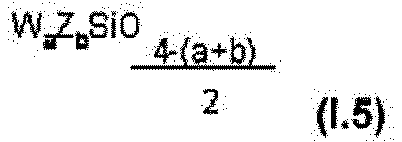 - in der:- a = 1 oder 2, b = 0, 1 oder 2 und a+b = 1, 2 oder 3;- W unabhängig für eine Alkenylgruppe, die vorzugsweise 2 bis 6 Kohlenstoffatome aufweist, und noch weiter bevorzugt eine Vinyl- oder Allylgruppe steht und- Z unabhängig für eine einwertige Kohlenwasserstoffgruppe, die 1 bis 30 Kohlenstoffatome aufweist und vorzugsweise aus der Gruppe bestehend aus Alkylgruppen mit 1 bis 8 Kohlenstoffatomen inklusive und Arylgruppen ausgewählt ist und noch weiter bevorzugt aus der Gruppe bestehend aus einem Methyl-, Ethyl-, Propyl-, 3,3,3-Trifluorpropyl-, Xylyl-, Tolyl- und Phenylrest ausgewählt ist, steht, und- mindestens eine Siloxyleinheit (1.6) der Formel:
 - a = 0, 1, 2 oder 3, und- Z1 unabhängig für eine einwertige Kohlenwasserstoffgruppe, die 1 bis 30 Kohlenstoffatome aufweist und vorzugsweise aus der Gruppe bestehend aus Alkylgruppen mit 1 bis 8 Kohlenstoffatomen inklusive und Arylgruppen ausgewählt ist und noch weiter bevorzugt aus der Gruppe bestehend aus einem Methyl-, Ethyl-, Propyl-, 3,3,3-Trifluorpropyl-, Xylyl-, Tolyl- und Phenylrest ausgewählt ist, steht.
- Verfahren nach Anspruch 1, wobei der Gehalt an Additiv X zwischen 0,1 und 10 Gew.-%, bezogen auf die Gesamtmasse der Emulsion oder der Mischung der Emulsion E1, und vorzugsweise zwischen 0,1 und 5 Gew.-%, bezogen auf die Gesamtmasse der Emulsion oder der Mischung der Emulsion E1, liegt.
- Verfahren nach Anspruch 1, wobei das Additiv X eine gemäß dem in der Beschreibung angegebenen Verfahren gemessene dynamische Viskosität bei 25 °C zwischen 10 und 700 mPa.s und vorzugsweise zwischen 15 und 300 mPa.s aufweist.
- Verfahren nach Anspruch 1, wobei der Emulgator D aus der Gruppe bestehend aus Tensiden, Schutzkolloiden und Mischungen davon ausgewählt wird.
- Wässrige Silikonemulsion E1, die durch Polyadditionsreaktionen zu einem Silikonelastomer vernetzt werden kann, wie gemäß einem der Ansprüche 1 bis 10 beschrieben.
Applications Claiming Priority (2)
| Application Number | Priority Date | Filing Date | Title |
|---|---|---|---|
| FR1700348 | 2017-03-30 | ||
| PCT/EP2018/058261 WO2018178321A1 (fr) | 2017-03-30 | 2018-03-29 | Procede de realisation d'un revetement hydrofuge et anti-adherent sur un support |
Publications (2)
| Publication Number | Publication Date |
|---|---|
| EP3601459A1 EP3601459A1 (de) | 2020-02-05 |
| EP3601459B1 true EP3601459B1 (de) | 2024-02-07 |
Family
ID=59325339
Family Applications (1)
| Application Number | Title | Priority Date | Filing Date |
|---|---|---|---|
| EP18713277.4A Active EP3601459B1 (de) | 2017-03-30 | 2018-03-29 | Verfahren zur herstellung einer feuchtigkeitsbeständigen und antihaftenden beschichtung auf einem träger |
Country Status (9)
| Country | Link |
|---|---|
| US (1) | US11898013B2 (de) |
| EP (1) | EP3601459B1 (de) |
| JP (1) | JP6921224B2 (de) |
| KR (1) | KR102316253B1 (de) |
| CN (1) | CN110612336B (de) |
| ES (1) | ES2973480T3 (de) |
| FI (1) | FI3601459T3 (de) |
| PL (1) | PL3601459T3 (de) |
| WO (1) | WO2018178321A1 (de) |
Families Citing this family (3)
| Publication number | Priority date | Publication date | Assignee | Title |
|---|---|---|---|---|
| JP7214592B2 (ja) * | 2019-08-05 | 2023-01-30 | 信越化学工業株式会社 | オルガノハイドロジェンポリシロキサンのエマルション、及びこれを用いた付加硬化型シリコーンエマルション組成物 |
| JP7875416B2 (ja) * | 2021-12-02 | 2026-06-18 | エルジー・ケム・リミテッド | 硬化性組成物、保護フィルム、光学素子及び液晶ディスプレイ装置 |
| US20250296751A1 (en) * | 2022-05-03 | 2025-09-25 | Elkem Silicones France Sas | Article suitable for food contact and method for producing same |
Family Cites Families (28)
| Publication number | Priority date | Publication date | Assignee | Title |
|---|---|---|---|---|
| US3194840A (en) | 1961-12-18 | 1965-07-13 | Procter & Gamble | N, n-diloweralkyl, 1, 1-dihydrogen perfluoroalkyl amine oxides |
| US3159602A (en) | 1962-06-07 | 1964-12-01 | Olin Mathieson | Preparation of polymeric phosphates |
| US3220972A (en) | 1962-07-02 | 1965-11-30 | Gen Electric | Organosilicon process using a chloroplatinic acid reaction product as the catalyst |
| US3159601A (en) | 1962-07-02 | 1964-12-01 | Gen Electric | Platinum-olefin complex catalyzed addition of hydrogen- and alkenyl-substituted siloxanes |
| NL133821C (de) | 1964-07-31 | |||
| NL131800C (de) | 1965-05-17 | |||
| GB1082179A (en) | 1965-07-19 | 1967-09-06 | Citrique Belge Nv | Unsaturated carboxylic salt materials and derivatives thereof |
| FR1528464A (fr) | 1966-06-23 | 1968-06-07 | Dow Corning | Compositions d'organopolysiloxanes durcissables à une partie composante |
| US3814730A (en) | 1970-08-06 | 1974-06-04 | Gen Electric | Platinum complexes of unsaturated siloxanes and platinum containing organopolysiloxanes |
| US3715334A (en) | 1970-11-27 | 1973-02-06 | Gen Electric | Platinum-vinylsiloxanes |
| BE787502A (fr) | 1971-08-18 | 1973-02-12 | Ici Ltd | Mousses |
| DE2654893A1 (de) | 1976-12-03 | 1978-06-15 | Wacker Chemie Gmbh | Verfahren zum herstellen von klebrige stoffe abweisenden ueberzuegen |
| US4394317A (en) | 1981-02-02 | 1983-07-19 | Sws Silicones Corporation | Platinum-styrene complexes which promote hydrosilation reactions |
| FR2575086B1 (fr) | 1984-12-20 | 1987-02-20 | Rhone Poulenc Spec Chim | Complexe platine-alcenylcyclohexene comme catalyseur de reaction d'hydrosilylation et son procede de preparation |
| FR2575085B1 (fr) | 1984-12-20 | 1987-02-20 | Rhone Poulenc Spec Chim | Complexe platine-triene comme catalyseur de reaction d'hydrosilylation et son procede de preparation |
| FR2702676B1 (fr) | 1993-03-18 | 1995-05-19 | Oreal | Emulsion huile-dans-eau contenant un perfluoropolyéther, composition en comportant, procédé de préparation et utilisation en cosmétique et dermatologie. |
| JP3022101B2 (ja) * | 1993-10-19 | 2000-03-15 | 信越化学工業株式会社 | 剥離性オルガノポリシロキサン組成物及び剥離紙 |
| FR2749850B1 (fr) | 1996-06-12 | 1998-09-04 | Rhone Poulenc Chimie | Procede d'hydrosilylation avec des huiles silicones et des motifs contenant au moins un cycle hydrocarbone dans lequel est inclus un atome d'oxygene en presence d'une composition catalytique |
| FR2773166B1 (fr) | 1997-12-31 | 2000-03-24 | Rhodia Chimie Sa | Emulsion silicone aqueuse, utile comme base de preparation de revetement hydrofuge et antiadherent pour papier, procede de preparation d'une emulsion de ce type et de revetements antiadherents |
| FR2813081B1 (fr) | 2000-08-17 | 2005-12-23 | Rhodia Chimie Sa | Procede de preparation d'huiles silicones par hydrosilylation de synthons contenant au moins un cycle hydrocarbone dans lequel est inclus un atome d'oxygene en presence d'un complexe metallique catalytique |
| US20050165194A1 (en) * | 2001-11-20 | 2005-07-28 | Rhodia Chimie | Crosslinking agent for a silicone composition which can be crosslinked at low temperature based on a hydrogenated silicone oil comprising Si-H units at the chain end and in the chain |
| US7090923B2 (en) | 2003-02-12 | 2006-08-15 | General Electric Corporation | Paper release compositions having improved adhesion to paper and polymeric films |
| FR2881748B1 (fr) * | 2005-02-07 | 2007-03-09 | Rhodia Chimie Sa | Dispersions silicones aqueuses, formulations notamment de peintures les comprenant et l'un de leurs procedes de preparation |
| FR2903112A1 (fr) * | 2006-06-29 | 2008-01-04 | Rhodia Recherches & Tech | Composition silicone reticulable pour la realisation de revetements anti-adherents pour supports souples et additif promoteur d'accrochage contenu dans cette composition |
| FR2957604A1 (fr) | 2010-03-22 | 2011-09-23 | Bluestar Silicones France | Composition silicone reticulable pour la realisation de revetements anti-adherents pour supports souples et additif promoteur d'accrochage contenu dans cette composition |
| KR101564857B1 (ko) * | 2011-06-21 | 2015-10-30 | 블루스타 실리콘즈 프랑스 에스에이에스 | 히드로실릴화 반응 저해제, 및 안정한 경화성 실리콘 조성물의 제조를 위한 이의 용도 |
| CN102702950A (zh) | 2012-06-12 | 2012-10-03 | 天长市巨龙车船涂料有限公司 | 高分子防水涂料 |
| JP6387885B2 (ja) | 2015-04-06 | 2018-09-12 | 信越化学工業株式会社 | 剥離紙又は剥離フィルム用オルガノポリシロキサンエマルション組成物及びその製造方法、並びに剥離紙及び剥離フィルム |
-
2018
- 2018-03-29 FI FIEP18713277.4T patent/FI3601459T3/fi active
- 2018-03-29 KR KR1020197031935A patent/KR102316253B1/ko active Active
- 2018-03-29 WO PCT/EP2018/058261 patent/WO2018178321A1/fr not_active Ceased
- 2018-03-29 PL PL18713277.4T patent/PL3601459T3/pl unknown
- 2018-03-29 JP JP2019553966A patent/JP6921224B2/ja active Active
- 2018-03-29 EP EP18713277.4A patent/EP3601459B1/de active Active
- 2018-03-29 CN CN201880029484.9A patent/CN110612336B/zh active Active
- 2018-03-29 ES ES18713277T patent/ES2973480T3/es active Active
- 2018-03-29 US US16/499,171 patent/US11898013B2/en active Active
Also Published As
| Publication number | Publication date |
|---|---|
| KR102316253B1 (ko) | 2021-10-21 |
| JP6921224B2 (ja) | 2021-08-18 |
| PL3601459T3 (pl) | 2024-06-24 |
| US20210108105A1 (en) | 2021-04-15 |
| KR20190128732A (ko) | 2019-11-18 |
| FI3601459T3 (fi) | 2024-03-15 |
| CN110612336B (zh) | 2021-11-09 |
| WO2018178321A1 (fr) | 2018-10-04 |
| US11898013B2 (en) | 2024-02-13 |
| CN110612336A (zh) | 2019-12-24 |
| EP3601459A1 (de) | 2020-02-05 |
| JP2020515694A (ja) | 2020-05-28 |
| ES2973480T3 (es) | 2024-06-20 |
Similar Documents
| Publication | Publication Date | Title |
|---|---|---|
| EP3353252B1 (de) | Vernetzbare silikonzusammensetzung zur herstellung von nichtklebrigen beschichtungen für flexible substrate und in dieser zusammensetzung enthaltenes haftförderndes additiv | |
| EP1263843B1 (de) | Verwendung von hydroplilen (co)polymeren in wässrigen, vernetzenden silikonemulsionen | |
| EP2310458B1 (de) | Silikonzusammensetzung zum beschichten eines flexiblen trägers zur bildung eines vernetzten überzugs mit verbesserter haftung, mechanischer festigkeit und reaktivität | |
| EP2024438B1 (de) | Vernetzbare siliciumzusammensetzung zur herstellung von antihaftbeschichtungen für polymerfolien | |
| EP2563870B1 (de) | Vernetzbare silikonzusammensetzung zur herstellung von nicht klebrigen beschichtungen für flexible substrate und in dieser zusammensetzung enthaltener haftfördender zusatz | |
| WO2003054059A1 (fr) | Reticulant pour une composition silicone reticulable avec bas taux de platine, a base d'une huile silicone hydrogenee comprenant des motifs si-h en bout de chaïne et dans la chaïne | |
| FR2463170A1 (fr) | Revetement anti-adhesif issu d'une composition durcissable par rayons uv et son procede d'obtention | |
| FR2712297A1 (fr) | Compositions à base d'époxysilicone, durcissables par les rayons UV, antiadhésives. | |
| EP1044237B1 (de) | Wässrige silikonemulsion die als grundlage zur herstellung von wasserabweisenden und auf papier nichthaftenden überzügen verwendbar ist, verfahren zur herstellung dieser emulsionen und nichthaftende überzüge | |
| EP2032654A1 (de) | Netzförmig anlegbarer silikonverbundstoff zur herstellung von antihaftbeschichtungen für flexible unterlagen und in diesem verbundstoff enthaltener zusatz als haftvermittler | |
| WO2002018506A1 (fr) | Procede de lutte contre l'apparition de brouillard lors de l'enduction de supports flexibles avec une composition silicone liquide reticulable, dans un dispositif a cylindres | |
| EP3601459A1 (de) | Verfahren zur herstellung einer wasserfesten und nicht haftenden beschichtung auf einer basis | |
| CA3028886C (fr) | Procede de lutte contre l'apparition de brouillard dans un dispositif a cylindres lors de l'enduction de supports flexibles avec une composition silicone liquide reticulable | |
| EP1448674B1 (de) | Vernetzer für bei niedriger temperatur vernetzbare silikonzusammensetzung auf basis eines wasserstoff-enthaltenden silikonöls mit sih-gruppen in der kette und endgruppe | |
| WO2007068657A1 (fr) | Procédé de lutte contre l'apparition de brouillard lors de l'enduction de supports flexibles avec une composition silicone liquide réticulable, dans un dispositif a cylindres | |
| EP3898861B1 (de) | Verfahren zu bekämpfung von nebelbildung in einer vorrichtung mit zylindern bei der beschichtung von flexiblen halterungen mit einer flüssigen aushärtbaren silikonzusammensetzung |
Legal Events
| Date | Code | Title | Description |
|---|---|---|---|
| STAA | Information on the status of an ep patent application or granted ep patent |
Free format text: STATUS: UNKNOWN |
|
| STAA | Information on the status of an ep patent application or granted ep patent |
Free format text: STATUS: THE INTERNATIONAL PUBLICATION HAS BEEN MADE |
|
| PUAI | Public reference made under article 153(3) epc to a published international application that has entered the european phase |
Free format text: ORIGINAL CODE: 0009012 |
|
| STAA | Information on the status of an ep patent application or granted ep patent |
Free format text: STATUS: REQUEST FOR EXAMINATION WAS MADE |
|
| 17P | Request for examination filed |
Effective date: 20191206 |
|
| AK | Designated contracting states |
Kind code of ref document: A1 Designated state(s): AL AT BE BG CH CY CZ DE DK EE ES FI FR GB GR HR HU IE IS IT LI LT LU LV MC MK MT NL NO PL PT RO RS SE SI SK SM TR |
|
| AX | Request for extension of the european patent |
Extension state: BA ME |
|
| DAV | Request for validation of the european patent (deleted) | ||
| DAX | Request for extension of the european patent (deleted) | ||
| GRAP | Despatch of communication of intention to grant a patent |
Free format text: ORIGINAL CODE: EPIDOSNIGR1 |
|
| STAA | Information on the status of an ep patent application or granted ep patent |
Free format text: STATUS: GRANT OF PATENT IS INTENDED |
|
| INTG | Intention to grant announced |
Effective date: 20230829 |
|
| RIN1 | Information on inventor provided before grant (corrected) |
Inventor name: WALTER, THIERRY Inventor name: MAADADI, YASSINE Inventor name: MARCHAL, FREDERIC Inventor name: MAGD, FREDERIC |
|
| GRAS | Grant fee paid |
Free format text: ORIGINAL CODE: EPIDOSNIGR3 |
|
| GRAA | (expected) grant |
Free format text: ORIGINAL CODE: 0009210 |
|
| STAA | Information on the status of an ep patent application or granted ep patent |
Free format text: STATUS: THE PATENT HAS BEEN GRANTED |
|
| AK | Designated contracting states |
Kind code of ref document: B1 Designated state(s): AL AT BE BG CH CY CZ DE DK EE ES FI FR GB GR HR HU IE IS IT LI LT LU LV MC MK MT NL NO PL PT RO RS SE SI SK SM TR |
|
| REG | Reference to a national code |
Ref country code: GB Ref legal event code: FG4D Free format text: NOT ENGLISH |
|
| REG | Reference to a national code |
Ref country code: CH Ref legal event code: EP |
|
| REG | Reference to a national code |
Ref country code: DE Ref legal event code: R096 Ref document number: 602018064925 Country of ref document: DE |
|
| REG | Reference to a national code |
Ref country code: IE Ref legal event code: FG4D Free format text: LANGUAGE OF EP DOCUMENT: FRENCH |
|
| REG | Reference to a national code |
Ref country code: FI Ref legal event code: FGE |
|
| REG | Reference to a national code |
Ref country code: NL Ref legal event code: FP |
|
| REG | Reference to a national code |
Ref country code: LT Ref legal event code: MG9D |
|
| PG25 | Lapsed in a contracting state [announced via postgrant information from national office to epo] |
Ref country code: IS Free format text: LAPSE BECAUSE OF FAILURE TO SUBMIT A TRANSLATION OF THE DESCRIPTION OR TO PAY THE FEE WITHIN THE PRESCRIBED TIME-LIMIT Effective date: 20240607 |
|
| PG25 | Lapsed in a contracting state [announced via postgrant information from national office to epo] |
Ref country code: LT Free format text: LAPSE BECAUSE OF FAILURE TO SUBMIT A TRANSLATION OF THE DESCRIPTION OR TO PAY THE FEE WITHIN THE PRESCRIBED TIME-LIMIT Effective date: 20240207 |
|
| PG25 | Lapsed in a contracting state [announced via postgrant information from national office to epo] |
Ref country code: GR Free format text: LAPSE BECAUSE OF FAILURE TO SUBMIT A TRANSLATION OF THE DESCRIPTION OR TO PAY THE FEE WITHIN THE PRESCRIBED TIME-LIMIT Effective date: 20240508 |
|
| REG | Reference to a national code |
Ref country code: AT Ref legal event code: MK05 Ref document number: 1655366 Country of ref document: AT Kind code of ref document: T Effective date: 20240207 |
|
| PG25 | Lapsed in a contracting state [announced via postgrant information from national office to epo] |
Ref country code: RS Free format text: LAPSE BECAUSE OF FAILURE TO SUBMIT A TRANSLATION OF THE DESCRIPTION OR TO PAY THE FEE WITHIN THE PRESCRIBED TIME-LIMIT Effective date: 20240507 Ref country code: HR Free format text: LAPSE BECAUSE OF FAILURE TO SUBMIT A TRANSLATION OF THE DESCRIPTION OR TO PAY THE FEE WITHIN THE PRESCRIBED TIME-LIMIT Effective date: 20240207 |
|
| PG25 | Lapsed in a contracting state [announced via postgrant information from national office to epo] |
Ref country code: AT Free format text: LAPSE BECAUSE OF FAILURE TO SUBMIT A TRANSLATION OF THE DESCRIPTION OR TO PAY THE FEE WITHIN THE PRESCRIBED TIME-LIMIT Effective date: 20240207 |
|
| PG25 | Lapsed in a contracting state [announced via postgrant information from national office to epo] |
Ref country code: RS Free format text: LAPSE BECAUSE OF FAILURE TO SUBMIT A TRANSLATION OF THE DESCRIPTION OR TO PAY THE FEE WITHIN THE PRESCRIBED TIME-LIMIT Effective date: 20240507 Ref country code: LT Free format text: LAPSE BECAUSE OF FAILURE TO SUBMIT A TRANSLATION OF THE DESCRIPTION OR TO PAY THE FEE WITHIN THE PRESCRIBED TIME-LIMIT Effective date: 20240207 Ref country code: IS Free format text: LAPSE BECAUSE OF FAILURE TO SUBMIT A TRANSLATION OF THE DESCRIPTION OR TO PAY THE FEE WITHIN THE PRESCRIBED TIME-LIMIT Effective date: 20240607 Ref country code: HR Free format text: LAPSE BECAUSE OF FAILURE TO SUBMIT A TRANSLATION OF THE DESCRIPTION OR TO PAY THE FEE WITHIN THE PRESCRIBED TIME-LIMIT Effective date: 20240207 Ref country code: GR Free format text: LAPSE BECAUSE OF FAILURE TO SUBMIT A TRANSLATION OF THE DESCRIPTION OR TO PAY THE FEE WITHIN THE PRESCRIBED TIME-LIMIT Effective date: 20240508 Ref country code: BG Free format text: LAPSE BECAUSE OF FAILURE TO SUBMIT A TRANSLATION OF THE DESCRIPTION OR TO PAY THE FEE WITHIN THE PRESCRIBED TIME-LIMIT Effective date: 20240207 Ref country code: AT Free format text: LAPSE BECAUSE OF FAILURE TO SUBMIT A TRANSLATION OF THE DESCRIPTION OR TO PAY THE FEE WITHIN THE PRESCRIBED TIME-LIMIT Effective date: 20240207 |
|
| PG25 | Lapsed in a contracting state [announced via postgrant information from national office to epo] |
Ref country code: PT Free format text: LAPSE BECAUSE OF FAILURE TO SUBMIT A TRANSLATION OF THE DESCRIPTION OR TO PAY THE FEE WITHIN THE PRESCRIBED TIME-LIMIT Effective date: 20240607 |
|
| PG25 | Lapsed in a contracting state [announced via postgrant information from national office to epo] |
Ref country code: SE Free format text: LAPSE BECAUSE OF FAILURE TO SUBMIT A TRANSLATION OF THE DESCRIPTION OR TO PAY THE FEE WITHIN THE PRESCRIBED TIME-LIMIT Effective date: 20240207 Ref country code: PT Free format text: LAPSE BECAUSE OF FAILURE TO SUBMIT A TRANSLATION OF THE DESCRIPTION OR TO PAY THE FEE WITHIN THE PRESCRIBED TIME-LIMIT Effective date: 20240607 Ref country code: LV Free format text: LAPSE BECAUSE OF FAILURE TO SUBMIT A TRANSLATION OF THE DESCRIPTION OR TO PAY THE FEE WITHIN THE PRESCRIBED TIME-LIMIT Effective date: 20240207 |
|
| PG25 | Lapsed in a contracting state [announced via postgrant information from national office to epo] |
Ref country code: DK Free format text: LAPSE BECAUSE OF FAILURE TO SUBMIT A TRANSLATION OF THE DESCRIPTION OR TO PAY THE FEE WITHIN THE PRESCRIBED TIME-LIMIT Effective date: 20240207 |
|
| PG25 | Lapsed in a contracting state [announced via postgrant information from national office to epo] |
Ref country code: SM Free format text: LAPSE BECAUSE OF FAILURE TO SUBMIT A TRANSLATION OF THE DESCRIPTION OR TO PAY THE FEE WITHIN THE PRESCRIBED TIME-LIMIT Effective date: 20240207 |
|
| PG25 | Lapsed in a contracting state [announced via postgrant information from national office to epo] |
Ref country code: EE Free format text: LAPSE BECAUSE OF FAILURE TO SUBMIT A TRANSLATION OF THE DESCRIPTION OR TO PAY THE FEE WITHIN THE PRESCRIBED TIME-LIMIT Effective date: 20240207 Ref country code: CZ Free format text: LAPSE BECAUSE OF FAILURE TO SUBMIT A TRANSLATION OF THE DESCRIPTION OR TO PAY THE FEE WITHIN THE PRESCRIBED TIME-LIMIT Effective date: 20240207 |
|
| PG25 | Lapsed in a contracting state [announced via postgrant information from national office to epo] |
Ref country code: SK Free format text: LAPSE BECAUSE OF FAILURE TO SUBMIT A TRANSLATION OF THE DESCRIPTION OR TO PAY THE FEE WITHIN THE PRESCRIBED TIME-LIMIT Effective date: 20240207 |
|
| PG25 | Lapsed in a contracting state [announced via postgrant information from national office to epo] |
Ref country code: SM Free format text: LAPSE BECAUSE OF FAILURE TO SUBMIT A TRANSLATION OF THE DESCRIPTION OR TO PAY THE FEE WITHIN THE PRESCRIBED TIME-LIMIT Effective date: 20240207 Ref country code: SK Free format text: LAPSE BECAUSE OF FAILURE TO SUBMIT A TRANSLATION OF THE DESCRIPTION OR TO PAY THE FEE WITHIN THE PRESCRIBED TIME-LIMIT Effective date: 20240207 Ref country code: RO Free format text: LAPSE BECAUSE OF FAILURE TO SUBMIT A TRANSLATION OF THE DESCRIPTION OR TO PAY THE FEE WITHIN THE PRESCRIBED TIME-LIMIT Effective date: 20240207 Ref country code: EE Free format text: LAPSE BECAUSE OF FAILURE TO SUBMIT A TRANSLATION OF THE DESCRIPTION OR TO PAY THE FEE WITHIN THE PRESCRIBED TIME-LIMIT Effective date: 20240207 Ref country code: DK Free format text: LAPSE BECAUSE OF FAILURE TO SUBMIT A TRANSLATION OF THE DESCRIPTION OR TO PAY THE FEE WITHIN THE PRESCRIBED TIME-LIMIT Effective date: 20240207 Ref country code: CZ Free format text: LAPSE BECAUSE OF FAILURE TO SUBMIT A TRANSLATION OF THE DESCRIPTION OR TO PAY THE FEE WITHIN THE PRESCRIBED TIME-LIMIT Effective date: 20240207 |
|
| REG | Reference to a national code |
Ref country code: CH Ref legal event code: PL |
|
| REG | Reference to a national code |
Ref country code: DE Ref legal event code: R097 Ref document number: 602018064925 Country of ref document: DE |
|
| PG25 | Lapsed in a contracting state [announced via postgrant information from national office to epo] |
Ref country code: MC Free format text: LAPSE BECAUSE OF FAILURE TO SUBMIT A TRANSLATION OF THE DESCRIPTION OR TO PAY THE FEE WITHIN THE PRESCRIBED TIME-LIMIT Effective date: 20240207 |
|
| PG25 | Lapsed in a contracting state [announced via postgrant information from national office to epo] |
Ref country code: MC Free format text: LAPSE BECAUSE OF FAILURE TO SUBMIT A TRANSLATION OF THE DESCRIPTION OR TO PAY THE FEE WITHIN THE PRESCRIBED TIME-LIMIT Effective date: 20240207 |
|
| PLBE | No opposition filed within time limit |
Free format text: ORIGINAL CODE: 0009261 |
|
| STAA | Information on the status of an ep patent application or granted ep patent |
Free format text: STATUS: NO OPPOSITION FILED WITHIN TIME LIMIT |
|
| 26N | No opposition filed |
Effective date: 20241108 |
|
| PG25 | Lapsed in a contracting state [announced via postgrant information from national office to epo] |
Ref country code: IE Free format text: LAPSE BECAUSE OF NON-PAYMENT OF DUE FEES Effective date: 20240329 |
|
| PG25 | Lapsed in a contracting state [announced via postgrant information from national office to epo] |
Ref country code: IE Free format text: LAPSE BECAUSE OF NON-PAYMENT OF DUE FEES Effective date: 20240329 Ref country code: CH Free format text: LAPSE BECAUSE OF NON-PAYMENT OF DUE FEES Effective date: 20240331 |
|
| PG25 | Lapsed in a contracting state [announced via postgrant information from national office to epo] |
Ref country code: SI Free format text: LAPSE BECAUSE OF FAILURE TO SUBMIT A TRANSLATION OF THE DESCRIPTION OR TO PAY THE FEE WITHIN THE PRESCRIBED TIME-LIMIT Effective date: 20240207 |
|
| PG25 | Lapsed in a contracting state [announced via postgrant information from national office to epo] |
Ref country code: CY Free format text: LAPSE BECAUSE OF FAILURE TO SUBMIT A TRANSLATION OF THE DESCRIPTION OR TO PAY THE FEE WITHIN THE PRESCRIBED TIME-LIMIT; INVALID AB INITIO Effective date: 20180329 |
|
| PG25 | Lapsed in a contracting state [announced via postgrant information from national office to epo] |
Ref country code: HU Free format text: LAPSE BECAUSE OF FAILURE TO SUBMIT A TRANSLATION OF THE DESCRIPTION OR TO PAY THE FEE WITHIN THE PRESCRIBED TIME-LIMIT; INVALID AB INITIO Effective date: 20180329 |
|
| PGFP | Annual fee paid to national office [announced via postgrant information from national office to epo] |
Ref country code: FI Payment date: 20251230 Year of fee payment: 9 |
|
| PGFP | Annual fee paid to national office [announced via postgrant information from national office to epo] |
Ref country code: FR Payment date: 20251231 Year of fee payment: 9 |
|
| PGFP | Annual fee paid to national office [announced via postgrant information from national office to epo] |
Ref country code: NL Payment date: 20260106 Year of fee payment: 9 |
|
| PGFP | Annual fee paid to national office [announced via postgrant information from national office to epo] |
Ref country code: GB Payment date: 20260106 Year of fee payment: 9 |
|
| PGFP | Annual fee paid to national office [announced via postgrant information from national office to epo] |
Ref country code: NO Payment date: 20260310 Year of fee payment: 9 Ref country code: DE Payment date: 20260102 Year of fee payment: 9 |
|
| PGFP | Annual fee paid to national office [announced via postgrant information from national office to epo] |
Ref country code: LU Payment date: 20260316 Year of fee payment: 9 Ref country code: BE Payment date: 20260105 Year of fee payment: 9 Ref country code: IT Payment date: 20260220 Year of fee payment: 9 |
|
| PGFP | Annual fee paid to national office [announced via postgrant information from national office to epo] |
Ref country code: TR Payment date: 20260327 Year of fee payment: 9 |
|
| PGFP | Annual fee paid to national office [announced via postgrant information from national office to epo] |
Ref country code: PL Payment date: 20260113 Year of fee payment: 9 |
|
| PGFP | Annual fee paid to national office [announced via postgrant information from national office to epo] |
Ref country code: ES Payment date: 20260415 Year of fee payment: 9 |