EP3601593B1 - Amorces universelles en épingle à cheveux - Google Patents
Amorces universelles en épingle à cheveux Download PDFInfo
- Publication number
- EP3601593B1 EP3601593B1 EP18770662.7A EP18770662A EP3601593B1 EP 3601593 B1 EP3601593 B1 EP 3601593B1 EP 18770662 A EP18770662 A EP 18770662A EP 3601593 B1 EP3601593 B1 EP 3601593B1
- Authority
- EP
- European Patent Office
- Prior art keywords
- target
- hairpin
- universal
- temperature
- specific
- Prior art date
- Legal status (The legal status is an assumption and is not a legal conclusion. Google has not performed a legal analysis and makes no representation as to the accuracy of the status listed.)
- Not-in-force
Links
Images



Classifications
-
- C—CHEMISTRY; METALLURGY
- C12—BIOCHEMISTRY; BEER; SPIRITS; WINE; VINEGAR; MICROBIOLOGY; ENZYMOLOGY; MUTATION OR GENETIC ENGINEERING
- C12Q—MEASURING OR TESTING PROCESSES INVOLVING ENZYMES, NUCLEIC ACIDS OR MICROORGANISMS; COMPOSITIONS OR TEST PAPERS THEREFOR; PROCESSES OF PREPARING SUCH COMPOSITIONS; CONDITION-RESPONSIVE CONTROL IN MICROBIOLOGICAL OR ENZYMOLOGICAL PROCESSES
- C12Q1/00—Measuring or testing processes involving enzymes, nucleic acids or microorganisms; Compositions therefor; Processes of preparing such compositions
- C12Q1/68—Measuring or testing processes involving enzymes, nucleic acids or microorganisms; Compositions therefor; Processes of preparing such compositions involving nucleic acids
- C12Q1/6844—Nucleic acid amplification reactions
- C12Q1/686—Polymerase chain reaction [PCR]
-
- C—CHEMISTRY; METALLURGY
- C12—BIOCHEMISTRY; BEER; SPIRITS; WINE; VINEGAR; MICROBIOLOGY; ENZYMOLOGY; MUTATION OR GENETIC ENGINEERING
- C12Q—MEASURING OR TESTING PROCESSES INVOLVING ENZYMES, NUCLEIC ACIDS OR MICROORGANISMS; COMPOSITIONS OR TEST PAPERS THEREFOR; PROCESSES OF PREPARING SUCH COMPOSITIONS; CONDITION-RESPONSIVE CONTROL IN MICROBIOLOGICAL OR ENZYMOLOGICAL PROCESSES
- C12Q1/00—Measuring or testing processes involving enzymes, nucleic acids or microorganisms; Compositions therefor; Processes of preparing such compositions
- C12Q1/68—Measuring or testing processes involving enzymes, nucleic acids or microorganisms; Compositions therefor; Processes of preparing such compositions involving nucleic acids
- C12Q1/6876—Nucleic acid products used in the analysis of nucleic acids, e.g. primers or probes
-
- C—CHEMISTRY; METALLURGY
- C12—BIOCHEMISTRY; BEER; SPIRITS; WINE; VINEGAR; MICROBIOLOGY; ENZYMOLOGY; MUTATION OR GENETIC ENGINEERING
- C12Q—MEASURING OR TESTING PROCESSES INVOLVING ENZYMES, NUCLEIC ACIDS OR MICROORGANISMS; COMPOSITIONS OR TEST PAPERS THEREFOR; PROCESSES OF PREPARING SUCH COMPOSITIONS; CONDITION-RESPONSIVE CONTROL IN MICROBIOLOGICAL OR ENZYMOLOGICAL PROCESSES
- C12Q1/00—Measuring or testing processes involving enzymes, nucleic acids or microorganisms; Compositions therefor; Processes of preparing such compositions
- C12Q1/68—Measuring or testing processes involving enzymes, nucleic acids or microorganisms; Compositions therefor; Processes of preparing such compositions involving nucleic acids
- C12Q1/6806—Preparing nucleic acids for analysis, e.g. for polymerase chain reaction [PCR] assay
-
- C—CHEMISTRY; METALLURGY
- C12—BIOCHEMISTRY; BEER; SPIRITS; WINE; VINEGAR; MICROBIOLOGY; ENZYMOLOGY; MUTATION OR GENETIC ENGINEERING
- C12Q—MEASURING OR TESTING PROCESSES INVOLVING ENZYMES, NUCLEIC ACIDS OR MICROORGANISMS; COMPOSITIONS OR TEST PAPERS THEREFOR; PROCESSES OF PREPARING SUCH COMPOSITIONS; CONDITION-RESPONSIVE CONTROL IN MICROBIOLOGICAL OR ENZYMOLOGICAL PROCESSES
- C12Q1/00—Measuring or testing processes involving enzymes, nucleic acids or microorganisms; Compositions therefor; Processes of preparing such compositions
- C12Q1/68—Measuring or testing processes involving enzymes, nucleic acids or microorganisms; Compositions therefor; Processes of preparing such compositions involving nucleic acids
- C12Q1/6813—Hybridisation assays
- C12Q1/6816—Hybridisation assays characterised by the detection means
- C12Q1/682—Signal amplification
-
- C—CHEMISTRY; METALLURGY
- C12—BIOCHEMISTRY; BEER; SPIRITS; WINE; VINEGAR; MICROBIOLOGY; ENZYMOLOGY; MUTATION OR GENETIC ENGINEERING
- C12Q—MEASURING OR TESTING PROCESSES INVOLVING ENZYMES, NUCLEIC ACIDS OR MICROORGANISMS; COMPOSITIONS OR TEST PAPERS THEREFOR; PROCESSES OF PREPARING SUCH COMPOSITIONS; CONDITION-RESPONSIVE CONTROL IN MICROBIOLOGICAL OR ENZYMOLOGICAL PROCESSES
- C12Q1/00—Measuring or testing processes involving enzymes, nucleic acids or microorganisms; Compositions therefor; Processes of preparing such compositions
- C12Q1/68—Measuring or testing processes involving enzymes, nucleic acids or microorganisms; Compositions therefor; Processes of preparing such compositions involving nucleic acids
- C12Q1/6844—Nucleic acid amplification reactions
- C12Q1/6848—Nucleic acid amplification reactions characterised by the means for preventing contamination or increasing the specificity or sensitivity of an amplification reaction
-
- C—CHEMISTRY; METALLURGY
- C12—BIOCHEMISTRY; BEER; SPIRITS; WINE; VINEGAR; MICROBIOLOGY; ENZYMOLOGY; MUTATION OR GENETIC ENGINEERING
- C12Q—MEASURING OR TESTING PROCESSES INVOLVING ENZYMES, NUCLEIC ACIDS OR MICROORGANISMS; COMPOSITIONS OR TEST PAPERS THEREFOR; PROCESSES OF PREPARING SUCH COMPOSITIONS; CONDITION-RESPONSIVE CONTROL IN MICROBIOLOGICAL OR ENZYMOLOGICAL PROCESSES
- C12Q1/00—Measuring or testing processes involving enzymes, nucleic acids or microorganisms; Compositions therefor; Processes of preparing such compositions
- C12Q1/68—Measuring or testing processes involving enzymes, nucleic acids or microorganisms; Compositions therefor; Processes of preparing such compositions involving nucleic acids
- C12Q1/6869—Methods for sequencing
Definitions
- PCR is a sensitive and specific assay allowing for the detection of minute quantities of a target nucleotide sequence in large amounts of non-target nucleic acid material.
- PCR based methods for the detection of low amounts of DNA such as cell-free DNA from plasma samples of pregnant women to screen for fetal aneuploidy or detection of circulating tumor DNA (ctDNA) in blood samples of cancer patients are known, see for example, US Patent Applications 2015/0147815 , 2015/0087535 , and 2016/0138112 , and US Patents 9,334,541 and 9,499,870 .
- nucleic acid library preparation procedures and amplification processes for example, reactions performed in aqueous solutions, microdroplets, emulsions, and solid-phase based nucleic acid amplifications (e.g., Illumina Inc., Ion Torrent, 454 Life Sciences, and Pacific Biosciences).
- solid-phase based nucleic acid amplifications e.g., Illumina Inc., Ion Torrent, 454 Life Sciences, and Pacific Biosciences.
- Further refinement of nucleic acid amplification methods has led to the development of multiplex nucleic acid amplification reactions allowing for the amplification of hundreds or thousands of nucleic acid targets in a single reaction mixture, see for example, US Patent Application 2016/0369333 and US Patents 8,673,560 and 8,728,728 .
- the design of primers and their function in nucleic acid amplification reactions is important to prevent and/or reduce the likelihood of mis-priming and/or failed priming events, the development of multiplex nucleic acid amplification reactions, and the need for less optimization of individual primer concentrations as the parameters of nucleic acid amplification reactions become more harmonized.
- primer design Some parameters for primer design of nucleic acid amplification reactions are well documented, such as percent GC content, primer length, annealing and melting temperatures, 5' end stability and 3' end specificity ( Dieffenbach et al., In: PCR Methods and Applications, Cold Spring Harbor Laboratory, 3: S30-S37 (1993 )).
- Another consideration of primer design is the presence of secondary structures, such as hairpins (stem loops) or primer dimers. Hairpins can greatly reduce the efficiency of PCR reactions by limiting the primers availability for priming and its ability to bind to a target nucleic acid of interest. These secondary structures lead to failed, disproportionate, or inefficient nucleic acid amplification because of the presence of complementary nucleic acid sequences within the secondary structure of the primer.
- kits for nucleic acid amplification.
- the invention provides methods that comprise (1) mixing a first target nucleic acid with (a) a first target primer pair, the first target primer pair comprising one or two first target-specific hairpin primers, the hairpin primers having (i) a 3' single-stranded target-specific region at or below a Tm temperature and (ii) a 5' region that forms a hairpin below a Tm temperature and that does not form the hairpin above the Tm temperature, wherein the 5' region comprises a universal adaptor sequence, and (b) a universal primer pair comprising one or two universal hairpin primers (i) having said 5' region, and (ii) lacking a single-stranded 3' end as determined below the Tm temperature; (2) annealing the 3' single-stranded target-specific region of at least one first target-specific hairpin primer from the first target primer pair to the first target nucleic acid at a temperature at or below the Tm temperature and extending the target-specific hairpin primer with a polymerase in
- the 3' single-stranded target-specific region is single-stranded at a temperature below the Tm temperature of the 5' region that forms a hairpin. In some embodiments, the 3' single-stranded target-specific region is single-stranded at a temperature that is above, below, or equal to, the Tm temperature of the 5' region that forms a hairpin. In some embodiments, the methods further comprise sequencing or purifying the second amplicon. In one embodiment, purifying the second amplicon can include purifying the second amplicon from the non-amplified nucleic acid material.
- purifying the second amplicon can include isolating or compartmentalizing of the second amplicon of a first target nucleic acid from the second amplicon of a second target nucleic acid.
- the sequencing can include massively parallel next generation sequencing (NGS).
- NGS next generation sequencing
- the methods of nucleic acid amplification disclosed herein comprise asymmetric or nested PCR.
- the methods disclosed herein comprise real-time analysis of nucleic acid amplification.
- the methods disclosed herein comprise bridge PCR or cluster amplification.
- the target nucleic acid amplification is performed in a microdroplet.
- the target nucleic acid is dilute so that single genomic targets, on average, from the target nucleic acid are partitioned into individual microdroplets.
- the target nucleic acid, first target primer pair and universal primer pair are partitioned into a microdroplet.
- the first target primer pair of the method described in the preceding paragraph comprises two target-specific hairpin primers.
- the method comprises repeating steps (2) and (3) multiple times. In one embodiment, steps (2) and (3) are repeated 5, 6, 7, 8, 9, 10, 11, 12, 13, 14, or 15 times. In some embodiments, steps (2) and (3) are repeated from 5 to 15 cycles and steps (4) and (5) are repeated from 5 to 30 cycles. In one embodiment, steps (4) and (5) are repeated 5, 6, 7, 8, 9, 10, 11, 12, 13, 14, 15, 16, 17, 18, 19, 20, 21, 22, 23, 24, 25, 26, 27, 28, 29, or 30 times. In some embodiments, the first target primer pair is exhausted prior to step (4). In some embodiments, the first target primer pair is not linked to or includes a label.
- the universal primer pair of the method described in the preceding paragraph comprises two universal hairpin primers.
- the universal primer pair of step (1) is present in a quantity greater than the quantity of the first target primer pair.
- the universal primer pair of step (1) comprises at least one universal hairpin primer linked to a label such that the label is incorporated into the second amplicon during amplification.
- the label is at the 5' end of the universal hairpin primer.
- the label is a fluorophore.
- the label comprises a FRET donor and FRET acceptor molecule.
- the methods comprise a first target-specific hairpin primer having a 5' region that forms a hairpin below a Tm temperature (melting temperature) and that does not form the hairpin above the Tm temperature, and a 3' target specific region.
- the Tm temperature of the first target-specific hairpin primer minus the 3' target specific region is within 5 °C of the melting temperature of universal hairpin primer.
- the Tm temperature of the first target-specific hairpin primer minus the 3' target specific region is within 3 °C of the melting temperature of the universal hairpin primer.
- the Tm temperature of the first target-specific hairpin primer minus the 3' target specific region is within 1 °C of the melting temperature of the universal hairpin primer.
- the Tm temperature of the first target-specific hairpin primer minus the 3' target specific region is 2 °C lower than the melting temperature of the universal hairpin primer. In another embodiment, the Tm temperature of the first target-specific hairpin primer minus the 3' target specific region is at least 2 °C lower than the melting temperature of the universal hairpin primer.
- the Tm temperature of the first target-specific hairpin primer minus the 3' target specific region is 2 °C, 2.1 °C, 2.2 °C, 2.3 °C, 2.4 °C, 2.5 °C, 2.6 °C, 2.7 °C, 2.8 °C, 2.9 °C, 3.0 °C, 3.1 °C, 3.2 °C, 3.3 °C, 3.4 °C, or more than 3.5 °C, lower than the melting temperature of the universal hairpin primer.
- the method of step (1) further comprises mixing a second target primer pair comprising one or two second target-specific hairpin primers, the second target-specific hairpin primers having (i) a 3' single-stranded target-specific region different from the 3' single-stranded target-specific regions of the first target-specific hairpin primers and (ii) said 5' region;
- step (2) comprises annealing at least one second target-specific hairpin primer from the second target primer pair to a second target nucleic acid at a temperature at or below the Tm temperature and extending the second target-specific hairpin primer with the polymerase in a template dependent manner to form a first extension product comprising one or two universal adaptor sequences
- step (3) comprises denaturing the first extension product into two nucleic acid strands;
- step (4) comprises annealing the one or two universal hairpin primers to a universal adaptor sequence of one of the strands of the first extension product at a temperature above the Tm temperature, and step (5) comprises extending the one or two universal
- the 3' single-stranded target-specific region is single-stranded at a temperature below the Tm temperature of the 5' region that forms a hairpin. In some embodiments, the 3' single-stranded target-specific region is single-stranded at a temperature that is above, below, or equal to, the Tm temperature of the 5' region that forms a hairpin.
- the second target-specific primer pair comprises two target-specific hairpin primers. In some embodiments, the one or two universal hairpin primers comprise two universal hairpin primers. In some embodiments, the method further comprises sequencing or purifying the second extension product.
- the methods of nucleic acid amplification disclosed herein comprise asymmetric or nested PCR. In some embodiments, the methods disclosed herein comprise real-time analysis of nucleic acid amplification
- the methods disclosed herein comprise mixing three or more target primer pairs to amplify three or more target nucleic acids.
- the three or more target primer pairs each comprise two target-specific hairpin primers for different ones of the three or more target nucleic acids having a 3' single-stranded target-specific region at or below a Tm temperature and a 5' region that forms a hairpin below a Tm temperature and that does not form a hairpin above the Tm temperature, wherein the 5' region comprises a universal adaptor sequence, and wherein the 3' single-stranded target-specific region is different among the three or more target primer pairs so as to amplify a different target nucleic acid among the three or more target nucleic acids.
- each target primer pair is designed such that the two target-specific hairpin primers amplify a distinct target nucleic acid (e.g., a single loci) as compared to other target primer pairs present in the amplification.
- each of the target primer pairs comprises one forward (upstream) target-specific primer and one reverse (downstream) target-specific primer for each target nucleic acid to be amplified.
- the method comprises mixing up to 50 different target primer pairs to amplify up to 50 different target nucleic acids.
- the method comprises mixing 50 target primer pairs comprising 50 different forward target primers having a 3' single-stranded region and a 5' region that forms a hairpin below a Tm temperature and that does not form the hairpin above the Tm temperature, and 50 different reverse target primers having a 3' single-stranded region and a 5' region that forms a hairpin below a Tm temperature and that does not form the hairpin above the Tm temperature, thereby allowing for the amplification of 50 different target nucleic acids.
- the method comprises mixing 100 target primer pairs comprising 100 forward target primers each having a 3' single-stranded region distinct from the 3' single-stranded region of another forward target primer, and 100 reverse target primers each having a 3' single-stranded region distinct from the 3' single-stranded region of another reverse target primer, thereby allowing for the amplification of 100 distinct target nucleic acids.
- the 3' single-stranded target-specific region is single-stranded at a temperature below the Tm temperature of the 5' region that forms a hairpin.
- the 3' single-stranded target-specific region is single-stranded at a temperature that is above, below, or equal to, the Tm temperature of the 5' region that forms a hairpin.
- the invention provides a kit that comprises (a) a first target primer pair, the first target primer pair comprising one or two first target-specific hairpin primers, the first target-specific hairpin primers having (i) a 3' single-stranded target-specific region at or below a Tm temperature and (ii) a 5' region that forms a hairpin below a Tm temperature and that does not form the hairpin above the Tm temperature, wherein the 5' region comprises a universal adaptor sequence, and (b) a universal primer pair comprising one or two universal hairpin primers (i) having said 5' region, and (ii) lacking a single-stranded 3' end as determined below the hairpin Tm temperature.
- the 3' single-stranded target-specific region is single-stranded at a temperature below the Tm temperature of the 5' region that forms a hairpin. In some embodiments, the 3' single-stranded target-specific region is single-stranded at a temperature that is above, below, or equal to, the Tm temperature of the 5' region that forms a hairpin.
- the first target primer pair of the kit comprises two target-specific hairpin primers. In some embodiments, the first target primer pair of the kit is not linked to a label. In some embodiments, the universal primer pair of the kit comprises two universal hairpin primers. In one embodiment, the universal primer pair is present in a quantity greater than the quantity of the first target primer pair.
- the universal hairpin primer of the universal primer pair is linked to a label.
- the label is a fluorophore.
- the label comprises a FRET donor and FRET acceptor molecule.
- the kit further comprises a polymerase, a buffer and dNTPs.
- the kit includes dNTPs for all anticipated triphosphate incorporations (e.g., dATP, dTTP, dGTP, dCTP, and where appropriate, dUTP).
- the kit further comprises a second target primer pair comprising one or two second target-specific hairpin primers, the second hairpin primers having (i) a 3' single-stranded target-specific region different from the 3' single-stranded target-specific regions of the first target-specific hairpin primers and (ii) said 5' region.
- the second target primer pair comprises two target-specific hairpin primers.
- the 3' single-stranded target-specific region is single-stranded at a temperature below the Tm temperature of the 5' region that forms a hairpin.
- the 3' single-stranded target-specific region is single-stranded at a temperature that is above, below, or equal to, the Tm temperature of the 5' region that forms a hairpin.
- the kit comprises three or more target primer pairs, where each target primer pair comprises two target-specific hairpin primers to amplify one of the three or more target nucleic acids.
- each of the target primer pairs comprises one forward (upstream) target-specific hairpin primer and one reverse (downstream) target-specific hairpin primer having (i) a 3' single-stranded target-specific region different from the 3' single-stranded target-specific region of another target primer pair in the kit and (ii) said 5' region, for each target nucleic acid to be amplified.
- the kit comprises up to 50 different target primer pairs to amplify up to 50 different target nucleic acids.
- the kit comprises 100 target primer pairs comprising 100 forward target primers having a 3' single-stranded region distinct from the 3' single-stranded region of another forward target primer in the kit, and a 5' region that forms a hairpin below a Tm temperature and that does not form the hairpin above the Tm temperature, and 100 reverse target primers having a 3' single-stranded region distinct from the 3' single-stranded region of another reverse target primer in the kit, and a 5' region that forms a hairpin below a Tm temperature and that does not form the hairpin above the Tm temperature, thereby allowing for the amplification of 100 different target nucleic acids.
- the kit further comprises between 1 and 10, 1 and 20, 1 and 30, 1 and 40, or 1 and 50, additional target primer pairs, wherein the additional target primer pairs comprise one or two target-specific hairpin primers having (i) a 3' single-stranded target-specific region different from the 3' single-stranded target-specific region of any other target-specific hairpin primers in the kit and (ii) said 5' region.
- the kit further comprises one or more additional reagents to stabilize or promote target nucleic acid amplification.
- the reagents stabilize proteins such as polymerases during storage, prior to amplification, and/or during the amplification process.
- the one or more additional reagents include non-ionic detergents such as polyethylene glycol (PEG), Tween 20, Triton X-100, or ethoxylated alky phenol (NP-40) (see for example US Patent 6,127,155 ).
- the one or more additional reagents to promote nucleic acid amplification include zwitterionic detergents (see for example US Patent 7,972,82 ; US Patent Application 2010/0099150 ; EP-B-2069487 ).
- the one or more additional reagents to stabilize or promote target nucleic acid amplification include reagents that stabilize polymerases used in the target nucleic acid amplification (see for example US Patent Application 2010/0159528 , which discloses the use of anionic detergents to stabilize the activity of thermostable DNA polymerases).
- the invention provides a reaction mixture comprising (1) a sample having one or more target nucleic acids, and (2) a first target primer pair, the first target primer pair comprising one or two first target-specific hairpin primers, the hairpin primers having (i) a 3' single-stranded target-specific region at or below a Tm temperature and (ii) a 5' region that forms a hairpin below a Tm temperature and that does not form the hairpin above the Tm temperature, wherein the 5' region comprises a universal adaptor sequence, and a universal primer pair comprising one or two universal hairpin primers (i) having said 5' region, and (ii) lacking a single-stranded 3' end as determined below the Tm temperature.
- the first target primer pair comprises two target-specific hairpin primers. In one embodiment, the first target primer pair is not linked to a label. In one embodiment, the universal primer pair comprises two universal hairpin primers. In another embodiment, the universal primer pair is present in a quantity greater than the quantity of the first target primer pair. In yet another embodiment, one universal hairpin primer of the universal primer pair is linked to a label. In one embodiment, the label is a fluorophore. In another embodiment, the label comprises a FRET donor and FRET acceptor molecule. In some embodiments, the reaction mixture includes dNTPs for all anticipated triphosphate incorporations (e.g., dATP, dTTP, dGTP, dCTP, and where appropriate, dUTP).
- dNTPs for all anticipated triphosphate incorporations (e.g., dATP, dTTP, dGTP, dCTP, and where appropriate, dUTP).
- the reaction mixture is partitioned into microdroplets.
- the microdroplets are emulsions.
- the reaction mixture further comprises between 1 and 10, 1 and 20, 1 and 30, 1 and 40, or 1 and 50, additional target primer pairs, wherein the additional target primer pairs comprise one or two target-specific hairpin primers having (i) a 3' single-stranded target-specific region that is different from the 3' single-stranded target-specific region of any other target-specific hairpin primer in the reaction mixture and (ii) said 5' region.
- the reaction mixture further comprises a second target primer pair comprising one or two second target-specific hairpin primers, the second hairpin primers having (i) a 3' single-stranded target-specific region different from the 3' single-stranded target-specific regions of the first target-specific hairpin primers and (ii) said 5' region.
- the second target primer pair comprises two target-specific hairpin primers.
- the reaction mixture comprises three or more target primer pairs, where each target primer pair comprises two target-specific hairpin primers to amplify one of the three or more target nucleic acids.
- each of the target primer pairs comprises one forward (upstream) target-specific primer and one reverse (downstream) target-specific primer having (i) a 3' single-stranded target-specific region different from the 3' single-stranded target-specific region of another target primer pair and (ii) said 5' region for each target nucleic acid to be amplified.
- the reaction mixture comprises up to 50 different target primer pairs to amplify up to 50 different target nucleic acids.
- the reaction mixture comprises 100 target primer pairs comprising 100 different forward target primers having a 3' single-stranded region distinct from the 3' single-stranded region of another forward target primer, and a 5' region that forms a hairpin below a Tm temperature and that does not form the hairpin above the Tm temperature, and 100 different reverse target primers having a 3' single-stranded region distinct from the 3' single-stranded region of another reverse target primer, and a 5' region that forms a hairpin below a Tm temperature and that does not form the hairpin above the Tm temperature, thereby allowing for the amplification of 100 different target nucleic acids.
- the reaction mixture further comprises amplification reagents for amplifying at least one of the one or more target nucleic acids present in a sample.
- the sample is diluted so that single genomic targets, on average, from the sample are partitioned into individual microdroplets.
- the sample is diluted so that between 0 and 3 genomic targets, on average, from the sample are partitioned into individual microdroplets.
- the amplification reagents include a polymerase, a buffer and dNTPs.
- the reaction mixture further comprises one or more reagents to stabilize or promote amplification of the target nucleic acids.
- the reagents stabilize proteins such as polymerases during storage, prior to amplification, and/or during the amplification process.
- the one or more additional reagents include non-ionic detergents such as polyethylene glycol (PEG), Tween 20, Triton X-100, or ethoxylated alky phenol (NP-40) (see for example US Patent 6,127,155 ).
- the one or more additional reagents to promote nucleic acid amplification include zwitterionic detergents (see for example US Patent 7,972,82 ; US Patent Application 2010/0099150 ; EP-B-2069487 ).
- the one or more additional reagents to stabilize or promote target nucleic acid amplification include reagents that stabilize polymerases used in the target nucleic acid amplification (see for example US Patent Application 2010/0159528 , which discloses the use of anionic detergents to stabilize the activity of thermostable DNA polymerases).
- the reaction mixture disclosed herein can be used for asymmetric or nested PCR. In some embodiments, the reaction mixture disclosed herein can be used for real-time analysis of nucleic acid amplification. In some embodiments, the target nucleic acid amplified in the reaction mixture can be sequenced, purified, or utilized in one or more downstream applications such as cloning, genotyping, detection and/or identification of genetic variants, detection and/or identification of pathogens, or detection and/or identification of foreign nucleic acids in the reaction mixture.
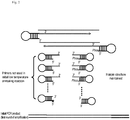
- FIG. 1 is a schematic outlining an exemplary primer design strategy of the instant application.
- FIG. 1 demonstrates four sets of target-specific primer pairs, designed to amplify four different target nucleic acids in a sample or reaction (Target 1, Target 2, Target 3, and Target 4).
- the target-specific primer pairs (TSPPs) are present in the amplification reaction mixture in low abundance such that during the amplification reaction, the TSPPs are exhausted.
- the primer design strategy also includes a universal primer pair that lacks a 3' single-stranded target-specific region and is therefore not capable of acting as a priming binding site during the first round of amplification.
- the universal primer pair is present in the nucleic acid amplification reaction mixture in high abundance as compared to the TSPPs.
- FIG. 2 is a schematic outlining an exemplary PCR reaction of the instant disclosure.
- FIG. 2 demonstrates the first amplification reaction using a first (low) annealing temperature, thereby allowing the TSPPs to anneal to a complementary sequence present in the target nucleic acids of the reaction mixture (e.g., shown here as the annealing of TSPP Target 4 to a complementary target nucleic acid in the reaction mixture); and extension of the TSPP, for example in a template dependent manner, to form a first amplification product (first amplicon).
- the three remaining TSPPs shown here as Target 1-3
- the first (low) annealing temperature is below the melting temperature of the hairpin structure of the universal primer pair, such that the hairpin structure is maintained during the first (low) annealing step.
- FIG. 3 is a schematic outlining the second amplification reaction of an exemplary PCR reaction of the instant disclosure.
- FIG. 3 demonstrates a second (high) annealing temperature applied to the reaction mixture after formation of the first amplicon.
- the high annealing temperature allows the universal primer pair present in the reaction mixture to transition from a hairpin to linear configuration, thereby facilitating hybridization of the universal primer pair to a complementary sequence present in the universal adaptor sequence of the first amplicon.
- the second (high) annealing temperature is above the Tm temperature of the 5' region of the TSPP but below the Tm temperature of the universal hairpin primer.
- FIG. 4 is a schematic outlining a subsequent step in the second amplification reaction of an exemplary PCR reaction of the instant disclosure.
- FIG. 4 demonstrates application of the high annealing temperature as discussed in the preceding paragraph, on the universal primer pair and subsequent extension, for example in a template dependent manner, to form second amplicons.
- the linear universal primer pair contains a nucleotide sequence that is complementary to the universal adaptor sequence present in the TSPPs and therefore can act as a priming binding site.
- the universal primer pair can be extended, for example in a template dependent manner, to form second amplicons.
- the second amplicons can be used in any appropriate downstream application such as nucleic acid sequencing, cloning, or genotyping.
- the terms “a,” “an,” and “the” are defined to mean one or more and include the plural unless the context is inappropriate. Ranges may be expressed herein as from “about” one specified value, and/or to “about” another specified value.
- the term “about” is used herein to mean approximately, in the region of, roughly, or around. When the term “about” is used in conjunction with a numerical range, it modifies that range by extending the boundaries above and below the numerical values set forth. In general, the term “about” is used herein to modify a numerical value above and below the stated value by a variance of 10%. When such a range is expressed, another embodiment includes from the one specific value and/or to the other specified value. Similarly, when values are expressed as approximations, by use of the antecedent "about,” it will be understood that the specified value forms another embodiment. It will be further understood that the endpoints of each of the ranges are included with the range.
- amplification refers to any in vitro means for multiplying the copies of a target nucleic acid.
- methods include polymerase chain reaction (PCR), DNA ligase chain reaction (LCR) (see US Patents. 4,683,195 and 4,683,202 ); PCR Protocols: A Guide to Methods and Applications (Innis et al., eds, 1990 )), RT-PCR, QBeta RNA replicase, and RNA transcription-based (such as TAS) mplification reactions as well as others known to those of skill in the art.
- Asymmetric PCR, nested PCR, bridge PCR and digital PCR are specific types of amplification reactions well known to those of skill in the art (see for example Chen et al., Methods Mol Biol., 2011, 231-43 ; Varley and Mitra, Genome Res., (2008), 1844-50 ).
- Amplifying refers to any process of submitting a target nucleic acid to conditions sufficient to allow for amplification of the target nucleic acid if all of the components of the amplification reaction are present.
- the nucleic acid amplification reactions disclosed herein can be performed in aqueous solutions, microdroplets, emulsions (such as oil-in water or water-in-oil emulsions), or solid-phase based amplification.
- Components of an amplification reaction typically include, e.g., primers, target nucleic acids, polymerases and nucleotides.
- amplifying typically refers to an "exponential" increase in target nucleic acids during the amplification reaction. However, “amplifying” as used herein can also refer to linear or non-exponential increases in the numbers of target nucleic acids.
- Amplification of a target nucleic acid to generate a population of first amplification or first extension products is collectively referred to as a "first amplicon”.
- Further amplification of a first amplicon e.g., a second round of amplification
- second amplicon Further amplification of a first amplicon (e.g., a second round of amplification) to produce a population of second amplification or second extension products.
- PCR Polymerase chain reaction
- Exemplary PCR reaction conditions typically comprise either two or three step cycles. Two step cycles have a denaturation step followed by a hybridization/elongation step. Three step cycles comprise (1) a denaturation step followed by a (2) hybridization step followed by a separate (3) elongation step. Standard PCR conditions for a two or three cycle reaction include a denaturation step at 98 °C for about 1 min to about 5 min on the initial cycle, and about 5 s to about 20 s for each remaining cycle.
- a hybridization or annealing step at about 45 °C to about 72 °C or at a Tm (melting temperature) at least 1 °C, 2 °C, 3 °C, or more, below the melting temperature of the pool of primers, for about 10 s to about 1 min.
- a elongation or extension step at about 68 °C to about 72 °C for about 15 s to about 1 min, typically about 1 min per kilobase of expected product.
- the extension step is typically between about 5 min and about 10 min on the last cycle of the PCR reaction, and the reaction mixture is typically held at 4 °C after completion of the final extension.
- a PCR reaction will include between 20 to 30 cycles of either the two step or three step PCR conditions described above.
- template-dependent manner typically refers to polynucleotide synthesis of RNA or DNA wherein the sequence of the newly synthesized strand of polynucleotide is complementary to the template, i.e., dictated by the well-known rules of complementary base pairing (see, for example, Watson, J. D. et al., In: Molecular Biology of the Gene, 4th Ed., W. A. Benjamin, Inc., Menlo Park, Calif. (1987 )).
- PCR is well known to those of skill in the art; see, e.g., US Patents 4,683,195 and 4,683,202 ; and PCR Protocols: A Guide to Methods and Applications, Innis et al., eds, 1990 .
- amplification reaction mixture or "amplification reagents” as used herein refers to a reaction mixture comprising various reagents necessary to amplify a target nucleic acid. These generally include enzymes, aqueous buffers, salts, primers, target nucleic acids, and nucleoside triphosphates.
- an amplification reaction mixture comprises an aqueous solution, microdroplet, emulsion, and/or solid-phase based amplification reaction mixture.
- an amplification reaction mixture of the instant application can include a microfluidic system or process.
- Microfluidic processes often employ the use of an emulsion, which contains drops of a dispersed liquid phase surrounded by an immiscible continuous liquid phase (e.g ., microdroplets).
- a microdroplet comprises an emulsion composition, i.e., a mixture of immiscible fluids ( e.g., water and oil).
- a microdroplet is an aqueous droplet that is surrounded by an immiscible carrier fluid (e.g., oil).
- a microdroplet is an oil droplet that is surrounded by an immiscible carrier fluid (e.g., an aqueous solution).
- the microdroplets described herein are relatively stable and have minimal coalescence between two or more microdroplets. In some embodiments, less than 0.0001%, 0.0005%, 0.001%, 0.005%, 0.01%, 0.05%, 0.1%, 0.5%, 1%, 2%, 3%, 4%, 5%, 6%, 7%, 8%, 9%, or 10% of microdroplets generated from a sample coalesce with other microdroplets.
- Microdroplets may be used as reaction vessels for chemical or biological reactions, as storage vessels, and/or as a method to isolate and compartmentalize molecules, such as chemical or biological elements.
- microdroplets With proper chemistry such as surfactants on the surface of the emulsion, microdroplets may be made "stable,” meaning they are substantially prevented form mixing and merging when in contact with each other. This stability allows one to create a population or library of microdroplets composed of different chemical or biological components that may be stored in the approximately same volume of space without mixing or contamination between and/or among the components of one microdroplet and another.
- microfluidic systems and processes capable of forming microdroplets are set forth in US Patent Applications, 2015/0065396 (claiming priority of 61/934,889 , 61/905,927 , 61/905,914 , 61/896,766 , 61/881,040 , 61/875,312 and 61/870,336 ), and 2016/0076082 (claiming priority of 61/816,431 ), and WO 2014/043388 .
- nucleic acid amplification reactions that can be performed within microdroplets is set forth in US Patent 9,581,549 .
- nucleic acid amplification reaction is limited to, or includes, a microdroplet process.
- the amplification reaction mixture can comprise a microfluidic process for amplifying the one or more target nucleic acids.
- the microfluidic process comprises the formation of a library or population of microdroplets that include one or more target nucleic acids, one or more target-specific primer pairs, a universal primer pair, and other reagents necessary to perform PCR, such as dNTPs, magnesium and a polymerase.
- microdroplets allow for the partitioning of target nucleic acids (e.g., genomic DNA) such that an individual microdroplet can comprise a single genomic target.
- a microdroplet of the instant application includes a single genomic target in combination with one or more target-specific primer pairs (TSPPs), a universal primer pair, and other reagents so that PCR can be performed on the single genomic target in the microdroplet.
- TSPPs target-specific primer pairs
- the target nucleic acid or sample is partitioned into at least 500 partitions, at least 1000 partitions, at least 2000 partitions, at least 3000 partitions, at least 4000 partitions, at least 5000 partitions, at least 6000 partitions, at least 7000 partitions, at least 8000 partitions, at least 10,000 partitions, at least 15,000 partitions, at least 20,000 partitions, at least 30,000 partitions, at least 40,000 partitions, at least 50,000 partitions, at least 60,000 partitions, at least 70,000 partitions, at least 80,000 partitions, at least 90,000 partitions, at least 100,000 partitions, at least 200,000 partitions, at least 300,000 partitions, at least 400,000 partitions, at least 500,000 partitions, at least 600,000 partitions, at least 700,000 partitions, at least 800,000 partitions, at least 900,000 partitions, at least 1,000,000 partitions, at least 2,000,000 partitions, at least 3,000,000 partitions, at least 4,000,000 partitions, at least 5,000,000 partitions, at least 10,000,000
- the microdroplets generated are substantially uniform in shape and/or size.
- the microdroplets are substantially uniform in average diameter.
- the microdroplets that are generated have an average diameter of about 0.001 ⁇ m, about 0.005 ⁇ m, about 0.01 ⁇ m, about 0.05 ⁇ m, about 0.1 ⁇ m, about 0.5 ⁇ m, about 1 ⁇ m, about 5 ⁇ m, about 10 ⁇ m, about 20 ⁇ m, about 30 ⁇ m, about 40 ⁇ m, about 50 ⁇ m, about 60 ⁇ m, about 70 ⁇ m, about 80 ⁇ m, about 90 ⁇ m, about 100 ⁇ m, about 150 ⁇ m, about 200 ⁇ m, about 300 ⁇ m, about 400 ⁇ m, about 500 ⁇ m, about 600 ⁇ m, about 700 ⁇ m, about 800 ⁇ m, about 900 ⁇ m, or about 1000 ⁇ m.
- the microdroplets that are generated have an average diameter of less than about 1000 ⁇ m, less than about 900 ⁇ m, less than about 800 ⁇ m, less than about 700 ⁇ m, less than about 600 ⁇ m, less than about 500 ⁇ m, less than about 400 ⁇ m, less than about 300 ⁇ m, less than about 200 ⁇ m, less than about 100 ⁇ m, less than about 50 ⁇ m, or less than about 25 ⁇ m.
- the microdroplets generated are non-uniform in shape and/or size.
- the microdroplets generated are substantially uniform in volume.
- the microdroplets generated have an average volume of about 0.001 nl, about 0.005 nl, about 0.01 nl, about 0.02 nl, about 0.03 nl, about 0.04 nl, about 0.05 nl, about 0.06 nl, about 0.07 nl, about 0.08 nl, about 0.09 nl, about 0.1 nl, about 0.2 nl, about 0.3 nl, about 0.4 nl, about 0.5 nl, about 0.6 nl, about 0.7 nl, about 0.8 nl, about 0.9 nl, about 1 nl, about 1.5 nl, about 2 nl, about 2.5 nl, about 3 nl, about 3.5 nl, about 4 nl, about 4.5 nl, about 5 nl, about 5.5 nl, about 6 nl, about 6.5 nl, about 7
- the target nucleic acid e.g., template molecule
- the partitioning comprises generating at least 1 partition that has 0 copies of the template molecule.
- the partitioning comprises generating at least about 1, 2, 3, 4, 5, 6, 7, 8, 9, 10, 15, 20, 25, 30, 40, 50, 60, 70, 80, 90, 100, 150, 200, 250, 300, 400, 500, 600, 700, 800, 900, or 1000 partitions or more that have 0 copies of the template molecule.
- the partitioning comprises generating at least about 1, 2, 3, 4, 5, 6, 7, 8, 9, 10, 15, 20, 25, 30, 40, 50, 60, 70, 80, 90, 100, 150, 200, 250, 300, 400, 500, 600, 700, 800, 900, or 1000 partitions or more that have 0 copies of the template molecule and at least about 1, 2, 3, 4, 5, 6, 7, 8, 9, 10, 15, 20, 25, 30, 40, 50, 60, 70, 80, 90, 100, 150, 200, 250, 300, 400, 500, 600, 700, 800, 900, or 1000 partitions or more that have 1 or more copies ( e.g., 1, 2, 3, 4, 5, 6, 7, 8, 9, 10 or more copies) of the template molecule.
- 1 or more copies e.g., 1, 2, 3, 4, 5, 6, 7, 8, 9, 10 or more copies
- Partitioning of target nucleic acids into a population or library of microdroplets can also reduce or eliminate cross-over of reagents, amplicons, or TSPPs among the population of microdroplets. Additionally, partitioning improves the ability to efficiently barcode target nucleic acids or amplicons and thereby reduces the likelihood of bias or duplicates when interpreting downstream data, such as NGS data.
- target nucleic acids e.g., genomic DNA
- partitioning improves the ability to efficiently barcode target nucleic acids or amplicons and thereby reduces the likelihood of bias or duplicates when interpreting downstream data, such as NGS data.
- Amplification reaction mixtures may also further include stabilizers and other additives to optimize efficiency and specificity.
- the amplification reaction mixture can be provided as a complete or an incomplete amplification reaction mixture.
- the amplification reaction mixture can be provided as a set of reaction vessels (e.g. , Eppendorf TM LoBind microcentrifuge tubes) including all the reagents necessary to conduct the nucleic acid amplification reaction ( i.e., a complete amplification reaction mixture).
- the amplification reaction mixture can be provided as an incomplete reaction mixture, for example lacking one or more reagents necessary to conduct the nucleic acid amplification reaction (e.g., a series of vessels containing the amplification reagents yet lacking a polymerase).
- the reagent necessary for amplification i.e., a polymerase
- the amplification reaction mixture as used herein is a complete amplification reaction mixture.
- stabilizers such as polyethylene glycol (PEG), Tween 20, Triton X-100, or ethoxylated alky phenol (NP-40)(see for example US Pat. No. 6,127,155 ) or polyols (such as glucose, mannitol, galacitol or glucitol) can be present in the amplification reaction mixture.
- additives such as 2-pyrrolidine, actemide, and formamide can be present in the amplification reaction mixture.
- zwitterionic detergents can be present in the reaction mixture (see for example US Patent 7,972,82 ; US Patent Application 2010/0099150 ; EP-B-2069487 ).
- partitioning refers to separating a sample (e.g. , genomic DNA) into a plurality of portions or “partitions.”
- Partitions can be solid or fluid.
- a partition is a solid partition, e.g. , a microchannel.
- a partition is a fluid partition, e.g. , a microdroplet.
- a fluid partition e.g., a microdroplet
- a fluid partition is a mixture of immiscible fluids (e.g., water and oil).
- a fluid partition e.g.
- a microdroplet is an aqueous droplet that is surrounded by an immiscible carrier fluid (e.g., oil).
- an immiscible carrier fluid e.g., oil
- a “primer” refers to a polynucleotide sequence that hybridizes to a complementary sequence on a target nucleic acid and serves as a point of initiation of nucleic acid synthesis.
- Primers can be of a variety of lengths and are often less than 80 nucleotides in length, for example 20-70 nucleotides, in length.
- a full length target-specific primer of the instant application can comprise between 30 and 65 nucleotides in length, such as 30, 35, 40, 45, 50, 55, 60 or 65 nucleotides in length.
- a multiplex amplification reaction mixture can include one or more full length target-specific primers having a length of between 30 and 65 nucleotides.
- Different length target-specific primers may be used in a multiplex amplification reaction such that one or more of the multiplex full length target-specific primers comprises a different nucleotide length as compared to the remainder of the multiplex full length target-specific primer pairs (e,g., a multiplex amplification reaction comprising a first full length target-specific primer having a nucleotide length of 45 nucleotides and a second full length target-specific primer having a nucleotide length of 58 nucleotides).
- the length and sequences of primers for use in PCR can be designed based on principles known to those of skill in the art, see, e.g., Innis et al., supra.
- a primer pair or collection of primers to be used in a nucleic acid amplification of the instant application are designed such that the Tm temperature (melting temperature) of the primer pairs or primer pool are similar ( e.g. , within 1 °C, 1.5 °C, 2 °C, 2.5 °C, 3 °C, 3.5 °C, 4 °C, 4.5 °C, 5 °C, 5.5 °C, 6 °C, 6.5 °C or 7 °C of each other).
- a primer with a Tm temperature significantly higher than the PCR reaction annealing temperate may mis-hybridize and extend at an incorrect location on the target nucleic acid (mis-priming), while a primer with a Tm temperature significantly lower than the PCR reaction annealing temperature may fail to anneal and extend at all (failed priming).
- Various tools exist for primer design and evaluation e.g., NCBI-Blast software.
- primers having highly degenerate sequences may be avoided to reduce the probability of mis-hybridization during the PCR annealing reaction.
- the target nucleic acids represent genes from different organisms it may be advantageous to use degenerate primers to identify the multitude of organisms present in the reaction mixture.
- Primers can be DNA, RNA, or a chimera of DNA and RNA portions.
- a primer can include one or more modified nucleosides (e.g. , 2-amino-deoxyadenosine or 5-propynyl deoxyuridine) or non-natural nucleotide bases (e.g., uracil in a DNA primer).
- a primer can include a label such as a fluorescent moiety or a FRET donor and FRET acceptor moiety.
- a "primer pair" refers to two polynucleotide sequences that may be the same or different that hybridize to a locus on a target nucleic acid (e.g., a gene of interest or region of chromosome of interest). Frequently, a primer pair will comprise a forward (upstream) primer and a reverse (downstream) primer that span a region of interest on the target nucleic acid ( e.g., one or more exons or one or more introns of a gene). In one embodiment, a forward primer comprises the same polynucleotide sequence as the reverse primer.
- a primer pair comprises two polynucleotides sequences that are different (e.g., in nucleotide sequence from a 5' to 3' direction) and that are complementary to a nucleotide sequence within a target nucleic acid, such that extension of the forward primer and/or reverse primer results in amplification of the locus in the target nucleic acid.
- the instant application utilizes two or more (e.g., 3, 4, 5, 6, 7, 8, 9, 10, 15, 20, 25, or more) primer pairs in the nucleic acid amplification, wherein each primer pair is specific to a genetic locus, thereby enabling amplification or two or more loci in the same nucleic acid amplification reaction.
- the instant application allows for up to 50 primer pairs enabling amplification of 50 different loci in the same single amplification reaction.
- the target-specific primer pairs of the instant disclosure have a GC content in the range of between 40-60% such as 45%, 50%, 55% or 60%.
- the target-specific primer pairs of the instant disclosure are present in the amplification reaction at the same primer concentration for each target-specific primer pair (e.g., 50 nM).
- the target-specific primer pairs of the instant disclosure are present in the amplification reaction at a concentration of between 20 and 100 nM, such as 20 nM, 30 nM, 40 nM, 50 nM, 60 nM, 70 nM, 80 nM, 90 nM or 100 nM. In some embodiments, the target-specific primer pairs of the instant disclosure are present in the amplification reaction at a molar concentration that is lower than the molar concentration of the universal primer pair.
- the universal primer pair is present in the amplification reaction at a concentration of between 400 nM and 1000 nM, such as 400 nM, 500nM, 600 nM, 700 nM, 800 nM, 900 nM or 1000 nM.
- the molar concentration of the target-specific primer pairs in the nucleic acid amplification reaction are 2-fold, 3-fold, 4-fold, 5-fold, 10-fold, 20-fold, 30-fold, 40-fold, 50-fold, or more, dilute, as compared to the molar concentration of the universal primer pair (e.g., 20 nM target-specific primer pair versus 1 ⁇ M universal primer pair) present in the amplification reaction.
- the molar concentration of target specific primer pairs and universal primer pair in an amplification reaction mixture disclosed herein can comprise 2-fold to 10-fold higher than the range of molar concentrations set forth in this paragraph.
- the molar concentration of a target specific primer pair can comprise between 40 nM and 1000 nM and the molar concentration of the universal primer pair can comprise between 800 nM and 10 ⁇ M.
- Tm melting temperature and is the temperature at which one half of a nucleic acid duplex (e.g., a DNA target nucleic acid) will dissociate to become single-stranded.
- Primer pairs in an amplification reaction mixture can anneal to complementary regions of the single-stranded nucleic acid molecules during hybridization (annealing) and can be extended by the action of a polymerase, for example in a template dependent manner, during an extension step of the nucleic acid amplification reaction.
- Tm temperature refers to primer melting temperature and is the temperature at which 50% of the target-specific primer pairs and/or universal primers present in the nucleic acid amplification reaction mixture are present in linear conformation as opposed to a hairpin conformation.
- the primers of the instant application i.e., target-specific primer pairs and universal primer pair
- the hairpin operates as a mechanism to enhance specificity of the nucleic acid amplification reaction based on the annealing temperatures of the PCR amplification reaction.
- a first round of amplification enables target-specific primer pairs to anneal to complementary sequences in target nucleic acids present in the reaction mixture, followed by extension of the target-specific primers by a polymerase to form a population of first amplicons.
- the annealing temperature in the first round of amplification is set at a Tm temperature that is lower than the melting temperature of the hairpin structures of the primer pairs and the universal primer pair, such that the primer pairs and universal primer pair retain their hairpin conformation. Accordingly, these hairpin conformations are not available to bind to complementary nucleic acid sequences in the target nucleic acids and do not serve as a point of initiation of nucleic acid synthesis (see, FIG. 2 ).
- a second round of amplification to form second extension products or second amplicons utilizes a universal primer pair having a hairpin structure including the same 5' region as the target-specific primer pair (i.e., a hairpin structure) and lacking a single-stranded 3' end as determined below the Tm temperature.
- the universal primer pair during the first annealing step retains its hairpin structure; while during the second annealing step the universal primer pair is transformed under the second annealing temperature, from a hairpin to linear conformation, allowing the universal primer pair to hybridize to a complementary sequence in the first amplicon ( i.e., to a universal adaptor sequence located in the 5' region of the first amplicon).
- the universal primer pair can be extended by a polymerase, for example in a template dependent manner, to create a population of second extension products or second amplicons.
- the first annealing reaction is performed at a Tm temperature below the melting temperature of the universal primer pair such that the universal primer pair in the first annealing reaction remains in a hairpin conformation.
- the second annealing reaction is performed at a Tm temperature above the melting temperature of the universal primer pair such that the universal primer pair in the second annealing reaction is present in a linear conformation.
- the first annealing reaction is performed at a Tm temperature at least 1 °C, 1.5 °C, 2 °C, 2.5 °C, 3 °C, 3.5 °C, 4 °C, or more, below the melting temperature of the universal primer pair such that the universal primer pair in the first annealing reaction remains in a hairpin conformation.
- the second annealing reaction is performed at a Tm temperature at least 1 °C, 1.5 °C, 2 °C, 2.5 °C, 3 °C, 3.5 °C, 4 °C, or more, above the melting temperature of the universal primer hairpin such that the universal primer pair in the second annealing reaction is in linear conformation.
- a nucleic acid, or a portion thereof "hybridizes” or “anneals” to another nucleic acid under conditions such that non-specific hybridization is minimal at a defined temperature in a physiological buffer (e.g., pH 6-9, 25-150 mM chloride salt).
- a nucleic acid, or portion thereof hybridizes to a conserved sequence shared among a group of target nucleic acids.
- a primer, or portion thereof can hybridize to a primer binding site if there are at least about 6, 8, 10, 12, 14, 16, or 18 contiguous complementary nucleotides.
- a primer, or portion thereof can hybridize to a primer binding site if there are fewer than 1 or 2 complementarity mismatches over at least about 10, 12, 14, 16, or 18 contiguous complementary nucleotides.
- the temperature at which hybridization between the target-specific primer pairs and the target nucleic acids occurs is room temperature. In some embodiments, the temperature at which hybridization between the target-specific primer pairs and the target nucleic acids occurs is higher than room temperature and lower than the melting temperature of the target-specific primer pairs.
- the temperature at which hybridization between the target-specific primer pairs and the target nucleic acids occurs is at least about 37 °C, 40 °C, 42 °C, 45 °C, 48 °C, 50 °C, 52 °C, 55 °C, 58 °C, 60 °C, 62 °C, 65 °C, 68 °C, 70 °C or 72 °C.
- the temperature at which hybridization between the target-specific primer pairs and the target nucleic acids occurs is 37 °C, 40 °C, 42 °C, 45 °C, 48 °C, 50 °C, 52 °C, 55 °C, 58 °C, 60 °C, 62 °C, 65 °C, 68 °C, 70 °C or 72 °C.
- the temperature at which hybridization between the target-specific primer pairs and the target nucleic acids i.e., first annealing reaction temperature
- the temperature at which hybridization between the target-specific primer pairs and the target nucleic acids is 2 °C, 3 °C, 4 °C, 5 °C or 6 °C lower than the second annealing reaction temperature.
- the first annealing reaction is performed at a Tm temperature at least 1 °C, 1.5 °C, 2 °C, 2.5 °C, 3 °C, 3.5 °C, 4 °C below the melting temperature of the target-specific primer pairs.
- the temperature at which hybridization between the universal primer pair and first amplicons (i.e., second round of amplification) occurs is at least about 40 °C, 42 °C, 45 °C, 48 °C, 50 °C, 52 °C, 55 °C, 58 °C, 60 °C, 62 °C, 65 °C, 68 °C, 70 °C, 72 °C, 73 °C, 74 °C, 75 °C, 76 °C, or higher, where the hybridization of the universal primer pair is performed at a temperature that is at least 2 °C or 1 °C lower than the Tm of the universal hairpin primer, equal to the Tm of the universal hairpin primer, or at least 1 °C higher than the Tm temperature of the universal hairpin primer.
- the temperature at which hybridization between the universal primer pair and first amplicons occurs is 40 °C, 42 °C, 45 °C, 48 °C, 50 °C, 52 °C, 55 °C, 58 °C, 60 °C, 62 °C, 65 °C, 70 °C, 72 °C, 73 °C, 74 °C, 75 °C, 76 °C, or higher, where the hybridization of the universal primer pair is performed at a temperature that is 2 °C or 1 °C lower than the Tm of the universal hairpin primer, equal to the Tm of the universal hairpin primer, or 1 °C higher than the Tm temperature of the universal hairpin primer pair.
- the temperature at which hybridization between the universal primer pair and first amplicons occurs is 1 °C, 1.5 °C, 2 °C, 2.5 °C, 3.0 °C, 3.5 °C, 4.0 °C, 4.5 °C, 5 °C, 5.5 °C or 6 °C higher than the first annealing reaction temperature.
- a "template” or “target nucleic acid” refers to a polynucleotide sequence that comprises the polynucleotide or nucleic acid to be amplified, flanked by one or a pair of primer hybridization sites.
- a “template” or “target nucleic acid” comprises the target polynucleotide sequence flanked by hybridization sites for a "forward" primer and/or a “reverse” primer.
- the target nucleic acid can include any nucleic acid of interest such as DNA, RNA, LNA, PNA, locked nucleic acids, mixtures thereof, and hybrids thereof.
- a target nucleic acid comprises any nucleotide sequence including one or more nucleotide or nucleoside modifications (e.g., capped or terminated nucleotides) or substitutions (e.g., 8-oxo-dG).
- a target nucleic acid is between 30 and about 500 nucleotides in length, preferably between 50 and 300 nucleotides in length.
- the target nucleic acid is obtained from one or more organisms.
- organism refers to a living or self-replicating particle that is or was previously in existence. The term organism is not necessarily limited to a particular species of organism but also refers to any level of classification.
- target nucleic acids may be prepared from nucleic acid molecules obtained from a single organism or from populations of nucleic acid molecules obtained from natural sources that include one or more organisms.
- Sources of nucleic acid molecules include organelles, cells, tissues, organs, or organisms.
- Cells that may be used as sources of target nucleic acid molecules may be prokaryotic (bacterial cells, e.g., Escherichia, Bacillus, Serratia, Salmonella, Staphylococcus, Streptococcus, Clostridium, Chlamydia, Neisseria, Treponema, Mycoplasma, Borrelia, Legionella, Pseudomonas, Mycobacterium, Helicobacter, Erwinia, Agrobacterium, Rhizobium, and Streptomyces genera); archeaon, such as crenarchaeota, nanoarchaeota or euryarchaeotia; or eukaryotic such as fungi, (e.g., yeasts), plants, protozoans and other parasites, and animals (including insects (e.g., Drosophila spp.), nematodes (e.g., Caenorhabditis elegans), and mammals (e.
- nucleic acid means DNA, RNA, single-stranded, double-stranded, or more highly aggregated hybridization motifs, and any chemical modifications thereof. Modifications include those providing chemical groups that incorporate additional charge, polarizability, hydrogen bonding, electrostatic interaction, points of attachment and functionality to the nucleic acid ligand bases or to the nucleic acid ligand as a whole.
- Such modifications include peptide nucleic acids (PNAs), phosphodiester group modifications (e.g., phosphorothioates, methylphosphonates), 2'-position sugar modifications, 5-position pyrimidine modifications, 8-position purine modifications, modifications at exocyclic amines, substitution of 4-thiouridine, substitution of 5-bromo or 5-iodo-uracil; backbone modifications, methylations and unusual base-pairing combinations such as the isobases, isocytidine and isoguanidine.
- Nucleic acids can also include non-natural bases such as nitroindole. Modifications can also include 3' and 5' modifications including capping with a fluorophore (e.g., quantum dot) or another moiety.
- a target-specific primer of the instant application comprises a 5' end and a 3' end, wherein the 3' end comprises a single-stranded region that is target-specific to a nucleic acid of interest to be amplified.
- the 3' end of a target-specific primer pair comprises at least 4, 5, 6, 7, 8, 9, 10, 11, 12, 13, 14, 15, 16, 17, 18, 19, 20, 21, 22, 23, 24, 25, 26, 27, 28, 29 or more, nucleotides in length capable of hybridizing to a target nucleic acid of interest. In one embodiment, the 3' end of a target-specific primer pair comprises at least 4, 5, 6, 7, 8, 9, 10, 11, 12, 13, 14, 15, 16, 17, 18, 19, 20, 21, 22, 23, 24, 25, 26, 27, 28, 29 or more, nucleotides that are complementary to a nucleotide sequence present in a target nucleic acid of interest.
- the target-specific primer pair also contains a 5' end, which includes a 5' region that forms a hairpin when the Tm temperature of the amplification reaction (i.e., the first annealing step) is lower than the Tm of the hairpin primer nucleotide sequence.
- the 5' region that forms a hairpin is at least 6, 7, 8, 9, 10, 11, 12, 13, 14, 15, 16, 17, 18, 19, 20, 21, 22, 23, 24, 25, 26, 27, 28, 29, or more nucleotides in length.
- the 5' region that forms a hairpin and includes an adaptor sequence is at least 10, 15, 20, 25, 30, 35, or 40 nucleotides in length.
- the Tm temperature of the 5' region that forms a hairpin is the Tm temperature of the universal hairpin primer nucleotide sequence. In one embodiment, when the Tm temperature of the nucleic acid amplification reaction is higher than the Tm temperature of the hairpin primer nucleotide sequence, the 5' end of the hairpin primer is present in linear conformation.
- a “stem loop,” also referred to as a "hairpin primer” or “hairpin” refers to a secondary structure formed by a single-stranded oligonucleotide when complementary bases in a first part of the single-stranded oligonucleotide (e.g. , the 5' end) hybridize with bases in a second part of the same oligonucleotide ( i.e., downstream from the 5' end, including the 3' end of the oligonucleotide) to form a stem structure having intramolecular base-pairing between complementary bases.
- intramolecular base-pairing may not occur along the oligonucleotide to form a loop structure adjacent to the stem structure.
- intramolecular base-pairing of the 5' region of the target-specific hairpin primer and/or 5' region of the universal primer may occur across the full length of the oligonucleotide sequence ( i.e., from the 5' to the 3' end of the nucleotide sequence).
- the complementary base-pairing of the 5' region of the target-specific hairpin primer and/or 5' region of the universal primer may be limited to the stem structure.
- the stem structure can include 3, 4, 5, 6, 7, 8, or more, nucleotides in length.
- the stem structure is between 4 and 8 nucleotides in length.
- the loop structure can comprise 2, 3, 4, 5, 6, 7, or 8, or more nucleotides in length. In one embodiment, the loop structure is between 4 and 8 nucleotides in length.
- the first species is the "target-specific primer pair" which comprises one or two target-specific hairpin primers having a 3' single-stranded region that is complementary or capable of hybridizing to a sequence within a target nucleic acid of interest, and a 5' region that forms a hairpin between complementary bases in the 5' region when the Tm temperature is below the melting temperature of the universal hairpin primer nucleotide sequence.
- the second species of hairpin primer in the nucleic acid amplification reaction is the "universal primer pair" that comprises one or two universal hairpin primers lacking a single-stranded 3' end as determined below the Tm temperature and includes a 5' region as described above for target-specific primer pairs (i.e., includes a nucleotide sequence capable of forming intramolecular base-pairing between complementary bases within the 5' region when the Tm temperature is below the melting temperature of the hairpin nucleotide sequence).
- nucleotide sequence 5'-ATTGCAGGC-3' is selected as a suitable sequence for preparation of a universal primer; this nucleotide sequence would require further modification to create a hairpin for use in the claimed nucleic acid amplification reaction.
- One exemplary modification includes modifying the nucleotide sequence such that the universal hairpin primer comprises "5' - ATTGCAGGC GCCTGCAAT - 3' (SEQ ID NO: 1), where the downstream part of the nucleotide sequence (underlined region) is the reverse complement of the upstream part of the nucleotide sequence, thereby allowing for hairpin formation when the Tm temperature is set below the melting temperature of the full-length or entire nucleotide sequence.
- Another exemplary modification includes modifying the starting nucleotide sequence (i.e., 5'-ATTGCAGGC-3') to include the nucleotide sequence "5' -ATTGCAGGCTTAAGCAAT- 3' (SEQ ID NO:4), where the downstream part of the nucleotide sequence (underlined region) is the reverse complement of the first five nucleotides of the 5' end thereby allowing for a hairpin formation that is not complementary along its full length (i.e., a hairpin having a 5 nucleotide stem and 4 nucleotide loop structure).
- a hairpin of the present disclosure includes complementary base pairing along the full length of the universal primer pair and/or target-specific primer pair nucleotide sequence.
- a hairpin of the present disclosure includes complementary base pairing along only part of the universal primer pair nucleotide sequence such that a stem and loop structure are formed, where the loop can be of various sizes.
- the loop of a hairpin of the present disclosure can comprise 2, 3, 4, 5, 6, 7, 8, or more, nucleotides in length.
- the stem of a hairpin of the present disclosure can comprise 2, 3, 4, 5, 6, 7, or 8 nucleotides in length. It is to be understood that the length and the composition (e.g.
- GC content of the target-specific hairpin primers and/or universal hairpin primers can be optimized according to buffer composition, hybridization temperature(s) of the nucleic acid amplification reaction, nucleotide sequence of the target-specific hairpin primer or universal hairpin primer, or any portion thereof used to form the target-specific hairpin or universal hairpin structure.
- the universal primer pair comprising one or two universal hairpin primers forms a hairpin structure with sufficient thermodynamic stability so as to remain in a closed conformation during the first annealing step and prior to the second annealing step, but that the energy barrier is sufficiently low to allow transformation of the hairpin structure to a linear conformation at the second annealing temperature of the nucleic acid amplification reaction.
- the universal primer pair comprising one or two universal hairpin primers is designed such that it is strong enough to remain in a hairpin conformation until the formation of the first amplicon(s) and weak enough so as to remain in linear conformation during the second annealing step and/or formation of the second amplicon(s).
- the target-specific primer pair comprising one or two target-specific hairpin primers forms a hairpin structure with sufficient thermodynamic stability so as to remain in a closed conformation during the first annealing step and prior to the second annealing step, such that the 5' region of the target-specific hairpin primers do not serve as points for initiation of nucleic acid synthesis.
- the 3' end of the target-specific hairpin primer comprises a 3' single-stranded region that is complementary or capable of hybridizing to a single-stranded region of a target nucleic acid of interest such that the 3' end acts as a point of initiation for nucleic acid synthesis.
- a person of ordinary skill in the art will be familiar with factors affecting hybridization and can determine the appropriate lengths for the target-specific hairpin primer and universal hairpin primer for a particular application in order to achieve the above properties.
- a target-specific hairpin primer refers to an oligonucleotide used to amplify a target nucleic acid of interest.
- a target-specific hairpin primer comprises a 5' region and 3' region, wherein the 3' region contains a single-stranded nucleic acid sequence that is complementary to a target nucleic acid of interest to be amplified.
- the 5' region contains a nucleotide sequence that is reverse complementary to a nucleotide sequence located downstream elsewhere in the 5' region such that the 5' region forms a hairpin (e.g., a stem, or stem-loop structure) under suitable reaction conditions.
- the 5' region does not contain a nucleotide sequence that is complementary and/or capable of hybridizing to a target nucleic acid of interest to be amplified under the reaction conditions provided.
- the 5' region of the target-specific primer contains a nucleic acid sequence that comprises a universal adaptor sequence to be used in a second amplification step ( i.e., second round of amplification to form a second extension product or second amplicon).
- the target-specific primers of the instant application can comprise multiplex nucleic acid amplification reactions (e.g., 50 target-specific primer pairs or 100 target-specific primers, in a single nucleic acid amplification reaction that allows for the amplification of up to 50 distinct loci).
- the target-specific primers hybridize under suitable conditions to a target nucleic acid to be amplified and undergo primer extension for example, in a template dependent manner.
- the extended first primer product (first amplicon) can then be used as a substrate for hybridization by a universal primer pair, to form a population of nucleic acids that are complementary to the first amplicons.
- the target nucleic acids to be amplified can include any nucleic acid such as RNA or DNA and may be obtained or derived from a living or dead organism, or may be obtained from a multiplicity of organisms.
- first target primer pair refers to two polynucleotide sequences prepared as a primer pair as defined herein, to amplify a single target nucleic acid of interest.
- the "first target primer pair” comprises a reverse (downstream) primer and a forward (upstream) primer to act as initiation sites for DNA or RNA synthesis.
- each primer pair of the nucleic acid amplification reaction is designed to hybridize to one loci, so as to prevent mis-hybridization.
- a first target primer pair comprises at least one forward and/or one reverse primer having a target-specific hairpin primer, wherein the hairpin primer contains a 3' region that is single-stranded and contains a nucleotide sequence that is complementary to or capable of hybridizing to a target nucleic acid to be amplified, and a 5' region that forms a hairpin structure below the Tm temperature of the hairpin nucleotide sequence and forms a linear structure at a Tm temperature above the Tm temperature of the hairpin nucleotide sequence.
- the Tm temperature of the 5' region that forms a hairpin can be determined by calculating the melting temperature of the nucleotide sequence that forms the hairpin structure.
- the Tm temperature of the 5' region that forms a hairpin can be determined by calculating the melting temperature of the universal hairpin primer.
- at least one of the target-specific primers of the first target primer pair comprises a 5' region that forms a hairpin structure below the Tm temperature of the universal hairpin nucleotide sequence and forms a linear structure at a Tm temperature above the Tm temperature of the universal hairpin primer.
- both the forward and reverse primer of the first target primer pair include a 5' region that forms a hairpin.
- the forward primer of the first target primer pair includes a 5' region that forms a hairpin.
- the reverse primer of the first target primer pair includes a 5' region that forms a hairpin.
- the first target primer pair contains a GC content of between 40-60%.
- the Tm temperature of the forward and reverse primers of the first target primer pair are similar to each other (e.g., a Tm temperature within a range of 1-5 °C).
- the Tm temperature of the pool of target primer pairs can be similar to each other (e.g., the pool of target primer pairs comprise a Tm temperature that is within a range of 1-5 °C).
- a "3' single-stranded target-specific region” refers to the 3' end of an oligonucleotide that is in linear, single-stranded form and has a polynucleotide sequence that is complementary to or capable of hybridizing to a target nucleic acid to be amplified.
- each target-specific primer pair or target-specific primer in the amplification reaction contains a 3' end having a nucleotide sequence that is complementary along its length or across at least 6, 7, 8, 9, 10, or more continuous nucleotides, to a single loci to enhance the hybridization process.
- the 3' single-stranded target-specific region can include at least 4, 5, 6, 7, 8, 9, 10, 11, 12, 13, 14, 15, 16, 17, 18, 19, 20, 21, 22, 23, 24, 25, or more, nucleotides in length.
- each target-specific primer pair or target-specific primer in the amplification reaction contains a 3' end having a nucleotide sequence that is designed to prevent cross-hybridization with other primers or nucleic acids under the nucleic acid amplification reaction conditions.
- the 3' single-stranded target-specific region is between 8 and 30 nucleotides in length, preferably between 12 and 25 nucleotides in length, and more preferably between 20 and 25 nucleotides in length.
- the 3' single-stranded target-specific region lacks significant secondary structure such as the potential to form hairpins or primer dimers under the nucleic acid amplification reaction conditions.
- the 3' single-stranded target-specific region does not contain highly degenerate nucleic acid sequences.
- the 3' single-stranded target-specific region can be complementary to or capable of hybridizing to any target nucleic acid, as defined herein.
- the 3' single-stranded target-specific region is single-stranded at a temperature below the Tm temperature of the 5' region that forms a hairpin.
- the 3' single-stranded target-specific region is single-stranded at a temperature that is above, below, or equal to, the Tm temperature of the 5' region that forms a hairpin.
- a "5' region that forms a hairpin” refers to a polynucleotide sequence located at the 5' end of a target-specific hairpin primer pair and/or universal primer pair that forms a hairpin when the target-specific hairpin primer pair or universal primer pair is at a Tm temperature below the melting temperature of the nucleotide sequence that forms the hairpin structure.
- the 5' end of a target-specific primer pair or universal primer pair comprises a first nucleotide sequence that is a reverse complement of a nucleic sequence found downstream in the same polynucleotide thereby creating a molecule capable of forming a hairpin configuration under favorable conditions (e.g.
- the 5' region fails to form a hairpin if the Tm temperature is higher than the melting temperature of the universal hairpin primer. In another embodiment, the 5' region fails to form a hairpin if the Tm temperature is higher than the melting temperature of the nucleotide sequence of the target-specific primer pair or universal primer pair that forms the stem-loop structure.
- the 5' region of the target-specific hairpin primer pair further comprises a universal adaptor sequence of about 4 to about 15 contiguous nucleotides that is a reverse complement to a nucleotide sequence present in the 5' end of the universal hairpin primer pair.
- the 5' region of the first target primer pair that forms a hairpin optionally contains a barcode sequence to allow for indexing of multiple nucleic acid samples (sources) in a single nucleic acid amplification reaction.
- the 5' region of the first target primer pair that forms a hairpin optionally contains a molecular barcode sequence to allow for tagging of amplified nucleic acids such that duplicate reads or errors can be removed, for example during software analysis of downstream sequencing data.
- Molecular barcoding and indexing of nucleic acid samples are well known in the art, for example lllumina TM sequencing generally utilizes 6 nucleotides to effectively generate 48 or more different barcodes for labelling of nucleic acid samples.
- the Ion Proton TM and Ion PGM TM sequencer library workflows also use 6 nucleotides to generate 16 or more different barcodes to label nucleic acid samples.
- US Patent Applications 2014/041315 and 2016/014274 demonstrate effective molecular barcoding of amplified nucleic acids, thereby improving data obtained in various downstream applications such as deep sequencing where detection of rare mutations or clonal cells within tumors may be useful.
- the universal adaptor sequence of the 5' region that forms a hairpin in the target-specific primer pair is complementary to or capable of hybridizing to a nucleotide sequence present in the 5' end of the universal hairpin primer pair.
- a nucleotide sequence having complementarity to the 5' end of the universal primer pair can be prepared such that the nucleotide sequence hybridizes to the universal hairpin primer pair, for example as an immobilized primer used to capture the universal primer pair in a downstream application such as capture-based nucleic acid sequencing.
- a "universal hairpin primer” refers to a hairpin primer as defined above and includes a 5' region that forms a hairpin under conditions favorable (i.e., at a Tm temperature below the Tm of the universal hairpin primer and does not form a hairpin above the Tm temperature of the universal hairpin primer).
- the universal hairpin primer lacks a 3' single-stranded-region that is target-specific for the nucleic acid to be amplified.
- the 5' region of the universal hairpin primer comprises a 5' end having a first nucleotide sequence that is complementary to a second nucleotide sequence found downstream from the 5' end of the same molecule (e.g., the 3' end).
- the universal hairpin primer allows for specific hybridization of the universal hairpin primer to a first amplification product or first amplicon having a complementary nucleotide sequence to the hairpin, located within the 5' region of the target-specific primer pair nucleotide sequence.
- a nucleic acid amplification reaction at a first (low) annealing temperature (e.g.
- the universal hairpin primer pair present in the second annealing reaction is transformed from a hairpin conformation to a linear configuration thereby allowing the universal hairpin primer pair (now linear) to act as a substrate for primer extension by a polymerase.
- the Tm temperature of the universal primer pair is about 2 °C to about 5 °C lower than the Tm temperature of the full length (i.e., 5' region and 3' region) target-specific primer pair or pool of target-specific primer pairs.
- a "polymerase” refers to an enzyme that performs template-directed synthesis of polynucleotides, e.g., DNA and/or RNA.
- the term encompasses both the full length polypeptides and a domain that has polymerase activity, including mutant or modified polymerases that retain polymerase activity.
- DNA polymerases are well-known to those skilled in the art, including DNA polymerases isolated or derived from Thermus aquaticus, Pyrococcus furiosus, Thermococcus litoralis, and Thermotoga maritime, or modified versions thereof.
- polymerase enzymes include: Klenow fragment (New England Biolabs ® Inc.), Taq DNA polymerase (QIAGEN), 9° N TM DNA polymerase (New England Biolabs ® Inc.), Deep Vent TM DNA polymerase (New England Biolabs ® Inc.), Manta DNA polymerase (Enzymatics ® ), Bst DNA polymerase (New England Biolabs ® Inc.), and phi29 DNA polymerase (New England Biolabs ® Inc.).
- Polymerases include both DNA-dependent polymerases and RNA-dependent polymerases such as reverse transcriptase. At least five families of DNA-dependent DNA polymerases are known, although most fall into families A, B and C.
- family A polymerases are single chain proteins that can contain multiple enzymatic functions including polymerase, 3' to 5' exonuclease activity and 5' to 3' exonuclease activity.
- Family B polymerases typically have a single catalytic domain with polymerase and 3' to 5' exonuclease activity, as well as accessory factors.
- Family C polymerases are typically multi-subunit proteins with polymerizing and 3' to 5' exonuclease activity.
- DNA polymerases I family A
- II family B
- III family C
- DNA polymerases ⁇ , ⁇ , and ⁇ are implicated in nuclear replication, and a family A polymerase, polymerase ⁇ , is used for mitochondrial DNA replication.
- DNA polymerases include phage polymerases.
- RNA polymerases typically include eukaryotic RNA polymerases I, II, and III, and bacterial RNA polymerases as well as phage and viral polymerases. RNA polymerases can be DNA-dependent and RNA-dependent.
- sample is meant to include a tissue or organ from an animal; a cell (either within a subject, taken directly from a subject, or a cell maintained in culture or from a cultured cell line); a cell lysate (or lysate fraction) or cell extract; a solution containing one or more molecules derived from a cell, cellular material, or viral material ( e.g. a polypeptide or nucleic acid); or a solution containing a naturally or non-naturally occurring nucleic acids.
- a sample may also include any body fluid or excretion (for example blood, serum, amniotic fluid, sperm, urine, stool, saliva, tears, bile) that contains cells, cell components, or nucleic acids.
- a sample can include a biopsy or liquid sample obtained from a patient, including a cancer patient that contains nucleic acids such as cell-free circulating tumor DNA (ctDNA).
- the sample can include a sample directly obtain from an animal or organism that is optionally purified to isolate or extract cells or target nucleic acids of interest such as a plasma sample from a pregnant animal, including a pregnant mammal.
- label refers to a composition detectable by spectroscopic, photochemical, biochemical, immunochemical, chemical, or other physical means.
- useful labels include fluorescent dyes (fluorophores), luminescent agents, electron-dense reagents, enzymes (e.g., as commonly used in an ELISA), biotin, digoxigenin, 32P and other isotopes, haptens, and proteins which can be made detectable, e.g. , by incorporating a label into the nucleotide sequence during extension and/or amplification.
- the term includes combinations of single labeling agents, e.g., a combination of fluorophores that provides a unique detectable signature, e.g.
- the label may be incorporated or attached to a nucleoside, nucleotide, or resulting double-stranded molecule (e.g., SYBR Green) and can include a ligand or dye, for example, a fluorescent dye such as FAM, DABCYL, TAMRA, JOE, ROX, Cy3, Cy5 or Alexa.
- the label can include fluorescence resonance energy transfer (FRET).
- a FRET label can include two chromophores that are in close proximity to one another (e.g., the donor and acceptor molecule are located on the same or different oligonucleotide strands).
- the label can be incorporated into the 5' region of the universal hairpin primer.
- a donor and acceptor molecule can be located at the 5' end of the universal hairpin primer.
- the mode of action of the FRET label can include a quenching of the chromophores when the universal hairpin primer is present in a hairpin conformation ( e.g. , during the first annealing step of the nucleic acid amplification reaction disclosed herein).
- the mode of action of the FRET label can include a separation of the chromophores and fluorescence of the donor molecule when the universal hairpin primer is present in a linear conformation (e.g. , during the second annealing step of the nucleic acid amplification reactions disclosed herein).
- incorporation of a label into one of more of the second extension products (second amplicons) can be detected via emission spectra.
- a label is incorporated into each of the second extension products (i.e., second amplicons).
- the label acts as an indicator of real-time PCR amplification.
- the label can include an AmpliFluor (fluorescein/DABCYL) or Scorpion based oligonucleotides (see for example Nazarenko et al., Nucleic Acids Res., 25, 2516-2521, (1997 ), Nazarenko et al., J. Histo. Cyctochem., 47(3), 273-279, (1999 ) and US Patent 6,117,635 .
- AmpliFluor fluorescein/DABCYL
- Scorpion based oligonucleotides see for example Nazarenko et al., Nucleic Acids Res., 25, 2516-2521, (1997 ), Nazarenko et al., J. Histo. Cyctochem., 47(3), 273-279, (1999 ) and US Patent 6,117,635 .
- the term “sequencing” and its variants comprises obtaining sequence information from a target nucleic acid, typically by determining the identity of at least one nucleotide (including its nucleobase component) within the target nucleic acid.
- “sequencing” includes identifying each and every nucleotide within the target nucleic acid that is sequenced.
- “sequencing” can include methods whereby the identity of one or more nucleotides in the target nucleic acid is determined, while the identity of some nucleotides remains undetermined or incorrectly determined.
- sequencing comprises obtaining sequence information from a target nucleic acid using next-generation high throughput methods such as single molecule real-time sequencing (e.g., Pacific Biosciences), pyrosequencing (e.g., Roche 454), sequencing by synthesis (e.g., Illumina (Solexa), sequencing by ligation (e.g., SOLiD sequencing), natural nucleotide pH-based sequencing (e.g., Ion Torrent semiconductor sequencing) or nanopore sequencing (e.g., MinION, Oxford Nanopore).
- sequencing as used herein includes obtaining RNA from a sample and converting the RNA into complementary DNA (cDNA) using reverse transcriptase.
- sequencing includes obtaining RNA from a sample and converting the RNA into complementary DNA (cDNA) using reverse transcriptase prior to performing the nucleic acid amplification reaction of the instant application on the cDNA.
- RNA may be directly amplified using the nucleic acid amplification reaction of the instant application by utilizing primer pairs that are specific for the corresponding RNA target nucleic acid (e.g. , primers containing uracil instead of thymine).
- the invention provides methods for target nucleic acid amplification by utilizing hairpin primers possessing a Tm temperature (melting temperature) that is dependent on the nucleotide sequence of the hairpin primer.
- Tm temperature can be utilized in two distinct annealing steps to increase the specificity of the nucleic acid amplification reaction.
- a target-specific hairpin primer pair anneals to a target nucleic acid under a first (low) Tm temperature and undergoes primer extension, for example in a template dependent manner.
- a universal hairpin primer containing a nucleotide sequence that is complementary to a portion of the target-specific hairpin primer anneals to the product of the first extension reaction at a second (high) annealing temperature and undergoes extension, for example in a template dependent manner.
- the methods comprise mixing a first target nucleic acid with a first target primer pair and a universal primer pair, such that a subsequent annealing and extending step results in the production of a population of first amplicons; denaturing the first amplicons into single-stranded molecules; annealing a universal primer pair to the single-stranded molecules and extending the universal primer pair to form second amplicons, thereby amplifying the first target nucleic acid.
- the methods disclosed in the preceding paragraph include a first target primer pair (FTPP) comprising one or two first target-specific hairpin primers (FTSHPs) having a 3' single-stranded target-specific region, at or below a Tm temperature that is complementary to or capable of hybridizing to a target nucleic acid of interest under the annealing conditions, and a 5' region that forms a hairpin below the Tm temperature (melting temperature) of the hairpin of the FTSHPs and/or universal hairpin primer and does not form a hairpin above the Tm temperature of the FTSHPs and/or universal hairpin primer.
- FTPP first target primer pair
- FTSHPs first target-specific hairpin primers
- the 3' single-stranded target-specific region is single-stranded at a temperature below the Tm temperature of the 5' region that forms a hairpin. In some embodiments, the 3' single-stranded target-specific region is single-stranded at a temperature that is above, below, or equal to, the Tm temperature of the 5' region that forms a hairpin. In some embodiments, the 5' region of the FTSHPs contains a universal adaptor sequence useful for subsequent downstream applications such as nucleic acid sequencing or bioinformatics analysis.
- the method includes a universal primer pair comprising one or two universal hairpin primers (UHPs) having a 5' region that forms a hairpin below the Tm temperature (melting temperature) of the UHPs and does not form a hairpin above the Tm temperature of the UHPs.
- UHPs universal hairpin primers
- the UHPs lack a single-stranded 3' end as determined below the Tm temperature of the UHPs.
- the UHPs lack a 3' single-stranded end that is complementary to, or capable of hybridizing to a target nucleic acid under the annealing conditions provided.
- the UHPs are capable of forming a stem-loop structure under the annealing conditions provided such that the stem structure creates a blunt-ended molecule (e.g., a hairpin without a 3' or 5' overhang).
- the method includes mixing the first target nucleic acid with the first target primer pair and the universal primer pair and annealing the first target primer pairs to the first nucleic acid at a first annealing temperature that corresponds to a temperature below the Tm temperature of the FTSHP; extending the FTSHP with a polymerase to form a first amplicon comprising one or two universal adaptor sequences; denaturing the first amplicon to form two nucleic acid strands and annealing the one or two UHPs to a universal adaptor sequence of one of the nucleic acid strands of the first amplicon at a temperature above the Tm temperature of the FTSHP; extending the one or two UHPs with a polymerase to form a second amplicon, thereby amplifying the first target nucleic acid.
- the first annealing temperature corresponds to a temperature that is 3 °C, 4 °C, 5 °C or 6 °C lower than the second annealing temperature. In another embodiment, the first annealing temperature at least 1 °C, 1.5 °C, 2 °C, 2.5 °C, 3 °C, 3.5 °C or 4 °C below the melting temperature of the FTSHPs. In another embodiment, the second annealing temperature corresponds to a temperature that is 2 °C or 1 °C lower than the Tm of the universal hairpin primer, equal to the Tm of the universal hairpin primer, or 1 °C or 2 °C higher than the Tm temperature of the universal hairpin primer.
- kits for performing a target nucleic acid amplification as disclosed in the preceding paragraph.
- the kits can comprise additional amplification reagents such as buffers, salts, dNTPS and polymerases necessary to perform the amplification methods.
- the invention provides reaction mixtures for performing a target nucleic acid amplification reaction.
- the reaction mixture comprises one or more target nucleic acids, such as up to 50 different nucleic acids in a single amplification reaction (i.e., a 50-plex reaction).
- the nucleic acid amplification reaction comprises up to 50 target-specific primer pairs, where each target-specific primer pair amplifies a distinct target nucleic acid in the amplification reaction, thereby performing a multiplex nucleic acid amplification reaction capable of amplifying up to 50 different target nucleic acids.
- the methods include amplification of a single target nucleic acid or the amplification of two or more target nucleic acids. For example, the amplification of up to 50 different target nucleic acids in a single amplification reaction mixture.
- methods for amplifying a single target nucleic acid include mixing a first target nucleic acid with (a) a first target primer pair, where the first target primer pair comprises one or two first target-specific hairpin primers, the target-specific hairpin primers having (i) a 3' single-stranded target-specific region at or below a Tm temperature and (ii) a 5' region that forms a hairpin below a Tm temperature and that does not form the hairpin above the Tm temperature, wherein the 5' region comprises a universal adaptor sequence, and (b) a universal primer pair comprising one or two universal hairpin primers (i) having said 5' region, and (ii) lacking a single-stranded 3' end as determined below the Tm temperature; (2) annealing the 3' single-stranded target-specific region of at least one first target-specific hairpin primer from the first target primer pair to the first target nucleic acid at a temperature at or below the Tm temperature and extending the target-specific hairpin
- steps (2) and (3) are repeated multiple times. In some embodiments, steps (2) and (3) are repeated about 5 to about 15 times. In some embodiments, steps (4) and (5) are repeated multiple times. In some embodiments, steps (4) and (5) are repeated about 10 to about 20 times. In some embodiments, step 1 is performed once and steps (2) and (3) are repeated for about 5 to about 15 times before steps (4) and (5) are repeated about 10 to about 20 times. In some embodiments, the first target primer pair is exhausted prior to performing steps (4) or (5). In some embodiments, the first target primer pair is exhausted prior to performing step (4). In some embodiments, the 3' single-stranded target-specific region is single-stranded at a temperature below the Tm temperature of the universal hairpin primer.
- the 3' single-stranded target-specific region is single-stranded at a temperature that is above, below, or equal to, the Tm temperature of the universal hairpin primer.
- the first annealing temperature is at least 2 °C below the Tm temperature of the universal primer pair and the second annealing temperature is equal to or at least 1 °C above the Tm temperature of the universal primer pair.
- the first target primer pair is present in the method at a molar concentration that is about 4-fold to about 50-fold more dilute than the molar concentration of the universal primer pair.
- the methods disclosed herein include amplification of a first target nucleic acid.
- the first target nucleic acid can comprise any appropriate polynucleotide of interest, such as a DNA, RNA or chimeric nucleic acid sequence of interest (see “target nucleic acid” definition provided herein).
- the first target nucleic acid of the method is obtained from, or derived from, a bacterial, viral, or pathogenic organism.
- the first target nucleic acid is obtained from, or derived, from a plant, fungal, or animal source.
- the first target nucleic acid can be obtained from a human sample, such as a plasma, blood, or tissue sample.
- the first target nucleic acid is genomic DNA. In some embodiments, the first target nucleic acid can include one or more introns or exons of one or more genes. In some embodiments, the first target nucleic acid is cDNA, for example obtained by RT-PCR of a RNA sample. In some embodiments, the first target nucleic acid is RNA. In some embodiments, the first target nucleic acid is plasmid DNA. In some embodiments, the first target nucleic acid can include a synthetically prepared ( e.g. , artificial) nucleic acid sequence of interest.
- the first target nucleic acid can include any appropriate polynucleotide sequence that is about 5 nucleotides to about 1000 nucleotides in length, about 10 nucleotides to about 500 nucleotides in length, about 20 nucleotides to about 400 nucleotides in length, about 25 nucleotides to about 250 nucleotides in length, about 30 nucleotides in length to about 150 nucleotides in length, or about 40 nucleotides in length to about 125 nucleotides in length.
- the first target nucleic acid can include a polynucleotide sequence that is at least 5, 6, 7, 8, 9, 10, 11, 12, 13, 14, 15, 16, 17, 17, 19, 20, 21, 22, 23, 24, 25, 26, 27, 28, 29, 30, 31, 32, 33, 34, 35, 36, 37, 38, 39, 40 nucleotides, or more, in length.
- the first target nucleic acid can comprise one or more polynucleotide modifications along the length of the first target nucleic acid (e.g., a modified nucleoside or nucleotide such as 8-oxo-2'-deoxyguanosine or 5-methylcytosine).
- the first target nucleic acid can be present at a low concentration such that after two, three, four, five, or more, rounds of nucleic acid amplification (e.g. , after formation of second amplicons) sufficient amplified first target nucleic acids exist that allow for suitable downstream applications, such as DNA or RNA sequencing, cloning, or genotyping.
- the first target nucleic acid may be present in the method at a nanogram, picogram or femtogram amount.
- the first target nucleic acid can comprise about 100 ng of DNA, about 75 ng DNA, about 50 ng DNA, about 25 ng DNA, about 10 ng DNA, about 1 ng DNA, about 750 pg DNA, about 500 pg DNA, about 250 pg DNA, about 100 pg DNA, about 10 pg DNA, about 1 pg DNA, about 750 fg DNA, about 500 fg DNA, or less.
- the first target nucleic can be present in an amount of about 100 ng of genomic DNA, about 50 ng of genomic DNA, or about 25 ng of genomic DNA.
- the concentration of the first target nucleic acid can comprise about 10 ng of plasmid DNA, about 5 ng of plasmid DNA, about 1 ng of plasmid DNA, about 750 pg of plasmid DNA, about 500 pg of plasmid DNA, about 250 pg of plasmid DNA, about 100 pg of plasmid DNA, or less.
- the polynucleotide source, or mass is not a critical parameter providing the method can amplify the first target nucleic acid of interest under the conditions disclosed herein.
- methods for amplifying a single target nucleic acid include a first target primer pair (FTPP), wherein the FTPP comprises one or two first target-specific hairpin primers (FTSHPs).
- the FTPP comprises two target-specific hairpin primers.
- only one of the FTPP is a target-specific hairpin primer and the second primer of the FTPP can include a first target-specific linear primer (FTSLP).
- a first target-specific linear primer comprises a single-stranded primer that lacks secondary structure and is capable of annealing to the target nucleic acid of interest under the conditions disclosed.
- a first target-specific linear primer can comprise a single-stranded primer that lacks sufficient intramolecular base-pairing to form a hairpin structure and comprises a nucleotide sequence that is complementary to or capable of hybridizing to a target nucleic acid of interest.
- the FTSHPs include a 3' single-stranded target-specific region at or below a Tm temperature and (ii) a 5' region that forms a hairpin below a Tm temperature (e.g. , corresponding to the melting temperature of the universal hairpin primer), and that does not form the hairpin above the Tm temperature of the universal hairpin primer.
- the 3' single-stranded target-specific region is single-stranded at a temperature below the Tm temperature of the 5' region that forms a hairpin.
- the Tm temperature of the FTSHP minus the 3' target specific region is within 5 °C of the melting temperature of universal hairpin primer.
- the Tm temperature of the FTSHP minus the 3' target specific region is within 3 °C of the melting temperature of universal hairpin primer.
- the Tm temperature of the FTSHP minus the 3' target specific region is within 1 °C of the melting temperature of universal hairpin primer.
- the Tm temperature of the FTSHP minus the 3' target specific region is 2 °C lower than the melting temperature of universal hairpin primer. In another embodiment, the Tm temperature of the FTSHP minus the 3' target specific region is at least 2 °C lower than the melting temperature of universal hairpin primer. In yet another embodiment, the Tm temperature of the FTSHP minus the 3' target specific region is more than 3 °C lower than the melting temperature of universal hairpin primer. In some embodiments, the 3' single-stranded target-specific region is single-stranded at a temperature that is above, below, or equal to, the Tm temperature of the 5' region that forms a hairpin.
- the Tm temperature of a FTSLP and a FTSHP forming the FTPP in the first annealing step are within 1-5 °C of each other, thereby facilitating specificity during the annealing and extension step. In another embodiment, the Tm temperature of a FTSLP and FTSHP are within 2 °C of each other. In some embodiments, the FTSHPs are not linked to or include a label and are present in the amplification reaction at a molar concentration that is about 4-fold to about 50-fold less than the molar concentration of the universal primer pair in the amplification reaction.
- the 3' single-stranded target-specific region at or below a Tm temperature of a FTSHP or FTSLP comprises at least 5, 6, 7, 8, 9, 10, 11, 12, 13, 14, 15, 16, 17, 18, 19, 20, 21, 22, 23, 24, 25 nucleotides or more, in length that is specific or unique to a first target nucleic acid.
- the 3' single-stranded target-specific region comprises a nucleotide sequence that is complementary along its length to an exon, exon-intron junction, and/or intron of a gene, thereby allowing for the detection of the gene using the nucleic acid amplification method.
- the 3' single-stranded target-specific region can include a single-nucleotide polymorphism (SNP), thereby allowing for the detection of a single nucleotide variation using the nucleic acid amplification method.
- the 3' single-stranded target-specific region comprises a nucleotide sequence that is complementary to a non-coding region of DNA.
- the length of the 3' single-stranded target-specific region is not critical, as long as the 3' single-stranded target-specific region allows for hybridization of the 3' single-stranded target-specific region of the FTPP to the first target nucleic acid, and that the hybridization remains stable so as to allow for extension of the 3' single-stranded target-specific region of the FTSHP or FTSLP to form a first amplicon.
- the FTPP can comprise of a FTSHP and a FTSLP each having a 3' single-stranded target-specific region at or below a Tm temperature comprising about 5, about 6, about 7, about 8, about 9, about 10, about 12, about 13, about 14, about 15, about 16, about 17, about 18, about 19, about 20, about 21, about 22, about 23, about 24, or about 25 nucleotides in length.
- the FTPP can comprise a FTSHP and a FTSLP each having a 3' single-stranded target-specific region at or below a Tm temperature, wherein the target-specific regions terminates with a GC or GG clamp ( e.g., to aid in the hybridization step).
- the method comprises two FTSHPs each having a 3' single-stranded target-specific region as disclosed herein, and a 5' region that forms a hairpin at a temperature below the melting temperature of the FTSHPs and/or the universal hairpin primer.
- the 3' single-stranded target-specific region is single-stranded at a temperature below the Tm temperature of the 5' region that forms a hairpin and/or the universal hairpin primer.
- the 3' single-stranded target-specific region is single-stranded at a temperature that is above, below, or equal to, the Tm temperature of the 5' region of the FTSHP minus the 3' region that forms a hairpin and/or the universal hairpin primer.
- the methods include mixing a first target primer pair having a 5' region that forms a hairpin below a Tm temperature and that does not form a hairpin above the Tm temperature with a first target nucleic acid in the presence of a universal primer pair.
- the 5' region of a FTSHP forms a hairpin when the temperature of the nucleic acid amplification reaction is maintained below the melting temperature (i.e., Tm temperature) of the hairpin.
- the melting temperature of the FTSHP corresponds to the temperature (e.g. , in Celsius) required to transform the hairpin configuration of the FTSHP to a linear configuration.
- the Tm temperature comprises the energy required as measured in Celsius or Fahrenheit to linearize the FTSHP nucleotide sequence (e.g. , linearize the stem-loop structure of the 5' region of the FTPP).
- the nucleotide sequence corresponding to the stem of a FTSHP is at least 3, at least 4, at least 5, at least 6, at least 7, or at least 8 nucleotides in length.
- the nucleotide sequence corresponding to the loop of a FTSHP is at least 3, at least 4, at least 5, at least 6, at least 7, at least 8, at least 9, at least 10, or more nucleotides in length.
- the 5' region forming the hairpin structure includes the stem and loop nucleotide sequence.
- the step and loop nucleotide sequences comprise at least 6, at least 7, at least 8, at least 9, at least 10, at least 11, at least 12, at least 13, at least 14, at least 15, at least 16, at least 17, at least 18, or more nucleotides in length.
- the Tm temperature of the 5' region of the FTSHP that forms a hairpin can be calculated using any appropriate algorithm available to determine the melting temperature of primers sequences, such as NCBI Blast and Primer3Plus software.
- the formation of a hairpin is dependent on the stability of the resulting stem and loop nucleotide sequences.
- the stability of a hairpin is determined for example by its length, the number of mismatches or bulges, and the base composition of the intramolecular paired region. Pairings between guanine and cytosine have three hydrogen bonds and are therefore more stable than adenine-thymine/adenine-thymine pairings that have only two hydrogen bonds. Loops that are less than three bases in length are generally not stable.
- the Tm temperature of a hairpin is about 2 °C lower than the melting temperature of the full length ( i.e., 5' region and 3' region) of the FTSHP sequence. In another embodiment, the Tm temperature of a hairpin is about 3 °C, about 3.5 °C, about 4 °C, about 4.5 °C, about 5 °C, or lower than the melting temperature of the FTSHP sequence ( i.e., the full length of the FTSHP nucleotide sequence).
- the Tm temperature of the hairpin is at least 2 °C, at least 2.5 °C, at least 3 °C, at least 3.5 °C, at least 4 °C, at least 4.5 °C, or at least 5 °C lower than the melting temperature of the full-length FTSHP nucleotide sequence.
- the following 18-mer (5'- ATT GCA GGC GCC TGC AAT) (SEQ ID NO:1) comprises a nucleotide sequence that could form a hairpin under the conditions disclosed herein.
- the calculated Tm of this sequence is 57.8 °C.
- nucleotide sequence corresponding to a 3' single-stranded target-specific region e.g., nucleotide sequence 5' AAT TGG CCG CTA-3'
- the resulting FTSHP would comprise 5' -ATT GCA GGC GCC TGC AAT AAT TGG CCG CTA -3 (SEQ ID NO:3) and have a Tm of 67.3 °C (underlined region corresponding to the 3' single-stranded target-specific nucleotide sequence).
- a FTSHP of the instant application can comprise a 5' region that forms a hairpin, where the hairpin comprises at least two bases that form a stem structure and at least three bases that generate a loop structure.
- the stem structure of the hairpin can comprise one or more additional GC base pairings as compared to AT base pairings in the stem structure, to improve the stability of the hairpin.
- the Tm temperature of a FTSHP is at least 2 °C higher than the melting temperature of the universal hairpin primer.
- the Tm temperature of a hairpin at the 5' end of a FTSHP is equal to the melting temperature of the universal hairpin primer.
- a FTPP comprises one or two FTSHPs having (i) a 3' single-stranded target-specific region at or below a Tm temperature and (ii) a 5' region that forms a hairpin below a Tm temperature and that does not form the hairpin above the Tm temperature, wherein the 5' region comprises a universal adaptor sequence.
- the universal adaptor sequence can comprise about 10, about 11, about 12, about 13, about 14, about 15, about 16, about 17, about 18, about 19, about 20, about 21, about 22, about 23, about 24, about 25, about 26, about 27, about 28, about 29, about 30, about 31, about 32, about 33, about 34, or more nucleotides in length.
- the universal adaptor sequence is at least 15, at least 20, at least 21, at least 22, at least 23, at least 24, at least 25, at least 26, at least 27, at least 28, at least 29, at least 30, at least 31, at least 32, at least 33, at least 34, or more nucleotides in length.
- the universal adaptor sequence can comprise 10, 11, 12, 13, 14, 15, 16, 17, 18, 19, 20, 21, 22, 23, 24, 25, 26, 27, 28, 29, 30, 31, 32, 33, 34, or more nucleotides in length.
- the universal adaptor sequence of the FTSHPs is complementary to a nucleotide sequence present in one, or both, of the universal hairpin primers.
- the universal adaptor sequence is present at the 5' end of the 5' region that forms a hairpin within the FTSHP and is complementary to or capable of hybridizing to a nucleotide sequence present in the 5' region of both universal hairpin primers of the universal primer pair.
- the universal adaptor sequence allows for the production of one or more second amplicons during a second round of amplification that contain a common (universal) nucleotide sequence flanking the variable, target-specific nucleic acids amplified in the first round of amplification (first amplicons).
- the universal adaptor sequence comprises one or more nucleotides from the stem structure and/or one or more nucleotides from the loop structure of the FTSHP as discussed in the preceding paragraph.
- the universal adaptor sequence comprises the stem nucleotide sequence of the FTSHP.
- the universal adaptor sequence comprises the loop nucleotide sequence of the FTSHP.
- the universal adaptor sequence comprises the reverse complement nucleotide sequence in a 5' to 3' direction of a nucleotide sequence present in the 5' region of at least one of the first amplicons.
- the methods disclosed herein comprise a universal primer pair (UPP).
- the universal primer pair comprises one universal hairpin primer (UHP) having a 5' region that is complementary in nucleotide sequence to the 5' region of a FTSHP and lacks the 3' single-stranded target-specific region of the FTSHP.
- the universal primer pair can comprise two universal hairpin primers (forward and reverse or upstream and downstream) having the same, or different, nucleotide sequences in 5' to 3' direction.
- the universal primer pair comprises two universal hairpin primers (UHPs) each having a nucleotide sequence that is complementary in 5' to 3' direction to the 5' region of two different target-specific hairpin primers and lacking the 3' single-stranded target-specific region as found in the 3' region of the two target-specific hairpin primers.
- the 5' region of the UHPs and the 5' region of the FTSHPs comprise a complementary nucleotide sequence across its full length in 5' to 3' direction.
- the UHPs may include one or two mismatches as long as the UHPs are capable of hybridizing to the amplified products of the first annealing temperature to generate second amplicons.
- the 5' region of the UHPs and the 5' region of the FTSHPs comprise a complementary nucleotide sequence present in the stem and loop structure of the 5' region of the FTSHP.
- the universal primer pair can include a forward (upstream) universal primer and a reverse (downstream) universal primer of different nucleotide lengths ( e.g., 25 nucleotide length for the forward universal primer and 30 nucleotide length for the reverse universal primer).
- the forward universal primer can include more, fewer, or equal number of nucleotides in the 5' region that form the UHP as compared to the reverse universal primer.
- the forward universal primer can comprise 4 nucleotides in the stem and 6 nucleotides in the loop structure as compared to a reverse universal primer having 7 nucleotides in the stem and 5 nucleotides in the loop structure.
- the forward and reverse universal primers can comprise two UHPs having a Tm that is within 1 °C, 2 °C, 3 °C, 4 °C or 5 °C of each other.
- a universal hairpin primer of the universal primer pair is linked to a label such that the label is incorporated into a second amplicon during the second extension step.
- the 5' end of the universal hairpin primer can include one or more labels such as biotin/streptavidin or a fluorophore, such as a donor molecule (fluorescein) and an acceptor molecule (DABCYL).
- the one or more labels can include any one or more of the labels provided in WO 2013/122826 , WO 2012/078710 , and US Patent Application 2016/0076082 .
- At least one universal hairpin primer of the universal primer pair is linked to a label that comprises a FRET donor and FRET acceptor molecule.
- the UHPs during the first annealing step maintain a hairpin conformation so as not to undergo hybridization to the target nucleic acids.
- the UHPs during the second annealing step create a linear conformation so as to undergo hybridization to one or more of the first amplicons.
- the UHP pair is present in the amplification reaction at a molar concentration that is at least 1-fold to at least 10-fold greater than the molar concentration of the FTSHPs.
- the label at the 5' end of the universal hairpin primer pair can be used to purify or separate the second amplicons from the target nucleic acids, first amplicons, or other components of the amplification reaction mixture.
- the label at the 5' end of the universal hairpin primer can be used to detect or quantify the presence or amount of second amplicons present in the amplification reaction.
- the label can be used to quantify the amount of second amplicons in the reaction under real-time analysis.
- the methods disclosed herein provide for annealing a 3' single-stranded target-specific region of at least one FTSHP from a first target primer pair to a first target nucleic acid at or below the Tm temperature of a hairpin present in the 5' region of the FTSHP or universal hairpin primer and extending the FTSHP with a polymerase in a template dependent manner to form a first amplicon comprising one or two universal adaptor sequences.
- the annealing includes conducting an annealing step at a temperature that is at least 2 °C lower than the melting temperature of the 5' region of the FTSHP that forms the hairpin.
- the annealing step is conducted at a temperature that is about 3 °C, about 3.5 °C, about 4 °C, about 4.5 °C, about 5 °C, or lower than the melting temperature of the 5' region of the FTSHP that forms the hairpin. In another embodiment, the annealing step is conducted at a temperature that is equal to, 1 °C or 2 °C lower than the melting temperature of the universal hairpin primer. In another embodiment, the annealing step is conducted at a temperature that is 3 °C, 4 °C, 5 °C or 6 °C lower than a second annealing step temperature used to generate second amplicons.
- annealing a 3' single-stranded target-specific region at or below a Tm temperature in at least one FTSHP from a first target primer pair or a universal primer from a universal primer pair to a first target nucleic acid is performed for a period of at least 10, at least 20, at least 30, at least 40 at least 50, or at least 60 s.
- the first annealing step is performed for a period of about 10, about 20, about 30, about 40, about 50, or about 60 s.
- the first annealing step is repeated for about 3 to about 20 cycles, about 5 to about 15 cycles, or about 10 cycles.
- the first annealing step and subsequent extension step is repeated until the FTSHPs are exhausted.
- the first annealing step can comprise room temperature.
- the first annealing step can be at least 37 °C, 40 °C, 42 °C, 45 °C, 48 °C, 50 °C, 52 °C, 55 °C, 58 °C, 60 °C, 62 °C, 65 °C, 70 °C, or 72 °C.
- the first annealing step can comprise 37 °C, 40 °C, 42 °C, 45 °C, 48 °C, 50 °C, 52 °C, 55 °C, 58 °C, 60 °C, 62 °C, 65 °C, 70 °C, or 72 °C.
- the first annealing step can be modified from the parameters set forth above as long as the 3' single-stranded target-specific region of the FTSHP anneals to a first target nucleic acid and that the 5' region of the FTSHP retains its hairpin configuration during the first annealing step.
- the 3' single-stranded target-specific region is single-stranded at a temperature below the Tm temperature of the 5' region that forms a hairpin.
- the 3' single-stranded target-specific region is single-stranded at a temperature that is above, below, or equal to, the Tm temperature of the 5' region that forms a hairpin.
- the method includes extending the FTSHP annealed to a first target nucleic acid in a polymerase template dependent manner.
- the polymerase can include a RNA or DNA polymerase, such as Taq DNA polymerase or Phusion ® DNA polymerase.
- the first extension step can be performed at a temperature below the Tm temperature of the FTSHP 5' region that forms a hairpin.
- the extension step comprises a temperature that is at least 2 °C below the Tm temperature of the FTSHP 5' region that forms a hairpin or a universal hairpin primer.
- the extension step can comprise a temperature that is about 2 °C, about 3 °C, about 4 °C, or about 5 °C below the Tm temperature of the FTSHP 5' region that forms a hairpin or a universal hairpin primer.
- the first extension step can be performed at about 60 °C to about 72 °C provided the extension temperature is below the Tm of the FTSHP 5' region that forms the hairpin.
- the first extension step can be performed for about 10 to about 30 s.
- the first extension step is repeated for about 5 to about 15 times.
- the first extension step is repeated 5, 8, 10, 12, 15,18 or times.
- the first extension step can be repeated until the FTSHPs are exhausted.
- the temperature at which the first extension reaction is performed is not a critical parameter provided the FTSHP remains annealed to the first target nucleic acid before and optionally during the extension step.
- the polymerase used to perform extension of the FTSHP can be dependent on the source of nucleic acids (e.g., DNA or RNA) and other considerations, such as accuracy and error rates.
- the length of the FTSHP or the presence of one or more nucleotide or nucleoside modifications along the target nucleic acid or FTSHP may act to block or slow DNA synthesis by a polymerase.
- the methods disclosed herein provide for denaturing the first amplicon comprising one or two universal adaptor sequences into two nucleic acid strands.
- any temperature above the melting temperature of the first amplicon is sufficient to separate the first amplicon into two nucleic acid strands.
- the denaturing step can include heating the first amplicon to a temperature of about 90 °C to about 98 °C for about 10 to about 45 s, about 15 to about 30 s, or about 25 s.
- the time period for denaturation is at least 15 s, at least 20 s or at least 30 s.
- the denaturing step can be modified from the parameters set forth above so long as the first amplicons are capable of acting as substrates for one or more universal hairpin primers of the universal primer pair in the second annealing step, discussed below.
- the first amplicon may not need to be physically separated in its entirety if an incomplete separation of the first amplicon allows at least one of the two universal hairpin primers to anneal to the universal adaptor sequence present in the first amplicon, and allows extension of the universal hairpin primer under conditions favorable for the extension reaction.
- the methods disclosed herein provide for a second annealing step when amplifying a target nucleic acid as discussed in the preceding paragraph.
- the methods disclosed herein provide for the annealing of one or two universal hairpin primers to a universal adaptor sequence present in one (or both) of the strands of the first amplicon at a temperature above the Tm temperature of the 5' region of the hairpin primer and/or universal hairpin primer.
- the second annealing step includes conducting the second annealing reaction at a temperature that is higher than the first annealing step.
- the second annealing step includes an annealing temperature that is higher than the first annealing reaction such that the one or more universal hairpin primers of the universal primer pair transition from a hairpin configuration to a linear configuration during the second annealing step.
- the second annealing step includes an annealing temperature that is higher than the first annealing reaction such that the one or more universal hairpin primers of the universal primer pair transition from a hairpin configuration to a linear configuration during the second annealing step and preferably during the second extension step.
- the second annealing step can include an annealing temperature that is at least 2 °C, 3 °C, 4 °C, 5 °C, 6 °C, 8 °C or even 10 °C higher than the first annealing temperature.
- the second annealing step is 2 °C, 3 °C, 4 °C, 5 °C, or 6 °C higher than the first annealing temperature.
- the second annealing step can include conducting the second annealing step at a temperature equal to the melting temperature of the FTSHP and/or universal hairpin primer.
- the second annealing step can comprise an annealing temperature that is about 2 °C, about 2.5 °C, about 3 °C, about 3.5 °C, or about 4 °C lower than the melting temperature of the full length FTSHP primer sequence but is equal to or 1 °C higher than the melting temperature of the universal hairpin primer.
- the second annealing step of the one or more universal hairpin primers to the universal adaptor sequence of the first amplicon is performed for a period of at least 10, at least 20, at least 30, at least 40 at least 50, or at least 60 s. In some embodiments, the second annealing step is performed for a period of 10, 20, 30, 40, 50, or 60 s.
- the second annealing step is repeated for about 5 to about 15 cycles, about 8 to about 12 cycles, or about 10 to about 20 cycles. It will be readily apparent to one of ordinary skill in the art that the second annealing step described in this paragraph can be modified from the parameters set forth above provided that the universal hairpin primers of the universal primer pair transition from a hairpin configuration to a linear configuration to facilitate annealing of the linear universal primer pair to the universal adaptor sequence present in 5' end of the first amplicon.
- the methods disclosed herein provide for a second extension step that results in extension of the one or more universal hairpin primers annealed to the universal adaptor sequence of the first amplicon.
- the method includes extending the one or more annealed universal hairpin primers with a polymerase in a template dependent manner.
- extension of the one or more universal hairpin primers results in the production of a second amplicon, thereby amplifying the first target nucleic acid.
- the second extension step comprises a temperature that is at least 1°C or 2°C above the Tm temperature of the FTSHP and/or universal hairpin primer.
- the second extension step comprises a temperature that is about 2°C, about 3°C, about 4°C, or about 5°C above the Tm temperature of the 5' region of the FTSHP that forms the hairpin and/or universal hairpin primer.
- the second extension step can be performed at about 62°C to about 72°C provided the extension temperature is above the Tm temperature of the 5' region that forms the FTSHP.
- the second extension step can be performed for about 10 to about 30 seconds.
- the second extension step is repeated for about 10 to about 20 times.
- the second extension step is repeated until the amount of PCR product is sufficient for any appropriate downstream application such as next-generation sequencing.
- the second extension step is repeated uniformly until the final cycle wherein the second extension step can be performed for about 1 min to about 5 min to ensure extension of the amplification product(s) is complete.
- the temperature at which the first extension reaction is performed is not a critical parameter provided the FTSHP remains annealed to the first target nucleic acid before and optionally during the extension step.
- the polymerase used to perform the second extension step can be the same or a different polymerase from the first extension reaction.
- the polymerase used to perform the first and second extension steps are the same polymerase, so as to generate a single, closed-tube nucleic acid amplification reaction.
- the polymerase used in the second extension reaction can be dependent on the source of nucleic acids to be amplified (e.g., DNA or RNA) and other considerations, such as accuracy and error rates.
- the length of a universal primer, or the presence of one or more nucleotide or nucleoside modifications along the target nucleic acid may act to block or slow DNA synthesis by a polymerase.
- the second extension step can be modified from the parameters set forth herein as long as one (or both) universal hairpin primer is extended to an extent that the second amplicons reflect the nucleotide sequence of the first amplicon(s).
- the second extension reaction can include a RNA or DNA polymerase, such as Taq DNA polymerase, 9°N DNA polymerase, or Phusion ® DNA polymerase.
- RNA or DNA polymerase such as Taq DNA polymerase, 9°N DNA polymerase, or Phusion ® DNA polymerase.
- Other polymerases including thermostable DNA polymerases are considered routine and foreseeable substitutions to the methods disclosed herein.
- methods for amplifying two or more target nucleic acids include (1) mixing two or more target nucleic acids with (a) a first and second target primer pair, where the first and second target primer pairs each comprise one or two target-specific hairpin primers for different ones of the two or more target nucleic acids, wherein the first and second target-specific hairpin primers have (i) a 3' single-stranded target-specific region at or below a Tm temperature and (ii) a 5' region that forms a hairpin below a Tm temperature and that does not form the hairpin above the Tm temperature, wherein the 5' region comprises a universal adaptor sequence, and (b) a universal primer pair comprising one or two universal hairpin primers (i) having said 5' region, and (ii) lacking a single-stranded 3' end as determined below the Tm temperature; (2) annealing the 3' single-stranded target-specific region of at least one first target-specific hairpin primer from the first target primer pair to a first target
- the 3' single-stranded target-specific region is single-stranded at a temperature below the Tm temperature of the 5' region that forms a hairpin and/or universal hairpin primer. In some embodiments, the 3' single-stranded target-specific region is single-stranded at a temperature that is above, below, or equal to, the Tm temperature of the 5' region that forms a hairpin.
- the methods disclosed herein comprise mixing three or more target primer pairs to amplify three or more different target nucleic acids.
- the three or more target primer pairs each comprise two target-specific hairpin primers having a 3' single-stranded target-specific region at or below a Tm temperature and a 5' region that forms a hairpin below a Tm temperature and that does not form a hairpin above the Tm temperature, wherein the 5' region comprises a universal adaptor sequence, and the 3' single-stranded target-specific region is designed to amplify a different target nucleic acid.
- each target primer pair is designed such that two target-specific hairpin primers amplify a distinct target nucleic acid (e.g., a single loci) as compared to other target primer pairs present in the amplification, thereby minimizing cross-hybridization.
- each of the target primer pairs of a multiplex nucleic acid amplification comprise one forward (upstream) target-specific primer and one reverse (downstream) target-specific primer for each target nucleic acid to be amplified.
- the method comprises mixing up to 50 different target primer pairs to amplify up to 50 different target nucleic acids.
- the method comprises mixing 25-100 target primer pairs comprising 25-100 different forward target primers having a 3' single-stranded region wherein each 3' region is target-specific for an individual loci, and a 5' region that forms a hairpin below a Tm temperature and that does not form the hairpin above the Tm temperature, and 25-100 different reverse target primers having a 3' single-stranded region wherein each 3' region is target-specific for an individual loci, and a 5' region that forms a hairpin below a Tm temperature and that does not form the hairpin above the Tm temperature, thereby allowing for the amplification of 25-100 different target nucleic acids.
- the method comprises mixing 40-60 target primer pairs comprising 40-60 forward target primers each having a 3' single-stranded region distinct from the 3' single-stranded region of another forward target primer in the primer pool, and 40-60 reverse target primers each having a 3' single-stranded region distinct from the 3' single-stranded region of another reverse target primer in the primer pool, thereby allowing for the amplification of 40-60 distinct target nucleic acids.
- multiplex nucleic acid amplification reactions disclosed herein can comprise 2, 5, 8, 10, 12, 15, 20, 25, 30, 35, 40, 45, 50, 55, 60, 65, 70, 75, 80, 85, 90, 95, or 100 target-specific primer pairs enabling nucleic acid amplification of up to 100 different target nucleic acids in a single amplification reaction.
- the target-specific primer pairs may be designed to amplify specific genes or portions thereof (e.g., exons or SNPs) associated with one or more diseases or conditions.
- target-specific primer pairs can be designed to amplify genes associated with inherited diseases such as inherited cardiomyopathy and cardiac arrhythmias, pulmonary, renal, hematology, autism, deafness, metabolic function, ophthalmic, neurological, primary immune deficiency, dermatology, endocrine, epilepsy, gastrointestinal, cystic fibrosis and cancers ( i.e., ovarian cancer), see for example, Ion Ampliseq TM Inherited Disease Gene Panels, Life Technologies Corp., Carlsbad, CA.
- target-specific primer pairs can be designed to amplify genes associated with infectious diseases such as tuberculosis and Ebola, see for example, Ion Ampliseq TM Infectious Disease Gene Panels, Life Technologies Corp., Carlsbad, CA.
- target-specific primer pairs can be designed to amplify genes associated with human identification which may be particularly useful for forensic analysis or predicting eye and hair color. For example, see DNA phenotyping panel, Human Identification Identity panel and Human Identification Ancestry panel offered by Ion Ampliseq TM Gene Panels, Life Technologies Corp., Carlsbad, CA.
- target-specific primer pairs of the instant disclosure can be designed to amplify one or more genes or a fragment thereof (e.g., a cancer hotspot mutation) associated with brain, breast, colon, ovarian, pancreatic, prostate, renal, uterine or other cancers.
- a cancer hotspot mutation e.g., a cancer hotspot mutation
- target-specific primer pairs of the instant disclosure can be designed to amplify one or more genes or a fragment thereof selected from the group consisting of ABL1, AIP, AKT1, ALK, APC, ATM, BAP1, BARD1, BLM, BRAF, BRCA1, BRCA2, BRIP1, BMPR1A, CDH1, CDK4, CDKN1B, CDKN2A, CHEK2, CSF1R, CTNNB1, DICER1, EGFR, EPCAM, ERBB2, ERBB4, EZH2, FANCC, FBXW7, FGFR1, FGFR3, FH, FLCN, FLT3, GALNT12, GNA11, GNAQ, GNAS, GREM1, HOXB13, HRAS, IDH1, IDH2, JAK2, JAK3, KDR, KIT, KRAS, MAX, MEN1, MET, MITF, MLH1, MPL, MRE11A, MSH2, MSH6, MUTYH, NBN, NF1,
- target-specific primer pairs can include one or more housekeeping genes to observe gene expression and/or act as a positive control for nucleic acid amplification.
- housekeeping genes to observe gene expression and/or act as a positive control for nucleic acid amplification.
- commercially available PCR kits exist for various housekeeping genes and may optionally be combined with labels during the multiplex nucleic acid amplification reaction such as SYBR-Green, see for example RT Profiler TM PCR Array Housekeeping Genes, Qiagen, Inc., (Germantown, MD, USA) including PCR arrays for cow, pig, horse, fruit fly, rat, zebrafish, mouse, Chinese hamster, dog, chicken, and human.
- target-specific primer pairs of the instant disclosure can be designed to amplify one or more human genes for experimental calibration/PCR control genes e.g., one or more genes selected from Table 1.
- Table 1. Gene Name RefSeq accession number Gene description Genomic coordinates (hg19) of strongly and uniformly expressed exons C1orf43 NM_015449 chromosome 1 open reading frame 43 chr1 154192817 154192883 chr1 154186932 154187050 chr1 154186368 154186422 chr1 154184933 154185100 chr1 154184795 154184854 CHMP2A NM_014453 charged multivesicular body protein 2A chr19 59065411 59065579 chr19 59063625 59063805 chr19 59063421 59063552 EMC7 NM_020154 ER membrane protein complex subunit 7 chr15 34382517
- target-specific primer pairs of the instant disclosure can be designed to amplify one or more housekeeping bacterial genes for experimental calibration/PCR control genes e.g., one or more genes selected from Table 2.
- the second amplicons or second extension products obtain by the methods disclosed herein can be using in any appropriate downstream application.
- the second amplicons or second extension products can be utilized in nucleic acid sequencing methods, as the input DNA or RNA for a next-generation sequencing reaction.
- the second amplicons or second extension products may be optionally isolated, extracted, or purified from one or more target nucleic acids in the amplification reaction prior to sequencing.
- the second amplicons and/or second extension products can be used in high-throughput sequencing.
- the second amplicons can be isolated or compartmentalized, for example, distributed into emulsions or micelles.
- the second amplicons can be dispersed into emulsions such that on average, each emulsion contains a single, second amplicon.
- the emulsions can be used for nucleic acid amplification and/or sequencing.
- sequencing technologies include pyrosequencing, sequencing-by-ligation, single molecule sequencing, sequence-by-synthesis (SBS), massive parallel clonal, massive parallel single molecule SBS, massive parallel single molecule real-time, massive parallel single molecule real-time nanopore technology, etc.
- SBS sequence-by-synthesis
- massive parallel clonal massive parallel single molecule SBS
- massive parallel single molecule real-time massive parallel single molecule real-time nanopore technology
- Exemplary DNA sequencing techniques include fluorescence-based sequencing methodologies ( See, e.g., Birren et al., Genome Analysis: Analyzing DNA, 1, Cold Spring Harbor, N.Y .). In some embodiments, automated sequencing techniques understood in that art are utilized.
- sequencing techniques include the Church polony technology ( Mitra et al., 2003, Analytical Biochemistry 320, 55-65 ; Shendure et al., 2005 Science 309, 1728-1732 ; and US Patents 6,432,360 ; 6,485,944 and 6,511,803 ), the 454 picotiter pyrosequencing technology ( Margulies et al., 2005 Nature 437, 376-380 ; US Patent Application 2005/0130173 ), the Solexa single base addition technology ( Bennett et al., 2005, Pharmacogenomics, 6, 373-382 ; US Patents 6,787,308 ; and 6,833,246 ), the Lynx massively parallel signature sequencing technology ( Brenner et al.
- high throughput sequencing methods share the common feature of massively parallel, high-throughput strategies, with the goal of lower costs in comparison to older sequencing methods ( See, e.g., Voelkerding et al., Clinical Chem., 55: 641-658, 2009 ; MacLean et al., Nature Rev. Microbiol., 7:287-296 ).
- Such methods can be broadly divided into those that typically use template amplification and those that do not.
- Amplification-requiring methods include pyrosequencing commercialized by Roche as the 454 technology platforms (e.g., GS 20 and GS FLX), the Solexa platform commercialized by Illumina Inc., and the Supported Oligonucleotide Ligation and Detection (SOLiD) platform commercialized by Applied Biosystems.
- Non-amplification approaches also known as single-molecule sequencing, are exemplified by the HeliScope platform commercialized by Helicos BioSciences, and platforms commercialized by VisiGen, Oxford Nanopore Technologies Ltd., Life Technologies/Ion Torrent, and Pacific Biosciences, respectively.
- Ion Torrent technology is a method of DNA sequencing that may be used in conjunction with the present invention.
- Ion Torrent sequencing is based on the detection of hydrogen ions that are released during polymerization of DNA ( See, e.g., Science 327(5970): 1190 (2010 ); US Patent Applications 2009/0026082 ; 2009/0127589 ; 2010/0301398 ; 2010/0197507 ; 2010/0188073 ; and 2010/0137143 ).
- a microwell contains a template DNA strand to be sequenced. Beneath the layer of microwells is a hypersensitive ISFET ion sensor. All layers are contained within a CMOS semiconductor chip, similar to that used in the electronics industry.
- a hydrogen ion is released, which triggers the hypersensitive ion sensor. If homopolymer repeats are present in the template sequence, multiple dNTP molecules will be incorporated in a single cycle. This leads to a corresponding number of released hydrogens and a proportionally higher electronic signal.
- This technology differs from other sequencing technologies in that no modified nucleotides or optics are used. The benefits of ion semiconductor sequencing are rapid sequencing speed and low upfront and operating costs.
- Other single molecule sequencing methods include real-time sequencing by synthesis using a VisiGen platform ( Voelkerding et al., Clinical Chem., 55: 641-58, 2009 ; U.S. Patent 7,329,492 ; and US Patent Applications 2007/0250274 and 2008/0241951 ) in which immobilized, primed template DNA is subjected to strand extension using a fluorescently-modified polymerase and florescent acceptor molecules, resulting in detectible fluorescence resonance energy transfer (FRET) upon nucleotide addition.
- a VisiGen platform Voelkerding et al., Clinical Chem., 55: 641-58, 2009 ; U.S. Patent 7,329,492 ; and US Patent Applications 2007/0250274 and 2008/0241951 .
- FRET fluorescence resonance energy transfer
- the primer template DNA of the single molecule sequencing method of Voelkerding et al. may be replaced with the second amplicon or second extension products of the instant application and undergo strand extension using the fluorescently modified polymerase and florescent acceptor molecules. It will be readily apparent that other high throughput sequencing methods may be modified to incorporate the second amplicons or second extension products as the template DNA in the sequencing methods known in the art.
- kits for amplifying a target nucleic acid.
- a kit includes (a) a first target primer pair (FTPP), the FTPP comprising one or two first target-specific hairpin primers (FTSHPs) having (i) a 3' single-stranded target-specific region at or below a Tm temperature and (ii) a 5' region that forms a hairpin below a Tm temperature and that does not form the hairpin above the Tm temperature, wherein the 5' region comprises a universal adaptor sequence, and (b) a universal primer pair comprising one or two universal hairpin primers (i) having said 5' region, and (ii) lacking a single-stranded 3' end as determined below the Tm temperature.
- FTPP first target primer pair
- FTSHPs first target-specific hairpin primers
- the 3' single-stranded target-specific region is single-stranded at a temperature below the Tm temperature of the 5' region that forms a hairpin and/or universal hairpin primer. In some embodiments, the 3' single-stranded target-specific region is single-stranded at a temperature that is above, below, or equal to, the Tm temperature of the 5' region that forms a hairpin and/or universal hairpin primer.
- the kit can include an FTPP that comprises two target-specific hairpin primers. In another embodiment, the kit can include an UPP that comprises two universal hairpin primers. In some embodiments, the universal primer pair is present in the kit in a quantity greater than the quantity of the first target primer pair.
- the universal primer pair is present in a 2-fold, 3-fold, 4-fold, 5-fold, 10-fold, 15-fold, 20-fold, 30-fold, 40-fold, 50-fold or even greater amount as compared to the quantity of the first target primer pair.
- the first target primer pair of the kit is not linked to a label.
- at least one universal hairpin primer of the universal primer pair is linked to a label.
- the universal hairpin primer is linked to fluorophore.
- the label present on the universal hairpin primer can comprise a FRET donor and FRET acceptor moiety.
- the kit can further comprise a second target primer pair comprising one or two second target-specific hairpin primers, the second hairpin primers having (i) a 3' single-stranded target-specific region different from the 3' single-stranded target-specific region of the first target-specific hairpin primers and (ii) said 5' region.
- a second target primer pair comprising one or two second target-specific hairpin primers, the second hairpin primers having (i) a 3' single-stranded target-specific region different from the 3' single-stranded target-specific region of the first target-specific hairpin primers and (ii) said 5' region.
- the kit can further include 5, 10, 15, 20, 25, 30, 35, 40, 45, 50, 60, 70, 80, 90, 100 or more, additional target primer pairs, wherein each additional target primer pair comprises one or two target-specific hairpin primers, wherein the additional target-specific hairpin primers include a (i) a 3' single-stranded target-specific region different from the 3' single-stranded target-specific region of any other target-specific hairpin primer present in the kit and (ii) said 5' region.
- the 3' single-stranded target-specific region of each target-specific hairpin primer pair are single-stranded at a temperature below the Tm temperature of the 5' region that forms a hairpin and/or universal hairpin primer.
- the 3' single-stranded target-specific region is single-stranded at a temperature that is above, below, or equal to, the Tm temperature of the 5' region that forms a hairpin and/or universal hairpin primer.
- the kit can be provided in a single container. In some embodiments, the kit can be provided in multiple containers or vessels. In some embodiments, the kit further comprises amplification reagents necessary to amplify the one or more target nucleic acids using the methods disclosed herein. In some embodiments, the amplification reagents can include one or more polymerases, amplification buffers, salts, and dNTPs. In some embodiments, the kit can include one or more additional stabilizers and/or additives to improve the yield, specificity, or accuracy of the nucleic acid amplification reaction.
- the reaction mixture can include (1) a sample having one or more target nucleic acids, and (2) a first target primer pair (FTPP), the FTPP comprising one or two first target-specific hairpin primers (FTSHPs) having (i) a 3' single-stranded target-specific region at or below a Tm temperature and (ii) a 5' region that forms a hairpin below a Tm temperature and that does not form the hairpin above the Tm temperature, wherein the 5' region comprises a universal adaptor sequence, and (b) a universal primer pair (UPP) comprising one or two universal hairpin primers (i) having said 5' region, and (ii) lacking a single-stranded 3' end as determined below the Tm temperature.
- FTPP first target primer pair
- FTSHPs first target-specific hairpin primers
- the reaction mixture further comprises amplification reagents for amplifying at least one of the one or more target nucleic acids present in the sample.
- the reaction mixture comprises a FTPP that comprises two target-specific hairpin primers.
- the reaction mixture comprises a UPP having two universal hairpin primers, wherein the two universal hairpin primers include (1) the said 5' region and lack a single-stranded 3' end as determined below the Tm temperature.
- the UPP is present in the reaction mixture in a quantity greater than the quantity of the first target primer pair.
- the UPP is present in a 2-fold, 3-fold, 4-fold, 5-fold, 10-fold, 15-fold, 20-fold, 30-fold, 40-fold, 50-fold, or even greater amount, as compared to the quantity of the first target primer pair.
- the first target primer pair of the reaction mixture is not linked to or includes a label.
- at least one universal hairpin primer of the UPP is linked to or includes a label.
- at least one universal hairpin primer of the UPP is linked to fluorophore.
- the number of target nucleic acids that can amplified in the reaction mixture is limited to the number of target-specific primer pairs present in the reaction mixture.
- the number of target-specific primer pairs in the reaction mixture is between, 1 and 10, 1 and 20, 1 and 30, 1 and 40, or 1 and 50 target-specific primer pairs. In one embodiment, the number of target-specific primer pairs can include up to 50 different target-specific primer pairs. It will be readily apparent to one of skill in the art, that as the number of target-specific primer pairs increases, the Tm temperature of the pool of target-specific primer pairs may shift up or down from a common or similar melting temperature. In one embodiment, the target-specific primer pairs of the reaction mixture have a Tm temperature that is within 1 °c to 5 °C of any other target-specific primer pair in the reaction mixture.
- a nucleic acid amplification reaction mixture comprising multiplex target-specific primer pairs is designed having a 3' single-stranded target-specific region, and a 5' region that forms a hairpin below the melting temperature and that does not form a hairpin above the melting temperature.
- the 5' region of the target-specific primer pairs contains a first nucleotide sequence and a second nucleotide sequence that are complementary to each other, to form a stem of the hairpin.
- the 5' region also contains a nucleotide sequence that acts as a universal adaptor sequence for subsequent amplifications (e.g., a nucleotide sequence in the loop of the hairpin and/or in the stem of the hairpin).
- the nucleic acid amplification reaction mixture also contains a universal primer pair, where the universal primer pair lacks a 3' single-stranded target-specific region, and includes a nucleotide sequence that can include: (1) a nucleotide sequence that is identical to the 5' region of the single-stranded target-specific primer, (2) a nucleotide sequence that is complementary to the nucleotide sequence present in the adaptor sequence, and (3) is complementary to the 3' end of the universal hairpin primer to form a hairpin structure.
- the universal primer pair can comprise one or two universal hairpin primers as described above.
- the hairpin is designed to remain "closed” during a first nucleic acid amplification reaction because the annealing temperature of the first nucleic acid amplification reaction is below the Tm temperature of the universal hairpin primer present in the amplification reaction mixture. Additionally, the universal primer pair is present in the first nucleic acid amplification reaction in a higher concentration as compared to the concentration of the target-specific primer pairs, which are present in low abundance and are typically exhausted prior to the termination of the first round of nucleic acid amplification.
- the universal primer pair cannot act as a point of initiation for primer extension because the universal primer pair cannot hybridize to the target nucleic acids in the reaction mixture because the universal primer pair lacks a 3' single-stranded target-specific region that is complementary to or capable of hybridizing to the target nucleic acids.
- the target-specific primer pairs have a 3' single-stranded nucleic acid sequence that is complementary to at least one nucleic acid of interest, thereby providing a basis for hybridization and primer extension (see FIG. 1 ).
- one of the universal primers of the universal primer pair is labeled (for example, with a fluorophore) so as to aid downstream applications such as sequencing, genotyping or quantification of second amplification products (second amplicons).
- the steps necessary for performing an amplification reaction using PCR principles are well known in the art (e.g., denaturation, hybridization, and extension).
- the instant application provides a method that allows for the amplification of target nucleic acids in a single vessel or single tube and optionally, does not require subsequent addition of enzymes or other amplification components (such as dNTPs or polymerase) other than those present in the initial amplification reaction, prior to completing two rounds of nucleic acid amplification.
- the method of the instant application reduces the potential for contaminants to enter the reaction mixture and hands on time required to perform the method, making the method suitable to high-throughput processes and/or automation.
- the method comprises a multiplex set of TSPPs, a universal primer pair, and reagents necessary for nucleic acid amplification.
- TSPPs are hybridized to a target nucleic acid of interest using the 3' single-stranded region of the TSPPs as a priming site.
- the PCR conditions for the first round of nucleic acid amplification include an initial denaturation step (e.g., for example 95 °C), followed by a temperature gradient to reach a first annealing temperature (e.g., 58 °C). Once the first annealing temperature is obtained, the TSPPs and the universal primer pair are present in hairpin configurations.
- the TSPPs are extended by a polymerase during the extension step (e.g., 72 °C) to form first amplicons while the universal hairpin primers are not.
- the PCR conditions set forth above are typically repeated several times, so that the low concentration of TSPPs are exhausted prior to, or during, the last cycle of first nucleic acid amplification reaction (see FIG. 2 ).
- the PCR conditions are modified so that the second annealing temperature is raised above the annealing temperature of the first annealing reaction (e.g., between 4 °C and 6 °C higher than the first annealing temperature).
- the second annealing temperature for example, 1 °C or 2 °C below, equal to, or 1 °C above, the melting temperature of the universal hairpin primer
- the universal primer pair transitions from a hairpin to linear configuration (see FIG. 3 ).
- the linear configuration allows the universal primer pair to act as a primer binding site by allowing hybridization to a nucleotide sequence present in the first amplicons (e.g., adaptor sequence).
- the universal primer pair contains a nucleotide sequence that is complementary to the universal adaptor sequence present in the 5' region of the target-specific primers, now part of the first amplicons.
- the universal primer pairs are extended by a polymerase during the second extension step (e.g., 72 °C) to form second amplicons. This set of PCR conditions is typically repeated for about 15 cycles.
- the second amplicons can then be purified or used in any appropriate downstream application, such as nucleic acid sequencing (see FIG. 4 ).
- a multiplexed pool of TSPPs, a pair of the fluorescently-labeled universal primers, and target nucleic acids are mixed with reagents necessary for nucleic acid amplification to form a PCR reaction mixture.
- the PCR reaction mixture can then be partitioned into microdroplets on a microfluidic system (for example as described in US Patent Application 2015/0065396 (claiming priority of 61/870,336 , 61/875,312 , 61/896,766 , 61/905,914 , 61/881,040 , 61/905,927 , 61/934,889 ), and US Patent 9,581,549 ).
- genomic DNA can be diluted before it is added to the PCR reaction mixture such that only a fraction of a genome will be partitioned into each of the microdroplets formed in the microfluidic system.
- genomic DNA is diluted such that on average only a single genomic target will be present in each microdroplet with one or more of the TSPPs.
- Microdroplets can then be thermally-cycled on the microfluidic system by passing them through thermally controlled zones for PCR.
- microdroplets can be cycled using a first thermal zone held at a denaturation temperature (for example 97 °C for a period of 15 s each cycle), and a second thermal zone held at a first annealing temperature (for example 58 °C for a period of 45 s each cycle) for 12 cycles. After the first 12 cycles, the microdroplets can continue cycling through the first thermal (denaturing) zone and a third thermal zone held at a second annealing temperature (for example 62 °C for 45 s each cycle) for an additional 38 cycles.
- a denaturation temperature for example 97 °C for a period of 15 s each cycle
- a first annealing temperature for example 58 °C for a period of 45 s each cycle
- the microdroplets can continue cycling through the first thermal (denaturing) zone and a third thermal zone held at a second annealing temperature (for example 62 °C for 45 s each cycle) for an additional 38 cycles.
- each microdroplet can be further interrogated with downstream reactions.
- post-PCR amplification microdroplets can be further injected into new microdroplets through a small orifice and an electric field, as described in US Patent Application 2015/0065396 .
- the newly injected microdroplets can carry a quencher-conjugated nucleic acid designed to hybridize to the fluorophore-conjugated universal hairpin primer.
- the quencher-fluorophore hybrid Once the quencher-fluorophore hybrid is formed it can be used for additional sequence interrogation. For example, it can be used to assess the presence of a specific DNA sequence within the PCR amplicon by using a sequence-specific oligonucleotide probe, for example, as described in WO 2012/078710 .
Landscapes
- Chemical & Material Sciences (AREA)
- Life Sciences & Earth Sciences (AREA)
- Organic Chemistry (AREA)
- Proteomics, Peptides & Aminoacids (AREA)
- Zoology (AREA)
- Wood Science & Technology (AREA)
- Health & Medical Sciences (AREA)
- Engineering & Computer Science (AREA)
- Analytical Chemistry (AREA)
- Microbiology (AREA)
- Immunology (AREA)
- Molecular Biology (AREA)
- Biotechnology (AREA)
- Biophysics (AREA)
- Physics & Mathematics (AREA)
- Biochemistry (AREA)
- Bioinformatics & Cheminformatics (AREA)
- General Engineering & Computer Science (AREA)
- General Health & Medical Sciences (AREA)
- Genetics & Genomics (AREA)
- Chemical Kinetics & Catalysis (AREA)
- Measuring Or Testing Involving Enzymes Or Micro-Organisms (AREA)
Claims (15)
- Procédé d'amplification d'acides nucléiques cibles, comprenant :(1) le mélange d'un premier acide nucléique cible avec :(a) une première paire d'amorces cibles, la première paire d'amorces cibles comprenant une ou deux premières amorces en épingle à cheveux spécifiques à la cible, les amorces en épingle à cheveux présentant(i) une région spécifique à la cible à un seul brin 3' à ou en dessous d'une température Tm et(ii) une région 5' qui forme une épingle à cheveux en dessous d'une température Tm et qui ne forme pas l'épingle à cheveux au-dessus de la température Tm, dans lequel la région 5' comprend une séquence adaptatrice universelle, et(b) une paire d'amorces universelles comprenant une ou deux amorces universelles en épingle à cheveux :(i) présentant ladite région 5', et(ii) ne présentant pas une extrémité 3' à un seul brin comme déterminé en dessous de la température Tm ;(2) l'annelage de la région spécifique à la cible à un seul brin 3' d'au moins une première amorce en épingle à cheveux spécifique à la cible provenant de la première paire d'amorces cibles au premier acide nucléique cible à une température égale à ou en dessous de la température Tm et l'extension de l'amorce en épingle à cheveux spécifique à la cible avec une polymérase d'une manière dépendante d'une matrice pour former un premier amplicon comprenant une ou deux séquences adaptatrices universelles,(3) la dénaturation du premier amplicon en deux brins d'acide nucléique ;(4) l'annelage de l'une ou des deux amorces universelles en épingle à cheveux à une séquence adaptatrice universelle d'un des brins du premier amplicon à une température supérieure à la température Tm,(5) l'extension de l'une ou des deux amorces universelles en épingle à cheveux avec une polymérase d'une manière dépendante d'une matrice pour former un second amplicon, amplifiant de ce fait le premier acide nucléique cible.
- Procédé selon la revendication 1, dans lequel la première paire d'amorces cibles comprend deux amorces en épingle à cheveux spécifiques à la cible ou la paire d'amorces universelles comprend deux amorces universelles en épingle à cheveux.
- Procédé selon la revendication 1, dans lequel les étapes (2) et (3) sont répétées plusieurs fois, de préférence la première paire d'amorces cibles est épuisée préalablement à l'étape (4).
- Procédé selon la revendication 1, dans lequel(i) au moins une amorce universelle en épingle à cheveux est liée à un marqueur de telle sorte que le marqueur est incorporé dans le second amplicon ou la première paire d'amorces cibles n'est pas liée à un marqueur ; ou(ii) la température Tm est inférieure d'au moins 2 °C à la température Tm de la première amorce en épingle à cheveux spécifique à la cible.
- Procédé selon la revendication 1, dans lequel le mélange comprend en outre le mélange d'une seconde paire d'amorces cibles comprenant une ou deux secondes amorces en épingle à cheveux spécifiques à la cible, les secondes amorces en épingle à cheveux présentant(i) une région spécifique à la cible à un seul brin 3' différente des régions spécifiques à la cible à un seul brin 3' des premières amorces en épingle à cheveux spécifiques à la cible et(ii) ladite région 5' ;l'étape (2) comprend l'annelage d'au moins une seconde amorce en épingle à cheveux spécifique à la cible de la seconde paire d'amorces cibles à un second acide nucléique cible à une température égale à ou en dessous de la température Tm et l'extension de la seconde amorce en épingle à cheveux spécifique à la cible avec la polymérase d'une manière dépendante d'une matrice pour former un premier produit d'extension comprenant une ou deux séquences adaptatrices universelles,l'étape (3) comprend la dénaturation du premier produit d'extension en deux brins d'acide nucléique ;(4) l'annelage de l'une ou des deux amorces universelles en épingle à cheveux à une séquence adaptatrice universelle d'un des brins du premier produit d'extension à une température supérieure à la température Tm,(5) l'extension de l'une ou des deux amorces universelles en épingle à cheveux avec une polymérase d'une manière dépendante d'une matrice pour former un second produit d'extension, amplifiant ainsi le second acide nucléique cible.
- Procédé selon la revendication 5, dans lequel la seconde paire d'amorces cibles comprend deux amorces en épingle à cheveux spécifiques à la cible ou l'une ou les deux amorces universelles en épingle à cheveux comprennent deux amorces universelles en épingle à cheveux.
- Procédé selon la revendication 5, dans lequel le mélange comprend en outre le mélange d'entre 1 et 10, 1 et 20, 1 et 30, 1 et 40 ou 1 et 50 paires d'amorces cibles additionnelles, dans lequel les paires d'amorces cibles additionnelles comprennent une ou deux amorces en épingle à cheveux spécifiques à la cible présentant : (i) une région spécifique à la cible à un seul brin 3' qui est différente de la région spécifique à la cible à un seul brin 3' d'une quelconque autre amorce en épingle à cheveux spécifique à la cible dans le mélange, et (ii) ladite région 5' ; dans lequel les étapes (2) à (5) sont effectuées sur les premières, deuxièmes amorces en épingle à cheveux spécifiques à la cible et les amorces en épingle à cheveux spécifiques à la cible additionnelles, amplifiant ainsi les acides nucléiques cibles.
- Procédé selon la revendication 1, dans lequel l'amplification d'acides nucléiques cibles est réalisée dans une microgouttelette.
- Kit comprenant :(a) une première paire d'amorces cibles, la première paire d'amorces cibles comprenant une ou deux premières amorces en épingle à cheveux spécifiques à la cible, les amorces en épingle à cheveux présentant(i) une région spécifique à la cible à un seul brin 3' à ou en dessous d'une température Tm et(ii) une région 5' qui forme une épingle à cheveux en dessous d'une température Tm et qui ne forme pas l'épingle à cheveux au-dessus de la température Tm, dans lequel la région 5' comprend une séquence adaptatrice universelle, et(b) une paire d'amorces universelles comprenant une ou deux amorces universelles en épingle à cheveux :(i) présentant ladite région 5', et(ii) ne présentant pas une extrémité 3' à un seul brin comme déterminé en dessous de la température Tm.
- Kit selon la revendication 9, dans lequel(i) la première paire d'amorces cibles comprend deux amorces en épingle à cheveux spécifiques à la cible ou la paire d'amorces universelles comprend deux amorces universelles en épingle à cheveux ; ou(ii) la première paire d'amorces cibles n'est pas liée à un marqueur ou dans lequel une amorce universelle en épingle à cheveux de la paire d'amorces universelles est liée à un marqueur.
- Kit selon la revendication 9, qui comprend en outre une seconde paire d'amorces cibles comprenant une ou deux secondes amorces en épingle à cheveux spécifiques à la cible, les secondes amorces en épingle à cheveux présentant (i) une région spécifique à la cible à un seul brin 3' différente des régions spécifiques à la cible à un seul brin 3' des premières amorces en épingle à cheveux spécifiques à la cible et (ii) ladite région 5', de préférence le kit comprend en outre entre 1 et 10, 1 et 20, 1 et 30, 1 et 40 ou 1 et 50 paires d'amorces cibles additionnelles, dans lequel les paires d'amorces cibles additionnelles comprennent une ou deux amorces en épingle à cheveux spécifiques à la cible présentant : (i) une région spécifique à la cible à un seul brin 3' différente de la région spécifique à la cible à un seul brin 3' d'une quelconque autre amorce en épingle à cheveux spécifique à la cible dans le kit et (ii) ladite région 5'.
- Mélange de réaction comprenant (1) un échantillon présentant un ou plusieurs acides nucléiques cibles et (2) une première paire d'amorces cibles, la première paire d'amorces cibles comprenant une ou deux premières amorces en épingle à cheveux spécifiques à la cible, les amorces en épingle à cheveux présentant(i) une région spécifique à la cible à un seul brin 3' à ou en dessous d'une température Tm et(ii) une région 5' qui forme une épingle à cheveux en dessous d'une température Tm et qui ne forme pas l'épingle à cheveux au-dessus de la température Tm, dans lequel la région 5' comprend une séquence adaptatrice universelle, et (3) une paire d'amorces universelles comprenant une ou deux amorces universelles en épingle à cheveux :(i) présentant ladite région 5', et(ii) ne présentant pas une extrémité 3' à un seul brin comme déterminé en dessous de la température Tm.
- Mélange de réaction selon la revendication 12, dans lequel(i) la première paire d'amorces cibles comprend deux amorces en épingle à cheveux spécifiques à la cible ou la paire d'amorces universelles comprend deux amorces universelles en épingle à cheveux ; ou(ii) une amorce universelle en épingle à cheveux de la paire d'amorces universelles est liée à un marqueur et la première paire d'amorces cibles n'est pas liée à un marqueur.
- Mélange de réaction selon la revendication 12, dans lequel le mélange de réaction est partagé en microgouttelettes.
- Mélange de réaction selon la revendication 12, comprenant en outre entre 1 et 10, 1 et 20, 1 et 30, 1 et 40 ou 1 et 50 paires d'amorces cibles additionnelles, dans lequel les paires d'amorces cibles additionnelles comprennent une ou deux amorces en épingle à cheveux spécifiques à la cible présentant : (i) une région spécifique à la cible à un seul brin 3' qui est différente de la région spécifique à la cible à un seul brin 3' d'une quelconque autre amorce en épingle à cheveux spécifique à la cible dans le mélange de réaction, et (ii) ladite région 5'.
Applications Claiming Priority (2)
| Application Number | Priority Date | Filing Date | Title |
|---|---|---|---|
| US201762476108P | 2017-03-24 | 2017-03-24 | |
| PCT/US2018/023305 WO2018175399A1 (fr) | 2017-03-24 | 2018-03-20 | Amorces universelles en épingle à cheveux |
Publications (3)
| Publication Number | Publication Date |
|---|---|
| EP3601593A1 EP3601593A1 (fr) | 2020-02-05 |
| EP3601593A4 EP3601593A4 (fr) | 2021-01-06 |
| EP3601593B1 true EP3601593B1 (fr) | 2021-12-22 |
Family
ID=63581630
Family Applications (1)
| Application Number | Title | Priority Date | Filing Date |
|---|---|---|---|
| EP18770662.7A Not-in-force EP3601593B1 (fr) | 2017-03-24 | 2018-03-20 | Amorces universelles en épingle à cheveux |
Country Status (4)
| Country | Link |
|---|---|
| US (1) | US10941445B2 (fr) |
| EP (1) | EP3601593B1 (fr) |
| CN (1) | CN110446787A (fr) |
| WO (1) | WO2018175399A1 (fr) |
Families Citing this family (10)
| Publication number | Priority date | Publication date | Assignee | Title |
|---|---|---|---|---|
| EP3730611A4 (fr) * | 2017-12-22 | 2021-10-13 | Mitsui Chemicals, Inc. | Procédé de quantification du nombre de cellules d'une bactérie dans un échantillon |
| US20220195510A1 (en) * | 2019-02-12 | 2022-06-23 | Biocartis Nv | Protocols and kits for multiplex amplification and ngs-specific tagging |
| CN109852612A (zh) * | 2019-02-26 | 2019-06-07 | 上海翼和应用生物技术有限公司 | 一种结合通用荧光引物的发夹修饰引物 |
| EP3992303A4 (fr) * | 2019-06-26 | 2023-03-15 | MGI Tech Co., Ltd. | Procédé de préparation d'une banque de séquençage à haut débit de pcr multiplex nichée et kit |
| EP4017989B1 (fr) * | 2019-08-20 | 2024-12-18 | Illumina, Inc. | Conception d'amorce en épingle à cheveux pour la production de pcr séquentielle de bibliothèques de séquençage ciblées |
| KR20230021697A (ko) * | 2020-06-09 | 2023-02-14 | 심센 다이아그노스틱스 에이비 | 림프구 클론성 결정 |
| US20230303666A1 (en) * | 2020-09-24 | 2023-09-28 | The Broad Institute, Inc. | Cell-free antibody engineering platform and neutralizing antibodies for sars-cov-2 |
| CN114686573B (zh) * | 2020-12-25 | 2024-04-12 | 厦门大学 | 一种检测靶核酸拷贝数重复的方法和试剂盒 |
| CN115125290B (zh) * | 2022-08-04 | 2023-04-07 | 山东鲁抗好丽友生物技术开发有限公司 | 一种多重单链的扩增方法及其应用 |
| CA3267928A1 (fr) * | 2022-09-23 | 2024-03-28 | Bio-Rad Laboratories, Inc. | Sondes fluorescentes universelles activées par rnaseh2 |
Family Cites Families (51)
| Publication number | Priority date | Publication date | Assignee | Title |
|---|---|---|---|---|
| US4683195A (en) | 1986-01-30 | 1987-07-28 | Cetus Corporation | Process for amplifying, detecting, and/or-cloning nucleic acid sequences |
| US4683202A (en) | 1985-03-28 | 1987-07-28 | Cetus Corporation | Process for amplifying nucleic acid sequences |
| US6127155A (en) | 1986-08-22 | 2000-10-03 | Roche Molecular Systems, Inc. | Stabilized thermostable nucleic acid polymerase compositions containing non-ionic polymeric detergents |
| US5714330A (en) | 1994-04-04 | 1998-02-03 | Lynx Therapeutics, Inc. | DNA sequencing by stepwise ligation and cleavage |
| US5695934A (en) | 1994-10-13 | 1997-12-09 | Lynx Therapeutics, Inc. | Massively parallel sequencing of sorted polynucleotides |
| EP2369007B1 (fr) | 1996-05-29 | 2015-07-29 | Cornell Research Foundation, Inc. | Détection de différences entre des séquences d'acides nucléiques faisant appel à la réaction de détection par ligation en chaîne couplée à la réaction de polymérisation en chaîne |
| US6117635A (en) | 1996-07-16 | 2000-09-12 | Intergen Company | Nucleic acid amplification oligonucleotides with molecular energy transfer labels and methods based thereon |
| JP2001519538A (ja) | 1997-10-10 | 2001-10-23 | プレジデント・アンド・フェローズ・オブ・ハーバード・カレッジ | 核酸アレイのレプリカ増幅 |
| US6511803B1 (en) | 1997-10-10 | 2003-01-28 | President And Fellows Of Harvard College | Replica amplification of nucleic acid arrays |
| US6485944B1 (en) | 1997-10-10 | 2002-11-26 | President And Fellows Of Harvard College | Replica amplification of nucleic acid arrays |
| US6787308B2 (en) | 1998-07-30 | 2004-09-07 | Solexa Ltd. | Arrayed biomolecules and their use in sequencing |
| AR021833A1 (es) | 1998-09-30 | 2002-08-07 | Applied Research Systems | Metodos de amplificacion y secuenciacion de acido nucleico |
| US6964847B1 (en) * | 1999-07-14 | 2005-11-15 | Packard Biosciences Company | Derivative nucleic acids and uses thereof |
| AU7537200A (en) | 1999-09-29 | 2001-04-30 | Solexa Ltd. | Polynucleotide sequencing |
| ATE377093T1 (de) | 2000-07-07 | 2007-11-15 | Visigen Biotechnologies Inc | Sequenzbestimmung in echtzeit |
| US7668697B2 (en) | 2006-02-06 | 2010-02-23 | Andrei Volkov | Method for analyzing dynamic detectable events at the single molecule level |
| CA2513899C (fr) | 2003-01-29 | 2013-03-26 | 454 Corporation | Procede d'amplification et de sequencage d'acides nucleiques |
| GB0522310D0 (en) | 2005-11-01 | 2005-12-07 | Solexa Ltd | Methods of preparing libraries of template polynucleotides |
| US7657009B2 (en) | 2006-05-16 | 2010-02-02 | At&T Intellectual Property I, Lp | Call block disabler |
| US20080241951A1 (en) | 2006-07-20 | 2008-10-02 | Visigen Biotechnologies, Inc. | Method and apparatus for moving stage detection of single molecular events |
| JP5479895B2 (ja) | 2006-07-25 | 2014-04-23 | アジレント・テクノロジーズ・インク | Dnaポリメラーゼの保存及び使用のための両性イオン洗剤 |
| US8262900B2 (en) | 2006-12-14 | 2012-09-11 | Life Technologies Corporation | Methods and apparatus for measuring analytes using large scale FET arrays |
| GB2457851B (en) | 2006-12-14 | 2011-01-05 | Ion Torrent Systems Inc | Methods and apparatus for measuring analytes using large scale fet arrays |
| EP1970440A1 (fr) | 2007-03-06 | 2008-09-17 | Qiagen GmbH | Stabilisation de polymérase par des détergents ioniques |
| EP2152864A1 (fr) | 2007-06-13 | 2010-02-17 | Amersham Biosciences Corp. | Stabilisation de polymérases |
| JP5131349B2 (ja) * | 2008-04-18 | 2013-01-30 | 株式会社村田製作所 | 積層型圧電セラミック素子の製造方法 |
| EP4512526A3 (fr) | 2008-09-23 | 2025-06-04 | Bio-Rad Laboratories, Inc. | Système de dosage à base de gouttelettes |
| US9156010B2 (en) | 2008-09-23 | 2015-10-13 | Bio-Rad Laboratories, Inc. | Droplet-based assay system |
| US20100137143A1 (en) | 2008-10-22 | 2010-06-03 | Ion Torrent Systems Incorporated | Methods and apparatus for measuring analytes |
| US20100301398A1 (en) | 2009-05-29 | 2010-12-02 | Ion Torrent Systems Incorporated | Methods and apparatus for measuring analytes |
| US9587270B2 (en) | 2009-06-29 | 2017-03-07 | Luminex Corporation | Chimeric primers with hairpin conformations and methods of using same |
| US10316362B2 (en) | 2010-05-18 | 2019-06-11 | Natera, Inc. | Methods for simultaneous amplification of target loci |
| WO2011146632A1 (fr) | 2010-05-18 | 2011-11-24 | Gene Security Network Inc. | Procédés de classification de ploïdie prénatale non invasive |
| US20120036793A1 (en) | 2010-08-11 | 2012-02-16 | Foundation Supportworks, Inc. | Wall anchor cover |
| CN103459612A (zh) | 2010-12-03 | 2013-12-18 | 布兰代斯大学 | 用于检测野生型群体中的核酸突变体的方法和试剂盒 |
| SG191725A1 (en) | 2010-12-07 | 2013-08-30 | Gnubio Inc | Nucleic acid target detection using a detector, a probe and an inhibitor |
| EP3495497B1 (fr) | 2011-04-28 | 2021-03-24 | Life Technologies Corporation | Procédés et compositions pour pcr multiplexe |
| US9109226B2 (en) * | 2011-09-01 | 2015-08-18 | New England Biolabs, Inc. | Synthetic nucleic acids for polymerization reactions |
| US20150045258A1 (en) | 2012-02-14 | 2015-02-12 | Gnubio, Inc. | Cascaded addition of target specific universal adapters to nucleic acids |
| WO2013138510A1 (fr) | 2012-03-13 | 2013-09-19 | Patel Abhijit Ajit | Mesure des variants d'acide nucléique au moyen du séquençage hautement multiplexé, à très haut débit et à suppression d'erreur |
| US9821312B2 (en) | 2012-09-12 | 2017-11-21 | Bio-Rad Laboratories, Inc. | Integrated microfluidic system, method and kit for performing assays |
| CN104838014B (zh) | 2012-10-15 | 2017-06-30 | 生命技术公司 | 用于标靶核酸富集的组合物、方法、系统和试剂盒 |
| US10138519B2 (en) * | 2012-12-28 | 2018-11-27 | Quest Diagnostics Investments Incorporated | Universal sanger sequencing from next-gen sequencing amplicons |
| CN105408495B (zh) | 2013-04-26 | 2019-01-08 | 基纽拜奥股份有限公司 | 通过茎环结构阻断3’dna末端的聚合酶延伸的方法 |
| TWI665305B (zh) | 2013-06-11 | 2019-07-11 | 美商唐娜 法柏癌症研究所公司 | 癌症中基因組改變之基於非侵入性血液的檢測 |
| EP3039119A4 (fr) | 2013-08-27 | 2017-04-05 | GnuBIO, Inc. | Dispositifs microfluidiques et leurs procédés d'utilisation |
| US9499870B2 (en) | 2013-09-27 | 2016-11-22 | Natera, Inc. | Cell free DNA diagnostic testing standards |
| EP3363904B1 (fr) * | 2014-01-31 | 2019-10-23 | Swift Biosciences, Inc. | Procédés améliorés pour traiter des substrats d'adn |
| EP3256607B1 (fr) * | 2015-02-13 | 2021-01-20 | Patel, Abhijit Ajit | Procédés de détection d'acides nucléiques hautement parallèle et précise |
| US10557134B2 (en) * | 2015-02-24 | 2020-02-11 | Trustees Of Boston University | Protection of barcodes during DNA amplification using molecular hairpins |
| CN106282353B (zh) * | 2016-08-26 | 2019-12-10 | 上海翼和应用生物技术有限公司 | 一种利用发夹引物进行多重pcr的方法 |
-
2018
- 2018-03-20 EP EP18770662.7A patent/EP3601593B1/fr not_active Not-in-force
- 2018-03-20 US US15/926,341 patent/US10941445B2/en not_active Expired - Fee Related
- 2018-03-20 CN CN201880020455.6A patent/CN110446787A/zh active Pending
- 2018-03-20 WO PCT/US2018/023305 patent/WO2018175399A1/fr not_active Ceased
Also Published As
| Publication number | Publication date |
|---|---|
| EP3601593A1 (fr) | 2020-02-05 |
| WO2018175399A1 (fr) | 2018-09-27 |
| EP3601593A4 (fr) | 2021-01-06 |
| US20180274029A1 (en) | 2018-09-27 |
| US10941445B2 (en) | 2021-03-09 |
| CN110446787A (zh) | 2019-11-12 |
Similar Documents
| Publication | Publication Date | Title |
|---|---|---|
| EP3601593B1 (fr) | Amorces universelles en épingle à cheveux | |
| US11725241B2 (en) | Compositions and methods for identification of a duplicate sequencing read | |
| US10876108B2 (en) | Compositions and methods for targeted nucleic acid sequence enrichment and high efficiency library generation | |
| US11162094B2 (en) | Capture methodologies for circulating cell free DNA | |
| US11155858B2 (en) | Polynucleotide barcodes for long read sequencing | |
| US20130143219A1 (en) | Methods and compositions for high yield, specific amplification | |
| KR102398479B1 (ko) | 카피수 보존 rna 분석 방법 | |
| US20220267848A1 (en) | Detection and quantification of rare variants with low-depth sequencing via selective allele enrichment or depletion | |
| US20220177950A1 (en) | Whole transcriptome analysis in single cells | |
| CN116113709A (zh) | 基因分型和核酸测序中的伪互补碱基 | |
| JP6890096B2 (ja) | サンプルからのシーケンス | |
| JP7739441B2 (ja) | シーケンシング中に核酸鋳型がナノポアを通り抜けるのを防止する構造 | |
| KR20230124636A (ko) | 멀티플렉스 반응에서 표적 서열의 고 감응성 검출을위한 조성물 및 방법 | |
| US12091715B2 (en) | Methods and compositions for reducing base errors of massive parallel sequencing using triseq sequencing | |
| US20230340462A1 (en) | Method for producing dna molecules having an adaptor sequence added thereto, and use thereof | |
| WO2022150135A1 (fr) | Séquençage d'un insert et d'un identifiant sans dénaturation | |
| JP2009219445A (ja) | Vkorc1遺伝子上の1塩基多型を検出する方法およびプライマーセット |
Legal Events
| Date | Code | Title | Description |
|---|---|---|---|
| STAA | Information on the status of an ep patent application or granted ep patent |
Free format text: STATUS: THE INTERNATIONAL PUBLICATION HAS BEEN MADE |
|
| PUAI | Public reference made under article 153(3) epc to a published international application that has entered the european phase |
Free format text: ORIGINAL CODE: 0009012 |
|
| STAA | Information on the status of an ep patent application or granted ep patent |
Free format text: STATUS: REQUEST FOR EXAMINATION WAS MADE |
|
| 17P | Request for examination filed |
Effective date: 20191007 |
|
| AK | Designated contracting states |
Kind code of ref document: A1 Designated state(s): AL AT BE BG CH CY CZ DE DK EE ES FI FR GB GR HR HU IE IS IT LI LT LU LV MC MK MT NL NO PL PT RO RS SE SI SK SM TR |
|
| AX | Request for extension of the european patent |
Extension state: BA ME |
|
| DAV | Request for validation of the european patent (deleted) | ||
| DAX | Request for extension of the european patent (deleted) | ||
| A4 | Supplementary search report drawn up and despatched |
Effective date: 20201207 |
|
| RIC1 | Information provided on ipc code assigned before grant |
Ipc: C12N 15/10 20060101ALI20201201BHEP Ipc: C12Q 1/68 20180101AFI20201201BHEP Ipc: C12Q 1/686 20180101ALI20201201BHEP |
|
| RAP3 | Party data changed (applicant data changed or rights of an application transferred) |
Owner name: BIO-RAD LABORATORIES, INC. |
|
| GRAP | Despatch of communication of intention to grant a patent |
Free format text: ORIGINAL CODE: EPIDOSNIGR1 |
|
| STAA | Information on the status of an ep patent application or granted ep patent |
Free format text: STATUS: GRANT OF PATENT IS INTENDED |
|
| INTG | Intention to grant announced |
Effective date: 20210709 |
|
| RIN1 | Information on inventor provided before grant (corrected) |
Inventor name: RAZ, TAL Inventor name: MARY, PASCALINE |
|
| GRAS | Grant fee paid |
Free format text: ORIGINAL CODE: EPIDOSNIGR3 |
|
| GRAA | (expected) grant |
Free format text: ORIGINAL CODE: 0009210 |
|
| STAA | Information on the status of an ep patent application or granted ep patent |
Free format text: STATUS: THE PATENT HAS BEEN GRANTED |
|
| REG | Reference to a national code |
Ref country code: DE Ref legal event code: R081 Ref document number: 602018028569 Country of ref document: DE Owner name: BIO-RAD LABORATORIES, INC., HERCULES, US Free format text: FORMER OWNER: BIO-RAD LABORATORIES, INC., HERCULES, CA, US |
|
| AK | Designated contracting states |
Kind code of ref document: B1 Designated state(s): AL AT BE BG CH CY CZ DE DK EE ES FI FR GB GR HR HU IE IS IT LI LT LU LV MC MK MT NL NO PL PT RO RS SE SI SK SM TR |
|
| REG | Reference to a national code |
Ref country code: GB Ref legal event code: FG4D |
|
| REG | Reference to a national code |
Ref country code: CH Ref legal event code: EP |
|
| REG | Reference to a national code |
Ref country code: DE Ref legal event code: R096 Ref document number: 602018028569 Country of ref document: DE |
|
| REG | Reference to a national code |
Ref country code: AT Ref legal event code: REF Ref document number: 1457114 Country of ref document: AT Kind code of ref document: T Effective date: 20220115 |
|
| REG | Reference to a national code |
Ref country code: IE Ref legal event code: FG4D |
|
| REG | Reference to a national code |
Ref country code: LT Ref legal event code: MG9D |
|
| PG25 | Lapsed in a contracting state [announced via postgrant information from national office to epo] |
Ref country code: RS Free format text: LAPSE BECAUSE OF FAILURE TO SUBMIT A TRANSLATION OF THE DESCRIPTION OR TO PAY THE FEE WITHIN THE PRESCRIBED TIME-LIMIT Effective date: 20211222 Ref country code: LT Free format text: LAPSE BECAUSE OF FAILURE TO SUBMIT A TRANSLATION OF THE DESCRIPTION OR TO PAY THE FEE WITHIN THE PRESCRIBED TIME-LIMIT Effective date: 20211222 Ref country code: FI Free format text: LAPSE BECAUSE OF FAILURE TO SUBMIT A TRANSLATION OF THE DESCRIPTION OR TO PAY THE FEE WITHIN THE PRESCRIBED TIME-LIMIT Effective date: 20211222 Ref country code: BG Free format text: LAPSE BECAUSE OF FAILURE TO SUBMIT A TRANSLATION OF THE DESCRIPTION OR TO PAY THE FEE WITHIN THE PRESCRIBED TIME-LIMIT Effective date: 20220322 |
|
| REG | Reference to a national code |
Ref country code: NL Ref legal event code: MP Effective date: 20211222 |
|
| REG | Reference to a national code |
Ref country code: AT Ref legal event code: MK05 Ref document number: 1457114 Country of ref document: AT Kind code of ref document: T Effective date: 20211222 |
|
| PG25 | Lapsed in a contracting state [announced via postgrant information from national office to epo] |
Ref country code: SE Free format text: LAPSE BECAUSE OF FAILURE TO SUBMIT A TRANSLATION OF THE DESCRIPTION OR TO PAY THE FEE WITHIN THE PRESCRIBED TIME-LIMIT Effective date: 20211222 Ref country code: NO Free format text: LAPSE BECAUSE OF FAILURE TO SUBMIT A TRANSLATION OF THE DESCRIPTION OR TO PAY THE FEE WITHIN THE PRESCRIBED TIME-LIMIT Effective date: 20220322 Ref country code: LV Free format text: LAPSE BECAUSE OF FAILURE TO SUBMIT A TRANSLATION OF THE DESCRIPTION OR TO PAY THE FEE WITHIN THE PRESCRIBED TIME-LIMIT Effective date: 20211222 Ref country code: HR Free format text: LAPSE BECAUSE OF FAILURE TO SUBMIT A TRANSLATION OF THE DESCRIPTION OR TO PAY THE FEE WITHIN THE PRESCRIBED TIME-LIMIT Effective date: 20211222 Ref country code: GR Free format text: LAPSE BECAUSE OF FAILURE TO SUBMIT A TRANSLATION OF THE DESCRIPTION OR TO PAY THE FEE WITHIN THE PRESCRIBED TIME-LIMIT Effective date: 20220323 |
|
| PG25 | Lapsed in a contracting state [announced via postgrant information from national office to epo] |
Ref country code: NL Free format text: LAPSE BECAUSE OF FAILURE TO SUBMIT A TRANSLATION OF THE DESCRIPTION OR TO PAY THE FEE WITHIN THE PRESCRIBED TIME-LIMIT Effective date: 20211222 |
|
| PG25 | Lapsed in a contracting state [announced via postgrant information from national office to epo] |
Ref country code: SM Free format text: LAPSE BECAUSE OF FAILURE TO SUBMIT A TRANSLATION OF THE DESCRIPTION OR TO PAY THE FEE WITHIN THE PRESCRIBED TIME-LIMIT Effective date: 20211222 Ref country code: SK Free format text: LAPSE BECAUSE OF FAILURE TO SUBMIT A TRANSLATION OF THE DESCRIPTION OR TO PAY THE FEE WITHIN THE PRESCRIBED TIME-LIMIT Effective date: 20211222 Ref country code: RO Free format text: LAPSE BECAUSE OF FAILURE TO SUBMIT A TRANSLATION OF THE DESCRIPTION OR TO PAY THE FEE WITHIN THE PRESCRIBED TIME-LIMIT Effective date: 20211222 Ref country code: PT Free format text: LAPSE BECAUSE OF FAILURE TO SUBMIT A TRANSLATION OF THE DESCRIPTION OR TO PAY THE FEE WITHIN THE PRESCRIBED TIME-LIMIT Effective date: 20220422 Ref country code: ES Free format text: LAPSE BECAUSE OF FAILURE TO SUBMIT A TRANSLATION OF THE DESCRIPTION OR TO PAY THE FEE WITHIN THE PRESCRIBED TIME-LIMIT Effective date: 20211222 Ref country code: EE Free format text: LAPSE BECAUSE OF FAILURE TO SUBMIT A TRANSLATION OF THE DESCRIPTION OR TO PAY THE FEE WITHIN THE PRESCRIBED TIME-LIMIT Effective date: 20211222 Ref country code: CZ Free format text: LAPSE BECAUSE OF FAILURE TO SUBMIT A TRANSLATION OF THE DESCRIPTION OR TO PAY THE FEE WITHIN THE PRESCRIBED TIME-LIMIT Effective date: 20211222 |
|
| PG25 | Lapsed in a contracting state [announced via postgrant information from national office to epo] |
Ref country code: PL Free format text: LAPSE BECAUSE OF FAILURE TO SUBMIT A TRANSLATION OF THE DESCRIPTION OR TO PAY THE FEE WITHIN THE PRESCRIBED TIME-LIMIT Effective date: 20211222 Ref country code: AT Free format text: LAPSE BECAUSE OF FAILURE TO SUBMIT A TRANSLATION OF THE DESCRIPTION OR TO PAY THE FEE WITHIN THE PRESCRIBED TIME-LIMIT Effective date: 20211222 |
|
| REG | Reference to a national code |
Ref country code: DE Ref legal event code: R097 Ref document number: 602018028569 Country of ref document: DE |
|
| PG25 | Lapsed in a contracting state [announced via postgrant information from national office to epo] |
Ref country code: IS Free format text: LAPSE BECAUSE OF FAILURE TO SUBMIT A TRANSLATION OF THE DESCRIPTION OR TO PAY THE FEE WITHIN THE PRESCRIBED TIME-LIMIT Effective date: 20220422 |
|
| PLBE | No opposition filed within time limit |
Free format text: ORIGINAL CODE: 0009261 |
|
| STAA | Information on the status of an ep patent application or granted ep patent |
Free format text: STATUS: NO OPPOSITION FILED WITHIN TIME LIMIT |
|
| PG25 | Lapsed in a contracting state [announced via postgrant information from national office to epo] |
Ref country code: MC Free format text: LAPSE BECAUSE OF FAILURE TO SUBMIT A TRANSLATION OF THE DESCRIPTION OR TO PAY THE FEE WITHIN THE PRESCRIBED TIME-LIMIT Effective date: 20211222 Ref country code: DK Free format text: LAPSE BECAUSE OF FAILURE TO SUBMIT A TRANSLATION OF THE DESCRIPTION OR TO PAY THE FEE WITHIN THE PRESCRIBED TIME-LIMIT Effective date: 20211222 Ref country code: AL Free format text: LAPSE BECAUSE OF FAILURE TO SUBMIT A TRANSLATION OF THE DESCRIPTION OR TO PAY THE FEE WITHIN THE PRESCRIBED TIME-LIMIT Effective date: 20211222 |
|
| REG | Reference to a national code |
Ref country code: CH Ref legal event code: PL |
|
| 26N | No opposition filed |
Effective date: 20220923 |
|
| REG | Reference to a national code |
Ref country code: BE Ref legal event code: MM Effective date: 20220331 |
|
| PG25 | Lapsed in a contracting state [announced via postgrant information from national office to epo] |
Ref country code: LU Free format text: LAPSE BECAUSE OF NON-PAYMENT OF DUE FEES Effective date: 20220320 Ref country code: LI Free format text: LAPSE BECAUSE OF NON-PAYMENT OF DUE FEES Effective date: 20220331 Ref country code: IE Free format text: LAPSE BECAUSE OF NON-PAYMENT OF DUE FEES Effective date: 20220320 Ref country code: CH Free format text: LAPSE BECAUSE OF NON-PAYMENT OF DUE FEES Effective date: 20220331 |
|
| PG25 | Lapsed in a contracting state [announced via postgrant information from national office to epo] |
Ref country code: SI Free format text: LAPSE BECAUSE OF FAILURE TO SUBMIT A TRANSLATION OF THE DESCRIPTION OR TO PAY THE FEE WITHIN THE PRESCRIBED TIME-LIMIT Effective date: 20211222 Ref country code: BE Free format text: LAPSE BECAUSE OF NON-PAYMENT OF DUE FEES Effective date: 20220331 |
|
| PGFP | Annual fee paid to national office [announced via postgrant information from national office to epo] |
Ref country code: FR Payment date: 20230323 Year of fee payment: 6 |
|
| PG25 | Lapsed in a contracting state [announced via postgrant information from national office to epo] |
Ref country code: IT Free format text: LAPSE BECAUSE OF FAILURE TO SUBMIT A TRANSLATION OF THE DESCRIPTION OR TO PAY THE FEE WITHIN THE PRESCRIBED TIME-LIMIT Effective date: 20211222 |
|
| PGFP | Annual fee paid to national office [announced via postgrant information from national office to epo] |
Ref country code: GB Payment date: 20230321 Year of fee payment: 6 Ref country code: DE Payment date: 20230328 Year of fee payment: 6 |
|
| P01 | Opt-out of the competence of the unified patent court (upc) registered |
Effective date: 20230510 |
|
| PG25 | Lapsed in a contracting state [announced via postgrant information from national office to epo] |
Ref country code: MK Free format text: LAPSE BECAUSE OF FAILURE TO SUBMIT A TRANSLATION OF THE DESCRIPTION OR TO PAY THE FEE WITHIN THE PRESCRIBED TIME-LIMIT Effective date: 20211222 Ref country code: CY Free format text: LAPSE BECAUSE OF FAILURE TO SUBMIT A TRANSLATION OF THE DESCRIPTION OR TO PAY THE FEE WITHIN THE PRESCRIBED TIME-LIMIT Effective date: 20211222 |
|
| PG25 | Lapsed in a contracting state [announced via postgrant information from national office to epo] |
Ref country code: HU Free format text: LAPSE BECAUSE OF FAILURE TO SUBMIT A TRANSLATION OF THE DESCRIPTION OR TO PAY THE FEE WITHIN THE PRESCRIBED TIME-LIMIT; INVALID AB INITIO Effective date: 20180320 |
|
| PG25 | Lapsed in a contracting state [announced via postgrant information from national office to epo] |
Ref country code: MT Free format text: LAPSE BECAUSE OF FAILURE TO SUBMIT A TRANSLATION OF THE DESCRIPTION OR TO PAY THE FEE WITHIN THE PRESCRIBED TIME-LIMIT Effective date: 20211222 |
|
| REG | Reference to a national code |
Ref country code: DE Ref legal event code: R119 Ref document number: 602018028569 Country of ref document: DE |
|
| GBPC | Gb: european patent ceased through non-payment of renewal fee |
Effective date: 20240320 |
|
| PG25 | Lapsed in a contracting state [announced via postgrant information from national office to epo] |
Ref country code: DE Free format text: LAPSE BECAUSE OF NON-PAYMENT OF DUE FEES Effective date: 20241001 |
|
| PG25 | Lapsed in a contracting state [announced via postgrant information from national office to epo] |
Ref country code: GB Free format text: LAPSE BECAUSE OF NON-PAYMENT OF DUE FEES Effective date: 20240320 |
|
| PG25 | Lapsed in a contracting state [announced via postgrant information from national office to epo] |
Ref country code: FR Free format text: LAPSE BECAUSE OF NON-PAYMENT OF DUE FEES Effective date: 20240331 |
|
| PG25 | Lapsed in a contracting state [announced via postgrant information from national office to epo] |
Ref country code: GB Free format text: LAPSE BECAUSE OF NON-PAYMENT OF DUE FEES Effective date: 20240320 Ref country code: FR Free format text: LAPSE BECAUSE OF NON-PAYMENT OF DUE FEES Effective date: 20240331 Ref country code: DE Free format text: LAPSE BECAUSE OF NON-PAYMENT OF DUE FEES Effective date: 20241001 |
|
| PG25 | Lapsed in a contracting state [announced via postgrant information from national office to epo] |
Ref country code: TR Free format text: LAPSE BECAUSE OF FAILURE TO SUBMIT A TRANSLATION OF THE DESCRIPTION OR TO PAY THE FEE WITHIN THE PRESCRIBED TIME-LIMIT Effective date: 20211222 |