EP3602004B1 - Procédé permettant de mesurer la friction humide de cheveux - Google Patents
Procédé permettant de mesurer la friction humide de cheveux Download PDFInfo
- Publication number
- EP3602004B1 EP3602004B1 EP18711146.3A EP18711146A EP3602004B1 EP 3602004 B1 EP3602004 B1 EP 3602004B1 EP 18711146 A EP18711146 A EP 18711146A EP 3602004 B1 EP3602004 B1 EP 3602004B1
- Authority
- EP
- European Patent Office
- Prior art keywords
- hair
- friction
- probe
- fibres
- bundle
- Prior art date
- Legal status (The legal status is an assumption and is not a legal conclusion. Google has not performed a legal analysis and makes no representation as to the accuracy of the status listed.)
- Active
Links
Images

Classifications
-
- A—HUMAN NECESSITIES
- A61—MEDICAL OR VETERINARY SCIENCE; HYGIENE
- A61K—PREPARATIONS FOR MEDICAL, DENTAL OR TOILETRY PURPOSES
- A61K8/00—Cosmetics or similar toiletry preparations
- A61K8/18—Cosmetics or similar toiletry preparations characterised by the composition
- A61K8/30—Cosmetics or similar toiletry preparations characterised by the composition containing organic compounds
- A61K8/33—Cosmetics or similar toiletry preparations characterised by the composition containing organic compounds containing oxygen
- A61K8/34—Alcohols
- A61K8/342—Alcohols having more than seven atoms in an unbroken chain
-
- G—PHYSICS
- G01—MEASURING; TESTING
- G01N—INVESTIGATING OR ANALYSING MATERIALS BY DETERMINING THEIR CHEMICAL OR PHYSICAL PROPERTIES
- G01N19/00—Investigating materials by mechanical methods
- G01N19/02—Measuring coefficient of friction between materials
-
- A—HUMAN NECESSITIES
- A61—MEDICAL OR VETERINARY SCIENCE; HYGIENE
- A61K—PREPARATIONS FOR MEDICAL, DENTAL OR TOILETRY PURPOSES
- A61K8/00—Cosmetics or similar toiletry preparations
- A61K8/18—Cosmetics or similar toiletry preparations characterised by the composition
- A61K8/30—Cosmetics or similar toiletry preparations characterised by the composition containing organic compounds
- A61K8/40—Cosmetics or similar toiletry preparations characterised by the composition containing organic compounds containing nitrogen
- A61K8/41—Amines
- A61K8/416—Quaternary ammonium compounds
-
- A—HUMAN NECESSITIES
- A61—MEDICAL OR VETERINARY SCIENCE; HYGIENE
- A61K—PREPARATIONS FOR MEDICAL, DENTAL OR TOILETRY PURPOSES
- A61K8/00—Cosmetics or similar toiletry preparations
- A61K8/18—Cosmetics or similar toiletry preparations characterised by the composition
- A61K8/30—Cosmetics or similar toiletry preparations characterised by the composition containing organic compounds
- A61K8/40—Cosmetics or similar toiletry preparations characterised by the composition containing organic compounds containing nitrogen
- A61K8/42—Amides
-
- A—HUMAN NECESSITIES
- A61—MEDICAL OR VETERINARY SCIENCE; HYGIENE
- A61Q—SPECIFIC USE OF COSMETICS OR SIMILAR TOILETRY PREPARATIONS
- A61Q5/00—Preparations for care of the hair
- A61Q5/12—Preparations containing hair conditioners
-
- A—HUMAN NECESSITIES
- A61—MEDICAL OR VETERINARY SCIENCE; HYGIENE
- A61K—PREPARATIONS FOR MEDICAL, DENTAL OR TOILETRY PURPOSES
- A61K2800/00—Properties of cosmetic compositions or active ingredients thereof or formulation aids used therein and process related aspects
- A61K2800/20—Chemical, physico-chemical or functional or structural properties of the composition as a whole
Definitions
- the present invention relates to a method for measuring friction of wet hair, particularly relating to hair that has been treated with a hair treatment composition and to comparisons between friction of hair treated with different treatments.
- Evaluation of the friction of hair provides information about the condition of the hair, which can be affected by such things as the degree of cuticle lift, cuticle breakage, surface erosion and deposition of materials on the hair surface. It can also provide information about the efficacy of friction reducing treatments and materials. This in turn enables the beneficial choice of products that suit the particular condition of the hair.
- hair friction force is measured using a Texture Analyzer (TA), where a composition is applied to 10 g of hair sample. After spreading the composition on the hair sample, and before and after rinsing in water, friction force between the hair sample and a polyurethane pad is measured using the TA.
- TA Texture Analyzer
- a method of measuring wet friction of hair using a system comprising:
- the system in Figure 1 comprises a friction probe (1) having a contact surface (2) that comprises surfactant, fitted with a weight (3), connected to a Texture Analyser (4); and showing a bundle of hair fibres (5) clamped at two positions along its length with a clamp (6); the clamp and friction probe being positioned in a water bath (7) below the fill line (8).
- steps vi) - vii) of the method are repeated without lifting the probe from the hair, until a constant value is obtained.
- steps vi) - vii) are repeated from 15 to 100 times, more preferably from 20 to 60 times, most preferably from 30 to 50 times.
- step iv)-vi) of the method are conducted without opening the security means.
- Step iv) The phrase 'moving the probe along the hair fibres' in Step iv) should be understood to mean that the probe is sliding on the hair fibres from one end to the other end, whilst the probe is sliding, the hair fibre is kept stationary.
- the hair fibres are aligned prior to contact with the probe. This is preferably achieved by combing or brushing the hair.
- a method of assessing the friction reducing efficacy of a hair treatment composition comprises the step of treating a bundle of hair fibres with a first hair treatment composition, before carrying out the method of the first aspect of the invention.
- 'treating' should be understood to mean applying the hair composition to a bundle of hair fibres.
- the hair fibres are cleaned and/or rinsed prior to the application of the hair composition.
- the hair fibres are rinsed after application of the hair composition, but before securing it on the means.
- the method may additionally comprise the step of treating a bundle of hair fibres with a second hair treatment composition, carrying out the method of the first aspect of the invention and comparing the friction of hair treated with the first hair treatment composition with the friction of the hair treated with the second hair treatment composition.
- the bundle of hair fibres is preferably bound or glued at one end.
- the bundle of hair fibres is a switch preferably comprising from 50 to 5000 hair fibres, most preferably from 500 to 2000 hair fibres.
- the hair switches are from 1 to 20 g in weight, more preferably 2 to 10 g.
- the switches are from 10 to 50 cm in length, more preferably from 15 to 30 cm in length.
- the friction probe has a contact surface that contacts the hair during use.
- the contact surface is preferably the outer surface of the friction probe.
- the friction probe comprises a rubber material, preferably a synthetic rubber, most preferably Neoprene.
- the contact surface of the friction probe comprises surfactant.
- the level of surfactant on the friction probe is from 10 ⁇ g/cm 2 to 1500 ⁇ g/cm 2 , more preferably 50 ⁇ g/cm 2 to 1000 ⁇ g/cm 2 , even more preferably 80 ⁇ g/cm 2 to 500 ⁇ g/cm 2 , most preferably 100 ⁇ g/cm 2 to 200 ⁇ g/cm 2 .
- the weight of the friction probe itself is approximately from 20 to 100g, preferably from 40 to 80g, more preferably 60g.
- the friction probe is fitted with a weight in the range of from 10 to 500 g, preferably from 50 to 300 g, most preferably from 100 to 200 g. The weight enables good contact between the probe and the hair.
- the friction probe is a stainless steel cylinder, coated with said rubber material.
- Surfactant may be added to the probe by treating with aqueous surfactant and drying.
- a preferred method is, prior to use, the probe is first washed with an aqueous surfactant composition, having a concentration of surfactant of from 5 to 25 wt % by weight of the total aqueous surfactant composition, and rinsed with water. The probe is then soaked in a dilute aqueous surfactant solution of concentration of from 10 ppm to1500 ppm surfactant, and dried.
- the aqueous surfactant composition has a concentration of from 5 to 25 wt %, preferably 8 to 20 wt %, by weight of the total aqueous surfactant composition, for example, 14 wt %.
- the probe is rinsed with water (preferably until no slippery feel remains) before being soaked in dilute aqueous surfactant solution of concentration 10 ppm to 1500 ppm, preferably 50 to 500 pm, most preferably 80 to 200 ppm, for example 140 ppm, preferably for 30 seconds to 5 minutes, more preferably from 1 minute to 3 minutes.
- the probe is then dried, preferably for 10 min to 3 hours, most preferably 1.5 to 2.5 hours.
- the surfactant in both the aqueous surfactant composition and the dilute surfactant solution is an anionic surfactant, preferably Sodium Lauryl Ether Sulphate (SLES).
- SLES Sodium Lauryl Ether Sulphate
- a preferred probe is first washed with aqueous anionic surfactant composition, having a concentration of from 5 to 25 wt %, and rinsed with water, then soaked in dilute aqueous surfactant solution of concentration of 10 ppm to 1500 ppm for 1 to 3 minutes, and dried for 1.5 to 2.5 hours.
- the bundle of hair fibres is secured with a securing means.
- the securing means is a clamp.
- the hair is secured at two positions along its length.
- the securing means and friction probe are positioned in the water bath below the fill line.
- the water is warm, preferably between 25 and 40 °C.
- the texture analyser (TA)
- Any suitable texture analyser may be used, for example, a TA.XT2i Texture Analyser supplied by Stable Micro Systems, Surrey, UK.
- the TA picks up the friction from the hair through the probe.
- the probe is connected to the Texture Analyser.
- the present invention operates in a region between 'boundary lubrication' and 'hydrodynamic lubrication'.
- the region itself is normally named 'elastohydrohynamic lubrication and mixed lubrication'.
- the hydrodynamic lubrication region the fluid completely isolates the friction surfaces (the probe and the hair), and internal fluid friction alone determines tribological characteristics.
- the hydrodynamic effects of lubricants for example, the hair composition left on the fibres, do not significantly influence tribological characteristics.
- the fluid such as fluid viscosity
- the pressure the solid surfaces are all influencing factors.
- the inventors have observed that the method according to claim 1 can be used to differentiated even small difference of friction on hair, resulting from different hair treatment compositions. Further, the difference seems to correlate well with the consumer perception.
- the hair treatment composition is a mixture of the hair treatment composition.
- Preferred hair treatment compositions for use in the methods of the invention are rinse off compositions.
- Preferred hair treatment compositions are selected from a shampoo, a rinse-off hair conditioner and a hair mask.
- Rinse off conditioners for use in the invention are conditioners that are typically left on wet hair for 1 to 2 minutes before being rinsed off.
- Hair masks for use in the present invention are treatments that are typically left on the hair for 3 to 10 minutes, preferably from 3 to 5 minutes, more preferably 4 to 5 minutes, before being rinsed off.
- Treatments compositions for use in the method of the current invention preferably comprise conditioning agents.
- Conditioning agents are preferably selected from cationic surfactants, used singly or in admixture.
- Cationic surfactants useful in compositions for use in the method of the invention contain amino or quaternary ammonium hydrophilic moieties which are positively charged when dissolved in aqueous composition.
- Suitable cationic surfactants are those corresponding to the formula: [N (R 1 ) (R 2 ) (R 3 ) (R 4 )] + (X) -
- R 1 , R 2 , R 3 and R 4 are independently selected from (a) an aliphatic group of from 1 to 22 carbon atoms, or (b) an aromatic, alkoxy, polyoxyalkylene, alkylamido, hydroxyalkyl, aryl or alklaryl group having up to 22 carbon atoms; and
- X is a salt-forming anion such as those selected from halogen, (e.g. chloride, bromide), acetate, citrate, lactate, glycolate, phosphate nitrate, sulphate, and alkylsulphate radicals.
- the aliphatic groups can contain, in addition to carbon and hydrogen atoms, ether linkages, and other groups such as amino groups.
- the longer chain aliphatic groups e.g., those of about 12 carbons, or higher, can be saturated or unsaturated.
- the most preferred cationic surfactants for compositions for use in the method of the present invention are monoalkyl quarternary ammonium compounds in which the akyl chain lengthy is C 16 to C 22 .
- R 5 is a hydrocarbon chain having 16 to 22 carbon atoms or a functionalised hydrocarbyl chain with 16 to 22 carbon atoms and containing ether, ester, amido or amino moieties present as substituents or as linkages in the radical chain
- R 6 , R 7 and R 8 are independently selected from (a) hydrocarbyl cahins of from 1 to about 4 carbon atoms, or (b) functionalised hydrocarbyl chains having from 1 to about 4 carbon atoms and containing one or more aromatic, ether, ester, amido or amino moieties present as substituents or as linkages in the radical chain
- X is a salt-forming anion such as those selected from halogen, (e.g. chloride, bromide), acetate, citrate, lactate, glycolate, phosphate nitrate, sulphate and
- the functionalised hydrocarbyl cahins (b) may suitably contain one or more hydrophilic moieties selected from alkoxy (preferably C 1 -C 3 alkoxy), polyoxyalkylene, alkylester, and combinations thereof.
- the hydrocarbon chains R 1 have 16 to 22 carbon atoms. They may be derived from source oils which contain substantial amounts of fatty acids having the desired hydrocarbyl chain length.
- Typical monoalkyl quarternary ammonium compounds of the above general formula for use in compositions for use in the method of the invention include:
- Mixtures of any of the foregoing cationic surfactants compounds may also be suitable.
- Suitable cationic surfactants for use in hair compositions for use in the method of the invention include cetyltrimethylammonium chloride, behenyltrimethylammonium chloride, cetylpyridinium chloride, tetramethylammonium chloride, tetraethylammonium chloride, octyltrimethylammonium chloride, dodecyltrimethylammonium chloride, hexadecyltrimethylammonium chloride, octyldimethylbenzylammonium chloride, decyldimethylbenzylammonium chloride, stearyldimethylbenzylammonium chloride, didodecyldimethylammonium chloride, dioctadecyldimethylammonium chloride, tallowtrimethylammonium chloride, cocotrimethylammonium chloride, and the corresponding hydroxides thereof.
- cationic surfactants include those materials having the CTFA designations Quaternium-5, Quaternium-31, Quaternium-98 and Quaternium-18. Mixtures of any of the foregoing materials may also be suitable.
- a particularly useful cationic surfactant is cetyltrimethylammonium chloride, available commercially, for example as DEHYQUART, ex Henkel.
- the level of cationic surfactant is preferably from 0.01 to 10, more preferably 0.05 to 5, most preferably 0.1 to 2 w.t. % of the total composition.
- a preferred conditioner comprises a conditioning gel phase. Such conditioners and methods for making them are described in WO2014/016354 , WO2014/016353 , WO2012/016352 and WO2014/016351 .
- a preferred hair conditioning composition of this type comprises from 0.4 to 8% wt. fatty alcohol having from 8-22 carbons, from 0.1 to 2 wt % cationic surfactant component, water, and wherein the composition confers a Draw Mass of from 1 to 250g to hair treated with the conditioning composition. Draw Mass is the mass required to draw a hair switch through a comb or brush.
- the conditioning compositions may also comprise other optional ingredients.
- Such ingredients include, but are not limited to; fatty material, deposition polymers and further conditioning agents.
- Conditioner compositions preferably additionally comprise fatty materials.
- fatty materials and cationic surfactants in conditioning compositions is believed to be especially advantageous, because this leads to the formation of a structured lamellar or liquid crystal phase, in which the cationic surfactant is dispersed.
- fatty material is meant a fatty alcohol, an alkoxylated fatty alcohol, a fatty acid or a mixture thereof.
- the alkyl chain of the fatty material is fully saturated.
- Representative fatty materials comprise from 8 to 22 carbon atoms, more preferably 16 to 22.
- suitable fatty alcohols include cetyl alcohol, stearyl alcohol and mixtures thereof. The use of these materials is also advantageous in that they contribute to the overall conditioning properties of compositions.
- Alkoxylated, (e.g. ethoxylated or propoxylated) fatty alcohols having from about 12 to about 18 carbon atoms in the alkyl chain can be used in place of, or in addition to, the fatty alcohols themselves. Suitable examples include ethylene glycol cetyl ether, polyoxyethylene (2) stearyl ether, polyoxyethylene (4) cetyl ether, and mixtures thereof.
- the level of fatty material in conditioners is suitably from 0.01 to 15, preferably from 0.1 to 10, and more preferably from 0.1 to 5 percent by weight of the total composition.
- the weight ratio of cationic surfactant to fatty alcohol is suitably from 10:1 to 1:10, preferably from 4:1 to 1:8, optimally from 1:1 to 1:7, for example 1:3.
- Further conditioning ingredients include esters of fatty alcohol and fatty acids, such as cetyl palmitate.
- a conditioning composition for use in the present invention may comprise a miscellar structured liquid.
- the pH of a conditioner comprising the present composition is preferably 3-5. More preferably the pH of the composition is 4.5-5.5.
- composition has a pH of less than 3.10 it is preferred that it is in the form of a conditioning mask for intense treatment.
- conditioning ingredients include conditioning oils, preferably selected from coconut oil and olive oil.
- Example 1 Composition for treatment of hair prior to friction analysis
- a hair conditioner composition was prepared and used to treat hair prior to friction analysis using the method of the invention.
- the composition is given in Table 1.
- Table 1 Compositions of Conditioner A INCI Active Level A Stearamidopropyl dimethylamine 100 1 Behentrimonium Chloride 70 1 Cetearyl Alcohol 100 4 Preservative 55 0.1 Sodium Chloride 100 0.1 Perfume 100 0.6 Preservative 100 0.04 Water 100 To 100
- Formulation A was made by adding the cationic surfactants to the fatty alcohol and stirring at 85°C. Gradually this mixture was added to water, typically at 55°C, such that the mixture temperature was 60°C. This temperature was maintained for 30 minutes with stirring. The mixture was then cooled towards ambient by adding more water, and other ambient temperature ingredients, and by the use of external cooling if required, and stirred.
- Example 2 Treatment of hair with Composition A prior to TA friction measurements in accordance with the invention
- the hair used was dark brown European hair, in switches of 5 g weight and 6 inch length.
- composition A The hair was treated with Composition A as follows:-
- the hair fibres were held under running water for 30 seconds, shampoo applied at a dose of 0.1 ml of shampoo per 1g of hair and rubbed into the hair for 30 seconds. Excess lather was removed by holding under running water for 30 seconds and the shampoo stage repeated. The hair was rinsed under running water for 1 minute.
- the wet hair was then treated with Conditioner A using the following method:-Conditioner was applied to the wet hair at a dose of 0.2 ml of conditioner per 1g of hair and massaged into the hair for 1 minute. The hair was rinsed under running water for 1 minute and excess water removed.
- Friction was measured using the apparatus and method of the invention as follows: Friction was measured using a TA. XT2i Texture Analyser supplied by Stable Micro Systems, Surrey, UK.
- the friction probe was a stainless steel cylinder, which was coated with rubber material.
- the load on the friction contact was approximately 138 g. When in use, an area of contact between the outer surface of the friction probe and the hair of approximately 1.0 cm 2 was achieved.
- Surfactant was added to the probe as follows: The probe was first washed with an aqueous composition of Sodium Lauryl Ether Sulphate (SLES) at a concentration of 14 wt %, by weight of the total aqueous surfactant composition, and rinsed with water. The probe was then soaked in a dilute solution of SLES having a concentration of 14 ppm, for 2 minutes, and then dried for 2 hours.
- SLES Sodium Lauryl Ether Sulphate
- the methodology used to assess the friction properties of hair treated with Conditioner A was as follows: A switch of hair was securely mounted onto the texture analyser, the hair fibres being aligned by combing before being secured in a flat configuration. The hair was immersed in the water bath. The friction probe was placed onto the hair and moved along the hair at a speed of 10 mms -1 to measure the friction between the probe and the hair. The measurement was repeated 30 times.
- the friction values reported below are of friction hysteresis in units of g.mm, obtained by integrating the total measured friction force over the total distance travelled by the probe, with and against cuticle.
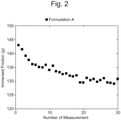
- Table 2 Immersed friction measured, and repeated 30 times, on hair switches treated with Conditioner A are given in the Table 2, and shown graphically in Figure 2 .
- Table 2 immersed fiction measurements for hair treated with Conditioner A. for 1 to 30 repeats Measurement number Formulation A 1 142.88 2 141.41 3 139.14 4 137.54 5 136.07 6 135.78 7 134.99 8 134.89 9 135.8 10 133.95 11 135.54 12 133.55 13 133.14 14 132.45 15 132.65 16 131.86 17 131.6 18 131.98 19 129.42 20 129.46 21 131.11 22 130.25 23 130.71 24 129.67 25 130.23 26 130.91 27 129.4 28 129.35 29 128.99 30 130.76
- Figure 2 shows the immersed fiction profile for hair treated with Conditioner A, repeated 30 times.
- Composition A was used to treat the hair fibres as described in Example 1. All probes comprise surfactant prior to use. All other experimental details are as described in Example 3 except that the probe is fitted with weights of 0g (no weight), 138g and 1000g respectively.
- the average friction recorded for probe fitted with 138g weight is 133.18 g mm, in good agreement with the data obtained in Table 2.
- the average friction recorded for probe fitted with 1000g weight is found artificially increased to 216.22g mm.
- this high friction caused difficulty in repeating the measurements because hair constantly slipped from clamp, then floated on water.
- no weight on probe has significantly decreased the friction. No meaningful data could be recorded.
Landscapes
- Health & Medical Sciences (AREA)
- Life Sciences & Earth Sciences (AREA)
- General Health & Medical Sciences (AREA)
- Veterinary Medicine (AREA)
- Animal Behavior & Ethology (AREA)
- Public Health (AREA)
- Birds (AREA)
- Epidemiology (AREA)
- Engineering & Computer Science (AREA)
- Biochemistry (AREA)
- Pathology (AREA)
- Automation & Control Theory (AREA)
- Physics & Mathematics (AREA)
- Chemical & Material Sciences (AREA)
- Analytical Chemistry (AREA)
- Dermatology (AREA)
- General Physics & Mathematics (AREA)
- Immunology (AREA)
- Emergency Medicine (AREA)
- Cosmetics (AREA)
- Investigating Or Analysing Biological Materials (AREA)
- Measurement Of The Respiration, Hearing Ability, Form, And Blood Characteristics Of Living Organisms (AREA)
- Investigating Strength Of Materials By Application Of Mechanical Stress (AREA)
Claims (7)
- Procédé de mesure de friction humide de cheveux, en utilisant un système comprenant :i) une sonde de friction (1), présentant une surface de contact (2), ladite sonde de friction équipée d'une masse (3) dans l'intervalle de 10 à 500 g ;ii) un moyen (6) pour fixer le faisceau de cheveux (5) ; etiii) un bain d'eau (7) ;dans lequel la sonde de friction est connectée à un analyseur de texture (4), ledit procédé comprenant les étapes de :i) fourniture d'un faisceau de fibres de cheveux (5) ;ii) alignement des fibres de cheveux (5) ;iii) fixation du faisceau de fibres de cheveux (5) ;iv) immersion du faisceau de fibres de cheveux (5) sous l'eau dans le bain d'eau (7) ;v) mise en contact des fibres de cheveux (5) avec la surface de contact (2) de la sonde de friction (1), qui est équipée de la masse (3) ;vi) déplacement de la sonde de friction le long des fibres de cheveux (5) ; etvii) enregistrement de la friction produite dans l'étape vi) ; caractérisé en ce que les étapes v) - vii) se font sous l'eau (8) ;et les étapes vi) - vii) sont répétées jusqu'à ce qu'une valeur constante soit obtenue, sans élever la sonde de friction (1) des cheveux (5).
- Procédé selon la revendication 1, comprenant l'étape de traitement du faisceau de fibres de cheveux (5) avec une première composition de traitement de cheveux.
- Procédé selon la revendication 2, comprenant les étapes de traitement du faisceau de fibres de cheveux (5) avec une seconde composition de traitement de cheveux, et de comparaison de la friction des cheveux traités avec la première composition de traitement des cheveux avec la friction des cheveux traités avec la seconde composition de traitement des cheveux.
- Procédé selon l'une quelconque des revendications précédentes, dans lequel les étapes vi) à vii) sont répétées de 15 à 100 fois.
- Procédé selon l'une quelconque des revendications précédentes, dans lequel la sonde de friction (1) comprend du tensioactif.
- Procédé selon la revendication 5, dans lequel la teneur en tensioactif sur la sonde de friction (1) est de 10 µg/cm2 à 1 500 µg/cm2.
- Procédé selon l'une quelconque des revendications précédentes, dans lequel la sonde de friction (1) comprend un matériau de caoutchouc.
Applications Claiming Priority (2)
| Application Number | Priority Date | Filing Date | Title |
|---|---|---|---|
| EP17163626 | 2017-03-29 | ||
| PCT/EP2018/057210 WO2018177850A1 (fr) | 2017-03-29 | 2018-03-21 | Procédé pour mesurer le frottement des cheveux à l'état humide |
Publications (2)
| Publication Number | Publication Date |
|---|---|
| EP3602004A1 EP3602004A1 (fr) | 2020-02-05 |
| EP3602004B1 true EP3602004B1 (fr) | 2022-01-26 |
Family
ID=58632126
Family Applications (1)
| Application Number | Title | Priority Date | Filing Date |
|---|---|---|---|
| EP18711146.3A Active EP3602004B1 (fr) | 2017-03-29 | 2018-03-21 | Procédé permettant de mesurer la friction humide de cheveux |
Country Status (10)
| Country | Link |
|---|---|
| US (1) | US11879831B2 (fr) |
| EP (1) | EP3602004B1 (fr) |
| JP (1) | JP7159191B2 (fr) |
| CN (1) | CN110476050B (fr) |
| BR (1) | BR112019019889B1 (fr) |
| EA (1) | EA037963B1 (fr) |
| MX (1) | MX2019011397A (fr) |
| PH (1) | PH12019502205A1 (fr) |
| WO (1) | WO2018177850A1 (fr) |
| ZA (1) | ZA201906403B (fr) |
Family Cites Families (69)
| Publication number | Priority date | Publication date | Assignee | Title |
|---|---|---|---|---|
| US2712235A (en) | 1952-08-25 | 1955-07-05 | Harold R Harlan | Paint testing machine |
| US3161704A (en) | 1962-09-12 | 1964-12-15 | Gen Electric | Testing device and use in process control |
| GB1157644A (en) | 1965-11-08 | 1969-07-09 | Courtaulds | Apparatus for Testing Physical Properties of Filaments |
| US3717025A (en) | 1971-03-01 | 1973-02-20 | Caterpillar Tractor Co | Apparatus and method for determining coefficient of friction |
| US3721250A (en) | 1971-04-16 | 1973-03-20 | Clairol Inc | Mist applicator comb |
| FR2207597A5 (fr) | 1972-11-20 | 1974-06-14 | Oreal | |
| US3921443A (en) | 1973-12-26 | 1975-11-25 | Redken Laboratories Inc | Apparatus for measuring tensile properties of hair |
| US3960160A (en) | 1974-08-15 | 1976-06-01 | Ladon Corporation | Hair treatment appliance |
| US4061022A (en) | 1976-07-19 | 1977-12-06 | Redken Laboratories, Inc. | Hair testing apparatus |
| US4167869A (en) | 1977-10-07 | 1979-09-18 | The Gillette Company | Apparatus for measuring hair grooming force |
| US4286469A (en) | 1980-02-06 | 1981-09-01 | The United States Of America As Represented By The Secretary Of The Navy | Optical fiber test apparatus |
| JPS57166545A (en) | 1981-04-08 | 1982-10-14 | Kazuo Nakayama | Measuring device for sharpness of grindstone by coefficient of friction |
| JP2526035B2 (ja) | 1986-05-21 | 1996-08-21 | 株式会社資生堂 | 毛髪の表面性状測定方法及び装置 |
| US4722218A (en) | 1986-09-22 | 1988-02-02 | The Goodyear Tire & Rubber Company | Device for measurement of coefficient of friction |
| US5618798A (en) | 1989-04-20 | 1997-04-08 | Bar-Shalom; Daniel | Use of sucralfate to treat baldness |
| FR2660756A1 (fr) | 1990-04-09 | 1991-10-11 | Elf France | Dispositif et procede pour ameliorer l'evaluation des performances d'un lubrifiant. |
| ZA931613B (en) | 1992-04-15 | 1993-11-15 | Curtis Helene Ind Inc | Conditioning shampoo composition and method of preparing and using the same |
| US5373723A (en) | 1992-09-11 | 1994-12-20 | Chou; Shou-Lai | Apparatus for determining friction between a support roller and a rubber roller |
| KR100278161B1 (ko) | 1996-12-16 | 2001-01-15 | 이토가 미찌야 | 실의 리프 턴오버 판정방법 및 실 삽입장치 |
| FR2780160B1 (fr) * | 1998-06-18 | 2000-09-15 | Rocher Yves Biolog Vegetale | Dispositif d'evaluation de proprietes de friction d'une surface |
| US6494076B1 (en) | 1998-12-22 | 2002-12-17 | The Goodyear Tire & Rubber Company | Pendulum rolling resistant test |
| US6321586B1 (en) | 1999-02-01 | 2001-11-27 | Lockheed Martin Federal Systems, Inc. | Conveyor friction measurement and cleaning system |
| GB0023472D0 (en) * | 2000-09-25 | 2000-11-08 | Procter & Gamble | Method,apparatus and system for assessing hair condition |
| US6817222B2 (en) | 2000-09-25 | 2004-11-16 | The Procter & Gamble Company | Method, apparatus and system for assessing hair condition |
| GB0220578D0 (en) | 2001-12-04 | 2002-10-09 | Unilever Plc | Hair treatement composition |
| US7082839B2 (en) * | 2002-01-28 | 2006-08-01 | Pine Instrument Company | Apparatus and method for testing moisture susceptibility, rutting and fatigue of material |
| US7378479B2 (en) | 2002-09-13 | 2008-05-27 | Lubrizol Advanced Materials, Inc. | Multi-purpose polymers, methods and compositions |
| CN2569129Y (zh) | 2002-09-19 | 2003-08-27 | 刘学耕 | 湿式摩擦材料摩擦性能试验机 |
| FR2867276B1 (fr) | 2004-03-04 | 2006-06-02 | Centre Nat Rech Scient | Sonde tribo acoustique |
| JP2005315594A (ja) | 2004-04-27 | 2005-11-10 | Yokohama Rubber Co Ltd:The | 摩擦係数測定方法及び測定装置 |
| EP1652555A1 (fr) | 2004-10-20 | 2006-05-03 | Unilever Plc | Compositions pour le soin des cheveux |
| US7472577B2 (en) | 2005-01-24 | 2009-01-06 | Kao Corporation | Hair sensor |
| US8417474B2 (en) * | 2006-02-10 | 2013-04-09 | The Procter & Gamble Company | Methods of use of substrate having properties of keratinous tissue |
| CA2689685C (fr) | 2007-06-05 | 2016-05-17 | Cargill, Incorporated | Procedes d'estimation d'attributs de saveur d'aliments a l'aide d'un dispositif de tribologie |
| US8151624B2 (en) * | 2007-09-14 | 2012-04-10 | The Procter & Gamble Company | Method for measuring surface smoothness of hair |
| US7997151B2 (en) | 2008-01-29 | 2011-08-16 | Kindersley Peter G | Automated apparatus and method for determining physical properties of materials |
| CN102159178A (zh) | 2008-06-25 | 2011-08-17 | 宝洁公司 | 包含二十二烷基三甲基甲酯硫酸铵并且具有较高屈服点的毛发调理组合物 |
| EP2326937A2 (fr) | 2008-08-25 | 2011-06-01 | The Procter & Gamble Company | Procédé d'évaluation des propriétés de frottement de fibres ou de substrats lors d'un traitement mécanique |
| US20120222466A1 (en) | 2009-11-24 | 2012-09-06 | Peter Lawrence Bailey | Device |
| WO2012016352A1 (fr) | 2010-08-03 | 2012-02-09 | Shi Jianmin | Bouteille d'humidification et appareil d'inhalation d'oxygène comprenant la bouteille d'humidification |
| CN102175600A (zh) | 2010-12-30 | 2011-09-07 | 东华大学 | 一种检测织物与皮肤间摩擦性能的装置及方法 |
| EP2570796A1 (fr) * | 2011-09-19 | 2013-03-20 | The Gillette Company | Procédé et appareil de mesure de rasage |
| US9541491B2 (en) | 2012-04-18 | 2017-01-10 | Phillip Nelson Rounds | Test methods and device for measuring transient resistance to movement |
| JP6002462B2 (ja) | 2012-06-15 | 2016-10-05 | 横浜ゴム株式会社 | コンベヤベルトの支持ローラ乗り越え抵抗力測定方法およびその装置 |
| EA028419B1 (ru) | 2012-07-27 | 2017-11-30 | Юнилевер Н.В. | Способ получения кондиционирующей гелевой фазы |
| CN104507452A (zh) | 2012-07-27 | 2015-04-08 | 荷兰联合利华有限公司 | 方法 |
| BR112015001732B1 (pt) | 2012-07-27 | 2019-08-27 | Unilever Nv | processo para produzir uma fase de gel de condicionamento e processo para fabricar uma composição de condicionamento |
| CN104507451B (zh) | 2012-07-27 | 2020-01-31 | 荷兰联合利华有限公司 | 方法 |
| US9662293B2 (en) | 2012-11-05 | 2017-05-30 | Hercules Llc | Personal care composition for a keratin substrate comprising conditioning and/or styling polymer |
| CN104956203A (zh) | 2013-02-01 | 2015-09-30 | 荷兰联合利华有限公司 | 方法 |
| WO2015043931A1 (fr) | 2013-09-25 | 2015-04-02 | Unilever Plc | Procédé d'évaluation de la lubrification et/ou du frottement des cheveux |
| CN105899183A (zh) | 2013-09-30 | 2016-08-24 | 宝洁公司 | 包含较高百分比的阳离子表面活性剂和沉积聚合物的毛发调理组合物 |
| JP6609244B2 (ja) | 2013-10-18 | 2019-11-20 | ユニリーバー・ナームローゼ・ベンノートシヤープ | ヘアケア組成物 |
| WO2015145466A2 (fr) | 2014-03-28 | 2015-10-01 | Ducom Instruments (Pvt) Ltd | Tribomètre à poignée |
| US9964471B2 (en) * | 2014-04-14 | 2018-05-08 | Instrotek, Inc. | Wheel-tracking devices and related systems and methods |
| EP2990796A1 (fr) | 2014-08-29 | 2016-03-02 | The Procter and Gamble Company | Dispositif pour tester les propriétés de fibres de cheveux |
| EP3193820B1 (fr) | 2014-09-15 | 2018-01-24 | Unilever Plc. | Composition de soin capillaire comprenant une émulsion de polymère polydiméthylsiloxane |
| US20160310375A1 (en) | 2015-04-23 | 2016-10-27 | The Procter & Gamble Company | Hair Care Regimen Using an Aerosol Foam Concentrated Conditioner |
| WO2016172406A1 (fr) | 2015-04-23 | 2016-10-27 | The Procter & Gamble Company | Composition de soins capillaires à faible viscosité |
| WO2016208307A1 (fr) | 2015-06-22 | 2016-12-29 | 花王株式会社 | Agent de traitement capillaire |
| EP3389610B1 (fr) | 2015-12-15 | 2024-04-17 | The Procter & Gamble Company | Composition de nettoyage de cheveux |
| CN108289817B (zh) | 2015-12-21 | 2021-10-01 | 瓦克美特罗尔克化学试剂有限公司 | 包含聚硅氧烷聚合物混合物的乳液及其制备方法 |
| EP3287119A1 (fr) | 2016-08-24 | 2018-02-28 | Noxell Corporation | Procédé de traitement capillaire |
| US10556133B2 (en) | 2017-06-05 | 2020-02-11 | Momentive Performance Materials Inc. | Composition and method for strengthening hair fiber |
| AR112127A1 (es) | 2017-06-15 | 2019-09-25 | Unilever Nv | Composición acondicionadora para el cabello que posee propiedades de enjuague mejoradas |
| CN110996711B (zh) | 2017-07-20 | 2023-08-25 | 宝洁公司 | 测量梳理阻力的梳状传感器 |
| EP3447475B1 (fr) | 2017-08-24 | 2020-06-17 | Alcon Inc. | Procédé et appareil pour déterminer un coefficient de frottement au niveau d'un site d'essai sur une surface d'une lentille de contact |
| EP3460433A1 (fr) | 2017-09-20 | 2019-03-27 | Koninklijke Philips N.V. | Dispositif de mesure de propriétés de cheveux |
| CN111556740B (zh) | 2017-12-28 | 2023-03-28 | 莱雅公司 | 用于调理角蛋白纤维的组合物 |
-
2018
- 2018-03-21 CN CN201880022260.5A patent/CN110476050B/zh active Active
- 2018-03-21 EA EA201991938A patent/EA037963B1/ru unknown
- 2018-03-21 MX MX2019011397A patent/MX2019011397A/es unknown
- 2018-03-21 WO PCT/EP2018/057210 patent/WO2018177850A1/fr not_active Ceased
- 2018-03-21 JP JP2019552939A patent/JP7159191B2/ja active Active
- 2018-03-21 EP EP18711146.3A patent/EP3602004B1/fr active Active
- 2018-03-21 US US16/497,441 patent/US11879831B2/en active Active
- 2018-03-21 BR BR112019019889-0A patent/BR112019019889B1/pt active IP Right Grant
-
2019
- 2019-09-25 PH PH12019502205A patent/PH12019502205A1/en unknown
- 2019-09-27 ZA ZA2019/06403A patent/ZA201906403B/en unknown
Non-Patent Citations (1)
| Title |
|---|
| None * |
Also Published As
| Publication number | Publication date |
|---|---|
| EA037963B1 (ru) | 2021-06-16 |
| MX2019011397A (es) | 2019-11-07 |
| JP7159191B2 (ja) | 2022-10-24 |
| US20210041349A1 (en) | 2021-02-11 |
| CN110476050B (zh) | 2022-02-18 |
| BR112019019889A2 (pt) | 2020-04-22 |
| EP3602004A1 (fr) | 2020-02-05 |
| PH12019502205A1 (en) | 2020-12-07 |
| CN110476050A (zh) | 2019-11-19 |
| US11879831B2 (en) | 2024-01-23 |
| EA201991938A1 (ru) | 2020-07-08 |
| BR112019019889B1 (pt) | 2023-10-03 |
| JP2020515836A (ja) | 2020-05-28 |
| ZA201906403B (en) | 2022-06-29 |
| WO2018177850A1 (fr) | 2018-10-04 |
Similar Documents
| Publication | Publication Date | Title |
|---|---|---|
| JP6153928B2 (ja) | パーソナルケア組成物 | |
| US11105732B2 (en) | Apparatus and method for measuring wet friction of hair | |
| EP1402881A1 (fr) | Compositions comprenant au moins une silicone phosphatée et au moins un composé aminé, et méthode utilisant ces compositions | |
| US7122174B2 (en) | Compositions comprising at least one silicone compound and at least one amine compound, and methods for using the same | |
| US11879831B2 (en) | Method for measuring wet friction of hair | |
| EP4045893B1 (fr) | Procédé de détermination de propriétés de rinçage | |
| JP4154548B2 (ja) | ヘアトリートメント | |
| US12140539B2 (en) | Method for determining rinse properties | |
| JP4123399B2 (ja) | ヘアトリートメント | |
| CA3099375A1 (fr) | Procede | |
| JPH09110644A (ja) | ヘアーコンディショニング剤組成物 |
Legal Events
| Date | Code | Title | Description |
|---|---|---|---|
| STAA | Information on the status of an ep patent application or granted ep patent |
Free format text: STATUS: UNKNOWN |
|
| STAA | Information on the status of an ep patent application or granted ep patent |
Free format text: STATUS: THE INTERNATIONAL PUBLICATION HAS BEEN MADE |
|
| PUAI | Public reference made under article 153(3) epc to a published international application that has entered the european phase |
Free format text: ORIGINAL CODE: 0009012 |
|
| STAA | Information on the status of an ep patent application or granted ep patent |
Free format text: STATUS: REQUEST FOR EXAMINATION WAS MADE |
|
| 17P | Request for examination filed |
Effective date: 20190927 |
|
| AK | Designated contracting states |
Kind code of ref document: A1 Designated state(s): AL AT BE BG CH CY CZ DE DK EE ES FI FR GB GR HR HU IE IS IT LI LT LU LV MC MK MT NL NO PL PT RO RS SE SI SK SM TR |
|
| AX | Request for extension of the european patent |
Extension state: BA ME |
|
| DAV | Request for validation of the european patent (deleted) | ||
| DAX | Request for extension of the european patent (deleted) | ||
| STAA | Information on the status of an ep patent application or granted ep patent |
Free format text: STATUS: EXAMINATION IS IN PROGRESS |
|
| 17Q | First examination report despatched |
Effective date: 20201022 |
|
| GRAP | Despatch of communication of intention to grant a patent |
Free format text: ORIGINAL CODE: EPIDOSNIGR1 |
|
| STAA | Information on the status of an ep patent application or granted ep patent |
Free format text: STATUS: GRANT OF PATENT IS INTENDED |
|
| RAP1 | Party data changed (applicant data changed or rights of an application transferred) |
Owner name: UNILEVER GLOBAL IP LIMITED Owner name: UNILEVER IP HOLDINGS B.V. |
|
| INTG | Intention to grant announced |
Effective date: 20210927 |
|
| GRAS | Grant fee paid |
Free format text: ORIGINAL CODE: EPIDOSNIGR3 |
|
| GRAA | (expected) grant |
Free format text: ORIGINAL CODE: 0009210 |
|
| STAA | Information on the status of an ep patent application or granted ep patent |
Free format text: STATUS: THE PATENT HAS BEEN GRANTED |
|
| AK | Designated contracting states |
Kind code of ref document: B1 Designated state(s): AL AT BE BG CH CY CZ DE DK EE ES FI FR GB GR HR HU IE IS IT LI LT LU LV MC MK MT NL NO PL PT RO RS SE SI SK SM TR |
|
| REG | Reference to a national code |
Ref country code: GB Ref legal event code: FG4D |
|
| REG | Reference to a national code |
Ref country code: CH Ref legal event code: EP |
|
| REG | Reference to a national code |
Ref country code: AT Ref legal event code: REF Ref document number: 1465650 Country of ref document: AT Kind code of ref document: T Effective date: 20220215 |
|
| REG | Reference to a national code |
Ref country code: IE Ref legal event code: FG4D |
|
| REG | Reference to a national code |
Ref country code: DE Ref legal event code: R096 Ref document number: 602018030048 Country of ref document: DE |
|
| RAP4 | Party data changed (patent owner data changed or rights of a patent transferred) |
Owner name: UNILEVER GLOBAL IP LIMITED Owner name: UNILEVER IP HOLDINGS B.V. |
|
| REG | Reference to a national code |
Ref country code: LT Ref legal event code: MG9D |
|
| REG | Reference to a national code |
Ref country code: AT Ref legal event code: MK05 Ref document number: 1465650 Country of ref document: AT Kind code of ref document: T Effective date: 20220126 |
|
| PG25 | Lapsed in a contracting state [announced via postgrant information from national office to epo] |
Ref country code: NL Free format text: LAPSE BECAUSE OF FAILURE TO SUBMIT A TRANSLATION OF THE DESCRIPTION OR TO PAY THE FEE WITHIN THE PRESCRIBED TIME-LIMIT Effective date: 20220126 |
|
| PG25 | Lapsed in a contracting state [announced via postgrant information from national office to epo] |
Ref country code: SE Free format text: LAPSE BECAUSE OF FAILURE TO SUBMIT A TRANSLATION OF THE DESCRIPTION OR TO PAY THE FEE WITHIN THE PRESCRIBED TIME-LIMIT Effective date: 20220126 Ref country code: RS Free format text: LAPSE BECAUSE OF FAILURE TO SUBMIT A TRANSLATION OF THE DESCRIPTION OR TO PAY THE FEE WITHIN THE PRESCRIBED TIME-LIMIT Effective date: 20220126 Ref country code: PT Free format text: LAPSE BECAUSE OF FAILURE TO SUBMIT A TRANSLATION OF THE DESCRIPTION OR TO PAY THE FEE WITHIN THE PRESCRIBED TIME-LIMIT Effective date: 20220526 Ref country code: NO Free format text: LAPSE BECAUSE OF FAILURE TO SUBMIT A TRANSLATION OF THE DESCRIPTION OR TO PAY THE FEE WITHIN THE PRESCRIBED TIME-LIMIT Effective date: 20220426 Ref country code: LT Free format text: LAPSE BECAUSE OF FAILURE TO SUBMIT A TRANSLATION OF THE DESCRIPTION OR TO PAY THE FEE WITHIN THE PRESCRIBED TIME-LIMIT Effective date: 20220126 Ref country code: HR Free format text: LAPSE BECAUSE OF FAILURE TO SUBMIT A TRANSLATION OF THE DESCRIPTION OR TO PAY THE FEE WITHIN THE PRESCRIBED TIME-LIMIT Effective date: 20220126 Ref country code: ES Free format text: LAPSE BECAUSE OF FAILURE TO SUBMIT A TRANSLATION OF THE DESCRIPTION OR TO PAY THE FEE WITHIN THE PRESCRIBED TIME-LIMIT Effective date: 20220126 Ref country code: BG Free format text: LAPSE BECAUSE OF FAILURE TO SUBMIT A TRANSLATION OF THE DESCRIPTION OR TO PAY THE FEE WITHIN THE PRESCRIBED TIME-LIMIT Effective date: 20220426 |
|
| PG25 | Lapsed in a contracting state [announced via postgrant information from national office to epo] |
Ref country code: PL Free format text: LAPSE BECAUSE OF FAILURE TO SUBMIT A TRANSLATION OF THE DESCRIPTION OR TO PAY THE FEE WITHIN THE PRESCRIBED TIME-LIMIT Effective date: 20220126 Ref country code: LV Free format text: LAPSE BECAUSE OF FAILURE TO SUBMIT A TRANSLATION OF THE DESCRIPTION OR TO PAY THE FEE WITHIN THE PRESCRIBED TIME-LIMIT Effective date: 20220126 Ref country code: GR Free format text: LAPSE BECAUSE OF FAILURE TO SUBMIT A TRANSLATION OF THE DESCRIPTION OR TO PAY THE FEE WITHIN THE PRESCRIBED TIME-LIMIT Effective date: 20220427 Ref country code: FI Free format text: LAPSE BECAUSE OF FAILURE TO SUBMIT A TRANSLATION OF THE DESCRIPTION OR TO PAY THE FEE WITHIN THE PRESCRIBED TIME-LIMIT Effective date: 20220126 Ref country code: AT Free format text: LAPSE BECAUSE OF FAILURE TO SUBMIT A TRANSLATION OF THE DESCRIPTION OR TO PAY THE FEE WITHIN THE PRESCRIBED TIME-LIMIT Effective date: 20220126 |
|
| PG25 | Lapsed in a contracting state [announced via postgrant information from national office to epo] |
Ref country code: IS Free format text: LAPSE BECAUSE OF FAILURE TO SUBMIT A TRANSLATION OF THE DESCRIPTION OR TO PAY THE FEE WITHIN THE PRESCRIBED TIME-LIMIT Effective date: 20220526 |
|
| REG | Reference to a national code |
Ref country code: DE Ref legal event code: R097 Ref document number: 602018030048 Country of ref document: DE |
|
| PG25 | Lapsed in a contracting state [announced via postgrant information from national office to epo] |
Ref country code: SM Free format text: LAPSE BECAUSE OF FAILURE TO SUBMIT A TRANSLATION OF THE DESCRIPTION OR TO PAY THE FEE WITHIN THE PRESCRIBED TIME-LIMIT Effective date: 20220126 Ref country code: SK Free format text: LAPSE BECAUSE OF FAILURE TO SUBMIT A TRANSLATION OF THE DESCRIPTION OR TO PAY THE FEE WITHIN THE PRESCRIBED TIME-LIMIT Effective date: 20220126 Ref country code: RO Free format text: LAPSE BECAUSE OF FAILURE TO SUBMIT A TRANSLATION OF THE DESCRIPTION OR TO PAY THE FEE WITHIN THE PRESCRIBED TIME-LIMIT Effective date: 20220126 Ref country code: MC Free format text: LAPSE BECAUSE OF FAILURE TO SUBMIT A TRANSLATION OF THE DESCRIPTION OR TO PAY THE FEE WITHIN THE PRESCRIBED TIME-LIMIT Effective date: 20220126 Ref country code: EE Free format text: LAPSE BECAUSE OF FAILURE TO SUBMIT A TRANSLATION OF THE DESCRIPTION OR TO PAY THE FEE WITHIN THE PRESCRIBED TIME-LIMIT Effective date: 20220126 Ref country code: DK Free format text: LAPSE BECAUSE OF FAILURE TO SUBMIT A TRANSLATION OF THE DESCRIPTION OR TO PAY THE FEE WITHIN THE PRESCRIBED TIME-LIMIT Effective date: 20220126 Ref country code: CZ Free format text: LAPSE BECAUSE OF FAILURE TO SUBMIT A TRANSLATION OF THE DESCRIPTION OR TO PAY THE FEE WITHIN THE PRESCRIBED TIME-LIMIT Effective date: 20220126 |
|
| REG | Reference to a national code |
Ref country code: CH Ref legal event code: PL |
|
| PG25 | Lapsed in a contracting state [announced via postgrant information from national office to epo] |
Ref country code: AL Free format text: LAPSE BECAUSE OF FAILURE TO SUBMIT A TRANSLATION OF THE DESCRIPTION OR TO PAY THE FEE WITHIN THE PRESCRIBED TIME-LIMIT Effective date: 20220126 |
|
| PLBE | No opposition filed within time limit |
Free format text: ORIGINAL CODE: 0009261 |
|
| STAA | Information on the status of an ep patent application or granted ep patent |
Free format text: STATUS: NO OPPOSITION FILED WITHIN TIME LIMIT |
|
| REG | Reference to a national code |
Ref country code: BE Ref legal event code: MM Effective date: 20220331 |
|
| 26N | No opposition filed |
Effective date: 20221027 |
|
| PG25 | Lapsed in a contracting state [announced via postgrant information from national office to epo] |
Ref country code: LU Free format text: LAPSE BECAUSE OF NON-PAYMENT OF DUE FEES Effective date: 20220321 Ref country code: LI Free format text: LAPSE BECAUSE OF NON-PAYMENT OF DUE FEES Effective date: 20220331 Ref country code: IE Free format text: LAPSE BECAUSE OF NON-PAYMENT OF DUE FEES Effective date: 20220321 Ref country code: CH Free format text: LAPSE BECAUSE OF NON-PAYMENT OF DUE FEES Effective date: 20220331 |
|
| PG25 | Lapsed in a contracting state [announced via postgrant information from national office to epo] |
Ref country code: SI Free format text: LAPSE BECAUSE OF FAILURE TO SUBMIT A TRANSLATION OF THE DESCRIPTION OR TO PAY THE FEE WITHIN THE PRESCRIBED TIME-LIMIT Effective date: 20220126 Ref country code: BE Free format text: LAPSE BECAUSE OF NON-PAYMENT OF DUE FEES Effective date: 20220331 |
|
| P01 | Opt-out of the competence of the unified patent court (upc) registered |
Effective date: 20230428 |
|
| PG25 | Lapsed in a contracting state [announced via postgrant information from national office to epo] |
Ref country code: IT Free format text: LAPSE BECAUSE OF FAILURE TO SUBMIT A TRANSLATION OF THE DESCRIPTION OR TO PAY THE FEE WITHIN THE PRESCRIBED TIME-LIMIT Effective date: 20220126 |
|
| PG25 | Lapsed in a contracting state [announced via postgrant information from national office to epo] |
Ref country code: MK Free format text: LAPSE BECAUSE OF FAILURE TO SUBMIT A TRANSLATION OF THE DESCRIPTION OR TO PAY THE FEE WITHIN THE PRESCRIBED TIME-LIMIT Effective date: 20220126 Ref country code: CY Free format text: LAPSE BECAUSE OF FAILURE TO SUBMIT A TRANSLATION OF THE DESCRIPTION OR TO PAY THE FEE WITHIN THE PRESCRIBED TIME-LIMIT Effective date: 20220126 |
|
| PG25 | Lapsed in a contracting state [announced via postgrant information from national office to epo] |
Ref country code: HU Free format text: LAPSE BECAUSE OF FAILURE TO SUBMIT A TRANSLATION OF THE DESCRIPTION OR TO PAY THE FEE WITHIN THE PRESCRIBED TIME-LIMIT; INVALID AB INITIO Effective date: 20180321 |
|
| PG25 | Lapsed in a contracting state [announced via postgrant information from national office to epo] |
Ref country code: TR Free format text: LAPSE BECAUSE OF FAILURE TO SUBMIT A TRANSLATION OF THE DESCRIPTION OR TO PAY THE FEE WITHIN THE PRESCRIBED TIME-LIMIT Effective date: 20220126 |
|
| PG25 | Lapsed in a contracting state [announced via postgrant information from national office to epo] |
Ref country code: MT Free format text: LAPSE BECAUSE OF FAILURE TO SUBMIT A TRANSLATION OF THE DESCRIPTION OR TO PAY THE FEE WITHIN THE PRESCRIBED TIME-LIMIT Effective date: 20220126 |
|
| PGFP | Annual fee paid to national office [announced via postgrant information from national office to epo] |
Ref country code: GB Payment date: 20260324 Year of fee payment: 9 |
|
| PGFP | Annual fee paid to national office [announced via postgrant information from national office to epo] |
Ref country code: DE Payment date: 20260319 Year of fee payment: 9 |
|
| PGFP | Annual fee paid to national office [announced via postgrant information from national office to epo] |
Ref country code: FR Payment date: 20260320 Year of fee payment: 9 |