EP3602078B1 - Procédé et système de détermination d'une estimation d'un paramètre anémométrique dans un aéronef - Google Patents
Procédé et système de détermination d'une estimation d'un paramètre anémométrique dans un aéronef Download PDFInfo
- Publication number
- EP3602078B1 EP3602078B1 EP18852019.1A EP18852019A EP3602078B1 EP 3602078 B1 EP3602078 B1 EP 3602078B1 EP 18852019 A EP18852019 A EP 18852019A EP 3602078 B1 EP3602078 B1 EP 3602078B1
- Authority
- EP
- European Patent Office
- Prior art keywords
- estimation
- aircraft
- indication
- actuator
- primary surface
- Prior art date
- Legal status (The legal status is an assumption and is not a legal conclusion. Google has not performed a legal analysis and makes no representation as to the accuracy of the status listed.)
- Active
Links
Images

Classifications
-
- G—PHYSICS
- G01—MEASURING; TESTING
- G01C—MEASURING DISTANCES, LEVELS OR BEARINGS; SURVEYING; NAVIGATION; GYROSCOPIC INSTRUMENTS; PHOTOGRAMMETRY OR VIDEOGRAMMETRY
- G01C23/00—Combined instruments indicating more than one navigational value, e.g. for aircraft; Combined measuring devices for measuring two or more variables of movement, e.g. distance, speed or acceleration
-
- B—PERFORMING OPERATIONS; TRANSPORTING
- B64—AIRCRAFT; AVIATION; COSMONAUTICS
- B64C—AEROPLANES; HELICOPTERS
- B64C13/00—Control systems or transmitting systems for actuating flying-control surfaces, lift-increasing flaps, air brakes, or spoilers
-
- B—PERFORMING OPERATIONS; TRANSPORTING
- B64—AIRCRAFT; AVIATION; COSMONAUTICS
- B64D—EQUIPMENT FOR FITTING IN OR TO AIRCRAFT; FLIGHT SUITS; PARACHUTES; ARRANGEMENT OR MOUNTING OF POWER PLANTS OR PROPULSION TRANSMISSIONS IN AIRCRAFT
- B64D43/00—Arrangements or adaptations of instruments
-
- B—PERFORMING OPERATIONS; TRANSPORTING
- B64—AIRCRAFT; AVIATION; COSMONAUTICS
- B64D—EQUIPMENT FOR FITTING IN OR TO AIRCRAFT; FLIGHT SUITS; PARACHUTES; ARRANGEMENT OR MOUNTING OF POWER PLANTS OR PROPULSION TRANSMISSIONS IN AIRCRAFT
- B64D43/00—Arrangements or adaptations of instruments
- B64D43/02—Arrangements or adaptations of instruments for indicating aircraft speed or stalling conditions
-
- G—PHYSICS
- G01—MEASURING; TESTING
- G01C—MEASURING DISTANCES, LEVELS OR BEARINGS; SURVEYING; NAVIGATION; GYROSCOPIC INSTRUMENTS; PHOTOGRAMMETRY OR VIDEOGRAMMETRY
- G01C9/00—Measuring inclination, e.g. by clinometers, by levels
- G01C9/005—Measuring inclination, e.g. by clinometers, by levels specially adapted for use in aircraft
-
- G—PHYSICS
- G01—MEASURING; TESTING
- G01P—MEASURING LINEAR OR ANGULAR SPEED, ACCELERATION, DECELERATION, OR SHOCK; INDICATING PRESENCE, ABSENCE, OR DIRECTION, OF MOVEMENT
- G01P13/00—Indicating or recording presence, absence, or direction, of movement
- G01P13/02—Indicating direction only, e.g. by weather vane
- G01P13/025—Indicating direction only, e.g. by weather vane indicating air data, i.e. flight variables of an aircraft, e.g. angle of attack, side slip, shear, yaw
-
- G—PHYSICS
- G01—MEASURING; TESTING
- G01P—MEASURING LINEAR OR ANGULAR SPEED, ACCELERATION, DECELERATION, OR SHOCK; INDICATING PRESENCE, ABSENCE, OR DIRECTION, OF MOVEMENT
- G01P21/00—Testing or calibrating of apparatus or devices covered by the preceding groups
- G01P21/02—Testing or calibrating of apparatus or devices covered by the preceding groups of speedometers
- G01P21/025—Testing or calibrating of apparatus or devices covered by the preceding groups of speedometers for measuring speed of fluids; for measuring speed of bodies relative to fluids
-
- G—PHYSICS
- G01—MEASURING; TESTING
- G01P—MEASURING LINEAR OR ANGULAR SPEED, ACCELERATION, DECELERATION, OR SHOCK; INDICATING PRESENCE, ABSENCE, OR DIRECTION, OF MOVEMENT
- G01P5/00—Measuring speed of fluids, e.g. of air stream; Measuring speed of bodies relative to fluids, e.g. of ship, of aircraft
- G01P5/02—Measuring speed of fluids, e.g. of air stream; Measuring speed of bodies relative to fluids, e.g. of ship, of aircraft by measuring forces exerted by the fluid on solid bodies, e.g. anemometer
Definitions
- the invention relates to management of aircraft systems. More precisely, the invention pertains to a method and a system for determining an estimation of an anemometric parameter in an aircraft.
- the flight computer for providing a flight envelope protection.
- a loss of the pitot static system or the air data computer, which are used for providing the calibrated airspeed can therefore have some serious consequences for the pilot of an aircraft.
- anemometric parameters which may be impacted by a loss of the pitot static system or the air data computer comprise the angle of attack (AOA)/flight path angle (FPA) of the aircraft and the sideslip angle (beta) of the aircraft.
- AOA angle of attack
- FPA flight path angle
- Beta sideslip angle
- the system comprises: a flight control surface for an aircraft; a control surface actuator coupled to the flight control surface, wherein the control surface actuator receives an actuator control output signal from an actuator control system and drives the flight control surface into a position based on the actuator control output signal; a wind estimator coupled to a plurality of aircraft sensors, wherein the plurality of aircraft sensors output a set of aircraft measurements to the wind estimator and wherein the actuator control output signal is further provided to the wind estimator; wherein the wind estimator calculates a wind speed estimate by applying the actuator control output and the set of aircraft measurements to an onboard aircraft model.
- a method for determining an estimation of an anemometric parameter of an aircraft comprising:
- the obtaining of an estimation of the load applied on a corresponding actuator used for actuating the horizontal primary surface comprises determining a first load estimation according to a first method; determining a second load estimation according to a second method different than the first method; performing a consolidation of the first load estimation and the second load estimation to provide the estimation of the load applied on the corresponding actuator.
- the performing of the consolidation comprises computing an average of the first load estimation and the second load estimation.
- the method further comprises obtaining an indication of a position of a piston of the actuator of the horizontal primary surface, an indication of a first internal pressure of the piston of the actuator and an indication of a second internal pressure of the piston of the actuator; further wherein the first load estimation is determined using the indication of the position of the piston and the indication of the position of the horizontal primary surface actuated by the corresponding actuator and the second load estimation is determined using the indication of the position of the horizontal primary surface actuated by the corresponding actuator and the indication of the first internal pressure of the piston of the actuator and the indication of the second internal pressure of the piston of the actuator.
- the method further comprises obtaining more than one other indication of a position for each of more than one other primary surface of the aircraft; obtaining more than one other estimation of a load applied on each of more than one other actuator used each for actuating one of the more than one other primary surface and a corresponding position of each corresponding actuator of the more than one other actuator; obtaining at least one of an inertial reference system (IRS) data of the aircraft and an estimation of an angle of attack (a) and an angle of slideslip ( ⁇ ) of the aircraft; accessing more than one other lookup table, each accessing with the indication of a state of the at least one secondary surface of the aircraft, a corresponding estimation of the load applied on a corresponding actuator of the more than one other actuator used for actuating a corresponding primary surface of the more than one other primary surface of the aircraft, and the corresponding position of the corresponding actuator used for actuating the corresponding primary surface of the more than one other corresponding surface; obtaining more than one corresponding estimation of the anemometric parameter of the
- the providing of the corresponding estimation of the anemometric parameter of the aircraft is performed upon detection of an event.
- the event comprises an erroneous reading of the anemometric parameter.
- the event comprises a detection of a failure of a given system of the aircraft.
- the providing of the corresponding estimation of the anemometric parameter of the aircraft comprises displaying the corresponding estimation of the anemometric parameter.
- the displaying of the corresponding estimation of the anemometric parameter of the aircraft is performed on a primary flight display.
- the providing of the corresponding estimation of the anemometric parameter of the aircraft comprises recording the corresponding estimation of the anemometric parameter of the aircraft in a flight data recorder.
- the providing of the corresponding estimation of the anemometric parameter of the aircraft comprises transmitting the corresponding estimation of the anemometric parameter of the aircraft to a remote location using a data network.
- a system for determining an estimation of an anemometric parameter of an aircraft the anemometric parameter selected from a group comprising at least one of an angle of attack, a sideslip angle and a calibrated airspeed
- the system comprising a state indication providing unit, obtaining an indication of a state of at least one secondary surface that acts on the aerodynamic coefficient of the aircraft and providing the indication of a state of at least one secondary surface of the aircraft; a load estimation unit receiving an indication of a position of a corresponding horizontal primary surface that act on the aircraft attitude and a position of a corresponding actuator used for actuating the horizontal primary surface, the load estimation unit providing an estimation of the load applied on the corresponding actuator used for actuating the horizontal primary surface of the aircraft using at least the indication of the position of the horizontal primary surface and the position of the corresponding actuator; at least one lookup table associating a given estimation of a load applied on a corresponding actuator, a given indication of the state of the at least one secondary surface,
- the load estimation unit comprises a first load estimation unit for determining a first load estimation according to a first method, a second load estimation unit for determining a second load estimation according to a second method different from the first method and a consolidation unit receiving the first load estimation, the second load estimation and performing a consolidation of the first load estimation and the second load estimation to provide the estimation of the load applied on the corresponding actuator.
- the first load estimation unit receives the indication of the position of the corresponding horizontal primary surface and the position of the corresponding actuator, further wherein the first load estimation unit provides the estimation of the load applied on the corresponding actuator used for actuating the horizontal primary surface of the aircraft using at least the indication of the position of the horizontal primary surface and the position of the corresponding actuator; and further wherein the second load estimation unit receives the indication of the position of the horizontal primary surface actuated by the corresponding actuator and an indication of a first internal pressure of a piston of the corresponding actuator and an indication of a second internal pressure of the piston of the corresponding actuator and determines the estimation of the load applied on the corresponding actuator using the indication of the position of the horizontal primary surface actuated by the corresponding actuator and the indication of the first internal pressure of the piston of the actuator and the indication of the second internal pressure of the piston of the actuator.
- the system further comprises at least one other load estimation unit, each of the at least one other load estimation unit receiving an indication of a corresponding position of a corresponding other primary surface and a corresponding position of a corresponding actuator used for actuating the corresponding other primary surface, each of the at least one other load estimation unit for providing a corresponding estimation of a load applied on the corresponding actuator used for actuating the corresponding other primary surface of the aircraft using at least the corresponding position of a corresponding primary surface and the corresponding position of the corresponding actuator; at least one other lookup table, each of the at least one other lookup table associating a given estimation of a load applied on a corresponding actuator, a given indication of a state of the at least one secondary surface, a corresponding position of a given corresponding actuator with a corresponding estimation of the anemometric parameter; at least one processing unit, each of the at least one processing unit receiving the corresponding estimation of the load applied on the corresponding at least one other actuator, the indication of the state of at least
- a non-transitory computer readable storage medium for storing computer-executable instructions which, when executed, cause a processing device to perform a method for determining an estimation of an anemometric parameter of an aircraft, the anemometric parameter selected from a group comprising at least one of an angle of attack, a sideslip angle and a calibrated airspeed, the method comprising:
- the processing unit further receives an indication of the anemometric parameter and generates at least one part of the at least one lookup table using the given estimation of the load applied on the corresponding actuator, the given indication of the state of the at least one secondary surface, the corresponding position of the corresponding actuator and the indication of the anemometric parameter.
- the generation of the at least one part of the at least one lookup table is performed using an artificial intelligence-based technique selected from a group consisting of Bayesian networks, neuronal networks and deep learning technology.
- the method further comprises receiving in the learning phase an indication of the anemometric parameter and generating during the learning phase at least one part of the at least one lookup table using the received indication of the anemometric parameter, the indication of the state of the at least one secondary surface of the aircraft, the estimation of the load applied on the corresponding actuator used for actuating the horizontal primary surface of the aircraft and the position of the corresponding actuator.
- the generating during the learning phase of the at least one part of the at least one lookup table is performed using an artificial intelligence-based technique selected from a group consisting of Bayesian networks, neuronal networks and deep learning technology.
- each of the at least one secondary surface is selected from a group consisting of a horizontal stabilizer trim of the aircraft, a spoiler of the aircraft, a slat of the aircraft and a flap of the aircraft.
- each of the at least one secondary surface is selected from a group consisting of a horizontal stabilizer trim of the aircraft, a spoiler of the aircraft, a slat of the aircraft and a flap of the aircraft.
- the horizontal primary surface is selected from a group consisting of an elevator of the aircraft, an aileron of the aircraft and a flaperon of the aircraft.
- the horizontal primary surface is selected from a group consisting of an elevator of the aircraft, an aileron of the aircraft and a flaperon of the aircraft.
- the state of the at least one secondary surface comprises a corresponding configuration of the at least one secondary surface.
- the state of the at least one secondary surface comprises a corresponding configuration of the at least one secondary surface.
- the state indication providing unit comprises at least one sensor, each sensor associated with a corresponding secondary surface of the at least one secondary surface of the aircraft.
- An advantage of the method disclosed herein is that it provides an estimation of an anemometric parameter of an aircraft notwithstanding the state of the pitot static system, wherein the anemometric parameter is at least one of an angle of attack, a sideslip angle and a calibrated airspeed.
- Another advantage of the method disclosed herein is that it is generic since it uses at least one lookup table, which is generated during a learning phase.
- Another advantage of the method disclosed herein is that it provides an estimation of an anemometric parameter, which may supplement and/or replace a corresponding one generated using the pitot static system.
- Another advantage of the method disclosed is that its use enables the providing of a flight envelope by the flight computer and other functions of the aircraft such as the autopilot.
- the present invention is directed to a system and a method for determining an estimation of an anemometric parameter in an aircraft.
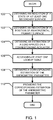
- FIG. 1 there is shown an embodiment of a method for determining an estimation of an anemometric parameter in an aircraft.
- the anemometric parameter is selected from a group comprising at least one of an angle of attack of the aircraft, a sideslip angle of the aircraft and a calibrated airspeed of the aircraft.
- estimation of the anemometric parameter may be provided according to various embodiments.
- the estimation of the anemometric parameter may be provided following a detection of an event.
- the event may be for instance a failure of a given system.
- the event may alternatively be a detection of an erroneous reading of a present anemometric parameter, which leads to believe that a failure of a system has occurred or is currently occurring.
- the estimation of the anemometric parameter is continuously generated.
- processing step 100 an indication of a state of at least one secondary surface of the aircraft is obtained.
- a secondary surface can be defined as a surface that acts on the aerodynamic coefficient (i.e., drag, lift and load).
- the secondary surface may be selected from a group consisting of a horizontal stabilizer trim, spoilers, slat and flap.
- the state of a secondary surface means a corresponding configuration of the secondary surface.
- the state may be an extension degree of the flap.
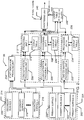
- FIG. 2 there is shown an embodiment of a system 199 for determining an estimation of an anemometric parameter in an aircraft.
- the system 199 comprises a state indication providing unit 204, a load estimation providing unit 1 208, a processing unit 1 210, a lookup table 1 212, a load estimation providing unit 2 226, a processing unit 2 228, a lookup table 2 230, a load estimation providing unit m 232, a processing unit m 234, a lookup table m 236, a processing unit 240, a lookup table 242.
- the state indication providing unit 204 is used for providing an indication of a state of at least one secondary surface of the aircraft.
- the state indication providing unit 204 is operatively coupled to at least one secondary surface 200.
- the at least one secondary surface 200 comprises a first secondary surface 214, a second secondary surface 216, ... and an n th secondary surface 218.
- the state indication providing unit 204 comprises a plurality of sensors, each sensor associated with a given secondary surface of the at least one secondary surface 200.
- the system 199 for determining an estimation of an anemometric parameter in an aircraft further comprises a load estimation providing unit 1 208.
- the load estimation providing unit 1 208 is used for providing an estimation of a load applied on a corresponding actuator used for actuating a primary surface of the aircraft. It will be appreciated by the skilled addressee that the load can be estimated but cannot be directly measured.
- the load can be referred to as a weight applied to a surface and may further be estimated according to various embodiments, as further explained below.
- a primary surface is defined as a surface that act on the aircraft attitude (i.e., on any one of a pitch angle, a roll angle and a yaw angle).
- the primary surface may be selected from a group consisting of elevators, ailerons, flaperon and rudder of the aircraft.
- the load estimation providing unit 1 208 is operatively coupled to a primary surface 1 220 of the at least one primary surface 202.
- the at least one primary surface 202 comprises a first primary surface 220, a second primary surface 222, ... and an m th primary surface 224. It will be further appreciated that at least one horizontal primary surface has to be used.
- the system 199 further comprises a processing unit 1 210 and a lookup table 1 212.
- the processing unit 1 210 is operatively coupled to the load estimation unit 1 208, to the state indication providing unit 204 and to the lookup table 1 212.
- the processing unit 1 210 receives an estimation of a load associated with the primary surface 1 220 from the load estimation providing unit 1 208 and an indication of a state of the at least one secondary surface 200 from the state indication providing unit 204 and accesses the lookup table 1 212 using that information to determine a first estimation of an anemometric parameter.
- the system 199 for determining an estimation of an anemometric parameter in an aircraft further comprises a load estimation providing unit 2 226.
- the load estimation providing unit 2 226 is used for providing an estimation of a load applied on a corresponding actuator used for actuating a corresponding primary surface of the aircraft. As explained above, it will be appreciated by the skilled addressee that the load can be estimated but cannot be directly measured.
- the load estimation providing unit 2 226 is operatively coupled to the primary surface 2 222 of the at least one primary surface 202.
- the system 199 further comprises a processing unit 2 228 and a lookup table 2 230.
- the processing unit 2 228 is operatively coupled to the load estimation unit 2 226, to the state indication providing unit 204 and to the lookup table 2 230.
- the processing unit 2 228 further receives an estimation of a load associated with the primary surface 2 222 from the load estimation providing unit 2 226 and an indication of a state of the at least one secondary surface 200 from the state indication providing unit 204 and accesses the lookup table 2 230 using that information to determine a second estimation of an anemometric parameter.
- the system 199 for determining an estimation of an anemometric parameter in an aircraft further comprises a load estimation providing unit m 232.
- the load estimation providing unit m 232 is used for providing an estimation of a load applied on a corresponding actuator used for actuating a corresponding primary surface of the aircraft. As explained above, it will be appreciated by the skilled addressee that the load can be estimated but cannot be directly measured.
- the load estimation providing unit m 232 is operatively coupled to primary surface m 224 of the at least one primary surface 202.
- the system 199 further comprises a processing unit m 234 and a lookup table m 236.
- the processing unit m 234 is operatively coupled to the load estimation unit m 232, to the state indication providing unit 204 and to the lookup table m 236.
- the processing unit m 234 receives an estimation of a load associated with the primary surface m 224 from the load estimation providing unit m 232 and an indication of a state of the at least one secondary surface 200 from the state indication providing unit 204 and accesses the lookup table m 236 using that information to determine an m th estimation of an anemometric parameter.
- system 199 for determining an estimation of an anemometric parameter in an aircraft further comprises a processing unit 240, also referred to as an anemometric parameter estimation processing unit.
- the processing unit 240 is used for receiving the first estimation of an anemometric parameter from the processing unit 1 210, the second estimation of an anemometric parameter from the processing unit 2 228 and the m th estimation of an anemometric parameter from the processing unit m 234.
- the processing unit 240 uses the inertial reference system (IRS) data signal available and the first estimation of an anemometric parameter from the processing unit 1 210, the second estimation of an anemometric parameter from the processing unit 2 228 and the m th estimation of an anemometric parameter from the processing unit m 234 to determine an estimation of the anemometric parameter.
- IRS inertial reference system
- the processing unit 240 uses data obtained from the lookup table 242 and the first estimation of an anemometric parameter from the processing unit 1 210, the second estimation of an anemometric parameter from the processing unit 2 228 and the m th estimation of an anemometric parameter from the processing unit m 234 to determine an estimation of the anemometric parameter.
- the data obtained from the lookup table 242 comprises an estimation of an angle of attack (a) and an angle of slideslip ( ⁇ ) of the aircraft. It will be appreciated that the lookup table 242 is accessed using each of the first estimation of an anemometric parameter, the second estimation of an anemometric parameter and the m th estimation of an anemometric parameter.
- the processing unit 240 may be of various types.
- the processing unit 240 is implemented using for instance a logic of vote. For instance, an average of valid data may be computed. The validity of the data may be determined using the validity of a signal and a range of the position.
- the processing unit 240 is further used for providing the corresponding estimation of the anemometric parameter of the aircraft.
- the corresponding estimation of the anemometric parameter of the aircraft is displayed to a pilot of the aircraft. It will be appreciated that the estimation of the anemometric parameter of the aircraft may be for instance displayed on a primary flight display (PFD) of the cockpit.
- PFD primary flight display
- estimation of the anemometric parameter of the aircraft may also be recorded in a flight data recorder, as known to the skilled addressee.
- the estimation of the anemometric parameter of the aircraft may be further provided to a remote location using a data communication network.
- the estimation of the anemometric parameter of the aircraft may be provided to a remote location using various technologies such as for instance Mode S transponder technology, ADS-B technology, ACARS technology or the like.
- an indication of a position of a horizontal primary surface is obtained.
- the position of a given primary surface refers to an angle value between the primary surface and a corresponding structure associated with the primary surface.
- the skilled addressee will further appreciate that the position of a given primary surface may be provided according to various alternative embodiments.
- the indication of a position of the horizontal primary surface is obtained using the load estimation providing unit 1 208 shown in Fig. 2 .
- an indication of a position of a horizontal primary surface is obtained for a single horizontal primary surface
- a plurality of indications of a position of a primary surface may be obtained from respectively a plurality of corresponding primary surfaces as explained further below. It will be appreciated that at least one of the plurality of corresponding primary surfaces has to be a horizontal primary surface as mentioned above.
- processing step 104 an estimation of the load applied on the corresponding actuator used for actuating the horizontal primary surface of the aircraft is obtained.
- the estimation of the load applied on the corresponding actuator is obtained using the load estimation providing unit 208 shown in Fig. 2 .
- an estimation of the load applied on the corresponding actuator used for actuating the horizontal primary surface of the aircraft is provided, it will be appreciated that in an alternative embodiment a plurality of load estimations may be obtained for respectively each actuator actuating a corresponding primary surface of a plurality of primary surfaces. In such embodiment, a plurality of estimations of a load applied respectively on each corresponding actuator used for actuating each corresponding primary surface may be used.
- the estimation of the load applied on the corresponding actuator used for actuating the horizontal primary surface of the aircraft is obtained using at least the indication of a position of the primary surface and a position of the corresponding actuator.
- At least one lookup table is accessed with the indication of a state of the at least one secondary surface of the aircraft, the indication of a position of the corresponding horizontal primary surface and the estimation of the load applied on the corresponding actuator used for actuating the corresponding horizontal primary surface of the aircraft.
- anemometric parameter is one of an angle of attack of the aircraft, a sideslip angle of the aircraft and a calibrated airspeed of the aircraft
- the anemometric parameter comprises more than one of the angle of the attack of the aircraft, the sideslip angle of the aircraft and the calibrated airspeed of the aircraft.
- an indication of the anemometric parameter may be further obtained.
- the indication of an estimation of the anemometric parameter may be provided according to various embodiments.
- the indication of the anemometric parameter for which an estimation has to be provided may be provided by a system upon detection of a failure for providing the corresponding anemometric parameter.
- the failure may be determined in one embodiment when a loss of communication with the ADCs is detected.
- the failure may be determined in another embodiment if invalid signals are received.
- the failure may alternatively be detected if a probe becomes frozen.
- lookup table 1 212 may be accessed using the indication of the anemometric parameter for which an estimation has to be provided.
- processing step 108 a corresponding estimation of the anemometric parameter of the aircraft is obtained.
- the corresponding estimation of the anemometric parameter of the aircraft is obtained from the lookup table 212 in the embodiment shown in Fig. 2 and in the embodiment where the estimation of the anemometric parameter is determined based on the primary surface 1 220.
- more than one estimation of the anemometric parameter may be used to determine a final estimation of the anemometric parameter.
- a first estimation of an anemometric parameter associated with the primary surface 1 220 is obtained.
- a second estimation of an anemometric parameter associated with the primary surface 2 222 is also obtained, and an m th estimation of an anemometric parameter associated with the primary surface m 224 is also obtained.
- Each of the first estimation of an anemometric parameter associated with the primary surface 1 220, the second estimation of an anemometric parameter associated with the primary surface 2 222 and the m th estimation of an anemometric parameter associated with the primary surface m 224 is provided respectively by the processing unit 1 210, the processing unit 2 228 and the processing unit m 234 shown in Fig. 2 .
- the processing unit 240 receives each of the first estimation of an anemometric parameter associated with the primary surface 1 220, the second estimation of an anemometric parameter associated with the primary surface 2 222 and the m th estimation of an anemometric parameter associated with the primary surface m 224.
- the processing unit 240 further receives at least one of an inertial reference system (IRS) data of the aircraft and an estimation of an angle of attack (a) and an angle of slideslip ( ⁇ ) of the aircraft and determines the estimation of the anemometric parameter associated with the aircraft using each of the first estimation of an anemometric parameter associated with the primary surface 1 220, the second estimation of an anemometric parameter associated with the primary surface 2 222, the m th estimation of an anemometric parameter associated with the primary surface m 224 and the received at least one of an inertial reference system (IRS) data of the aircraft and an estimation of an angle of attack (a) and an angle of slideslip ( ⁇ ) of the aircraft.
- IRS inertial reference system
- this embodiment may provide a better estimate of the estimation of the anemometric parameter associated with the aircraft since it uses more than one primary surface.
- processing step 110 the corresponding estimation of the anemometric parameter is provided.
- the corresponding estimation of the anemometric parameter of the aircraft is displayed to the pilot of the aircraft. It will be appreciated that the estimation of the anemometric parameter of the aircraft may be displayed for instance on a primary flight display (PFD) of the cockpit.
- PFD primary flight display
- estimation of the anemometric parameter of the aircraft may be also recorded in a flight data recorder as known to the skilled addressee.
- the estimation of the anemometric parameter of the aircraft may be further provided to a remote location using a data communication network.
- the at least one lookup table is generated during a learning phase as further explained below.
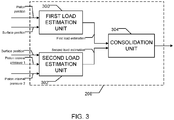
- FIG. 3 there is shown an embodiment of the load estimation providing unit 208.
- the load estimation providing unit 208 comprises a first load estimation unit 300, a second load estimation unit 302 and a consolidation unit 304.
- load estimation providing unit 208 is to provide a more robust unit.
- the first load estimation unit 300 is used for providing a first load estimation signal.
- the first load estimation signal is generated using a position of a piston of a corresponding actuator and a surface position of the corresponding surface actuated by the corresponding actuator. It will be appreciated that the first load estimation unit 300 therefore computes a structural deformation of the surface actuated by the corresponding actuator. This is therefore one way to estimate a load.
- the second load estimation unit 302 is used for providing a second load estimation signal.
- the second load estimation signal is generated using the surface position of the corresponding surface actuated by the corresponding actuator, a first internal pressure of the piston of the corresponding actuator and a second internal pressure of the piston of the corresponding actuator. It will be appreciated that the second load estimation unit 302 operates using the Newton's laws to generate an estimation of the load.
- the consolidation unit 304 is used for receiving the first load estimation signal and the second load estimation signal and for generating a corresponding consolidated signal.
- the purpose of the consolidating unit 304 is to do a mathematical operation, such as the computing of an average on the incoming signals or for instance use the second load estimation signal provided by the second load estimation unit 302 and use the first load estimation signal provided by the first load estimation unit 300 as a backup.
- the at least one lookup table 212 is generated during a learning phase.
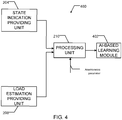
- FIG. 4 there is shown a first embodiment of a system 400 for achieving a learning phase for the purpose of building the at least one lookup table 212.
- the system comprises the state indication providing unit 204, the load estimation providing unit 208, the processing unit 210 and an artificial intelligence-based learning module 402.
- the processing unit 210 further receives an indication of the accurate anemometric parameter.
- the purpose of the receiving of the accurate anemometric parameter is to train the artificial-intelligence-based learning module 402 using data received from the state indication providing unit 204 and the load estimation providing unit 208.
- the training of the artificial-intelligence-based learning module 402 may be implemented according to various embodiments.
- the artificial-intelligence-based learning module 402 may be based on various technologies such as Bayesian networks, neuronal networks, deep learning technology, etc.
- the lookup table 212 may be generated accordingly.
- the artificial-intelligence-based learning module 402 is progressively built using data, as known to the skilled addressee.
- the lookup table 242 is used when a plurality of estimations of the anemometric parameter is used to determine the estimation of the anemometric parameter.
- the anemometric parameter comprises a calibrated airspeed.
- a first estimation of the anemometric parameter (referred to as Airspeed_EST_surf1) associated with the primary surface 1 220
- a second estimation of the anemometric parameter (referred to as Airspeed_EST_surf2) associated with the primary surface 2 222
- Airspeed_EST_surfn an m estimation of the anemometric parameter associated with the primary surface m 224
- the processing unit 240 generates an estimation of the airspeed (Airspeed_EST), an estimation of the angle of attack (a) and the angle of slideslip ( ⁇ ) (respectively Alpha_EST and Beta_EST).
- a comparator is then used for comparing the estimation of the airspeed (Airspeed_EST), the estimation of the angle of attack (a) and the estimation of the angle of slideslip ( ⁇ ) (respectively Alpha_EST and Beta_EST) with a current calibrated airspeed and a current airplane attitude and the result of the comparison is provided to the Artificial Intelligence learning module which also receives the first estimation of the anemometric parameter associated with the primary surface 1 220, the second estimation of the anemometric parameter associated with the primary surface 2 222,.. and the m th estimation of the anemometric parameter associated with the primary surface m 224.
- a non-transitory computer readable storage medium for storing computer-executable instructions which, when executed, cause a processing device to perform a method for determining an estimation of an anemometric parameter of an aircraft, the anemometric parameter selected from a group comprising at least one of an angle of attack, a sideslip angle and a calibrated airspeed, the method comprising obtaining an indication of a state of at least one secondary surface of the aircraft; obtaining an indication of a position of a horizontal primary surface; obtaining an estimation of the load applied on a corresponding actuator used for actuating the horizontal primary surface of the aircraft using at least the indication of the position of the horizontal primary surface and the position of the corresponding actuator; accessing at least one lookup table with the indication of the state of the at least one secondary surface of the aircraft, the estimation of the load applied on the corresponding actuator used for actuating the horizontal primary surface of the aircraft, and the position of the corresponding actuator; obtaining a corresponding estimation of the anemometric parameter of the aircraft;
- An advantage of the method disclosed herein is that it provides an estimation of an anemometric parameter of an aircraft notwithstanding the state of the pitot static system, wherein the anemometric parameter is at least one of an angle of attack, a sideslip angle and a calibrated airspeed.
- Another advantage of the method disclosed herein is that it is generic since it uses at least one lookup table, which is generated during a learning phase.
- Another advantage of the method disclosed herein is that it provides an estimation of an anemometric parameter, which may supplement and/or replace a corresponding one generated using the pitot static system.
- Another advantage of the method disclosed is that its use enables the providing of a flight envelope by the flight computer and other functions of the aircraft such as the autopilot.
Landscapes
- Engineering & Computer Science (AREA)
- Aviation & Aerospace Engineering (AREA)
- Physics & Mathematics (AREA)
- General Physics & Mathematics (AREA)
- Radar, Positioning & Navigation (AREA)
- Remote Sensing (AREA)
- Automation & Control Theory (AREA)
- Traffic Control Systems (AREA)
- Force Measurement Appropriate To Specific Purposes (AREA)
Claims (20)
- Procédé pour déterminer une estimation d'un paramètre anémométrique d'un aéronef, le paramètre anémométrique étant choisi dans un groupe comprenant au moins l'un d'un angle d'attaque, d'un angle de dérapage et d'une vitesse d'air calibrée, le procédé comprenant les étapes consistant à :obtenir (100) une indication d'un état d'au moins une surface secondaire (200) qui agit sur le coefficient aérodynamique de l'aéronef ;obtenir (102) une indication d'une position d'une surface primaire horizontale (202) qui agit sur l'attitude de l'aéronef ;obtenir (104) une estimation de la charge appliquée sur un actionneur correspondant utilisé pour actionner la surface primaire horizontale (202) de l'aéronef à l'aide d'au moins l'indication de la position de la surface primaire horizontale (202) et de la position de l'actionneur correspondant ;recevoir l'estimation de la charge appliquée sur l'actionneur correspondant, l'indication de l'état d'au moins une surface secondaire (200) de l'aéronef et de la position de l'actionneur correspondant ;accéder (106) à au moins une table de correspondance (212,230,236,242) avec l'indication de l'état de l'au moins une surface secondaire (200) de l'aéronef, l'estimation de la charge appliquée sur l'actionneur correspondant utilisé pour actionner la surface primaire horizontale (202) de l'aéronef, et de la position de l'actionneur correspondant, l'au moins une table de correspondance (212,230,236,242) associant une indication donnée de l'état de l'au moins une surface secondaire (200) de l'aéronef, une estimation donnée de la charge appliquée sur l'actionneur correspondant utilisé pour actionner la surface primaire horizontale (202) de l'aéronef, et une position correspondante de l'actionneur correspondant avec une estimation correspondante du paramètre anémométrique ; etobtenir (108) une estimation correspondante du paramètre anémométrique de l'aéronef associé à la surface primaire horizontale (202) ;fournir (110) l'estimation correspondante du paramètre anémométrique de l'aéronef associé à la surface primaire horizontale (202) ; etdans lequel l'au moins une table de correspondance (212,230,236,242) est générée pendant une phase d'apprentissage.
- Procédé selon la revendication 1, dans lequel l'obtention (104) d'une estimation de la charge appliquée sur un actionneur correspondant utilisé pour actionner la surface primaire horizontale (202) comprend les étapes consistant à :déterminer une première estimation de charge selon un premier procédé ;déterminer une deuxième estimation de charge selon un deuxième procédé différent du premier procédé ;effectuer une consolidation de la première estimation de charge et de la deuxième estimation de charge pour fournir l'estimation de la charge appliquée sur l'actionneur correspondant.
- Procédé selon la revendication 2, dans lequel l'exécution de la consolidation comprend le calcul d'une moyenne de la première estimation de charge et de la deuxième estimation de charge.
- Procédé selon l'une quelconque des revendications 2 à 3, comprenant en outre l'obtention d'une indication d'une position d'un piston de l'actionneur de la surface primaire horizontale (202), d'une indication d'une première pression interne du piston de l'actionneur et d'une indication d'une deuxième pression interne du piston de l'actionneur ; en outre dans lequel la première estimation de charge est déterminée en utilisant l'indication de la position du piston et l'indication de la position de la surface primaire horizontale (202) actionnée par l'actionneur correspondant ; et
en outre dans lequel la deuxième estimation de charge est déterminée en utilisant l'indication de la position de la surface primaire horizontale (202) actionnée par l'actionneur correspondant et l'indication de la première pression interne du piston de l'actionneur et l'indication de la seconde pression interne du piston de l'actionneur. - Procédé selon la revendication 1, comprenant en outre les étapes consistant à :obtenir plus d'une autre indication d'une position pour chacune de plus d'une autre surface primaire (202) de l'aéronef ;obtenir plus d'une autre estimation d'une charge appliquée sur chacun de plus d'un autre actionneur utilisé chacun pour actionner l'une des plus d'une autre surface primaire (202) et une position correspondante de chaque actionneur correspondant de plus d'un autre actionneur ;obtenir au moins l'une des données d'un système de référence inertielle (IRS) de l'aéronef et d'une estimation d'un angle d'attaque (a) et d'un angle de glissement (β) de l'aéronefaccéder à plus d'une autre table de consultation (212,230,236,242), chacune accédant avec l'indication d'un état de l'au moins une surface secondaire (200) de l'aéronef, une estimation correspondante de la charge appliquée sur un actionneur correspondant de plus d'un autre actionneur utilisé pour actionner une surface primaire correspondante (202) de la plus d'une autre surface primaire (202) de l'aéronef, et la position correspondante de l'actionneur correspondant utilisé pour actionner la surface primaire correspondante (202) de la plus d'une autre surface correspondante ;obtenir plus d'une estimation correspondante du paramètre anémométrique de l'aéronef, chaque estimation correspondante du paramètre anémométrique étant associée à une surface primaire correspondante (202) de la plus d'une autre surface primaire (202) ;dans lequel la fourniture de l'estimation correspondante du paramètre anémométrique de l'aéronef comprend l'utilisation de chacune de plus d'une estimation correspondante obtenue du paramètre anémométrique de l'aéronef, l'estimation correspondante du paramètre anémométrique associé à la surface primaire horizontale (202) de l'aéronef et l'au moins une des données du système de référence inertielle (IRS) de l'aéronef et l'estimation de l'angle d'attaque (α) et de l'angle de dérapage (β) de l'aéronef pour déterminer une estimation correspondante du paramètre anémométrique de l'aéronef.
- Procédé selon l'une quelconque des revendications 1 à 5, dans lequel la fourniture de l'estimation correspondante du paramètre anémométrique de l'aéronef est effectuée lors de la détection d'un événement.
- Procédé selon la revendication 6, dans lequel l'événement comprend une lecture erronée du paramètre anémométrique.
- Procédé selon la revendication 6, dans lequel l'événement comprend une détection d'une défaillance d'un système donné de l'aéronef.
- Procédé selon la revendication 1, comprenant en outre la réception dans la phase d'apprentissage d'une indication du paramètre anémométrique et la génération pendant la phase d'apprentissage d'au moins une partie de l'au moins une table de consultation (212,230,236,242) en utilisant l'indication reçue du paramètre anémométrique, l'indication de l'état de l'au moins une surface secondaire (200) de l'aéronef, l'estimation de la charge appliquée sur l'actionneur correspondant utilisé pour actionner la surface primaire horizontale (202) de l'aéronef et la position de l'actionneur correspondant.
- Procédé selon la revendication 9, dans lequel la génération pendant la phase d'apprentissage de l'au moins une partie de l'au moins une table de consultation (212,230,236,242) est effectuée à l'aide d'une technique basée sur l'intelligence artificielle sélectionnée dans un groupe constitué de réseaux bayésiens, de réseaux neuronaux et d'une technologie d'apprentissage en profondeur.
- Système selon l'une quelconque des revendications 1, 2, 3, 4, 5, 6, 7 et 8, dans lequel l'état de l'au moins une surface secondaire (200) comprend une configuration correspondante de l'au moins une surface secondaire (200).
- Système pour déterminer une estimation d'un paramètre anémométrique d'un aéronef, le paramètre anémométrique étant choisi dans un groupe comprenant au moins l'un d'un angle d'attaque, d'un angle de dérapage et d'une vitesse d'air calibrée, le système comprenant :une unité de fourniture d'indication d'état (204) destinée à obtenir (100) une indication d'un état d'au moins une surface secondaire (200) qui agit sur le coefficient aérodynamique de l'aéronef et fournir l'indication d'un état d'au moins une surface secondaire (200) de l'aéronef ;une unité d'estimation de charge (208,226,232) destinée à recevoir une indication d'une position d'une surface primaire horizontale correspondante (202) qui agit sur l'attitude de l'aéronef et d'une position d'un actionneur correspondant utilisé pour actionner la surface primaire horizontale (202), l'unité d'estimation de charge (208,226,232) fournissant une estimation de la charge appliquée sur l'actionneur correspondant utilisé pour actionner la surface primaire horizontale (202) de l'aéronef utilisant au moins l'indication de la position de la surface primaire horizontale (202) et la position de l'actionneur correspondant ;au moins une table de correspondance (212,230,236,242) destinée à associer une estimation donnée d'une charge appliquée sur un actionneur correspondant, une indication donnée de l'état de l'au moins une surface secondaire (200), une position correspondante de l'actionneur correspondant avec une estimation correspondante du paramètre anémométrique ;une unité de traitement (210,228,234) destinée à recevoir l'estimation de la charge appliquée sur l'actionneur correspondant, l'indication de l'état d'au moins une surface secondaire (200) de l'aéronef et la position de l'actionneur correspondant et accéder à l'au moins une table de correspondance (212,230,236,242) avec l'indication de l'état de l'au moins une surface secondaire (200) de l'aéronef, l'estimation de la charge appliquée sur l'actionneur correspondant utilisé pour actionner la surface primaire horizontale (202) de l'aéronef et la position de l'actionneur correspondant et obtenir une estimation correspondante du paramètre anémométrique de l'aéronef associé à la surface primaire horizontale (202) ; l'unité de traitement (210,228,234), fournissant (110) en outre l'estimation correspondante du paramètre anémométrique de l'aéronef associé à la surface primaire horizontale (202) ;dans lequel l'au moins une table de correspondance (212,230,236,242) est générée pendant une phase d'apprentissage.
- Système selon la revendication 12, dans lequel l'unité d'estimation de charge (208,226,232) comprend une première unité d'estimation de charge pour déterminer une première estimation de charge selon un premier procédé, une deuxième unité d'estimation de charge pour déterminer une deuxième estimation de charge selon un deuxième procédé différent du premier procédé et une unité de consolidation recevant la première estimation de charge, la deuxième estimation de charge et effectuant une consolidation de la première estimation de charge et de la deuxième estimation de charge pour fournir l'estimation de la charge appliquée sur l'actionneur correspondant.
- Système selon la revendication 13, dans lequel la première unité d'estimation de charge reçoit l'indication de la position de la surface primaire horizontale correspondante (202) et de la position de l'actionneur correspondant, en outre dans lequel la première unité d'estimation de charge fournit l'estimation de la charge appliquée sur l'actionneur correspondant utilisé pour actionner la surface primaire horizontale (202) de l'aéronef utilisant au moins l'indication de la position de la surface primaire horizontale (202) et la position de l'actionneur correspondant ; et
en outre dans lequel la deuxième unité d'estimation de charge reçoit l'indication de la position de la surface primaire horizontale (202) actionnée par l'actionneur correspondant et une indication d'une première pression interne d'un piston de l'actionneur correspondant et une indication d'une deuxième pression interne du piston de l'actionneur correspondant et détermine l'estimation de la charge appliquée sur l'actionneur correspondant à l'aide de l'indication de la position de la surface primaire horizontale (202) actionnée par l'actionneur correspondant et de l'indication de la première pression interne du piston de l'actionneur et de l'indication de la deuxième pression interne du piston de l'actionneur. - Système selon l'une quelconque des revendications 12 à 14, comprenant en outre :au moins une autre unité d'estimation de charge (208,226,232), chacune de l'au moins une autre unité d'estimation de charge recevant une indication d'une position correspondant d'une surface primaire horizontale correspondante (202) et d'une position correspondante d'un actionneur correspondant utilisé pour actionner l'autre surface primaire correspondante (202), chacune de l'au moins une autre unité d'estimation de charge fournissant une estimation correspondante d'une charge appliquée sur l'actionneur correspondant utilisé pour actionner l'autre surface primaire horizontale correspondante (202) de l'aéronef utilisant au moins la position correspondante d'une surface primaire correspondante (202) et la position correspondante de l'actionneur correspondant ;au moins une autre table de correspondance (212,230,236,242), chacune de l'au moins une autre table de correspondance (212,230,236,242) associant une estimation donnée d'une charge appliquée sur un actionneur correspondant, une indication donnée d'un état de l'au moins une surface secondaire (200), une position correspondante d'un actionneur correspondant donné avec une estimation correspondante du paramètre anémométrique ;au moins une unité de traitement (210,228,234), chacune de l'au moins une unité de traitement (210,228,234) recevant l'estimation correspondante de la charge appliquée sur l'au moins un autre actionneur correspondant, l'indication de l'état d'au moins une surface secondaire (200) de l'aéronef et de la position correspondante de l'au moins un autre actionneur correspondant et accédant à l'au moins une table de correspondance (212,230,236,242) avec l'indication de l'état de l'au moins une surface secondaire (200) de l'aéronef, l'estimation correspondante de la charge appliquée sur l'au moins un autre actionneur correspondant utilisé pour actionner l'au moins une autre surface primaire (202) de l'aéronef et la position correspondante de l'actionneur correspondant et obtenant une estimation correspondante du paramètre anémométrique de l'aéronef ; l'unité de traitement (210,228,234) fournissant en outre l'estimation correspondante du paramètre anémométrique de l'aéronef ; etune unité de traitement d'estimation de paramètre anémométrique (210,228,234) recevant l'estimation correspondante du paramètre anémométrique de l'aéronef associée à la surface primaire horizontale (202), chacune de l'au moins une autre estimation correspondante estime le paramètre anémométrique de l'aéronef et au moins l'un d'un système de référence inertiel (IRS) de l'aéronef et une estimation d'un angle d'attaque (a) et d'un angle de dérapage (β) de l'aéronef et déterminant une estimation du paramètre anémométrique de l'aéronef à l'aide de l'estimation correspondante du paramètre anémométrique de l'aéronef associé à la surface primaire horizontale (202), chacune de l'au moins une autre estimation correspondante estime le paramètre anémométrique de l'aéronef et de l'au moins l'une des données du système de référence inertielle (IRS) reçues de l'aéronef et l'estimation de l'angle de l'attaque (α) et de l'angle de dérapage (β) de l'aéronef.
- Système selon la revendication 12, dans lequel dans la phase d'apprentissage, l'unité de traitement (210,228,234) reçoit en outre une indication du paramètre anémométrique et génère au moins une partie de l'au moins une table de consultation (212,230,236,242) en utilisant l'estimation donnée de la charge appliquée sur l'actionneur correspondant, l'indication donnée de l'état de l'au moins une surface secondaire (200), la position correspondante de l'actionneur correspondant et l'indication du paramètre anémométrique.
- Système selon la revendication 16, dans lequel la génération de l'au moins une partie de l'au moins une table de consultation (212,230,236,242) est effectuée à l'aide d'une technique basée sur l'intelligence artificielle sélectionnée dans un groupe constitué de réseaux bayésiens, de réseaux neuronaux et d'une technologie d'apprentissage en profondeur.
- Système selon l'une quelconque des revendications 12 à 17, dans lequel l'état de l'au moins une surface secondaire (200) comprend une configuration correspondante de l'au moins une surface secondaire (200).
- Système selon l'une quelconque des revendications 12 à 18, dans lequel l'unité de fourniture d'indication d'état (204) comprend au moins un capteur, chaque capteur étant associé à une surface secondaire correspondante (200) de l'au moins une surface secondaire (200) de l'aéronef.
- Support de stockage non transitoire lisible par un ordinateur stockant des instructions exécutables par ordinateur qui lorsqu'elles sont exécutées amènent un dispositif de traitement à exécuter le procédé pour déterminer une estimation d'un paramètre anémométrique d'un aéronef, le paramètre anémométrique étant choisi dans un groupe comprenant au moins l'un d'un angle d'attaque, d'un angle de dérapage et d'une vitesse d'air calibrée, le procédé comprenant les étapes consistant à :obtenir (100) une indication d'un état d'au moins une surface secondaire (200) qui agit sur le coefficient aérodynamique de l'aéronef ;obtenir (102) une indication d'une position d'une surface primaire horizontale (202) qui agit sur l'attitude de l'aéronef ;obtenir (104) une estimation de la charge appliquée sur un actionneur correspondant utilisé pour actionner la surface primaire horizontale (202) de l'aéronef à l'aide d'au moins l'indication de la position de la surface primaire horizontale (202) et de la position de l'actionneur correspondant ;recevoir l'estimation de la charge appliquée sur l'actionneur correspondant, l'indication de l'état d'au moins une surface secondaire (200) de l'aéronef et la position de l'actionneur correspondant ;
accéder à au moins une table de correspondance (212,230,236,242) avec l'indication de l'état de l'au moins une surface secondaire (200) de l'aéronef, l'estimation de la charge appliquée sur l'actionneur correspondant utilisé pour actionner la surface primaire horizontale (202) de l'aéronef, et la position de l'actionneur correspondant, l'au moins une table de correspondance (212,230,236,242) associant une indication donnée de l'état de l'au moins une surface secondaire (200) de l'aéronef, une estimation donnée de la charge appliquée sur l'actionneur correspondant utilisé pour actionner la surface primaire horizontale (202) de l'aéronef, et une position correspondante de l'actionneur correspondant avec une estimation correspondante du paramètre anémométrique ; etobtenir une estimation correspondante du paramètre anémométrique de l'aéronef associé à la surface primaire horizontale (202) ;fournir (110) l'estimation correspondante du paramètre anémométrique de l'aéronef ; etdans lequel l'au moins une table de correspondance (212,230,236,242) est générée pendant une phase d'apprentissage.
Applications Claiming Priority (2)
| Application Number | Priority Date | Filing Date | Title |
|---|---|---|---|
| US201762553381P | 2017-09-01 | 2017-09-01 | |
| PCT/IB2018/056680 WO2019043645A1 (fr) | 2017-09-01 | 2018-08-31 | Procédé et système de détermination d'une estimation d'un paramètre anémométrique dans un aéronef |
Publications (3)
| Publication Number | Publication Date |
|---|---|
| EP3602078A1 EP3602078A1 (fr) | 2020-02-05 |
| EP3602078A4 EP3602078A4 (fr) | 2020-04-15 |
| EP3602078B1 true EP3602078B1 (fr) | 2021-11-03 |
Family
ID=65525066
Family Applications (1)
| Application Number | Title | Priority Date | Filing Date |
|---|---|---|---|
| EP18852019.1A Active EP3602078B1 (fr) | 2017-09-01 | 2018-08-31 | Procédé et système de détermination d'une estimation d'un paramètre anémométrique dans un aéronef |
Country Status (6)
| Country | Link |
|---|---|
| US (1) | US11619517B2 (fr) |
| EP (1) | EP3602078B1 (fr) |
| CN (1) | CN110709709B (fr) |
| CA (1) | CA3055490C (fr) |
| GB (1) | GB2579696A (fr) |
| WO (1) | WO2019043645A1 (fr) |
Families Citing this family (4)
| Publication number | Priority date | Publication date | Assignee | Title |
|---|---|---|---|---|
| US10778479B1 (en) * | 2020-04-27 | 2020-09-15 | Bestechnic (Shanghai) Co., Ltd. | Systems and methods for wireless transmission of audio information |
| KR102634052B1 (ko) * | 2021-07-14 | 2024-02-05 | 한국항공우주연구원 | 비행체 조종면 작동기 정보를 이용한 실시간 풍속 풍향 추정 장치 및 방법 |
| FR3127047B1 (fr) * | 2021-09-15 | 2023-09-22 | Airbus Operations Sas | Système et procédé d’estimation automatique d’une vitesse d’un aéronef lors d’un vol de l’aéronef. |
| CN118211511B (zh) * | 2024-04-03 | 2025-07-15 | 西北工业大学 | 一种基于气动参数经验的高速飞行器参数快速估计方法 |
Family Cites Families (10)
| Publication number | Priority date | Publication date | Assignee | Title |
|---|---|---|---|---|
| EP2333322A3 (fr) * | 2009-11-30 | 2017-02-22 | Vestas Wind Systems A/S | Mesure des charges sur des pales d'éolienne |
| US8718839B2 (en) * | 2009-12-06 | 2014-05-06 | Evolved Aircraft Systems, L.L.C. | Method and apparatus for automatically controlling aircraft flight control trim systems |
| GB201220653D0 (en) * | 2012-11-16 | 2013-01-02 | Mcculloch Norman L | Improvements in aircraft |
| FR3007131B1 (fr) * | 2013-06-14 | 2015-12-11 | Thales Sa | Procede et dispositif de diagnostic d'une perte de controle d'un aeronef |
| WO2015089636A1 (fr) * | 2013-12-20 | 2015-06-25 | Thales Canada Inc. | Procédé et système permettant d'estimer une topologie d'un réseau et son utilisation dans un réseau radioélectrique ad hoc mobile |
| US9506945B2 (en) * | 2014-06-10 | 2016-11-29 | Sikorsky Aircraft Corporation | Rotorcraft flight parameter estimation |
| US9428279B2 (en) * | 2014-07-23 | 2016-08-30 | Honeywell International Inc. | Systems and methods for airspeed estimation using actuation signals |
| FR3027397B1 (fr) * | 2014-10-20 | 2019-05-03 | Airbus Operations | Procede et dispositif d'estimation automatique d'au moins une vitesse d'un aeronef |
| WO2016191320A1 (fr) * | 2015-05-22 | 2016-12-01 | Tiger Century Aircraft, Inc. | Systèmes et procédés d'affichage de sensibilité à l'état d'énergie d'avion |
| US9989972B2 (en) * | 2016-02-22 | 2018-06-05 | The Boeing Company | Systems and methods to prevent an aircraft from tail contact with the ground |
-
2018
- 2018-08-31 GB GB1913896.5A patent/GB2579696A/en not_active Withdrawn
- 2018-08-31 CN CN201880036618.XA patent/CN110709709B/zh active Active
- 2018-08-31 WO PCT/IB2018/056680 patent/WO2019043645A1/fr not_active Ceased
- 2018-08-31 EP EP18852019.1A patent/EP3602078B1/fr active Active
- 2018-08-31 US US16/495,057 patent/US11619517B2/en active Active
- 2018-08-31 CA CA3055490A patent/CA3055490C/fr active Active
Also Published As
| Publication number | Publication date |
|---|---|
| CA3055490A1 (fr) | 2019-03-07 |
| CN110709709A (zh) | 2020-01-17 |
| EP3602078A1 (fr) | 2020-02-05 |
| CA3055490C (fr) | 2022-08-16 |
| WO2019043645A1 (fr) | 2019-03-07 |
| GB201913896D0 (en) | 2019-11-13 |
| US11619517B2 (en) | 2023-04-04 |
| GB2579696A (en) | 2020-07-01 |
| EP3602078A4 (fr) | 2020-04-15 |
| CN110709709B (zh) | 2022-02-25 |
| US20200011701A1 (en) | 2020-01-09 |
Similar Documents
| Publication | Publication Date | Title |
|---|---|---|
| US8761970B2 (en) | Alternative method to determine the air mass state of an aircraft and to validate and augment the primary method | |
| EP3602078B1 (fr) | Procédé et système de détermination d'une estimation d'un paramètre anémométrique dans un aéronef | |
| US10723479B2 (en) | Synthetic air data output generation | |
| EP0262702B1 (fr) | Appareil et méthode d'avertissement de forte embardée dans un avion | |
| US8423206B2 (en) | Variable maximum commandable roll rate for directional control during engine-out rolling maneuver | |
| AU2021211996B2 (en) | A system and method for determining the real-time effect of ice accumulation on aircraft surfaces on angle of attack during flight | |
| EP3521175B1 (fr) | Procédés et systèmes de contrôle de la poussée produite par une pluralité de moteurs sur un aéronef pour aider dans certaines conditions de vol | |
| US9701422B2 (en) | Aircraft turbulence detection | |
| BR102017002018B1 (pt) | Método para evitar contato da cauda de uma aeronave com o chão | |
| US20130311013A1 (en) | Measurement Assisted Aerodynamic State Estimator | |
| US20170336803A1 (en) | Automated flight control system with altitude-based, automatically-adjusting rate of climb | |
| EP2450765B1 (fr) | Gestion des surfaces de contrôle pour avion | |
| EP2955106B1 (fr) | Estimation de paramètres de vol d'un giravion | |
| US10648850B2 (en) | Devices and methods for determining aircraft weight | |
| Sun | Reliable air data solutions for small unmanned aircraft systems | |
| Raab et al. | Measuring the angle of attack-practical considerations for the development of fault detection residuals | |
| Turkmen | An alternative neural airspeed computation method for aircrafts | |
| Ganguli | Airspeed estimation using servo current and aircraft model | |
| CN118111497A (zh) | 微下击暴流的识别方法、装置、设备及存储介质 | |
| HK1231028B (en) | Aircraft turbulence detection | |
| HK1231028A1 (en) | Aircraft turbulence detection |
Legal Events
| Date | Code | Title | Description |
|---|---|---|---|
| STAA | Information on the status of an ep patent application or granted ep patent |
Free format text: STATUS: THE INTERNATIONAL PUBLICATION HAS BEEN MADE |
|
| PUAI | Public reference made under article 153(3) epc to a published international application that has entered the european phase |
Free format text: ORIGINAL CODE: 0009012 |
|
| STAA | Information on the status of an ep patent application or granted ep patent |
Free format text: STATUS: REQUEST FOR EXAMINATION WAS MADE |
|
| 17P | Request for examination filed |
Effective date: 20191031 |
|
| AK | Designated contracting states |
Kind code of ref document: A1 Designated state(s): AL AT BE BG CH CY CZ DE DK EE ES FI FR GB GR HR HU IE IS IT LI LT LU LV MC MK MT NL NO PL PT RO RS SE SI SK SM TR |
|
| AX | Request for extension of the european patent |
Extension state: BA ME |
|
| REG | Reference to a national code |
Ref country code: DE Ref legal event code: R079 Ref document number: 602018026254 Country of ref document: DE Free format text: PREVIOUS MAIN CLASS: G01P0005000000 Ipc: G01P0005020000 |
|
| A4 | Supplementary search report drawn up and despatched |
Effective date: 20200316 |
|
| RIC1 | Information provided on ipc code assigned before grant |
Ipc: G01C 23/00 20060101ALI20200310BHEP Ipc: G01P 13/02 20060101ALI20200310BHEP Ipc: G01P 5/02 20060101AFI20200310BHEP Ipc: G01P 21/02 20060101ALI20200310BHEP |
|
| DAV | Request for validation of the european patent (deleted) | ||
| DAX | Request for extension of the european patent (deleted) | ||
| GRAP | Despatch of communication of intention to grant a patent |
Free format text: ORIGINAL CODE: EPIDOSNIGR1 |
|
| STAA | Information on the status of an ep patent application or granted ep patent |
Free format text: STATUS: GRANT OF PATENT IS INTENDED |
|
| INTG | Intention to grant announced |
Effective date: 20210127 |
|
| GRAJ | Information related to disapproval of communication of intention to grant by the applicant or resumption of examination proceedings by the epo deleted |
Free format text: ORIGINAL CODE: EPIDOSDIGR1 |
|
| STAA | Information on the status of an ep patent application or granted ep patent |
Free format text: STATUS: REQUEST FOR EXAMINATION WAS MADE |
|
| GRAP | Despatch of communication of intention to grant a patent |
Free format text: ORIGINAL CODE: EPIDOSNIGR1 |
|
| STAA | Information on the status of an ep patent application or granted ep patent |
Free format text: STATUS: GRANT OF PATENT IS INTENDED |
|
| INTC | Intention to grant announced (deleted) | ||
| INTG | Intention to grant announced |
Effective date: 20210601 |
|
| GRAS | Grant fee paid |
Free format text: ORIGINAL CODE: EPIDOSNIGR3 |
|
| GRAA | (expected) grant |
Free format text: ORIGINAL CODE: 0009210 |
|
| STAA | Information on the status of an ep patent application or granted ep patent |
Free format text: STATUS: THE PATENT HAS BEEN GRANTED |
|
| AK | Designated contracting states |
Kind code of ref document: B1 Designated state(s): AL AT BE BG CH CY CZ DE DK EE ES FI FR GB GR HR HU IE IS IT LI LT LU LV MC MK MT NL NO PL PT RO RS SE SI SK SM TR |
|
| REG | Reference to a national code |
Ref country code: GB Ref legal event code: FG4D |
|
| REG | Reference to a national code |
Ref country code: AT Ref legal event code: REF Ref document number: 1444425 Country of ref document: AT Kind code of ref document: T Effective date: 20211115 Ref country code: CH Ref legal event code: EP |
|
| REG | Reference to a national code |
Ref country code: DE Ref legal event code: R096 Ref document number: 602018026254 Country of ref document: DE |
|
| REG | Reference to a national code |
Ref country code: IE Ref legal event code: FG4D |
|
| REG | Reference to a national code |
Ref country code: LT Ref legal event code: MG9D |
|
| REG | Reference to a national code |
Ref country code: NL Ref legal event code: MP Effective date: 20211103 |
|
| REG | Reference to a national code |
Ref country code: AT Ref legal event code: MK05 Ref document number: 1444425 Country of ref document: AT Kind code of ref document: T Effective date: 20211103 |
|
| PG25 | Lapsed in a contracting state [announced via postgrant information from national office to epo] |
Ref country code: RS Free format text: LAPSE BECAUSE OF FAILURE TO SUBMIT A TRANSLATION OF THE DESCRIPTION OR TO PAY THE FEE WITHIN THE PRESCRIBED TIME-LIMIT Effective date: 20211103 Ref country code: LT Free format text: LAPSE BECAUSE OF FAILURE TO SUBMIT A TRANSLATION OF THE DESCRIPTION OR TO PAY THE FEE WITHIN THE PRESCRIBED TIME-LIMIT Effective date: 20211103 Ref country code: FI Free format text: LAPSE BECAUSE OF FAILURE TO SUBMIT A TRANSLATION OF THE DESCRIPTION OR TO PAY THE FEE WITHIN THE PRESCRIBED TIME-LIMIT Effective date: 20211103 Ref country code: BG Free format text: LAPSE BECAUSE OF FAILURE TO SUBMIT A TRANSLATION OF THE DESCRIPTION OR TO PAY THE FEE WITHIN THE PRESCRIBED TIME-LIMIT Effective date: 20220203 Ref country code: AT Free format text: LAPSE BECAUSE OF FAILURE TO SUBMIT A TRANSLATION OF THE DESCRIPTION OR TO PAY THE FEE WITHIN THE PRESCRIBED TIME-LIMIT Effective date: 20211103 |
|
| PG25 | Lapsed in a contracting state [announced via postgrant information from national office to epo] |
Ref country code: IS Free format text: LAPSE BECAUSE OF FAILURE TO SUBMIT A TRANSLATION OF THE DESCRIPTION OR TO PAY THE FEE WITHIN THE PRESCRIBED TIME-LIMIT Effective date: 20220303 Ref country code: SE Free format text: LAPSE BECAUSE OF FAILURE TO SUBMIT A TRANSLATION OF THE DESCRIPTION OR TO PAY THE FEE WITHIN THE PRESCRIBED TIME-LIMIT Effective date: 20211103 Ref country code: PT Free format text: LAPSE BECAUSE OF FAILURE TO SUBMIT A TRANSLATION OF THE DESCRIPTION OR TO PAY THE FEE WITHIN THE PRESCRIBED TIME-LIMIT Effective date: 20220303 Ref country code: PL Free format text: LAPSE BECAUSE OF FAILURE TO SUBMIT A TRANSLATION OF THE DESCRIPTION OR TO PAY THE FEE WITHIN THE PRESCRIBED TIME-LIMIT Effective date: 20211103 Ref country code: NO Free format text: LAPSE BECAUSE OF FAILURE TO SUBMIT A TRANSLATION OF THE DESCRIPTION OR TO PAY THE FEE WITHIN THE PRESCRIBED TIME-LIMIT Effective date: 20220203 Ref country code: NL Free format text: LAPSE BECAUSE OF FAILURE TO SUBMIT A TRANSLATION OF THE DESCRIPTION OR TO PAY THE FEE WITHIN THE PRESCRIBED TIME-LIMIT Effective date: 20211103 Ref country code: LV Free format text: LAPSE BECAUSE OF FAILURE TO SUBMIT A TRANSLATION OF THE DESCRIPTION OR TO PAY THE FEE WITHIN THE PRESCRIBED TIME-LIMIT Effective date: 20211103 Ref country code: HR Free format text: LAPSE BECAUSE OF FAILURE TO SUBMIT A TRANSLATION OF THE DESCRIPTION OR TO PAY THE FEE WITHIN THE PRESCRIBED TIME-LIMIT Effective date: 20211103 Ref country code: GR Free format text: LAPSE BECAUSE OF FAILURE TO SUBMIT A TRANSLATION OF THE DESCRIPTION OR TO PAY THE FEE WITHIN THE PRESCRIBED TIME-LIMIT Effective date: 20220204 Ref country code: ES Free format text: LAPSE BECAUSE OF FAILURE TO SUBMIT A TRANSLATION OF THE DESCRIPTION OR TO PAY THE FEE WITHIN THE PRESCRIBED TIME-LIMIT Effective date: 20211103 |
|
| PG25 | Lapsed in a contracting state [announced via postgrant information from national office to epo] |
Ref country code: SM Free format text: LAPSE BECAUSE OF FAILURE TO SUBMIT A TRANSLATION OF THE DESCRIPTION OR TO PAY THE FEE WITHIN THE PRESCRIBED TIME-LIMIT Effective date: 20211103 Ref country code: SK Free format text: LAPSE BECAUSE OF FAILURE TO SUBMIT A TRANSLATION OF THE DESCRIPTION OR TO PAY THE FEE WITHIN THE PRESCRIBED TIME-LIMIT Effective date: 20211103 Ref country code: RO Free format text: LAPSE BECAUSE OF FAILURE TO SUBMIT A TRANSLATION OF THE DESCRIPTION OR TO PAY THE FEE WITHIN THE PRESCRIBED TIME-LIMIT Effective date: 20211103 Ref country code: EE Free format text: LAPSE BECAUSE OF FAILURE TO SUBMIT A TRANSLATION OF THE DESCRIPTION OR TO PAY THE FEE WITHIN THE PRESCRIBED TIME-LIMIT Effective date: 20211103 Ref country code: DK Free format text: LAPSE BECAUSE OF FAILURE TO SUBMIT A TRANSLATION OF THE DESCRIPTION OR TO PAY THE FEE WITHIN THE PRESCRIBED TIME-LIMIT Effective date: 20211103 Ref country code: CZ Free format text: LAPSE BECAUSE OF FAILURE TO SUBMIT A TRANSLATION OF THE DESCRIPTION OR TO PAY THE FEE WITHIN THE PRESCRIBED TIME-LIMIT Effective date: 20211103 |
|
| REG | Reference to a national code |
Ref country code: DE Ref legal event code: R097 Ref document number: 602018026254 Country of ref document: DE |
|
| PLBE | No opposition filed within time limit |
Free format text: ORIGINAL CODE: 0009261 |
|
| STAA | Information on the status of an ep patent application or granted ep patent |
Free format text: STATUS: NO OPPOSITION FILED WITHIN TIME LIMIT |
|
| 26N | No opposition filed |
Effective date: 20220804 |
|
| PG25 | Lapsed in a contracting state [announced via postgrant information from national office to epo] |
Ref country code: AL Free format text: LAPSE BECAUSE OF FAILURE TO SUBMIT A TRANSLATION OF THE DESCRIPTION OR TO PAY THE FEE WITHIN THE PRESCRIBED TIME-LIMIT Effective date: 20211103 |
|
| PG25 | Lapsed in a contracting state [announced via postgrant information from national office to epo] |
Ref country code: SI Free format text: LAPSE BECAUSE OF FAILURE TO SUBMIT A TRANSLATION OF THE DESCRIPTION OR TO PAY THE FEE WITHIN THE PRESCRIBED TIME-LIMIT Effective date: 20211103 |
|
| PG25 | Lapsed in a contracting state [announced via postgrant information from national office to epo] |
Ref country code: MC Free format text: LAPSE BECAUSE OF FAILURE TO SUBMIT A TRANSLATION OF THE DESCRIPTION OR TO PAY THE FEE WITHIN THE PRESCRIBED TIME-LIMIT Effective date: 20211103 |
|
| REG | Reference to a national code |
Ref country code: CH Ref legal event code: PL |
|
| PG25 | Lapsed in a contracting state [announced via postgrant information from national office to epo] |
Ref country code: LU Free format text: LAPSE BECAUSE OF NON-PAYMENT OF DUE FEES Effective date: 20220831 Ref country code: LI Free format text: LAPSE BECAUSE OF NON-PAYMENT OF DUE FEES Effective date: 20220831 Ref country code: CH Free format text: LAPSE BECAUSE OF NON-PAYMENT OF DUE FEES Effective date: 20220831 |
|
| REG | Reference to a national code |
Ref country code: BE Ref legal event code: MM Effective date: 20220831 |
|
| PG25 | Lapsed in a contracting state [announced via postgrant information from national office to epo] |
Ref country code: IT Free format text: LAPSE BECAUSE OF FAILURE TO SUBMIT A TRANSLATION OF THE DESCRIPTION OR TO PAY THE FEE WITHIN THE PRESCRIBED TIME-LIMIT Effective date: 20211103 |
|
| PG25 | Lapsed in a contracting state [announced via postgrant information from national office to epo] |
Ref country code: IE Free format text: LAPSE BECAUSE OF NON-PAYMENT OF DUE FEES Effective date: 20220831 |
|
| PG25 | Lapsed in a contracting state [announced via postgrant information from national office to epo] |
Ref country code: BE Free format text: LAPSE BECAUSE OF NON-PAYMENT OF DUE FEES Effective date: 20220831 |
|
| PG25 | Lapsed in a contracting state [announced via postgrant information from national office to epo] |
Ref country code: HU Free format text: LAPSE BECAUSE OF FAILURE TO SUBMIT A TRANSLATION OF THE DESCRIPTION OR TO PAY THE FEE WITHIN THE PRESCRIBED TIME-LIMIT; INVALID AB INITIO Effective date: 20180831 |
|
| PG25 | Lapsed in a contracting state [announced via postgrant information from national office to epo] |
Ref country code: CY Free format text: LAPSE BECAUSE OF FAILURE TO SUBMIT A TRANSLATION OF THE DESCRIPTION OR TO PAY THE FEE WITHIN THE PRESCRIBED TIME-LIMIT Effective date: 20211103 |
|
| PG25 | Lapsed in a contracting state [announced via postgrant information from national office to epo] |
Ref country code: MK Free format text: LAPSE BECAUSE OF FAILURE TO SUBMIT A TRANSLATION OF THE DESCRIPTION OR TO PAY THE FEE WITHIN THE PRESCRIBED TIME-LIMIT Effective date: 20211103 |
|
| REG | Reference to a national code |
Ref country code: DE Ref legal event code: R081 Ref document number: 602018026254 Country of ref document: DE Owner name: THALES CANADA INC., OTTAWA, CA Free format text: FORMER OWNER: THALES CANADA INC., TORONTO, ON, CA |
|
| PG25 | Lapsed in a contracting state [announced via postgrant information from national office to epo] |
Ref country code: MT Free format text: LAPSE BECAUSE OF FAILURE TO SUBMIT A TRANSLATION OF THE DESCRIPTION OR TO PAY THE FEE WITHIN THE PRESCRIBED TIME-LIMIT Effective date: 20211103 |
|
| PGFP | Annual fee paid to national office [announced via postgrant information from national office to epo] |
Ref country code: FR Payment date: 20250630 Year of fee payment: 8 |
|
| PGFP | Annual fee paid to national office [announced via postgrant information from national office to epo] |
Ref country code: DE Payment date: 20250714 Year of fee payment: 8 |
|
| PGFP | Annual fee paid to national office [announced via postgrant information from national office to epo] |
Ref country code: GB Payment date: 20250828 Year of fee payment: 8 |
|
| PG25 | Lapsed in a contracting state [announced via postgrant information from national office to epo] |
Ref country code: TR Free format text: LAPSE BECAUSE OF FAILURE TO SUBMIT A TRANSLATION OF THE DESCRIPTION OR TO PAY THE FEE WITHIN THE PRESCRIBED TIME-LIMIT Effective date: 20211103 |