EP3603460A1 - Gegensprechanlagensystem für eine wohnung - Google Patents
Gegensprechanlagensystem für eine wohnung Download PDFInfo
- Publication number
- EP3603460A1 EP3603460A1 EP19185082.5A EP19185082A EP3603460A1 EP 3603460 A1 EP3603460 A1 EP 3603460A1 EP 19185082 A EP19185082 A EP 19185082A EP 3603460 A1 EP3603460 A1 EP 3603460A1
- Authority
- EP
- European Patent Office
- Prior art keywords
- mailbox
- command
- unlocking
- electric
- response
- Prior art date
- Legal status (The legal status is an assumption and is not a legal conclusion. Google has not performed a legal analysis and makes no representation as to the accuracy of the status listed.)
- Granted
Links
Images


Classifications
-
- A—HUMAN NECESSITIES
- A47—FURNITURE; DOMESTIC ARTICLES OR APPLIANCES; COFFEE MILLS; SPICE MILLS; SUCTION CLEANERS IN GENERAL
- A47G—HOUSEHOLD OR TABLE EQUIPMENT
- A47G29/00—Supports, holders, or containers for household use, not provided for in groups A47G1/00-A47G27/00 or A47G33/00
- A47G29/14—Deposit receptacles for food, e.g. breakfast, milk, or large parcels; Similar receptacles for food or large parcels with appliances for preventing unauthorised removal of the deposited articles, i.e. food or large parcels
- A47G29/141—Deposit receptacles for food, e.g. breakfast, milk, or large parcels; Similar receptacles for food or large parcels with appliances for preventing unauthorised removal of the deposited articles, i.e. food or large parcels comprising electronically controlled locking means
-
- H—ELECTRICITY
- H04—ELECTRIC COMMUNICATION TECHNIQUE
- H04M—TELEPHONIC COMMUNICATION
- H04M11/00—Telephonic communication systems specially adapted for combination with other electrical systems
- H04M11/02—Telephonic communication systems specially adapted for combination with other electrical systems with bell or annunciator systems
- H04M11/025—Door telephones
-
- H—ELECTRICITY
- H04—ELECTRIC COMMUNICATION TECHNIQUE
- H04M—TELEPHONIC COMMUNICATION
- H04M9/00—Arrangements for interconnection not involving centralised switching
- H04M9/02—Arrangements for interconnection not involving centralised switching involving a common line for all parties
-
- A—HUMAN NECESSITIES
- A47—FURNITURE; DOMESTIC ARTICLES OR APPLIANCES; COFFEE MILLS; SPICE MILLS; SUCTION CLEANERS IN GENERAL
- A47G—HOUSEHOLD OR TABLE EQUIPMENT
- A47G29/00—Supports, holders, or containers for household use, not provided for in groups A47G1/00-A47G27/00 or A47G33/00
- A47G29/14—Deposit receptacles for food, e.g. breakfast, milk, or large parcels; Similar receptacles for food or large parcels with appliances for preventing unauthorised removal of the deposited articles, i.e. food or large parcels
- A47G29/141—Deposit receptacles for food, e.g. breakfast, milk, or large parcels; Similar receptacles for food or large parcels with appliances for preventing unauthorised removal of the deposited articles, i.e. food or large parcels comprising electronically controlled locking means
- A47G2029/145—Deposit receptacles for food, e.g. breakfast, milk, or large parcels; Similar receptacles for food or large parcels with appliances for preventing unauthorised removal of the deposited articles, i.e. food or large parcels comprising electronically controlled locking means the receptacle comprising means for identifying a deposit; Deposits carrying identification means, e.g. a bar code
-
- A—HUMAN NECESSITIES
- A47—FURNITURE; DOMESTIC ARTICLES OR APPLIANCES; COFFEE MILLS; SPICE MILLS; SUCTION CLEANERS IN GENERAL
- A47G—HOUSEHOLD OR TABLE EQUIPMENT
- A47G29/00—Supports, holders, or containers for household use, not provided for in groups A47G1/00-A47G27/00 or A47G33/00
- A47G29/14—Deposit receptacles for food, e.g. breakfast, milk, or large parcels; Similar receptacles for food or large parcels with appliances for preventing unauthorised removal of the deposited articles, i.e. food or large parcels
- A47G29/141—Deposit receptacles for food, e.g. breakfast, milk, or large parcels; Similar receptacles for food or large parcels with appliances for preventing unauthorised removal of the deposited articles, i.e. food or large parcels comprising electronically controlled locking means
- A47G2029/148—Deposit receptacles for food, e.g. breakfast, milk, or large parcels; Similar receptacles for food or large parcels with appliances for preventing unauthorised removal of the deposited articles, i.e. food or large parcels comprising electronically controlled locking means the receptacle comprising a letter box
-
- A—HUMAN NECESSITIES
- A47—FURNITURE; DOMESTIC ARTICLES OR APPLIANCES; COFFEE MILLS; SPICE MILLS; SUCTION CLEANERS IN GENERAL
- A47G—HOUSEHOLD OR TABLE EQUIPMENT
- A47G29/00—Supports, holders, or containers for household use, not provided for in groups A47G1/00-A47G27/00 or A47G33/00
- A47G29/14—Deposit receptacles for food, e.g. breakfast, milk, or large parcels; Similar receptacles for food or large parcels with appliances for preventing unauthorised removal of the deposited articles, i.e. food or large parcels
- A47G29/141—Deposit receptacles for food, e.g. breakfast, milk, or large parcels; Similar receptacles for food or large parcels with appliances for preventing unauthorised removal of the deposited articles, i.e. food or large parcels comprising electronically controlled locking means
- A47G2029/149—Deposit receptacles for food, e.g. breakfast, milk, or large parcels; Similar receptacles for food or large parcels with appliances for preventing unauthorised removal of the deposited articles, i.e. food or large parcels comprising electronically controlled locking means with central server link
Definitions
- the invention relates to an intercom system for a residence.
- the invention also relates to a remote management module for a mailbox and an electric door entry system for this intercom system.
- WO95 / 15050A1 an electric door entry system is connected to the residents' handsets via a local switched network. This allows residents to trigger the entry door to open from their handsets.
- a console separate from the electric doorman, is located near the mailboxes. An unlock code can be entered by a delivery person on a keyboard of this console to trigger the opening of one of these mailboxes.
- WO95 / 15050A1 does not allow remote control of the opening of a mailbox.
- the invention therefore aims to simplify the architecture of smart mailboxes to reduce their manufacturing cost and simplify installation inside the entrance hall of a residence.
- the embodiments of this intercom system may include one or more of the features of the dependent claims.
- the invention also relates to a remote management module of a mailbox for the intercom system object of the present application.
- the invention also relates to an electric door entry system for the intercom system which is the subject of the present application.
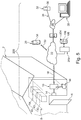
- the figure 1 represents a residence 2 equipped with an intercom system 4.
- residence 2 is a collective housing such as a building or a group of buildings.
- the system 4 comprises an electric door entry unit 10.
- the door entry frame 10 is sealed without any degree of freedom in a wall of the residence 2 outside and, generally, near door 6.
- the doorman 10 makes it possible to call a resident of the residence 2, to communicate with the latter and to command the unlocking of the door 6 and, alternately, to prohibit this unlocking.
- the doorman 10 is connected to an electric lock 14.
- the lock 14 is movable, in response to an opening command, from a locked position to an unlocked position. In the locked position, the lock 14 locks the door 6 in its closed position. In the unlocked position, the lock 14 unlocks the door 6 so that the door 6 is freely movable, for example by hand, from its closed position to its open position.
- the electric lock 14 is an electric strike.
- the doorman 10 is connected to the residents' handset via a link 18 and a public telecommunications network 22.
- the link 18 is a wireless link and the network 22 is a public wireless network.
- network 22 is a UMTS (Universal Mobile Telecommunications System) network.
- This network 22 can itself be connected via a gateway 24 to other public telecommunications networks such as a wired network 26.
- the network 26 is a circuit switched network.
- the network 26 is a PSTN (Public Switched Telephone Network) or a packet switched network (for example the Internet).
- PSTN Public Switched Telephone Network
- packet switched network for example the Internet
- the handset 28 is here in addition a mobile terminal directly transportable by hand by the resident. It is typically a mobile phone, such as a smartphone.
- the handset 32 is, for example, a landline telephone or a personal computer equipped with a microphone, a loudspeaker, a network connection module 26 and a telephony application enabling it to communicate with other handsets connected to network 26 or 22.
- Each of these handsets is able to receive calls from the electric doorman 10 and to establish a communication between a visitor present in front of this doorman and the resident holder of this handset.
- the communication between the doorman 10 and the resident's handset here takes the form of a videoconference.
- the visitor's images are transmitted to the resident's handset.
- the resident's images are not transmitted to the doorman 10.
- each of the handsets 28 and 32 is equipped with a man-machine interface 36 allowing the establishment of this communication with the visitor.
- the interface 36 includes at least one screen, a microphone, a loudspeaker and, optionally, a camera.
- each of the handsets is able to remotely control the unlocking of the door 6 of the residence 2.
- the man-machine interface 36 includes means for acquiring a command to open the door 6.
- these means are made using a keyboard or a touch screen.
- the handsets 28 and 32 have been shown to be located outside of residence 2. However, these operate in the same way whether they are located inside or outside of residence 2. When the handset 32 is located inside the residence 2, it is typically located inside an apartment in the residence 2.
- the system 4 also includes access keys allowing residents to unlock the front door 6 when they present their keys in front of an access center.
- the access center is incorporated inside the electric door entry unit 10.
- These keys contain access information which authorizes or, on the contrary, prohibits access to the residence 2.
- the access information is read without contact by the access center via a short-distance information transmission link.
- Short distance link means a link of less than ten meters.
- the keys of system 4 are transponder keys, i.e. keys equipped with a transponder.
- a transponder is an electronic circuit supplied with electromagnetic waves radiated by the access center.
- these keys do not necessarily include a supply battery. To simplify the figure 1 , only a transponder key 38 has been shown.
- the system 4 also comprises a station 39 for remote configuration of the gatekeeper 10.
- This station 39 makes it possible in particular to transmit instructions for updating the programmable parameters of the gatekeeper 10 via an information transmission link established by the same way as that used by this doorman 10 to communicate with the residents' handsets.
- the station 39 is shown as being connected to the gatekeeper 10 through, successively, the network 26, the gateway 24, the network 22 and the link 18.
- System 4 also includes a group 40 of intelligent mailboxes located inside hall 8. To simplify the figure 1 , only three mailboxes 42 to 44 are shown. System 4 has one private mailbox per apartment in residence 2. Thus, generally, group 40 has more than four, five or ten private mailboxes. For example, mailboxes 42 and 43 are private mailboxes. Here, in addition to the private mailboxes, group 40 has a mailbox common to all of the apartments in residence 2. This is mailbox 44.
- the private mailboxes are identical to each other and only the mailbox 42 is described below in more detail.
- the mailbox 44 is structurally identical to the mailbox 42 except that it differs from this mailbox by its dimensions. Indeed, typically, the mailbox 44 is designed to receive large parcels which cannot be deposited inside the private mailboxes. Thus, the interior volume of the mailbox 44 is greater and, for example, two or three times greater than the interior volume of the mailbox 42.
- the figure 2 represents in more detail the mailbox 42.
- This mailbox 42 comprises a chest 50 essentially parallelepipedic, fixed without any degree of freedom on a vertical wall of hall 8.
- This chest 50 defines a housing inside of which small packages can be deposited by passing through an opening 52 of the trunk 50.
- the opening 52 has an area greater than 100 cm 2 and, generally greater than 500 cm 2 . Normally, the area of the opening 52 is less than 1 m 2 or 0.5 m 2 .
- the box 42 includes a leaf 54 which can be moved, for example manually, between an open position, shown on the figure 2 , and a closed position.
- the leaf 54 leaves free access to the interior of the trunk 50 so that a package can be placed inside this trunk.
- the leaf 54 prevents access to the interior of the trunk 50.
- a resident or any other person cannot remove a package from inside the safe 50.
- the outer face of the leaf 54 that is to say the face of the leaf 54 facing the side opposite the face facing the inside of the trunk 50, is provided with a label bearing the name or an identifier d 'an apartment or a resident of the residence 2.
- the leaf 54 also has a through slot 56 through which the mail can be introduced inside the trunk 50 even when the leaf 54 is in its closed position.
- the trunk 50 and the leaf 54 are designed to resist acts of vandalism and attempted break-ins. To this end, they are made of hard materials, that is to say materials having a Young's modulus at 25 ° C. greater than 10 GPa or 100 GPa.
- the trunk 50 and the leaf 54 are made of steel.
- the box 42 also includes an electric lock 60 reversibly displaceable, in response to the reception of an unlocking command, from a locked position to an unlocked position.
- the lock 60 locks the leaf 54 in its closed position.
- the leaf 54 In its unlocked position, the leaf 54 can be freely moved, for example by hand, from its closed position to its open position.
- the lock 60 is powered by batteries or connected to an electricity distribution network.
- the lock 60 is also connected by a link 64 to the doorman 10.
- the link 64 can be a wired link or a wireless link.
- the link 64 is a wire link.
- the lock 60 further comprises a button 62 such as a push button.
- This button 62 is located opposite a hole 66 arranged in the leaf 54 so that this button 62 can be pressed even when the leaf 54 is in its closed position.
- the button 62 To trigger the movement of the lock 60 to its unlocked position, the button 62 must be pressed. To this end, the button 62 generates a sinking signal only in its depressed state.
- the box 42 also includes a sensor 68 capable of generating a signal for the presence of a parcel inside the trunk 50 only when a parcel is present inside this trunk. Conversely, in the absence of packages inside the trunk 50, the sensor 68 does not generate any presence signal. The presence signal is transmitted to the doorman 10 via the link 64.
- a sensor 68 is for example a balance sensitive to the mass of an object deposited on the horizontal bottom of the trunk 68.
- This sensor 68 can also be an optical sensor which detects the presence of a package in response to the cut of a light beam.
- the box 42 includes a mechanism 70 which permanently biases the leaf 54 towards its closed position.
- this mechanism 70 is produced using a spring or a leaf spring. Thus, in the absence of any other force exerted on the leaf 54, the mechanism 70 automatically returns it to its closed position.
- the doorman 10 uses the characteristics of the electric doorman described in the request. EP2239932 , supplemented by additional features to additionally manage access to mailboxes 42 to 44. The reader can therefore refer to this request for a more detailed description of the characteristics already known of such a doorman and, in particular, those necessary to establish a videoconference between the doorman 10 and the handset 28 or 32.
- the interface 80 is formed by a screen 96, a microphone and a speaker 98, a camera 100 and a keyboard 102.
- the access center 84 is equipped with a key reader 104.
- this reader 104 is a transponder key reader. More specifically, this central unit 84 is able to read the access information recorded in a transponder key and to compare it with access parameters 106 to authorize and, alternately, prohibit the opening of the door 6.
- the parameters 106 are stored in memory 92. Parameters 106 are programmable parameters. These parameters 106 here include in addition to the access parameters to authorize and, alternately, also prohibit access to the mailboxes.
- call parameters are possible. For example, for each resident, it is possible to specify a second telephone number to dial if the first number corresponds to a busy line or does not answer. These call parameters are programmable parameters.
- the unit 90 is connected to the lock 14 and to each of the locks 60 by means of wired connections here.
- the unit 90 is typically produced from a programmable microprocessor capable of executing instructions recorded on an information recording medium.
- the unit 90 is connected to the memory 92 and the memory 92 contains the instructions and data necessary for the execution of the method of the figure 4 .
- the process begins first with a phase 130 of installation of the system 4. During this phase 130, the doorman 10 is sealed in a wall of the residence 2 next to the door 6 and the mailboxes 42 to 44 are installed inside hall 8. Next, locks 14 and 60 are connected to doorman 10.
- the gatekeeper 10 is configured and updated. More precisely, during this step 132, the various programmable parameters of this gatekeeper are recorded in its memory 92. For example, it is during this step that the parameters 106 and 108 are programmed.
- the station 39 establishes a link with the electric door entry system via the network 22 and the line 18 and thus establishes a data transmission link between the station 39 and the door line through the l transmitter / receiver 82, networks 22 and 26 and the gateway 24. Once the connection is established, the doorman 10 transmits an identifier to the station 39. This identifier allows the station 39 to identify the doorman 10 from all of the electric doormen likely to contact him.
- a session is the execution by the station 39 of a task of configuration of a particular doorman who has identified himself beforehand. The session lasts as long as the configuration task is executed on station 39.
- station 39 transmits to gatekeeper 10, during the same session, parameters 106 and 108.
- these parameters are received almost simultaneously by the doorman 10, which allows an almost simultaneous update of the parameters making it possible to control access to residence 2, to mailboxes 42 to 44 and of parameters making it possible to contact the resident.
- the drawbacks linked to a time difference between the updating of parameters 106 and 108 do not occur.
- a single operation of identifying the address of the transmitter / receiver 82 on the public network is carried out.
- an unlock code authorizing access to the interior of a given mailbox is different from those authorizing access to the interior of other mailboxes.
- the same unlock code can only authorize access to a single mailbox.
- the resident identifiers associated with a list of mailbox unlock codes make it possible to limit the right to open this mailbox remotely to only residents thus identified.
- Step 132 is executed at each change of resident or modification concerning a resident living in residence 2 and not only during the installation of the doorman 10.
- the first mode of operation corresponds to the case where the person who appears before the doorman 10 is a delivery person wishing to deliver a package in the mailbox of a resident. It is then assumed that the resident's mailbox is mailbox 42.
- the delivery man appears before the porter 10 and selects, using the interface 80, the resident of the residence 2 for which the package is intended.
- the gatekeeper 10 calls, using the transmitter / receiver 82 and via the link 18 and the network 22, the handset of the selected resident. For this purpose, during step 144, the call parameters associated with the selected resident are used.
- the unit 90 checks whether the handset of the called resident has taken the line. If not, the process stops. If so, an information transmission link between the unit 90 and the resident's handset is established.
- This presentation message is displayed on the resident's handset. It therefore makes it possible to acquire, via this handset, various commands from the system 4.
- the handset verifies whether a button for activating the communication by videoconference has been pressed by the resident. If so, communication by videoconference between the resident and the delivery person is triggered.
- the opening command and the unlocking code can be transmitted in the form of DTMF tones (“Dual-Tone Multi-Frequency” for example).
- the opening command and the unlocking code can be transmitted on a channel different from the channel used to transport the voice.
- the channel used for the transmission of the opening command and the unlocking code corresponds to a port number different from the port number used for the transmission of the voice and / or images.
- a step 156 in response to the reception of the command to open the door 6, the module 110 immediately transmits the command to open the lock 14. Then, still during the step 156, the doorman 10 transmits to the handset, via the link 18 and the network 22, an acknowledgment of execution of the opening command. This acknowledgment of execution is presented to the resident via the interface 36, which allows him to verify that his opening command has been taken into account.
- the lock 14 switches from its locked position to its unlocked position.
- the delivery person can then freely move the door 6 to its open position and access the interior of hall 8.
- step 160 in response to the reception of an unlocking code via the established link, the module 112 compares this unlocking code received with the access parameters 106 to determine if the unlock code received is a valid unlock code. An unlock code is said to be “valid” if it corresponds to access parameters 106 which authorize access to the mailbox 42 associated with the called resident. Otherwise, the unlock code received is said to be “invalid”. If an invalid unlock code is received, then the module 112 prohibits access to mailbox 42 until a valid unlock code is received.
- the module 112 in response to the reception of the command to open door 6, the module 112 immediately triggers a timer which counts down a predetermined time DT.
- the delay DT is for example recorded in the memory 92.
- the delay DT is fixed to leave the time necessary for the deliveryman to open the door 6 and move to the group 40 of mailboxes. Consequently, the delay DT is greater than 5 s and, generally, greater than 10 s or 20 s.
- the DT delay is generally also less than 5 min or 1 min. As long as the delay DT has not completely elapsed, the module 112 inhibits the transmission to lock 60 of the command to unlock this lock.
- the module 112 immediately generates and transmits the appropriate unlocking command to the lock 60.
- the transmission of the unlocking command is delayed until the countdown of the DT delay is completed.
- the unlock command is immediately transmitted after receipt of the valid unlock code.
- step 162 the doorman transmits to the handset, via the link 18 and the network 22, an acknowledgment of execution of the command to unlocking.
- This acknowledgment of execution is presented to the resident via the interface 36, which allows him to verify that his unlocking command has been taken into account.
- the lock 60 switches to a waiting state for the button depressing signal 62 and triggers a timer which counts down a predetermined duration DV.
- the predetermined duration DV is chosen to allow sufficient time for the delivery person to identify and press the button 62 of the mailbox to open.
- the DV duration is more than 30 seconds or 1 minute and, generally, less than five minutes.
- a push signal is transmitted to the lock 60. If the push signal is received while the timer is counting down the duration DV, then, when In a step 166, the lock 60 immediately moves from its locked position to its unlocked position. Conversely, if the push-in signal is received outside the time interval when the duration DV is counted down, the lock 60 remains in its locked position.
- the movement of the lock 60 from its locked position to its unlocked position is conditioned on the reception of the unlocking code and the push-in signal in a time interval less than or equal to the duration DV.
- the delivery person after having been authorized to enter inside hall 8, the delivery person must then press the button 62 before the duration DV has completely expired. If it succeeds, the lock 60 moves to its unlocked position. The delivery man can then freely move the leaf 54 to its open position and deposit the package inside the trunk 50. Otherwise, the lock 60 remains in the locked position. The delivery person can then, for example, ask the resident to repeat step 154. In this case, the process returns directly to step 154.
- the deposit of the package inside the trunk 50 is detected by the sensor 68.
- the sensor 68 transmits to the unit 90, via the link 64, a presence signal of packages.
- the unit 90 transmits to the handset, via the link 18 and the network 22, an acknowledgment of deposit of the package at the inside the mailbox 42.
- This acknowledgment of deposit is presented to the resident via the interface 36, which allows him to verify that a package has been deposited by the delivery man inside his box to letters.
- the resident After receiving the deposit acknowledgment, during a step 172, the resident terminates the information transmission link established between his handset and the doorman 10.
- a second operating mode corresponds to the case where the resident presents his key to the reader 104 of the doorman 10.
- the doorman 10 automatically signals to the resident the presence of a package in his mailbox through the interface 80 as soon as the key of this resident passes near the reader 104.
- the resident is identified from the information contained in his transponder key.
- the unit 90 checks whether the sensor 68 emits a package presence signal. If so, the unit 90 controls the interface 80 to notify the resident of the presence of a package in its mailbox. For example, the unit 90 controls the display on the screen 96 of a message signaling the presence of a package. Following this report, the resident can then decide to open his mailbox.
- the movement of the lock 60 to its unlocked position is triggered by pressing a particular key on the keyboard 102.
- the pressing of this particular key triggers the transmission of the unlocking command for the lock 60 only if, for example, the resident simultaneously presents his key 38 in front of the reader 104.
- the application When the application is executed, it contacts each electric door entry operator whose telephone number is contained in the database and establishes, for example successively, an information transmission link with each of these electric door openers via the network 22. Each time an information transmission link is established, the following operations are performed. Here, these operations are described in the particular case of the gatekeeper 10 and the link 18.
- the application transmits to unit 90 the identifier of the mailbox in which the delivery person must deposit a package. Subsequently, it is assumed that this is the identifier of the mailbox 42.
- the module 112 determines from the measurements of the sensor 68 if a package is already present inside the mailbox 42. If the module 112 has determined that a package is already present inside the box 42, then, in response, via the link 18 and the transmitter / receiver 82, an indication of the presence of a package inside the box 42 is transmitted by module 112 to the application. Conversely, if the module 112 has determined that no package is present inside the box 42, then, in response, it transmits to the application an indication of absence of package inside the mailbox 42.
- the application uses these indications of presence and absence of packages in the mailboxes to optimize the deliveryman's route. For example, in a particularly simple case, the application simply informs the deliveryman that the mailbox 42 already contains a package so that the deliveryman can then take the decision to temporarily delay the delivery of the package in the mailbox 42 until 'so that it is empty again.
- the server 202 is connected to a memory 204.
- This memory 204 can contain some or all of the call and / or access parameters which, in the system 4, are recorded in the memory 92.
- the operation of the system 200 is similar to the operation of the system 4 with the exception that when a deliveryman has selected a resident, the connection between the doorman 10 and the handset of the selected resident is established through the server 202 For example, the gatekeeper 10 establishes a first information transmission link with the server 202. Then, the gatekeeper 10 transmits an identifier of the selected resident to the server 202 via this first information transmission link. In response, server 202 uses call parameters 108 recorded in its memory 204 to establish a second information transmission link between it and the handset of the selected resident. Then, for communication between the delivery man and the selected resident, for example, the server 202 simply plays the role of a gateway.
- a code for unlocking the lock 60 When a code for unlocking the lock 60 is transmitted by the handset of the selected resident, it is transmitted to the server 202. As indicated previously, the server 202 then determines whether it is a valid unlock code . Only in the case of a valid received unlocking code, the server 202 generates and transmits to the module 112 the unlocking command for the lock 60 via the transmitter / receiver 82.
- the server 202 which compares them to the access parameters 106 and which, in response, sends a command opening or not opening the door entry unit 10.
- most of the programmable parameters necessary for the operation of the electric door entry units can be updated by simply establishing a connection between the configuration station 39 and the server 202 without it being necessary to communicate directly with the electric door openers. .
- the unit 222 comprises an electronic computer and a keyboard 224.
- the keyboard 224 is fixed, for example, without any degree of freedom on the outer face of the leaf 54. This keyboard 224 can be used to enter a code for unlocking the lock 60 of this mailbox 220.
- the unit 222 is able to compare the code entered on the keyboard 224 with prerecorded codes authorized to unlock the mailbox 220. Only in case of correspondence between the entered code and one of the prerecorded codes, the unit 222 generates and transmits the unlocking command to the lock 60.
- the module 112 controls the man-machine interface 80 to communicate this unlock code to the delivery person. For example, the module 112 controls the screen 96 to display this code on this screen. The module 112 does not automatically generate and transmit the unlocking command to the lock 60 since in this embodiment, the lock 60 is not connected to the doorman 10.
- the delivery man reads and stores the unlock code displayed. Then, after having been authorized to enter inside Hall 8, he enters the code communicated to him using the keyboard 224.
- the unit 222 compares the code entered on the keyboard 224 with the prerecorded codes. If there is a correspondence between the code entered and one of the pre-registered codes, the unit 222 generates and transmits the unlocking command to the lock 60. In the opposite case, no unlocking command is generated and the lock 60 remains so in its locked position.
- the mailbox can be equipped with an indicator light or any other indicator making it possible to indicate to a human being the position in which the lock 60 is currently located.
- the button 62 can be produced differently. For example, as a variant, it is produced using a touch screen present on the external face of the leaf 54. In another embodiment, the button 62 is simply omitted.
- the processing of the insertion signal generated by the button 62 can be carried out by the module 112.
- the insertion signal is transmitted to the module 112 in response to the pressing of this button. It is then the module 112 which counts down the duration DV and triggers the movement of the lock 60 towards its position unlocked only if the push-in signal and a valid unlock code are received within a time interval of duration less than or equal to DV.
- the sensor 68 can be omitted in all the embodiments described here.
- the access control unit 222 can be common to several mailboxes.
- the keyboard 224 can be common to several mailboxes.
- the module 112 can be implemented in a control circuit located in the mailbox or in the group 40 of mailboxes.
- the unlock code is first received via the transmitter / receiver 82 and then transmitted, via the link 64, to the module 112.
- the access center 84 can be implemented in a separate box from that containing the other equipment of the doorman 10. In this case, the access center can be deported outside the doorman 10 and connected to the doorman 10 by a wired link or wireless.
- the access center 84 can also be omitted in a simplified embodiment.
- the gatekeeper 10 can be formed of several housings mechanically separated from each other and connected to each other by the bus 94.
- the transceiver 82 is housed in a housing separate from the housing in which the other elements are housed porter 10.
- the server 202 transmits the unlock code received to the module 112.
- the module 112 commands the interface 80 to communicate the unlock code received to the delivery person.
- the handset of the selected resident transmits to the server 202 an unlocking command and not an unlocking code.
- the server 202 In response to the reception of this unlocking command, the server 202 generates an unlocking code and transmits it to the module 112.
- the module 112 When the module 112 receives this unlocking code, it controls the man-machine interface 80 to communicate it to the delivery person. .
- the resident's handset directly generates an unlocking command which is then transmitted to the module 112.
- the module 112 transmits it directly to the lock 60 as already described in the case of system 200.
- no unlock code is used.
- the module 112 in response to the reception of an unlocking command, can also generate a code for unlocking the lock 60 and command the interface 80 to communicate this code generated to the delivery man.
- the key 38 can be produced differently.
- the key 38 is a mobile terminal, such as a smartphone, capable of communicating with the access center 84 via a short distance link such as for example a link conforming to one of the standards. following: WIFI, Bluetooth or NFC (Near Field Communication).
- WIFI Wireless Fidelity
- Bluetooth Wireless Fidelity
- NFC Near Field Communication
- connection established between the doorman 10 and the called handset only allows oral communication without exchanging images.
- the interface camera 80 and / or 36 can be omitted.
- connection established between the doorman 10 and the called handset only allows the exchange of textual information.
- the camera, microphone and speaker of the interface 80 and / or 36 can be omitted.
- the connection established can also allow only the transmission of the images filmed by the camera 100 without authorizing a verbal exchange between the delivery man and the resident called.
- the unlocking code is received via another information transmission link established with the handset of the selected resident than that used to receive the command to open door 6.
- the doorman 10 receives the command to open via a first link established using the transmitter / receiver 82 and then ends this first link. Then, the delivery person triggers the establishment of a second link via the same transmitter / receiver 82. The unlocking code is then transmitted via this second link.
- the module 112 checks only that the unlocking code received belongs to the list of unlocking codes authorized to open the box 42 without additionally checking that the identifier of the called resident is associated with this list. In this case, a resident can remotely trigger the opening of the mailbox of another resident by providing a valid unlock code for the mailbox of that other resident.
- the triggering of a timer before the transmission of the unlocking command to the lock 60 is omitted.
- the module 112 immediately transmits the unlocking command in response to the reception of a valid unlocking code and the lock 60 executes it immediately.
- steps 190 and 196 are implemented only for the common mailbox 44.
- Steps 142 to 172, 180 and 190 to 196 can be implemented independently of each other. Thus, in a simplified embodiment, only steps 142 to 172 are implemented or only step 180 is implemented or only steps 190 and 196 are implemented.
- the entrance hall 8 has a single mailbox connected to the doorman 10, for example, the common mailbox 44.
- the movement of the door 6 between its open and closed positions can be carried out automatically by a motor.
- transceiver 82 is common to more than two or three mailboxes makes it possible to further simplify the system 4.
- modules 110 and 112 are both implemented using the same microprocessor also simplifies the system 4 since a single microprocessor is then used for this instead of two as would have been the case if the modules 110 and 112 were implemented in gatekeeper 10 and group 40 of mailboxes, respectively.
- Delaying the transmission of the unlocking command to lock 60 for at least 5 seconds makes it more difficult for a person already in hall 8 to open the mailbox before the delivery man himself has had time to get inside this hall. In other words, this delay makes it more difficult to open the mailbox in the absence of the delivery man and without the knowledge of the delivery man.
- the button 62 makes it possible to wait until the delivery man has entered inside hall 8 before the lock 60 switches to its unlocked position.
- control module 112 can only receive the unlocking code via the same information transmission link as that used to receive the opening command guarantees that only the mailbox of the resident who opened the door can be opened. This therefore makes access to mailboxes even more secure.
Landscapes
- Engineering & Computer Science (AREA)
- Signal Processing (AREA)
- Food Science & Technology (AREA)
- Lock And Its Accessories (AREA)
- Interconnected Communication Systems, Intercoms, And Interphones (AREA)
Applications Claiming Priority (1)
| Application Number | Priority Date | Filing Date | Title |
|---|---|---|---|
| FR1857138A FR3084572B1 (fr) | 2018-07-31 | 2018-07-31 | Systeme d'interphonie pour une residence |
Publications (3)
| Publication Number | Publication Date |
|---|---|
| EP3603460A1 true EP3603460A1 (de) | 2020-02-05 |
| EP3603460C0 EP3603460C0 (de) | 2023-06-07 |
| EP3603460B1 EP3603460B1 (de) | 2023-06-07 |
Family
ID=63834234
Family Applications (1)
| Application Number | Title | Priority Date | Filing Date |
|---|---|---|---|
| EP19185082.5A Active EP3603460B1 (de) | 2018-07-31 | 2019-07-09 | Gegensprechanlagensystem für eine wohnung |
Country Status (2)
| Country | Link |
|---|---|
| EP (1) | EP3603460B1 (de) |
| FR (1) | FR3084572B1 (de) |
Cited By (1)
| Publication number | Priority date | Publication date | Assignee | Title |
|---|---|---|---|---|
| FR3119478A1 (fr) * | 2021-02-04 | 2022-08-05 | Cogelec | Système de contrôle d’accès à un bâtiment |
Citations (4)
| Publication number | Priority date | Publication date | Assignee | Title |
|---|---|---|---|---|
| JPH05246488A (ja) | 1992-02-28 | 1993-09-24 | Cleanup Corp | 荷物等自動管理ロッカーシステムの出荷表示方法 |
| WO1995015050A1 (fr) | 1993-11-23 | 1995-06-01 | Inovaxion | Dispositif de gestion des acces et equipements de plusieurs locaux d'un meme batiment |
| US20030231112A1 (en) | 2002-06-18 | 2003-12-18 | Sun Microsystems, Inc., A Delaware Corporation | Secure parcel delivery with electronic notification and approval |
| EP2239932A1 (de) | 2009-04-06 | 2010-10-13 | Cogelec | Sprechanlagenverfahren, Aufzeichnungsträger und elektronisches Türschloss für dieses Verfahren |
-
2018
- 2018-07-31 FR FR1857138A patent/FR3084572B1/fr not_active Expired - Fee Related
-
2019
- 2019-07-09 EP EP19185082.5A patent/EP3603460B1/de active Active
Patent Citations (4)
| Publication number | Priority date | Publication date | Assignee | Title |
|---|---|---|---|---|
| JPH05246488A (ja) | 1992-02-28 | 1993-09-24 | Cleanup Corp | 荷物等自動管理ロッカーシステムの出荷表示方法 |
| WO1995015050A1 (fr) | 1993-11-23 | 1995-06-01 | Inovaxion | Dispositif de gestion des acces et equipements de plusieurs locaux d'un meme batiment |
| US20030231112A1 (en) | 2002-06-18 | 2003-12-18 | Sun Microsystems, Inc., A Delaware Corporation | Secure parcel delivery with electronic notification and approval |
| EP2239932A1 (de) | 2009-04-06 | 2010-10-13 | Cogelec | Sprechanlagenverfahren, Aufzeichnungsträger und elektronisches Türschloss für dieses Verfahren |
Cited By (2)
| Publication number | Priority date | Publication date | Assignee | Title |
|---|---|---|---|---|
| FR3119478A1 (fr) * | 2021-02-04 | 2022-08-05 | Cogelec | Système de contrôle d’accès à un bâtiment |
| EP4040410A1 (de) | 2021-02-04 | 2022-08-10 | Cogelec | Zugangskontrollsystem für gebäude |
Also Published As
| Publication number | Publication date |
|---|---|
| FR3084572A1 (fr) | 2020-02-07 |
| FR3084572B1 (fr) | 2020-07-17 |
| EP3603460C0 (de) | 2023-06-07 |
| EP3603460B1 (de) | 2023-06-07 |
Similar Documents
| Publication | Publication Date | Title |
|---|---|---|
| EP3166088B1 (de) | Zugangssteuerungsverfahren zu einem raum | |
| US20080111684A1 (en) | Security System and Method for Use of Same | |
| CA2691774A1 (en) | Security system with two-way communication and video | |
| GB2483474A (en) | Apparatus for delivery or exchange of a postal item | |
| JP4086142B2 (ja) | ホームセキュリティシステム及びその方法 | |
| KR20090079114A (ko) | 무인 택배 관리 장치 및 방법 | |
| EP4344182B1 (de) | Zugangskontrollsystem | |
| EP3603460B1 (de) | Gegensprechanlagensystem für eine wohnung | |
| AU718328B2 (en) | Facility for interfacing video intercommunication system with an integrated services digital network | |
| EP2239932B1 (de) | Sprechanlagenverfahren, aufzeichnungsträger und elektronisches türschloss für dieses verfahren | |
| EP4344181B1 (de) | Zugangskontrollsystem | |
| FR2813297A1 (fr) | Installation d'ascenseur avec acces prioritaire pour certains usagers a une des cabines d'ascenseur et procede d'isolation de cabine d'ascenseur correspondant | |
| EP1654897B1 (de) | Konfiguration eines tragbaren schlüssellosen telefons durch sms | |
| EP0788707B1 (de) | Fernsteuerung zum öffnen einer tür mittels eines telefons | |
| US8406387B2 (en) | Method for the remote request of information which is stored in a telecommunication entity and a telecommunication entity having remote request functionality for stored information | |
| EP1333654B1 (de) | Tortelefon und Anwendungsverfahren dafür | |
| FR3064393A1 (fr) | Boitier de commande emetteur/recepteur | |
| FR2732852A1 (fr) | Recepteur portatif de radiomessagerie unidirectionnelle dote d'un emetteur de signaux sonores codes, et procede d'identification utilisant ce recepteur | |
| KR20090108755A (ko) | 사용자와 방문자의 인증 데이터 조합에 의한 도어 개폐시스템 및 이를 위한 도어 개폐장치 | |
| EP1977589B1 (de) | Verfahren zum transfer eines anrufs | |
| KR100557089B1 (ko) | Hvdp 제어방법 | |
| JP3490710B1 (ja) | 電子施解錠装置及び施解錠システム | |
| KR20190043020A (ko) | IoT 기반 택배 서비스 제공 시스템 및 방법 | |
| FR2868650A1 (fr) | Procede et systeme pour mettre en communication un visiteur equipe d'un terminal mobile et un occupant d'immeuble | |
| FR2826820A1 (fr) | Procede de communication entre un visiteur et un residant par l'intermediaire d'un systeme d'interphone, serveur de mise en relation et portier pour mise en oeuvre du procede |
Legal Events
| Date | Code | Title | Description |
|---|---|---|---|
| PUAI | Public reference made under article 153(3) epc to a published international application that has entered the european phase |
Free format text: ORIGINAL CODE: 0009012 |
|
| STAA | Information on the status of an ep patent application or granted ep patent |
Free format text: STATUS: THE APPLICATION HAS BEEN PUBLISHED |
|
| AK | Designated contracting states |
Kind code of ref document: A1 Designated state(s): AL AT BE BG CH CY CZ DE DK EE ES FI FR GB GR HR HU IE IS IT LI LT LU LV MC MK MT NL NO PL PT RO RS SE SI SK SM TR |
|
| AX | Request for extension of the european patent |
Extension state: BA ME |
|
| STAA | Information on the status of an ep patent application or granted ep patent |
Free format text: STATUS: REQUEST FOR EXAMINATION WAS MADE |
|
| 17P | Request for examination filed |
Effective date: 20200708 |
|
| RBV | Designated contracting states (corrected) |
Designated state(s): AL AT BE BG CH CY CZ DE DK EE ES FI FR GB GR HR HU IE IS IT LI LT LU LV MC MK MT NL NO PL PT RO RS SE SI SK SM TR |
|
| STAA | Information on the status of an ep patent application or granted ep patent |
Free format text: STATUS: EXAMINATION IS IN PROGRESS |
|
| 17Q | First examination report despatched |
Effective date: 20211220 |
|
| GRAP | Despatch of communication of intention to grant a patent |
Free format text: ORIGINAL CODE: EPIDOSNIGR1 |
|
| STAA | Information on the status of an ep patent application or granted ep patent |
Free format text: STATUS: GRANT OF PATENT IS INTENDED |
|
| INTG | Intention to grant announced |
Effective date: 20230102 |
|
| GRAS | Grant fee paid |
Free format text: ORIGINAL CODE: EPIDOSNIGR3 |
|
| GRAA | (expected) grant |
Free format text: ORIGINAL CODE: 0009210 |
|
| STAA | Information on the status of an ep patent application or granted ep patent |
Free format text: STATUS: THE PATENT HAS BEEN GRANTED |
|
| AK | Designated contracting states |
Kind code of ref document: B1 Designated state(s): AL AT BE BG CH CY CZ DE DK EE ES FI FR GB GR HR HU IE IS IT LI LT LU LV MC MK MT NL NO PL PT RO RS SE SI SK SM TR |
|
| REG | Reference to a national code |
Ref country code: GB Ref legal event code: FG4D Free format text: NOT ENGLISH |
|
| REG | Reference to a national code |
Ref country code: CH Ref legal event code: EP Ref country code: AT Ref legal event code: REF Ref document number: 1572188 Country of ref document: AT Kind code of ref document: T Effective date: 20230615 |
|
| REG | Reference to a national code |
Ref country code: DE Ref legal event code: R096 Ref document number: 602019029807 Country of ref document: DE |
|
| U01 | Request for unitary effect filed |
Effective date: 20230607 |
|
| U07 | Unitary effect registered |
Designated state(s): AT BE BG DE DK EE FI FR IT LT LU LV MT NL PT SE SI Effective date: 20230612 |
|
| U20 | Renewal fee for the european patent with unitary effect paid |
Year of fee payment: 5 Effective date: 20230720 |
|
| REG | Reference to a national code |
Ref country code: LT Ref legal event code: MG9D |
|
| PG25 | Lapsed in a contracting state [announced via postgrant information from national office to epo] |
Ref country code: NO Free format text: LAPSE BECAUSE OF FAILURE TO SUBMIT A TRANSLATION OF THE DESCRIPTION OR TO PAY THE FEE WITHIN THE PRESCRIBED TIME-LIMIT Effective date: 20230907 Ref country code: ES Free format text: LAPSE BECAUSE OF FAILURE TO SUBMIT A TRANSLATION OF THE DESCRIPTION OR TO PAY THE FEE WITHIN THE PRESCRIBED TIME-LIMIT Effective date: 20230607 |
|
| PG25 | Lapsed in a contracting state [announced via postgrant information from national office to epo] |
Ref country code: RS Free format text: LAPSE BECAUSE OF FAILURE TO SUBMIT A TRANSLATION OF THE DESCRIPTION OR TO PAY THE FEE WITHIN THE PRESCRIBED TIME-LIMIT Effective date: 20230607 Ref country code: HR Free format text: LAPSE BECAUSE OF FAILURE TO SUBMIT A TRANSLATION OF THE DESCRIPTION OR TO PAY THE FEE WITHIN THE PRESCRIBED TIME-LIMIT Effective date: 20230607 Ref country code: GR Free format text: LAPSE BECAUSE OF FAILURE TO SUBMIT A TRANSLATION OF THE DESCRIPTION OR TO PAY THE FEE WITHIN THE PRESCRIBED TIME-LIMIT Effective date: 20230908 |
|
| PG25 | Lapsed in a contracting state [announced via postgrant information from national office to epo] |
Ref country code: SK Free format text: LAPSE BECAUSE OF FAILURE TO SUBMIT A TRANSLATION OF THE DESCRIPTION OR TO PAY THE FEE WITHIN THE PRESCRIBED TIME-LIMIT Effective date: 20230607 |
|
| PG25 | Lapsed in a contracting state [announced via postgrant information from national office to epo] |
Ref country code: IS Free format text: LAPSE BECAUSE OF FAILURE TO SUBMIT A TRANSLATION OF THE DESCRIPTION OR TO PAY THE FEE WITHIN THE PRESCRIBED TIME-LIMIT Effective date: 20231007 |
|
| PG25 | Lapsed in a contracting state [announced via postgrant information from national office to epo] |
Ref country code: SM Free format text: LAPSE BECAUSE OF FAILURE TO SUBMIT A TRANSLATION OF THE DESCRIPTION OR TO PAY THE FEE WITHIN THE PRESCRIBED TIME-LIMIT Effective date: 20230607 Ref country code: SK Free format text: LAPSE BECAUSE OF FAILURE TO SUBMIT A TRANSLATION OF THE DESCRIPTION OR TO PAY THE FEE WITHIN THE PRESCRIBED TIME-LIMIT Effective date: 20230607 Ref country code: RO Free format text: LAPSE BECAUSE OF FAILURE TO SUBMIT A TRANSLATION OF THE DESCRIPTION OR TO PAY THE FEE WITHIN THE PRESCRIBED TIME-LIMIT Effective date: 20230607 Ref country code: IS Free format text: LAPSE BECAUSE OF FAILURE TO SUBMIT A TRANSLATION OF THE DESCRIPTION OR TO PAY THE FEE WITHIN THE PRESCRIBED TIME-LIMIT Effective date: 20231007 Ref country code: CZ Free format text: LAPSE BECAUSE OF FAILURE TO SUBMIT A TRANSLATION OF THE DESCRIPTION OR TO PAY THE FEE WITHIN THE PRESCRIBED TIME-LIMIT Effective date: 20230607 |
|
| PG25 | Lapsed in a contracting state [announced via postgrant information from national office to epo] |
Ref country code: PL Free format text: LAPSE BECAUSE OF FAILURE TO SUBMIT A TRANSLATION OF THE DESCRIPTION OR TO PAY THE FEE WITHIN THE PRESCRIBED TIME-LIMIT Effective date: 20230607 |
|
| REG | Reference to a national code |
Ref country code: CH Ref legal event code: PL |
|
| REG | Reference to a national code |
Ref country code: DE Ref legal event code: R097 Ref document number: 602019029807 Country of ref document: DE |
|
| PG25 | Lapsed in a contracting state [announced via postgrant information from national office to epo] |
Ref country code: MC Free format text: LAPSE BECAUSE OF FAILURE TO SUBMIT A TRANSLATION OF THE DESCRIPTION OR TO PAY THE FEE WITHIN THE PRESCRIBED TIME-LIMIT Effective date: 20230607 |
|
| PG25 | Lapsed in a contracting state [announced via postgrant information from national office to epo] |
Ref country code: MC Free format text: LAPSE BECAUSE OF FAILURE TO SUBMIT A TRANSLATION OF THE DESCRIPTION OR TO PAY THE FEE WITHIN THE PRESCRIBED TIME-LIMIT Effective date: 20230607 |
|
| PLBE | No opposition filed within time limit |
Free format text: ORIGINAL CODE: 0009261 |
|
| STAA | Information on the status of an ep patent application or granted ep patent |
Free format text: STATUS: NO OPPOSITION FILED WITHIN TIME LIMIT |
|
| REG | Reference to a national code |
Ref country code: IE Ref legal event code: MM4A |
|
| PG25 | Lapsed in a contracting state [announced via postgrant information from national office to epo] |
Ref country code: CH Free format text: LAPSE BECAUSE OF NON-PAYMENT OF DUE FEES Effective date: 20230731 |
|
| 26N | No opposition filed |
Effective date: 20240308 |
|
| PG25 | Lapsed in a contracting state [announced via postgrant information from national office to epo] |
Ref country code: IE Free format text: LAPSE BECAUSE OF NON-PAYMENT OF DUE FEES Effective date: 20230709 |
|
| PG25 | Lapsed in a contracting state [announced via postgrant information from national office to epo] |
Ref country code: IE Free format text: LAPSE BECAUSE OF NON-PAYMENT OF DUE FEES Effective date: 20230709 |
|
| U20 | Renewal fee for the european patent with unitary effect paid |
Year of fee payment: 6 Effective date: 20240724 |
|
| U1N | Appointed representative for the unitary patent procedure changed after the registration of the unitary effect |
Representative=s name: INNOV-GROUP; FR |
|
| PG25 | Lapsed in a contracting state [announced via postgrant information from national office to epo] |
Ref country code: CY Free format text: LAPSE BECAUSE OF FAILURE TO SUBMIT A TRANSLATION OF THE DESCRIPTION OR TO PAY THE FEE WITHIN THE PRESCRIBED TIME-LIMIT; INVALID AB INITIO Effective date: 20190709 |
|
| PG25 | Lapsed in a contracting state [announced via postgrant information from national office to epo] |
Ref country code: HU Free format text: LAPSE BECAUSE OF FAILURE TO SUBMIT A TRANSLATION OF THE DESCRIPTION OR TO PAY THE FEE WITHIN THE PRESCRIBED TIME-LIMIT; INVALID AB INITIO Effective date: 20190709 |
|
| U20 | Renewal fee for the european patent with unitary effect paid |
Year of fee payment: 7 Effective date: 20250722 |
|
| PGFP | Annual fee paid to national office [announced via postgrant information from national office to epo] |
Ref country code: GB Payment date: 20250725 Year of fee payment: 7 |
|
| PG25 | Lapsed in a contracting state [announced via postgrant information from national office to epo] |
Ref country code: TR Free format text: LAPSE BECAUSE OF FAILURE TO SUBMIT A TRANSLATION OF THE DESCRIPTION OR TO PAY THE FEE WITHIN THE PRESCRIBED TIME-LIMIT Effective date: 20230607 |