EP3604512A1 - Hitzebeständige carboanhydrasemutanten und zusammensetzung zur erfassung von kohlendioxid damit - Google Patents
Hitzebeständige carboanhydrasemutanten und zusammensetzung zur erfassung von kohlendioxid damit Download PDFInfo
- Publication number
- EP3604512A1 EP3604512A1 EP19189724.8A EP19189724A EP3604512A1 EP 3604512 A1 EP3604512 A1 EP 3604512A1 EP 19189724 A EP19189724 A EP 19189724A EP 3604512 A1 EP3604512 A1 EP 3604512A1
- Authority
- EP
- European Patent Office
- Prior art keywords
- carbonic anhydrase
- carbon dioxide
- mutant
- expression
- present
- Prior art date
- Legal status (The legal status is an assumption and is not a legal conclusion. Google has not performed a legal analysis and makes no representation as to the accuracy of the status listed.)
- Granted
Links
Images



Classifications
-
- C—CHEMISTRY; METALLURGY
- C12—BIOCHEMISTRY; BEER; SPIRITS; WINE; VINEGAR; MICROBIOLOGY; ENZYMOLOGY; MUTATION OR GENETIC ENGINEERING
- C12N—MICROORGANISMS OR ENZYMES; COMPOSITIONS THEREOF; PROPAGATING, PRESERVING, OR MAINTAINING MICROORGANISMS; MUTATION OR GENETIC ENGINEERING; CULTURE MEDIA
- C12N9/00—Enzymes; Proenzymes; Compositions thereof; Processes for preparing, activating, inhibiting, separating or purifying enzymes
- C12N9/88—Lyases (4.)
-
- B—PERFORMING OPERATIONS; TRANSPORTING
- B01—PHYSICAL OR CHEMICAL PROCESSES OR APPARATUS IN GENERAL
- B01D—SEPARATION
- B01D53/00—Separation of gases or vapours; Recovering vapours of volatile solvents from gases; Chemical or biological purification of waste gases, e.g. engine exhaust gases, smoke, fumes, flue gases, aerosols
- B01D53/34—Chemical or biological purification of waste gases
- B01D53/46—Removing components of defined structure
- B01D53/62—Carbon oxides
-
- C—CHEMISTRY; METALLURGY
- C12—BIOCHEMISTRY; BEER; SPIRITS; WINE; VINEGAR; MICROBIOLOGY; ENZYMOLOGY; MUTATION OR GENETIC ENGINEERING
- C12N—MICROORGANISMS OR ENZYMES; COMPOSITIONS THEREOF; PROPAGATING, PRESERVING, OR MAINTAINING MICROORGANISMS; MUTATION OR GENETIC ENGINEERING; CULTURE MEDIA
- C12N15/00—Mutation or genetic engineering; DNA or RNA concerning genetic engineering, vectors, e.g. plasmids, or their isolation, preparation or purification; Use of hosts therefor
- C12N15/09—Recombinant DNA-technology
- C12N15/11—DNA or RNA fragments; Modified forms thereof; Non-coding nucleic acids having a biological activity
- C12N15/52—Genes encoding for enzymes or proenzymes
-
- C—CHEMISTRY; METALLURGY
- C12—BIOCHEMISTRY; BEER; SPIRITS; WINE; VINEGAR; MICROBIOLOGY; ENZYMOLOGY; MUTATION OR GENETIC ENGINEERING
- C12N—MICROORGANISMS OR ENZYMES; COMPOSITIONS THEREOF; PROPAGATING, PRESERVING, OR MAINTAINING MICROORGANISMS; MUTATION OR GENETIC ENGINEERING; CULTURE MEDIA
- C12N15/00—Mutation or genetic engineering; DNA or RNA concerning genetic engineering, vectors, e.g. plasmids, or their isolation, preparation or purification; Use of hosts therefor
- C12N15/09—Recombinant DNA-technology
- C12N15/63—Introduction of foreign genetic material using vectors; Vectors; Use of hosts therefor; Regulation of expression
- C12N15/70—Vectors or expression systems specially adapted for E. coli
-
- C—CHEMISTRY; METALLURGY
- C12—BIOCHEMISTRY; BEER; SPIRITS; WINE; VINEGAR; MICROBIOLOGY; ENZYMOLOGY; MUTATION OR GENETIC ENGINEERING
- C12P—FERMENTATION OR ENZYME-USING PROCESSES TO SYNTHESISE A DESIRED CHEMICAL COMPOUND OR COMPOSITION OR TO SEPARATE OPTICAL ISOMERS FROM A RACEMIC MIXTURE
- C12P3/00—Preparation of elements or inorganic compounds except carbon dioxide
-
- C—CHEMISTRY; METALLURGY
- C12—BIOCHEMISTRY; BEER; SPIRITS; WINE; VINEGAR; MICROBIOLOGY; ENZYMOLOGY; MUTATION OR GENETIC ENGINEERING
- C12Y—ENZYMES
- C12Y402/00—Carbon-oxygen lyases (4.2)
- C12Y402/01—Hydro-lyases (4.2.1)
- C12Y402/01001—Carbonate dehydratase (4.2.1.1), i.e. carbonic anhydrase
-
- F—MECHANICAL ENGINEERING; LIGHTING; HEATING; WEAPONS; BLASTING
- F25—REFRIGERATION OR COOLING; COMBINED HEATING AND REFRIGERATION SYSTEMS; HEAT PUMP SYSTEMS; MANUFACTURE OR STORAGE OF ICE; LIQUEFACTION SOLIDIFICATION OF GASES
- F25J—LIQUEFACTION, SOLIDIFICATION OR SEPARATION OF GASES OR GASEOUS OR LIQUEFIED GASEOUS MIXTURES BY PRESSURE AND COLD TREATMENT OR BY BRINGING THEM INTO THE SUPERCRITICAL STATE
- F25J3/00—Processes or apparatus for separating the constituents of gaseous or liquefied gaseous mixtures involving the use of liquefaction or solidification
- F25J3/02—Processes or apparatus for separating the constituents of gaseous or liquefied gaseous mixtures involving the use of liquefaction or solidification by rectification, i.e. by continuous interchange of heat and material between a vapour stream and a liquid stream
- F25J3/0228—Processes or apparatus for separating the constituents of gaseous or liquefied gaseous mixtures involving the use of liquefaction or solidification by rectification, i.e. by continuous interchange of heat and material between a vapour stream and a liquid stream characterised by the separated product stream
- F25J3/0266—Processes or apparatus for separating the constituents of gaseous or liquefied gaseous mixtures involving the use of liquefaction or solidification by rectification, i.e. by continuous interchange of heat and material between a vapour stream and a liquid stream characterised by the separated product stream separation of carbon dioxide
-
- Y—GENERAL TAGGING OF NEW TECHNOLOGICAL DEVELOPMENTS; GENERAL TAGGING OF CROSS-SECTIONAL TECHNOLOGIES SPANNING OVER SEVERAL SECTIONS OF THE IPC; TECHNICAL SUBJECTS COVERED BY FORMER USPC CROSS-REFERENCE ART COLLECTIONS [XRACs] AND DIGESTS
- Y02—TECHNOLOGIES OR APPLICATIONS FOR MITIGATION OR ADAPTATION AGAINST CLIMATE CHANGE
- Y02C—CAPTURE, STORAGE, SEQUESTRATION OR DISPOSAL OF GREENHOUSE GASES [GHG]
- Y02C20/00—Capture or disposal of greenhouse gases
- Y02C20/40—Capture or disposal of greenhouse gases of CO2
Definitions
- the present invention relates to a heat-resistant carbonic anhydrase mutant and a composition for capturing carbon dioxide containing the same. More particularly, the present invention relates to a carbonic anhydrase mutant having heat resistance at a high temperature of 80°C and excellent activity to capture carbon dioxide, and a composition for capturing carbon dioxide containing the same.
- a carbonic anhydrase is a metalloenzyme containing zinc ions, which rapidly accelerates the hydration of carbon dioxide. As depicted below, the carbonic anhydrase nucleophilically reacts with carbon dioxide to produce bicarbonate and then greatly facilitates the formation of bicarbonate through exchange with water ( G. Puxty et. al. Environ. Sci. Technol. 43: 6427, 2009 ; A. Veawab et. al. Ind. Eng. Chem. Res. 38:3917, 1999 ).
- the carbonic anhydrase accelerates the reaction up to 10 million times faster than a natural reaction, but has problems of lowered productivity upon practical application to a real-world process and the requirement to improve enzyme stability at a high regeneration tower temperature.
- the present inventors have made intensive efforts to develop a carbonic anhydrase maintaining excellent activity to capture carbon dioxide at a high temperature of 80°C or higher for a long time.
- the present inventors have constructed a Sulfolobales archaeon AZ1-derived KJR78985.1 protein mutant and have found that the mutant maintained a high carbon dioxide capture activity at a high temperature of 80°C or higher for a long period of time. Based on this finding, the present invention has been completed.
- a carbonic anhydrase mutant including an A58G mutation in an amino acid sequence set forth in SEQ ID NO: 1.
- nucleic acid encoding the carbonic anhydrase mutant
- a recombinant vector including the nucleic acid
- a recombinant microorganism introduced with the recombinant vector.
- a method for producing a carbonic anhydrase mutant including: (a) culturing the recombinant microorganism to produce a carbonic anhydrase mutant; and (b) recovering the produced carbonic anhydrase mutant.
- composition for capturing carbon dioxide containing the carbonic anhydrase mutant.
- a method for capturing carbon dioxide at 40 to 90°C using the carbonic anhydrase mutant is provided.
- the heat-resistant carbonic anhydrase mutant according to the present invention has high stability as well as a fast carbon dioxide hydration rate at high temperatures, and thus can be applied to a high-temperature carbon dioxide capture process.
- the present invention relates to the development of a carbonic anhydrase that has high stability as well as high activity at a high temperature of 80°C which is a desorption temperature after capture of carbon dioxide and thus can be mass-produced using an E . coli expression system for the purpose of application to a carbon dioxide capture process.
- a recombinant Escherichia coli expressing KJR78985.1 protein derived from Sulfolobales archaeon AZ1 has been constructed, a wild-type carbonic anhydrase derived from S. archaeon AZ1 has been produced from the recombinant Escherichia coli, and the heat resistance and carbon dioxide capture activity thereof have been determined.
- active site of the wild-type carbonic anhydrase has been identified and one or more amino acid at the active site have been substituted with another amino acid by site-directed mutagenesis to produce a carbonic anhydrase mutant, and it has been confirmed that the produced carbonic anhydrase mutant has higher carbon dioxide capture activity than the wild-type carbonic anhydrase.
- the present invention is directed to a carbonic anhydrase mutant including an A58G mutation in an amino acid sequence set forth in SEQ ID NO: 1.
- a mutant 1.0 including an A58G mutation in the amino acid sequence of SEQ ID NO: 1 has been produced, and a carbonic anhydrase mutant 13.0 further including a P53G mutation in the mutant 1.0 has been produced.
- the present invention is directed to a nucleic acid encoding the carbonic anhydrase mutant, a recombinant vector including the nucleic acid, and a recombinant microorganism introduced with the recombinant vector.
- the carbonic anhydrase mutant of the present invention can be mass-produced through recombinant microorganisms.
- a carbonic anhydrase mutant has been produced using recombinant E . coli transformed with a pET vector system into which a nucleic acid encoding the carbonic anhydrase mutant is introduced.
- the term "vector” means a DNA product containing a DNA sequence operably linked to a control sequence capable of expressing DNA in a suitable host.
- the vector may be a plasmid, a phage particle or a simple potential genome insert. Once the vector is transformed with an appropriate host, it may replicate and function independently of the genome of the host, or may be integrated with the genome itself. Since the plasmid is the most commonly used type of vector, the terms “plasmid” and “vector” are sometimes used interchangeably throughout the specification of the present invention. However, the present invention includes other forms of vectors having identical functions to those already known or to be known in the art.
- Typical expression vectors for mammalian cell culture expression are based on, for example, pRK5 ( EP 307,247 ), pSV16B ( WO 91/08291 ) and pVL1392 (Pharmingen).
- control sequence means a DNA sequence essential for the expression of an operably linked coding sequence in a particular host organism.
- a control sequence includes promoters for conducting transcription, operator sequences for controlling such transcription, sequences for encoding suitable mRNA ribosome-binding sites, and sequences for controlling the termination of transcription and translation.
- control sequences suitable for prokaryotes include promoters, optional operator sequences and ribosome-binding sites.
- Eukaryotic cells include promoters, polyadenylation signals and enhancers. The factor that has the greatest impact on the expression level of the gene in the plasmid is a promoter.
- SR ⁇ promoters, cytomegalovirus-derived promoters and the like are preferably used as promoters for high expression.
- any of a wide variety of expression control sequences may be used for the vector in order to express the DNA sequences of the present invention.
- Useful expression control sequences include, for example, the early and late promoters of SV40 or adenovirus, the lac system, the trp system, the TAC or TRC system, T3 and T7 promoters, the major operator and promoter regions of phage lambda, control regions of fd code proteins, promoters of 3-phosphoglycerate kinase or other glycol lyases, promoters of the phosphatase, such as Pho5, promoters of yeast alpha-mating systems and other sequences having configurations and inductions known to control the expression of genes of prokaryotic or eukaryotic cells or viruses thereof and various combinations thereof.
- the T7 RNA polymerase promoter ⁇ 10 may be useful for expressing proteins in E. coli.
- nucleic acid sequence When a nucleic acid sequence is placed together with another nucleic acid sequence based on a functional relationship, it is "operably linked" thereto.
- This may be gene(s) and control sequence(s) linked in such a way so as to enable gene expression when a suitable molecule (e.g., a transcriptional activator protein) is linked to the control sequence(s).
- a suitable molecule e.g., a transcriptional activator protein
- DNA for a pre-sequence or secretory leader is operably linked to DNA for a polypeptide, when expressed as a pre-protein involved in the secretion of the polypeptide; a promoter or enhancer is operably linked to a coding sequence when it affects the transcription of the sequence; or a ribosome-binding site is operably linked to a coding sequence when it affects the transcription of the sequence; or the ribosome-binding site is operably linked to a coding sequence when positioned to facilitate translation.
- "operably linked” means that the linked DNA sequence is in contact therewith, or for a secretory leader, it is in contact therewith and is present in the reading frame.
- linkage of these sequences is carried out by ligation (linkage) at convenient restriction enzyme sites.
- ligation linkage
- a synthetic oligonucleotide adapter or a linker according to a conventional method is used.
- the term "expression vector” commonly refers to a recombinant carrier, into which a fragment of heterologous DNA is inserted, and generally means a fragment of double-stranded DNA.
- the heterologous DNA is xenogenous DNA that is not naturally found in the host cell. Once an expression vector is present in a host cell, it can replicate independently of the host chromosomal DNA, and several copies of the vector and inserted (heterologous) DNA thereof can be produced.
- the gene in order to increase the expression level of a transgene in a host cell, the gene should be operably linked to a transcriptional/translational expression control sequence that functions in a selected expression host.
- the expression control sequence and the corresponding gene are included in one recombinant vector containing both a bacterial selection marker and a replication origin.
- the recombinant vector should further include a useful expression marker in the eukaryotic expression host.
- expression host/vector combinations can be used to express the DNA sequences of subject proteins of the invention.
- Suitable expression vectors for eukaryotic hosts include, for example, expression control sequences derived from SV40, cow papillomavirus, adenovirus, adeno-associated virus, cytomegalovirus and retrovirus.
- Expression vectors that can be used for bacterial hosts include bacterial plasmids that can be exemplified by those obtained from E.
- coli such as pBlueScript, pGEX2T, pUC vectors, col E1, pCR1, pBR322, pMB9 and derivatives thereof, plasmids having a wide host range such as RP4, phage DNA that can be exemplified by a wide variety of phage lambda derivatives such as ⁇ gt10, ⁇ gt11 and NM989, and other DNA phages such as M13 and filamentous single-stranded DNA phages.
- Expression vectors useful for yeast cells include 2 ⁇ plasmids and derivatives thereof.
- the vector useful for insect cells is pVL 941.
- transfected or transformed with the recombinant vector described above constitutes another aspect of the present invention.
- transfection means introducing DNA into a host and making the DNA replicable by an extrachromosomal factor or chromosomal integration.
- transformation means that an expression vector is accommodated by the host cell, regardless of whether or not any coding sequence is actually expressed.
- the host cell of the invention may be a prokaryotic or eukaryotic cell.
- a host having high introduction efficiency of DNA and high expression efficiency of the introduced DNA is usually used.
- Examples of the host cell that can be used include well-known eukaryotic and prokaryotic hosts such as E . coli, Pseudomonas, Bacillus, Streptomyces, fungi and yeast, insect cells such as Spodoptera frugiperda (SF9), animal cells such as CHO and mouse cells, African green monkey cells such as COS 1, COS 7, BSC 1, BSC 40 and BMT 10, and tissue-cultured human cells.
- the cDNA encoding the protein of the present invention is cloned, it is preferable to use an bacterial cell as a host.
- E. coli is exemplified, but the present invention is not limited thereto.
- COS cells When COS cells are used, SV40 large T antigen is expressed in the COS cells. Therefore, the plasmid having a replication origin of SV40 is present as multiple episome copies in the cells, so that higher expression can be expected.
- the introduced DNA sequence may be obtained from the same species as the host cell, may be a different species from the host cell, or may be a hybrid DNA sequence including any heterologous or homologous DNA.
- the single-cell host may be selected in consideration of factors such as the selected vector, the toxicity of the product encoded by the DNA sequence of the present invention, secretion characteristics, the ability to accurately fold proteins, culture and fermentation factors, and ease of purification of the product encoded by the DNA sequence according to the present invention.
- factors such as the selected vector, the toxicity of the product encoded by the DNA sequence of the present invention, secretion characteristics, the ability to accurately fold proteins, culture and fermentation factors, and ease of purification of the product encoded by the DNA sequence according to the present invention.
- those skilled in the art can select various vector/expression control sequences/host combinations capable of expressing the DNA sequences of the present invention in fermentation or large cultures.
- a screening method for cloning cDNA of proteins through expression cloning a binding method, a panning method, a film emulsion method or the like can be applied.
- the present invention is directed to amehtod for producing a carbonic anhydrase mutant comprising: (a) culturing the recombinant microorganism to produce a carbonic anhydrase mutant; and (b) recovering the produced carbonic anhydrase mutant.
- the present invention is directed to a composition for capturing carbon dioxide containing the carbonic anhydrase mutant and a method for capturing carbon dioxide at 40 to 90°C using the carbonic anhydrase mutant.
- the composition for capturing carbon dioxide may include the carbonic anhydrase mutant, a recombinant microorganism transformed with a nucleic acid encoding the enzyme mutant, a lysate of the microorganism, or an extract of the microorganism lysate.
- the heat-resistant carbonic anhydrase mutant according to the present invention has high stability as well as excellent activity at a high temperature of 80°C, which is a desorption temperature after capture of carbon dioxide and can be mass-produced using an E. coli expression system, thus being applicable to a carbon dioxide capture process.
- Example 1 Construction of recombinant Escherichia coli producing wild-type carbonic anhydrase
- a codon-optimized nucleic acid was synthesized so as to express a nucleic acid encoding the KJR78985.1 protein, which is a carbonic anhydrase derived from Sulfolobales archaeon AZ1, in Escherichia coli, and then inserted into a pUCIDT-AMP vector (Integrated DNA Technologies, USA).
- the nucleic acid encoding the carbonic anhydrase gene was introduced into the pET-28b(+) vector (Novagen, USA) using an Ndel/Xhol restriction enzyme to produce a recombinant expression vector.
- the carbonic anhydrase gene in the pET-28b(+) vector had a histidine tag capable of binding Ni ions at the C-terminus.
- the recombinant vector was introduced into the host cell, E. coli BL21 (DE3), by a thermal-shock method at 42°C for 45 seconds, and Escherichia coli introduced with the recombinant vector was selected in LB medium supplemented with kanamycin to produce a recombinant Escherichia coli transformed with a carbonic anhydrase gene.
- the recombinant E . coli transformed with the wild-type carbonic anhydrase gene prepared in Example 1 was inoculated into 100 ml of LB (+Kan) medium, cultured at 37°C for 18 hours, and added with 1 mM IPTG at OD of 0.4 to 0.6, followed by further incubation at 37°C for 5 hours to express carbonic anhydrase.
- the cultured solution was collected and the cells were recovered by centrifugation at 4°C and 4500 rpm, washed with 50 mM PBS buffer (pH 7.0), suspended in 30 ml of binding buffer, and sonicated (sonication conditions: pulse 2 seconds on/10 seconds off 12 minutes, 50% amplitude).
- the resulting solution was centrifuged at 12,000 rpm at 4°C for 20 minutes to recover the supernatant, and the protein was purified using a Ni-NTA column.
- the eluate was centrifuged at 4,000 g for 30 minutes in an ultracentrifuge (Amicon ultra), and the buffer was changed to 15 ml of 20 mM Tris-HCI (pH 8.0) buffer.
- the obtained wild-type carbonic anhydrase was protein-assayed by a BCA method, and 300 ⁇ l of a purified enzyme was obtained at a concentration of 9.3 mg/ml.
- the buffer system used for enzyme purification is as follows. Binding buffer: 20 mM Tris-HCI, 300 mM NaCl, 20 mM imidazole, (pH 8.0) Wash buffer: 20 mM Tris-HCI, 300 mM NaCl, 50 mM imidazole, (pH 8.0) Elution buffer: 20 mM Tris-HCI, 300 mM NaCl, 250 mM imidazole, (pH 8.0) For buffer change: 20 mM Tris-HCI, 300 mM NaCl (pH 8.0).
- FIG. 1 shows the results of SDS-PAGE analysis of the carbonic anhydrase expression before and after purification.
- the carbonic anhydrase was successfully expressed in the cytoplasm of E . coli, and the purification rate and purity were high.
- M represents a molecular weight standard marker
- T represents the whole cell lysate
- S represents a cell lysis supernatant
- P represents a purified carbonic anhydrase protein.
- the carbon dioxide capture activity was measured using the wild-type carbonic anhydrase obtained in Example 2. Primarily distilled water and carbonic acid were sequentially injected into a carbonated water production bottle and the bottle was allowed to stand for 2 hours in a water tank filled with ice. 120 ⁇ l of buffer (20 mM Tris-sulfate, pH 8.3), 30 ⁇ l of 0.04% BTB Solution (Sigma-Aldrich), 40 ⁇ l of distilled water and 10 ⁇ l of carbonic anhydrase solution were added to a 96-well plate, and then 50 ⁇ l of carbonic acid water was added thereto. The absorbance was measured at 610 nm for 2 minutes.
- the enzyme was added at different concentrations of 20 ⁇ g, 10 ⁇ g, 5 ⁇ g, 2.5 ⁇ g, 1.25 ⁇ g and 0.625 ⁇ g to the reaction mixture.
- the blank was a control group containing no carbonic anhydrase.
- the pH of the experimental group, to which the carbonic anhydrase was added, was lowered faster than that of the control group with nothing added thereto, which means that the carbonic anhydrase has high activity for capturing carbon dioxide.
- Example 2 In order to identify the heat resistance and stability of the wild-type carbonic anhydrase, while the carbonic anhydrase obtained in Example 2 was stored at 80°C, the degree of decrease in carbon dioxide capture activity was periodically measured. The same activity measurement method used in Example 3 was used.
- the active site of the enzyme was analyzed.
- a carbonic anhydrase mutant 1.0 was produced by substituting alanine at position 58 with glycine.
- a carbonic anhydrase mutant 13.0 was produced by substituting proline at position 53, presumed to be the active site, with glycine, in addition to the substitution with glycine at position 58. (see Table 2).
- mutants were prepared through PCR using the QuikChange II Site-Directed Mutagenesis Kit (Agilent, USA) and the mutated amino acid information and the primers that were used are shown in Table 2 and Table 3.
- Table 2 Mutation positions and information of carbonic anhydrase mutants Carbonic anhydrase Position 58 53 wild type A P 1.0 G G 13.0 GG G G
- Table 3 Primers and templates used for mutations Template Sequence -F Sequence -R 1.0 Wild type 13. 0 Mutant 1.0
- E. coli BL21 (DE3) was transformed with a vector, into which the produced mutant gene was inserted, by a thermal-shock method at 42°C for 45 seconds, and the transformed E. coli introduced with the vector was selected in LB medium supplemented with kanamycin to produce recombinant E . coli.
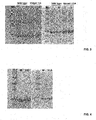
- the carbonic anhydrase mutants were expressed in E. coli and purified in the same manner as in Example 2. As shown in FIGS. 3 and 4 , the results of SDS-PAGE analysis showed the mutants were successfully expressed in the cytoplasm of recombinant E . coli and that the purification rate and purity were high.
- M represents a molecular weight standard marker
- T represents the whole cell lysate
- S represents a cell lysate supernatant.
- the carbon dioxide capture activity of the carbonic anhydrase mutants obtained in Example 6 was measured.
- Primarily distilled water and carbonic acid were sequentially injected into a carbonated water production bottle and the bottle was allowed to stand for 2 hours in a water tank filled with ice.
- 120 ⁇ l of buffer (20 mM Tris-sulfate, pH 8.3), 30 ⁇ l of a 0.04% BTB Solution, 40 ⁇ l of distilled water and 10 ⁇ l of an enzyme were added to a 96-well plate, and then 50 ⁇ l of carbonic acid water was added thereto.
- the absorbance was measured at 610 nm for 2 minutes.
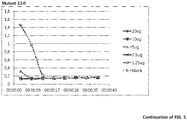
- the enzyme was added at different concentrations of 20 ⁇ g, 10 ⁇ g, 5 ⁇ g, 2.5 ⁇ g, and 1.25 ⁇ g to the reaction mixture, the measurement was conducted at each concentration, and the results for the mutants are shown in FIG. 5 .
- Table 4 summarizes the enzyme activity. Both enzyme mutants had smaller amounts of the enzyme that saturates the initial reaction rate than the wild-type enzyme, and mutant 1.0 showed the highest carbon dioxide capture activity. [Table 4] Comparison of carbon dioxide capture activity between wild-type carbonic anhydrase and carbonic anhydrase mutants Wild type Mutant 1.0 Mutant 13.0 Amount of enzyme saturating initial reaction rate [ ⁇ g] 10 2.5 2.5 Increase in activity compared to wild type [times] - 4 4
- Example 6 In order to compare the heat resistance and stability between the carbonic anhydrase mutant and wild-type carbonic anhydrase, while the carbonic anhydrase mutant obtained in Example 6 was stored at 80 °C, the degree of decrease in carbon dioxide capture activity was periodically measured. The same activity measurement method used in Example 3 was used.
Landscapes
- Health & Medical Sciences (AREA)
- Chemical & Material Sciences (AREA)
- Engineering & Computer Science (AREA)
- Life Sciences & Earth Sciences (AREA)
- Genetics & Genomics (AREA)
- Organic Chemistry (AREA)
- Wood Science & Technology (AREA)
- Zoology (AREA)
- Bioinformatics & Cheminformatics (AREA)
- General Engineering & Computer Science (AREA)
- Biomedical Technology (AREA)
- Biotechnology (AREA)
- General Health & Medical Sciences (AREA)
- Biochemistry (AREA)
- Molecular Biology (AREA)
- Microbiology (AREA)
- Physics & Mathematics (AREA)
- Medicinal Chemistry (AREA)
- Biophysics (AREA)
- Plant Pathology (AREA)
- Chemical Kinetics & Catalysis (AREA)
- General Chemical & Material Sciences (AREA)
- Thermal Sciences (AREA)
- Mechanical Engineering (AREA)
- Environmental & Geological Engineering (AREA)
- Analytical Chemistry (AREA)
- Oil, Petroleum & Natural Gas (AREA)
- Enzymes And Modification Thereof (AREA)
- Micro-Organisms Or Cultivation Processes Thereof (AREA)
Applications Claiming Priority (1)
| Application Number | Priority Date | Filing Date | Title |
|---|---|---|---|
| KR1020180090236A KR102658830B1 (ko) | 2018-08-02 | 2018-08-02 | 내열성 탄산무수화효소 변이체 및 이를 포함하는 이산화탄소 포집용 조성물 |
Publications (2)
| Publication Number | Publication Date |
|---|---|
| EP3604512A1 true EP3604512A1 (de) | 2020-02-05 |
| EP3604512B1 EP3604512B1 (de) | 2021-02-17 |
Family
ID=67539323
Family Applications (1)
| Application Number | Title | Priority Date | Filing Date |
|---|---|---|---|
| EP19189724.8A Active EP3604512B1 (de) | 2018-08-02 | 2019-08-02 | Hitzebeständige carboanhydrasemutanten und zusammensetzung zur erfassung von kohlendioxid damit |
Country Status (4)
| Country | Link |
|---|---|
| US (1) | US10920213B2 (de) |
| EP (1) | EP3604512B1 (de) |
| KR (1) | KR102658830B1 (de) |
| CN (1) | CN110791492B (de) |
Families Citing this family (4)
| Publication number | Priority date | Publication date | Assignee | Title |
|---|---|---|---|---|
| CN110975435A (zh) * | 2019-12-23 | 2020-04-10 | 应城市天润产业用布有限责任公司 | 一种工业除尘的复合过滤材料及其制备工艺 |
| KR102535897B1 (ko) * | 2021-02-25 | 2023-05-26 | 포항공과대학교 산학협력단 | 내염성, 내열성, 내알칼리성이 증가된 신규 탄산무수화효소, 상기 효소의 유전자를 포함하는 재조합 벡터, 및 상기 재조합 벡터로 형질 전환된 형질전환체 |
| WO2025169967A1 (ja) * | 2024-02-06 | 2025-08-14 | 東ソー株式会社 | 改変された炭酸脱水酵素 |
| WO2025168806A1 (en) * | 2024-02-08 | 2025-08-14 | Novozymes A/S | Polypeptides having carbonic anhydrase activity and polynucleotides encoding same |
Citations (6)
| Publication number | Priority date | Publication date | Assignee | Title |
|---|---|---|---|---|
| EP0307247A2 (de) | 1987-09-11 | 1989-03-15 | Genentech, Inc. | Verfahren zur Züchtung rekombinanter Zellen |
| WO1991008291A2 (en) | 1989-11-22 | 1991-06-13 | Genentech, Inc. | Latency associated peptide and uses therefor |
| WO2008095057A2 (en) * | 2007-01-31 | 2008-08-07 | Novozymes A/S | Heat-stable carbonic anhydrases and their use |
| US20160222371A1 (en) * | 2013-10-17 | 2016-08-04 | Postech Academy-Industry Foundation | Carbonic anhydrase with stability at high temperature and capturring agent for carbon dioxide comprising the same |
| KR20160098652A (ko) * | 2015-02-10 | 2016-08-19 | 포항공과대학교 산학협력단 | 신규한 이황화결합을 가진, 개량된 고온 안정성 탄산무수화효소 및 이의 이용 |
| WO2018017792A1 (en) * | 2016-07-20 | 2018-01-25 | Novozymes A/S | Heat-stable metagenomic carbonic anhydrases and their use |
Family Cites Families (4)
| Publication number | Priority date | Publication date | Assignee | Title |
|---|---|---|---|---|
| KR20120064030A (ko) * | 2010-12-08 | 2012-06-18 | 에스케이이노베이션 주식회사 | 이산화탄소의 배출이 저감된 가스화 방법 |
| US9410140B2 (en) * | 2011-05-10 | 2016-08-09 | Danisco Us Inc | Thermostable carbonic anhydrases and methods of use thereof |
| WO2013064195A1 (en) * | 2011-11-04 | 2013-05-10 | Enel Ingegneria E Ricerca S.P.A. | A new heat-stable carbonic anhydrase and uses thereof |
| KR101591992B1 (ko) * | 2013-07-29 | 2016-02-19 | 한양대학교 산학협력단 | 두날리엘라 살리나 유래의 신규한 탄산무수화 효소 1 |
-
2018
- 2018-08-02 KR KR1020180090236A patent/KR102658830B1/ko active Active
-
2019
- 2019-07-30 US US16/525,935 patent/US10920213B2/en active Active
- 2019-08-01 CN CN201910708393.4A patent/CN110791492B/zh active Active
- 2019-08-02 EP EP19189724.8A patent/EP3604512B1/de active Active
Patent Citations (6)
| Publication number | Priority date | Publication date | Assignee | Title |
|---|---|---|---|---|
| EP0307247A2 (de) | 1987-09-11 | 1989-03-15 | Genentech, Inc. | Verfahren zur Züchtung rekombinanter Zellen |
| WO1991008291A2 (en) | 1989-11-22 | 1991-06-13 | Genentech, Inc. | Latency associated peptide and uses therefor |
| WO2008095057A2 (en) * | 2007-01-31 | 2008-08-07 | Novozymes A/S | Heat-stable carbonic anhydrases and their use |
| US20160222371A1 (en) * | 2013-10-17 | 2016-08-04 | Postech Academy-Industry Foundation | Carbonic anhydrase with stability at high temperature and capturring agent for carbon dioxide comprising the same |
| KR20160098652A (ko) * | 2015-02-10 | 2016-08-19 | 포항공과대학교 산학협력단 | 신규한 이황화결합을 가진, 개량된 고온 안정성 탄산무수화효소 및 이의 이용 |
| WO2018017792A1 (en) * | 2016-07-20 | 2018-01-25 | Novozymes A/S | Heat-stable metagenomic carbonic anhydrases and their use |
Non-Patent Citations (8)
| Title |
|---|
| A. VEAWAB, IND. ENG. CHEM. RES., vol. 38, 1999, pages 3917 |
| ANNA DI FIORE ET AL: "Thermostable Carbonic Anhydrases in Biotechnological Applications", INTERNATIONAL JOURNAL OF MOLECULAR SCIENCES, vol. 16, no. 7, 8 July 2015 (2015-07-08), pages 15456 - 15480, XP055340373, DOI: 10.3390/ijms160715456 * |
| ANNA DI FIORE: "Thermostable Carbonic Anhydrases in Biotechnological Applications", INT. J. MOL. SCI., vol. 16, no. 7, 8 July 2015 (2015-07-08), pages 15456 - 80, XP055340373, doi:10.3390/ijms160715456 |
| ANONYMOUS: "carbonic anhydrase [Metallosphaera yellowstonensis] - Protein - NCBI", 28 May 2013 (2013-05-28), XP055636013, Retrieved from the Internet <URL:https://www.ncbi.nlm.nih.gov/protein/WP_009072641> [retrieved on 20191025] * |
| ANONYMOUS: "Lsan_2877 - Carbonic anhydrase - Legionella santicrucis - Lsan_2877 gene & protein", 16 March 2016 (2016-03-16), XP055636019, Retrieved from the Internet <URL:https://www.uniprot.org/uniprot/A0A0W0YID9> [retrieved on 20191025] * |
| ANONYMOUS: "TQ35_04350 - Carbonic anhydrase - Candidatus Aramenus sulfurataquae - TQ35_04350 gene & protein", 6 April 2016 (2016-04-06), XP055636032, Retrieved from the Internet <URL:https://www.uniprot.org/uniprot/A0A0F2LR90> [retrieved on 20191025] * |
| G. PUXTY, ENVIRON. SCI. TECHNOL., vol. 43, 2009, pages 6427 |
| YUTAKA KAWARABAYASI ET AL: "Complete Genome Sequence of an Aerobic Thermoacidophilic Crenarchaeon, Sulf olobus tokodaii strain7", DNA RESEARCH, 1 January 2001 (2001-01-01), pages 123 - 140, XP055636027, Retrieved from the Internet <URL:https://watermark.silverchair.com/dnares_8_4_123.pdf?token=AQECAHi208BE49Ooan9kkhW_Ercy7Dm3ZL_9Cf3qfKAc485ysgAAAoQwggKABgkqhkiG9w0BBwagggJxMIICbQIBADCCAmYGCSqGSIb3DQEHATAeBglghkgBZQMEAS4wEQQMc71HADVbnFAiLodGAgEQgIICN9JE9GTXlhcnWZ_DAPwiK5WAuSPPC7gALc3gOd2YhBrSv89-2YyFlnbrTV94MKuEggTLUFnIsLcqCoU-ThLOU> * |
Also Published As
| Publication number | Publication date |
|---|---|
| US20200040324A1 (en) | 2020-02-06 |
| KR102658830B1 (ko) | 2024-04-19 |
| US10920213B2 (en) | 2021-02-16 |
| CN110791492B (zh) | 2024-03-22 |
| CN110791492A (zh) | 2020-02-14 |
| KR20200015012A (ko) | 2020-02-12 |
| EP3604512B1 (de) | 2021-02-17 |
Similar Documents
| Publication | Publication Date | Title |
|---|---|---|
| EP3604512B1 (de) | Hitzebeständige carboanhydrasemutanten und zusammensetzung zur erfassung von kohlendioxid damit | |
| US7608434B2 (en) | Mutated Tn5 transposase proteins and the use thereof | |
| CN113767168B (zh) | 高效引入赖氨酸衍生物的氨酰基—tRNA合成酶 | |
| JP2022529021A (ja) | タンパク質作製の材料および方法 | |
| CN111718920B (zh) | 在蛋白中高效引入赖氨酸衍生物的氨酰基-tRNA合成酶 | |
| CN111172129B (zh) | 一种提高热稳定、扩增均一性和扩增效率的Phi29 DNA聚合酶突变体及其应用 | |
| CN111718949B (zh) | 利用双质粒系统在蛋白中引入非天然氨基酸 | |
| CN112840028B (zh) | 包含变体RpoC编码序列的核酸分子 | |
| KR102501259B1 (ko) | 목적 단백질의 분비 생산능이 향상된 재조합 코리네박테리움 | |
| JP2023504869A (ja) | 改変daao及びその使用 | |
| WO2011137369A1 (en) | Production of gamma-aminobutyric acid by recombinant microorganisms | |
| CN111850020B (zh) | 利用质粒系统在蛋白中引入非天然氨基酸 | |
| US20090081754A1 (en) | Gene of enzyme having activity to generate lachrymatory factor | |
| EP2285966A1 (de) | Mehrstufige polynukleotidsteuersequenzen | |
| CN112877269B (zh) | 生产赖氨酸的微生物以及赖氨酸的生产方法 | |
| CN102747060A (zh) | D-氨甲酰水解酶的突变体及其制备方法和应用 | |
| KR20230012324A (ko) | 신규한 베타-카로틴 15,15 -옥시게네이즈 변이체 및 이를 이용한 레티노이드 생산방법 | |
| CN104781275A (zh) | 修饰的apol1多肽 | |
| JP7270884B2 (ja) | バチルス科好熱細菌由来変異型グリシンオキシダーゼおよびその製造方法 | |
| JP4884733B2 (ja) | D−乳酸脱水素酵素 | |
| EP4370687B1 (de) | Neue systeme zur herstellung rekombinanter proteine | |
| KR101524926B1 (ko) | 재조합 발현벡터, 이를 포함하는 숙주세포 및 그 용도 | |
| KR100755727B1 (ko) | β-갈락토시다제 유래의 융합 단편 펩타이드 및 이를 융합파트너로 이용하는 재조합 단백질의 제조방법 | |
| JP2025069921A (ja) | アルロースエピマー化酵素発現カセットおよびこれを用いたアルロース製造方法 | |
| CN121555462A (zh) | TelN原核端粒酶变体及其应用 |
Legal Events
| Date | Code | Title | Description |
|---|---|---|---|
| PUAI | Public reference made under article 153(3) epc to a published international application that has entered the european phase |
Free format text: ORIGINAL CODE: 0009012 |
|
| STAA | Information on the status of an ep patent application or granted ep patent |
Free format text: STATUS: REQUEST FOR EXAMINATION WAS MADE |
|
| 17P | Request for examination filed |
Effective date: 20190802 |
|
| AK | Designated contracting states |
Kind code of ref document: A1 Designated state(s): AL AT BE BG CH CY CZ DE DK EE ES FI FR GB GR HR HU IE IS IT LI LT LU LV MC MK MT NL NO PL PT RO RS SE SI SK SM TR |
|
| AX | Request for extension of the european patent |
Extension state: BA ME |
|
| STAA | Information on the status of an ep patent application or granted ep patent |
Free format text: STATUS: EXAMINATION IS IN PROGRESS |
|
| 17Q | First examination report despatched |
Effective date: 20200414 |
|
| GRAJ | Information related to disapproval of communication of intention to grant by the applicant or resumption of examination proceedings by the epo deleted |
Free format text: ORIGINAL CODE: EPIDOSDIGR1 |
|
| STAA | Information on the status of an ep patent application or granted ep patent |
Free format text: STATUS: GRANT OF PATENT IS INTENDED |
|
| GRAP | Despatch of communication of intention to grant a patent |
Free format text: ORIGINAL CODE: EPIDOSNIGR1 |
|
| INTG | Intention to grant announced |
Effective date: 20200828 |
|
| GRAS | Grant fee paid |
Free format text: ORIGINAL CODE: EPIDOSNIGR3 |
|
| GRAA | (expected) grant |
Free format text: ORIGINAL CODE: 0009210 |
|
| STAA | Information on the status of an ep patent application or granted ep patent |
Free format text: STATUS: THE PATENT HAS BEEN GRANTED |
|
| AK | Designated contracting states |
Kind code of ref document: B1 Designated state(s): AL AT BE BG CH CY CZ DE DK EE ES FI FR GB GR HR HU IE IS IT LI LT LU LV MC MK MT NL NO PL PT RO RS SE SI SK SM TR |
|
| REG | Reference to a national code |
Ref country code: GB Ref legal event code: FG4D |
|
| REG | Reference to a national code |
Ref country code: CH Ref legal event code: EP |
|
| REG | Reference to a national code |
Ref country code: DE Ref legal event code: R096 Ref document number: 602019002575 Country of ref document: DE |
|
| REG | Reference to a national code |
Ref country code: AT Ref legal event code: REF Ref document number: 1361497 Country of ref document: AT Kind code of ref document: T Effective date: 20210315 |
|
| REG | Reference to a national code |
Ref country code: IE Ref legal event code: FG4D |
|
| REG | Reference to a national code |
Ref country code: LT Ref legal event code: MG9D |
|
| REG | Reference to a national code |
Ref country code: NO Ref legal event code: T2 Effective date: 20210217 |
|
| REG | Reference to a national code |
Ref country code: NL Ref legal event code: MP Effective date: 20210217 |
|
| PG25 | Lapsed in a contracting state [announced via postgrant information from national office to epo] |
Ref country code: BG Free format text: LAPSE BECAUSE OF FAILURE TO SUBMIT A TRANSLATION OF THE DESCRIPTION OR TO PAY THE FEE WITHIN THE PRESCRIBED TIME-LIMIT Effective date: 20210517 Ref country code: HR Free format text: LAPSE BECAUSE OF FAILURE TO SUBMIT A TRANSLATION OF THE DESCRIPTION OR TO PAY THE FEE WITHIN THE PRESCRIBED TIME-LIMIT Effective date: 20210217 Ref country code: FI Free format text: LAPSE BECAUSE OF FAILURE TO SUBMIT A TRANSLATION OF THE DESCRIPTION OR TO PAY THE FEE WITHIN THE PRESCRIBED TIME-LIMIT Effective date: 20210217 Ref country code: GR Free format text: LAPSE BECAUSE OF FAILURE TO SUBMIT A TRANSLATION OF THE DESCRIPTION OR TO PAY THE FEE WITHIN THE PRESCRIBED TIME-LIMIT Effective date: 20210518 Ref country code: LT Free format text: LAPSE BECAUSE OF FAILURE TO SUBMIT A TRANSLATION OF THE DESCRIPTION OR TO PAY THE FEE WITHIN THE PRESCRIBED TIME-LIMIT Effective date: 20210217 Ref country code: PT Free format text: LAPSE BECAUSE OF FAILURE TO SUBMIT A TRANSLATION OF THE DESCRIPTION OR TO PAY THE FEE WITHIN THE PRESCRIBED TIME-LIMIT Effective date: 20210617 |
|
| REG | Reference to a national code |
Ref country code: AT Ref legal event code: MK05 Ref document number: 1361497 Country of ref document: AT Kind code of ref document: T Effective date: 20210217 |
|
| PG25 | Lapsed in a contracting state [announced via postgrant information from national office to epo] |
Ref country code: SE Free format text: LAPSE BECAUSE OF FAILURE TO SUBMIT A TRANSLATION OF THE DESCRIPTION OR TO PAY THE FEE WITHIN THE PRESCRIBED TIME-LIMIT Effective date: 20210217 Ref country code: RS Free format text: LAPSE BECAUSE OF FAILURE TO SUBMIT A TRANSLATION OF THE DESCRIPTION OR TO PAY THE FEE WITHIN THE PRESCRIBED TIME-LIMIT Effective date: 20210217 Ref country code: PL Free format text: LAPSE BECAUSE OF FAILURE TO SUBMIT A TRANSLATION OF THE DESCRIPTION OR TO PAY THE FEE WITHIN THE PRESCRIBED TIME-LIMIT Effective date: 20210217 Ref country code: NL Free format text: LAPSE BECAUSE OF FAILURE TO SUBMIT A TRANSLATION OF THE DESCRIPTION OR TO PAY THE FEE WITHIN THE PRESCRIBED TIME-LIMIT Effective date: 20210217 Ref country code: LV Free format text: LAPSE BECAUSE OF FAILURE TO SUBMIT A TRANSLATION OF THE DESCRIPTION OR TO PAY THE FEE WITHIN THE PRESCRIBED TIME-LIMIT Effective date: 20210217 |
|
| PG25 | Lapsed in a contracting state [announced via postgrant information from national office to epo] |
Ref country code: IS Free format text: LAPSE BECAUSE OF FAILURE TO SUBMIT A TRANSLATION OF THE DESCRIPTION OR TO PAY THE FEE WITHIN THE PRESCRIBED TIME-LIMIT Effective date: 20210617 |
|
| PG25 | Lapsed in a contracting state [announced via postgrant information from national office to epo] |
Ref country code: AT Free format text: LAPSE BECAUSE OF FAILURE TO SUBMIT A TRANSLATION OF THE DESCRIPTION OR TO PAY THE FEE WITHIN THE PRESCRIBED TIME-LIMIT Effective date: 20210217 Ref country code: SM Free format text: LAPSE BECAUSE OF FAILURE TO SUBMIT A TRANSLATION OF THE DESCRIPTION OR TO PAY THE FEE WITHIN THE PRESCRIBED TIME-LIMIT Effective date: 20210217 Ref country code: EE Free format text: LAPSE BECAUSE OF FAILURE TO SUBMIT A TRANSLATION OF THE DESCRIPTION OR TO PAY THE FEE WITHIN THE PRESCRIBED TIME-LIMIT Effective date: 20210217 Ref country code: CZ Free format text: LAPSE BECAUSE OF FAILURE TO SUBMIT A TRANSLATION OF THE DESCRIPTION OR TO PAY THE FEE WITHIN THE PRESCRIBED TIME-LIMIT Effective date: 20210217 |
|
| REG | Reference to a national code |
Ref country code: DE Ref legal event code: R097 Ref document number: 602019002575 Country of ref document: DE |
|
| PG25 | Lapsed in a contracting state [announced via postgrant information from national office to epo] |
Ref country code: DK Free format text: LAPSE BECAUSE OF FAILURE TO SUBMIT A TRANSLATION OF THE DESCRIPTION OR TO PAY THE FEE WITHIN THE PRESCRIBED TIME-LIMIT Effective date: 20210217 Ref country code: SK Free format text: LAPSE BECAUSE OF FAILURE TO SUBMIT A TRANSLATION OF THE DESCRIPTION OR TO PAY THE FEE WITHIN THE PRESCRIBED TIME-LIMIT Effective date: 20210217 Ref country code: RO Free format text: LAPSE BECAUSE OF FAILURE TO SUBMIT A TRANSLATION OF THE DESCRIPTION OR TO PAY THE FEE WITHIN THE PRESCRIBED TIME-LIMIT Effective date: 20210217 |
|
| PLBE | No opposition filed within time limit |
Free format text: ORIGINAL CODE: 0009261 |
|
| STAA | Information on the status of an ep patent application or granted ep patent |
Free format text: STATUS: NO OPPOSITION FILED WITHIN TIME LIMIT |
|
| 26N | No opposition filed |
Effective date: 20211118 |
|
| PG25 | Lapsed in a contracting state [announced via postgrant information from national office to epo] |
Ref country code: ES Free format text: LAPSE BECAUSE OF FAILURE TO SUBMIT A TRANSLATION OF THE DESCRIPTION OR TO PAY THE FEE WITHIN THE PRESCRIBED TIME-LIMIT Effective date: 20210217 Ref country code: AL Free format text: LAPSE BECAUSE OF FAILURE TO SUBMIT A TRANSLATION OF THE DESCRIPTION OR TO PAY THE FEE WITHIN THE PRESCRIBED TIME-LIMIT Effective date: 20210217 |
|
| PG25 | Lapsed in a contracting state [announced via postgrant information from national office to epo] |
Ref country code: SI Free format text: LAPSE BECAUSE OF FAILURE TO SUBMIT A TRANSLATION OF THE DESCRIPTION OR TO PAY THE FEE WITHIN THE PRESCRIBED TIME-LIMIT Effective date: 20210217 |
|
| PG25 | Lapsed in a contracting state [announced via postgrant information from national office to epo] |
Ref country code: MC Free format text: LAPSE BECAUSE OF FAILURE TO SUBMIT A TRANSLATION OF THE DESCRIPTION OR TO PAY THE FEE WITHIN THE PRESCRIBED TIME-LIMIT Effective date: 20210217 |
|
| REG | Reference to a national code |
Ref country code: BE Ref legal event code: MM Effective date: 20210831 |
|
| PG25 | Lapsed in a contracting state [announced via postgrant information from national office to epo] |
Ref country code: IT Free format text: LAPSE BECAUSE OF FAILURE TO SUBMIT A TRANSLATION OF THE DESCRIPTION OR TO PAY THE FEE WITHIN THE PRESCRIBED TIME-LIMIT Effective date: 20210217 |
|
| PG25 | Lapsed in a contracting state [announced via postgrant information from national office to epo] |
Ref country code: IS Free format text: LAPSE BECAUSE OF FAILURE TO SUBMIT A TRANSLATION OF THE DESCRIPTION OR TO PAY THE FEE WITHIN THE PRESCRIBED TIME-LIMIT Effective date: 20210617 Ref country code: LU Free format text: LAPSE BECAUSE OF NON-PAYMENT OF DUE FEES Effective date: 20210802 |
|
| PG25 | Lapsed in a contracting state [announced via postgrant information from national office to epo] |
Ref country code: IE Free format text: LAPSE BECAUSE OF NON-PAYMENT OF DUE FEES Effective date: 20210802 Ref country code: BE Free format text: LAPSE BECAUSE OF NON-PAYMENT OF DUE FEES Effective date: 20210831 |
|
| REG | Reference to a national code |
Ref country code: CH Ref legal event code: PL |
|
| PG25 | Lapsed in a contracting state [announced via postgrant information from national office to epo] |
Ref country code: LI Free format text: LAPSE BECAUSE OF NON-PAYMENT OF DUE FEES Effective date: 20220831 Ref country code: CH Free format text: LAPSE BECAUSE OF NON-PAYMENT OF DUE FEES Effective date: 20220831 |
|
| PG25 | Lapsed in a contracting state [announced via postgrant information from national office to epo] |
Ref country code: CY Free format text: LAPSE BECAUSE OF FAILURE TO SUBMIT A TRANSLATION OF THE DESCRIPTION OR TO PAY THE FEE WITHIN THE PRESCRIBED TIME-LIMIT Effective date: 20210217 |
|
| PG25 | Lapsed in a contracting state [announced via postgrant information from national office to epo] |
Ref country code: HU Free format text: LAPSE BECAUSE OF FAILURE TO SUBMIT A TRANSLATION OF THE DESCRIPTION OR TO PAY THE FEE WITHIN THE PRESCRIBED TIME-LIMIT; INVALID AB INITIO Effective date: 20190802 |
|
| P01 | Opt-out of the competence of the unified patent court (upc) registered |
Effective date: 20230622 |
|
| PG25 | Lapsed in a contracting state [announced via postgrant information from national office to epo] |
Ref country code: MK Free format text: LAPSE BECAUSE OF FAILURE TO SUBMIT A TRANSLATION OF THE DESCRIPTION OR TO PAY THE FEE WITHIN THE PRESCRIBED TIME-LIMIT Effective date: 20210217 |
|
| PG25 | Lapsed in a contracting state [announced via postgrant information from national office to epo] |
Ref country code: TR Free format text: LAPSE BECAUSE OF FAILURE TO SUBMIT A TRANSLATION OF THE DESCRIPTION OR TO PAY THE FEE WITHIN THE PRESCRIBED TIME-LIMIT Effective date: 20210217 |
|
| PG25 | Lapsed in a contracting state [announced via postgrant information from national office to epo] |
Ref country code: MT Free format text: LAPSE BECAUSE OF FAILURE TO SUBMIT A TRANSLATION OF THE DESCRIPTION OR TO PAY THE FEE WITHIN THE PRESCRIBED TIME-LIMIT Effective date: 20210217 |
|
| PGFP | Annual fee paid to national office [announced via postgrant information from national office to epo] |
Ref country code: GB Payment date: 20250624 Year of fee payment: 7 |
|
| PGFP | Annual fee paid to national office [announced via postgrant information from national office to epo] |
Ref country code: NO Payment date: 20250626 Year of fee payment: 7 |
|
| PGFP | Annual fee paid to national office [announced via postgrant information from national office to epo] |
Ref country code: FR Payment date: 20250624 Year of fee payment: 7 |
|
| PGFP | Annual fee paid to national office [announced via postgrant information from national office to epo] |
Ref country code: DE Payment date: 20250624 Year of fee payment: 7 |