EP3605334A1 - Commande d'incitation pour systèmes multi-agents - Google Patents
Commande d'incitation pour systèmes multi-agents Download PDFInfo
- Publication number
- EP3605334A1 EP3605334A1 EP18186631.0A EP18186631A EP3605334A1 EP 3605334 A1 EP3605334 A1 EP 3605334A1 EP 18186631 A EP18186631 A EP 18186631A EP 3605334 A1 EP3605334 A1 EP 3605334A1
- Authority
- EP
- European Patent Office
- Prior art keywords
- agent
- reward
- agents
- policy
- meta
- Prior art date
- Legal status (The legal status is an assumption and is not a legal conclusion. Google has not performed a legal analysis and makes no representation as to the accuracy of the status listed.)
- Withdrawn
Links
Images




Classifications
-
- G—PHYSICS
- G06—COMPUTING OR CALCULATING; COUNTING
- G06N—COMPUTING ARRANGEMENTS BASED ON SPECIFIC COMPUTATIONAL MODELS
- G06N20/00—Machine learning
-
- G—PHYSICS
- G06—COMPUTING OR CALCULATING; COUNTING
- G06F—ELECTRIC DIGITAL DATA PROCESSING
- G06F9/00—Arrangements for program control, e.g. control units
- G06F9/06—Arrangements for program control, e.g. control units using stored programs, i.e. using an internal store of processing equipment to receive or retain programs
- G06F9/46—Multiprogramming arrangements
- G06F9/54—Interprogram communication
-
- G—PHYSICS
- G05—CONTROLLING; REGULATING
- G05B—CONTROL OR REGULATING SYSTEMS IN GENERAL; FUNCTIONAL ELEMENTS OF SUCH SYSTEMS; MONITORING OR TESTING ARRANGEMENTS FOR SUCH SYSTEMS OR ELEMENTS
- G05B19/00—Program-control systems
- G05B19/02—Program-control systems electric
- G05B19/18—Numerical control [NC], i.e. automatically operating machines, in particular machine tools, e.g. in a manufacturing environment, so as to execute positioning, movement or co-ordinated operations by means of program data in numerical form
- G05B19/4155—Numerical control [NC], i.e. automatically operating machines, in particular machine tools, e.g. in a manufacturing environment, so as to execute positioning, movement or co-ordinated operations by means of program data in numerical form characterised by program execution, i.e. part program or machine function execution, e.g. selection of a program
-
- G—PHYSICS
- G06—COMPUTING OR CALCULATING; COUNTING
- G06N—COMPUTING ARRANGEMENTS BASED ON SPECIFIC COMPUTATIONAL MODELS
- G06N3/00—Computing arrangements based on biological models
- G06N3/004—Artificial life, i.e. computing arrangements simulating life
- G06N3/006—Artificial life, i.e. computing arrangements simulating life based on simulated virtual individual or collective life forms, e.g. social simulations or particle swarm optimisation [PSO]
-
- G—PHYSICS
- G06—COMPUTING OR CALCULATING; COUNTING
- G06N—COMPUTING ARRANGEMENTS BASED ON SPECIFIC COMPUTATIONAL MODELS
- G06N3/00—Computing arrangements based on biological models
- G06N3/02—Neural networks
- G06N3/08—Learning methods
- G06N3/084—Backpropagation, e.g. using gradient descent
-
- G—PHYSICS
- G06—COMPUTING OR CALCULATING; COUNTING
- G06N—COMPUTING ARRANGEMENTS BASED ON SPECIFIC COMPUTATIONAL MODELS
- G06N7/00—Computing arrangements based on specific mathematical models
- G06N7/01—Probabilistic graphical models, e.g. probabilistic networks
-
- G—PHYSICS
- G05—CONTROLLING; REGULATING
- G05B—CONTROL OR REGULATING SYSTEMS IN GENERAL; FUNCTIONAL ELEMENTS OF SUCH SYSTEMS; MONITORING OR TESTING ARRANGEMENTS FOR SUCH SYSTEMS OR ELEMENTS
- G05B2219/00—Program-control systems
- G05B2219/30—Nc systems
- G05B2219/40—Robotics, robotics mapping to robotics vision
- G05B2219/40499—Reinforcement learning algorithm
Definitions
- the present invention relates to methods and systems for inducing desirable equilibrium behaviour in a system of reinforcement learning agents.
- One approach for ensuring desirable behaviour in a system of agents is to employ a centralised learner to determine policies for the agents.
- Such an approach typically becomes prohibitively computationally expensive for large numbers of agents (for example hundreds or thousands of agents), with the cost of the learning computation scaling exponentially with the number of agents.
- Such an approach also requires large volumes of data to be transferred between the agents and the centralised learner, which may not be feasible or practicable, particularly for cases in which the number of agents is large, and/or in which the agents are remote from the centralised learner.
- Such an approach is only applicable for cases in which a single entity has control of all of the agents and can thus ensure the agents will work selflessly, as opposed to self-interestedly, towards a common objective.
- a machine learning system comprising: a set of agents, each having associated processing circuitry and associated memory circuitry, the associated memory circuitry of each agent holding a respective policy for selecting an action in dependence on the agent making an observation of an environment; and a meta-agent having associated processing circuitry and associated memory circuitry.
- the associated memory circuitry of each agent further holds program code which, when executed by the associated processing circuitry of that agent, causes the agent to update iteratively the respective policy of that agent, each iteration of the updating comprising, for each of a sequence of time steps: making an observation of the environment; selecting an action depending on the observation and the respective policy; and determining a reward depending on the selected action, the reward depending on a reward modifier parameter.
- Each iteration of the updating further includes: generating trajectory data dependent on the observations made, the actions performed, and the rewards determined at each of the sequence of time steps; and updating the respective policy using the sequentially generated trajectory data.
- the iterative updating causes the respective policy of each of the agents to converge towards a respective stationary policy, thereby substantially inducing equilibrium behaviour between the agents.
- the associated memory circuitry of the meta-agent holds program code which, when executed by the associated processing circuitry of the meta-agent, causes the agent to: determine a system reward depending on the equilibrium behaviour of the agents; determine, using the determined system reward, an estimated system value associated with the equilibrium behaviour of the agents; and determine, using the estimated system value, a revised reward modifier parameter for determining subsequent reward signals for the plurality of agents.
- the present system may, for example, be used to induce a system of independent, self-interested agents to work together towards a common goal.
- the present system may be contrasted with a system of agents following policies determined by a centralised learner, in that the agents in the present system perform reinforcement learning independently, and the actions of the meta-agent only affect the agents indirectly by modifying an incentivisation structure for the agents. Since the agents in the present system are independent, the present system is readily scalable to large numbers of agents, for example hundreds or thousands of agents. Furthermore, the agents in the present system are self-interested, and therefore it is not necessary for a single entity to have direct control of the agents in order to achieve desirable behaviour of the agents.
- the present system may also be contrasted with distributed learning methods, in which agents share information with each other and effectively perform a distributed learning computation.
- distributed learning methods in which agents share information with each other and effectively perform a distributed learning computation.
- the agents in the present system are not required to work selflessly towards a common objective, nor is any transfer of data between the agents necessary.
- the meta-agent is not required to be able to directly alter behaviour of the agents, for example by modifying program code, memory and/or communication capabilities of the agents, any of which may be impractical or impossible, for example in the case of remotely-deployed agents.
- the present invention may be used in open systems where the meta-agent cannot directly modify the agents, but can only indirectly alter the behaviour of the agents by providing incentives to the agents.
- a set N ⁇ 1, ..., n ⁇ of autonomous agents 100 (of which agent 100.1, agent 100.2, and agent 100. n are shown) interact with an environment 110.
- the environment 110 is a physical environment
- each agent 100 is associated with a robot having one or more sensors and one or more actuators.
- Each agent 100 is further associated with a computing module comprising memory and processor circuitry.
- each robot makes an observation of the environment 110 using the one or more sensors, and the agent 100 receives an observation signal indicative of the observation.
- the information conveyed by an observation signal does not convey a complete description of a state of the environment because, for example, the sensors of the corresponding robot may have limited sensing capabilities and physical obstructions within the environment 110 may restrict the sensing of the environment 110.
- each agent 100 is generally only able to partially observe the state of the environment.
- the agents 100 generally have no a priori model of the environment, and accordingly the only information stored by each agent 100 regarding the environment 110 is that conveyed by the observation signals.
- a state of the environment 110 includes variables associated with the agents 100 themselves.
- the state of the environment 110 includes the location of each robot.
- the agents 100 are associated with autonomous vehicles, and the state of the environment includes the locations of the autonomous vehicles.
- Each agent 100 selects actions according to a respective (stochastic) policy, and sends control signals to the associated robot corresponding to the selected actions, causing the associated robot to perform the selected actions on the environment 110 using the one or more actuators.
- the respective policy of an agent 100 is a conditional distribution over a set of possible actions given a current observation signal.
- the performed actions affect subsequent states of the environment 110, and accordingly may affect observation signals received by one or more of the agents 100 at subsequent time steps.
- the agents 100 proceed on the assumption that the next state of the environment 110 is determined by the current state of the environment 110 and the actions performed by the set N of agents 100 in accordance with a state transition probability distribution.
- the state transition probability distribution is generally not known a priori, but is assumed to remain constant over the course of the learning process.
- the independence of the state transition probability distribution from states of the environment preceding the current state of the environment 110 is referred to as the Markov property, and the environment 110 is sometimes referred to as "memoryless" by virtue of satisfying the Markov property.
- the present invention is applicable in systems where the above assumptions hold, or approximately hold (for example, in cases where a state transition probability distribution changes over a time scale much greater than that of the learning process described hereafter).
- the agent 100 determines a reward.
- the reward determined at a given time step generally depends on the state of the environment 110 at the given time step, the action selected by that agent 100 at the given time step, and may depend on actions selected by one or more of the other agents 100 at the given time step.
- the reward is a real number
- the objective of each agent 100 is to update its respective policy, to maximise a (possibly discounted) expected cumulative reward over a predetermined (possibly infinite) number of time steps.
- Each agent 100 can therefore be described as self-interested or rational, as each agent 100 only seeks to maximise its own cumulative reward.
- Some examples in accordance with the present invention involve continuing or infinite horizon tasks, in which agents continue to interact with an environment for an indefinite number of time steps.
- the number of time steps over which the agents seek to maximise an expected cumulative reward may be infinite, in which case a multiplicative discount factor is included to ensure convergence of the expected cumulative reward.
- Other examples involve episodic tasks, in which agents interact with an environment in a series of episodes, each episode having a finite number of time steps.
- the number of time steps for an episodic task may be predetermined, may be random, or may be dependent on the system reaching particular states (for example, an episodic task may have one or more predetermined terminal states, such that when the system reaches a terminal state, the episode ends).
- the initial state of the system may be different for different episodes, and may, for example, be modelled using an initial state probability distribution.
- the initial state probability distribution may be a priori unknown to the agents.
- agents For an episodic task, agents generally aim to maximise an expected cumulative reward over a single episode.
- MPG Markov Potential Game
- An MPG is distinguished from the more general class of MGs by the property that the incentive of the agents to change strategy is expressible using a single global function called a potential function, as described hereafter.
- MPGs arise in systems in which agents compete for a common resource or share common limitations. Examples include communication devices sharing limited frequency bands in a communication network (spectrum sharing), electrical devices sharing a limited power source (for example, an electricity grid), multiple users sharing limited computing resources in a cloud computing environment, or a set of robots sharing limited physical space, for example in swarm robotics.
- MPGs include congestion games, which model, for example, traffic flow in a transport network, and therefore MPG models may be applied to understand and optimise the behaviour of vehicles (for example, autonomous vehicles) in a transport network. MPGs also arise in cooperative or team games, in which independent agents work together to achieve a common objective. Examples include distributed logistics and network packet delivery problems.
- the present invention is applicable to MPGs and to systems that can be modelled with sufficient accuracy by MPGs. For such systems, it can be shown that by tuning the rewards of the agents 100, a given objective can be maximised, as will be described in detail hereafter.
- each agent 100 learns a respective policy so that the collective behaviour of the agents 100 converges towards an equilibrium is referred to as multi-agent reinforcement learning (MARL).
- MARL multi-agent reinforcement learning
- each agent 100 iteratively updates its respective policy with the objective of maximising an expected sum of (possibly discounted) rewards over a sequence of time steps.
- BR Best Response
- M-NE Markov-Nash Equilibrium
- a system such as that illustrated in Figure 1 may have multiple possible M-NEs.
- the present invention provides a method of inducing favourable M-NEs with respect to a predefined system metric by providing incentives to the agents 100 and modifying the provided incentives when an M-NE is substantially reached, whilst assuming that the agents 100 will continue to act self-interestedly.
- the system of Figure 1 further includes a meta-agent 120, which is arranged to determine system rewards depending on the equilibrium behaviour of the agents 100, and determine, using the determined system rewards, a reward modifier parameter for modifying the rewards determined by the agents 100.
- a reward determined by an agent 100 corresponds to the sum of an intrinsic reward component and a reward modifier component.
- the meta-agent 120 is unable to influence the intrinsic reward component, but the reward modifier component is dependent on the reward modifier parameter and accordingly the meta-agent 120 is able to influence the reward modifier component by revising the reward modifier parameter.
- the meta-agent 120 provides incentives to the agents in the form of the reward modifier parameter.
- a reward may include a different composition or combination of an intrinsic reward component and a reward modifier component, or may consist entirely of a reward modifier component, but in any example the meta-agent influences the reward vale by updating the reward modifier parameter.
- the intrinsic reward component and the reward modifier component determined at a given time step may both depend on the observation signal received by the agent 100 at the given time step, the action selected by that agent 100 at the given time step, and may depend on actions selected by one or more of the other agents 100 at the given time step.
- the reward modifier component also depends on the reward modifier parameter generated by the meta-agent 120.
- each agent 100 holds a respective policy for selecting actions in dependence on received observation signals.
- the memory of each agent 100 further holds a respective state value estimator.
- the respective state value estimator for a given policy approximates the state value function for the given policy, where the state value function gives the expected discounted reward that the agent 100 will receive over a predetermined (possibly infinite) number of time steps, given an initial state of the environment, assuming that the agent continues to select actions according to the given policy.
- the state value function of each agent 100 is a priori unknown, and in most examples is extremely challenging to obtain. Obtaining the state value function is made particularly challenging by the fact that each agent 100 may only partially observe the environment 110, as mentioned above.
- each agent 100 determines a state value estimator from trajectory data generated by that agent 100, and uses this state value estimator in place of the state value function, as will be described in more detail hereafter.
- u ⁇ ⁇ , s 0 s
- Equation (2) states that a state value v i ⁇ i , ⁇ ⁇ i s of a state s , for the i th agent 100, when the i th agent 100 follows a policy ⁇ i , and the other agents 100 follow a joint policy ⁇ - i (denoting the policies of all of the agents 100 other than the i th agent 100), is given by the expected sum of discounted rewards determined by the i th agent 100 over T s time steps.
- T s may be infinite.
- T s is finite.
- a discounted reward determined at a given time step is a product of a reward R i,w ( s t , u i,t , u -i,t ) determined at the given time step, and a discount factor ⁇ i ⁇ [0,1], which determines the relative value that the i th agent 100 assigns to subsequent rewards in comparison to the present reward.
- R i,w s t , u i,t , u -i,t
- Equation (2) s t denotes the state of the environment 110 at time step t (which is generally unknown to any given agent 100), u i,t denotes the action performed by the i th agent 100 at time step t, and u -i,t denotes the combined action performed by the other agents 100 at time step t .
- the combined action performed by all of the agents 100 is denoted u
- the joint policy of all of the agents 100 is denoted ⁇ .
- R i ( s t , u i,t , u -i,t ) is an intrinsic reward component
- ⁇ ( s t , u i,t , u -i,t , w ) is a reward modifier component.
- the reward modifier component depends on a reward modifier parameter w, which is determined by the meta-agent 120 as will be described in more detail hereafter.
- the reward modifier component may be generated differently, for example using a Fourier basis in [ s t , u i,t , u -i,t ], which may be appropriate in cases where the state components are expected to exhibit periodicity.
- the reward modifier component may be determined by a neural network, in which case w corresponds to connection weights in the network.
- each agent 100 stores, in memory, a respective state value estimator v ⁇ i ⁇ i , ⁇ ⁇ i , w O i that returns an approximate value for each observation signal o i .
- each agent 100 implements its respective state value estimator using a neural network that takes a vector of values representing an observation signal as an input, and outputs an estimated state value corresponding to the expected sum of discounted reward signals received by the i th agent 100 over a predetermined number T s of time steps, similar to the state value of Equation (2). It is noted that whereas a state value function depends on the state of the environment, the state value estimator depends on an observation signal received an agent 100.
- the respective policy ⁇ i of the i th agent 100 is a conditional distribution over a set of possible actions given a current observation signal o i .
- the policy is implemented using a neural network that takes a vector of values representing an observation signal as an input, and outputs parameters of a distribution from which actions can be sampled.
- the parameters output by the deep neural network may be, for example, a mean and/or variance of a Gaussian distribution, where different values sampled from the Gaussian distribution correspond to different actions. In other examples, other distributions may be used.
- an agent 100 may use the same deep neural network for the respective state value estimator and the respective policy.
- the agents 100 perform an MARL process, where each agent 100 in the present example employs an actor-critic method, with the respective state estimator v ⁇ i ⁇ i , ⁇ ⁇ i , w O i as the "critic" and the respective policy ⁇ i as the "actor".
- T may be a predetermined number.
- the i th agent 100 receives, at S201, an observation signal o i,t corresponding to an observation of the environment 110 at time step t.
- Each agent 100 selects, at S203, an action u i,t depending on the received observation signal o i,t and the current respective policy ⁇ i .
- an agent 100 selects an action u i,t by sampling from a distribution having parameters output by a neural network held in the memory of the agent 100.
- each agent 100 sends a control signal to a robot associated with that agent 100, causing the robot to perform the selected action.
- the agent 100 determines, at S205, a reward R i,w .
- the reward R i,w generally depends on the state of the environment 110 at time t , as well as the combined actions selected by the agents 100 at time step t .
- the reward R i,w also depends on a reward modifier parameter w .
- the reward R i,w includes an intrinsic reward component R i and a reward modifier component ⁇ according to Equation (3) above, where only the reward modifier component depends on the reward modifier parameter w .
- the agents 100 in the present example do not have a priori knowledge of how the reward depends on the state of the environment 110 or the combined actions of the agents 100, and in this example an agent 100 determines a reward by receiving a reward signal from the environment 110.
- a computing device implementing an agent may determine either or both components of the reward from other data received from the environment 110.
- the agent updates, at S209, the respective policy ⁇ i using the generated trajectory data.
- each agent 100 implements the advantage actor-critic (A2C) algorithm to update the respective policy ⁇ i .
- A2C advantage actor-critic
- each agent 100 first updates the respective state value estimator v ⁇ i ⁇ i , ⁇ ⁇ i , w O i using the generated trajectory data. This step is referred to as policy evaluation.
- the agents 100 use temporal difference learning to update v ⁇ i ⁇ i , ⁇ ⁇ i , w O i , in which the state value estimator is computed by passing observation signals through the neural network implementing the state value estimator, backpropagating a temporal difference error through the neural network to determine a gradient of v ⁇ i ⁇ i , ⁇ ⁇ i , w O i with respect to parameters of the neural network, and performing stochastic gradient descent to update the parameters of the neural network such that the temporal difference error is reduced.
- the gradient used in stochastic gradient descent is augmented using a vector of eligibility traces, as will be understood by those skilled in the art.
- Each agent 100 then updates the respective policy ⁇ i on the basis of the updated respective state value estimator v ⁇ i ⁇ i , ⁇ ⁇ i , w O i .
- the respective policy ⁇ i is updated using policy gradient ascent, with the policy gradient estimated based on an advantage function determined from the trajectory data.
- actor-critic algorithms may be used to update the respective policies of agents without departing from the scope of the invention, for example the asynchronous advantage actor-critic (A3C) algorithm.
- other known reinforcement learning algorithms may be used instead of actor-critic algorithms, for example value-based methods or policy-based methods.
- different agents in a system may implement different reinforcement learning algorithms.
- the agents 100 continue to perform steps S201 to S209 iteratively, causing the respective policy ⁇ i of each of the agents 100 to converge towards a respective BR policy.
- a joint policy ⁇ resulting from each of the agents 100 implementing a BR policy corresponds to a M-NE of the MPG associated with the system, and therefore the iterative updating substantially induces an M-NE between the agents 100.
- the agents 100 perform a predetermined number M of MARL iterations, where M is chosen to be large enough that substantial convergence to an M-NE is expected.
- agents perform MARL until predetermined convergence criteria are satisfied, indicating that the joint policy of the agents has substantially reached an M-NE.
- Equation (4) states that the state value of each state of the environment 110 for the i th agent 100 following the policy ⁇ i is greater or equal to the state value of that state if the agent 100 followed the alternative policy ⁇ 'i .
- Every MPG has at least one M-NE.
- the meta-agent 120 determines, at S211, a system reward R MA ( w, ⁇ ) depending on the equilibrium behaviour of the agents 100.
- the meta-agent 120 receives an observation signal corresponding to an observation of the environment 110 after the agents 100 have performed the M iterations of MARL, and determines a system reward in accordance with the observation.
- the observation includes the physical locations of the agents 100, and the system reward depends on a deviation of the distribution of the agents 100 from a desired distribution.
- the desired distribution is chosen to match expected customer demand.
- the agents 100 send data directly to the meta-agent 120, from which the meta-agent 120 determines the system reward R MA ( w, ⁇ ).
- the data sent to the meta-agent 120 may include trajectory data generated by the agents 100 after the joint policy of the agents 100 is expected to have substantially converged to an M-NE.
- each agent 100 stores trajectory data generated by that agent 100 during the last M c iterations of MARL, where M c ⁇ M.
- the agents 100 continue to interact with the environment 110 and to generate trajectory data subsequent to the M iterations of MARL, and store the subsequently-generated trajectory data.
- each agent 100 may send some or all of this trajectory data to the meta-agent 120 for determining a system reward.
- each agent 100 may send data to the meta-agent 120 corresponding to the state value estimator for that agent 100 (for example, connection weights of a neural network used to implement the state value estimator, in the case that the state value estimator is implemented using a neural network), and/or reward values determined by the agents 100 after the joint policy of the agents 100 is expected to have substantially converged to an M-NE.
- the state value estimator for example, connection weights of a neural network used to implement the state value estimator, in the case that the state value estimator is implemented using a neural network
- the system reward R MA ( w, ⁇ ) is "trajectory targeted", such that the system reward depends on the Markov chain X ⁇ induced by the agents 100 following the joint policy ⁇ (which is assumed to have substantially converged to a M-NE associated with the system).
- a trajectory targeted system reward the meta-agent 120 is directly rewarded in accordance with the behaviour of the agents 100.
- a trajectory targeted system reward may be used, for example, to reward a meta-agent for inducing even traffic flow over a network, and to penalise the meta-agent for inducing congestion.
- the system reward R MA ( w , ⁇ ) is "welfare targeted", such that the meta-agent's 120 objective is to maximise a function h ( ⁇ ) of the state value estimators of the individual agents.
- a utilitarian meta-agent 120 may seek to maximise a sum of individual state value estimators of the agents 100, whereas an episcopitarian meta-agent 120 may seek to maximise a minimum state value estimator of the agents 100.
- the meta-agent 120 may, for example, incentivise the agents 100 to reach equilibrium behaviour that results in the best overall outcome for the agents 100.
- the meta-agent 120 estimates, at S213, a system value J ( w , ⁇ ) corresponding to the value, with respect to the system reward R MA ( w , ⁇ ), of applying the reward modifier parameter w , resulting in the agents 100 following the joint policy ⁇ .
- the meta-agent 120 has the objective of maximising the value of J ( w , ⁇ ) by varying the parameter w . Due to the flexibility in the definition of R MA ( w , ⁇ ), as discussed above, this framework allows for different objectives to be incentivised.
- the meta-agent 120 estimates the system value J ( w, ⁇ ) using the system reward R MA ( w, ⁇ ) determined at S211.
- the value of R MA ( w , ⁇ ) is an unbiased estimator of J ( w , ⁇ ), and therefore using R MA ( w , ⁇ ) as an estimate of J ( w , ⁇ ) allows for stochastic optimisation of J ( w, ⁇ ).
- multiple evaluations of R MA ( w , ⁇ ) may be used to estimate J ( w , ⁇ ).
- multiple episodes may be run after the joint policy of the agents is determined, or assumed, to have converged, with each episode leading to the meta-agent 120 receiving a system reward R MA ( w, ⁇ ).
- the system value J ( w , ⁇ ) is then estimated as a mean value of the rewards received by the meta-agent 120.
- multiple evaluations of the system reward R MA ( w, ⁇ ) can similarly be used to estimate a value of the system value J(w, ⁇ ).
- the meta-agent 120 uses the estimated system value J ( w , ⁇ ) to determine, at S215, a revised reward modifier parameter w' for modifying subsequent rewards for the agents 100.
- the meta-agent 120 updates the reward modifier parameter with the aim of inducing a new joint policy ⁇ ' having a greater associated system value i.e. J ( w', ⁇ ') > J ( w , ⁇ ). It is not assumed that any functional form of the system value with respect to w is known a priori by the meta-agent 120, and therefore for the present invention, the meta-agent 120 uses black box optimisation to determine the revised reward modifier parameter.
- determining a revised reward modifier component may not be tractable using, for example, a gradient-based optimisation method.
- the meta-agent 120 uses Bayesian optimisation to determine the revised reward parameter, as will be described in more detail hereafter. It will be appreciated, however, that in other examples other optimisation methods may be used to determine a revised reward modifier component, for example gradient-based optimisation methods.
- the meta-agent 120 transmits, at S217, the revised reward modifier w' for modifying subsequent rewards for the agents 100.
- the revised reward modifier w' is transmitted to the environment 110, such that the agents 100 will subsequently determine rewards depending on the revised reward modifier parameter.
- the meta-agent 120 may transmit the revised reward modifier parameter to the computing devices associated with the agents 100.
- the routine of Figure 2 is repeated K times, where in this example K is a predetermined number.
- the optimisation process may instead be repeated until predetermined convergence criteria are satisfied, or may be repeated indefinitely, for example in cases where an environment is expected to change slowly over time.
- the routine of Figure 2 is an inner-outer loop method, where the inner loop refers to the M iterations of MARL performed by the agents 100, and the outer loop refers to the K iterations of optimisation of the reward modifier parameter performed by the meta-agent 120.
- the inner-outer loop method of Figure 2 has favourable convergence properties compared with, for example, a method that attempts to simultaneously update the respective policies of the agents along with the reward modifier parameter.
- the meta-agent 120 uses Bayesian optimisation to update the reward modifier parameter. Accordingly, the meta-agent 120 treats the system value J ( w , ⁇ ) as a random function of w having a prior distribution over the space of functions.
- Figure 3 shows a routine performed by the meta-agent 120 at each of the K optimisation iterations.
- the meta-agent 120 loads, at S301, data corresponding to the prior distribution into working memory.
- the prior distribution is constructed from a predetermined Gaussian process prior, and the data corresponding to the prior distribution includes a choice of kernel (for example, a Matérn kernel) as well as hyperparameters for the resulting Gaussian process prior.
- kernel for example, a Matérn kernel
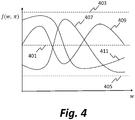
- Figure 4 shows an example of a prior distribution constructed for a system value J ( w , ⁇ ) in the case of a scalar reward modifier parameter w.
- the prior distribution in this example has a constant mean function, represented by the dashed line 401.
- the dashed lines 403 and 405 are each separated from the mean function by twice the standard deviation of the prior distribution at each value of w
- solid curves 407, 409, and 411 are sample functions taken from the prior distribution. Sample functions that are close to the mean function generally have a higher probability density than sample functions that are remote from the mean function.
- the meta-agent 120 conditions, at S303, the prior distribution of J ( w , ⁇ ) on the estimated value J ( w k , ⁇ k ) for that iteration, along with the system value values estimated during each preceding iteration of optimisation, resulting in a posterior distribution of J ( w , ⁇ ).
- Figure 5a shows a posterior distribution of J ( w , ⁇ ) in which the prior distribution of Figure 3 has been conditioned on two data points 501 and 503, corresponding to values of the system value J (w 1 , ⁇ ) and J ( w 2 , ⁇ ) estimated during the first and second iterations of optimisation.
- the solid line 505 shows the mean function of the posterior distribution and the dashed curves 507 and 509 are each separated from the mean function by twice the standard deviation of the updated posterior distribution.
- the mean function represented by the solid line 505 passes through both of the data points, and the standard deviation of the posterior distribution is zero at these points.
- the meta-agent 120 constructs, at S305, an acquisition function a ( w ) using the posterior distribution.
- the acquisition function may be evaluated analytically from the posterior distribution of J ( w , ⁇ ).
- the meta-agent 120 uses the expected improvement acquisition function.
- acquisition functions that may be used are upper confidence bounds, probability of improvement, and entropy search.
- An acquisition function establishes a trade-off between exploitation (such that a high value of the acquisition function corresponds to points where the expectation of the posterior distribution is high) and exploration (such that a high value of the acquisition function corresponds to points where the variance of the posterior distribution is high).
- Figure 5b shows an expected improvement acquisition function a ( w ) determined from the posterior distribution of Figure 5a . It is observed that a ( w ) is maximum at a value w * of the reward modifier parameter, which shows a good trade-off between exploitation (i.e. remaining close to the observed maximum) and exploration (i.e. visiting areas of high uncertainty).
- the meta-agent 120 determines, at S307, the revised reward modifier parameter w k +1 using the acquisition function.
- varying the reward modifier parameter w results in the system corresponding to a different MPG, and hence in general the set of M-NEs will change as the meta-agent 120 iteratively updates the reward modifier parameter.
- the problem of a meta-agent may instead be to induce convergence to one of the existing M-NEs that is favourable to the meta-agent, whilst preserving the set of M-NEs associated with the system.
- This variant including the additional constraint that the set of M-NEs must be preserved, is referred to as equilibrium selection, and represents an extremely challenging problem in game theory.
- the present invention provides a method of solving the equilibrium selection problem.
- the reward modifier component ⁇ is restricted to lie within a class of functions referred to as potential-based functions.
- T c may be equal to the number of time steps T s in an episode.
- Equation (6) may be applied to constrain the reward modifier parameter in examples where the reward modifier component corresponds to a transfer of a limited resource to an agent 100 (for example, a physical or financial resource).
- the constant C is real valued (and may be negative) and corresponds to a bound of the net resources transferred to (or from) the agents (note that the reward modifier component may be positive or negative).
- Figure 6 shows a first computing device 600 for implementing an agent in a system of agents in accordance with an embodiment of the present invention.
- the first computing device 600 includes a power supply 602 and a system bus 604.
- the system bus 604 is connected to: a CPU 606; a communication module 608; a memory 610; actuators 612; and sensors 614.
- the memory 610 holds: program code 616; trajectory data 618; policy data 620; state value estimator data 622; and reward modifier data 624.
- the program code 616 includes agent code 626, which, when executed by the CPU 606, cause the first computing device 600 to implement a reinforcement learning routine, as described in detail below.
- FIG. 7 shows a second computing device 700 for implementing a meta-agent in accordance with an embodiment of the present invention.
- the second computing device 700 includes a power supply 702 and a system bus 704.
- the system bus 704 is connected to: a CPU 706; a communication module 708; and a memory 710.
- the memory 710 holds: program code 716; system reward data 718; system value data 720; and reward modifier parameter data 722.
- the program code 716 includes agent code 724, which, when executed by the CPU 706, cause the second computing device 700 to implement a meta-agent routine, as described in detail below.
- the first computing device 600 executes program code 616 using the CPU 606.
- the program code 616 causes the first computing device 600 to make, at each of a sequence of time steps, a measurement of an environment using the sensors 614, and send an observation signal to the CPU 606 conveying data indicative of the measurement.
- the CPU 606 selects an action based on the data conveyed by the observation signal and the policy data 620.
- the policy data 620 includes connection weights, as well as the associated architecture, of a neural network for outputting parameters of a stochastic distribution representing the policy.
- the first computing device 600 performs the selected action using the actuators 612.
- the first computing device 600 takes a subsequent measurement of the environment using the sensors 614 and determines a reward depending on the subsequent measurement.
- the first computing device 600 determines the reward using the reward modifier data 624, where the reward modifier data 624 includes a reward modifier parameter and a function for determining a reward modifier component depending on the observation, the action, and the reward modifier parameter.
- the first computing device 600 For each time step, the first computing device 600 stores trajectory data 618 corresponding to the observation signal, the action, and the reward for that time step, and the observation signal for the following time step. At the end of the sequence of time steps, the first computing device 600 updates the state value estimator data 622 using the stored trajectory data 618, and uses the updated state value estimator data 622 to update the policy data 624 using the A2C algorithm. The first computing device 600 iteratively performs the steps above, until the policy data 624 is determined to substantially correspond to a BR policy, according to predetermined convergence criteria. The first computing device 600 continues to interact with the environment and generate trajectory data 618 after the policy data 624 is determined to have converged.
- the first computing device 600 sends data to the second computing device 700 using the communication module 608.
- the communication module 608 includes a wireless communication antenna, and the first computing device sends data to the second computing device 700 using a wireless communication protocol (for example, Long Term Evolution (LTE)).
- LTE Long Term Evolution
- the data includes trajectory data 618 generated after the policy data 624 is determined to have converged.
- the second computing device 700 executes program code 716 using the CPU 706.
- the second computing device 700 receives the data from the first computing device 600 using the communication module 708, and determines a system reward based on the data received from the first computing device 600, and computing devices associated with the other agents in the system of agents.
- the second computing device 700 stores the system reward as system reward data 718.
- the second computing device 700 estimates a system value using the system reward data 718, and stores the estimated system value as system value data 720.
- the second computing device 700 determines a revised reward modifier parameter using the system value data 720, and transmits the revised reward modifier parameter to the first computing device 600, along with the computing devices associated with the other agents in the system of agents, using the communication module 708.
- the first computing device 600 receives the revised reward modifier parameter and replaces the previous reward modifier parameter in the reward modifier data 624.
- Figure 8 illustrates an example of a system of robots moving in a square region 800 in accordance with the present invention.
- Each robot is associated with a self-interested agent, and is able to sense its own position, as well as the positions of the other robots in the square region 800.
- Figure 8a shows an initial distribution of robots, which is random and assumed to correspond to a state sampled from an initial state distribution.
- each robot senses the locations of the robots in the region 800, and performs an action in accordance with a respective policy stored by the associated agent, corresponding to a movement within the region 800, and observes the resulting locations of the robots after the movement.
- the agent associated with each robot determines a reward depending on the joint actions performed by the robots.
- the reward determined by a given agent includes an intrinsic reward component that depends on the location of the associated robot (with some parts of the region 800 being intrinsically more desirable than others), and that penalises the agent in dependence on the distance moved by the associated robot.
- the intrinsic reward component further penalises the agent for the associated robot being located at a point in the region 800 with a high density of robots.
- the reward also includes a reward modifier component, which is determined according to a function parameterised by a reward modifier parameter.
- Figure 8b shows a distribution of robots desired by a meta-agent that observes, at each time step, the locations of all of the robots in the region 800, where regions bounded within the closed curves 802, 804, and 806 represent regions of decreasing desired robot density
- the meta-agent determines a system reward for each episode which depends on a sum of distances from the desired distribution to the distributions observed at each time step (as measured by a Kullback-Leibler (KL) divergence in this example). Specifically, the system reward for an episode in this example is given by minus the sum of the KL divergences determined at each time step.
- KL Kullback-Leibler
- the meta-agent seeks to maximise a system value corresponding to the expected system reward for an episode.
- the meta-agent implements the optimisation method described herein for K iterations, with each iteration including multiple episodes.
- a system value at each iteration is estimated as a mean of system rewards determined for a subset of episodes in which the behaviour of the agents is determined to have substantially converged to an equilibrium.
- the meta-agent determines a revised reward modifier parameter, and transmits the revised reward modifier to the system of agents for determining subsequent reward modifier components.
- Figure 8c shows the distribution of robots at the end of an episode in the K th iteration. It is observed that, despite being controlled by independent and self-interested agents, the robots arrange themselves approximately in accordance with the desired distribution of Figure 8b.
- Figure 8d shows the variation of the system value estimated by the meta-agent with number of iterations. It is observed that, after K iterations, the estimated system value has substantially converged, indicating that the meta-agent has determined a substantially optimal reward modifier parameter.
- each robot is able to observe the location of each of the other robots.
- each robot may only sense the locations of a subset of the other robots, for example those within a given distance of that robot, or a predetermined subset of the other robots.
- the example of Figure 8 may be extended to large numbers of robots, for example thousands of robots or hundreds of thousands of robots.
- a swarm of robots may be controlled in two or three dimensions according to a similar strategy.
- the example may be adapted for a continuing, rather than episodic, task, and the task itself may be dynamic, for example if the desired distribution of robots varies with time.
- the autonomous robots are autonomous vehicles moving in a city, and the region 800 corresponds to a two-dimensional map of the city.
- the example of Figure 8 may similarly be adapted to the problem of spectrum sharing, in which case the region 800 may correspond to a resource map within a frequency band, and an agent is associated with each of a number of communication devices seeking to share a frequency band.
- the meta-agent optimises a reward modifier parameter to ensure efficient sharing of the spectrum.
- a system of agents and a meta-agent may interact with a virtual environment, for example in a computer game or simulation, in which case the method described herein may be implemented within a single computing device having regions of memory assigned to each agent and the meta-agent, or alternatively by multiple computing devices connected by a network.
- agents and/or a meta-agent may have access to a complete representation of the state of the environment.
- the method described herein may also be applied to systems with complete observability.
- an agent has associated processing circuitry and memory circuitry, where the memory circuitry stores agent code which, when executed by the processing circuitry, causes the processing circuitry to perform an agent routine, which includes performing MARL to update a respective policy of the agent, as described above.
Landscapes
- Engineering & Computer Science (AREA)
- Theoretical Computer Science (AREA)
- Physics & Mathematics (AREA)
- General Physics & Mathematics (AREA)
- Software Systems (AREA)
- General Engineering & Computer Science (AREA)
- Mathematical Physics (AREA)
- Computing Systems (AREA)
- Data Mining & Analysis (AREA)
- Evolutionary Computation (AREA)
- Artificial Intelligence (AREA)
- Biomedical Technology (AREA)
- Computational Linguistics (AREA)
- Molecular Biology (AREA)
- General Health & Medical Sciences (AREA)
- Biophysics (AREA)
- Life Sciences & Earth Sciences (AREA)
- Health & Medical Sciences (AREA)
- Manufacturing & Machinery (AREA)
- Automation & Control Theory (AREA)
- Human Computer Interaction (AREA)
- Computer Vision & Pattern Recognition (AREA)
- Medical Informatics (AREA)
- Probability & Statistics with Applications (AREA)
- Mathematical Analysis (AREA)
- Algebra (AREA)
- Pure & Applied Mathematics (AREA)
- Mathematical Optimization (AREA)
- Computational Mathematics (AREA)
- Feedback Control In General (AREA)
Priority Applications (3)
| Application Number | Priority Date | Filing Date | Title |
|---|---|---|---|
| EP18186631.0A EP3605334A1 (fr) | 2018-07-31 | 2018-07-31 | Commande d'incitation pour systèmes multi-agents |
| PCT/EP2019/070540 WO2020025633A1 (fr) | 2018-07-31 | 2019-07-30 | Commande d'incitation pour systèmes à agents multiples |
| US17/261,500 US20210319362A1 (en) | 2018-07-31 | 2019-07-30 | Incentive control for multi-agent systems |
Applications Claiming Priority (1)
| Application Number | Priority Date | Filing Date | Title |
|---|---|---|---|
| EP18186631.0A EP3605334A1 (fr) | 2018-07-31 | 2018-07-31 | Commande d'incitation pour systèmes multi-agents |
Publications (1)
| Publication Number | Publication Date |
|---|---|
| EP3605334A1 true EP3605334A1 (fr) | 2020-02-05 |
Family
ID=63363827
Family Applications (1)
| Application Number | Title | Priority Date | Filing Date |
|---|---|---|---|
| EP18186631.0A Withdrawn EP3605334A1 (fr) | 2018-07-31 | 2018-07-31 | Commande d'incitation pour systèmes multi-agents |
Country Status (3)
| Country | Link |
|---|---|
| US (1) | US20210319362A1 (fr) |
| EP (1) | EP3605334A1 (fr) |
| WO (1) | WO2020025633A1 (fr) |
Cited By (12)
| Publication number | Priority date | Publication date | Assignee | Title |
|---|---|---|---|---|
| DE102019203214A1 (de) * | 2019-03-08 | 2020-09-10 | Robert Bosch Gmbh | Verfahren zum Betreiben eines Roboters in einem Multiagentensystem, Roboter und Multiagentensystem |
| CN112311589A (zh) * | 2020-09-09 | 2021-02-02 | 重庆邮电大学 | 多智能体在Markov切换拓扑下的分组一致控制方法 |
| CN113110455A (zh) * | 2021-04-16 | 2021-07-13 | 哈尔滨工业大学 | 一种未知初始状态的多机器人协同探索方法、装置及系统 |
| DE102020204388A1 (de) | 2020-04-03 | 2021-10-07 | Robert Bosch Gesellschaft mit beschränkter Haftung | Verfahren und Vorrichtung zum Ansteuern eines Agenten |
| WO2021244746A1 (fr) | 2020-06-04 | 2021-12-09 | Huawei Technologies Co., Ltd. | Cadre de système de jeu à somme non nulle avec solution d'équilibre de nash tractable |
| WO2021244745A1 (fr) | 2020-06-04 | 2021-12-09 | Huawei Technologies Co., Ltd. | Procédé et système à deux niveaux pour concevoir des systèmes et des simulateurs multi-agents |
| CN113900739A (zh) * | 2021-10-27 | 2022-01-07 | 大连理工大学 | 一种多对多边缘计算场景下的计算卸载方法及系统 |
| US20220129728A1 (en) * | 2020-10-26 | 2022-04-28 | Arizona Board Of Regents On Behalf Of Arizona State University | Reinforcement learning-based recloser control for distribution cables with degraded insulation level |
| CN114536319A (zh) * | 2020-11-11 | 2022-05-27 | 罗伯特·博世有限公司 | 用于借助于强化学习来训练控制策略的设备和方法 |
| WO2022167663A1 (fr) * | 2021-02-05 | 2022-08-11 | Deepmind Technologies Limited | Mise à jour conjointe de politiques de contrôle d'agent à l'aide des meilleures réponses estimées à des politiques de contrôle actuelles |
| WO2024038304A1 (fr) * | 2022-08-16 | 2024-02-22 | Telefonaktiebolaget Lm Ericsson (Publ) | Apprentissage par renforcement sensible à la mobilité pour optimiser des réseaux d'accès radio |
| WO2025241145A1 (fr) * | 2024-05-23 | 2025-11-27 | Huawei Technologies Co., Ltd. | Cadriciel pour calcul d'équilibre de nash approximatif efficace par l'intermédiaire d'un procédé de gradient conditionnel |
Families Citing this family (17)
| Publication number | Priority date | Publication date | Assignee | Title |
|---|---|---|---|---|
| CN117521725A (zh) * | 2016-11-04 | 2024-02-06 | 渊慧科技有限公司 | 加强学习系统 |
| US12223430B1 (en) | 2019-03-05 | 2025-02-11 | Hrl Laboratories, Llc | Empirical game theoretic system and method for adversarial decision analysis |
| US12061673B1 (en) | 2019-03-05 | 2024-08-13 | Hrl Laboratories, Llc | Multi-agent planning and autonomy |
| WO2020180480A1 (fr) * | 2019-03-05 | 2020-09-10 | Hrl Laboratories, Llc | Paradigme d'apprentissage automatique robuste, évolutif et généralisable pour applications à agents multiples |
| DE102019210372A1 (de) * | 2019-07-12 | 2021-01-14 | Robert Bosch Gmbh | Verfahren, Vorrichtung und Computerprogramm zum Erstellen einer Strategie für einen Roboter |
| KR102461732B1 (ko) * | 2019-07-16 | 2022-11-01 | 한국전자통신연구원 | 강화 학습 방법 및 장치 |
| US11835958B2 (en) * | 2020-07-28 | 2023-12-05 | Huawei Technologies Co., Ltd. | Predictive motion planning system and method |
| EP4002234B1 (fr) * | 2020-11-13 | 2025-06-25 | Tata Consultancy Services Limited | Système et procédé de programmation de tâches dynamique distribué en temps réel |
| US11580042B2 (en) * | 2020-11-30 | 2023-02-14 | Seagate Technology Llc | Automated and intelligent data channel optimizers with sensitivity assessment |
| CN113159341A (zh) * | 2021-04-23 | 2021-07-23 | 中国电力科学研究院有限公司 | 融合深度强化学习和专家经验的配电网辅助决策方法及系统 |
| US12387138B2 (en) * | 2022-06-14 | 2025-08-12 | Braze, Inc. | Meta-agent for reinforcement learning |
| WO2023240331A1 (fr) * | 2022-06-15 | 2023-12-21 | Huawei Technologies Canada Co., Ltd. | Systèmes et procédés d'achèvement de tâche coopérative pour des applications multi-agents asynchrones |
| IL295792B2 (en) * | 2022-08-21 | 2025-01-01 | Univ Ramot | System and method for controlling movement of multiple autonomous elements |
| CN115841155B (zh) * | 2022-10-24 | 2026-03-27 | 复旦大学 | 一种针对未知开放环境的层级式风控演绎装置系统 |
| CN116233174A (zh) * | 2022-12-28 | 2023-06-06 | 新睿信智能物联研究院(南京)有限公司 | 多个智能体之间的人工智能协作、状态监控、信息收集和交互、数据、容量共享系统 |
| CN116306896B (zh) * | 2023-01-01 | 2025-05-30 | 西北工业大学 | 基于知识数据驱动分层强化学习的机器人技能学习方法 |
| CN117113227B (zh) * | 2023-09-07 | 2026-02-27 | 天津光电通信技术有限公司 | 通信调制识别模型训练方法及装置 |
Family Cites Families (4)
| Publication number | Priority date | Publication date | Assignee | Title |
|---|---|---|---|---|
| US20180165602A1 (en) * | 2016-12-14 | 2018-06-14 | Microsoft Technology Licensing, Llc | Scalability of reinforcement learning by separation of concerns |
| WO2018211139A1 (fr) * | 2017-05-19 | 2018-11-22 | Deepmind Technologies Limited | Réseaux neuronaux de sélection d'action d'apprentissage faisant appel à une fonction de crédit différentiable |
| WO2018224695A1 (fr) * | 2017-06-09 | 2018-12-13 | Deepmind Technologies Limited | Formation de réseaux neuronaux de sélection d'action |
| US10845815B2 (en) * | 2018-07-27 | 2020-11-24 | GM Global Technology Operations LLC | Systems, methods and controllers for an autonomous vehicle that implement autonomous driver agents and driving policy learners for generating and improving policies based on collective driving experiences of the autonomous driver agents |
-
2018
- 2018-07-31 EP EP18186631.0A patent/EP3605334A1/fr not_active Withdrawn
-
2019
- 2019-07-30 WO PCT/EP2019/070540 patent/WO2020025633A1/fr not_active Ceased
- 2019-07-30 US US17/261,500 patent/US20210319362A1/en not_active Abandoned
Non-Patent Citations (4)
| Title |
|---|
| DAVID MGUNI ET AL: "Decentralised Learning in Systems with Many, Many Strategic Agents", 13 March 2018 (2018-03-13), pages 1 - 20, XP055549759, Retrieved from the Internet <URL:https://arxiv.org/pdf/1803.05028.pdf> [retrieved on 20190131] * |
| GIANLUCA BALDASSARRE ET AL: "Evolving Mobile Robots Able to Display Collective Behaviors", ARTIFICIAL LIFE, 1 July 2003 (2003-07-01), United States, pages 255 - 267, XP055549575, Retrieved from the Internet <URL:http://www.swarm-bots.org/dllink.php@id=296&type=documents> [retrieved on 20190130], DOI: 10.1162/106454603322392460 * |
| MARCO DORIGO ET AL: "Evolving Self-Organizing Behaviors for a Swarm-Bot", AUTONOMOUS ROBOTS, KLUWER ACADEMIC PUBLISHERS, BO, vol. 17, no. 2-3, 1 September 2004 (2004-09-01), pages 223 - 245, XP019204897, ISSN: 1573-7527, DOI: 10.1023/B:AURO.0000033973.24945.F3 * |
| SERGIO VALCARCEL MACUA ET AL: "Learning Parametric Closed-Loop Policies for Markov Potential Games", 2 February 2018 (2018-02-02), pages 1 - 16, XP055549769, Retrieved from the Internet <URL:https://arxiv.org/pdf/1802.00899.pdf> [retrieved on 20190131] * |
Cited By (17)
| Publication number | Priority date | Publication date | Assignee | Title |
|---|---|---|---|---|
| DE102019203214B4 (de) | 2019-03-08 | 2022-01-20 | Robert Bosch Gmbh | Verfahren zum Betreiben eines Roboters in einem Multiagentensystem, Roboter und Multiagentensystem |
| US11986966B2 (en) | 2019-03-08 | 2024-05-21 | Robert Bosch Gmbh | Method for operating a robot in a multi-agent system, robot, and multi-agent system |
| DE102019203214A1 (de) * | 2019-03-08 | 2020-09-10 | Robert Bosch Gmbh | Verfahren zum Betreiben eines Roboters in einem Multiagentensystem, Roboter und Multiagentensystem |
| DE102020204388A1 (de) | 2020-04-03 | 2021-10-07 | Robert Bosch Gesellschaft mit beschränkter Haftung | Verfahren und Vorrichtung zum Ansteuern eines Agenten |
| CN115668216A (zh) * | 2020-06-04 | 2023-01-31 | 华为技术有限公司 | 具有易处理的纳什均衡解的非零和博弈系统框架 |
| WO2021244746A1 (fr) | 2020-06-04 | 2021-12-09 | Huawei Technologies Co., Ltd. | Cadre de système de jeu à somme non nulle avec solution d'équilibre de nash tractable |
| WO2021244745A1 (fr) | 2020-06-04 | 2021-12-09 | Huawei Technologies Co., Ltd. | Procédé et système à deux niveaux pour concevoir des systèmes et des simulateurs multi-agents |
| CN112311589B (zh) * | 2020-09-09 | 2022-04-05 | 重庆邮电大学 | 多智能体在Markov切换拓扑下的分组一致控制方法 |
| CN112311589A (zh) * | 2020-09-09 | 2021-02-02 | 重庆邮电大学 | 多智能体在Markov切换拓扑下的分组一致控制方法 |
| US20220129728A1 (en) * | 2020-10-26 | 2022-04-28 | Arizona Board Of Regents On Behalf Of Arizona State University | Reinforcement learning-based recloser control for distribution cables with degraded insulation level |
| CN114536319A (zh) * | 2020-11-11 | 2022-05-27 | 罗伯特·博世有限公司 | 用于借助于强化学习来训练控制策略的设备和方法 |
| WO2022167663A1 (fr) * | 2021-02-05 | 2022-08-11 | Deepmind Technologies Limited | Mise à jour conjointe de politiques de contrôle d'agent à l'aide des meilleures réponses estimées à des politiques de contrôle actuelles |
| CN113110455B (zh) * | 2021-04-16 | 2022-09-23 | 哈尔滨工业大学 | 一种未知初始状态的多机器人协同探索方法、装置及系统 |
| CN113110455A (zh) * | 2021-04-16 | 2021-07-13 | 哈尔滨工业大学 | 一种未知初始状态的多机器人协同探索方法、装置及系统 |
| CN113900739A (zh) * | 2021-10-27 | 2022-01-07 | 大连理工大学 | 一种多对多边缘计算场景下的计算卸载方法及系统 |
| WO2024038304A1 (fr) * | 2022-08-16 | 2024-02-22 | Telefonaktiebolaget Lm Ericsson (Publ) | Apprentissage par renforcement sensible à la mobilité pour optimiser des réseaux d'accès radio |
| WO2025241145A1 (fr) * | 2024-05-23 | 2025-11-27 | Huawei Technologies Co., Ltd. | Cadriciel pour calcul d'équilibre de nash approximatif efficace par l'intermédiaire d'un procédé de gradient conditionnel |
Also Published As
| Publication number | Publication date |
|---|---|
| US20210319362A1 (en) | 2021-10-14 |
| WO2020025633A1 (fr) | 2020-02-06 |
Similar Documents
| Publication | Publication Date | Title |
|---|---|---|
| US20210319362A1 (en) | Incentive control for multi-agent systems | |
| Corah et al. | Distributed matroid-constrained submodular maximization for multi-robot exploration: Theory and practice | |
| US12175366B2 (en) | Graph neural networks for datasets with heterophily | |
| Moerland et al. | A0c: Alpha zero in continuous action space | |
| Barrett et al. | Learning all optimal policies with multiple criteria | |
| Mguni et al. | Coordinating the crowd: Inducing desirable equilibria in non-cooperative systems | |
| Laroche et al. | Transfer reinforcement learning with shared dynamics | |
| Berkenkamp | Safe exploration in reinforcement learning: Theory and applications in robotics | |
| Venturini et al. | Distributed reinforcement learning for flexible UAV swarm control with transfer learning capabilities | |
| KR20220090732A (ko) | 리스크 척도를 나타내는 파라미터에 기반하여 훈련된 모델을 사용하여, 주어진 상황에 대한 디바이스의 행동을 결정하는 방법 및 시스템 | |
| CN112313672A (zh) | 用于无模型强化学习的堆叠的卷积长短期记忆 | |
| CN115066694A (zh) | 计算图优化 | |
| Li et al. | A novel Q-learning algorithm based on improved whale optimization algorithm for path planning | |
| Lauri et al. | Multi-agent active information gathering in discrete and continuous-state decentralized POMDPs by policy graph improvement | |
| EP3596662B1 (fr) | Réseaux neuronaux d'agents basés sur l'imagination | |
| Ma et al. | Hierarchical reinforcement learning via dynamic subspace search for multi-agent planning | |
| EP3525136A1 (fr) | Système distribué d'apprentissage par machine | |
| Amini et al. | POMCP-based decentralized spatial task allocation algorithms for partially observable environments | |
| Noh et al. | Real-time path re-planning to deal with dynamic obstacles using a parallel probabilistic roadmap | |
| Tokmak et al. | PACSBO: Probably approximately correct safe Bayesian optimization | |
| Liemhetcharat et al. | Allocating training instances to learning agents for team formation | |
| KR20190141581A (ko) | 데이터 예측을 위한 인공신경망을 학습하는 방법 및 장치 | |
| Becerra-Rozas et al. | Reinforcement learning based whale optimizer | |
| US12189688B2 (en) | Fast exploration and learning of latent graph models | |
| Nguyen et al. | An alternative approach to avoid overfitting for surrogate models |
Legal Events
| Date | Code | Title | Description |
|---|---|---|---|
| PUAI | Public reference made under article 153(3) epc to a published international application that has entered the european phase |
Free format text: ORIGINAL CODE: 0009012 |
|
| STAA | Information on the status of an ep patent application or granted ep patent |
Free format text: STATUS: THE APPLICATION HAS BEEN PUBLISHED |
|
| AK | Designated contracting states |
Kind code of ref document: A1 Designated state(s): AL AT BE BG CH CY CZ DE DK EE ES FI FR GB GR HR HU IE IS IT LI LT LU LV MC MK MT NL NO PL PT RO RS SE SI SK SM TR |
|
| AX | Request for extension of the european patent |
Extension state: BA ME |
|
| STAA | Information on the status of an ep patent application or granted ep patent |
Free format text: STATUS: REQUEST FOR EXAMINATION WAS MADE |
|
| 17P | Request for examination filed |
Effective date: 20200805 |
|
| RBV | Designated contracting states (corrected) |
Designated state(s): AL AT BE BG CH CY CZ DE DK EE ES FI FR GB GR HR HU IE IS IT LI LT LU LV MC MK MT NL NO PL PT RO RS SE SI SK SM TR |
|
| RAP1 | Party data changed (applicant data changed or rights of an application transferred) |
Owner name: SECONDMIND LIMITED |
|
| STAA | Information on the status of an ep patent application or granted ep patent |
Free format text: STATUS: THE APPLICATION HAS BEEN WITHDRAWN |
|
| 18W | Application withdrawn |
Effective date: 20210527 |