EP3605421A1 - Dispositif d'analyse de communication, dispositif de mesure/rétroaction utilisé à cet effet et dispositif d'interaction - Google Patents
Dispositif d'analyse de communication, dispositif de mesure/rétroaction utilisé à cet effet et dispositif d'interaction Download PDFInfo
- Publication number
- EP3605421A1 EP3605421A1 EP18771449.8A EP18771449A EP3605421A1 EP 3605421 A1 EP3605421 A1 EP 3605421A1 EP 18771449 A EP18771449 A EP 18771449A EP 3605421 A1 EP3605421 A1 EP 3605421A1
- Authority
- EP
- European Patent Office
- Prior art keywords
- participants
- feedback
- communication
- unit
- structured
- Prior art date
- Legal status (The legal status is an assumption and is not a legal conclusion. Google has not performed a legal analysis and makes no representation as to the accuracy of the status listed.)
- Withdrawn
Links
Images



Classifications
-
- G—PHYSICS
- G06—COMPUTING OR CALCULATING; COUNTING
- G06Q—INFORMATION AND COMMUNICATION TECHNOLOGY [ICT] SPECIALLY ADAPTED FOR ADMINISTRATIVE, COMMERCIAL, FINANCIAL, MANAGERIAL OR SUPERVISORY PURPOSES; SYSTEMS OR METHODS SPECIALLY ADAPTED FOR ADMINISTRATIVE, COMMERCIAL, FINANCIAL, MANAGERIAL OR SUPERVISORY PURPOSES, NOT OTHERWISE PROVIDED FOR
- G06Q10/00—Administration; Management
- G06Q10/06—Resources, workflows, human or project management; Enterprise or organisation planning; Enterprise or organisation modelling
- G06Q10/063—Operations research, analysis or management
- G06Q10/0639—Performance analysis of employees; Performance analysis of enterprise or organisation operations
- G06Q10/06398—Performance of employee with respect to a job function
-
- G—PHYSICS
- G10—MUSICAL INSTRUMENTS; ACOUSTICS
- G10L—SPEECH ANALYSIS TECHNIQUES OR SPEECH SYNTHESIS; SPEECH RECOGNITION; SPEECH OR VOICE PROCESSING TECHNIQUES; SPEECH OR AUDIO CODING OR DECODING
- G10L25/00—Speech or voice analysis techniques not restricted to a single one of groups G10L15/00 - G10L21/00
- G10L25/48—Speech or voice analysis techniques not restricted to a single one of groups G10L15/00 - G10L21/00 specially adapted for particular use
- G10L25/51—Speech or voice analysis techniques not restricted to a single one of groups G10L15/00 - G10L21/00 specially adapted for particular use for comparison or discrimination
- G10L25/63—Speech or voice analysis techniques not restricted to a single one of groups G10L15/00 - G10L21/00 specially adapted for particular use for comparison or discrimination for estimating an emotional state
-
- G—PHYSICS
- G06—COMPUTING OR CALCULATING; COUNTING
- G06V—IMAGE OR VIDEO RECOGNITION OR UNDERSTANDING
- G06V40/00—Recognition of biometric, human-related or animal-related patterns in image or video data
- G06V40/10—Human or animal bodies, e.g. vehicle occupants or pedestrians; Body parts, e.g. hands
- G06V40/16—Human faces, e.g. facial parts, sketches or expressions
- G06V40/172—Classification, e.g. identification
-
- G—PHYSICS
- G06—COMPUTING OR CALCULATING; COUNTING
- G06V—IMAGE OR VIDEO RECOGNITION OR UNDERSTANDING
- G06V40/00—Recognition of biometric, human-related or animal-related patterns in image or video data
- G06V40/10—Human or animal bodies, e.g. vehicle occupants or pedestrians; Body parts, e.g. hands
- G06V40/16—Human faces, e.g. facial parts, sketches or expressions
- G06V40/174—Facial expression recognition
-
- G—PHYSICS
- G10—MUSICAL INSTRUMENTS; ACOUSTICS
- G10L—SPEECH ANALYSIS TECHNIQUES OR SPEECH SYNTHESIS; SPEECH RECOGNITION; SPEECH OR VOICE PROCESSING TECHNIQUES; SPEECH OR AUDIO CODING OR DECODING
- G10L15/00—Speech recognition
- G10L15/24—Speech recognition using non-acoustical features
- G10L15/25—Speech recognition using non-acoustical features using position of the lips, movement of the lips or face analysis
Definitions
- the present invention relates to a technique for analyzing communication.
- a TV camera apparatus employing a fish-eye lens or a super-wide-angle lens and variable-direction microphone.
- the TV camera apparatus supports stable tracking of participants even when no audio is generated in a video conference, thereby generating a video conference video image with a sense of activity.
- This arrangement provides a high-quality, realistic video conference with low noise and low echo.
- Patent document 1 Japanese Patent Application Laid Open No. H11-331827
- such a conventional apparatus remains at a level of only monitoring or recording communication in a passive manner. That is to say, such a conventional apparatus by no means actively intervenes in communication. In other words, such a conventional apparatus by no means has an effect on a meeting.
- the present invention has been made in view of such a situation. Accordingly, it is an exemplary purpose of an embodiment of the present invention to provide a communication analysis apparatus configured to intervene in communication. Also, it is another purpose of an embodiment of the present invention to provide a measurement/feedback apparatus configured to measure communication and to feed back the evaluation result.
- An embodiment of the present invention relates to a communication analysis apparatus structured to analyze a communication by multiple participants.
- the communication analysis apparatus comprises: a microphone structured to acquire voices of the multiple participants in the form of audio data; a camera structured to acquire image data of the multiple participants; an analysis evaluation unit structured to evaluate the communication based on the audio data and the image data; and a feedback unit structured to provide an evaluation result obtained by the analysis evaluation unit or otherwise a feedback based on the evaluation result to the multiple participants in a real-time manner.
- the communication can be analyzed in a real-time manner. Furthermore, the analysis result can be fed back to the participants in a real-time manner. This provides improved quality of communication.
- the feedback unit may present a rhythm shared by the multiple participants. Such a rhythm is hidden at the site of face-to-face communication. It is difficult for individual participants to perceive such a rhythm visually or otherwise audibly.
- this rhythm By extracting this rhythm from the site of face-to-face communication, and by re-presenting the extracted rhythm emphasized in the form of a visual stimulus, an auditory stimulus, or a somatosensory stimulus at the site of face-to-face communication, this arrangement allows other participants that have not shared this rhythm to be prompted to synchronize with this rhythm.
- the feedback unit may be configured as a humanoid robot. Also, the feedback unit may present a rhythm in the form of at least one from among nodding, body language, and gesture.
- the feedback unit may present the rhythm to a participant evaluated as having a low participation level.
- the feedback unit may present the rhythm to a participant selected based on a mental state evaluation result obtained by the analysis evaluation unit.
- the mental states that can be employed as a reference state include the empathy level, the sense of identification level, the agreement level, and the like.
- By presenting a rhythm to a participant having a negative mental state such an arrangement allows this participant to change to a positive state with respect to the empathy level, the sense of identification level, or the agreement level.
- a state in which the empathy level, the sense of identification level, or the agreement level is low will be referred to as the "negative state”.
- a state in which the empathy level, the sense of identification level, or the agreement level is high will be referred to as the "positive state”.
- the analysis evaluation unit may evaluate the synchronization state among the multiple participants.
- the synchronization state has a correspondence with the mental state of the participants. Accordingly, in a case in which the synchronization state, which is a physical quantity, is evaluated, the mental state can be evaluated based on the synchronization state. Also, the analysis evaluation unit is not necessarily required to evaluate the mental state. In this case, the analysis evaluation unit may analyze only the synchronization state, which is a physical quantity, and may use the synchronization state as feedback data.
- the feedback unit may visualize and may present the evaluation result obtained by the analysis evaluation unit.
- the analysis evaluation unit may monitor a body movement for each of the multiple participants.
- the body movement may include body language, gesture, posture, nodding, etc.
- the analysis evaluation unit may monitor the movement of the line of sight for each of the multiple participants.
- the analysis evaluation unit may monitor the facial expression, transition of the facial expression, the direction of the face, or the like.
- the measurement/feedback apparatus comprises: a microphone structured to acquire voices of the multiple participants in the form of audio data; a camera structured to acquire image data of the multiple participants; an interface unit structured to transmit the audio data and the image data to an external computer, and to receive feedback data based on an evaluation result of the communication from the computer; and a feedback unit structured to present information to the multiple participants.
- the camera may be configured as a 360-degree camera.
- the measurement/feedback apparatus may further comprise a distance measurement sensor structured to measure the distance between it and each of the multiple participants.
- this arrangement is capable of having an effect on communication so as to improve the quality of the communication.
- Fig. 1 is a block diagram showing a communication analysis apparatus 2 according to an embodiment.
- the communication analysis apparatus 2 analyzes a meeting, discussion, lecture, or the like (which will be referred to as "communication” hereafter) with multiple participants, and feeds back the analysis results to the participants.
- the communication analysis apparatus 2 includes a microphone 10, a camera 20, an analysis evaluation unit 30, and a feedback unit 40.
- the microphone 10 acquires the utterances of the multiple participants 4 as audio data S 1 .
- Fig. 1 shows the communication analysis apparatus 2 including a single microphone 10 and a single camera 20. Also, multiple microphones 10 or multiple cameras 20 may be provided.
- the camera 20 acquires the images of the multiple participants as image data S 2 .
- the analysis evaluation unit 30 analyzes the audio data S 1 and the image data S 2 , analyzes the communication performed by the multiple participants 4, and generates an index that indicates the evaluation result.
- the format of the index is not restricted in particular.
- the index may be configured as binary data of 1 or 0, or otherwise may be configured as multi-value data. Also, the index may be configured as a vector value.
- the feedback unit 40 feeds back the evaluation results S 3 obtained by the analysis evaluation unit 30 to the multiple participants 4.
- a feedback method an auditory stimulation method, a visual stimulation method, a somatosensory stimulation method, or a combination of them, may be employed. That is to say, such a feedback method is not restricted in particular.
- a beep, an alarm, or predetermined audio data sampled beforehand may be used.
- a character string may be converted into an acoustic signal (synthesized voice) using a speech synthesizer (voice synthesizer).
- an LED, illumination device, or the like which provides a light-emission state (brightness, color, an emission pattern such as blinking or the like)
- a display device that displays an image or a text, or a mechanical device
- Examples of a somatosensory stimulation method include a haptic stimulation method using vibration or pressure, a stimulation method using wind, a stimulation method using temperature, etc.
- the feedback method or mechanism may be selected according to the aspect of the communication to be evaluated.
- the participation level represents the level of contribution to communication, which can be analyzed based on verbal information or non-verbal information.
- the frequency or number of utterances may be measured for each participant using the audio data S 1 acquired by the microphone 10. Also, the measurement result may be quantified. As a further improved method, the content of each statement may be analyzed based on linguistic information (statement content) so as to distinguish productive speech from speech unrelated to the meeting or private speech, which is an effective method for calculating the participation level.
- the participation level can also be analyzed based on non-verbal information.
- non-verbal information include back-channeling, blinking, gaze retention time, body language, gestures, head shaking, trunk swinging, line of sight movement, etc.
- Such information can be acquired based on the visual appearance of each participant 4.
- the image data S 2 acquired by the camera 20 may preferably be analyzed.
- Specific examples of such information that can be acquired based on the visual data include nodding off, doing unrelated work, etc.
- the kind of non-verbal information affected by a given mental state of a participant can be acquired based on experimental results obtained beforehand, rules of thumb obtained by verification, or learning results. Accordingly, it can be understood that the index that indicates the participation level can be generated based on the verbal information and the non-verbal information.
- non-verbal information examples include turn-taking in conversation, sighing, tone of voice, and the like.
- a beep may be supplied to a participant evaluated as having a low participation level in order to prompt the participant to participate or to make a statement.
- an indicator such as a lamp or the like may be assigned to each participant.
- the indicator assigned to the participant evaluated as having a low participation level (otherwise, a participant evaluated as having a high participation level) may be turned on.
- the value of the participation level may be displayed in a form that allows each participant to recognize the value of his/her own participation level (and the values of the participation levels of other participants). For example, the brightness or color may be changed according to the value of the participation level.
- a stimulus may be applied to such a participant using audio data or an indicator in order to give a warning.
- a facilitator In many communications such as a meeting, in many cases, only particular participants make statements. Conventionally, in many cases, a facilitator also plays the role of prompting all the participants to have a productive meeting, and in some cases, of prompting a particular participant to make a statement. However, in a case in which the facilitator serves in such a role, this has the potential to interfere with the original task of facilitating the meeting. In addition, the judgment of whether or not each participant is involved in communication is left to the subjective judgment of the facilitator.
- the communication analysis apparatus 2 evaluates the participation level, and feeds back the analysis results to the participants, thereby solving such a problem.
- the facilitator in some cases, in a case in which a superior or a senior colleague of the facilitator does not actively contribute to communication, the facilitator can be reluctant to prompt such a superior or a senior colleague to contribute to communication. Otherwise, if such a superior or a senior colleague is prompted by a subordinate or a junior, the superior or the senior colleague can come to be offended. That is to say, the human relationship becomes a bottleneck in improving the quality of communication.
- the apparatus (machine) prompts each participant to contribute without involving human relationships.
- the participant readily accepts the prompt. From this viewpoint, the communication analysis apparatus 2 has an advantage.
- the mental state as used here is an index that represents mental states between individual participants, such as empathy, sense of trust, sense of identification, sense of belonging, sense of reality, consensus or agreement, sense of understanding, interest, etc., which is a higher-level index than the participation level.
- Such mental states can be quantified using the technique described in International Patent Application ( PCT/JP2013/007352 ) filed by the present applicant.
- an index that indicates such a mental state can be generated based on verbal information and non-verbal information.
- the interest level, the agreement level, the empathy level, etc. with respect to the statement of a given participant may be detected based on movements such as back-channeling, nodding, or the like, which can be analyzed based on the audio data S 1 and the image data S 2 .
- the empathy level, the interest level, or the agreement level can be quantified based on the degree of synchronization (synchronization level) between the movements of a presenter (speaker) and other participants (listeners).
- the interest level, agreement level, or empathy level may be quantified based on the synchronization level with respect to nodding, body language, gesture, posture, or facial expression between the presenter and the other participants.
- the empathy level can be detected based on the relation between the empathy level and the nodding timing (phase).
- the empathy level can be detected based on the line of sight movement of the participants.
- a presenter may be notified of a value of a mental state index (interest level, agreement level, or the like) of the multiple participants. Also, the presenter may be notified of an average value of the mental state index values of all the participants. Also, the presenter may be notified of an index value of each individual participant in a form associated with the corresponding participant.
- a mental state index interest level, agreement level, or the like
- the presenter is able to understand the interest level, empathy level, or the like, of the participants based on the index value received as a notification, which can be used as feedback for the next statement and presentation, thereby improving the quality of communication.
- the feedback method is not restricted to the notification of the index value.
- a visual stimulation method may be employed as the feedback method. Examples of such a visual stimulation method include: a method in which the empathy level is represented by the color type or color depth; and a method in which the empathy level is represented by a change in the lighting state (lighting-on, lighting-off, blinking period).
- an auditory stimulation method may be employed.
- Examples of such an auditory stimulation method include: a method in which the empathy level is represented by the pitch or the volume of sound; and a method in which the empathy level is represented by a periodic sound rhythm. Also, when the empathy level is high, pleasant music or sound may be output. Also, when the empathy level is low, unpleasant music or sound may be output.
- a somatosensory stimulation method may be employed.
- a somatosensory stimulation method include: a method in which the empathy level is represented by the amplitude or the magnitude of vibration; and a method in which the empathy level is represented by a periodical vibration rhythm.
- the feedback unit 40 is provided in order to feed back the mental states or the like of the participants thus acquired. Also, the feedback unit 40 may be used to improve the empathy states of the participants in the future. For example, it is known that the synchronization of physical movement among multiple participants improves the empathy level. Accordingly, the feedback unit 40 may provide the multiple participants with a rhythm in the form of a visual stimulus, an auditory stimulus, a somatosensory stimulus, or a combination thereof. This allows the state of synchronization of the multiple participants to be raised, thereby improving the empathy state.
- the rhythm to be provided in this arrangement is preferably extracted from the multiple participants, and is preferably shared by many participants. Such a rhythm seldom becomes apparent at a site of communication. Accordingly, it is difficult for a human being to perceive such a rhythm.
- the communication analysis apparatus 2 is capable of extracting such a rhythm. By making apparent or emphasizing the rhythm thus extracted, and by providing the participants with the rhythm in the form of a visual stimulus, an auditory stimulus, or a somatosensory stimulus, this arrangement allows the participants to synchronize with the rhythm thus supplied even before the participants share the rhythm, thereby improving the state of synchronization.
- the "rhythm shared by multiple participants” may be a rhythm with which the multiple participants are simply physically synchronized.
- the "rhythm shared by multiple participants” may be a rhythm with which the participants are synchronized in a positive mental state in addition to such a state in which the multiple participants are simply physically synchronized.
- the one-to-one synchronization level may be evaluated for all pairings of the participants.
- This evaluation allows a synchronization level matrix to be generated.
- this arrangement is capable of estimating clusters (groups) of multiple participants associated with each other at a high synchronization level. In this case, a common rhythm with which the participants included in such a particular cluster are synchronized may be extracted. Also, the rhythm thus extracted may be provided to the participants other than those included in the particular cluster.
- the one-to-one mental state (any one of empathy level, sense of identification level, agreement level, or otherwise a combination of them) may be evaluated for all pairings of the participants.
- This evaluation allows a mental state level matrix to be generated.
- this arrangement is capable of estimating clusters (groups) of multiple participants associated with each other in a positive mental state. In this case, a common rhythm with which the participants included in such a particular cluster are synchronized may be extracted. Also, the rhythm thus extracted may be provided to the participants other than those included in the particular cluster.
- the analysis evaluation unit 30 may analyze and evaluate the emotions of the participants such as emotions of delight, anger, romance, pleasure, etc.
- the communication analysis apparatus 2 may evaluate multiple items. Also, the communication analysis apparatus 2 may provide feedback for each item.
- the above is the basic configuration of the communication analysis apparatus 2.
- the present invention encompasses various kinds of apparatuses and circuits that can be regarded as a block configuration shown in Fig. 1 , or otherwise that can be derived from the aforementioned description. That is to say, the present invention is not restricted to a specific configuration. More specific description will be made below regarding example configurations and embodiments for clarification and ease of understanding of the essence of the present invention and the circuit operation. That is to say, the following description will by no means be intended to restrict the technical scope of the present invention.
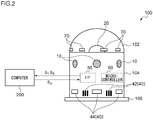
- Fig. 2 is a diagram showing the measurement/feedback apparatus 100 that forms the communication analysis apparatus 2.
- the measurement/feedback apparatus 100 is configured as a device (module) including an interface unit 50 and a signal processing unit 60 in addition to the microphone 10, the camera 20, and the feedback unit 40 shown in Fig. 1 , which are arranged in a single housing in the form of a package.
- the measurement/feedback apparatus 100 is configured to have a table-top size.
- the measurement/feedback apparatus 10 is placed at a central position in a group of multiple participants participating in communication such as a meeting or the like.
- the measurement/feedback apparatus 100 includes a housing 104 having a dome-shaped transparent portion 102 and a base 106 provided to the lower portion of the housing 104.
- the camera 20 is provided on the inside of the dome-shaped portion 102.
- the camera 20 is configured as a 360-degree (spherical) camera, which acquires an image of all the participants that surround the measurement/feedback apparatus 100.
- multiple microphones 10 are arranged radially in the housing 104.
- the microphones 10 convert the utterances of the multiple participants into an electrical signal.
- the signal processing apparatus 60 is configured as a microcontroller, CPU (Central Processing Unit), FPGA (Field Programmable Gate Array), or the like, for example.
- the signal processing unit 60 integrally controls the measurement/feedback apparatus 100.
- the signal processing unit 60 converts an audio signal acquired by the microphones 10 into a digital signal, which is compressed as necessary.
- the signal processing unit 60 compresses the image data acquired by the camera 20 as necessary.
- the interface unit 50 is coupled to an external computer 200 in a wired or wireless manner.
- the computer 200 corresponds to the analysis evaluation unit 30 shown in Fig. 1 .
- the computer 200 may be configured as a desktop computer or a laptop computer. Otherwise, the computer 200 may be configured as a network server or a cloud computer.
- the interface unit 50 may be configured as a Bluetooth (trademark) module, a WLAN module, or a USB module.
- the interface unit 50 transmits the audio data S 1 and the image data S 2 to the external computer 200.
- the measurement/feedback apparatus 100 is provided with a single or otherwise multiple speakers 42 and a single or otherwise multiple indicator lamps 44 as the feedback unit 40 shown in Fig. 1 .
- the feedback unit 40 may be provided with a vibration generating apparatus such as a vibration motor or the like.
- the interface unit 50 receives the feedback data S 3 from the computer 200 based on the communication evaluation result.
- the signal processing unit 60 drives and controls the speaker 42 based on the feedback data S 3 , so as to instruct the speaker 42 to output a beep or a sound that corresponds to the feedback data S 3 .
- the signal processing unit 60 drives and controls the indicator lamp 44 based on the feedback data S 3 .
- the measurement/feedback apparatus 100 is further provided with a distance measurement sensor 70 that measures the distance between the measurement/feedback apparatus 100 and each participant.
- a distance measurement sensor 70 an optical (laser) distance measurement sensor, an ultrasonic distance measurement sensor, or the like, may be employed.
- Distance information S 4 that represents the distance between each participant and the measurement/feedback apparatus 100 is transmitted from the interface unit 50 to the computer 200 together with the image data S 2 . As described later, the distance measurement information S 4 is used to correct distortion that occurs in the image acquired by the 360-degree camera.
- the components of the communication analysis apparatus 2 other than the analysis evaluation unit 30 shown in Fig. 1 as such a single measurement/feedback apparatus 100 in the form of a package or module, this provides the measurement/feedback apparatus 100 with dramatically improved mobility, and dramatically facilitates the installation thereof.
- a camera or microphone
- the communication analysis apparatus 2 cannot be used.
- this dramatically relaxes time restrictions and spatial restrictions, thereby increasing the opportunities to use the communication analysis apparatus 2.
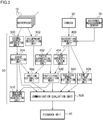
- Fig. 3 is a specific function block diagram showing the communication analysis apparatus 2.
- Each component indicated by a thick frame corresponds to a hardware component.
- Each thin frame indicates a processing block supported by a software component implemented in the analysis evaluation unit 30.
- a distortion correction unit 400 extracts image data of each participant, and corrects the distortion of the image data for each participant based on the distance information that represents the distance up to the corresponding participant measured by the distance measurement sensor 70.
- the image data thus distortion-corrected is provided to a downstream-stage processing mechanism.
- a facial expression recognition unit 402 recognizes the facial expression for each participant.
- a face authentication unit 404 identifies individual participants based on the image data acquired for each participant.
- a signal source separation unit 300 applies blind sound source separation to the audio signals received from the multiple microphones 10, so as to extract utterances for each participant.
- a voiceprint recognition unit 302 compares the audio signal received from the microphone with a voiceprint acquired beforehand for each participant (pattern matching), in order to identify the individual participants.
- a voice recognition unit 304 converts the utterance content acquired based on an utterance into text information or the like.
- a participant recognition unit 500 identifies a speaker based on the recognition result obtained by the face authentication unit 404, the identification result obtained by the voiceprint recognition unit 302, lip movement, and the speaker position estimation result.
- An emotion estimation unit 502 estimates the emotional state for each participant based on the facial expression recognized by the facial expression recognition unit 402 and the identification result obtained by the voice recognition unit 304.
- a skeleton model estimation unit 504 estimates the posture and gestures of a participant based on a skeleton model.
- a line of sight estimation unit 506 estimates the direction of the line of sight for each participant.
- a communication evaluation unit 508 evaluates a communication evaluation index (e.g., participation level, interest level, mental state, described above) or the like based on the utterance content received by the voice recognition unit 304, the emotion information received from the emotion estimation unit 502, the skeleton information (movement information) received from the skeleton model estimation unit 504, the line of sight information received from the line of sight estimation unit 506, or a combination of such multiple information.
- a communication evaluation index e.g., participation level, interest level, mental state, described above
- a meeting minutes generating unit 510 generates meeting minutes that record the names of participants who made a statement, as well as what each statement was and when each statement was made, based on the text information received from the voice recognition unit 304 and the participants identified by the participant identification unit 500.
- the meeting minutes further preferably record the evaluation results, which change with time, obtained by the communication evaluation unit 508 in a form associated with the corresponding statement and conversation.
- the present invention is not restricted to such an arrangement.
- multiple cameras may be employed.
- the measurement/feedback apparatus 100 may be provided with multiple cameras arranged radially. In a case in which such an arrangement involves little distortion in an image acquired by the cameras, the distance measurement sensor may be omitted.
- the configuration of the measurement/feedback apparatus 100 in Fig. 2 is shown for exemplary purposes only. That is to say, the present invention is not restricted to such a configuration.
- the layout of the multiple microphones 10, the layout of the multiple distance measurement sensors 70, the layout of the multiple speakers 42, and the layout of the multiple indicator lamps 44 are not restricted in particular.
- one or more variable-directional microphones may be employed instead of the multiple microphones 10.
- the feedback unit 40 may be configured as a wearable device that can be mounted on each participant. In this case, this allows feedback to be supplied to a desired participant without the awareness of the other participants.
- Examples of such a wearable device that can be mounted on each participant include: a vibrator that supplies feedback in the form of vibration; an earphone that supplies feedback in the form of sound; a head-mounted display that supplies feedback in the form of a video image, and the like.
- the microphones 10, the camera 20, and the feedback units 40 included in the communication analysis apparatus 2 are preferably arranged in the single feedback apparatus 100 in the form of a module.
- the present invention is not restricted to such an arrangement.
- the feedback unit 40 is configured as a wearable device, only the microphones 10 and the camera 20 may be mounted on the measurement/feedback apparatus 100.
- the microphone 10 may be monolithically integrated in the wearable device as a single unit. This arrangement allows each voice to be separated in a simple manner. Furthermore, such an arrangement does not require voiceprint judgement.
- Fig. 4 is a diagram showing another example of the feedback unit 40.
- the feedback unit 40 is configured as a humanoid robot that is capable of providing body language and gestures.
- the humanoid robot may be configured to support nodding movement (arrow i) and arm swinging (arm ii). By providing nodding or arm swinging, the humanoid robot may present a rhythm to participants. By synchronizing the participants with the rhythm presented by the humanoid robot, this arrangement allows the empathy level to be improved.
- the 360-degree camera 20 may be mounted in a head portion of the humanoid robot.
- the indicator lamps 44 and the speaker 42 shown in Fig. 2 are also provided at suitable portions.
- the humanoid robot may be configured such that its body direction or face direction can be changed (arrow iii). Also, the humanoid robot may be controlled such that it faces a speaker. Also, when a given participant is to be cautioned, the humanoid robot may be controlled such that it faces the participant to be cautioned.
- the feedback unit 40 is configured as a humanoid robot, such an arrangement is expected to provide improved quality of communication as compared with an impersonal visual appearance as shown in Fig. 2 .
- the feedback unit 40 may be configured such that it can autonomously move. When there is a participant with a low empathy level, the feedback unit 40 may move in front of the participant so as to present a rhythm or the like to the participant.
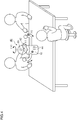
- the body movement of the multiple participants may be acquired as follows. That is to say, an image frame acquired by the camera 20 is divided into divided frames for the respective participants 4.
- Fig. 5 is a diagram showing image data of a single frame acquired by the 360-degree camera. Each divided frame preferably includes a portion of the corresponding participant 4 ranging from the head to the chest.
- the brightness values are integrated for the divided frames so as to acquire an integrated value in the form of a time waveform.
- the time waveform is preferably subjected to filtering processing as necessary by means of a lowpass filter. Such an arrangement employs a cutoff frequency on the order of 4 Hz.
- Fig. 6A is a diagram showing a result of a preliminary experiment executed with two subjects.
- Fig. 6A shows the time waveforms of the integrated brightness values calculated based on the corresponding pair of divided frames measured under different conditions.
- a role A and a role B are assigned to the two subjects, respectively.
- the subjects thus assigned to the role A and the role B face each other Intentional body movement is measured under three conditions by means of the 360-degree camera.
- the subject assigned to the role A nods 100 times with a frequency of 40 times per minute under all the conditions in the measurement.
- the subject assigned to the role B follows the following conditions.
- Fig. 6B shows Z values each obtained by applying Fisher's z-transformation to the correspondence coefficient value of the difference in brightness between the role A and role B, and by further applying Bartlett correction.
- an intentional nodding movement appears as a waveform of change in brightness. Based on this result, it can be understood that body movement can be satisfactorily evaluated by measurement using the 360-degree camera and analysis using the method proposed above.
- the subject A In the synchronous condition, the subject A claps in front of his/her face at a frequency of once per second while looking at the face of the co-participant B. In this condition, the co-participant B claps at a timing that is synchronous with the subject A. In the asynchronous condition, the subject A claps in front of his/her face at a frequency of once per second while looking at the face of the co-participant B. In this condition, the co-participant B claps at a timing that is not synchronous with the subject.
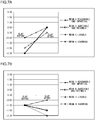
- Figs. 7A and 7B are diagrams showing the results under the synchronous condition and the asynchronous condition, respectively.
- the behavioral experiment results confirm that, upon presenting a rhythm to participants by the feedback unit 40 described above, the participants can be synchronized with the rhythm, resulting in improving the empathy level of the participants.
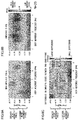
- Figs. 8A through 8C are diagrams each showing the relation between the empathy level and body movement in face-to-face communication. Body movement was measured by an acceleration sensor. Fig. 8A shows a non-empathic state, and Fig. 8B shows an empathic state. Examples of the body movement shown in Figs. 8A through 8C include laughing and the like in addition to nodding movement, which can be distinguished based on frequency. In this example, the frequency component of 1 through 4 Hz corresponds to nodding. The frequency component of 4 Hz or more corresponds to laughing.
- the vertical axis represents the phase difference of body movement.
- the negative phase correspond to a state in which the speaker involves body movement with an advanced phase.
- the positive phase corresponds to a state in which the listener involves body movement with an advanced phase.
- the horizontal axis represents the frequency of nodding movement.
- Fig. 8C shows a plot of the difference between Figs. 8A and 8B .
- a large difference is calculated in a region where the phase is positive. That is to say, it can be understood that, when a pair of participants come to be in an empathic state, the nodding movements of the two participants synchronize with each other with the phase of a listener participant advanced as compared with that of a speaker participant.
- the empathic state between two or more participants in face-to-face communication can be evaluated, quantified, or otherwise visualized, based on body movement (including nodding movement).
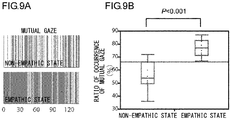
- Figs. 9A and 9B are diagrams each showing the relation between the empathy level and the movement of the line of sight in face-to-face communication.
- Fig. 9A is a waveform diagram showing the occurrence of a mutual gaze in a non-empathic state and an empathic state.
- Fig. 9B shows the ratio of the occurrence of a mutual gaze in the non-empathic state and the empathic state.
- the experiment results suggest that an empathic state and a mutual gaze have a correspondence with each other. Based on the findings, the empathic state between two or more participants in face-to-face communication can be evaluated, quantified, or otherwise visualized, based on the movement of the line of sight.
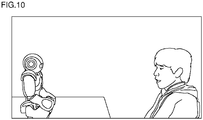
- Fig. 10 is a diagram showing an experiment using a robot.
- the subject and a robot face each other, and the subject speaks to the robot.
- the robot is switchable between: (i) a state in which the robot does not move at all (no-reaction mode); and (ii) a state in which the robot moves (nods) synchronously with the subject (interactive mode).
- the two states are each set for five minutes, with an interval of five minutes between them.
- This experiment was executed with five participants who are each native speakers of Japanese as the subjects.
- the movement of the robot was controlled with respect to frequency and phase by feedback control so as to synchronize with the movements of the subjects.
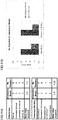
- Figs. 11A and 11B are diagrams showing the experiment results executed as shown in Fig. 10 .
- Fig. 11A shows a questionnaire tabulation result. Answers were obtained from the five participants with respect to two items, i.e., "naturalness" and "consensus building". Regarding the naturalness item, in the interactive mode, the answers of three participants were “somewhat natural", and the answers of the other two participants were “somewhat unnatural”. In the no-reaction mode, the answers of two participants were “somewhat unnatural", and the answers of the other three participants were “unnatural". Regarding the consensus building item, in the interactive mode, the answers of three participants were "somewhat consensual", and the answers of the other two participants were “somewhat not consensual". In the no-reaction mode, the answer of one participant was “somewhat not consensual", and the answers of the other three participants were “not consensual”.
- Fig. 11B shows scoring results of weighted averages for each of the two items "naturalness” and "consensus building” in the two modes.
- the weighting coefficients assigned to "natural”, “somewhat natural”, “somewhat unnatural”, and “unnatural” were set to 4, 3, 2, and 1, in this order.
- the weighting coefficients assigned to "consensual”, “somewhat consensual”, “somewhat not consensual”, and “not consensual” were set to 4, 3, 2, and 1, in this order.
- higher scores were obtained as compared with those in the no-reaction mode. Based on the experiment results, it can be understood that providing such a humanoid robot at a site of face-to-face communication will improve the empathy level of the participants.
- communication via the implicit channel is the basis of communication via the explicit channel.
- Examples of such an implicit channel include posture, nodding, facial expressions, peripheral language, physical distance from the other party, artifacts, etc.[7] It has also been said that non-verbal behavior contributes to human face-to-face communication with a contribution ratio on the order of 65%.[8] Such non-verbal behavior appears unconsciously, and is said to be related to mental states such as emotion, feelings, etc.[9, 10] Examples of such a relation that have been reported include: a relation between fear and peripheral language or the left prefrontal area of the brain [11]; and the relation between the capability of empathizing with pain and brain activity [12].
- 2 communication analysis apparatus 4 participant, 10 microphone, 20 camera, 30 analysis evaluation unit, 40 feedback unit, 42 speaker, 44 indicator lamp, 50 interface unit, 60 signal processing unit, 70 distance measurement sensor, 100 measurement/feedback apparatus, 102 dome-shaped portion, 104 housing, 106 base, 300 signal source separation unit, 302 voiceprint recognition unit, 304 voice recognition unit, 400 distortion correction unit, 402 facial expression recognition unit, 404 face authentication unit, 500 participant recognition unit, 502 emotion estimation unit, 504 skeleton model estimation unit, 506 line of sight estimation unit, 508 communication evaluation unit, 510 meeting minutes generating unit.
- the present invention relates to a technique for analyzing communication.
Landscapes
- Engineering & Computer Science (AREA)
- Business, Economics & Management (AREA)
- Health & Medical Sciences (AREA)
- Physics & Mathematics (AREA)
- Human Resources & Organizations (AREA)
- Human Computer Interaction (AREA)
- Multimedia (AREA)
- General Health & Medical Sciences (AREA)
- Theoretical Computer Science (AREA)
- General Physics & Mathematics (AREA)
- Audiology, Speech & Language Pathology (AREA)
- Acoustics & Sound (AREA)
- Computational Linguistics (AREA)
- Entrepreneurship & Innovation (AREA)
- Strategic Management (AREA)
- Oral & Maxillofacial Surgery (AREA)
- Development Economics (AREA)
- Educational Administration (AREA)
- Economics (AREA)
- Psychiatry (AREA)
- Hospice & Palliative Care (AREA)
- Child & Adolescent Psychology (AREA)
- Signal Processing (AREA)
- Game Theory and Decision Science (AREA)
- Marketing (AREA)
- Operations Research (AREA)
- Quality & Reliability (AREA)
- Tourism & Hospitality (AREA)
- General Business, Economics & Management (AREA)
- Management, Administration, Business Operations System, And Electronic Commerce (AREA)
- User Interface Of Digital Computer (AREA)
- Two-Way Televisions, Distribution Of Moving Picture Or The Like (AREA)
- Measurement Of The Respiration, Hearing Ability, Form, And Blood Characteristics Of Living Organisms (AREA)
Applications Claiming Priority (2)
| Application Number | Priority Date | Filing Date | Title |
|---|---|---|---|
| JP2017054727 | 2017-03-21 | ||
| PCT/JP2018/011173 WO2018174088A1 (fr) | 2017-03-21 | 2018-03-20 | Dispositif d'analyse de communication, dispositif de mesure/rétroaction utilisé à cet effet et dispositif d'interaction |
Publications (2)
| Publication Number | Publication Date |
|---|---|
| EP3605421A1 true EP3605421A1 (fr) | 2020-02-05 |
| EP3605421A4 EP3605421A4 (fr) | 2020-08-19 |
Family
ID=63585401
Family Applications (1)
| Application Number | Title | Priority Date | Filing Date |
|---|---|---|---|
| EP18771449.8A Withdrawn EP3605421A4 (fr) | 2017-03-21 | 2018-03-20 | Dispositif d'analyse de communication, dispositif de mesure/rétroaction utilisé à cet effet et dispositif d'interaction |
Country Status (4)
| Country | Link |
|---|---|
| US (1) | US20210110844A1 (fr) |
| EP (1) | EP3605421A4 (fr) |
| JP (1) | JP7002143B2 (fr) |
| WO (1) | WO2018174088A1 (fr) |
Cited By (1)
| Publication number | Priority date | Publication date | Assignee | Title |
|---|---|---|---|---|
| EP4283547A1 (fr) * | 2022-05-27 | 2023-11-29 | Ricoh Company, Ltd. | Appareil de traitement d'informations, système de traitement d'informations, système de support, procédé de fourniture de rythme et moyens de support correspondant |
Families Citing this family (14)
| Publication number | Priority date | Publication date | Assignee | Title |
|---|---|---|---|---|
| JP7369942B2 (ja) * | 2020-07-02 | 2023-10-27 | パナソニックIpマネジメント株式会社 | コミュニケーション解析システム、及び、コミュニケーション解析方法 |
| US11386899B2 (en) * | 2020-08-04 | 2022-07-12 | Honeywell International Inc. | System and method for providing real-time feedback of remote collaborative communication |
| EP3975181B1 (fr) * | 2020-09-29 | 2023-02-22 | Bull Sas | Évaluation de la qualité d'une session de communication dans un réseau de télécommunication |
| JP7213857B2 (ja) * | 2020-10-23 | 2023-01-27 | 本田技研工業株式会社 | 会議支援装置、会議支援方法および会議支援プログラム |
| JP7678716B2 (ja) * | 2021-06-17 | 2025-05-16 | キヤノン株式会社 | 情報処理システム、その制御方法、および、プログラム |
| JP7057011B1 (ja) * | 2021-06-25 | 2022-04-19 | 株式会社Kakeai | 二者間のコミュニケーションにおいて個々人への関わり方を改善するためのコンピュータシステム、方法、およびプログラム |
| WO2023276701A1 (fr) * | 2021-06-28 | 2023-01-05 | パナソニックIpマネジメント株式会社 | Système de segmentation et de regroupement de locuteur, système d'analyse de communication et procédé d'estimation de quantité d'énonciation |
| TWI902903B (zh) * | 2021-09-17 | 2025-11-01 | 信驊科技股份有限公司 | 視訊內容提供方法及視訊內容提供裝置 |
| WO2023062767A1 (fr) * | 2021-10-14 | 2023-04-20 | 日本電信電話株式会社 | Dispositif, procédé et programme de commande de présentation de réaction |
| US12125480B2 (en) * | 2021-11-30 | 2024-10-22 | Motorola Solutions, Inc. | System and method for encouraging group discussion participation |
| JP7806571B2 (ja) | 2022-03-22 | 2026-01-27 | 株式会社リコー | 情報処理装置、情報処理システム、コミュニケーション支援システム、情報処理方法及びプログラム |
| JP2023149744A (ja) * | 2022-03-31 | 2023-10-13 | ソニーグループ株式会社 | 情報処理装置および情報処理方法、並びにプログラム |
| US12592008B2 (en) | 2022-11-30 | 2026-03-31 | Ricoh Company, Ltd. | Information analysis system, information analysis method, and non-transitory recording medium |
| US12367876B2 (en) | 2022-12-13 | 2025-07-22 | Honeywell International, Inc. | System and method for real-time feedback of remote collaborative communication |
Family Cites Families (6)
| Publication number | Priority date | Publication date | Assignee | Title |
|---|---|---|---|---|
| JPH11331827A (ja) | 1998-05-12 | 1999-11-30 | Fujitsu Ltd | テレビカメラ装置 |
| JP2008262046A (ja) * | 2007-04-12 | 2008-10-30 | Hitachi Ltd | 会議可視化システム、会議可視化方法、及び集計処理サーバ |
| FR2963132A1 (fr) * | 2010-07-23 | 2012-01-27 | Aldebaran Robotics | Robot humanoide dote d'une interface de dialogue naturel, methode d'utilisation et de programmation de ladite interface |
| US10176725B2 (en) * | 2011-08-29 | 2019-01-08 | Worcester Polytechnic Institute | System and method of pervasive developmental disorder interventions |
| WO2014091766A1 (fr) | 2012-12-15 | 2014-06-19 | 国立大学法人東京工業大学 | Appareil d'évaluation d'un état mental humain |
| US9639770B2 (en) * | 2015-03-26 | 2017-05-02 | Konica Minolta Laboratory U.S.A., Inc. | System and method for improving communication productivity |
-
2018
- 2018-03-20 EP EP18771449.8A patent/EP3605421A4/fr not_active Withdrawn
- 2018-03-20 WO PCT/JP2018/011173 patent/WO2018174088A1/fr not_active Ceased
- 2018-03-20 JP JP2019507706A patent/JP7002143B2/ja active Active
- 2018-03-20 US US16/496,677 patent/US20210110844A1/en not_active Abandoned
Cited By (2)
| Publication number | Priority date | Publication date | Assignee | Title |
|---|---|---|---|---|
| EP4283547A1 (fr) * | 2022-05-27 | 2023-11-29 | Ricoh Company, Ltd. | Appareil de traitement d'informations, système de traitement d'informations, système de support, procédé de fourniture de rythme et moyens de support correspondant |
| US12052113B2 (en) | 2022-05-27 | 2024-07-30 | Ricoh Company, Ltd. | Information processing apparatus, information processing system, method for providing rhythm, and non-transitory recording medium |
Also Published As
| Publication number | Publication date |
|---|---|
| WO2018174088A1 (fr) | 2018-09-27 |
| JP7002143B2 (ja) | 2022-01-20 |
| US20210110844A1 (en) | 2021-04-15 |
| JPWO2018174088A1 (ja) | 2020-01-23 |
| EP3605421A4 (fr) | 2020-08-19 |
Similar Documents
| Publication | Publication Date | Title |
|---|---|---|
| EP3605421A1 (fr) | Dispositif d'analyse de communication, dispositif de mesure/rétroaction utilisé à cet effet et dispositif d'interaction | |
| Benssassi et al. | Wearable assistive technologies for autism: opportunities and challenges | |
| US11890748B2 (en) | Socially assistive robot | |
| Semertzidis et al. | Neo-noumena: Augmenting emotion communication | |
| Knoors et al. | Teaching deaf learners: Psychological and developmental foundations | |
| Tsiourti et al. | A virtual assistive companion for older adults: design implications for a real-world application | |
| US20160042648A1 (en) | Emotion feedback based training and personalization system for aiding user performance in interactive presentations | |
| Santos et al. | An open sensing and acting platform for context-aware affective support in ambient intelligent educational settings | |
| Hanakawa | What just happened? And what is happening now? The art and science of moment-to-moment tracking in AEDP. | |
| Dehais et al. | Non-invasive brain-computer interfaces | |
| Garner | Applications of virtual reality | |
| Solano | Bridging communication deficits in preschool children diagnosed with autism spectrum disorder, a review of literature in technology aided instruction and intervention | |
| Roy | Gestural human-machine interaction using neural networks for people with severe speech and motor impairment due to cerebral palsy | |
| Hansen et al. | Active listening and expressive communication for children with hearing loss using getatable environments for creativity | |
| Heiskanen | Social presence in extended reality | |
| Kochanowicz | Using Eye-Tracking Technology as an Art Mediumand a Tool of Clinical Intervention in Art Therapy of a Child with Multiple Disabilities | |
| Rutkowski | Student teaching and research laboratory focusing on brain-computer interface paradigms-A creative environment for computer science students | |
| Cacace | Evaluating Joint Attention in Child-Robot Interaction for Hard-of-Hearing Children | |
| Cozma | Using a NAO robot during speech audiometry for hearing-impaired children: developing a video protocol to detect non-verbal cues during child-robot interactions | |
| CN120636756A (zh) | 疼痛管理系统、设备及存储介质 | |
| Cisco | Connecting the Puzzle Pieces: Adapting Virtual Reality Environments with Biometric Data to Support Learners with Autism Spectrum Disorder | |
| Hassib | Designing communication technologies based on physiological sensing | |
| Feghoul | Deep learning for simulation in healthcare: Application to affective computing and surgical data science | |
| JP2023174524A (ja) | 情報処理装置、情報処理システム、支援システム、方法、及びプログラム | |
| Fornari et al. | Testing the causal relationship between interpersonal closeness and inter-brain synchrony |
Legal Events
| Date | Code | Title | Description |
|---|---|---|---|
| STAA | Information on the status of an ep patent application or granted ep patent |
Free format text: STATUS: THE INTERNATIONAL PUBLICATION HAS BEEN MADE |
|
| PUAI | Public reference made under article 153(3) epc to a published international application that has entered the european phase |
Free format text: ORIGINAL CODE: 0009012 |
|
| STAA | Information on the status of an ep patent application or granted ep patent |
Free format text: STATUS: REQUEST FOR EXAMINATION WAS MADE |
|
| 17P | Request for examination filed |
Effective date: 20191008 |
|
| AK | Designated contracting states |
Kind code of ref document: A1 Designated state(s): AL AT BE BG CH CY CZ DE DK EE ES FI FR GB GR HR HU IE IS IT LI LT LU LV MC MK MT NL NO PL PT RO RS SE SI SK SM TR |
|
| AX | Request for extension of the european patent |
Extension state: BA ME |
|
| DAV | Request for validation of the european patent (deleted) | ||
| DAX | Request for extension of the european patent (deleted) | ||
| A4 | Supplementary search report drawn up and despatched |
Effective date: 20200721 |
|
| RIC1 | Information provided on ipc code assigned before grant |
Ipc: G06Q 10/06 20120101ALI20200715BHEP Ipc: G06K 9/00 20060101ALN20200715BHEP Ipc: G06Q 10/10 20120101AFI20200715BHEP |
|
| STAA | Information on the status of an ep patent application or granted ep patent |
Free format text: STATUS: EXAMINATION IS IN PROGRESS |
|
| 17Q | First examination report despatched |
Effective date: 20210903 |
|
| STAA | Information on the status of an ep patent application or granted ep patent |
Free format text: STATUS: THE APPLICATION IS DEEMED TO BE WITHDRAWN |
|
| 18D | Application deemed to be withdrawn |
Effective date: 20220114 |