EP3605527A2 - Présentation visuelle d'informations relatives à une conversation de langage naturel - Google Patents
Présentation visuelle d'informations relatives à une conversation de langage naturel Download PDFInfo
- Publication number
- EP3605527A2 EP3605527A2 EP19186657.3A EP19186657A EP3605527A2 EP 3605527 A2 EP3605527 A2 EP 3605527A2 EP 19186657 A EP19186657 A EP 19186657A EP 3605527 A2 EP3605527 A2 EP 3605527A2
- Authority
- EP
- European Patent Office
- Prior art keywords
- information
- person
- topic
- natural language
- search
- Prior art date
- Legal status (The legal status is an assumption and is not a legal conclusion. Google has not performed a legal analysis and makes no representation as to the accuracy of the status listed.)
- Withdrawn
Links
Images









Classifications
-
- G—PHYSICS
- G06—COMPUTING OR CALCULATING; COUNTING
- G06F—ELECTRIC DIGITAL DATA PROCESSING
- G06F40/00—Handling natural language data
- G06F40/10—Text processing
- G06F40/166—Editing, e.g. inserting or deleting
- G06F40/169—Annotation, e.g. comment data or footnotes
-
- G—PHYSICS
- G06—COMPUTING OR CALCULATING; COUNTING
- G06F—ELECTRIC DIGITAL DATA PROCESSING
- G06F40/00—Handling natural language data
- G06F40/20—Natural language analysis
- G06F40/205—Parsing
- G06F40/216—Parsing using statistical methods
-
- G—PHYSICS
- G06—COMPUTING OR CALCULATING; COUNTING
- G06F—ELECTRIC DIGITAL DATA PROCESSING
- G06F40/00—Handling natural language data
- G06F40/20—Natural language analysis
- G06F40/279—Recognition of textual entities
- G06F40/284—Lexical analysis, e.g. tokenisation or collocates
-
- G—PHYSICS
- G06—COMPUTING OR CALCULATING; COUNTING
- G06F—ELECTRIC DIGITAL DATA PROCESSING
- G06F40/00—Handling natural language data
- G06F40/30—Semantic analysis
-
- G—PHYSICS
- G06—COMPUTING OR CALCULATING; COUNTING
- G06F—ELECTRIC DIGITAL DATA PROCESSING
- G06F40/00—Handling natural language data
- G06F40/30—Semantic analysis
- G06F40/35—Discourse or dialogue representation
-
- G—PHYSICS
- G06—COMPUTING OR CALCULATING; COUNTING
- G06F—ELECTRIC DIGITAL DATA PROCESSING
- G06F40/00—Handling natural language data
- G06F40/40—Processing or translation of natural language
- G06F40/58—Use of machine translation, e.g. for multi-lingual retrieval, for server-side translation for client devices or for real-time translation
-
- G—PHYSICS
- G10—MUSICAL INSTRUMENTS; ACOUSTICS
- G10L—SPEECH ANALYSIS TECHNIQUES OR SPEECH SYNTHESIS; SPEECH RECOGNITION; SPEECH OR VOICE PROCESSING TECHNIQUES; SPEECH OR AUDIO CODING OR DECODING
- G10L15/00—Speech recognition
- G10L15/26—Speech to text systems
-
- G—PHYSICS
- G10—MUSICAL INSTRUMENTS; ACOUSTICS
- G10L—SPEECH ANALYSIS TECHNIQUES OR SPEECH SYNTHESIS; SPEECH RECOGNITION; SPEECH OR VOICE PROCESSING TECHNIQUES; SPEECH OR AUDIO CODING OR DECODING
- G10L15/00—Speech recognition
- G10L15/08—Speech classification or search
- G10L15/18—Speech classification or search using natural language modelling
- G10L15/1822—Parsing for meaning understanding
Definitions
- This invention relates generally to displaying information and, more particularly to automatically visually presenting information relevant to an utterance during a natural language conversation.
- the present invention extends to methods, systems, machines, manufacture products, and computer program products for automatically visually presenting information relevant to an utterance.
- an utterance is an uninterrupted chain of spoken or written language. Whether they are speech or text, utterances are always verbal.
- a conversation is a sequence of turns, where each turn is an utterance.
- utterances are also called natural language expressions and the terms are used interchangeably.
- a natural language expression may consist, for example, of one or more spoken words, a spoken phrase, a spoken sentence, or a few words of text.
- NLU natural language understanding
- search is any class of algorithms for finding desired information, if present, within a corpus of information, such as by using tags, indexing, sorting, or other methods taught in computer science courses.
- Identified relevant information can be visually displayed also essentially in real-time at a device, such as, for example, during a phone call, a video conference, a game, or an augmented reality experience.
- the relevance of the information can be anticipated and the relevant information presented by providing relevant information, based on the conversation, just in time. Relevant information automatically appears on a display visible to a person.
- Some aspects compute a relevance score and filter information based on its relevance.
- Other embodiments compute a relevance score by comparison to a threshold or by comparison of relevance scores between different pieces of information. Redundancy between relevant pieces of information and already displayed information can be detected to ensure that displayed information is not duplicated during a conversation. However, information displayed in the past but no longer displayed can be displayed again, if found again relevant. Displayed information can relate to topics such as weather, sports, regions; or to identified concepts such as specifc entities or activities.
- an utterance is received from a first person and relevant information displayed to a second person. In another aspect, an utterance is received from a first person and relevant information displayed to both the first person and a second person.
- aspects can assist a person with requesting further information, saving information for later use, or sharing information with others.
- a person can provide feedback about displayed information, such as, its relevance.
- Information can be translated between different human languages.
- Some aspects overlay displayed information on a display with human faces, compute face location detection, and dynamically arrange the display to avoid overlapping faces.
- Information selection can be adapted to display based on a user profile or on environmental factors.
- NLU can be performed on natural language expressions from multiple or many people in a conversation.
- ads or other persuasive information can be displayed along with information related to verbal communication.
- Devices implementing aspects of the invention include video conferencing systems, augmented reality eyewear, other wearable devices, or vehicle heads-up displays.
- aspects of the invention provide various benefits, such as, helping participants in conversations remember the names of things that they want to refer to, enabling persons to look up something when they can't access a browser immediately or it would interrupt the conversation to use an informational device with a speech interface, providing information about something other conversation participants mention, and presenting pieces of information that may be relevant to an upcoming conversation turn.
- aspects of the invention provide information automatically to a person's interface device. Unlike conventional automatic captioning systems, aspects of the invention understand natural language and respond accordingly. Unlike conventional voice call analysis, aspects of the invention search for relevant information and provide the results of the search to a person. Unlike conventional natural language question-answering systems that merely respond to a single user/speaker, aspects of the invention respond to one or more persons based on what another person says. Unlike conventional augmented reality video conferencing systems, aspects of the invention interpret and act on conversation participants expressions without express commands or manipulation of shared virtual objects.
- Embodiments of the present invention may comprise or utilize a special purpose or general-purpose computer including computer hardware, such as, for example, one or more processors and system memory, as discussed in greater detail below.
- Embodiments within the scope of the present invention also include physical and other computer-readable media for carrying or storing computer-executable instructions and/or data structures.
- Such computer-readable media can be any available media that can be accessed by a general purpose or special purpose computer system.
- Computer-readable media that store computer-executable instructions are computer storage media (devices).
- Computer-readable media that carry computer-executable instructions are transmission media.
- embodiments of the invention can comprise at least two distinctly different kinds of computer-readable media: computer storage media (devices) and transmission media.
- Computer storage media includes random access memory (RAM), read-only memory (ROM), electrically erasable programmable read-only memory (EEPROM), compact disc read-only memory (CD-ROM), solid state drives (“SSDs”) (e.g., based on RAM), Flash memory, phase-change memory (“PCM”), other types of memory, other optical disk storage, magnetic disk storage or other magnetic storage devices, or any other medium which can be used to store desired program code means in the form of computer-executable instructions or data structures and which can be accessed by a general purpose or special purpose computer.
- RAM random access memory
- ROM read-only memory
- EEPROM electrically erasable programmable read-only memory
- CD-ROM compact disc read-only memory
- SSDs solid state drives
- PCM phase-change memory
- other types of memory other optical disk storage, magnetic disk storage or other magnetic storage devices, or any other medium which can be used to store desired program code means in the form of computer-executable instructions or data structures and which can be accessed by a general purpose
- a "network” is defined as one or more data links that enable the transport of electronic data between computer systems and/or modules and/or other electronic devices.
- Transmission media can include a network and/or data links which can be used to carry desired program code means in the form of computer-executable instructions or data structures and which can be accessed by a general purpose or special purpose computer. Combinations of the above should also be included within the scope of computer-readable media.
- program code means in the form of computer-executable instructions or data structures can be transferred automatically from transmission media to computer storage media (devices) (or vice versa).
- computer-executable instructions or data structures received over a network or data link can be buffered in RAM within a network interface module (e.g., a "NIC"), and then eventually transferred to computer system RAM and/or to less volatile computer storage media (devices) at a computer system.
- RAM can also include solid state drives (SSDs or Peripheral Component Interconnect eXtended (PCIx) based real time memory tiered Storage, such as FusionIO).
- SSDs solid state drives
- PCIx Peripheral Component Interconnect eXtended
- FusionIO real time memory tiered Storage
- Computer-executable instructions comprise, for example, instructions and data which, when executed at a processor, cause a general purpose computer, special purpose computer, or special purpose processing device to perform a certain function or group of functions.
- the computer executable instructions may be, for example, binaries, intermediate format instructions such as assembly language, or even source code.
- the invention may be practiced in network computing environments with many types of computer system configurations, including, personal computers, desktop computers, laptop computers, message processors, hand-held devices, multi-processor systems, microprocessor-based or programmable consumer electronics, network PCs, minicomputers, mainframe computers, mobile telephones, personal digital assistants (PDAs), tablets, pagers, routers, switches, various storage devices, and the like.
- the invention may also be practiced in distributed system environments where local and remote computer systems, which are linked (either by hardwired data links, wireless data links, or by a combination of hardwired and wireless data links) through a network, both perform tasks.
- program modules may be located in both local and remote memory storage devices.
- Embodiments of the invention can also be implemented in cloud computing environments.
- cloud computing is defined as an approach to enabling ubiquitous, convenient, on-demand network access to a shared pool of configurable computing resources (e.g., networks, servers, storage, applications, and services) that can be rapidly provisioned via virtualization and released with minimal management effort or service provider interaction, and then scaled accordingly.
- configurable computing resources e.g., networks, servers, storage, applications, and services
- a cloud approach can be composed of various characteristics (e.g., on-demand self-service, broad network access, resource pooling, rapid elasticity, measured service, etc.), service (e.g., Software as a Service (SaaS), Platform as a Service (PaaS), Infrastructure as a Service (IaaS), and deployments (e.g., private cloud, community cloud, public cloud, hybrid cloud, etc.). Databases and servers described with respect to the present invention can be included in a cloud approach.
- characteristics e.g., on-demand self-service, broad network access, resource pooling, rapid elasticity, measured service, etc.
- service e.g., Software as a Service (SaaS), Platform as a Service (PaaS), Infrastructure as a Service (IaaS)
- deployments e.g., private cloud, community cloud, public cloud, hybrid cloud, etc.
- ASICs application specific integrated circuits
- FPGAs field programmable gate arrays
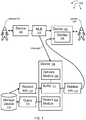
- Figure 1 illustrates a computer architecture 100 that facilitates automatically visually presenting information related to an utterance.
- computer architecture 100 includes devices 102, 104, and 108 and network storage 113.
- Device 104 further includes display 106.
- Device 108 further includes delivery module 109, buffer 111, and search module 112.
- Devices 102 and 104 are electronic/digital devices capable of communicating with one another over a communication network (e.g., mobile phones, computer systems, etc.). Each of devices 102 and 104 can also include components, such as, a microphone and a speaker (not shown), that facilitate the transfer of voice communication. For example, person 101 can speak at or near device 102. A microphone in device 102 converts acoustical energy (sound waves) into electrical energy (an audio signal). Device 102 sends the audio signal (possibly in a digital format) to device 104. The audio signal can carry an utterance over the network to device 104. Device 104 receives the audio signal over the network.
- a microphone in device 102 converts acoustical energy (sound waves) into electrical energy (an audio signal).
- Device 102 sends the audio signal (possibly in a digital format) to device 104.
- the audio signal can carry an utterance over the network to device 104.
- Device 104 receives the audio signal over the network
- a speaker in device 104 converts the audio signal back into acoustical energy (sound waves) reproducing person 101's speech. Person 107 can then hear what person 101 said. Speech from person 107 can be similarly transferred from device 104 to device 102. As such, persons 101 and 107 can conduct a verbal conversation with one another using devices 102 and 104 respectively.
- a communication network (e.g., cellular network, a radio network, etc.) allocates one or more communication channels for use by devices 102 and 104.
- a single channel is allocated to facilitate simplex transfer of voice communication between devices 102 and 104.
- a plurality of channels is allocated to facilitate duplex transfer of voice communication between devices 102 and 104.
- device 108 is configured to monitor communication channels, network connections, etc. between devices 102 and 104.
- Device 108 can intercept audio signals, such as NLEs, transferred between devices 102 and 107.
- Search module 112 can formulate search terms based on and related to the content of an intercepted NLE, using automatic speech recognition (ASR) if needed.
- ASR automatic speech recognition
- NLU and domain knowledge, applied to an NLE can produce additional search parameters such as filters, additional terms, or related information not explicitly expressed in the NLE.
- search module 112 can submit queries containing the search terms to network storage locations, such as, for example, websites, online databases, social media networks, etc.
- the search for related information can be expanded according to domain information.
- a search for a tennis match, or for a hotel in the next few days may expand to include related information about the weather at the date and location of the tennis match or hotel.
- a network storage location can locate and return information satisfying the various search terms.
- a network storage location can return information related to the contents of a NLE transferred between devices 102 and 104 (and thus also related to a conversation between persons 101 and 107).
- Device 108 can buffer related information returned from network storage locations in buffer 111.
- Buffer 111 can be maintained as a cache in system memory, or depend on more persistent storage.
- Delivery module 109 can anticipate when related information can be of interest to a person. Specifically, delivery module 109 can anticipate a person's interest in related information based on the information content itself and other characteristics of an intercepted NLE (size, device of origin, etc.), content and other characteristics of other intercepted NLEs (transfer frequency, size, device of origin, etc.), knowledge about of the persons (101 or 107) and their current goals and intention, and prior dialog. Other NLEs can be intercepted prior to or subsequent to an intercepted NLE.
- Delivery module 109 can transmit the related information from buffer 111 to a device that received an intercepted NLE so that the related information arrives before the related information is to be of interest to the person.
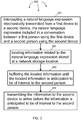
- Figure 2 illustrates a flow chart 200 of an example method for automatically visually presenting information related to an utterance. Method 200 will be described with respect to the components and data in computer architecture 100.
- Method 200 includes intercepting a natural language expression electronically transmitted from a first device to a second device, the natural language expression included in a conversation between a first person 101 using the first device 102 and a second person 107 using the second device 104.
- An utterance such as NLE 103 is first intercepted (201) then analyzed for its natural language content.
- device 108 can intercept NLE 103 when NLE 103 is electronically transmitted from device 102 to device 104.
- NLE 103 is part of the conversation between person 101 and person 107.
- the intercepted natural language utterance (NLE 103) is analyzed using NLU techniques. Such analysis may be able to recognize content words, topics, or the utterance's intent. The use of NLU analysis is further discussed below.
- Method 200 based on the results of NLU analysis, including any content words, topics or intents extracted from NLE 103, proceeds to locating information related to the natural language expression, stored at a network storage location (202).
- search module 112 can form one or more queries 116 from the content of NLE 103, using ASR if needed, and possibly NLU and domain knowledge.
- Search module 112 can submit one or more queries 116 to one or more storage devices 113 including local disks and databases, and network storage locations.
- Storage locations 113 can receive one or more queries 116 from device 108.
- storage locations 113 can identify and return related information 114.
- Related information 114 can be information related to NLE 103.
- Method 200 can also include updating a model of the second person's interests, based on any content words, topics or intents extracted from the natural language expression 103, and on the conversation to date.
- a model of a person's interests is a long-term data structure stored as part of a user profile. It comprises a list of topics, such as weather, sports, and stock prices.
- a model of a person's interests comprises specific entities such as Facebook, Mark Zuckerberg, and the stock ticker symbol FB, and the names of the person's children.
- a model of a person's interests comprises indications of level of interest based on the frequency or recency of the person's made or received expressions related to an intent, a topic or a content word such as an entity.
- intents are represented as slot-value pairs
- NLU primarily extracts such pairs from the NLE.
- the slot-value pairs may include something like (INTENT, "FLIGHT_RESERVATION), (FLIGHT_FROM, “SFO”), (FLIGHT_TO, “SEA”), (CITY_FROM, "SAN FRANCISCO”), (CITY_TO, "SEATTLE”), associated date and time information, and (TOPIC, "TRAVEL”).
- each dialog turn creates a set (a 'bundle') of slot-value pairs, and the conversation is summarized as a sequence of such bundles.
- bundles are stored and transmitted as data structures described using JavaScript Object Notation (JSON) or Extensible Markup Language (XML). Said sequence can be used as a quick summary of the conversation.
- JSON JavaScript Object Notation
- XML Extensible Markup Language
- a model of a person's interests can be updated based on this summary. For example, airport entities (“SFO” and “SEA”), city entities (“SAN FRANCISCO” and “SEATTLE”), the topic (“TRAVEL”) and expression intent (“FLIGHT RESERVATION”) may all become part of the model.
- Each slot-value pair for the conversation to date may be given an individual relevance weight.
- the relevance weights of slot-value pairs in successive bundles can be cumulated or otherwise combined to create a profile of the second person's interests, as a list of entities and relevance weights. Cumulating weights is appropriate when information is compatible, such as inquiring about two flights from "SFO”.
- Combining weights can take other forms, such as reducing the weight of "SEA" after the expression "What if I flew to Vancouver instead?”
- a model of a person's interests may take a more complex form than the simple set of topics, intents and entities, each with relevance weights.
- the power and complexity of the model reflects the depth of understanding of the NLU system; for example, a smarter system might understand negations, hypotheticals, navigation, planning events in time order or at particular calendar dates, and so on. Nevertheless, the relatively simple techniques just described can suffice to update a model of a person's interests based on the conversation to date.
- method 200 also includes computing relevance scores for located information based on a model of a person's interests.
- Information is located according to a search query based on certain search terms, such as "Seattle weather".
- the model based on relevance weights, such as just described, computing relevance scores is simple.
- the relevance score of search terms not matched in the model is set low; and the relevance score of a search term matched in the model is its relevance weight in the model.
- the relevance weight of "weather” to the "FLIGHT_TO" city is used and multiplied by the relevance weight of "Seattle” to obtain a relevance score for "Seattle weather”.
- method 200 also includes comparing relevance scores for located information to a threshold.
- the threshold may be fixed or it may be scaled to reflect normalization requirements.
- a threshold may need to be increased if there is an abundance of located information, so that less information is transmitted. This can save bandwidth and avoid overwhelming a system user with too much information.
- Method 200 includes buffering the information until the information is anticipated to be of interest to the second person (203).
- device 108 can buffer related information 114 in buffer 111.
- Delivery module 109 can anticipate the timing of a person 107's interest in related information 114 based on content and other characteristics of NLE 103 (size, device of origin, etc.), content and other characteristics of other received NLEs (transfer frequency, size, device of origin, etc.), knowledge of persons 101 and/or 107, etc.
- method 200 includes transmitting the information to the second device for display to the second person (204).
- delivery module 109 can transmit related information 114 to device 104 so that related information arrives at device 104 before related information 114 is of interest to person 107.
- Device 104 can receive related information 114 from device 108.
- Device 104 can display related information 114 at display 106. Displaying related information 114 at display 106 can provide person 107 insights into the content of NLE 103. In one aspect, related information 114 is displayed concurrently with (e.g., at or near the time of) NLE 103 being output at a speaker of device 104.
- Figure 3 illustrates a computer architecture 300 that facilitates automatically visually presenting information related to an utterance.
- computer architecture 300 includes devices 302 and 304 and storage device 313.
- Device 304 further includes display 306, delivery module 309, buffer 311, and search module 312.
- Devices 302 and 304 are electronic/digital devices capable of communicating with one another over a communication network (e.g., mobile phones, video conferencing units, computer systems, etc.). Each of devices 302 and 304 can also include components, such as, a microphone and a speaker (not shown), that facilitate the transfer of voice communication. For example, person 301 can speak at or near device 302. A microphone in device 302 converts acoustical energy (sound waves) into electrical energy (an audio signal). Device 302 sends the audio signal (possibly in a digital format) to device 304. The audio signal can carry an NLE, such as, for example, one or more spoken words, a spoken phrase, a spoken sentence, etc., over the network to device 304.
- an NLE such as, for example, one or more spoken words, a spoken phrase, a spoken sentence, etc.
- Device 304 receives the audio signal over the network.
- a speaker in device 304 converts the audio signal back into acoustical energy (sound waves) reproducing person 301's speech. Person 307 can then hear what person 301 said. Speech from person 307 can be similarly transferred from device 304 to device 302. As such, persons 301 and 307 can conduct a verbal conversation with one another using devices 302 and 304 respectively.
- a communication network (e.g., cellular network, a radio network, etc.) allocates one or more communication channels for use by devices 302 and 304.
- a single channel is allocated to facilitate simplex transfer of voice communication between devices 302 and 304.
- a plurality of channels is allocated to facilitate duplex transfer of voice communication between devices 302 and 304.
- Search module 312 can monitor NLEs received at device 304. Search module 312 can formulate search terms based on and related to the content of a received NLE, using ASR if needed. NLU and domain knowledge can be used to form additional relatedness relationships, and corresponding searches, as described with search module 112. Search module 312 can submit one or more queries 316 to storage devices 313, including, for example, local disk drives, data stores and databases, network storage locations, and web application programming interfaces (APIs). In response to a query, storage devices 313 return information satisfying the search terms. Thus, each storage device can return information related to the contents of a NLE transferred from devices 302 to device 304 (and thus also related to a conversation between persons 301 and 307).
- queries 316 including, for example, local disk drives, data stores and databases, network storage locations, and web application programming interfaces (APIs).
- APIs web application programming interfaces
- storage devices 313 return information satisfying the search terms.
- each storage device can return information related to the contents of a NLE transferred from
- Device 304 can buffer related information returned from a storage device in buffer 311.
- Buffer 311 can be system memory or more durable storage.
- Delivery module 309 can anticipate when related information is to be of interest to person 307. Delivery module 309 can anticipate person 307's interest in related information based on content and other characteristics of a received NLE (size, device of origin, etc.), content and other characteristics of other received NLEs (transfer frequency, size, device of origin, etc.), knowledge of persons 301 and/or 307, etc. Other NLEs can be received prior to or subsequent to a received NLE.
- Delivery module 309 can display related information from buffer 311 at display 306 when the related information is anticipated to be of interest to person 307.
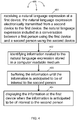
- Figure 4 illustrates a flow chart 400 of an example method for automatically visually presenting information related to an utterance. Method 400 will be described with respect to the components and data in computer architecture 300.
- Method 400 includes receiving a natural language expression at a first device, the natural language expression electronically transmitted from a second device to the first device, the natural language expression included in a conversation between a first person using the first device and a second person using the second device (401).
- device 304 can receive NLE 303.
- Device 302 can transmit NLE 303 to device 304 as part of a conversation between person 301 and person 307.
- Method 400 operates essentially like method 200.
- the natural language utterance (NLE 303) is analyzed using NLU techniques described elsewhere in this specification. Such analysis may recognize keywords, action words, entities, topics and intents.
- information related to the natural language expression and stored in a computer readable medium may be identified (402).
- search module 312 can form one or more queries 316 from the content of NLE 303, using ASR if needed, and possibly NLU and domain knowledge as explained elsewhere.
- Search module 312 can submit one or more queries 316 to one or more storage devices 313 including local disks and databases, and network storage locations. Such storage devices 313 can receive queries 316 from device 308. In response, storage devices 313 can identify related information 114.
- Related information 314 can be information related to NLE 303.
- Method 400 includes buffering the information until the information is anticipated to be of interest to the second person (403).
- device 304 can buffer related information 314 in buffer 311.
- Delivery module 309 can anticipate the timing of a person 307's interest in related information 314 based on content and other characteristics of NLE 303 (size, device of origin, etc.), content and other characteristics of other received NLEs (transfer frequency, size, device of origin, etc.), knowledge of persons 301 and/or 307, etc.
- Method 400 includes displaying the information at the first device at the time when the information is anticipated to be of interest to the second person (404).
- delivery module 309 can display related information 314 from buffer 311 at display 306. Displaying related information 314 at display 306 can provide person 307 insight into the content of NLE 303 and thus into the conversation between persons 301 and 307.
- related information 314 is displayed concurrently with (e.g., at or near the time of) NLE 303 being output at a speaker of device 304.
- delivery module 309 schedules delivery of the hotel address for a time when the user is at a taxi line. For another example, in discussions of baseball, people usually ask about the score first, then what inning, then which team is batting, then what's the count of balls and strikes. If an NLE was about the score of a baseball game, search module 312 queries a game stats data storage source 313 for the score, inning, team batting, and the count. The device 304 receives the related information 314 and stores it in buffer 311. Device 304 proceeds to display to person 307 the score only.
- delivery module 309 causes all of the related information 314 to be shown on display 306 so that person 307 can be well informed of all of the interesting information easily without either person 301 or person 307 needing to explicit request that information.
- natural language domains are programmed with rules indicating related types of information and the conditions under which to display related information.
- machine learning algorithms detect patterns of information requests across many users and many conversations and train models, such as neural networks or other predictive models, to predict what types of information are related and what topics, intents, or entities in NLEs trigger the display of the related information.
- Figure 5 illustrates computer architecture 500 that facilitates automatically visually presenting information related to an utterance.
- computer architecture 500 includes device 502 and storage device 513.
- Device 502 further includes display 506, delivery module 509, buffer 511, search module 512, and perception device 517.
- Device 502 can be a digital device such as, for example, a mobile phone, video game console, AR/VR head set, vehicle with a heads-up windshield display, etc.
- Device 502 can also include components, such as, a microphone and a speaker (not shown).
- a person in range of the device 502 for example, person 501 or person 507, can speak at or near device 502.
- a microphone in device 502 converts acoustical energy (sound waves) into electrical energy (an audio signal).
- a speaker in device 504 converts audio signals back into acoustical energy (sound waves), for example, reproducing speech.
- Perception device 517 can be connected to the microphone. Perception device 517 can receive verbal communication picked up by the microphone and detect an NLE. Perception device 517 can send the NLE to search module 512.
- Search module 512 can formulate search terms based on and related to the content of a received NLE, using ASR if needed. NLU and domain knowledge can be used to create additional relatedness relationships, and the corresponding searches, as described for search module 112. Search module 512 can submit queries containing the search terms to storage devices, such as, for example, disk drivers, data stores, databases, web APIs, etc. In response to a query, a storage device can return information satisfying the search terms. Thus, a storage device can return information related to the contents of a NLE derived at device 502.
- Device 502 can buffer related information returned from a storage device in buffer 511.
- Buffer 511 can be system memory or more durable storage.
- Delivery module 509 can anticipate when related information is to be of interest to person 501. Delivery module 509 can anticipate the person 501's interest in related information based on content and other characteristics of a detected NLE (size, etc.), content and other characteristics of other detected NLEs (detection frequency, size, etc.), knowledge of persons 501 and/or 507, etc. Other NLEs can be detected prior to or subsequent to a detected NLE.
- Delivery module 509 can display related information from buffer 511 at display 506 when the related information is anticipated to be of interest to person 501.
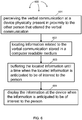
- Figure 6 illustrates a chart 600 of an example method for automatically visually presenting information related to an utterance. Method 600 will be described with respect to the components and data in computer architecture 500.
- Method 600 includes perceiving verbal communication at a device physically present in proximity to a person that uttered verbal communication (601).
- perception device 517 can perceive verbal communication 503 uttered by person 507.
- Perception device 517 can convert verbal communication 502 into an NLE.
- Perception device 517 can send the NLE to search module 512.
- Method 600 includes locating information related to the verbal communication stored in a computer readable medium (602).
- search module 512 can form one or more queries 516 from the content of the NLE, using ASR if needed, and possibly NLU and domain knowledge as explained for search module 112.
- the NLE can be analyzed to recognize content words, topics or intents using NLU techniques, as discussed with method 200.
- Search module 512 can submit one or more queries 516 to one or more storage devices 513 including local disks and databases, network storage locations, and web APIs.
- storage devices 513 can identify related information 514.
- Related information 514 can be information related to NLE 503.
- Method 600 includes buffering the located information until a time when the located information is anticipated to be of interest to another person (603).
- device 502 can buffer related information 514 in buffer 511.
- Delivery module 509 can anticipate the timing of person 501's interest in related information 514 based on content and other characteristics the NLE (size, etc.), content and other characteristics of other detected NLEs (detection frequency, size, etc.), knowledge of persons 501 and/or 507, etc.
- Method 600 includes displaying the information at the device when the information is anticipated to be of interest to the other person (604).
- delivery module 509 can display related information 514 from buffer 511 at display 506. Displaying related information 514 at display 506 can provide person 501 insight into verbal communication 503.
- natural language expressions may be analyzed when received, using any of the NLU techniques known in the art.
- the NLU analysis may include keyword matching, part-of-speech detection, action word detection, entity detection, partial parsing, or full parsing.
- the NLU analysis may construct an interpretation that represents the meaning of the analyzed NLE.
- the recognition of content words, such as keywords, may be used to suggest a topic.
- the analysis of a NLE may include the recognition of its intent.
- the system may proceed to a perform searches, that locate information related to the natural language expression. Searching can exploit domain knowledge, for example, by mapping interpretations to search queries, or by relating content words to topics. In some systems, deductive reasoning supplements searching in locating related information. The relevance of related information will then be determined using techniques described below.
- interpretations are represented as slot-value pairs extracted from the NLE by NLU techniques. For example, if NLE is "find me a flight from San Francisco to Seattle " relevant slot-value pairs might include something like (INTENT, "FLIGHT_RESERVATION), (FLIGHT_FROM, “SFO”), (FLIGHT_TO, “SEA”), (CITY_FROM, "SAN FRANCISCO”), (CITY_TO, "SEATTLE”), date information in a similar slot-value format, and additional information such as (TOPIC, "TRAVEL”).
- each conversation turn creates a set (a 'bundle') of slot-value pairs, and the conversation may be represented as a sequence of such bundles.
- bundles are stored and transmitted as data structures described using JavaScript Object Notation (JSON) or Extensible Markup Language (XML). Such a sequence can be used as a quick summary of the conversation, and become the basis for building a model of a person's interests, as discussed later.
- JSON JavaScript Object Notation
- XML Extensible Markup Language
- method 200 also includes computing relevance scores for located information based on a model of a person's interests. Information is located according to a search query based on certain search terms, such as "Seattle weather”.
- computing relevance scores is simple.
- the relevance score of search terms not matched in the model is set low; and the relevance score of search terms matched in the model is its relevance weight in the model.
- a relevance weight of "weather” to the "FLIGHT_TO" city is used and multiplied with the relevance weight of "Seattle” to obtain a relevance score for "Seattle weather”.
- Figures 7-16 depict various data flows 700 - 1600 respectively for visually presenting information relevant to an utterance.
- Data flows 700 - 1600 can be implemented in any of the architectures 100, 300, and 500 and in other architectures comprising necessary subsets of features shown and described.
- Data flows 700 - 1600 can be used to supplement and/or in the alternative to methods 200, 400, and 600.
- Elements depicted in data flows 700 - 1600 can also be used in different combinations and/or permutations.
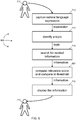
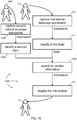
- Figure 7 illustrates a data flow 700 for displaying information in response to natural language expressions.
- person 711 is engaged in a conversation with an assisted user 712.
- a NLE is captured from person 711 (713).
- a topic is identified, for example, by performing NLU on the NLE (714).
- a plurality of topics is identified from a single NLE.
- Domain grammars can be used to recognize one or more topics. Topics can also be associated with keywords. Computed relevance scores can indicate a probability that an expression addresses each of a plurality of topics.
- a search for information on the topic and likely to be related to the NLE is performed (715).
- Information returned in response to the search is displayed to assisted user 712 (716).
- Information can be displayed at an appropriate time, for example, when the information is anticipated to be of interest to assisted user 712.
- Information related to an NLE can be displayed in a browser tab or in a side-by-side view along with other information. Multiple pieces of information related to an NLE can be displayed together with different pieces grouped by content categories and/or sorted by relevance. Pieces of information can also be presented in chronological order such as by when person 711 uttered a triggering natural language expression.
- text-based interfaces capture natural language expressed as text.
- voice-based interfaces perform automatic speech recognition on audio signals, such as, ones captured by local or remote microphones, to recognize spoken natural language expressions.
- Some interfaces overlay generated graphics or text on transparent glass to create an augmented reality experience or heads-up vehicle display.
- Other interfaces display the relevant information with limited (if any) other graphical elements, such as, a real-time real-life captioning system.
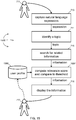
- Figure 8 illustrates a data flow 800 for displaying information in response to natural language expressions using a relevance score.
- An assistive system may not disrupt or distract conversations with less relevant (or irrelevant) information.
- a NLE is captured from person 711 (713).
- a topic is identified, for example, by performing NLU on the NLE (714).
- a search for information on the topic and likely to be related to the NLE is performed (715).
- a relevance score is computed for information returned in response to the search and the relevance score is compared to a threshold (827). If the relevance score exceeds the threshold, the returned information is displayed to assisted user 712 (716). If the relevance score is below the threshold, the returned information is not displayed.
- Relevance scores can be based, at least in part, on pre-existing rules that impact the ranking of search results (and corresponding display decisions) according to specific aspects of the history, including the conversation history.
- Foreground topics from the most recent query or expression and background topics (from the earlier conversation) can be distinguished.
- the roles of conversation participants can also be considered. For example, if a first person describes an object, they have a picture of it in their mind and do not need to see it, whereas a second person involved in the conversation would benefit by seeing a picture of the object. Therefore, it would be appropriate to give the object a higher relevance score for the second person than for the first.
- Relevance scores can be based, at least in part, on express user input that dynamically impacts the ranking of search results (and corresponding display decisions) in combination with specific aspects of history. For example, a user can tap on a name of an object of possible relevance to get more detail immediately and in the future. For another example, a system can provide a configuration interface in which an assisted user can specify a list of interests as part of their personal profile.
- Demoting actions such as, closing a visual panel (or any graphical element) can demote a specific topic but not necessarily a broader topic. For example, dismissing information about a specific book would decrease its relevance score, but may not decrease the relevance score for the book's author or for the topic of books in general.
- the impact of a demoting action may vary from a slight topic demotion, to a stronger topic demotion, to blocking a topic entirely.
- promoting actions can promote a set of topics associated with an element or the broader topic. Aspects support selecting text on an element to promote the topics or aspects that the text describes.
- Various UI actions including clicks, swipes, or other gestures can be used to demote (including eliminate) and promote.
- Figure 9 illustrates a data flow 900 for displaying information in response to natural language expressions for multiple topics.
- one or more topics are selected from multiple possible topics of interest. For example, relevance scores can be computed for each topic and selections may be made based on relevance scores.
- person 711 is engaged in a conversation with an assisted user 712.
- a NLE is captured from person 711 (713).
- Multiple topics of interest are identified (934).
- a relevance score is computed for each topic and one or more topics are selected (937).
- a search for information on the one or more topics and likely to be related to the NLE is performed (935). If the relevance score for a topic exceeds the threshold, the returned information associated with the topic is displayed to assisted user 712 (716). If the relevance score is below the threshold, the returned information is not displayed.
- Searching can also be based on topic score. Topics with relevance scores exceeding a threshold can be searched. In one aspect, a number of topics with higher relevance scores are searched. Multiple topics can be searched and information display space reserved according to the relevance score of each topic.
- Figure 10 illustrates a data flow 1000 for displaying information in response to natural language expressions for multiple topics.
- a conversation may remain on one topic during a series of natural language expressions.
- a person utters multiple natural language expressions on the same topic.
- One system design risk is that, as the first person 711 issues multiple natural language expressions on the same topic, the system will display the same information multiple times. There can be various approaches to avoid this.
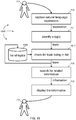
- Data flow 1000 is similar to data flow 700. Person 711 is engaged in a conversation with an assisted user 712. However, after identifying a topic, a check is performed to determine if the topic is in a list of recent topics. For example, in data flow 1000, a NLE is captured from person 711 (713). A topic is identified, for example, by performing NLU on the NLE (714).
- the identified topic is included in list of topics 1048 (1047).
- the topic may be dropped.
- the identified topic is not included in list of topics 1048, the identified topic is added to list of topics 1048.
- a search for information on the topic and likely to be related to the NLE is performed (715).
- Information returned in response to the search is displayed to assisted user 712 (716). Information can be displayed at an appropriate time, for example, when the information is anticipated to be of interest to assisted user 712.
- Topics can be retained in list of topics 1048 for a specified amount of time that may depend on importance and/or permanence of a topic.
- Importance can be assigned to topics by their design such as, giving a first aid topic higher importance than a recipes topic.
- Importance can also be scaled by weights resulting from user profile, location, or recent conversation history. For example, inside a building, shopping prices might have higher importance than directions to a store, but in an automobile, directions to a store might have higher importance than prices.
- Permanence can be determined in relation to a specific user profile. For example, contacts in an address book marked with a star may be considered permanent subjects of conversation. A system can maintain related information about such starred contacts in a buffer local to a device.
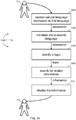
- Figure 11 illustrates a data flow 1100 for displaying information in response to natural language expressions without repetition of information.
- Data flow 1100 is similar to data flow 700. Person 711 is engaged in a conversation with an assisted user 712. However, after searching for and identifying information, a check is performed to determine if the information is included in a database of information. Data flow 1100 can be used to prevent the display of repetitive information when the repetitive information is identified from searches of different topics. For example, in data flow 1100, a NLE is captured from person 711 (713). A topic is identified, for example, by performing NLU on the NLE (714). A search for information on the topic and likely to be related to the NLE is performed (715).
- database of past information 1158 It is determined if information returned in response to the search is included in database of past information 1158 (1157).
- the information may be disregarded for display.
- the returned information is not included in database of past information 1158, the information is added to database of past information 1158.
- the returned information is displayed to assisted user 712 (716). Information can be displayed at an appropriate time, for example, when the information is anticipated to be of interest to assisted user 712.
- Information can be stored in database of past information 1158 while the information is being present, for an amount of time approximating how long assisted user 712 might likely have the topic in mind.
- Information stored in database of past information 1158 can be considered for repeated display after a period of time over which the assisted user 712 might likely remember the information without refreshing, etc.
- aspects of data flows 1000 and 1100 can be used in combination to prevent repetitive searches and repetitive display of information respectively. Determining whether or not to search for or display information can be based on a computed relevance for a topic or returned information respectively. In one aspect, a higher relevance value is computed for infrequently expressed topics or concepts. A global frequency calculation can be scaled by frequencies for any or all conversation participants' individual profile. Thus, on the other hand, in another aspect a higher relevance value is computed for topics or concepts expressed very frequently. A higher relevance value may also be computed for trending topics or concepts, or for topics or concepts related to a person's location or an event on a person's calendar.
- Relevance values can be represented, for example, as integers, floating-point numbers, or strings. Relevance values can be compared to a threshold to determine whether to search for and/or display information. Thresholds can be dynamic varying based on the frequency or recency of other information being displayed. A relevance value for a topic or concept can be compared to the relevance values of other topics or concepts recently displayed or captured from the same natural language expression.
- Figure 12 illustrates a data flow 1200 for displaying information in response to natural language expressions using a concept for searching.
- search inputs are selected to be more granular than a topic, such as, selecting a concept (a finer grain categorization) within a topic.
- Concepts can be entity values (e.g., people, places, or things) mentioned in natural language expressions.
- Concepts can also be classes of entities, such as, Teachers, Cities, or Articles_of_Clothing whose instances are any teacher, any city, or any article of clothing.
- a slot type can be an entity class, and an entity value for the corresponding slot, if present, is an instance of a class.
- Entity classes can be arguments and entity values can be the values of those arguments for application programming interface (API) to accesses data sources.
- searching for information is through a web API request.
- API application programming interface
- Data flow 1200 is similar to data flow 700. Person 711 is engaged in a conversation with an assisted user 712. However, after identifying a topic, a concept is identified and a search for information of the concept is performed. For example, in data flow 1200, a NLE is captured from person 711 (713). A topic is identified, for example, by performing NLU on the NLE (714).
- a concept is identified (1267).
- a search for information on the concept and likely to be related to the NLE is performed (1265).
- Information returned in response to the search is displayed to assisted user 712 (716).
- Information can be displayed at an appropriate time, for example, when the information is anticipated to be of interest to assisted user 712.
- a concept is identified without identifying a topic.
- a model of a person's interests is a long-term data structure stored as part of a user profile. It comprises a list of topics, such as weather, sports, and stock prices.
- a model of a person's interests comprises specific entities such as Facebook, Mark Zuckerberg, and the stock ticker symbol FB, and the names of the person's children.
- a model of a person's interests comprises indications of level of interest based on the frequency or recency of the person's made or received expressions related to an intent, a topic or a content word such as an entity.
- the NLE " find me a flight from San Francisco to Seattle " is represented as a bundle of slot-value pairs, such as, (INTENT, "FLIGHT_RESERVATION), (FLIGHT_FROM, “SFO”), (FLIGHT_TO, “SEA”), (CITY_FROM, "SAN FRANCISCO”), (CITY_TO, "SEATTLE”), date information, and (TOPIC, "TRAVEL”).
- Each conversation turn creates a bundle of slot-value pairs, and the conversation may be summarized as a sequence of such bundles.
- a model of a person's interests can be updated based on this summary. For example, the airport entities (“SFO” and “SEA”), city entities (“SAN FRANCISCO” and “SEATTLE”), the topic (“TRAVEL”) and the expression intent (FLIGHT_RESERVATION”) all become part of the model.
- each slot-value pair in the conversation to date is given an individual relevance weight, and the relevance weights of slot-value pairs in successive bundles can be cumulated or otherwise combined to create a profile of the second person's interests, as a list of entities and relevance weights. Cumulating weights is appropriate when information is compatible, such as inquiring about two flights from "SFO”. Combining weights can take other forms, such as reducing the weight of "SEA” after the expression "What if I flew to Vancouver instead?"
- a model of a person's interests may take a more complex form than the simple set of topics, intents and entities, each with relevance weights.
- the power and complexity of the model reflects the depth of understanding of the NLU system; for example, a smarter system might understand negations, hypotheticals, navigation, planning events in time order or at particular calendar dates, and so on.
- Figure 13 illustrates a data flow 1300 for displaying information in response to natural language expressions and accepting a request for further information. Aspects of the invention permit a person to control what information is visible and to access information deemed relevant. A person can also request further information.
- person 711 is engaged in a conversation with an assisted user 712.
- a NLE is captured from person 711 (713).
- a topic is identified, for example, by performing NLU on the NLE (714).
- a plurality of topics are identified from a single NLE.
- Domain grammars can be used to recognize one or more topics. Topics can also be associated with keywords. Computed relevance scores can indicate a probability that an expression addresses each of a plurality of topics.
- a search for information on the topic and likely to be related to the NLE is performed (715).
- Information returned in response to the search is displayed to assisted user 712 (716).
- Information can be displayed at an appropriate time, for example, when the information is anticipated to be of interest to assisted user 712.
- assisted user 712 can request further information (1377).
- Various non-verbal techniques can be used to control access to further information (so a conversation is not interrupted). Further information can be requested by selecting an item or a link or a portion of text by tapping or swiping a display, clicking a button, winking to glasses, or other gestures.
- a request for further information brings up further information within a display view overlay, in an alternate display device, or as a switch to a different view within the display.
- Assisted user 712's electronic device can include detailed controls for dismissing, sharing, filtering, and saving information.
- a request for further information can include a request for more detail related to displayed information.
- a response to a request for further information can be another small piece of information or more extensive information such as from a web search.
- Assisted user 712's electronic device can track what pieces of information assisted user 712 dismisses.
- a model e.g., a list, a neural network, etc.
- assisted user 712's electronic device can determine whether to show the same or related information in the future.
- Some aspects of the invention detect regions of interest within the display space and place displayed information in locations that do not overlap regions of interest. Any of a variety of algorithms can be used to determine regions of interest. Video conferencing systems, for example, can perform face location detection and place information in locations without faces. Regions of interest can also be detected based on the presence of high visual or temporal frequency information. Objects of interest can be recognized and information placed close to such objects or information placed with arrows pointing or lines touching objects of interest. Such aspects can be used, for example, with augmented reality glasses that respond to natural language conversations in progress.
- Figure 14 illustrates a data flow 1400 for displaying information in response to natural language expressions in an alternate human language. Conversations can take place locally or in different parts of the world between people that speak different languages. Aspects of the invention can perform NLU in one language and search for information in one or more other languages.
- person 711 is engaged in a conversation with an assisted user 712.
- a NLE is captured from person 711 in a first language (1484).
- the NLE is translated into a second language (1485).
- a topic is identified from the NLE in the second language (1486).
- a search for information on the topic and likely to be related to the NLE is performed in the second language (1487).
- Information returned in response to the search is displayed to assisted user 712 (716).
- Information can be displayed at an appropriate time, for example, when the information is anticipated to be of interest to assisted user 712.
- translation is performed after topic identification. In further aspects, translation is performed on information return from a search.
- the second language can be language understood by assisted user 712.
- Figure 15 illustrates a data flow 1500 for displaying information in response to natural language expressions based on relevance for a particular user. Displayed information can be tailored based on and/or to interests of a person.
- Data flow 1500 is similar to data flow 800.
- Person 711 is engaged in a conversation with an assisted user 712.
- a relevance score is computed using profile information for assisted user 712.
- a NLE is captured from person 711 (713).
- a topic is identified, for example, by performing NLU on the NLE (714).
- a search for information on the topic and likely to be related to the NLE is performed (715).
- a relevance score is computed for information returned in response to the search and the relevant score is compared to a threshold (1597).
- the relevance score is computed using information from user profile 1598 (a user profile for assisted user 712).
- Information returned in response to the search is displayed to assisted user 712 (716).
- Information can be displayed at an appropriate time, for example, when the information is anticipated to be of interest to assisted user 712.
- Relevance can be computed based on and/or to anticipate the interests of assisted user 712. For example, if user profile 1598 indicates that assisted user 712 has young children, a relevance score of search results for visiting a circus can be elevated relative to a relevance score of search results for a buying a desk. Similarly, if user profile 1598 indicates that assisted user 712 frequently shops at golf stores, a relevance score of search results for the weather can be elevated relative to a relevance score of search results for cooking stores.
- a relevance score for a topic can be computed based on contents of a user profile prior to searching for related information.
- the contents of a user profile can also be used to weight a probability score representing the probability that a topic is interesting or that search results are interesting to a person.
- the computation of relevance is also based other external information, which is broadly called current context, such as, for example, a person's location, time of day, day of week, and other situational circumstances. For example, if a person is in a grocery store, the relevance of search results related to coupons can be elevated.
- a person explicitly indicates an interest in or a preference for certain topics or concepts.
- a person's interests can be interpreted from natural language expressions. For example, a person can indicate an interest in weather and traffic conditions presented by the system. The interest in weather and traffic conditions can also be stored in a user profile. Thus, a person's input can provide feedback facilitating learning and personalization to provide the person with more relevant information in the future.
- Figure 16 illustrates a data flow 1600 for displaying information in response to natural language expressions from multiple people. Aspects of the invention can provide relevant information to both participants in a two-person conversation. In a two-person conversation, each person is provided relevant information in one direction. Different people participating in a conversation have different information needs.
- a listener can be provided background information related to what the speaker is saying. Providing background information helps the listener understand and provide optimally informed responses.
- a speaker can be provided a current state of dynamic information related to their topic such as weather or location-related information. Providing a current state of dynamic information helps the speaker provide more up-to-date and more accurate information.
- aspects of the invention also support 1 to N, N to 1, and N to N conversations, such as, video conference between three or more people.
- Each person can have a unique view. Some information can be displayed globally to all persons and other information is displayed to some participants based on interest.
- a first NLE is captured from person 711 (713).
- a first topic is identified, for example, by performing NLU on the first NLE (714).
- a second NLE is captured from person 1607 (1608).
- a second topic is identified, for example, by performing NLU on the second NLE (1609).
- a search for information related to the first topic or the second topic is performed and likely to be related to the first NLE or the second NLE is performed (1605).
- Information returned in response to the search is displayed to assisted user 712 (716).
- Information can be displayed at an appropriate time, for example, when the information is anticipated to be of interest to assisted user 712.
- aspects of the invention can support conversations with many people, such as, video conferencing systems and massively distributed games.
- the frequency of information searches can be limited, such as, to only every fifth natural language expression or every 10 seconds.
- Such searches can be based on topics and/or concepts expressed in the time since a previous search. This avoids frequent changing of displayed information, which can be distracting or confusing to some assisted users.
- information about people such as, name, location, age, and relationship is searched and displayed.
- general knowledge information such as, that available from Wikipedia is search and displayed.
- FIG. 17 illustrates a computer architecture 1700 supporting multiple devices according to an embodiment.
- Computer architecture 1700 depicts aspects of a two-way conversation between person 1711 and person 1712.
- Person 1711 communicates by speech through a multimedia interface device 1713 (e.g., a mobile phone, computer, VR/IR headset, etc.).
- Multimedia interface device 1713 communicates, as a client, using a networking protocol, through cloud network 1715 to server 1716.
- Server 1716 provides a virtual connection through cloud network 1715 to multimedia interface device 1714 (e.g., a mobile phone, computer, VR/IR headset, etc.).
- Multimedia interface device 1714 received speech communication via the virtual connection.
- Person 1712 can communicate by speech back to multimedia interface device 1713 in a similar manner.
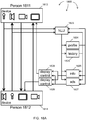
- Figure 18A illustrates a computer architecture 1800 with device modules relative to media interfaces.
- Interface devices 1813 and 1814 each support automatic speech recognition of speech captured by one or more microphones.
- Interface devices 1813 and 1814 each support outputting audio, including synthesized speech, through one or more speaker.
- Interface devices 1813 and 1814 each have a camera and a video display screen (e.g., similar to display 108, 308, or 508) to capture and display video.
- Interface devices 1813 and 1814 can use different forms of audio and video encoding, synchronization, compression, and error correction coding, including real-time video and one-way telecasting.
- NLU 1823 can receive spoken expressions from intercepted speech. Results of natural language understanding can be used to build and maintain a user profile 1824 and a conversation history 1825. User profile 1824 can also depend on previously known information. Conversation history 1825, user profile 1824, and other environmental information can be used to influence understanding and improve the probability of selecting relevant information. In one aspect, NLU 1823 outputs a topic. Information module 1826 uses the topic to search for relevant information. Information module 1826 can be integrated into and/or interoperate with a search module, such as, for example, search module 112, 312, or 512. An optional ads module 1827 can use the topic to search for a relevant ad. Both the information module 1826 and the ads module 1827 can use user profile 1824 and conversation history 1825 to enhance their search results relevance.
- Display control 1828 provides information to interface device 1813.
- Interface device 1813 can present information from display control 1828 on a video screen.
- display control 1829 provides information to interface device 1814.
- Interface device 1814 can present information from display control 1829 on a video screen.
- Display control 1828 and/or display control 1829 can be integrated into and/or interoperate with a delivery module, such as, for example, delivery module 109, 309, or 509
- person 1811 and person 1812 each see information more relevant to their interests. Information is presented visually to support their two-way verbal conversation.
- the information displayed to Bob depends both on what Alice says and on having a high likelihood of being relevant to Bob in the near future as the conversation progresses.
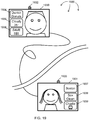
- FIG. 19 illustrates a video conferencing system 1900.
- Alice is using video conferencing terminal 1930 and Bob is using a video conferencing terminal 1931.
- the users are communicating with one another through a network connection.
- Video conferencing terminal 1930 includes camera and microphone module 1932.
- video conferencing terminal 1931 includes camera and microphone module 1933.
- the system displays to Bob Wikipedia introduction for Boston 1937.
- the system displays to Alice ad for Dunkin Donuts restaurant in Boston 1934.
- the system displays to Bob ad for laundry detergent 1938.
- the system displays to Alice her three Charlie contacts.
- the system displays to Alice weather forecast 1935 and New England aquarium coupons 1936.
- the system displays to Bob pictures of Boston Common or New England Aquarium based on his profile.
- Each user can use a swiping gesture to remove cards from the display. If not, each card starts fading after a specified time, for example, 10 seconds. When fading, if the user taps the card it becomes sharp and stays that way, otherwise, after another 5 seconds the card disappears. If the user taps a sharp card, the system performs an associated action such as requesting further information or providing a menu to save the card to a card deck for later reference. Card decks are accessible from a pull-down menu that appears during a downward swipe from the top of the display.
- Figure 18A operates symmetrically between two users, who are both receiving assistance from the system.
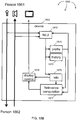
- Figure 18B illustrates a computer architecture 1850 that assists only one user, Person 1861.
- the system is very similar but offers a personal augmentation tool to person 1861, as opposed to mutual augmentation.
- Person 1862 receives no assistance.
- person 1862 is at the other end of a phone line.
- person 1862 may be on the other side of Person 1861's desk, and no telephone is involved, but only person 1861 receives the relevant information.
- person 1862 is not a real person, but person 1861 is dictating some text.
- person 1861 receives information that is relevant to the speech without interfering with the conversation.
- the word conversation is a monolog.
- the aspect shown in Figure 18B is similar to that of Figure 18A , except for the one-way nature of the augmentation, and minor differences.
- the module 1877 that computes the relevance of info 1876 is exposed, while in Figure 18A its presence is only implicit.
- a single device 1863 provides the entire system functionality. In some aspects it is a local self-contained device, while in Figure 18A device 1813 only performs I/O functions and, presumably, leaves the NLU and other functions to a server. These are just some variations of the architecture.
- Interface device 1863 supports automatic speech recognition of speech captured by one or more microphones; it may output audio through one or more speaker.
- Interface device 1863 has a display screen used to display the assistive information generated by the system.
- NLU 1873 can receive spoken expressions from received speech. Results of natural language understanding can be used to build and maintain a user profile 1874 and a conversation history 1875. User profile 1874 can also depend on previously known information. Conversation history 1875, user profile 1874, and other environmental information can be used to influence understanding and help select the most relevant information. In one aspect, NLU 1873 outputs a topic. Information module 1876 uses the topic to search for relevant information. Information module 1876 can be integrated into and/or interoperate with a search module, such as, for example, search module 112, 312, or 512. An optional ads module (not shown) can use the topic to search for a relevant ad. Both the information module 1876 and the ads module 1877 can use user profile 1874 and conversation history 1875 to improve the relevance of searches.
- Display control 1878 presents information on the display screen of device 1863.
- Display control 1878 can be integrated into and/or interoperate with a delivery module, such as, for example, delivery module 109, 309, or 509.
- a delivery module such as, for example, delivery module 109, 309, or 509.
- the relevance of the information to the recipient of the information is computed, and the relevance is compared to a threshold to decide whether to display the information; often there is limited space on the screen, and information will be displayed in order of relevance.
- the assisted user 1861 sees information more relevant to their interests.
- the information is presented visually to support the two-way verbal conversation.
- the asymmetrical mode of operation can also be supported. For example, a system might be accessed for free by unassisted users, but a fee would be required to access to the user assistance system.
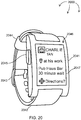
- FIG. 20 illustrates a wearable device 2000.
- Wearable device 2000 includes a body 2041, held by a strap 2042, which is held by clasp 2043 and tucked into keeper 2044.
- Watch body 2041 comprises a display 2047 that shows information, a general control button 2045 on the side, and a microphone hole 2046 for capturing NLEs.
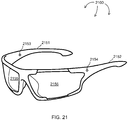
- FIG. 21 illustrates virtual reality glasses 2100.
- Virtual reality glasses 2100 include a right earpiece unit 2151 that contains an internal battery, communications module, and processing module among other components within a flexible plastic housing.
- the glasses further comprise a left earpiece unit 2152 that contains, among other components, a battery with a weight approximately equal to the weight of earpiece unit 2151 within a flexible plastic housing.
- the weight evenness provides a balanced feel for the wearer.
- the battery having the greatest weight, sits near the rear of the earpiece in order to minimize weight on the wearer's nose.
- Virtual reality glasses 2100 further include, within earpiece unit 2151, a proximal microphone hole 2153 for capturing speech from the assisted wearer.
- Virtual reality glasses 2100 further include, within earpiece unit 2152, a distal microphone hole 2154 for capturing speech from other people (e.g., as described with respect to computer architecture 500).
- Virtual reality glasses 2100 further include a right display screen 2155 mounted within the right earpiece unit and a left display screen 2156 mounted so as to connect the right earpiece unit 2151 and the left earpiece unit 2152 such that the glasses can wrap around a wearer's head.
- the display screens 2155 and 2156 are symmetrical to provide for a sympathetic visual field between the wearer's two eyes.
- Display screens 2155 and 2156 can be OLED glass displays.
- the processor in earpiece unit 2151 can control display screens 2155 and 2156 independently.
- the processor can display information on one or both screens 2155 and 2156 in order to ease the viewing or maximize the amount of information visible to the wearer overlaid on his or her field of vision.
- Some aspects provide for the display screens to also act as corrective lenses according to an optical prescription.
- Figure 22 illustrates a vehicle heads-up display 2200 (e.g., in windshield 2261). Windshield 2261 is visible to a driver behind rearview mirror 2262 and steering wheel 2263. A microphone 2264 captures speech. An internal computer processor system performs NLU on the captured speech to determine topics of conversation and search for relevant information. A dashboard embedded projector unit 2266 projects relevant information on a display area 2265 within the visual field of windshield 2261.
- the topic of conversation "groceries" can be identified from NLEs received during the conversation.
- a search for grocery store location information can be performed.
- the grocery store "Mall-Mart” can be identified and presented in display area 2265 along with directions (e.g., turn right in two kilometers).
- results can be filtered based on paid sponsorships.
- Mall-Mart may have paid a back-end server provider to have its store locations displayed, whereas Mom-Shop and Pop-Shop did not pay.
- FIG. 23A illustrates an example rotating disk 2371.
- Rotating disk 2371 is an example non-transitory computer readable medium (e.g., a rotating magnetic disk). Cloud data centers can use magnetic disks to store code and data for servers. Rotating disk 2371 can store code comprising instructions that, if executed by one or more computers, would cause the computer to perform methods and data flows described herein. Rotating optical disks and other mechanically moving storage media are also contemplated.
- FIG. 23B illustrates an example Flash Random Access Memory (RAM) chip 2372.
- Flash Random Access Memory (RAM) chip 2372 is an example non-transitory computer readable medium. Data centers can use Flash memory to store data and code comprising instructions for server processors. Mobile devices can use Flash memory to store data and code comprising instructions for processors within system-on-chip devices. Flash Random Access Memory (RAM) chip 2372 can store code comprising instructions that, if executed by one or more computers, would cause the computer to perform the methods and data flows described herein. Other non-moving storage media packaged with leads or solder balls are also contemplated.
- SoC System on chip
- Figure 24A illustrates an example solder ball (bottom) side of packaged System On Chip (SoC) 2480.
- SoC System On Chip
- the bottom side of packaged SoC 2480 is depicted with a ball grid array for surface-mount soldering to a printed circuit board.
- Various package shapes and sizes are possible for various chip implementations.
- System-on-chip (SoC) devices can control embedded systems and IoT device embodiments as described herein.
- FIG. 24B illustrates an example architecture of System On Chip (SoC) 2480.
- SoC System On Chip
- SoC System On Chip
- SoC includes a multicore cluster of computer processor (CPU) cores 2481 and a multicore cluster of graphics processor (GPU) cores 2482.
- the processor cores connect through a network-on-chip 2483 to an off-chip dynamic random-access memory (DRAM) interface 2484 for volatile program and data storage.
- DRAM dynamic random-access memory
- the processor cores also connect to a Flash interface 2485 for non-volatile storage of computer program code in a Flash RAM non-transitory computer readable medium.
- DRAM dynamic random-access memory
- SoC 2480 also includes a display interface 186 for displaying a GUI and an I/O interface module 2487 for connecting to various I/O interface devices, as appropriate for different peripheral devices.
- the I/O interface enables sensors such as touch screen sensors, geolocation receivers, microphones, speakers, Bluetooth peripherals, and USB devices, such as keyboards and mice, among others.
- SoC 2480 also comprises a network interface 2488.
- Network interface 2488 allows the processor cores to access the Internet (or other networks) through wired or wireless connections such as WiFi, 3G, 4G long-term evolution (LTE), 5G, and other wireless interface standard radios as well as ethernet connection hardware.
- FIG. 25A illustrates an example of a rack-based server 2590.
- Rack based server 2590 can include a plurality of rack-mounted multi-processor server blades.
- the plurality of rack-mounted multi-processor server blades can each include a multiplicity of network-connected computer processors.
- the multiplicity of network-connected computer processors can run software in parallel.
- FIG. 25B illustrates an example architecture of a server 2590.
- the architecture includes a multicore cluster of CPU cores 2591 and a multicore cluster of GPU cores 2592.
- the processors connect through a board-level interconnect 2593 to RAM devices 2594 for program code and data storage.
- Server system 2590 also comprises a network interface 2598 to allow the processors to access the Internet (or other networks). By executing instructions stored in RAM devices through interface 2594, the CPUs 2591 and GPUs 2592 can perform methods and/or data flows as described herein.
- Various embodiments are methods that use the behavior of either or a combination of humans and machines. Method embodiments are complete wherever in the world most constituent steps occur. Some embodiments are one or more non-transitory computer readable media arranged to store such instructions for methods described herein. Whatever machine holds non-transitory computer readable media comprising any of the necessary code holds a complete embodiment. Some embodiments are physical devices such as semiconductor chips; hardware description language representations of the logical or functional behavior of such devices; and one or more non-transitory computer readable media arranged to store such hardware description language representations.
- Examples shown and described use certain spoken languages. Various embodiments operate, similarly, for other languages or combinations of languages. Examples shown and described use certain domains of knowledge. Various embodiments operate similarly for other domains or combinations of domains.
- Some embodiments are stationary, such as a vending machine. Some embodiments are mobile, such as an automobile. Some embodiments are portable, such as a mobile phone. Some embodiments comprise manual interfaces such as keyboard or touch screens. Some embodiments comprise neural interfaces that use human thoughts as a form of natural language expression.
- the present disclosure extends to methods, systems, and computer program products for automatically visually presenting information relevant to an utterance.
- Natural language expressions from conversation participants are received and processed to determine a topic and concepts, a search finds relevant information and it is visually displayed to an assisted user.
- Applications can include video conferencing, wearable devices, augmented reality, and heads-up vehicle displays.
- Topics, concepts, and information search results are analyzed for relevance and non-repetition. Relevance can depend on a user profile, conversation history, and environmental information. Further information can be requested through non-verbal modes. Searched and displayed information can be in languages other than that spoken in the conversation. Many-party conversations can be processed.
- the disclosure comprises the following items:
Landscapes
- Engineering & Computer Science (AREA)
- Theoretical Computer Science (AREA)
- Physics & Mathematics (AREA)
- Computational Linguistics (AREA)
- Health & Medical Sciences (AREA)
- Audiology, Speech & Language Pathology (AREA)
- Artificial Intelligence (AREA)
- General Health & Medical Sciences (AREA)
- General Engineering & Computer Science (AREA)
- General Physics & Mathematics (AREA)
- Multimedia (AREA)
- Acoustics & Sound (AREA)
- Human Computer Interaction (AREA)
- Probability & Statistics with Applications (AREA)
- Information Retrieval, Db Structures And Fs Structures Therefor (AREA)
- User Interface Of Digital Computer (AREA)
- Information Transfer Between Computers (AREA)
Applications Claiming Priority (2)
| Application Number | Priority Date | Filing Date | Title |
|---|---|---|---|
| US16/052,930 US20200043479A1 (en) | 2018-08-02 | 2018-08-02 | Visually presenting information relevant to a natural language conversation |
| KR1020190031067A KR102300606B1 (ko) | 2018-08-02 | 2019-03-19 | 자연어 대화에 관련되는 정보의 시각적 제시 |
Publications (2)
| Publication Number | Publication Date |
|---|---|
| EP3605527A2 true EP3605527A2 (fr) | 2020-02-05 |
| EP3605527A3 EP3605527A3 (fr) | 2020-04-15 |
Family
ID=67314711
Family Applications (1)
| Application Number | Title | Priority Date | Filing Date |
|---|---|---|---|
| EP19186657.3A Withdrawn EP3605527A3 (fr) | 2018-08-02 | 2019-07-16 | Présentation visuelle d'informations relatives à une conversation de langage naturel |
Country Status (1)
| Country | Link |
|---|---|
| EP (1) | EP3605527A3 (fr) |
Family Cites Families (3)
| Publication number | Priority date | Publication date | Assignee | Title |
|---|---|---|---|---|
| JP5315289B2 (ja) * | 2010-04-12 | 2013-10-16 | トヨタ自動車株式会社 | オペレーティングシステム及びオペレーティング方法 |
| US9257115B2 (en) * | 2012-03-08 | 2016-02-09 | Facebook, Inc. | Device for extracting information from a dialog |
| US20170004178A1 (en) * | 2015-06-30 | 2017-01-05 | Avaya Inc. | Reference validity checker |
-
2019
- 2019-07-16 EP EP19186657.3A patent/EP3605527A3/fr not_active Withdrawn
Also Published As
| Publication number | Publication date |
|---|---|
| EP3605527A3 (fr) | 2020-04-15 |
Similar Documents
| Publication | Publication Date | Title |
|---|---|---|
| US20200219490A1 (en) | Information Retrieval According To A User Interest Model | |
| US11823289B2 (en) | User controlled task execution with task persistence for assistant systems | |
| US11563706B2 (en) | Generating context-aware rendering of media contents for assistant systems | |
| US20250342828A1 (en) | Digital assistant control of applications | |
| US11159767B1 (en) | Proactive in-call content recommendations for assistant systems | |
| EP4172843B1 (fr) | Utilisation d'une seule demande pour l'appel de plusieurs personnes dans des systèmes d'assistant | |
| US20210117214A1 (en) | Generating Proactive Content for Assistant Systems | |
| US20220358727A1 (en) | Systems and Methods for Providing User Experiences in AR/VR Environments by Assistant Systems | |
| US12574627B2 (en) | Smart cameras enabled by assistant systems | |
| US20250119480A1 (en) | Generating Proactive Reminders for Assistant Systems | |
| EP4385009A1 (fr) | Système d'intelligence artificielle conversationnelle dans un espace de réalité virtuelle | |
| US9569701B2 (en) | Interactive text recognition by a head-mounted device | |
| KR102196917B1 (ko) | 영어 말하기 평가 시스템 및 방법 | |
| EP3605527A2 (fr) | Présentation visuelle d'informations relatives à une conversation de langage naturel | |
| US20240330362A1 (en) | System and method for generating visual captions | |
| HK40017683A (en) | Visually presenting information relevant to a natural language conversation |
Legal Events
| Date | Code | Title | Description |
|---|---|---|---|
| PUAI | Public reference made under article 153(3) epc to a published international application that has entered the european phase |
Free format text: ORIGINAL CODE: 0009012 |
|
| STAA | Information on the status of an ep patent application or granted ep patent |
Free format text: STATUS: THE APPLICATION HAS BEEN PUBLISHED |
|
| AK | Designated contracting states |
Kind code of ref document: A2 Designated state(s): AL AT BE BG CH CY CZ DE DK EE ES FI FR GB GR HR HU IE IS IT LI LT LU LV MC MK MT NL NO PL PT RO RS SE SI SK SM TR |
|
| AX | Request for extension of the european patent |
Extension state: BA ME |
|
| PUAL | Search report despatched |
Free format text: ORIGINAL CODE: 0009013 |
|
| AK | Designated contracting states |
Kind code of ref document: A3 Designated state(s): AL AT BE BG CH CY CZ DE DK EE ES FI FR GB GR HR HU IE IS IT LI LT LU LV MC MK MT NL NO PL PT RO RS SE SI SK SM TR |
|
| AX | Request for extension of the european patent |
Extension state: BA ME |
|
| RIC1 | Information provided on ipc code assigned before grant |
Ipc: G10L 15/22 20060101ALN20200312BHEP Ipc: G10L 15/18 20130101AFI20200312BHEP |
|
| 18D | Application deemed to be withdrawn |
Effective date: 20201016 |