EP3605531B1 - Informationsverarbeitungsvorrichtung, informationsverarbeitungsverfahren und programm - Google Patents
Informationsverarbeitungsvorrichtung, informationsverarbeitungsverfahren und programm Download PDFInfo
- Publication number
- EP3605531B1 EP3605531B1 EP18774689.6A EP18774689A EP3605531B1 EP 3605531 B1 EP3605531 B1 EP 3605531B1 EP 18774689 A EP18774689 A EP 18774689A EP 3605531 B1 EP3605531 B1 EP 3605531B1
- Authority
- EP
- European Patent Office
- Prior art keywords
- audio
- objects
- data
- audio objects
- viewpoint
- Prior art date
- Legal status (The legal status is an assumption and is not a legal conclusion. Google has not performed a legal analysis and makes no representation as to the accuracy of the status listed.)
- Active
Links
Images







Classifications
-
- G—PHYSICS
- G10—MUSICAL INSTRUMENTS; ACOUSTICS
- G10L—SPEECH ANALYSIS TECHNIQUES OR SPEECH SYNTHESIS; SPEECH RECOGNITION; SPEECH OR VOICE PROCESSING TECHNIQUES; SPEECH OR AUDIO CODING OR DECODING
- G10L19/00—Speech or audio signals analysis-synthesis techniques for redundancy reduction, e.g. in vocoders; Coding or decoding of speech or audio signals, using source filter models or psychoacoustic analysis
- G10L19/008—Multichannel audio signal coding or decoding using interchannel correlation to reduce redundancy, e.g. joint-stereo, intensity-coding or matrixing
-
- H—ELECTRICITY
- H04—ELECTRIC COMMUNICATION TECHNIQUE
- H04S—STEREOPHONIC SYSTEMS
- H04S3/00—Systems employing more than two channels, e.g. quadraphonic
- H04S3/008—Systems employing more than two channels, e.g. quadraphonic in which the audio signals are in digital form, i.e. employing more than two discrete digital channels
-
- H—ELECTRICITY
- H04—ELECTRIC COMMUNICATION TECHNIQUE
- H04S—STEREOPHONIC SYSTEMS
- H04S7/00—Indicating arrangements; Control arrangements, e.g. balance control
- H04S7/30—Control circuits for electronic adaptation of the sound field
- H04S7/302—Electronic adaptation of stereophonic sound system to listener position or orientation
-
- H—ELECTRICITY
- H04—ELECTRIC COMMUNICATION TECHNIQUE
- H04S—STEREOPHONIC SYSTEMS
- H04S7/00—Indicating arrangements; Control arrangements, e.g. balance control
- H04S7/30—Control circuits for electronic adaptation of the sound field
- H04S7/305—Electronic adaptation of stereophonic audio signals to reverberation of the listening space
-
- H—ELECTRICITY
- H04—ELECTRIC COMMUNICATION TECHNIQUE
- H04S—STEREOPHONIC SYSTEMS
- H04S2400/00—Details of stereophonic systems covered by H04S but not provided for in its groups
- H04S2400/11—Positioning of individual sound objects, e.g. moving airplane, within a sound field
-
- H—ELECTRICITY
- H04—ELECTRIC COMMUNICATION TECHNIQUE
- H04S—STEREOPHONIC SYSTEMS
- H04S2400/00—Details of stereophonic systems covered by H04S but not provided for in its groups
- H04S2400/15—Aspects of sound capture and related signal processing for recording or reproduction
Definitions
- the present technology relates to an information processing device, an information processing method, and a program, and in particular relates to an information processing device, an information processing method, and a program that enable reduction of an amount of data to be transmitted in transmission of data of a plurality of audio objects.
- Free-viewpoint video technologies have drawn attention as efforts of video technologies.
- Object-based audio data is reproduced by rendering based on metadata on waveform data of each audio object into signals of a desired number of channels depending on a system on the reproduction side.
- US 2005/0114121 A1 discloses a computer device comprising a memory for storing audio signals, in part prerecorded, each corresponding to a defined source, by means of spatial position data, and a processing module for processing these audio signals in real time as a function of the spatial position data.
- the processing module allows for the instantaneous power level parameters to be calculated on the basis of audio signals, the corresponding sources being defined by instantaneous power level parameters.
- the processing module comprises a selection module for regrouping certain of the audio signals into a variable number of audio signal groups, and the processing module is capable of calculating spatial position data which is representative of a group of audio signals as a function of the spatial position data and instantaneous power level parameters for each corresponding source.
- EP 0 930 755 A1 describes a virtual reality networked system in which, in one embodiment, if a message includes object data regarding live voice or live sound which do not make sense unless they are continuous, and the position of the sound source of the message exists within an area Hmin, the respective messages are compressed, without mixing the sounds of the plurality of messages. If the sound source of the message exists between Hmin and Hmax, the sounds are mixed, and then compressed. If the sound source of the message exists outside Hmax, this message is discarded without being processed.
- the nearest spherical radius of the audible area that the user can recognize the sound source is indicated as Hmin, and the farthest spherical radius of the audible area that the user cannot recognize the sound source but can recognize the background sound is indicated as Hmax.
- the present technology has been made in view of such a situation, and an object thereof is to enable reduction of an amount of data to be transmitted in transmission of data of a plurality of audio objects.
- the combining unit can be caused to generate audio waveform data and a rendering parameter of the combined audio object.
- the transmitting unit can be caused to transmit, as the data of the combined audio object, the audio waveform data and the rendering parameter that are generated by the combining unit, and to transmit, as the data of the other audio objects, audio waveform data of each of the other audio objects and a rendering parameter for the predetermined supposed listening position.
- the combining unit can be caused to combine audio objects with sounds that are undistinguishable at the predetermined supposed listening position and belong to a same preset group.
- the combining unit can be caused to perform audio object combination such that the number of audio objects to be transmitted becomes the number corresponding to a transmission bit rate.
- the transmitting unit can be caused to transmit an audio bitstream including flag information representing whether an audio object included in the audio bitstream is an uncombined audio object or the combined audio object.
- the transmitting unit can be caused to transmit an audio bitstream file along with a reproduction management file including flag information representing whether an audio object included in the audio bitstream is an uncombined audio object or the combined audio object.
- the present technology enables reduction of an amount of data to be transmitted in transmission of data of a plurality of audio objects.
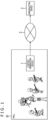
- FIG. 1 is a figure illustrating an exemplary configuration of a transmission system according to one embodiment of the present technology.
- the transmission system illustrated in FIG. 1 is constituted by a content generating device 1 and a reproduction device 2 being connected via the Internet 3.
- the content generating device 1 is a device managed by a content creator, and is installed at a hall #1 where a live music performance is underway. Contents generated by the content generating device 1 are transmitted to the reproduction device 2 via the Internet 3. Content distribution may be performed via a server which is not illustrated.
- the reproduction device 2 is a device installed in the home of a user who views and listens to contents of the live music performance generated by the content generating device 1. Although only the reproduction device 2 is illustrated as a reproduction device to which contents are distributed in the example illustrated in FIG. 1 , there are actually many reproduction devices connected to the Internet 3.
- Video contents generated by the content generating device 1 are a video for which one can switch the viewpoint.
- sound contents also are sounds for which one can switch the viewpoint (supposed listening position) such that the listening position matches the position of the video viewpoint, for example. If the viewpoint is switched, the positioning of sounds is switched.
- Audio data included in contents includes audio waveform data of each audio object, and rendering parameters as metadata for positioning the sound source of each audio object.
- audio objects are simply called objects, as appropriate.
- a user of the reproduction device 2 can select any viewpoint from a plurality of viewpoints that are prepared, and view and listen to contents through a video and sounds according to the viewpoint.
- the content generating device 1 provides the reproduction device 2 with contents including video data of a video as seen from the viewpoint selected by the user, and object-based audio data of the viewpoint selected by the user.
- object-based audio data is transmitted in a form of data compressed in a predetermined manner such as MPEG-H 3D Audio.
- MPEG-H 3D Audio is disclosed at " ISO/IEC 23008-3: 2015 “Information technology -- High efficiency coding and media delivery in heterogeneous environments-- Part 3: 3D audio,” ⁇ https://www.iso.org/standard/63878.html> .”
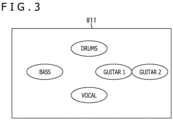
- the live music performance that is underway in the hall #1 is a live performance where five people play a bass, drums, a guitar 1 (main guitar), a guitar 2 (side guitar), and a vocal on a stage. Treating each of the bass, drums, guitar 1, guitar 2, and vocal as an object, audio waveform data of each object, and rendering parameters for each viewpoint are generated at the content generating device 1.
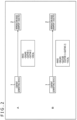
- FIG. 2 is a figure illustrating exemplary types of objects to be transmitted from the content generating device 1.
- a viewpoint 1 is selected from a plurality of viewpoints by the user, data of five types of objects, the bass, drums, guitar 1, guitar 2, and vocal, is transmitted as illustrated in FIG. 2A .
- the transmitted data includes audio waveform data of each of the objects, the bass, drums, guitar 1, guitar 2, and vocal, and rendering parameters of each object for the viewpoint 1.
- the guitar 1 and the guitar 2 are merged into one object of a guitar, and data of four types of objects, the bass, drums, guitar, and vocal is transmitted as illustrated in FIG. 2B .
- the transmitted data includes audio waveform data of each of the objects, the bass, drums, guitar, and vocal, and rendering parameters of each object for the viewpoint 2.
- the viewpoint 2 is set to a position where sounds of the guitar 1 and sounds of the guitar 2 are undistinguishable by the human auditory sense since they come from the same direction, for example. In this manner, objects with sounds that are undistinguishable at a viewpoint selected by the user are merged, and transmitted as data of a single merged object.
- n is a time index.
- i represents the type of an object.
- the number of objects is L.
- j represents the type of a viewpoint.
- the number of viewpoints is M.
- rendering information r is a gain (gain information).
- the value range of rendering information r is 0 to 1.
- Audio data for each viewpoint is represented by the sum of audio waveform data of all the objects, a piece of audio waveform data of each object being multiplied by a gain.
- a calculation like the one illustrated by Math (1) is performed at the reproduction device 2.
- a plurality of objects with sounds that is undistinguishable at a viewpoint are transmitted as merged data.
- Objects that are far from a viewpoint, and within a predetermined horizontal angular range from the viewpoint are selected as objects with undistinguishable sounds.
- nearby objects with distinguishable sounds at a viewpoint are not merged, but are transmitted as independent objects.
- Rendering information about an object corresponding to each viewpoint is defined by the type of the object, the position of the object, and the position of the viewpoint as: r(obj_type, obj_loc_x, obj_loc_y, obj_loc_z, lis_loc_x, lis_loc_y, lis_loc_z)
- obj_type is information indicating the type of the object, and indicates the type of a musical instrument, for example.
- obj_loc_x, obj_loc_y, and obj_loc_z are information indicating the position of the object in a three-dimensional space.
- lis_loc_x, lis_loc_y, and lis_loc_z are information indicating the position of the viewpoint in the three-dimensional space.
- parameter information constituted by obj_type, obj_loc_x, obj_loc_y, obj_loc_z, lis_loc_x, lis_loc_y, and lis_loc_z is transmitted along with rendering information r.
- Rendering parameters are constituted by parameter information and rendering information.
- FIG. 3 is a top view of a stage #11 in the hall #1.
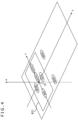
- FIG. 4 is an oblique view of the entire hall #1 including the stage #11 and seats.
- the origin O is the center position on the stage #11.
- a viewpoint 1 and a viewpoint 2 are set in the seats.
- the coordinate of each object is represented as follows in meters:
- rendering information about each object for the viewpoint 1 is represented as follows:
- obj_type of each object assumes the following values.
- rendering parameters including parameter information and rendering information represented in the manner mentioned above is generated at the content generating device 1.
- i represents the following objects in x(n, i):
- FIG. 5A An exemplary arrangement of respective objects as seen from the viewpoint 1 is illustrated in FIG. 5A .
- the lower portion indicated by a pale color illustrates a side surface of the stage #11. This is similar also to other figures.
- FIG. 5B An exemplary arrangement of respective objects as seen from the viewpoint 2 is illustrated in FIG. 5B .
- the angle ⁇ 1 which is a horizontal angle formed by the direction of the guitar 1 and the direction of the guitar 2 as seen from the viewpoint 1 as the reference position is different from the angle ⁇ 2 which is a horizontal angle formed by the direction of the guitar 1 and the direction of the guitar 2 as seen from the viewpoint 2 as the reference position.
- the angle ⁇ 2 is narrower than the angle ⁇ 1.
- FIG. 6 is a plan view illustrating a positional relation between each object and viewpoints.
- the angle ⁇ 1 is an angle between a broken line A1-1 connecting the viewpoint 1 and the guitar 1 and a broken line A1-2 connecting the viewpoint 1 and the guitar 2.
- the angle ⁇ 2 is an angle between a broken line A2-1 connecting the viewpoint 2 and the guitar 1 and a broken line A2-2 connecting the viewpoint 2 and the guitar 2.
- the angle ⁇ 1 is deemed to be an angle that allows the human auditory sense to distinguish sounds, that is, an angle that allows the human auditory sense to identify a sound of the guitar 1 and a sound of the guitar 2 as sounds that come from different directions.
- the angle ⁇ 2 is deemed to be an angle that does not allow the human auditory sense to distinguish sounds.
- audio data of the viewpoint 2 can be replaced using Math (4): [Math.
- y n 1 x n 0 ⁇ r 0 , ⁇ 20 , 0,0 , ⁇ 35,30 , ⁇ 1 + x n 1 ⁇ r 1,0 , ⁇ 10,0 , ⁇ 35,30 , ⁇ 1 + x n 5 ⁇ r 5 , 25 , 0,0 , ⁇ 35,30 , ⁇ 1 + x n 4 ⁇ r 3,0 , 10 , 0 , ⁇ 35,30 , ⁇ 1
- Math (5) represents audio waveform data of one object which is obtained by merging the guitar 1 and the guitar 2 as the sum of audio waveform data of the guitar 1 and audio waveform data of the guitar 2.
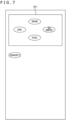
- An exemplary arrangement of respective objects in the case where the guitar 1 and the guitar 2 are merged into one object is illustrated in FIG. 7 .
- FIG. 8 An exemplary arrangement of respective objects including the combined object as seen from the viewpoint 2 is illustrated in FIG. 8 .
- a video as seen from the viewpoint 2 presents images of the guitar 1 and the guitar 2 respectively, only one guitar is arranged as an audio object.
- the content generating device 1 can reduce the number of objects for which data is transmitted, and can reduce the data transmission amount.
- the reproduction device 2 can reduce the amount of calculation required for rendering.
- the vocal is an object which is within the horizontal angle range of the angle ⁇ 2 as seen from the viewpoint 2 other than the guitar 1 and the guitar 2 in the example of FIG. 6 , the vocal is an object that is close to the viewpoint 2, and is distinguishable from the guitar 1 and the guitar 2.
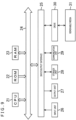
- FIG. 9 is a block diagram illustrating an exemplary configuration of the content generating device 1.
- a CPU Central Processing Unit
- ROM Read Only Memory
- RAM Random Access Memory
- the bus 24 is further connected with an input/output interface 25.
- the input/output interface 25 is connected with an input unit 26, an output unit 27, a storage unit 28, a communication unit 29, and a drive 30.
- the input unit 26 is constituted by a keyboard, a mouse, and the like.
- the input unit 26 outputs signals representing contents of manipulation by a user.
- the output unit 27 is constituted by a display such as an LCD (Liquid Crystal Display) or an organic EL display, and a speaker.
- a display such as an LCD (Liquid Crystal Display) or an organic EL display, and a speaker.
- the storage unit 28 is constituted by a hard disk, a non-volatile memory, and the like.
- the storage unit 28 stores various types of data such as programs to be executed by the CPU 21, and contents.
- the communication unit 29 is constituted by a network interface and the like, and performs communication with an external device via the Internet 3.
- the drive 30 writes data in an attached removable media 31, and reads out data recorded in the removable media 31.
- the reproduction device 2 also has a configuration which is the same as the configuration illustrated in FIG. 9 .
- explanations are given by referring to the configuration illustrated in FIG. 9 as the configuration of the reproduction device 2 as appropriate.
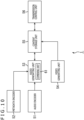
- FIG. 10 is a block diagram illustrating an exemplary functional configuration of the content generating device 1.
- At least part of the configuration illustrated in FIG. 10 is realized by the CPU 21 in FIG. 9 executing a predetermined program.
- the content generating device 1 an audio encoder 51, a metadata encoder 52, an audio generating unit 53, a video generating unit 54, a content storage unit 55, and a transmission control unit 56 are realized.
- the audio encoder 51 acquires sound signals in a live music performance collected by a microphone (not illustrated), and generates audio waveform data of each object.
- the metadata encoder 52 generates rendering parameters of each object for each viewpoint according to manipulation by a content creator. Rendering parameters for each of a plurality of viewpoints set in the hall #1 are generated by the metadata encoder 52.
- the audio generating unit 53 associates audio waveform data generated by the audio encoder 51 with rendering parameters generated by the metadata encoder 52 to thereby generate object-based audio data for each viewpoint.
- the audio generating unit 53 outputs the generated audio data for each viewpoint to the content storage unit 55.
- a combining unit 61 is realized in the audio generating unit 53.
- the combining unit 61 performs combination of objects, as appropriate.
- the combining unit 61 reads out audio data for each viewpoint stored in the content storage unit 55, combines objects that can be combined, and stores audio data obtained by the combination in the content storage unit 55.
- the video generating unit 54 acquires data of a video captured by a camera installed at the position of each viewpoint, and encode the data in a predetermined encoding manner to thereby generate video data for each viewpoint.
- the video generating unit 54 outputs the generated video data for each viewpoint to the content storage unit 55.
- the content storage unit 55 stores the audio data for each viewpoint generated by the audio generating unit 53 and the video data for each viewpoint generated by the video generating unit 54 in association with each other.
- the transmission control unit 56 controls the communication unit 29, and performs communication with the reproduction device 2.
- the transmission control unit 56 receives selection viewpoint information which is information representing a viewpoint selected by a user of the reproduction device 2, and sends, to the reproduction device 2, contents consisting of video data and audio data corresponding to the selected viewpoint.
- FIG. 11 is a block diagram illustrating an exemplary functional configuration of the reproduction device 2.
- At least part of the configuration illustrated in FIG. 11 is realized by the CPU 21 in FIG. 9 executing a predetermined program.
- a content acquiring unit 71, a separating unit 72, an audio reproduction unit 73, and a video reproduction unit 74 are realized.
- the content acquiring unit 71 controls the communication unit 29, and sends selection viewpoint information to the content generating device 1.
- the content acquiring unit 71 receives and acquires contents sent from the content generating device 1 in response to the sending of the selection viewpoint information.
- the content generating device 1 sends contents including video data and audio data corresponding to the viewpoint selected by a user.
- the content acquiring unit 71 outputs the acquired contents to the separating unit 72.
- the separating unit 72 separates video data and audio data included in the contents supplied from the content acquiring unit 71.
- the separating unit 72 outputs the video data of the contents to the video reproduction unit 74, and outputs the audio data of the contents to the audio reproduction unit 73.
- the audio reproduction unit 73 Based on rendering parameters, the audio reproduction unit 73 performs rendering of audio waveform data constituting the audio data supplied from the separating unit 72, and makes sound contents output from a speaker constituting the output unit 27.
- the video reproduction unit 74 decodes the video data supplied from the separating unit 72, and makes a video of contents as seen from a predetermined viewpoint displayed on a display constituting the output unit 27.
- the speaker and display that are used in reproducing contents may be prepared as external equipment connected to the reproduction device 2.
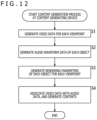
- the processes illustrated in FIG. 12 are started, for example, when a live music performance is started and video data for each viewpoint and sound signals of each object are input to the content generating device 1.
- a plurality of cameras is installed in the hall #1, and videos captured by those cameras are input to the content generating device 1.
- microphones are installed near each object in the hall #1, and sound signals acquired by those microphones are input to the content generating device 1.
- the video generating unit 54 acquires data of a video captured by a camera for each viewpoint, and generates a video data for each viewpoint.
- the audio encoder 51 acquires sound signals of each object, and generates audio waveform data of each object.
- audio waveform data of each of the objects, the bass, drums, guitar 1, guitar 2 and vocal is generated.
- the metadata encoder 52 generates rendering parameters of each object for each viewpoint according to manipulation by a content creator.
- viewpoint 1 and the viewpoint 2 are set in the hall #1 as mentioned above, a set of rendering parameters of each of the objects, the bass, drums, guitar 1, guitar 2, and vocal, for the viewpoint 1, and a set of rendering parameters of each of the objects, the bass, drums, guitar 1, guitar 2, and vocal, for the viewpoint 2 are generated.
- the content storage unit 55 associates audio data with video data for each viewpoint to thereby generate and store contents for each viewpoint.
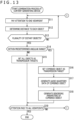
- the processes illustrated in FIG. 13 are performed at a predetermined timing after a set of audio waveform data of each of the objects, the bass, drums, guitar 1, guitar 2, and vocal, and rendering parameters of each object for each viewpoint is generated.
- the combining unit 61 pays attention to a predetermined one viewpoint among a plurality of viewpoints for which rendering parameters are generated.
- the combining unit 61 based on parameter information included in rendering parameters, the combining unit 61 identifies the position of each object, and determines the distance to each object as measured from the viewpoint to which attention is being paid as the reference position.
- the combining unit 61 determines whether or not there is a plurality of objects far from the viewpoint to which attention is being paid. Objects at positions which are at distances equal to or longer than a distance preset as a threshold are treated as distant objects. If it is determined at Step S13 that there are not a plurality of distant objects, the flow returns to Step S11, and the processes mentioned above are repeated while viewpoints to which attention is paid are switched.
- Step S13 if it is determined at Step S13 there is a plurality of distant objects, the process advances to Step S14. If the viewpoint 2 is selected as a viewpoint to which attention is being paid, for example, the drums, guitar 1, and guitar 2 are determined as distant objects.
- the combining unit 61 determines whether or not the plurality of distant objects is within a predetermined horizontal angular range. That is, in this example, objects that are far from a viewpoint, and within a predetermined horizontal angular range from the viewpoint are processed as objects with undistinguishable sounds.
- the combining unit 61 sets all the objects as transmission targets for the viewpoint to which attention is being paid. In this case, if the viewpoint to which attention is being paid is selected at the time of content transmission, similar to the case where the viewpoint 1 is selected as mentioned above, audio waveform data of all the objects and rendering parameters of each object of the viewpoint are transmitted.
- the combining unit 61 merges the plurality of distant objects within the predetermined horizontal angular range, and sets the combined object to a transmission target.
- the viewpoint to which attention is being paid is selected at the time of content transmission, audio waveform data and rendering parameters of the combined object are transmitted along with audio waveform data and rendering parameters of uncombined, independent objects.
- the combining unit 61 determines the sum of audio waveform data of the distant objects within the predetermined horizontal angular range to thereby generate audio waveform data of the combined object. This process is equivalent to the process of a calculation of Math (5) illustrated above.
- the combining unit 61 determines the average of rendering parameters of the distant objects within the predetermined horizontal angular range to thereby generate rendering parameters of the combined object. This process is equivalent to the process of a calculation of Math (6) illustrated above.
- the audio waveform data and rendering parameters of the combined object are stored in the content storage unit 55, and are managed as data to be transmitted when the viewpoint to which attention is being paid is selected.
- Step S19 the combining unit 61 determines whether or not attention has been paid to all the viewpoints. If it is determined at Step S19 that there is a viewpoint to which attention has not been paid, the flow returns to Step S11, and the processes mentioned above are repeated while viewpoints to which attention is paid are switched.
- Step S19 if it is determined at Step S19 that attention has been paid to all the viewpoints, the processes illustrated in FIG. 13 are ended.
- the processes illustrated in FIG. 13 may be performed in response to sending of selection viewpoint information from the reproduction device 2.
- the processes illustrated in FIG. 13 are performed using a viewpoint selected by a user as a viewpoint to which attention is being paid, and combination of objects is performed as appropriate.
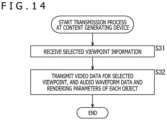
- the processes illustrated in FIG. 14 are started when the reproduction device 2 requests the start of content transmission, and selection viewpoint information is sent from the reproduction device 2.
- the transmission control unit 56 receives the selection viewpoint information sent from the reproduction device 2.
- the transmission control unit 56 reads out, from the content storage unit 55, video data for a viewpoint selected by a user of the reproduction device 2, and audio waveform data and rendering parameters of each object for the selected viewpoint, and transmit them. For objects that are combined, audio waveform data and rendering parameters generated for audio data of a combined object are transmitted.
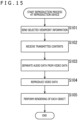
- the content acquiring unit 71 sends information representing a viewpoint selected by a user to the content generating device 1 as selection viewpoint information.
- a screen to be used for selecting from which viewpoint among a plurality of prepared viewpoints contents are to be viewed and listened to is displayed based on information sent from the content generating device 1.
- the content generating device 1 sends contents including video data and audio data for a viewpoint selected by a user.
- the content acquiring unit 71 receives and acquires the contents sent from the content generating device 1.
- the separating unit 72 separates the video data and audio data included in the contents.
- the video reproduction unit 74 decodes the video data supplied from the separating unit 72, and makes a video of contents as seen from a predetermined viewpoint displayed on a display.
- the audio reproduction unit 73 performs rendering of audio waveform data of each object included in the audio data supplied from the separating unit 72, and makes sounds output from a speaker.
- a series of processes mentioned above can reduce the number of objects to be transmitted, and can reduce the data transmission amount.
- the maximum number of objects may be decided according to the transmission bit rate, and objects may be merged such that the number of the objects does not exceed the maximum number.
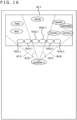
- FIG. 16 is a figure illustrating another exemplary arrangement of objects.
- FIG. 16 illustrates an example of a performance by a bass, drums, a guitar 1, a guitar 2, vocals 1 to 6, a piano, a trumpet, and a saxophone.
- a viewpoint 3 for viewing the stage #11 from the front is set.
- the piano, bass, vocal 1, and vocal 2 are merged into a first object based on determination according to angles like the one mentioned above.
- the piano, bass, vocal 1, and vocal 2 are objects within an angular range between a broken line A11 and a broken line A12 set for the left side of the stage #11 as seen from the viewpoint 3 as the reference position.
- drums, vocal 3, and vocal 4 are merged into a second object.
- the drums, vocal 3, and vocal 4 are objects within an angular range between the broken line A12 and a broken line A13 set for the middle of the stage #11.
- trumpet, saxophone, guitar 1, guitar 2, vocal 5, and vocal 6 are merged into a third object.
- the trumpet, saxophone, guitar 1, guitar 2, vocal 5, and vocal 6 are objects within an angular range between the broken line A13 and a broken line A14 set for the right side of the stage #11.
- audio waveform data and rendering parameters of each object are generated, and audio data of three objects is transmitted.
- the number of combined objects into which objects are merged in this manner can be set to three or larger.
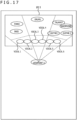
- FIG. 17 is a figure illustrating another exemplary manner of merging objects. For example, if the maximum number of objects according to a transmission bit rate is six, and the viewpoint 3 is selected, individual objects are merged as illustrated by sectioning using broken lines in FIG. 17 based on determination according to angles and distances like the ones mentioned above.
- the piano and bass are merged into a first object, and the vocal 1 and vocal 2 are merged into a second object.
- the drums are treated as an independent third object, and the vocal 3 and vocal are merged into a fourth object.
- the trumpet, saxophone, guitar 1, and guitar 2 are merged into a fifth object, and the vocal 5 and vocal 6 are merged into a sixth object.
- the manner of merging illustrated in FIG. 16 is a manner of merging selected in the case where the transmission bit rate is low as compared with that when the manner of merging illustrated in FIG. 17 is employed.
- the content storage unit 55 of the content generating device 1 stores audio data of the three objects as illustrated in FIG. 16 , and audio data of the six objects as illustrated in FIG. 17 .
- the transmission control unit 56 categorizes the communication environment of the reproduction device 2 before content transmission is started, and performs the transmission by selecting either the audio data of the three objects or the audio data of the six objects according to the transmission bit rate.
- Reverberation amount is an amount of components of spatial reflection at walls, a floor, and the like.
- the reverberation amount varies depending on distances between objects (musical instruments) and a viewer/listener. Typically, the shorter the distance is, the smaller reverberation amount is, and the longer the distance is, the larger the reverberation amount is.
- distances between objects may be used as an additional index to merge objects.
- An example in which objects are merged also taking distances between objects into consideration is illustrated in FIG. 18 .
- objects are grouped as illustrated by sectioning using broken lines, and objects belonging to each group are merged.
- Objects belonging to each group are as follows:
- the content storage unit 55 of the content generating device 1 stores audio data of the eight objects.
- a group may be set according not only to distances between objects, but also to the types of objects, the positions of objects, and the like.
- rendering information may be not only gains or reverb information, but also equalizer information, compressor information or reverb information. That is, rendering information r can be information representing at least any one of gains, equalizer information, compressor information, and reverb information.
- objects of two stringed instruments are merged into one stringed instrument object.
- the one stringed instrument object as a combined object is allocated a new object type (obj_type).
- audio waveform data of a violin 1 and audio waveform data of a violin 2 which are objects to be merged are x(n, 10) and x(n, 11), respectively
- the two pieces of audio waveform data are highly correlated.
- the difference component x(n, 15) of the audio waveform data of the violin 1 and the violin 2 indicated by Math (8) illustrated below has low information entropy, and requires only a low bit rate in case of being encoded.
- the content generating device 1 transmits the audio waveform data x(n, 14) to the reproduction device 2.
- the difference component x(n, 15) is also transmitted.
- the reproduction device 2 having received the difference component x(n, 15) along with the audio waveform data x(n, 14) can reproduce the audio waveform data x(n, 10) of the violin 1 and the audio waveform data x(n, 11) of the violin 2.
- the content storage unit 55 of the content generating device 1 stores the difference component x(n, 15) along with the audio waveform data x(n, 14) as stringed instrument object audio data to be transmitted if a predetermined viewpoint is selected.
- a flag indicating that difference component data is retained is managed at the content generating device 1.
- the flag is sent from the content generating device 1 to the reproduction device 2 along with other information, for example, and the reproduction device 2 identifies that difference component data is retained.
- the amount of data of the sum of the audio waveform data x(n, 14) and the difference component x(n, 15) is smaller than the amount of data of the sum of the audio waveform data x(n, 10) and x(n, 11).
- x(n, 10), x(n, 11), x(n, 12), and x(n, 13) are audio waveform data of the violin 1, audio waveform data of the violin 2, audio waveform data of the violin 3, and audio waveform data of the violin 4, respectively.
- the content generating device 1 transmits the audio waveform data x(n, 14) to the reproduction device 2.
- the difference components x(n, 15), x(n, 16), and x(n, 17) are also transmitted.
- the reproduction device 2 having received the difference components x(n, 15), x(n, 16), and x(n, 17) along with the audio waveform data x(n, 14) can reproduce the audio waveform data x(n, 10) of the violin 1, the audio waveform data x(n, 11) of the violin 2, the audio waveform data x(n, 12) of the violin 3, and the audio waveform data x(n, 13) of the violin 4.
- Maths (15) to (18) the reproduction device 2 having received the difference components x
- the difference components x(n, 15), x(n, 16), and x(n, 17) are transmitted from the content generating device 1 along with the audio waveform data x(n, 14) obtained by merging the four objects.
- the difference component x(n, 15) is transmitted from the content generating device 1 along with the audio waveform data x(n, 14) obtained by merging the four objects.
- the audio waveform data x(n, 14) obtained by merging the four objects is transmitted from the content generating device 1.
- hierarchical transmission (encoding) according to a transmission bit rate may be performed by the content generating device 1.
- Such hierarchical transmission may be performed according to a fee paid by a user of the reproduction device 2. For example, if the user paid a normal fee, transmission of only the audio waveform data x(n, 14) is performed, and if the user paid a fee higher than the normal fee, transmission of the audio waveform data x(n, 14) and a difference component is performed.
- video data of contents transmitted by the content generating device 1 is point cloud moving image data.
- point cloud moving image data and object audio data have data about coordinates in a three-dimensional space, and serve as color data and audio data at those coordinates.
- point cloud moving image data is disclosed, for example, at "Microsoft "A Voxelized Point Cloud Dataset,” ⁇ https://jpeg.org/plenodb/pc/microsoft/>.”
- the content generating device 1 retains a three-dimensional coordinate as information about the position of a vocal, for example, and in association with the coordinate, retains point cloud moving image data and audio object data. Thereby, the reproduction device 2 can easily acquire point cloud moving image data and audio object data of a desired object.
- An audio bitstream transmitted by the content generating device 1 may include flag information indicating whether or not an object being transmitted by the stream is an unmerged independent object or a combined object.
- An audio bitstream including flag information is illustrated in FIG. 19 .
- the audio bitstream illustrated in FIG. 19 also includes audio waveform data and rendering parameters of an object, for example.
- the flag information illustrated in FIG. 19 may be information indicating whether or not an object being transmitted by the stream is an independent object, or information indicating whether or not the object being transmitted is a combined object.
- the reproduction device 2 can identify whether data included in the stream is data of a combined object or data of an independent object.
- Such flag information may be described in a reproduction management file transmitted along with a bitstream as illustrated in FIG. 20 .
- the reproduction management file also describes information such as a stream ID of a stream which is a target of reproduction of the reproduction management file (a stream to be reproduced by using the reproduction management file).
- This reproduction management file may be configured as an MPD (Media Presentation Description) file in MPEG-DASH.
- the reproduction device 2 can identify whether an object being transmitted by the stream is a combined object or an independent object.
- contents to be reproduced by the reproduction device 2 includes video data and object-based audio data
- the contents may not include video data, but may consist of object-based audio data. If a predetermined listening position is selected from listening positions for which rendering parameters are prepared, rendering parameters for the selected listening position are used to reproduce each audio object.
- the present technology can have a configuration of cloud computing in which a plurality of devices shares one function via a network, and performs processes in cooperation with each other.
- one step includes a plurality of processes
- the plurality of processes included in the one step can be executed by one device, or may be executed by a plurality of devices in a shared manner.
- the series of processes mentioned above can be executed by hardware, and can also be executed by software. If the series of processes is executed by software, a program constituting the software is installed on a computer incorporated into dedicated hardware, a general-purpose personal computer, or the like.
- the program to be installed is provided as a program recorded in the removable media 31 illustrated in FIG. 9 constituted by an optical disc (CD-ROM) (Compact Disc-Read Only Memory), DVD (Digital Versatile Disc), etc.), a semiconductor memory, and the like. In addition, it may be provided via wireless or wired transmission medium such as a local area network, the Internet, or digital broadcasting.
- the program can be installed in advance in the ROM 22 or the storage unit 28.
- program to be executed by a computer may be a program to perform processes in a temporal sequence along the order explained in the present specification, or may be a program that performs processes in parallel, or at required timings when the processes are called or at different timings.
- 1 Content generating device
- 2 Reproduction device
Landscapes
- Engineering & Computer Science (AREA)
- Physics & Mathematics (AREA)
- Acoustics & Sound (AREA)
- Signal Processing (AREA)
- Multimedia (AREA)
- Mathematical Physics (AREA)
- Computational Linguistics (AREA)
- Health & Medical Sciences (AREA)
- Audiology, Speech & Language Pathology (AREA)
- Human Computer Interaction (AREA)
- Stereophonic System (AREA)
- Reverberation, Karaoke And Other Acoustics (AREA)
Claims (13)
- Informationsverarbeitungsvorrichtung (1), umfassend:eine Kombinationseinheit (61), die konfiguriert ist, um Audioobjekte mit Tönen zu kombinieren, die an einer vorgegebenen vermutlichen Hörposition aus einer Vielzahl von Audioobjekten für die vorgegebene vermutliche Hörposition aus einer Vielzahl von vermutlichen Hörpositionen nicht zu unterscheiden sind; undeine Übertragungseinheit (56), die konfiguriert ist, um Daten eines durch die Kombination erhaltenen kombinierten Audioobjekts zusammen mit Daten anderer Audioobjekte mit Tönen zu übertragen, die an der vorgegebenen vermutlichen Hörposition unterscheidbar sind; wobeidie Kombinationseinheit (61) konfiguriert ist zum:Bestimmen einer Vielzahl von Audioobjekten als nicht unterscheidbare, entfernte Audioobjekte, wenn sich die Vielzahl von Audioobjekten an Positionen befindet, die von der vorgegebenen vermutlichen Hörposition um Entfernungen entfernt sind, die gleich oder größer als eine vorgegebene Entfernung sind, und sich die Vielzahl von Audioobjekten innerhalb eines horizontalen Winkelbereichs voneinander befinden, gemessen von der vorgegebenen vermutlichen Hörposition aus, der kleiner ist als ein Winkel, der es dem menschlichen Gehör ermöglicht, Töne zu unterscheiden; undKombinieren der Vielzahl von Audioobjekten, wenn festgestellt wird, dass es sich um nicht unterscheidbare, entfernte Audioobjekte handelt.
- Informationsverarbeitungsvorrichtung (1) nach Anspruch 1, wobei
basierend auf Audio-Wellenformdaten und Rendering-Parametern einer Vielzahl von Audioobjekten, die Ziele der Kombination sein sollen, die Kombinationseinheit (61) konfiguriert ist, um Audio-Wellenformdaten und einen Rendering-Parameter des kombinierten Audioobjekts zu erzeugen. - Informationsverarbeitungsvorrichtung (1) nach Anspruch 2, wobei
die Übertragungseinheit (56) konfiguriert ist, um die Audio-Wellenformdaten und den Rendering-Parameter als Daten des kombinierten Audioobjekts zu übertragen, die von der Kombinationseinheit erzeugt werden, und konfiguriert ist, um jedes der anderen Audioobjekte und einen Rendering-Parameter für die vorgegebene vermutliche Hörposition als Daten der anderen Audioobjekte Audio-Wellenformdaten zu übertragen. - Informationsverarbeitungsvorrichtung (1) nach Anspruch 1, wobei
die Kombinationseinheit (61) konfiguriert ist, um Audioobjekte mit Tönen zu kombinieren, die an der vorgegebenen vermutlichen Hörposition nicht zu unterscheiden sind und zu derselben voreingestellten Gruppe gehören. - Informationsverarbeitungsvorrichtung (1) nach Anspruch 1, wobei
die Kombinationseinheit (61) konfiguriert ist, um eine Audioobjektkombination so durchzuführen, dass die Anzahl der zu übertragenden Audioobjekte der Zahl einer Übertragungsbitrate entspricht. - Informationsverarbeitungsvorrichtung (1) nach Anspruch 1, wobei
die Übertragungseinheit (56) konfiguriert ist, um einen Audio-Bitstrom zu übertragen, der Flag-Informationen einschließt, die angeben, ob ein im Audio-Bitstrom enthaltenes Audioobjekt ein unkombiniertes Audioobjekt oder das kombinierte Audioobjekt ist. - Informationsverarbeitungsvorrichtung (1) nach Anspruch 1, wobei
die Übertragungseinheit (56) konfiguriert ist, um eine Audio-Bitstromdatei zusammen mit einer Wiedergabeverwaltungsdatei zu übertragen, die Flag-Informationen einschließt, die angeben, ob ein im Audio-Bitstrom enthaltenes Audioobjekt ein unkombiniertes Audioobjekt oder das kombinierte Audioobjekt ist. - Übertragungssystem, umfassend:Informationsverarbeitungsvorrichtung (1) nach einem der vorstehenden Ansprüche; undeine Wiedergabevorrichtung (2),wobei die Übertragungseinheit (56) der Informationsverarbeitungsvorrichtung (1) konfiguriert ist, um die Daten des kombinierten Audioobjekts an die Wiedergabevorrichtung zu übertragen.
- Übertragungssystem nach Anspruch 8, wobei
die Informationsverarbeitungsvorrichtung (1) und die Wiedergabevorrichtung (2) konfiguriert sind, um über das Internet (3) verbunden zu werden. - Übertragungssystem nach Anspruch 8 oder Anspruch 9, wobei
die Wiedergabevorrichtung (2) eine Erfassungseinheit (71) zum Steuern einer Kommunikationseinheit umfasst, um an die Informationsverarbeitungsvorrichtung (1) Auswahlblickpunktinformationen zu übertragen, die einen von einem Benutzer ausgewählten Blickpunkt angeben. - Übertragungssystem nach Anspruch 10, wobei
die Informationsverarbeitungsvorrichtung (1) als Reaktion auf die Auswahlblickpunktinformationen Inhalte an die Wiedergabevorrichtung überträgt, die Videodaten und Audiodaten, die dem vom Benutzer ausgewählten Blickwinkel entsprechen, einschließen. - Informationsverarbeitungsverfahren, umfassend die Schritte:Kombinieren von Audioobjekten mit Tönen, die an einer vorgegebenen vermutlichen Hörposition aus einer Vielzahl von Audioobjekten für die vorgegebene vermutliche Hörposition aus einer Vielzahl von vermutlichen Hörpositionen nicht zu unterscheiden sind; undÜbertragen von Daten eines durch die Kombination erhaltenen kombinierten Audioobjekts zusammen mit Daten anderer Audioobjekte mit Tönen, die an der vorgegebenen vermutlichen Hörposition unterscheidbar sind; wobei das Verfahren ferner umfasstBestimmen einer Vielzahl von Audioobjekten als nicht unterscheidbare, entfernte Audioobjekte, wenn sich die Vielzahl von Audioobjekten an Positionen befindet, die von der vorgegebenen vermutlichen Hörposition um Entfernungen entfernt sind, die gleich oder größer als eine vorgegebene Entfernung sind, und sich die Vielzahl von Audioobjekten, gemessen von der vorgegebenen vermutlichen Hörposition aus, in einem horizontalen Winkelbereich voneinander befinden, der kleiner ist als ein Winkel, der es dem menschlichen Gehör ermöglicht, Töne zu unterscheiden; undKombinieren der Vielzahl von Audioobjekten, wenn bestimmt wird, dass es sich um nicht unterscheidbare, entfernte Audioobjekte handelt.
- Programm, das einen Computer veranlasst, die Verarbeitung auszuführen, einschließlich der Schritte:Kombinieren von Audioobjekten mit Tönen, die an einer vorgegebenen vermutlichen Hörposition aus einer Vielzahl von Audioobjekten für die vorgegebene vermutliche Hörposition aus einer Vielzahl von vermutlichen Hörpositionen nicht zu unterscheiden sind;Übertragen von Daten eines durch die Kombination erhaltenen kombinierten Audioobjekts zusammen mit Daten anderer Audioobjekte mit Tönen, die an der vorgegebenen vermutlichen Hörposition unterscheidbar sind;Bestimmen einer Vielzahl von Audioobjekten als nicht unterscheidbare, entfernte Audioobjekte, wenn sich die Vielzahl von Audioobjekten an Positionen befindet, die von der vorgegebenen vermutlichen Hörposition um Entfernungen entfernt sind, die gleich oder größer als eine vorgegebene Entfernung sind, und sich die Vielzahl von Audioobjekten, gemessen von der vorgegebenen vermutlichen Hörposition aus, in einem horizontalen Winkelbereich voneinander befinden, der kleiner ist als ein Winkel, der es dem menschlichen Gehör ermöglicht, Töne zu unterscheiden; undKombinieren der Vielzahl von Audioobjekten, wenn bestimmt wird, dass es sich um nicht unterscheidbare, entfernte Audioobjekte handelt.
Applications Claiming Priority (2)
| Application Number | Priority Date | Filing Date | Title |
|---|---|---|---|
| JP2017062305 | 2017-03-28 | ||
| PCT/JP2018/010165 WO2018180531A1 (ja) | 2017-03-28 | 2018-03-15 | 情報処理装置、情報処理方法、およびプログラム |
Publications (3)
| Publication Number | Publication Date |
|---|---|
| EP3605531A1 EP3605531A1 (de) | 2020-02-05 |
| EP3605531A4 EP3605531A4 (de) | 2020-04-15 |
| EP3605531B1 true EP3605531B1 (de) | 2024-08-21 |
Family
ID=63677107
Family Applications (1)
| Application Number | Title | Priority Date | Filing Date |
|---|---|---|---|
| EP18774689.6A Active EP3605531B1 (de) | 2017-03-28 | 2018-03-15 | Informationsverarbeitungsvorrichtung, informationsverarbeitungsverfahren und programm |
Country Status (5)
| Country | Link |
|---|---|
| US (1) | US11074921B2 (de) |
| EP (1) | EP3605531B1 (de) |
| JP (2) | JP7230799B2 (de) |
| CN (1) | CN110447071B (de) |
| WO (1) | WO2018180531A1 (de) |
Families Citing this family (9)
| Publication number | Priority date | Publication date | Assignee | Title |
|---|---|---|---|---|
| CN109410299B (zh) * | 2017-08-15 | 2022-03-11 | 腾讯科技(深圳)有限公司 | 一种信息处理方法、装置和计算机存储介质 |
| JP2020005038A (ja) * | 2018-06-25 | 2020-01-09 | キヤノン株式会社 | 送信装置、送信方法、受信装置、受信方法、及び、プログラム |
| KR102790646B1 (ko) | 2019-06-21 | 2025-04-04 | 소니그룹주식회사 | 신호 처리 장치 및 방법, 그리고 컴퓨터 판독가능한 기록 매체에 저장된 프로그램 |
| US12154582B2 (en) | 2019-07-08 | 2024-11-26 | Voiceage Corporation | Method and system for coding metadata in audio streams and for efficient bitrate allocation to audio streams coding |
| EP3809709A1 (de) | 2019-10-14 | 2021-04-21 | Koninklijke Philips N.V. | Audiokodierungsvorrichtung und -verfahren |
| CA3163166A1 (en) | 2020-01-09 | 2021-07-15 | Mitsuyuki Hatanaka | Information processing apparatus and information processing method, and program |
| JP7457525B2 (ja) * | 2020-02-21 | 2024-03-28 | 日本放送協会 | 受信装置、コンテンツ伝送システム、及びプログラム |
| TW202325370A (zh) * | 2021-11-12 | 2023-07-01 | 日商索尼集團公司 | 資訊處理裝置及方法、以及程式 |
| CN121970374A (zh) * | 2023-10-06 | 2026-05-01 | 松下电器(美国)知识产权公司 | 声音信号处理方法、计算机程序以及声音信号处理装置 |
Citations (1)
| Publication number | Priority date | Publication date | Assignee | Title |
|---|---|---|---|---|
| EP0930755A1 (de) * | 1997-12-15 | 1999-07-21 | Mitsubishi Denki Kabushiki Kaisha | Virtuelle realität netzwerksystem |
Family Cites Families (22)
| Publication number | Priority date | Publication date | Assignee | Title |
|---|---|---|---|---|
| FR2862799B1 (fr) | 2003-11-26 | 2006-02-24 | Inst Nat Rech Inf Automat | Dispositif et methode perfectionnes de spatialisation du son |
| US7818077B2 (en) * | 2004-05-06 | 2010-10-19 | Valve Corporation | Encoding spatial data in a multi-channel sound file for an object in a virtual environment |
| ATE499677T1 (de) * | 2006-09-18 | 2011-03-15 | Koninkl Philips Electronics Nv | Kodierung und dekodierung von audio-objekten |
| CN101479785B (zh) * | 2006-09-29 | 2013-08-07 | Lg电子株式会社 | 用于编码和解码基于对象的音频信号的方法和装置 |
| US20090210239A1 (en) | 2006-11-24 | 2009-08-20 | Lg Electronics Inc. | Method for Encoding and Decoding Object-Based Audio Signal and Apparatus Thereof |
| CN101542597B (zh) * | 2007-02-14 | 2013-02-27 | Lg电子株式会社 | 用于编码和解码基于对象的音频信号的方法和装置 |
| EP2278582B1 (de) * | 2007-06-08 | 2016-08-10 | LG Electronics Inc. | Verfahren und vorrichtung zum verarbeiten eines audiosignals |
| WO2010113434A1 (ja) * | 2009-03-31 | 2010-10-07 | パナソニック株式会社 | 音響再生装置及び音響再生方法 |
| US8892230B2 (en) * | 2009-11-18 | 2014-11-18 | Nec Corporation | Multicore system, control method of multicore system, and non-transitory readable medium storing program |
| EP2346028A1 (de) | 2009-12-17 | 2011-07-20 | Fraunhofer-Gesellschaft zur Förderung der Angewandten Forschung e.V. | Vorrichtung und Verfahren zur Umwandlung eines ersten parametrisch beabstandeten Audiosignals in ein zweites parametrisch beabstandetes Audiosignal |
| US9516446B2 (en) | 2012-07-20 | 2016-12-06 | Qualcomm Incorporated | Scalable downmix design for object-based surround codec with cluster analysis by synthesis |
| US9761229B2 (en) | 2012-07-20 | 2017-09-12 | Qualcomm Incorporated | Systems, methods, apparatus, and computer-readable media for audio object clustering |
| CN104541524B (zh) | 2012-07-31 | 2017-03-08 | 英迪股份有限公司 | 一种用于处理音频信号的方法和设备 |
| EP2830045A1 (de) | 2013-07-22 | 2015-01-28 | Fraunhofer-Gesellschaft zur Förderung der angewandten Forschung e.V. | Konzept zur Audiocodierung und Audiodecodierung für Audiokanäle und Audioobjekte |
| EP2830048A1 (de) | 2013-07-22 | 2015-01-28 | Fraunhofer-Gesellschaft zur Förderung der angewandten Forschung e.V. | Vorrichtung und Verfahren zur Realisierung eines SAOC-Downmix von 3D-Audioinhalt |
| WO2015017235A1 (en) | 2013-07-31 | 2015-02-05 | Dolby Laboratories Licensing Corporation | Processing spatially diffuse or large audio objects |
| US10063207B2 (en) * | 2014-02-27 | 2018-08-28 | Dts, Inc. | Object-based audio loudness management |
| WO2015150480A1 (en) * | 2014-04-02 | 2015-10-08 | Dolby International Ab | Exploiting metadata redundancy in immersive audio metadata |
| CN114242081B (zh) * | 2014-05-30 | 2025-11-07 | 索尼公司 | 信息处理装置和信息处理方法 |
| KR101646867B1 (ko) | 2015-02-23 | 2016-08-09 | 서울과학기술대학교 산학협력단 | 마이크로폰 위치정보를 이용하는 ftv 입체음향 구현 장치 및 그 방법 |
| CN106409301A (zh) * | 2015-07-27 | 2017-02-15 | 北京音图数码科技有限公司 | 数字音频信号处理的方法 |
| WO2018047667A1 (ja) | 2016-09-12 | 2018-03-15 | ソニー株式会社 | 音声処理装置および方法 |
-
2018
- 2018-03-15 WO PCT/JP2018/010165 patent/WO2018180531A1/ja not_active Ceased
- 2018-03-15 US US16/488,136 patent/US11074921B2/en active Active
- 2018-03-15 JP JP2019509243A patent/JP7230799B2/ja active Active
- 2018-03-15 CN CN201880019499.7A patent/CN110447071B/zh active Active
- 2018-03-15 EP EP18774689.6A patent/EP3605531B1/de active Active
-
2023
- 2023-01-20 JP JP2023007068A patent/JP7597133B2/ja active Active
Patent Citations (1)
| Publication number | Priority date | Publication date | Assignee | Title |
|---|---|---|---|---|
| EP0930755A1 (de) * | 1997-12-15 | 1999-07-21 | Mitsubishi Denki Kabushiki Kaisha | Virtuelle realität netzwerksystem |
Also Published As
| Publication number | Publication date |
|---|---|
| CN110447071B (zh) | 2024-04-26 |
| JP7230799B2 (ja) | 2023-03-01 |
| EP3605531A4 (de) | 2020-04-15 |
| JP2023040294A (ja) | 2023-03-22 |
| WO2018180531A1 (ja) | 2018-10-04 |
| JP7597133B2 (ja) | 2024-12-10 |
| US20200043505A1 (en) | 2020-02-06 |
| EP3605531A1 (de) | 2020-02-05 |
| JPWO2018180531A1 (ja) | 2020-02-06 |
| CN110447071A (zh) | 2019-11-12 |
| US11074921B2 (en) | 2021-07-27 |
Similar Documents
| Publication | Publication Date | Title |
|---|---|---|
| US11074921B2 (en) | Information processing device and information processing method | |
| JP7251592B2 (ja) | 情報処理装置、情報処理方法、およびプログラム | |
| US10924875B2 (en) | Augmented reality platform for navigable, immersive audio experience | |
| CN114339297B (zh) | 音频处理方法、装置、电子设备和计算机可读存储介质 | |
| JP6239145B2 (ja) | 幾何学的な距離定義を使用してオーディオレンダリングする装置および方法 | |
| EP3145220A1 (de) | Darstellung virtueller audioquellen mittels virtueller verformung der lautsprecheranordnung | |
| EP3713255B1 (de) | Signalverarbeitungsvorrichtung und -verfahren und programm | |
| US20220386062A1 (en) | Stereophonic audio rearrangement based on decomposed tracks | |
| KR20230038426A (ko) | 신호 처리 장치 및 방법, 그리고 프로그램 | |
| CN110191745B (zh) | 利用空间音频的游戏流式传输 | |
| CA3044260A1 (en) | Augmented reality platform for navigable, immersive audio experience | |
| US20260038520A1 (en) | Encoding device and method, decoding device and method, and program | |
| JP7729352B2 (ja) | 情報処理装置および方法、並びにプログラム | |
| WO2024241707A1 (ja) | 情報処理装置および方法、並びにプログラム | |
| CN120544593A (zh) | 音频信号的处理方法和电子设备 | |
| WO2025075149A1 (ja) | 音声信号処理方法、コンピュータプログラム、及び、音声信号処理装置 |
Legal Events
| Date | Code | Title | Description |
|---|---|---|---|
| STAA | Information on the status of an ep patent application or granted ep patent |
Free format text: STATUS: THE INTERNATIONAL PUBLICATION HAS BEEN MADE |
|
| PUAI | Public reference made under article 153(3) epc to a published international application that has entered the european phase |
Free format text: ORIGINAL CODE: 0009012 |
|
| STAA | Information on the status of an ep patent application or granted ep patent |
Free format text: STATUS: REQUEST FOR EXAMINATION WAS MADE |
|
| 17P | Request for examination filed |
Effective date: 20190902 |
|
| AK | Designated contracting states |
Kind code of ref document: A1 Designated state(s): AL AT BE BG CH CY CZ DE DK EE ES FI FR GB GR HR HU IE IS IT LI LT LU LV MC MK MT NL NO PL PT RO RS SE SI SK SM TR |
|
| AX | Request for extension of the european patent |
Extension state: BA ME |
|
| A4 | Supplementary search report drawn up and despatched |
Effective date: 20200316 |
|
| RIC1 | Information provided on ipc code assigned before grant |
Ipc: H04S 7/00 20060101ALI20200310BHEP Ipc: G10L 19/008 20130101AFI20200310BHEP |
|
| DAV | Request for validation of the european patent (deleted) | ||
| DAX | Request for extension of the european patent (deleted) | ||
| RAP3 | Party data changed (applicant data changed or rights of an application transferred) |
Owner name: SONY GROUP CORPORATION |
|
| STAA | Information on the status of an ep patent application or granted ep patent |
Free format text: STATUS: EXAMINATION IS IN PROGRESS |
|
| 17Q | First examination report despatched |
Effective date: 20220208 |
|
| GRAP | Despatch of communication of intention to grant a patent |
Free format text: ORIGINAL CODE: EPIDOSNIGR1 |
|
| STAA | Information on the status of an ep patent application or granted ep patent |
Free format text: STATUS: GRANT OF PATENT IS INTENDED |
|
| INTG | Intention to grant announced |
Effective date: 20231212 |
|
| GRAJ | Information related to disapproval of communication of intention to grant by the applicant or resumption of examination proceedings by the epo deleted |
Free format text: ORIGINAL CODE: EPIDOSDIGR1 |
|
| STAA | Information on the status of an ep patent application or granted ep patent |
Free format text: STATUS: EXAMINATION IS IN PROGRESS |
|
| GRAP | Despatch of communication of intention to grant a patent |
Free format text: ORIGINAL CODE: EPIDOSNIGR1 |
|
| STAA | Information on the status of an ep patent application or granted ep patent |
Free format text: STATUS: GRANT OF PATENT IS INTENDED |
|
| INTC | Intention to grant announced (deleted) | ||
| INTG | Intention to grant announced |
Effective date: 20240327 |
|
| GRAS | Grant fee paid |
Free format text: ORIGINAL CODE: EPIDOSNIGR3 |
|
| GRAA | (expected) grant |
Free format text: ORIGINAL CODE: 0009210 |
|
| STAA | Information on the status of an ep patent application or granted ep patent |
Free format text: STATUS: THE PATENT HAS BEEN GRANTED |
|
| AK | Designated contracting states |
Kind code of ref document: B1 Designated state(s): AL AT BE BG CH CY CZ DE DK EE ES FI FR GB GR HR HU IE IS IT LI LT LU LV MC MK MT NL NO PL PT RO RS SE SI SK SM TR |
|
| P01 | Opt-out of the competence of the unified patent court (upc) registered |
Free format text: CASE NUMBER: APP_40993/2024 Effective date: 20240710 |
|
| REG | Reference to a national code |
Ref country code: GB Ref legal event code: FG4D |
|
| REG | Reference to a national code |
Ref country code: CH Ref legal event code: EP |
|
| REG | Reference to a national code |
Ref country code: IE Ref legal event code: FG4D |
|
| REG | Reference to a national code |
Ref country code: DE Ref legal event code: R096 Ref document number: 602018073367 Country of ref document: DE |
|
| REG | Reference to a national code |
Ref country code: LT Ref legal event code: MG9D |
|
| REG | Reference to a national code |
Ref country code: NL Ref legal event code: MP Effective date: 20240821 |
|
| PG25 | Lapsed in a contracting state [announced via postgrant information from national office to epo] |
Ref country code: NO Free format text: LAPSE BECAUSE OF FAILURE TO SUBMIT A TRANSLATION OF THE DESCRIPTION OR TO PAY THE FEE WITHIN THE PRESCRIBED TIME-LIMIT Effective date: 20241121 |
|
| REG | Reference to a national code |
Ref country code: AT Ref legal event code: MK05 Ref document number: 1716318 Country of ref document: AT Kind code of ref document: T Effective date: 20240821 |
|
| PG25 | Lapsed in a contracting state [announced via postgrant information from national office to epo] |
Ref country code: NL Free format text: LAPSE BECAUSE OF FAILURE TO SUBMIT A TRANSLATION OF THE DESCRIPTION OR TO PAY THE FEE WITHIN THE PRESCRIBED TIME-LIMIT Effective date: 20240821 Ref country code: PL Free format text: LAPSE BECAUSE OF FAILURE TO SUBMIT A TRANSLATION OF THE DESCRIPTION OR TO PAY THE FEE WITHIN THE PRESCRIBED TIME-LIMIT Effective date: 20240821 Ref country code: GR Free format text: LAPSE BECAUSE OF FAILURE TO SUBMIT A TRANSLATION OF THE DESCRIPTION OR TO PAY THE FEE WITHIN THE PRESCRIBED TIME-LIMIT Effective date: 20241122 Ref country code: FI Free format text: LAPSE BECAUSE OF FAILURE TO SUBMIT A TRANSLATION OF THE DESCRIPTION OR TO PAY THE FEE WITHIN THE PRESCRIBED TIME-LIMIT Effective date: 20240821 Ref country code: PT Free format text: LAPSE BECAUSE OF FAILURE TO SUBMIT A TRANSLATION OF THE DESCRIPTION OR TO PAY THE FEE WITHIN THE PRESCRIBED TIME-LIMIT Effective date: 20241223 |
|
| PG25 | Lapsed in a contracting state [announced via postgrant information from national office to epo] |
Ref country code: BG Free format text: LAPSE BECAUSE OF FAILURE TO SUBMIT A TRANSLATION OF THE DESCRIPTION OR TO PAY THE FEE WITHIN THE PRESCRIBED TIME-LIMIT Effective date: 20240821 |
|
| PG25 | Lapsed in a contracting state [announced via postgrant information from national office to epo] |
Ref country code: LV Free format text: LAPSE BECAUSE OF FAILURE TO SUBMIT A TRANSLATION OF THE DESCRIPTION OR TO PAY THE FEE WITHIN THE PRESCRIBED TIME-LIMIT Effective date: 20240821 |
|
| PG25 | Lapsed in a contracting state [announced via postgrant information from national office to epo] |
Ref country code: AT Free format text: LAPSE BECAUSE OF FAILURE TO SUBMIT A TRANSLATION OF THE DESCRIPTION OR TO PAY THE FEE WITHIN THE PRESCRIBED TIME-LIMIT Effective date: 20240821 Ref country code: IS Free format text: LAPSE BECAUSE OF FAILURE TO SUBMIT A TRANSLATION OF THE DESCRIPTION OR TO PAY THE FEE WITHIN THE PRESCRIBED TIME-LIMIT Effective date: 20241221 |
|
| PG25 | Lapsed in a contracting state [announced via postgrant information from national office to epo] |
Ref country code: HR Free format text: LAPSE BECAUSE OF FAILURE TO SUBMIT A TRANSLATION OF THE DESCRIPTION OR TO PAY THE FEE WITHIN THE PRESCRIBED TIME-LIMIT Effective date: 20240821 |
|
| PG25 | Lapsed in a contracting state [announced via postgrant information from national office to epo] |
Ref country code: RS Free format text: LAPSE BECAUSE OF FAILURE TO SUBMIT A TRANSLATION OF THE DESCRIPTION OR TO PAY THE FEE WITHIN THE PRESCRIBED TIME-LIMIT Effective date: 20241121 Ref country code: ES Free format text: LAPSE BECAUSE OF FAILURE TO SUBMIT A TRANSLATION OF THE DESCRIPTION OR TO PAY THE FEE WITHIN THE PRESCRIBED TIME-LIMIT Effective date: 20240821 |
|
| PG25 | Lapsed in a contracting state [announced via postgrant information from national office to epo] |
Ref country code: RS Free format text: LAPSE BECAUSE OF FAILURE TO SUBMIT A TRANSLATION OF THE DESCRIPTION OR TO PAY THE FEE WITHIN THE PRESCRIBED TIME-LIMIT Effective date: 20241121 Ref country code: PT Free format text: LAPSE BECAUSE OF FAILURE TO SUBMIT A TRANSLATION OF THE DESCRIPTION OR TO PAY THE FEE WITHIN THE PRESCRIBED TIME-LIMIT Effective date: 20241223 Ref country code: PL Free format text: LAPSE BECAUSE OF FAILURE TO SUBMIT A TRANSLATION OF THE DESCRIPTION OR TO PAY THE FEE WITHIN THE PRESCRIBED TIME-LIMIT Effective date: 20240821 Ref country code: NO Free format text: LAPSE BECAUSE OF FAILURE TO SUBMIT A TRANSLATION OF THE DESCRIPTION OR TO PAY THE FEE WITHIN THE PRESCRIBED TIME-LIMIT Effective date: 20241121 Ref country code: NL Free format text: LAPSE BECAUSE OF FAILURE TO SUBMIT A TRANSLATION OF THE DESCRIPTION OR TO PAY THE FEE WITHIN THE PRESCRIBED TIME-LIMIT Effective date: 20240821 Ref country code: LV Free format text: LAPSE BECAUSE OF FAILURE TO SUBMIT A TRANSLATION OF THE DESCRIPTION OR TO PAY THE FEE WITHIN THE PRESCRIBED TIME-LIMIT Effective date: 20240821 Ref country code: IS Free format text: LAPSE BECAUSE OF FAILURE TO SUBMIT A TRANSLATION OF THE DESCRIPTION OR TO PAY THE FEE WITHIN THE PRESCRIBED TIME-LIMIT Effective date: 20241221 Ref country code: HR Free format text: LAPSE BECAUSE OF FAILURE TO SUBMIT A TRANSLATION OF THE DESCRIPTION OR TO PAY THE FEE WITHIN THE PRESCRIBED TIME-LIMIT Effective date: 20240821 Ref country code: GR Free format text: LAPSE BECAUSE OF FAILURE TO SUBMIT A TRANSLATION OF THE DESCRIPTION OR TO PAY THE FEE WITHIN THE PRESCRIBED TIME-LIMIT Effective date: 20241122 Ref country code: FI Free format text: LAPSE BECAUSE OF FAILURE TO SUBMIT A TRANSLATION OF THE DESCRIPTION OR TO PAY THE FEE WITHIN THE PRESCRIBED TIME-LIMIT Effective date: 20240821 Ref country code: ES Free format text: LAPSE BECAUSE OF FAILURE TO SUBMIT A TRANSLATION OF THE DESCRIPTION OR TO PAY THE FEE WITHIN THE PRESCRIBED TIME-LIMIT Effective date: 20240821 Ref country code: BG Free format text: LAPSE BECAUSE OF FAILURE TO SUBMIT A TRANSLATION OF THE DESCRIPTION OR TO PAY THE FEE WITHIN THE PRESCRIBED TIME-LIMIT Effective date: 20240821 Ref country code: AT Free format text: LAPSE BECAUSE OF FAILURE TO SUBMIT A TRANSLATION OF THE DESCRIPTION OR TO PAY THE FEE WITHIN THE PRESCRIBED TIME-LIMIT Effective date: 20240821 |
|
| PG25 | Lapsed in a contracting state [announced via postgrant information from national office to epo] |
Ref country code: DK Free format text: LAPSE BECAUSE OF FAILURE TO SUBMIT A TRANSLATION OF THE DESCRIPTION OR TO PAY THE FEE WITHIN THE PRESCRIBED TIME-LIMIT Effective date: 20240821 Ref country code: SM Free format text: LAPSE BECAUSE OF FAILURE TO SUBMIT A TRANSLATION OF THE DESCRIPTION OR TO PAY THE FEE WITHIN THE PRESCRIBED TIME-LIMIT Effective date: 20240821 Ref country code: RO Free format text: LAPSE BECAUSE OF FAILURE TO SUBMIT A TRANSLATION OF THE DESCRIPTION OR TO PAY THE FEE WITHIN THE PRESCRIBED TIME-LIMIT Effective date: 20240821 |
|
| PG25 | Lapsed in a contracting state [announced via postgrant information from national office to epo] |
Ref country code: EE Free format text: LAPSE BECAUSE OF FAILURE TO SUBMIT A TRANSLATION OF THE DESCRIPTION OR TO PAY THE FEE WITHIN THE PRESCRIBED TIME-LIMIT Effective date: 20240821 |
|
| PG25 | Lapsed in a contracting state [announced via postgrant information from national office to epo] |
Ref country code: CZ Free format text: LAPSE BECAUSE OF FAILURE TO SUBMIT A TRANSLATION OF THE DESCRIPTION OR TO PAY THE FEE WITHIN THE PRESCRIBED TIME-LIMIT Effective date: 20240821 |
|
| PG25 | Lapsed in a contracting state [announced via postgrant information from national office to epo] |
Ref country code: IT Free format text: LAPSE BECAUSE OF FAILURE TO SUBMIT A TRANSLATION OF THE DESCRIPTION OR TO PAY THE FEE WITHIN THE PRESCRIBED TIME-LIMIT Effective date: 20240821 Ref country code: SK Free format text: LAPSE BECAUSE OF FAILURE TO SUBMIT A TRANSLATION OF THE DESCRIPTION OR TO PAY THE FEE WITHIN THE PRESCRIBED TIME-LIMIT Effective date: 20240821 |
|
| REG | Reference to a national code |
Ref country code: DE Ref legal event code: R097 Ref document number: 602018073367 Country of ref document: DE |
|
| PLBE | No opposition filed within time limit |
Free format text: ORIGINAL CODE: 0009261 |
|
| STAA | Information on the status of an ep patent application or granted ep patent |
Free format text: STATUS: NO OPPOSITION FILED WITHIN TIME LIMIT |
|
| 26N | No opposition filed |
Effective date: 20250522 |
|
| PG25 | Lapsed in a contracting state [announced via postgrant information from national office to epo] |
Ref country code: SE Free format text: LAPSE BECAUSE OF FAILURE TO SUBMIT A TRANSLATION OF THE DESCRIPTION OR TO PAY THE FEE WITHIN THE PRESCRIBED TIME-LIMIT Effective date: 20240821 |
|
| PG25 | Lapsed in a contracting state [announced via postgrant information from national office to epo] |
Ref country code: MC Free format text: LAPSE BECAUSE OF FAILURE TO SUBMIT A TRANSLATION OF THE DESCRIPTION OR TO PAY THE FEE WITHIN THE PRESCRIBED TIME-LIMIT Effective date: 20240821 |
|
| REG | Reference to a national code |
Ref country code: CH Ref legal event code: H13 Free format text: ST27 STATUS EVENT CODE: U-0-0-H10-H13 (AS PROVIDED BY THE NATIONAL OFFICE) Effective date: 20251023 |
|
| PG25 | Lapsed in a contracting state [announced via postgrant information from national office to epo] |
Ref country code: LU Free format text: LAPSE BECAUSE OF NON-PAYMENT OF DUE FEES Effective date: 20250315 |
|
| REG | Reference to a national code |
Ref country code: BE Ref legal event code: MM Effective date: 20250331 |
|
| PG25 | Lapsed in a contracting state [announced via postgrant information from national office to epo] |
Ref country code: FR Free format text: LAPSE BECAUSE OF NON-PAYMENT OF DUE FEES Effective date: 20250331 |
|
| PG25 | Lapsed in a contracting state [announced via postgrant information from national office to epo] |
Ref country code: BE Free format text: LAPSE BECAUSE OF NON-PAYMENT OF DUE FEES Effective date: 20250331 |
|
| PG25 | Lapsed in a contracting state [announced via postgrant information from national office to epo] |
Ref country code: CH Free format text: LAPSE BECAUSE OF NON-PAYMENT OF DUE FEES Effective date: 20250331 |
|
| PG25 | Lapsed in a contracting state [announced via postgrant information from national office to epo] |
Ref country code: IE Free format text: LAPSE BECAUSE OF NON-PAYMENT OF DUE FEES Effective date: 20250315 |
|
| PGFP | Annual fee paid to national office [announced via postgrant information from national office to epo] |
Ref country code: GB Payment date: 20260219 Year of fee payment: 9 |
|
| PGFP | Annual fee paid to national office [announced via postgrant information from national office to epo] |
Ref country code: DE Payment date: 20260219 Year of fee payment: 9 |