EP3606232B1 - Procédé et dispositif pour fournir une instruction de ressource physique utilisée pour un accès aléatoire, et support de stockage - Google Patents
Procédé et dispositif pour fournir une instruction de ressource physique utilisée pour un accès aléatoire, et support de stockage Download PDFInfo
- Publication number
- EP3606232B1 EP3606232B1 EP18776632.4A EP18776632A EP3606232B1 EP 3606232 B1 EP3606232 B1 EP 3606232B1 EP 18776632 A EP18776632 A EP 18776632A EP 3606232 B1 EP3606232 B1 EP 3606232B1
- Authority
- EP
- European Patent Office
- Prior art keywords
- random access
- slot
- access slot
- downlink
- block
- Prior art date
- Legal status (The legal status is an assumption and is not a legal conclusion. Google has not performed a legal analysis and makes no representation as to the accuracy of the status listed.)
- Active
Links
Images

Classifications
-
- H—ELECTRICITY
- H04—ELECTRIC COMMUNICATION TECHNIQUE
- H04W—WIRELESS COMMUNICATION NETWORKS
- H04W72/00—Local resource management
- H04W72/20—Control channels or signalling for resource management
- H04W72/23—Control channels or signalling for resource management in the downlink direction of a wireless link, i.e. towards a terminal
-
- H—ELECTRICITY
- H04—ELECTRIC COMMUNICATION TECHNIQUE
- H04W—WIRELESS COMMUNICATION NETWORKS
- H04W74/00—Wireless channel access
- H04W74/002—Transmission of channel access control information
- H04W74/006—Transmission of channel access control information in the downlink, i.e. towards the terminal
-
- H—ELECTRICITY
- H04—ELECTRIC COMMUNICATION TECHNIQUE
- H04W—WIRELESS COMMUNICATION NETWORKS
- H04W56/00—Synchronisation arrangements
- H04W56/001—Synchronization between nodes
-
- H—ELECTRICITY
- H04—ELECTRIC COMMUNICATION TECHNIQUE
- H04L—TRANSMISSION OF DIGITAL INFORMATION, e.g. TELEGRAPHIC COMMUNICATION
- H04L41/00—Arrangements for maintenance, administration or management of data switching networks, e.g. of packet switching networks
- H04L41/08—Configuration management of networks or network elements
- H04L41/0803—Configuration setting
- H04L41/0806—Configuration setting for initial configuration or provisioning, e.g. plug-and-play
-
- H—ELECTRICITY
- H04—ELECTRIC COMMUNICATION TECHNIQUE
- H04W—WIRELESS COMMUNICATION NETWORKS
- H04W72/00—Local resource management
- H04W72/04—Wireless resource allocation
- H04W72/044—Wireless resource allocation based on the type of the allocated resource
- H04W72/0446—Resources in time domain, e.g. slots or frames
-
- H—ELECTRICITY
- H04—ELECTRIC COMMUNICATION TECHNIQUE
- H04W—WIRELESS COMMUNICATION NETWORKS
- H04W72/00—Local resource management
- H04W72/30—Resource management for broadcast services
-
- H—ELECTRICITY
- H04—ELECTRIC COMMUNICATION TECHNIQUE
- H04W—WIRELESS COMMUNICATION NETWORKS
- H04W74/00—Wireless channel access
- H04W74/08—Non-scheduled access, e.g. ALOHA
- H04W74/0833—Random access procedures, e.g. with 4-step access
-
- H—ELECTRICITY
- H04—ELECTRIC COMMUNICATION TECHNIQUE
- H04W—WIRELESS COMMUNICATION NETWORKS
- H04W74/00—Wireless channel access
- H04W74/08—Non-scheduled access, e.g. ALOHA
- H04W74/0866—Non-scheduled access, e.g. ALOHA using a dedicated channel for access
- H04W74/0891—Non-scheduled access, e.g. ALOHA using a dedicated channel for access for synchronized access
-
- H—ELECTRICITY
- H04—ELECTRIC COMMUNICATION TECHNIQUE
- H04W—WIRELESS COMMUNICATION NETWORKS
- H04W74/00—Wireless channel access
- H04W74/002—Transmission of channel access control information
Definitions
- the present invention relates to the field of wireless communications, and specifically relates to a method and a device for indicating a random access physical resource, and a storage medium thereof.
- system networking will be performed on carrier frequencies higher than those used in 2G, 3G, and 4G systems.
- the frequency bands widely recognized by the industry and identified by international organizations are mainly 3 GHz to 6 GHz, and 6 GHz to 100 GHz.
- these frequency bands are relatively high, have greater loss in propagation, and have a relatively smaller coverage radius under the same power.
- This also determines that the beamforming technology needs to be adopted for increasing the coverage radius in the networking of the new generation mobile communications system.
- the initial access has higher requirements for coverage, and requires a coverage range greater than that required by the service.
- the beamforming technology is even more essential.
- one beam cannot completely cover an entire cell, and a plurality of beams are needed to cover the entire cell or a sector in the traditional sense. If the plurality of beams cannot be transmitted at the same time, a process of beam scanning in the time dimension is required to cover the entire cell or sector. For downlink common signals or channels such as synchronization signals, broadcast channels, common control channels, common traffic channels, etc., a seamless coverage of the entire cell needs to be ensured, and the beam is required to meet the coverage requirement. When the plurality of beams cannot be transmitted at the same time, a complete process of beam scanning must be gone through so that the corresponding common signals or common information can be read by terminals at all possible positions in the cell.
- the terminal may initiate random access according to the random access physical resource notified in the random access configuration message.
- the base station needs to transmit a message to the terminal, which beam is a preferred beam that can successfully transmit information to the terminal is at least required to be known since a single beam cannot cover the entire cell.
- a technical solution is not provided in the related art. If the base station randomly selects one beam or transmits a message to a specific terminal in all beams, this causes a wrong selection of a beam by the base station so that the terminal fails to receive the message, or a waste of beam resources because of a use of all beams to transmit the message to a specific terminal.
- WO 2016/086144 A1 relates to initial access in high frequency wireless systems, and discloses a method according to the preamble of the independent claims.
- EP 3 032 910 A1 discloses a method and system for configuring random access channel resources.
- the base station configures the internal structure of the random access slot through the broadcast channel. If the internal structure of such a random access slot is known by the terminal (e.g., user equipment (UE)) in advance, the UE may transmit a random access request in a corresponding random access slot once a beam is detected by the UE itself, such that after the random access request is received by the base station, the base station knows which beam is detected by the terminal, and then successfully transmits information to the terminal by using the beam. For example, the association relationship between the downlink synchronization signal block or the reference signal and the first random access slot is notified through a system message according to the internal structure of the random access slot.
- the terminal e.g., user equipment (UE)
- the base station may determine which beam may be detected by the terminal or that the beam with the highest received signal strength is detected by the terminal according to the random access physical resource where the random access request transmitted currently by the terminal is located. If the beam determined by this method is used to transmit information to the terminal, the information has a higher probability of being successfully received by the terminal.
- random access physical resources are common resources for all beams, and no subset of random access physical resources is specifically configured for a certain beam.
- the advantage is that the random access physical resources are a large resource pool for all beams, the resource selection range is larger, and the collision probability of random access can be reduced when the access density is not high, while the disadvantage is also obvious.
- No resource subset for a specific beam direction exists, and it is difficult for the base station to determine the downlink beam preferred by the terminal through the resource selected by the terminal. Therefore, in the embodiments, the base station will notify to configure an internal structure of the random access resource, and after the internal structure is known by the terminal, the terminal selects a random access resource and transmits a random access request according to the internal structure and the beam detected by the terminal itself.
- the terminal will obtain the association relationship between a downlink synchronization signal block or a reference signal and the first random access slot, and the downlink synchronization signal block or the reference signal has a corresponding relationship with a specific beam.
- the beam that may be successfully detected by the terminal may be easily determined by the terminal, so that which beam is used to transmit the information to the terminal is determined. Thereby, the success rate of transmitting information to the terminal is improved.
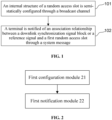
- a method for indicating a random access physical resource is provided and may include the steps described below.
- an internal structure of a random access slot is semi-statically configured through a broadcast channel.
- a terminal is notified of an association relationship between a downlink synchronization signal block or a reference signal (the reference signal is not according to the invention) and a first random access slot through a system message.
- the step 101 may include: determining the internal structure of the random access slot, and semi-statically broadcasting the internal structure of the random access slot through the broadcast channel.
- the internal structure of the random access slot configured by a base station may be received by the terminal on the broadcast channel.
- the base station semi-statically broadcasts the internal structure of the random access slot, that is, in a semi-static period corresponding to every other semi-static period, the base station broadcasts the internal structure of the random access slot once through the broadcast channel.
- the step 102 may include: determining an association relationship between the downlink synchronization signal block and the first random access slot, and/or determining an association relationship between the reference signal and the first random access slot according to the internal structure of the random access slot, and notifying the terminal of the determined association relationship through the system message.
- a plurality of random access slots may be involved in the association relationship between the downlink synchronization signal block or the reference signal and the random access slot, and N random access slots may be provided (as described below).
- the first random access slot in the embodiment represents the first slot of the plurality of random access slots, and the random access slots may be fully expressed by the starting point plus the number.
- the number N may be separately notified, and the first random access slot may also be separately notified.
- the internal structure of the random access slot comprises
- the internal structure of the random access slot is a slot in which the downlink part is dominant or a slot in which the uplink part is dominant.
- the internal structure of the random access slot is configured according to a random access preamble format.
- the internal structure of the random access slot is configured according to a random access preamble format that needs to be supported.
- the association relationship between the downlink synchronization signal block or the reference signal and the first random access slot may be that: the k-th random access slot after the downlink synchronization signal block or the reference signal is the first random access slot, where k is a positive integer.
- the association relationship between the downlink synchronization signal block or the reference signal and the first random access slot may be: the association relationship between the downlink synchronization signal block or the reference signal and the first random access slot is related to an index of the downlink synchronization signal block or the reference signal in the time domain.
- the random access slot may select the same index of the downlink synchronization signal block or the reference signal, or the random access slot may be obtained by performing function calculation on the index of the downlink synchronization signal block or the reference signal.
- the index may be an index number.
- the method further includes: determining an association relationship between the synchronization signal block or the reference signal and N random access slots, and notifying the terminal in an explicit or implicit manner, where N is an integer greater than or equal to 1 or a fraction greater than 0 and less than 1.
- N is an integer greater than or equal to 1 or a fraction greater than 0 and less than 1.
- the method may include: a corresponding relationship between a certain message or signal and an association relationship is established in advance, and then the message or signal is transmitted.
- the association relationship is not explicitly indicated, but the terminal may determine the indicated association relationship according to the above-mentioned corresponding relationship.
- the number N may be determined by at least one of the following configurations or any combination thereof:
- the step in which the internal structure of the random access slot is semi-statically configured through the broadcast channel includes one of the steps described below.
- Each of the synchronization signal blocks or reference signals in the synchronization signal burst set has an association relationship respectively configured.
- each of the random access slots provides one or more frequency domain resources as random access time-frequency resources.
- a device for indicating a random access physical resource includes a first configuration module 21 and a first notification module 22.
- the first configuration module 21 is configured to semi-statically configure an internal structure of a random access slot through a broadcast channel.
- the first notification module 22 is configured to notify a terminal of an association relationship between a downlink synchronization signal block or a reference signal and a first random access slot through a system message.
- the first notification module 22 may be configured to notify the terminal of an association relationship between the downlink synchronization signal block or the reference signal and the first random access slot through the system message according to an internal structure of a random access slot.
- the internal structure of the random access slot at least includes one of:
- the internal structure of the random access slot is a slot in which the downlink part is dominant or a slot in which the uplink part is dominant.
- the first configuration module 21 may be configured to set the internal structure of the random access slot according to a random access preamble format that needs to be supported.
- the first configuration module 21 may further be configured to determine the association relationship between the downlink synchronization signal block or the reference signal and the first random access slot in the time domain as that: the k-th random access slot after the downlink synchronization signal block or the reference signal is the first random access slot, where k is a positive integer.
- the first configuration module 21 may further be configured to determine an association between the downlink synchronization signal block or the reference signal and N random access slots; and the first notification module 22 may be further configured to notify the terminal of the association between the downlink synchronization signal block or the reference signal and N random access slots in an explicit or implicit manner, where N is an integer greater than or equal to 1 or a fraction greater than 0 and less than 1.
- the number N is determined by at least one of the following configurations or any combination thereof:
- the step in which the first configuration module 21 may be configured to semi-statically configure the internal structure of the random access slot through the broadcast channel includes one of the steps described below.
- the association relationship between every synchronization signal block or reference signal in the synchronization burst set and the respective corresponding first random access slot is the same.
- Each of the synchronization signal blocks or reference signals in the synchronization burst set has an association relationship respectively configured.
- the first configuration module 21 is further configured to configure each of the random access slots for providing one or more frequency domain resources as random access time-frequency resources.
- the association relationship between the downlink synchronization signal block and the first random access slot in the time domain is determined as an index of the downlink synchronization signal block.
- Another device for indicating a random access physical resource includes a processor and a memory.
- the memory is configured to store computer-executable instructions which, when executed by the processor, implement the method described below.
- An internal structure of a random access slot is semi-statically configured through a broadcast channel.
- a terminal is notified of an association relationship between a downlink synchronization signal block or a reference signal and a first random access slot through a system message.
- the device for indicating a random access physical resource in the embodiment may implement all details of the method in the embodiment. The description related to the method may be referred to.
- the device for indicating a random access physical resource in the embodiment may implement the above-mentioned functions and the method of the embodiment by being configured on a base station, a transmission-reception point or other similar devices, or the device for indicating a random access physical resource in the embodiment may directly be the base station, the transmission-reception point or other similar devices.
- the first configuration module 21 and the first notification module 22 may respectively be implemented by software, hardware, or a combination thereof.
- the first configuration module 21 may be implemented by the base station, the transmission-reception point or other similar devices, and the first notification module 22 may be implemented by a communications unit of the base station, the transmission-reception point or other similar devices.
- the first configuration module 21 may be implemented by a processor of the base station, the transmission-reception point or another similar device, and the first notification module 22 may be implemented by a combination of a communications unit and the processor of the base station, the transmission-reception point or other similar devices. No limitation thereto is made herein.
- a method for indicating a random access physical resource is provided and may include the steps described below.
- a step 301 an internal structure of a random access slot semi-statically configured by a base station or a transmission-reception point (TRP) through a broadcast channel is received.
- the internal structure of the random access slot may be used for determining the type of an association relationship between a downlink synchronization signal block or a reference signal and a first random access slot, such as, an association relationship between the downlink synchronization signal block and the first random access slot which may be the same as or be different from an association relationship between the reference signal and the first random access slot.
- a random access slot in use is determined according to an association relationship between a downlink synchronization signal block or a reference signal from the base station or the transmission-reception point and the first random access slot.
- the random access slot in use is determined according to the configured internal structure of the random access slot.
- a random access signal is transmitted on the determined random access slot or on a part of the random access slot.
- a plurality of random access slots may be involved in the association relationship between the downlink synchronization signal block or the reference signal and the random access slot, and N random access slots may be provided (as described in Embodiment 1).
- the first random access slot in the embodiment represents the first slot of the plurality of random access slots, and the random access slots may be fully expressed by the starting point plus the number.
- the number N may be separately notified, and the first random access slot may also be separately notified.
- the internal structure of the random access slot at least includes one of:
- the internal structure of the random access slot may satisfy one of the conditions described below.
- the downlink part is dominant in the random access slot.
- the uplink part is dominant in the random access slot.
- the association relationship between the downlink synchronization signal block and the first random access slot is that: the k-th random access slot after the downlink synchronization signal block or the reference signal is the first random access slot, where k is a positive integer.
- the step in which the random access signal is transmitted on the determined random access slot or on a part of the random access slot may include: transmitting the random access signal by taking the first random access slot or randomly selecting any random access slot after the first random access slot as the starting position.
- the step in which the random access signal is transmitted on the determined random access slot or on a part of the random access slot may include: selecting N random access slots to transmit the random access signal, where N is an integer greater than or equal to 1 or a fraction greater than 0 and less than 1.
- the number N is determined by at least one of the following configurations or any combination thereof:
- the step in which the random access signal is transmitted on the determined random access slot or on a part of the random access slot may include that the starting position of the random access signal in the random access slot is determined by the index number of the downlink synchronization signal block or the reference signal and the number N.
- the method may further include: selecting one or more frequency domain resources as random access time-frequency resources in each of the random access slots, so that the random access signal is transmitted on the random access time-frequency resources.
- the step in which the random access signal is transmitted on the determined random access slot or on a part of the random access slot may include: determining a frequency domain resource or a frequency domain position in a manner of frequency domain randomization when the random access signal is transmitted.
- the association relationship between the downlink synchronization signal block or the reference signal and the first random access slot is related to an index of the downlink synchronization signal block or the reference signal in the time domain.
- the step in which the random access signal is transmitted on the determined random access slot or on a part of the random access slot may include: transmitting the random access signal by taking the first random access slot or randomly selecting any random access slot after the first random access slot as the starting position.
- the above-mentioned method of the embodiment may be implemented through a terminal or other similar devices.
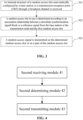
- a device for indicating a random access physical resource may include a second receiving module 41, a second determining module 42 and a second transmitting module 43.
- the second receiving module 41 is configured to receive an internal structure of a random access slot semi-statically configured by a base station or a transmission-reception point (TRP) through a broadcast channel.
- TRP transmission-reception point
- the second determining module 42 is configured to determine a random access slot in use according to an association relationship between a downlink synchronization signal block or a reference signal from the base station or the transmission-reception point and a first random access slot.
- the second transmitting module 43 is configured to transmit a random access signal on the determined random access slot or on a part of the random access slot.
- the internal structure of the random access slot at least includes one of:
- the internal structure of the random access slot satisfies one of the conditions described below.
- the downlink part is dominant in the random access slot.
- the uplink part is dominant in the random access slot.
- the association relationship between the downlink synchronization signal block or the reference signal and the first random access slot may be that: the k-th random access slot after the downlink synchronization signal block or the reference signal is the first random access slot, where k is a positive integer.
- the second transmitting module 43 may be specifically used for transmitting the random access signal by taking the first random access slot or randomly selecting any random access slot after the first random access slot as the starting position.
- the second transmitting module 43 may be configured to select N random access slots to transmit the random access signal.
- N is an integer greater than or equal to 1 or a fraction greater than 0 and less than 1.
- the number N is determined by at least one of the following configurations or any combination thereof random access channel preamble format; random access slot configuration; and a length of a random access signal.
- the second transmitting module 43 may further be configured to determine a starting position of the random access signal in the random access slot through the index number of the downlink synchronization signal block or the reference signal and the number N.
- the second determining module 42 may further be configured to select one or more frequency domain resources as random access time-frequency resources in each of the random access slots, so that the random access signal is transmitted on the random access time-frequency resources.
- the second transmitting module 43 may further be configured to determine a frequency domain resource or a frequency domain position in a manner of frequency domain randomization when the random access signal is transmitted.
- the association relationship between the downlink synchronization signal block or the reference signal and the first random access slot is related to an index of the downlink synchronization signal block or the reference signal in the time domain.
- the second transmitting module 43 may be specifically used for transmitting the random access signal by taking the first random access slot or randomly selecting any random access slot after the first random access slot as the starting position.
- Another device for indicating a random access physical resource includes a processor and a memory.
- the memory is configured to store computer-executable instructions which, when executed by the processor, implement the method described below.
- An internal structure of a random access slot semi-statically configured by a base station or a transmission-reception point (TRP) through a broadcast channel is received.
- a random access slot in use is determined according to an association relationship between a downlink synchronization signal block or a reference signal from the base station or the transmission-reception point and a first random access slot.
- a random access signal is transmitted on the determined random access slot or on a part of the random access slot.
- the device for indicating a random access physical resource in the embodiment may implement all details of the method in the embodiment. The description related to the method may be referred to. In practical application, the device for indicating a random access physical resource in the embodiment may implement the above-mentioned functions and the method of the embodiment by being configured on a terminal or other similar devices, or the device for indicating a random access physical resource in the embodiment may directly be the terminal or other similar devices.
- the second receiving module 41, the second determining module 42, and the second transmitting module 43 may respectively be implemented by software, hardware, or a combination thereof.
- the second determining module 42 may be implemented by the terminal or other similar devices.
- the second receiving module 41 and the second transmitting module 43 may be implemented by a communications unit of the terminal or other similar devices.
- the second determining module 42 may be implemented by a processor of the terminal or other similar devices.
- the second receiving module 41 and the second transmitting module 43 may be implemented by a combination of a communications unit and the processor of the terminal or another similar device. No limitation thereto is made herein.
- An embodiment provides a method for indicating a random access physical resource. The process is described below.
- An internal structure of a random access slot is semi-statically configured by a base station or a TRP through a broadcast channel.
- a terminal receives the internal structure of the random access slot semi-statically configured by the base station or the TRP through the broadcast channel.
- the base station or the TRP notifies the terminal of an association relationship between a downlink synchronization signal block or a reference signal and a first random access slot through a system message.
- the terminal determines a random access slot according to the quality of the received downlink signal or channel and the association relationship between the downlink synchronization signal block or the reference signal and the first random access slot.
- the terminal transmits a random access signal on the determined random access slot or on a part of the random access slot.
- Embodiment 1 and Embodiment 2 For the specific implementation process of the embodiment, reference may be made to Embodiment 1 and Embodiment 2. Reference may be made to Embodiment 1 and Embodiment 2 described above.
- the common channel may be a broadcast channel, a channel carrying common control information, a channel carrying a common traffic, or the like.
- the simplest corresponding relationship is to establish a corresponding relationship of a one-to-one mapping between the downlink signal or channel and a subset of a random access physical resource pool.
- a certain block of resource carrying the above-mentioned common signal or channel is referred to as a synchronization signal block (SS block).
- the SS block is merely a possible name, and does not limit the functional features of the carried corresponding downlink signal or channel.
- Each SS block corresponds to at least one downlink signal or channel in a specific beam direction or from an antenna port.
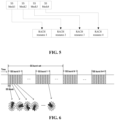
- the SS block has a one-to-one corresponding relationship with a random access physical resource subset. For example, as shown in FIG.
- a one-to-one correspondence exists between a downlink SS block 1 or a reference signal 1 and a RACH resource 1
- a one-to-one correspondence exists between a downlink SS block 2 or a reference signal 2 and a RACH resource 2
- a one-to-one correspondence exists between a downlink SS block 3 or a reference signal 3 and a RACH resource 3
- a one-to-one correspondence exists between a downlink SS block 4 or a reference signal 4 and a RACH resource 4.
- the one-to-one correspondence is a relatively simple corresponding relationship.
- the terminal needs to obtain such corresponding relationship for obtaining corresponding random access physical resources, and then determine the corresponding random access physical resource according to the selected downlink signal or channel.
- the SS block of the base station is the minimum unit carrying the synchronization signal, and carries a synchronization signal in a beam direction or from an antenna port.
- a plurality of SS blocks are combined into a synchronization signal burst (SS burst) in the time domain, and a plurality of SS bursts are combined into a synchronization signal burst set (SS burst set) in the time domain.
- One SS burst set includes synchronization signals in all beam directions or from antenna ports, and the synchronization signals are repeatedly transmitted in a period of a SS burst set.
- An example of a SS burst set is shown in FIG. 6 .
- a random access channel (RACH) occasion is defined as a time-frequency resource used by a random access signal transmitted in a configured random access preamble format.
- the terminal receives the downlink signal or channel and detects the quality thereof to obtain quality information. For example, the strength of the received signal of the SS block is detected, a suitable SS block is selected according to the strength of the received signal, and the time-frequency resource used by the random access channel (RACH) occasion is determined by combining the corresponding relationship between the downlink signal or channel and the subset of the random access physical resource pool.
- the base station may indirectly know the SS block preferred by the terminal by receiving the random access signal.
- the random access signal transmitted within the RACH occasion corresponds to all possible beam directions received in the uplink or to receive antenna ports. All receiving beam directions or receiving antenna ports are needed by the base station for detecting random access signals.
- the terminal needs to repeatedly transmit the random access signal to ensure that the base station may obtain the preferred downlink transmit beam and the preferred uplink receive beam respectively by detecting the random access signal.
- the terminal may not need to repeatedly transmit the random access signal.
- the representation of the resource occupied by the RACH occasion of the random access physical resource pool is a logical resource, and the logical resource ultimately needs to be embodied on the physical resource.
- the physical resource for transmitting the random access signal is defined as a random access slot.
- a slot may be divided into a downlink slot and an uplink slot.
- the downlink slot or the uplink slot is not a simple downlink signal and a downlink channel or an uplink signal and an uplink channel, but refers to that the downlink signal and the downlink channel have a higher ratio in the downlink slot or the uplink signal and the uplink channel have a higher ratio in the uplink slot.
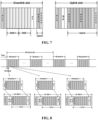
- FIG. 7 An example of a slot including an uplink slot and a downlink slot is shown in FIG. 7 .
- the downlink slot is in a time division duplex (TDD) mode, and has 14 symbols, where the downlink control channel (DLC) and the synchronization signal block (SSB) occupy 10 symbols with a ratio of more than 50%, while the uplink signal RACH and the physical uplink control channel (PUCCH) occupy two symbols.
- the uplink slot is in the TDD mode, and has 14 symbols, where the downlink control channel (DLC) occupies 2 symbols, and the uplink signal RACH and the PUCCH occupy 10 symbols with a ratio more than 50%.
- DLC downlink control channel
- SSB synchronization signal block
- PUCCH physical uplink control channel
- Both the downlink slot and the uplink slot may be used to carry the uplink RACH signal, and the slot used to carry the random access signal is called a random access slot.
- the internal structures of the downlink slot and the uplink slot are not limited to the example of FIG. 7 .
- the granularity of the time change is at least one slot. When the change is the fastest, the number of resources provided by each different random access slot may be different.
- the terminal searches for a physical resource for transmitting the RACH according to the association relationship between the downlink channel or the downlink channel (typically a SSB) and a certain subset of the random access physical resource pool (typically a RACH occasion)
- the downlink control information (DCI) in the downlink control channel in the slot needs to be read to obtain the RACH physical resource, so as to obtain the allocation of the RACH resources in the internal structure of the slot. Then the specific physical resource position is obtained through indirect calculation. If the DCI information is always read, it is very disadvantageous for reducing the power consumption of the terminal.
- due to the dynamic change of the RACH resources in the random access slot it is difficult to generally determine whether the random access physical resources in a SS burst set period are sufficient.
- the internal structure of the random access slot Before the type of the random access slot is reconfigured, the internal structure of the random access slot should remain unchanged. That is, the ratio of the internal downlink and uplink, the number of symbols occupied by random access, and the time length of the random access physical resource should remain unchanged.
- the internal structure of the random access slot is preferably semi-static. Semi-static configuration may be implemented through the broadcast message. Multiple options may exist for a configuration set. The option may be a downlink slot, an uplink slot or the like. The configuration of the random access slot notified in the broadcast message may be marked with the index of the internal structure of the random access slot. The specific configuration is selected by the base station according to the random access preamble format that needs to be supported by the slot. In special cases, a semi-static configuration may become a completely static curing configuration.
- the base station further needs to determine all random access slots available to the system.
- the density of the random access slot and the allocation position of the resource depend on various factors including: the random access preamble format to be adopted by the base station, the size of the random access area provided for an uplink transmission in the internal structure of the random access slot, whether the base station can receive a plurality of different beams in the frequency domain at the same time, whether the base station has the reciprocity of beam receiving and transmitting, and the like.
- the resources (sum of time, frequency, and code resources) of the RACH occasion provided by the random access slot in a SS burst set period need to meet at least the corresponding relationship with the downlink SS block or the reference signal.
- a physical resource for transmitting the RACH i.e., a random access slot when an association relationship exists between a downlink signal or a downlink channel (typically a downlink SS block or a reference signal) and a subset of the random access physical resource pool (typically a RACH occasion).
- the example describes in detail the process of determining a physical resource, i.e., a random access slot, for transmitting the RACH, in the scenario where the base station has no beam reciprocity.
- FIG. 8 illustrates a mapping relationship between a downlink SS block or a reference signal, an occasion, and a RACH slot.
- Different SS blocks or reference signals correspond to different RACH occasions.
- An occasion is a logical resource number and needs to be mapped into a specific physical RACH slot.
- FIG. 8 is a typical configuration, that is, one SS block corresponds to one RACH occasion, and a logical resource of a RACH occasion may right be carried by a random access physical slot.
- 8 RACH symbols in the physical slot are taken as an example, indicating that the same random access symbol and sequence need to be repeated 8 times, so that the base station performs training and detection on 8 different receive beams.
- a cyclic prefix (CP) of the random access signal and the guard period (GP) for differentiating slot downlink and uplink may share resources.
- a guard time (GT) of the random access signal and the PUCCH may share resources.
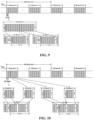
- FIG. 9 is a second typical configuration, that is, one downlink SS block or reference signal corresponds to one RACH occasion, and a logical resource of one RACH occasion may be carried by a plurality of, two in the example, random access physical slots.
- An uplink slot 1 and an uplink slot 2 may be continuously transmitted, or may be discontinuously transmitted. If a SS burst set period is long and contains more SS blocks, the corresponding RACH occasion is also longer, and more RACH physical slots are mapped.
- FIG. 10 is a third typical configuration, that is, one downlink SS block or reference signal corresponds to one RACH occasion, and the logical resource of a plurality of occasions may be carried by one random access physical slot.
- the same random access symbol and sequence of a same RACH occasion need to be repeated 4 times, so that the base station performs training and detection on 4 different receive beams.
- the above three typical mapping relationships may cover one-to-one, one-to-many, and many-to-one mapping relationships between RACH occasions and random access physical resources under the condition that the base station does not have beam reciprocity.
- the base station needs to at least notify the terminal SS block of the mapping relationship between the downlink SS block or the reference signal and the initial RACH slot. For example, a rank number of a RACH slot, after the downlink SS block or the reference signal, where the initial access may be performed is notified.
- a rank number of a slot in which the initial access may be performed need be notified, and a specific starting position in the slot need be determined.
- the specific starting position in the slot may be directly notified and, in addition, may be indirectly determined by the index number of the downlink SS block or the reference signal and the number of random access signals that can be carried in one physical slot.
- the base station may further notify how many RACH slots may be mapped with one downlink SS block or reference signal, that is, how many RACH slots may be used by the random access signal corresponding to the downlink SS block or reference signal to transmit a random access signal.
- This number relationship is inversely related to the number of random access signals that may be carried in one RACH slot.
- the number of RACH slots here may not only be an integer greater than or equal to 1, but may also be a fraction greater than 0 and less than 1, such as 0.5, indicating that the random access signal may use only a half RACH slot, and such as 0.25, indicating that the random access signal may occupy only 1/4 of the RACH slots.
- the number of RACH slots that may be used by the random access signal corresponding to the downlink SS block or the reference signal may also be indirectly calculated through the configured physical random access channel format and the length of the random access signal.
- the above single mapping relationship may be applied to all downlink SS blocks or reference signals.
- Each downlink SS block or reference signal may also be considered to have an independent mapping relationship.
- the configuration of the independent mapping relationship requires more signaling overhead. From the perspective of saving signaling overhead, a single mapping relationship is more advantageous for all downlink SS blocks or reference signals in a unified configuration. If the RACH resources that need to be mapped with each downlink SS block or reference signal are not uniform, the RACH resources required for each downlink SS block or reference signal may be added in the frequency domain or the code domain.
- the example describes in detail the process of determining a physical resource, i.e., a random access slot, for transmitting the RACH, in the scenario where the base station has beam reciprocity.
- the random access symbol and sequence do not need to be repeated multiple times to meet the needs of scanning by the receive beam of the base station, while it is not excluded that the sequence or symbol is repeated for enhancing coverage.
- the random access signal transmitted within the RACH occasion corresponds to all possible beam directions received in the uplink or to receive antenna ports.
- a representation form of the RACH occasion is different from that under the condition of no reciprocity.
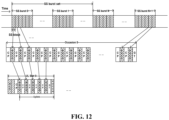
- FIG. 11 illustrates a mapping relationship between a downlink SS block or a reference signal, an occasion, and a RACH slot. Different downlink SS blocks or reference signals in a same SS burst set correspond to one RACH occasion.
- An occasion is a logical resource number and needs to be mapped into a specific physical RACH slot.
- FIG. 11 is a typical configuration, that is, one downlink SS block or reference signal corresponds to a part of resources (corresponding to receive beams of the base station) of one RACH occasion, logical resources of one RACH occasion are carried by a plurality of random access physical slots, while a certain downlink SS block or reference signal corresponds to one of the plurality of random access physical slot.
- FIG. 12 shows another possible typical configuration, that is, one downlink SS block or reference signal corresponds to a part of resources (corresponding to receive beams of the base station) of one RACH occasion, and logical resources of one RACH occasion are carried by a plurality of random access physical slots, while certain downlink SS blocks or reference signals correspond to one of the plurality of random access physical slots. That is, one random access physical slot is mapped to a plurality of downlink SS blocks or reference signals.
- One downlink SS block or reference signal corresponding to a plurality of random access physical slots is also a possibility, similar to the configuration shown in FIG. 9 of Example 1, and will not be described again.
- a certain commonality in the mapping relationship between the downlink SS block or the reference signal and the random access slot exists whether the base station has beam reciprocity or not.
- the base station needs to at least notify the terminal of the mapping relationship between the downlink SS block or the reference signal and the initial RACH slot. For example, a rank number of a RACH slot, after the downlink SS block or the reference signal, where the initial access may be performed is notified.
- a rank number of a RACH slot after the downlink SS block or the reference signal, where the initial access may be performed is notified.
- a rank number of a slot in which the initial access may be performed need be notified, and a specific starting position in the slot need be determined.
- the specific starting position in the slot may be directly notified and, in addition, may be indirectly determined by the index number of the downlink SS block or the reference signal and the number of random access signals that can be carried in one physical slot.
- the base station may further notify the terminal of the mapping relationship between the downlink SS block or the reference signal and the initial RACH slot in other implementation modes.
- the association relationship between the downlink SS block or the reference signal and the initial RACH slot in the time domain is related to the index of the downlink SS block or the reference signal. In short, if the index of the downlink SS block or the reference signal is i, the RACH slot whose index is i or whose functional relationship is i is the associated initial RACH slot.
- the base station may further notify how many RACH slots may be mapped with one downlink SS block or reference signal, that is, how many RACH slots may be used by the random access signal corresponding to the downlink SS block or reference signal to transmit a random access signal.
- This number relationship is inversely related to the number of random access signals that may be carried in one RACH slot.
- the number of RACH slots here may not only be an integer greater than or equal to 1, but may also be a fraction greater than 0 and less than 1, such as 0.5, indicating that the random access signal may use only a half RACH slot, and such as 0.25, indicating that the random access signal may occupy only 1/4 of the RACH slots.
- the number of RACH slots that may be used by the random access signal corresponding to the downlink SS block or the reference signal may also be indirectly calculated through the configured physical random access channel format and the length of the random access signal.
- the above single mapping relationship may be applied to all downlink SS blocks or reference signals.
- the above notification and indication methods apply not only to a single terminal user, but also to a multi-user scenario. If multiple users prefer the same downlink SS block or reference signal and initiate random access, interference with each other is avoided for the multiple users in a manner of frequency domain or code domain randomization.
- the frequency domain randomization is preferred, and the position of the frequency domain is determined by the terminal itself.
- the present disclosure further provides a computer-readable storage medium storing computer-executable instructions which, when executed, implement any one of the above-mentioned methods for indicating a random access physical resource, such as implementing the method illustrated in FIG. 1 and/or FIG. 3 .
- the storage medium may include, but is not limited to, a USB flash drive, a read-only memory (ROM), a random access memory (RAM), a mobile hard disk, a magnetic disk, an optical disk or another medium capable of storing program codes.
- ROM read-only memory
- RAM random access memory
- mobile hard disk a magnetic disk
- optical disk another medium capable of storing program codes.
- the storage medium is a non-transitory storage medium.
- a processor executes the steps in the methods described in the above embodiments according to the program codes stored in the storage medium.
- the base station will configure an internal structure of the random access slot, and notify the terminal of the association relationship between the downlink SS block and the first random access slot through the system message according to the internal structure of the random access slot.
- the terminal initiates a random access request on the first random access slot according to the association relationship, and then the base station may know which beam may be used to successfully transmit information to the terminal.
- the problem that which beam used to transmit the information to the terminal cannot be determined is solved, and the success rate of transmitting information to the terminal by the base station is improved at the same time, which has positive industrial effect and characterizes simple implementation and good application prospects.
Landscapes
- Engineering & Computer Science (AREA)
- Computer Networks & Wireless Communication (AREA)
- Signal Processing (AREA)
- Mobile Radio Communication Systems (AREA)
Claims (7)
- Procédé, comprenant :
configurer une structure interne d'un créneau d'accès aléatoire par l'intermédiaire d'un canal de diffusion, la structure interne du seul créneau d'accès aléatoire comprenant :un nombre de symboles occupés par l'accès aléatoire d'une partie de liaison montante dans le seul créneau d'accès aléatoire, etun nombre de canal d'accès aléatoire, RACH, occasions pour la partie de liaison montante dans le seul créneau d'accès aléatoire ;caractérisé partransmettre un paramètre indiquant la structure interne du seul créneau d'accès aléatoire par l'intermédiaire du canal de diffusion et une association entre un index d'un bloc de signaux de synchronisation de la liaison descendante et le seul créneau d'accès aléatoire dans le domaine temporel. - Procédé selon la revendication 1, dans lequel la structure interne du seul créneau d'accès aléatoire est configurée selon un format de préambule d'accès aléatoire.
- Procédé, comprenant :
recevoir un paramètre indiquant une structure interne d'un créneau d'accès aléatoire configuré par une station de base par l'intermédiaire d'un canal de diffusion et une association entre un index d'un bloc de signaux de synchronisation de la liaison descendante et le seul créneau d'accès aléatoire dans le domaine temporel, la structure interne du seul créneau d'accès aléatoire comprenant :un nombre de symboles occupés par l'accès aléatoire d'une partie de liaison montante dans le seul créneau d'accès aléatoire, etun nombre de canal d'accès aléatoire, RACH, occasions pour la partie de liaison montante dans le seul créneau d'accès aléatoire ;caractérisé pardéterminer le seul créneau d'accès aléatoire en fonction de l'association entre le bloc de signaux de synchronisation de la liaison descendante et le seul créneau d'accès aléatoire ; ettransmettre un signal d'accès aléatoire sur ledit seul créneau d'accès aléatoire déterminé. - Procédé selon la revendication 3, dans lequel l'association entre le bloc de signaux de synchronisation de la liaison descendante et le seul créneau d'accès aléatoire est reçue par l'intermédiaire d'un message du système.
- Dispositif comprenant un processeur et une mémoire, dans lequel la mémoire stocke des instructions exécutables par ordinateur qui, lorsqu'elles sont exécutées par le processeur, mettent en oeuvre un procédé selon la revendication 1 ou 2.
- Dispositif comprenant un processeur et une mémoire, dans lequel la mémoire stocke des instructions exécutables par ordinateur qui, lorsqu'elles sont exécutées par le processeur, mettent en oeuvre un procédé selon la revendication 3 ou 4.
- Support de stockage non transitoire lisible par ordinateur, stockant des instructions exécutables par ordinateur qui, lorsqu'elles sont exécutées, peuvent mettre en oeuvre un procédé selon l'une des revendications 1 à 4.
Applications Claiming Priority (2)
| Application Number | Priority Date | Filing Date | Title |
|---|---|---|---|
| CN201710189324.8A CN108668362A (zh) | 2017-03-27 | 2017-03-27 | 一种随机接入物理资源的指示方法及装置 |
| PCT/CN2018/080247 WO2018177214A1 (fr) | 2017-03-27 | 2018-03-23 | Procédé et dispositif pour fournir une instruction de ressource physique utilisée pour un accès aléatoire, et support de stockage |
Publications (3)
| Publication Number | Publication Date |
|---|---|
| EP3606232A1 EP3606232A1 (fr) | 2020-02-05 |
| EP3606232A4 EP3606232A4 (fr) | 2020-04-08 |
| EP3606232B1 true EP3606232B1 (fr) | 2024-07-24 |
Family
ID=63674180
Family Applications (1)
| Application Number | Title | Priority Date | Filing Date |
|---|---|---|---|
| EP18776632.4A Active EP3606232B1 (fr) | 2017-03-27 | 2018-03-23 | Procédé et dispositif pour fournir une instruction de ressource physique utilisée pour un accès aléatoire, et support de stockage |
Country Status (8)
| Country | Link |
|---|---|
| US (2) | US11363637B2 (fr) |
| EP (1) | EP3606232B1 (fr) |
| JP (1) | JP7241023B2 (fr) |
| KR (1) | KR102289798B1 (fr) |
| CN (2) | CN114786269B (fr) |
| DK (1) | DK3606232T3 (fr) |
| FI (1) | FI3606232T3 (fr) |
| WO (1) | WO2018177214A1 (fr) |
Families Citing this family (10)
| Publication number | Priority date | Publication date | Assignee | Title |
|---|---|---|---|---|
| CN114786269B (zh) | 2017-03-27 | 2026-03-20 | 中兴通讯股份有限公司 | 一种随机接入物理资源的指示方法及装置 |
| CN114867125B (zh) | 2017-05-05 | 2026-03-06 | 华为技术有限公司 | 资源配置的方法及装置 |
| EP3855640A1 (fr) * | 2017-08-09 | 2021-07-28 | Lenovo (Singapore) Pte. Ltd. | Procédé et appareil de sélection d'un port d'antenne utilisant des réglages spécifiques de port d'antenne reçus |
| CN111294787B (zh) * | 2018-12-10 | 2024-03-12 | 中兴通讯股份有限公司 | 一种用户设备ue定位方法及装置 |
| CN111278154A (zh) * | 2019-01-28 | 2020-06-12 | 维沃移动通信有限公司 | 一种随机接入方法、终端设备和网络侧设备 |
| CN111757538B (zh) * | 2019-03-29 | 2022-05-13 | 华为技术有限公司 | 一种确定随机接入资源的方法及装置 |
| CN111787617B (zh) * | 2019-04-04 | 2022-11-11 | 中国信息通信研究院 | 一种移动通信中继节点上行随机接入配置方法和设备 |
| US20210266975A1 (en) * | 2020-02-21 | 2021-08-26 | Qualcomm Incorporated | Techniques for communicating random access messages based on beam refining in wireless communications |
| CN115997442A (zh) * | 2020-05-14 | 2023-04-21 | 欧芬诺有限责任公司 | 具有覆盖增强的随机接入过程 |
| CN115226207A (zh) * | 2021-04-15 | 2022-10-21 | 华为技术有限公司 | 一种随机接入的方法、通信装置及通信系统 |
Citations (1)
| Publication number | Priority date | Publication date | Assignee | Title |
|---|---|---|---|---|
| US20110098035A1 (en) * | 2008-07-02 | 2011-04-28 | Frenger Paal | Method and arrangement for automatic tuning of the rach configuration in a wireless communication network |
Family Cites Families (43)
| Publication number | Priority date | Publication date | Assignee | Title |
|---|---|---|---|---|
| US6973060B1 (en) * | 1999-04-08 | 2005-12-06 | Nokia Corporation | Rotating synchronization channel (SCH) transmission |
| US7088734B2 (en) * | 2001-03-27 | 2006-08-08 | Motorola, Inc. | Slot format and method for increasing random access opportunities in a wireless communication system |
| CN101420265B (zh) * | 2007-10-26 | 2012-08-08 | 鼎桥通信技术有限公司 | 一种长期演进系统中的数据传输方法、系统及装置 |
| CN101425845A (zh) * | 2007-11-02 | 2009-05-06 | 大唐移动通信设备有限公司 | 一种时分双工系统的传输方法和装置 |
| CN101378595B (zh) * | 2008-09-28 | 2012-05-23 | 中兴通讯股份有限公司 | 确定随机接入信道数量的方法及测量参考信号的发送方法 |
| KR101151134B1 (ko) * | 2008-12-03 | 2012-06-01 | 한국전자통신연구원 | 넓은 셀 영역을 가지는 무선통신 시스템을 위한 계층적 임의 접속 방법 |
| CN101772182B (zh) * | 2009-01-05 | 2012-11-14 | 电信科学技术研究院 | 随机接入的方法及设备 |
| CN101841922B (zh) * | 2009-03-16 | 2015-01-28 | 中兴通讯股份有限公司 | 选择随机接入资源的方法及终端 |
| WO2011046377A2 (fr) * | 2009-10-14 | 2011-04-21 | Lg Electronics Inc. | Affectation de ressources radio |
| US8948154B2 (en) * | 2010-02-10 | 2015-02-03 | Qualcomm Incorporated | Method and apparatus for sending and receiving a low-complexity transmission in a wireless communication system |
| KR101995798B1 (ko) * | 2012-07-03 | 2019-07-03 | 삼성전자주식회사 | 빔포밍을 사용하는 통신 시스템의 랜덤 억세스 장치 및 방법 |
| CN103716895B (zh) * | 2012-09-29 | 2020-11-17 | 中兴通讯股份有限公司 | 物理随机接入信道的资源确定方法及装置 |
| EP2949055A1 (fr) | 2013-01-25 | 2015-12-02 | Interdigital Patent Holdings, Inc. | Procédés et appareil de conformation verticale de faisceau |
| TWI488513B (zh) | 2013-05-03 | 2015-06-11 | Univ Nat Taiwan Science Tech | 動態資源分配方法 |
| KR102026256B1 (ko) | 2013-05-21 | 2019-11-04 | 삼성전자주식회사 | 빔포밍 시스템에서의 rach 신호 송수신 기법 |
| US10034121B2 (en) | 2013-08-01 | 2018-07-24 | Kabushiki Kaisha Toshiba | RAN overload control for M2M communications in LTE networks |
| CN104349476B (zh) * | 2013-08-09 | 2019-09-24 | 中兴通讯股份有限公司 | 随机接入信道资源配置方法和系统 |
| US9313698B2 (en) * | 2013-10-11 | 2016-04-12 | Blackberry Limited | Method and apparatus for handover in heterogeneous cellular networks |
| PL3462798T3 (pl) * | 2014-03-25 | 2022-04-04 | Telefonaktiebolaget Lm Ericsson (Publ) | System i sposób dla fizycznego dostępu losowego opartego na wiązce |
| US10306632B2 (en) * | 2014-09-30 | 2019-05-28 | Qualcomm Incorporated | Techniques for transmitting channel usage beacon signals over an unlicensed radio frequency spectrum band |
| EP3225070A1 (fr) * | 2014-11-26 | 2017-10-04 | IDAC Holdings, Inc. | Accès initial dans des systèmes sans fil haute fréquence |
| WO2016118765A1 (fr) * | 2015-01-25 | 2016-07-28 | Titus Lo | Transmission collaborative par des dispositifs mobiles |
| EP3048853B1 (fr) * | 2015-01-26 | 2021-05-26 | ASUSTek Computer Inc. | Procédé et appareil pour traiter la transmission dans un système de communication sans fil |
| WO2017011802A1 (fr) * | 2015-07-16 | 2017-01-19 | Zte Wistron Telecom Ab | Configuration d'accès aléatoire à base de mesures |
| KR102674427B1 (ko) * | 2016-02-26 | 2024-06-13 | 삼성전자 주식회사 | 빔포밍이 적용된 시스템에서의 랜덤 액세스를 수행하는 장치 및 방법 |
| KR102909813B1 (ko) * | 2016-04-04 | 2026-01-09 | 삼성전자 주식회사 | 무선 통신 시스템에서 피드백 송수신 방법 및 장치 |
| JP2019534615A (ja) * | 2016-09-28 | 2019-11-28 | アイディーエーシー ホールディングス インコーポレイテッド | ビームフォーミングシステムにおけるNew Radioランダムアクセス |
| JP7064493B2 (ja) * | 2016-11-04 | 2022-05-10 | テレフオンアクチーボラゲット エルエム エリクソン(パブル) | アクセス手順を実施する方法、デバイス、およびネットワークノード |
| US10405354B2 (en) * | 2016-12-09 | 2019-09-03 | Samsung Electronics Co., Ltd. | Method and apparatus for RACH procedure in wireless systems |
| WO2018128218A1 (fr) * | 2017-01-03 | 2018-07-12 | 엘지전자 주식회사 | Procédé de réalisation de processus d'accès aléatoire et équipement utilisateur |
| MX2019008035A (es) * | 2017-01-05 | 2019-10-07 | Fg innovation co ltd | Metodo y aparato para determinar la direccion de haz. |
| JP6913171B2 (ja) * | 2017-01-05 | 2021-08-04 | ノキア テクノロジーズ オサケユイチア | ハンドオーバのためのビームを選択する方法、コンピュータプログラム、及び装置 |
| WO2018129319A1 (fr) * | 2017-01-06 | 2018-07-12 | Convida Wireless, Llc | Mécanismes pour accès et transmission efficaces en nr |
| MX2019008596A (es) * | 2017-02-02 | 2019-10-30 | Sharp Kk | Transmision y recepcion de señales de sincronizacion para sistema de radio. |
| US20180220450A1 (en) * | 2017-02-02 | 2018-08-02 | Sharp Laboratories Of America, Inc. | User equipments, base stations and methods |
| US10194410B2 (en) * | 2017-02-16 | 2019-01-29 | Qualcomm Incorporated | Synchronization signal blocks |
| DK3592061T3 (da) * | 2017-03-02 | 2021-12-06 | Ntt Docomo Inc | Brugerterminal og trådløs kommunikationsfremgangsmåde |
| US10708028B2 (en) * | 2017-03-08 | 2020-07-07 | Samsung Electronics Co., Ltd. | Method and apparatus for reference signals in wireless system |
| EP3606257B1 (fr) * | 2017-03-22 | 2021-10-06 | LG Electronics Inc. | Procédé et équipement utilisateur pour exécuter une récupération de faisceau |
| EP3602825A1 (fr) * | 2017-03-23 | 2020-02-05 | Intel IP Corporation | Configuration de canal physique d'accès aléatoire de nouvelle technologie d'accès radioélectrique et fonctionnement à faisceaux multiples |
| WO2018171801A1 (fr) * | 2017-03-24 | 2018-09-27 | Mediatek Inc. | Appareils et procédés d'identification de faisceau au moyen du canal d'accès aléatoire physique (prach) et utilisation de ressource de canal prach efficace |
| KR20250022251A (ko) * | 2017-03-24 | 2025-02-14 | 모토로라 모빌리티 엘엘씨 | 무선 통신 네트워크 상에서의 랜덤 액세스를 위한 방법 및 장치 |
| CN114786269B (zh) | 2017-03-27 | 2026-03-20 | 中兴通讯股份有限公司 | 一种随机接入物理资源的指示方法及装置 |
-
2017
- 2017-03-27 CN CN202210537350.6A patent/CN114786269B/zh active Active
- 2017-03-27 CN CN201710189324.8A patent/CN108668362A/zh active Pending
-
2018
- 2018-03-23 KR KR1020197031769A patent/KR102289798B1/ko active Active
- 2018-03-23 WO PCT/CN2018/080247 patent/WO2018177214A1/fr not_active Ceased
- 2018-03-23 FI FIEP18776632.4T patent/FI3606232T3/fi active
- 2018-03-23 EP EP18776632.4A patent/EP3606232B1/fr active Active
- 2018-03-23 JP JP2019552848A patent/JP7241023B2/ja active Active
- 2018-03-23 DK DK18776632.4T patent/DK3606232T3/da active
-
2019
- 2019-09-12 US US16/569,509 patent/US11363637B2/en active Active
-
2022
- 2022-04-27 US US17/660,959 patent/US11716768B2/en active Active
Patent Citations (1)
| Publication number | Priority date | Publication date | Assignee | Title |
|---|---|---|---|---|
| US20110098035A1 (en) * | 2008-07-02 | 2011-04-28 | Frenger Paal | Method and arrangement for automatic tuning of the rach configuration in a wireless communication network |
Also Published As
| Publication number | Publication date |
|---|---|
| JP7241023B2 (ja) | 2023-03-16 |
| CN114786269B (zh) | 2026-03-20 |
| KR102289798B1 (ko) | 2021-08-13 |
| JP2020512765A (ja) | 2020-04-23 |
| US20220256614A1 (en) | 2022-08-11 |
| US11716768B2 (en) | 2023-08-01 |
| CN114786269A (zh) | 2022-07-22 |
| EP3606232A4 (fr) | 2020-04-08 |
| EP3606232A1 (fr) | 2020-02-05 |
| US20200045746A1 (en) | 2020-02-06 |
| US11363637B2 (en) | 2022-06-14 |
| DK3606232T3 (da) | 2024-08-19 |
| CN108668362A (zh) | 2018-10-16 |
| FI3606232T3 (fi) | 2024-09-24 |
| KR20190132465A (ko) | 2019-11-27 |
| WO2018177214A1 (fr) | 2018-10-04 |
Similar Documents
| Publication | Publication Date | Title |
|---|---|---|
| US11716768B2 (en) | Method and device for providing instruction of physical resource used for random access, and storage medium | |
| KR102888825B1 (ko) | 전송채널의 구성 방법 및 장치, 전송채널의 송신 방법 및 장치, 설비 및 저장매체 | |
| EP4002947B1 (fr) | Procédé et appareil permettant de transmettre et de recevoir des signaux dans un système de communication sans fil | |
| US11569949B2 (en) | Communication method and communications apparatus | |
| EP4266620B1 (fr) | Indication et réception d'un emplacement de ressource | |
| US11665738B2 (en) | Method, device, and apparatus for transmitting and receiving a request signal | |
| US10952168B2 (en) | Method for transmitting downlink control signal and apparatus | |
| EP4311334A1 (fr) | Procédé et appareil de communication | |
| US12114370B2 (en) | Determination method, access, transmission, processing method and device, base station and terminal | |
| EP4322449A1 (fr) | Procédé et appareil de communication pour équipement utilisateur xdd dans un système de communication sans fil | |
| EP3700270B1 (fr) | Procédé d'envoi d'informations de commande, procédé de détection, dispositif de réseau et terminal | |
| US20240049154A1 (en) | Utilization of ssb resources | |
| US20250338262A1 (en) | Wireless transmission method and apparatus, device, and storage medium | |
| KR20200138386A (ko) | 클리어 채널 청취 방법, 장치 및 기기 | |
| WO2025152165A1 (fr) | Détermination de porteuse pour des transmissions en liaison montante dans des communications sans fil | |
| WO2025156638A1 (fr) | Utilisation de sous-bande dans des communications sans fil | |
| US20250203507A1 (en) | Method and device for reducing base station energy consumption in wireless communication system |
Legal Events
| Date | Code | Title | Description |
|---|---|---|---|
| STAA | Information on the status of an ep patent application or granted ep patent |
Free format text: STATUS: THE INTERNATIONAL PUBLICATION HAS BEEN MADE |
|
| PUAI | Public reference made under article 153(3) epc to a published international application that has entered the european phase |
Free format text: ORIGINAL CODE: 0009012 |
|
| STAA | Information on the status of an ep patent application or granted ep patent |
Free format text: STATUS: REQUEST FOR EXAMINATION WAS MADE |
|
| 17P | Request for examination filed |
Effective date: 20191028 |
|
| AK | Designated contracting states |
Kind code of ref document: A1 Designated state(s): AL AT BE BG CH CY CZ DE DK EE ES FI FR GB GR HR HU IE IS IT LI LT LU LV MC MK MT NL NO PL PT RO RS SE SI SK SM TR |
|
| AX | Request for extension of the european patent |
Extension state: BA ME |
|
| A4 | Supplementary search report drawn up and despatched |
Effective date: 20200311 |
|
| RIC1 | Information provided on ipc code assigned before grant |
Ipc: H04W 72/04 20090101AFI20200305BHEP Ipc: H04W 74/00 20090101ALI20200305BHEP |
|
| DAV | Request for validation of the european patent (deleted) | ||
| DAX | Request for extension of the european patent (deleted) | ||
| STAA | Information on the status of an ep patent application or granted ep patent |
Free format text: STATUS: EXAMINATION IS IN PROGRESS |
|
| 17Q | First examination report despatched |
Effective date: 20210804 |
|
| GRAP | Despatch of communication of intention to grant a patent |
Free format text: ORIGINAL CODE: EPIDOSNIGR1 |
|
| STAA | Information on the status of an ep patent application or granted ep patent |
Free format text: STATUS: GRANT OF PATENT IS INTENDED |
|
| INTG | Intention to grant announced |
Effective date: 20240321 |
|
| RIN1 | Information on inventor provided before grant (corrected) |
Inventor name: HAO, PENG Inventor name: ZHANG, JUNFENG |
|
| GRAS | Grant fee paid |
Free format text: ORIGINAL CODE: EPIDOSNIGR3 |
|
| GRAA | (expected) grant |
Free format text: ORIGINAL CODE: 0009210 |
|
| STAA | Information on the status of an ep patent application or granted ep patent |
Free format text: STATUS: THE PATENT HAS BEEN GRANTED |
|
| AK | Designated contracting states |
Kind code of ref document: B1 Designated state(s): AL AT BE BG CH CY CZ DE DK EE ES FI FR GB GR HR HU IE IS IT LI LT LU LV MC MK MT NL NO PL PT RO RS SE SI SK SM TR |
|
| REG | Reference to a national code |
Ref country code: GB Ref legal event code: FG4D |
|
| REG | Reference to a national code |
Ref country code: CH Ref legal event code: EP |
|
| REG | Reference to a national code |
Ref country code: IE Ref legal event code: FG4D Ref country code: DE Ref legal event code: R096 Ref document number: 602018072208 Country of ref document: DE |
|
| REG | Reference to a national code |
Ref country code: DK Ref legal event code: T3 Effective date: 20240813 |
|
| REG | Reference to a national code |
Ref country code: FI Ref legal event code: FGE |
|
| REG | Reference to a national code |
Ref country code: SE Ref legal event code: TRGR |
|
| REG | Reference to a national code |
Ref country code: LT Ref legal event code: MG9D |
|
| REG | Reference to a national code |
Ref country code: NL Ref legal event code: MP Effective date: 20240724 |
|
| PG25 | Lapsed in a contracting state [announced via postgrant information from national office to epo] |
Ref country code: PT Free format text: LAPSE BECAUSE OF FAILURE TO SUBMIT A TRANSLATION OF THE DESCRIPTION OR TO PAY THE FEE WITHIN THE PRESCRIBED TIME-LIMIT Effective date: 20241125 |
|
| REG | Reference to a national code |
Ref country code: AT Ref legal event code: MK05 Ref document number: 1707446 Country of ref document: AT Kind code of ref document: T Effective date: 20240724 |
|
| PG25 | Lapsed in a contracting state [announced via postgrant information from national office to epo] |
Ref country code: NL Free format text: LAPSE BECAUSE OF FAILURE TO SUBMIT A TRANSLATION OF THE DESCRIPTION OR TO PAY THE FEE WITHIN THE PRESCRIBED TIME-LIMIT Effective date: 20240724 |
|
| PG25 | Lapsed in a contracting state [announced via postgrant information from national office to epo] |
Ref country code: PT Free format text: LAPSE BECAUSE OF FAILURE TO SUBMIT A TRANSLATION OF THE DESCRIPTION OR TO PAY THE FEE WITHIN THE PRESCRIBED TIME-LIMIT Effective date: 20241125 Ref country code: NL Free format text: LAPSE BECAUSE OF FAILURE TO SUBMIT A TRANSLATION OF THE DESCRIPTION OR TO PAY THE FEE WITHIN THE PRESCRIBED TIME-LIMIT Effective date: 20240724 |
|
| PG25 | Lapsed in a contracting state [announced via postgrant information from national office to epo] |
Ref country code: NO Free format text: LAPSE BECAUSE OF FAILURE TO SUBMIT A TRANSLATION OF THE DESCRIPTION OR TO PAY THE FEE WITHIN THE PRESCRIBED TIME-LIMIT Effective date: 20241024 |
|
| PG25 | Lapsed in a contracting state [announced via postgrant information from national office to epo] |
Ref country code: PL Free format text: LAPSE BECAUSE OF FAILURE TO SUBMIT A TRANSLATION OF THE DESCRIPTION OR TO PAY THE FEE WITHIN THE PRESCRIBED TIME-LIMIT Effective date: 20240724 Ref country code: GR Free format text: LAPSE BECAUSE OF FAILURE TO SUBMIT A TRANSLATION OF THE DESCRIPTION OR TO PAY THE FEE WITHIN THE PRESCRIBED TIME-LIMIT Effective date: 20241025 |
|
| PG25 | Lapsed in a contracting state [announced via postgrant information from national office to epo] |
Ref country code: BG Free format text: LAPSE BECAUSE OF FAILURE TO SUBMIT A TRANSLATION OF THE DESCRIPTION OR TO PAY THE FEE WITHIN THE PRESCRIBED TIME-LIMIT Effective date: 20240724 |
|
| PG25 | Lapsed in a contracting state [announced via postgrant information from national office to epo] |
Ref country code: LV Free format text: LAPSE BECAUSE OF FAILURE TO SUBMIT A TRANSLATION OF THE DESCRIPTION OR TO PAY THE FEE WITHIN THE PRESCRIBED TIME-LIMIT Effective date: 20240724 |
|
| PG25 | Lapsed in a contracting state [announced via postgrant information from national office to epo] |
Ref country code: IS Free format text: LAPSE BECAUSE OF FAILURE TO SUBMIT A TRANSLATION OF THE DESCRIPTION OR TO PAY THE FEE WITHIN THE PRESCRIBED TIME-LIMIT Effective date: 20241124 Ref country code: AT Free format text: LAPSE BECAUSE OF FAILURE TO SUBMIT A TRANSLATION OF THE DESCRIPTION OR TO PAY THE FEE WITHIN THE PRESCRIBED TIME-LIMIT Effective date: 20240724 |
|
| PG25 | Lapsed in a contracting state [announced via postgrant information from national office to epo] |
Ref country code: HR Free format text: LAPSE BECAUSE OF FAILURE TO SUBMIT A TRANSLATION OF THE DESCRIPTION OR TO PAY THE FEE WITHIN THE PRESCRIBED TIME-LIMIT Effective date: 20240724 |
|
| PG25 | Lapsed in a contracting state [announced via postgrant information from national office to epo] |
Ref country code: ES Free format text: LAPSE BECAUSE OF FAILURE TO SUBMIT A TRANSLATION OF THE DESCRIPTION OR TO PAY THE FEE WITHIN THE PRESCRIBED TIME-LIMIT Effective date: 20240724 Ref country code: RS Free format text: LAPSE BECAUSE OF FAILURE TO SUBMIT A TRANSLATION OF THE DESCRIPTION OR TO PAY THE FEE WITHIN THE PRESCRIBED TIME-LIMIT Effective date: 20241024 |
|
| PG25 | Lapsed in a contracting state [announced via postgrant information from national office to epo] |
Ref country code: RS Free format text: LAPSE BECAUSE OF FAILURE TO SUBMIT A TRANSLATION OF THE DESCRIPTION OR TO PAY THE FEE WITHIN THE PRESCRIBED TIME-LIMIT Effective date: 20241024 Ref country code: PL Free format text: LAPSE BECAUSE OF FAILURE TO SUBMIT A TRANSLATION OF THE DESCRIPTION OR TO PAY THE FEE WITHIN THE PRESCRIBED TIME-LIMIT Effective date: 20240724 Ref country code: NO Free format text: LAPSE BECAUSE OF FAILURE TO SUBMIT A TRANSLATION OF THE DESCRIPTION OR TO PAY THE FEE WITHIN THE PRESCRIBED TIME-LIMIT Effective date: 20241024 Ref country code: LV Free format text: LAPSE BECAUSE OF FAILURE TO SUBMIT A TRANSLATION OF THE DESCRIPTION OR TO PAY THE FEE WITHIN THE PRESCRIBED TIME-LIMIT Effective date: 20240724 Ref country code: IS Free format text: LAPSE BECAUSE OF FAILURE TO SUBMIT A TRANSLATION OF THE DESCRIPTION OR TO PAY THE FEE WITHIN THE PRESCRIBED TIME-LIMIT Effective date: 20241124 Ref country code: HR Free format text: LAPSE BECAUSE OF FAILURE TO SUBMIT A TRANSLATION OF THE DESCRIPTION OR TO PAY THE FEE WITHIN THE PRESCRIBED TIME-LIMIT Effective date: 20240724 Ref country code: GR Free format text: LAPSE BECAUSE OF FAILURE TO SUBMIT A TRANSLATION OF THE DESCRIPTION OR TO PAY THE FEE WITHIN THE PRESCRIBED TIME-LIMIT Effective date: 20241025 Ref country code: ES Free format text: LAPSE BECAUSE OF FAILURE TO SUBMIT A TRANSLATION OF THE DESCRIPTION OR TO PAY THE FEE WITHIN THE PRESCRIBED TIME-LIMIT Effective date: 20240724 Ref country code: BG Free format text: LAPSE BECAUSE OF FAILURE TO SUBMIT A TRANSLATION OF THE DESCRIPTION OR TO PAY THE FEE WITHIN THE PRESCRIBED TIME-LIMIT Effective date: 20240724 Ref country code: AT Free format text: LAPSE BECAUSE OF FAILURE TO SUBMIT A TRANSLATION OF THE DESCRIPTION OR TO PAY THE FEE WITHIN THE PRESCRIBED TIME-LIMIT Effective date: 20240724 |
|
| PG25 | Lapsed in a contracting state [announced via postgrant information from national office to epo] |
Ref country code: RO Free format text: LAPSE BECAUSE OF FAILURE TO SUBMIT A TRANSLATION OF THE DESCRIPTION OR TO PAY THE FEE WITHIN THE PRESCRIBED TIME-LIMIT Effective date: 20240724 Ref country code: SM Free format text: LAPSE BECAUSE OF FAILURE TO SUBMIT A TRANSLATION OF THE DESCRIPTION OR TO PAY THE FEE WITHIN THE PRESCRIBED TIME-LIMIT Effective date: 20240724 |
|
| P01 | Opt-out of the competence of the unified patent court (upc) registered |
Free format text: CASE NUMBER: APP_12699/2025 Effective date: 20250314 |
|
| PG25 | Lapsed in a contracting state [announced via postgrant information from national office to epo] |
Ref country code: EE Free format text: LAPSE BECAUSE OF FAILURE TO SUBMIT A TRANSLATION OF THE DESCRIPTION OR TO PAY THE FEE WITHIN THE PRESCRIBED TIME-LIMIT Effective date: 20240724 |
|
| PG25 | Lapsed in a contracting state [announced via postgrant information from national office to epo] |
Ref country code: CZ Free format text: LAPSE BECAUSE OF FAILURE TO SUBMIT A TRANSLATION OF THE DESCRIPTION OR TO PAY THE FEE WITHIN THE PRESCRIBED TIME-LIMIT Effective date: 20240724 |
|
| REG | Reference to a national code |
Ref country code: DE Ref legal event code: R097 Ref document number: 602018072208 Country of ref document: DE |
|
| PG25 | Lapsed in a contracting state [announced via postgrant information from national office to epo] |
Ref country code: IT Free format text: LAPSE BECAUSE OF FAILURE TO SUBMIT A TRANSLATION OF THE DESCRIPTION OR TO PAY THE FEE WITHIN THE PRESCRIBED TIME-LIMIT Effective date: 20240724 Ref country code: SK Free format text: LAPSE BECAUSE OF FAILURE TO SUBMIT A TRANSLATION OF THE DESCRIPTION OR TO PAY THE FEE WITHIN THE PRESCRIBED TIME-LIMIT Effective date: 20240724 |
|
| PLBE | No opposition filed within time limit |
Free format text: ORIGINAL CODE: 0009261 |
|
| STAA | Information on the status of an ep patent application or granted ep patent |
Free format text: STATUS: NO OPPOSITION FILED WITHIN TIME LIMIT |
|
| 26N | No opposition filed |
Effective date: 20250425 |
|
| PG25 | Lapsed in a contracting state [announced via postgrant information from national office to epo] |
Ref country code: MC Free format text: LAPSE BECAUSE OF FAILURE TO SUBMIT A TRANSLATION OF THE DESCRIPTION OR TO PAY THE FEE WITHIN THE PRESCRIBED TIME-LIMIT Effective date: 20240724 |
|
| REG | Reference to a national code |
Ref country code: CH Ref legal event code: H13 Free format text: ST27 STATUS EVENT CODE: U-0-0-H10-H13 (AS PROVIDED BY THE NATIONAL OFFICE) Effective date: 20251023 |
|
| PG25 | Lapsed in a contracting state [announced via postgrant information from national office to epo] |
Ref country code: LU Free format text: LAPSE BECAUSE OF NON-PAYMENT OF DUE FEES Effective date: 20250323 |
|
| REG | Reference to a national code |
Ref country code: BE Ref legal event code: MM Effective date: 20250331 |
|
| PGFP | Annual fee paid to national office [announced via postgrant information from national office to epo] |
Ref country code: FI Payment date: 20251230 Year of fee payment: 9 |
|
| PGFP | Annual fee paid to national office [announced via postgrant information from national office to epo] |
Ref country code: FR Payment date: 20251231 Year of fee payment: 9 |
|
| PG25 | Lapsed in a contracting state [announced via postgrant information from national office to epo] |
Ref country code: BE Free format text: LAPSE BECAUSE OF NON-PAYMENT OF DUE FEES Effective date: 20250331 |
|
| PG25 | Lapsed in a contracting state [announced via postgrant information from national office to epo] |
Ref country code: CH Free format text: LAPSE BECAUSE OF NON-PAYMENT OF DUE FEES Effective date: 20250331 |
|
| PG25 | Lapsed in a contracting state [announced via postgrant information from national office to epo] |
Ref country code: IE Free format text: LAPSE BECAUSE OF NON-PAYMENT OF DUE FEES Effective date: 20250323 |
|
| PGFP | Annual fee paid to national office [announced via postgrant information from national office to epo] |
Ref country code: SE Payment date: 20260105 Year of fee payment: 9 |
|
| PGFP | Annual fee paid to national office [announced via postgrant information from national office to epo] |
Ref country code: GB Payment date: 20260106 Year of fee payment: 9 |
|
| PGFP | Annual fee paid to national office [announced via postgrant information from national office to epo] |
Ref country code: DK Payment date: 20260313 Year of fee payment: 9 Ref country code: DE Payment date: 20260102 Year of fee payment: 9 |