EP3606643B1 - Compositions absorbantes comprenant des amino-siloxanes - Google Patents
Compositions absorbantes comprenant des amino-siloxanes Download PDFInfo
- Publication number
- EP3606643B1 EP3606643B1 EP17720625.7A EP17720625A EP3606643B1 EP 3606643 B1 EP3606643 B1 EP 3606643B1 EP 17720625 A EP17720625 A EP 17720625A EP 3606643 B1 EP3606643 B1 EP 3606643B1
- Authority
- EP
- European Patent Office
- Prior art keywords
- amino
- siloxane
- occurrence
- independently
- aliphatic
- Prior art date
- Legal status (The legal status is an assumption and is not a legal conclusion. Google has not performed a legal analysis and makes no representation as to the accuracy of the status listed.)
- Active
Links
Images


Classifications
-
- B—PERFORMING OPERATIONS; TRANSPORTING
- B01—PHYSICAL OR CHEMICAL PROCESSES OR APPARATUS IN GENERAL
- B01D—SEPARATION
- B01D53/00—Separation of gases or vapours; Recovering vapours of volatile solvents from gases; Chemical or biological purification of waste gases, e.g. engine exhaust gases, smoke, fumes, flue gases, aerosols
- B01D53/14—Separation of gases or vapours; Recovering vapours of volatile solvents from gases; Chemical or biological purification of waste gases, e.g. engine exhaust gases, smoke, fumes, flue gases, aerosols by absorption
- B01D53/1493—Selection of liquid materials for use as absorbents
-
- B—PERFORMING OPERATIONS; TRANSPORTING
- B01—PHYSICAL OR CHEMICAL PROCESSES OR APPARATUS IN GENERAL
- B01D—SEPARATION
- B01D53/00—Separation of gases or vapours; Recovering vapours of volatile solvents from gases; Chemical or biological purification of waste gases, e.g. engine exhaust gases, smoke, fumes, flue gases, aerosols
- B01D53/14—Separation of gases or vapours; Recovering vapours of volatile solvents from gases; Chemical or biological purification of waste gases, e.g. engine exhaust gases, smoke, fumes, flue gases, aerosols by absorption
- B01D53/1456—Removing acid components
- B01D53/1475—Removing carbon dioxide
-
- B—PERFORMING OPERATIONS; TRANSPORTING
- B01—PHYSICAL OR CHEMICAL PROCESSES OR APPARATUS IN GENERAL
- B01D—SEPARATION
- B01D53/00—Separation of gases or vapours; Recovering vapours of volatile solvents from gases; Chemical or biological purification of waste gases, e.g. engine exhaust gases, smoke, fumes, flue gases, aerosols
- B01D53/34—Chemical or biological purification of waste gases
- B01D53/46—Removing components of defined structure
- B01D53/62—Carbon oxides
-
- B—PERFORMING OPERATIONS; TRANSPORTING
- B01—PHYSICAL OR CHEMICAL PROCESSES OR APPARATUS IN GENERAL
- B01D—SEPARATION
- B01D53/00—Separation of gases or vapours; Recovering vapours of volatile solvents from gases; Chemical or biological purification of waste gases, e.g. engine exhaust gases, smoke, fumes, flue gases, aerosols
- B01D53/34—Chemical or biological purification of waste gases
- B01D53/74—General processes for purification of waste gases; Apparatus or devices specially adapted therefor
- B01D53/77—Liquid phase processes
- B01D53/78—Liquid phase processes with gas-liquid contact
-
- C—CHEMISTRY; METALLURGY
- C08—ORGANIC MACROMOLECULAR COMPOUNDS; THEIR PREPARATION OR CHEMICAL WORKING-UP; COMPOSITIONS BASED THEREON
- C08G—MACROMOLECULAR COMPOUNDS OBTAINED OTHERWISE THAN BY REACTIONS ONLY INVOLVING UNSATURATED CARBON-TO-CARBON BONDS
- C08G77/00—Macromolecular compounds obtained by reactions forming a linkage containing silicon with or without sulfur, nitrogen, oxygen or carbon in the main chain of the macromolecule
- C08G77/04—Polysiloxanes
- C08G77/22—Polysiloxanes containing silicon bound to organic groups containing atoms other than carbon, hydrogen and oxygen
- C08G77/26—Polysiloxanes containing silicon bound to organic groups containing atoms other than carbon, hydrogen and oxygen nitrogen-containing groups
-
- C—CHEMISTRY; METALLURGY
- C08—ORGANIC MACROMOLECULAR COMPOUNDS; THEIR PREPARATION OR CHEMICAL WORKING-UP; COMPOSITIONS BASED THEREON
- C08G—MACROMOLECULAR COMPOUNDS OBTAINED OTHERWISE THAN BY REACTIONS ONLY INVOLVING UNSATURATED CARBON-TO-CARBON BONDS
- C08G77/00—Macromolecular compounds obtained by reactions forming a linkage containing silicon with or without sulfur, nitrogen, oxygen or carbon in the main chain of the macromolecule
- C08G77/04—Polysiloxanes
- C08G77/38—Polysiloxanes modified by chemical after-treatment
- C08G77/382—Polysiloxanes modified by chemical after-treatment containing atoms other than carbon, hydrogen, oxygen or silicon
- C08G77/388—Polysiloxanes modified by chemical after-treatment containing atoms other than carbon, hydrogen, oxygen or silicon containing nitrogen
-
- C—CHEMISTRY; METALLURGY
- C08—ORGANIC MACROMOLECULAR COMPOUNDS; THEIR PREPARATION OR CHEMICAL WORKING-UP; COMPOSITIONS BASED THEREON
- C08G—MACROMOLECULAR COMPOUNDS OBTAINED OTHERWISE THAN BY REACTIONS ONLY INVOLVING UNSATURATED CARBON-TO-CARBON BONDS
- C08G77/00—Macromolecular compounds obtained by reactions forming a linkage containing silicon with or without sulfur, nitrogen, oxygen or carbon in the main chain of the macromolecule
- C08G77/70—Siloxanes defined by use of the MDTQ nomenclature
-
- C—CHEMISTRY; METALLURGY
- C08—ORGANIC MACROMOLECULAR COMPOUNDS; THEIR PREPARATION OR CHEMICAL WORKING-UP; COMPOSITIONS BASED THEREON
- C08G—MACROMOLECULAR COMPOUNDS OBTAINED OTHERWISE THAN BY REACTIONS ONLY INVOLVING UNSATURATED CARBON-TO-CARBON BONDS
- C08G77/00—Macromolecular compounds obtained by reactions forming a linkage containing silicon with or without sulfur, nitrogen, oxygen or carbon in the main chain of the macromolecule
- C08G77/80—Siloxanes having aromatic substituents, e.g. phenyl side groups
-
- C—CHEMISTRY; METALLURGY
- C08—ORGANIC MACROMOLECULAR COMPOUNDS; THEIR PREPARATION OR CHEMICAL WORKING-UP; COMPOSITIONS BASED THEREON
- C08L—COMPOSITIONS OF MACROMOLECULAR COMPOUNDS
- C08L83/00—Compositions of macromolecular compounds obtained by reactions forming in the main chain of the macromolecule a linkage containing silicon with or without sulfur, nitrogen, oxygen or carbon only; Compositions of derivatives of such polymers
- C08L83/04—Polysiloxanes
- C08L83/08—Polysiloxanes containing silicon bound to organic groups containing atoms other than carbon, hydrogen and oxygen
-
- B—PERFORMING OPERATIONS; TRANSPORTING
- B01—PHYSICAL OR CHEMICAL PROCESSES OR APPARATUS IN GENERAL
- B01D—SEPARATION
- B01D2252/00—Absorbents, i.e. solvents and liquid materials for gas absorption
- B01D2252/20—Organic absorbents
- B01D2252/204—Amines
- B01D2252/2041—Diamines
-
- B—PERFORMING OPERATIONS; TRANSPORTING
- B01—PHYSICAL OR CHEMICAL PROCESSES OR APPARATUS IN GENERAL
- B01D—SEPARATION
- B01D2252/00—Absorbents, i.e. solvents and liquid materials for gas absorption
- B01D2252/20—Organic absorbents
- B01D2252/204—Amines
- B01D2252/20415—Tri- or polyamines
-
- B—PERFORMING OPERATIONS; TRANSPORTING
- B01—PHYSICAL OR CHEMICAL PROCESSES OR APPARATUS IN GENERAL
- B01D—SEPARATION
- B01D2252/00—Absorbents, i.e. solvents and liquid materials for gas absorption
- B01D2252/20—Organic absorbents
- B01D2252/204—Amines
- B01D2252/20421—Primary amines
-
- B—PERFORMING OPERATIONS; TRANSPORTING
- B01—PHYSICAL OR CHEMICAL PROCESSES OR APPARATUS IN GENERAL
- B01D—SEPARATION
- B01D2252/00—Absorbents, i.e. solvents and liquid materials for gas absorption
- B01D2252/20—Organic absorbents
- B01D2252/204—Amines
- B01D2252/20426—Secondary amines
-
- B—PERFORMING OPERATIONS; TRANSPORTING
- B01—PHYSICAL OR CHEMICAL PROCESSES OR APPARATUS IN GENERAL
- B01D—SEPARATION
- B01D2252/00—Absorbents, i.e. solvents and liquid materials for gas absorption
- B01D2252/20—Organic absorbents
- B01D2252/205—Other organic compounds not covered by B01D2252/00 - B01D2252/20494
- B01D2252/2053—Other nitrogen compounds
-
- B—PERFORMING OPERATIONS; TRANSPORTING
- B01—PHYSICAL OR CHEMICAL PROCESSES OR APPARATUS IN GENERAL
- B01D—SEPARATION
- B01D2257/00—Components to be removed
- B01D2257/50—Carbon oxides
- B01D2257/504—Carbon dioxide
-
- B—PERFORMING OPERATIONS; TRANSPORTING
- B01—PHYSICAL OR CHEMICAL PROCESSES OR APPARATUS IN GENERAL
- B01D—SEPARATION
- B01D2258/00—Sources of waste gases
- B01D2258/02—Other waste gases
- B01D2258/0283—Flue gases
-
- Y—GENERAL TAGGING OF NEW TECHNOLOGICAL DEVELOPMENTS; GENERAL TAGGING OF CROSS-SECTIONAL TECHNOLOGIES SPANNING OVER SEVERAL SECTIONS OF THE IPC; TECHNICAL SUBJECTS COVERED BY FORMER USPC CROSS-REFERENCE ART COLLECTIONS [XRACs] AND DIGESTS
- Y02—TECHNOLOGIES OR APPLICATIONS FOR MITIGATION OR ADAPTATION AGAINST CLIMATE CHANGE
- Y02C—CAPTURE, STORAGE, SEQUESTRATION OR DISPOSAL OF GREENHOUSE GASES [GHG]
- Y02C20/00—Capture or disposal of greenhouse gases
- Y02C20/40—Capture or disposal of greenhouse gases of CO2
Definitions
- Power generating processes that are based on combustion of carbon-containing fuel typically produce carbon dioxide (CO 2 ) and other exhaust gases as byproducts.
- the exhaust gases may be harmful to the environment, such as by contributing to the greenhouse effect and global warming. It may be desirable to capture or otherwise separate the CO 2 from the gas stream exhausted to the environment to reduce the CO 2 emissions and/or to utilize CO 2 in the power generation process or in other processes.
- some conventional absorbent solvents dilute the concentration of the absorbent composition in the solvent using a carrier fluid, such as water.
- a carrier fluid such as water
- the reduced concentration of the absorbent composition also reduces the performance of the absorbent solvent by decreasing the amount of CO 2 that can be absorbed, referred to herein as CO 2 uptake.
- the use of the carrier fluid also increases the energy consumption of the process relative to not using the carrier fluid, due to the energy required for heating and evaporation of the carrier fluid.
- the absorbent compositions include amino-siloxanes that have a primary or secondary amine group on a terminus of the molecule.
- the amine group on the terminus is separated from a heteroatom, such as an oxygen atom or a sulfur atom, by an ethyl linkage.
- methods of using these absorbent compositions as gas absorbents to capture target gases, such as CO 2 from process gas streams.
- the absorbent compositions described herein are configured to provide effective CO 2 capture and to remain in a flowable, liquid phase after absorbing CO 2 . Due to the low viscosity reaction product, one or more of the absorbent compositions described herein are substantially free of a carrier fluid with the amino-siloxane because a carrier fluid is not required to provide a flowable reaction product.
- the amino-siloxanes in the absorbent compositions described herein have various different core architectures or structures, including linear core structures, branched core structures, and cyclic core structures.
- the different amino-siloxanes were synthesized to contain various functional amine groups at the termini of the molecules, as well as different heteroatoms that are spaced apart from the functional amine groups by the ethyl linkages.
- a target gas such as CO 2
- the functional amine groups are configured to react with and bond to the target gas molecules to capture (e.g., absorb) the target gas from the process stream.
- the amino-siloxanes described herein include at least one functional arm or branch that extends outward from the siloxane core of the molecule.
- Each functional arm includes a respective heteroatom linked to a respective primary or secondary functional amine group by an ethyl linkage.
- Some of the amino-siloxanes may have a single functional arm, while other amino-siloxanes described herein are bi-functional, tri-functional, tetra-functional, or the like.
- a tetra-functional amino-siloxane includes four functional arms that each can participate in the capture of the target gas.
- the functional arms also include an alkyl spacer between the core of the molecule and the heteroatom of the functional arm.
- Approximating language may be applied to modify any quantitative representation that could permissibly vary without resulting in a change in the basic function to which it is related. Accordingly, a value modified by a term such as “about” or “substantially” is not limited to the precise value specified. In some instances, the approximating language may correspond to the precision of an instrument for measuring the value. Furthermore, a value modified by a term such as “about” or “substantially” may be inclusive of a threshold range of values around the specified value, such as values within 10%, 5%, or 1% of the specified value.
- an absorbent composition that is "substantially free of a carrier fluid” may refer to absorbent compositions without any carrier fluid and also to absorbent compositions that do include a carrier fluid within the designated threshold range. Therefore, if the threshold range is 15%, then an absorbent composition that is "substantially free of a carrier fluid” may refer to an absorbent composition that has up to 15% by mass or volume of a carrier fluid, but does not include an absorbent composition having greater than 15% of a carrier fluid.
- aliphatic radical refers to an organic radical having a valence of at least one consisting of a linear or branched array of carbon and hydrogen atoms, which is not cyclic.
- the aliphatic radicals include fully saturated hydrocarbon molecules (e.g., alkanes) and unsaturated hydrocarbon molecules (e.g., alkenes or alkynes).
- a C 1 -C 5 aliphatic radical contains at least one but no more than five carbon atoms.
- a methyl group i.e., CH 3 -
- an ethyl group i.e., CH 3 CH 2 -
- a propyl group i.e., CH 3 (CH 2 ) 2 -
- a butyl group i.e., CH 3 (CH 2 ) 3 -
- aromatic radical refers to a cyclic hydrocarbon molecule with at least one double bond.
- phenyl is a C 6 aromatic molecule.
- heterocyclic compound or group refers to a cyclic compound that has atoms of at least two different elements as members of the ring or rings of the compound.
- piperidine and pyridine are two examples of heterocyclic compounds.
- An absorbent composition includes an amino-siloxane that has structure (I) (not according to claim 1) : wherein R 1 is independently at each occurrence a C 1 -C 6 aliphatic or aromatic radical; R 2 is independently at each occurrence a C 2 -C 10 aliphatic or aromatic radical; R 3 is independently at each occurrence a hydrogen atom or a C 1 -C 6 aliphatic or aromatic radical; R 4 is independently at each occurrence a C 1 -C 18 aliphatic or aromatic radical or R 5 , wherein R 5 comprises structure (II): wherein X is independently at each occurrence an oxygen atom or a sulfur atom; w is between 0 and 5; y is between 0 and 10; and z is between 0 and 10; wherein, when R 4 is R 5 comprising the structure (II), a sum of w, y, and z is greater than or equal to 0, and, when R 4 is not R 5 , a sum of w, y
- the amino-siloxane has at least one functional arm that includes a primary or secondary amine at the terminus connected to a heteroatom of either oxygen or sulfur via an ethyl linkage.
- a primary or secondary amine at the terminus connected to a heteroatom of either oxygen or sulfur via an ethyl linkage.
- R 3 is a hydrogen atom
- the amine is a primary amine (e.g., -NH 2 ).
- the amine is a secondary amine when R 3 is a C 1 -C 6 aliphatic or aromatic radical.
- the secondary amine group may be a methylamine group (e.g., -NHCH 3 ) or an ethylamine group (e.g., -NHC 2 H 5 ).
- the C 1 -C 6 aliphatic or aromatic radical of R 3 that is bonded to the nitrogen atom can be linear, branched, or cyclic.
- R 3 is a C 4 aliphatic radical
- the radical may be in a linear butyl form or a branched isobutyl form.
- the spacer R 2 between the silicon and the heteroatom is a C 2 -C 10 aliphatic or aromatic radical.
- R 2 may be a C 3 aliphatic radical that is either in the linear propyl form or the branched isopropyl form.
- Some amino-siloxanes described herein may be present in an absorbent composition in ratio of multiple isomeric states.
- a certain amino-siloxane with a propyl spacer at spacer at R 2 may include 60% ⁇ -isomer in which the spacer is in the linear form and 40% ⁇ -isomer in which the spacer is in the branched form.
- the spacer R 2 may include a cyclic hydrocarbon, such as benzene or the like. Therefore, the spacer R 2 may be linear, branched, or cyclic and contain between two and ten carbon atoms.
- the structure (I) has a siloxane core structure.
- the siloxane core structure can include a linear and/or branched chain of siloxy units.
- the amino-siloxane structure (I) includes a double-branching repeat unit at w, a single-branching repeat unit at y, and a siloxy repeat unit (that lacks branching functional arms) at z. It is recognized that the amino-siloxane of structure (I) can have both a branched core structure (e.g., w and/or y is at least 1) and an extended linear core structure (e.g., z is at least 1).
- the amino-siloxane includes at least one of the repeat units because the sum of w, y, and z is at least 1 (unless R 4 is R 5 comprising the structure (II), as described below). For example, when w and y are both 0 and z is at least 1, then the amino-siloxane has an extended linear core structure (without branching). In another example, when w or y is at least 1, then the amino-siloxane has a branched core structure. For example, if w is 1 and y is 0, then the amino-siloxane can be tri-functional or tetra-functional, depending on whether or not R 4 comprises structure (II) of R 5 .
- R 4 is R 5 and comprises structure (II)
- w is 1, and y is 0, the amino-siloxane is tetra-functional, such that four functional arms branch from the core structure.
- the siloxane core structure of this tetra-functional molecule may be described as being star-shaped or diamond-shaped, such that a central silicon atom is bonded to four siloxane branches.
- R 3 is an aliphatic or aromatic radical, such as a phenyl group
- w is 1, and y is 0, the amino-siloxane is tri-functional.
- the multiple siloxane branches may be identical to one another, but alternatively may differ from one another.
- one or more of the siloxane branches may include different amine groups at the termini of the branches.
- the amino-siloxane can be bifunctional or tri-functional, depending on whether or not R 4 is R 5 .
- R 4 is R 5 and comprises structure (II)
- the amino-siloxane is tri-functional, with three amine functional arms branching from the core structure.
- the amino-siloxane is bifunctional when R 4 is either an aliphatic radical or an aromatic radical, such as a phenyl group.
- the amino-siloxane of structure (I) has only one functional arm when R 4 is a hydrocarbon (e.g., is not R 5 ), and both w and y are 0.
- R 4 when R 4 is R 5 such that R 4 comprises structure (II), the sum of w, y, and z is greater than or equal to 0. Therefore, if the sum is 0, then amino-siloxane includes none of the repeating units, and the molecular structure is bifunctional with two functional arms extending from a single siloxane group (e.g., Si-O-Si) at the core. Therefore, the various embodiments of the amino-siloxane of structure (I) always include at least one siloxane group, and may include multiple siloxane groups. For example, if z is at least 1, then the core includes a linear chain of multiple siloxane groups.
- the amino-siloxane of structure (I) is bifunctional because R 4 is R 5 , having the structure (II), and both w and y are 0.
- the amino-siloxane is linear with two functional arms branching in opposite directions from the siloxane core, as shown in structure (Ia):
- siloxy repeat unit is shown in structure (Ia), it is recognized that z may be 0 such that the repeat unit may not be present in the molecule.
- the two functional groups in the structure (Ia) may be identical to one another, but alternatively may differ from one another.
- the functional amine groups at the termini may include different elements or groups bonded to the nitrogen atom.
- the heteroatom X at each occurrence is an oxygen atom and R 3 at each occurrence is a methyl aliphatic radical, as shown in structure (Ie):
- R 4 is independently at each occurrence a C 1 -C 18 aliphatic or aromatic radical or R 5 , wherein R 5 comprises structure (IIa):
- the heteroatom X may be a sulfur atom and/or R 3 may be a hydrogen atom or a hydrocarbon other than a methyl group.
- the amino-siloxane of structure (I) has a branched core structure.
- at least one of w or y is greater than or equal to 1, such that one or more functional arms branch out vertically from the core structure.
- w is 1, and both y and z are 0, such that the amino-siloxane is branched with at least three functional arms extending from a central silicon atom.
- the amino-siloxane according to claim 1 has structure (Ib):
- the amino-siloxane of structure (Ib) may be tri-functional or tetra-functional, depending on whether or not R 4 has a functional arm (e.g., includes the structure (II) of R 5 ).
- R 4 when R 4 is R 5 , the amino-siloxane is tetra-functional with four functional arms branching from the core structure.
- the tetra-functional form of the structure (Ib) is shown in structure (Ic):
- the siloxane core structure is star-shaped or diamond-shaped, such that a central silicon atom is bonded to four siloxane groups. Each of the siloxane groups are disposed between the central silicon atom and a corresponding amine functional arm.
- the multiple amine functional arms may be identical to one another, but alternatively may differ from one another.
- the amino-siloxane of structure (Ib) is tri-functional when R 4 is a C 1 -C 18 aliphatic or aromatic radical, such as a methyl group, a phenyl group, or the like.
- R 4 is a C 1 -C 18 aliphatic or aromatic radical, such as a methyl group, a phenyl group, or the like.
- structure (Id) One embodiment of the tri-functional form of structure (Ib) is shown in structure (Id): In the illustrated embodiment, R 4 is a phenyl group. The central silicon atom is bonded to three siloxane groups.
- the amino-siloxane of the absorbent composition has a cyclic core structure.
- the amino-siloxane includes structure (III): wherein R 1 is independently at each occurrence a C 1 -C 6 aliphatic or aromatic radical; R 2 is independently at each occurrence a C 2 -C 10 aliphatic or aromatic radical; R 3 is independently at each occurrence a hydrogen atom or a C 1 -C 6 aliphatic or aromatic radical; R 4 is independently at each occurrence a C 1 -C 18 aliphatic or aromatic radical or R 5 , wherein R 5 comprises structure (IV): wherein X is independently at each occurrence an oxygen atom or a sulfur atom; and n is between 1 and 6.
- the amino-siloxane includes a silicon and oxygen pair repeat unit (denoted by the brackets).
- the amino-siloxane can include from 1 to 6 pairs of the repeat unit.
- the core also include two other pairs of silicon and oxygen atoms outside of the brackets, the ring-shaped core can have between three and eight alternating pairs of silicon and oxygen atoms (e.g., for a total of between six and sixteen atoms in the ring).
- each R 4 can include the structure (IV).
- the amino-siloxane can include up to eight functional arms extending from the cyclic core if the core has eight total silicon atoms (e.g., n is 6) and each R 4 is the structure (IV) of R 5 .
- the details and various alternatives of the amine functional arms of the structure (III) are the same as the amine functional arms of the structure (I) described above.
- the amino-siloxane of structure (III) has a ring-shaped core that includes four alternating pairs of silicon and oxygen atoms, such that n is 2.
- Such an amino-siloxane can have between one and four amine functional arms.
- the embodiment in which the amino-siloxane has four functional arms extending from the silicon atoms of the ring-shaped core structure is shown in structure (IIIa):
- the multiple functional arms may be identical to one another, but alternatively may differ from one another.
- the absorbent compositions described herein include amino-siloxanes having structures (I) and (III), including variations thereof.
- the absorbent compositions are solvents that are liquid under ambient conditions.
- the absorbent compositions are configured to react with a target gas, such as CO 2 , to form a reaction product, which is referred to herein as an adduct. More specifically, the adduct of a secondary functional amine group with CO 2 is a carbamate.
- the absorbent compositions described herein are useful for capturing CO 2 because the adduct remains in a substantially flowable, liquid phase under reaction conditions following exposure to CO 2 .
- substantially liquid means that the amino-siloxane and the adduct are characterized by a melting temperature or a glass transition temperature lower than the temperature at which the amino-siloxane absorbs the CO 2 .
- the reaction conditions may include a temperature range between about 10 degrees Celsius (C) and about 70 degrees C.
- the temperature range under reaction conditions may be between about 20 degrees C and about 70 degrees C, or between about 20 degrees C and about 50 degrees C.
- the pressure range under ambient conditions may be between about 97 kPa and about 105 kPa.
- the absorbent composition optionally may include one or more other components in addition to the amino-siloxane.
- the absorbent composition may have an oxidation inhibitor or antioxidant (e.g., to increase the oxidative stability), a corrosion inhibitor, an anti-foaming agent, or the like.
- the amino-siloxane-containing absorbent composition is substantially free of a carrier fluid, such as water, ionic liquids, glycols, and combinations thereof.
- a carrier fluid such as water, ionic liquids, glycols, and combinations thereof.
- an absorbent composition that is substantially free of a carrier fluid may be completely free of the carrier fluid or may have a content of the carrier fluid that is less than a threshold range, such as less than fifteen percent volume of the carrier fluid in the absorbent composition. Therefore, the presence of a carrier fluid in an absorbent composition is sufficiently low to not significantly or noticeably adversely affect the gas absorption process, such as by decreasing the reactivity and CO 2 uptake (or absorption capability) of the amino-siloxane.
- any carrier fluid present is in a sufficiently low concentration such that a significant energy load is not required to evaporate the carrier fluid.
- the amino-siloxane absorbent compositions described herein may not require the use of co-solvents, such as carrier fluids, in order to achieve an acceptably low viscosity level that is a flowable liquid even after reacting with CO 2 gas. Further, the amino-siloxane compositions have low volatility, high thermal stability, and a high net capacity for CO 2 . The amino-siloxane compositions can be appropriate for large-scale implementation. For these reasons, the amino-siloxane compositions provided herein may perform better than conventional absorbent solvents utilized for absorbing CO 2 from process gas streams.
- Figure 1 is a flow chart of a method 100 for reducing an amount of a target gas in a process stream according to an embodiment.
- the method 100 is performed using the absorbent compositions described herein, which include one or more of the amino-siloxane molecules having structure (I), including variations thereof.
- an absorbent composition including an amino-siloxane is provided.
- the absorbent composition may be provided by formulating or preparing the absorbent composition, such as by synthesizing the amino-siloxane molecules and/or by mixing the amino-siloxane molecules with additional components of the absorbent composition, such as an antioxidant, an anti-foaming agent, a corrosion inhibitor, and/or the like.
- the absorbent composition is substantially free of a carrier fluid with the amino-siloxane.
- Providing the absorbent composition may additionally include transporting the absorbent composition to the process stream.
- the amino-siloxane molecules in the absorbent compositions have a functional amine group at one or more termini of the molecules, and the amine groups are spaced apart from an oxygen or sulfur atom via an ethyl linkage.
- the amino-siloxane has the structure (I): wherein R 1 is independently at each occurrence a C 1 -C 6 aliphatic or aromatic radical; R 2 is independently at each occurrence a C 2 -C 10 aliphatic or aromatic radical; R 3 is independently at each occurrence a hydrogen atom or a C 1 -C 6 aliphatic or aromatic radical; R 4 is independently at each occurrence a C 1 -C 18 aliphatic or aromatic radical or R 5 , wherein R 5 comprises structure (II): wherein X is independently at each occurrence an oxygen atom or a sulfur atom; w is between 0 and 5; y is between 0 and 10; and z is between 0 and 10; wherein, when R 4 is R 5 comprising the structure (II), a sum of w, y, and z is greater than or equal to 0, and, when R 4 is not R 5 , a sum of w, y, and z is greater than or equal to 1.
- the process stream is contacted with the absorbent composition to absorb the target gas from the process stream.
- the target gas is absorbed by the amino-siloxanes of the absorbent composition, which reduces the amount (e.g., concentration) of the target gas in the process stream downstream of the contact location with the absorbent composition.
- the target gas in one or more embodiments is CO 2 , but the absorbent composition may be used to absorb other target gases in addition to CO 2 or as an alternative to CO 2 in other embodiments.
- the process stream is gaseous but may contain solid or liquid components. The process stream may be at a wide range of temperatures and pressures, depending on the application.
- the process stream may be a process stream from a manufacturing process within a power plant (e.g., coal, natural gas, or the like), a factory, a manufacturing plant, or the like.
- the manufacturing process may be associated with a chemical industry, a cement industry, a steel industry, or the like.
- the process stream may be generated from a combustion process, a gasification process, a landfill, a furnace, a steam generator, a gas turbine, a boiler, or the like.
- the process stream may be a flue gas including a gas mixture exhausted as a result of the processing of fuels, such as natural gas, biomass, gasoline, diesel fuel, coal, oil shale, fuel oil, tar sands, or combinations thereof.
- the method may be useful in power plants requiring absorbents for reducing CO 2 emissions.
- the process stream includes syngas generated by gasification at a reforming plant.
- the step of contacting the process stream with the amino-siloxane absorbent composition optionally may be effected under controlled conditions (e.g., temperature, pressure, humidity, etc.) in a reaction chamber.
- suitable reaction chambers may include an absorption tower, a wetted wall tower, a spray tower, a venturi scrubber, or combinations thereof.
- the process stream may be contacted with the absorbent composition at a temperature between about 10 degrees C and 70 degrees C, between about 20 degrees C and about 70 degrees C, or between about 20 degrees C and about 50 degrees C.
- an adduct stream is formed, as well as a CO 2 -lean gas stream.
- the CO 2 -lean gas stream has a CO 2 content lower than that of the process stream.
- the CO 2 -lean gas stream may be transported to another vessel or system for subsequent processing, may be transported to another vessel or system for storage, or may be released into the environment.
- the adduct stream includes the adduct or reaction product, and may be further subjected to one or more desorption steps to release CO 2 and regenerate the absorbent composition.
- the adduct in the adduct stream has a sufficiently low viscosity such that the adduct is substantially liquid.
- the adduct is substantially liquid within at least a temperature range between about 20 degrees C and about 70 degrees C. Therefore, the adduct can flow through a liquid-based processing system to a different location for subsequent desorption and/or storage.
- absorbent compositions including different amino-siloxanes described herein were prepared and experimentally tested as working examples.
- the amino-siloxanes of the working examples all included at least one functional arm having an amine group on the terminus separated from a heteroatom, such as an oxygen atom or a sulfur atom, by an ethyl linkage.
- one absorbent composition including an amino-siloxane with a different functional arm was prepared and experimentally tested as a control example.
- the working examples and the control example were all subjected to CO 2 uptake testing, which measures the amount of CO 2 absorbed by the absorbent compositions. The results were used to compare the effectiveness of the working examples to the control example.
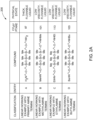
- Figures 2A and 2B show a table 200 of five different working example absorbent compositions, identified as entries A-E, and two control example absorbent compositions, identified as entries F and G.
- the table 200 includes a Classification column that provides a short description of the amino-siloxanes in each absorbent composition; an Entry column that provides a shorthand identifier for each amino-siloxane; a Compound column that shows the molecular structure of the amino-siloxanes, a CO 2 Uptake column that provides a percentage of CO 2 absorbed by each amino-siloxane relative to a calculated theoretical amount of CO 2 that could be absorbed by each amino-siloxane; and a Physical State column that provides a qualitative observation of the phase and/or viscosity of the reaction product or adduct for each amino-siloxane after reacting with CO 2 gas.
- all five of the working example amino-siloxanes are embodiments of the amino-siloxane having structure (I), as described herein, such that the working example amino-siloxanes are linear and/or branched.
- the amino-siloxane of the first working example A has a linear core in which w and y are both 0, and z is 1.
- R 1 at each occurrence is a methyl group
- the spacer R 2 at each occurrence is a propyl group
- R 3 at each occurrence is a hydrogen atom
- R 4 is R 5 having the structure (II)
- the heteroatom X at each occurrence is oxygen. Since R 3 is hydrogen, the amino-siloxane has primary amines at the termini.
- the amino-siloxanes of the second, third, and fourth working examples B, C, and D, respectively, include amino-siloxanes similar to the amino-siloxane of entry A but have secondary amines at the termini instead of primary amines.
- the amino-siloxane B has methylamine groups at the termini
- the amino-siloxane C has ethylamine groups at the termini
- the amino-siloxane D has butylamine groups at the termini.
- the amino-siloxane of the fifth working example E has the tetra-functional branched core shown in structure (Ic) above.
- R 1 at each occurrence is a methyl group
- the spacer R 2 at each occurrence is a propyl group
- R 3 at each occurrence is a butyl group (e.g., a C 4 aliphatic radical)
- the heteroatom X at each occurrence is oxygen.
- the amino-siloxanes of the experimentally-tested absorbent compositions all include oxygen as the heteroatom, it is recognized that sulfur may be used as the heteroatom instead of oxygen in other embodiments.
- the control example amino-siloxanes F and G have linear cores.
- the amino-siloxane F has ethylamine groups at the termini, similar to the working example amino-siloxane C.
- the amino-siloxane G has butylamine groups at the termini, similar to the working examine amino-siloxane D.
- the structures of the working example amino-siloxanes F and G differ from the structures of the amino-siloxanes C and D because the amino-siloxanes F and G lack a heteroatom between a propyl spacer and an ethyl linkage on the functional arms. Instead of the heteroatom, the control example amino-siloxanes F and G have a linear C 6 spacer extending between the siloxane group and the amine group at the terminus.
- the data in the CO 2 Uptake column and Physical State column was obtained experimentally by performing CO 2 uptake testing.
- the working examples and the control example were all subjected to the CO 2 uptake testing under the same experimental conditions.
- the CO 2 uptake testing involved contacting dry CO 2 gas with a known amount (e.g., an amount between 1-10 g) of the respective absorbent compositions or solvent in a reaction flask.
- the CO 2 gas was generated via the sublimation of dry ice and passed through a drying tube (e.g., a CaCl 2 drying tube).
- the mixture was mechanically stirred for a designated time period at a constant temperature.
- the data shown in the table 200 was measured by reacting the absorbent compositions with the CO 2 gas at a temperature of 23 degrees C. In an embodiment, the mixture was mixed at 200 rpm for at least 30 minutes, such as between about 30 minutes and about two hours. All seven of the absorbent compositions tested, including the amino-siloxanes A-G, were substantially free from carrier
- the reaction was considered completed when either a preset elapsed time was reached or a substantially constant weight of the mixture was achieved.
- the reaction flask with the absorbent composition therein was weighed prior to introducing the CO 2 gas into the reaction flask, and the weight of the reaction flask was monitored during the reaction to measure a weight change of the flask.
- the weight gain experienced during the reaction was attributable to the CO 2 that reacted with the absorbent composition.
- the experimental weight gain for each tested absorbent composition was calculated by subtracting the difference between the final and initial weights.
- the experimental weight gain was compared to a theoretical weight gain to determine a CO 2 uptake percentage.
- the theoretical weight gain was calculated based on the initial weight and the molecular weight of the candidate absorbent composition.
- the theoretical weight gain was calculated assuming one mole of CO 2 required two moles of primary or secondary amine for complete reaction.
- the CO 2 uptake percentage was calculated by dividing the difference between the experimental weight gain and the theoretical weight gain by the theoretical weight gain and then multiplying the result by 100. Additionally, the physical state of the reaction product (or adduct) was observed and reported when the reaction was completed, as shown in the Physical State column.
- the results of the solvent tests are shown in table 200.
- the data in table 200 shows that all seven amino-siloxanes A-G, including the control examples, were able to absorb CO 2 .
- there were differences in the observed viscosities of the adducts such that the working example amino-siloxanes B, C and D had lower viscosity adducts than the adducts of the entries A, E, F, and G.
- the amino-siloxanes B, C, and D had secondary amines at the termini, which may have suppressed intermolecular hydrogen bonding interactions, resulting in the lower viscosities.
- the primary amines of the amino-siloxane A may have allowed some intermolecular hydrogen bonding, resulting in the observed thicker, more viscous liquid.
- the thick, flowable liquid adduct of the tetra-functional branched amino-siloxane E may have been caused by intermolecular interactions between the four functional arms of the molecules.
- the control amino-siloxanes F and G had adducts that were thicker and more viscous than the adducts of the similar amino-siloxanes C and D, respectively.
- the presence of the oxygen heteroatoms in the working example amino-siloxanes C and D significantly reduced the viscosity of the CO 2 adducts (e.g., carbamate fluid) relative to the similar control example amino-siloxanes F and G.
- the table 200 also shows that all seven amino-siloxanes were able to absorb CO 2 at percentages from 80% to 115% of the respective theoretical amounts.
- the working example amino-siloxanes B, C, and D and the control example amino-siloxanes F and G showed greater CO 2 uptake percentages than the working example amino-siloxanes A and E, and therefore performed slightly better at CO 2 capture.
- a satisfactory level of CO 2 uptake for a potential application may be any percentage greater than a designated lower limit, such as 60% or 70% of theoretical. In this case, all seven amino-siloxanes exceeded these designated lower limits and therefore would be considered satisfactory for use in the application based on CO 2 uptake.
- the results of the experimental testing show that all five of the working example absorbent compositions and the two control example absorbent compositions were able to absorb CO 2 at satisfactory or desirable levels.
- the working example amino-siloxanes B, C, and D performed better than the other tested amino-siloxanes because the CO 2 adducts had lower viscosities than the CO 2 adducts of the other tested amino-siloxanes, and were readily flowable liquids even without the presence of a co-solvent diluent (e.g., a carrier fluid) in the absorbent compositions.
- a co-solvent diluent e.g., a carrier fluid
- amino-siloxane A 2,2'-(((1,1,3,3,5,5-hexamethyltrisiloxane-1,5-diyl)bis(propane-3,1-diyl))bis(oxy))diethanamine-ethanamine and the preparation is as follows. Cesium carbonate (53 g, 161.2 mmol) was added to a solution of allyl chloride (18.6 g, 242 mmol) and t-butyl(2-hydroxyethyl)carbamate (13 g, 80.6 mmol) in toluene (150 mL) and then the mixture was sparged with N 2 .
- Trifluoroacetic acid 5 mL was added to a solution of di-t-butyl((((1,1,3,3,5,5-hexamethyltrisiiloxane)-1,5-diyl)bis(propane-3,1-diyl))bis(oxy))bis(ethane-2,1-diyl))dicarbamate (4.55 g, 7.45 mmol) in CH 2 Cl 2 (10 mL) at ambient temperature. After 4 h the mixture was concentrated and the residue partitioned between toluene and 1N NaOH. The phases were separated and the organic layer dried over MgSO 4 , filtered and concentrated to give 2.24 g (73%) of product as a light brown oil.
- TFA Trifluoroacetic acid
- amino-siloxane B 2,2'-(((1,1,3,3,5,5-hexamethyltrisiloxane-1,5-diyl)bis(propane-3,1-diyl)bis(oxy))bis(N-methylethanamine) and the preparation is as follows. A solution of 2-allyloxyethanol (45 g, 0.44 mole) in THF (300 mL) was treated with triethylamine (62 mL, 45 mole) followed by para-toluene sulfonyl chloride (84 g, 0.44 mole). The mixture was mechanically stirred at 60 °C for 18 h then cooled to ambient temperature.
- amino-siloxane C 2,2'-(((1,1,3,3,5,5-hexamethyltrisiloxane-1,5-diyl)bis(propane-3,1-diyl))bis(oxy))bis(N-ethylethanamine) and the preparation is as follows. 2-(Allyloxy)ethyl 4-methylbenzenesulfonate (10.0 g, 39 mmol) and ethylamine (2M, 100 mL in THF, 200 mmol) were added together in a pressure bottle and heated at 50 °C for 10 h.
- the compound 2-(allyloxy)-N-ethylethanamine (1.5g, 11.6 mol) was added to a solution of 1,1,3,3-tetramethyldisiloxane (0.67 g, 5.0 mol) in toluene (1 mL) followed by 1 drop of Karstedt's catalyst (4.7% Pt in xylenes).
- the reaction mixture was heated to 60 °C and after 16 h another aliquot of catalyst was added and the heat increased to 85 °C. After 6 more h, the reaction mixture was concentrated and chromatographed on silica get eluting with CHCl 3 then CHCl 3 with 10% (MeOH:NH 4 OH/9:1) to give 0.67 g (34%) chain extended product. ).
- amino-siloxane D N,N'-((((1,1,3,3,5,5-hexamethyltrisiloxane-1,5-diyl)bis(propane-3,1-diyl)bis(oxy))bis(ethane-2,1-diyl)bis(butan-1-amine) and the preparation is as follows. 2-(Allyloxy)ethyl 4-methylbenzenesulfonate (6.4 g, 25 mmol), n-butylamine (25 mL, 252 mmol) and THF (100 mL) were added together and heated at 60 °C for 22 h.
- amino-siloxane E Tetrakis((3-(2-butylamino)ethoxy)propyl)dimethylsilyl) orthosilicate and the preparation is as follows. Tetrakis(dimethylsiloxy)silane (0.70 g, 2.12 mmol) was dissolved in toluene (1 mL) then a solution of 2-allyloxy-N-butylaminoethane (1.5 g, 9.55 mmol) in toluene (1 mL) was added followed by 1 drop of Karstedt's catalyst (4.7% Pt in xylenes). The mixture was heated to 60 °C with an exotherm to 80 °C noted.
- amino-siloxane F 6,6'-(1,1,3,3,5,5-hexamethyltrisiloxane-1,5-diyl)bis(N-ethylhexan-1-amine) and the preparation is as follows. Hexyl-4-methylbenzenesulfonate (11.5 g, 45 mmol), n-ethylamine solution (150 mL, 300 mmol, 2N in THF) were added together and heated at 50 °C for 16 h in a pressure bottle.
- control example amino-siloxane G is 6,6'-(1,1,3,3,5,5-hexamethyltrisiloxane-1,5-diyl)bis(N-butylhexan-1-amine) and the preparation is as follows. Hexyl-4-methylbenzenesulfonate (7.0 g, 27.55 mmol), n-butylamine (25 mL, 252 mmol) and THF (25 mL) were added together and heated at 50 °C for 20 h.
- a structure, composition, or element that is “configured to” perform a task or operation is particularly structurally formed, constructed, or adapted in a manner corresponding to the task or operation.
- an object that is merely capable of being modified to perform the task or operation is not “configured to” perform the task or operation as used herein.
- the use of "configured to” as used herein denotes structural adaptations or characteristics, and denotes structural requirements of any structure, composition, or element that is described as being “configured to” perform the task or operation.
Landscapes
- Chemical & Material Sciences (AREA)
- Engineering & Computer Science (AREA)
- Chemical Kinetics & Catalysis (AREA)
- Health & Medical Sciences (AREA)
- General Chemical & Material Sciences (AREA)
- Analytical Chemistry (AREA)
- Oil, Petroleum & Natural Gas (AREA)
- Environmental & Geological Engineering (AREA)
- Medicinal Chemistry (AREA)
- Polymers & Plastics (AREA)
- Organic Chemistry (AREA)
- Biomedical Technology (AREA)
- Silicon Polymers (AREA)
- Solid-Sorbent Or Filter-Aiding Compositions (AREA)
- Gas Separation By Absorption (AREA)
Claims (9)
- Composition absorbante comprenant un amino-siloxane ayant une structure (Ib) :


- Composition absorbante selon la revendication 1, dans laquelle R3 indépendamment à chaque occurrence comprend l'un parmi un atome d'hydrogène, un groupe méthyle, ou un groupe éthyle.
- Composition absorbante selon la revendication 1, dans laquelle R2 est indépendamment à chaque occurrence un radical aliphatique en C3 sous une forme propyle linéaire ou une forme isopropyle ramifiée.
- Composition absorbante selon la revendication 1, dans laquelle la composition absorbante est sensiblement exempt d'un fluide porteur avec l'amino-siloxane.
- Composition absorbante selon la revendication 1, dans laquelle l'amino-siloxane comprend une structure (Ic) :

- Composition absorbante selon la revendication 1, dans laquelle l'amino-siloxane comprend une structure (Id) :

- Procédé de réduction d'une quantité d'un gaz cible dans un flux de processus comprenant :
la mise en contact du flux de processus contenant le gaz cible avec une composition absorbante comprenant un amino-siloxane ayant une structure (I) :

- Procédé selon la revendication 7, comprenant en outre la fourniture de la composition absorbante de sorte que la composition absorbante comprend l'amino-siloxane et est sensiblement exempt d'un fluide porteur avec l'amino-siloxane.
- Procédé selon la revendication 7, dans lequel le gaz cible est du dioxyde de carbone, le flux de processus venant en contact avec la composition absorbante à une température comprise entre environ 20 degrés Celsius et environ 50 degrés Celsius et formant un produit de réaction qui est sensiblement liquide.
Applications Claiming Priority (1)
| Application Number | Priority Date | Filing Date | Title |
|---|---|---|---|
| PCT/US2017/026289 WO2018186860A1 (fr) | 2017-04-06 | 2017-04-06 | Compositions absorbantes comprenant des amino-siloxanes |
Publications (2)
| Publication Number | Publication Date |
|---|---|
| EP3606643A1 EP3606643A1 (fr) | 2020-02-12 |
| EP3606643B1 true EP3606643B1 (fr) | 2023-08-30 |
Family
ID=58645386
Family Applications (1)
| Application Number | Title | Priority Date | Filing Date |
|---|---|---|---|
| EP17720625.7A Active EP3606643B1 (fr) | 2017-04-06 | 2017-04-06 | Compositions absorbantes comprenant des amino-siloxanes |
Country Status (3)
| Country | Link |
|---|---|
| US (1) | US11400411B2 (fr) |
| EP (1) | EP3606643B1 (fr) |
| WO (1) | WO2018186860A1 (fr) |
Family Cites Families (8)
| Publication number | Priority date | Publication date | Assignee | Title |
|---|---|---|---|---|
| GB1002460A (en) * | 1963-08-09 | 1965-08-25 | Midland Silicones Ltd | Organosilicon polymers |
| GB1062418A (en) * | 1964-01-27 | 1967-03-22 | Ici Ltd | New nitrogen-containing siloxanes |
| US4570010A (en) * | 1983-03-23 | 1986-02-11 | The Upjohn Company | Product |
| US5220033A (en) * | 1990-06-13 | 1993-06-15 | Shin-Etsu Chemical Co., Ltd. | Siloxane compounds and their preparation |
| WO2004044012A1 (fr) * | 2002-11-12 | 2004-05-27 | The Polymer Technology Group Incorporated | Regulation de l'architecture moleculaire de surface polymere au moyen de groupes terminaux amphipathiques |
| US20100154639A1 (en) * | 2008-12-24 | 2010-06-24 | General Electric Company | Liquid carbon dioxide absorbent and methods of using the same |
| US8030509B2 (en) * | 2008-12-24 | 2011-10-04 | General Electric Company | Carbon dioxide absorbent and method of using the same |
| US9310374B2 (en) * | 2012-11-16 | 2016-04-12 | Redwood Bioscience, Inc. | Hydrazinyl-indole compounds and methods for producing a conjugate |
-
2017
- 2017-04-06 EP EP17720625.7A patent/EP3606643B1/fr active Active
- 2017-04-06 WO PCT/US2017/026289 patent/WO2018186860A1/fr not_active Ceased
- 2017-04-06 US US16/499,612 patent/US11400411B2/en active Active
Also Published As
| Publication number | Publication date |
|---|---|
| EP3606643A1 (fr) | 2020-02-12 |
| US11400411B2 (en) | 2022-08-02 |
| WO2018186860A1 (fr) | 2018-10-11 |
| US20200108343A1 (en) | 2020-04-09 |
Similar Documents
| Publication | Publication Date | Title |
|---|---|---|
| AU2010276766B2 (en) | Carbon dioxide absorbent and method of using the same | |
| KR20110018383A (ko) | 이온성 액체 및 이를 사용하는 방법 | |
| EA024501B1 (ru) | Аминсодержащий абсорбент и способ абсорбции кислых газов из газовых смесей | |
| BRPI1007899A2 (pt) | Absorção de co2 de misturas de gás usando uma solução aquosa de 4-amino-2,2,6,6-tetrametil piperidina | |
| US10610826B2 (en) | Method and system for treatment of a gas stream that contains carbon dioxide | |
| Perry et al. | Aminosilicone solvents for CO2 capture | |
| HU218960B (hu) | Abszorbens készítmény savas komponenseket tartalmazó gázok tisztítására és eljárás gázok tisztítására | |
| JPS6312648B2 (fr) | ||
| Yang et al. | Efficient SO 2 capture by amine functionalized PEG | |
| WO2013028391A1 (fr) | Compositions pour absorber le dioxyde de carbone, et procédés et systèmes associés | |
| CN1112852A (zh) | 从燃烧废气中除去二氧化碳的方法 | |
| JP2014522867A (ja) | 気体混合物から硫化水素を除去するためのアミノピリジン誘導体 | |
| RU2735544C2 (ru) | Абсорбирующий раствор на основе гидроксильных производных 1,6-гександиамина и способ удаления кислотных соединений из газообразного отходящего потока | |
| US9221012B2 (en) | Carbon dioxide absorbent and method of using the same | |
| EP3606643B1 (fr) | Compositions absorbantes comprenant des amino-siloxanes | |
| US9919263B2 (en) | Amino-siloxane composition and methods of using the same | |
| DK3102311T3 (en) | CO2 CHEMISTRY BY FUNCTIONALIZED AMINO ACID DERIVATIVES | |
| US20160175770A1 (en) | Method and system for carbon dioxide desorption | |
| US20210106944A1 (en) | Absorbent compositions including amino-siloxanes | |
| Fallah | Absorption capacity of carbon dioxide in aqueous solution of 1, 2-bis (3-aminopropylamino) ethane and Dytek EP diamine: Experimental measurements and simulation with the E-NRTL model | |
| KR20240160343A (ko) | 헤테로고리 음이온을 함유하는 이온성 액체 및 물을 포함하는 이산화탄소 흡수 조성물 및 이를 이용하는 이산화탄소 분리방법 | |
| Ratnakumara | Development of Ionic Liquids for CO2 Absorption |
Legal Events
| Date | Code | Title | Description |
|---|---|---|---|
| STAA | Information on the status of an ep patent application or granted ep patent |
Free format text: STATUS: UNKNOWN |
|
| STAA | Information on the status of an ep patent application or granted ep patent |
Free format text: STATUS: THE INTERNATIONAL PUBLICATION HAS BEEN MADE |
|
| PUAI | Public reference made under article 153(3) epc to a published international application that has entered the european phase |
Free format text: ORIGINAL CODE: 0009012 |
|
| STAA | Information on the status of an ep patent application or granted ep patent |
Free format text: STATUS: REQUEST FOR EXAMINATION WAS MADE |
|
| 17P | Request for examination filed |
Effective date: 20191101 |
|
| AK | Designated contracting states |
Kind code of ref document: A1 Designated state(s): AL AT BE BG CH CY CZ DE DK EE ES FI FR GB GR HR HU IE IS IT LI LT LU LV MC MK MT NL NO PL PT RO RS SE SI SK SM TR |
|
| AX | Request for extension of the european patent |
Extension state: BA ME |
|
| DAV | Request for validation of the european patent (deleted) | ||
| DAX | Request for extension of the european patent (deleted) | ||
| STAA | Information on the status of an ep patent application or granted ep patent |
Free format text: STATUS: EXAMINATION IS IN PROGRESS |
|
| 17Q | First examination report despatched |
Effective date: 20220302 |
|
| REG | Reference to a national code |
Ref legal event code: R079 Ipc: B01D0053620000 Ref country code: DE Ref legal event code: R079 Ref document number: 602017073377 Country of ref document: DE Free format text: PREVIOUS MAIN CLASS: B01D0053140000 Ipc: B01D0053620000 |
|
| GRAP | Despatch of communication of intention to grant a patent |
Free format text: ORIGINAL CODE: EPIDOSNIGR1 |
|
| STAA | Information on the status of an ep patent application or granted ep patent |
Free format text: STATUS: GRANT OF PATENT IS INTENDED |
|
| RIC1 | Information provided on ipc code assigned before grant |
Ipc: C07F 7/08 20060101ALI20230509BHEP Ipc: B01D 53/62 20060101AFI20230509BHEP |
|
| INTG | Intention to grant announced |
Effective date: 20230525 |
|
| P01 | Opt-out of the competence of the unified patent court (upc) registered |
Effective date: 20230526 |
|
| GRAS | Grant fee paid |
Free format text: ORIGINAL CODE: EPIDOSNIGR3 |
|
| GRAA | (expected) grant |
Free format text: ORIGINAL CODE: 0009210 |
|
| STAA | Information on the status of an ep patent application or granted ep patent |
Free format text: STATUS: THE PATENT HAS BEEN GRANTED |
|
| AK | Designated contracting states |
Kind code of ref document: B1 Designated state(s): AL AT BE BG CH CY CZ DE DK EE ES FI FR GB GR HR HU IE IS IT LI LT LU LV MC MK MT NL NO PL PT RO RS SE SI SK SM TR |
|
| REG | Reference to a national code |
Ref country code: GB Ref legal event code: FG4D |
|
| REG | Reference to a national code |
Ref country code: CH Ref legal event code: EP |
|
| REG | Reference to a national code |
Ref country code: DE Ref legal event code: R096 Ref document number: 602017073377 Country of ref document: DE |
|
| REG | Reference to a national code |
Ref country code: IE Ref legal event code: FG4D |
|
| REG | Reference to a national code |
Ref country code: NL Ref legal event code: FP |
|
| REG | Reference to a national code |
Ref country code: NO Ref legal event code: T2 Effective date: 20230830 |
|
| REG | Reference to a national code |
Ref country code: LT Ref legal event code: MG9D |
|
| REG | Reference to a national code |
Ref country code: AT Ref legal event code: MK05 Ref document number: 1604704 Country of ref document: AT Kind code of ref document: T Effective date: 20230830 |
|
| PG25 | Lapsed in a contracting state [announced via postgrant information from national office to epo] |
Ref country code: GR Free format text: LAPSE BECAUSE OF FAILURE TO SUBMIT A TRANSLATION OF THE DESCRIPTION OR TO PAY THE FEE WITHIN THE PRESCRIBED TIME-LIMIT Effective date: 20231201 |
|
| PG25 | Lapsed in a contracting state [announced via postgrant information from national office to epo] |
Ref country code: IS Free format text: LAPSE BECAUSE OF FAILURE TO SUBMIT A TRANSLATION OF THE DESCRIPTION OR TO PAY THE FEE WITHIN THE PRESCRIBED TIME-LIMIT Effective date: 20231230 |
|
| PG25 | Lapsed in a contracting state [announced via postgrant information from national office to epo] |
Ref country code: SE Free format text: LAPSE BECAUSE OF FAILURE TO SUBMIT A TRANSLATION OF THE DESCRIPTION OR TO PAY THE FEE WITHIN THE PRESCRIBED TIME-LIMIT Effective date: 20230830 Ref country code: RS Free format text: LAPSE BECAUSE OF FAILURE TO SUBMIT A TRANSLATION OF THE DESCRIPTION OR TO PAY THE FEE WITHIN THE PRESCRIBED TIME-LIMIT Effective date: 20230830 Ref country code: LV Free format text: LAPSE BECAUSE OF FAILURE TO SUBMIT A TRANSLATION OF THE DESCRIPTION OR TO PAY THE FEE WITHIN THE PRESCRIBED TIME-LIMIT Effective date: 20230830 Ref country code: LT Free format text: LAPSE BECAUSE OF FAILURE TO SUBMIT A TRANSLATION OF THE DESCRIPTION OR TO PAY THE FEE WITHIN THE PRESCRIBED TIME-LIMIT Effective date: 20230830 Ref country code: IS Free format text: LAPSE BECAUSE OF FAILURE TO SUBMIT A TRANSLATION OF THE DESCRIPTION OR TO PAY THE FEE WITHIN THE PRESCRIBED TIME-LIMIT Effective date: 20231230 Ref country code: HR Free format text: LAPSE BECAUSE OF FAILURE TO SUBMIT A TRANSLATION OF THE DESCRIPTION OR TO PAY THE FEE WITHIN THE PRESCRIBED TIME-LIMIT Effective date: 20230830 Ref country code: GR Free format text: LAPSE BECAUSE OF FAILURE TO SUBMIT A TRANSLATION OF THE DESCRIPTION OR TO PAY THE FEE WITHIN THE PRESCRIBED TIME-LIMIT Effective date: 20231201 Ref country code: FI Free format text: LAPSE BECAUSE OF FAILURE TO SUBMIT A TRANSLATION OF THE DESCRIPTION OR TO PAY THE FEE WITHIN THE PRESCRIBED TIME-LIMIT Effective date: 20230830 Ref country code: AT Free format text: LAPSE BECAUSE OF FAILURE TO SUBMIT A TRANSLATION OF THE DESCRIPTION OR TO PAY THE FEE WITHIN THE PRESCRIBED TIME-LIMIT Effective date: 20230830 |
|
| PG25 | Lapsed in a contracting state [announced via postgrant information from national office to epo] |
Ref country code: PL Free format text: LAPSE BECAUSE OF FAILURE TO SUBMIT A TRANSLATION OF THE DESCRIPTION OR TO PAY THE FEE WITHIN THE PRESCRIBED TIME-LIMIT Effective date: 20230830 |
|
| PG25 | Lapsed in a contracting state [announced via postgrant information from national office to epo] |
Ref country code: ES Free format text: LAPSE BECAUSE OF FAILURE TO SUBMIT A TRANSLATION OF THE DESCRIPTION OR TO PAY THE FEE WITHIN THE PRESCRIBED TIME-LIMIT Effective date: 20230830 |
|
| PG25 | Lapsed in a contracting state [announced via postgrant information from national office to epo] |
Ref country code: SM Free format text: LAPSE BECAUSE OF FAILURE TO SUBMIT A TRANSLATION OF THE DESCRIPTION OR TO PAY THE FEE WITHIN THE PRESCRIBED TIME-LIMIT Effective date: 20230830 Ref country code: RO Free format text: LAPSE BECAUSE OF FAILURE TO SUBMIT A TRANSLATION OF THE DESCRIPTION OR TO PAY THE FEE WITHIN THE PRESCRIBED TIME-LIMIT Effective date: 20230830 Ref country code: ES Free format text: LAPSE BECAUSE OF FAILURE TO SUBMIT A TRANSLATION OF THE DESCRIPTION OR TO PAY THE FEE WITHIN THE PRESCRIBED TIME-LIMIT Effective date: 20230830 Ref country code: EE Free format text: LAPSE BECAUSE OF FAILURE TO SUBMIT A TRANSLATION OF THE DESCRIPTION OR TO PAY THE FEE WITHIN THE PRESCRIBED TIME-LIMIT Effective date: 20230830 Ref country code: DK Free format text: LAPSE BECAUSE OF FAILURE TO SUBMIT A TRANSLATION OF THE DESCRIPTION OR TO PAY THE FEE WITHIN THE PRESCRIBED TIME-LIMIT Effective date: 20230830 Ref country code: CZ Free format text: LAPSE BECAUSE OF FAILURE TO SUBMIT A TRANSLATION OF THE DESCRIPTION OR TO PAY THE FEE WITHIN THE PRESCRIBED TIME-LIMIT Effective date: 20230830 Ref country code: PT Free format text: LAPSE BECAUSE OF FAILURE TO SUBMIT A TRANSLATION OF THE DESCRIPTION OR TO PAY THE FEE WITHIN THE PRESCRIBED TIME-LIMIT Effective date: 20240102 Ref country code: SK Free format text: LAPSE BECAUSE OF FAILURE TO SUBMIT A TRANSLATION OF THE DESCRIPTION OR TO PAY THE FEE WITHIN THE PRESCRIBED TIME-LIMIT Effective date: 20230830 |
|
| REG | Reference to a national code |
Ref country code: DE Ref legal event code: R097 Ref document number: 602017073377 Country of ref document: DE |
|
| PLBE | No opposition filed within time limit |
Free format text: ORIGINAL CODE: 0009261 |
|
| STAA | Information on the status of an ep patent application or granted ep patent |
Free format text: STATUS: NO OPPOSITION FILED WITHIN TIME LIMIT |
|
| PG25 | Lapsed in a contracting state [announced via postgrant information from national office to epo] |
Ref country code: SI Free format text: LAPSE BECAUSE OF FAILURE TO SUBMIT A TRANSLATION OF THE DESCRIPTION OR TO PAY THE FEE WITHIN THE PRESCRIBED TIME-LIMIT Effective date: 20230830 |
|
| 26N | No opposition filed |
Effective date: 20240603 |
|
| PG25 | Lapsed in a contracting state [announced via postgrant information from national office to epo] |
Ref country code: BG Free format text: LAPSE BECAUSE OF FAILURE TO SUBMIT A TRANSLATION OF THE DESCRIPTION OR TO PAY THE FEE WITHIN THE PRESCRIBED TIME-LIMIT Effective date: 20230830 |
|
| PG25 | Lapsed in a contracting state [announced via postgrant information from national office to epo] |
Ref country code: MC Free format text: LAPSE BECAUSE OF FAILURE TO SUBMIT A TRANSLATION OF THE DESCRIPTION OR TO PAY THE FEE WITHIN THE PRESCRIBED TIME-LIMIT Effective date: 20230830 |
|
| PG25 | Lapsed in a contracting state [announced via postgrant information from national office to epo] |
Ref country code: MC Free format text: LAPSE BECAUSE OF FAILURE TO SUBMIT A TRANSLATION OF THE DESCRIPTION OR TO PAY THE FEE WITHIN THE PRESCRIBED TIME-LIMIT Effective date: 20230830 Ref country code: BG Free format text: LAPSE BECAUSE OF FAILURE TO SUBMIT A TRANSLATION OF THE DESCRIPTION OR TO PAY THE FEE WITHIN THE PRESCRIBED TIME-LIMIT Effective date: 20230830 |
|
| REG | Reference to a national code |
Ref country code: CH Ref legal event code: PL |
|
| PG25 | Lapsed in a contracting state [announced via postgrant information from national office to epo] |
Ref country code: LU Free format text: LAPSE BECAUSE OF NON-PAYMENT OF DUE FEES Effective date: 20240406 |
|
| REG | Reference to a national code |
Ref country code: BE Ref legal event code: MM Effective date: 20240430 |
|
| PG25 | Lapsed in a contracting state [announced via postgrant information from national office to epo] |
Ref country code: LU Free format text: LAPSE BECAUSE OF NON-PAYMENT OF DUE FEES Effective date: 20240406 |
|
| PG25 | Lapsed in a contracting state [announced via postgrant information from national office to epo] |
Ref country code: BE Free format text: LAPSE BECAUSE OF NON-PAYMENT OF DUE FEES Effective date: 20240430 |
|
| PG25 | Lapsed in a contracting state [announced via postgrant information from national office to epo] |
Ref country code: FR Free format text: LAPSE BECAUSE OF NON-PAYMENT OF DUE FEES Effective date: 20240430 |
|
| PG25 | Lapsed in a contracting state [announced via postgrant information from national office to epo] |
Ref country code: FR Free format text: LAPSE BECAUSE OF NON-PAYMENT OF DUE FEES Effective date: 20240430 Ref country code: BE Free format text: LAPSE BECAUSE OF NON-PAYMENT OF DUE FEES Effective date: 20240430 Ref country code: CH Free format text: LAPSE BECAUSE OF NON-PAYMENT OF DUE FEES Effective date: 20240430 |
|
| PG25 | Lapsed in a contracting state [announced via postgrant information from national office to epo] |
Ref country code: IE Free format text: LAPSE BECAUSE OF NON-PAYMENT OF DUE FEES Effective date: 20240406 |
|
| PGFP | Annual fee paid to national office [announced via postgrant information from national office to epo] |
Ref country code: DE Payment date: 20250321 Year of fee payment: 9 |
|
| PG25 | Lapsed in a contracting state [announced via postgrant information from national office to epo] |
Ref country code: CY Free format text: LAPSE BECAUSE OF FAILURE TO SUBMIT A TRANSLATION OF THE DESCRIPTION OR TO PAY THE FEE WITHIN THE PRESCRIBED TIME-LIMIT; INVALID AB INITIO Effective date: 20170406 |
|
| PG25 | Lapsed in a contracting state [announced via postgrant information from national office to epo] |
Ref country code: HU Free format text: LAPSE BECAUSE OF FAILURE TO SUBMIT A TRANSLATION OF THE DESCRIPTION OR TO PAY THE FEE WITHIN THE PRESCRIBED TIME-LIMIT; INVALID AB INITIO Effective date: 20170406 |
|
| PG25 | Lapsed in a contracting state [announced via postgrant information from national office to epo] |
Ref country code: TR Free format text: LAPSE BECAUSE OF FAILURE TO SUBMIT A TRANSLATION OF THE DESCRIPTION OR TO PAY THE FEE WITHIN THE PRESCRIBED TIME-LIMIT Effective date: 20230830 |
|
| PGFP | Annual fee paid to national office [announced via postgrant information from national office to epo] |
Ref country code: GB Payment date: 20260319 Year of fee payment: 10 |
|
| PGFP | Annual fee paid to national office [announced via postgrant information from national office to epo] |
Ref country code: NO Payment date: 20260320 Year of fee payment: 10 |
|
| PGFP | Annual fee paid to national office [announced via postgrant information from national office to epo] |
Ref country code: IT Payment date: 20260319 Year of fee payment: 10 |
|
| PGFP | Annual fee paid to national office [announced via postgrant information from national office to epo] |
Ref country code: NL Payment date: 20260319 Year of fee payment: 10 |