EP3606967B1 - Dimethyl-silyl-verbrückte 1-phenyl-2-indenylmetallocenkomplexe zur olefinpolymerisierung - Google Patents
Dimethyl-silyl-verbrückte 1-phenyl-2-indenylmetallocenkomplexe zur olefinpolymerisierung Download PDFInfo
- Publication number
- EP3606967B1 EP3606967B1 EP18716994.1A EP18716994A EP3606967B1 EP 3606967 B1 EP3606967 B1 EP 3606967B1 EP 18716994 A EP18716994 A EP 18716994A EP 3606967 B1 EP3606967 B1 EP 3606967B1
- Authority
- EP
- European Patent Office
- Prior art keywords
- phenyl
- methyl
- metallocene complex
- ethyl
- complex according
- Prior art date
- Legal status (The legal status is an assumption and is not a legal conclusion. Google has not performed a legal analysis and makes no representation as to the accuracy of the status listed.)
- Active
Links
- 0 C[C@@](C([C@](*1)[C@@]1Cl)C1=CI=CC=C1)C(C=CC)=C Chemical compound C[C@@](C([C@](*1)[C@@]1Cl)C1=CI=CC=C1)C(C=CC)=C 0.000 description 3
Classifications
-
- C—CHEMISTRY; METALLURGY
- C08—ORGANIC MACROMOLECULAR COMPOUNDS; THEIR PREPARATION OR CHEMICAL WORKING-UP; COMPOSITIONS BASED THEREON
- C08F—MACROMOLECULAR COMPOUNDS OBTAINED BY REACTIONS ONLY INVOLVING CARBON-TO-CARBON UNSATURATED BONDS
- C08F210/00—Copolymers of unsaturated aliphatic hydrocarbons having only one carbon-to-carbon double bond
- C08F210/16—Copolymers of ethene with alpha-alkenes, e.g. EP rubbers
-
- C—CHEMISTRY; METALLURGY
- C07—ORGANIC CHEMISTRY
- C07F—ACYCLIC, CARBOCYCLIC OR HETEROCYCLIC COMPOUNDS CONTAINING ELEMENTS OTHER THAN CARBON, HYDROGEN, HALOGEN, OXYGEN, NITROGEN, SULFUR, SELENIUM OR TELLURIUM
- C07F17/00—Metallocenes
-
- C—CHEMISTRY; METALLURGY
- C08—ORGANIC MACROMOLECULAR COMPOUNDS; THEIR PREPARATION OR CHEMICAL WORKING-UP; COMPOSITIONS BASED THEREON
- C08F—MACROMOLECULAR COMPOUNDS OBTAINED BY REACTIONS ONLY INVOLVING CARBON-TO-CARBON UNSATURATED BONDS
- C08F2410/00—Features related to the catalyst preparation, the catalyst use or to the deactivation of the catalyst
- C08F2410/01—Additive used together with the catalyst, excluding compounds containing Al or B
-
- C—CHEMISTRY; METALLURGY
- C08—ORGANIC MACROMOLECULAR COMPOUNDS; THEIR PREPARATION OR CHEMICAL WORKING-UP; COMPOSITIONS BASED THEREON
- C08F—MACROMOLECULAR COMPOUNDS OBTAINED BY REACTIONS ONLY INVOLVING CARBON-TO-CARBON UNSATURATED BONDS
- C08F2420/00—Metallocene catalysts
- C08F2420/01—Cp or analog bridged to a non-Cp X neutral donor
-
- C—CHEMISTRY; METALLURGY
- C08—ORGANIC MACROMOLECULAR COMPOUNDS; THEIR PREPARATION OR CHEMICAL WORKING-UP; COMPOSITIONS BASED THEREON
- C08F—MACROMOLECULAR COMPOUNDS OBTAINED BY REACTIONS ONLY INVOLVING CARBON-TO-CARBON UNSATURATED BONDS
- C08F4/00—Polymerisation catalysts
- C08F4/42—Metals; Metal hydrides; Metallo-organic compounds; Use thereof as catalyst precursors
- C08F4/44—Metals; Metal hydrides; Metallo-organic compounds; Use thereof as catalyst precursors selected from light metals, zinc, cadmium, mercury, copper, silver, gold, boron, gallium, indium, thallium, rare earths or actinides
- C08F4/60—Metals; Metal hydrides; Metallo-organic compounds; Use thereof as catalyst precursors selected from light metals, zinc, cadmium, mercury, copper, silver, gold, boron, gallium, indium, thallium, rare earths or actinides together with refractory metals, iron group metals, platinum group metals, manganese, rhenium technetium or compounds thereof
- C08F4/62—Refractory metals or compounds thereof
- C08F4/639—Component covered by group C08F4/62 containing a transition metal-carbon bond
- C08F4/6392—Component covered by group C08F4/62 containing a transition metal-carbon bond containing at least one cyclopentadienyl ring, condensed or not, e.g. an indenyl or a fluorenyl ring
- C08F4/63922—Component covered by group C08F4/62 containing a transition metal-carbon bond containing at least one cyclopentadienyl ring, condensed or not, e.g. an indenyl or a fluorenyl ring containing at least two cyclopentadienyl rings, fused or not
- C08F4/63927—Component covered by group C08F4/62 containing a transition metal-carbon bond containing at least one cyclopentadienyl ring, condensed or not, e.g. an indenyl or a fluorenyl ring containing at least two cyclopentadienyl rings, fused or not two cyclopentadienyl rings being mutually bridged
-
- C—CHEMISTRY; METALLURGY
- C08—ORGANIC MACROMOLECULAR COMPOUNDS; THEIR PREPARATION OR CHEMICAL WORKING-UP; COMPOSITIONS BASED THEREON
- C08F—MACROMOLECULAR COMPOUNDS OBTAINED BY REACTIONS ONLY INVOLVING CARBON-TO-CARBON UNSATURATED BONDS
- C08F4/00—Polymerisation catalysts
- C08F4/42—Metals; Metal hydrides; Metallo-organic compounds; Use thereof as catalyst precursors
- C08F4/44—Metals; Metal hydrides; Metallo-organic compounds; Use thereof as catalyst precursors selected from light metals, zinc, cadmium, mercury, copper, silver, gold, boron, gallium, indium, thallium, rare earths or actinides
- C08F4/60—Metals; Metal hydrides; Metallo-organic compounds; Use thereof as catalyst precursors selected from light metals, zinc, cadmium, mercury, copper, silver, gold, boron, gallium, indium, thallium, rare earths or actinides together with refractory metals, iron group metals, platinum group metals, manganese, rhenium technetium or compounds thereof
- C08F4/62—Refractory metals or compounds thereof
- C08F4/64—Titanium, zirconium, hafnium or compounds thereof
-
- C—CHEMISTRY; METALLURGY
- C08—ORGANIC MACROMOLECULAR COMPOUNDS; THEIR PREPARATION OR CHEMICAL WORKING-UP; COMPOSITIONS BASED THEREON
- C08F—MACROMOLECULAR COMPOUNDS OBTAINED BY REACTIONS ONLY INVOLVING CARBON-TO-CARBON UNSATURATED BONDS
- C08F4/00—Polymerisation catalysts
- C08F4/42—Metals; Metal hydrides; Metallo-organic compounds; Use thereof as catalyst precursors
- C08F4/44—Metals; Metal hydrides; Metallo-organic compounds; Use thereof as catalyst precursors selected from light metals, zinc, cadmium, mercury, copper, silver, gold, boron, gallium, indium, thallium, rare earths or actinides
- C08F4/60—Metals; Metal hydrides; Metallo-organic compounds; Use thereof as catalyst precursors selected from light metals, zinc, cadmium, mercury, copper, silver, gold, boron, gallium, indium, thallium, rare earths or actinides together with refractory metals, iron group metals, platinum group metals, manganese, rhenium technetium or compounds thereof
- C08F4/62—Refractory metals or compounds thereof
- C08F4/64—Titanium, zirconium, hafnium or compounds thereof
- C08F4/659—Component covered by group C08F4/64 containing a transition metal-carbon bond
- C08F4/65908—Component covered by group C08F4/64 containing a transition metal-carbon bond in combination with an ionising compound other than alumoxane, e.g. (C6F5)4B-X+
-
- C—CHEMISTRY; METALLURGY
- C08—ORGANIC MACROMOLECULAR COMPOUNDS; THEIR PREPARATION OR CHEMICAL WORKING-UP; COMPOSITIONS BASED THEREON
- C08F—MACROMOLECULAR COMPOUNDS OBTAINED BY REACTIONS ONLY INVOLVING CARBON-TO-CARBON UNSATURATED BONDS
- C08F4/00—Polymerisation catalysts
- C08F4/42—Metals; Metal hydrides; Metallo-organic compounds; Use thereof as catalyst precursors
- C08F4/44—Metals; Metal hydrides; Metallo-organic compounds; Use thereof as catalyst precursors selected from light metals, zinc, cadmium, mercury, copper, silver, gold, boron, gallium, indium, thallium, rare earths or actinides
- C08F4/60—Metals; Metal hydrides; Metallo-organic compounds; Use thereof as catalyst precursors selected from light metals, zinc, cadmium, mercury, copper, silver, gold, boron, gallium, indium, thallium, rare earths or actinides together with refractory metals, iron group metals, platinum group metals, manganese, rhenium technetium or compounds thereof
- C08F4/62—Refractory metals or compounds thereof
- C08F4/64—Titanium, zirconium, hafnium or compounds thereof
- C08F4/659—Component covered by group C08F4/64 containing a transition metal-carbon bond
- C08F4/65912—Component covered by group C08F4/64 containing a transition metal-carbon bond in combination with an organoaluminium compound
-
- C—CHEMISTRY; METALLURGY
- C08—ORGANIC MACROMOLECULAR COMPOUNDS; THEIR PREPARATION OR CHEMICAL WORKING-UP; COMPOSITIONS BASED THEREON
- C08F—MACROMOLECULAR COMPOUNDS OBTAINED BY REACTIONS ONLY INVOLVING CARBON-TO-CARBON UNSATURATED BONDS
- C08F4/00—Polymerisation catalysts
- C08F4/42—Metals; Metal hydrides; Metallo-organic compounds; Use thereof as catalyst precursors
- C08F4/44—Metals; Metal hydrides; Metallo-organic compounds; Use thereof as catalyst precursors selected from light metals, zinc, cadmium, mercury, copper, silver, gold, boron, gallium, indium, thallium, rare earths or actinides
- C08F4/60—Metals; Metal hydrides; Metallo-organic compounds; Use thereof as catalyst precursors selected from light metals, zinc, cadmium, mercury, copper, silver, gold, boron, gallium, indium, thallium, rare earths or actinides together with refractory metals, iron group metals, platinum group metals, manganese, rhenium technetium or compounds thereof
- C08F4/62—Refractory metals or compounds thereof
- C08F4/64—Titanium, zirconium, hafnium or compounds thereof
- C08F4/659—Component covered by group C08F4/64 containing a transition metal-carbon bond
- C08F4/65916—Component covered by group C08F4/64 containing a transition metal-carbon bond supported on a carrier, e.g. silica, MgCl2, polymer
Definitions
- the invention relates to substituted 2-indenyl metallocene complexes, a catalyst comprising a substituted 2-indenyl metallocene complex, a process for the preparation of a ligand, a process for the preparation of olefin polymers in the presence of substituted 2-indenyl metallocene complexes, the use of the olefin polymers for making articles and articles comprising an olefin polymer.
- Metallocene complexes together with a cocatalyst form catalysts that are widely used for olefin polymerization are described to have only one type of active species in the polymerization and are often mentioned to be single site catalysts or alternatively single-center catalysts. This terminology is often used to distinguish metallocene based catalysts from heterogeneous Ziegler-Natta type catalysts, which contain multiple active species. The presence of one type of active site is believed to result in polymers having a narrow molecular weight distribution (MWD) and in the case of copolymers result in a narrow comonomer composition distribution (CCD).
- MWD molecular weight distribution
- CCD narrow comonomer composition distribution
- metallocene catalysts are their high activity and well-defined structures compared to traditional Ziegler-Natta catalysts.
- a general feature of metallocene catalysts is that they contain two cyclopentadienyl based ligands, which can be linked together by a connecting moiety, often referred to as a bridging moiety or bridge.
- WO2014/099307 describes metallocene catalysts for the polymerization of ethylene to branched polyethylene made using Me 2 Si (2,3,4,5 tetramethyl-1-cyclopentadienyl)(3-phenyl-1-indenyl zirconiumdichloride
- WO94/11406 discloses 2-indenyl complexes for olefin polymerization.
- WO2015/065681 describes metallocenes having a bridged ligand system containing a 1-indenyl moiety, having an aryl substituent on the 4 position and an hydrocarbyl group on the 2-position of the 1-indenyl.
- US2015/0119539 describes metallocenes having a (2-alkyl-4-aryl-1-indenyl) connected via Me 2 Si bridge to a tetramethyl-cyclopentadienyl ligand.
- the aryl ligand is attached to the aromatic 6-ring of the indenyl ligand, specifically on the 4 position.
- WO2014/099303 describes metallocenes having a Me 2 Si-bridged (3-aryl-1-indenyl-tetramethylcyclopentadienyl) ligand system.
- US20140179884 describes metallocenes containing Me 2 Si bridged tetramethylcyclopentadienyl 3-aryl-1-indenyl systems.
- JP2001302687A describes dimethylsilylene-(1-(2-alkyl-4,5-benzoindenyl),(2-indenyl) zirconium dichloride, where the alkyl is methyl, ethyl or butyl.
- a new family of metallocene complexes has now been discovered which advantageously can be used for olefin polymerization, preferably for ethylene copolymerization, and which gives at least one advantage of a higher catalyst activity, a higher alfa olefin (for example 1-hexene) incorporation and/or a high molecular weight polymer.
- the invention relates to a metallocene complex according to formula A
- the invention relates to a metallocene complex according to formula I,
- the metallocene complex according to the invention surprisingly can copolymerize ethylene with alfa olefins in a high yield with a very high alfa olefin incorporation, and/or a very high molecular weight.
- This copolymerization can take place in the presence of a cocatalyst and under suitable polymerization conditions.
- the metallocene complex according to the present invention has the general structure according to formula A:
- R0 may be a phenyl group.
- the metallocene complex according to the present invention has the general structure according to formula I:
- M is zirconium or hafnium.
- M is connected to 2 monovalent anionic groups, selected from the group consisting of halogen (F, Cl, Br or I), a C1-C20 hydrocarbyl group or a C1-C20 alkoxy group.
- halogen F, Cl, Br or I
- X is a methyl group, Cl, Br or I, most preferably methyl or Cl.
- the metallocene complex comprises a 1-aryl substituted 2-indenyl group which is bridged through a disubstituted alkyl-silyl bridge to a 1-indenyl group, which 1-indenyl group is preferably substituted with one or more substituents.
- the Ar group at the 1 position of the 2-indenyl group is preferably a C6-C24 aryl group, more preferably a substituted or unsubstituted phenyl group, most preferably a phenyl group.
- R7-R10 are independently selected from H, methyl, ethyl and methoxy, more preferably R7-R10 are H.
- the 2-indenyl and 1-indenyl group are preferably coupled through an dihydrocarbyl substituted silyl bridge. More preferably the dihydrocarbyl substituted silyl bridge is a dimethylsilyl bridge, which means that R11 is a methyl group.
- the 1-indenyl group can contain substituents independently selected from C1-C10 alkyl, C6-C20 aryl, C7-C20 aralkyl groups, and C1-C10 alkoxygroups, wherein R1 and R2, R3 and R4, R4 and R5, or R5 and R6 can be connected to form a ring structure.
- R5 and R6 are H atoms.
- R1 is selected from H, methyl, ethyl, and isopropyl.
- R1 is other than H, preferably R2 is H.
- R1 may be selected from methyl, ethyl, and isopropyl.
- R2 may for example be selected from H, methyl, ethyl, isopropyl, phenyl, 2-methyl-1-phenyl, 3,5-dialkyl-1-phenyl, preferably 3,5-dimethyl-1-phenyl, 3,5-diethyl-1-phenyl, 3,5-diisopropyl-1-phenyl or 3,5-ditertiairbutyl-1-phenyl.
- R2 is selected from H, methyl, ethyl, phenyl, 2-methyl-1-phenyl, 3,5-dialkyl-1-phenyl, preferably 3,5-dimethyl-1-phenyl, 3,5-diethyl-1-phenyl, 3,5-diisopropyl-1-phenyl or 3,5-ditertiairbutyl-1-phenyl.
- R2 may be selected from H, methyl, ethyl, isopropyl or phenyl.
- R2 is selected from H, methyl, ethyl and phenyl.
- R1 is preferably a H.
- R2 may be selected from methyl, ethyl, isopropyl or phenyl.
- R2 may be selected from methyl, ethyl or isopropyl.
- R1 is selected from methyl, ethyl and isopropyl, and R2 is H. In another exemplary embodiment, R1 is methyl and R2 is H. In another exemplary embodiment, R1 is ethyl and R2 is H. In another exemplary embodiment, R1 is isopropyl and R2 is H.
- R1 is H and R2 is selected from methyl, ethyl, isopropyl and phenyl. In another exemplary embodiment, R1 is H and R2 is methyl. In another exemplary embodiment, R1 is H and R2 is ethyl. In another exemplary embodiment, R1 is H and R2 is isopropyl. In another exemplary embodiment, R1 is H and R2 is phenyl.
- R3 and R4 are each selected from H, methyl, ethyl or they can form a fused ring together with the atoms to which they are bound, preferably a 5 or 6 membered aliphatic or aromatic ring-structure.
- the catalysts show an increase in molecular weight of the resulting polymer (Mn and Mw) as compared to the unsubstituted analog.
- R2 is a phenyl group
- the activity and comonomer reactivity increase relative to the unsubstituted analog.
- metallocene complexes with R1 is methyl, ethyl, isopropyl and/or R2 is selected from methyl, ethyl, phenyl group and R3, R4, R5 and R6 are H are very active in ethylene alfa-olefin copolymerization and show a good alfa olefin incorporation, high molecular weight and increase in activity when an alfa-olefin monomer is present.
- the metallocene complexes are selected from the group consisting of:
- the metallocene complex can be immobilized on a support.
- the support is preferably an inert support, more preferably a porous inert support.
- porous inert supports materials are talc, clays and inorganic oxides.
- the support material is in a finely divided form.
- Suitable inorganic oxide materials include group 2A, 3A, 4A and 4B metal oxides such as silica, alumina and mixtures thereof.
- Other inorganic oxides that may be employed either alone or in combination with the silica or alumina are magnesia, titania, zirconia and the like.
- Other support materials can be employed, for example finely divided functionalized polyolefins such as finely divided polyethylene.
- the support is a silica having a surface area between 200 and 900 m 2 /g and a pore volume between 0.5 and 4 ml/g.
- the invention is also directed to a catalyst prepared from the metallocene complex according to the invention and a cocatalyst.
- the cocatalyst should be capable to generate a cationic specie from the metallocene compound and form a so-called non- or weakly coordinating anion.
- Suitable cocatalysts include aluminium- or boron-containing cocatalysts.
- Suitable aluminium-containing cocatalysts comprise aluminoxanes, alkyl aluminium compounds and aluminium-alkyl-chlorides.
- aluminoxanes usable according to the present invention are well known and preferably comprise oligomeric linear and/or cyclic and/or cage-like alkyl aluminoxanes represented by the formula: R 3 - (AlR 3 -O) n - AlR 3 2 for oligomeric, linear aluminoxanes and (- AlR 3 - O -) m for oligomeric, cyclic aluminoxanes; wherein n is 1-40, preferably n is 10-30; m is 3-40, preferably m is 3-30 and R 3 is a C 1 to C 8 alkyl group and preferably a methyl group.
- organoaluminum compounds can be used such as trimethylaluminum, triethylaluminium, triisopropylaluminum, tri-n-propylaluminum, triisobutylaluminum, tri-n-butylaluminum, triamylaluminium; dimethylaluminium ethoxide, diethylaluminium ethoxide, diisopropylaluminium ethoxide, di-n-propylaluminium ethoxide, diisobutylaluminium ethoxide and di-n-butylaluminium ethoxide; dimethylaluminium hydride, diethylaluminium hydride, diisopropylaluminium hydride, di-n-propylaluminium hydride, diisobutylaluminium hydride and di-n-butylaluminium hydride.
- Suitable boron-containing cocatalysts include trialkylboranes, for example trimethylborane or triethylborane and/or perfluoroarylborane and/or perfluoroarylborate-compounds.
- olefin polymers by polymerizing one or more olefins in the presence of a metallocene complex preferably an organoaluminum cocatalyst and/or a perfluoroborate cocatalyst is present.
- methylaluminoxane, trialkylboranes, perfluoroarylboranes or perfluoroarylborates are used as the cocatalyst.
- the invention relates to a process for the preparation of olefin polymers by polymerizing one or more olefins in the presence of a cocatalyst and the metallocene complex of the invention, wherein the metallocene complex optionally is immobilized on a support.
- the process to produce the olefin polymers may start with the reaction of the metallocene complex according to the invention with the cocatalyst.
- This reaction can be performed in the same vessel as the reaction vessel wherein the olefin polymers are produced or in a separate vessel, whereafter the mixture of the metallocene complex and the cocatalyst is fed to the reaction vessel.
- an inert solvent can be used.
- the polymerization can be adequately carried out in a slurry process, a solution process or a gasphase process.
- the cocatalyst is used in an amount of 10 to 100,000 mol, preferably from 10 to 10,000 mol per mol of the transition metal compound.
- the cocatalyst is used in an amount of 0,1 to 100 mol, preferably from 0,5 to 100 mol per mol of the transition metal compound.
- the solvent used in a slurry process to produce olefin polymers may be any organic solvent usually used for the polymerization.
- solvents are benzene, toluene, xylene, propane, butane, pentane, hexane, heptane, cyclohexane and methylene chloride.
- the olefin to be polymerized can be used as the solvent.
- the polymerization conditions like for example temperature, time, pressure, monomer concentration can be chosen within wide limits.
- the polymerization temperature is in the range from -100 to 300 °C, preferably 0 to 200 °C, more preferably 50 to 200 °C.
- the polymerization time is in the range of from 10 seconds to 20 hours, preferably from 1 minute to 10 hours, more preferably from 5 minutes to 5 hours.
- the ethylene pressure during polymerization is in the range from 1 to 3500 bar, preferably from 1 to 2500 bar, more preferably from 1 to 1000 bar, even more preferably from 1 to 500 bar, most preferably from 1 to 100 bar.
- the molecular weight of the polymer can be controlled by use of hydrogen in the polymerization.
- the polymerization may be conducted by a batch process, a semi-continuous process or a continuous process and may also be conducted in two or more steps of different polymerization conditions.
- the polyolefin produced is separated from the polymerization solvent and dried by methods known to a person skilled in the art.
- the olefin which is polymerized can be one type of olefin or can be mixtures of different olefins.
- the polymerization thus includes homopolymerization and copolymerization.
- olefins examples include ⁇ -olefins such as ethylene, propylene, 1-butene, 1-pentene, 4-methyl-1-pentene, 1-hexene, 1-octene, 1-nonene, 1-decene ; conjugated and non-conjugated dienes such as butadiene, 1,4-hexadiene, 5-ethylidene-2-norbornene, dicyclopentadiene, 4-methyl-1,4-hexadiene and 7-methyl-1,6-octadiene; cyclic olefins such as cyclobutene and other olefinic compounds such as isobutene, vinyl-cyclohexane and styrene but is not limited thereto.
- ⁇ -olefins such as ethylene, propylene, 1-butene, 1-pentene, 4-methyl-1-pentene, 1-hexene, 1-octene, 1-nonene,
- At least one of the olefins that is polymerized is ethylene. More preferably, a mixture of ethylene and at least one comonomer of 3 or more carbon atoms is polymerized.
- the comonomerof 3 or more carbon atoms is chosen from 1-butene, 1-hexene, 1-octene, vinylcyclohexane or 4-methyl-1-pentene.
- the olefin comonomer is present in an amount of about 5 to about 50 percent by weight of the ethylene-olefin copolymer, more preferably an amount of from about 7 to about 40 percent by weight of the ethylene ⁇ -olefin copolymer.
- a linear low density polyethylene (LLDPE) having a melt mass flow rate (also known as melt flow index) as determined using ASTM D1238-10 (190°C/2.16 kg) which ranges from 0.5 to 125 g/10 min and a density in the range from 900 kg/m 3 to less than 940 kg/m 3 as determined using ASTM D1505-10 may be obtained.
- the density of the LLDPE ranges from about 915 kg/m 3 to less than 940 kg/m 3 , for example between 915 and 925 kg/m 3 .
- the melt flow index of the LLDPE ranges from 0.3 to 3 g/10min.
- the polymerisation may be performed via a gas phase process, via a slurry process or via a solution process.
- the production processes of polyethylene are summarised in " Handbook of Polyethylene” by Andrew Peacock (2000; Dekker; ISBN 0824795466) at pages 43-66 .
- the various processes may be divided into solution polymerisation processes employing homogeneous (soluble) catalysts and processes employing supported (heterogeneous) catalysts.
- the latter processes include both slurry and gas phase processes.
- a so-called continuity agent or anti-static agent or anti-fouling agent may be added to reactor.
- impurity scavenger When employing the metallocene catalysts in the polymerization of olefins, a so-called impurity scavenger may be added to the reactor.
- Suitable impurity scavengers are organometal compounds, like alkyl aluminium or alkyl magnesium compounds.
- the invention is also directed to a polyolefin, for example polyethylene, preferably high density polyethylene (HDPE) obtainable or obtained by the process of the invention, for example by copolymerizing ethylene and at least one other olefin in the presence of a metallocene complex according to the invention or a composition, wherein the metallocene complex according to the invention is immobilized on a support.
- a polyolefin for example polyethylene, preferably high density polyethylene (HDPE) obtainable or obtained by the process of the invention, for example by copolymerizing ethylene and at least one other olefin in the presence of a metallocene complex according to the invention or a composition, wherein the metallocene complex according to the invention is immobilized on a support.
- a polyolefin for example polyethylene, preferably high density polyethylene (HDPE) obtainable or obtained by the process of the invention, for example by copolymerizing ethylene and at least one other olefin in the
- linear means that the polymer is substantially linear, but may contain some long chain branching.
- LLB Long chain branching
- metallocene complex of the invention or with the composition of the invention wherein the metallocene complex of the invention is present on a support, it is possible to produce polyethylene from ethylene and at least one other olefin, for example an olefin having up to 8 carbon atoms, with a high incorporation of the at least one other olefin.
- the amount of incorporation of the at least one other olefin, for example an ⁇ -olefin in the polyethylene is expressed by the amount of branches per 1000 carbon atoms.
- the invention also relates to a polyolefin, preferably polyethylene, for example linear low density polyethylene (LLDPE).
- the low density polyethylene for example LLDPE, preferably has an amount of branches per 1000 carbon atoms as determined using 13 C NMR of at least 18, for example of at least 19, for example at least 20 and/or for example at most 30, for example at most 25, for example at most 23, for example at most 21.
- the number average molecular weight (Mn) of the polyolefin, for example polyethylene, for example LLDPE of the invention may vary between wide ranges and may for example be in the range from 1000 to 200000 Da.
- the Mn of the polyolefin of the invention may be at least 1500, for example at least 2000, for example at least 20,000, for example at least 50,000 and/or for example at most 150,000, for example at most 110,000, for example at most 100,000, for example at most 70,000 Da.
- the weight average molecular weight (Mw) of the polyolefin, for example polyethylene, for example LLDPE of the invention may also vary between wide ranges and may for example be in the range from 1500 to 500000.
- the Mw of the polyolefin of the invention may be at least 2500, for example at least 10,000, for example at least 50,000, for example at least 100,000 and/or for example at most 400,000, for example at least 350,000, for example at most 300,000, for example at most 250,000.
- the Mw and Mn are determined using SEC (Size Exclusion Chromatography) using 1,2,4-trichlorobenzene or o-dichlorobenzene as an eluent, and calibrated using linear polyethylene or polystyrene standards.
- the molecular weight distribution (that is Mw/Mn) of the polyolefin of the invention may for example vary from 2 to 5, from 2.1 to 4 or from 2.5 to 3.5.
- the polyolefin obtained or obtainable by the process of the invention may be mixed with suitable additives.
- suitable additives for polyethylene include but are not limited to the additives usually used for polyethylene, for example antioxidants, nucleating agents, acid scavengers, processing aids, lubricants, surfactants, blowing agents, ultraviolet light absorbers, quenchers, antistatic agents, slip agents, anti-blocking agents, antifogging agents, pigments, dyes and fillers, and cure agents such as peroxides.
- the additives may be present in the typically effective amounts well known in the art, such as 0.001 weight % to 10 weight % based on the total composition.
- the polyolefins of the invention and compositions comprising said polyolefins may suitably be used for the manufacture of articles.
- the polyolefins and compositions of the invention may be manufactured into film, for example by compounding, extrusion, film blowing or casting or other methods of film formation to achieve, for example uniaxial or biaxial orientation.
- films include blown or cast films formed by coextrusion (to form multilayer films) or by lamination and may be useful as films for packaging, for example as shrink film, cling film, stretch film, sealing films, oriented films, snack packaging, heavy duty bags, grocery sacks, baked and frozen food packaging, medical packaging, industrial liners, membranes, etc. in food-contact and non-food contact applications, agricultural films and sheets.
- the invention also relates to articles comprising the polyolefins obtainable by the process of the invention.
- the invention also relates to use of the polyolefins obtainable by the process of the invention for the preparation of articles, for example for the preparation of films.
- the invention relates to a process for the preparation of articles using the polyolefin according to the invention.
- n-Butyllitium in hexanes (1 equiv) was added dropwise to a solution of the respective indene (1 equiv) in dry ether at room temperature, and the formed mixture was stirred overnight.
- the desired chlorosilane (1 equiv) was added at -80°C, the obtained mixture was allowed to warm slowly to room temperature and stirred overnight.
- the resulting mixture was poured into water, the organic layer was separated, and the aqueous layer was extracted with ether.
- the combined extract was dried over anhydrous sodium sulfate and then evaporated to dryness.
- the residue was purified by flash chromatography on silica gel 60 (40-64 um) using hexane-dichloromethane mixture (10:1, vol.) as an eluent.
- n-Butyllithium in hexanes (2 equiv) was added dropwise to a solution of the respective ligand (1 equiv) in ether at room temperature and the formed mixture was stirred overnight. Then, ZrCl 4 (1 equiv) was added at -80°C, and the obtained mixture was allowed to warm slowly to room temperature and stirred overnight. The resulting mixture was evaporated to dryness, toluene was added to the residue, and the resulting suspension was filtered through a pad of Celite 503 (hot filtration may be necessary in case of a low soluble product). The obtained filtrate was evaporated until the precipitation started. Crystals precipitated from this solution overnight at room temperature were collected, washed with small amount of cold toluene, and then dried in vacuum.
- tert-Butyllitium in pentane (65.0 ml, 111 mmol, 1.7 M) was added dropwise to a solution of 10.0 g (36.9 mmol) of 2-bromo-3-phenyl-1 H -indene in 250 ml of dry ether at -80°C, and the formed mixture was stirred for 1 h at -80°C.
- Dichlorodimethylsilane (2.38 g, 18.5 mmol) was added at -80°C, the obtained mixture was allowed to warm slowly to room temperature and stirred overnight. The resulting mixture was poured into water, the organic layer was separated, and the aqueous layer was extracted with ether (2 ⁇ 100 ml).
- Cat 89 0.70 g (17%) of the Cat 89 and 0.30 g (4.3 %) of the isomeric Cat 90 were obtained from 2.60 g (6.90 mmol) of L89 in 100 ml of ether, 5.50 ml (13.8 mmol, 2.5 M) of n-butyllithium, and 1.60 g (6.90 mmol) of zirconium tetrachloride.
- Cat 89 was precipitated as described in the general procedure and contained 0.5 equiv of cocrytallized toluene. According to NMR spectroscopy, a ca. 42:58 mixture of Cat 90 and Cat89 (the latter with 0.5 equiv of toluene) was isolated from the mother liquor.
- Cat 130 was prepared in a method analoguous to the method as teached in Macromolecules 2004 (Waymouth et al.)
- the polymerizations were carried out in a Parallel Pressure Reactor (PPR48) for olefin polymerization.
- PPR48 Parallel Pressure Reactor
- This equipment containing 48 reactors mounted in a triple glove-box, was sold commercially by the company Symyx, thereafter by the company Freeslate.
- the applied polymerization protocols were as follows: Prior to the execution of a library, the 48 PPR cells (reactors) undergo 'bake-and-purge' cycles overnight (8 h at 90-140°C with intermittent dry N2 flow), to remove any contaminants and left-overs from previous experiments.
- the stir tops are taken off, and the cells are fitted with disposable 10 mL glass inserts and PEEK stirring paddles (previously hot-dried under vacuum); the stir tops are then set back in place, the cells are loaded with the proper amounts of toluene (in the range 2.0-4.0 mL), 1-hexene (in the range 0.05 -2.0 mL) and MAO solution (100 ⁇ L of 0.1 mol L-1 in toluene), thermostated at 80°C, and brought to the operating pressure of 65 psig with ethylene.
- toluene in the range 2.0-4.0 mL
- 1-hexene in the range 0.05 -2.0 mL
- MAO solution 100 ⁇ L of 0.1 mol L-1 in toluene
- the catalyst injection sequence is started; proper volumes of a toluene 'chaser', a solution of the precatalyst in toluene (typically in the range 0.005-0.05 mmol L-1), and a toluene 'buffer' are uptaken into the slurry needle, and then injected into the cell of destination.
- the reaction is left to proceed under stirring (800 rpm) at constant temperature and pressure with continuous feed of ethylene for 5-60 min, and quenched by over-pressurizing the cell with dry air (preferred to other possible catalyst poisons because in case of cell or quench line leaks oxygen is promptly detected by the dedicated glove-box sensor).
- reaction yields are double-checked against on-line monomer conversion measurements by robotically weighing the dry polymers in a Bohdan Balance Automator while still in the reaction vials (subtracting the pre-recorded tare). Polymer aliquots are then sampled out for the characterizations.
- GPC curves are recorded with a Freeslate Rapid GPC setup, equipped with a set of 2 mixed-bed Agilent PLgel 10 ⁇ m columns and a Polymer Char IR4 detector.
- the upper deck of the setup features a sample dissolution station for up to 48 samples in 10 mL magnetically stirred glass vials, 4 thermostated bays each accommodating 48 polymer solutions in 10 mL glass vials, and a dual arm robot with two heated injection needles.
- pre-weighed polymer amounts typically 1-4 mg are dissolved in proper volumes of orthodichlorobenzene (ODCB) containing 0.40 mg mL-1 of 4-methyl-2,6-di-tert-butylphenol (BHT) as a stabilizer, so as to obtain solutions at a concentration of 0.5 to 1.0 mg mL-1.
- ODCB orthodichlorobenzene
- BHT 4-methyl-2,6-di-tert-butylphenol
- the samples are transferred to a thermostated bay at 145°C, and sequentially injected into the system at 145°C and a flow rate of 1.0 mL min-1.
- the analysis time is 12.5 min per sample. Calibration is carried out with the universal method, using 10 monodisperse polystyrene samples (Mn between 1.3 and 3700 KDa).
- 13C NMR spectra are recorded with a Bruker Avance 400 III spectrometer equipped with a 5 mm High Temperature Cryoprobe, and a robotic sample changer with pre-heated carousel (24 positions).
- the samples (20-30 mg) are dissolved at 120°C in tetrachloroethane-1,2-d2 (0.6 mL), added with 0.40 mg mL-1 of BHT as a stabilizer, and loaded in the carousel maintained at the same temperature.
- the spectra are taken sequentially with automated tuning, matching and shimming.
- Typical operating conditions for routine measurements are: 45° pulse; acquisition time, 2.7 s; relaxation delay, 5.0 s; 400-800 transients (corresponding to an analysis time of 30-60 min).
- Broad-band proton decoupling is achieved with a modified WALTZ16 sequence (BI_WALTZ16_32 by Bruker).
Landscapes
- Chemical & Material Sciences (AREA)
- Organic Chemistry (AREA)
- Health & Medical Sciences (AREA)
- Chemical Kinetics & Catalysis (AREA)
- Medicinal Chemistry (AREA)
- Polymers & Plastics (AREA)
- Transition And Organic Metals Composition Catalysts For Addition Polymerization (AREA)
Claims (13)
- Metallocenkomplex nach Formel A:
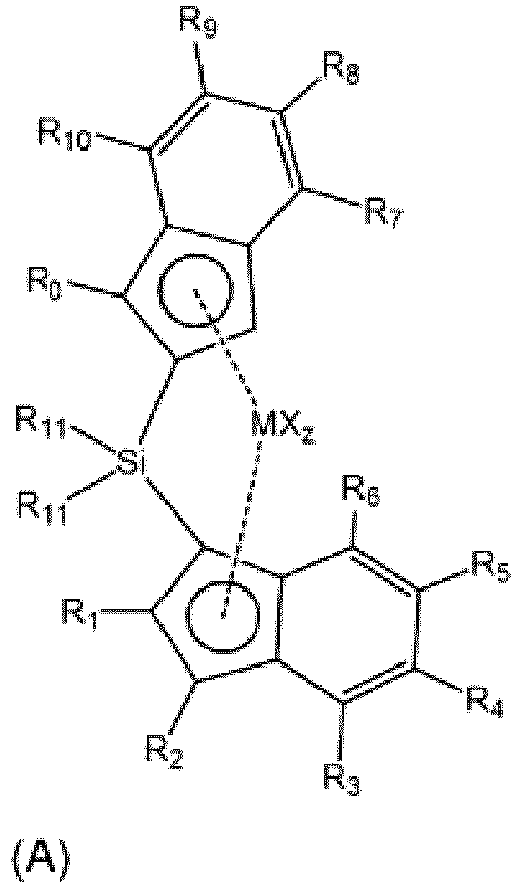 wobei R1-R10 unabhängig aus H, C1-C10-Alkyl, C7-C20-Aralkylgruppen und C1-C10-Alkoxygruppen ausgewählt sind;wobei R2 auch eine C6-Arylgruppe sein kann;wobei R11 aus Methyl, Ethyl, Propyl, Isopropyl, Butyl, Phenyl ausgewählt ist;wobei R1 und R2, R3 und R4, R4 und R5, R5 und R6, R7 und R8, R8 und R9 und/oder R9 und R10 verbunden werden können, um eine Ringstruktur zu bilden;wobei R0 eine Arylgruppe ist,wobei M aus Ti, Zr und Hf ausgewählt ist, X ein anionischer Ligand an M ist, z die Anzahl von X-Gruppen ist und der Valenz von M minus 2 entspricht.
 - Metallocenkomplex nach Anspruch 1, wobei M Zirconium oder Hafnium ist.
- Metallocenkomplex nach einem der Ansprüche 1-2, wobei X eine Methylgruppe, Cl, Br oder I, am meisten bevorzugt Methyl oder Cl ist.
- Metallocenkomplex nach einem der Ansprüche 1-3, wobei R7-R10 unabhängig aus H, Methyl, Ethyl und Methoxy ausgewählt sind, stärker bevorzugt R7-R10 H sind.
- Metallocenkomplex nach einem der Ansprüche 1-4, wobei das R11 eine Methylgruppe ist.
- Metallocenkomplex nach einem der Ansprüche 1-5, wobei R5 und R6 H-Atome sind und wobei R1 aus H, Methyl, Ethyl, Isopropyl ausgewählt ist.
- Metallocenkomplex nach einem der Ansprüche 1-6, wobei R2 H ist, wenn R1 anders als H ist.
- Metallocenkomplex nach einem der Ansprüche 1-7, wobei R2 aus H, Methyl, Ethyl, Phenyl, 2-Méthyl-1-phényl, 3,5-Dialkyl-1-phenyl, bevorzugt 3,5-Dimethyl-1-phenyl, 3,5-Diethyl-1-phenyl, 3,5-Diisopropyl-1-phenyl oder 3,5-Di-tert-butyl-1-phenyl ausgewählt ist, wobei bevorzugt R2 aus H, Methyl, Ethyl und Phenyl ausgewählt ist und wobei R1 bevorzugt ein H ist, wenn R2 anders als H ist.
- Metallocenkomplex nach einem der Ansprüche 1-8, wobei R1 aus Methyl, Ethyl, Isopropyl ausgewählt ist und/oder R2 eine Methyl-, Ethyl-, Phenylgruppe ist und R3, R4, R5 und R6 H sind.
- Metallocenkomplex nach einem der Ansprüche 1-9, wobei die Metallocenkomplexe aus der Gruppe bestehend aus Folgendem ausgewählt sind:

- Metallocenkomplex nach einem der Ansprüche 1-10, wobei der Metallocenkomplex auf einem Träger, bevorzugt einem inerten Träger, stärker bevorzugt einem porösen inerten Träger immobilisiert ist.
- Olefinpolymerisationskatalysator, der aus dem Metallocenkomplex nach einem der Ansprüche 1-11 und einem Co-Katalysator hergestellt ist, bevorzugt wobei der Co-Katalysator aus Methylaluminoxan, Trialkylboranen, Perfluorarylboranen oder Perfluorarylboraten ausgewählt ist.
- Prozess zur Herstellung von Olefinpolymeren durch Polymerisieren eines oder mehrerer Olefine in der Anwesenheit eines Co-Katalysators und des Metallocenkomplexes nach einem der Ansprüche 1-11, wobei der Metallocenkomplex optional auf einem Träger immobilisiert ist.
Applications Claiming Priority (2)
| Application Number | Priority Date | Filing Date | Title |
|---|---|---|---|
| EP17164678 | 2017-04-04 | ||
| PCT/EP2018/058625 WO2018185173A1 (en) | 2017-04-04 | 2018-04-04 | Dimethyl-silyl-bridged-1-substituted-2-indenyl metallocene complexes for olefin polymerization |
Publications (2)
| Publication Number | Publication Date |
|---|---|
| EP3606967A1 EP3606967A1 (de) | 2020-02-12 |
| EP3606967B1 true EP3606967B1 (de) | 2021-08-11 |
Family
ID=58548530
Family Applications (1)
| Application Number | Title | Priority Date | Filing Date |
|---|---|---|---|
| EP18716994.1A Active EP3606967B1 (de) | 2017-04-04 | 2018-04-04 | Dimethyl-silyl-verbrückte 1-phenyl-2-indenylmetallocenkomplexe zur olefinpolymerisierung |
Country Status (4)
| Country | Link |
|---|---|
| US (1) | US11155659B2 (de) |
| EP (1) | EP3606967B1 (de) |
| CN (1) | CN110650978B (de) |
| WO (1) | WO2018185173A1 (de) |
Families Citing this family (6)
| Publication number | Priority date | Publication date | Assignee | Title |
|---|---|---|---|---|
| CN110650965B (zh) | 2017-04-04 | 2022-10-04 | Sabic环球技术有限责任公司 | 用于烯烃聚合的二烃基-甲硅烷基-桥连-1,3二取代-2-茚基茂金属络合物 |
| US20210079032A1 (en) | 2018-01-24 | 2021-03-18 | Sabic Global Technologies B.V. | 1,2-phenylene bridged 1-indenyl-2-indenyl metallocene complexes for olefin polymerisation |
| CN112745415B (zh) * | 2019-10-30 | 2022-09-09 | 中国石油化工股份有限公司 | 一种制备高粘度指数聚α-烯烃的方法 |
| CN115066444B (zh) * | 2020-04-24 | 2024-06-11 | Sabic环球技术有限责任公司 | 后茂金属化合物 |
| US20240218098A1 (en) * | 2021-04-25 | 2024-07-04 | China Petroleum & Chemical Corporation | Propylene-based copolymer, preparation process and use thereof, and polypropylene composition containing the same |
| CN118055913A (zh) | 2021-08-11 | 2024-05-17 | Sabic环球技术有限责任公司 | 制备聚α-烯烃的方法 |
Family Cites Families (21)
| Publication number | Priority date | Publication date | Assignee | Title |
|---|---|---|---|---|
| DE3840772A1 (de) | 1988-12-03 | 1990-06-07 | Hoechst Ag | Verfahren zur herstellung einer heterogenen metallocenkatalysatorkomponente |
| NL9201970A (nl) | 1992-11-11 | 1994-06-01 | Dsm Nv | Indenylverbindingen en katalysatorcomponenten voor de polymerisatie van olefinen. |
| JPH08127612A (ja) * | 1994-10-27 | 1996-05-21 | Idemitsu Kosan Co Ltd | 遷移金属化合物、それを含有するオレフィン重合用触媒、その触媒を用いたオレフィン系重合体、およびそのオレフィン系重合体の製造方法。 |
| ES2188047T3 (es) * | 1998-03-09 | 2003-06-16 | Basell Polyolefine Gmbh | Compuestos de circonoceno puenteados, procedimiento para su preparacion y su empleo como componentes catalizadores en la polimerizacion de olefinas. |
| DE69907721T2 (de) * | 1998-11-18 | 2004-02-26 | Basell Polyolefine Gmbh | Methylen-verbrückte metallocene als olefin-polymerisationskatalysatorkomponente |
| US6342622B1 (en) * | 1999-06-11 | 2002-01-29 | Dsm B.V. | Indenyl compounds for the polymerization of olefins |
| JP2001064322A (ja) * | 1999-06-24 | 2001-03-13 | Idemitsu Petrochem Co Ltd | プロピレン系重合体及びその成形体並びにプロピレン系重合体の製造方法 |
| KR100333406B1 (ko) * | 2000-01-26 | 2002-04-25 | 정문조 | 고밀도 표층을 지니는 폴리올레핀 발포체 입자 및 그의제조방법 |
| JP4152551B2 (ja) * | 2000-02-08 | 2008-09-17 | 出光興産株式会社 | 遷移金属化合物、オレフィン重合触媒、オレフィン系重合体の製造方法及びオレフィン系重合体 |
| JP4521092B2 (ja) | 2000-04-20 | 2010-08-11 | 出光興産株式会社 | 遷移金属化合物、オレフィン重合触媒及びオレフィン重合体の製造方法 |
| US20030104928A1 (en) * | 2000-12-22 | 2003-06-05 | Holtcamp Matthew W. | Bridged metallocene catalyst compounds for olefin polymerization |
| PT2800754T (pt) * | 2011-12-19 | 2017-08-18 | Saudi Basic Ind Corp (Sabic) | Processo para a preparação de complexos metalocenos |
| WO2014099307A1 (en) | 2012-12-21 | 2014-06-26 | Exxonmobil Chemical Patents Inc. | Branched polyethylene with improved processing and high tear films made therefrom |
| CN104822697A (zh) | 2012-12-21 | 2015-08-05 | 埃克森美孚化学专利公司 | 桥联的金属茂化合物、催化剂体系和使用它们的聚合方法 |
| US9266977B2 (en) | 2012-12-21 | 2016-02-23 | Exxonmobil Chemical Patents Inc. | Bridged metallocene compounds, catalyst systems and processes for polymerization therewith |
| JP2016516019A (ja) * | 2013-03-12 | 2016-06-02 | サウディ ベーシック インダストリーズ コーポレイション | ビス(2−インデニル)メタロセン錯体 |
| US9266910B2 (en) | 2013-10-29 | 2016-02-23 | Exxonmobil Chemical Patents Inc. | Asymmetric polypropylene catalysts |
| EP3063184B1 (de) | 2013-10-29 | 2017-11-29 | ExxonMobil Chemical Patents Inc. | Asymmetrische katalysatoren zur polymerisation von olefinen |
| EP3114149B1 (de) * | 2014-03-06 | 2019-09-18 | Saudi Basic Industries Corporation | Katalysator mit einem metallocenkomplex und einem cokatalysator |
| CN106715450B (zh) * | 2014-09-10 | 2019-10-22 | Sabic环球技术有限责任公司 | 用于烯烃聚合的硼桥连的2-茚基茂金属复合物 |
| CN110650965B (zh) | 2017-04-04 | 2022-10-04 | Sabic环球技术有限责任公司 | 用于烯烃聚合的二烃基-甲硅烷基-桥连-1,3二取代-2-茚基茂金属络合物 |
-
2018
- 2018-04-04 EP EP18716994.1A patent/EP3606967B1/de active Active
- 2018-04-04 US US16/500,645 patent/US11155659B2/en active Active
- 2018-04-04 CN CN201880033523.2A patent/CN110650978B/zh active Active
- 2018-04-04 WO PCT/EP2018/058625 patent/WO2018185173A1/en not_active Ceased
Also Published As
| Publication number | Publication date |
|---|---|
| EP3606967A1 (de) | 2020-02-12 |
| CN110650978B (zh) | 2022-09-23 |
| US20200115478A1 (en) | 2020-04-16 |
| WO2018185173A1 (en) | 2018-10-11 |
| CN110650978A (zh) | 2020-01-03 |
| US11155659B2 (en) | 2021-10-26 |
Similar Documents
| Publication | Publication Date | Title |
|---|---|---|
| EP3606967B1 (de) | Dimethyl-silyl-verbrückte 1-phenyl-2-indenylmetallocenkomplexe zur olefinpolymerisierung | |
| EP3606931B1 (de) | Dihydrocarbyl-silyl-verbrückte substituierte cyclopentadienyl-metallocenkomplexe zur olefinpolymerisation | |
| EP3400230B1 (de) | Katalysator mit einem metallocenkomplex und einem cokatalysator | |
| JP5404614B2 (ja) | 長鎖分岐を含むエチレン−α−オレフィン共重合体 | |
| US11691998B2 (en) | 1,2-phenylene bridged 1-indenyl-2-indenyl metallocene complexes for olefin polymerisation | |
| EP1764378B1 (de) | Polymerisations- und Herstellungsverfahren einer Katalysatorzusammensetzung zur Polymerisation von Olefinen | |
| EP3606930B1 (de) | Dihydrocarbylsilyl-überbrückte-1,3-dimethyl-2-indenyl-metallocen-komplexe zur olefinpolymerisierung | |
| KR101146875B1 (ko) | 전이금속 촉매계 및 이를 이용한 에틸렌 단독중합체 또는에틸렌과 올레핀의 공중합체 제조방법 | |
| EP3303354B1 (de) | Katalysator mit einem metallocenkomplex und einem cokatalysator | |
| EP3114149A1 (de) | Katalysator mit einem metallocenkomplex und einem cokatalysator | |
| US12291593B2 (en) | Compounds for use in catalyst compositions for the production of polyolefins | |
| EP3783004B1 (de) | Übergangsmetallverbindung, katalysatorzusammensetzung damit und polymerherstellungsverfahren damit | |
| US9868797B2 (en) | Bridged metallocene complex for olefin polymerization | |
| EP3696184A1 (de) | Polyolefinkatalysator und verfahren zur herstellung von polyolefin damit |
Legal Events
| Date | Code | Title | Description |
|---|---|---|---|
| STAA | Information on the status of an ep patent application or granted ep patent |
Free format text: STATUS: UNKNOWN |
|
| STAA | Information on the status of an ep patent application or granted ep patent |
Free format text: STATUS: THE INTERNATIONAL PUBLICATION HAS BEEN MADE |
|
| PUAI | Public reference made under article 153(3) epc to a published international application that has entered the european phase |
Free format text: ORIGINAL CODE: 0009012 |
|
| STAA | Information on the status of an ep patent application or granted ep patent |
Free format text: STATUS: REQUEST FOR EXAMINATION WAS MADE |
|
| 17P | Request for examination filed |
Effective date: 20191001 |
|
| AK | Designated contracting states |
Kind code of ref document: A1 Designated state(s): AL AT BE BG CH CY CZ DE DK EE ES FI FR GB GR HR HU IE IS IT LI LT LU LV MC MK MT NL NO PL PT RO RS SE SI SK SM TR |
|
| AX | Request for extension of the european patent |
Extension state: BA ME |
|
| DAV | Request for validation of the european patent (deleted) | ||
| DAX | Request for extension of the european patent (deleted) | ||
| STAA | Information on the status of an ep patent application or granted ep patent |
Free format text: STATUS: EXAMINATION IS IN PROGRESS |
|
| 17Q | First examination report despatched |
Effective date: 20201208 |
|
| GRAP | Despatch of communication of intention to grant a patent |
Free format text: ORIGINAL CODE: EPIDOSNIGR1 |
|
| STAA | Information on the status of an ep patent application or granted ep patent |
Free format text: STATUS: GRANT OF PATENT IS INTENDED |
|
| INTG | Intention to grant announced |
Effective date: 20210329 |
|
| GRAS | Grant fee paid |
Free format text: ORIGINAL CODE: EPIDOSNIGR3 |
|
| GRAA | (expected) grant |
Free format text: ORIGINAL CODE: 0009210 |
|
| STAA | Information on the status of an ep patent application or granted ep patent |
Free format text: STATUS: THE PATENT HAS BEEN GRANTED |
|
| AK | Designated contracting states |
Kind code of ref document: B1 Designated state(s): AL AT BE BG CH CY CZ DE DK EE ES FI FR GB GR HR HU IE IS IT LI LT LU LV MC MK MT NL NO PL PT RO RS SE SI SK SM TR |
|
| REG | Reference to a national code |
Ref country code: CH Ref legal event code: EP |
|
| REG | Reference to a national code |
Ref country code: DE Ref legal event code: R096 Ref document number: 602018021638 Country of ref document: DE |
|
| REG | Reference to a national code |
Ref country code: IE Ref legal event code: FG4D Ref country code: AT Ref legal event code: REF Ref document number: 1419310 Country of ref document: AT Kind code of ref document: T Effective date: 20210915 |
|
| REG | Reference to a national code |
Ref country code: LT Ref legal event code: MG9D |
|
| REG | Reference to a national code |
Ref country code: NL Ref legal event code: MP Effective date: 20210811 |
|
| REG | Reference to a national code |
Ref country code: AT Ref legal event code: MK05 Ref document number: 1419310 Country of ref document: AT Kind code of ref document: T Effective date: 20210811 |
|
| PG25 | Lapsed in a contracting state [announced via postgrant information from national office to epo] |
Ref country code: RS Free format text: LAPSE BECAUSE OF FAILURE TO SUBMIT A TRANSLATION OF THE DESCRIPTION OR TO PAY THE FEE WITHIN THE PRESCRIBED TIME-LIMIT Effective date: 20210811 Ref country code: SE Free format text: LAPSE BECAUSE OF FAILURE TO SUBMIT A TRANSLATION OF THE DESCRIPTION OR TO PAY THE FEE WITHIN THE PRESCRIBED TIME-LIMIT Effective date: 20210811 Ref country code: HR Free format text: LAPSE BECAUSE OF FAILURE TO SUBMIT A TRANSLATION OF THE DESCRIPTION OR TO PAY THE FEE WITHIN THE PRESCRIBED TIME-LIMIT Effective date: 20210811 Ref country code: FI Free format text: LAPSE BECAUSE OF FAILURE TO SUBMIT A TRANSLATION OF THE DESCRIPTION OR TO PAY THE FEE WITHIN THE PRESCRIBED TIME-LIMIT Effective date: 20210811 Ref country code: ES Free format text: LAPSE BECAUSE OF FAILURE TO SUBMIT A TRANSLATION OF THE DESCRIPTION OR TO PAY THE FEE WITHIN THE PRESCRIBED TIME-LIMIT Effective date: 20210811 Ref country code: PT Free format text: LAPSE BECAUSE OF FAILURE TO SUBMIT A TRANSLATION OF THE DESCRIPTION OR TO PAY THE FEE WITHIN THE PRESCRIBED TIME-LIMIT Effective date: 20211213 Ref country code: NO Free format text: LAPSE BECAUSE OF FAILURE TO SUBMIT A TRANSLATION OF THE DESCRIPTION OR TO PAY THE FEE WITHIN THE PRESCRIBED TIME-LIMIT Effective date: 20211111 Ref country code: LT Free format text: LAPSE BECAUSE OF FAILURE TO SUBMIT A TRANSLATION OF THE DESCRIPTION OR TO PAY THE FEE WITHIN THE PRESCRIBED TIME-LIMIT Effective date: 20210811 Ref country code: BG Free format text: LAPSE BECAUSE OF FAILURE TO SUBMIT A TRANSLATION OF THE DESCRIPTION OR TO PAY THE FEE WITHIN THE PRESCRIBED TIME-LIMIT Effective date: 20211111 Ref country code: AT Free format text: LAPSE BECAUSE OF FAILURE TO SUBMIT A TRANSLATION OF THE DESCRIPTION OR TO PAY THE FEE WITHIN THE PRESCRIBED TIME-LIMIT Effective date: 20210811 |
|
| PG25 | Lapsed in a contracting state [announced via postgrant information from national office to epo] |
Ref country code: PL Free format text: LAPSE BECAUSE OF FAILURE TO SUBMIT A TRANSLATION OF THE DESCRIPTION OR TO PAY THE FEE WITHIN THE PRESCRIBED TIME-LIMIT Effective date: 20210811 Ref country code: LV Free format text: LAPSE BECAUSE OF FAILURE TO SUBMIT A TRANSLATION OF THE DESCRIPTION OR TO PAY THE FEE WITHIN THE PRESCRIBED TIME-LIMIT Effective date: 20210811 Ref country code: GR Free format text: LAPSE BECAUSE OF FAILURE TO SUBMIT A TRANSLATION OF THE DESCRIPTION OR TO PAY THE FEE WITHIN THE PRESCRIBED TIME-LIMIT Effective date: 20211112 |
|
| PG25 | Lapsed in a contracting state [announced via postgrant information from national office to epo] |
Ref country code: NL Free format text: LAPSE BECAUSE OF FAILURE TO SUBMIT A TRANSLATION OF THE DESCRIPTION OR TO PAY THE FEE WITHIN THE PRESCRIBED TIME-LIMIT Effective date: 20210811 |
|
| PG25 | Lapsed in a contracting state [announced via postgrant information from national office to epo] |
Ref country code: DK Free format text: LAPSE BECAUSE OF FAILURE TO SUBMIT A TRANSLATION OF THE DESCRIPTION OR TO PAY THE FEE WITHIN THE PRESCRIBED TIME-LIMIT Effective date: 20210811 |
|
| REG | Reference to a national code |
Ref country code: DE Ref legal event code: R097 Ref document number: 602018021638 Country of ref document: DE |
|
| PG25 | Lapsed in a contracting state [announced via postgrant information from national office to epo] |
Ref country code: SM Free format text: LAPSE BECAUSE OF FAILURE TO SUBMIT A TRANSLATION OF THE DESCRIPTION OR TO PAY THE FEE WITHIN THE PRESCRIBED TIME-LIMIT Effective date: 20210811 Ref country code: SK Free format text: LAPSE BECAUSE OF FAILURE TO SUBMIT A TRANSLATION OF THE DESCRIPTION OR TO PAY THE FEE WITHIN THE PRESCRIBED TIME-LIMIT Effective date: 20210811 Ref country code: RO Free format text: LAPSE BECAUSE OF FAILURE TO SUBMIT A TRANSLATION OF THE DESCRIPTION OR TO PAY THE FEE WITHIN THE PRESCRIBED TIME-LIMIT Effective date: 20210811 Ref country code: EE Free format text: LAPSE BECAUSE OF FAILURE TO SUBMIT A TRANSLATION OF THE DESCRIPTION OR TO PAY THE FEE WITHIN THE PRESCRIBED TIME-LIMIT Effective date: 20210811 Ref country code: CZ Free format text: LAPSE BECAUSE OF FAILURE TO SUBMIT A TRANSLATION OF THE DESCRIPTION OR TO PAY THE FEE WITHIN THE PRESCRIBED TIME-LIMIT Effective date: 20210811 Ref country code: AL Free format text: LAPSE BECAUSE OF FAILURE TO SUBMIT A TRANSLATION OF THE DESCRIPTION OR TO PAY THE FEE WITHIN THE PRESCRIBED TIME-LIMIT Effective date: 20210811 |
|
| PLBE | No opposition filed within time limit |
Free format text: ORIGINAL CODE: 0009261 |
|
| STAA | Information on the status of an ep patent application or granted ep patent |
Free format text: STATUS: NO OPPOSITION FILED WITHIN TIME LIMIT |
|
| 26N | No opposition filed |
Effective date: 20220512 |
|
| PG25 | Lapsed in a contracting state [announced via postgrant information from national office to epo] |
Ref country code: IT Free format text: LAPSE BECAUSE OF FAILURE TO SUBMIT A TRANSLATION OF THE DESCRIPTION OR TO PAY THE FEE WITHIN THE PRESCRIBED TIME-LIMIT Effective date: 20210811 |
|
| PG25 | Lapsed in a contracting state [announced via postgrant information from national office to epo] |
Ref country code: SI Free format text: LAPSE BECAUSE OF FAILURE TO SUBMIT A TRANSLATION OF THE DESCRIPTION OR TO PAY THE FEE WITHIN THE PRESCRIBED TIME-LIMIT Effective date: 20210811 |
|
| REG | Reference to a national code |
Ref country code: CH Ref legal event code: PL |
|
| REG | Reference to a national code |
Ref country code: BE Ref legal event code: MM Effective date: 20220430 |
|
| PG25 | Lapsed in a contracting state [announced via postgrant information from national office to epo] |
Ref country code: MC Free format text: LAPSE BECAUSE OF FAILURE TO SUBMIT A TRANSLATION OF THE DESCRIPTION OR TO PAY THE FEE WITHIN THE PRESCRIBED TIME-LIMIT Effective date: 20210811 Ref country code: LU Free format text: LAPSE BECAUSE OF NON-PAYMENT OF DUE FEES Effective date: 20220404 Ref country code: LI Free format text: LAPSE BECAUSE OF NON-PAYMENT OF DUE FEES Effective date: 20220430 Ref country code: CH Free format text: LAPSE BECAUSE OF NON-PAYMENT OF DUE FEES Effective date: 20220430 |
|
| PG25 | Lapsed in a contracting state [announced via postgrant information from national office to epo] |
Ref country code: BE Free format text: LAPSE BECAUSE OF NON-PAYMENT OF DUE FEES Effective date: 20220430 |
|
| PG25 | Lapsed in a contracting state [announced via postgrant information from national office to epo] |
Ref country code: IE Free format text: LAPSE BECAUSE OF NON-PAYMENT OF DUE FEES Effective date: 20220404 |
|
| P01 | Opt-out of the competence of the unified patent court (upc) registered |
Effective date: 20230529 |
|
| PG25 | Lapsed in a contracting state [announced via postgrant information from national office to epo] |
Ref country code: MK Free format text: LAPSE BECAUSE OF FAILURE TO SUBMIT A TRANSLATION OF THE DESCRIPTION OR TO PAY THE FEE WITHIN THE PRESCRIBED TIME-LIMIT Effective date: 20210811 Ref country code: CY Free format text: LAPSE BECAUSE OF FAILURE TO SUBMIT A TRANSLATION OF THE DESCRIPTION OR TO PAY THE FEE WITHIN THE PRESCRIBED TIME-LIMIT Effective date: 20210811 |
|
| PG25 | Lapsed in a contracting state [announced via postgrant information from national office to epo] |
Ref country code: HU Free format text: LAPSE BECAUSE OF FAILURE TO SUBMIT A TRANSLATION OF THE DESCRIPTION OR TO PAY THE FEE WITHIN THE PRESCRIBED TIME-LIMIT; INVALID AB INITIO Effective date: 20180404 |
|
| PG25 | Lapsed in a contracting state [announced via postgrant information from national office to epo] |
Ref country code: MT Free format text: LAPSE BECAUSE OF FAILURE TO SUBMIT A TRANSLATION OF THE DESCRIPTION OR TO PAY THE FEE WITHIN THE PRESCRIBED TIME-LIMIT Effective date: 20210811 |
|
| PGFP | Annual fee paid to national office [announced via postgrant information from national office to epo] |
Ref country code: DE Payment date: 20250429 Year of fee payment: 8 |
|
| PGFP | Annual fee paid to national office [announced via postgrant information from national office to epo] |
Ref country code: GB Payment date: 20250428 Year of fee payment: 8 |
|
| PGFP | Annual fee paid to national office [announced via postgrant information from national office to epo] |
Ref country code: FR Payment date: 20250425 Year of fee payment: 8 |
|
| PG25 | Lapsed in a contracting state [announced via postgrant information from national office to epo] |
Ref country code: TR Free format text: LAPSE BECAUSE OF FAILURE TO SUBMIT A TRANSLATION OF THE DESCRIPTION OR TO PAY THE FEE WITHIN THE PRESCRIBED TIME-LIMIT Effective date: 20210811 |