EP3607739B1 - Sélection prédictive de débit binaire pour la diffusion de vidéo à 360 degrés en continu - Google Patents
Sélection prédictive de débit binaire pour la diffusion de vidéo à 360 degrés en continu Download PDFInfo
- Publication number
- EP3607739B1 EP3607739B1 EP18781769.7A EP18781769A EP3607739B1 EP 3607739 B1 EP3607739 B1 EP 3607739B1 EP 18781769 A EP18781769 A EP 18781769A EP 3607739 B1 EP3607739 B1 EP 3607739B1
- Authority
- EP
- European Patent Office
- Prior art keywords
- probability
- metadata
- viewport
- view orientation
- user view
- Prior art date
- Legal status (The legal status is an assumption and is not a legal conclusion. Google has not performed a legal analysis and makes no representation as to the accuracy of the status listed.)
- Active
Links
Images



Classifications
-
- H—ELECTRICITY
- H04—ELECTRIC COMMUNICATION TECHNIQUE
- H04L—TRANSMISSION OF DIGITAL INFORMATION, e.g. TELEGRAPHIC COMMUNICATION
- H04L65/00—Network arrangements, protocols or services for supporting real-time applications in data packet communication
- H04L65/80—Responding to QoS
-
- H—ELECTRICITY
- H04—ELECTRIC COMMUNICATION TECHNIQUE
- H04L—TRANSMISSION OF DIGITAL INFORMATION, e.g. TELEGRAPHIC COMMUNICATION
- H04L65/00—Network arrangements, protocols or services for supporting real-time applications in data packet communication
- H04L65/60—Network streaming of media packets
- H04L65/61—Network streaming of media packets for supporting one-way streaming services, e.g. Internet radio
- H04L65/612—Network streaming of media packets for supporting one-way streaming services, e.g. Internet radio for unicast
-
- H—ELECTRICITY
- H04—ELECTRIC COMMUNICATION TECHNIQUE
- H04L—TRANSMISSION OF DIGITAL INFORMATION, e.g. TELEGRAPHIC COMMUNICATION
- H04L65/00—Network arrangements, protocols or services for supporting real-time applications in data packet communication
- H04L65/60—Network streaming of media packets
- H04L65/75—Media network packet handling
-
- H—ELECTRICITY
- H04—ELECTRIC COMMUNICATION TECHNIQUE
- H04L—TRANSMISSION OF DIGITAL INFORMATION, e.g. TELEGRAPHIC COMMUNICATION
- H04L65/00—Network arrangements, protocols or services for supporting real-time applications in data packet communication
- H04L65/60—Network streaming of media packets
- H04L65/75—Media network packet handling
- H04L65/752—Media network packet handling adapting media to network capabilities
-
- H—ELECTRICITY
- H04—ELECTRIC COMMUNICATION TECHNIQUE
- H04L—TRANSMISSION OF DIGITAL INFORMATION, e.g. TELEGRAPHIC COMMUNICATION
- H04L67/00—Network arrangements or protocols for supporting network services or applications
- H04L67/50—Network services
- H04L67/56—Provisioning of proxy services
- H04L67/568—Storing data temporarily at an intermediate stage, e.g. caching
- H04L67/5681—Pre-fetching or pre-delivering data based on network characteristics
-
- H—ELECTRICITY
- H04—ELECTRIC COMMUNICATION TECHNIQUE
- H04N—PICTORIAL COMMUNICATION, e.g. TELEVISION
- H04N19/00—Methods or arrangements for coding, decoding, compressing or decompressing digital video signals
- H04N19/50—Methods or arrangements for coding, decoding, compressing or decompressing digital video signals using predictive coding
- H04N19/597—Methods or arrangements for coding, decoding, compressing or decompressing digital video signals using predictive coding specially adapted for multi-view video sequence encoding
-
- H—ELECTRICITY
- H04—ELECTRIC COMMUNICATION TECHNIQUE
- H04N—PICTORIAL COMMUNICATION, e.g. TELEVISION
- H04N21/00—Selective content distribution, e.g. interactive television or video on demand [VOD]
- H04N21/20—Servers specifically adapted for the distribution of content, e.g. VOD servers; Operations thereof
- H04N21/21—Server components or server architectures
- H04N21/218—Source of audio or video content, e.g. local disk arrays
- H04N21/21805—Source of audio or video content, e.g. local disk arrays enabling multiple viewpoints, e.g. using a plurality of cameras
-
- H—ELECTRICITY
- H04—ELECTRIC COMMUNICATION TECHNIQUE
- H04N—PICTORIAL COMMUNICATION, e.g. TELEVISION
- H04N21/00—Selective content distribution, e.g. interactive television or video on demand [VOD]
- H04N21/20—Servers specifically adapted for the distribution of content, e.g. VOD servers; Operations thereof
- H04N21/23—Processing of content or additional data; Elementary server operations; Server middleware
- H04N21/234—Processing of video elementary streams, e.g. splicing of video streams or manipulating encoded video stream scene graphs
- H04N21/2343—Processing of video elementary streams, e.g. splicing of video streams or manipulating encoded video stream scene graphs involving reformatting operations of video signals for distribution or compliance with end-user requests or end-user device requirements
- H04N21/23439—Processing of video elementary streams, e.g. splicing of video streams or manipulating encoded video stream scene graphs involving reformatting operations of video signals for distribution or compliance with end-user requests or end-user device requirements for generating different versions
-
- H—ELECTRICITY
- H04—ELECTRIC COMMUNICATION TECHNIQUE
- H04N—PICTORIAL COMMUNICATION, e.g. TELEVISION
- H04N21/00—Selective content distribution, e.g. interactive television or video on demand [VOD]
- H04N21/40—Client devices specifically adapted for the reception of or interaction with content, e.g. set-top-box [STB]; Operations thereof
- H04N21/43—Processing of content or additional data, e.g. demultiplexing additional data from a digital video stream; Elementary client operations, e.g. monitoring of home network or synchronising decoder's clock; Client middleware
- H04N21/442—Monitoring of processes or resources, e.g. detecting the failure of a recording device, monitoring the downstream bandwidth, the number of times a movie has been viewed, the storage space available from the internal hard disk
- H04N21/44213—Monitoring of end-user related data
- H04N21/44218—Detecting physical presence or behaviour of the user, e.g. using sensors to detect if the user is leaving the room or changes his face expression during a TV programme
-
- H—ELECTRICITY
- H04—ELECTRIC COMMUNICATION TECHNIQUE
- H04N—PICTORIAL COMMUNICATION, e.g. TELEVISION
- H04N21/00—Selective content distribution, e.g. interactive television or video on demand [VOD]
- H04N21/40—Client devices specifically adapted for the reception of or interaction with content, e.g. set-top-box [STB]; Operations thereof
- H04N21/47—End-user applications
- H04N21/472—End-user interface for requesting content, additional data or services; End-user interface for interacting with content, e.g. for content reservation or setting reminders, for requesting event notification, for manipulating displayed content
- H04N21/4728—End-user interface for requesting content, additional data or services; End-user interface for interacting with content, e.g. for content reservation or setting reminders, for requesting event notification, for manipulating displayed content for selecting a Region Of Interest [ROI], e.g. for requesting a higher resolution version of a selected region
-
- H—ELECTRICITY
- H04—ELECTRIC COMMUNICATION TECHNIQUE
- H04N—PICTORIAL COMMUNICATION, e.g. TELEVISION
- H04N21/00—Selective content distribution, e.g. interactive television or video on demand [VOD]
- H04N21/60—Network structure or processes for video distribution between server and client or between remote clients; Control signalling between clients, server and network components; Transmission of management data between server and client, e.g. sending from server to client commands for recording incoming content stream; Communication details between server and client
- H04N21/63—Control signaling related to video distribution between client, server and network components; Network processes for video distribution between server and clients or between remote clients, e.g. transmitting basic layer and enhancement layers over different transmission paths, setting up a peer-to-peer communication via Internet between remote STB's; Communication protocols; Addressing
- H04N21/637—Control signals issued by the client directed to the server or network components
- H04N21/6373—Control signals issued by the client directed to the server or network components for rate control, e.g. request to the server to modify its transmission rate
-
- H—ELECTRICITY
- H04—ELECTRIC COMMUNICATION TECHNIQUE
- H04N—PICTORIAL COMMUNICATION, e.g. TELEVISION
- H04N21/00—Selective content distribution, e.g. interactive television or video on demand [VOD]
- H04N21/60—Network structure or processes for video distribution between server and client or between remote clients; Control signalling between clients, server and network components; Transmission of management data between server and client, e.g. sending from server to client commands for recording incoming content stream; Communication details between server and client
- H04N21/65—Transmission of management data between client and server
- H04N21/658—Transmission by the client directed to the server
- H04N21/6587—Control parameters, e.g. trick play commands, viewpoint selection
-
- H—ELECTRICITY
- H04—ELECTRIC COMMUNICATION TECHNIQUE
- H04N—PICTORIAL COMMUNICATION, e.g. TELEVISION
- H04N21/00—Selective content distribution, e.g. interactive television or video on demand [VOD]
- H04N21/80—Generation or processing of content or additional data by content creator independently of the distribution process; Content per se
- H04N21/81—Monomedia components thereof
- H04N21/816—Monomedia components thereof involving special video data, e.g 3D video
-
- H—ELECTRICITY
- H04—ELECTRIC COMMUNICATION TECHNIQUE
- H04L—TRANSMISSION OF DIGITAL INFORMATION, e.g. TELEGRAPHIC COMMUNICATION
- H04L69/00—Network arrangements, protocols or services independent of the application payload and not provided for in the other groups of this subclass
- H04L69/30—Definitions, standards or architectural aspects of layered protocol stacks
- H04L69/32—Architecture of open systems interconnection [OSI] 7-layer type protocol stacks, e.g. the interfaces between the data link level and the physical level
- H04L69/322—Intralayer communication protocols among peer entities or protocol data unit [PDU] definitions
- H04L69/329—Intralayer communication protocols among peer entities or protocol data unit [PDU] definitions in the application layer [OSI layer 7]
Definitions
- aspects of the present disclosure are related to video streaming.
- the present disclosure is related to streaming of 360 degree video.
- 360 degree video is created by taking video streams from several cameras arranged around a single point and stitching the video streams together to create a single continuous video image.
- Modern encoders break the continuous video image in to multiple video streams of frames.
- a server sends a client these multiple streams of frames.
- the client decodes and reassembles the streams into continuous images that are presented on a display.
- a system may send a single request for frames, download the requested frames and then assemble them for display. This combination of actions is sometimes called a fetch action.
- a client Generally to reliably stream video without interruption a client must also pre-fetch video which means the system must download frames and process them before prior downloaded frames have been displayed. In this way the system builds a buffer of processed frames between the processed frames that are being displayed and subsequent frames that need to be downloaded and processed.
- Buffering can be very costly on system resources especially when processing and storing high resolution video.
- a client may request only a high resolution video stream frames that are within the field of view of the client also known as the viewport. In this case the client receives low resolution video streams for all but the current view of the client.
- a problem with this system is that a client is often able to move the field of view faster than a high quality stream can be requested, delivered and buffered.
- streaming 360 degree video over a network involves receiving a set of video streams of all one quality.
- Newer streaming techniques allow the reduction in bandwidth usage by only loading high quality streams in the area the viewer is focused. This technique has the additional effect of allowing the viewer to load higher resolution video streams without requiring as much time or buffer resources.
- an author of a 360 degree video may have some artist vision as to what the viewer should see in a certain scene of a 360 degree video. According to prior art methods such details in a scene displayed to a viewer might be lost due to display of low resolution videos or while the view looks in another direction. As such aspects of present disclosure have been developed to improve perceived 360 degree video stream quality and to allow authors to define a viewport and video quality for a viewer.
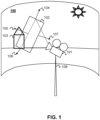
- the Camera 101 is fixed at a point 108 and the scene 100 is wrapped around the camera 101 to create a 360 degree viewable area.
- the Camera may rotate around the fixation point 108 to view images 103 in the scene.
- the scene may be broken up into different areas called viewports 102.
- Each viewport 102 may be a different video stream loaded by the client. As seen in figure 2 each section of the video may be divided in to these viewports.
- the camera 101 may change orientation in any direction, e.g., up 104 , down 106 , left 105 , or right 107, to shift from one viewport 102 to another.
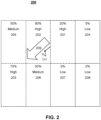
- FIG. 2 depicts an equirectangular projection according to aspects of the current disclosure.
- the 360 degree scene 200 is composed of a series of equally sized rectangles 201 - 208. Each rectangle may be separate video stream that the client device loads and stitches together for display. Each rectangle may be large enough to encompass the view of the camera in which case they are a viewport 201 . Alternatively several rectangles may together represent a single viewport (Not shown).
- an Author may define the location of a high resolution frame for the client to load 202 .
- the Author may also define a metadata 209 within the video streams which the client can use to predictively to load high resolution video content for streams that correspond to portions of 360 degree video the user is likely to view.
- the metadata 209 may be in the form of a vector having both a magnitude, representing the significance, and a direction.
- time may be encoded beside the metadata 209 or the vector could be placed in a stream of fixed time-step intervals.
- the Author-defined metadata may also be referred to as user view orientation metadata.
- the metadata may be generated on a backend or server-side with no explicit sending of view orientation information by the client.
- a server may build a probability field based on which streams the client requests and when, then mapping which stream belongs to which viewport. This assumes the client will select the highest quality streams for the current client viewport.
- the metadata 209 may be associated with a potential for a movement of the viewport 201 within the video streams by a user.
- metadata 209 in the form of an Author defined pre-fetch vector may be an idealized movement vector for the viewer according to the Author's artistic vision.
- the client device may track both the actual movement of the viewport 210 and the metadata 209 .
- the client device may pre-fetch frames in the actual view port 201 and frames along the Author defined prefetching vector 202, 203.
- the client may only fetch high resolution frames 202, 203 along an Author defined vector to encourage the viewer to move the viewport to a different location in the 360 degree stream.
- the Author-defined prefetching metadata need not be a vector.
- the Author may simply define frames they desire to be in high resolution during certain times of display 202 .
- the client may fetch the Author defined high resolution frames at certain times as defined by the author.
- An author may also define a certain area of a frame as high-resolution for a zoom function.
- the Author may provide level of detail information for a subsection of the frame such that a certain subsection of a frame is encoded as high resolution. Metadata informing the client of the location of this high resolution subsection could be sent to the client so that it may pre-fetch that stream.
- the metadata 209 may also be used to control viewport 201, during display of video.
- the Author may choose to have the Viewport 201 move along the metadata 209 without viewer input. In this way virtual cameraman functionality can be achieved and the Author can better display the artistic vision in a 360 degree display.
- the client may pre-fetch high resolution fames to match production effects. For example and without limitation, it may be desirable for the client to pre-fetch high resolution frames in the apparent direction of a loud sound. Alternatively during production it may be desirable for the client to pre-fetch frames in location where there is a lot of special effects or special camera movement.
- the client may receive metadata that causes the client to pre-fetch certain frames as defined during production. These defined frames may correspond more to special effects and sound cues than artistic vision as discussed above.
- the Production defined pre-fetch metadata may also be referred to as user orientation metadata.
- a client may use predictive metadata to pre-fetch streams determined to be in the potential future viewport as seen in figure 2 and 3 .
- the predictive metadata may be generated during production to ensure that the end viewer receives higher resolution frames in their field of view than they would in a system employing a single resolution stream.
- a studio may use screening data collected from viewers of a 360 degree video to generate a probabilistic model of where a viewer may be looking in the video at any time.
- This probabilistic model may define a user's likelihood to move from the current frame 201 to another 202 or stay in the current frame 201 based on such variables as, current view orientation in the 360 degree video, time code within video, past views of the video and the like.
- the probability of changing frames to may be represented by probabilities tied to each frame in the 360 degree video currently displayed, this is represented by the percentages in each frame 201 - 208 seen in figure 2 .
- Predictive prefetching data may be referred to as user orientation metadata.
- the predictive prefetching metadata may be negative or inverse/opposite data.
- the prefetching metadata may instead represent one or more probabilities of where the viewer is not likely to look.
- the pre-fetching of video frames is not limited to high and low resolution streams. As seen in figure 2 , the system may select to pre-fetch intermediate resolutions for frames that have a certain threshold level of probability 205, 206 . Likewise frames that have low probability of being a viewport 204, 207, 208 will only be pre-fetched with display low resolution images. As an additional aspect low viewport probability frames 204, 207, 208 may receive fewer updates than higher probability frames by way of example and not by way of limitation, a low probability frame may only update, e.g., once every 2 updates of high probability streams. More generally, any factor of the optimal/high probability streams may be used for updating low-probability streams depending on whether they are in-view or not. In some implementations a low-probability stream that is still in view may be updated at the full high probability update rate to avoid noticeable desynchronization between the stitched frames.
- the client may have a defined threshold probability level.
- the probabilistic metadata determines that the probability a viewer will move the viewport into a certain frame exceeds the threshold probability level; the client will pre-fetch that frame.
- the client may pre-fetch frames based on the fidelity of probabilistic metadata.
- FIG. 3 depicts a cube mapped projection according to aspects of the present disclosure.
- the predictive data represented as percentages in each frame mis-matches the actual movement 305 of the viewport 301.
- author predicted pre-fetch vector 303 also does not match an actual movement vector 305 of the viewport 301 .
- the actual viewport would end up at 302 while the system would pre-fetch either frame 301 based on prediction data or 304 based on the author defined pre-fetch vector.
- the system may to determine whether to continue to follow the viewer orientation metadata or default to a single quality level.
- the client may perform continuous or intermittent checking of the fidelity of the probabilistic and Author defined metadata.
- the client may initially pre-fetch high resolution frames based on probabilistic metadata and the actual orientation of the viewport 301 .
- the client may then display high resolution frames in accordance with the orientation of the viewport and the metadata.
- the client may check to determine whether the viewer has moved the viewport to the high resolution frame in accordance with the probabilistic or author defined metadata.
- the client may cease to use the metadata for pre-fetching and only fetch high resolution frames in the current field of view of the viewport.
- the client may continuously check the viewport movement with the metadata for a correlation.
- the client may have a tolerance level for viewport movements that do not follow the probabilistic metadata.
- This tolerance level may for example but not by limitation be, a ratio of predicted frames missed over predicted frames viewed, in that instance as the ratio grows to 1 the client may shift to fetching only frames within the actual viewport. More generally, the tolerance level may be determined by statistically quantifying the amount of variation in a set of values. Any suitable measure of variability, e.g., standard deviation may be applied over a fixed or sliding window set of user and meta data
- the client device may collect data from the viewer as to the orientation of the viewport.
- the client device may use this viewer data to generate predictive data and pre-fetch a video stream according the predictive data.
- the client device may also share the predictive data with other clients or a server to generate or refine probabilistic metadata for the video stream.
- the client device may use viewport orientation data to generate predictive data.
- the client device may use a movement vector 305 of the viewport to predictively fetch high resolution video streams lying on the vector and taking into account movement speed.
- User generated predictive prefetching data may be referred to as user orientation metadata.
- the client may send the viewport orientation data to a data collection center to generate better probabilistic metadata for future viewing.
- the data collection center may use the viewport orientation data in addition to the Author defined pre-fetching data to generate metadata for the video stream.
- the generated metadata may weight the Author defined prefetching data such that prefetching of author defined streams are preferred unless the client is following a past user defined viewing vector closely.
- the server uses the metadata to select high resolution streams to send to the client device.
- the metadata used by the server may be author defined, probabilistic data generated from viewer, or other predictive data.
- the server may receive a request for a 360 degree video stream from a client device.
- the server may the check for viewer orientation metadata for the requested stream. Upon finding such metadata, the server may send high resolution streams to the client according to the metadata.
- the server may also receive actual viewer orientation data and send high resolution streams in view of the actual viewport. Furthermore the server may perform predictive fidelity checking as discussed above to determine whether it should continue to send high resolution video streams based on the metadata.
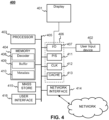
- FIG. 4 depicts a system according to exemplary implementations of the present disclosure.
- the system may include a computing device 400 coupled to a display 401 and a user input device 402 .
- the display device 401 may be in the form of a cathode ray tube (CRT), flat panel screen, touch screen, or other device that displays text, numerals, graphical symbols, or other visual objects.
- the user input device 402 may be a controller, touch screen or other device that allows the user to interact with a user view orientation and select 360 degree video streams.
- the display 401 may be a 360 degree display configured to display multiple viewports of 360 degree video simultaneously for an immersive 360 degree video experience.
- the display 401 may be a conventional two-dimensional display. In such implementations, a user may be able to determine the viewport by interaction with the computing device.
- the computing device 400 may include one or more processor units 403 , which may be configured according to well-known architectures, such as, e.g., single-core, dual-core, quad-core, multi-core, processor-coprocessor, cell processor, and the like.
- the computing device may also include one or more memory units 404 (e.g., random access memory (RAM), dynamic random access memory (DRAM), read-only memory (ROM), and the like).
- RAM random access memory
- DRAM dynamic random access memory
- ROM read-only memory
- the processor unit 403 may execute one or more programs, portions of which may be stored in the memory 404 and the processor 403 may be operatively coupled to the memory, e.g., by accessing the memory via a data bus 405.
- the programs may be configured to request a frames for a video stream based on metadata received 410 for that video stream.
- the programs when executed by the processor may cause the system to decode high-resolution frames 408 and store frames potentially in the viewport of the viewer in a buffer 409 .
- the computing device 400 may also include well-known support circuits, such as input/output (I/O) 407 , circuits, power supplies (P/S) 411 , a clock (CLK) 412 , and cache 413 , which may communicate with other components of the system, e.g., via the bus 405 .
- the computing device may include a network interface 414.
- the processor unit 403 and network interface 414 may be configured to implement a local area network (LAN) or personal area network (PAN), via a suitable network protocol, e.g., Bluetooth, for a PAN.
- LAN local area network
- PAN personal area network
- the computing device may optionally include a mass storage device 415 such as a disk drive, CD-ROM drive, tape drive, flash memory, or the like, and the mass storage device may store programs and/or data.
- the computing device may also include a user interface 416 to facilitate interaction between the system and a user.
- the user interface may include a keyboard, mouse, light pen, game control pad, touch interface, or other device.
- the user may use the interface 416 to change the viewport, e.g., by scrolling with a mouse or manipulation of a joystick.
- the display 401 may be a hand-held display, as in a smart phone, tablet computer, or portable game device.
- user interface 416 may include an accelerometer that is part of the display 401 .
- the processor 403 can be configured, e.g., through suitable programming, to detect changes in the orientation of the display and use this information to determine the viewport. The user can therefore change the viewport simply by moving the display.
- the predictive metadata may be configured to implement a Markov chain.
- FIG. 5 shows a graphical representation of a Markov chain according to aspects of the current disclosure.
- Each circle represents a state 501-506 , e.g., a viewport orientation in the 360 degree video.
- states in this Markov chain representing a cube mapped video stream.
- Each arrow represents the probability that the viewport will change to another one of the viewports of the video stream.
- These transfer probabilities could be set by hand by the director or producer, determined from focus group data or from actual viewer data.
- Each frame may have its own Markov probabilities at each time point in the video stream.
- the system may only receive metadata representing the Markov probabilities for a transition from the current viewport orientation to a different orientation, e.g., a client displaying a current viewport at 501 would only receive the probability of moving from the current viewport 501 to a different one of a plurality of viewports 502-506 or staying in current viewport 501 .
- the system could reduce initial load times and band width usage by only receiving probabilities of transition from the current state while receiving the stream.
- the system may receive an overall Markov probability model for the video stream at each time point at the start of the video stream. This embodiment increases the initial load time for the stream but reduce the overall information that needs to be processed during streaming.
- the system may receive Markov probability models at each time point while streaming the 360 degree video. This embodiment decreases upfront load times at the cost of stream processing but also includes additional Markov probability data in case of a desynch between the client and the server.
- the system may weight the probability of transition to states lying along an Author defined pre-fetch vector. Thus if the probability of movement plus the weight surpasses a threshold then the client will initiate prefetching of that state.
- the client may receive the viewer orientation metadata for a requested video stream independently of the video stream. If the metadata is received independently of the video stream it must be time-synched to the stream.
- the metadata may be received as part the video stream itself, by way of example and not by way of limitation, in the header of the 360 degree video stream Fig. 6 depicts a flow diagram for predictive bit rate selection according to aspects of the present disclosure.
- the system may request a video stream 601 from the network.
- the system may obtain user view orientation metadata 602 from the network or stored locally in mass store memory 415 or from storage media such as a compact disk or from any suitable type of data storage known in the art.
- user view orientation metadata may also be obtained during streaming.
- the viewer orientation metadata may inform the system of frames to fetch before display including potential viewports that have the user has not yet entered as discussed above.
- the system will pre-fetch the frames that are potential viewports or desired viewports as well as the initial starting viewport frames in higher resolution and the rest of the frames in the 360 degree video stream in lower resolution 603 as discussed above.
- the system will then display the pre-fetched frames 604 through for example a display device 401 as discussed above. While displaying pre-fetched frames 604 the system may continue 605 pre-fetching frames 603 to create an uninterrupted 360 degree video streaming experience with higher resolution frames in the user's field of view.
- the system may use 606 prediction fidelity checking 607 to determine whether to continue pre-fetching frames according to view orientation metadata 608 or to enter a present load state in which only frames in the current viewport are pre-fetched in a higher resolution. In the present load state the system may continue to check the fidelity of prediction 609 until the predictions become accurate as discussed above. At which point the system may resume prefetching 608 based or user view orientation metadata 603.
Landscapes
- Engineering & Computer Science (AREA)
- Multimedia (AREA)
- Signal Processing (AREA)
- Computer Networks & Wireless Communication (AREA)
- Databases & Information Systems (AREA)
- Health & Medical Sciences (AREA)
- General Health & Medical Sciences (AREA)
- Social Psychology (AREA)
- Human Computer Interaction (AREA)
- Two-Way Televisions, Distribution Of Moving Picture Or The Like (AREA)
- Closed-Circuit Television Systems (AREA)
- Transforming Electric Information Into Light Information (AREA)
Claims (14)
- Procédé comprenant :a) l'obtention (602) de métadonnées d'orientation de vue d'utilisateur d'un flux vidéo à 360 degrés qui comporte des données d'une pluralité de fenêtres d'affichage, les métadonnées d'orientation de vue d'utilisateur comprenant une probabilité prédictive d'un changement de fenêtre d'affichage ;b) la pré-extraction (603) de données correspondant à une ou plusieurs trames de haute résolution d'une fenêtre d'affichage particulière de la pluralité de fenêtres d'affichage déterminées par les métadonnées d'orientation de vue d'utilisateur, l'étape de pré-extraction comportant l'application d'un premier seuil à la probabilité prédictive pour déterminer la fenêtre d'affichage particulière de la pluralité de fenêtres d'affichage ;c) la pré-extraction (603) de données correspondant à une ou plusieurs trames de résolution intermédiaire lorsque la probabilité prédictive dépasse un deuxième seuil ; etd) l'affichage (604) des une ou plusieurs trames de haute résolution, dans lequel les une ou plusieurs trames de haute résolution sont caractérisées par une résolution supérieure à celle des fenêtres d'affichage restantes de la pluralité de fenêtres d'affichage.
- Procédé selon la revendication 1 dans lequel le premier seuil correspond à une première probabilité prédictive ; et
le deuxième seuil correspond à une deuxième probabilité prédictive, dans lequel la deuxième probabilité prédictive est inférieure à la première probabilité prédictive. - Procédé selon la revendication 1 comprenant la pré-extraction de données correspondant à une ou plusieurs trames de basse résolution lorsque la probabilité prédictive ne dépasse pas le deuxième seuil.
- Procédé selon la revendication 3 comprenant la pré-extraction de trames de basse résolution à un taux de mise à jour inférieur à celui des trames de haute résolution.
- Procédé selon la revendication 1 dans lequel :la probabilité prédictive est générée par un groupe de focalisation ; oula probabilité prédictive est générée à l'aide de données de localisation de trame générées par l'utilisateur ; oula probabilité prédictive comprend également un vecteur de pré-extraction défini par l'auteur ; oula probabilité prédictive d'un changement de trame de fenêtre d'affichage est une probabilité pour un modèle de Markov.
- Procédé selon la revendication 5 dans lequel le vecteur de pré-extraction défini par l'auteur est un poids appliqué à la probabilité d'un changement de trame de fenêtre d'affichage.
- Procédé selon la revendication 1 dans lequel les métadonnées d'orientation de vue d'utilisateur comprennent un vecteur de mouvement.
- Procédé selon la revendication 1, dans lequel les métadonnées d'orientation de vue d'utilisateur représentent l'une : d'une probabilité d'un endroit qu'un utilisateur est susceptible de regarder ; et d'une probabilité d'un endroit qu'un utilisateur n'est pas susceptible de regarder.
- Procédé selon la revendication 1 comprenant en outre la vérification des métadonnées d'orientation de vue d'utilisateur par rapport à une orientation de vue d'utilisateur réelle ; et la désactivation de la pré-extraction lorsque les métadonnées d'orientation de vue d'utilisateur ne coïncident pas avec l'orientation de vue d'utilisateur réelle durant l'affichage.
- Procédé selon la revendication 9 dans lequel la désactivation de la pré-extraction lorsque les métadonnées d'orientation de vue d'utilisateur ne coïncident pas avec l'orientation de vue d'utilisateur réelle durant l'affichage comporte l'application d'un seuil de trames manquées pour déterminer de désactiver ou non la pré-extraction.
- Procédé selon la revendication 1 dans lequel la pré-extraction de données correspondant à une ou plusieurs trames de haute résolution déterminées par les métadonnées d'orientation de vue d'utilisateur comporte la pré-extraction d'une trame ayant une section de résolution supérieure au reste de la trame.
- Support non transitoire lisible par ordinateur contenant des instructions de programme qui, à leur exécution par un ordinateur, amènent l'ordinateur à réaliser le procédé selon la revendication 1.
- Système comprenant :un processeur ;un afficheur couplé au processeur ;une mémoire couplée au processeur comportant des instructions exécutables par le processeur configurées pour, à leur exécution par le processeur, amener le processeur à implémenter le procédé selon la revendication 1.
- Système selon la revendication 13 dans lequel l'afficheur est un affichage à 360 degrés configuré pour afficher simultanément la pluralité de fenêtres d'affichage.
Applications Claiming Priority (2)
| Application Number | Priority Date | Filing Date | Title |
|---|---|---|---|
| US15/481,324 US10547704B2 (en) | 2017-04-06 | 2017-04-06 | Predictive bitrate selection for 360 video streaming |
| PCT/US2018/022259 WO2018187003A1 (fr) | 2017-04-06 | 2018-03-13 | Sélection prédictive de débit binaire pour la diffusion de vidéo à 360 degrés en continu |
Publications (3)
| Publication Number | Publication Date |
|---|---|
| EP3607739A1 EP3607739A1 (fr) | 2020-02-12 |
| EP3607739A4 EP3607739A4 (fr) | 2020-12-23 |
| EP3607739B1 true EP3607739B1 (fr) | 2023-10-11 |
Family
ID=63711412
Family Applications (1)
| Application Number | Title | Priority Date | Filing Date |
|---|---|---|---|
| EP18781769.7A Active EP3607739B1 (fr) | 2017-04-06 | 2018-03-13 | Sélection prédictive de débit binaire pour la diffusion de vidéo à 360 degrés en continu |
Country Status (5)
| Country | Link |
|---|---|
| US (2) | US10547704B2 (fr) |
| EP (1) | EP3607739B1 (fr) |
| JP (2) | JP6867501B2 (fr) |
| CN (1) | CN110832849B (fr) |
| WO (1) | WO2018187003A1 (fr) |
Families Citing this family (8)
| Publication number | Priority date | Publication date | Assignee | Title |
|---|---|---|---|---|
| US10547704B2 (en) * | 2017-04-06 | 2020-01-28 | Sony Interactive Entertainment Inc. | Predictive bitrate selection for 360 video streaming |
| JPWO2020184188A1 (fr) * | 2019-03-08 | 2020-09-17 | ||
| CN110166850B (zh) * | 2019-05-30 | 2020-11-06 | 上海交通大学 | 多重cnn网络预测全景视频观看位置的方法和系统 |
| US10972789B2 (en) | 2019-06-03 | 2021-04-06 | At&T Intellectual Property I, L.P. | Methods, systems, and devices for providing service differentiation for different types of frames for video content |
| CN110248178B (zh) * | 2019-06-18 | 2021-11-23 | 深圳大学 | 利用物体跟踪和历史轨迹全景视频的视口预测方法及系统 |
| US10972753B1 (en) * | 2019-09-13 | 2021-04-06 | Apple Inc. | Versatile tile coding for multi-view video streaming |
| EP4046384A1 (fr) * | 2019-10-15 | 2022-08-24 | Nokia Technologies Oy | Procédé, appareil et produit programme d'ordinateur permettant d'obtenir des marges étendues autour d'une fenêtre d'affichage pour un contenu immersif |
| EP4060997A1 (fr) * | 2021-03-17 | 2022-09-21 | Koninklijke Philips N.V. | Pré-traitement de vidéo immersive |
Family Cites Families (40)
| Publication number | Priority date | Publication date | Assignee | Title |
|---|---|---|---|---|
| US20010056574A1 (en) * | 2000-06-26 | 2001-12-27 | Richards Angus Duncan | VTV system |
| WO2004004320A1 (fr) * | 2002-07-01 | 2004-01-08 | The Regents Of The University Of California | Traitement numerique d'images video |
| US7719563B2 (en) * | 2003-12-11 | 2010-05-18 | Angus Richards | VTV system |
| JP4326406B2 (ja) * | 2004-06-15 | 2009-09-09 | シャープ株式会社 | コンテンツ視聴装置、テレビジョン装置、コンテンツ視聴方法、プログラム、及び記録媒体 |
| US8101067B2 (en) * | 2004-10-13 | 2012-01-24 | Marathon Oil Canada Corporation | Methods for obtaining bitumen from bituminous materials |
| JP2008145809A (ja) * | 2006-12-12 | 2008-06-26 | Sony Corp | 全周画像入出力装置 |
| US8554784B2 (en) * | 2007-08-31 | 2013-10-08 | Nokia Corporation | Discovering peer-to-peer content using metadata streams |
| CH702836B1 (fr) * | 2008-06-23 | 2011-09-30 | Omega Sa | Pièce décorative réalisée par incrustation et pièce d'horlogerie comprenant une telle pièce. |
| JP5428509B2 (ja) * | 2009-05-11 | 2014-02-26 | ソニー株式会社 | 2次元固体撮像装置、及び、2次元固体撮像装置における偏光光データ処理方法 |
| JP5511361B2 (ja) * | 2009-12-22 | 2014-06-04 | キヤノン株式会社 | 画像表示装置およびその制御方法、プログラム |
| US8874538B2 (en) | 2010-09-08 | 2014-10-28 | Nokia Corporation | Method and apparatus for video synthesis |
| US8953022B2 (en) * | 2011-01-10 | 2015-02-10 | Aria Glassworks, Inc. | System and method for sharing virtual and augmented reality scenes between users and viewers |
| US10585472B2 (en) | 2011-08-12 | 2020-03-10 | Sony Interactive Entertainment Inc. | Wireless head mounted display with differential rendering and sound localization |
| IN2013CH03069A (fr) * | 2013-07-09 | 2015-08-28 | Samsung India Software Operations Pvt Ltd | |
| US20150124171A1 (en) * | 2013-11-05 | 2015-05-07 | LiveStage°, Inc. | Multiple vantage point viewing platform and user interface |
| JP6178705B2 (ja) * | 2013-11-15 | 2017-08-09 | 日本電信電話株式会社 | 映像配信システム、映像配信装置及び映像配信プログラム |
| GB2525170A (en) * | 2014-04-07 | 2015-10-21 | Nokia Technologies Oy | Stereo viewing |
| US10356022B2 (en) * | 2014-07-06 | 2019-07-16 | Movy Co. | Systems and methods for manipulating and/or concatenating videos |
| US10204658B2 (en) * | 2014-07-14 | 2019-02-12 | Sony Interactive Entertainment Inc. | System and method for use in playing back panorama video content |
| US10750153B2 (en) * | 2014-09-22 | 2020-08-18 | Samsung Electronics Company, Ltd. | Camera system for three-dimensional video |
| US9686520B2 (en) * | 2015-01-22 | 2017-06-20 | Microsoft Technology Licensing, Llc | Reconstructing viewport upon user viewpoint misprediction |
| GB2536025B (en) * | 2015-03-05 | 2021-03-03 | Nokia Technologies Oy | Video streaming method |
| JP6359993B2 (ja) * | 2015-03-09 | 2018-07-18 | 日本電信電話株式会社 | 映像配信方法、映像配信装置及び映像配信プログラム |
| US9906590B2 (en) | 2015-08-20 | 2018-02-27 | Verizon Digital Media Services Inc. | Intelligent predictive stream caching |
| EP3347810A1 (fr) * | 2015-09-10 | 2018-07-18 | Google LLC | Lecture d'une vidéo sphérique sur une connexion ayant une largeur de bande limitée |
| US10096130B2 (en) | 2015-09-22 | 2018-10-09 | Facebook, Inc. | Systems and methods for content streaming |
| US9858706B2 (en) * | 2015-09-22 | 2018-01-02 | Facebook, Inc. | Systems and methods for content streaming |
| US20170103577A1 (en) * | 2015-10-12 | 2017-04-13 | Cinova Media | Method and apparatus for optimizing video streaming for virtual reality |
| CN105323552B (zh) * | 2015-10-26 | 2019-03-12 | 北京时代拓灵科技有限公司 | 一种全景视频播放方法及系统 |
| US10476922B2 (en) * | 2015-12-16 | 2019-11-12 | Disney Enterprises, Inc. | Multi-deterministic dynamic linear content streaming |
| US10484621B2 (en) * | 2016-02-29 | 2019-11-19 | Gopro, Inc. | Systems and methods for compressing video content |
| US10645362B2 (en) * | 2016-04-11 | 2020-05-05 | Gopro, Inc. | Systems, methods and apparatus for compressing video content |
| US10602191B2 (en) * | 2016-05-13 | 2020-03-24 | Gopro, Inc. | Apparatus and methods for video compression |
| US10462466B2 (en) * | 2016-06-20 | 2019-10-29 | Gopro, Inc. | Systems and methods for spatially selective video coding |
| CN106060570B (zh) * | 2016-06-30 | 2019-06-14 | 北京奇艺世纪科技有限公司 | 一种全景视频图像播放、编码方法及装置 |
| US10388075B2 (en) * | 2016-11-08 | 2019-08-20 | Rockwell Automation Technologies, Inc. | Virtual reality and augmented reality for industrial automation |
| US10547704B2 (en) * | 2017-04-06 | 2020-01-28 | Sony Interactive Entertainment Inc. | Predictive bitrate selection for 360 video streaming |
| WO2018222996A1 (fr) * | 2017-06-02 | 2018-12-06 | Vid Scale, Inc. | Distribution de vidéo à 360° sur un réseau de nouvelle génération |
| JP6599966B2 (ja) * | 2017-12-25 | 2019-10-30 | ファナック株式会社 | 電子装置 |
| US10873614B2 (en) * | 2018-01-17 | 2020-12-22 | Samsung Electronics Co., Ltd. | Method and apparatus for configuration and deployment of media processing in the network |
-
2017
- 2017-04-06 US US15/481,324 patent/US10547704B2/en active Active
-
2018
- 2018-03-13 CN CN201880016424.3A patent/CN110832849B/zh active Active
- 2018-03-13 EP EP18781769.7A patent/EP3607739B1/fr active Active
- 2018-03-13 JP JP2019541128A patent/JP6867501B2/ja active Active
- 2018-03-13 WO PCT/US2018/022259 patent/WO2018187003A1/fr not_active Ceased
-
2020
- 2020-01-22 US US16/749,225 patent/US11128730B2/en active Active
-
2021
- 2021-04-08 JP JP2021065818A patent/JP7129517B2/ja active Active
Also Published As
| Publication number | Publication date |
|---|---|
| US20200162757A1 (en) | 2020-05-21 |
| WO2018187003A1 (fr) | 2018-10-11 |
| CN110832849A (zh) | 2020-02-21 |
| EP3607739A4 (fr) | 2020-12-23 |
| US10547704B2 (en) | 2020-01-28 |
| JP7129517B2 (ja) | 2022-09-01 |
| EP3607739A1 (fr) | 2020-02-12 |
| JP2020506614A (ja) | 2020-02-27 |
| JP2021108481A (ja) | 2021-07-29 |
| JP6867501B2 (ja) | 2021-04-28 |
| CN110832849B (zh) | 2022-01-11 |
| US20180295205A1 (en) | 2018-10-11 |
| US11128730B2 (en) | 2021-09-21 |
Similar Documents
| Publication | Publication Date | Title |
|---|---|---|
| EP3607739B1 (fr) | Sélection prédictive de débit binaire pour la diffusion de vidéo à 360 degrés en continu | |
| US12255945B2 (en) | Methods and apparatus to reduce latency for 360-degree viewport adaptive streaming | |
| US10306180B2 (en) | Predictive virtual reality content streaming techniques | |
| US10277669B1 (en) | Communication channel between device and CDN during playback | |
| CA2942377C (fr) | Suivi d'objets dans des agrandissements de videos | |
| KR101926018B1 (ko) | 동영상 녹화 방법 및 시스템 | |
| US11202117B2 (en) | Methods for personalized 360 video delivery | |
| US20150015789A1 (en) | Method and device for rendering selected portions of video in high resolution | |
| US20240173631A1 (en) | Dynamic allocation of compute resources for highlight generation in cloud gaming systems | |
| US10499066B2 (en) | Method and apparatus for improving efficiency of content delivery based on consumption data relative to spatial data | |
| KR20160143778A (ko) | 비디오 게임에 있어서 관심 영역에 따른 힌트를 이용한 비디오 코딩 | |
| JP2009518103A (ja) | ユーザがモバイル機器によって大画面ゲームをプレイできるようにするための方法およびシステム | |
| JP2013134762A (ja) | 画像処理システム、画像提供サーバ、情報処理装置、および画像処理方法 | |
| US20180302604A1 (en) | System, Algorithms, and Designs of View-Optimized Zoom for 360 degree Video | |
| US11025880B2 (en) | ROI-based VR content streaming server and method | |
| CN111083523A (zh) | 一种全景视频播放的方法及终端 | |
| US10469794B2 (en) | Information processing apparatus, information processing method, and information processing system for content management using play lists | |
| IL293986A (en) | A system and method for determining an area of interest in media | |
| KR102027172B1 (ko) | Roi 기반의 vr 콘텐츠 스트리밍 서버 및 방법 | |
| Zhang et al. | Towards attention-aware interactive 360-degree video streaming on smartphones | |
| WO2023056574A1 (fr) | Procédés et appareil pour réduire la latence lors de la commutation de fenêtre d'affichage dans une vidéo immersive | |
| WO2023031890A1 (fr) | Recadrage vidéo adaptable basé sur le contexte | |
| CN117114964B (zh) | 一种缓存图像帧的方法、电子设备及存储介质 | |
| WO2018185769A1 (fr) | Lecture à démarrage sans à-coups d'éléments multimédia | |
| CN121865006A (zh) | 一种基于视野预测智能体的全景视频按需传输方法及装置 |
Legal Events
| Date | Code | Title | Description |
|---|---|---|---|
| STAA | Information on the status of an ep patent application or granted ep patent |
Free format text: STATUS: THE INTERNATIONAL PUBLICATION HAS BEEN MADE |
|
| PUAI | Public reference made under article 153(3) epc to a published international application that has entered the european phase |
Free format text: ORIGINAL CODE: 0009012 |
|
| STAA | Information on the status of an ep patent application or granted ep patent |
Free format text: STATUS: REQUEST FOR EXAMINATION WAS MADE |
|
| 17P | Request for examination filed |
Effective date: 20190926 |
|
| AK | Designated contracting states |
Kind code of ref document: A1 Designated state(s): AL AT BE BG CH CY CZ DE DK EE ES FI FR GB GR HR HU IE IS IT LI LT LU LV MC MK MT NL NO PL PT RO RS SE SI SK SM TR |
|
| AX | Request for extension of the european patent |
Extension state: BA ME |
|
| DAV | Request for validation of the european patent (deleted) | ||
| DAX | Request for extension of the european patent (deleted) | ||
| A4 | Supplementary search report drawn up and despatched |
Effective date: 20201124 |
|
| RIC1 | Information provided on ipc code assigned before grant |
Ipc: H04N 21/6587 20110101ALI20201118BHEP Ipc: H04L 29/06 20060101AFI20201118BHEP Ipc: H04N 21/81 20110101ALI20201118BHEP Ipc: H04N 21/218 20110101ALI20201118BHEP Ipc: H04N 21/4728 20110101ALI20201118BHEP Ipc: H04N 7/00 20110101ALI20201118BHEP |
|
| REG | Reference to a national code |
Ref legal event code: R079 Ipc: H04L0065800000 Ref country code: DE Ref legal event code: R079 Ref document number: 602018059219 Country of ref document: DE Free format text: PREVIOUS MAIN CLASS: H04N0007000000 Ipc: H04L0065800000 |
|
| RIC1 | Information provided on ipc code assigned before grant |
Ipc: H04N 21/6587 20110101ALI20230330BHEP Ipc: H04N 21/81 20110101ALI20230330BHEP Ipc: H04N 21/4728 20110101ALI20230330BHEP Ipc: H04N 21/218 20110101ALI20230330BHEP Ipc: H04L 67/5681 20220101ALI20230330BHEP Ipc: H04L 65/612 20220101ALI20230330BHEP Ipc: H04L 65/80 20220101AFI20230330BHEP |
|
| GRAP | Despatch of communication of intention to grant a patent |
Free format text: ORIGINAL CODE: EPIDOSNIGR1 |
|
| STAA | Information on the status of an ep patent application or granted ep patent |
Free format text: STATUS: GRANT OF PATENT IS INTENDED |
|
| INTG | Intention to grant announced |
Effective date: 20230508 |
|
| P01 | Opt-out of the competence of the unified patent court (upc) registered |
Effective date: 20230717 |
|
| GRAS | Grant fee paid |
Free format text: ORIGINAL CODE: EPIDOSNIGR3 |
|
| GRAA | (expected) grant |
Free format text: ORIGINAL CODE: 0009210 |
|
| STAA | Information on the status of an ep patent application or granted ep patent |
Free format text: STATUS: THE PATENT HAS BEEN GRANTED |
|
| AK | Designated contracting states |
Kind code of ref document: B1 Designated state(s): AL AT BE BG CH CY CZ DE DK EE ES FI FR GB GR HR HU IE IS IT LI LT LU LV MC MK MT NL NO PL PT RO RS SE SI SK SM TR |
|
| REG | Reference to a national code |
Ref country code: GB Ref legal event code: FG4D |
|
| REG | Reference to a national code |
Ref country code: CH Ref legal event code: EP |
|
| REG | Reference to a national code |
Ref country code: DE Ref legal event code: R096 Ref document number: 602018059219 Country of ref document: DE |
|
| REG | Reference to a national code |
Ref country code: IE Ref legal event code: FG4D |
|
| REG | Reference to a national code |
Ref country code: LT Ref legal event code: MG9D |
|
| REG | Reference to a national code |
Ref country code: NL Ref legal event code: MP Effective date: 20231011 |
|
| REG | Reference to a national code |
Ref country code: AT Ref legal event code: MK05 Ref document number: 1621373 Country of ref document: AT Kind code of ref document: T Effective date: 20231011 |
|
| PG25 | Lapsed in a contracting state [announced via postgrant information from national office to epo] |
Ref country code: NL Free format text: LAPSE BECAUSE OF FAILURE TO SUBMIT A TRANSLATION OF THE DESCRIPTION OR TO PAY THE FEE WITHIN THE PRESCRIBED TIME-LIMIT Effective date: 20231011 |
|
| PG25 | Lapsed in a contracting state [announced via postgrant information from national office to epo] |
Ref country code: GR Free format text: LAPSE BECAUSE OF FAILURE TO SUBMIT A TRANSLATION OF THE DESCRIPTION OR TO PAY THE FEE WITHIN THE PRESCRIBED TIME-LIMIT Effective date: 20240112 |
|
| PG25 | Lapsed in a contracting state [announced via postgrant information from national office to epo] |
Ref country code: IS Free format text: LAPSE BECAUSE OF FAILURE TO SUBMIT A TRANSLATION OF THE DESCRIPTION OR TO PAY THE FEE WITHIN THE PRESCRIBED TIME-LIMIT Effective date: 20240211 |
|
| PG25 | Lapsed in a contracting state [announced via postgrant information from national office to epo] |
Ref country code: LT Free format text: LAPSE BECAUSE OF FAILURE TO SUBMIT A TRANSLATION OF THE DESCRIPTION OR TO PAY THE FEE WITHIN THE PRESCRIBED TIME-LIMIT Effective date: 20231011 |
|
| PG25 | Lapsed in a contracting state [announced via postgrant information from national office to epo] |
Ref country code: AT Free format text: LAPSE BECAUSE OF FAILURE TO SUBMIT A TRANSLATION OF THE DESCRIPTION OR TO PAY THE FEE WITHIN THE PRESCRIBED TIME-LIMIT Effective date: 20231011 |
|
| PG25 | Lapsed in a contracting state [announced via postgrant information from national office to epo] |
Ref country code: ES Free format text: LAPSE BECAUSE OF FAILURE TO SUBMIT A TRANSLATION OF THE DESCRIPTION OR TO PAY THE FEE WITHIN THE PRESCRIBED TIME-LIMIT Effective date: 20231011 |
|
| PG25 | Lapsed in a contracting state [announced via postgrant information from national office to epo] |
Ref country code: LT Free format text: LAPSE BECAUSE OF FAILURE TO SUBMIT A TRANSLATION OF THE DESCRIPTION OR TO PAY THE FEE WITHIN THE PRESCRIBED TIME-LIMIT Effective date: 20231011 Ref country code: IS Free format text: LAPSE BECAUSE OF FAILURE TO SUBMIT A TRANSLATION OF THE DESCRIPTION OR TO PAY THE FEE WITHIN THE PRESCRIBED TIME-LIMIT Effective date: 20240211 Ref country code: GR Free format text: LAPSE BECAUSE OF FAILURE TO SUBMIT A TRANSLATION OF THE DESCRIPTION OR TO PAY THE FEE WITHIN THE PRESCRIBED TIME-LIMIT Effective date: 20240112 Ref country code: ES Free format text: LAPSE BECAUSE OF FAILURE TO SUBMIT A TRANSLATION OF THE DESCRIPTION OR TO PAY THE FEE WITHIN THE PRESCRIBED TIME-LIMIT Effective date: 20231011 Ref country code: BG Free format text: LAPSE BECAUSE OF FAILURE TO SUBMIT A TRANSLATION OF THE DESCRIPTION OR TO PAY THE FEE WITHIN THE PRESCRIBED TIME-LIMIT Effective date: 20240111 Ref country code: AT Free format text: LAPSE BECAUSE OF FAILURE TO SUBMIT A TRANSLATION OF THE DESCRIPTION OR TO PAY THE FEE WITHIN THE PRESCRIBED TIME-LIMIT Effective date: 20231011 Ref country code: PT Free format text: LAPSE BECAUSE OF FAILURE TO SUBMIT A TRANSLATION OF THE DESCRIPTION OR TO PAY THE FEE WITHIN THE PRESCRIBED TIME-LIMIT Effective date: 20240212 |
|
| PG25 | Lapsed in a contracting state [announced via postgrant information from national office to epo] |
Ref country code: SE Free format text: LAPSE BECAUSE OF FAILURE TO SUBMIT A TRANSLATION OF THE DESCRIPTION OR TO PAY THE FEE WITHIN THE PRESCRIBED TIME-LIMIT Effective date: 20231011 Ref country code: RS Free format text: LAPSE BECAUSE OF FAILURE TO SUBMIT A TRANSLATION OF THE DESCRIPTION OR TO PAY THE FEE WITHIN THE PRESCRIBED TIME-LIMIT Effective date: 20231011 Ref country code: PL Free format text: LAPSE BECAUSE OF FAILURE TO SUBMIT A TRANSLATION OF THE DESCRIPTION OR TO PAY THE FEE WITHIN THE PRESCRIBED TIME-LIMIT Effective date: 20231011 Ref country code: NO Free format text: LAPSE BECAUSE OF FAILURE TO SUBMIT A TRANSLATION OF THE DESCRIPTION OR TO PAY THE FEE WITHIN THE PRESCRIBED TIME-LIMIT Effective date: 20240111 Ref country code: LV Free format text: LAPSE BECAUSE OF FAILURE TO SUBMIT A TRANSLATION OF THE DESCRIPTION OR TO PAY THE FEE WITHIN THE PRESCRIBED TIME-LIMIT Effective date: 20231011 Ref country code: HR Free format text: LAPSE BECAUSE OF FAILURE TO SUBMIT A TRANSLATION OF THE DESCRIPTION OR TO PAY THE FEE WITHIN THE PRESCRIBED TIME-LIMIT Effective date: 20231011 |
|
| PG25 | Lapsed in a contracting state [announced via postgrant information from national office to epo] |
Ref country code: DK Free format text: LAPSE BECAUSE OF FAILURE TO SUBMIT A TRANSLATION OF THE DESCRIPTION OR TO PAY THE FEE WITHIN THE PRESCRIBED TIME-LIMIT Effective date: 20231011 |
|
| REG | Reference to a national code |
Ref country code: DE Ref legal event code: R097 Ref document number: 602018059219 Country of ref document: DE |
|
| PG25 | Lapsed in a contracting state [announced via postgrant information from national office to epo] |
Ref country code: CZ Free format text: LAPSE BECAUSE OF FAILURE TO SUBMIT A TRANSLATION OF THE DESCRIPTION OR TO PAY THE FEE WITHIN THE PRESCRIBED TIME-LIMIT Effective date: 20231011 |
|
| PG25 | Lapsed in a contracting state [announced via postgrant information from national office to epo] |
Ref country code: SK Free format text: LAPSE BECAUSE OF FAILURE TO SUBMIT A TRANSLATION OF THE DESCRIPTION OR TO PAY THE FEE WITHIN THE PRESCRIBED TIME-LIMIT Effective date: 20231011 |
|
| PG25 | Lapsed in a contracting state [announced via postgrant information from national office to epo] |
Ref country code: SM Free format text: LAPSE BECAUSE OF FAILURE TO SUBMIT A TRANSLATION OF THE DESCRIPTION OR TO PAY THE FEE WITHIN THE PRESCRIBED TIME-LIMIT Effective date: 20231011 Ref country code: SK Free format text: LAPSE BECAUSE OF FAILURE TO SUBMIT A TRANSLATION OF THE DESCRIPTION OR TO PAY THE FEE WITHIN THE PRESCRIBED TIME-LIMIT Effective date: 20231011 Ref country code: RO Free format text: LAPSE BECAUSE OF FAILURE TO SUBMIT A TRANSLATION OF THE DESCRIPTION OR TO PAY THE FEE WITHIN THE PRESCRIBED TIME-LIMIT Effective date: 20231011 Ref country code: IT Free format text: LAPSE BECAUSE OF FAILURE TO SUBMIT A TRANSLATION OF THE DESCRIPTION OR TO PAY THE FEE WITHIN THE PRESCRIBED TIME-LIMIT Effective date: 20231011 Ref country code: EE Free format text: LAPSE BECAUSE OF FAILURE TO SUBMIT A TRANSLATION OF THE DESCRIPTION OR TO PAY THE FEE WITHIN THE PRESCRIBED TIME-LIMIT Effective date: 20231011 Ref country code: DK Free format text: LAPSE BECAUSE OF FAILURE TO SUBMIT A TRANSLATION OF THE DESCRIPTION OR TO PAY THE FEE WITHIN THE PRESCRIBED TIME-LIMIT Effective date: 20231011 Ref country code: CZ Free format text: LAPSE BECAUSE OF FAILURE TO SUBMIT A TRANSLATION OF THE DESCRIPTION OR TO PAY THE FEE WITHIN THE PRESCRIBED TIME-LIMIT Effective date: 20231011 |
|
| PLBE | No opposition filed within time limit |
Free format text: ORIGINAL CODE: 0009261 |
|
| STAA | Information on the status of an ep patent application or granted ep patent |
Free format text: STATUS: NO OPPOSITION FILED WITHIN TIME LIMIT |
|
| 26N | No opposition filed |
Effective date: 20240712 |
|
| PG25 | Lapsed in a contracting state [announced via postgrant information from national office to epo] |
Ref country code: SI Free format text: LAPSE BECAUSE OF FAILURE TO SUBMIT A TRANSLATION OF THE DESCRIPTION OR TO PAY THE FEE WITHIN THE PRESCRIBED TIME-LIMIT Effective date: 20231011 |
|
| PG25 | Lapsed in a contracting state [announced via postgrant information from national office to epo] |
Ref country code: SI Free format text: LAPSE BECAUSE OF FAILURE TO SUBMIT A TRANSLATION OF THE DESCRIPTION OR TO PAY THE FEE WITHIN THE PRESCRIBED TIME-LIMIT Effective date: 20231011 |
|
| REG | Reference to a national code |
Ref country code: CH Ref legal event code: PL |
|
| PG25 | Lapsed in a contracting state [announced via postgrant information from national office to epo] |
Ref country code: LU Free format text: LAPSE BECAUSE OF NON-PAYMENT OF DUE FEES Effective date: 20240313 |
|
| PG25 | Lapsed in a contracting state [announced via postgrant information from national office to epo] |
Ref country code: MC Free format text: LAPSE BECAUSE OF FAILURE TO SUBMIT A TRANSLATION OF THE DESCRIPTION OR TO PAY THE FEE WITHIN THE PRESCRIBED TIME-LIMIT Effective date: 20231011 |
|
| PG25 | Lapsed in a contracting state [announced via postgrant information from national office to epo] |
Ref country code: MC Free format text: LAPSE BECAUSE OF FAILURE TO SUBMIT A TRANSLATION OF THE DESCRIPTION OR TO PAY THE FEE WITHIN THE PRESCRIBED TIME-LIMIT Effective date: 20231011 Ref country code: LU Free format text: LAPSE BECAUSE OF NON-PAYMENT OF DUE FEES Effective date: 20240313 |
|
| REG | Reference to a national code |
Ref country code: BE Ref legal event code: MM Effective date: 20240331 |
|
| PG25 | Lapsed in a contracting state [announced via postgrant information from national office to epo] |
Ref country code: BE Free format text: LAPSE BECAUSE OF NON-PAYMENT OF DUE FEES Effective date: 20240331 |
|
| PG25 | Lapsed in a contracting state [announced via postgrant information from national office to epo] |
Ref country code: IE Free format text: LAPSE BECAUSE OF NON-PAYMENT OF DUE FEES Effective date: 20240313 |
|
| PG25 | Lapsed in a contracting state [announced via postgrant information from national office to epo] |
Ref country code: IE Free format text: LAPSE BECAUSE OF NON-PAYMENT OF DUE FEES Effective date: 20240313 Ref country code: BE Free format text: LAPSE BECAUSE OF NON-PAYMENT OF DUE FEES Effective date: 20240331 Ref country code: CH Free format text: LAPSE BECAUSE OF NON-PAYMENT OF DUE FEES Effective date: 20240331 |
|
| PG25 | Lapsed in a contracting state [announced via postgrant information from national office to epo] |
Ref country code: CY Free format text: LAPSE BECAUSE OF FAILURE TO SUBMIT A TRANSLATION OF THE DESCRIPTION OR TO PAY THE FEE WITHIN THE PRESCRIBED TIME-LIMIT; INVALID AB INITIO Effective date: 20180313 |
|
| PG25 | Lapsed in a contracting state [announced via postgrant information from national office to epo] |
Ref country code: HU Free format text: LAPSE BECAUSE OF FAILURE TO SUBMIT A TRANSLATION OF THE DESCRIPTION OR TO PAY THE FEE WITHIN THE PRESCRIBED TIME-LIMIT; INVALID AB INITIO Effective date: 20180313 |
|
| PG25 | Lapsed in a contracting state [announced via postgrant information from national office to epo] |
Ref country code: FI Free format text: LAPSE BECAUSE OF FAILURE TO SUBMIT A TRANSLATION OF THE DESCRIPTION OR TO PAY THE FEE WITHIN THE PRESCRIBED TIME-LIMIT Effective date: 20231011 |
|
| PG25 | Lapsed in a contracting state [announced via postgrant information from national office to epo] |
Ref country code: TR Free format text: LAPSE BECAUSE OF FAILURE TO SUBMIT A TRANSLATION OF THE DESCRIPTION OR TO PAY THE FEE WITHIN THE PRESCRIBED TIME-LIMIT Effective date: 20231011 |
|
| PGFP | Annual fee paid to national office [announced via postgrant information from national office to epo] |
Ref country code: GB Payment date: 20260220 Year of fee payment: 9 |
|
| PGFP | Annual fee paid to national office [announced via postgrant information from national office to epo] |
Ref country code: DE Payment date: 20260219 Year of fee payment: 9 |
|
| PGFP | Annual fee paid to national office [announced via postgrant information from national office to epo] |
Ref country code: FR Payment date: 20260220 Year of fee payment: 9 |