EP3608111A1 - Dispositif et procédé d'éjection de liquide - Google Patents
Dispositif et procédé d'éjection de liquide Download PDFInfo
- Publication number
- EP3608111A1 EP3608111A1 EP19189554.9A EP19189554A EP3608111A1 EP 3608111 A1 EP3608111 A1 EP 3608111A1 EP 19189554 A EP19189554 A EP 19189554A EP 3608111 A1 EP3608111 A1 EP 3608111A1
- Authority
- EP
- European Patent Office
- Prior art keywords
- nozzle
- liquid
- ejecting
- ink
- mask
- Prior art date
- Legal status (The legal status is an assumption and is not a legal conclusion. Google has not performed a legal analysis and makes no representation as to the accuracy of the status listed.)
- Granted
Links
Images



Classifications
-
- B—PERFORMING OPERATIONS; TRANSPORTING
- B41—PRINTING; LINING MACHINES; TYPEWRITERS; STAMPS
- B41J—TYPEWRITERS; SELECTIVE PRINTING MECHANISMS, i.e. MECHANISMS PRINTING OTHERWISE THAN FROM A FORME; CORRECTION OF TYPOGRAPHICAL ERRORS
- B41J2/00—Typewriters or selective printing mechanisms characterised by the printing or marking process for which they are designed
- B41J2/005—Typewriters or selective printing mechanisms characterised by the printing or marking process for which they are designed characterised by bringing liquid or particles selectively into contact with a printing material
- B41J2/01—Ink jet
- B41J2/21—Ink jet for multi-colour printing
- B41J2/2132—Print quality control characterised by dot disposition, e.g. for reducing white stripes or banding
- B41J2/2139—Compensation for malfunctioning nozzles creating dot place or dot size errors
-
- B—PERFORMING OPERATIONS; TRANSPORTING
- B41—PRINTING; LINING MACHINES; TYPEWRITERS; STAMPS
- B41J—TYPEWRITERS; SELECTIVE PRINTING MECHANISMS, i.e. MECHANISMS PRINTING OTHERWISE THAN FROM A FORME; CORRECTION OF TYPOGRAPHICAL ERRORS
- B41J2/00—Typewriters or selective printing mechanisms characterised by the printing or marking process for which they are designed
- B41J2/005—Typewriters or selective printing mechanisms characterised by the printing or marking process for which they are designed characterised by bringing liquid or particles selectively into contact with a printing material
- B41J2/01—Ink jet
- B41J2/015—Ink jet characterised by the jet generation process
- B41J2/04—Ink jet characterised by the jet generation process generating single droplets or particles on demand
- B41J2/045—Ink jet characterised by the jet generation process generating single droplets or particles on demand by pressure, e.g. electromechanical transducers
- B41J2/04501—Control methods or devices therefor, e.g. driver circuits, control circuits
- B41J2/0451—Control methods or devices therefor, e.g. driver circuits, control circuits for detecting failure, e.g. clogging, malfunctioning actuator
-
- B—PERFORMING OPERATIONS; TRANSPORTING
- B41—PRINTING; LINING MACHINES; TYPEWRITERS; STAMPS
- B41J—TYPEWRITERS; SELECTIVE PRINTING MECHANISMS, i.e. MECHANISMS PRINTING OTHERWISE THAN FROM A FORME; CORRECTION OF TYPOGRAPHICAL ERRORS
- B41J2/00—Typewriters or selective printing mechanisms characterised by the printing or marking process for which they are designed
- B41J2/005—Typewriters or selective printing mechanisms characterised by the printing or marking process for which they are designed characterised by bringing liquid or particles selectively into contact with a printing material
- B41J2/01—Ink jet
- B41J2/07—Ink jet characterised by jet control
-
- B—PERFORMING OPERATIONS; TRANSPORTING
- B41—PRINTING; LINING MACHINES; TYPEWRITERS; STAMPS
- B41J—TYPEWRITERS; SELECTIVE PRINTING MECHANISMS, i.e. MECHANISMS PRINTING OTHERWISE THAN FROM A FORME; CORRECTION OF TYPOGRAPHICAL ERRORS
- B41J2/00—Typewriters or selective printing mechanisms characterised by the printing or marking process for which they are designed
- B41J2/005—Typewriters or selective printing mechanisms characterised by the printing or marking process for which they are designed characterised by bringing liquid or particles selectively into contact with a printing material
- B41J2/01—Ink jet
- B41J2/015—Ink jet characterised by the jet generation process
- B41J2/04—Ink jet characterised by the jet generation process generating single droplets or particles on demand
- B41J2/045—Ink jet characterised by the jet generation process generating single droplets or particles on demand by pressure, e.g. electromechanical transducers
- B41J2/04501—Control methods or devices therefor, e.g. driver circuits, control circuits
- B41J2/04586—Control methods or devices therefor, e.g. driver circuits, control circuits controlling heads of a type not covered by groups B41J2/04575 - B41J2/04585, or of an undefined type
-
- B—PERFORMING OPERATIONS; TRANSPORTING
- B41—PRINTING; LINING MACHINES; TYPEWRITERS; STAMPS
- B41J—TYPEWRITERS; SELECTIVE PRINTING MECHANISMS, i.e. MECHANISMS PRINTING OTHERWISE THAN FROM A FORME; CORRECTION OF TYPOGRAPHICAL ERRORS
- B41J2/00—Typewriters or selective printing mechanisms characterised by the printing or marking process for which they are designed
- B41J2/005—Typewriters or selective printing mechanisms characterised by the printing or marking process for which they are designed characterised by bringing liquid or particles selectively into contact with a printing material
- B41J2/01—Ink jet
- B41J2/135—Nozzles
-
- B—PERFORMING OPERATIONS; TRANSPORTING
- B41—PRINTING; LINING MACHINES; TYPEWRITERS; STAMPS
- B41J—TYPEWRITERS; SELECTIVE PRINTING MECHANISMS, i.e. MECHANISMS PRINTING OTHERWISE THAN FROM A FORME; CORRECTION OF TYPOGRAPHICAL ERRORS
- B41J2/00—Typewriters or selective printing mechanisms characterised by the printing or marking process for which they are designed
- B41J2/005—Typewriters or selective printing mechanisms characterised by the printing or marking process for which they are designed characterised by bringing liquid or particles selectively into contact with a printing material
- B41J2/01—Ink jet
- B41J2/205—Ink jet for printing a discrete number of tones
-
- B—PERFORMING OPERATIONS; TRANSPORTING
- B41—PRINTING; LINING MACHINES; TYPEWRITERS; STAMPS
- B41J—TYPEWRITERS; SELECTIVE PRINTING MECHANISMS, i.e. MECHANISMS PRINTING OTHERWISE THAN FROM A FORME; CORRECTION OF TYPOGRAPHICAL ERRORS
- B41J2/00—Typewriters or selective printing mechanisms characterised by the printing or marking process for which they are designed
- B41J2/005—Typewriters or selective printing mechanisms characterised by the printing or marking process for which they are designed characterised by bringing liquid or particles selectively into contact with a printing material
- B41J2/01—Ink jet
- B41J2/21—Ink jet for multi-colour printing
- B41J2/2121—Ink jet for multi-colour printing characterised by dot size, e.g. combinations of printed dots of different diameter
-
- B—PERFORMING OPERATIONS; TRANSPORTING
- B41—PRINTING; LINING MACHINES; TYPEWRITERS; STAMPS
- B41J—TYPEWRITERS; SELECTIVE PRINTING MECHANISMS, i.e. MECHANISMS PRINTING OTHERWISE THAN FROM A FORME; CORRECTION OF TYPOGRAPHICAL ERRORS
- B41J2/00—Typewriters or selective printing mechanisms characterised by the printing or marking process for which they are designed
- B41J2/005—Typewriters or selective printing mechanisms characterised by the printing or marking process for which they are designed characterised by bringing liquid or particles selectively into contact with a printing material
- B41J2/01—Ink jet
- B41J2/21—Ink jet for multi-colour printing
- B41J2/2132—Print quality control characterised by dot disposition, e.g. for reducing white stripes or banding
-
- G—PHYSICS
- G06—COMPUTING OR CALCULATING; COUNTING
- G06K—GRAPHICAL DATA READING; PRESENTATION OF DATA; RECORD CARRIERS; HANDLING RECORD CARRIERS
- G06K15/00—Arrangements for producing a permanent visual presentation of the output data, e.g. computer output printers
- G06K15/02—Arrangements for producing a permanent visual presentation of the output data, e.g. computer output printers using printers
- G06K15/10—Arrangements for producing a permanent visual presentation of the output data, e.g. computer output printers using printers by matrix printers
- G06K15/102—Arrangements for producing a permanent visual presentation of the output data, e.g. computer output printers using printers by matrix printers using ink jet print heads
- G06K15/105—Multipass or interlaced printing
- G06K15/107—Mask selection
-
- B—PERFORMING OPERATIONS; TRANSPORTING
- B41—PRINTING; LINING MACHINES; TYPEWRITERS; STAMPS
- B41J—TYPEWRITERS; SELECTIVE PRINTING MECHANISMS, i.e. MECHANISMS PRINTING OTHERWISE THAN FROM A FORME; CORRECTION OF TYPOGRAPHICAL ERRORS
- B41J2/00—Typewriters or selective printing mechanisms characterised by the printing or marking process for which they are designed
- B41J2/005—Typewriters or selective printing mechanisms characterised by the printing or marking process for which they are designed characterised by bringing liquid or particles selectively into contact with a printing material
- B41J2/01—Ink jet
- B41J2/21—Ink jet for multi-colour printing
- B41J2/2132—Print quality control characterised by dot disposition, e.g. for reducing white stripes or banding
- B41J2/2146—Print quality control characterised by dot disposition, e.g. for reducing white stripes or banding for line print heads
-
- B—PERFORMING OPERATIONS; TRANSPORTING
- B41—PRINTING; LINING MACHINES; TYPEWRITERS; STAMPS
- B41J—TYPEWRITERS; SELECTIVE PRINTING MECHANISMS, i.e. MECHANISMS PRINTING OTHERWISE THAN FROM A FORME; CORRECTION OF TYPOGRAPHICAL ERRORS
- B41J3/00—Typewriters or selective printing or marking mechanisms characterised by the purpose for which they are constructed
- B41J3/407—Typewriters or selective printing or marking mechanisms characterised by the purpose for which they are constructed for marking on special material
- B41J3/4078—Printing on textile
Definitions
- the present disclosure relates to a liquid ejecting device and a liquid ejecting method.
- Japanese Unexamined Patent Publication No. 2015-130166 discloses a method of complementary control in which complementary ejection is performed by a nearby nozzle so as to compensate for the amount of ink dot that is not ejected by a defective nozzle.
- the inventors of the present application conducted intensive research on a method of recovery process, which is a process for suppressing the influence of the presence of an abnormal nozzle when an abnormal nozzle is present. Then, in a case where ink is ejected by another normal nozzle instead of the abnormal nozzle, consideration is made to determine the ejecting position and the amount of ink using a mask. With this configuration, for example, the recovery process can be executed without performing many operations and the like.
- the original ejection amount by the abnormal nozzle is the amount of ink ejected when an abnormal nozzle is normal.
- the recovery process is not configured to be accurately performed in accordance with the original ejection amount of the abnormal nozzle due to the configuration using a mask prepared in advance.
- the inventors of the present application found that the recovery process can be appropriately performed even by a method using a mask in practice by actually performing various experiments and the like.
- the inventors found that particularly when ink dots widely spread to a certain extent or more on a medium to be printed (medium) such as a case of printing on a cloth, for example, the recovery process can be simply and appropriately performed with high accuracy by using a mask.
- the present disclosure provides a liquid ejecting device that ejects a liquid through an inkjet method, the liquid ejecting device including an inkjet head including a plurality of nozzles lined up at positions in a predetermined nozzle row direction that are shifted from each other; a scanning driving unit configured to cause the inkjet head to perform a main scan of ejecting the liquid while moving in a main scanning direction intersecting the nozzle row direction, relative to a liquid ejecting target; and a control unit configured to control operation of the inkjet head and the scanning driving unit, in which when an abnormal nozzle which is a nozzle having an abnormal ejection characteristic is present, the control unit is configured to cause another nozzle in a vicinity of the abnormal nozzle to eject liquid of a larger amount than at a normal time when an abnormal nozzle is not present to
- the liquid ejecting device is, for example, a printing apparatus.
- the liquid ejecting target is a medium to be printed.
- the liquid ejected from the inkjet head is, for example, ink.
- the inkjet head is, for example, an ejection head that ejects liquid through an inkjet method.
- the ink can be ejected by another nozzle instead of the abnormal nozzle by increasing the ejection amount of the other nozzles.
- the recovery process can be appropriately performed in a case in which an abnormal nozzle is present.
- the recovery process can be easily and appropriately performed without performing many calculations, and the like by specifying ejecting positions at which the ejection amount of ink by other nozzles is increased and the ejection amount (increase amount of liquid) to be increased at these ejecting positions in the mask. Therefore, if configured in this way, for example, when an abnormal nozzle is present, the influence of the presence of the abnormal nozzle can be appropriately suppressed.
- the control unit when an abnormal nozzle is present, the control unit is configured not to cause the abnormal nozzle to eject the liquid and causes the other nozzle to eject liquid of a larger amount than at the normal time to some of the ejecting positions where the liquid can be ejected by the other nozzle in the main scan.
- the influence of the abnormal nozzle can be more appropriately suppressed.
- the mask specifies, for example, the number of levels by which the ejection amount is increased at the ejecting position for increasing the ejection amount of the liquid.
- the volume of the liquid to be ejected can be made larger than at the normal time for the ejecting position (e.g., a part of ejecting position) where the liquid is ejected by another nozzle in the vicinity of the abnormal nozzle by increasing the ejection amount according to the number of levels specified by the mask.
- a nozzle adjacent to the abnormal nozzle in the nozzle row direction may mean a nozzle that is arranged adjacent (immediately next) to the abnormal nozzle.
- the control unit periodically applies the mask for every preset number of ejecting positions for ejecting the liquid by the nozzle adjacent to the abnormal nozzle. According to such a configuration, for example, it is possible to cause the adjacent nozzle to eject liquid of a larger amount than at the normal time to some of the ejecting positions where the liquid can be ejected by the nozzle adjacent to the abnormal nozzle at the time of the main scan. Furthermore, for example, the recovery process using a mask can be appropriately performed.
- the control unit increases an amount of liquid to be ejected compared to the normal time based on the mask, but only with respect to ejecting positions adjacent in the nozzle row direction to ejecting positions of the abnormal nozzle.
- the amount of ink to be ejected is not changed even if it is specified to increase the amount of liquid in the mask with respect to the ejecting position adjacent in the nozzle row direction to the ejecting position where liquid is not ejected even when the abnormal nozzle is a normal nozzle.
- the recovery process can be performed according to the number of original ejecting positions of the abnormal nozzle.
- excessive recovery process can be appropriately prevented from being carried out.
- the recovery process corresponding to the image to be printed can be more appropriately performed.
- the control unit each of the nozzles of the inkjet head to eject the liquid based on, for example, a raster image indicating the ejecting position of the liquid.
- the control unit is configured to correct the raster image based on the mask, and to cause each of the nozzles to eject the liquid based on the corrected raster image.
- control unit is configured to cause the other nozzle to eject liquid of a larger amount than at the normal time to some of the ejecting positions where the liquid can be ejected by the other nozzle in the vicinity of the abnormal nozzle at the time of the main scan.
- the recovery process using the mask can be appropriately performed.
- the multi-pass method is, for example, a method in which the main scan is performed such that a plurality of main scans are performed with respect to each position of a liquid ejecting target.
- the sub scan for moving the inkjet head relative to the liquid ejecting target in the sub scanning direction orthogonal to the main scanning direction is performed between the main scans so that the nozzle capable of ejecting liquid to one position can be differed for each main scan. Therefore, even when an abnormal nozzle is present, the recovery process can be performed by an alternative process of ejecting liquid using another nozzle in another main scan with respect to the ejecting position corresponding to the abnormal nozzle in each main scan.
- the recovery process by such a method cannot be performed.
- the recovery process can be performed in one main scan by using a nozzle in the vicinity of the abnormal nozzle. Therefore, the recovery process using the mask as described above can be particularly suitably used when only one main scan is performed for each position of the liquid ejecting target.
- the scanning driving unit causes the inkjet head to perform the main scan such that, for example, one main scan is performed with respect to each position of the liquid ejecting target.
- a printing apparatus using a cloth medium as a liquid ejecting target can be suitably used as the liquid ejecting device.
- the liquid ejected from the inkjet head is an ink used for printing.
- the ink is preferably ejected from the inkjet head so that an ink dot, which is large to a certain extent, is formed in the main scan.
- the inkjet head ejects ink from the respective nozzles so that ink dots formed on the medium by the ink ejected from the nozzle adjacent in the nozzle row direction have a size of making contact on the medium.
- the sublimation transfer ink is a sublimation ink used for transfer.
- a printing apparatus using a transfer medium as an ejecting target of sublimation transfer ink as the liquid ejecting device.
- the ink dots spread during sublimation transfer of transferring the image from the transfer medium to another medium the ink dots constituting the image after transfer, which becomes the final product, tend to be large dots. Therefore, even in such a case, the effect of the recovery process performed using the mask can be appropriately enhanced.
- an ultraviolet-curable ink or the like that cures by irradiation of ultraviolet light as the liquid to be ejected by the liquid ejecting device.
- the ultraviolet-curable ink when a change occurs in the landing timing, an unintended stripe or the like may be generated due to an influence that a difference occurs in the curing timing between the ultraviolet-curable ink and the surrounding ink.
- the recovery process is preferably performed in the same main scan. As a result, it can be said particularly preferable to perform the recovery process using the mask as described above in the case where the ultraviolet-curable ink is used as well.
- the liquid ejecting device further includes, for example, a mask storage that stores a plurality of masks different from each other.
- the control unit is configured to cause the other nozzle to eject liquid of a larger amount than at the normal time at some of the ejecting positions where the liquid can be ejected by the other nozzle in the vicinity of the abnormal nozzle at the time of the main scan based on one of the masks selected from the plurality of masks.
- the recovery process performed using a mask can be more appropriately performed.
- the difference in correction intensity means that, for example, the amounts of ink to be increased with respect to other nozzles in the vicinity of the abnormal nozzle are different from each other.
- the mask selection may be performed automatically or manually by a user.
- the image density is, for example, the color strength in the image to be printed.
- the image density can also be considered as, for example, a concentration corresponding to the density of ink (liquid) dots formed on the medium at the time of printing.
- the other nozzle is caused to eject liquid of a larger amount than at the normal time at some of the ejecting positions where the liquid can be ejected by the other nozzle in the vicinity of the abnormal nozzle at the time of the main scan based on the selected mask.
- the recovery process can be more appropriately performed in accordance with the image to be printed.
- the influence of the presence of an abnormal nozzle can be more appropriately suppressed.
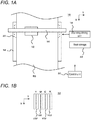
- FIG. 1 is a view describing a printing apparatus 10 according to one embodiment of the present disclosure.
- FIG. 1A shows one example of a configuration of a main part of the printing apparatus 10.
- FIG. 1B shows one example of a configuration of a head unit 12 in the printing apparatus 10.
- the printing apparatus 10 may have features same as or similar to the known inkjet printers.
- the printing apparatus 10 may further have a configuration same as or similar to a known inkjet printer, in addition to the configuration described below.
- the printing apparatus 10 is an example of a liquid ejecting device that ejects liquid through an inkjet method, and performs printing through the inkjet method on a medium 50 to be printed (medium).
- the medium 50 is an example of an ink ejecting target.
- the ink is, for example, liquid ejected from an inkjet head.
- the inkjet head is, for example, an ejection head that ejects liquid through an inkjet method.
- the ink can also be considered as, for example, a functional liquid or the like ejected by a liquid ejecting device.
- the printing apparatus 10 is an inkjet printer (textile printer) that uses the cloth medium 50 as an ink ejecting target, and includes a head unit 12, a platen 14, a guide rail 16, a heater 20, a scanning driving unit 18, a mask storage 22, and a control unit 30.
- the cloth medium 50 is, for example, fabric, various types of cloth products and the like.
- a medium 50 same as or similar to the medium 50 used as a printing target in a known textile printer can be suitably used.
- the head unit 12 is a portion that ejects the ink to the medium 50, and for example, includes a plurality of inkjet heads 102, as shown in FIG. 1B .
- each inkjet head 102 is an inkjet head that ejects the ink of each color used for printing.
- Each of the plurality of inkjet heads 102 includes a nozzle row in which a plurality of nozzles for ejecting ink onto the medium 50 are arranged, and ejects inks having different colors from each other. Furthermore, the plurality of nozzles in each of the inkjet heads 102 are lined up at their positions in a predetermined nozzle row direction that are shifted from one another.
- the nozzle row direction is a direction parallel to the sub scanning direction (X direction in the figure) set in advance in the printing apparatus 10.
- the plurality of nozzles form a nozzle row by being arranged so that the intervals in the sub scanning direction become constant.
- the head unit 12 includes the plurality of inkjet heads 102, each of which ejects ink of each color of yellow (Y), magenta (M), cyan (C), and black (K).
- the plurality of inkjet heads 102 are arranged side by side in a main scanning direction (Y direction in the figure) orthogonal to the sub scanning direction with the positions in the sub scanning direction aligned.
- the main scanning direction is an example of a direction intersecting the nozzle row.
- a plurality of inkjet heads 102 are held by a carriage (not shown).
- an evaporation-drying type ink which is an ink that fixes to the medium 50 by evaporating the solvent is used as the ink of each color.
- an inkjet head 102 for each color an inkjet head that can change the volume of ink to be ejected from a nozzle in a plurality of levels is used. The feature that the volume of ink can be changed will be described in more detail later.
- the platen 14 is a table-shaped member that supports the medium 50 at a position facing the head unit 12.
- the guide rail 16 is a rail-like member extending in the main scanning direction, and guides the movement of the head unit 12 in the main scanning direction.
- the heater 20 is a heating means for evaporating the solvent in the ink. In the present embodiment, the heater 20 is disposed in the platen 14 at a position facing the head unit 12 with the medium 50 therebetween, and volatilizes and removes the solvent in the ink by heating the medium 50.
- the scanning driving unit 18 is a driving unit that causes the head unit 12 to perform a scanning operation of relatively moving with respect to the medium 50.
- causing the head unit 12 to perform a scanning operation means, for example, causing the respective inkjet heads 102 of the head unit 12 to perform a scanning operation.
- the scanning driving unit 18 causes the head unit 12 to perform the main scan and the sub scan.
- the main scan is, for example, an operation (scanning operation) of ejecting ink while moving in the main scanning direction. Furthermore, at the time of the main scan, the scanning driving unit 18 moves the head unit 12 along the guide rail 16.
- the movement of the head unit 12 in the main scanning direction is a relative movement with respect to the medium 50. Therefore, in the modified example of the printing apparatus 10, the medium 50 side may be moved by fixing the position of the head unit 12, and moving the platen 14, for example.
- the sub scan is, for example, an operation that moves relative to the medium 50 in the sub scanning direction.
- the scanning driving unit 18 causes the head unit 12 to perform the sub scan by conveying the medium 50 in the conveyance direction parallel to the sub scanning direction using, for example, a roller (not shown).
- the medium 50 is conveyed by a preset feed amount between each main scan.
- the printing apparatus 10 executes the printing operation through the serial method by causing the head unit 12 to perform the main scan and the sub scan.
- the printing operation is performed by the one-pass operation of setting the pass number to one.
- the pass number is, for example, the number of main scans performed on the same position on the medium 50.
- the operation of one pass can be considered as, for example, an operation in a configuration in which only one main scan is performed with respect to each position of the medium 50.
- the mask storage 22 is a storage means that stores a mask used in the recovery process.
- the recovery process is, for example, a process for suppressing the influence of the presence of an abnormal nozzle when an abnormal nozzle is present.
- the abnormal nozzle is a nozzle whose ejection characteristic is abnormal.
- the abnormal nozzle can also be considered as, for example, a nozzle whose ejection characteristic is deviated from a preset normal range.
- the mask storage 22 stores a plurality of masks different from each other. The recovery process performed using the mask will be described in more detail later.
- the control unit 30 is, for example, a CPU of the printing apparatus 10, and controls the operation of each unit of the printing apparatus 10. More specifically, the printing apparatus 10 causes each nozzle in the head unit 12 to eject ink according to an image to be printed, for example, at the time of control of the main scan by the head unit 12. Furthermore, as will be described in more detail later, in the present example, the printing apparatus 10 further performs control of recovery process and the like performed using a mask. According to this example, for example, various images can be appropriately printed by the printing apparatus 10.
- FIG. 2 is a view describing the recovery process performed in the present example.
- FIG. 2A shows one example of the volume of ink that can be ejected from the nozzles in the inkjet head 102 (see FIG. 1 ) for each color.
- an inkjet head capable of changing the volume of the ink to be ejected from the nozzle in a plurality of levels is used as the inkjet head 102 for each color. More specifically, in the present example, the inkjet head 102 can eject the ink from each of the nozzles with three types of volumes of S (small), M (medium), and L (large) as shown in the figure.
- four types of values can be represented by one nozzle by including a state in which ink is not ejected from the nozzle.
- a known inkjet head multi-valued head in which the volume of ink can be varied in a plurality of levels can be suitably used.
- the recovery process is performed using such a feature that the volume of ink can be changed. More specifically, when one of the nozzles in any one of the inkjet heads 102 is an abnormal nozzle, the control unit 30 (see FIG. 1 ) controls the operation of the scanning driving unit 18 (see FIG. 1 ) so that the main scan is performed without using the abnormal nozzle. In this case, any other nozzle other than the abnormal nozzle is caused to eject an amount of ink larger than that in the normal time when no abnormal nozzle is present, thereby suppressing the influence that may occur when the abnormal noise is caused not to eject ink.
- the ink can be ejected by the other nozzles in place of the abnormal nozzle by increasing the ejection amount of the other nozzles other than the abnormal nozzle.
- the recovery process can be appropriately performed in a case in which an abnormal nozzle is present.
- FIGs. 2B to 2D are views specifically showing an example of the recovery process performed in the present example.
- the ink dots are shown somewhat smaller in order to reduce the overlapping of the ink dots and to make it easy to identify the individual ink dots. The size of the ink dot will be described in more detail later.
- FIG. 2B shows one example of the arrangement of ink dots formed at the normal time when an abnormal nozzle is not present.
- the ink dots arranged in the main scanning direction are dots formed by one nozzle in one inkjet head 102.
- the arrangement of ink dots arranged in the main scanning direction can also be considered as dots formed by one nozzle in one main scan.
- each nozzle of each inkjet head 102 forms a plurality of ink dots arranged in the main scanning direction by ejecting ink to an ejecting position set in advance according to the image to be printed.
- characters L1 to L5 indicate five lines arranged in the sub scanning direction.
- a line is a line formed by a plurality of ink dots arranged in the main scanning direction.
- each line corresponds to each of the five nozzles arranged continuously in the nozzle row direction parallel to the sub scanning direction (X direction).
- FIG. 2C shows one example of the arrangement of ink dots formed when the recovery process is not performed when an abnormal nozzle is present.
- an example of the arrangement of ink dots is shown for the case where the nozzle corresponding to the line denoted with the character L3 is a non-ejection nozzle that does not eject ink.
- the line of L3 a state in which the dots constituting the line denoted with the character L3 (hereinafter referred to as the line of L3) are removed from the arrangement of ink dots shown in FIG. 2B is obtained.
- streaky portions white stripes in which the amount of ink runs short occurs in the printing result, and the printing quality may lower.
- FIG. 2D shows one example of the arrangement of ink dots formed when the recovery process is performed.
- the line of L3 is not formed as in the case shown in FIG. 2C .
- the influence of the disappearance of the line of L3 is reduced by increasing the amount of ink constituting the line than in the normal time.
- the volume of ink to be ejected to a part of ejecting position is made larger than at the normal time for the line of L2 and the line of L4 (line denoted with L2 and L4 in the figure), which are lines adjacent to the line of L3.
- the abnormal nozzle when an abnormal nozzle is present, the abnormal nozzle may not eject ink and the amount of ink ejected at the time of the main scan by the other nozzles in the vicinity of the abnormal nozzle can be made larger than at the normal time.
- the influence of the disappearance of the line of L3 can be reduced, and the recovery process can be appropriately performed.
- the ink dots are illustrated slightly smaller. Therefore, for example, in FIG. 2D , an impression may be given as if the effect of the recovery process is small. However, when the actual ink dot size is taken into consideration, the recovery process can be appropriately performed by performing as described above.
- FIG. 3 is a view describing the size of ink dots in more detail.
- FIG. 3A is a view showing one example of the size of ink dots, and shows one example of the relationship between the resolution of printing and the ink dots of three types of sizes of S, M and L.
- the three types of sizes of S, M, and L refer to the sizes of ink dots formed by the respective volumes of three types of S, M, and L.
- the relationship with the resolution of printing for example, is the relationship with the interval of the ejecting position set according to the resolution of printing. More specifically, in FIG. 3A , the nine squares shown in the background of ink dots of each size indicate an example of the ejecting positions set according to the resolution.
- the central square indicates an ejecting position at which ink is ejected at the time of forming each dot.
- squares other than the central square indicate the ejecting positions around the ejecting position corresponding to the central square.
- a dot having a size that comes into contact with the ink dot formed at the adjacent ejecting position is formed as the ink dot of each size.
- the adjacent ejecting position is, for example, an ejecting position adjacent in each of the main scanning direction and sub scanning direction.
- the inkjet head 102 (see FIG. 1 ) for each color, for example, ejects ink from the respective nozzles so that ink dots formed on the medium 50 by the ink ejected from the nozzle adjacent in the nozzle row direction have a size of making contact on the medium 50.
- FIG. 3B is a view showing an example of the arrangement of ink dots formed when the recovery process is performed, and shows the result of performing the recovery process in a manner same as or similar to the case described with reference to FIG. 2D while reflecting the size of the ink dots shown in FIG. 3A .
- the recovery process can be appropriately performed when an abnormal nozzle is present.
- FIG. 4 is a view describing the recovery process performed in the present example in more detail.
- the volume of ink ejected to a part of ejecting positions by nozzles other than the abnormal nozzle is made larger than that in the normal time as in the recovery process performed in the present example, ideally, the volume of ink is preferably changed so as to match as accurately as possible to the original ejection amount by the abnormal nozzle.
- the original ejection amount at the abnormal nozzle is the amount of ink ejected when the abnormal nozzle is normal.
- the time required for the calculation may become long due to the increase in the required calculation amount, which may affect the printing speed.
- the cost of the device may greatly rise.
- the recovery process is performed using the mask, as described above.
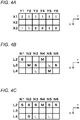
- FIG. 4A shows an example of a mask used in the recovery process of the present example.
- the recovery process is performed by changing the ejection amount of the ink by the other nozzles in the vicinity of the abnormal nozzle.
- at least a nozzle adjacent to the abnormal nozzle in the nozzle row direction serves as the other nozzles.
- FIG. 4A illustrates an example of the mask in a case where the recovery process is performed using nozzles adjacent to the abnormal nozzle on both sides in the nozzle row direction.
- characters X1 to X3 indicate three nozzles continuously arranged in the nozzle row direction.
- the central character X2 indicates an abnormal nozzle to be subjected to recovery process.
- the characters X1 and X3 indicate nozzles adjacent to the abnormal nozzle in the nozzle row direction.
- characters Y1 to Y6 indicate a plurality of ejecting positions continuously arranged in the main scanning direction.
- the plurality of ejecting positions that are continuously arranged in the main scanning direction are a plurality of ejecting positions that are continuously arranged, which are formed by ejecting ink by one nozzle in one main scan.
- the ejecting position formed by ejecting ink is a position to which the ink is ejected as needed according to the image to be printed.
- the printing apparatus 10 executes the printing operation in a one-pass operation.
- the characters Y1 to Y6 indicate a plurality of positions arranged in the main scanning direction at intervals corresponding to the printing resolution.
- each of the squares aligned in a matrix indicates the ejecting position to which each nozzle ejects the ink at the time of the main scan.
- the numbers in the squares indicate the ejection amount to be increased at each ejecting position as compared to the normal time with respect to the other nozzles (nozzles used for recovery) other than the abnormal nozzle.
- the number of levels by which the ejection amount is increased is specified as the ejection amount to be increased at the ejecting position for increasing the ejection amount of the ink.
- the level number of the ejection amount is a number indicating the level in the volume of ink of a plurality of levels that can be ejected from each nozzle.
- the volume of the ink to be ejected is increased by two levels.
- the volume of the ink to be ejected at the ejecting position before application of the mask is the dot of S size (S dot)
- the volume of the ink is increased by two levels by the application of the mask to be set to the volume of the dot (L dot) of L size.
- the volume of the ink is increased by two levels by the application of the mask to be set to the volume of the dot of M size (M dot).
- the volume of ink after the application of the mask is set to the volume of L dot.
- the volume of ink before the application of the mask is M dot or L dot
- the volume of ink after the application of the mask is set to the volume of L dot.
- the volume of the ink to be ejected is increased by one level.
- the volume of ink before the application of the mask is the volume of S dot
- the volume of ink after the application of the mask is set to the volume of M dot.
- the volume of ink after the application of the mask is set to the volume of L dot.
- the volume of the ink is increased by one level by the application of the mask to be set to the volume of S dot.
- the ejecting position where the number 0 is specified is an ejecting position where the volume of ink is not changed. In this case, the same volume as that before the application of the mask is set as the volume of ink after the application of the mask.
- the mask used in the present example can be considered as data specifying ejecting positions at which the ejection amount of ink is increased and the ejection amount to be increased at the ejecting positions.
- the ejection amount to be increased at the ejecting position may be determined in consideration of the degree of influence on the ejecting position corresponding to the abnormal nozzle.
- the degree of influence on the ejecting position corresponding to the abnormal nozzle is the magnitude of influence determined according to the range covering the ejecting position of the abnormal nozzle, for example, when ink dots of various sizes are formed by the nozzles adjacent to the abnormal nozzle.
- the ejecting position to increase the ejection amount of ink and the number of levels to increase the ejection amount are specified for a preset number of ejecting positions lined up in the main scanning direction.
- the ink is ejected to more ejecting positions than the ejecting positions lined up in the main scanning direction in the mask. Therefore, in the present example, in the case of applying the mask, for example, the mask is applied to the respective ejecting positions to eject ink at the time of each main scan by periodically applying the mask with respect to the main scanning direction.
- the operation of the control unit 30 can be considered as an operation for causing the adjacent nozzle to eject ink of a larger amount than at the normal time at some of the ejecting positions where the ink can be ejected at the time of the main scan by the nozzle adjacent to the abnormal nozzle based on the mask described above.
- the nozzle adjacent to the abnormal nozzle is an example of another nozzle in the vicinity of the abnormal nozzle.
- the volume of the ink to be ejected is made larger than at the normal time for a part of ejecting positions where ink is ejected by the nozzle adjacent to the abnormal nozzle by increasing the ejection amount according to the number of levels specified in the mask.
- the manner of applying the mask for example, can be considered as an operation of periodically applying a mask for each size (preset number mentioned above) of the mask in the main scanning direction with respect to the arrangement of ejecting positions where ink is ejected by the nozzles adjacent to the abnormal nozzle.
- FIGs. 4B and 4C show an example of the application result of a mask.
- FIG. 4B is a view showing the volume of ink to be ejected to each ejecting position before application of the mask, and shows an example of the volume of ink to be ejected to the ejecting positions indicated by characters N1 to N6 in the figure for three consecutive nozzles indicated by characters L2 to L4 in the figure (three nozzles continuously arranged in the nozzle row direction).
- the contents shown in FIG. 4B can be considered as, for example, part of data (image data) indicating an image before application of the mask. Furthermore, in FIG.
- the volume of ink specified for each ejecting position is the volume of ink when there is no abnormal nozzle in the above three nozzles.
- the ejecting positions indicated by the characters N1 to N6 are the ejecting positions in one main scan.
- FIG. 4C is a view showing the volume of ink to be ejected to each ejecting position after application of the mask, and shows the result of applying the mask shown in FIG. 4A for a case in which the nozzle indicated by the character L3 is an abnormal nozzle, and the volume of ink at each ejecting position is set as shown in FIG. 4B .
- the contents shown in FIG. 4C can be considered as, for example, part of data (recovery data) indicating an image in a state after the recovery process has been performed.
- the original ejecting position by the abnormal nozzle is, for example, a position where the ink should have been ejected when the abnormal nozzle is a normal nozzle.
- the ejecting positions indicated by the characters N2, N3, N5, and N6 are the original ejecting positions.
- the contents of the mask are reflected only on the ejecting position adjacent in the nozzle row direction to the original ejecting position by the abnormal nozzle, and the ejection amount of the ink is increased.
- to increase the ejection amount of ink by reflecting the contents of the mask means, for example, to increase the ejection amount of ink when a value greater than or equal to one is set as the value corresponding to the relevant ejecting position in the mask.
- the control unit 30 sets the amount of ink to be ejected to be larger than at the normal time based on the mask only with respect to the ejecting position adjacent in the nozzle row direction to the ejecting position where ink is ejected when the abnormal nozzle is a normal nozzle among the ejecting positions where the nozzles adjacent to the abnormal nozzle eject ink.
- the ejecting positions indicated by the characters N2, N3, N5 and N6 become the original ejecting positions. Therefore, only the ejecting positions indicated by the characters N2, N3, N5, and N6 are the ejecting positions whose values are changed by the mask even for the ejecting positions corresponding to the nozzles indicated by the characters L1 and L3, which are nozzles adjacent to the abnormal nozzle.
- the volume of ink does not change between before and after the application of the mask for the ejecting positions corresponding to the characters N1 and N4 among the ejecting positions corresponding to the nozzle indicated by the character L2.
- the result of performing an excessive recovery process may be obtained by performing a uniform recovery process when the original ejecting position by the abnormal nozzle is not taken into consideration, for example, even when printing an image in which printing is performed with hardly using the nozzle corresponding to the abnormal nozzle.
- the amount of ink to be ejected is not changed even if it is specified to increase the amount of ink in the mask with respect to the ejecting position adjacent in the nozzle row direction to the ejecting position where ink is not ejected even when the abnormal nozzle is a normal nozzle.
- the recovery process can be performed in accordance with the number of original ejecting positions in the abnormal nozzle. Furthermore, for example, this makes it possible to appropriately prevent excessive recovery process from being performed, and more appropriately perform the recovery process in accordance with the image to be printed.
- the recovery process performed using a mask can be appropriately performed.
- the recovery process can be easily and appropriately performed without performing many calculations, and the like by specifying ejecting positions at which the ejection amount of ink by other nozzles other than the abnormal nozzle is increased and the ejection amount (increase amount of ink) to be increased at these ejecting positions in the mask. Therefore, according to this example, when an abnormal nozzle is present, the influence of the presence of the abnormal nozzle can be appropriately suppressed.
- the extent to which the recovery process is preferably performed differs depending on the printing conditions and the image to be printed.
- the mask storage 22 (see FIG. 1 ) of the printing apparatus 10 is used to store a plurality of masks different from each other.
- a mask can be selected from among a plurality of masks prepared in advance, according to the printing conditions and the image to be printed.
- the recovery process is executed based on any mask selected from the plurality of masks. More specifically, in this case, it is conceivable to use, for example, masks having different correction intensities as the plurality of masks.
- the difference in correction intensity means that, for example, the amounts of ink to be increased with respect to other nozzles in the vicinity of the abnormal nozzle are different from each other.
- the amount of ink to be increased can be considered as, for example, an amount corresponding to the total of the number of levels specified as an amount to increase the ejection amount of the ink in the mask.
- the mask selection may be performed automatically or manually by a user.
- the image density is, for example, the color strength in the image to be printed.
- the image density can also be considered as, for example, a concentration corresponding to the density of ink dots formed on the medium at the time of printing.
- the plurality of masks stored by the mask storage 22 for example, it is conceivable to use a plurality of masks each associated with different image densities. In this case, at the time of execution of the recovery process, the control unit 30 (see FIG.
- the printing apparatus 10 selects any mask from the plurality of masks based on, for example, the image density of the image to be printed. Then, recovery process is executed based on the selected mask. With this configuration, for example, the recovery process can be more appropriately performed in accordance with the image to be printed. In addition, when selecting the mask manually, for example, it is conceivable to check the result of actually performing the printing and change the mask as necessary.
- a raster image is generated as image data indicating an image to be printed by performing RIP process or the like.
- Generating a raster image by performing RIP process and the like means, for example, generating a raster image indicating the ink ejecting position at a resolution that matches the resolution of printing by performing a separation process according to the number of colors of ink to be used for printing, conversion of resolution according to the printing resolution, halftone process and the like.
- consideration is made to generate a raster image that is the same as or similar to that at the time of printing with a known inkjet printer.
- the mask described above is applied to, for example, a raster image generated in this manner.
- the recovery process can be considered, for example, as an operation of correcting a raster image indicating the ink ejecting position.
- the control unit 30 causes the respective nozzles of each of the inkjet heads in the head unit 12 (see FIG. 1 ) to eject the ink, for example, based on the raster image indicating the ejecting position of the ink. Furthermore, when an abnormal nozzle is present, the control unit 30 corrects the raster image based on the mask, for example, to cause each nozzle to eject ink based on the corrected raster image. Moreover, for example, the recovery process is executed by changing the ejection amount of ink by the nozzle adjacent to the abnormal nozzle at the time of the main scan. According to such a configuration, for example, the recovery process using a mask can be appropriately performed.
- FIG. 5 is a flowchart showing an example of the printing operation performed by the printing apparatus 10.
- print data indicating an image to be printed is first input (S102). It is conceivable to input the data of the raster image described above, for example, as the print data.
- a host PC or the like that controls the operation of the printing apparatus 10 performs the RIP process and the like to generate a raster image.
- data before the RIP process or the like is performed may be input as the print data.
- the control unit 30 of the printing apparatus 10 performs the RIP process and the like to generate the raster image.
- an abnormal nozzle is present is checked based on, for example, information of the abnormal nozzle stored in advance. Moreover, whether or not perform the recovery process is determined (S104).
- a mask used for the recovery process is selected from the plurality of masks stored in the mask storage 22 (S106). In this case, the mask may be selected automatically or manually by the user, as described above.
- the mask is applied to the print data indicating the raster image, so that the print data is corrected to make the volume of ink to be ejected by the nozzle adjacent to the abnormal nozzle larger than that in the normal time without using the abnormal nozzle (S108).
- the main scan or the like is performed based on the corrected print data to execute the ejecting operation of ejecting the ink from each nozzle of each inkjet head (S110).
- the process proceeds to step S110, and the ejecting operation is executed.
- the image indicated by the print data can be appropriately printed by the above operations.
- the recovery process can be appropriately performed in a case where an abnormal nozzle is present.
- the recovery process when an abnormal nozzle is present can be appropriately performed. Furthermore, regarding this point, as a recovery process when an abnormal nozzle is present, a recovery process using an operation through a multi-pass method, and the like has been widely performed conventionally.
- the multi-pass method is, for example, a method in which the main scan is performed such that a plurality of main scans are performed on each position of the medium which is an ink ejecting target.
- the nozzles which can eject ink to one position can be differed for each main scan by performing the sub scan between the main scans. Therefore, even when an abnormal nozzle is present, the recovery process can be performed by an alternative process of ejecting ink using another nozzle in another main scan with respect to the ejecting position corresponding to the abnormal nozzle in each main scan.
- the recovery process can be performed in one main scan using a nozzle in the vicinity of the abnormal nozzle. Therefore, according to the present example, even when printing is performed by a one-pass operation, the recovery process can be appropriately performed.
- the printing apparatus 10 is a textile printer that uses a cloth medium as an ink ejecting target.
- the ink permeates the medium, the ink dots easily spread on the medium. As a result, the ink dots become large, and the recovery process can be more appropriately performed.
- printing may be performed on a medium other than fabric.
- the ink is preferably ejected from the inkjet head so that an ink dot, which is large to a certain extent, is formed at the time of the main scan.
- a method of transferring using a transfer medium other than the direct printing method of directly printing on a medium.
- a transfer medium is used as an ink ejecting target.
- the image is transferred to a medium such as fabric to complete an image (image after transfer), which becomes a final product.
- a sublimation transfer ink which is a sublimation ink used for transfer can be suitably used as the ink.
- the ink dots spread during sublimation transfer of transferring the image from the transfer medium to another medium since the ink dots spread during sublimation transfer of transferring the image from the transfer medium to another medium, the ink dots constituting the image after transfer, which becomes the final product, tend to be large dots. Therefore, even in such a case, the effect of the recovery process performed using the mask can be appropriately enhanced.
- the mask storage 22 stores a plurality of masks different from each other.
- a plurality of masks each associated with different image densities as the plurality of masks.
- the image density in the entire image is, for example, the average image density in the entire image.
- a plurality of masks may be selected for one image, and the masks may be switched for each part of the image.
- the line drawn by one nozzle is, for example, a line which should have been drawn when the abnormal nozzle is a normal nozzle.
- the image density may be calculated for each part of a preset length in one line, not for the entire line, and the mask may be switched for each part. With this configuration, for example, the recovery process with higher accuracy can be appropriately performed.
- the operation of ejecting ink in place of the abnormal nozzle is performed in another main scan as in the recovery process performed using the operation through the multi-pass method
- a change may occur also in the timing at which the ink lands.
- an unintended stripe or the like may be generated due to an influence that a difference occurs in the curing timing between the ultraviolet-curable ink and the surrounding ink.
- the recovery process is preferably performed in the same main scan. Therefore, in the case of using the ultraviolet-curable ink, it is particularly preferable to perform the recovery process as in the present example.
- the printing apparatus 10 performs the printing operation through the serial method.
- the printing apparatus 10 may perform the printing operation through the line method.
- the printing operation through the line method is, for example, an operation of performing printing using an inkjet head capable of simultaneously ejecting ink to the entire width direction of the printing range in a medium.
- the printing operation through the line method can also be considered as, for example, an operation in which printing is performed by performing only the scanning operation corresponding to the main scan, instead of performing the main scan and the sub scan.
- the operation of ejecting ink from the inkjet head while moving the inkjet head relative to the medium by conveying the medium can be considered as an example of the main scan.
- various modified examples may be considered the configuration of the printing apparatus 10 and the like. More specifically, for example, a part of the process performed by the control unit 30 of the printing apparatus 10 may be performed by a computer or the like external to the printing apparatus 10. Furthermore, it is also conceivable to use a storage device external to the printing apparatus 10 as the mask storage 22. In these cases, the printing system including the device external to the printing apparatus 10 can be considered as an example of the liquid ejecting device.
- the printing apparatus 10 is an inkjet printer that draws a two-dimensional image on the medium by ejecting the ink to the medium.
- a 3D printer (3D printing apparatus, shaping device) or the like that shapes a stereoscopic shaped object.
- a shaping table that supports a shaped object being shaped and a shaped object being shaped can be considered as objects to which the ink is to be ejected.
- the influence of the presence of an abnormal nozzle can be more appropriately suppressed by performing the recovery process in the same manner as described above.
- the 3D printer can be considered as an example of the liquid ejecting device.
- the present disclosure can be suitably used in, for example, a printing apparatus.
Landscapes
- Engineering & Computer Science (AREA)
- Physics & Mathematics (AREA)
- Quality & Reliability (AREA)
- Mathematical Physics (AREA)
- General Engineering & Computer Science (AREA)
- General Physics & Mathematics (AREA)
- Theoretical Computer Science (AREA)
- Ink Jet (AREA)
Applications Claiming Priority (1)
| Application Number | Priority Date | Filing Date | Title |
|---|---|---|---|
| JP2018151362A JP7210187B2 (ja) | 2018-08-10 | 2018-08-10 | 液体吐出装置及び液体吐出方法 |
Publications (2)
| Publication Number | Publication Date |
|---|---|
| EP3608111A1 true EP3608111A1 (fr) | 2020-02-12 |
| EP3608111B1 EP3608111B1 (fr) | 2023-02-15 |
Family
ID=67514482
Family Applications (1)
| Application Number | Title | Priority Date | Filing Date |
|---|---|---|---|
| EP19189554.9A Active EP3608111B1 (fr) | 2018-08-10 | 2019-08-01 | Dispositif et procédé d'éjection de liquide |
Country Status (4)
| Country | Link |
|---|---|
| US (2) | US20200047489A1 (fr) |
| EP (1) | EP3608111B1 (fr) |
| JP (1) | JP7210187B2 (fr) |
| CN (1) | CN110816059B (fr) |
Cited By (1)
| Publication number | Priority date | Publication date | Assignee | Title |
|---|---|---|---|---|
| CN115447282A (zh) * | 2021-06-08 | 2022-12-09 | 深圳市汉森软件有限公司 | 异常喷嘴补偿打印方法、装置、设备及存储介质 |
Families Citing this family (2)
| Publication number | Priority date | Publication date | Assignee | Title |
|---|---|---|---|---|
| JP7428541B2 (ja) * | 2020-03-02 | 2024-02-06 | 住友重機械工業株式会社 | インク塗布装置、インク塗布装置の制御装置、及びインク塗布方法 |
| JP2024155041A (ja) * | 2023-04-20 | 2024-10-31 | 株式会社リコー | 情報処理装置、データ生成方法および画像形成システム |
Citations (5)
| Publication number | Priority date | Publication date | Assignee | Title |
|---|---|---|---|---|
| US20030146963A1 (en) * | 2002-10-31 | 2003-08-07 | John Murray | Micro-diffusion ink and ink jet printing process |
| EP1405727A1 (fr) * | 2002-10-01 | 2004-04-07 | Sony Corporation | Appareil et procédé d'éjection de liquide |
| WO2006125780A1 (fr) * | 2005-05-25 | 2006-11-30 | Agfa Graphics Nv | Procede de traitement d'image et appareil permettant d'ameliorer la qualite d'image d'une imprimante par points |
| JP2015130166A (ja) | 2013-12-30 | 2015-07-16 | 富士通株式会社 | 裏面透かしの検出方法及び裏面透かしの検出装置 |
| EP3225406A1 (fr) * | 2016-03-28 | 2017-10-04 | Seiko Epson Corporation | Dispositif de commande d'évacuation de gouttelettes liquides, procédé de commande d'évacuation de gouttelettes liquides et appareil d'évacuation de gouttelettes liquides |
Family Cites Families (16)
| Publication number | Priority date | Publication date | Assignee | Title |
|---|---|---|---|---|
| US7075677B1 (en) | 2000-06-30 | 2006-07-11 | Silverbrook Research Pty Ltd | Ink jet fault tolerance using oversize drops |
| ATE393025T1 (de) * | 2003-11-05 | 2008-05-15 | Oce Tech Bv | Verfahren zur maskierung von ausgefallenen druckelementen in einem drucker |
| KR100999509B1 (ko) * | 2008-09-23 | 2010-12-09 | 삼성전기주식회사 | 보완용 인쇄 노즐을 포함하는 잉크젯 장치를 이용한 배선인쇄 방법 |
| JP6232871B2 (ja) | 2013-09-12 | 2017-11-22 | セイコーエプソン株式会社 | インクジェットプリンター、および印刷方法 |
| CN104512110B (zh) * | 2013-10-07 | 2016-09-07 | 株式会社御牧工程 | 印刷装置以及喷出异常的侦测方法 |
| JP6319556B2 (ja) * | 2014-01-17 | 2018-05-09 | セイコーエプソン株式会社 | 液体吐出装置 |
| JP6050268B2 (ja) * | 2014-01-30 | 2016-12-21 | 富士フイルム株式会社 | 画像処理装置及び方法、プログラム、並びにインクジェット印刷システム |
| JP6278184B2 (ja) * | 2014-03-17 | 2018-02-14 | セイコーエプソン株式会社 | 記録方法、及び、インクジェットプリンター |
| JP2016141102A (ja) * | 2015-02-04 | 2016-08-08 | セイコーエプソン株式会社 | 印刷制御装置および印刷制御方法 |
| US9457561B2 (en) * | 2015-02-16 | 2016-10-04 | Ricoh Company, Ltd. | Image forming apparatus, image processing method, and program recording medium |
| JP6657862B2 (ja) | 2015-11-30 | 2020-03-04 | 株式会社リコー | 補償方法、プログラム、補償装置、及び補償システム |
| US9573382B1 (en) * | 2016-03-02 | 2017-02-21 | Xerox Corporation | System and method for missing inkjet compensation in a multi-level inkjet printer |
| JP6808435B2 (ja) | 2016-10-11 | 2021-01-06 | 株式会社ミマキエンジニアリング | 印刷装置 |
| CN108274898B (zh) * | 2018-01-17 | 2019-06-04 | 森大(深圳)技术有限公司 | 喷墨打印机喷嘴异常补偿方法、装置、设备及存储介质 |
| CN108177442B (zh) * | 2018-01-17 | 2019-03-01 | 森大(深圳)技术有限公司 | 喷嘴异常补偿方法、装置、喷墨打印设备及存储介质 |
| JP7047513B2 (ja) | 2018-03-19 | 2022-04-05 | 株式会社リコー | 液体吐出装置、不吐出ノズル補完方法及びプログラム |
-
2018
- 2018-08-10 JP JP2018151362A patent/JP7210187B2/ja active Active
-
2019
- 2019-07-25 US US16/521,594 patent/US20200047489A1/en not_active Abandoned
- 2019-08-01 EP EP19189554.9A patent/EP3608111B1/fr active Active
- 2019-08-08 CN CN201910729504.XA patent/CN110816059B/zh active Active
-
2021
- 2021-06-07 US US17/341,339 patent/US20210291512A1/en active Pending
Patent Citations (5)
| Publication number | Priority date | Publication date | Assignee | Title |
|---|---|---|---|---|
| EP1405727A1 (fr) * | 2002-10-01 | 2004-04-07 | Sony Corporation | Appareil et procédé d'éjection de liquide |
| US20030146963A1 (en) * | 2002-10-31 | 2003-08-07 | John Murray | Micro-diffusion ink and ink jet printing process |
| WO2006125780A1 (fr) * | 2005-05-25 | 2006-11-30 | Agfa Graphics Nv | Procede de traitement d'image et appareil permettant d'ameliorer la qualite d'image d'une imprimante par points |
| JP2015130166A (ja) | 2013-12-30 | 2015-07-16 | 富士通株式会社 | 裏面透かしの検出方法及び裏面透かしの検出装置 |
| EP3225406A1 (fr) * | 2016-03-28 | 2017-10-04 | Seiko Epson Corporation | Dispositif de commande d'évacuation de gouttelettes liquides, procédé de commande d'évacuation de gouttelettes liquides et appareil d'évacuation de gouttelettes liquides |
Cited By (2)
| Publication number | Priority date | Publication date | Assignee | Title |
|---|---|---|---|---|
| CN115447282A (zh) * | 2021-06-08 | 2022-12-09 | 深圳市汉森软件有限公司 | 异常喷嘴补偿打印方法、装置、设备及存储介质 |
| CN115447282B (zh) * | 2021-06-08 | 2023-08-15 | 深圳市汉森软件有限公司 | 异常喷嘴补偿打印方法、装置、设备及存储介质 |
Also Published As
| Publication number | Publication date |
|---|---|
| CN110816059A (zh) | 2020-02-21 |
| JP7210187B2 (ja) | 2023-01-23 |
| EP3608111B1 (fr) | 2023-02-15 |
| US20210291512A1 (en) | 2021-09-23 |
| JP2020026063A (ja) | 2020-02-20 |
| CN110816059B (zh) | 2021-07-23 |
| US20200047489A1 (en) | 2020-02-13 |
Similar Documents
| Publication | Publication Date | Title |
|---|---|---|
| EP0955174A2 (fr) | Impression bi-directionnelle à l'altération chromatique controlée | |
| US20210291512A1 (en) | Liquid ejecting device and liquid ejecting method | |
| US9440438B2 (en) | Inkjet printer | |
| US10940695B2 (en) | Printing apparatus and printing method | |
| US20100231644A1 (en) | Liquid ejection apparatus | |
| US20150328881A1 (en) | Inkjet printer | |
| US8434843B2 (en) | Printing apparatus, printing method, and program | |
| JP6567312B2 (ja) | インクジェット印刷装置 | |
| JP2014168851A (ja) | 印刷装置及び印刷方法 | |
| CN106103098B (zh) | 印刷装置和印刷方法 | |
| US11273635B2 (en) | Liquid ejecting device and liquid ejecting method | |
| US9944068B2 (en) | Droplet ejection control apparatus, droplet ejection control method, and droplet ejection apparatus | |
| JP6054850B2 (ja) | 記録装置及び記録方法 | |
| US20190344581A1 (en) | Printing apparatus, control method thereof and storage medium | |
| JP2009231957A (ja) | 補正値取得方法、及び、液体噴射装置 | |
| EP3838597B1 (fr) | Dispositif d'impression et procédé d'impression | |
| US20070046725A1 (en) | Printing method, printing system, and storage medium storing program | |
| JP7094826B2 (ja) | 印刷装置及び印刷方法 | |
| JP7451038B2 (ja) | 印刷システム及び印刷方法 | |
| JP2009226640A (ja) | 補正値取得方法、及び、液体噴射装置 | |
| JP2019181893A (ja) | インクジェット記録装置及び記録方法 | |
| WO2015137479A1 (fr) | Système d'impression et procédé d'impression | |
| JP2012232556A (ja) | 補正値の取得方法、及び、印刷装置の製造方法 | |
| JP2009278370A (ja) | 補正値算出方法、及び、液体噴射方法 |
Legal Events
| Date | Code | Title | Description |
|---|---|---|---|
| PUAI | Public reference made under article 153(3) epc to a published international application that has entered the european phase |
Free format text: ORIGINAL CODE: 0009012 |
|
| STAA | Information on the status of an ep patent application or granted ep patent |
Free format text: STATUS: THE APPLICATION HAS BEEN PUBLISHED |
|
| AK | Designated contracting states |
Kind code of ref document: A1 Designated state(s): AL AT BE BG CH CY CZ DE DK EE ES FI FR GB GR HR HU IE IS IT LI LT LU LV MC MK MT NL NO PL PT RO RS SE SI SK SM TR |
|
| AX | Request for extension of the european patent |
Extension state: BA ME |
|
| STAA | Information on the status of an ep patent application or granted ep patent |
Free format text: STATUS: REQUEST FOR EXAMINATION WAS MADE |
|
| 17P | Request for examination filed |
Effective date: 20200812 |
|
| RBV | Designated contracting states (corrected) |
Designated state(s): AL AT BE BG CH CY CZ DE DK EE ES FI FR GB GR HR HU IE IS IT LI LT LU LV MC MK MT NL NO PL PT RO RS SE SI SK SM TR |
|
| STAA | Information on the status of an ep patent application or granted ep patent |
Free format text: STATUS: EXAMINATION IS IN PROGRESS |
|
| 17Q | First examination report despatched |
Effective date: 20220608 |
|
| GRAP | Despatch of communication of intention to grant a patent |
Free format text: ORIGINAL CODE: EPIDOSNIGR1 |
|
| STAA | Information on the status of an ep patent application or granted ep patent |
Free format text: STATUS: GRANT OF PATENT IS INTENDED |
|
| INTG | Intention to grant announced |
Effective date: 20220927 |
|
| GRAS | Grant fee paid |
Free format text: ORIGINAL CODE: EPIDOSNIGR3 |
|
| GRAA | (expected) grant |
Free format text: ORIGINAL CODE: 0009210 |
|
| STAA | Information on the status of an ep patent application or granted ep patent |
Free format text: STATUS: THE PATENT HAS BEEN GRANTED |
|
| AK | Designated contracting states |
Kind code of ref document: B1 Designated state(s): AL AT BE BG CH CY CZ DE DK EE ES FI FR GB GR HR HU IE IS IT LI LT LU LV MC MK MT NL NO PL PT RO RS SE SI SK SM TR |
|
| REG | Reference to a national code |
Ref country code: CH Ref legal event code: EP Ref country code: GB Ref legal event code: FG4D |
|
| REG | Reference to a national code |
Ref country code: DE Ref legal event code: R096 Ref document number: 602019025230 Country of ref document: DE |
|
| REG | Reference to a national code |
Ref country code: AT Ref legal event code: REF Ref document number: 1548043 Country of ref document: AT Kind code of ref document: T Effective date: 20230315 Ref country code: IE Ref legal event code: FG4D |
|
| REG | Reference to a national code |
Ref country code: LT Ref legal event code: MG9D |
|
| REG | Reference to a national code |
Ref country code: NL Ref legal event code: MP Effective date: 20230215 |
|
| REG | Reference to a national code |
Ref country code: AT Ref legal event code: MK05 Ref document number: 1548043 Country of ref document: AT Kind code of ref document: T Effective date: 20230215 |
|
| PG25 | Lapsed in a contracting state [announced via postgrant information from national office to epo] |
Ref country code: RS Free format text: LAPSE BECAUSE OF FAILURE TO SUBMIT A TRANSLATION OF THE DESCRIPTION OR TO PAY THE FEE WITHIN THE PRESCRIBED TIME-LIMIT Effective date: 20230215 Ref country code: PT Free format text: LAPSE BECAUSE OF FAILURE TO SUBMIT A TRANSLATION OF THE DESCRIPTION OR TO PAY THE FEE WITHIN THE PRESCRIBED TIME-LIMIT Effective date: 20230615 Ref country code: NO Free format text: LAPSE BECAUSE OF FAILURE TO SUBMIT A TRANSLATION OF THE DESCRIPTION OR TO PAY THE FEE WITHIN THE PRESCRIBED TIME-LIMIT Effective date: 20230515 Ref country code: NL Free format text: LAPSE BECAUSE OF FAILURE TO SUBMIT A TRANSLATION OF THE DESCRIPTION OR TO PAY THE FEE WITHIN THE PRESCRIBED TIME-LIMIT Effective date: 20230215 Ref country code: LV Free format text: LAPSE BECAUSE OF FAILURE TO SUBMIT A TRANSLATION OF THE DESCRIPTION OR TO PAY THE FEE WITHIN THE PRESCRIBED TIME-LIMIT Effective date: 20230215 Ref country code: LT Free format text: LAPSE BECAUSE OF FAILURE TO SUBMIT A TRANSLATION OF THE DESCRIPTION OR TO PAY THE FEE WITHIN THE PRESCRIBED TIME-LIMIT Effective date: 20230215 Ref country code: HR Free format text: LAPSE BECAUSE OF FAILURE TO SUBMIT A TRANSLATION OF THE DESCRIPTION OR TO PAY THE FEE WITHIN THE PRESCRIBED TIME-LIMIT Effective date: 20230215 Ref country code: ES Free format text: LAPSE BECAUSE OF FAILURE TO SUBMIT A TRANSLATION OF THE DESCRIPTION OR TO PAY THE FEE WITHIN THE PRESCRIBED TIME-LIMIT Effective date: 20230215 Ref country code: AT Free format text: LAPSE BECAUSE OF FAILURE TO SUBMIT A TRANSLATION OF THE DESCRIPTION OR TO PAY THE FEE WITHIN THE PRESCRIBED TIME-LIMIT Effective date: 20230215 |
|
| PG25 | Lapsed in a contracting state [announced via postgrant information from national office to epo] |
Ref country code: SE Free format text: LAPSE BECAUSE OF FAILURE TO SUBMIT A TRANSLATION OF THE DESCRIPTION OR TO PAY THE FEE WITHIN THE PRESCRIBED TIME-LIMIT Effective date: 20230215 Ref country code: PL Free format text: LAPSE BECAUSE OF FAILURE TO SUBMIT A TRANSLATION OF THE DESCRIPTION OR TO PAY THE FEE WITHIN THE PRESCRIBED TIME-LIMIT Effective date: 20230215 Ref country code: IS Free format text: LAPSE BECAUSE OF FAILURE TO SUBMIT A TRANSLATION OF THE DESCRIPTION OR TO PAY THE FEE WITHIN THE PRESCRIBED TIME-LIMIT Effective date: 20230615 Ref country code: GR Free format text: LAPSE BECAUSE OF FAILURE TO SUBMIT A TRANSLATION OF THE DESCRIPTION OR TO PAY THE FEE WITHIN THE PRESCRIBED TIME-LIMIT Effective date: 20230516 Ref country code: FI Free format text: LAPSE BECAUSE OF FAILURE TO SUBMIT A TRANSLATION OF THE DESCRIPTION OR TO PAY THE FEE WITHIN THE PRESCRIBED TIME-LIMIT Effective date: 20230215 |
|
| PG25 | Lapsed in a contracting state [announced via postgrant information from national office to epo] |
Ref country code: SM Free format text: LAPSE BECAUSE OF FAILURE TO SUBMIT A TRANSLATION OF THE DESCRIPTION OR TO PAY THE FEE WITHIN THE PRESCRIBED TIME-LIMIT Effective date: 20230215 Ref country code: RO Free format text: LAPSE BECAUSE OF FAILURE TO SUBMIT A TRANSLATION OF THE DESCRIPTION OR TO PAY THE FEE WITHIN THE PRESCRIBED TIME-LIMIT Effective date: 20230215 Ref country code: EE Free format text: LAPSE BECAUSE OF FAILURE TO SUBMIT A TRANSLATION OF THE DESCRIPTION OR TO PAY THE FEE WITHIN THE PRESCRIBED TIME-LIMIT Effective date: 20230215 Ref country code: DK Free format text: LAPSE BECAUSE OF FAILURE TO SUBMIT A TRANSLATION OF THE DESCRIPTION OR TO PAY THE FEE WITHIN THE PRESCRIBED TIME-LIMIT Effective date: 20230215 Ref country code: CZ Free format text: LAPSE BECAUSE OF FAILURE TO SUBMIT A TRANSLATION OF THE DESCRIPTION OR TO PAY THE FEE WITHIN THE PRESCRIBED TIME-LIMIT Effective date: 20230215 |
|
| REG | Reference to a national code |
Ref country code: DE Ref legal event code: R097 Ref document number: 602019025230 Country of ref document: DE |
|
| PG25 | Lapsed in a contracting state [announced via postgrant information from national office to epo] |
Ref country code: SK Free format text: LAPSE BECAUSE OF FAILURE TO SUBMIT A TRANSLATION OF THE DESCRIPTION OR TO PAY THE FEE WITHIN THE PRESCRIBED TIME-LIMIT Effective date: 20230215 |
|
| PLBE | No opposition filed within time limit |
Free format text: ORIGINAL CODE: 0009261 |
|
| STAA | Information on the status of an ep patent application or granted ep patent |
Free format text: STATUS: NO OPPOSITION FILED WITHIN TIME LIMIT |
|
| 26N | No opposition filed |
Effective date: 20231116 |
|
| PG25 | Lapsed in a contracting state [announced via postgrant information from national office to epo] |
Ref country code: SI Free format text: LAPSE BECAUSE OF FAILURE TO SUBMIT A TRANSLATION OF THE DESCRIPTION OR TO PAY THE FEE WITHIN THE PRESCRIBED TIME-LIMIT Effective date: 20230215 |
|
| PG25 | Lapsed in a contracting state [announced via postgrant information from national office to epo] |
Ref country code: MC Free format text: LAPSE BECAUSE OF FAILURE TO SUBMIT A TRANSLATION OF THE DESCRIPTION OR TO PAY THE FEE WITHIN THE PRESCRIBED TIME-LIMIT Effective date: 20230215 |
|
| REG | Reference to a national code |
Ref country code: CH Ref legal event code: PL |
|
| PG25 | Lapsed in a contracting state [announced via postgrant information from national office to epo] |
Ref country code: MC Free format text: LAPSE BECAUSE OF FAILURE TO SUBMIT A TRANSLATION OF THE DESCRIPTION OR TO PAY THE FEE WITHIN THE PRESCRIBED TIME-LIMIT Effective date: 20230215 |
|
| PG25 | Lapsed in a contracting state [announced via postgrant information from national office to epo] |
Ref country code: LU Free format text: LAPSE BECAUSE OF NON-PAYMENT OF DUE FEES Effective date: 20230801 |
|
| GBPC | Gb: european patent ceased through non-payment of renewal fee |
Effective date: 20230801 |
|
| PG25 | Lapsed in a contracting state [announced via postgrant information from national office to epo] |
Ref country code: LU Free format text: LAPSE BECAUSE OF NON-PAYMENT OF DUE FEES Effective date: 20230801 Ref country code: CH Free format text: LAPSE BECAUSE OF NON-PAYMENT OF DUE FEES Effective date: 20230831 |
|
| REG | Reference to a national code |
Ref country code: BE Ref legal event code: MM Effective date: 20230831 |
|
| REG | Reference to a national code |
Ref country code: IE Ref legal event code: MM4A |
|
| PG25 | Lapsed in a contracting state [announced via postgrant information from national office to epo] |
Ref country code: IT Free format text: LAPSE BECAUSE OF FAILURE TO SUBMIT A TRANSLATION OF THE DESCRIPTION OR TO PAY THE FEE WITHIN THE PRESCRIBED TIME-LIMIT Effective date: 20230215 |
|
| PG25 | Lapsed in a contracting state [announced via postgrant information from national office to epo] |
Ref country code: IE Free format text: LAPSE BECAUSE OF NON-PAYMENT OF DUE FEES Effective date: 20230801 |
|
| PG25 | Lapsed in a contracting state [announced via postgrant information from national office to epo] |
Ref country code: GB Free format text: LAPSE BECAUSE OF NON-PAYMENT OF DUE FEES Effective date: 20230801 |
|
| PG25 | Lapsed in a contracting state [announced via postgrant information from national office to epo] |
Ref country code: IE Free format text: LAPSE BECAUSE OF NON-PAYMENT OF DUE FEES Effective date: 20230801 Ref country code: GB Free format text: LAPSE BECAUSE OF NON-PAYMENT OF DUE FEES Effective date: 20230801 |
|
| PG25 | Lapsed in a contracting state [announced via postgrant information from national office to epo] |
Ref country code: BE Free format text: LAPSE BECAUSE OF NON-PAYMENT OF DUE FEES Effective date: 20230831 |
|
| PGFP | Annual fee paid to national office [announced via postgrant information from national office to epo] |
Ref country code: FR Payment date: 20240702 Year of fee payment: 6 |
|
| PG25 | Lapsed in a contracting state [announced via postgrant information from national office to epo] |
Ref country code: BG Free format text: LAPSE BECAUSE OF FAILURE TO SUBMIT A TRANSLATION OF THE DESCRIPTION OR TO PAY THE FEE WITHIN THE PRESCRIBED TIME-LIMIT Effective date: 20230215 |
|
| PG25 | Lapsed in a contracting state [announced via postgrant information from national office to epo] |
Ref country code: BG Free format text: LAPSE BECAUSE OF FAILURE TO SUBMIT A TRANSLATION OF THE DESCRIPTION OR TO PAY THE FEE WITHIN THE PRESCRIBED TIME-LIMIT Effective date: 20230215 |
|
| PG25 | Lapsed in a contracting state [announced via postgrant information from national office to epo] |
Ref country code: CY Free format text: LAPSE BECAUSE OF FAILURE TO SUBMIT A TRANSLATION OF THE DESCRIPTION OR TO PAY THE FEE WITHIN THE PRESCRIBED TIME-LIMIT; INVALID AB INITIO Effective date: 20190801 |
|
| PG25 | Lapsed in a contracting state [announced via postgrant information from national office to epo] |
Ref country code: HU Free format text: LAPSE BECAUSE OF FAILURE TO SUBMIT A TRANSLATION OF THE DESCRIPTION OR TO PAY THE FEE WITHIN THE PRESCRIBED TIME-LIMIT; INVALID AB INITIO Effective date: 20190801 |
|
| PGFP | Annual fee paid to national office [announced via postgrant information from national office to epo] |
Ref country code: DE Payment date: 20250702 Year of fee payment: 7 |
|
| PG25 | Lapsed in a contracting state [announced via postgrant information from national office to epo] |
Ref country code: TR Free format text: LAPSE BECAUSE OF FAILURE TO SUBMIT A TRANSLATION OF THE DESCRIPTION OR TO PAY THE FEE WITHIN THE PRESCRIBED TIME-LIMIT Effective date: 20230215 |