EP3608469A2 - Sèche-linge et procédé de séchage du linge à l'aide d'un sèche-linge - Google Patents
Sèche-linge et procédé de séchage du linge à l'aide d'un sèche-linge Download PDFInfo
- Publication number
- EP3608469A2 EP3608469A2 EP19186484.2A EP19186484A EP3608469A2 EP 3608469 A2 EP3608469 A2 EP 3608469A2 EP 19186484 A EP19186484 A EP 19186484A EP 3608469 A2 EP3608469 A2 EP 3608469A2
- Authority
- EP
- European Patent Office
- Prior art keywords
- drum
- fan
- air
- temperature
- laundry
- Prior art date
- Legal status (The legal status is an assumption and is not a legal conclusion. Google has not performed a legal analysis and makes no representation as to the accuracy of the status listed.)
- Granted
Links
Images


Classifications
-
- D—TEXTILES; PAPER
- D06—TREATMENT OF TEXTILES OR THE LIKE; LAUNDERING; FLEXIBLE MATERIALS NOT OTHERWISE PROVIDED FOR
- D06F—LAUNDERING, DRYING, IRONING, PRESSING OR FOLDING TEXTILE ARTICLES
- D06F58/00—Domestic laundry dryers
- D06F58/32—Control of operations performed in domestic laundry dryers
- D06F58/34—Control of operations performed in domestic laundry dryers characterised by the purpose or target of the control
- D06F58/36—Control of operational steps, e.g. for optimisation or improvement of operational steps depending on the condition of the laundry
- D06F58/38—Control of operational steps, e.g. for optimisation or improvement of operational steps depending on the condition of the laundry of drying, e.g. to achieve the target humidity
-
- D—TEXTILES; PAPER
- D06—TREATMENT OF TEXTILES OR THE LIKE; LAUNDERING; FLEXIBLE MATERIALS NOT OTHERWISE PROVIDED FOR
- D06F—LAUNDERING, DRYING, IRONING, PRESSING OR FOLDING TEXTILE ARTICLES
- D06F58/00—Domestic laundry dryers
- D06F58/20—General details of domestic laundry dryers
-
- D—TEXTILES; PAPER
- D06—TREATMENT OF TEXTILES OR THE LIKE; LAUNDERING; FLEXIBLE MATERIALS NOT OTHERWISE PROVIDED FOR
- D06F—LAUNDERING, DRYING, IRONING, PRESSING OR FOLDING TEXTILE ARTICLES
- D06F2103/00—Parameters monitored or detected for the control of domestic laundry washing machines, washer-dryers or laundry dryers
- D06F2103/02—Characteristics of laundry or load
- D06F2103/08—Humidity
-
- D—TEXTILES; PAPER
- D06—TREATMENT OF TEXTILES OR THE LIKE; LAUNDERING; FLEXIBLE MATERIALS NOT OTHERWISE PROVIDED FOR
- D06F—LAUNDERING, DRYING, IRONING, PRESSING OR FOLDING TEXTILE ARTICLES
- D06F2103/00—Parameters monitored or detected for the control of domestic laundry washing machines, washer-dryers or laundry dryers
- D06F2103/28—Air properties
- D06F2103/32—Temperature
-
- D—TEXTILES; PAPER
- D06—TREATMENT OF TEXTILES OR THE LIKE; LAUNDERING; FLEXIBLE MATERIALS NOT OTHERWISE PROVIDED FOR
- D06F—LAUNDERING, DRYING, IRONING, PRESSING OR FOLDING TEXTILE ARTICLES
- D06F2103/00—Parameters monitored or detected for the control of domestic laundry washing machines, washer-dryers or laundry dryers
- D06F2103/28—Air properties
- D06F2103/34—Humidity
-
- D—TEXTILES; PAPER
- D06—TREATMENT OF TEXTILES OR THE LIKE; LAUNDERING; FLEXIBLE MATERIALS NOT OTHERWISE PROVIDED FOR
- D06F—LAUNDERING, DRYING, IRONING, PRESSING OR FOLDING TEXTILE ARTICLES
- D06F2103/00—Parameters monitored or detected for the control of domestic laundry washing machines, washer-dryers or laundry dryers
- D06F2103/28—Air properties
- D06F2103/36—Flow or velocity
-
- D—TEXTILES; PAPER
- D06—TREATMENT OF TEXTILES OR THE LIKE; LAUNDERING; FLEXIBLE MATERIALS NOT OTHERWISE PROVIDED FOR
- D06F—LAUNDERING, DRYING, IRONING, PRESSING OR FOLDING TEXTILE ARTICLES
- D06F2103/00—Parameters monitored or detected for the control of domestic laundry washing machines, washer-dryers or laundry dryers
- D06F2103/38—Time, e.g. duration
-
- D—TEXTILES; PAPER
- D06—TREATMENT OF TEXTILES OR THE LIKE; LAUNDERING; FLEXIBLE MATERIALS NOT OTHERWISE PROVIDED FOR
- D06F—LAUNDERING, DRYING, IRONING, PRESSING OR FOLDING TEXTILE ARTICLES
- D06F2103/00—Parameters monitored or detected for the control of domestic laundry washing machines, washer-dryers or laundry dryers
- D06F2103/44—Current or voltage
-
- D—TEXTILES; PAPER
- D06—TREATMENT OF TEXTILES OR THE LIKE; LAUNDERING; FLEXIBLE MATERIALS NOT OTHERWISE PROVIDED FOR
- D06F—LAUNDERING, DRYING, IRONING, PRESSING OR FOLDING TEXTILE ARTICLES
- D06F2103/00—Parameters monitored or detected for the control of domestic laundry washing machines, washer-dryers or laundry dryers
- D06F2103/52—Parameters monitored or detected for the control of domestic laundry washing machines, washer-dryers or laundry dryers related to electric heating means, e.g. temperature or voltage
-
- D—TEXTILES; PAPER
- D06—TREATMENT OF TEXTILES OR THE LIKE; LAUNDERING; FLEXIBLE MATERIALS NOT OTHERWISE PROVIDED FOR
- D06F—LAUNDERING, DRYING, IRONING, PRESSING OR FOLDING TEXTILE ARTICLES
- D06F2103/00—Parameters monitored or detected for the control of domestic laundry washing machines, washer-dryers or laundry dryers
- D06F2103/54—Parameters monitored or detected for the control of domestic laundry washing machines, washer-dryers or laundry dryers related to blowers or fans
-
- D—TEXTILES; PAPER
- D06—TREATMENT OF TEXTILES OR THE LIKE; LAUNDERING; FLEXIBLE MATERIALS NOT OTHERWISE PROVIDED FOR
- D06F—LAUNDERING, DRYING, IRONING, PRESSING OR FOLDING TEXTILE ARTICLES
- D06F2105/00—Systems or parameters controlled or affected by the control systems of washing machines, washer-dryers or laundry dryers
- D06F2105/16—Air properties
- D06F2105/24—Flow or velocity
-
- D—TEXTILES; PAPER
- D06—TREATMENT OF TEXTILES OR THE LIKE; LAUNDERING; FLEXIBLE MATERIALS NOT OTHERWISE PROVIDED FOR
- D06F—LAUNDERING, DRYING, IRONING, PRESSING OR FOLDING TEXTILE ARTICLES
- D06F2105/00—Systems or parameters controlled or affected by the control systems of washing machines, washer-dryers or laundry dryers
- D06F2105/28—Electric heating
-
- D—TEXTILES; PAPER
- D06—TREATMENT OF TEXTILES OR THE LIKE; LAUNDERING; FLEXIBLE MATERIALS NOT OTHERWISE PROVIDED FOR
- D06F—LAUNDERING, DRYING, IRONING, PRESSING OR FOLDING TEXTILE ARTICLES
- D06F2105/00—Systems or parameters controlled or affected by the control systems of washing machines, washer-dryers or laundry dryers
- D06F2105/30—Blowers
-
- D—TEXTILES; PAPER
- D06—TREATMENT OF TEXTILES OR THE LIKE; LAUNDERING; FLEXIBLE MATERIALS NOT OTHERWISE PROVIDED FOR
- D06F—LAUNDERING, DRYING, IRONING, PRESSING OR FOLDING TEXTILE ARTICLES
- D06F2105/00—Systems or parameters controlled or affected by the control systems of washing machines, washer-dryers or laundry dryers
- D06F2105/32—Air flow control means
-
- D—TEXTILES; PAPER
- D06—TREATMENT OF TEXTILES OR THE LIKE; LAUNDERING; FLEXIBLE MATERIALS NOT OTHERWISE PROVIDED FOR
- D06F—LAUNDERING, DRYING, IRONING, PRESSING OR FOLDING TEXTILE ARTICLES
- D06F34/00—Details of control systems for washing machines, washer-dryers or laundry dryers
- D06F34/14—Arrangements for detecting or measuring specific parameters
- D06F34/26—Condition of the drying air, e.g. air humidity or temperature
-
- D—TEXTILES; PAPER
- D06—TREATMENT OF TEXTILES OR THE LIKE; LAUNDERING; FLEXIBLE MATERIALS NOT OTHERWISE PROVIDED FOR
- D06F—LAUNDERING, DRYING, IRONING, PRESSING OR FOLDING TEXTILE ARTICLES
- D06F58/00—Domestic laundry dryers
- D06F58/02—Domestic laundry dryers having dryer drums rotating about a horizontal axis
-
- D—TEXTILES; PAPER
- D06—TREATMENT OF TEXTILES OR THE LIKE; LAUNDERING; FLEXIBLE MATERIALS NOT OTHERWISE PROVIDED FOR
- D06F—LAUNDERING, DRYING, IRONING, PRESSING OR FOLDING TEXTILE ARTICLES
- D06F58/00—Domestic laundry dryers
- D06F58/20—General details of domestic laundry dryers
- D06F58/26—Heating arrangements, e.g. gas heating equipment
Definitions
- the invention relates to a clothes dryer and a method for drying laundry to be dried with a clothes dryer.
- a tumble dryer usually having a drum including drive, air supply and air discharge. Furthermore, a fan is provided to blow heated air into the tumble dryer via the air supply. Air discharged from the drum at the air outlet is then dehumidified in different ways. To dry laundry, the same amount of heat or warm air is often introduced into the drum. Moisture measurement takes place either in the drum or in the air discharged from the drum. If a certain desired degree of drying is detected, it is defined that the end of the drying process has been reached and the dryer stops.
- the invention has for its object to provide a clothes dryer and a method mentioned at the outset, with which problems of the prior art can be solved and in particular it is possible to carry out the drying of laundry quickly, efficiently and as gently as possible.
- a clothes dryer according to the invention has a drum to hold laundry to be dried and a drive motor for the drum.
- An air discharge towards the drum and an air discharge away from the drum are provided. These are advantageously channels with a large cross section, as is customary per se.
- a fan for generating an air flow is provided to move the air flow towards the drum through the air supply. The same fan sucks air out of the drum or away from the drum through the air outlet mentioned.
- the fan has its own fan drive, which can basically be of a general nature.
- heating means are provided for heating the air flow, which is essential for the drying function.
- Temperature sensing means are provided to sense the temperature of the air entering the drum or, alternatively, the air discharging from the drum. Provision can also be made to record the temperature of the air in both cases.
- moisture detection means are provided to correspondingly detect a moisture in the air fed into the drum and / or the air discharged from the drum. In any case, it is advantageous to measure the moisture in the air that is discharged from the drum in order to obtain information about how much moisture is still present in the drum or how wet the laundry is. The temperature can be recorded in a similar form.
- the tumble dryer has a controller which, on the one hand, has a memory in which at least one preset curve for the course of temperature and / or humidity over time for a specific drying program of laundry is stored.
- This drying program can be adapted to the type of laundry or its main fiber content and to a user request whether drying should be gentle or fast.
- the control also has computing means which are designed to compare currently recorded values for temperature and / or moisture during a drying program, depending on the drying phase in the laundry, within this drying program with a previously mentioned preset curve. In this way it can be determined at which working point of the default curve the drying program is located. For this purpose, the currently recorded values for temperature and / or humidity are used.
- the control is designed to influence the further drying program or the further drying process on the basis of the specific working point.
- it can be optimized, for which purpose the temperature of the air flow can be adapted or changed by influencing the heating means.
- the strength of the air flow can be adjusted by influencing the fan, that is to say air can be supplied to the drum to a greater or lesser extent or blown into it.
- the control can also effect or control a drum movement or the drive motor for the drum separately and as desired.
- a method for determining the temperature and / or moisture of the laundry can be optimally supported.
- the invention to influence the drying program in the further course with regard to temperature and / or strength of the air flow, in order to advantageously keep the temperature of the air flow to the drum below the average of the previously used temperature during the last quarter of the drying program Lower airflow.
- the temperature can particularly advantageously be reduced at least 5 ° C. below this average, possibly even at least 15 ° C. up to 20 ° C.
- the strength of the air flow to the drum should be increased above the average of the strength of the air flow used hitherto, advantageously increased by at least 20%, particularly advantageously by at least 50%.
- the knowledge can thus be implemented that during the last quarter of the drying program, the laundry is already to a large extent or largely dry and is very warm in the outer region or in the outer layers. Further or continued heating brings little or nothing here, so that energy can be saved by lowering the temperature of the supplied air and the laundry can also be spared. Rather, due to the increased blowing in of air at the end of drying, the moisture is better removed from the laundry, which is already warmed up anyway.
- Drying in the tumble dryer is mainly done by air drying.
- the temperature, air flow and drum movement are coordinated so that a consistently good drying result is achieved.
- contact drying could possibly be provided, preferably by heating the drum.
- the strength of the air flow can be reduced and the temperature thereof increased.
- the laundry to be dried which is still very damp or has almost the initial moisture, can be heated as quickly as possible so that the moisture on the surface of the material can evaporate better.
- the air supply In order to achieve the best possible effect for the air supply, it can be provided that it is provided at most 10% of the diameter of the drum below its highest point.
- the air supply can advantageously even be provided at the highest point of the drum. This ensures that the air supply is not directly covered by laundry or inadvertently sealed. Furthermore, in the event that air is also sucked out of the air supply in order to detect the temperature and / or the humidity of the air in the drum, this detection can be hampered as little as possible by laundry located close to it.
- the fan direction or the direction of the air flow is reversed several times at intervals. Then air can be sucked out of the drum into the air supply, and not at the air discharge, but at the air supply. Information about the exhaust air or the air from the drum can be obtained from this. This is particularly advantageous information regarding temperature and / or humidity of the exhaust air, which can be used for the aforementioned determination of the working point on a default curve or for the determination of the default curve itself. This is particularly advantageous if the temperature detection means and the moisture detection means are arranged in the air supply close to the drum. This is explained in more detail below.
- the fan is preferably arranged close to the drum.
- a distance can be a maximum of 50 cm from the drum, preferably a maximum of 30 cm or even only 20 cm.
- the fan drive in an advantageous embodiment of the present invention is separate Drive only for the fan is provided.
- the fan drive forms a structural unit together with the fan. Suitable power electronics are provided for the control of the fan drive, which can advantageously adjust the fan drive continuously.
- this is known in the prior art and is not a problem.
- the fan has an inductively heatable fan rotor, which thus forms a heating means for heating the air flow for the drum.
- the fan rotor can have a plurality of fan blades, at least one fan blade consisting at least partially of material which can be heated by means of a magnetic field generating means or has such material.
- This material is preferably provided in a radially outer area of the fan rotor or the fan blades, as a result of which it can be arranged as close as possible to the magnetic field generating means mentioned. It can be provided that a fan blade is made entirely from such a material. When this fan blade is heated inductively, the air conveyed by it can thus be heated as well as possible.
- the magnetic field generating means are preferably arranged adjacent to and / or can at least partially surround the fan rotor. They can also be arranged in or on a fan housing.
- An example of such an inductively heatable fan is known from the DE 102017210527.5 the same applicant with the filing date of June 22, 2017.
- the at least one magnetic field generating means has at least one induction coil or is such an induction coil.
- a single induction heating coil is advantageously provided for a fan.
- it can be wound radially outside the fan rotor around the fan rotor, so that its coil axis coincides with the axis of rotation of the fan rotor.
- a plurality of induction coils can be arranged adjacent to one another around the fan rotor, so that their coil axes run perpendicular to the axis of the fan rotor and point to the latter.
- the temperature detection means to include the fan rotor and the magnetic field generation means in the form of the induction coil.
- the temperature of the inductively heatable fan blade or of the inductively heatable fan rotor and thus also the temperature of the air flow generated by the fan or the conveyed air can be recognized from the control of the induction coil.
- Such an inductive temperature measurement is generally known to the person skilled in the art for induction heating, for example from the field of induction hobs including induction heating coils.
- the temperature of air blown into the drum can be detected in order to regulate the heating means to a desired temperature.
- the direction of rotation of the fan rotor can be reversed and the air flow, the temperature of the air extracted directly from the drum can be measured. This means that the temperature in the drum can be measured almost directly.
- the heating means for heating the air flow can simultaneously form the temperature detection means.
- a separate temperature sensor can be saved by using the fan or the fan rotor for temperature measurement.
- any heating means can then in principle be provided, and inductive heating of the fan rotor in the above-described embodiment can even be provided by means of at least one permanent magnet. This can be arranged alone or together with further permanent magnets near the fan rotor in a form similar to the induction coils described above for inductively heating the fan rotor. Then there is no need for a complex induction generator for the aforementioned induction coils, which significantly reduces the outlay on components.
- a magnetic field generating means for an inductively heatable fan rotor can be arranged outside a fan housing or outside the air supply. In this way, an air flow is affected as little as possible.
- Such a magnetic field generating means can extend radially outside the fan rotor, preferably only at the axial height of the fan rotor and not above or not below it.
- the moisture detection means mentioned at the beginning can also be implemented in or by the fan or can include the fan and its drive.
- the humidity of the air conveyed can be determined from the control of the fan drive. The fact that a high torque must be generated by the drive in the air moving by the fan must be used, while a low torque must be provided in the air moving by the fan when the humidity is low. This is simply due to the fact that the specific density is higher in the first case than in the second case, so that in the first case more power or a higher torque has to be produced by the fan drive. For normal operation of the fan for conveying of air via the air supply into the drum, such a detection of the moisture in the air is not necessary.
- the moisture will usually be relatively low here. Rather, this possibility is intended to detect the moisture in the air extracted from the drum when the fan direction or the direction of the air flow is reversed. Since a separate fan drive with its own control is provided in any case, it can also be used as a moisture detection means. Separate moisture detection means can then be dispensed with. A phase shift between current and voltage in the fan drive is advantageously monitored to evaluate whether a high or a low torque is to be produced by the fan drive. In this way, the amount of the torque mentioned can be determined, this relationship being known in principle to the person skilled in the art.
- a separate moisture detection means can be provided. This can then be an independent moisture sensor. Similar to the temperature sensor described above, if it is designed independently, it can also be provided in the air outlet, where moisture can then be detected during normal air circulation with a normal fan direction.
- the inside of the tumble dryer according to the invention is free of sensors. In this way, it can be designed in a simplified manner with increased operational reliability, since no sensors can break.
- the drum may also not have any sensors on its outside, so that it can also be simple and reliable in this regard.
- FIG. 1 shows how a clothes dryer 11 can be constructed in principle according to the invention.
- the clothes dryer 11 has a housing 12 with a drum 14 which is arranged in a drum receptacle 18.
- the drum 14 can be driven by a drum drive 15 by means of a drive belt 16, as is known in principle.
- the drum 14 usually rotates at a single possible rotational speed, which then remains constant. However, this can also be varied.
- the drum 14 has no sensors or the like here. on, especially not for temperature or humidity.
- a channel-like air supply 20 approaches the drum receptacle 18 at the top right, as is known per se from the prior art. This high position is important and advantageous, as previously explained.
- a fan 21 together with the fan rotor 22 and fan drive 24 is arranged in the air supply 20, advantageously as a structural unit.
- the fan rotor 22, as has been explained at the beginning, is made of inductively heatable material, especially the individual rotor blades. It can thus be inductively heated by two induction coils 26a and 26b which are arranged opposite the fan rotor 22 and surround the outside of the air supply 20. This is also known from the prior art. The heating can be varied depending on the strength of the magnetic field generated by the induction coils 26a and 26b and also on the speed of the fan rotor 22.
- Such a fan 21, which can be heated inductively is known.
- the drum drive 15, the fan drive 24 and the induction coils 26a and 26b are connected to a controller 28 of the clothes dryer 11. This carries out the method explained at the beginning and the other operation of the tumble dryer.
- the controller 28 advantageously has a suitably designed processor.
- an air outlet 40 is arranged on the drum receptacle 18 at the top left, which leads to a condenser 42 by separating water from the moist air in a known manner, which is sucked out of the drum 14.
- a condenser 42 by separating water from the moist air in a known manner, which is sucked out of the drum 14.
- the drum 14, the air outlet 40 and the air supply 20 form a type of circuit, the air being moved or circulated therein counterclockwise, so to speak.
- This ventilation direction corresponds to normal, normal dry operation.
- the clothes dryer 11 can also use a heat pump or in some other way dehumidify the air extracted from the drum 14 at the air outlet 40.
- the controller 28 is designed to determine the temperature of the fan rotor 22 or the inductively heatable parts present thereon on the basis of the actuation of the induction coils 26a and 26b. The temperature of the air flowing past it can thus be recorded indirectly, which is also advantageous or even necessary in normal heating operation. Furthermore, the controller 28 controls the fan drive 24 of the fan 21, so that it knows or can determine its power to be applied. As explained at the beginning, the moisture in the transported air can be concluded from this. Finally, the controller 28 can advantageously contain a converter or inverter for the fan drive 24 or be designed as a structural unit therewith. Likewise, it can have an induction generator for controlling the induction coils 26a and 26b or form a structural unit with it. Thus, in a configuration of the invention, a central control unit could be provided, which takes over the aforementioned control functions and a power supply.
- the controller can also be a combination of an inverter and a controller or microcontroller and measuring means, for example a current measuring coil or a current shunt. Zero crossing detection can also be provided.
- a tumble dryer 111 is shown in enlargement as a variation, which has an additional outlet 130 in its housing 112. This outlet 130 opens into a branch 132, which branches off from the air supply 120 or is connected to it. It is closed by a branch flap 134, which can be opened downwards by a flap actuator 136 and closed upwards, ie can be moved.
- the flap actuator 136 can be a rod drive, alternatively an electromagnet or the like.
- a smaller second fan rotor 123 is fastened to a fan 121 on the same shaft on which a larger first fan rotor 122 is also seated.
- the second fan rotor 123 is designed to convey air in the opposite direction of rotation as the first fan rotor 122. If the fan drive 124 rotates in its normal direction, the first fan rotor 122 conveys air through the air supply 120 according to the large arrow into the drum receptacle 118 and thus also into the drum 114 according to normal operation. It can be heated in the manner described above by induction coils 126a and 126b so as to heat the conveyed air for the dryer operation.
- the second fan rotor 123 can also consist partially or entirely of inductively heatable material.
- the air flow is generated in accordance with the thinner arrow and air is sucked out of the drum 114 into the air supply 120.
- the branch flap 134 is opened downwards and shown in broken lines, this air flows upwards through the outlet 130, here, for example, out of the housing 112.
- it could also be led back into the duct of the air outlet 40 via a return line, as a result of which the escape of fluff can be reduced or avoided.
- this air from the drum 114 does not have to be heated, here the heating function by means of the induction coils 126a and 126b serves to detect the temperature of this extracted air in this way.
- the first fan rotor 122 may be ineffective, although it may possibly contribute to the conveyance of air in this direction, but it is not necessary.
- the second fan rotor 123 is provided for this.
- a single fan rotor 22 is provided on the fan 21, it should be designed for operation in both directions. A considerably better efficiency can be provided for blowing air through the air supply 20 into the drum 14, but it should at least be possible in principle in the other direction.
- the fan 21 or 121 can be operated arbitrarily and independently by the fan drive 24 or 124, which is independent of the drum drive 15.
- the instantaneous power of the fan drive 124 can also be detected in general by monitoring the fan drive 124 and its operating values. From this, as has been explained above, the humidity of the extracted air and thus within the drum 114 can be determined. The more power the fan drive 124 has to exert for suction at a certain speed, the more humid this air is. The laundry in the drum 114 is then also all the wetter.
- a determination of the humidity of the air discharged from the drum, possibly also of the air fed into the drum 114, is advantageously carried out by determining a phase shift in the fan drive 124, since the necessary torque changes with the dependence of the viscosity of the air on its moisture content. Air with a high moisture content is simply more difficult to convey than dry air. A corresponding reference in the control or a previous "calibration" in dry air allows this determination. Such a measurement can be carried out in the Fig. 2 shown double fan 121 can be performed well. The difference between sucking the air out of the drum 114 and blowing air into the drum is measured. Useful information about this process can be obtained from the difference.
- the heating of the air via the inductively heated fan rotor 22 or 122 or 123 allows in parallel an evaluation of the energy which is absorbed by the induction coils 126a and 126b.
- the course of the energy consumed can be recognized on an induction generator (not shown) by means of corresponding control variables, which provides information about the temperature of the fan rotors, since a comparison with existing characteristic curves is possible.
- Dynamic electromagnetic excitation of induction coils 126a and 126b can provide further information about the temperature of the air.
- the change compared to known characteristics can also be one Give information about the humidity of the air or its change.
- the course 1 is the relative humidity of the laundry.
- Parameter 2 in the diagram below is the mass flow of the removed moisture, specified in kg / (m 2 s).
- the parameter of the course 3 is the surface temperature T WO of the laundry.
- the course 4 of the corresponding Parameters shows the core temperature T WK of the laundry, and the curve 5 is the temperature T L of the air supplied. All temperatures are given in ° C.
- Section I the laundry is heated and the moisture evaporates on the surface of the material.
- the drying intensity is not great, because on the one hand the transferred heat is not only needed to evaporate the moisture, but above all to heat the entire laundry.
- the increasing thermal moisture conductivity due to the temperature difference between the surface and the core slows down the removal of moisture.
- thermal moisture conductivity is such that the moisture content of the laundry changes constantly during drying. This creates a concentration gradient between the textile surface, from which moisture is continuously removed, and the inner layers of the laundry items, which consequently causes moisture to be transported from places with a greater moisture concentration to those with a lower moisture concentration in accordance with a moisture diffusion, also known as moisture conductivity.
- the moisture is therefore transported to the surface of the laundry or to the location of the evaporation limit, where it is converted into steam, which mixes with the heated air, and discharged into the environment.
- the evaporation limit moves in the course of the drying process or drying program from the surface of the laundry into the interior of the laundry.
- the material to be dried is heated in addition to the removal of the moisture.
- the supply of heat via the surface creates a temperature difference between the surface and the inner layers or the core.
- thermal moisture Due to effects associated with the binding of liquids in capillaries, moisture tends to migrate from higher to lower temperature locations. This phenomenon is called thermal moisture. If the surface temperature is higher than the core temperature, the vectors of the moisture conductivity and the thermal moisture conductivity have different signs, i.e. the drying process slows down. With increasing warming of the drying material as a reduction in the temperature gradient, the influence of the thermal moisture conductivity decreases. With increasing heating of the laundry, the temperature difference over the cross section of the laundry also decreases, which leads to an increase in the drying speed.
- section III the drying speed decreases again.
- the evaporation limit moves with increasing warming from the surface into the inner layers or the core of the laundry.
- the heat supplied via the air is no longer used only or predominantly to evaporate the moisture, but increasingly to heat the laundry.
- the partial pressure difference between the inner and outer layers of the laundry is decisive for the moisture transport to the laundry surface.
- the removal of the moisture from the laundry has ended, the laundry temperature approaches the temperature of the air.
- the drying rate depends on the conditions of heat transfer on the laundry surface and the removal of water vapor from the evaporation limit.
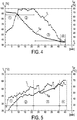
- Fig. 4 is marked with triangles the time course of the moisture f L in the air as it was measured during a drying process.
- this air humidity rises sharply to almost 100%. It remains at this high value for another 12 minutes during phase 2.
- the time course of the moisture f W of the laundry marked by rectangles only decreases slightly. This moisture f W of the laundry has been determined experimentally for the same time and cannot be used directly with the tumble dryer 1 or 2 be recorded.
- the moisture f W of the laundry decreases sharply, which is not surprising, since the air removed during this phase is at most or almost completely saturated, see the moisture f L.
- the moisture f W still decreases, but this decrease flattens out. Accordingly, the moisture f L also decreases sharply.
- the last phase 4 which lasts about 5 minutes, moisture can hardly be released into the air, but the laundry is dry or completely dry, since its moisture f W reaches zero or even slightly less.
- Fig. 4 divided into four phases, a curve for the temperature T L of the discharged air is shown with triangles during the same drying process. A curve for the temperature T W of the laundry with rectangles is also shown. It corresponds approximately to the core temperature T WK of the course 4 in Fig. 3 , The temperature T W of the laundry has been determined experimentally as before, the moisture f W of the laundry.
- phase 1 the temperature T L is rapidly increased to approximately 40 ° C.
- phase 2 the temperature T L is increased again to slightly above 50 ° C.
- phase 1 the temperature of the laundry T W , which is shown as a rectangle, rises with a delay. Then an increase in temperature is greatly reduced during phase 2.
- phase 2 it is recommended to accelerate the process of increasing the temperature of the laundry in phase 1 so that evaporation begins as quickly as possible.
- the temperature T W is equal to the temperature T L , so that the energy supplied is used for the evaporation.
- phase 3 an increase in the temperature T L makes little or no sense, since this only leads to an increase in the temperature T W and not to an acceleration of the evaporation due to the thermodynamic effects.
- Phase 4 is necessary due to the inconsistent moisture distribution, which is more difficult to remove because it is "bound moisture".
- the decisive factor here is the combination of heating power, air rate or convection and drum movement. The focus is also on the heating output.
- a combination of an air heating system with an integrated heater in the fan enables the measurement function to be optimized with fewer components and increased data acquisition.
- the aim is to use indirect information from the process for the process.
- parameters should be recorded directly and used for process control, which are directly related to the convection and evaporation of water in the dryer.
- the aforementioned possibility of arbitrarily controlling the drum movement or the drive motor for the drum can optimally support a named method for detecting parameters for the process control.
Landscapes
- Engineering & Computer Science (AREA)
- Textile Engineering (AREA)
- Control Of Washing Machine And Dryer (AREA)
- Detail Structures Of Washing Machines And Dryers (AREA)
Applications Claiming Priority (1)
| Application Number | Priority Date | Filing Date | Title |
|---|---|---|---|
| DE102018213108.2A DE102018213108A1 (de) | 2018-08-06 | 2018-08-06 | Wäschetrockner und Verfahren zum Trocknen von Wäsche mit einem Wäschetrockner |
Publications (3)
| Publication Number | Publication Date |
|---|---|
| EP3608469A2 true EP3608469A2 (fr) | 2020-02-12 |
| EP3608469A3 EP3608469A3 (fr) | 2020-05-06 |
| EP3608469B1 EP3608469B1 (fr) | 2023-08-30 |
Family
ID=67314643
Family Applications (1)
| Application Number | Title | Priority Date | Filing Date |
|---|---|---|---|
| EP19186484.2A Active EP3608469B1 (fr) | 2018-08-06 | 2019-07-16 | Sèche-linge et procédé de séchage du linge à l'aide d'un sèche-linge |
Country Status (4)
| Country | Link |
|---|---|
| US (1) | US11021837B2 (fr) |
| EP (1) | EP3608469B1 (fr) |
| DE (1) | DE102018213108A1 (fr) |
| PL (1) | PL3608469T3 (fr) |
Cited By (3)
| Publication number | Priority date | Publication date | Assignee | Title |
|---|---|---|---|---|
| EP3696313A1 (fr) * | 2019-02-15 | 2020-08-19 | Miele & Cie. KG | Appareil de traitement du linge, de préférence sèche-linge |
| US11021837B2 (en) * | 2018-08-06 | 2021-06-01 | E.G.O. Elektro-Geraetebau Gmbh | Tumble dryer and method for drying laundry using a tumble dryer |
| US11105037B2 (en) * | 2016-01-14 | 2021-08-31 | Herbert Kannegiesser Gmbh | Device for mangling laundry items |
Families Citing this family (8)
| Publication number | Priority date | Publication date | Assignee | Title |
|---|---|---|---|---|
| US10487443B1 (en) * | 2015-10-30 | 2019-11-26 | Cool Dry, Inc. | Hybrid RF/conventional clothes dryer |
| KR102695866B1 (ko) * | 2019-01-04 | 2024-08-19 | 엘지전자 주식회사 | 의류처리장치 및 그 제어방법 |
| US12366025B2 (en) | 2020-03-16 | 2025-07-22 | Lg Electronics Inc. | Laundry treating apparatus |
| EP4123078A4 (fr) * | 2020-03-16 | 2024-04-03 | LG Electronics Inc. | Appareil de traitement de vêtements |
| DE102020111604A1 (de) | 2020-04-29 | 2021-11-04 | Miele & Cie. Kg | Verfahren und Steuereinheit zum Einstellen einer Trockentemperatur für ein Trockengerät und Trockengerät |
| AU2021335818B2 (en) | 2020-09-04 | 2025-01-02 | Lg Electronics Inc. | Laundry treating apparatus |
| US12534848B2 (en) | 2022-10-27 | 2026-01-27 | Haier Us Appliance Solutions, Inc. | Induction heating system for a dryer appliance |
| DE102022130372A1 (de) * | 2022-11-16 | 2024-05-16 | Mewa Textil-Service Se & Co. Management Ohg | Vorrichtung und Verfahren zur Trocknung von Wäsche |
Citations (7)
| Publication number | Priority date | Publication date | Assignee | Title |
|---|---|---|---|---|
| EP0240052A1 (fr) | 1986-04-04 | 1987-10-07 | DANIELI & C. OFFICINE MECCANICHE S.p.A. | Procédé de préchauffage de billettes tout en économisant de l'énergie |
| EP0262018A1 (fr) | 1986-09-05 | 1988-03-30 | Commissariat A L'energie Atomique | Système de traitement de signaux issus d'un dispositif de détection de rayonnements et sonde de détection de rayonnements, comportant ce système |
| DE102009026646A1 (de) | 2009-06-02 | 2010-12-09 | BSH Bosch und Siemens Hausgeräte GmbH | Verfahren zur Behandlung von Wäsche in einer Waschmaschine mittels einer Induktionsheizung sowie Waschmaschine hierfür |
| DE102016110859B3 (de) | 2016-05-19 | 2017-06-22 | Miele & Cie. Kg | Vorrichtung zum Waschen und bzw. oder zum Trocknen von Wäsche |
| DE102016110871A1 (de) | 2016-05-19 | 2017-11-23 | Miele & Cie. Kg | Wäschetrockner |
| DE102016110883A1 (de) | 2016-05-19 | 2017-11-23 | Miele & Cie. Kg | Wäschetrockner |
| DE102017210527A1 (de) | 2017-06-22 | 2018-12-27 | E.G.O. Elektro-Gerätebau GmbH | Pumpe für ein Elektrogerät und Elektrogerät mit einer Fluidführung und einer solchen Pumpe |
Family Cites Families (27)
| Publication number | Priority date | Publication date | Assignee | Title |
|---|---|---|---|---|
| US4231166A (en) * | 1979-10-09 | 1980-11-04 | General Electric Company | Automatic control for a clothes dryer |
| US4621438A (en) * | 1980-12-04 | 1986-11-11 | Donald M. Thompson | Energy efficient clothes dryer |
| KR940006250B1 (ko) | 1991-12-23 | 1994-07-13 | 주식회사 금성사 | 복합 센서 방식 의류 건조기의 제어방법 및 그 회로 |
| DE4447270A1 (de) * | 1994-12-30 | 1996-07-04 | Bosch Siemens Hausgeraete | Verfahren zum Steuern von Trockenvorgängen in Haushalt-Wäschetrocknern |
| US5649372A (en) * | 1996-03-14 | 1997-07-22 | American Dryer Corporation | Drying cycle controller for controlling drying as a function of humidity and temperature |
| US6047486A (en) * | 1998-09-03 | 2000-04-11 | Whirlpool Corporation | Control system for a dryer |
| KR100955484B1 (ko) * | 2003-04-30 | 2010-04-30 | 삼성전자주식회사 | 세탁기 및 그 건조 제어방법 |
| US7005618B2 (en) * | 2003-06-27 | 2006-02-28 | General Electric Company | Clothes dryer apparatus and method |
| KR101063701B1 (ko) * | 2003-11-03 | 2011-09-07 | 엘지전자 주식회사 | 건조기의 부하 제어방법 |
| KR100710215B1 (ko) * | 2004-07-30 | 2007-04-20 | 엘지전자 주식회사 | 의류 건조기 및 그의 제어 방법 |
| ES2368431T3 (es) * | 2004-12-06 | 2011-11-17 | Lg Electronics Inc. | Secador de ropa. |
| EP1700944B1 (fr) * | 2005-03-08 | 2013-10-23 | Electrolux Home Products Corporation N.V. | Procédé pour la désinfection du linge et sèche-linge domestique avec cycle de désinfection du linge |
| US8104191B2 (en) * | 2008-07-31 | 2012-01-31 | Electrolux Home Products, Inc. | Laundry dryer providing moisture application during tumbling and reduced airflow |
| WO2012098625A1 (fr) * | 2011-01-18 | 2012-07-26 | パナソニック株式会社 | Moteur électrique et appareil électrique équipé de celui-ci |
| JP2013022225A (ja) * | 2011-07-21 | 2013-02-04 | Panasonic Corp | 洗濯乾燥機 |
| US20130145644A1 (en) * | 2011-12-13 | 2013-06-13 | Bsh Home Appliances Corporation | Process for operating a washer dryer with a sensor placed between a tub and a heat exchanger, and related washer dryer |
| KR20140084950A (ko) * | 2012-12-27 | 2014-07-07 | 동부대우전자 주식회사 | 세탁기용 건조장치 및 건조방법 |
| MX2013015344A (es) * | 2013-12-19 | 2015-06-18 | Mabe Sa De Cv | Sistema electronico inteligente para desvanecer las arrugas en prendas textiles y metodo para llevar a cabo dicho desvanecimiento. |
| JP2016107063A (ja) * | 2014-11-28 | 2016-06-20 | 三星電子株式会社Samsung Electronics Co.,Ltd. | 乾燥機 |
| KR101613965B1 (ko) * | 2014-12-08 | 2016-04-20 | 엘지전자 주식회사 | 배기식 의류 건조기의 제어방법 |
| EP3067459A1 (fr) * | 2015-03-09 | 2016-09-14 | LG Electronics Inc. | Séchoir |
| WO2016170880A1 (fr) * | 2015-04-20 | 2016-10-27 | 株式会社デンソー | Dispositif de ventilation |
| DE102015217667A1 (de) | 2015-09-15 | 2017-03-16 | E.G.O. Elektro-Gerätebau GmbH | Verfahren zum Betrieb eines Wäschetrockners |
| US10487443B1 (en) * | 2015-10-30 | 2019-11-26 | Cool Dry, Inc. | Hybrid RF/conventional clothes dryer |
| EP3246454B1 (fr) * | 2016-05-19 | 2019-11-06 | Miele & Cie. KG | Sèche-linge |
| KR102677286B1 (ko) * | 2016-12-07 | 2024-06-21 | 엘지전자 주식회사 | 의류처리장치의 제어방법 |
| DE102018213108A1 (de) * | 2018-08-06 | 2020-02-06 | E.G.O. Elektro-Gerätebau GmbH | Wäschetrockner und Verfahren zum Trocknen von Wäsche mit einem Wäschetrockner |
-
2018
- 2018-08-06 DE DE102018213108.2A patent/DE102018213108A1/de not_active Withdrawn
-
2019
- 2019-07-16 PL PL19186484.2T patent/PL3608469T3/pl unknown
- 2019-07-16 EP EP19186484.2A patent/EP3608469B1/fr active Active
- 2019-07-30 US US16/525,712 patent/US11021837B2/en active Active
Patent Citations (7)
| Publication number | Priority date | Publication date | Assignee | Title |
|---|---|---|---|---|
| EP0240052A1 (fr) | 1986-04-04 | 1987-10-07 | DANIELI & C. OFFICINE MECCANICHE S.p.A. | Procédé de préchauffage de billettes tout en économisant de l'énergie |
| EP0262018A1 (fr) | 1986-09-05 | 1988-03-30 | Commissariat A L'energie Atomique | Système de traitement de signaux issus d'un dispositif de détection de rayonnements et sonde de détection de rayonnements, comportant ce système |
| DE102009026646A1 (de) | 2009-06-02 | 2010-12-09 | BSH Bosch und Siemens Hausgeräte GmbH | Verfahren zur Behandlung von Wäsche in einer Waschmaschine mittels einer Induktionsheizung sowie Waschmaschine hierfür |
| DE102016110859B3 (de) | 2016-05-19 | 2017-06-22 | Miele & Cie. Kg | Vorrichtung zum Waschen und bzw. oder zum Trocknen von Wäsche |
| DE102016110871A1 (de) | 2016-05-19 | 2017-11-23 | Miele & Cie. Kg | Wäschetrockner |
| DE102016110883A1 (de) | 2016-05-19 | 2017-11-23 | Miele & Cie. Kg | Wäschetrockner |
| DE102017210527A1 (de) | 2017-06-22 | 2018-12-27 | E.G.O. Elektro-Gerätebau GmbH | Pumpe für ein Elektrogerät und Elektrogerät mit einer Fluidführung und einer solchen Pumpe |
Cited By (3)
| Publication number | Priority date | Publication date | Assignee | Title |
|---|---|---|---|---|
| US11105037B2 (en) * | 2016-01-14 | 2021-08-31 | Herbert Kannegiesser Gmbh | Device for mangling laundry items |
| US11021837B2 (en) * | 2018-08-06 | 2021-06-01 | E.G.O. Elektro-Geraetebau Gmbh | Tumble dryer and method for drying laundry using a tumble dryer |
| EP3696313A1 (fr) * | 2019-02-15 | 2020-08-19 | Miele & Cie. KG | Appareil de traitement du linge, de préférence sèche-linge |
Also Published As
| Publication number | Publication date |
|---|---|
| EP3608469A3 (fr) | 2020-05-06 |
| PL3608469T3 (pl) | 2024-04-02 |
| DE102018213108A1 (de) | 2020-02-06 |
| US11021837B2 (en) | 2021-06-01 |
| EP3608469B1 (fr) | 2023-08-30 |
| US20200040515A1 (en) | 2020-02-06 |
Similar Documents
| Publication | Publication Date | Title |
|---|---|---|
| EP3608469B1 (fr) | Sèche-linge et procédé de séchage du linge à l'aide d'un sèche-linge | |
| EP0467188B1 (fr) | Sèche linge avec pompe à chaleur | |
| EP3274499B1 (fr) | Procédé pour l'exécution d'un programme d'hygiène dans un séchoir pourvu d'une pompe à chaleur et séchoir prévu à cet effet | |
| EP3246454B1 (fr) | Sèche-linge | |
| EP0679754B1 (fr) | Procédé et dispositif pour le traitement de produits textiles pendant le séchage | |
| EP3255204B1 (fr) | Procédé de détermination de l'humidité résiduelle dans un séchoir à condensation et séchoir à condensation adapté | |
| DE102007016077A1 (de) | Verfahren zum Betreiben eines Kondensationstrockners mit einem Wärmepumpenkreis, sowie entsprechender Kondensationstrockner | |
| DE102016110883A1 (de) | Wäschetrockner | |
| WO2013167489A2 (fr) | Procédé permettant de faire fonctionner un sèche-linge en fonction de la charge et sèche-linge permettant la mise en oeuvre dudit procédé | |
| DE60220169T2 (de) | Verfahren zum Trocknen von Wäsche in einer Trocknungsvorrichtung | |
| EP4269683B1 (fr) | Procédé de détermination de l'humidité résiduelle dans un séchoir à pompe à chaleur et séchoir à pompe à chaleur adapté à ce procédé | |
| EP1813712A1 (fr) | Séchoir et procédé de traitement d' un bien | |
| EP0358849B1 (fr) | Procédé pour le séchage de pièces de linge | |
| EP4119713A1 (fr) | Procédé permettant de faire fonctionner un lave-linge et lave-linge | |
| DE4204771B4 (de) | Verfahren und Anordnung zum Betrieb eines dampfbeheizten Trockners | |
| EP0424781B1 (fr) | Sèche-linge domestique | |
| EP3064638A1 (fr) | Procede de fonctionnement d'un sechoir dote d'une pompe a chaleur et sechoir approprie | |
| EP0377193B1 (fr) | Séchoir à linge | |
| DE2543763A1 (de) | Lufttrockner und verfahren zu seiner regelung | |
| EP3868947B1 (fr) | Procédé de fonctionnement d'un appareil électroménager à circulation d'eau et appareil électroménager à circulation d'eau | |
| DE102013221663A1 (de) | Einrichtung und Verfahren zum Lösen von Tabakgut in einer Anlage der Tabak verarbeitenden Industrie | |
| DE102018007678A1 (de) | Verfahren und Vorrichtung zum Trocknen von Wäsche | |
| DE102012207742A1 (de) | Verfahren zum Betrieb eines Trockners mit variabler Drehzahl eines Antriebsmotors sowie hierfür geeigneter Trockner | |
| EP3118553B1 (fr) | Dispositif et procede de sechage d'une nappe de fils | |
| DE102015203682A1 (de) | Trockner mit einer Wärmepumpe mit variabler Kältemittelmasse sowie Verfahren zu seinem Betrieb |
Legal Events
| Date | Code | Title | Description |
|---|---|---|---|
| PUAI | Public reference made under article 153(3) epc to a published international application that has entered the european phase |
Free format text: ORIGINAL CODE: 0009012 |
|
| STAA | Information on the status of an ep patent application or granted ep patent |
Free format text: STATUS: THE APPLICATION HAS BEEN PUBLISHED |
|
| AK | Designated contracting states |
Kind code of ref document: A2 Designated state(s): AL AT BE BG CH CY CZ DE DK EE ES FI FR GB GR HR HU IE IS IT LI LT LU LV MC MK MT NL NO PL PT RO RS SE SI SK SM TR |
|
| AX | Request for extension of the european patent |
Extension state: BA ME |
|
| PUAL | Search report despatched |
Free format text: ORIGINAL CODE: 0009013 |
|
| AK | Designated contracting states |
Kind code of ref document: A3 Designated state(s): AL AT BE BG CH CY CZ DE DK EE ES FI FR GB GR HR HU IE IS IT LI LT LU LV MC MK MT NL NO PL PT RO RS SE SI SK SM TR |
|
| AX | Request for extension of the european patent |
Extension state: BA ME |
|
| RIC1 | Information provided on ipc code assigned before grant |
Ipc: D06F 103/38 20200101ALN20200328BHEP Ipc: D06F 58/20 20060101AFI20200328BHEP Ipc: D06F 103/00 20200101ALN20200328BHEP Ipc: D06F 103/08 20200101ALN20200328BHEP Ipc: D06F 105/28 20200101ALN20200328BHEP Ipc: D06F 58/30 20200101ALI20200328BHEP |
|
| STAA | Information on the status of an ep patent application or granted ep patent |
Free format text: STATUS: REQUEST FOR EXAMINATION WAS MADE |
|
| 17P | Request for examination filed |
Effective date: 20201102 |
|
| RBV | Designated contracting states (corrected) |
Designated state(s): AL AT BE BG CH CY CZ DE DK EE ES FI FR GB GR HR HU IE IS IT LI LT LU LV MC MK MT NL NO PL PT RO RS SE SI SK SM TR |
|
| STAA | Information on the status of an ep patent application or granted ep patent |
Free format text: STATUS: EXAMINATION IS IN PROGRESS |
|
| 17Q | First examination report despatched |
Effective date: 20210520 |
|
| REG | Reference to a national code |
Ref country code: DE Ref legal event code: R079 Free format text: PREVIOUS MAIN CLASS: D06F0058260000 Ipc: D06F0058380000 Ref country code: DE Ref legal event code: R079 Ref document number: 502019009115 Country of ref document: DE Free format text: PREVIOUS MAIN CLASS: D06F0058260000 Ipc: D06F0058380000 |
|
| RIC1 | Information provided on ipc code assigned before grant |
Ipc: D06F 34/26 20200101ALN20230116BHEP Ipc: D06F 58/26 20060101ALN20230116BHEP Ipc: D06F 58/02 20060101ALN20230116BHEP Ipc: D06F 105/32 20200101ALN20230116BHEP Ipc: D06F 105/30 20200101ALN20230116BHEP Ipc: D06F 103/54 20200101ALN20230116BHEP Ipc: D06F 103/52 20200101ALN20230116BHEP Ipc: D06F 103/44 20200101ALN20230116BHEP Ipc: D06F 103/34 20200101ALN20230116BHEP Ipc: D06F 103/32 20200101ALN20230116BHEP Ipc: D06F 105/28 20200101ALN20230116BHEP Ipc: D06F 103/38 20200101ALN20230116BHEP Ipc: D06F 103/08 20200101ALN20230116BHEP Ipc: D06F 103/00 20200101ALN20230116BHEP Ipc: D06F 58/38 20200101AFI20230116BHEP |
|
| GRAP | Despatch of communication of intention to grant a patent |
Free format text: ORIGINAL CODE: EPIDOSNIGR1 |
|
| STAA | Information on the status of an ep patent application or granted ep patent |
Free format text: STATUS: GRANT OF PATENT IS INTENDED |
|
| INTG | Intention to grant announced |
Effective date: 20230227 |
|
| GRAS | Grant fee paid |
Free format text: ORIGINAL CODE: EPIDOSNIGR3 |
|
| GRAA | (expected) grant |
Free format text: ORIGINAL CODE: 0009210 |
|
| STAA | Information on the status of an ep patent application or granted ep patent |
Free format text: STATUS: THE PATENT HAS BEEN GRANTED |
|
| AK | Designated contracting states |
Kind code of ref document: B1 Designated state(s): AL AT BE BG CH CY CZ DE DK EE ES FI FR GB GR HR HU IE IS IT LI LT LU LV MC MK MT NL NO PL PT RO RS SE SI SK SM TR |
|
| REG | Reference to a national code |
Ref country code: GB Ref legal event code: FG4D Free format text: NOT ENGLISH |
|
| REG | Reference to a national code |
Ref country code: CH Ref legal event code: EP |
|
| REG | Reference to a national code |
Ref country code: DE Ref legal event code: R096 Ref document number: 502019009115 Country of ref document: DE |
|
| REG | Reference to a national code |
Ref country code: IE Ref legal event code: FG4D Free format text: LANGUAGE OF EP DOCUMENT: GERMAN |
|
| REG | Reference to a national code |
Ref country code: LT Ref legal event code: MG9D |
|
| REG | Reference to a national code |
Ref country code: NL Ref legal event code: MP Effective date: 20230830 |
|
| PG25 | Lapsed in a contracting state [announced via postgrant information from national office to epo] |
Ref country code: GR Free format text: LAPSE BECAUSE OF FAILURE TO SUBMIT A TRANSLATION OF THE DESCRIPTION OR TO PAY THE FEE WITHIN THE PRESCRIBED TIME-LIMIT Effective date: 20231201 |
|
| PG25 | Lapsed in a contracting state [announced via postgrant information from national office to epo] |
Ref country code: IS Free format text: LAPSE BECAUSE OF FAILURE TO SUBMIT A TRANSLATION OF THE DESCRIPTION OR TO PAY THE FEE WITHIN THE PRESCRIBED TIME-LIMIT Effective date: 20231230 |
|
| PG25 | Lapsed in a contracting state [announced via postgrant information from national office to epo] |
Ref country code: SE Free format text: LAPSE BECAUSE OF FAILURE TO SUBMIT A TRANSLATION OF THE DESCRIPTION OR TO PAY THE FEE WITHIN THE PRESCRIBED TIME-LIMIT Effective date: 20230830 Ref country code: RS Free format text: LAPSE BECAUSE OF FAILURE TO SUBMIT A TRANSLATION OF THE DESCRIPTION OR TO PAY THE FEE WITHIN THE PRESCRIBED TIME-LIMIT Effective date: 20230830 Ref country code: NO Free format text: LAPSE BECAUSE OF FAILURE TO SUBMIT A TRANSLATION OF THE DESCRIPTION OR TO PAY THE FEE WITHIN THE PRESCRIBED TIME-LIMIT Effective date: 20231130 Ref country code: LV Free format text: LAPSE BECAUSE OF FAILURE TO SUBMIT A TRANSLATION OF THE DESCRIPTION OR TO PAY THE FEE WITHIN THE PRESCRIBED TIME-LIMIT Effective date: 20230830 Ref country code: LT Free format text: LAPSE BECAUSE OF FAILURE TO SUBMIT A TRANSLATION OF THE DESCRIPTION OR TO PAY THE FEE WITHIN THE PRESCRIBED TIME-LIMIT Effective date: 20230830 Ref country code: IS Free format text: LAPSE BECAUSE OF FAILURE TO SUBMIT A TRANSLATION OF THE DESCRIPTION OR TO PAY THE FEE WITHIN THE PRESCRIBED TIME-LIMIT Effective date: 20231230 Ref country code: HR Free format text: LAPSE BECAUSE OF FAILURE TO SUBMIT A TRANSLATION OF THE DESCRIPTION OR TO PAY THE FEE WITHIN THE PRESCRIBED TIME-LIMIT Effective date: 20230830 Ref country code: GR Free format text: LAPSE BECAUSE OF FAILURE TO SUBMIT A TRANSLATION OF THE DESCRIPTION OR TO PAY THE FEE WITHIN THE PRESCRIBED TIME-LIMIT Effective date: 20231201 Ref country code: FI Free format text: LAPSE BECAUSE OF FAILURE TO SUBMIT A TRANSLATION OF THE DESCRIPTION OR TO PAY THE FEE WITHIN THE PRESCRIBED TIME-LIMIT Effective date: 20230830 |
|
| PG25 | Lapsed in a contracting state [announced via postgrant information from national office to epo] |
Ref country code: NL Free format text: LAPSE BECAUSE OF FAILURE TO SUBMIT A TRANSLATION OF THE DESCRIPTION OR TO PAY THE FEE WITHIN THE PRESCRIBED TIME-LIMIT Effective date: 20230830 |
|
| PG25 | Lapsed in a contracting state [announced via postgrant information from national office to epo] |
Ref country code: ES Free format text: LAPSE BECAUSE OF FAILURE TO SUBMIT A TRANSLATION OF THE DESCRIPTION OR TO PAY THE FEE WITHIN THE PRESCRIBED TIME-LIMIT Effective date: 20230830 |
|
| PG25 | Lapsed in a contracting state [announced via postgrant information from national office to epo] |
Ref country code: SM Free format text: LAPSE BECAUSE OF FAILURE TO SUBMIT A TRANSLATION OF THE DESCRIPTION OR TO PAY THE FEE WITHIN THE PRESCRIBED TIME-LIMIT Effective date: 20230830 Ref country code: RO Free format text: LAPSE BECAUSE OF FAILURE TO SUBMIT A TRANSLATION OF THE DESCRIPTION OR TO PAY THE FEE WITHIN THE PRESCRIBED TIME-LIMIT Effective date: 20230830 Ref country code: ES Free format text: LAPSE BECAUSE OF FAILURE TO SUBMIT A TRANSLATION OF THE DESCRIPTION OR TO PAY THE FEE WITHIN THE PRESCRIBED TIME-LIMIT Effective date: 20230830 Ref country code: EE Free format text: LAPSE BECAUSE OF FAILURE TO SUBMIT A TRANSLATION OF THE DESCRIPTION OR TO PAY THE FEE WITHIN THE PRESCRIBED TIME-LIMIT Effective date: 20230830 Ref country code: DK Free format text: LAPSE BECAUSE OF FAILURE TO SUBMIT A TRANSLATION OF THE DESCRIPTION OR TO PAY THE FEE WITHIN THE PRESCRIBED TIME-LIMIT Effective date: 20230830 Ref country code: CZ Free format text: LAPSE BECAUSE OF FAILURE TO SUBMIT A TRANSLATION OF THE DESCRIPTION OR TO PAY THE FEE WITHIN THE PRESCRIBED TIME-LIMIT Effective date: 20230830 Ref country code: PT Free format text: LAPSE BECAUSE OF FAILURE TO SUBMIT A TRANSLATION OF THE DESCRIPTION OR TO PAY THE FEE WITHIN THE PRESCRIBED TIME-LIMIT Effective date: 20240102 Ref country code: SK Free format text: LAPSE BECAUSE OF FAILURE TO SUBMIT A TRANSLATION OF THE DESCRIPTION OR TO PAY THE FEE WITHIN THE PRESCRIBED TIME-LIMIT Effective date: 20230830 |
|
| REG | Reference to a national code |
Ref country code: DE Ref legal event code: R097 Ref document number: 502019009115 Country of ref document: DE |
|
| PLBE | No opposition filed within time limit |
Free format text: ORIGINAL CODE: 0009261 |
|
| STAA | Information on the status of an ep patent application or granted ep patent |
Free format text: STATUS: NO OPPOSITION FILED WITHIN TIME LIMIT |
|
| PG25 | Lapsed in a contracting state [announced via postgrant information from national office to epo] |
Ref country code: SI Free format text: LAPSE BECAUSE OF FAILURE TO SUBMIT A TRANSLATION OF THE DESCRIPTION OR TO PAY THE FEE WITHIN THE PRESCRIBED TIME-LIMIT Effective date: 20230830 |
|
| 26N | No opposition filed |
Effective date: 20240603 |
|
| PG25 | Lapsed in a contracting state [announced via postgrant information from national office to epo] |
Ref country code: BG Free format text: LAPSE BECAUSE OF FAILURE TO SUBMIT A TRANSLATION OF THE DESCRIPTION OR TO PAY THE FEE WITHIN THE PRESCRIBED TIME-LIMIT Effective date: 20230830 |
|
| PG25 | Lapsed in a contracting state [announced via postgrant information from national office to epo] |
Ref country code: BG Free format text: LAPSE BECAUSE OF FAILURE TO SUBMIT A TRANSLATION OF THE DESCRIPTION OR TO PAY THE FEE WITHIN THE PRESCRIBED TIME-LIMIT Effective date: 20230830 |
|
| PG25 | Lapsed in a contracting state [announced via postgrant information from national office to epo] |
Ref country code: MC Free format text: LAPSE BECAUSE OF FAILURE TO SUBMIT A TRANSLATION OF THE DESCRIPTION OR TO PAY THE FEE WITHIN THE PRESCRIBED TIME-LIMIT Effective date: 20230830 |
|
| REG | Reference to a national code |
Ref country code: CH Ref legal event code: PL |
|
| PG25 | Lapsed in a contracting state [announced via postgrant information from national office to epo] |
Ref country code: LU Free format text: LAPSE BECAUSE OF NON-PAYMENT OF DUE FEES Effective date: 20240716 |
|
| GBPC | Gb: european patent ceased through non-payment of renewal fee |
Effective date: 20240716 |
|
| PG25 | Lapsed in a contracting state [announced via postgrant information from national office to epo] |
Ref country code: LU Free format text: LAPSE BECAUSE OF NON-PAYMENT OF DUE FEES Effective date: 20240716 |
|
| PG25 | Lapsed in a contracting state [announced via postgrant information from national office to epo] |
Ref country code: BE Free format text: LAPSE BECAUSE OF NON-PAYMENT OF DUE FEES Effective date: 20240731 Ref country code: CH Free format text: LAPSE BECAUSE OF NON-PAYMENT OF DUE FEES Effective date: 20240731 |
|
| PG25 | Lapsed in a contracting state [announced via postgrant information from national office to epo] |
Ref country code: FR Free format text: LAPSE BECAUSE OF NON-PAYMENT OF DUE FEES Effective date: 20240731 |
|
| PG25 | Lapsed in a contracting state [announced via postgrant information from national office to epo] |
Ref country code: GB Free format text: LAPSE BECAUSE OF NON-PAYMENT OF DUE FEES Effective date: 20240716 |
|
| REG | Reference to a national code |
Ref country code: BE Ref legal event code: MM Effective date: 20240731 |
|
| PGFP | Annual fee paid to national office [announced via postgrant information from national office to epo] |
Ref country code: PL Payment date: 20250617 Year of fee payment: 7 |
|
| PG25 | Lapsed in a contracting state [announced via postgrant information from national office to epo] |
Ref country code: IE Free format text: LAPSE BECAUSE OF NON-PAYMENT OF DUE FEES Effective date: 20240716 |
|
| REG | Reference to a national code |
Ref country code: AT Ref legal event code: MM01 Ref document number: 1605580 Country of ref document: AT Kind code of ref document: T Effective date: 20240716 |
|
| PGFP | Annual fee paid to national office [announced via postgrant information from national office to epo] |
Ref country code: DE Payment date: 20250723 Year of fee payment: 7 |
|
| PGFP | Annual fee paid to national office [announced via postgrant information from national office to epo] |
Ref country code: TR Payment date: 20250710 Year of fee payment: 7 Ref country code: IT Payment date: 20250731 Year of fee payment: 7 |
|
| PG25 | Lapsed in a contracting state [announced via postgrant information from national office to epo] |
Ref country code: AT Free format text: LAPSE BECAUSE OF NON-PAYMENT OF DUE FEES Effective date: 20240716 |
|
| PG25 | Lapsed in a contracting state [announced via postgrant information from national office to epo] |
Ref country code: CY Free format text: LAPSE BECAUSE OF FAILURE TO SUBMIT A TRANSLATION OF THE DESCRIPTION OR TO PAY THE FEE WITHIN THE PRESCRIBED TIME-LIMIT; INVALID AB INITIO Effective date: 20190716 |
|
| PG25 | Lapsed in a contracting state [announced via postgrant information from national office to epo] |
Ref country code: HU Free format text: LAPSE BECAUSE OF FAILURE TO SUBMIT A TRANSLATION OF THE DESCRIPTION OR TO PAY THE FEE WITHIN THE PRESCRIBED TIME-LIMIT; INVALID AB INITIO Effective date: 20190716 |