EP3609507B1 - Hydrophob modifizierte polymere mit variabler grösse - Google Patents
Hydrophob modifizierte polymere mit variabler grösse Download PDFInfo
- Publication number
- EP3609507B1 EP3609507B1 EP18783898.2A EP18783898A EP3609507B1 EP 3609507 B1 EP3609507 B1 EP 3609507B1 EP 18783898 A EP18783898 A EP 18783898A EP 3609507 B1 EP3609507 B1 EP 3609507B1
- Authority
- EP
- European Patent Office
- Prior art keywords
- chitosan
- polymer
- hydrophobic
- groups
- composition
- Prior art date
- Legal status (The legal status is an assumption and is not a legal conclusion. Google has not performed a legal analysis and makes no representation as to the accuracy of the status listed.)
- Active
Links
Images



Classifications
-
- A—HUMAN NECESSITIES
- A61—MEDICAL OR VETERINARY SCIENCE; HYGIENE
- A61K—PREPARATIONS FOR MEDICAL, DENTAL OR TOILETRY PURPOSES
- A61K31/00—Medicinal preparations containing organic active ingredients
- A61K31/70—Carbohydrates; Sugars; Derivatives thereof
- A61K31/715—Polysaccharides, i.e. having more than five saccharide radicals attached to each other by glycosidic linkages; Derivatives thereof, e.g. ethers, esters
- A61K31/716—Glucans
- A61K31/722—Chitin, chitosan
-
- A—HUMAN NECESSITIES
- A61—MEDICAL OR VETERINARY SCIENCE; HYGIENE
- A61K—PREPARATIONS FOR MEDICAL, DENTAL OR TOILETRY PURPOSES
- A61K31/00—Medicinal preparations containing organic active ingredients
- A61K31/70—Carbohydrates; Sugars; Derivatives thereof
- A61K31/715—Polysaccharides, i.e. having more than five saccharide radicals attached to each other by glycosidic linkages; Derivatives thereof, e.g. ethers, esters
- A61K31/716—Glucans
- A61K31/717—Celluloses
-
- A—HUMAN NECESSITIES
- A61—MEDICAL OR VETERINARY SCIENCE; HYGIENE
- A61K—PREPARATIONS FOR MEDICAL, DENTAL OR TOILETRY PURPOSES
- A61K31/00—Medicinal preparations containing organic active ingredients
- A61K31/70—Carbohydrates; Sugars; Derivatives thereof
- A61K31/715—Polysaccharides, i.e. having more than five saccharide radicals attached to each other by glycosidic linkages; Derivatives thereof, e.g. ethers, esters
- A61K31/734—Alginic acid
-
- A—HUMAN NECESSITIES
- A61—MEDICAL OR VETERINARY SCIENCE; HYGIENE
- A61K—PREPARATIONS FOR MEDICAL, DENTAL OR TOILETRY PURPOSES
- A61K45/00—Medicinal preparations containing active ingredients not provided for in groups A61K31/00 - A61K41/00
- A61K45/06—Mixtures of active ingredients without chemical characterisation, e.g. antiphlogistics and cardiaca
-
- A—HUMAN NECESSITIES
- A61—MEDICAL OR VETERINARY SCIENCE; HYGIENE
- A61K—PREPARATIONS FOR MEDICAL, DENTAL OR TOILETRY PURPOSES
- A61K47/00—Medicinal preparations characterised by the non-active ingredients used, e.g. carriers or inert additives; Targeting or modifying agents chemically bound to the active ingredient
- A61K47/30—Macromolecular organic or inorganic compounds, e.g. inorganic polyphosphates
- A61K47/36—Polysaccharides; Derivatives thereof, e.g. gums, starch, alginate, dextrin, hyaluronic acid, chitosan, inulin, agar or pectin
-
- A—HUMAN NECESSITIES
- A61—MEDICAL OR VETERINARY SCIENCE; HYGIENE
- A61K—PREPARATIONS FOR MEDICAL, DENTAL OR TOILETRY PURPOSES
- A61K8/00—Cosmetics or similar toiletry preparations
- A61K8/18—Cosmetics or similar toiletry preparations characterised by the composition
- A61K8/72—Cosmetics or similar toiletry preparations characterised by the composition containing organic macromolecular compounds
- A61K8/73—Polysaccharides
-
- A—HUMAN NECESSITIES
- A61—MEDICAL OR VETERINARY SCIENCE; HYGIENE
- A61K—PREPARATIONS FOR MEDICAL, DENTAL OR TOILETRY PURPOSES
- A61K9/00—Medicinal preparations characterised by special physical form
-
- A—HUMAN NECESSITIES
- A61—MEDICAL OR VETERINARY SCIENCE; HYGIENE
- A61L—METHODS OR APPARATUS FOR STERILISING MATERIALS OR OBJECTS IN GENERAL; DISINFECTION, STERILISATION OR DEODORISATION OF AIR; CHEMICAL ASPECTS OF BANDAGES, DRESSINGS, ABSORBENT PADS OR SURGICAL ARTICLES; MATERIALS FOR BANDAGES, DRESSINGS, ABSORBENT PADS OR SURGICAL ARTICLES
- A61L15/00—Chemical aspects of, or use of materials for, bandages, dressings or absorbent pads
- A61L15/16—Bandages, dressings or absorbent pads for physiological fluids such as urine or blood, e.g. sanitary towels, tampons
- A61L15/22—Bandages, dressings or absorbent pads for physiological fluids such as urine or blood, e.g. sanitary towels, tampons containing macromolecular materials
- A61L15/26—Macromolecular compounds obtained otherwise than by reactions only involving carbon-to-carbon unsaturated bonds; Derivatives thereof
-
- A—HUMAN NECESSITIES
- A61—MEDICAL OR VETERINARY SCIENCE; HYGIENE
- A61L—METHODS OR APPARATUS FOR STERILISING MATERIALS OR OBJECTS IN GENERAL; DISINFECTION, STERILISATION OR DEODORISATION OF AIR; CHEMICAL ASPECTS OF BANDAGES, DRESSINGS, ABSORBENT PADS OR SURGICAL ARTICLES; MATERIALS FOR BANDAGES, DRESSINGS, ABSORBENT PADS OR SURGICAL ARTICLES
- A61L15/00—Chemical aspects of, or use of materials for, bandages, dressings or absorbent pads
- A61L15/16—Bandages, dressings or absorbent pads for physiological fluids such as urine or blood, e.g. sanitary towels, tampons
- A61L15/22—Bandages, dressings or absorbent pads for physiological fluids such as urine or blood, e.g. sanitary towels, tampons containing macromolecular materials
- A61L15/28—Polysaccharides or their derivatives
-
- A—HUMAN NECESSITIES
- A61—MEDICAL OR VETERINARY SCIENCE; HYGIENE
- A61L—METHODS OR APPARATUS FOR STERILISING MATERIALS OR OBJECTS IN GENERAL; DISINFECTION, STERILISATION OR DEODORISATION OF AIR; CHEMICAL ASPECTS OF BANDAGES, DRESSINGS, ABSORBENT PADS OR SURGICAL ARTICLES; MATERIALS FOR BANDAGES, DRESSINGS, ABSORBENT PADS OR SURGICAL ARTICLES
- A61L24/00—Surgical adhesives or cements; Adhesives for colostomy devices
- A61L24/04—Surgical adhesives or cements; Adhesives for colostomy devices containing macromolecular materials
- A61L24/08—Polysaccharides
-
- A—HUMAN NECESSITIES
- A61—MEDICAL OR VETERINARY SCIENCE; HYGIENE
- A61Q—SPECIFIC USE OF COSMETICS OR SIMILAR TOILETRY PREPARATIONS
- A61Q19/00—Preparations for care of the skin
-
- C—CHEMISTRY; METALLURGY
- C08—ORGANIC MACROMOLECULAR COMPOUNDS; THEIR PREPARATION OR CHEMICAL WORKING-UP; COMPOSITIONS BASED THEREON
- C08B—POLYSACCHARIDES; DERIVATIVES THEREOF
- C08B11/00—Preparation of cellulose ethers
- C08B11/02—Alkyl or cycloalkyl ethers
-
- C—CHEMISTRY; METALLURGY
- C08—ORGANIC MACROMOLECULAR COMPOUNDS; THEIR PREPARATION OR CHEMICAL WORKING-UP; COMPOSITIONS BASED THEREON
- C08B—POLYSACCHARIDES; DERIVATIVES THEREOF
- C08B11/00—Preparation of cellulose ethers
- C08B11/193—Mixed ethers, i.e. ethers with two or more different etherifying groups
-
- C—CHEMISTRY; METALLURGY
- C08—ORGANIC MACROMOLECULAR COMPOUNDS; THEIR PREPARATION OR CHEMICAL WORKING-UP; COMPOSITIONS BASED THEREON
- C08B—POLYSACCHARIDES; DERIVATIVES THEREOF
- C08B3/00—Preparation of cellulose esters of organic acids
- C08B3/16—Preparation of mixed organic cellulose esters, e.g. cellulose aceto-formate or cellulose aceto-propionate
-
- C—CHEMISTRY; METALLURGY
- C08—ORGANIC MACROMOLECULAR COMPOUNDS; THEIR PREPARATION OR CHEMICAL WORKING-UP; COMPOSITIONS BASED THEREON
- C08B—POLYSACCHARIDES; DERIVATIVES THEREOF
- C08B3/00—Preparation of cellulose esters of organic acids
- C08B3/16—Preparation of mixed organic cellulose esters, e.g. cellulose aceto-formate or cellulose aceto-propionate
- C08B3/18—Aceto-butyrates
-
- C—CHEMISTRY; METALLURGY
- C08—ORGANIC MACROMOLECULAR COMPOUNDS; THEIR PREPARATION OR CHEMICAL WORKING-UP; COMPOSITIONS BASED THEREON
- C08B—POLYSACCHARIDES; DERIVATIVES THEREOF
- C08B37/00—Preparation of polysaccharides not provided for in groups C08B1/00 - C08B35/00; Derivatives thereof
- C08B37/0006—Homoglycans, i.e. polysaccharides having a main chain consisting of one single sugar, e.g. colominic acid
- C08B37/0024—Homoglycans, i.e. polysaccharides having a main chain consisting of one single sugar, e.g. colominic acid beta-D-Glucans; (beta-1,3)-D-Glucans, e.g. paramylon, coriolan, sclerotan, pachyman, callose, scleroglucan, schizophyllan, laminaran, lentinan or curdlan; (beta-1,6)-D-Glucans, e.g. pustulan; (beta-1,4)-D-Glucans; (beta-1,3)(beta-1,4)-D-Glucans, e.g. lichenan; Derivatives thereof
- C08B37/0027—2-Acetamido-2-deoxy-beta-glucans; Derivatives thereof
- C08B37/003—Chitin, i.e. 2-acetamido-2-deoxy-(beta-1,4)-D-glucan or N-acetyl-beta-1,4-D-glucosamine; Chitosan, i.e. deacetylated product of chitin or (beta-1,4)-D-glucosamine; Derivatives thereof
-
- C—CHEMISTRY; METALLURGY
- C08—ORGANIC MACROMOLECULAR COMPOUNDS; THEIR PREPARATION OR CHEMICAL WORKING-UP; COMPOSITIONS BASED THEREON
- C08B—POLYSACCHARIDES; DERIVATIVES THEREOF
- C08B37/00—Preparation of polysaccharides not provided for in groups C08B1/00 - C08B35/00; Derivatives thereof
- C08B37/006—Heteroglycans, i.e. polysaccharides having more than one sugar residue in the main chain in either alternating or less regular sequence; Gellans; Succinoglycans; Arabinogalactans; Tragacanth or gum tragacanth or traganth from Astragalus; Gum Karaya from Sterculia urens; Gum Ghatti from Anogeissus latifolia; Derivatives thereof
- C08B37/0084—Guluromannuronans, e.g. alginic acid, i.e. D-mannuronic acid and D-guluronic acid units linked with alternating alpha- and beta-1,4-glycosidic bonds; Derivatives thereof, e.g. alginates
-
- C—CHEMISTRY; METALLURGY
- C08—ORGANIC MACROMOLECULAR COMPOUNDS; THEIR PREPARATION OR CHEMICAL WORKING-UP; COMPOSITIONS BASED THEREON
- C08L—COMPOSITIONS OF MACROMOLECULAR COMPOUNDS
- C08L1/00—Compositions of cellulose, modified cellulose or cellulose derivatives
- C08L1/08—Cellulose derivatives
-
- C—CHEMISTRY; METALLURGY
- C08—ORGANIC MACROMOLECULAR COMPOUNDS; THEIR PREPARATION OR CHEMICAL WORKING-UP; COMPOSITIONS BASED THEREON
- C08L—COMPOSITIONS OF MACROMOLECULAR COMPOUNDS
- C08L5/00—Compositions of polysaccharides or of their derivatives not provided for in groups C08L1/00 or C08L3/00
- C08L5/04—Alginic acid; Derivatives thereof
-
- C—CHEMISTRY; METALLURGY
- C08—ORGANIC MACROMOLECULAR COMPOUNDS; THEIR PREPARATION OR CHEMICAL WORKING-UP; COMPOSITIONS BASED THEREON
- C08L—COMPOSITIONS OF MACROMOLECULAR COMPOUNDS
- C08L5/00—Compositions of polysaccharides or of their derivatives not provided for in groups C08L1/00 or C08L3/00
- C08L5/08—Chitin; Chondroitin sulfate; Hyaluronic acid; Derivatives thereof
-
- C—CHEMISTRY; METALLURGY
- C08—ORGANIC MACROMOLECULAR COMPOUNDS; THEIR PREPARATION OR CHEMICAL WORKING-UP; COMPOSITIONS BASED THEREON
- C08L—COMPOSITIONS OF MACROMOLECULAR COMPOUNDS
- C08L71/00—Compositions of polyethers obtained by reactions forming an ether link in the main chain; Compositions of derivatives of such polymers
Definitions
- hydrophobically-modified (hm) polymers A vast array of hydrophobically-modified (hm) polymers has been created for various uses, such as: paints, industrial thickeners, drug delivery matrices, and hemostasis.
- the associations between the hydrophobic groups in water allow the polymers to self-assemble into 3-dimensional networks. These associations tend to thicken the resulting aqueous solutions created by these biopolymers.
- hydrophobically-modified (hm) polymers generally have one length of hydrophobic grafts to the backbone of the polymer.
- Abdelaal et al. discloses chotisan functionalized with phthalic acid and phthalic anhydride. Properties of polymers having variable graft structures, sizes, and densities have not been investigated.
- variable-length hydrophobically-modified polymers These variable-length hydrophobes decorated along the hydrophilic polymer backbone provide advanced properties and allow for precise control over the behavior of the resulting amphiphilic polymer, including in aqueous solution. Such control allows for enhanced functionality of the amphiphilic polymer relative to standard single-length hydrophobe grafting designs.
- the invention provides a hm polymer or composition thereof, wherein the modified polymer has hydrophobic groups of at least two different sizes attached to the polymer backbone.
- These variable-length hm polymers are a new class of associating polymers, including for uses in water-treatment, cosmetics and personal care compositions, drug delivery, wound care, hemostasis, industrial paints/coatings, and other uses.
- the polymer is chitosan.
- the polymer has hydrophobic groups from 2 to about 10 different sizes, and optionally from 2 to about 5 different hydrophobic groups (e.g., 2, 3, or 4 different hydrophobic groups).
- the hydrophobic groups are saturated hydrocarbons, optionally acyl groups (e.g., fatty aldehyde or fatty acid anhydride).
- the hydrophobic groups comprise C8 hydrocarbon groups, which are present along with at least one of C14, C16, or C18 hydrocarbon groups at a ratio of from 5:1 to 20:1; or the hydrophobic groups comprise C10 or C12 hydrocarbon groups, which are present along with at least one of C14, C16, or C18 hydrocarbon groups at a ratio of 2:1 to 10:1.
- the polymer has at least one or at least two of:
- the polymer composition may be formulated as a solid, liquid, gel, foam, or putty.
- the polymer may be a solid, which may be lyophilized or may be a dehydrated solution or dehydrated foam.
- the polymer is formulated with one or more solvents.
- the solvents may comprise water.
- the solvent comprises an industrial solvent, which may be an organic solvent.
- the solvent is paint or industrial coating.
- the modified polymer is present at 0.1 to about 5% by weight in the composition, or in some embodiments, from 0.5 to 2.0% (e.g., about 0.5%, about 1.0%, 1.5%, or about 2%).
- the polymer is formulated with at least one synthetic polymer.
- Exemplary synthetic polymers include polythene, polystyrene, polyacrylate, polyamide, polyester, polyurethane, polysulfide, and polycarbonate.
- the synthetic polymer is polyvinyl alcohol.
- the modified polymer may provide anti-bacterial and/or anti-fungal properties, which is desirable for many types of garments and fabrics, as well as cosmetic and personal care composition.
- the composition is a hemostatic device or dressing for bleeding control.
- a hemostatic device or dressing for bleeding control There are a myriad of material characteristics that are desired for a well-functioning hemostatic material.
- the material should be easy to apply (ideally flowable to conform to surfaces, cavities, and/or small areas), able to create a rapid seal when in contact with bleeding tissue, retain its mechanical integrity in the face of high pressure bloodflow, be easy to remove, and be safely bioresorbable if left inside the body after use.
- the present application provides a framework to create specific hydrophobic designs that employ multiple different grafting lengths and density of hydrophobic groups to achieve optimized properties in flowability, tissue adhesion, cohesion, biodegradation, and removability.
- the modified polymer e.g., chitosan or other polymer disclosed herein
- the modified polymer has both C8 and C18 acyl groups covalently attached to the backbone of the biopolymer, which is both adhesive to tissues, due to the C8 groups, and also cohesive under exudate flow, due the C18 groups.
- the C8 groups are fluid at room and body temperature, allowing the polymer to spread onto the cell surfaces more effectively, whereas the C18's on neighboring polymer chains hold the polymer molecules together strongly even in the presence of high exudate or blood flow.
- incorporation of small hydrophobic groups allows the chitosan to degrade more predictably from lysozyme activity in the body. This is very important for creating a material which can be left inside the body after treatment of the wound. More specifically, hydrophobic groups below the length of C6 do not contribute towards improved hemostatic effect. However, hydrophobic modification in the range of C1 to C6 allow for a framework to optimize the degradation of the material inside the body via lysozymes. Particularly in the case of surgical-use hemostats, it is ideal for the hemostatic biomaterial to degrade quickly after achieving hemostasis.
- C1 to C4 acyl chains allows the chitosan to degrade more predictably from lysozyme activity in the body. This is very important for creating a material which can be left inside the body after treatment of the wound. More specifically, hydrophobic groups below the length of C6 do not contribute towards improved hemostatic effect. However, hydrophobic modification in the range of C1 to C6 allow for a framework to optimize the degradation of
- the invention provides the polymer or composition with hemostatic properties for use in treating a bleeding wound.
- the wound has high exudate or blood flow.
- the polymer composition provides advantages in tissue adhesion as well as material cohesion (for creating a barrier even with high blood flow).
- the material degrades in the body within two months, within one month, within two weeks, or within one week, or with about 2 days.
- the material is mechanically removable from the wound without damaging the underlying tissue.
- the modified polymer (in the amount employed) is soluble in aqueous environment.
- a hydrophobically-modified (hm) biopolymer material for incorporation into aqueous or organic solutions or suspensions can be based on a solution of the hm-biopolymer that is about 0.1% to about 5.0% by weight relative to the total weight of the composition, or in some embodiments, about 0.5% to about 4%, or about 0.5% to about 3% of the total weight of the composition, or about 0.5% to about 2% of the total weight of the composition.
- the hydrophobic moieties are fatty acids conjugated to polymer functional groups, including amines or hydroxyl groups.
- An exemplary conjugation chemistry is a fatty acid anhydride.
- the invention provides compositions of variable-length hydrophobically-modified polymers for use in applications such as wound treatment, drug delivery, cosmetics, textiles, and others.
- Known hydrophobically-modified polymers generally have one length of hydrophobic grafts to the backbone of the polymer, albeit at various grafting densities.
- variable-length hydrophobes decorated along the hydrophilic polymer backbone allow for precise control over the behavior of the resulting amphiphilic polymer. Such control allows for enhanced functionality of the amphiphilic polymer relative to standard single-length hydrophobe grafting designs. The enhanced functionalities can result from novel three dimensional structures created by these polymers.
- the invention provides a hydrophobically-modified polymer or composition thereof, wherein the modified polymer has hydrophobic groups of from two to about ten different sizes attached to the polymer backbone.
- These variable-length hydrophobically-modified polymers are a new class of associating polymers. These polymers provide a greater level of control over how these polymers interact with themselves and with other entities in an aqueous or organic environment. This results in a new regime of functionality which may have uses in water-treatment, cosmetics and personal care compositions, drug delivery, wound care, hemostasis, industrial paints/coatings, and other uses.
- the modified polymer is chitosan.
- the polymer is chitosan having a level of deacetylation of from about 40 to about 90%, or from about 50 to about 80%, with from about 10% to about 50% of functional groups occupied by a hydrophobic group.
- the term "mol%" of a hydrophobic group refers to the % of available amines occupied by a hydrophobic group, assuming a level of deacetylation (e.g., in the case of chitosan) of 85%.
- the modified polymer may have about 5 to about 100 moles of hydrophobic group per mole of polymer. The molecular weight of the polymer is from about 40,000 to about 500,000 Daltons.
- the polymer has from 2 to about 10 different hydrophobic groups, and optionally may have from 2 to about 5 different hydrophobic groups (e.g., 2, 3, or 4 different hydrophobic groups).
- the hydrophobic groups are saturated hydrocarbons, optionally acyl groups.
- the hydrophobic groups comprise C8 hydrocarbon groups, which are present along with at least one of C14, C16, or C18 hydrocarbon groups at a ratio of from 5:1 to 20:1; or the hydrophobic groups comprise C10 or C12 hydrocarbon groups, which are present along with at least one of C14, C16, or C18 hydrocarbon groups at a ratio of 2:1 to 10:1.
- the hydrophobic groups each have from 1 to about 100 carbon atoms, or from 1 to about 50 carbon atoms. In some embodiments, the hydrophobic groups each have from 1 to about 28 carbon atoms.
- the polymer e.g., chitosan
- the polymer has at least one or at least two of:
- the hydrophobic groups comprise C8 hydrocarbon groups, which are present along with at least one of C14, C16, or C18 hydrocarbon groups at a ratio of from 5:1 to 15:1, or about 10:1 in some embodiments (C8 to C14/C16/C18).
- the hydrophobic groups comprise C10 or C12 hydrocarbon groups, which are present along with at least one of C14, C16, or C18 hydrocarbon groups at a ratio of from 2:1 to 8:1, or about 5:1 in some embodiments (C10/C12 to C14/C16/C18).
- the hydrophobic groups comprise a C6 to C12 hydrocarbon and a C16 to C28 hydrocarbon. In some embodiments, the hydrophobic groups comprise a C1 to C4 hydrocarbon, a C6 to C12 hydrocarbon, and a C16 to C28 hydrocarbon.
- the C1 to C4 hydrocarbon groups (e.g., C1) is present at 5:1 to 25:1 with respect to other larger hydrophobic grafts (e.g., C6 or greater). In some embodiments, C1 to C4 hydrocarbon groups are present at from about 5:1 to about 20:1, or about 5:1 to about 15:1, or about 5:1 to about 10:1 with regard to larger hydrophobic grafts (C6 or greater). In some embodiments, C1 to C4 hydrocarbon groups (e.g., C1) is incorporated into the polymer along with C6 to C12 (e.g., C8 or C10 or C12), and C13 to C28 hydrocarbon groups (e.g., C16 or C18).
- C6 to C12 e.g., C8 or C10 or C12
- C13 to C28 hydrocarbon groups e.g., C16 or C18.
- the polymer composition may be formulated as a solid, liquid, gel, foam, or putty.
- the polymer may be a solid, which may be lyophilized or may be a dehydrated solution or dehydrated foam.
- the polymer may form a solid matrix.
- the polymer is formulated with one or more solvents.
- the solvents may comprise water.
- the solvent comprises an industrial solvent, which may be an organic solvent.
- the solvent is paint or industrial coating.
- the modified polymer is present at 0.1 to about 5% by weight in the composition, or in some embodiments, from 0.5 to 2.0% (e.g., about 0.5%, about 1.0%, 1.5%, or about 2%).
- the polymer is formulated with at least one synthetic polymer.
- Exemplary synthetic polymers include polythene, polystyrene, polyacrylate, polyamide, polyester, polyurethane, polysulfide, and polycarbonate.
- the synthetic polymer is polyvinyl alcohol.
- the modified polymer may provide anti-bacterial and/or anti-fungal properties, which provide unique advantages.
- the composition may be a fiber or textile as described in PCT/US2017/56887 .
- antimicrobial properties are desirable for many types of garments and fabrics.
- the composition is a cosmetic, personal care composition, or drug delivery matrix, as described in WO 2017/177027 .
- the composition is paint, industrial coating, or industrial thickener.
- the polymer provides unique physical properties to the composition which can provide for improved functionality.
- the composition is a hemostatic device or dressing for bleeding control.
- hemostatic material There are a myriad of material characteristics that are desired for a well-functioning hemostatic material, including: (1) the material should be easy to apply (ideally flowable to conform to surfaces, cavities, and/or small areas), (2) able to create a rapid seal when in contact with bleeding tissue, (3) retain its mechanical integrity in the face of high pressure bloodflow, (4) be easy to remove, and (5) be safely bioresorbable if left inside the body after use.
- these attributes are evaluated by mixing a number of different components together (e.g. polymer, nanoparticles, and proteins), due to the assumption that a single material cannot provide all critical characteristics.
- the modified polymer e.g., chitosan or other polymer disclosed herein
- the modified polymer has both C8 and C18 acyl groups covalently attached to the backbone of the biopolymer, which is both adhesive to tissues, due to the C8 groups, and also cohesive under exudate flow, due the C18 groups.
- the C8 groups are fluid at room and body temperature, allowing the polymer to spread onto the cell surfaces more effectively, whereas the C18's on neighboring polymer chains hold the polymer molecules together strongly even in the presence of high exudate or blood flow.
- Traditional chitosan dressings fail due to either lack of adherence to the wound site or lack of coherence once an initial seal has been achieved. More specifically, native chitosan is particularly good at adhering to wet, bleeding tissue. However, chitosan generally has a limited ability to hold together under high-pressure blood flow.
- certain hydrophobes provide advantages for optimizing adherence (e.g., to the tissue or wound site), and other hydrophobes are more advantageous for improving coherence (e.g., coherence of the artificial clot).
- artificial clot refers to physical networks of hydrophobically-modified polymers, blood cells, and surrounding tissue cells which effectively act as a solid barrier to prevent further blood loss.
- the hydrophobic grafts are useful in improving adhesion of the dressings.
- the hydrophobic grafts are useful in improving the cohesion of the dressings.
- the polymer has from 1 mol% to 20 mol% C12 hydrophobic groups, or from 2 mol% to about 10 mol% C12 hydrophobic groups, or about 5 mol% C12 hydrophobic groups. In some embodiments, the polymer has from 0.5 mol% to 5 mol% C18 hydrophobic groups, such as from 0.5 mol% to 2 mol% (e.g., about 1 mol%) C18 hydrophobic groups. These may be present for example on medium molecular weight chitosan (MW ⁇ 250kDa).
- MW ⁇ 250kDa medium molecular weight chitosan
- the hemostat composition is a syringeable gel.
- the C12 component allows for robust attachment of the gel to the mucosal surface, whereas the C18 component allows for cohesive matrix properties as the blood begins to infiltrate the gel.
- the hemostat composition is a lyophilized sponge.
- the dressing not only adheres strongly to the bleeding tissue (relative to native chitosan), but also holds together in the presence of significant blood pressure. While a single-length 5 mol% C12 adheres significantly more than native chitosan to wet tissue, it fails upon application of blood pressures much greater than 100 mmHg. Particularly during resuscitation after trauma, there can be a significant risk of re-bleeding at resuscitation pressures.
- the hemostat composition is a clear film.
- the film not only adheres strongly to the bleeding tissue (relative to native chitosan), but also holds together in the presence of significant blood pressure. While a single-length 5 mol% C12 adheres significantly more than native chitosan to wet tissue, it fails upon application of blood pressures much greater than 30 mmHg. An ability to stand up to such pressures creates an issue in most clinical bleeding scenarios.
- the hemostat composition is a powder.
- the powder not only adheres strongly to bleeding tissue (relative to native chitosan), but also holds together in the presence of significant blood pressure. While a single-length 5 mol% C12 powder adheres significantly more than native chitosan to wet tissue, it fails upon application of blood pressures much greater than 100 mmHg. Again, during resuscitation after trauma, there can be a significant risk of re-bleeding at resuscitation pressures.
- the hemostat composition is a foam, including a sprayable foam created by mixing the hm-chitosan solution with liquefied gas under pressure in a canister. Upon opening the canister valve to atmospheric pressure, the gas causes rapidly expulsion of the hm-chitosan from the canister.
- the C12 component of the formulation allows for large expansion of the foam relative to the initial gel volume, whereas the C18 component allows for a mechanically integral final foam product.
- the foam described herein may also be a syringeable foam, where a double-barrel syringe system connected to a mixing tip is utilized.
- the hemostat composition is a moldable putty.
- Hydrophobically-modified chitosan in the form of a moldable putty composition is described in US 9,616,088 .
- the gel at 1.0 wt% in aqueous 0.15 M lactic acid
- the gel at 1.0 wt% is thick, but has an ability to mix with polyvinyl alcohol and sodium tetraborate to create a putty-like mechanical characteristic.
- the C12 component of the formulation allows for robust attachment of the putty to the mucosal surface, whereas the C18 component allows for cohesive matrix properties as the blood begins to infiltrate the putty.
- incorporation of small hydrophobic groups allows the chitosan to degrade more predictably from lysozyme activity in the body. This is very important for creating a material which can be left inside the body after treatment of the wound. More specifically, hydrophobic groups below the length of C6 do not contribute towards improved hemostatic effect. However, hydrophobic modification in the range of C1 to C6 allow for a framework to optimize the degradation of the material inside the body via lysozymes. Particularly in the case of surgical-use hemostats, it is ideal for the hemostatic biomaterial to degrade quickly after achieving hemostasis.
- C1 to C4 acyl chains allows the chitosan to degrade more predictably from lysozyme activity in the body. This is very important for creating a material which can be left inside the body after treatment of the wound. More specifically, hydrophobic groups below the length of C6 do not contribute towards improved hemostatic effect. However, hydrophobic modification in the range of C1 to C6 allow for a framework to optimize the degradation of
- C1 to C4 acyl chains are incorporated at from 10 mol% to 80 mol%, such as from 10 mol% to 60 mol%. In some embodiments, the C1 to C4 acyl chains are incorporated at 20 mol% to 60 mol%, or from 20 mol% to 50 mol%, or from 20 mol% to 40 mol%.
- the invention provides the polymer or composition with hemostatic properties for use in treating a bleeding wound.
- the wound has high exudate or blood flow.
- the polymer composition provides advantages in tissue adhesion as well as material cohesion (for creating a barrier even with high blood flow).
- the material degrades in the body within about two months, within about one month, or within about two weeks, or within about one week, or with about two days.
- the material is mechanically removable from the wound without damaging the underlying tissue.
- the modified polymer (in the amount employed) is soluble in aqueous environment.
- the composition has antimicrobial properties. While the mechanism of action of chitosan as an anti-microbial is a not well understood, two key contributing mechanisms likely play a role: (1) penetration into the bacterial cells and intercalation with plasmid DNA, thus preventing replication, and (2) physical immobilization of cells due to physical binding of bacteria into a robust cohesive network. Smaller hydrophobes (e.g., C1-C12) assist with interfacing with the cell membrane and/or cell wall, and larger hydrophobes (e.g., C13-C22) may assist with physical binding of the bacteria into immobilized networks.
- hydrophobes e.g., C1-C12
- larger hydrophobes e.g., C13-C22
- variable-length design framework along a wide span of polymer (e.g., chitosan) backbone lengths, allows for the creation of many unique molecules which can amplify a given mechanism towards bacterial death depending upon the clinical circumstances.
- Certain bacteria are more susceptible to penetration through the cell well (typically gram negative); infections caused robust bacteria may be limited to treatment via molecules that work only by physical bacteriostasis (e.g. multi-drug resistant bacteria).
- the polymer composition is a second-order (2nd Order), third-order (3rd Order) or fourth-order (4th Order) hm-polymer, such as a hm-chitosan.
- the 2nd Order, 3rd Order, or 4th Order biopolymer can be based on a low molecular weight polymer (e.g., 50-200 kDa), a medium molecular weight biopolymer (200-400 kDa), or high molecular weight polymer (400 to 1,500 kDa).
- the hm-polymer material is hm-chitosan.
- Chitosan is the common name of the linear, random copolymer that consists of ⁇ -(1-4)-linked D-glucosamine and N-acetyl-D-glucosamine.
- the molecular structure of chitosan consists of a linear backbone linked with glycosidic bonds.
- Chitosan is the major component of crustacean shells such as crab, shrimp, krill and crawfish shells. Additionally, chitosan is the second most abundant natural biopolymer after cellulose. Commercial chitosan samples are typically prepared by chemical de-N-acetylation of chitin under alkaline conditions.
- chitosan can differ in size (average molecular weight Mw) and degree of N-acetylation (%DA). While the poor solubility of chitosan in water and in common organic solvents restricts its applications, reactive amino groups in the chitosan backbone make it possible to chemically conjugate chitosan with various molecules and to modulate its properties for use in textiles.
- the degree of deacetylation of chitin may range from about 40-100%, or in some embodiments, from 60 to 100%, which determines the charge density.
- repeating monomeric units include a free amino group, which makes molecules or compounds containing chitosan or its derivatives readily reactive.
- the hydrophobic modification of the chitosan backbone is through the association of an amphiphilic compound with the amino group, such that the hydrophobic tail of the amphiphilic compound is bound with the hydrophilic backbone structure.
- the biopolymer is a hm-chitosan, which may be prepared from a chitosan having a degree of deacetylation of from about 40% to about 90%, such as from about 50% to about 80%, such as from about 60% to about 75%.
- the degree of substitution of the hydrophobic substituent on the biopolymer is from about 1 to about 100 moles of the hydrophobic substituent per mole of the biopolymer.
- the degree of substitution of the hydrophobic substituent on the polysaccharide is from about 20 to about 100 moles of the substituent per mole of the biopolymer, or from about 40 to about 100 moles of the substituent per mole of the biopolymer, or from about 40 to about 65 moles of the hydrophobic substituent per mole of the biopolymer. In some embodiments, the degree of substitution of the hydrophobic substituent on the biopolymer is from about 1 to about 30 moles of the hydrophobic substituent per mole of the biopolymer (e.g., chitosan). In some embodiments, the molecular weight of the polymer is from about 25,000 to about 1,500,000 grams per mole.
- the molecular weight of the biopolymer ranges from about 40,000 to about 500,000 grams per more, or from about 50,000 to about 250,000 grams per mole, or from about 50,000 to about 100,000 grams per mole.
- the term "molecular weight” means weight average molecular weight.
- Methods for determining average molecular weight of bio-polymers include low angle laser light scattering (LLS) and Size Exclusion Chromatography (SEC). In performing low angle LLS, a dilute solution of the polysaccharide, typically 2% or less, is placed in the path of a monochromatic laser. Light scattered from the sample hits the detector, which is positioned at a low angle relative to the laser source.
- Fluctuation in scattered light over time is correlated with the average molecular weight of the polysaccharide in solution.
- a dilute solution of biopolymer typically 2% or less, is injected into a packed column.
- the polysaccharide is separated based on the size of the dissolved polymer molecules and compared with a series of standards to derive the molecular weight.
- a hydrophobically-modified biopolymer material for incorporation into aqueous or organic solutions or suspensions can be based on a solution of the hm-biopolymer that is about 0.1% to about 5.0% by weight relative to the total weight of the composition, or in some embodiments, about 0.5% to about 4%, or about 0.5% to about 3% of the total weight of the composition, or about 0.5% to about 2% of the total weight of the composition.
- the biopolymer is about 1.0% to about 5.0% by weight relative to the total weight of the composition of the biopolymer, or in some embodiments, about 1.5% to about 5%, or about 2.0% to about 4% of the total weight of the composition.
- the hm-biopolymer solution is dried or lyophilized.
- Hydrophobic moieties can be independently selected from saturated hydrocarbons (e.g., alkanes) and unsaturated hydrocarbons (e.g., alkenes, alkynes), which may be linear, branched or cyclic.
- the hydrophobic moieties include aromatic hydrocarbons.
- the hydrophobic moieties are selected from hydrocarbons having from 1 to about 100 carbon atoms, or from about 1 to about 60 carbon atoms, or from about 1 to about 28 carbon atoms, or from about 1 to about 18 carbon atoms.
- the hydrophobic substituents may comprise at least one hydrocarbon group having from about 8 to about 18 carbon atoms attached to the backbone of the one biopolymer, and in some embodiments the C8 to C18 group is an alkyl group. In some embodiments, the hydrocarbon group comprises an arylalkyl group. As used herein, the term "arylalkyl group" means a group containing both aromatic and aliphatic structures.
- the modified biopolymer comprises a biopolymer backbone (chitosan) that includes a hydrophilically reactive functional group (e.g., amino groups) that binds with the hydrophilically reactive head groups (e.g., carbonyl functional group) of an amphiphilic compound (e.g., aldehyde), to form the hm-chitosan or other hm-polymer.
- the head group is further associated with a hydrophobic tail group.
- the hydrophobic tail may be, for example, a hydrocarbon.
- a hydrophobic tail is associated with the biopolymer backbone providing the hydrophobic modification to the molecule that extends from the backbone and may interact with a surrounding environment in numerous ways, such as through hydrophobic interaction with materials.
- Chitosans can be hydrophobically modified by reaction of alkyl (or aryl) aldehydes with primary amine groups along the chitosan backbone in a 50/50 (v/v)% of aqueous 0.2 M acetic acid and ethanol. After reaction, the resulting Schiff bases, or imine groups, are reduced to stable secondary amines by dropwise addition of the reducing agent sodium cyanoborohydride. Alternatively, fatty acid anhydride chemistry may be used, as described herein.
- the degree of substitution of the hydrophobic substituent on the polymer is up to 50% of available amines in the chitosan.
- the hydrophobic substituent can be added to from 10 to 50% of available amines, or from 20 to 50% of available amine, or from 30 to 50% of available amines.
- the hydrophobic substituent is derived from an amphiphilic compound, meaning it is composed of a hydrophilic Head group and a hydrophobic Tail group.
- the Head group binds with the polymer and positions the Tail group to extend from the backbone of the polymer scaffold. This makes the hydrophobic Tail group available for hydrophobic interactions.
- the Tail group is a hydrocarbon of various forms.
- Hydrocarbons that find use in accordance with this disclosure may be classified as saturated hydrocarbons, unsaturated hydrocarbons, and aromatic hydrocarbons. From this basic classification system there exist many derivatives and further types of compounds that build therefrom. For example, numerous and varied compounds include more than one aromatic ring and are generally referred to as polyaromatic hydrocarbons (PAH).
- PAH polyaromatic hydrocarbons
- the hydrophobic moiety is aliphatic. Aliphatic compounds, carbon atoms can be joined together in straight chains, branched chains, or rings (in which case they are called alicyclic). They can be joined by single bonds (alkanes), double bonds (alkenes), or triple bonds (alkynes).
- the hydrophobic tail group of the amphiphilic compound bound to the polymer backbone of the current invention is capable of branching and/or allowing the inclusion of side chains onto its carbon backbone. It may be understood that the strength of the hydrophobic interaction is based upon the available amount of "hydrophobes" that may interact amongst themselves or one another. Thus, it may further promote the hydrophobic effect by increasing the amount of and/or hydrophobic nature of the hydrophobic Tail group that is interacting. For instance, a hydrophobic Tail group, which in its original form may include a hydrocarbon chain, may promote an increase in its hydrophobicity (ability to hydrophobically bond and strength of hydrophobic interaction) by having a hydrophobic side chain attach to one of the carbons of its carbon backbone.
- the side chains may be linear chains, aromatic, aliphatic, cyclic, polycyclic, or any various other types of hydrophobic side chains as contemplated by those skilled in the art. Some of the contemplated hydrophobic side chains may include the following. Table 1: Linear Alkanes Number of C Atoms Formula Common Name 1 CH 4 Methane 2 C 2 H 6 Ethane 3 C 3 H 8 Propane 4 C 4 H 10 n-Butane 5 C 5 H 12 n-Pentane 6 C 6 H 14 n-Hexane 7 C 7 H 16 n-Heptane 8 C 8 H 18 n-Octane 9 C 9 H 20 n-Nonane 10 C 10 H 22 n-Decane 11 C 11 H 24 n-Undecane 12 C 12 H 26 n-Dodecane 13 C 13 H 28 n-Trideacane 14 C 14 H 30 n-Tetradecane 15 C 15 H 32 n-Pentadecane 16 C 16 H 34 n
- Alicyclic Compound/Cycloalkane/Cycloalkene An organic compound that is both aliphatic and cyclic with or without side chains attached. Typically include one or more all-carbon rings (may be saturated or unsaturated), but NO aromatic character.
- Aromatic hydrocarbon/Polycyclic aromatic hydrocarbon/Heterocyclic compound Organic compounds with a ring structure containing atoms in addition to carbon, such as nitrogen, oxygen, sulfur, chloride, as part of the ring. May be simple aromatic rings, nonaromatic rings. Some examples are pyridine (C5H5N), Pyrimidine (C4H4N2) and Dioxane.
- Table 2 Cyclic Compounds Polycyclic Compounds Sub-Types Example Compounds Bridged Compound - compounds which contain interlocking rings Bicyclo compound adamantine amantadine biperiden memantine methenamine rimantadine Macrocyclic Compounds Calixarene Crown Compounds Cyclodextrins Cycloparaffins Ethers, Cyclic Lactans, macrocyclic Macrolides Peptides, Cyclic Tetrapyrroles Trichothecenes Polycyclic Hydrocarbons, Aromatic.
- chitosan was dissolved in 100 mL of 0.2 M acetic acid by stirring for 30 minutes in a beaker covered with aluminum foil. The solution was filtered using a vacuum filter. Once the chitosan solution was poured from the flask into a 600 mL beaker, 100 mL of ethanol was added to the flask gradually and swirled around to remove the remaining chitosan on the sides of the flask.
- the ethanol and remaining chitosan was poured into the beaker with the rest of the chitosan and the solution was heated to 60°C; the pH was adjusted to 6.0 by dropwise addition of 0.5 M NaOH.
- 20 mL of ethanol was added to a mixture of dodecanoic anhydride (0.24 g for 5% modification) and palmitic anhydride (0.061 g for the 1% modification); the solution was also heated to 60°C to fully dissolve the fatty anhydrides, and it was then slowly poured into the chitosan solution. The mixture was stirred for 24 hours under heat and the hm-chitosan was then precipitated from the solution by adding 0.2 M sodium hydroxide dropwise.
- An AR2000 advanced rheometer with a cone and plate geometry was used to measure the dynamic viscoelastic properties for the experiments of this disclosure.
- the cone had a 40 mm diameter with a 2-degree angle.
- first stress amplitude sweeps were performed. After the human blood was drawn into the test tubes with the heparin, a pipette was used to add 1 mL of blood onto the plate of the rheometer. Then 1 mL of the chitosan (or hm-chitosan) solution (or foam) was added to the blood on the plate. Once the solutions were combined, the parameters for the rheometer were set up and the run was started.
- Variable length hm-chitosan was produced by attaching dodecyl anhydride (5 mol% of available amines) and oleic anhydride (1 mol% of available amines) to the chitosan backbone (using a process similar to that described above). All of the hm-chitosan solutions used contained 1.25% modified chitosan with C-12 tails and either a high or a low concentration C-18 tails in a lactate solution. The hm-chitosan, unmodified, and saline solutions were then loaded into spray canisters with AB-46 propellant and a mixture of propane and butane gas before they were ready for use. The canister was approximately in a 70/30 ratio of solution to propellant, which was used in calculating the ratio of blood and saline to add during testing.
- Foam samples were sprayed directly onto the rheometer test plate to a mass of approximately 500g.
- the blood tests were all performed using a 1 ⁇ g:1 ⁇ L ratio of solution (70% of the can mass difference) to heparinized bovine whole blood.
- the tests using saline were performed by adding 400 ⁇ L of 0.9 wt% NaCl solution to the mixture per 500 ⁇ L of blood that was added, or by adding 400 ⁇ L of saline solution per 500 ⁇ L of blood, if blood was to be added (in the case of no blood tests).
- the tests using ⁇ -CD used the same ratio as the saline: 400 ⁇ L of 100 ⁇ M ⁇ -CD in 0.9 wt% NaCl solution were added per 500 ⁇ L of blood.
- the mixture was then stirred using a micropipette tip in order to ensure even distribution of the blood or treatment throughout the foam mixture.
- variable length designs along the chitosan backbone allow for optimized outcomes with respect to ultimate material handling and performance characteristics.
- the hydrophobically-modified polymers disclosed herein could be useful as hemostatic biomaterials for treatment of bleeding, from minor oozing in surgeries to severe lacerations in a traumatic event.
- Foams (prior to gelling experiment) were compared to gelled foam to ensure that the results of the rheology were because of the gelling of the blood and not a result of the foams initial properties.
- the hm-chitosan foam appears to have some structure prior to the addition of blood.
- the steady-shear viscosities were compared for both the hm-chitosan (C12 (5 mol%) and C18 (1 mol%) attached) and the unmodified chitosan.
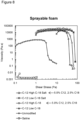
- Figure 7 shows that while the modified and unmodified foams (both at initial concentration of 1.25 wt% in the canister) have viscosities greater than that of a saline solution, the addition of blood greatly increases the viscosity because of the gelation of the chitosan polymers.
- Figure 8 also demonstrates how the addition of the variable length hydrophobically modified tails improves the ability of chitosan to gel blood.
- % refers to mol% as described elsewhere herein. All hydrophobic design grafts are attached to a medium molecular weight chitosan (Primex hqg 400). Preferred concentrations of the below variable-length hm-chitosans are 0.1 to 2.5 wt%. Preferred counteracids are acetic acid, hydrochloric acid, L-lactic acid, citric acid and glutamic acid, each acid concentration being 1 to 2 wt% in water. Grafting of different sizes are randomly distributed along the backbone due to a free reaction of a mixture of fatty anhydrides.
- Table 3 Exemplary embodiments for blood gelation %C6 %C8 %C10 %C12 %C14 %C16 %C18 Order 5 5 2° 4 4 2° 10 1 2° 8 1 2° 6.5 1 2° 5 1 2° 3 1 2° 5 2 1 3° 2 1 2° 1 1 1 3° 5 1 2° 5 2.5 2° 10 3 1 3° 1 2 1 0.5 4° 1 1 2 1 4°
- Hydrophobically-modified polymers that balance tissue adhesive properties with material cohesive properties were constructed.
- biopolymer hemostatic dressings including chitosan-based dressings, must first adhere quickly and strongly to the site of bleeding in order to create a robust seal.
- the dressings must also be cohesive enough to avoid collapse under high-pressure blood flow.
- chitosan dressings fail due to either a lack of adherence to the wound site or a lack of coherence once an initial seal has been achieved.
- Native chitosan is particularly good at adhering to wet, bleeding tissue. However, native chitosan generally has a limited ability to hold together under high-pressure blood flow.
- hydrophobes are more advantageous for optimizing adherence, and other hydrophobes are more advantageous for improving coherence.
- the hydrophobic grafts are useful in improving adhesion of the chitosan dressing, and in the range of C13-C22 lengths, the hydrophobic grafts are useful in improving the cohesion of the dressings.
- hydrophobic grafts for example in a preferred embodiment of 5 mol% C12 and 1.0 mol% C18 attached to a medium molecular weight chitosan (MW ⁇ 250kDa), a composition was created which had improved characteristics compared to either: (1) native chitosan; (2) 5% C12 chitosan only; or (3) 1.0% C18 chitosan only.
- This composition allowed for the following improvements over a single length hydrophobically modified chitosan:
- hydrophobically-modified chitosans were prepared with altered biodegradation profiles. Hydrophobic groups below the length of C6 do not contribute towards improved hemostatic effect of the chitosan polysaccharide. However, hydrophobic modification in the range of C1 to C6 do allow for a framework to optimize the degradation of the material inside the body via lysozymes. Particularly in the case of surgical-use hemostats, it is ideal for the hemostatic biomaterial to degrade quickly after achieving hemostasis.
- hydrophobic grafts for example in a preferred embodiment of 5% C12 and 30% C1 attached to a medium molecular weight chitosan (MW ⁇ 250kDa), a composition was created which had improved biodegradation characteristics relative to either: (1) native chitosan, (2) 5% C12 chitosan only, or (3) 30% C1 chitosan only.
- a composition was created which had improved biodegradation characteristics relative to either: (1) native chitosan, (2) 5% C12 chitosan only, or (3) 30% C1 chitosan only.
- chitosan-based materials can be useful as anti-microbial agents due to their bacteriostatic effect. While the mechanism of action of chitosan as an anti-microbial is not well understood, two key contributing mechanisms likely play a role: (1) penetration into the bacterial cells and intercalation with plasmid DNA, thus preventing replication; and, (2) physical immobilization of cells due to physical binding of bacteria into a robust cohesive network. Smaller hydrophobes C1-C12 assist with interfacing with the cell membrane and/or cell wall; larger hydrophobes C13-C22 assist with physical binding of the bacteria into immobilized networks.
- variable-length design framework along a wide span of chitosan backbone lengths, allows for the creation of many unique molecules which can amplify a given mechanism towards bacterial death depending upon the clinical circumstances.
- Certain bacteria are more susceptible to penetration through the cell wall (typically gram negative); and infections caused by robust bacteria may be limited to treatment via molecules that work only by physical bacteriostasis (e.g. bacteria which have genetically mutated to become resistant to traditional small molecule antibiotic agents).
Landscapes
- Health & Medical Sciences (AREA)
- Chemical & Material Sciences (AREA)
- Life Sciences & Earth Sciences (AREA)
- Medicinal Chemistry (AREA)
- General Health & Medical Sciences (AREA)
- Chemical Kinetics & Catalysis (AREA)
- Organic Chemistry (AREA)
- Polymers & Plastics (AREA)
- Animal Behavior & Ethology (AREA)
- Public Health (AREA)
- Veterinary Medicine (AREA)
- Engineering & Computer Science (AREA)
- Materials Engineering (AREA)
- Epidemiology (AREA)
- Biochemistry (AREA)
- Molecular Biology (AREA)
- Pharmacology & Pharmacy (AREA)
- Hematology (AREA)
- Surgery (AREA)
- Inorganic Chemistry (AREA)
- Birds (AREA)
- Dermatology (AREA)
- Materials For Medical Uses (AREA)
- Pharmaceuticals Containing Other Organic And Inorganic Compounds (AREA)
- Graft Or Block Polymers (AREA)
Claims (10)
- Ein hydrophob modifiziertes Polymer oder eine Zusammensetzung davon, wobei das modifizierte Polymer Chitosan ist, das gesättigte hydrophobe Kohlenwasserstoffgruppen von 2 bis etwa 10 verschiedenen Größen am Polymer-Rückgrat angebracht hat;wobei die hydrophoben Gruppen C8-Kohlenwasserstoffgruppen umfassen, die zusammen mit mindestens einem von C14-, C16- oder C18-Kohlenwasserstoffgruppen in einem Verhältnis von 5:1 bis 20:1 vorliegen; oderwobei die hydrophoben Gruppen C10- oder C12-Kohlenwasserstoffgruppen umfassen, die zusammen mit mindestens einem von C14-, C16- oder C18-Kohlenwasserstoffgruppen in einem Verhältnis von 2:1 bis 10:1 vorliegen.
- Das Polymer oder die Zusammensetzung aus Anspruch 1, wobei die hydrophoben Gruppen umfassend C8-Kohlenwasserstoffgruppen zusammen mit mindestens einem von C14-, C16- oder C18-Kohlenwasserstoffgruppen in einem Verhältnis von 5:1 bis 15:1 vorliegen.
- Das Polymer oder die Zusammensetzung aus Anspruch 1, wobei die hydrophoben Gruppen umfassend C10- oder C12-Kohlenwasserstoffgruppen zusammen mit mindestens einem von C14-, C16- oder C18-Kohlenwasserstoffgruppen in einem Verhältnis von 2:1 bis 8:1 vorliegen.
- Das Polymer oder die Zusammensetzung aus irgendeinem der Ansprüche 1 bis 3, wobei das Polymer Chitosan ist und hydrophobe Gruppen durch Anhydrid-Chemie angebracht sind.
- Das Polymer oder die Zusammensetzung aus irgendeinem der Ansprüche 1 bis 4, wobei das Polymer von etwa 10% bis etwa 50% der funktionellen Gruppen von einer hydrophoben Gruppe besetzt hat.
- Das Polymer oder die Zusammensetzung aus irgendeinem der Ansprüche 1 bis 5, das von 2 bis etwa 5 verschiedene hydrophobe Gruppen hat.
- Das Polymer oder die Zusammensetzung aus irgendeinem der Ansprüche 1 bis 6, formuliert als ein Feststoff, eine Flüssigkeit, ein Gel, ein Schaum oder eine Knete.
- Das Polymer oder die Zusammensetzung aus Anspruch 7, wobei das modifizierte Polymer bei 0,1 bis etwa 5 Gew.-% vorliegt.
- Das Polymer oder die Zusammensetzung aus irgendeinem der Ansprüche 1 bis 8, wobei die Zusammensetzung ein Hämostatikum ist.
- Das Polymer oder die Zusammensetzung aus Anspruch 9 zur Verwendung in der Behandlung einer blutenden Wunde.
Priority Applications (1)
| Application Number | Priority Date | Filing Date | Title |
|---|---|---|---|
| EP24194069.1A EP4450525A3 (de) | 2017-04-13 | 2018-04-13 | Hydrophob modifizierte polymere mit variabler grösse |
Applications Claiming Priority (2)
| Application Number | Priority Date | Filing Date | Title |
|---|---|---|---|
| US201762484985P | 2017-04-13 | 2017-04-13 | |
| PCT/US2018/027637 WO2018191705A1 (en) | 2017-04-13 | 2018-04-13 | Variable-size hydrophobically-modified polymers |
Related Child Applications (1)
| Application Number | Title | Priority Date | Filing Date |
|---|---|---|---|
| EP24194069.1A Division EP4450525A3 (de) | 2017-04-13 | 2018-04-13 | Hydrophob modifizierte polymere mit variabler grösse |
Publications (3)
| Publication Number | Publication Date |
|---|---|
| EP3609507A1 EP3609507A1 (de) | 2020-02-19 |
| EP3609507A4 EP3609507A4 (de) | 2021-04-14 |
| EP3609507B1 true EP3609507B1 (de) | 2024-08-14 |
Family
ID=63793623
Family Applications (2)
| Application Number | Title | Priority Date | Filing Date |
|---|---|---|---|
| EP18783898.2A Active EP3609507B1 (de) | 2017-04-13 | 2018-04-13 | Hydrophob modifizierte polymere mit variabler grösse |
| EP24194069.1A Pending EP4450525A3 (de) | 2017-04-13 | 2018-04-13 | Hydrophob modifizierte polymere mit variabler grösse |
Family Applications After (1)
| Application Number | Title | Priority Date | Filing Date |
|---|---|---|---|
| EP24194069.1A Pending EP4450525A3 (de) | 2017-04-13 | 2018-04-13 | Hydrophob modifizierte polymere mit variabler grösse |
Country Status (5)
| Country | Link |
|---|---|
| US (7) | US20200121825A1 (de) |
| EP (2) | EP3609507B1 (de) |
| CN (2) | CN110603043B (de) |
| CA (1) | CA3060002A1 (de) |
| WO (1) | WO2018191705A1 (de) |
Families Citing this family (14)
| Publication number | Priority date | Publication date | Assignee | Title |
|---|---|---|---|---|
| EP3609507B1 (de) | 2017-04-13 | 2024-08-14 | Medcura, Inc. | Hydrophob modifizierte polymere mit variabler grösse |
| EP3934659A4 (de) * | 2019-03-05 | 2022-12-14 | Medcura, Inc. | System und verfahren zur verminderung von gewebe- oder organadhäsion |
| US12201742B2 (en) | 2019-10-03 | 2025-01-21 | Medcura, Inc. | Hydrophobically-modified biopolymer materials |
| CN111420116B (zh) * | 2020-03-31 | 2022-11-29 | 优尔爱(常州)医疗科技有限公司 | 一种防黏连鼻腔止血用低压变聚氨酯泡沫材料及其制备方法 |
| US12161777B2 (en) | 2020-07-02 | 2024-12-10 | Davol Inc. | Flowable hemostatic suspension |
| US11739166B2 (en) | 2020-07-02 | 2023-08-29 | Davol Inc. | Reactive polysaccharide-based hemostatic agent |
| US20240032943A1 (en) * | 2020-08-29 | 2024-02-01 | Medcura, Inc. | Vascular bleeding control device and methods of use |
| EP4267210A1 (de) | 2020-12-28 | 2023-11-01 | Davol Inc. | Reaktives trockenpulver-hämostasematerial mit einem protein und einem multifunktionalisierten modifizierten polyethylenglykolbasierten vernetzungsmittel |
| CN114569781B (zh) * | 2022-03-02 | 2022-10-04 | 上海交通大学 | 一种多糖缀合物止血材料、制备方法及其应用 |
| CN114558167A (zh) * | 2022-03-09 | 2022-05-31 | 上海长征医院 | 一种快速止血喷雾及其制备方法 |
| CN115779136B (zh) * | 2022-12-15 | 2024-04-12 | 湖南中腾湘岳生物科技有限公司 | 一种医用止血材料及其制备方法 |
| CN116510070B (zh) * | 2023-04-21 | 2025-03-14 | 齐鲁工业大学(山东省科学院) | 一种胶原蛋白水凝胶及其制备方法与应用 |
| WO2025155960A1 (en) * | 2024-01-18 | 2025-07-24 | Medcura, Inc. | Film compositions for hemostasis |
| WO2026015591A1 (en) * | 2024-07-09 | 2026-01-15 | Medcura, Inc. | Powder compositions for establishing hemostasis |
Family Cites Families (25)
| Publication number | Priority date | Publication date | Assignee | Title |
|---|---|---|---|---|
| US2651629A (en) * | 1949-07-01 | 1953-09-08 | Celanese Corp | Cellulose esters |
| US6342484B1 (en) * | 1993-06-30 | 2002-01-29 | Board Of Regents, The University Of Texas Systems | Method and compositions for promotion of wound treatment |
| US6284267B1 (en) * | 1996-08-14 | 2001-09-04 | Nutrimed Biotech | Amphiphilic materials and liposome formulations thereof |
| US6517678B1 (en) * | 2000-01-20 | 2003-02-11 | Kimberly-Clark Worldwide, Inc. | Modified polysaccharides containing amphiphillic hydrocarbon moieties |
| CN1167468C (zh) * | 2002-05-31 | 2004-09-22 | 天津大学 | 烷基化壳聚糖转基因复合物微粒的制备方法 |
| US20080064843A1 (en) * | 2002-09-19 | 2008-03-13 | Thomas Daly | Polymers with pendant alkyl chains |
| US8382794B2 (en) | 2006-01-04 | 2013-02-26 | St. Jude Medical Puerto Rico Llc | Balloon insertion apparatus and method of sealing a tissue puncture |
| US8932560B2 (en) | 2007-09-04 | 2015-01-13 | University of Maryland, College Parke | Advanced functional biocompatible polymeric matrix used as a hemostatic agent and system for damaged tissues and cells |
| US9066885B2 (en) | 2007-03-16 | 2015-06-30 | University Of Maryland, College Park | Advanced functional biocompatible polymeric matrix containing nano-compartments |
| JP2010534563A (ja) * | 2007-07-24 | 2010-11-11 | ネクスバイオ,インク. | マイクロ粒子の作製のための技術 |
| CN101407624B (zh) * | 2007-10-11 | 2011-12-21 | 罗门哈斯公司 | 增稠剂混合组合物及使水性体系增稠的方法 |
| RU2011105732A (ru) * | 2008-07-17 | 2012-08-27 | Геркулес Инкорпорейтед (Us) | Способ получения композиций покрытия на водной основе с заданными свойствами |
| KR101106627B1 (ko) * | 2008-07-18 | 2012-01-20 | 중앙대학교 산학협력단 | 키토산 스폰지의 제조방법 및 이를 이용한 창상도포재 |
| EP2166043B1 (de) * | 2008-09-19 | 2016-04-27 | Rohm and Haas Company | Eindickungszusammensetzung und Verfahren zur Eindickung wässriger Systeme |
| CA2780898A1 (en) * | 2009-11-13 | 2011-05-19 | University Of Maryland, College Park | Advanced functional biocompatible foam used as a hemostatic agent for compressible and non-compressible acute wounds |
| US8664199B2 (en) | 2010-08-13 | 2014-03-04 | University Of Maryland, College Park | Method and system for reversal of interactions between hydrophobically modified biopolymers and vesicles or cell membranes |
| US8858883B2 (en) | 2010-12-02 | 2014-10-14 | University Of Maryland, College Park | Method and system for capture and use of intact vesicles on electrodeposited hydrophobically modified biopolymer films |
| CN102408497B (zh) * | 2011-07-22 | 2013-07-31 | 华南农业大学 | 一种载药纳米胶束溶液及其制备方法与应用 |
| FR2989001B1 (fr) * | 2012-04-06 | 2017-07-21 | Centre Nat Rech Scient | Microparticules et nanoparticules constituees de polysaccharides hydrophobises et d'une alpha-cyclodextrine |
| WO2014160136A1 (en) | 2013-03-13 | 2014-10-02 | University Of Maryland, Office Of Technology Commercialization | Advanced functional biocompatible polymer putty used as a hemostatic agent for treating damaged tissue and cells |
| EP3439615A4 (de) | 2016-04-06 | 2019-12-25 | Gel-E, Inc. | Hydrophobisch modifiziertes chitosan zur verwendung in kosmetika und körperpflegemitteln |
| US20200046870A1 (en) | 2016-10-17 | 2020-02-13 | Gel-E Life Sciences | Materials comprising hydrophobically-modified biopolymer |
| US20210353501A1 (en) | 2017-03-31 | 2021-11-18 | Medcura, Inc. | Hydrophobically-modified polymer foams and methods of use |
| EP3609507B1 (de) | 2017-04-13 | 2024-08-14 | Medcura, Inc. | Hydrophob modifizierte polymere mit variabler grösse |
| EP3934659A4 (de) | 2019-03-05 | 2022-12-14 | Medcura, Inc. | System und verfahren zur verminderung von gewebe- oder organadhäsion |
-
2018
- 2018-04-13 EP EP18783898.2A patent/EP3609507B1/de active Active
- 2018-04-13 CA CA3060002A patent/CA3060002A1/en active Pending
- 2018-04-13 WO PCT/US2018/027637 patent/WO2018191705A1/en not_active Ceased
- 2018-04-13 EP EP24194069.1A patent/EP4450525A3/de active Pending
- 2018-04-13 CN CN201880029067.4A patent/CN110603043B/zh active Active
- 2018-04-13 US US16/603,933 patent/US20200121825A1/en not_active Abandoned
- 2018-04-13 CN CN202311025585.8A patent/CN117343213B/zh active Active
-
2019
- 2019-10-03 US US16/592,234 patent/US11274194B2/en active Active
-
2022
- 2022-01-05 US US17/568,790 patent/US20220243039A1/en not_active Abandoned
- 2022-01-31 US US17/588,542 patent/US11787922B2/en active Active
-
2023
- 2023-03-16 US US18/122,208 patent/US12584002B2/en active Active
- 2023-03-31 US US18/129,239 patent/US20230348699A1/en active Pending
- 2023-09-21 US US18/371,043 patent/US20240101795A1/en not_active Abandoned
Also Published As
| Publication number | Publication date |
|---|---|
| CN117343213B (zh) | 2026-02-13 |
| WO2018191705A1 (en) | 2018-10-18 |
| EP3609507A4 (de) | 2021-04-14 |
| CN110603043B (zh) | 2023-09-29 |
| US20240101795A1 (en) | 2024-03-28 |
| US11274194B2 (en) | 2022-03-15 |
| EP4450525A3 (de) | 2025-01-01 |
| US20200102446A1 (en) | 2020-04-02 |
| EP3609507A1 (de) | 2020-02-19 |
| US20230323096A1 (en) | 2023-10-12 |
| US12584002B2 (en) | 2026-03-24 |
| US20220243039A1 (en) | 2022-08-04 |
| CA3060002A1 (en) | 2018-10-18 |
| US20230348699A1 (en) | 2023-11-02 |
| CN117343213A (zh) | 2024-01-05 |
| US20220227974A1 (en) | 2022-07-21 |
| US20200121825A1 (en) | 2020-04-23 |
| CN110603043A (zh) | 2019-12-20 |
| US11787922B2 (en) | 2023-10-17 |
| EP4450525A2 (de) | 2024-10-23 |
Similar Documents
| Publication | Publication Date | Title |
|---|---|---|
| US20230323096A1 (en) | Variable-size hydrophobically-modified polymers | |
| Qian et al. | Injectable and self-healing polysaccharide-based hydrogel for pH-responsive drug release | |
| Mo et al. | Advances in injectable and self‐healing polysaccharide hydrogel based on the Schiff base reaction | |
| Jeong et al. | Carboxymethyl cellulose-based superabsorbent hydrogels containing carboxymehtyl β-cyclodextrin for enhanced mechanical strength and effective drug delivery | |
| Chen et al. | All-polysaccharide, self-healing injectable hydrogels based on chitosan and oxidized hydroxypropyl polysaccharides | |
| Cao et al. | An injectable hydrogel formed by in situ cross-linking of glycol chitosan and multi-benzaldehyde functionalized PEG analogues for cartilage tissue engineering | |
| Qi et al. | Fabrication and characterization of a novel anticancer drug delivery system: salecan/poly (methacrylic acid) semi-interpenetrating polymer network hydrogel | |
| US20150175718A1 (en) | Advanced functional biocompatible polymeric matrix used as a hemostatic agent and system for damaged tissues and cells | |
| Shim et al. | Chitosan–dipeptide hydrogels as potential anticancer drug delivery systems | |
| Huang et al. | Chitosan catechol-tannic acid composite hydrogel and cryogel with antimicrobial and hemostatic properties | |
| Li et al. | Novel hydrogels based on carboxyl pullulan and collagen crosslinking with 1, 4-butanediol diglycidylether for use as a dermal filler: initial in vitro and in vivo investigations | |
| Soltani et al. | Shear-thinning and self-healing nanohybrid alginate-graphene oxide hydrogel based on guest-host assembly | |
| US20250170300A1 (en) | Hydrophobically-modified biopolymer materials | |
| Oh et al. | Preparation and characterization of an in situ crosslinkable glycol chitosan thermogel for biomedical applications | |
| Patel et al. | Nanocellulose-assisted mechanically tough hydrogel platforms for sustained drug delivery | |
| Elangwe et al. | Evaluation of composition effects on the tissue-adhesive, mechanical and physical properties of physically crosslinked hydrogels based on chitosan and pullulan for wound healing applications | |
| US20190159992A1 (en) | Hydrophobically-Modified Chitosan for Use in Cosmetics and Personal Care Applications | |
| Erden et al. | Preparation and in vitro characterization of laminarin based hydrogels | |
| US20150335795A1 (en) | Multilayer implants for delivery of therapeutic agents | |
| KR102141826B1 (ko) | 양이온성 베타 시클로덱스트린 올리고머를 이용한 외부 pH 자극 반응형 자가치유성 하이드로젤 | |
| KR102869207B1 (ko) | 주사 가능한 pH-반응성 하이드로겔 | |
| Su et al. | Synthesis and characterization of biodegradable macroporous cryogels crosslinked by chitosan oligosaccharide-graft-acrylic acid | |
| Baran et al. | Glycan-Based Systems for Regenerative Medicine | |
| WO2026015591A1 (en) | Powder compositions for establishing hemostasis | |
| RU2659175C1 (ru) | Композиция на основе бактериальной целлюлозы и гиалуроновой кислоты |
Legal Events
| Date | Code | Title | Description |
|---|---|---|---|
| STAA | Information on the status of an ep patent application or granted ep patent |
Free format text: STATUS: THE INTERNATIONAL PUBLICATION HAS BEEN MADE |
|
| PUAI | Public reference made under article 153(3) epc to a published international application that has entered the european phase |
Free format text: ORIGINAL CODE: 0009012 |
|
| STAA | Information on the status of an ep patent application or granted ep patent |
Free format text: STATUS: REQUEST FOR EXAMINATION WAS MADE |
|
| 17P | Request for examination filed |
Effective date: 20191104 |
|
| AK | Designated contracting states |
Kind code of ref document: A1 Designated state(s): AL AT BE BG CH CY CZ DE DK EE ES FI FR GB GR HR HU IE IS IT LI LT LU LV MC MK MT NL NO PL PT RO RS SE SI SK SM TR |
|
| AX | Request for extension of the european patent |
Extension state: BA ME |
|
| RAP1 | Party data changed (applicant data changed or rights of an application transferred) |
Owner name: MEDCURA, INC. |
|
| DAV | Request for validation of the european patent (deleted) | ||
| DAX | Request for extension of the european patent (deleted) | ||
| RIC1 | Information provided on ipc code assigned before grant |
Ipc: C08B 3/18 20060101ALI20201208BHEP Ipc: C08L 5/08 20060101ALI20201208BHEP Ipc: C08B 3/16 20060101ALI20201208BHEP Ipc: C08L 5/04 20060101ALI20201208BHEP Ipc: C08L 1/08 20060101ALI20201208BHEP Ipc: C08B 11/193 20060101ALI20201208BHEP Ipc: C08B 11/02 20060101ALI20201208BHEP Ipc: C08B 37/08 20060101ALI20201208BHEP Ipc: C08B 3/00 20060101ALI20201208BHEP Ipc: A61K 31/734 20060101ALI20201208BHEP Ipc: A61K 31/722 20060101ALI20201208BHEP Ipc: C08B 37/00 20060101ALI20201208BHEP Ipc: A61K 31/717 20060101AFI20201208BHEP |
|
| A4 | Supplementary search report drawn up and despatched |
Effective date: 20210317 |
|
| RIC1 | Information provided on ipc code assigned before grant |
Ipc: A61K 31/717 20060101AFI20210311BHEP Ipc: A61K 31/722 20060101ALI20210311BHEP Ipc: A61K 31/734 20060101ALI20210311BHEP Ipc: C08B 37/08 20060101ALI20210311BHEP Ipc: C08L 5/08 20060101ALI20210311BHEP Ipc: C08L 1/08 20060101ALI20210311BHEP Ipc: C08B 3/00 20060101ALI20210311BHEP Ipc: C08B 37/00 20060101ALI20210311BHEP Ipc: C08L 5/04 20060101ALI20210311BHEP Ipc: C08B 3/16 20060101ALI20210311BHEP Ipc: C08B 3/18 20060101ALI20210311BHEP Ipc: C08B 11/02 20060101ALI20210311BHEP Ipc: C08B 11/193 20060101ALI20210311BHEP |
|
| RIN1 | Information on inventor provided before grant (corrected) |
Inventor name: DOWLING, MATTHEW |
|
| RAP3 | Party data changed (applicant data changed or rights of an application transferred) |
Owner name: MEDCURA, INC. |
|
| STAA | Information on the status of an ep patent application or granted ep patent |
Free format text: STATUS: EXAMINATION IS IN PROGRESS |
|
| 17Q | First examination report despatched |
Effective date: 20221115 |
|
| GRAP | Despatch of communication of intention to grant a patent |
Free format text: ORIGINAL CODE: EPIDOSNIGR1 |
|
| STAA | Information on the status of an ep patent application or granted ep patent |
Free format text: STATUS: GRANT OF PATENT IS INTENDED |
|
| INTG | Intention to grant announced |
Effective date: 20240311 |
|
| GRAS | Grant fee paid |
Free format text: ORIGINAL CODE: EPIDOSNIGR3 |
|
| GRAA | (expected) grant |
Free format text: ORIGINAL CODE: 0009210 |
|
| STAA | Information on the status of an ep patent application or granted ep patent |
Free format text: STATUS: THE PATENT HAS BEEN GRANTED |
|
| AK | Designated contracting states |
Kind code of ref document: B1 Designated state(s): AL AT BE BG CH CY CZ DE DK EE ES FI FR GB GR HR HU IE IS IT LI LT LU LV MC MK MT NL NO PL PT RO RS SE SI SK SM TR |
|
| REG | Reference to a national code |
Ref country code: GB Ref legal event code: FG4D |
|
| REG | Reference to a national code |
Ref country code: CH Ref legal event code: EP |
|
| REG | Reference to a national code |
Ref country code: DE Ref legal event code: R096 Ref document number: 602018073107 Country of ref document: DE |
|
| REG | Reference to a national code |
Ref country code: IE Ref legal event code: FG4D |
|
| REG | Reference to a national code |
Ref country code: NL Ref legal event code: FP |
|
| REG | Reference to a national code |
Ref country code: LT Ref legal event code: MG9D |
|
| PG25 | Lapsed in a contracting state [announced via postgrant information from national office to epo] |
Ref country code: NO Free format text: LAPSE BECAUSE OF FAILURE TO SUBMIT A TRANSLATION OF THE DESCRIPTION OR TO PAY THE FEE WITHIN THE PRESCRIBED TIME-LIMIT Effective date: 20241114 |
|
| REG | Reference to a national code |
Ref country code: AT Ref legal event code: MK05 Ref document number: 1712655 Country of ref document: AT Kind code of ref document: T Effective date: 20240814 |
|
| PG25 | Lapsed in a contracting state [announced via postgrant information from national office to epo] |
Ref country code: FI Free format text: LAPSE BECAUSE OF FAILURE TO SUBMIT A TRANSLATION OF THE DESCRIPTION OR TO PAY THE FEE WITHIN THE PRESCRIBED TIME-LIMIT Effective date: 20240814 Ref country code: GR Free format text: LAPSE BECAUSE OF FAILURE TO SUBMIT A TRANSLATION OF THE DESCRIPTION OR TO PAY THE FEE WITHIN THE PRESCRIBED TIME-LIMIT Effective date: 20241115 Ref country code: PT Free format text: LAPSE BECAUSE OF FAILURE TO SUBMIT A TRANSLATION OF THE DESCRIPTION OR TO PAY THE FEE WITHIN THE PRESCRIBED TIME-LIMIT Effective date: 20241216 Ref country code: PL Free format text: LAPSE BECAUSE OF FAILURE TO SUBMIT A TRANSLATION OF THE DESCRIPTION OR TO PAY THE FEE WITHIN THE PRESCRIBED TIME-LIMIT Effective date: 20240814 |
|
| PG25 | Lapsed in a contracting state [announced via postgrant information from national office to epo] |
Ref country code: BG Free format text: LAPSE BECAUSE OF FAILURE TO SUBMIT A TRANSLATION OF THE DESCRIPTION OR TO PAY THE FEE WITHIN THE PRESCRIBED TIME-LIMIT Effective date: 20240814 |
|
| PG25 | Lapsed in a contracting state [announced via postgrant information from national office to epo] |
Ref country code: LV Free format text: LAPSE BECAUSE OF FAILURE TO SUBMIT A TRANSLATION OF THE DESCRIPTION OR TO PAY THE FEE WITHIN THE PRESCRIBED TIME-LIMIT Effective date: 20240814 |
|
| PG25 | Lapsed in a contracting state [announced via postgrant information from national office to epo] |
Ref country code: AT Free format text: LAPSE BECAUSE OF FAILURE TO SUBMIT A TRANSLATION OF THE DESCRIPTION OR TO PAY THE FEE WITHIN THE PRESCRIBED TIME-LIMIT Effective date: 20240814 Ref country code: IS Free format text: LAPSE BECAUSE OF FAILURE TO SUBMIT A TRANSLATION OF THE DESCRIPTION OR TO PAY THE FEE WITHIN THE PRESCRIBED TIME-LIMIT Effective date: 20241214 |
|
| PG25 | Lapsed in a contracting state [announced via postgrant information from national office to epo] |
Ref country code: HR Free format text: LAPSE BECAUSE OF FAILURE TO SUBMIT A TRANSLATION OF THE DESCRIPTION OR TO PAY THE FEE WITHIN THE PRESCRIBED TIME-LIMIT Effective date: 20240814 |
|
| PG25 | Lapsed in a contracting state [announced via postgrant information from national office to epo] |
Ref country code: RS Free format text: LAPSE BECAUSE OF FAILURE TO SUBMIT A TRANSLATION OF THE DESCRIPTION OR TO PAY THE FEE WITHIN THE PRESCRIBED TIME-LIMIT Effective date: 20241114 Ref country code: ES Free format text: LAPSE BECAUSE OF FAILURE TO SUBMIT A TRANSLATION OF THE DESCRIPTION OR TO PAY THE FEE WITHIN THE PRESCRIBED TIME-LIMIT Effective date: 20240814 |
|
| PG25 | Lapsed in a contracting state [announced via postgrant information from national office to epo] |
Ref country code: RS Free format text: LAPSE BECAUSE OF FAILURE TO SUBMIT A TRANSLATION OF THE DESCRIPTION OR TO PAY THE FEE WITHIN THE PRESCRIBED TIME-LIMIT Effective date: 20241114 Ref country code: PT Free format text: LAPSE BECAUSE OF FAILURE TO SUBMIT A TRANSLATION OF THE DESCRIPTION OR TO PAY THE FEE WITHIN THE PRESCRIBED TIME-LIMIT Effective date: 20241216 Ref country code: PL Free format text: LAPSE BECAUSE OF FAILURE TO SUBMIT A TRANSLATION OF THE DESCRIPTION OR TO PAY THE FEE WITHIN THE PRESCRIBED TIME-LIMIT Effective date: 20240814 Ref country code: NO Free format text: LAPSE BECAUSE OF FAILURE TO SUBMIT A TRANSLATION OF THE DESCRIPTION OR TO PAY THE FEE WITHIN THE PRESCRIBED TIME-LIMIT Effective date: 20241114 Ref country code: LV Free format text: LAPSE BECAUSE OF FAILURE TO SUBMIT A TRANSLATION OF THE DESCRIPTION OR TO PAY THE FEE WITHIN THE PRESCRIBED TIME-LIMIT Effective date: 20240814 Ref country code: IS Free format text: LAPSE BECAUSE OF FAILURE TO SUBMIT A TRANSLATION OF THE DESCRIPTION OR TO PAY THE FEE WITHIN THE PRESCRIBED TIME-LIMIT Effective date: 20241214 Ref country code: HR Free format text: LAPSE BECAUSE OF FAILURE TO SUBMIT A TRANSLATION OF THE DESCRIPTION OR TO PAY THE FEE WITHIN THE PRESCRIBED TIME-LIMIT Effective date: 20240814 Ref country code: GR Free format text: LAPSE BECAUSE OF FAILURE TO SUBMIT A TRANSLATION OF THE DESCRIPTION OR TO PAY THE FEE WITHIN THE PRESCRIBED TIME-LIMIT Effective date: 20241115 Ref country code: FI Free format text: LAPSE BECAUSE OF FAILURE TO SUBMIT A TRANSLATION OF THE DESCRIPTION OR TO PAY THE FEE WITHIN THE PRESCRIBED TIME-LIMIT Effective date: 20240814 Ref country code: ES Free format text: LAPSE BECAUSE OF FAILURE TO SUBMIT A TRANSLATION OF THE DESCRIPTION OR TO PAY THE FEE WITHIN THE PRESCRIBED TIME-LIMIT Effective date: 20240814 Ref country code: BG Free format text: LAPSE BECAUSE OF FAILURE TO SUBMIT A TRANSLATION OF THE DESCRIPTION OR TO PAY THE FEE WITHIN THE PRESCRIBED TIME-LIMIT Effective date: 20240814 Ref country code: AT Free format text: LAPSE BECAUSE OF FAILURE TO SUBMIT A TRANSLATION OF THE DESCRIPTION OR TO PAY THE FEE WITHIN THE PRESCRIBED TIME-LIMIT Effective date: 20240814 |
|
| PG25 | Lapsed in a contracting state [announced via postgrant information from national office to epo] |
Ref country code: DK Free format text: LAPSE BECAUSE OF FAILURE TO SUBMIT A TRANSLATION OF THE DESCRIPTION OR TO PAY THE FEE WITHIN THE PRESCRIBED TIME-LIMIT Effective date: 20240814 Ref country code: RO Free format text: LAPSE BECAUSE OF FAILURE TO SUBMIT A TRANSLATION OF THE DESCRIPTION OR TO PAY THE FEE WITHIN THE PRESCRIBED TIME-LIMIT Effective date: 20240814 Ref country code: SM Free format text: LAPSE BECAUSE OF FAILURE TO SUBMIT A TRANSLATION OF THE DESCRIPTION OR TO PAY THE FEE WITHIN THE PRESCRIBED TIME-LIMIT Effective date: 20240814 |
|
| PG25 | Lapsed in a contracting state [announced via postgrant information from national office to epo] |
Ref country code: EE Free format text: LAPSE BECAUSE OF FAILURE TO SUBMIT A TRANSLATION OF THE DESCRIPTION OR TO PAY THE FEE WITHIN THE PRESCRIBED TIME-LIMIT Effective date: 20240814 |
|
| PG25 | Lapsed in a contracting state [announced via postgrant information from national office to epo] |
Ref country code: CZ Free format text: LAPSE BECAUSE OF FAILURE TO SUBMIT A TRANSLATION OF THE DESCRIPTION OR TO PAY THE FEE WITHIN THE PRESCRIBED TIME-LIMIT Effective date: 20240814 |
|
| PG25 | Lapsed in a contracting state [announced via postgrant information from national office to epo] |
Ref country code: IT Free format text: LAPSE BECAUSE OF FAILURE TO SUBMIT A TRANSLATION OF THE DESCRIPTION OR TO PAY THE FEE WITHIN THE PRESCRIBED TIME-LIMIT Effective date: 20240814 Ref country code: SK Free format text: LAPSE BECAUSE OF FAILURE TO SUBMIT A TRANSLATION OF THE DESCRIPTION OR TO PAY THE FEE WITHIN THE PRESCRIBED TIME-LIMIT Effective date: 20240814 |
|
| PGFP | Annual fee paid to national office [announced via postgrant information from national office to epo] |
Ref country code: NL Payment date: 20250422 Year of fee payment: 8 |
|
| REG | Reference to a national code |
Ref country code: DE Ref legal event code: R097 Ref document number: 602018073107 Country of ref document: DE |
|
| PLBE | No opposition filed within time limit |
Free format text: ORIGINAL CODE: 0009261 |
|
| STAA | Information on the status of an ep patent application or granted ep patent |
Free format text: STATUS: NO OPPOSITION FILED WITHIN TIME LIMIT |
|
| PGFP | Annual fee paid to national office [announced via postgrant information from national office to epo] |
Ref country code: DE Payment date: 20250423 Year of fee payment: 8 |
|
| PGFP | Annual fee paid to national office [announced via postgrant information from national office to epo] |
Ref country code: GB Payment date: 20250423 Year of fee payment: 8 |
|
| PGFP | Annual fee paid to national office [announced via postgrant information from national office to epo] |
Ref country code: FR Payment date: 20250422 Year of fee payment: 8 |
|
| 26N | No opposition filed |
Effective date: 20250515 |
|
| PGFP | Annual fee paid to national office [announced via postgrant information from national office to epo] |
Ref country code: CH Payment date: 20250501 Year of fee payment: 8 |
|
| PG25 | Lapsed in a contracting state [announced via postgrant information from national office to epo] |
Ref country code: SE Free format text: LAPSE BECAUSE OF FAILURE TO SUBMIT A TRANSLATION OF THE DESCRIPTION OR TO PAY THE FEE WITHIN THE PRESCRIBED TIME-LIMIT Effective date: 20240814 |
|
| PG25 | Lapsed in a contracting state [announced via postgrant information from national office to epo] |
Ref country code: LU Free format text: LAPSE BECAUSE OF NON-PAYMENT OF DUE FEES Effective date: 20250413 |
|
| PG25 | Lapsed in a contracting state [announced via postgrant information from national office to epo] |
Ref country code: MC Free format text: LAPSE BECAUSE OF FAILURE TO SUBMIT A TRANSLATION OF THE DESCRIPTION OR TO PAY THE FEE WITHIN THE PRESCRIBED TIME-LIMIT Effective date: 20240814 |
|
| REG | Reference to a national code |
Ref country code: BE Ref legal event code: MM Effective date: 20250430 |
|
| PG25 | Lapsed in a contracting state [announced via postgrant information from national office to epo] |
Ref country code: BE Free format text: LAPSE BECAUSE OF NON-PAYMENT OF DUE FEES Effective date: 20250430 |
|
| PG25 | Lapsed in a contracting state [announced via postgrant information from national office to epo] |
Ref country code: IE Free format text: LAPSE BECAUSE OF NON-PAYMENT OF DUE FEES Effective date: 20250413 |