EP3609976B1 - Colorant photochromique organique et ses utilisations pour des cellules solaires sensibilisées par colorant - Google Patents
Colorant photochromique organique et ses utilisations pour des cellules solaires sensibilisées par colorant Download PDFInfo
- Publication number
- EP3609976B1 EP3609976B1 EP18724574.1A EP18724574A EP3609976B1 EP 3609976 B1 EP3609976 B1 EP 3609976B1 EP 18724574 A EP18724574 A EP 18724574A EP 3609976 B1 EP3609976 B1 EP 3609976B1
- Authority
- EP
- European Patent Office
- Prior art keywords
- radical
- segment
- optionally substituted
- radicals
- group optionally
- Prior art date
- Legal status (The legal status is an assumption and is not a legal conclusion. Google has not performed a legal analysis and makes no representation as to the accuracy of the status listed.)
- Active
Links
Images

Classifications
-
- C—CHEMISTRY; METALLURGY
- C09—DYES; PAINTS; POLISHES; NATURAL RESINS; ADHESIVES; COMPOSITIONS NOT OTHERWISE PROVIDED FOR; APPLICATIONS OF MATERIALS NOT OTHERWISE PROVIDED FOR
- C09B—ORGANIC DYES OR CLOSELY-RELATED COMPOUNDS FOR PRODUCING DYES, e.g. PIGMENTS; MORDANTS; LAKES
- C09B57/00—Other synthetic dyes of known constitution
- C09B57/02—Coumarine dyes
-
- C—CHEMISTRY; METALLURGY
- C09—DYES; PAINTS; POLISHES; NATURAL RESINS; ADHESIVES; COMPOSITIONS NOT OTHERWISE PROVIDED FOR; APPLICATIONS OF MATERIALS NOT OTHERWISE PROVIDED FOR
- C09K—MATERIALS FOR MISCELLANEOUS APPLICATIONS, NOT PROVIDED FOR ELSEWHERE
- C09K9/00—Tenebrescent materials, i.e. materials for which the range of wavelengths for energy absorption is changed as a result of excitation by some form of energy
- C09K9/02—Organic tenebrescent materials
-
- C—CHEMISTRY; METALLURGY
- C09—DYES; PAINTS; POLISHES; NATURAL RESINS; ADHESIVES; COMPOSITIONS NOT OTHERWISE PROVIDED FOR; APPLICATIONS OF MATERIALS NOT OTHERWISE PROVIDED FOR
- C09B—ORGANIC DYES OR CLOSELY-RELATED COMPOUNDS FOR PRODUCING DYES, e.g. PIGMENTS; MORDANTS; LAKES
- C09B57/00—Other synthetic dyes of known constitution
- C09B57/008—Triarylamine dyes containing no other chromophores
-
- H—ELECTRICITY
- H01—ELECTRIC ELEMENTS
- H01G—CAPACITORS; CAPACITORS, RECTIFIERS, DETECTORS, SWITCHING DEVICES, LIGHT-SENSITIVE OR TEMPERATURE-SENSITIVE DEVICES OF THE ELECTROLYTIC TYPE
- H01G9/00—Electrolytic capacitors, rectifiers, detectors, switching devices, light-sensitive or temperature-sensitive devices; Processes of their manufacture
- H01G9/20—Light-sensitive devices
- H01G9/2059—Light-sensitive devices comprising an organic dye as the active light absorbing material, e.g. adsorbed on an electrode or dissolved in solution
-
- H—ELECTRICITY
- H10—SEMICONDUCTOR DEVICES; ELECTRIC SOLID-STATE DEVICES NOT OTHERWISE PROVIDED FOR
- H10K—ORGANIC ELECTRIC SOLID-STATE DEVICES
- H10K30/00—Organic devices sensitive to infrared radiation, light, electromagnetic radiation of shorter wavelength or corpuscular radiation
- H10K30/80—Constructional details
-
- H—ELECTRICITY
- H10—SEMICONDUCTOR DEVICES; ELECTRIC SOLID-STATE DEVICES NOT OTHERWISE PROVIDED FOR
- H10K—ORGANIC ELECTRIC SOLID-STATE DEVICES
- H10K85/00—Organic materials used in the body or electrodes of devices covered by this subclass
- H10K85/60—Organic compounds having low molecular weight
- H10K85/631—Amine compounds having at least two aryl rest on at least one amine-nitrogen atom, e.g. triphenylamine
- H10K85/633—Amine compounds having at least two aryl rest on at least one amine-nitrogen atom, e.g. triphenylamine comprising polycyclic condensed aromatic hydrocarbons as substituents on the nitrogen atom
-
- H—ELECTRICITY
- H10—SEMICONDUCTOR DEVICES; ELECTRIC SOLID-STATE DEVICES NOT OTHERWISE PROVIDED FOR
- H10K—ORGANIC ELECTRIC SOLID-STATE DEVICES
- H10K85/00—Organic materials used in the body or electrodes of devices covered by this subclass
- H10K85/60—Organic compounds having low molecular weight
- H10K85/631—Amine compounds having at least two aryl rest on at least one amine-nitrogen atom, e.g. triphenylamine
- H10K85/636—Amine compounds having at least two aryl rest on at least one amine-nitrogen atom, e.g. triphenylamine comprising heteroaromatic hydrocarbons as substituents on the nitrogen atom
-
- H—ELECTRICITY
- H10—SEMICONDUCTOR DEVICES; ELECTRIC SOLID-STATE DEVICES NOT OTHERWISE PROVIDED FOR
- H10K—ORGANIC ELECTRIC SOLID-STATE DEVICES
- H10K85/00—Organic materials used in the body or electrodes of devices covered by this subclass
- H10K85/60—Organic compounds having low molecular weight
- H10K85/649—Aromatic compounds comprising a hetero atom
- H10K85/655—Aromatic compounds comprising a hetero atom comprising only sulfur as heteroatom
-
- H—ELECTRICITY
- H10—SEMICONDUCTOR DEVICES; ELECTRIC SOLID-STATE DEVICES NOT OTHERWISE PROVIDED FOR
- H10K—ORGANIC ELECTRIC SOLID-STATE DEVICES
- H10K85/00—Organic materials used in the body or electrodes of devices covered by this subclass
- H10K85/60—Organic compounds having low molecular weight
- H10K85/649—Aromatic compounds comprising a hetero atom
- H10K85/657—Polycyclic condensed heteroaromatic hydrocarbons
- H10K85/6574—Polycyclic condensed heteroaromatic hydrocarbons comprising only oxygen in the heteroaromatic polycondensed ring system, e.g. cumarine dyes
-
- H—ELECTRICITY
- H01—ELECTRIC ELEMENTS
- H01G—CAPACITORS; CAPACITORS, RECTIFIERS, DETECTORS, SWITCHING DEVICES, LIGHT-SENSITIVE OR TEMPERATURE-SENSITIVE DEVICES OF THE ELECTROLYTIC TYPE
- H01G9/00—Electrolytic capacitors, rectifiers, detectors, switching devices, light-sensitive or temperature-sensitive devices; Processes of their manufacture
- H01G9/20—Light-sensitive devices
- H01G9/2027—Light-sensitive devices comprising an oxide semiconductor electrode
- H01G9/2031—Light-sensitive devices comprising an oxide semiconductor electrode comprising titanium oxide, e.g. TiO2
-
- Y—GENERAL TAGGING OF NEW TECHNOLOGICAL DEVELOPMENTS; GENERAL TAGGING OF CROSS-SECTIONAL TECHNOLOGIES SPANNING OVER SEVERAL SECTIONS OF THE IPC; TECHNICAL SUBJECTS COVERED BY FORMER USPC CROSS-REFERENCE ART COLLECTIONS [XRACs] AND DIGESTS
- Y02—TECHNOLOGIES OR APPLICATIONS FOR MITIGATION OR ADAPTATION AGAINST CLIMATE CHANGE
- Y02E—REDUCTION OF GREENHOUSE GAS [GHG] EMISSIONS, RELATED TO ENERGY GENERATION, TRANSMISSION OR DISTRIBUTION
- Y02E10/00—Energy generation through renewable energy sources
- Y02E10/50—Photovoltaic [PV] energy
- Y02E10/542—Dye sensitized solar cells
Definitions
- the present invention belongs to the field of photoelectrical energy and, particularly, to the field of photovoltaic cells and devices.
- the present invention proposes a family of purely organic compounds comprising at least one photochromic moiety and the use thereof as photosensitizers for dye sensitized solar cell (DSSC).
- DSSC dye sensitized solar cell
- DSSCs Dye-Sensitized Solar Cells
- DSSCs present many advantages for applications in Building Integrated PhotoVoltaics (BIPV) [2]. Indeed they can exhibit up to 40% superior performance compared to the conventional silicon solar cells under non-ideal light environments (dim, diffuse and indoor light). Their energy payback time is significantly shorter than silicon but the strongest advantage relies on the fact that they can be semi-transparent and colorful.
- BIPV Building Integrated PhotoVoltaics
- the DSSC technology consists of a transparent conducting oxide (TCO) deposited on transparent substrates to make working and counter electrodes with an electrolyte in between to transport charges.
- the working (or "photo") electrode is constituted of a thin layer (few ⁇ m) of nanoparticles of a semiconductor, usually TiO 2 .
- the TiO 2 is sintered to allow the transport of the electrons from particle to particle down to the TCO.
- the working electrode is then soaked in a sensitizer (dye) solution.
- a sensitizer Several different classes of materials are employed to fabricate a DSSC, but the sensitizer is the key element since it governs the photon harvesting and the creation of free charges after injection of electrons into the nanostructured semi-conducting oxide.
- the sensitizer structure has also been shown to control key electron transfer processes at the TiO 2/ dye/electrolyte interface such as the recombination of TiO 2 electrons with electrolyte species or with dye cations themselves. For this reason many efforts have recently focused on the development of new efficient sensitizers that could help improving device performance, allowing the real use of this technology beyond the laboratory.
- ruthenium sensitizers have some drawbacks that limit the potential of DSSCs.
- their molar extinction coefficients are moderate to low. Therefore thick layers of TiO 2 are required to harvest visible light.
- thick layers are detrimental to the performances when ionic liquid based electrolytes are used for developing stable DSSCs.
- ruthenium complexes are difficult to synthesize and purify and some derivatives should be considered as highly toxic and carcinogenic.
- organic dyes As alternative to ruthenium complexes, organic dyes have successfully been developed for applications in DSSCs in the recent years. Organic dyes reveal several advantages such as higher molar absorption coefficient and tunable colors that are of a great importance for practical applications. Besides, employing them, DSSCs showing rather good power conversion efficiencies up to 8% with ionic liquid electrolyte and a long-term stability up to 10 years have been demonstrated.
- the optical transparency of solar cells can be adapted by tuning the thickness of the TiO 2 electrode or the absorption domain of the sensitizer.
- the actual state of the art only allows for the fabrication of semi-transparent solar cells showing a given optical transmission that is determined by the molar absorption coefficient and the thickness of the mesoporous electrode.
- the patent application US 2010/056810 A1 proposes C 5 -C 6 annelated naphthopyrans that possess at least one electron-withdrawing group i.e.at least one electron attractor group.
- the work of the inventors has made it possible to design and use photochromic-based materials to replace conventional dyes in DSSC whereby said solar cells present a new functionality that is to adapt their transparency to the weather conditions.
- the inventors have adapted the structure of photochromic organic dyes to match the requirements of use in solar cells.
- a photochromic compound In contrast to electrochromic materials, a photochromic compound is a chemical species that is capable of undergoing a reversible transformation between two forms having different absorption spectra under light irradiation.
- Organic photochromic compounds are known for decades and they have been studied extensively owing to the possibility of having a photochromic response in a wide range of wavelengths in the visible spectrum. More than one hundred organic photochromic molecules have been developed, the most commonly known being fulgides, azobenzenes, diarylethenes, spirooxazines, spiropyrans and chromenes derivatives [5] .
- the organic photochromic dyes prepared by the inventors take advantage of the ability of some photochromic compounds to change color upon UV irradiation and in a reversible way. Optical transmission as well as photovoltaic parameters can thus be tuned with any light source, including sunlight that comprises UV.
- the solar cells of the present invention i.e. fabricated with organic photochromic dyes are highly transparent in the absence of light and become colored under sunlight during the day.
- the solar cells pass from the non-colored state to the colored state they start to produce electricity.
- the intensity of the absorption of the solar cells is directly controlled by the photochromic process and the light intensity.
- the present inventors have invented the first solar cell showing self-adaptable optical parameters.
- the solar cells are highly transparent in the visible range and become colorful upon irradiation, showing self-adjustable light transmission with the weather conditions.
- the organic photochromic dye according to the present invention in its colored form will act as a photon harvester and a sensitizer of the wide band gap inorganic semiconductor (such as TiO 2 ).
- a sensitizer of the wide band gap inorganic semiconductor such as TiO 2 .
- the photochromic behavior of the molecules of the prior art is only observed in solution or dispersed in a polymer matrix such as, for example, for application in painting or in optical devices.
- a polymer matrix such as, for example, for application in painting or in optical devices.
- these molecules could present a photochromic behavior even after grafting on a nanostructured semi-conductor metal oxide i.e. in a solid state.
- these molecules could be used as photosensitizer of a metal oxide.
- the present invention relates to an organic dye presenting the following formula (I): in which
- Alkyl group is taken to mean, within the scope of the present invention, a linear, branched or cyclic alkyl group, comprising from 1 to 20 carbon atoms, particularly from 1 to 15 carbon atoms and in particular, from 1 to 10 carbon atoms, which can optionally comprise at least one heteroatom and/or at least one carbon-carbon double bonds or triple bonds, such as, for example, a methyl, ethyl, n-propyl, isopropyl, butyl, isobutyl, sec -butyl, tert -butyl, pentyl, isopentyl, hexyl, heptyl, octyl or nonyl group.
- Aryl group is taken to mean, within the scope of the present invention, any functional group or substituent derived from at least one simple aromatic ring wherein an aromatic ring corresponds to any planar cyclic compound having a delocalized ⁇ system in which each atom of the ring comprises a p-orbital, said p-orbitals overlapping themselves.
- An aryl group comprises one aromatic ring or several aromatic rings identical or different joined or connected by a single bond or by a hydrocarbon group, each ring having from 4 to 20 carbon atoms, particularly from 4 to 14 carbon atoms, in particular, from 4 to 8 carbon atoms and which can optionally comprise at least one heteroatom.
- aryl group phenyl, biphenyl, naphthyl, anthracenyl, cyclopentadienyl, pyrenyl, tetrahydronaphthyl, furanyl, pyrrolyl, thiophenyl, oxazolyl, pyrazolyl, isoquinolinyl, thiazolyl, imidazolyl, triazolyl, pyridinyl, pyranyl, quinolinyl, pyrazinyl and pyrimidinyl groups may be cited.
- An aryl group can be substituted.
- Alkylaryl group is taken to mean, within the scope of the present invention, any group derived from an aryl group as defined above wherein a hydrogen atom is replaced by an alkyl group as defined above.
- Arylalkyl group is taken to mean, within the scope of the present invention, any group derived from an alkyl group as defined above wherein a hydrogen atom is replaced by an aryl group as defined above.
- Substituted alkyl group is taken to mean, within the scope of the present invention, an alkyl, aryl, alkylaryl or arylalkyl group as defined previously substituted by a group or several groups, identical or different, selected from the group consisting of a halogen; an amine; a diamine; a carboxyl; a carboxylate; an aldehyde; an ester; an ether; a hydroxyl; a halogen; an aryl optionally substituted as defined previously and particularly such as a phenyl, a benzyl or a naphthyl; an alkyl optionally substituted as defined previously and particularly such as a methyl, an ethyl, a propyl or a hydroxypropyl; an amide; a sulphonyl; a
- Heteroatom is taken to mean, within the scope of the present invention, an atom chosen from the group consisting of nitrogen, oxygen, phosphorous, sulphur, silicon, fluorine, chlorine and bromine.
- Halogen is taken to mean, within the scope of the present invention, an atom chosen from the group consisting of fluorine, chlorine, iodine and bromine.
- a halogen is implemented in the present invention, it is a fluorine or a chlorine.
- radicals R 1 and R 2 in the organic dye according to the present invention form with the carbons to which they are attached an aromatic or heteroaromatic ring.
- the organic dye according to the invention presents the following formula (II): in which
- the organic dye according to the invention presents the following formula (III): in which
- the radicals R 3 and R 4 are identical and both represent a hydrogen, a halogen, a cyano group (-CN), a nitro group (-NO 2 ), an alkyl group optionally substituted, an aryl group optionally substituted, an alkylaryl group optionally substituted or an arylalkyl group optionally substituted. More advantageously, in the organic dyes of formula (II) or (III), the radicals R 3 and R 4 are identical and both represent a hydrogen.
- the radicals R 5 , R 6 and R 8 are identical and selected in the group consisting a hydrogen, a halogen, a cyano group (-CN), a nitro group (-NO 2 ), an alkyl group optionally substituted, an aryl group optionally substituted, an alkylaryl group optionally substituted and an arylalkyl group optionally substituted. More advantageously, in the organic dyes of formula (II) or (III), the radicals R 5 , R 6 and R 8 represent a hydrogen.
- the radical R 7 is a segment -eD, a segment -L-A, an aryl group substituted by a segment -eD or an aryl group substituted by a segment -L-A.
- radicals R 3 and R 4 in the organic dye according to the present invention form with the carbons to which they are attached an aromatic or heteroaromatic ring.
- the organic dye according to the invention presents the following formula (IV): in which
- the organic dye according to the invention presents the following formula (V): in which
- the radical R 11 , the radical R 12 , the radical R 13 , the radical R 14 are identical and represent a hydrogen, a halogen, a cyano group (-CN), a nitro group (-NO 2 ), an alkyl group optionally substituted, an aryl group optionally substituted, an alkylaryl group optionally substituted or an arylalkyl group optionally substituted. More advantageously, in the organic dyes of formula (IV) or (V) as previously defined, the radical R 11 , the radical R 12 , the radical R 13 , the radical R 14 are identical and represent a hydrogen.
- the radicals R 1 and R 2 are different and selected in the group consisting a hydrogen, a halogen, a cyano group (-CN), a nitro group (-NO 2 ), an alkyl group optionally substituted, an aryl group optionally substituted, an alkylaryl group optionally substituted and an arylalkyl group optionally substituted.
- the radical R 1 represents a hydrogen and the radical R 2 is a segment -eD, a segment -L-A, an aryl group substituted by a segment -eD or an aryl group substituted by a segment -L-A.
- radicals R 1 and R 2 in the organic dye according to the present invention form with the carbons to which they are attached an aromatic or heteroaromatic ring and the radicals R 3 and R 4 in the organic dye according to the present invention form with the carbons to which they are attached an aromatic or heteroaromatic ring.
- the organic dye according to the invention presents the following formula (VI): in which
- organic dye according to the invention presents the following formula (VII): in which
- the organic dye according to the invention presents the following formula (VIII): in which
- the radicals R 19 and R 21 are identical and the radical R 20 is different therefrom.
- the radicals R 19 and R 21 are selected in the group consisting of a hydrogen, a halogen, a cyano group (-CN), a nitro group (-NO 2 ), an alkyl group optionally substituted, an aryl group optionally substituted, an alkylaryl group optionally substituted and an arylalkyl group optionally substituted.
- the radicals R 19 and R 21 are identical and represent a hydrogen and the radical R 20 is a segment -eD, a segment -L-A, an aryl group substituted by a segment -eD or an aryl group substituted by a segment -L-A.
- X represents CH.
- organic dye according to the invention presents the following formula (IX): in which
- organic dye according to the invention presents the following formula (X): in which
- the radicals R 22 and R 23 are different and selected in the group consisting of a hydrogen, a halogen, a cyano group (-CN), a nitro group (-NO 2 ), an alkyl group optionally substituted, an aryl group optionally substituted, an alkylaryl group optionally substituted and an arylalkyl group optionally substituted. More advantageously, the radical R 22 represents a hydrogen and the radical R 23 is a segment -eD, a segment -L-A, an aryl group substituted by a segment -eD or an aryl group substituted by a segment -L-A.
- the radical R 23 represents a hydrogen and the radical R 22 is a segment -eD, a segment -L-A, an aryl group substituted by a segment -eD or an aryl group substituted by a segment - L-A.
- Y represents CH 2 .
- the radicals R 15 and R 16 are identical and selected from the group consisting a halogen, a cyano group (-CN), a nitro group (-NO 2 ), an alkyl group optionally substituted, an aryl group optionally substituted, an alkylaryl group optionally substituted and an arylalkyl group optionally substituted.
- the radicals R 15 and R 16 are identical and represent an alkylaryl optionally substituted.
- the radicals R 15 and R 16 represent a group -C 6 H 4 -C 6 H 13 -
- the radical R 11 , the radical R 12 , the radical R 13 and the radical R 14 are identical and represent a hydrogen, a halogen, a cyano group (-CN), a nitro group (-NO 2 ), an alkyl group optionally substituted, an aryl group optionally substituted, an alkylaryl group optionally substituted or an arylalkyl group optionally substituted.
- the radical R 11 , the radical R 12 , the radical R 13 , the radical R 14 are identical and represent a hydrogen.
- the radicals R 9 and R 10 are different and selected from the group More advantageously, in the organic dyes of formula (IV) to (X) as previously defined, the radical R 11 , the radical R 12 , the radical R 13 , the radical R 14 are identical and represent a hydrogen.
- the radicals R 9 and R 10 are different and selected from the group consisting of a hydrogen, a halogen, a cyano group (-CN), a nitro group (-NO 2 ), an alkyl group optionally substituted, an aryl group optionally substituted, an alkylaryl group optionally substituted, an arylalkyl group optionally substituted, a segment -eD or a segment -L-A.
- the radical R 9 represents a hydrogen and the radical R 10 is a segment -eD, a segment -L-A, an aryl group substituted by a segment -eD or an aryl group substituted by a segment -L-A and advantageously the radical R 10 is a segment -L-A or an aryl group substituted by a segment -L-A. More advantageously, the radical R 10 is a segment -L-A, a C 6 H 4 - group substituted by a segment -L-A or a C 4 H 2 S- group substituted by a segment -L-A.
- Electrode donor segment (eD) is taken to mean, within the scope of the present invention, an electron donor function that enables the organic dye according to the present invention to be reduced more easily by the electrolyte.
- electron donor segments commonly used in the field of photosensitizer organic colorants may be used within the scope of the present invention.
- As examples of such electron donor segments may be cited those described from page 42, line 10 to page 45, line 1 of the international application WO 2009/109499 [7] and those implemented in the 56 organic colorants described in Mishra et al, 2009 [8].
- the electron donor segment implemented within the scope of the present invention is an amino group of (Z 1 )(Z 2 )N- type, with Z 1 and Z 2 , identical or different, representing an alkyl group optionally substituted or an aryl group optionally substituted as defined previously.
- Z 1 and/or Z 2 identical or different, represent a substituted aryl group, the latter is substituted by one group or several groups, identical or different, with electron donor character.
- Electrode donor character is taken to mean, within the scope of the present invention, a group chosen from an alkyl group, comprising from 1 to 10 carbon atoms, optionally substituted; an alkoxy group comprising from 1 to 10 carbon atoms, optionally substituted; a diamine group and particularly a di(alkyl)amino group optionally substituted on the alkyl group(s) by an hydroxy; a alkylthio group and a thioether group.
- Electrode segment (A) is taken to mean, within the scope of the present invention, an electron acceptor function which ensures the anchoring of the organic dye according to the present invention on the solid support such as a solid support of metal oxide type while ensuring good transfer of charges between said support and said colorant.
- electron acceptor segments commonly used in the field of photosensitizer organic colorants may be used within the scope of the present invention.
- electron acceptor segments may be cited those as defined on page 1, lines 26 and 27 and particularly exemplified on page 29, lines 7 to 23; page 37, lines 6 to 9 ; from page 46, line 6 to page 47, line 1 or page 47, lines 2 to 8 of international application WO 2009/109499 [7] and those implemented in the 56 organic colorants described in Mishra et al, 2009 [8].
- the electron acceptor segment implemented within the scope of the present invention is a carboxylic acid group, a cyanoacrylic acid group, a phosphonic group, a dithiocarboic group or a group corresponding to any of the following formula:
- spacer known to those skilled in the art and commonly used in the field of photosensitizer organic colorants may be used within the scope of the present invention.
- spacers those implemented in the 56 organic colorants described in Mishra et al , 2009 [8] may be cited.
- the spacer L is particularly a pi-conjugated function such as an alkenylene or alkynylene chain optionally substituted or an arylene chain optionally substituted.
- alkylene chain is taken to mean a linear, branched or cyclic alkylene chain, comprising from 1 to 40 carbon atoms, particularly from 2 to 30 carbon atoms and which can optionally comprise at least one heteroatom.
- alkylene chains that may be used, methylene, ethylene, n-propylene, isopropylene, butylene, isobutylene, sec -butylene, tert -butylene, pentylene, isopentylene, hexylene, cyclopentylene, cyclohexylene, -(CH 2 ) n -O-(CH 2 ) m -, -(CH 2 ) n -S-(CH 2 ) m -, -(CH 2 ) n -S-S-(CH 2 ) m -, -(CH 2 ) n -C(O)O-(CH 2 ) m -, -(CH 2 ) n -N(R)-(CH 2 ) m -, -(CH 2 ) n -N(R')-(CH 2 ) p -N(R")-(CH 2 ) m
- alkenylene or alkynylene chain is taken to mean a linear, branched or cyclic alkenylene or alkynylene chain, comprising from 4 to 40 carbon atoms and particularly from 4 to 30 carbon atoms and which can optionally comprise at least one heteroatom.
- alkenylene or alkynylene chains being able to be used, butenylene or butynylene, isobutenylene or isobutynylene, sec -butenylene or sec -butynylene, tert -butenylene or tert -butynylene, pentenylene or pentynylene, isopentenylene or isopentynylene, cyclopentenylene or cyclopentynylene, cyclohexenylene or cyclohexynylene groups may be cited.
- arylene chain is taken to mean an arylene chain with one ring or several rings joined or connected by a single bond or by a hydrocarbon group, each ring having from 4 to 50 carbon atoms and particularly from 4 to 40 carbon atoms and which can comprise optionally at least one heteroatom.
- arylene chains which may be used, phenylene, biphenylene, naphthylene, anthracenylene, cyclopentadienylene, pyrenylene, tetrahydronaphthylene, furanylene, pyrrolylene, thiophenylene, selenophenylene, oxazolylene, pyrazolylene, isoquinolinylene, thiazolylene, imidazolylene, triazolylene, pyridinylene, pyranylene, quinolinylene, pyrazinylene and pyrimidinylene groups may be cited.
- substituted alkylene chain "substituted alkenylene or alkynylene chain” or “substituted arylene chain” are taken to mean an alkylene chain, an alkenylene or an alkynylene chain or arylene chain as defined previously having one substitution or several substitutions, identical or different, this or these substitutions corresponding, preferably, to halogen atoms or to aliphatic groups optionally comprising at least one heteroatom such as, for example, a -COOR", -CHO, -OR", -SR", -SCOR", -SO 2 R", -NR"R′′′, -CONR"R′′′, -C(Hal) 3 , -OC(Hal) 3 , -C(O)Hal or -CN group in which R" and R′′′ represent a hydrogen atom or a hydrocarbon group as defined previously, whereas Hal represents a halogen atom, particularly fluorine, chlorine or
- spacers L which can be more particularly implemented within the scope of the present invention, an ethylenyl, propylenyl, butenyl, phenylene, benzylene or naphthylene chain may be cited.
- organic dye according to the present invention is chosen from the following compounds:
- a method of preparing an organic dye as defined in the present invention implements chemical reactions well known to those skilled in the art. The latter, on the basis of the different protocols explained in the experimental part hereafter and protocols for preparing organic dyes of the prior art, could prepare any organic dye according to the present invention without any inventive effort.
- the present invention moreover relates to an organic dye as defined previously used as photosensitizer in a photovoltaic device.
- photovoltaic device As well as the scope of the present invention, the expressions "photovoltaic device”, “photovoltaic cell”, “Dye-Sensitized Solar Cell” and “DSSC” are similar and can be used in an interchangeable manner.
- the present invention relates to the photovoltaic device thereby obtained i.e. a photovoltaic device having a nanostructured semi-conductor metal oxide layer sensitized by an organic dye as defined in the present invention.
- the organic dyes according to the present invention are organic photochromic dyes that can act as sensitizers of wide band gap semiconductors, the photovoltaic cell thus obtained is a semi-transparent solar cell capable to adapt its absorption depending on the light intensity.
- the present invention have thus developed the concept of photo-chromo-voltaic cells.
- the organic dye as defined previously reacts with the metal oxide layer via its electron attractor segment to give a group derived from the functionalising organic dye, i.e. covalently bonded to the metal oxide layer.
- These functionalising groups thus have an electron donor segment (eD), a pi-conjugated chromophore, optionally a spacer (L) and a group derived from the electron acceptor segment (A) covalently bonded to the metal oxide layer, the electron donor segment (eD), the pi-conjugated chromophore, the spacer (L) and the electron acceptor segment (A) being as defined previously.
- the organic photochromic dye when reacts with, i.e. is adsorbed on, the metal oxide layer, said reaction may take place in the presence of an additive such as another organic colorant or a co-adsorbent.
- the other organic colorant which can also be adsorbed on the metal oxide layer, may be (a) another chromophoric dye according to the present invention, (b) a mixture of chromophoric dyes according to the present invention, (c) another colorant different from a chromophoric dye according to the present invention and (d) a mixture comprising at least one other chromophoric dye according to the present invention and at least one other dye different from a chromophoric dye according to the present invention.
- Dye different from a chromophoric dye according to the present invention is taken to mean, within the scope of the present invention, a dye chosen from a metal complex dye and/or an organic dye such as a dye of indoline, courmarine, cyanine, merocyanine, hemicyanine, methine, azo, quinone, quinonimine, diceto-pyrrolo-pyrrole, quinacridone, squaraine, triphenylmethane, perylene, indigo, xanthene, eosin, rhodamine, phthalocyanine optionally metallised, porphyrine optionally metallised and mixtures thereof.
- a dye chosen from a metal complex dye and/or an organic dye such as a dye of indoline, courmarine, cyanine, merocyanine, hemicyanine, methine, azo, quinone, quinonimine, diceto-pyrrolo-pyrrole, qui
- steroid co-adsorbents such as deoxycholic acid, dehydrodeoxycholic acid, chenodeoxycholic acid, cholic acid methyl ester, the sodium salt of cholic acid or a mixture thereof.
- the photovoltaic device moreover comprises two electrodes, designated, within the scope of the invention, anode and counter electrode, and separated from each other by an electrolyte and optionally polymer shims.
- the anode implemented within the scope of the present invention consists of a layer of tin dioxide doped with fluorine (SnO 2 :F or FTO) or indium tin oxide (ITO) deposited on a glass plate.
- nano-conductor metal oxide is taken to mean any binary, tertiary or quaternary metal oxide.
- nanostructured semi-conductor metal oxide is taken to mean any semi-conductor metal oxide as defined previously comprising pores and particularly pores in which the average size is comprised between 20 and 500 ⁇ , i.e. any mesoporous semi-conductor metal oxide as defined previously.
- the nanostructured semi-conductor metal oxide layer in the form of a mesoporous layer is deposited on the anode as defined previously.
- binary metal oxide is taken to mean a metal oxide of M II O, M III 2 O 3 or M V 2 O 5 type with M representing a mono-, bi -, tri-, pentavalent metal and O an oxygen atom.
- binary metal oxides may be cited TiO 2 , ZnO, SnO 2 , Nb 2 O 5 , In 2 O 3 and RuO 2 .
- tertiary metal oxide is taken to mean a metal oxide of MM'O type with M and M' representing two different bivalent metals.
- Zn 2 SnO 4 , SrTiO 4 , SrTiO 3 , BaSnO 3 may be cited.
- composition of mixed oxides is taken to mean:
- the electrolyte may be a liquid, an ionic liquid, a gel or a solid. Such an electrolyte is particularly as disclosed in the book of Kalyanasundaram K., 2010 [9].
- the electrolyte is a liquid electrolyte
- it is advantageously chosen from customary liquid electrolytes such as I - /I 3 - , Br - /Br 2 , SCN - /(SCN) 2 or cobalt complexes of Co(III/II) type.
- the electrolyte is an electrolyte of gel or ionic liquid type
- it is advantageously chosen from imidazolium salts such as, by way of examples and in a non-exhaustive manner, 1-ethyl-3-methylimidazolium selenocyanate (EMISeCN), 1-ethyl-3-methylimidazolium thiocyanate (EMISCN) or 1-methyl-3-n-hexylimidazolium iodide (MHlml).
- imidazolium salts such as, by way of examples and in a non-exhaustive manner, 1-ethyl-3-methylimidazolium selenocyanate (EMISeCN), 1-ethyl-3-methylimidazolium thiocyanate (EMISCN) or 1-methyl-3-n-hexylimidazolium iodide (MHlml).
- the electrolyte is a solid type electrolyte, it is advantageously chosen from a p-type semi-conductor solid, such as a polymer or a small molecule, being able to be deposited by liquid process. More particularly, the electrolyte of solid type capable of being implemented within the scope of the present invention is chosen from the compound spiro-OMeTAD or a derivative of triarylamine.
- a pi-conjugated polymer may also be used such as, for example, poly(3,4-ethylenedioxythiophene) (PEDOT) or a mixture of PEDOT and sodium poly(styrene sulphonate) (PSS) known as PEDOT:PSS.
- PEDOT poly(3,4-ethylenedioxythiophene)
- PSS sodium poly(styrene sulphonate)
- a polymer of poly(ethylene) oxide type containing a redox couple or even polyaniline may also be used.
- the latter moreover comprises a redox couple such as the redox couple I - /I 3- or a cobalt complex and optionally an anion of bis(trifluoro-methanesulphonyl)imide (TFSI) type such as Li-TFSI and does so to improve the conductivity of the electrolyte.
- a redox couple such as the redox couple I - /I 3- or a cobalt complex
- an anion of bis(trifluoro-methanesulphonyl)imide (TFSI) type such as Li-TFSI
- polymer shim is taken to mean a thermal polymer adhesive making it possible to set the two electrodes.
- polymer adhesives are particularly the adhesives of Solaronix brand such as those of the Amosil or even Meltonix range or even the adhesives of the FastelFilm range of Dupond.
- These polymers come in the form of thick hot melt thermoplastic sheets.
- the sealing occurs when the polymer is heated to around 100°C for several seconds, for example, using a vacuum laminator, a hot press or a soldering iron for small surfaces. Typically, the seals or the strips are cut and laid out on the electrode substrate before hot lamination.
- the counter electrode of the photovoltaic device according to the present invention is constituted of a metal layer deposited on a transparent solid FTO support according to an operating method well known to those skilled in the art.
- NMR spectra were recorded on Bruker AC 200 MHz and Bruker AC 400 MHz spectrometers.
- the deuterated solvents used were chloroform-d (1H, ⁇ : 7.26, 13C, ⁇ : 77.16), acetone- d 6 (1H ⁇ : 2.05, 13C, ⁇ : 29.84), tetrahydrofuran- d 8 (1H, ⁇ : 3.58, 13C, ⁇ : 67.21) and dichloromethane- d 2 (1H, ⁇ : 5.32, 13C, ⁇ : 53.84).
- the follow abbreviations were used: s for singlet, d for doublet, t for triplet, m for multiplet and br for broaden signals.
- (4-hexylphenyl)magnesium bromide was prepared from 1(4-bromophenyl)hexane (1.0g, 4.15 mmol) and magnesium (100 mg, 4.15 mmol, 1eq) in 5 mL freshly distillated THF. This reaction mixture was stirred at reflux for 1h. In a second flask, methyl 5-bromo-2-(4-methoxynaphthalen-1-yl) benzoate (500 mg, 1.35 mmol) was solubilized in 15 mL THF. Then the Grignard reagent was added dropwise and the solution was heated to reflux overnight. After cooling to room temperature, the crude mixture was poured into water.
- the organic layer was extracted twice with ethyl acetate and washed by water and brine, dried over sodium sulphate, filtered and concentrated under vacuum overnight.
- the crude was dissolved in glacial acetic acid (40 mL). After 30 min, 4 mL concentrated HCl were added dropwise and refluxed at 120°C for 5 h. After back to room temperature, the acetic acid was removed by rotary evaporation, and the crude was extracted by pentane. The organic layer was washed several times by water and dried over sodium sulphate, filtered and concentrated under vacuum.
- the crude product was purified by chromatography on silica gel using n-hexane/DCM : 98/5 as eluent to afford colorless oil (273 mg, 0.42 mmol, 39.1%).
- chromene 3-(4-bromophenyl)-13,13-bis(4-hexylphenyl)-N,N,3-triphenyl-3,13-dihydrobenzo[h]indeno[2,1-f]chromen-11-amine 195 mg, 0.20 mmol
- 4-(4,4,5,5-tetramethyl-1,3,2-dioxaborolan-2-yl)-benzaldehyde 60 mg, 0.27 mmol
- Pd(PPh 3 ) 4 4.5 mg, 3.9 ⁇ lmol
- the reaction was cool to room temperature before extracting the organic phase with diethyl ether. The latter is washed with brine, dried on sodium sulfate and concentrated under reduced pressure.
- the crude product is purified on silica gel using petroleum ether/Et 2 O (7:3) as eluent to give a pale green solid (120 mg, 0.12 mmol, 60%).
- the methoxy-protected precursor (470 mg, 1eq) was dissolved in distilled THF (10 mL). Then BBr 3 (270 mg, 1.3eq) was added at 0°C. The reaction was allowed to reach room temperature in 3 h under vigorous stirring. Then the reaction was quenched with K 2 CO 3 , saturation solution. The organic phase was extracted with DCM and dried with sodium sulfate. After concentration under vacuum the purification was carried out on silica gel using a mixture of n-hexane and EtOAc as eluent (8/2 in volume). A second purification with DCM as eluent was necessary to recover the pure product (370 mg, 83%).
- chromene 3-(4-bromophenyl)-13,13-bis(4-hexylphenyl)-N,N,3-triphenyl-3,13-dihydrobenzo[h]indeno[2,1-f]chromen-11-amine (245 mg, 0.25 mmol)
- the (5-formylthiophen-2-yl)boronic acid 43 mg, 0.73 mmol
- the Pd(PPh3)4 9 mg, 7.4 ⁇ mol
- the mixture is directly concentrated them quenched with HCl 1M, exacted with diethyl ether and washed with water and saturated sodium chloride solution.
- the crude mixture is purified on silica by column chromatography using hexane/Et2O: 9/1 as eluent and then purified on silica gel column chromatography hexane/DCM: 5/5. Finally it was purified on silica gel by column chromatography with hexane/THF: 95/5 as eluent to give a green solid (28%).
- N,O-dimethylhydroxylamine hydrochloride (729 mg, 1.5eq), was dissolved in anhydrous DCM (110 mL). The solution was cooled to 0°C and stirred 5 min before the addition of trimethylamine (1.26 g, 2.5eq). After, benzoyl chloride (700 mg, 5 mmol) was added dropwise and stirred for 30 min at 0°C and the cold bath was left for stirred overnight at room temperature. The mixture was treated with a NaHCO 3 saturated solution and the organic phase was extracted with DCM, dried on sodium sulfate and concentrated. A flash purification was performed on silica gel using Hexane/ Et 2 O : 8/2 as eluent to afford a pale oil of N-methoxy-N-methylbenzamide which used after.
- this oil was put with p-toluenesulfonic acid (70 mg, 1.3eq) in a mix of 10 mL of THF and 4 mL of HCl conc. This mixture was refluxed for 3 h and was treated with a NaHCO 3 saturated. The organic phase was extracted with Et 2 O, dried on sodium sulfate and concentrated. Purification was performed on silica gel using n-hexane/acetone : 95/5 as eluent to give a green solid (181 mg, 0.19 mmol, 31.8 %).
- the devices were prepared as followed: the layer of TiO 2 films were screen-printed (ordered from Solaronix). The electrode total active area was 0.36 cm 2 . A layer of transparent titania was deposited with a TiO 2 nanoparticles paste (Ti-Nanoxide HT/SP) obtained from Solaronix, Switzerland. In order to optimize adhesion, titania layer porosity and specific area a pre and post TiCl 4 treatment was performed.
- the sintered TiO 2 electrodes were sensitized by immersion in a solution of the dye in indicated solvent with or without chenodeoxycholic acid (CDCA) for at least 1 h but preferentially 3 h or longer in SPrAM, and then assembled using a thermally platinized FTO/glass (TCO 22-7, Solaronix) counter electrode.
- the working and counter electrodes were separated by a 60 ⁇ m thick hot melt gasket (Meltonix 1170-25, Solaronix) and sealed by heating. The heating was minimized to avoid dye thermal degradation.
- the cell was then filled with a volatile electrolyte (Solaronix lodolyte HI-30) through a pre-drilled hole using a vacuum pump.
- a volatile electrolyte (Solaronix lodolyte HI-30)
- the electrolyte injection hole on the thermally platinized FTO glass counter electrode was finally sealed with a thin glass cover.
- Devices using a non-volatile ionic liquid based electrolyte were prepared following the previously described procedure with a 25 ⁇ lm thich hot melt gasket.
- the devices were characterized using a Oriel SP94023 A (Xe lamp) solar simulator (AAA) previously calibrated.
- the current-voltage characteristics of the cell measured under AM 1.5G, 100% sun, were obtained by applying external potential bias to the cell and by measuring the generated photocurrent with a Keithley model 2400 digital source meter (Keithley, USA).
- the devices were masked prior to measurement according to a procedure previously described to attain an illuminated active area of 0.36 cm 2 .
- the organic dye DJ277 shows a reversible photochromic behavior and can absorb UV light up to 400 nm in the close form (FF) giving rise to the formation of the colored species (FO) that can absorb photons up to 500-550 nm ( Figure 1 ).
- the organic dye YKC5P21 presents a range of absorption of the close form (FF) in the UV shifted up to 450 nm ( Figure 1 ). This gives rise to a better light absorption even in devices and as a consequence the absorption range of the colored species (FO).
- the chemical modification of YKC5P21 compared to DJ277 i.e. a more extended pi-conjugated system with a fused ring makes it possible to improve the coloration upon irradiation even in devices.
- the devices were irradiated using a solar simulator with a power of irradiation of 1000 W/m 2 at 25°C.
- the I(V) curves were recorded at different interval time and the photovoltaic parameters were measured.
Landscapes
- Engineering & Computer Science (AREA)
- Chemical & Material Sciences (AREA)
- Materials Engineering (AREA)
- Power Engineering (AREA)
- Organic Chemistry (AREA)
- Physics & Mathematics (AREA)
- Spectroscopy & Molecular Physics (AREA)
- Microelectronics & Electronic Packaging (AREA)
- Electromagnetism (AREA)
- Hybrid Cells (AREA)
- Plural Heterocyclic Compounds (AREA)
Claims (14)
- Colorant organique présentant la formule (I) suivante :
 - les radicaux Ar1 et Ar2, identiques ou différents, représentent un groupe aryle éventuellement substitué ;- les radicaux R1 à R4, identiques ou différents, représentent un hydrogène, un halogène, un groupe cyano (-CN), un groupe nitro (-NO2), un groupe alkyle éventuellement substitué, un groupe aryle éventuellement t substitué, un groupe alkylaryle éventuellement substitué ou un groupe arylalkyle éventuellement substitué ; les radicaux R1 et R2 peuvent former avec les carbones auxquels ils sont liés un cycle aromatique ou hétéroaromatique éventuellement substitué et les radicaux R3 et R4 peuvent former avec les carbones auxquels ils sont liés un cycle aromatique ou hétéroaromatique éventuellement substitué ;dans laquellesoit le radical Ar1 et/ou le radical Ar2 est/sont substitué(s) par un segment -eD et au moins un élément choisi dans le groupe consistant en le radical R1, le radical R2, le radical R3, le radical R4, le cycle aromatique ou hétéroaromatique formé par les radicaux R1 et R2 avec les carbones auxquels ils sont liés et le cycle aromatique ou hétéroaromatique formé par les radicaux R3 et R4 avec les carbones auxquels ils sont liés est substitué par un segment -L-A ;soit le radical Ar1 et/ou le radical Ar2 est/sont substitué(s) par un segment -L-A et au moins un élément choisi dans le groupe consistant en le radical R1, le radical R2, le radical R3, le radical R4, le cycle aromatique ou hétéroaromatique formé par les radicaux R1 et R2 avec les carbones auxquels ils sont liés et le cycle aromatique ou hétéroaromatique formé par les radicaux R3 et R4 avec les carbones auxquels ils sont liés est substitué par un segment -eD ;avec- -eD représentant un segment donneur d'électrons,- -L- représentant une liaison covalente ou un segment espaceur et en particulier un segment espaceur à conjugaison pi, et- -A représentant un segment attracteur d'électrons capable de former une liaison covalente avec un semi-conducteur,où ledit segment -eD est un groupe amino de type (Z1)(Z2)N-, avec Z1 et Z2, identiques ou différents, représentant un groupe alkyle éventuellement substitué ou un groupe aryle éventuellement substitué etoù ledit segment -A est un groupe acide carboxylique, un groupe acide cyanoacrylique, un groupe phosphonique, un groupe dithiocarboïque ou un groupe correspondant à l'une quelconque des formules suivantes :

- Colorant organique selon la revendication 1, dans lequel ledit colorant organique présente la formule (III) suivante :
 - les radicaux R3 et R4 sont tels que définis dans la revendication 1 ;- les radicaux R5 à R8, identiques ou différents, représentent un hydrogène, un halogène, un groupe cyano (-CN), un groupe nitro (-NO2), un groupe alkyle éventuellement substitué, un groupe aryle éventuellement substitué, un groupe alkylaryle éventuellement substitué, un groupe arylalkyle éventuellement substitué, un segment -eD ou un segment -L-A ;- les radicaux R9 et R10, identiques ou différents, représentent un hydrogène, un halogène, un groupe cyano (-CN), un groupe nitro (-NO2), un groupe alkyle éventuellement substitué, un groupe aryle éventuellement substitué, un groupe alkylaryle éventuellement substitué, un groupe arylalkyle éventuellement substitué, un segment -eD ou un segment -L-A ;dans laquellesoit le radical R9 et/ou le radical R10 est/sont un segment -eD ou est/sont substitué(s) par un segment -eD et au moins un élément choisi dans le groupe consistant en le radical R3, le radical R4, le radical R5, le radical R6, le radical R7 et le radical R8 est un segment -L-A ou substitué par un segment -L-A ;soit le radical Rg et/ou le radical R10 est/sont un segment -L-A ou est/sont substitué(s) par un segment -L-A et au moins un élément choisi dans le groupe consistant en le radical R3, le radical R4, le radical R5, le radical R6, le radical R7 et le radical R8 est un segment -eD ou est substitué par un segment -eD ;un segment -eD et un segment -L-A étant tels que définis dans la revendication 1.
 - Colorant organique selon la revendication 1, dans lequel ledit colorant organique présente la formule (V) suivante :
 - les radicaux R1 et R2 sont tels que définis dans la revendication 1 ;- les radicaux R9 et R10 sont tels que définis dans la revendication 2 ;- les radicaux R11 à R14, identiques ou différents, représentent un hydrogène, un halogène, un groupe cyano (-CN), un groupe nitro (-NO2), un groupe alkyle éventuellement substitué, un groupe aryle éventuellement substitué, un groupe alkylaryle éventuellement substitué, un groupe arylalkyle éventuellement substitué, un segment -eD ou un segment -L-A; les radicaux R11 et R12 peuvent former avec les carbones auxquels ils sont liés un cycle aromatique ou hétéroaromatique éventuellement substitué et les radicaux R13 et R14 peuvent former avec les carbones auxquels ils sont liés un cycle aromatique ou hétéroaromatique éventuellement substitué ;dans laquellesoit le radical R9 et/ou le radical R10 est/sont un segment -eD ou est/sont substitué(s) par un segment -eD et au moins un élément choisi dans le groupe consistant en le radical R1, le radical R2, le radical R11, le radical R12, le radical R13, le radical R14, le cycle aromatique ou hétéroaromatique formé par les radicaux R11 et R12 avec les carbones auxquels ils sont liés et le cycle aromatique ou hétéroaromatique formé par les radicaux R13 et R14 avec les carbones auxquels ils sont liés est un segment -L-A ou est substitué par un segment -L-A ;soit le radical R9 et/ou le radical R10 est/sont un segment -L-A ou est/sont substitué(s) par un segment -L-A et au moins un élément choisi dans le groupe consistant en le radical R1, le radical R2, le radical R11, le radical R12, le radical R13, le radical R14, le cycle aromatique ou hétéroaromatique formé par les radicaux R11 et R12 avec les carbones auxquels ils sont liés et le cycle aromatique ou hétéroaromatique formé par les radicaux R13 et R14 avec les carbones auxquels ils sont liés est un segment -eD ou est substitué par un segment -eD ;un segment -eD et un segment -L-A étant tels que définis dans la revendication 1.
 - Colorant organique selon l'une quelconque des revendications 1 à 3, dans lequel ledit espaceur -L- est une fonction à conjugaison pi telle qu'une chaîne alcénylène ou alcynylène éventuellement substituée ou une chaîne arylène éventuellement substituée.
- Colorant organique selon l'une quelconque des revendications 1 à 4, dans lequel ledit colorant organique est choisi parmi les composés suivants :
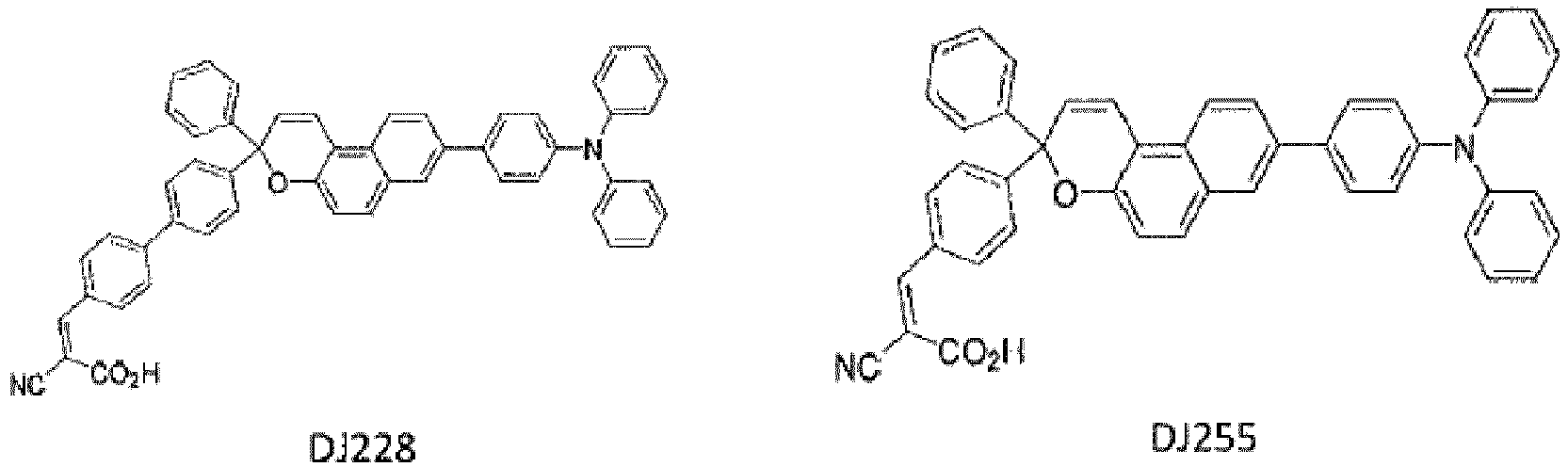
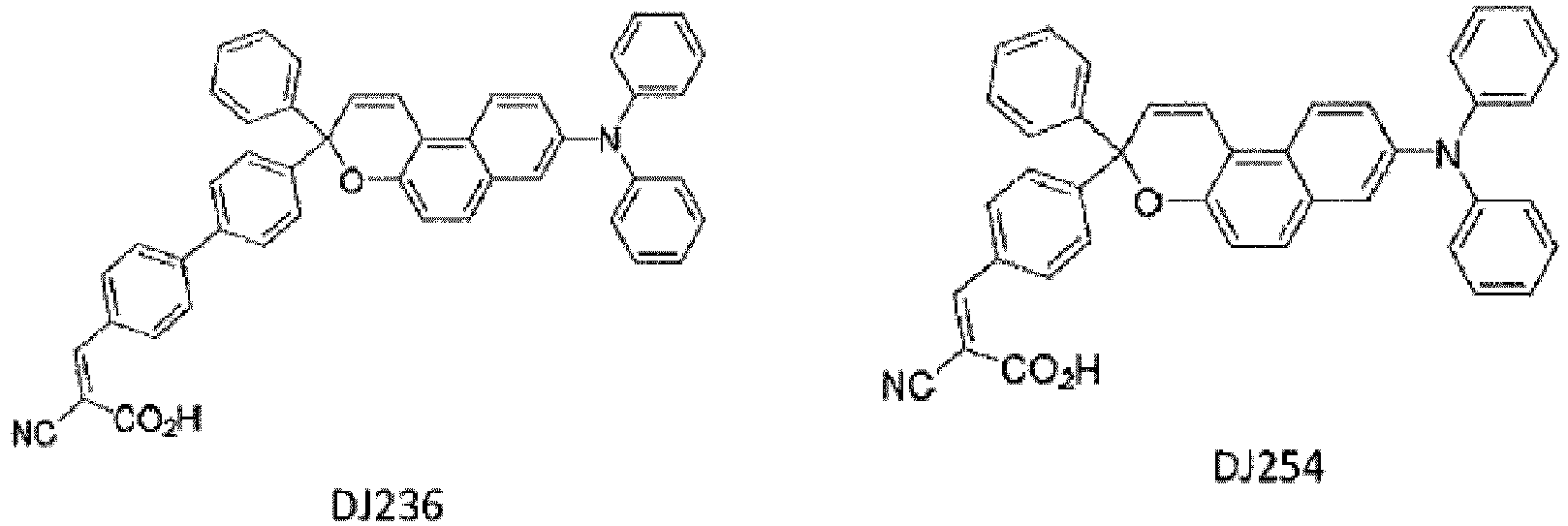

- Colorant organique présentant la formule (VIII) suivante :
 - les radicaux Rg et R10 sont tels que définis dans la revendication 2 ;- les radicaux R11 à R14 sont tels que définis dans la revendication 3 ;- X représente C(R26) ou N ;- les radicaux R15 et R16, identiques ou différents, représentent un hydrogène, un halogène, un groupe cyano (-CN), un groupe nitro (-NO2), un groupe alkyle éventuellement substitué, un groupe aryle éventuellement substitué, un groupe alkylaryle éventuellement substitué ou un groupe arylalkyle éventuellement substitué ; les radicaux R15 et R16 peuvent former ensemble un groupe =O ou =C(R24)(R25), les radicaux R24 et R25, identiques ou différents, représentant un hydrogène, un halogène, un groupe cyano (-CN), un groupe nitro (-NO2), un groupe alkyle éventuellement substitué, un groupe aryle éventuellement substitué, un groupe alkylaryle éventuellement substitué ou un groupe arylalkyle éventuellement substitué ;- les radicaux R19 à R21, identiques ou différents, représentent un hydrogène, un halogène, un groupe cyano (-CN), un groupe nitro (-NO2), un groupe alkyle éventuellement substitué, un groupe aryle éventuellement substitué, un groupe alkylaryle éventuellement substitué, un groupe arylalkyle éventuellement substitué, un segment -eD ou un segment -L-A ;- le radical R26 représente un hydrogène, un halogène, un groupe cyano (-CN), un groupe nitro (-NO2), un groupe alkyle éventuellement substitué, un groupe aryle éventuellement substitué, un groupe alkylaryle éventuellement substitué ou un groupe arylalkyle éventuellement substitué ;dans laquellesoit le radical Rg et/ou le radical R10 est/sont un segment -eD ou est/sont substitué(s) par un segment -eD et au moins un élément choisi dans le groupe consistant en le radical R11, le radical R12, le radical R13, le radical R14, le cycle aromatique ou hétéroaromatique formé par les radicaux R11 et R12 avec les carbones auxquels ils sont liés, le cycle aromatique ou hétéroaromatique formé par les radicaux R13 et R14 avec les carbones auxquels ils sont liés, le radical R15, le radical R16, le radical R19, le radical R20, le radical R21, le radical R24 et le radical R25 est un segment -L-A ou est substitué par un segment -L-A ;soit le radical Rg et/ou le radical R10 est/sont un segment -L-A ou est/sont substitué(s) par un segment -L-A et au moins un élément choisi dans le groupe consistant en le radical R11, le radical R12, le radical R13, le radical R14, le cycle aromatique ou hétéroaromatique formé par les radicaux R11 et R12 avec les carbones auxquels ils sont liés, le cycle aromatique ou hétéroaromatique formé par les radicaux R13 et R14 avec les carbones auxquels ils sont liés, le radical R15, le radical R16, le radical R19, le radical R20, le radical R21, le radical R24 et le radical R25 est un segment -eD ou est substitué par un segment -eD ;un segment -eD et un segment -L-A étant tels que définis dans la revendication 1,et où ledit espaceur -L- est de préférence une fonction à conjugaison pi telle qu'une chaîne alcénylène ou alcynylène éventuellement substituée ou une chaîne arylène éventuellement substituée.
 - Colorant organique selon la revendications 6, dans lequel ledit colorant organique est choisi parmi les composés suivants :


- Colorant organique présentant la formule (X) suivante :
 - les radicaux Rg et R10 sont tels que définis dans la revendication 2 ;- les radicaux R11 à R14 sont tels que définis dans la revendication 3 ;- les radicaux R15 et R16 sont tels que définis dans la revendication 6 ;- Y représente C(R27)(R28), C(=O), S, Se, O, N(R29), P(R30) ou Si(R31)(R32) ;- les radicaux R22 et R23, identiques ou différents, représentent un hydrogène, un halogène, un groupe cyano (-CN), un groupe nitro (-NO2), un groupe alkyle éventuellement substitué, un groupe aryle éventuellement substitué, un groupe alkylaryle éventuellement substitué, un groupe arylalkyle éventuellement substitué, un segment -eD ou un segment -L-A ;- les radicaux R27 à R32, identiques ou différents, représentent un hydrogène, un groupe alkyle éventuellement substitué, un groupe aryle éventuellement substitué, un groupe alkylaryle éventuellement substitué ou un groupe arylalkyle éventuellement substitué ;dans laquellesoit le radical Rg et/ou le radical R10 est/sont un segment -eD ou est/sont substitué(s) par un segment -eD et au moins un élément choisi dans le groupe consistant en le radical R11, le radical R12, le radical R13, le radical R14, le cycle aromatique ou hétéroaromatique formé par les radicaux R11 et R12 avec les carbones auxquels ils sont liés, le cycle aromatique ou hétéroaromatique formé par les radicaux R13 et R14 avec les carbones auxquels ils sont liés, le radical R15, le radical R16, le radical R22, le radical R23, le radical R24 et le radical R25 est un segment -L-A ou est substitué par un segment -L-A ;soit le radical Rg et/ou le radical R10 est/sont un segment -L-A ou est/sont substitué(s) par un segment -L-A et au moins un élément choisi dans le groupe consistant en le radical R11, le radical R12, le radical R13, le radical R14, le cycle aromatique ou hétéroaromatique formé par les radicaux R11 et R12 avec les carbones auxquels ils sont liés, le cycle aromatique ou hétéroaromatique formé par les radicaux R13 et R14 avec les carbones auxquels ils sont liés, le radical R15, le radical R16, le radical R22, le radical R23, le radical R24 et le radical R25 est un segment -eD ou est substitué par un segment -eD ;un segment -eD et un segment -L-A étant tels que définis dans la revendication 1,et où ledit espaceur -L- est de préférence une fonction à conjugaison pi telle qu'une chaîne alcénylène ou alcynylène éventuellement substituée ou une chaîne arylène éventuellement substituée.
 - Utilisation d'un colorant organique tel que défini dans l'une quelconque des revendications 1 à 8, comme photosensibilisateur dans un dispositif photovoltaïque.
- Dispositif photovoltaïque ayant une couche d'oxyde métallique semi-conducteur nanostructurée sensibilisée par un colorant organique tel que défini dans l'une quelconque des revendications 1 à 8.
- Dispositif photovoltaïque selon la revendication 10, dans lequel ledit dispositif photovoltaïque comprend en plus deux électrodes, appelées anode et contre-électrode, et séparées l'une de l'autre par un électrolyte et éventuellement des entretoises en polymère.
- Dispositif photovoltaïque selon la revendication 10 ou 11, dans lequel ledit oxyde de métal semi-conducteur est un oxyde métallique binaire, tertiaire ou quaternaire.
- Dispositif photovoltaïque selon l'une quelconque des revendications 10 à 12, dans lequel ladite couche d'oxyde métallique semi-conducteur nanostructurée sous la forme d'une couche mésoporeuse est déposée sur ladite anode.
- Dispositif photovoltaïque selon l'une quelconque des revendications 11 à 13, dans lequel ledit électrolyte est un liquide, un liquide ionique, un gel ou un solide.
Applications Claiming Priority (2)
| Application Number | Priority Date | Filing Date | Title |
|---|---|---|---|
| EP17305597.1A EP3406691A1 (fr) | 2017-05-22 | 2017-05-22 | Colorant photochromique organique et ses utilisations pour des cellules solaires sensibilisées par colorant |
| PCT/EP2018/063208 WO2018215371A1 (fr) | 2017-05-22 | 2018-05-18 | Colorant photochromique organique et ses utilisations pour des cellules solaires à colorant |
Publications (2)
| Publication Number | Publication Date |
|---|---|
| EP3609976A1 EP3609976A1 (fr) | 2020-02-19 |
| EP3609976B1 true EP3609976B1 (fr) | 2022-08-24 |
Family
ID=59034665
Family Applications (2)
| Application Number | Title | Priority Date | Filing Date |
|---|---|---|---|
| EP17305597.1A Withdrawn EP3406691A1 (fr) | 2017-05-22 | 2017-05-22 | Colorant photochromique organique et ses utilisations pour des cellules solaires sensibilisées par colorant |
| EP18724574.1A Active EP3609976B1 (fr) | 2017-05-22 | 2018-05-18 | Colorant photochromique organique et ses utilisations pour des cellules solaires sensibilisées par colorant |
Family Applications Before (1)
| Application Number | Title | Priority Date | Filing Date |
|---|---|---|---|
| EP17305597.1A Withdrawn EP3406691A1 (fr) | 2017-05-22 | 2017-05-22 | Colorant photochromique organique et ses utilisations pour des cellules solaires sensibilisées par colorant |
Country Status (5)
| Country | Link |
|---|---|
| US (1) | US11248123B2 (fr) |
| EP (2) | EP3406691A1 (fr) |
| KR (1) | KR102673672B1 (fr) |
| CN (1) | CN110678532B (fr) |
| WO (1) | WO2018215371A1 (fr) |
Families Citing this family (6)
| Publication number | Priority date | Publication date | Assignee | Title |
|---|---|---|---|---|
| KR102145663B1 (ko) * | 2017-06-30 | 2020-08-19 | 주식회사 엘지화학 | 헤테로고리 화합물 및 이를 포함하는 유기 발광 소자 |
| EP4023444B1 (fr) | 2020-12-30 | 2024-09-18 | Dover Europe Sàrl | Procédé de nettoyage pour le circuit hydraulique d'une imprimante à jet d'encre |
| CN113582886A (zh) * | 2021-09-01 | 2021-11-02 | 临沂大学 | 一种五取代3-亚烯基环戊烯类衍生物及其合成方法和应用 |
| CN115073412B (zh) * | 2022-07-08 | 2024-05-07 | 天津孚信阳光科技有限公司 | 荧光基团修饰的茚稠环萘并吡喃光致变色化合物及其制备方法与应用 |
| WO2025028365A1 (fr) * | 2023-08-02 | 2025-02-06 | 株式会社トクヤマ | Composé photochromique, dérivé de phénol, composition durcissable, article optique, lentille et lunette |
| CN118702667B (zh) * | 2024-06-05 | 2025-09-30 | 重庆蕾明视光科技有限公司 | 光致变色染料化合物及其在红绿色盲矫正隐形眼镜中的应用 |
Family Cites Families (10)
| Publication number | Priority date | Publication date | Assignee | Title |
|---|---|---|---|---|
| JP4157239B2 (ja) * | 1999-10-19 | 2008-10-01 | 株式会社トクヤマ | クロメン化合物 |
| JP4157245B2 (ja) | 2000-02-21 | 2008-10-01 | 株式会社トクヤマ | クロメン化合物 |
| US20060228557A1 (en) * | 2005-04-08 | 2006-10-12 | Beon-Kyu Kim | Photochromic materials having extended pi-conjugated systems and compositions and articles including the same |
| US20060226402A1 (en) * | 2005-04-08 | 2006-10-12 | Beon-Kyu Kim | Ophthalmic devices comprising photochromic materials having extended PI-conjugated systems |
| AU2007277518A1 (en) | 2006-07-28 | 2008-01-31 | Lg Electronics Inc. | Multiple laundry treating machine |
| EP2098520B1 (fr) * | 2008-03-05 | 2013-07-03 | Essilor International (Compagnie Générale D'Optique) | Naphtopyranes dichroïques photochromiques et articles optiques les contenant |
| EP2253031B1 (fr) | 2008-03-07 | 2012-10-17 | Basf Se | Cellule solaire sensibilisee par un colorant |
| US8217188B2 (en) * | 2008-08-27 | 2012-07-10 | Corning Incorporated | 2H-chromenes annelated at C5-C6 and methods of making and using thereof |
| CN101735638A (zh) * | 2008-11-25 | 2010-06-16 | 乐金显示有限公司 | 用于染料敏化太阳能电池的染料以及包括其的太阳能电池 |
| ITMI20131621A1 (it) * | 2013-10-01 | 2015-04-02 | Cnrs Ct Nat De La Rech He Scient | Colorante organico per una cella solare sensibilizzata con colorante |
-
2017
- 2017-05-22 EP EP17305597.1A patent/EP3406691A1/fr not_active Withdrawn
-
2018
- 2018-05-18 EP EP18724574.1A patent/EP3609976B1/fr active Active
- 2018-05-18 CN CN201880033677.1A patent/CN110678532B/zh active Active
- 2018-05-18 WO PCT/EP2018/063208 patent/WO2018215371A1/fr not_active Ceased
- 2018-05-18 US US16/612,538 patent/US11248123B2/en active Active
- 2018-05-18 KR KR1020197034207A patent/KR102673672B1/ko active Active
Also Published As
| Publication number | Publication date |
|---|---|
| CN110678532B (zh) | 2023-11-03 |
| EP3406691A1 (fr) | 2018-11-28 |
| CN110678532A (zh) | 2020-01-10 |
| WO2018215371A1 (fr) | 2018-11-29 |
| KR102673672B1 (ko) | 2024-06-12 |
| US11248123B2 (en) | 2022-02-15 |
| EP3609976A1 (fr) | 2020-02-19 |
| KR20200010260A (ko) | 2020-01-30 |
| US20200207991A1 (en) | 2020-07-02 |
Similar Documents
| Publication | Publication Date | Title |
|---|---|---|
| EP3609976B1 (fr) | Colorant photochromique organique et ses utilisations pour des cellules solaires sensibilisées par colorant | |
| He et al. | New Bithiazole‐Based Sensitizers for Efficient and Stable Dye‐Sensitized Solar Cells | |
| Mao et al. | Benzotriazole‐bridged sensitizers containing a furan moiety for dye‐sensitized solar cells with high open‐circuit voltage performance | |
| Mao et al. | Highly efficient light-harvesting boradiazaindacene sensitizers for dye-sensitized solar cells featuring phenothiazine donor antenna | |
| Zhang et al. | Triphenylamine-based dyes for dye-sensitized solar cells | |
| Yang et al. | Efficient and stable organic DSSC sensitizers bearing quinacridone and furan moieties as a planar π-spacer | |
| Baik et al. | Synthesis and photovoltaic properties of novel organic sensitizers containing indolo [1, 2-f] phenanthridine for solar cell | |
| Cheng et al. | Organic dyes incorporating the cyclopentadithiophene moiety for efficient dye-sensitized solar cells | |
| Shi et al. | New efficient dyes containing tert-butyl in donor for dye-sensitized solar cells | |
| Yang et al. | Phenothiazine derivatives-based D–π–A and D–A–π–A organic dyes for dye-sensitized solar cells | |
| Chaurasia et al. | Synthesis, optical and electrochemical properties of pyridal [2, 1, 3] thiadiazole based organic dyes for dye sensitized solar cells | |
| Martins et al. | Styryl and phenylethynyl based coumarin chromophores for dye sensitized solar cells | |
| Ci et al. | Influence of the benzo [d] thiazole-derived π-bridges on the optical and photovoltaic performance of D–π–A dyes | |
| Mao et al. | Molecular engineering of DA-π-A dyes with 2-(1, 1-dicyanomethylene) rhodanine as an electron-accepting and anchoring group for dye-sensitized solar cells | |
| KR102062929B1 (ko) | 유기 염료 및 광전지에서의 이의 이용 | |
| Chiu et al. | A new series of azobenzene-bridged metal-free organic dyes and application on DSSC | |
| Duerto et al. | DSSCs based on aniline derivatives functionalized with a tert-butyldimethylsilyl group and the effect of the π-spacer | |
| Baldoli et al. | Benzodithiophene based organic dyes for DSSC: Effect of alkyl chain substitution on dye efficiency | |
| Tejada et al. | Novel 4H-pyranylidene organic dyes for dye-sensitized solar cells: effect of different heteroaromatic rings on the photovoltaic properties | |
| Lee et al. | Functionalized organic dyes containing a phenanthroimidazole donor for dye-sensitized solar cell applications | |
| Jia et al. | New D–π–A dyes incorporating dithieno [3, 2-b: 2′, 3′-d] pyrrole (DTP)-based π-spacers for efficient dye-sensitized solar cells | |
| Miu et al. | Insight into the positional effect of bulky rigid substituents in organic sensitizers on the performance of dye-sensitized solar cells | |
| Tamilavan et al. | Synthesis of triphenylamine-based thiophene-(N-aryl) pyrrole-thiophene dyes for dye-sensitized solar cell applications | |
| KR101082086B1 (ko) | 염료 감응 태양전지용 염료 및 이를 함유하는 태양전지 | |
| Wang et al. | Influence of the donor size in panchromatic D–π-A–π-A dyes bearing 5-phenyl-5H-dibenzo-[b, f] azepine units for dye-sensitized solar cells |
Legal Events
| Date | Code | Title | Description |
|---|---|---|---|
| STAA | Information on the status of an ep patent application or granted ep patent |
Free format text: STATUS: UNKNOWN |
|
| STAA | Information on the status of an ep patent application or granted ep patent |
Free format text: STATUS: THE INTERNATIONAL PUBLICATION HAS BEEN MADE |
|
| PUAI | Public reference made under article 153(3) epc to a published international application that has entered the european phase |
Free format text: ORIGINAL CODE: 0009012 |
|
| STAA | Information on the status of an ep patent application or granted ep patent |
Free format text: STATUS: REQUEST FOR EXAMINATION WAS MADE |
|
| 17P | Request for examination filed |
Effective date: 20191113 |
|
| AK | Designated contracting states |
Kind code of ref document: A1 Designated state(s): AL AT BE BG CH CY CZ DE DK EE ES FI FR GB GR HR HU IE IS IT LI LT LU LV MC MK MT NL NO PL PT RO RS SE SI SK SM TR |
|
| AX | Request for extension of the european patent |
Extension state: BA ME |
|
| DAV | Request for validation of the european patent (deleted) | ||
| DAX | Request for extension of the european patent (deleted) | ||
| STAA | Information on the status of an ep patent application or granted ep patent |
Free format text: STATUS: EXAMINATION IS IN PROGRESS |
|
| 17Q | First examination report despatched |
Effective date: 20200828 |
|
| GRAP | Despatch of communication of intention to grant a patent |
Free format text: ORIGINAL CODE: EPIDOSNIGR1 |
|
| STAA | Information on the status of an ep patent application or granted ep patent |
Free format text: STATUS: GRANT OF PATENT IS INTENDED |
|
| INTG | Intention to grant announced |
Effective date: 20220323 |
|
| RIN1 | Information on inventor provided before grant (corrected) |
Inventor name: DEMADRILLE, RENAUD Inventor name: KERVELLA, YANN Inventor name: JOLY, DAMIEN |
|
| GRAS | Grant fee paid |
Free format text: ORIGINAL CODE: EPIDOSNIGR3 |
|
| GRAA | (expected) grant |
Free format text: ORIGINAL CODE: 0009210 |
|
| STAA | Information on the status of an ep patent application or granted ep patent |
Free format text: STATUS: THE PATENT HAS BEEN GRANTED |
|
| AK | Designated contracting states |
Kind code of ref document: B1 Designated state(s): AL AT BE BG CH CY CZ DE DK EE ES FI FR GB GR HR HU IE IS IT LI LT LU LV MC MK MT NL NO PL PT RO RS SE SI SK SM TR |
|
| REG | Reference to a national code |
Ref country code: CH Ref legal event code: EP |
|
| REG | Reference to a national code |
Ref country code: DE Ref legal event code: R096 Ref document number: 602018039689 Country of ref document: DE |
|
| REG | Reference to a national code |
Ref country code: IE Ref legal event code: FG4D |
|
| REG | Reference to a national code |
Ref country code: AT Ref legal event code: REF Ref document number: 1513653 Country of ref document: AT Kind code of ref document: T Effective date: 20220915 |
|
| REG | Reference to a national code |
Ref country code: LT Ref legal event code: MG9D |
|
| REG | Reference to a national code |
Ref country code: NL Ref legal event code: MP Effective date: 20220824 |
|
| PG25 | Lapsed in a contracting state [announced via postgrant information from national office to epo] |
Ref country code: SE Free format text: LAPSE BECAUSE OF FAILURE TO SUBMIT A TRANSLATION OF THE DESCRIPTION OR TO PAY THE FEE WITHIN THE PRESCRIBED TIME-LIMIT Effective date: 20220824 Ref country code: RS Free format text: LAPSE BECAUSE OF FAILURE TO SUBMIT A TRANSLATION OF THE DESCRIPTION OR TO PAY THE FEE WITHIN THE PRESCRIBED TIME-LIMIT Effective date: 20220824 Ref country code: PT Free format text: LAPSE BECAUSE OF FAILURE TO SUBMIT A TRANSLATION OF THE DESCRIPTION OR TO PAY THE FEE WITHIN THE PRESCRIBED TIME-LIMIT Effective date: 20221226 Ref country code: NO Free format text: LAPSE BECAUSE OF FAILURE TO SUBMIT A TRANSLATION OF THE DESCRIPTION OR TO PAY THE FEE WITHIN THE PRESCRIBED TIME-LIMIT Effective date: 20221124 Ref country code: NL Free format text: LAPSE BECAUSE OF FAILURE TO SUBMIT A TRANSLATION OF THE DESCRIPTION OR TO PAY THE FEE WITHIN THE PRESCRIBED TIME-LIMIT Effective date: 20220824 Ref country code: LV Free format text: LAPSE BECAUSE OF FAILURE TO SUBMIT A TRANSLATION OF THE DESCRIPTION OR TO PAY THE FEE WITHIN THE PRESCRIBED TIME-LIMIT Effective date: 20220824 Ref country code: LT Free format text: LAPSE BECAUSE OF FAILURE TO SUBMIT A TRANSLATION OF THE DESCRIPTION OR TO PAY THE FEE WITHIN THE PRESCRIBED TIME-LIMIT Effective date: 20220824 Ref country code: FI Free format text: LAPSE BECAUSE OF FAILURE TO SUBMIT A TRANSLATION OF THE DESCRIPTION OR TO PAY THE FEE WITHIN THE PRESCRIBED TIME-LIMIT Effective date: 20220824 |
|
| REG | Reference to a national code |
Ref country code: AT Ref legal event code: MK05 Ref document number: 1513653 Country of ref document: AT Kind code of ref document: T Effective date: 20220824 |
|
| PG25 | Lapsed in a contracting state [announced via postgrant information from national office to epo] |
Ref country code: PL Free format text: LAPSE BECAUSE OF FAILURE TO SUBMIT A TRANSLATION OF THE DESCRIPTION OR TO PAY THE FEE WITHIN THE PRESCRIBED TIME-LIMIT Effective date: 20220824 Ref country code: IS Free format text: LAPSE BECAUSE OF FAILURE TO SUBMIT A TRANSLATION OF THE DESCRIPTION OR TO PAY THE FEE WITHIN THE PRESCRIBED TIME-LIMIT Effective date: 20221224 Ref country code: HR Free format text: LAPSE BECAUSE OF FAILURE TO SUBMIT A TRANSLATION OF THE DESCRIPTION OR TO PAY THE FEE WITHIN THE PRESCRIBED TIME-LIMIT Effective date: 20220824 Ref country code: GR Free format text: LAPSE BECAUSE OF FAILURE TO SUBMIT A TRANSLATION OF THE DESCRIPTION OR TO PAY THE FEE WITHIN THE PRESCRIBED TIME-LIMIT Effective date: 20221125 |
|
| PG25 | Lapsed in a contracting state [announced via postgrant information from national office to epo] |
Ref country code: SM Free format text: LAPSE BECAUSE OF FAILURE TO SUBMIT A TRANSLATION OF THE DESCRIPTION OR TO PAY THE FEE WITHIN THE PRESCRIBED TIME-LIMIT Effective date: 20220824 Ref country code: RO Free format text: LAPSE BECAUSE OF FAILURE TO SUBMIT A TRANSLATION OF THE DESCRIPTION OR TO PAY THE FEE WITHIN THE PRESCRIBED TIME-LIMIT Effective date: 20220824 Ref country code: ES Free format text: LAPSE BECAUSE OF FAILURE TO SUBMIT A TRANSLATION OF THE DESCRIPTION OR TO PAY THE FEE WITHIN THE PRESCRIBED TIME-LIMIT Effective date: 20220824 Ref country code: DK Free format text: LAPSE BECAUSE OF FAILURE TO SUBMIT A TRANSLATION OF THE DESCRIPTION OR TO PAY THE FEE WITHIN THE PRESCRIBED TIME-LIMIT Effective date: 20220824 Ref country code: CZ Free format text: LAPSE BECAUSE OF FAILURE TO SUBMIT A TRANSLATION OF THE DESCRIPTION OR TO PAY THE FEE WITHIN THE PRESCRIBED TIME-LIMIT Effective date: 20220824 Ref country code: AT Free format text: LAPSE BECAUSE OF FAILURE TO SUBMIT A TRANSLATION OF THE DESCRIPTION OR TO PAY THE FEE WITHIN THE PRESCRIBED TIME-LIMIT Effective date: 20220824 |
|
| REG | Reference to a national code |
Ref country code: DE Ref legal event code: R097 Ref document number: 602018039689 Country of ref document: DE |
|
| PG25 | Lapsed in a contracting state [announced via postgrant information from national office to epo] |
Ref country code: SK Free format text: LAPSE BECAUSE OF FAILURE TO SUBMIT A TRANSLATION OF THE DESCRIPTION OR TO PAY THE FEE WITHIN THE PRESCRIBED TIME-LIMIT Effective date: 20220824 Ref country code: EE Free format text: LAPSE BECAUSE OF FAILURE TO SUBMIT A TRANSLATION OF THE DESCRIPTION OR TO PAY THE FEE WITHIN THE PRESCRIBED TIME-LIMIT Effective date: 20220824 |
|
| PG25 | Lapsed in a contracting state [announced via postgrant information from national office to epo] |
Ref country code: AL Free format text: LAPSE BECAUSE OF FAILURE TO SUBMIT A TRANSLATION OF THE DESCRIPTION OR TO PAY THE FEE WITHIN THE PRESCRIBED TIME-LIMIT Effective date: 20220824 |
|
| PLBE | No opposition filed within time limit |
Free format text: ORIGINAL CODE: 0009261 |
|
| STAA | Information on the status of an ep patent application or granted ep patent |
Free format text: STATUS: NO OPPOSITION FILED WITHIN TIME LIMIT |
|
| 26N | No opposition filed |
Effective date: 20230525 |
|
| PG25 | Lapsed in a contracting state [announced via postgrant information from national office to epo] |
Ref country code: SI Free format text: LAPSE BECAUSE OF FAILURE TO SUBMIT A TRANSLATION OF THE DESCRIPTION OR TO PAY THE FEE WITHIN THE PRESCRIBED TIME-LIMIT Effective date: 20220824 |
|
| PG25 | Lapsed in a contracting state [announced via postgrant information from national office to epo] |
Ref country code: MC Free format text: LAPSE BECAUSE OF FAILURE TO SUBMIT A TRANSLATION OF THE DESCRIPTION OR TO PAY THE FEE WITHIN THE PRESCRIBED TIME-LIMIT Effective date: 20220824 |
|
| REG | Reference to a national code |
Ref country code: BE Ref legal event code: MM Effective date: 20230531 |
|
| PG25 | Lapsed in a contracting state [announced via postgrant information from national office to epo] |
Ref country code: MC Free format text: LAPSE BECAUSE OF FAILURE TO SUBMIT A TRANSLATION OF THE DESCRIPTION OR TO PAY THE FEE WITHIN THE PRESCRIBED TIME-LIMIT Effective date: 20220824 Ref country code: LU Free format text: LAPSE BECAUSE OF NON-PAYMENT OF DUE FEES Effective date: 20230518 |
|
| REG | Reference to a national code |
Ref country code: IE Ref legal event code: MM4A |
|
| PG25 | Lapsed in a contracting state [announced via postgrant information from national office to epo] |
Ref country code: IE Free format text: LAPSE BECAUSE OF NON-PAYMENT OF DUE FEES Effective date: 20230518 |
|
| PG25 | Lapsed in a contracting state [announced via postgrant information from national office to epo] |
Ref country code: IE Free format text: LAPSE BECAUSE OF NON-PAYMENT OF DUE FEES Effective date: 20230518 |
|
| PG25 | Lapsed in a contracting state [announced via postgrant information from national office to epo] |
Ref country code: BE Free format text: LAPSE BECAUSE OF NON-PAYMENT OF DUE FEES Effective date: 20230531 |
|
| PG25 | Lapsed in a contracting state [announced via postgrant information from national office to epo] |
Ref country code: BG Free format text: LAPSE BECAUSE OF FAILURE TO SUBMIT A TRANSLATION OF THE DESCRIPTION OR TO PAY THE FEE WITHIN THE PRESCRIBED TIME-LIMIT Effective date: 20220824 |
|
| PG25 | Lapsed in a contracting state [announced via postgrant information from national office to epo] |
Ref country code: BG Free format text: LAPSE BECAUSE OF FAILURE TO SUBMIT A TRANSLATION OF THE DESCRIPTION OR TO PAY THE FEE WITHIN THE PRESCRIBED TIME-LIMIT Effective date: 20220824 |
|
| PGFP | Annual fee paid to national office [announced via postgrant information from national office to epo] |
Ref country code: DE Payment date: 20250519 Year of fee payment: 8 |
|
| PGFP | Annual fee paid to national office [announced via postgrant information from national office to epo] |
Ref country code: GB Payment date: 20250527 Year of fee payment: 8 |
|
| PGFP | Annual fee paid to national office [announced via postgrant information from national office to epo] |
Ref country code: IT Payment date: 20250530 Year of fee payment: 8 |
|
| PGFP | Annual fee paid to national office [announced via postgrant information from national office to epo] |
Ref country code: FR Payment date: 20250526 Year of fee payment: 8 |
|
| PGFP | Annual fee paid to national office [announced via postgrant information from national office to epo] |
Ref country code: CH Payment date: 20250601 Year of fee payment: 8 |
|
| PG25 | Lapsed in a contracting state [announced via postgrant information from national office to epo] |
Ref country code: CY Free format text: LAPSE BECAUSE OF FAILURE TO SUBMIT A TRANSLATION OF THE DESCRIPTION OR TO PAY THE FEE WITHIN THE PRESCRIBED TIME-LIMIT; INVALID AB INITIO Effective date: 20180518 |
|
| PG25 | Lapsed in a contracting state [announced via postgrant information from national office to epo] |
Ref country code: HU Free format text: LAPSE BECAUSE OF FAILURE TO SUBMIT A TRANSLATION OF THE DESCRIPTION OR TO PAY THE FEE WITHIN THE PRESCRIBED TIME-LIMIT; INVALID AB INITIO Effective date: 20180518 |
|
| PG25 | Lapsed in a contracting state [announced via postgrant information from national office to epo] |
Ref country code: TR Free format text: LAPSE BECAUSE OF FAILURE TO SUBMIT A TRANSLATION OF THE DESCRIPTION OR TO PAY THE FEE WITHIN THE PRESCRIBED TIME-LIMIT Effective date: 20220824 |