EP3610256B1 - Évaluation et atténuation de risque de cire à l'aide d'une analyse de données avancée et d'une modélisation de flux de tuyau - Google Patents
Évaluation et atténuation de risque de cire à l'aide d'une analyse de données avancée et d'une modélisation de flux de tuyau Download PDFInfo
- Publication number
- EP3610256B1 EP3610256B1 EP17905080.2A EP17905080A EP3610256B1 EP 3610256 B1 EP3610256 B1 EP 3610256B1 EP 17905080 A EP17905080 A EP 17905080A EP 3610256 B1 EP3610256 B1 EP 3610256B1
- Authority
- EP
- European Patent Office
- Prior art keywords
- wax
- hydrocarbon
- sample
- risks
- analysis
- Prior art date
- Legal status (The legal status is an assumption and is not a legal conclusion. Google has not performed a legal analysis and makes no representation as to the accuracy of the status listed.)
- Active
Links
Images






Classifications
-
- G—PHYSICS
- G01—MEASURING; TESTING
- G01N—INVESTIGATING OR ANALYSING MATERIALS BY DETERMINING THEIR CHEMICAL OR PHYSICAL PROPERTIES
- G01N33/00—Investigating or analysing materials by specific methods not covered by groups G01N1/00 - G01N31/00
- G01N33/26—Oils; Viscous liquids; Paints; Inks
- G01N33/28—Oils, i.e. hydrocarbon liquids
-
- G—PHYSICS
- G01—MEASURING; TESTING
- G01N—INVESTIGATING OR ANALYSING MATERIALS BY DETERMINING THEIR CHEMICAL OR PHYSICAL PROPERTIES
- G01N33/00—Investigating or analysing materials by specific methods not covered by groups G01N1/00 - G01N31/00
- G01N33/26—Oils; Viscous liquids; Paints; Inks
- G01N33/28—Oils, i.e. hydrocarbon liquids
- G01N33/2835—Specific substances contained in the oils or fuels
-
- C—CHEMISTRY; METALLURGY
- C10—PETROLEUM, GAS OR COKE INDUSTRIES; TECHNICAL GASES CONTAINING CARBON MONOXIDE; FUELS; LUBRICANTS; PEAT
- C10G—CRACKING HYDROCARBON OILS; PRODUCTION OF LIQUID HYDROCARBON MIXTURES, e.g. BY DESTRUCTIVE HYDROGENATION, OLIGOMERISATION, POLYMERISATION; RECOVERY OF HYDROCARBON OILS FROM OIL-SHALE, OIL-SAND, OR GASES; REFINING MIXTURES MAINLY CONSISTING OF HYDROCARBONS; REFORMING OF NAPHTHA; MINERAL WAXES
- C10G31/00—Refining of hydrocarbon oils, in the absence of hydrogen, by methods not otherwise provided for
-
- C—CHEMISTRY; METALLURGY
- C10—PETROLEUM, GAS OR COKE INDUSTRIES; TECHNICAL GASES CONTAINING CARBON MONOXIDE; FUELS; LUBRICANTS; PEAT
- C10G—CRACKING HYDROCARBON OILS; PRODUCTION OF LIQUID HYDROCARBON MIXTURES, e.g. BY DESTRUCTIVE HYDROGENATION, OLIGOMERISATION, POLYMERISATION; RECOVERY OF HYDROCARBON OILS FROM OIL-SHALE, OIL-SAND, OR GASES; REFINING MIXTURES MAINLY CONSISTING OF HYDROCARBONS; REFORMING OF NAPHTHA; MINERAL WAXES
- C10G75/00—Inhibiting corrosion or fouling in apparatus for treatment or conversion of hydrocarbon oils, in general
-
- C—CHEMISTRY; METALLURGY
- C10—PETROLEUM, GAS OR COKE INDUSTRIES; TECHNICAL GASES CONTAINING CARBON MONOXIDE; FUELS; LUBRICANTS; PEAT
- C10G—CRACKING HYDROCARBON OILS; PRODUCTION OF LIQUID HYDROCARBON MIXTURES, e.g. BY DESTRUCTIVE HYDROGENATION, OLIGOMERISATION, POLYMERISATION; RECOVERY OF HYDROCARBON OILS FROM OIL-SHALE, OIL-SAND, OR GASES; REFINING MIXTURES MAINLY CONSISTING OF HYDROCARBONS; REFORMING OF NAPHTHA; MINERAL WAXES
- C10G75/00—Inhibiting corrosion or fouling in apparatus for treatment or conversion of hydrocarbon oils, in general
- C10G75/02—Inhibiting corrosion or fouling in apparatus for treatment or conversion of hydrocarbon oils, in general by addition of corrosion inhibitors
-
- C—CHEMISTRY; METALLURGY
- C10—PETROLEUM, GAS OR COKE INDUSTRIES; TECHNICAL GASES CONTAINING CARBON MONOXIDE; FUELS; LUBRICANTS; PEAT
- C10G—CRACKING HYDROCARBON OILS; PRODUCTION OF LIQUID HYDROCARBON MIXTURES, e.g. BY DESTRUCTIVE HYDROGENATION, OLIGOMERISATION, POLYMERISATION; RECOVERY OF HYDROCARBON OILS FROM OIL-SHALE, OIL-SAND, OR GASES; REFINING MIXTURES MAINLY CONSISTING OF HYDROCARBONS; REFORMING OF NAPHTHA; MINERAL WAXES
- C10G75/00—Inhibiting corrosion or fouling in apparatus for treatment or conversion of hydrocarbon oils, in general
- C10G75/04—Inhibiting corrosion or fouling in apparatus for treatment or conversion of hydrocarbon oils, in general by addition of antifouling agents
-
- G—PHYSICS
- G01—MEASURING; TESTING
- G01N—INVESTIGATING OR ANALYSING MATERIALS BY DETERMINING THEIR CHEMICAL OR PHYSICAL PROPERTIES
- G01N33/00—Investigating or analysing materials by specific methods not covered by groups G01N1/00 - G01N31/00
- G01N33/26—Oils; Viscous liquids; Paints; Inks
- G01N33/28—Oils, i.e. hydrocarbon liquids
- G01N33/2835—Specific substances contained in the oils or fuels
- G01N33/2876—Total acid number
Definitions
- methods of analyzing hydrocarbon samples including methods of analyzing hydrocarbon samples to predict wax risks. More specifically, methods and systems disclosed herein provide for rapidly and easily determining wax risks of a hydrocarbon composition as well as determining the optimal wax inhibitors/dispersants/dissolvers, and thereby improving the mitigation of wax risks in hydrocarbon production, transportation, refining, and refined hydrocarbon processing and use by identifying the hydrocarbon streams presenting the risk of wax formation and/or chemical treatments for the hydrocarbon stream of interest.
- Precipitation of paraffin wax can lead to deposition of wax on well-bore tubing, oil transportation pipelines as well as during refinery processing and refined hydrocarbon production, processing, handling, storage, and use, including a tank-farm, a cold preheat train, a desalter, a hot preheat train, a crude heater/furnace, a crude distillation unit, a vacuum unit furnace, a vacuum distillation unit, and downstream processing units such a hydrotreater, a hydrocracker, fluid catalytic cracking (FCC), a visbreaker, a coker, etc.
- FCC fluid catalytic cracking
- Deposition and accumulation of a phase separated from the mobile phase in a refining operation is also known as fouling.
- the wax deposit attached to the inner walls of oil transportation pipelines require regular remediation, e.g., mechanical removal, also known as "pigging".
- a weekly pigging operation generates a typical yearly operational cost of over $30 million USD. Severe and reoccurring wax deposition can even lead to abandonment of the oil field at a cost of over $100 million USD.
- Wax deposition can also be encountered in refinery equipment. For example, crude preheat train fouling due to wax deposition decreases refining efficiency, both by requiring additional energy inputs to overcome temperature reduction and interrupting normal refinery operation for cleaning and other maintenance.
- a prediction method for the wax deposition rate based on a radial basis function neural network Ying Xie, Yu Xing, Petroleum, Volume 3, Issue 2, 2017, Pages 237-241 , is disclosed the use of a radial basis function neural network to predict the wax deposition rate by considering four main influencing factors: the pipe wall temperature gradient, pipe wall wax crystal solubility coefficient, pipe wall shear stress and crude oil viscosity, by the gray correlational analysis method.
- hydrocarbon hydrocarbon composition
- hydrocarbon sample refers to crude oil, crude oil blends, tower bottoms, gas oil/diesel fuel, naphtha, condensates, slop oil, hydrotreated oil, hydrocracked oil, and mixtures thereof.
- Wax risks of a crude oil or a blend in oil production and transportation include the tendency to deposit materials on the surface of oil production/transportation equipment, including wellbore tubing, pipelines, etc., leading to decreased cross-sectional area available for oil flow, increased pump power to maintain flow and even risk of clogging.
- Wax risks in refining processes include the tendency to deposit materials on the heat transfer surface, leading to decrease in heat transfer efficiency.
- Heat exchanger network systems are used to recover as much sensible heat as possible from process streams around the crude distillation unit (CDU) by preheating the feedstock prior to entering the furnace. The more the heat transferred to the feed in the exchangers, the less energy/fuel is required to heat the crude to the required distillation temperature range. The hottest exchangers have a direct impact on the furnace inlet temperature. Exchangers with the highest heat flux or low flow velocity usually show the highest fouling rates.
- Fouling is caused by the precipitation of materials, both organic and inorganic and including wax, present in the feed or formed during the cooling of the hydrocarbon stream.
- materials both organic and inorganic and including wax
- Fouling is caused by the precipitation of materials, both organic and inorganic and including wax, present in the feed or formed during the cooling of the hydrocarbon stream.
- the fouling potential can be expressed in more than one way, such as the loss of heat transfer (delta T, or ⁇ T), increase of pressure drop (delta P, or ⁇ P) or amount of foulant (e.g., thickness of solids, volume of foulant, or weight of foulant), since all three can reflect the amount of fouling occurring on solid surfaces in of tubing, pipeline and other production or refinery equipment. Determining wax risks and mitigating them can lower fouling potential. Determined wax risks may include one or more of wax appearance temperature (WAT), pour point (PP), wax deposition potential, and the like. Additional details regarding fouling in a refining process can be found in Patent Cooperation Treat application with the publication number WO2017100224 filed December 7,2016 .
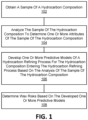
- FIG. 1 is a flowchart illustrating an exemplary method of determining wax risk and way of mitigating of a hydrocarbon composition.
- wax risks can be evaluated by measuring and/or analyzing a hydrocarbon sample and/or various portions thereof.
- the exemplary method begins by 102 obtaining a sample of the hydrocarbon composition.
- this sample is taken at any point of the oil production/transportation, refining, refined hydrocarbon production, processing, handling, storage, and use.
- the sample may be obtained from storage tanks that store the hydrocarbon composition prior to refining.
- Obtaining the sample may be a manual process, or it may involve automated mechanisms for obtaining the sample.
- the sample can be of any size.
- embodiments as disclosed herein require only a small sample size.
- the sample size may be 50 mL or less for the embodiments disclosed herein.
- the obtained sample of the hydrocarbon composition is analyzed to determine one or more attributes of the sample.
- Analyzing the sample of the hydrocarbon composition to determine one or more attributes of the sample of the hydrocarbon composition comprises performing one or more of a fingerprint analysis of the sample, a high temperature gas chromatography (HTGC) analysis of the sample, differential scanning calorimetry analysis, inductively coupled plasma mass spectrum analysis or combination of the variable analysis of the sample to determine one or more attributes of the sample. If fingerprint analysis of the sample is performed, it may involve the use of spectroscopy.
- HTGC high temperature gas chromatography
- spectroscopy may comprise one or more of infrared (IR) spectroscopy, near-infrared spectroscopy, nuclear magnetic resonance spectroscopy temperature-dependent IR spectroscopy, two-dimension (2D) IR, UV (ultraviolet) spectroscopy, mid-IR spectroscopy, and the like.
- IR infrared
- near-infrared spectroscopy nuclear magnetic resonance spectroscopy temperature-dependent IR spectroscopy
- 2D two-dimension
- UV (ultraviolet) spectroscopy mid-IR spectroscopy, and the like.
- the fingerprint analysis can be performed using IR spectroscopy, for instance as described in US6087662 .
- the fingerprint analysis can be used to measure paraffin/wax related properties such as wax appearance temperature, pour point, paraffin distribution, wax content, heavy wax content, and wax deposition potential, using multiple variable regression analysis, specifically, by:
- the fingerprint analysis may be performed at a temperature that is below the Wax Appearance Temperature (WAT) for the hydrocarbon composition under analysis.
- WAT Wax Appearance Temperature
- PP pour point
- WAT prediction may be improved by as much as ⁇ 20°C and PP prediction may improve as much as ⁇ 10°C by performing fingerprint analysis at a temperature that is below the WAT temperature for the hydrocarbon composition.
- the attributes of the hydrocarbon composition include one or more of a Total Acid Number (TAN), American Petroleum Institute gravity (API gravity), Colloid Instability Index (CII), viscosity, Wax Appearance Temperature (WAT), Pour Point (PP), SG(specific gravity); SARA: Sat(saturates), Aro(aromatic), Res(resin), Asp(asphaltene); viscosity; rheology; wax content, heavy wax content, and the like.
- the attributes are measured from the sample.
- only some (less than the total determined attributes) are measured, while other attributes are predicted based on the one or more measured attributes of the sample of the hydrocarbon composition.
- the attributes may be measured using, for example, microscopy, UV-vis spectroscopy, light scattering, acoustic resonance, and the like.
- Combination of the variable analysis comprises any possible mathematic combination of above attributes including ratios, PCAs (principal components/linear combination) etc.
- the analysis could involve single properties or multi properties, or any combination e.g. ratio, principle components.
- Principal component analysis (PCA) is a dimensionality reduction technique that was initially adopted to deal with the autocorrelation that exists between multiple crude oil properties (e.g., viscosity, API, density, boiling point, etc.) and identify the most important properties to describe the types of crude oils.
- one or more predictive models of a hydrocarbon production, transportation, refining, refined hydrocarbon production, processing, handling, storage, and use process are developed for the hydrocarbon composition being produced or transported through tubing or pipelines or the hydrocarbon composition entering the hydrocarbon refining process, and refined hydrocarbon products being produced, processed, and used.
- These one or more models are developed based at least in part on the analysis of the sample of the hydrocarbon composition.
- the models are developed using machine learning algorithms. Machine learning algorithms cover qualitative modelling (unsupervised clustering0 and quantitative modelling (supervised regression and classification).
- the machine learning algorithms can include principal component analysis (PCA), linear regression analysis, logistic regression analysis, PCA clustering; k-means clustering; SVM (support vector machine); rf (random forest); partial-least squares; neural network; Naive Bayes classifier; linear discriminant analysis; quadratic discriminant analysis; gradient boosting; boosted trees; decision trees, and the like.
- PCA principal component analysis
- SVM support vector machine
- rf random forest
- partial-least squares neural network
- Naive Bayes classifier linear discriminant analysis
- quadratic discriminant analysis gradient boosting; boosted trees; decision trees, and the like.
- These predictive models are trained by a labelled dataset containing a few crudes properties as inputs, a few wax properties and chemical performance as outputs.
- Chemical performance could be deposition inhibition rate, chemical performance level (e.g. high, medium, low), chemical recommendation, dosage recommendation, and the like.
- An example of chemical prediction model training comprises training a classification model using the complete dataset.
- the model was fitted using overall 167 experimental observations, and 3 classification labels: H, M, and L for four chemicals. It was found that accuracies ranged from ⁇ 65-85%.
- the performance of classification models is generally represented using the confusion matrix, in which the observed classes of the data are tabulated against the classes predicted from the model. The overall accuracy rate can then be used as a performance indicator, which reflects the agreement between the observed and predicted classes.
- the wax risks for the hydrocarbon sample are predicted using the developed predictive models developed in 106 based on the analysis of the hydrocarbon sample in 104. Predicting the wax risks may involve predicting one or more of wax appearance temperature (WAT), pour point (PP), wax deposition potential, wax content, heavy wax content, and the like.
- WAT wax appearance temperature
- PP pour point
- wax deposition potential wax content
- heavy wax content heavy wax content
- FIG. 2A illustrates a graph showing exemplary results for the ability of the predictive models developed in 106 to predict the WAT of crude oils and refined hydrocarbon fluids.
- the exemplary graph shows the measured WAT (x-axis) plotted against the predicted WAT (y-axis).
- the predicted WAT was predicted by the trained predictive models in 106 based on the results of IR analysis on the hydrocarbon sample performed in 104.
- FIG. 2B illustrates a graph showing exemplary results for the ability of the predictive models developed in 106 to predict the PP of crude oils and refined hydrocarbon fluids.
- the exemplary graph shows the measured PP (x-axis) plotted against the predicted PP (y-axis).
- the predicted PP was by the trained predictive models in 106 based on the results of IR analysis on the hydrocarbon sample performed in 104.
- the graph shows dashed lines showing absolute errors for +/- 5 degree C.
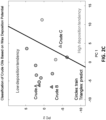
- FIG. 2C illustrates a graph showing exemplary results for the ability of the predictive models developed in 106 to predict the wax deposition potential of crude oils and refined hydrocarbon fluids.
- the exemplary graph shows three samples of crude - Crude A, Crude B, and Crude C. Measured values, used for training the predictive models are shown as circles. Predicted values are shown as triangles. High deposition tendency is shown to the right of the diagonal line and low deposition tendency is shown to the left of the diagonal line.
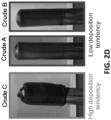
- FIG. 2D are images of the three samples from FIG. 2C . As can be seen the deposition of the sample with the high deposition tendency is greater than the deposition of the samples with the low deposition tendency.
- FIG. 2E illustrates prediction of the effect of temperature on wax deposition potential of crude oils and refined hydrocarbon fluids.
- the exemplary graph shows one sample of Crude C. Measured values, used for training the predictive models are shown as circles.
- FIG. 2F is an image of the sample in FIG. 2E that shows high tendency deposition at 25 C and low deposition tendency at 40 C.
- FIG. 2G is a graph that illustrates the exemplary results for the ability of the predicative model to predict the heavy wax content (n-C50+ wax) of oils.
- the heaviest fraction (n-C50+) of wax contained by oils is the first portion to precipitate upon cooling.
- the potential of waxy oils to cause gelation/fouling issues can be characterized by the heavy wax content.
- measured values are represented as circles and predicted values are represented as triangles.
- the oils located to the right of the solid black line have relatively low heavy wax contents, i.e., ⁇ 0.1 wt.% while examples shown on the left-side of the black line are with high heavy wax contents, i.e., > 0.1 wt.%.
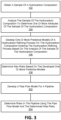
- FIG. 3 is a flowchart illustrating an exemplary alternative method of determining wax risk and way of mitigating of a hydrocarbon composition.
- the embodiments shown in FIG. 3 includes the steps 102-108, as described with reference to FIG. 1 .
- FIG. 3 further includes 302 developing a pipe flow model for a pipeline and 304 determining wax risks in the pipeline based on the pipe flow model and the wax risks determined at 108.
- developing the pipe flow model for the pipeline comprises using parameters and operating conditions of the pipeline when developing the pipe flow model. These parameters may comprise, for example, temperatures at different locations along the pipeline, both internal to the pipeline and external (ambient), flow rates, pressures, viscosity, valve positions, and the like.
- the parameters may be obtained real-time from systems and devices that constantly monitor pipeline conditions, or they may be obtained from logged and/or stored data about the operation of pipeline. Paramters and operating conditions of the pipeline comprise a combination of real-time and stored information.
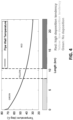
- FIG. 4 is an exemplary graph that shows the results of predicting wax deposition in a modelled pipeline based on the wax risks predicted in 108. As can be seen, the graph plots temperature (pipe wall temperature) versus length of the pipeline. As the length of the pipeline increase and the temperature of the pipe wall decrease, the wax deposition tendency increases.
- FIG. 5 is a flowchart illustrating yet another exemplary alternative method of determining wax risk and way of mitigating of a hydrocarbon composition.
- the embodiments shown in FIG. 3 includes the steps 102-108, as described with reference to FIG. 1 .
- FIG. 5 further includes the step of 502 determining chemical additives to mitigate the determined wax risks.
- determining chemical additives to mitigate the determined wax risks comprises selecting one or more chemical additives based on matching precipitation characteristics between the one or more chemical additives and wax in the hydrocarbon composition. Matching precipitation characteristics between additives and waxes generally leads to satisfying performance. For example, as shown in exemplary FIGS.
- Additive I is likely to interact with Wax I (heavier) and Additive II is likely to interact with Wax II (lighter).
- Wax I Heavier
- Additive II is likely to interact with Wax II (lighter).
- Additive I + Wax II or Additive II + Wax I are mismatches that result in no efficacy. Mismatches of precipitation characteristics explain the lack of efficacy.
- Chemical additives can be applied during production, transportation, storage, processing, and/or distribution of the hydrocarbon composition.
- the chemical additives can include one or more one or more wetting agents, emulsion breakers, detergents, dispersants, stabilizers, corrosion inhibitors, sulphide or metal-sulphide dissolvers, polymerization inhibitors, antioxidants and metal deactivators or combinations thereof.
- the additive may comprise a blend of similar class of chemical additives.
- the blend of chemical additives for minimizing wax deposition risk can be determined based on matching precipitation characteristics between the blend of chemical additives and wax in the hydrocarbon composition.
- Table I below, is an example showing how a blend of two additives results in an optimal pour point: Table I ADDITIVE I DOSAGE ADDITIVE II DOSAGE POUR POINT (°F) Untreated Oil 0 0 55 Treatment Program I 1000 0 30 Treatment Program II 0 1000 55 Treatment Program III 500 500 -10
- Treatment Program III results in the lowest pour point, thus it is the optimal chemical additive blend in this example.
- the amount of wax in the hydrocarbon composition can either be measured or predicted, as described above.
- determining chemical additives (or chemical additive blends) to mitigate the determined wax risks may comprise developing qualitative chemical additive predictive models for selecting one or more chemical additives based on the analysis of the sample of the hydrocarbon composition to determine the one or more attributes of the sample of the hydrocarbon composition.
- the qualitative chemical additive predictive models can be developed using a chemical additive machine learning algorithm.
- the chemical additive machine learning algorithm may include one or more of random decisions forests (i.e.
- Random Forest TM Salford Systems, San Diego, California
- PCA principal component analysis
- SVM support vector machine
- partial-least squares neural network
- Naive Bayes classifier linear discriminant analysis
- quadratic discriminant analysis gradient boosting
- boosted trees decision trees, and the like.
- one embodiment of the disclosed method may further comprise determining an efficacy of the chemical additives to mitigate the determined wax risks.
- determining an efficacy of the chemical additives to mitigate the determined wax risks comprises determining qualitative and quantitative predictions of pour point depression of the hydrocarbon composition based on analysis of samples of the hydrocarbon composition before and after chemical treatment. Actual changes in the hydrocarbon, such as PP temperature, can be quantitatively measured by performing infrared (IR) fingerprint analysis of the samples before and after chemical treatment, which can be used to train chemical additive efficacy predictive models for predicting the efficacy of chemical additives to mitigate the determined wax risks.
- IR infrared
- the one or more chemical additive efficacy predictive models are developed using one or more chemical additive efficacy machine learning algorithms such as principal component analysis (PCA), linear regression, and the like.
- FIGS. 6C and 6D illustrate a change in differential scanning calorimetry (DSC) heat traces as an indication of potential efficacies of chemical additives. It can be seen from FIG. 6C that the DSC heat traces of the treated and untreated oil are virtually identical, suggesting minimal interference on the wax precipitation process by the chemical additive and thus minimal to none efficacy. On the contrary, as is shown in FIG. 6D , the heat released during wax precipitation is significantly reduced after chemical treatment, suggesting disturbance of the molecular alignment of waxes by the chemical additive and leading to a significant reduction in the pour point.
- DSC differential scanning calorimetry
- Waxing risks may also be reduced by blending two or more separate hydrocarbon samples.
- An oil producer or refiner which primary employs a hydrocarbon crude with high wax deposition tendencies can blend one or more hydrocarbon crudes with low wax deposition tendencies with the high-wax deposition tendency crude to give a blend with overall reduced wax deposition tendency.
- the low-wax deposition crude can be blended at a ratio of 1%., 2.5%, 5%, 10%, 15%, 20% or 25% by volume or weight, or at a ratio of from 1-25%, 5-25%, 10-25% or 10-20% by volume or weight.
- wax risks described herein can be performed either on or offline during hydrocarbon production, transportation, refining, refined hydrocarbon production, processing, handling, storage, and use.
- wax risks of hydrocarbon samples could be measured on a separated sample from the hydrocarbon stream with devices separated from hydrocarbon plant, and then mitigation steps taken on the hydrocarbon stream.
- hydrocarbon streams can be treated with an appropriate chemical additive or blend of additives, or the hydrocarbon streams blended prior to entering the concerned process.
- streams can be measured with or without a sample being withdrawn, for instance, well-bore tubing, pipelines, the pre-heat exchangers and other refinery equipment.
- one or more measurements can be taken in real-time and automatically and/or one or more predictions can be made in real-time and automatically and/or one or more processes can be controlled in real-time and automatically according to the measurement(s) and/or prediction(s).
- the producer/refiner can add mitigation chemicals to the production tubing, processing tanks, pipelines, desalters, heat exchangers and the like. Mitigation chemical can be added to multiple components as well.
- the oil producer/refiner can adjust the flow rate, order of blending, temperature, and/or introduction or removal of one or more hydrocarbon streams, of the individual crudes entering the refining stream.
- the solutions presented in the present application can be conducted with a time lag, or they can be conducted dynamically, which is essentially in real-time with the use of appropriate computer processors.
- a unit can be software, hardware, or a combination of software and hardware.
- the units can comprise software for determining wax risks in an oil production, transportation, refining, refined product production, processing and use process and taking steps to mitigate those risks, if necessary.
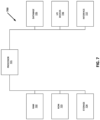
- the units can comprise a computer 700 that comprises a processor 721 as illustrated in FIG. 7 and described below.
- the computer 700 described in relation to FIG. 7 may comprise a portion of a cloud-based processing and storage system.
- a cloud-base service that can be used in implementations of the disclosed is GE Predix TM , as available from the General Electric Company (Schenectady, NY).
- Predix TM is a cloud-based PaaS (platform as a service) that enables industrial-scale analytics for asset performance management (APM) and operations optimization by providing a standard way to connect machines, data, and people.
- API asset performance management
- FIG. 7 illustrates an exemplary computer 700 that can be used for analyzing the sample of the hydrocarbon composition to determine one or more attributes of the sample of the hydrocarbon composition; developing one or more predictive models of a hydrocarbon production, transportation, refining, refined hydrocarbon production, processing, handling, storage, and use of the hydrocarbon composition entering the process of hydrocarbon production, transportation, refining, refined hydrocarbon production, processing, handling, storage, and use based on the analysis of the sample of the hydrocarbon composition; and determining wax risks based on the developed one or more predictive models.
- the computer of FIG. 7 may comprise all or a portion of the computer 700 and/or a process control system.
- "computer” may include a plurality of computers.
- the computer 700 may include one or more hardware components such as, for example, a processor 721, a random access memory (RAM) module 722, a read-only memory (ROM) module 723, a storage 724, a database 725, one or more input/output (I/O) devices 726, and an interface 727.
- the computer 700 may include one or more software components such as, for example, a computer-readable medium including computer executable instructions for performing a method associated with the exemplary embodiments. It is contemplated that one or more of the hardware components listed above may be implemented using software.
- storage 724 may include a software partition associated with one or more other hardware components. It is understood that the components listed above are exemplary only and not intended to be limiting.
- Processor 721 may include one or more processors, each configured to execute instructions and process data to perform one or more functions associated with a processing device for determining wax risks in a hydrocarbon refining process and taking steps to mitigate those risks, if necessary.
- processor refers to a physical hardware device that executes encoded instructions for performing functions on inputs and creating outputs.
- Processor 721 may be communicatively coupled to RAM 722, ROM 723, storage 724, database 725, I/O devices 726, and interface 727.
- Processor 721 may be configured to execute sequences of computer program instructions to perform various processes. The computer program instructions may be loaded into RAM 722 for execution by processor 721.
- RAM 722 and ROM 723 may each include one or more devices for storing information associated with operation of processor 721.
- ROM 723 may include a memory device configured to access and store information associated with computer 700, including information for identifying, initializing, and monitoring the operation of one or more components and subsystems.
- RAM 722 may include a memory device for storing data associated with one or more operations of processor 721.
- ROM 723 may load instructions into RAM 722 for execution by processor 721.
- Storage 724 may include any type of mass storage device configured to store information that processor 721 may need to perform processes consistent with the disclosed embodiments.
- storage 724 may include one or more magnetic and/or optical disk devices, such as hard drives, CD-ROMs, DVD-ROMs, or any other type of mass media device.
- Database 725 may include one or more software and/or hardware components that cooperate to store, organize, sort, filter, and/or arrange data used by computer 700 and/or processor 721. It is contemplated that database 725 may store additional and/or different information than that listed above.
- I/O devices 726 may include one or more components configured to communicate information with a user associated with computer 700.
- I/O devices 726 may include a console with an integrated keyboard and mouse to allow a user to maintain an algorithm for analyzing the sample of the hydrocarbon composition to determine one or more attributes of the sample of the hydrocarbon composition; developing one or more predictive models of a hydrocarbon production, transportation, refining, refined hydrocarbon production, processing, handling, storage, and use for the hydrocarbon composition entering the process of hydrocarbon production, transportation, refining, refined hydrocarbon production, processing, handling, storage, and use based on the analysis of the sample of the hydrocarbon composition; and determining wax risks based on the developed one or more predictive models, and the like.
- I/O devices 726 may also include a display including a graphical user interface (GUI) for outputting information on a monitor.
- GUI graphical user interface
- I/O devices 726 may also include peripheral devices such as, for example, a printer for printing information associated with computer 700, a user-accessible disk drive (e.g., a USB port, a floppy, CD-ROM, or DVD-ROM drive, etc.) to allow a user to input data stored on a portable media device, a microphone, a speaker system, or any other suitable type of interface device.
- a printer for printing information associated with computer 700
- a user-accessible disk drive e.g., a USB port, a floppy, CD-ROM, or DVD-ROM drive, etc.
- Interface 727 may include one or more components configured to transmit and receive data via a communication network, such as the Internet, a local area network, a workstation peer-to-peer network, a direct link network, a wireless network, or any other suitable communication platform.
- interface 727 may include one or more modulators, demodulators, multiplexers, demultiplexers, network communication devices, wireless devices, antennas, modems, and any other type of device configured to enable data communication via a communication network.
Landscapes
- Chemical & Material Sciences (AREA)
- Oil, Petroleum & Natural Gas (AREA)
- Engineering & Computer Science (AREA)
- Chemical Kinetics & Catalysis (AREA)
- General Chemical & Material Sciences (AREA)
- Health & Medical Sciences (AREA)
- Life Sciences & Earth Sciences (AREA)
- Organic Chemistry (AREA)
- Food Science & Technology (AREA)
- Medicinal Chemistry (AREA)
- Physics & Mathematics (AREA)
- Analytical Chemistry (AREA)
- Biochemistry (AREA)
- General Health & Medical Sciences (AREA)
- General Physics & Mathematics (AREA)
- Immunology (AREA)
- Pathology (AREA)
- Production Of Liquid Hydrocarbon Mixture For Refining Petroleum (AREA)
Claims (8)
- Procédé de détermination et d'atténuation de risque de cire d'une composition d'hydrocarbures, le procédé comprenant :l'obtention (102) d'un échantillon de la composition d'hydrocarbures ;l'analyse (104) de l'échantillon de la composition d'hydrocarbures pour déterminer un ou plusieurs attributs de l'échantillon de la composition d'hydrocarbures, dans lequel le ou les attributs comportent, de préférence, au moins un parmi l'indice d'acidité totale, la densité API, la densité relative, les SARA (saturés, aromatiques, résines et asphaltènes), l'indice d'instabilité colloïdale, la viscosité, la rhéologie, la teneur en cire, la teneur en cire lourde, la température d'apparition de la cire, et le point d'écoulement ;le développement (106) d'un premier modèle prédictif d'un processus de production, de transport, de raffinage, de stockage, de traitement et/ou de distribution d'hydrocarbures sur la base de l'analyse de l'échantillon de la composition d'hydrocarbures ;la détermination (108) des premiers risques liés à la cire sur la base du premier modèle prédictif, dans lequel les premiers risques déterminés liés à la cire comportent de préférence un ou plusieurs éléments parmi la teneur en cire, la teneur en cire lourde, la température d'apparition de la cire, le point d'écoulement et le potentiel de dépôt de la cire, et dans lequel le premier modèle prédictif est développé à l'aide d'un ou de plusieurs algorithmes d'apprentissage automatique ;le développement (302), à l'aide du ou des algorithmes d'apprentissage automatique, un modèle d'écoulement pour un pipeline associé au processus de production, de transport, de raffinage, de stockage, de traitement et/ou de distribution d'hydrocarbures, dans lequel le modèle d'écoulement de tuyau est un second modèle prédictif développé à l'aide de paramètres et de conditions d'exploitation du pipeline stockés et en temps réel ;le fait de déterminer (304) les seconds risques de cire pour le pipeline sur la base du modèle d'écoulement de conduit et des premiers risques de cire déterminés ; etl'atténuation du premier et/ou du second risque de cire déterminé en introduisant un ou plusieurs additifs chimiques au cours d'au moins un parmi la production, le transport, le stockage, le traitement et/ou la distribution de la composition d'hydrocarbures.
- Procédé selon la revendication 1, comprenant en outre le développement d'un troisième modèle prédictif pour prédire l'efficacité du ou des additifs chimiques dans l'atténuation d'un ou de plusieurs des risques de cire déterminés.
- Procédé selon la revendication 1, comprenant en outre la sélection du ou des additifs chimiques sur la base i) de la correspondance des caractéristiques de précipitation entre le ou les additifs chimiques et la cire dans la composition d'hydrocarbure, et/ou ii) des attributs liés à la composition de l'hydrocarbure.
- Procédé selon l'une quelconque des revendications 1 à 3, dans lequel l'analyse de l'échantillon de la composition d'hydrocarbure pour déterminer un ou plusieurs attributs de l'échantillon de la composition d'hydrocarbure comprend le fait d'effectuer une ou plusieurs analyses d'empreintes digitales de l'échantillon, une analyse de l'échantillon par chromatographie en phase gazeuse à haute température, une analyse par calorimétrie à balayage différentiel, une analyse par spectrométrie de masse à plasma à couplage inductif ou une combinaison des analyses variables de l'échantillon pour déterminer un ou plusieurs attributs de l'échantillon.
- Procédé selon les revendications 1 à 4, dans lequel le ou les algorithmes d'apprentissage automatique comportent l'analyse en composantes principales, la régression linéaire et la régression logistique.
- Système d'analyse prédictive pour la gestion d'un processus d'hydrocarbures, ledit système comprenant :
une mémoire, dans lequel la mémoire stocke des instructions lisibles par ordinateur, un système de commande de processus ; et un processeur couplé de manière communicative à la mémoire, dans lequel le processeur exécute les instructions lisibles par ordinateur stockées dans la mémoire, les instructions lisibles par ordinateur amenant le processeur à :recevoir une analyse d'un échantillon d'hydrocarbures,développer un premier modèle prédictif pour un hydrocarbure sur la base d'un ou de plusieurs attributs de l'échantillon de la composition d'hydrocarbure déterminé dans l'analyse de l'échantillon d'hydrocarbure, dans lequel le premier modèle prédictif du raffinage de l'hydrocarbure est développé à l'aide d'un ou de plusieurs algorithmes d'apprentissage automatique comportant au moins une analyse en composantes principales (ACP), une régression linéaire et une régression logistique, la régression linéaire et la régression logistique, dans lequel le ou les attributs comportent, de préférence, l'indice d'acidité totale (TAN), la densité APl, la densité relative, les SARA (saturés, aromatiques, résines et asphaltènes), l'indice d'instabilité colloïdale, la viscosité, la rhéologie, la teneur en cire, la teneur en cire lourde, la température d'apparition de la cire et le point d'écoulement ;le fait de déterminer les premiers risques de cire pour l'hydrocarbure sur la base du premier modèle prédictif ;le développement, à l'aide du ou des algorithmes d'apprentissage automatique, un modèle d'écoulement de conduit pour un pipeline associé au processus d'hydrocarbure, dans lequel le modèle d'écoulement de conduit est un second modèle prédictif développé à l'aide de paramètres et de conditions d'exploitation en temps réel et stockés du pipeline ;le fait de déterminer les seconds risques de cire pour le pipeline sur la base du modèle d'écoulement de conduit et des premiers risques de cire déterminés ; etla commande de certains aspects du processus d'hydrocarbure en introduisant un ou plusieurs additifs chimiques à un ou plusieurs stades du processus d'hydrocarbure afin d'atténuer le premier et/ou le second risque de cire déterminé,dans lequel l'analyse est obtenue par les étapes suivantes :
l'obtention d'un échantillon de la composition d'hydrocarbure ; et l'analyse de l'échantillon de la composition d'hydrocarbure pour déterminer le ou les attributs de l'échantillon de la composition d'hydrocarbure, dans lequel l'analyse de l'échantillon de la composition d'hydrocarbure pour déterminer un ou plusieurs attributs de l'échantillon de la composition d'hydrocarbures comprend, de préférence, le fait d'effectuer une ou plusieurs analyses d'empreintes digitales de l'échantillon, une analyse de l'échantillon par chromatographie en phase gazeuse à haute température, une analyse par calorimétrie à balayage différentiel, une analyse par spectrométrie de masse à plasma à couplage inductif ou une combinaison des analyses variables de l'échantillon pour déterminer un ou plusieurs attributs de l'échantillon. - Système selon la revendication 6, dans lequel le ou les additifs chimiques sont sélectionnés sur la base des caractéristiques de précipitation entre le ou les additifs chimiques et la cire dans la composition d'hydrocarbure.
- Système selon la revendication 6 ou 7, dans lequel la commande des aspects du processus d'hydrocarbures sur la base des risques de cire déterminés pour atténuer un ou plusieurs des risques de cire déterminés comprend la commande d'un ou plusieurs parmi la production d'hydrocarbures, le transport, le raffinage, la production d'hydrocarbures raffinés, le traitement, la manipulation, le stockage et l'utilisation, lorsque la composition d'hydrocarbures entre dans la production, le transport, le raffinage, la production d'hydrocarbures raffinés, le traitement, la manipulation, le stockage et l'utilisation ou se déplace dans la production, le transport, le raffinage, la production d'hydrocarbures raffinés, le traitement, la manipulation, le stockage et l'utilisation.
Priority Applications (1)
| Application Number | Priority Date | Filing Date | Title |
|---|---|---|---|
| HUE17905080A HUE072909T2 (hu) | 2017-04-10 | 2017-04-10 | Viasz kockázat értékelés kibõvített adatelemzés és csõáramlás-modellezés segítségével |
Applications Claiming Priority (1)
| Application Number | Priority Date | Filing Date | Title |
|---|---|---|---|
| PCT/CN2017/079875 WO2018187898A1 (fr) | 2017-04-10 | 2017-04-10 | Évaluation et atténuation de risque de cire à l'aide d'une analyse de données avancée et d'une modélisation de flux de tuyau |
Publications (3)
| Publication Number | Publication Date |
|---|---|
| EP3610256A1 EP3610256A1 (fr) | 2020-02-19 |
| EP3610256A4 EP3610256A4 (fr) | 2021-04-28 |
| EP3610256B1 true EP3610256B1 (fr) | 2025-06-25 |
Family
ID=63793092
Family Applications (1)
| Application Number | Title | Priority Date | Filing Date |
|---|---|---|---|
| EP17905080.2A Active EP3610256B1 (fr) | 2017-04-10 | 2017-04-10 | Évaluation et atténuation de risque de cire à l'aide d'une analyse de données avancée et d'une modélisation de flux de tuyau |
Country Status (10)
| Country | Link |
|---|---|
| US (1) | US11513111B2 (fr) |
| EP (1) | EP3610256B1 (fr) |
| CN (1) | CN110494748A (fr) |
| AU (1) | AU2017409024A1 (fr) |
| BR (1) | BR112019021352B1 (fr) |
| CA (1) | CA3057179C (fr) |
| HU (1) | HUE072909T2 (fr) |
| MY (1) | MY195879A (fr) |
| PL (1) | PL3610256T3 (fr) |
| WO (1) | WO2018187898A1 (fr) |
Families Citing this family (9)
| Publication number | Priority date | Publication date | Assignee | Title |
|---|---|---|---|---|
| US11480709B2 (en) * | 2019-10-21 | 2022-10-25 | Chevron U.S.A. Inc. | Systems and methods for predicting hydrocarbon production and assessing prediction uncertainty |
| EP3904986B1 (fr) * | 2020-04-27 | 2023-08-02 | Petroleos del Norte, S.A. | Procédé, système et produit programme informatique pour la surveillance en ligne d'une raffinerie de pétrole |
| US12019059B2 (en) * | 2020-10-16 | 2024-06-25 | Saudi Arabian Oil Company | Detecting equipment defects using lubricant analysis |
| US12247940B2 (en) | 2021-03-30 | 2025-03-11 | The University Of Akron | Fluid property sensing array utilizing a neural network |
| WO2023196389A1 (fr) * | 2022-04-05 | 2023-10-12 | Schlumberger Technology Corporation | Détermination de l'état d'apparition d'asphaltène de fluides de réservoir pendant une analyse de fluide de fond de trou |
| US12529650B2 (en) * | 2022-08-12 | 2026-01-20 | Tata Consultancy Services Limited | Methods and systems for monitoring lubricant oil condition using photoacoustic modelling |
| WO2024097686A1 (fr) * | 2022-10-31 | 2024-05-10 | Chevron U.S.A. Inc. | Surveillance et prédiction du risque de gel d'un pipeline |
| US20240255454A1 (en) * | 2023-02-01 | 2024-08-01 | Saudi Arabian Oil Company | Utilizing thermal camera for detecting scale in pipelines |
| US20250149126A1 (en) * | 2023-11-03 | 2025-05-08 | Schlumberger Technology Corporation | Digital framework for design and selection of paraffin inhibitors |
Family Cites Families (7)
| Publication number | Priority date | Publication date | Assignee | Title |
|---|---|---|---|---|
| US6087662A (en) | 1998-05-22 | 2000-07-11 | Marathon Ashland Petroleum Llc | Process for analysis of asphaltene content in hydrocarbon mixtures by middle infrared spectroscopy |
| FR2806803B1 (fr) | 2000-03-24 | 2002-10-25 | Inst Francais Du Petrole | Methode de prediction precoce du risque de depot de paraffines en cours de production et de transport |
| US7813894B2 (en) * | 2006-12-14 | 2010-10-12 | General Electric Company | Method and system for assessing the performance of crude oils |
| US7920970B2 (en) * | 2008-01-24 | 2011-04-05 | Schlumberger Technology Corporation | Methods and apparatus for characterization of petroleum fluid and applications thereof |
| AU2016303647B2 (en) | 2015-07-31 | 2021-10-28 | Bl Technologies, Inc. | System and method of predictive analytics for dynamic control of a hydrocarbon refining process |
| AU2016368277B2 (en) | 2015-12-07 | 2022-04-07 | Bl Technologies, Inc. | System and method to mitigate fouling during a hydrocarbon refining process |
| AR109534A1 (es) * | 2016-09-16 | 2018-12-19 | Ecolab Usa Inc | Ésteres y alcoholes grasos para el tratamiento de petróleo crudo |
-
2017
- 2017-04-10 CA CA3057179A patent/CA3057179C/fr active Active
- 2017-04-10 MY MYPI2019004714A patent/MY195879A/en unknown
- 2017-04-10 US US16/604,199 patent/US11513111B2/en active Active
- 2017-04-10 AU AU2017409024A patent/AU2017409024A1/en not_active Abandoned
- 2017-04-10 HU HUE17905080A patent/HUE072909T2/hu unknown
- 2017-04-10 WO PCT/CN2017/079875 patent/WO2018187898A1/fr not_active Ceased
- 2017-04-10 EP EP17905080.2A patent/EP3610256B1/fr active Active
- 2017-04-10 BR BR112019021352-0A patent/BR112019021352B1/pt active IP Right Grant
- 2017-04-10 CN CN201780089491.3A patent/CN110494748A/zh active Pending
- 2017-04-10 PL PL17905080.2T patent/PL3610256T3/pl unknown
Also Published As
| Publication number | Publication date |
|---|---|
| WO2018187898A1 (fr) | 2018-10-18 |
| CA3057179C (fr) | 2024-01-16 |
| BR112019021352A8 (pt) | 2022-11-08 |
| BR112019021352B1 (pt) | 2022-11-22 |
| BR112019021352A2 (pt) | 2020-06-16 |
| CN110494748A (zh) | 2019-11-22 |
| EP3610256A4 (fr) | 2021-04-28 |
| PL3610256T3 (pl) | 2025-09-29 |
| HUE072909T2 (hu) | 2025-12-28 |
| US20200033317A1 (en) | 2020-01-30 |
| EP3610256A1 (fr) | 2020-02-19 |
| MY195879A (en) | 2023-02-27 |
| AU2017409024A1 (en) | 2019-08-15 |
| CA3057179A1 (fr) | 2018-10-18 |
| US11513111B2 (en) | 2022-11-29 |
Similar Documents
| Publication | Publication Date | Title |
|---|---|---|
| EP3610256B1 (fr) | Évaluation et atténuation de risque de cire à l'aide d'une analyse de données avancée et d'une modélisation de flux de tuyau | |
| Kurup et al. | Revisiting asphaltene deposition tool (ADEPT): field application | |
| Kaiser | A review of refinery complexity applications | |
| AU2016303647B2 (en) | System and method of predictive analytics for dynamic control of a hydrocarbon refining process | |
| Ali et al. | Risk quantification and ranking of oil fields and wells facing asphaltene deposition problem using fuzzy TOPSIS coupled with AHP | |
| Pereira et al. | Evaluation and improvement of screening methods applied to asphaltene precipitation | |
| Ghashghaee | Predictive correlations for thermal upgrading of petroleum residues | |
| Bergman et al. | A consistent and accurate dead-oil-viscosity method | |
| Kapusta et al. | Safe processing of acid crudes | |
| CN107257926B (zh) | 通过紫外可见光谱法表征原油 | |
| Kooti et al. | A constrained machine learning surrogate model to predict the distribution of water-in-oil emulsions in electrostatic fields | |
| Rajan Babu et al. | Modeling of asphaltene deposition in a packed bed column | |
| US11021656B2 (en) | System and method to mitigate fouling during a hydrocarbon refining process | |
| Ahmadi et al. | Upgrading fuzzy logic by GA-PS to determine asphaltene stability in crude oil | |
| Fan et al. | Wax deposition behaviour and prediction modelling of high‐wax crude oil transport in cold regions | |
| Aguilar-Hernández et al. | Predicting wax formation in High-Pressure conditions for condensate samples using Machine learning | |
| Zhang et al. | Effect of temperature on the solubility of SARA components in n-Alkane (C3-C5) deasphalting: Molecular simulation and experimental study | |
| Place et al. | Assessment of Corrosion Inhibitors for Very Light Hydrocarbon and Finished Product Pipelines | |
| Ahmadlouydarab et al. | A Precise Mathematical Correlation to Estimate Product Yield of Delayed Coking Units | |
| Yu et al. | Wax deposition law under a gas–liquid bubbly flow pattern | |
| Olugbenga et al. | Efficient Modeling and Simulation of Crude Oil Stabilization Processes: Integrating RSM and ASPEN HYSYS for Energy-Saving Modifications. | |
| Alhajeri et al. | Neural-network-based model for predicting asphaltene stability in crude oils | |
| Jennings et al. | Asphaltene Testing for Inhibitor Evaluation | |
| Gharfeh et al. | A general study of asphaltene flocculation prediction at field conditions | |
| Sandu et al. | Innovative solutions for processing shale oils |
Legal Events
| Date | Code | Title | Description |
|---|---|---|---|
| STAA | Information on the status of an ep patent application or granted ep patent |
Free format text: STATUS: THE INTERNATIONAL PUBLICATION HAS BEEN MADE |
|
| PUAI | Public reference made under article 153(3) epc to a published international application that has entered the european phase |
Free format text: ORIGINAL CODE: 0009012 |
|
| STAA | Information on the status of an ep patent application or granted ep patent |
Free format text: STATUS: REQUEST FOR EXAMINATION WAS MADE |
|
| 17P | Request for examination filed |
Effective date: 20191106 |
|
| AK | Designated contracting states |
Kind code of ref document: A1 Designated state(s): AL AT BE BG CH CY CZ DE DK EE ES FI FR GB GR HR HU IE IS IT LI LT LU LV MC MK MT NL NO PL PT RO RS SE SI SK SM TR |
|
| AX | Request for extension of the european patent |
Extension state: BA ME |
|
| DAV | Request for validation of the european patent (deleted) | ||
| DAX | Request for extension of the european patent (deleted) | ||
| A4 | Supplementary search report drawn up and despatched |
Effective date: 20210329 |
|
| RIC1 | Information provided on ipc code assigned before grant |
Ipc: G01N 33/28 20060101AFI20210323BHEP Ipc: C10G 75/00 20060101ALI20210323BHEP |
|
| RIN1 | Information on inventor provided before grant (corrected) |
Inventor name: PEREZ DIAZ, PETER LARRY Inventor name: MCDERMOTT, JOHN BRIAN Inventor name: ZHENG, SHENG Inventor name: PENG, WENQING Inventor name: PENG, YUN Inventor name: ZHANG, XIAO Inventor name: XIE, XIAOAN Inventor name: WANG, GUOLIANG Inventor name: BAGARIA, HITESH GHANSHYAM Inventor name: PATEL, NIMESHKUMAR KANTILAL |
|
| RAP1 | Party data changed (applicant data changed or rights of an application transferred) |
Owner name: BL TECHNOLOGIES, INC. |
|
| STAA | Information on the status of an ep patent application or granted ep patent |
Free format text: STATUS: EXAMINATION IS IN PROGRESS |
|
| 17Q | First examination report despatched |
Effective date: 20221024 |
|
| P01 | Opt-out of the competence of the unified patent court (upc) registered |
Effective date: 20230521 |
|
| GRAP | Despatch of communication of intention to grant a patent |
Free format text: ORIGINAL CODE: EPIDOSNIGR1 |
|
| STAA | Information on the status of an ep patent application or granted ep patent |
Free format text: STATUS: GRANT OF PATENT IS INTENDED |
|
| INTG | Intention to grant announced |
Effective date: 20250130 |
|
| GRAS | Grant fee paid |
Free format text: ORIGINAL CODE: EPIDOSNIGR3 |
|
| GRAA | (expected) grant |
Free format text: ORIGINAL CODE: 0009210 |
|
| STAA | Information on the status of an ep patent application or granted ep patent |
Free format text: STATUS: THE PATENT HAS BEEN GRANTED |
|
| AK | Designated contracting states |
Kind code of ref document: B1 Designated state(s): AL AT BE BG CH CY CZ DE DK EE ES FI FR GB GR HR HU IE IS IT LI LT LU LV MC MK MT NL NO PL PT RO RS SE SI SK SM TR |
|
| REG | Reference to a national code |
Ref country code: GB Ref legal event code: FG4D |
|
| REG | Reference to a national code |
Ref country code: CH Ref legal event code: EP |
|
| REG | Reference to a national code |
Ref country code: CH Ref legal event code: EP |
|
| REG | Reference to a national code |
Ref country code: IE Ref legal event code: FG4D |
|
| REG | Reference to a national code |
Ref country code: DE Ref legal event code: R096 Ref document number: 602017090197 Country of ref document: DE |
|
| PG25 | Lapsed in a contracting state [announced via postgrant information from national office to epo] |
Ref country code: FI Free format text: LAPSE BECAUSE OF FAILURE TO SUBMIT A TRANSLATION OF THE DESCRIPTION OR TO PAY THE FEE WITHIN THE PRESCRIBED TIME-LIMIT Effective date: 20250625 |
|
| REG | Reference to a national code |
Ref country code: LT Ref legal event code: MG9D |
|
| PG25 | Lapsed in a contracting state [announced via postgrant information from national office to epo] |
Ref country code: NO Free format text: LAPSE BECAUSE OF FAILURE TO SUBMIT A TRANSLATION OF THE DESCRIPTION OR TO PAY THE FEE WITHIN THE PRESCRIBED TIME-LIMIT Effective date: 20250925 Ref country code: GR Free format text: LAPSE BECAUSE OF FAILURE TO SUBMIT A TRANSLATION OF THE DESCRIPTION OR TO PAY THE FEE WITHIN THE PRESCRIBED TIME-LIMIT Effective date: 20250926 |
|
| PG25 | Lapsed in a contracting state [announced via postgrant information from national office to epo] |
Ref country code: BG Free format text: LAPSE BECAUSE OF FAILURE TO SUBMIT A TRANSLATION OF THE DESCRIPTION OR TO PAY THE FEE WITHIN THE PRESCRIBED TIME-LIMIT Effective date: 20250625 |
|
| PG25 | Lapsed in a contracting state [announced via postgrant information from national office to epo] |
Ref country code: HR Free format text: LAPSE BECAUSE OF FAILURE TO SUBMIT A TRANSLATION OF THE DESCRIPTION OR TO PAY THE FEE WITHIN THE PRESCRIBED TIME-LIMIT Effective date: 20250625 |
|
| PG25 | Lapsed in a contracting state [announced via postgrant information from national office to epo] |
Ref country code: RS Free format text: LAPSE BECAUSE OF FAILURE TO SUBMIT A TRANSLATION OF THE DESCRIPTION OR TO PAY THE FEE WITHIN THE PRESCRIBED TIME-LIMIT Effective date: 20250925 |
|
| PG25 | Lapsed in a contracting state [announced via postgrant information from national office to epo] |
Ref country code: LV Free format text: LAPSE BECAUSE OF FAILURE TO SUBMIT A TRANSLATION OF THE DESCRIPTION OR TO PAY THE FEE WITHIN THE PRESCRIBED TIME-LIMIT Effective date: 20250625 |
|
| REG | Reference to a national code |
Ref country code: NL Ref legal event code: MP Effective date: 20250625 |
|
| PG25 | Lapsed in a contracting state [announced via postgrant information from national office to epo] |
Ref country code: NL Free format text: LAPSE BECAUSE OF FAILURE TO SUBMIT A TRANSLATION OF THE DESCRIPTION OR TO PAY THE FEE WITHIN THE PRESCRIBED TIME-LIMIT Effective date: 20250625 |
|
| PG25 | Lapsed in a contracting state [announced via postgrant information from national office to epo] |
Ref country code: PT Free format text: LAPSE BECAUSE OF FAILURE TO SUBMIT A TRANSLATION OF THE DESCRIPTION OR TO PAY THE FEE WITHIN THE PRESCRIBED TIME-LIMIT Effective date: 20251027 |
|
| REG | Reference to a national code |
Ref country code: AT Ref legal event code: MK05 Ref document number: 1806943 Country of ref document: AT Kind code of ref document: T Effective date: 20250625 |
|
| REG | Reference to a national code |
Ref country code: HU Ref legal event code: AG4A Ref document number: E072909 Country of ref document: HU |
|
| PG25 | Lapsed in a contracting state [announced via postgrant information from national office to epo] |
Ref country code: IS Free format text: LAPSE BECAUSE OF FAILURE TO SUBMIT A TRANSLATION OF THE DESCRIPTION OR TO PAY THE FEE WITHIN THE PRESCRIBED TIME-LIMIT Effective date: 20251025 |
|
| PG25 | Lapsed in a contracting state [announced via postgrant information from national office to epo] |
Ref country code: AT Free format text: LAPSE BECAUSE OF FAILURE TO SUBMIT A TRANSLATION OF THE DESCRIPTION OR TO PAY THE FEE WITHIN THE PRESCRIBED TIME-LIMIT Effective date: 20250625 Ref country code: SM Free format text: LAPSE BECAUSE OF FAILURE TO SUBMIT A TRANSLATION OF THE DESCRIPTION OR TO PAY THE FEE WITHIN THE PRESCRIBED TIME-LIMIT Effective date: 20250625 |
|
| PG25 | Lapsed in a contracting state [announced via postgrant information from national office to epo] |
Ref country code: CZ Free format text: LAPSE BECAUSE OF FAILURE TO SUBMIT A TRANSLATION OF THE DESCRIPTION OR TO PAY THE FEE WITHIN THE PRESCRIBED TIME-LIMIT Effective date: 20250625 |
|
| PG25 | Lapsed in a contracting state [announced via postgrant information from national office to epo] |
Ref country code: EE Free format text: LAPSE BECAUSE OF FAILURE TO SUBMIT A TRANSLATION OF THE DESCRIPTION OR TO PAY THE FEE WITHIN THE PRESCRIBED TIME-LIMIT Effective date: 20250625 |
|
| PG25 | Lapsed in a contracting state [announced via postgrant information from national office to epo] |
Ref country code: SK Free format text: LAPSE BECAUSE OF FAILURE TO SUBMIT A TRANSLATION OF THE DESCRIPTION OR TO PAY THE FEE WITHIN THE PRESCRIBED TIME-LIMIT Effective date: 20250625 |
|
| PG25 | Lapsed in a contracting state [announced via postgrant information from national office to epo] |
Ref country code: ES Free format text: LAPSE BECAUSE OF FAILURE TO SUBMIT A TRANSLATION OF THE DESCRIPTION OR TO PAY THE FEE WITHIN THE PRESCRIBED TIME-LIMIT Effective date: 20250625 |
|
| PG25 | Lapsed in a contracting state [announced via postgrant information from national office to epo] |
Ref country code: DK Free format text: LAPSE BECAUSE OF FAILURE TO SUBMIT A TRANSLATION OF THE DESCRIPTION OR TO PAY THE FEE WITHIN THE PRESCRIBED TIME-LIMIT Effective date: 20250625 |