EP3610945A1 - Material und verfahren zur entfernung von schadstoffen aus wasser - Google Patents
Material und verfahren zur entfernung von schadstoffen aus wasser Download PDFInfo
- Publication number
- EP3610945A1 EP3610945A1 EP18189279.5A EP18189279A EP3610945A1 EP 3610945 A1 EP3610945 A1 EP 3610945A1 EP 18189279 A EP18189279 A EP 18189279A EP 3610945 A1 EP3610945 A1 EP 3610945A1
- Authority
- EP
- European Patent Office
- Prior art keywords
- adsorbent material
- pharmaceutical
- porous mineral
- optionally
- silane
- Prior art date
- Legal status (The legal status is an assumption and is not a legal conclusion. Google has not performed a legal analysis and makes no representation as to the accuracy of the status listed.)
- Withdrawn
Links
Images



Classifications
-
- B—PERFORMING OPERATIONS; TRANSPORTING
- B01—PHYSICAL OR CHEMICAL PROCESSES OR APPARATUS IN GENERAL
- B01J—CHEMICAL OR PHYSICAL PROCESSES, e.g. CATALYSIS OR COLLOID CHEMISTRY; THEIR RELEVANT APPARATUS
- B01J20/00—Solid sorbent compositions or filter aid compositions; Sorbents for chromatography; Processes for preparing, regenerating or reactivating thereof
- B01J20/02—Solid sorbent compositions or filter aid compositions; Sorbents for chromatography; Processes for preparing, regenerating or reactivating thereof comprising inorganic material
- B01J20/10—Solid sorbent compositions or filter aid compositions; Sorbents for chromatography; Processes for preparing, regenerating or reactivating thereof comprising inorganic material comprising silica or silicate
- B01J20/12—Naturally occurring clays or bleaching earth
-
- B—PERFORMING OPERATIONS; TRANSPORTING
- B01—PHYSICAL OR CHEMICAL PROCESSES OR APPARATUS IN GENERAL
- B01J—CHEMICAL OR PHYSICAL PROCESSES, e.g. CATALYSIS OR COLLOID CHEMISTRY; THEIR RELEVANT APPARATUS
- B01J20/00—Solid sorbent compositions or filter aid compositions; Sorbents for chromatography; Processes for preparing, regenerating or reactivating thereof
- B01J20/02—Solid sorbent compositions or filter aid compositions; Sorbents for chromatography; Processes for preparing, regenerating or reactivating thereof comprising inorganic material
- B01J20/10—Solid sorbent compositions or filter aid compositions; Sorbents for chromatography; Processes for preparing, regenerating or reactivating thereof comprising inorganic material comprising silica or silicate
- B01J20/16—Alumino-silicates
-
- B—PERFORMING OPERATIONS; TRANSPORTING
- B01—PHYSICAL OR CHEMICAL PROCESSES OR APPARATUS IN GENERAL
- B01J—CHEMICAL OR PHYSICAL PROCESSES, e.g. CATALYSIS OR COLLOID CHEMISTRY; THEIR RELEVANT APPARATUS
- B01J20/00—Solid sorbent compositions or filter aid compositions; Sorbents for chromatography; Processes for preparing, regenerating or reactivating thereof
- B01J20/02—Solid sorbent compositions or filter aid compositions; Sorbents for chromatography; Processes for preparing, regenerating or reactivating thereof comprising inorganic material
- B01J20/10—Solid sorbent compositions or filter aid compositions; Sorbents for chromatography; Processes for preparing, regenerating or reactivating thereof comprising inorganic material comprising silica or silicate
- B01J20/16—Alumino-silicates
- B01J20/165—Natural alumino-silicates, e.g. zeolites
-
- B—PERFORMING OPERATIONS; TRANSPORTING
- B01—PHYSICAL OR CHEMICAL PROCESSES OR APPARATUS IN GENERAL
- B01J—CHEMICAL OR PHYSICAL PROCESSES, e.g. CATALYSIS OR COLLOID CHEMISTRY; THEIR RELEVANT APPARATUS
- B01J20/00—Solid sorbent compositions or filter aid compositions; Sorbents for chromatography; Processes for preparing, regenerating or reactivating thereof
- B01J20/02—Solid sorbent compositions or filter aid compositions; Sorbents for chromatography; Processes for preparing, regenerating or reactivating thereof comprising inorganic material
- B01J20/10—Solid sorbent compositions or filter aid compositions; Sorbents for chromatography; Processes for preparing, regenerating or reactivating thereof comprising inorganic material comprising silica or silicate
- B01J20/16—Alumino-silicates
- B01J20/18—Synthetic zeolitic molecular sieves
-
- B—PERFORMING OPERATIONS; TRANSPORTING
- B01—PHYSICAL OR CHEMICAL PROCESSES OR APPARATUS IN GENERAL
- B01J—CHEMICAL OR PHYSICAL PROCESSES, e.g. CATALYSIS OR COLLOID CHEMISTRY; THEIR RELEVANT APPARATUS
- B01J20/00—Solid sorbent compositions or filter aid compositions; Sorbents for chromatography; Processes for preparing, regenerating or reactivating thereof
- B01J20/28—Solid sorbent compositions or filter aid compositions; Sorbents for chromatography; Processes for preparing, regenerating or reactivating thereof characterised by their form or physical properties
- B01J20/28002—Solid sorbent compositions or filter aid compositions; Sorbents for chromatography; Processes for preparing, regenerating or reactivating thereof characterised by their form or physical properties characterised by their physical properties
- B01J20/28004—Sorbent size or size distribution, e.g. particle size
-
- B—PERFORMING OPERATIONS; TRANSPORTING
- B01—PHYSICAL OR CHEMICAL PROCESSES OR APPARATUS IN GENERAL
- B01J—CHEMICAL OR PHYSICAL PROCESSES, e.g. CATALYSIS OR COLLOID CHEMISTRY; THEIR RELEVANT APPARATUS
- B01J20/00—Solid sorbent compositions or filter aid compositions; Sorbents for chromatography; Processes for preparing, regenerating or reactivating thereof
- B01J20/28—Solid sorbent compositions or filter aid compositions; Sorbents for chromatography; Processes for preparing, regenerating or reactivating thereof characterised by their form or physical properties
- B01J20/28054—Solid sorbent compositions or filter aid compositions; Sorbents for chromatography; Processes for preparing, regenerating or reactivating thereof characterised by their form or physical properties characterised by their surface properties or porosity
- B01J20/28057—Surface area, e.g. B.E.T specific surface area
- B01J20/28059—Surface area, e.g. B.E.T specific surface area being less than 100 m2/g
-
- B—PERFORMING OPERATIONS; TRANSPORTING
- B01—PHYSICAL OR CHEMICAL PROCESSES OR APPARATUS IN GENERAL
- B01J—CHEMICAL OR PHYSICAL PROCESSES, e.g. CATALYSIS OR COLLOID CHEMISTRY; THEIR RELEVANT APPARATUS
- B01J20/00—Solid sorbent compositions or filter aid compositions; Sorbents for chromatography; Processes for preparing, regenerating or reactivating thereof
- B01J20/30—Processes for preparing, regenerating, or reactivating
- B01J20/32—Impregnating or coating ; Solid sorbent compositions obtained from processes involving impregnating or coating
- B01J20/3202—Impregnating or coating ; Solid sorbent compositions obtained from processes involving impregnating or coating characterised by the carrier, support or substrate used for impregnation or coating
- B01J20/3204—Inorganic carriers, supports or substrates
-
- B—PERFORMING OPERATIONS; TRANSPORTING
- B01—PHYSICAL OR CHEMICAL PROCESSES OR APPARATUS IN GENERAL
- B01J—CHEMICAL OR PHYSICAL PROCESSES, e.g. CATALYSIS OR COLLOID CHEMISTRY; THEIR RELEVANT APPARATUS
- B01J20/00—Solid sorbent compositions or filter aid compositions; Sorbents for chromatography; Processes for preparing, regenerating or reactivating thereof
- B01J20/30—Processes for preparing, regenerating, or reactivating
- B01J20/32—Impregnating or coating ; Solid sorbent compositions obtained from processes involving impregnating or coating
- B01J20/3214—Impregnating or coating ; Solid sorbent compositions obtained from processes involving impregnating or coating characterised by the method for obtaining this coating or impregnating
- B01J20/3217—Resulting in a chemical bond between the coating or impregnating layer and the carrier, support or substrate, e.g. a covalent bond
- B01J20/3219—Resulting in a chemical bond between the coating or impregnating layer and the carrier, support or substrate, e.g. a covalent bond involving a particular spacer or linking group, e.g. for attaching an active group
-
- B—PERFORMING OPERATIONS; TRANSPORTING
- B01—PHYSICAL OR CHEMICAL PROCESSES OR APPARATUS IN GENERAL
- B01J—CHEMICAL OR PHYSICAL PROCESSES, e.g. CATALYSIS OR COLLOID CHEMISTRY; THEIR RELEVANT APPARATUS
- B01J20/00—Solid sorbent compositions or filter aid compositions; Sorbents for chromatography; Processes for preparing, regenerating or reactivating thereof
- B01J20/30—Processes for preparing, regenerating, or reactivating
- B01J20/32—Impregnating or coating ; Solid sorbent compositions obtained from processes involving impregnating or coating
- B01J20/3231—Impregnating or coating ; Solid sorbent compositions obtained from processes involving impregnating or coating characterised by the coating or impregnating layer
- B01J20/3242—Layers with a functional group, e.g. an affinity material, a ligand, a reactant or a complexing group
- B01J20/3244—Non-macromolecular compounds
- B01J20/3246—Non-macromolecular compounds having a well defined chemical structure
- B01J20/3257—Non-macromolecular compounds having a well defined chemical structure the functional group or the linking, spacer or anchoring group as a whole comprising at least one of the heteroatoms nitrogen, oxygen or sulfur together with at least one silicon atom, these atoms not being part of the carrier as such
-
- B—PERFORMING OPERATIONS; TRANSPORTING
- B01—PHYSICAL OR CHEMICAL PROCESSES OR APPARATUS IN GENERAL
- B01J—CHEMICAL OR PHYSICAL PROCESSES, e.g. CATALYSIS OR COLLOID CHEMISTRY; THEIR RELEVANT APPARATUS
- B01J20/00—Solid sorbent compositions or filter aid compositions; Sorbents for chromatography; Processes for preparing, regenerating or reactivating thereof
- B01J20/30—Processes for preparing, regenerating, or reactivating
- B01J20/32—Impregnating or coating ; Solid sorbent compositions obtained from processes involving impregnating or coating
- B01J20/3291—Characterised by the shape of the carrier, the coating or the obtained coated product
- B01J20/3293—Coatings on a core, the core being particle or fiber shaped, e.g. encapsulated particles, coated fibers
Definitions
- the present disclosure was co-financed by 'Topconsortium Kennis & Innovatie (TKI)' of the Dutch ministry of Economic Affairs.
- TKI Kennis & Innovatie
- the present invention relates to an adsorbent material for adsorbing a pharmaceutical, a pharmaceutical metabolite, or a pharmaceutical and a pharmaceutical metabolite.
- the present invention also relates to a method of forming an adsorbent material.
- the present invention also relates to a method of adsorbing a pharmaceutical, a pharmaceutical metabolite, or a pharmaceutical and a pharmaceutical metabolite, from water.
- Ozonation methods require the production of ozone.
- Ozone is typically formed from oxygen by the following reaction: O + O 2 ⁇ O 3 (2) where O 2 is oxygen, hv is ultraviolet light, O is singlet oxygen and O 3 is ozone.
- ozone requires an input of energy.
- Methods of forming ozone in a laboratory include an electric discharge field created by a CD-type ozone generator (which has a corona discharge that simulates lightning) or ultraviolet radiation such as an UV-type ozone generator (which simulates the ultraviolet rays from the sun).
- ozone may also be made through electrolytic or chemical reactions.
- small-scale systems typically use a UV-type generator, whilst large-scale systems typically use corona discharge or other bulk-ozone producing methods.
- the dry, clean air that passes through the high voltage electric discharge will create an ozone concentration of approximately 1% or 10 000 mg L -1 .
- untreated water is exposed to ozone.
- the untreated water can be passed through a venturi throat which creates a vacuum and pulls the ozone gas into the water, or by bubbling ozone through the raw water.
- the ozone will react with metals present in the water to form insoluble metal oxides. To remove the insoluble metal oxides, filtration is required.
- ozone has an effect over a wide pH range and will react rapidly with bacteria, viruses and protozoans
- another advantage is that ozone has stronger germicidal properties then chlorination.
- ozone has a strong oxidising power and therefore a short reaction time as well as not requiring any chemicals to be added to the water.
- ozone can eliminate a wide variety of inorganic, organic, microbiological, taste and odour problems.
- ozonation is not without disadvantages.
- One disadvantage is that ozonation requires a high equipment and operational cost. This requirement is further exacerbated by the chemistry of the method requiring a professional and proficient person to be employed.
- the technology may produce carcinogenic by-products, these may include brominated by-products, aldehydes, ketones and carboxylic acids.
- a pre-treatment for hardness reduction or the additional polyphosphate may be required to prevent the formation of carbonate scale.
- other disadvantages include (a) requiring a special mixing method because ozone is less soluble than water and (b) the creation of ozone may be a potential fire hazard and cause toxicity issues.
- a toilet rim block called pCureTM is currently on the market.
- pCureTM is said to use an enzyme technology to remove emitted medicines directly from waste.
- the enzymes are natural, especially developed enzymes that can immediately remove pharmaceutical residue.
- the rim block prevents the release of harmful pharmaceutical residues into nature.
- the rim block will release enzymes every time a toilet is flushed.
- the rim block method of working is two-fold: (a) enzymes remaining from the previous flush; and (b) enzymes that come with the new flush that begins to work as soon as they enter the water.
- the present invention provides an adsorbent material that adsorbs pharmaceuticals and pharmaceutical metabolites at their source, for example adsorbing the pharmaceuticals and/or pharmaceutical metabolites in a toilet or urinal.
- the solid adsorbent material containing adsorbed pharmaceuticals and pharmaceutical metabolites can be removed, in solid form, by current existing water treatment technologies more easily than if the pharmaceuticals and pharmaceutical metabolites are in aqueous solution.
- the adsorbent material of the present invention can be used in sewage treatment methods.
- the invention is not restricted to that particular use and can be applied to any system requiring the removal of pharmaceuticals and/or pharmaceutical metabolites from an aqueous system.
- Porous mineral refers to naturally occurring or synthetic minerals which have a specific surface area of 14 m 2 /g or higher, as obtained by the Brunauer-Emmett-Teller (BET) adsorption method.
- BET Brunauer-Emmett-Teller
- “porous mineral” refers to naturally occurring or synthetic minerals which have a specific surface area of 20 m 2 /g or higher; optionally, from 20 m 2 /g to 100 m 2 /g, as obtained by the Brunauer-Emmett-Teller (BET) adsorption method.
- Non-limiting examples of porous minerals include: clinoptilolite, chabazite, kaolin, bentonite, montmorillonite, illite, natural zeolites, synthetic zeolites, clays, micas, phyllosilicates, aluminosilcates and silicates.
- BET Brunauer-Emmett-Teller
- Ankerfume A25 refers to a form of clinoptilolite as made and sold by Sibelco. Ankerfume A25 has a D50 of 6.5 ⁇ m. The particle size distribution was measured by laser diffraction, in one example with a SympatecTM Helos BR with QuixelTM. The technical characteristics of Ankerfume A25 are as shown in Table 1. Table 1: technical characteristics of Ankerfume A25 (mean values) A 25 Method + 45 micron % 1 Alpine air jet + 25 micron % 5 Alpine air jet D 50 ⁇ m 6.5 Sympatec laser diffraction Specific surface m 2 /g 16 - 22 B.E.T. Bulk density kg/m 3 570 Böhme
- “Pharmaceutical” refers to compounds manufactured for use as a medicinal drug.
- Non-limiting examples of pharmaceuticals include: Diclofenac, Carbamazepine, lopamidol, Acetyl Sulfadiazine, Bezafibrate, Clofibric Acid, Diatrizoic Acid, Furosemide, Gemfibrozil, Ibuprofen, Ketoprofen, Naproxen, Niacin, Paroxetine and Sulfamethoxazole.
- “Pharmaceutical metabolite” refers to a compound derived from a medicinal drug wherein the medicinal drug has been broken down, for example by the body, into a modified form.
- a pharmaceutical metabolite may be derived from any one of the non-limiting examples of pharmaceuticals above.
- Silane refers to compounds with four substituents on a silicon atom.
- Alkoxysilane refers to compounds which contain an organic group bonded through an oxygen atom to a Si atom. Alkoxysilane refers to compounds of the general formula: R 1 O-SiR 2 R 3 R 4 , where R 1 is an organic group and R 2 ,R 3 and R 4 can be the same or different and can be H, an organic group or O bonded to an organic group.
- R 2 , R 3 and R 4 are -OCH 3 and R 1 is a substituted or unsubstituted organic group.
- R 2 , R 3 and R 4 are the same as -OR 1 .
- Organic group refers to an alkyl, an aliphatic or an aryl group.
- Alkyl refers to substituted or unsubstituted straight-chain or branched-chain hydrocarbons having 1, 2, 3, 4, 5, 6, 7, 8, 9, 10, 11, 12, 13, 14, 15, 16, 17, 18, 19 or 20, 21, 22, 23, 24 or 25 carbon atoms linked exclusively by single bonds and not having any cyclic structure.
- alkyl includes methyl, ethyl, n-propyl, isopropyl, n-butyl, isobutyl, sec-butyl, tert-butyl, pentyl, iso-amyl, hexyl, heptyl, octyl, noyl, decyl, undecyl, dodecyl tridecyl, tetradecyl, pentadecyl, hexadecyl, heptadecyl, octadecyl, nonadecyl and eicosyl.
- Substituted alkyl refers to alkyl groups including one, two, three or more heteroatoms, for example N, O, P or S in the straight-chain or branched-chain hydrocarbon chain.
- Unsubstituted alkyl refers to alkyl groups including no heteroatoms in the straight-chain or branched-chain hydrocarbon chain.
- Aliphatic includes alkyl, alkenyl, alkynyl, halogenated alkyl and cycloalkyl groups.
- Aryl refers to substituted or unsubstituted aromatic hydrocarbons with a conjugated cyclic molecular ring structure of 3, 4, 5, 6, 7, 8, 9, 10, 11 or 12 carbon atoms.
- aryl includes monocyclic, bicyclic or polycyclic rings.
- aryl includes one to three additional ring structures selected from the group consisting of a cycloalkyl, a cycloalkenyl, a heterocycloalkyl, a heterocycloalkenyl, or a heteroaryl.
- aryl includes phenyl (benzenyl), thiophenyl, indolyl, naphthyl, totyl, xylyl, anthracenyl, phenanthryl, azulenyl, biphenyl, naphthalenyl, 1 -methylnaphthalenyl, acenaphthenyl, acenaphthylenyl, anthracenyl, fluorenyl, phenalenyl, phenanthrenyl, benzo[a]anthracenyl, benzo[c]phenanthrenyl, chrysenyl, fluoranthenyl, pyrenyl, tetracenyl (naphthacenyl), triphenylenyl, anthanthrenyl, benzopyrenyl, benzo[a]pyrenyl, benzo[e]fluoranthenyl, benzo[ghi]pe
- aryl refers to aryls substituted with 1, 2, 3, 4 or 5 substituents selected from the group consisting of H, lower alkyl, aryl, alkenyl, alkynyl, arylalkyl, alkoxy, aryloxy, arylalkoxy, alkoxyalkylaryl, alkylamino, arylamino, NH 2 , OH, CN, NO 2 , OCF 3 , CF 3 , Br, CI, F, 1 -amidino, 2-amidino, alkylcarbonyl, morpholino, piperidinyl, dioxanyl, pyranyl, heteroaryl, furanyl, thiophenyl, tetrazolo, thiazole, isothiazolo, imidazolo, thiadiazole, thiadiazole S-oxide, thiadiazole S,S-dioxide,pyrazolo, oxazole, isoxazo
- an adsorbent refers to a substance which adsorbs another substance.
- an adsorbent is a material which adsorbs a pharmaceutical, a pharmaceutical metabolite or a pharmaceutical and a pharmaceutical metabolite.
- Adsorption refers to the adhesion of substances onto the surface of an adsorbent. Adsorption may be affected by the properties of the substance (for example, the pharmaceuticals and/or pharmaceutical metabolites) to be adsorbed, the types of adsorbent, the presence of surface groups, the presence of surface group competitors and the pH of the aqueous solution from which substances are adsorbed.
- the functional groups of pharmaceuticals and/or pharmaceutical metabolites may be similar. Adsorption may occur due to the specific interaction between surface groups on an adsorbent and the functional groups in a molecule to be adsorbed. Adsorption may be based upon any one or more of: Van der Waals, electrostatic attraction, coulomb forces, hydrogen bonding, base pairs (a special form of hydrogen bonding), acid-base reactions and/or ⁇ -stacking.
- an adsorbent material is formed by combining a porous mineral and a silane, thereby bonding the silane to the surface of the porous mineral.
- a silane is bonded to the surface of the porous mineral by mixing the solid porous mineral with a silane in solution (at a temperature of 20°C and at a pressure of 1 atmosphere), drying the mixture by heating in an oven at from 80 to 95°C for two hours and then washing away excess silane with water.
- the adsorbent material of the present invention has a density of greater than 1 kg L -1 . As a result, the adsorbent material sinks in water.
- the porous mineral used to form the adsorbent material comprises particles of porous mineral with a maximum dimension of from 1 ⁇ m to 50 ⁇ m.
- the porous mineral used to form the adsorbent material comprises particles of porous mineral with a maximum dimension of from 1 ⁇ m to 5 ⁇ m.
- the silane bonded to the surface of the porous mineral is optionally an alkoxysilane.
- Non-limiting examples of silanes bonded to the surface of the porous mineral to form adsorbent materials according to the present invention include:
- Example 1 Formation of adsorbent material
- an adsorbent material was formed by adding a porous mineral and a silane in solution, to a Henschel FM 40 A mixer. Mixing occurred at a temperature of 20°C and at a pressure of 1 atmosphere.
- the resultant mixture was then dried at 90 °C in an oven.
- the resulting solid material was then washed with water and then dried again at 90 °C in an oven.
- the resulting solid material was adsorbent material according to the presently claimed invention, referred to as AM1 in the following examples.
- AM1 adsorbent material according to the presently claimed invention
- 15% by weight of AM1 was the silane bonded to the surface of the Ankerfume A25 (the balance being Ankerfume A25).
- this method is described with reference to a particular porous mineral and a particular silane, the method can be modified accordingly for different porous mineral and/or silane combinations.
- the adsorbent material may be formulated as a toilet block, urinal block, a gel, granules or powder.
- the adsorbent material may be used in different buildings, for example homes, hospitals and office buildings. By placing the adsorbent material in a toilet, it adsorbs pharmaceuticals out of aqueous solution into solid form. This solid can be easily removed during water treatment.
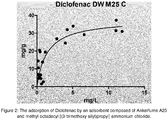
- Example 2 Determining the adsorption of the pharmaceutical Diclofenac by adsorbent material composed of either: silica or Ankerfume A25; and, dimethyl octadecyl [(3-trimethoxy silyl)propyl] ammonium chloride
- Adsorbent material AM1 was compared with a different material formed using silica as a comparative mineral.
- silica 10 kg was added to a Henschel FM 40 A mixer.
- the silica was a silica gel with a pore size of 60 ⁇ , pore volume of 0.8 cm 3 /g and a surface area of 500m 2 /g.
- 3.57 kg of a silane in solution in this example dimethyl octadecyl [(3-trimethoxy silyl)propyl] ammonium chloride (42% by weight solution of silane in methanol), was added to the mixer.
- the resultant mixture was mixed twice for five minutes at 1740 rpm.
- the resultant mixture was then dried at 90 °C in an oven.
- the resulting solid material was then washed with water and then dried again at 90 °C in an oven.
- the resulting solid material was adsorbent material, referred to as SIM1 in the following examples.
- the adsorbent materials of the present invention demonstrate strong adsorption capacity of the silane bonded to the surfaces of the minerals.
- surface modified Ankerfume A25 AM1
- SIM1 comparative surface modified silica
- the specific surface area of Ankerfume A25 forming the AM1 is 16-22 m 2 /g
- the specific surface area of the silica gel forming the SIM1 is 500 m 2 /g.
- Example 3 Determining the adsorption of different pharmaceuticals using an adsorbent composed of Ankerfume A25 and dimethyl octadecyl [(3-trimethoxy silyl)propyl] ammonium chloride
- Material AM1 was formed as set out in example 1.
- AM1 was then exposed to seven different pharmaceuticals, namely:
- Figures 3-9 depict the results.
- the figures show adsorption isotherms.
- the adsorption isotherms show the amounts of adsorbate adsorbed on the surface of adsorbent and the concentration of adsorbate in the solution.
- a series of solutions with different concentrations of pharmaceutical were prepared. The same amount of adsorbent material was added to a reaction vessel in each case.
- Figure 10 depicts the adsorption of six of the pharmaceuticals (all except diclofenac).
- an adsorbent material according to the presently claimed invention can successfully adsorb a variety of pharmaceuticals (all the seven different pharmaceuticals were adsorbed by the adsorbent material AM1).
- Example 4 Formulation of an adsorbent composed of Ankerfume A25 and dimethyl octadecyl [(3-trimethoxy silyl)propyl] ammonium chloride
- AM1 was formed as set out in Example 1.
- the AM1 was in powder form.
- Artificial urine was prepared using the formulation of Martinez et al., PNAS, 2008, 105(50), pp. 19606-19611 .
- the artificial urine solution contained 1.1mM lactic acid, 2.0mM citric acid, 25mM sodium bicarbonate, 170mM urea, 2.5mM calcium chloride, 90mM sodium chloride, 2.0mM magnesium sulfate, 10mM sodium sulfate, 7.0mM potassium dihydrogen phosphate, 7.0mM dipotassium hydrogen phosphate, and 25mM ammonium chloride.
- the components of the solution were mixed in Millipore-purified water.
- the pH of the solution was adjusted to 6.0 by addition of 1.0M hydrochloric acid.
- Diclofenac 28 mg/g Diclofenac was added to this artificial urine solution.
- the adsorbent material (AM1) in powder form was mixed with the artificial urine containing Diclofenac.
- the concentration of Diclofenac in solution was measured after five minutes. AM1 was found to adsorb most if not all of the Diclofenac.
- the AM1 making up the powder adsorbs pharmaceutical, for example Diclofenac.
- the solid particulate matter which in a toilet can be flushed away, is believed to contain the Diclofenac adsorbed to the silane on the surface of the Ankerfume A25. This solid material is easily filtered out of waste water. Therefore, the adsorbent material of the present invention provides a beneficial way of removing pharmaceuticals from waste materials, e.g. urine.
- a toilet block of approximately cuboid dimensions (6cm x 3cm x 3cm) can be formed in a mould in a humid environment.
- the toilet block can be placed in a suitably sized plastic container having holes in its sides to permit the flow of liquid into and out of the toilet block.
- Running a solution, e.g. an artificial urine solution, containing a pharmaceutical through the toilet block toilet block is believed to result in the adsorption of pharmaceutical from the solution.
- a toilet block formulated in this way falls apart, dropping solid particulate material into the water flushed from the toilet.
- the AM1 making up the toilet block adsorbs pharmaceutical, for example Diclofenac.
- the solid particulate matter which is flushed from the toilet is believed to contain the Diclofenac adsorbed to the silane on the surface of the Ankerfume A25. This solid material is easily filtered out of waste water. Therefore, the adsorbent material of the present invention provides a beneficial way of removing pharmaceuticals from waste materials, e.g. urine.
- the adsorbent material of the present invention may be formulated as urinal block.
- a urinal block is similar to toilet block, shaped appropriately for a urinal.
- the adsorbent material of the present invention may be formulated a gel. Such a gel can be placed on the rim of a toilet or urinal.
- the adsorbent material of the present invention may be formulated as granules or as a powder. Such granules or powder may be placed into a toilet or urinal prior to or during the use of a toilet or urinal. Alternatively, such granules or powder can be introduced into waste water downstream from a toilet or urinal.
Landscapes
- Chemical & Material Sciences (AREA)
- Analytical Chemistry (AREA)
- Organic Chemistry (AREA)
- Chemical Kinetics & Catalysis (AREA)
- Inorganic Chemistry (AREA)
- Life Sciences & Earth Sciences (AREA)
- Dispersion Chemistry (AREA)
- Geochemistry & Mineralogy (AREA)
- Solid-Sorbent Or Filter-Aiding Compositions (AREA)
- Pharmaceuticals Containing Other Organic And Inorganic Compounds (AREA)
Priority Applications (3)
| Application Number | Priority Date | Filing Date | Title |
|---|---|---|---|
| EP18189279.5A EP3610945A1 (de) | 2018-08-16 | 2018-08-16 | Material und verfahren zur entfernung von schadstoffen aus wasser |
| EP19742782.6A EP3837046A1 (de) | 2018-08-16 | 2019-07-29 | Material und verfahren zur entfernung von schadstoffen aus wasser |
| PCT/EP2019/070323 WO2020035295A1 (en) | 2018-08-16 | 2019-07-29 | A material and a method for the removal of pollutants from water |
Applications Claiming Priority (1)
| Application Number | Priority Date | Filing Date | Title |
|---|---|---|---|
| EP18189279.5A EP3610945A1 (de) | 2018-08-16 | 2018-08-16 | Material und verfahren zur entfernung von schadstoffen aus wasser |
Publications (1)
| Publication Number | Publication Date |
|---|---|
| EP3610945A1 true EP3610945A1 (de) | 2020-02-19 |
Family
ID=63491369
Family Applications (2)
| Application Number | Title | Priority Date | Filing Date |
|---|---|---|---|
| EP18189279.5A Withdrawn EP3610945A1 (de) | 2018-08-16 | 2018-08-16 | Material und verfahren zur entfernung von schadstoffen aus wasser |
| EP19742782.6A Withdrawn EP3837046A1 (de) | 2018-08-16 | 2019-07-29 | Material und verfahren zur entfernung von schadstoffen aus wasser |
Family Applications After (1)
| Application Number | Title | Priority Date | Filing Date |
|---|---|---|---|
| EP19742782.6A Withdrawn EP3837046A1 (de) | 2018-08-16 | 2019-07-29 | Material und verfahren zur entfernung von schadstoffen aus wasser |
Country Status (2)
| Country | Link |
|---|---|
| EP (2) | EP3610945A1 (de) |
| WO (1) | WO2020035295A1 (de) |
Families Citing this family (1)
| Publication number | Priority date | Publication date | Assignee | Title |
|---|---|---|---|---|
| CN116970137A (zh) * | 2023-07-25 | 2023-10-31 | 广东工业大学 | 高效吸附非甾体药物的有机框架材料及制备方法和应用 |
Citations (4)
| Publication number | Priority date | Publication date | Assignee | Title |
|---|---|---|---|---|
| DE2619609A1 (de) * | 1976-05-04 | 1977-11-17 | Dynamit Nobel Ag | Verfahren zur herstellung eines reaktiven montmorillonits |
| US20070181502A1 (en) * | 2006-02-07 | 2007-08-09 | James Harris | Adsorbent with multiple layers |
| US20170065927A1 (en) * | 2006-06-27 | 2017-03-09 | Nanoscape Ag | Coated molecular sieve |
| US20170274350A1 (en) * | 2014-09-12 | 2017-09-28 | Arkema France | Zeolite nanocrystal aggregates |
-
2018
- 2018-08-16 EP EP18189279.5A patent/EP3610945A1/de not_active Withdrawn
-
2019
- 2019-07-29 WO PCT/EP2019/070323 patent/WO2020035295A1/en not_active Ceased
- 2019-07-29 EP EP19742782.6A patent/EP3837046A1/de not_active Withdrawn
Patent Citations (4)
| Publication number | Priority date | Publication date | Assignee | Title |
|---|---|---|---|---|
| DE2619609A1 (de) * | 1976-05-04 | 1977-11-17 | Dynamit Nobel Ag | Verfahren zur herstellung eines reaktiven montmorillonits |
| US20070181502A1 (en) * | 2006-02-07 | 2007-08-09 | James Harris | Adsorbent with multiple layers |
| US20170065927A1 (en) * | 2006-06-27 | 2017-03-09 | Nanoscape Ag | Coated molecular sieve |
| US20170274350A1 (en) * | 2014-09-12 | 2017-09-28 | Arkema France | Zeolite nanocrystal aggregates |
Non-Patent Citations (2)
| Title |
|---|
| BRUNAUER ET AL.: "Adsorption of Gases in Multimolecular Layers", J. AM. CHEM. SOC., vol. 60, no. 2, 1938, pages 309 - 319, XP055374752, DOI: doi:10.1021/ja01269a023 |
| MARTINEZ ET AL., PNAS, vol. 105, no. 50, 2008, pages 19606 - 19611 |
Also Published As
| Publication number | Publication date |
|---|---|
| EP3837046A1 (de) | 2021-06-23 |
| WO2020035295A1 (en) | 2020-02-20 |
Similar Documents
| Publication | Publication Date | Title |
|---|---|---|
| Ajala et al. | Adsorptive removal of antibiotic pollutants from wastewater using biomass/biochar-based adsorbents | |
| Nguyen et al. | Metal‐organic framework MIL‐53 (Fe) as an adsorbent for Ibuprofen drug removal from aqueous solutions: response surface modeling and optimization | |
| Maleky et al. | Tetracycline adsorption from aqueous media by magnetically separable Fe3O4@ Methylcellulose/APTMS: isotherm, kinetic and thermodynamic studies | |
| Ahmadi et al. | Study survey of cupric oxide nanoparticles in removal efficiency of ciprofloxacin antibiotic from aqueous solution: adsorption isotherm study | |
| Mansour et al. | The use of activated carbon for the removal of pharmaceuticals from aqueous solutions: a review | |
| TWI424961B (zh) | 用於移除內分泌中斷性化合物之方法 | |
| Rauthula et al. | Studies on adsorption/desorption of nitrobenzene and humic acid onto/from activated carbon | |
| Shejale et al. | Evaluation of techniques for the remediation of antibiotic-contaminated water using activated carbon | |
| Shahmoradi et al. | Removal of nitrate from ground water using activated carbon prepared from rice husk and sludge of paper industry wastewater treatment | |
| Parashar et al. | Ciprofloxacin and metronidazole adsorption on chitosan-modified graphene oxide as single-compound and binary mixtures: Kinetics, isotherm, and sorption mechanism | |
| Vall et al. | Amine-modified mesoporous magnesium carbonate as an effective adsorbent for Azo dyes | |
| WO2020035295A1 (en) | A material and a method for the removal of pollutants from water | |
| Rahman et al. | Development of poly-o-toluidine zirconium (IV) ethylenediamine as a new adsorbent for nitrate: Equilibrium modelling and thermodynamic studies | |
| Balarak et al. | Nonlinear isotherms and kinetics and application error functions for adsorption of tetracycline on Lemna minor | |
| Nkwoada et al. | Removal of aspirin and chloroquine from aqueous solution using organo-clay derived from kaolinite | |
| Alabbad | Estimation the sorption capacity of chemically modified chitosan toward cadmium ion in wastewater effluents | |
| Adesokan et al. | Removal of trimethoprim from water using carbonized wood waste as adsorbents | |
| Shamsudin et al. | Thin adsorbent coating for contaminant of emerging concern (CEC) removal | |
| US20180236436A1 (en) | Liquid purification using activated carbon | |
| CN102120665B (zh) | 一种光催化净化水中五氯酚的方法 | |
| CN1329113C (zh) | 一种重金属离子吸附剂的制备方法 | |
| JP2002370023A (ja) | 汚染物質の吸着剤および吸着方法 | |
| Nijpanich et al. | Floating adsorbent for organic removal fabricated through crystallization of silicalite-1 on hollow glass microspheres | |
| Nirmala Rani et al. | Adsorption isotherm studies of the simultaneous removal of turbidity and hardness by natural coagulants | |
| CN105688843A (zh) | 一种污水重金属离子吸附剂的介孔碳材料及其制备方法 |
Legal Events
| Date | Code | Title | Description |
|---|---|---|---|
| PUAI | Public reference made under article 153(3) epc to a published international application that has entered the european phase |
Free format text: ORIGINAL CODE: 0009012 |
|
| AK | Designated contracting states |
Kind code of ref document: A1 Designated state(s): AL AT BE BG CH CY CZ DE DK EE ES FI FR GB GR HR HU IE IS IT LI LT LU LV MC MK MT NL NO PL PT RO RS SE SI SK SM TR |
|
| AX | Request for extension of the european patent |
Extension state: BA ME |
|
| STAA | Information on the status of an ep patent application or granted ep patent |
Free format text: STATUS: THE APPLICATION IS DEEMED TO BE WITHDRAWN |
|
| 18D | Application deemed to be withdrawn |
Effective date: 20200820 |