EP3612059B1 - Kartusche, anordnung und tasse zur herstellung von losem blatttee und verfahren zur herstellung von tee - Google Patents
Kartusche, anordnung und tasse zur herstellung von losem blatttee und verfahren zur herstellung von tee Download PDFInfo
- Publication number
- EP3612059B1 EP3612059B1 EP18727893.2A EP18727893A EP3612059B1 EP 3612059 B1 EP3612059 B1 EP 3612059B1 EP 18727893 A EP18727893 A EP 18727893A EP 3612059 B1 EP3612059 B1 EP 3612059B1
- Authority
- EP
- European Patent Office
- Prior art keywords
- wall
- cartridge
- chamber
- chamber wall
- cup
- Prior art date
- Legal status (The legal status is an assumption and is not a legal conclusion. Google has not performed a legal analysis and makes no representation as to the accuracy of the status listed.)
- Active
Links
Images



Classifications
-
- A—HUMAN NECESSITIES
- A47—FURNITURE; DOMESTIC ARTICLES OR APPLIANCES; COFFEE MILLS; SPICE MILLS; SUCTION CLEANERS IN GENERAL
- A47G—HOUSEHOLD OR TABLE EQUIPMENT
- A47G19/00—Table service
- A47G19/12—Vessels or pots for table use
- A47G19/16—Tea infusers, e.g. infusing bags, egg-shaped infuses
-
- A—HUMAN NECESSITIES
- A47—FURNITURE; DOMESTIC ARTICLES OR APPLIANCES; COFFEE MILLS; SPICE MILLS; SUCTION CLEANERS IN GENERAL
- A47G—HOUSEHOLD OR TABLE EQUIPMENT
- A47G19/00—Table service
- A47G19/22—Drinking vessels or saucers used for table service
-
- A—HUMAN NECESSITIES
- A47—FURNITURE; DOMESTIC ARTICLES OR APPLIANCES; COFFEE MILLS; SPICE MILLS; SUCTION CLEANERS IN GENERAL
- A47G—HOUSEHOLD OR TABLE EQUIPMENT
- A47G19/00—Table service
- A47G19/22—Drinking vessels or saucers used for table service
- A47G19/2205—Drinking glasses or vessels
- A47G19/2266—Means for facilitating drinking, e.g. for infants or invalids
- A47G19/2272—Means for facilitating drinking, e.g. for infants or invalids from drinking glasses or cups comprising lids or covers
-
- A—HUMAN NECESSITIES
- A47—FURNITURE; DOMESTIC ARTICLES OR APPLIANCES; COFFEE MILLS; SPICE MILLS; SUCTION CLEANERS IN GENERAL
- A47J—KITCHEN EQUIPMENT; COFFEE MILLS; SPICE MILLS; APPARATUS FOR MAKING BEVERAGES
- A47J31/00—Apparatus for making beverages
- A47J31/06—Filters or strainers for coffee or tea makers ; Holders therefor
- A47J31/0615—Filters or strainers for coffee or tea makers ; Holders therefor with special arrangements for making tea or the like, e.g. where the infusion liquid is kept a certain time in the filter before flowing out
-
- A—HUMAN NECESSITIES
- A47—FURNITURE; DOMESTIC ARTICLES OR APPLIANCES; COFFEE MILLS; SPICE MILLS; SUCTION CLEANERS IN GENERAL
- A47J—KITCHEN EQUIPMENT; COFFEE MILLS; SPICE MILLS; APPARATUS FOR MAKING BEVERAGES
- A47J31/00—Apparatus for making beverages
- A47J31/18—Apparatus in which ground coffee or tea-leaves are immersed in the hot liquid in the beverage container
- A47J31/20—Apparatus in which ground coffee or tea-leaves are immersed in the hot liquid in the beverage container having immersible, e.g. rotatable, filters
-
- B—PERFORMING OPERATIONS; TRANSPORTING
- B65—CONVEYING; PACKING; STORING; HANDLING THIN OR FILAMENTARY MATERIAL
- B65D—CONTAINERS FOR STORAGE OR TRANSPORT OF ARTICLES OR MATERIALS, e.g. BAGS, BARRELS, BOTTLES, BOXES, CANS, CARTONS, CRATES, DRUMS, JARS, TANKS, HOPPERS, FORWARDING CONTAINERS; ACCESSORIES, CLOSURES, OR FITTINGS THEREFOR; PACKAGING ELEMENTS; PACKAGES
- B65D43/00—Lids or covers for rigid or semi-rigid containers
- B65D43/02—Removable lids or covers
- B65D43/0202—Removable lids or covers without integral tamper element
- B65D43/0204—Removable lids or covers without integral tamper element secured by snapping over beads or projections
- B65D43/0212—Removable lids or covers without integral tamper element secured by snapping over beads or projections only on the outside, or a part turned to the outside, of the mouth
-
- B—PERFORMING OPERATIONS; TRANSPORTING
- B65—CONVEYING; PACKING; STORING; HANDLING THIN OR FILAMENTARY MATERIAL
- B65D—CONTAINERS FOR STORAGE OR TRANSPORT OF ARTICLES OR MATERIALS, e.g. BAGS, BARRELS, BOTTLES, BOXES, CANS, CARTONS, CRATES, DRUMS, JARS, TANKS, HOPPERS, FORWARDING CONTAINERS; ACCESSORIES, CLOSURES, OR FITTINGS THEREFOR; PACKAGING ELEMENTS; PACKAGES
- B65D51/00—Closures not otherwise provided for
- B65D51/24—Closures not otherwise provided for combined or co-operating with auxiliary devices for non-closing purposes
- B65D51/28—Closures not otherwise provided for combined or co-operating with auxiliary devices for non-closing purposes with auxiliary containers for additional articles or materials
- B65D51/2807—Closures not otherwise provided for combined or co-operating with auxiliary devices for non-closing purposes with auxiliary containers for additional articles or materials the closure presenting means for placing the additional articles or materials in contact with the main contents by acting on a part of the closure without removing the closure, e.g. by pushing down, pulling up, rotating or turning a part of the closure, or upon initial opening of the container
-
- B—PERFORMING OPERATIONS; TRANSPORTING
- B65—CONVEYING; PACKING; STORING; HANDLING THIN OR FILAMENTARY MATERIAL
- B65D—CONTAINERS FOR STORAGE OR TRANSPORT OF ARTICLES OR MATERIALS, e.g. BAGS, BARRELS, BOTTLES, BOXES, CANS, CARTONS, CRATES, DRUMS, JARS, TANKS, HOPPERS, FORWARDING CONTAINERS; ACCESSORIES, CLOSURES, OR FITTINGS THEREFOR; PACKAGING ELEMENTS; PACKAGES
- B65D85/00—Containers, packaging elements or packages, specially adapted for particular articles or materials
- B65D85/70—Containers, packaging elements or packages, specially adapted for particular articles or materials for materials not otherwise provided for
- B65D85/804—Disposable containers or packages with contents which are mixed, infused or dissolved in situ, i.e. without having been previously removed from the package
- B65D85/808—Disposable containers or packages with contents which are mixed, infused or dissolved in situ, i.e. without having been previously removed from the package for immersion in the liquid to release part or all of their contents, e.g. tea bags
-
- B—PERFORMING OPERATIONS; TRANSPORTING
- B65—CONVEYING; PACKING; STORING; HANDLING THIN OR FILAMENTARY MATERIAL
- B65D—CONTAINERS FOR STORAGE OR TRANSPORT OF ARTICLES OR MATERIALS, e.g. BAGS, BARRELS, BOTTLES, BOXES, CANS, CARTONS, CRATES, DRUMS, JARS, TANKS, HOPPERS, FORWARDING CONTAINERS; ACCESSORIES, CLOSURES, OR FITTINGS THEREFOR; PACKAGING ELEMENTS; PACKAGES
- B65D85/00—Containers, packaging elements or packages, specially adapted for particular articles or materials
- B65D85/70—Containers, packaging elements or packages, specially adapted for particular articles or materials for materials not otherwise provided for
- B65D85/804—Disposable containers or packages with contents which are mixed, infused or dissolved in situ, i.e. without having been previously removed from the package
- B65D85/808—Disposable containers or packages with contents which are mixed, infused or dissolved in situ, i.e. without having been previously removed from the package for immersion in the liquid to release part or all of their contents, e.g. tea bags
- B65D85/812—Disposable containers or packages with contents which are mixed, infused or dissolved in situ, i.e. without having been previously removed from the package for immersion in the liquid to release part or all of their contents, e.g. tea bags with features facilitating their manipulation or suspension
-
- B—PERFORMING OPERATIONS; TRANSPORTING
- B65—CONVEYING; PACKING; STORING; HANDLING THIN OR FILAMENTARY MATERIAL
- B65D—CONTAINERS FOR STORAGE OR TRANSPORT OF ARTICLES OR MATERIALS, e.g. BAGS, BARRELS, BOTTLES, BOXES, CANS, CARTONS, CRATES, DRUMS, JARS, TANKS, HOPPERS, FORWARDING CONTAINERS; ACCESSORIES, CLOSURES, OR FITTINGS THEREFOR; PACKAGING ELEMENTS; PACKAGES
- B65D85/00—Containers, packaging elements or packages, specially adapted for particular articles or materials
- B65D85/70—Containers, packaging elements or packages, specially adapted for particular articles or materials for materials not otherwise provided for
- B65D85/804—Disposable containers or packages with contents which are mixed, infused or dissolved in situ, i.e. without having been previously removed from the package
- B65D85/816—Disposable containers or packages with contents which are mixed, infused or dissolved in situ, i.e. without having been previously removed from the package into which liquid is added and the resulting preparation is retained, e.g. cups preloaded with powder or dehydrated food
-
- B—PERFORMING OPERATIONS; TRANSPORTING
- B65—CONVEYING; PACKING; STORING; HANDLING THIN OR FILAMENTARY MATERIAL
- B65D—CONTAINERS FOR STORAGE OR TRANSPORT OF ARTICLES OR MATERIALS, e.g. BAGS, BARRELS, BOTTLES, BOXES, CANS, CARTONS, CRATES, DRUMS, JARS, TANKS, HOPPERS, FORWARDING CONTAINERS; ACCESSORIES, CLOSURES, OR FITTINGS THEREFOR; PACKAGING ELEMENTS; PACKAGES
- B65D2543/00—Lids or covers essentially for box-like containers
- B65D2543/00009—Details of lids or covers for rigid or semi-rigid containers
- B65D2543/00018—Overall construction of the lid
- B65D2543/00046—Drinking-through lids
-
- B—PERFORMING OPERATIONS; TRANSPORTING
- B65—CONVEYING; PACKING; STORING; HANDLING THIN OR FILAMENTARY MATERIAL
- B65D—CONTAINERS FOR STORAGE OR TRANSPORT OF ARTICLES OR MATERIALS, e.g. BAGS, BARRELS, BOTTLES, BOXES, CANS, CARTONS, CRATES, DRUMS, JARS, TANKS, HOPPERS, FORWARDING CONTAINERS; ACCESSORIES, CLOSURES, OR FITTINGS THEREFOR; PACKAGING ELEMENTS; PACKAGES
- B65D2543/00—Lids or covers essentially for box-like containers
- B65D2543/00009—Details of lids or covers for rigid or semi-rigid containers
- B65D2543/00018—Overall construction of the lid
- B65D2543/00064—Shape of the outer periphery
- B65D2543/00074—Shape of the outer periphery curved
- B65D2543/00092—Shape of the outer periphery curved circular
-
- B—PERFORMING OPERATIONS; TRANSPORTING
- B65—CONVEYING; PACKING; STORING; HANDLING THIN OR FILAMENTARY MATERIAL
- B65D—CONTAINERS FOR STORAGE OR TRANSPORT OF ARTICLES OR MATERIALS, e.g. BAGS, BARRELS, BOTTLES, BOXES, CANS, CARTONS, CRATES, DRUMS, JARS, TANKS, HOPPERS, FORWARDING CONTAINERS; ACCESSORIES, CLOSURES, OR FITTINGS THEREFOR; PACKAGING ELEMENTS; PACKAGES
- B65D2543/00—Lids or covers essentially for box-like containers
- B65D2543/00009—Details of lids or covers for rigid or semi-rigid containers
- B65D2543/00018—Overall construction of the lid
- B65D2543/00259—Materials used
- B65D2543/00296—Plastic
-
- B—PERFORMING OPERATIONS; TRANSPORTING
- B65—CONVEYING; PACKING; STORING; HANDLING THIN OR FILAMENTARY MATERIAL
- B65D—CONTAINERS FOR STORAGE OR TRANSPORT OF ARTICLES OR MATERIALS, e.g. BAGS, BARRELS, BOTTLES, BOXES, CANS, CARTONS, CRATES, DRUMS, JARS, TANKS, HOPPERS, FORWARDING CONTAINERS; ACCESSORIES, CLOSURES, OR FITTINGS THEREFOR; PACKAGING ELEMENTS; PACKAGES
- B65D2543/00—Lids or covers essentially for box-like containers
- B65D2543/00009—Details of lids or covers for rigid or semi-rigid containers
- B65D2543/00444—Contact between the container and the lid
- B65D2543/00481—Contact between the container and the lid on the inside or the outside of the container
- B65D2543/0049—Contact between the container and the lid on the inside or the outside of the container on the inside, or a part turned to the inside of the mouth of the container
- B65D2543/00527—NO contact
-
- B—PERFORMING OPERATIONS; TRANSPORTING
- B65—CONVEYING; PACKING; STORING; HANDLING THIN OR FILAMENTARY MATERIAL
- B65D—CONTAINERS FOR STORAGE OR TRANSPORT OF ARTICLES OR MATERIALS, e.g. BAGS, BARRELS, BOTTLES, BOXES, CANS, CARTONS, CRATES, DRUMS, JARS, TANKS, HOPPERS, FORWARDING CONTAINERS; ACCESSORIES, CLOSURES, OR FITTINGS THEREFOR; PACKAGING ELEMENTS; PACKAGES
- B65D2543/00—Lids or covers essentially for box-like containers
- B65D2543/00009—Details of lids or covers for rigid or semi-rigid containers
- B65D2543/00444—Contact between the container and the lid
- B65D2543/00481—Contact between the container and the lid on the inside or the outside of the container
- B65D2543/00537—Contact between the container and the lid on the inside or the outside of the container on the outside, or a part turned to the outside of the mouth of the container
-
- B—PERFORMING OPERATIONS; TRANSPORTING
- B65—CONVEYING; PACKING; STORING; HANDLING THIN OR FILAMENTARY MATERIAL
- B65D—CONTAINERS FOR STORAGE OR TRANSPORT OF ARTICLES OR MATERIALS, e.g. BAGS, BARRELS, BOTTLES, BOXES, CANS, CARTONS, CRATES, DRUMS, JARS, TANKS, HOPPERS, FORWARDING CONTAINERS; ACCESSORIES, CLOSURES, OR FITTINGS THEREFOR; PACKAGING ELEMENTS; PACKAGES
- B65D2543/00—Lids or covers essentially for box-like containers
- B65D2543/00009—Details of lids or covers for rigid or semi-rigid containers
- B65D2543/00444—Contact between the container and the lid
- B65D2543/00592—Snapping means
- B65D2543/00601—Snapping means on the container
- B65D2543/00611—Profiles
- B65D2543/00629—Massive bead
-
- B—PERFORMING OPERATIONS; TRANSPORTING
- B65—CONVEYING; PACKING; STORING; HANDLING THIN OR FILAMENTARY MATERIAL
- B65D—CONTAINERS FOR STORAGE OR TRANSPORT OF ARTICLES OR MATERIALS, e.g. BAGS, BARRELS, BOTTLES, BOXES, CANS, CARTONS, CRATES, DRUMS, JARS, TANKS, HOPPERS, FORWARDING CONTAINERS; ACCESSORIES, CLOSURES, OR FITTINGS THEREFOR; PACKAGING ELEMENTS; PACKAGES
- B65D2543/00—Lids or covers essentially for box-like containers
- B65D2543/00009—Details of lids or covers for rigid or semi-rigid containers
- B65D2543/00444—Contact between the container and the lid
- B65D2543/00592—Snapping means
- B65D2543/00601—Snapping means on the container
- B65D2543/00675—Periphery concerned
- B65D2543/00685—Totality
-
- B—PERFORMING OPERATIONS; TRANSPORTING
- B65—CONVEYING; PACKING; STORING; HANDLING THIN OR FILAMENTARY MATERIAL
- B65D—CONTAINERS FOR STORAGE OR TRANSPORT OF ARTICLES OR MATERIALS, e.g. BAGS, BARRELS, BOTTLES, BOXES, CANS, CARTONS, CRATES, DRUMS, JARS, TANKS, HOPPERS, FORWARDING CONTAINERS; ACCESSORIES, CLOSURES, OR FITTINGS THEREFOR; PACKAGING ELEMENTS; PACKAGES
- B65D2543/00—Lids or covers essentially for box-like containers
- B65D2543/00009—Details of lids or covers for rigid or semi-rigid containers
- B65D2543/00444—Contact between the container and the lid
- B65D2543/00592—Snapping means
- B65D2543/00712—Snapping means on the lid
- B65D2543/00722—Profiles
- B65D2543/00731—Groove or hollow bead
-
- B—PERFORMING OPERATIONS; TRANSPORTING
- B65—CONVEYING; PACKING; STORING; HANDLING THIN OR FILAMENTARY MATERIAL
- B65D—CONTAINERS FOR STORAGE OR TRANSPORT OF ARTICLES OR MATERIALS, e.g. BAGS, BARRELS, BOTTLES, BOXES, CANS, CARTONS, CRATES, DRUMS, JARS, TANKS, HOPPERS, FORWARDING CONTAINERS; ACCESSORIES, CLOSURES, OR FITTINGS THEREFOR; PACKAGING ELEMENTS; PACKAGES
- B65D2543/00—Lids or covers essentially for box-like containers
- B65D2543/00009—Details of lids or covers for rigid or semi-rigid containers
- B65D2543/00444—Contact between the container and the lid
- B65D2543/00592—Snapping means
- B65D2543/00712—Snapping means on the lid
- B65D2543/00787—Periphery concerned
- B65D2543/00796—Totality
Definitions
- the invention relates to cartridges, assemblies and cups for preparing loose leaf tea and methods of preparing tea from loose leaves.
- United States patent application publication US20060226147 discloses a disposable lid for a cup which provides for use of a beverage bag unit comprising a beverage bag and a drawstring connected to the beverage bag.
- the lid comprises a flange for attachment to a cup and a body unit comprising a body section including an aperture through which the drawstring is slideable, and at least one wing member operable to allow a user to squeeze and/or hold the beverage bag when in a raised position.
- WO2013162438A1 discloses a lid for a cup used for preparation of beverages in the cup.
- the lid has a cover portion with a shape corresponding to the shape of the opening of the cup.
- a lip part is integrated with the cover portion in order to achieve a detachable connection with the opening of the cup.
- the lid has a down-hanging, stationary, shape permanent receptacle adapted to receive a product in loose weight for brewing beverages.
- the receptacle is equipped with perforations.
- WO2013162438A1 discloses that in order to close the perforations, the lid has a, thin plate-shaped, laminar closing member.
- the desired amount of tea loose is put into the receptacle through the opening.
- hot water is added to the cup and the lid is placed on top of the cup, preferably a disposable cup.
- the tea will be brewed when the hot water comes into contact with the tea in the receptacle.
- the closing member is used, and pushed into guidings inside the receptacle to close-off the perforations from the inside.
- the present invention provides a cartridge attachable to a cup for controlled brewing of loose-leaf tea in the cup, an assembly of a cartridge and a, disposable or non-disposable, cup, as well as a method of preparing tea, as described in the accompanying claims.
- the cartridge as used herein may be a prefabricated receptacle that can be easily inserted in, and attached to, a drinking cup from which a human consumer will drink the beverage and which allows a controllable release of flavouring substances into a consumable liquid in the cup, controlled by the consumer.
- a receptacle e.g. loose tea leaves (or other flavouring substances) can be provided to be controllable released into a liquid in the cup, e.g. be extraction or solution.
- the cartridge may be such that it can be closed-off to keep the flavouring substances into the receptacle, at least until the consumer releases them into the liquid.
- the cartridge may be permanently or releasably attachable to the cup, e.g. by laterally moving the cartridge into the cup without rotation.
- the cartridge may be pressed on the rim of the cup to lock an interlocking mechanism.
- the cartridge may be replaced with another interchangeable cartridge, for instance in case of a non-disposable cup.
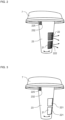
- the shown example of a cartridge 1 comprises an infusion chamber 2 for containing loose tea leaves 3 and infusing the portion 40 of the liquid 4 inside the infusion chamber 2 with substances from the tea leaves 3 to brew tea.
- the infusion chamber 2 is defined by a chamber wall 20 which is impervious to the liquid 4.
- a passage 21 is provided between the infusion chamber 2 and an exterior 5 thereof, i.e. the rest of the cup 100 when placed thereon.
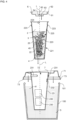
- the passage 21 has an open state, as illustrated in FIG. 2 , in which the infusion chamber 2 is in liquid communication with the exterior 5, to transfer, as indicated with the arrows, the substances from the liquid 40 in the infusion chamber into the portion of the liquid 41 in the exterior 5 during brewing tea, e.g. through convection and/or diffusion.
- the passage 21 has a closed state in which the liquid 40 inside the infusion chamber is closed off from the liquid 41 in the cup outside the infusion chamber 2 and thus the concentration of the substances in the liquid in the exterior stopped from increasing.
- the cartridge 1 has a manual control 6 which is manually controllable by a human-being and allows to bring the passage 21 from the open state into the closed state, as illustrated in FIG 3 . It will be apparent from the FIGs. that in the shown example, the opening and closing is not motorized and that the cartridge does not have an actuator, e.g. an electromotor. A manual control is therefore the only manner in which a user can bring the opening into the open or closed state. This allows for a simple operation of the cartridge without a complex, e.g. battery operated, powered assembly being required.
- a consumer can manually control the strength of the tea to his or hers individual taste.
- the brewing of tea and especially the strength thereof can be stopped easily, without requiring to remove the cartridge 1 from the cup 100 as would be with the known tea-bag based solutions, and without requiring a dedicated computer interface to control the brewing.
- the cartridge 1 allows to avoid a messy situation with e.g. dripping tea-bags while providing a controllable brewing process.
- the infusion chamber 2 provides a confined and protecting environment for the tea leaves and thus allows to prepare tea of a higher quality.
- the cartridge 1 can be used to prepare tea (or other hot drinks or cold drinks - like citronade or mint water).
- FIG. 4 shows the cartridge 1 placed into a cup 100 which is filled with a liquid 4 and more specific shows that a cartridge 1 is provided on a top rim 101 of the cup 100.
- a liquid 4 suitable to prepare tea e.g. hot water, milk, lemon juice or other suitable (mixture of) liquid(s), and optionally flavourings like sugar, sliced lemon etc, for example with a temperature equal to or above 65 °C, e.g.
- the cartridge 1 may be made of a material which withstands such hot liquid, and e.g. be a disposable cartridge such as made of (coated) paper or a suitable (thermo-)plastic as commonly known for disposable cups. Also, the disposable cartridge may be made of a bio-degradable material. Alternatively, the cartridge 1 can be non-disposable and e.g. be dishwasher proof, and e.g. made of a thermoset plastic, a thermoplastic with a glass transition point above 100 °C, glass ceramics or other suitable non-disposable material.
- the passage 21 When the tea leaves are brought into contact with the liquid 40 in the infusion chamber 2, substances from the tea leaves 3 will be released therein.
- the passage 21 When the passage 21 is open, the substances will be transported into the rest of the cup, e.g. by convection and/or diffusion.
- the passage 21 is brought in the closed state by a human-being, e.g. when the liquid 41 outside the infusion chamber 2 has a desired concentration of substances extracted from the tea leaves.
- the passage 21 can also be brought from the closed state back into the open state.
- a consumer can for example stop the brewing by closing the passage 21, taste the tea to determine if the strength matches the consumer's personal preferences, and reopen the passage 21 if the prepared tea is not strong enough to the individual's taste.
- this allows to refill the cup with new liquid and prepare several cups of tea with a single cartridge.
- the cartridge 1 may be releasably attached to the cup 100.
- the cartridge 1 may be permanently attached to the cup 1 to inhibit unwanted refills.
- the cartridge 1 can e.g. be assembled with the passage 21 closed, such that the brewing does not start immediately upon bringing the cartridge 1 in contact with liquid in a cup 100 (either by placing the cartridge 1 in a liquid-filled cup or filling a cup in which the cartridge is placed with liquid) but only at a point in time the passage 21 is opened. This allows a user to select the point in time the liquid 41 outside the infusion chamber 2 actually starts being transformed into tea by opening the passage 21. Such can be convenient e.g. when the cup will be transported after filling with liquid and placing the cartridge, e.g. from the location where this takes place to a, relatively, remote location where the consumer will drink the tea (and after drinking dispose of at least the cartridge 1).
- the infusion chamber 2 may be implemented in any manner suitable for the specific implementation.
- the infusion chamber has a defined shape determined by the chamber wall 20.
- the chamber wall 20 is impervious to the liquid 40 in the infusion chamber 2 and, under normal circumstances, retains its shape when brewing tea.
- the chamber wall 20 has a liquid tight inner surface 220 facing the infusion chamber 2, which defines the inside of the infusion chamber 2, and an outer surface 221 facing away from the infusion chamber towards the exterior 5.
- the passage 21 comprises an opening 22 in the chamber wall 20 between the inner surface 220 and the outer surface 221.
- the opening may be shaped differently, in this example, the opening comprises a perforated region 222 of the chamber wall 20.
- the chamber wall 20 is of a closed material, except for the perforated region 222.
- the opening can be created in a simple manner, e.g. by simply perforating the region 222, and allows to create a passage which can retain the tea leaves in the infusion chamber.
- the perforations can be sufficiently small to retain loose tea leaves in the infusion chamber 2, such as with a diameter equal to or less than 5 mm, e.g. equal to or less than 2 mm, such as equal to or less than 1 mm, although other sizes may be suitable as well.
- the cartridge 1 further comprises an outer wall 23.
- the chamber wall 20 and the outer wall 23 are made of a material which is impervious to the liquid. Except for the opening 22, the chamber wall 20 thus closes-off the infusion chamber 2. Where the outer wall 23 covers the outer surface 221 of the chamber wall 20, these covered parts are separated, e.g. sealed, from the exterior 5 by the outer wall 23. When the outer wall 23 covers the opening 22, the opening 22 is thus closed off for the liquid 41 outside the infusion chamber 2.
- the outer wall 23 is movable relative to the chamber wall 20 to cover, and close, the opening 22 in the chamber wall 20. This allows a mechanically simple manual control, e.g. by manually sliding, rotating or otherwise moving the outer wall 23 relatively to the chamber wall 20.
- the passage 21 includes one or more windows 230 in the outer wall 23, which leaves a part of the chamber wall 20 exposed.
- the manual control 6 engages in this example on the chamber wall 20 to move the chamber wall relative to the outer wall 23, to position the window 230 to overlap with the opening 22, in this example the perforated region 222, in the chamber wall and thereby bring the passage in the open state.
- the opening 22 in the chamber wall can be implemented differently and, e.g. as a window (see FIG. 8 ) or as one or more narrow slits, as can be seen in FIG. 7 .
- the outer wall 23 may be provided with another type of aperture, such as perforations, slides or otherwise which can be moved to expose the opening in the chamber wall 20 to the exterior 5, as e.g. shown in FIG. 8 .
- the manual control 6 may, as e.g. shown in FIG. 10 , engage on the outer wall 23 to move the outer wall relative to the chamber wall.
- the chamber wall 20 is shaped as a container for the loose tea leaves and the outer wall 23 is shaped as a receptacle which holds the container.
- the container is movable relative to the receptacle to bring the passage into the open state or the closed state. This allows to assemble the cartridge 1 in a simple manner, by simply placing the container in the receptacle, as indicated with the arrows in FIG. 4 .
- the chamber wall may have a different shape and, e.g.
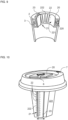
- the chamber wall 20 may e.g. be a rectangular cuboid as illustrated in FIG. 10 , which allows to stack the chambers in an easy manner.
- the cartridge comprises two interlocking members 20, 23 movable relative to each other.
- the chamber wall 20 is rotatable (relative to the outer wall 23) around a longitudinal axis L thereof and comprises a protrusion 223 at the outer surface.
- the outer wall is provided at an inside thereof with a groove 231 extending in tangential direction relative to the longitudinal axis in which the protrusion is movably accepted.
- the protrusion 223 and groove 231 provide an interlocking engagement between the members. If the members are resiliently deformable, the fixation can be obtained by simply inserting the protrusion into the groove with sufficient force. To obtain a releasable attachment, the groove 231 may extend to the entrance of the axial passage 72, which allows to slide the protrusion 223 into the groove without deformation. This allows to reuse the cartridge with fresh tea leaves.
- the chamber wall 20 is shaped as a first tube with an outer diameter smaller than an inner diameter of the outer wall 23, which is shaped as a second tube.
- at least one of said tubes is closed off at a cup-side end, in the drawings at the bottom thereof. This ensures that the leaves and liquid are retained in the infusion chamber 2 when the passage is closed off.
- the second tube is open at a top side end, which allows to insert the first tube and, hence, assemble the cartridge 1.
- Such tubes can be shaped without undercuts and hence manufactured in a simple manner e.g. using a one-piece mould.
- the tubes can fit tightly and an outer surface of the first tube abuts to an inner surface of the second tube when the first tube is inserted in the second tube. This allows to enable the movement while having a sufficient sealing of the opening when the passage 21 is closed.
- the tubes are just an example where the outer wall 23 and the chamber wall 20 are both cup-shaped.
- Other types of cup shapes such as conforming bowls or other shapes may be suitable as well.
- the chamber wall 20 fits tightly into the outer wall. When moving the walls relative to each other there will, therefore, be some friction which allows to ensure that the outer wall seals of the covered parts of the chamber wall in a simple manner.
- the outer wall 23 may have a different shape and for example, be a sheet which covers only a part of the chamber wall and which can be slid to cover the outer surface 222 or, as illustrated in FIG. 6 , be a flat leg-shaped member which is slidably clamped on the chamber wall 20, as illustrated in FIG. 7 , be a sleeve provided with a suitable aperture in which the container is inserted and which can be rotated to expose the opening in the chamber wall 20, as shown in FIG. 8 to just name a few.
- the cartridge 1 comprises a top, lid-shaped portion 7 which allows to cover the cup 100.
- the lid-shaped portion 7 covers the cup and thus reduces heat losses and accordingly slows down the dropping of the temperature of the tea.
- the lid-shaped portion 7 is provided with a drinking funnel 70 which enables the user to drink the liquid 41 in the cup outside the infusion chamber 2 when the cartridge 1 is in place.
- the portion 7 has an outer annular flange 71, which interlocks with the top-rim 101 of the cup, which is suitable for a disposable cartridge 1.
- the cartridge 1 may releasably attached to the cup 100, e.g. using a watertight releasable seal.
- FIGs. 1-4 comprises an excess liquid outlet 225 in the chamber wall which is located above the passage, for transferring excess liquid from the infusion chamber 2 when the cartridge 1 is tilted around a horizontal axis.
- the outer wall is provided with a corresponding window 232 which is open when the passage 21 is closed, to drain excess liquid from the chamber 2 when drinking. More specifically, when the cup in which the cartridge is tilted to start drinking, the excess liquid outlet 225 will be at the lower side (i.e. towards the user) and excess liquid will be drained out of the chamber into the exterior by gravity. When the cup is turned back in upright position, the liquid level outside the chamber will be lower than the excess liquid outlet 225 and, hence, not flow back into the chamber. This allows to avoid messy situations caused by a dripping container.
- the excess liquid outlet enables easy mass production of the product while allowing to remove the excess fluid from the chamber. Additionally or alternatively, the excess liquid outlet enables as well to establish a circulating liquid flow between the chamber and the inside of the cup, which mixes the content of the chamber with the liquid inside the cup, e.g., to extract flavoring substances from the tea-leaves or to dissolve soluble substances (such as sugar or milk powder). This obviates the need for mechanical components, such as, for example a mixer, or the use of a spoon by the consumer.
- the chamber wall 20 extends from the lid-shaped portion 7 and encloses the infusion chamber. More specific, in this example, the lid-shaped portion 7 is part of an integral member which is formed into the outer wall 23. As best seen in FIG. 1 , the lid-shaped portion 7 has an annular shape attached to the outer wall 23, such that the outer wall forms a pouch-shaped receptacle behind the axial passage 72 of the annular shape in which the chamber wall 20 can be received. Said differently, the axial passage 72 is a blind hole in which the infusion chamber fits.
- the lid-shaped portion 7 has a shape which allows it to be nested with similar components.
- the chamber wall 20 has a shape which allows it to be nested with similar components. More specifically, the axial passage 72 and the chamber wall 20 have a tapered shape, which narrows towards the bottom. This allows to nest multiple chamber walls and to nest multiple lid-shaped portions 7. In addition, this provides a strong construction which resists torque induced deformation with a relatively thin wall, which in addition can be mass manufactured with a mould.
- the lid-shaped portion 7 is strengthened to withstand torque induced deformation. More specifically, the annular lid has a rim which projects upwards and which, in this example, has a cross section of a U-shape turned upwards down, with a skirt which forms the flange which projects downwards to interlock on the rim of the cup.
- the rim on the lid has thus been elevated, which provides additional strength to withstand the friction, and torque resulting therefrom, when opening and closing the chamber wall by rotating the chamber.
- This strengthening allows to have relatively thin, not so rigid, material like thermoplastics or paper.
- the chamber wall 20 can be inserted through the axial passage into the receptacle, i.e. the outer wall 23.
- a cup 100 can be prefilled with hot liquid and covered with the lid-shaped portion 7 to avoid the liquid from cooling too fast and sometime later the container 22 with tea leaves inserted into the receptacle to start the brewing in the infusion chamber 2.
- the chamber wall 20 can be inserted into the receptacle by exerting a force until the protrusion 223 interlocks with the groove 231 and, hence, is attached to the receptacle.
- This allows a permanent, movable attachment and hence, is suitable for a disposable cartridge.
- the cartridge 1 can comprise a cover 6 for covering a top-side of the space (i.e. the infusion chamber 2) enclosed by the chamber wall 20 and which interlocks therewith.
- the infusion chamber 2 can be pre-filled with loose tea leaves, closed off and be placed on for instance the shelf to wait for a customer to order a cup of tea.
- the cover 6 can exert a force on the chamber wall to move the chamber wall.
- the cover is provided with a grip 60 for manually moving the chamber wall 20 relative to the outer wall 23.
- the grip 60 is formed by a ridge which extends radially through the axial centre of the cover and which allows to manually rotate the cover which is transferred through the interlocking attachment to the chamber wall 20 and will thus, rotate the chamber wall 20 relative to the outer wall 23, to open or close the passage 21.
- the cover 6 is shaped as a rotary knob rotatable relative to the outer wall and mechanically attached to the chamber wall 20 to transfer the rotational movement of the rotary knob to a rotational movement of the chamber wall 20.
- the shown example of a cover 6 has a rim 62, which interlocks with the chamber wall 20. More specifically, the rim 62 is provided with one or more protrusions 61 which fit into a hole 224 in the chamber wall 20.
- the cover 6 locks permanently, i.e. is not releasable without excessive force and without damaging the cover 6, and/or the chamber wall 20. This allows to stop unwanted reuse by e.g. refilling the chamber 2 with fresh leaves after use.
- the cover 6 may be releasable attached to the chamber wall, e.g. by a threaded connection. The attachment of the cover 6 to the wall 20 allows to exert a rotating force on the chamber wall 20.
- a user can exert the force by inserting his or her fingers into an annular recess 63 enclosed by the rim 62.
- An elongated projection 60 is located in the recess.
- the elongated projection 60 has sidewalls 64, which project from the bottom 63 of the recess 64, which the user can pinch between his fingers because the distance between the sidewalls and the rim is sufficient to admit a finger top in the recess between the elongated projection and the rim.
- the rotating force on the projection 60 will rotate the cover 6 and, by the interlocking attachment, rotate the chamber wall 20.
- a second elongated projection 60 may be provided which extends perpendicular to the first elongated projection, such that a cross-shaped grip is obtained.
- the control, e.g. cover 6, and the lid-shaped portion 7 may both be provided with an optical marker to indicate their relative position, and allow a user to identify whether or not the passage 21 is open or closed.
- the elongated projection 60 itself can be used as an optical marker and the lid-shaped portion 7 can be provided with one or more indicator(s), towards which the elongated projection 60 points, when the passage 21 is open or closed.
- the cover 6 is separated from the cup.
- the cover 6 may be attached to the cup, or to the cartridge prior to use, e.g. by tearable strip between the cover and the other part.
- the outer wall and/or the chamber wall and/or the cover each have a top side with a shape which conforms to the bottom side.
- the outer wall and/or the chamber wall and/or the cover are nestable and several outer walls and/or chamber walls and/or covers can be stacked onto each other in a compact manner.
- the cartridge can be compartmentalized in order to provide more variation of the extracts as well as usage of sugar, syrup and the sorts.
- the cartridge may include various chambers 501-504 filled with flavoring substances, such as solid, non-soluble parts from which flavoring substances can be extracted or extracts (i.e. concentrated flavoring liquids or soluble solids).
- Each of the chambers has a respective passage in the chamber wall. A controlled release of the different flavoring substances into the cup can then be obtained by opening and closing the passages in an order and for a duration controlled by the consumer.
- one or more chambers with aromatic flavorings may be opened first to give the liquid a base flavoring, such a tea, fruit or other flavor, and closed after a period of time determined by the consumer. Thereafter, a chamber with a sweeting flavoring, e.g. sugar or another soluble sweetener, can be opened, which again is closed after a period of time determined by the consumer. Also, a chamber with e.g. dairy products may be provided, such as with milk powder or sterilized milk.
- reservoirs (pre-)filled with extracts may be provided, which are sealed-off with a sealing strip.
- the reservoirs may be opened to release the extract by removing, e.g. tearing, the sealing strip from the reservoir, which allows the extract to mix with the liquid.
- the sealing strip then ensures that the cartridge with extract will not leak until usage in the lid.
- advertisement or other graphics can be printed on the side of the cartridges and the lid during production.
- the graphics may be printed (e.g. by applying a suitable ink or paint pattern, engraving or otherwise).
- the cartridge, and the cup (if provided with the cartridge), may be manufactured in any manner suitable for the specific product.
- the components may be manufactured with one or more of the production methods summarized below, not leaving out other production methods.
- the cartridge may be manufactured with:
- the product and its components can be made from any suitable material or combination of disposable or non-disposable materials, such as metal, glass, plastic or cardboard.
- the material may e.g. be a recyclable material or a biodegradable material, for example.
- a recyclable material or a biodegradable material, for example.
- a biodegradable material for example.
- Suitable plastic-based materials may for example be:
- Suitable paper and/or paperboard materials can for example be:
- the paper or cardboard materials may e.g. be coated or non-coated with additional materials like plastic amongst other materials.
- tea leaves refers to actual tea leaves, but may additionally or alternatively, comprise other solid particles in the chamber which release flavorizing substances in hot water, such as herbs, sliced citrus fruits, or otherwise. Likewise, it may comprise or consist of another flavouring substance or substances, such as non-soluble solid particles which release such substance, soluble solid particles, or a liquid flavouring (such as a liquid extract or concentrate).
- the various components may be made from the same materials, or from different materials, in order to achieve optimal strength and closure of the liquids.
- a chamber wall 20 is shown, it will be apparent that this implies that the wall 22 retains under normal circumstances its shape when brewing tea, but that the wall may be subject to some resilient or plastic deformation when opening or closing the passage 21.
- the outer wall closes or seals of the covered parts of the chamber wall. It will be apparent that this does not need to be a liquid tight seal and that some liquid may seep between the chamber wall and the outer wall as long as for practical purposes the concentration of tea in the cup outside the infusion chamber does not noticeably increase during typical use.
- the cartridge may be provided as a kit of parts, as a container or other type of infusion chamber which can be filled with loose tea leaves and closed (e.g. by placing a cover on an open top-side of the container, and which can be placed in a receptacle to obtain an assembled product.
- the cartridge can be provided as part of an assembly of a cartridge and a cup and for example be packaged together.
- the cartridge and cup can be made of any suitable material, such as coated or waxed paper or plastic.
- the passage 21 is provided at the longitudinal surface or side of the chamber 2, it will be apparent that e.g. the chamber wall may be provided with a passage at the bottom which can be opened/closed with a rotary disk.
- the outer wall 23 is movable in tangential direction of the chamber 2, it will be apparent that e.g. in FIG.s 5-8 , the chamber wall 20 may be non-tapered and the outer wall 23 movable in longitudinal direction of the chamber wall 20.
- the passage may e.g. be closable by moving the outer wall downwards relative to the chamber wall (or vice versa), i.e. in a longitudinal direction from the top of the cartridge towards the bottom to cover the passage.
- the passage has a small dimension, sufficiently small to retain the solid, non-soluble parts of the flavoring substances (i.e. in the examples the tea-leaves) in the chamber.
- the passage may have a larger diameter, larger than those parts and e.g. be covered with a filtering mesh to retain the parts.
- any reference signs placed between parentheses shall not be construed as limiting the claim.
- the word 'comprising' does not exclude the presence of other elements or steps then those listed in a claim.
- the terms "a” or "an,” as used herein, are defined as one or more than one.
- the object may be moving relative to an observer while the other object is static, the other object may be moving while the object is static relative to the observer or both objects may be moving, but differently, relative to the observer.
Landscapes
- Engineering & Computer Science (AREA)
- Mechanical Engineering (AREA)
- Food Science & Technology (AREA)
- Health & Medical Sciences (AREA)
- General Health & Medical Sciences (AREA)
- Pediatric Medicine (AREA)
- Apparatus For Making Beverages (AREA)
Claims (15)
- Kartusche (1), die an einer Tasse (100) befestigbar ist, um Tee aus losen Blättern in der Tasse (100) auf gesteuerte Weise aufzubrühen, wenn die Kartusche auf einem oberen Rand (101) der Tasse (100) bereitgestellt ist, wobei die Kartusche (1) Folgendes umfasst:einen oberen, deckelförmigen Abschnitt (7) zum Abdecken der Tasse (100);eine Aufgusskammer (2), in der lose Teeblätter (3) aufgenommen werden und eine Flüssigkeit (4) mit Substanzen aus den Teeblättern (3) zum Aufbrühen von Tee aufgegossen wird;eine Kammerwand, die sich vom deckelförmigen Abschnitt (7) erstreckt und die Aufgusskammer (2) umschließt, wobei die Kammerwand für die Flüssigkeit undurchlässig ist und die Aufgusskammer definiert, wobei die Kammerwand (20) eine flüssigkeitsdichte Innenfläche (220), die der Aufgusskammer (2) zugewandt ist, die das Innere der Aufgusskammer (2) definiert, und eine Außenfläche (221), die von der Aufgusskammer (2) zum Außenbereich (5) hin abgewandt ist, aufweist;einen Durchlass (21) in der Kammerwand (20) zwischen der Aufgusskammer (2) und einem Außenbereich (5) davon, wobei der Durchlass (21) eine Öffnung (22) in der Kammerwand (20) zwischen der Innenfläche (220) und der Außenfläche (221) umfasst und der Durchlass (21) Folgendes aufweist: einen offenen Zustand, in dem die Aufgusskammer (20) in Flüssigkeitsverbindung mit dem Außenbereich (5) steht, um die Substanzen aus der Flüssigkeit (40) in der Aufgusskammer in die Flüssigkeit (41) im Außenbereich (4) während eines Aufbrühens des Tees zu transportieren, und einen geschlossenen Zustand, in dem die Flüssigkeit (40) innerhalb der Aufgusskammer (20) von der Flüssigkeit (41) im Außenbereich (5) abgeriegelt ist, um zu verhindern, dass sich eine Konzentration der Substanzen in der Flüssigkeit im Außenbereich (5) erhöht; undeine von einem Menschen manuell steuerbare manuelle Steuerung (6), um den Durchlass (21) von dem offenen Zustand in den geschlossenen Zustand zu bringen;dadurch gekennzeichnet,dass die Kartusche (1) eine Außenwand (23) aufweist, die zumindest einen Teil der Außenfläche (221) der Kammerwand (20) mit bedeckten Teilen der Außenfläche (221) bedeckt, dass, wenn die Außenwand (23) die Außenfläche (221) der Kammerwand (20) bedeckt, die bedeckten Teile der Außenfläche (221) vom Außenbereich (5) durch die Außenwand (23) getrennt sind, wobei die Außenwand (23) relativ zur Kammerwand (20) beweglich ist, um die Öffnung (22) in der Kammerwand (20) zu bedecken und zu verschließen;dass die Kammerwand (20) als ein Behälter für die losen Teeblätter (3) geformt ist, wobei die Außenwand (23) als eine Aufnahme geformt ist, die den Behälter hält, wobei der Behälter relativ zur Aufnahme beweglich ist, um den Durchlass (21) in den geöffneten oder den geschlossenen Zustand zu bringen, und wobei der obere, deckelförmige Abschnitt (7) eine ringförmige Form aufweist, die an der Außenwand (23) mit einer axialen Öffnung befestigt ist, durch welche die Kammerwand (20) eingeführt ist; unddass die manuelle Steuerung (6) auf der Kammerwand (20) oder der Außenwand (23) eingreift, um die Kammerwand relativ zur Außenwand zu bewegen.
- Kartusche nach Anspruch 1, umfassend:
einen Auslass (225) für überschüssige Flüssigkeit in der Kammerwand (20), der sich über dem Durchlass (21) befindet, um überschüssige Flüssigkeit von der Aufgusskammer zum Außenbereich (5) zu übertragen, wenn die Kartusche (1) um eine horizontale Achse gekippt wird. - Kartusche nach einem der vorhergehenden Ansprüche, wobei:
die manuelle Steuerung eine Abdeckung (6) zum Abdecken einer Oberseite der Aufgusskammer ist, wobei die Abdeckung (6) als ein Drehknopf geformt ist, der relativ zur Außenwand drehbar und mechanisch an der Kammerwand (20) befestigt ist, um eine Drehbewegung des Drehknopfs in eine Drehbewegung der Kammerwand (20) zu übertragen. - Kartusche nach einem der vorhergehenden Ansprüche, wobei die Innenfläche (220) die Aufgusskammer (2) umschließt und die Außenwand (23) für die Flüssigkeit im Außenbereich (5) undurchlässig ist und die von der Außenwand (23) bedeckten Teile der Außenfläche (221) der Kammerwand (20) von der Flüssigkeit im Außenbereich (5) abriegelt.
- Kartusche (1) nach einem der vorhergehenden Ansprüche, wobei:
der Durchlass (21) einen Durchgang in der Außenwand (23) umfasst, der einen Teil der Außenfläche (221) der Kammerwand (20) freilässt, und wobei die Außenwand (23) relativ zur Kammerwand (20) beweglich ist, um den Durchgang so zu positionieren, dass er sich mit der Öffnung (22) in der Kammerwand (20) überlappt und dadurch den Durchlass (21) in den geöffneten Zustand bringt. - Kartusche nach Anspruch 5, wobei:
die Kammerwand (20) als ein erstes Rohr (23) geformt ist, wobei das erste Rohr einen Außendurchmesser aufweist, der kleiner ist als ein Innendurchmesser der Außenwand, die als ein zweites Rohr geformt ist, wobei mindestens eines der Rohre an einem tassenseitigen Ende davon abgeriegelt ist und das zweite Rohr an einem oberseitigen Ende zum Einführen des ersten Rohrs offen ist. - Kartusche (1) nach Anspruch 6, wobei:
eine Außenfläche des ersten Rohrs an einer Innenfläche des zweiten Rohrs anliegt, wenn das erste Rohr in das zweite Rohr eingeführt ist. - Kartusche (1) nach einem der vorhergehenden Ansprüche, wobei:
die Kammerwand (20) aus einem geschlossenen Material besteht und die Öffnung (22) einen perforierten Bereich (222) der Kammerwand (20) mit Perforationen umfasst, die ausreichend klein sind, um lose Teeblätter (3) in der Aufgusskammer (2) zu halten. - Kartusche (1) nach einem der vorhergehenden Ansprüche, wobei:
der obere, deckelförmige Abschnitt (7) mit einem Trinktrichter (70) versehen ist, um ein Trinken der Flüssigkeit in der Tasse (100) außerhalb der Aufgusskammer (2) zu ermöglichen, wenn die Kartusche (1) platziert ist und die Tasse (100) bedeckt. - Kartusche (1) nach einem der vorhergehenden Ansprüche, umfassend zwei ineinandergreifende Elemente (20,23), die relativ zueinander beweglich sind, und wobei:
die Kammerwand (20) Teil eines jeweiligen der Elemente (20,23) ist. - Kartusche (1) nach Anspruch 10 und einem der Ansprüche 5-7, wobei:die Kammerwand relativ zur Außenwand um eine Längsachse davon drehbar ist und an der Außenfläche einen Vorsprung aufweist; unddie Außenwand an einer Innenseite davon mit einer Nut versehen ist, die sich in tangentialer Richtung relativ zur Längsachse erstreckt, in welcher der Vorsprung beweglich aufgenommen ist.
- Kartusche nach Anspruch 9 und einem der Ansprüche 10 oder 11, wobei:
der obere, deckelförmige Abschnitt (7) Teil eines jeweiligen Elements ist und einen äußeren ringförmigen Flansch aufweist, der mit dem oberen Rand der Tasse verriegelt. - Kartusche (1) nach einem der vorhergehenden Ansprüche, die aus Einwegmaterial, wie etwa Papier oder Kunststoff, besteht, wobei die Kartusche optional eine Einwegkartusche ist.
- Baugruppe aus einer Kartusche (1) nach einem der vorhergehenden Ansprüche und einer Einweg- oder Mehrweg-Tasse (100).
- Verfahren zum Zubereiten von Tee, umfassend:Verwenden einer Kartusche (1) nach einem der Ansprüche 1-13, die in einer Tasse (100) platziert wird, die zumindest teilweise mit einer zum Zubereiten von Tee geeigneten Flüssigkeit gefüllt ist, wobei ein Raum der Tasse (100) außerhalb der Aufgusskammer (2) den Außenbereich (5) bildet;manuelles Bringen des Durchlasses (21) der Kartusche (1) in den geschlossenen Zustand durch einen Menschen zu einem gewünschten Zeitpunkt, um zu verhindern, dass sich eine Konzentration von aus den Teeblättern extrahierten Substanzen im Außenbereich (5) erhöht.
Applications Claiming Priority (2)
| Application Number | Priority Date | Filing Date | Title |
|---|---|---|---|
| NL2018743A NL2018743B1 (en) | 2017-04-19 | 2017-04-19 | Cartridge, assembly and cup for preparing loose leaf tea and method of preparing tea |
| PCT/NL2018/050241 WO2018194450A1 (en) | 2017-04-19 | 2018-04-17 | Cartridge, assembly and cup for preparing loose leaf tea and method of preparing tea |
Publications (3)
| Publication Number | Publication Date |
|---|---|
| EP3612059A1 EP3612059A1 (de) | 2020-02-26 |
| EP3612059C0 EP3612059C0 (de) | 2024-11-27 |
| EP3612059B1 true EP3612059B1 (de) | 2024-11-27 |
Family
ID=58779342
Family Applications (1)
| Application Number | Title | Priority Date | Filing Date |
|---|---|---|---|
| EP18727893.2A Active EP3612059B1 (de) | 2017-04-19 | 2018-04-17 | Kartusche, anordnung und tasse zur herstellung von losem blatttee und verfahren zur herstellung von tee |
Country Status (10)
| Country | Link |
|---|---|
| US (1) | US11577908B2 (de) |
| EP (1) | EP3612059B1 (de) |
| CN (1) | CN110719744A (de) |
| AU (1) | AU2018255113A1 (de) |
| CA (1) | CA3060657A1 (de) |
| ES (1) | ES3008585T3 (de) |
| HU (1) | HUE070236T2 (de) |
| NL (1) | NL2018743B1 (de) |
| PL (1) | PL3612059T3 (de) |
| WO (1) | WO2018194450A1 (de) |
Families Citing this family (24)
| Publication number | Priority date | Publication date | Assignee | Title |
|---|---|---|---|---|
| KR101947530B1 (ko) * | 2017-08-24 | 2019-02-13 | 이의선 | 원두 커피 드립 백 |
| US11459151B2 (en) * | 2019-03-25 | 2022-10-04 | Arbor Grace Inc. | Dispensing devices and systems |
| FR3098382B1 (fr) * | 2019-07-09 | 2022-12-23 | Seb Sa | Dispositif d’infusion avec obturateur de paroi filtrante et maitrise de la duree d’infusion |
| US11957268B2 (en) * | 2020-01-17 | 2024-04-16 | JPK Startups, LLC | Cold brew adapter system |
| US11432667B2 (en) * | 2020-01-22 | 2022-09-06 | Pack Chic International Corporation | Beverage cup with beverage ingredient container and straw cup lid |
| CN111345691B (zh) * | 2020-04-13 | 2024-08-09 | 合肥联宝信息技术有限公司 | 一种消毒茶漏设备 |
| US12414645B2 (en) * | 2020-05-08 | 2025-09-16 | Kevo Brew Llc | Cold brew devices, systems and methods |
| CN111616568A (zh) * | 2020-07-21 | 2020-09-04 | 紫阳县圣和山农业科技有限公司 | 一种新型茶水分离茶杯 |
| CN111820691B (zh) * | 2020-08-06 | 2022-04-12 | 永康市顾得工贸股份有限公司 | 一种保温杯 |
| KR102253346B1 (ko) * | 2020-09-10 | 2021-05-18 | 김범수 | 생수병 티백 수납구조 |
| DE102020133229A1 (de) * | 2020-12-11 | 2022-06-15 | Pi-Design Ag | Filtervorrichtung zum Filtern von unlöslichem Material |
| USD1024670S1 (en) * | 2020-12-15 | 2024-04-30 | Camelbak Products, Llc | Beverage cap with filter |
| USD1003661S1 (en) * | 2021-01-15 | 2023-11-07 | Brumate, Inc. | Beverage container with lid |
| USD1003110S1 (en) * | 2021-01-15 | 2023-10-31 | Brumate, Inc. | Beverage container with lid |
| USD1002278S1 (en) | 2021-01-15 | 2023-10-24 | Brumate, Inc. | Beverage container |
| NL2027442B1 (en) | 2021-01-27 | 2022-09-02 | T Cap Ip B V | Cartridge, assembly and cup for preparing loose leaf tea and method of preparing tea |
| RU2761978C1 (ru) * | 2021-03-23 | 2021-12-14 | Виталий Павлович Панкратов | Держатель капсулы для устройств для приготовления напитков |
| CN113697230B (zh) * | 2021-07-20 | 2023-07-18 | 浙江吉利控股集团有限公司 | 一种便于调酒的原浆酒、组件及提升品酒文化的调酒方法 |
| IT202100019763A1 (it) * | 2021-07-23 | 2023-01-23 | Soc Agricola Ondalab S R L | Diffusore di aromi naturali. |
| CN118215624A (zh) * | 2021-09-01 | 2024-06-18 | 克里斯蒂夫有限公司 | 一种用于饮料杯的盖和制造该盖的方法 |
| US20230159257A1 (en) * | 2021-11-19 | 2023-05-25 | Crunch Tech, Inc. | Cup system for simultaneous delivery of contents from separated cups to a mouth of a user |
| TWI824954B (zh) * | 2023-03-16 | 2023-12-01 | 國立勤益科技大學 | 旋轉式沏茶結構 |
| US20230391516A1 (en) * | 2023-08-18 | 2023-12-07 | Edward Fischer | Single use substance filled insert for disposable beverage lids |
| WO2025215049A1 (en) * | 2024-04-11 | 2025-10-16 | Adriana Brizio | Article for instant preparation of a drinkable product equipped with a removable insert |
Family Cites Families (12)
| Publication number | Priority date | Publication date | Assignee | Title |
|---|---|---|---|---|
| US1008861A (en) * | 1911-04-20 | 1911-11-14 | John Piaseczny | Percolator. |
| US3102465A (en) * | 1962-04-16 | 1963-09-03 | Montesano Lewis | Leak-proof packaging infusion unit |
| US3657994A (en) * | 1971-05-10 | 1972-04-25 | Norman W Post | Combination container and dispenser |
| GB0318527D0 (en) | 2003-08-07 | 2003-09-10 | Sussex Intellectual Property L | Lid,in particular for a disposable cup |
| DE202006005941U1 (de) * | 2006-04-12 | 2006-06-08 | Less'n'more Gmbh | Teesieb |
| US8734874B1 (en) * | 2010-06-17 | 2014-05-27 | UCAI Holdings LLC | Beverage brewing lid and system and method incorporating such a lid |
| AU2011278538B2 (en) | 2010-07-14 | 2015-04-30 | Ekaterra Research and Development UK Limited | Method for brewing beverage and cartridge containing infusible material |
| US20120012008A1 (en) * | 2010-07-16 | 2012-01-19 | Hop Shing Metal & Plastic Manufactory Ltd. | Tea brewing apparatus |
| SE536470C2 (sv) * | 2012-04-26 | 2013-12-03 | Anitha Schulman | Lock till en mugg |
| KR20180035793A (ko) * | 2015-06-17 | 2018-04-06 | 팅고 테크놀로지스, 인크. | 브루잉 음료의 준비 및 운반을 위한 휴대용 디바이스 |
| CN105433705A (zh) * | 2015-12-25 | 2016-03-30 | 邹晓婷 | 一种可调节茶味浓淡的茶杯 |
| US20180078080A1 (en) * | 2016-09-21 | 2018-03-22 | Keenwawa, Inc. | Fluid infusing apparatus |
-
2017
- 2017-04-19 NL NL2018743A patent/NL2018743B1/en active
-
2018
- 2018-04-17 WO PCT/NL2018/050241 patent/WO2018194450A1/en not_active Ceased
- 2018-04-17 AU AU2018255113A patent/AU2018255113A1/en not_active Abandoned
- 2018-04-17 PL PL18727893.2T patent/PL3612059T3/pl unknown
- 2018-04-17 CN CN201880036411.2A patent/CN110719744A/zh active Pending
- 2018-04-17 CA CA3060657A patent/CA3060657A1/en active Pending
- 2018-04-17 ES ES18727893T patent/ES3008585T3/es active Active
- 2018-04-17 HU HUE18727893A patent/HUE070236T2/hu unknown
- 2018-04-17 EP EP18727893.2A patent/EP3612059B1/de active Active
- 2018-04-17 US US16/606,134 patent/US11577908B2/en active Active
Also Published As
| Publication number | Publication date |
|---|---|
| US11577908B2 (en) | 2023-02-14 |
| EP3612059A1 (de) | 2020-02-26 |
| EP3612059C0 (de) | 2024-11-27 |
| HUE070236T2 (hu) | 2025-05-28 |
| CA3060657A1 (en) | 2018-10-25 |
| AU2018255113A1 (en) | 2019-11-21 |
| NL2018743B1 (en) | 2018-10-29 |
| ES3008585T3 (en) | 2025-03-24 |
| PL3612059T3 (pl) | 2025-03-24 |
| CN110719744A (zh) | 2020-01-21 |
| WO2018194450A1 (en) | 2018-10-25 |
| US20200039738A1 (en) | 2020-02-06 |
Similar Documents
| Publication | Publication Date | Title |
|---|---|---|
| EP3612059B1 (de) | Kartusche, anordnung und tasse zur herstellung von losem blatttee und verfahren zur herstellung von tee | |
| US6095033A (en) | Lid for beverage container | |
| US8529119B2 (en) | Mug with stirring mechanism | |
| CN100480150C (zh) | 用于制备泡制饮料的盒 | |
| US6374726B1 (en) | Lid for beverage container with removable inner cover | |
| US6314866B1 (en) | Lid for beverage container with removable inner cover having an attached infuser unit | |
| US6168816B1 (en) | Beverage infuser | |
| US11191286B2 (en) | Capsule, method and device for brewing a beverage | |
| US9648976B2 (en) | Commuter java press | |
| EP2465792A2 (de) | Kapsel für Kaffee, Tee oder andere lösliche Produkte | |
| US20130256307A1 (en) | Loose tea brewing lid | |
| US20070125238A1 (en) | Brewing and drinking receptacle | |
| WO2018057398A1 (en) | Fluid infusing apparatus and designs | |
| US20240300732A1 (en) | Cartridge, assembly and cup for preparing loose leaf tea and method of preparing tea | |
| US20170303725A1 (en) | Apparatus, system and related method for infusion of material in a liquid | |
| WO2004008925A1 (en) | Beverage brewing device | |
| WO2007052014A1 (en) | Lids | |
| KR101391783B1 (ko) | 이중 컵 | |
| KR200426927Y1 (ko) | 차 우림구 | |
| IE20020607U1 (en) | Beverage brewing device | |
| IES83286Y1 (en) | Beverage brewing device |
Legal Events
| Date | Code | Title | Description |
|---|---|---|---|
| STAA | Information on the status of an ep patent application or granted ep patent |
Free format text: STATUS: UNKNOWN |
|
| STAA | Information on the status of an ep patent application or granted ep patent |
Free format text: STATUS: THE INTERNATIONAL PUBLICATION HAS BEEN MADE |
|
| PUAI | Public reference made under article 153(3) epc to a published international application that has entered the european phase |
Free format text: ORIGINAL CODE: 0009012 |
|
| STAA | Information on the status of an ep patent application or granted ep patent |
Free format text: STATUS: REQUEST FOR EXAMINATION WAS MADE |
|
| 17P | Request for examination filed |
Effective date: 20191119 |
|
| AK | Designated contracting states |
Kind code of ref document: A1 Designated state(s): AL AT BE BG CH CY CZ DE DK EE ES FI FR GB GR HR HU IE IS IT LI LT LU LV MC MK MT NL NO PL PT RO RS SE SI SK SM TR |
|
| AX | Request for extension of the european patent |
Extension state: BA ME |
|
| DAV | Request for validation of the european patent (deleted) | ||
| DAX | Request for extension of the european patent (deleted) | ||
| STAA | Information on the status of an ep patent application or granted ep patent |
Free format text: STATUS: EXAMINATION IS IN PROGRESS |
|
| 17Q | First examination report despatched |
Effective date: 20211019 |
|
| 17Q | First examination report despatched |
Effective date: 20211028 |
|
| RAP3 | Party data changed (applicant data changed or rights of an application transferred) |
Owner name: T-CAP IP B.V. |
|
| GRAP | Despatch of communication of intention to grant a patent |
Free format text: ORIGINAL CODE: EPIDOSNIGR1 |
|
| STAA | Information on the status of an ep patent application or granted ep patent |
Free format text: STATUS: GRANT OF PATENT IS INTENDED |
|
| INTG | Intention to grant announced |
Effective date: 20240103 |
|
| GRAJ | Information related to disapproval of communication of intention to grant by the applicant or resumption of examination proceedings by the epo deleted |
Free format text: ORIGINAL CODE: EPIDOSDIGR1 |
|
| STAA | Information on the status of an ep patent application or granted ep patent |
Free format text: STATUS: EXAMINATION IS IN PROGRESS |
|
| INTC | Intention to grant announced (deleted) | ||
| GRAP | Despatch of communication of intention to grant a patent |
Free format text: ORIGINAL CODE: EPIDOSNIGR1 |
|
| STAA | Information on the status of an ep patent application or granted ep patent |
Free format text: STATUS: GRANT OF PATENT IS INTENDED |
|
| INTG | Intention to grant announced |
Effective date: 20240618 |
|
| GRAS | Grant fee paid |
Free format text: ORIGINAL CODE: EPIDOSNIGR3 |
|
| GRAF | Information related to payment of grant fee modified |
Free format text: ORIGINAL CODE: EPIDOSCIGR3 |
|
| GRAA | (expected) grant |
Free format text: ORIGINAL CODE: 0009210 |
|
| STAA | Information on the status of an ep patent application or granted ep patent |
Free format text: STATUS: THE PATENT HAS BEEN GRANTED |
|
| AK | Designated contracting states |
Kind code of ref document: B1 Designated state(s): AL AT BE BG CH CY CZ DE DK EE ES FI FR GB GR HR HU IE IS IT LI LT LU LV MC MK MT NL NO PL PT RO RS SE SI SK SM TR |
|
| REG | Reference to a national code |
Ref country code: GB Ref legal event code: FG4D |
|
| REG | Reference to a national code |
Ref country code: CH Ref legal event code: EP |
|
| REG | Reference to a national code |
Ref country code: IE Ref legal event code: FG4D |
|
| REG | Reference to a national code |
Ref country code: DE Ref legal event code: R096 Ref document number: 602018076952 Country of ref document: DE |
|
| U01 | Request for unitary effect filed |
Effective date: 20241217 |
|
| U07 | Unitary effect registered |
Designated state(s): AT BE BG DE DK EE FI FR IT LT LU LV MT NL PT RO SE SI Effective date: 20250110 |
|
| REG | Reference to a national code |
Ref country code: ES Ref legal event code: FG2A Ref document number: 3008585 Country of ref document: ES Kind code of ref document: T3 Effective date: 20250324 |
|
| REG | Reference to a national code |
Ref country code: SK Ref legal event code: T3 Ref document number: E 45918 Country of ref document: SK |
|
| PG25 | Lapsed in a contracting state [announced via postgrant information from national office to epo] |
Ref country code: HR Free format text: LAPSE BECAUSE OF FAILURE TO SUBMIT A TRANSLATION OF THE DESCRIPTION OR TO PAY THE FEE WITHIN THE PRESCRIBED TIME-LIMIT Effective date: 20241127 Ref country code: IS Free format text: LAPSE BECAUSE OF FAILURE TO SUBMIT A TRANSLATION OF THE DESCRIPTION OR TO PAY THE FEE WITHIN THE PRESCRIBED TIME-LIMIT Effective date: 20250327 |
|
| U20 | Renewal fee for the european patent with unitary effect paid |
Year of fee payment: 8 Effective date: 20250307 |
|
| PG25 | Lapsed in a contracting state [announced via postgrant information from national office to epo] |
Ref country code: GR Free format text: LAPSE BECAUSE OF FAILURE TO SUBMIT A TRANSLATION OF THE DESCRIPTION OR TO PAY THE FEE WITHIN THE PRESCRIBED TIME-LIMIT Effective date: 20250228 |
|
| PGFP | Annual fee paid to national office [announced via postgrant information from national office to epo] |
Ref country code: SK Payment date: 20250331 Year of fee payment: 8 |
|
| PG25 | Lapsed in a contracting state [announced via postgrant information from national office to epo] |
Ref country code: RS Free format text: LAPSE BECAUSE OF FAILURE TO SUBMIT A TRANSLATION OF THE DESCRIPTION OR TO PAY THE FEE WITHIN THE PRESCRIBED TIME-LIMIT Effective date: 20250227 |
|
| U1N | Appointed representative for the unitary patent procedure changed after the registration of the unitary effect |
Representative=s name: BIRD & BIRD LLP; DE |
|
| REG | Reference to a national code |
Ref country code: HU Ref legal event code: AG4A Ref document number: E070236 Country of ref document: HU |
|
| PG25 | Lapsed in a contracting state [announced via postgrant information from national office to epo] |
Ref country code: SM Free format text: LAPSE BECAUSE OF FAILURE TO SUBMIT A TRANSLATION OF THE DESCRIPTION OR TO PAY THE FEE WITHIN THE PRESCRIBED TIME-LIMIT Effective date: 20241127 |
|
| PGFP | Annual fee paid to national office [announced via postgrant information from national office to epo] |
Ref country code: MC Payment date: 20250410 Year of fee payment: 8 |
|
| PGFP | Annual fee paid to national office [announced via postgrant information from national office to epo] |
Ref country code: PL Payment date: 20250402 Year of fee payment: 8 |
|
| PGFP | Annual fee paid to national office [announced via postgrant information from national office to epo] |
Ref country code: ES Payment date: 20250507 Year of fee payment: 8 |
|
| PGFP | Annual fee paid to national office [announced via postgrant information from national office to epo] |
Ref country code: HU Payment date: 20250407 Year of fee payment: 8 Ref country code: NO Payment date: 20250409 Year of fee payment: 8 |
|
| PGFP | Annual fee paid to national office [announced via postgrant information from national office to epo] |
Ref country code: CH Payment date: 20250501 Year of fee payment: 8 |
|
| PGFP | Annual fee paid to national office [announced via postgrant information from national office to epo] |
Ref country code: TR Payment date: 20250402 Year of fee payment: 8 |
|
| PGFP | Annual fee paid to national office [announced via postgrant information from national office to epo] |
Ref country code: CZ Payment date: 20250404 Year of fee payment: 8 |
|
| PGFP | Annual fee paid to national office [announced via postgrant information from national office to epo] |
Ref country code: IE Payment date: 20250409 Year of fee payment: 8 |
|
| PLBE | No opposition filed within time limit |
Free format text: ORIGINAL CODE: 0009261 |
|
| STAA | Information on the status of an ep patent application or granted ep patent |
Free format text: STATUS: NO OPPOSITION FILED WITHIN TIME LIMIT |
|
| 26N | No opposition filed |
Effective date: 20250828 |
|
| PGFP | Annual fee paid to national office [announced via postgrant information from national office to epo] |
Ref country code: GB Payment date: 20260330 Year of fee payment: 9 |